

Biodiv Sci ›› 2026, Vol. 34 ›› Issue (8): 26207. DOI: 10.17520/biods.2026207 cstr: 32101.14.biods.2026207
• Original Papers: Genetic Diversity • Previous Articles Next Articles
Yishuo Zhao1,2, Yazhen Ma1, Tianrui Wang1,2, Qi Zhou3, Feng Ling4, Qichi Yang4, Qing Wang1,5, Yingang Li3,*( ), Yingxiong Qiu1,*(
 )()
Received:2026-06-05
Accepted:2026-08-03
Online:2026-08-20
Published:2026-09-23
Contact:
*Co-authors for correspondence: E-mail: hzliyg@126.com;
qiuyingxiong@wbgcas.cn
Supported by:Yishuo Zhao, Yazhen Ma, Tianrui Wang, Qi Zhou, Feng Ling, Qichi Yang, Qing Wang, Yingang Li, Yingxiong Qiu. Resolving population genetic structure and developing an ex situ conservation framework for Parrotia subaequalis[J]. Biodiv Sci, 2026, 34(8): 26207.
| 地点 Locality | 种群大小 Population size | 成年植株数 No. of mature plant (DBH > 5 cm) | 保护状况 Conservation status | 重测序个体数 No. of resequencing individuals | 种子采集数 No. of seed collection | 海拔 Altitude (m) |
|---|---|---|---|---|---|---|
| 河南商城五里山村 Wulishan Village, Shangcheng, Henan (WLS) | 100 | 50 | 否 No | 32 | 7 | 199-304 |
| 安徽金寨仙桃村杨家河 Yangjia River, Xiantao Village, Jinzhai, Anhui (YJH) | 50 | 30 | 否 No | 18 | 11 | 466 |
| 安徽金寨沙河乡花娘寨 Huaniang Village, Jinzhai, Anhui (HNZ) | 196 | 100 | 否 No | 17 | 8 | 586-617 |
| 安徽金寨长春村 Changchun Village, Jinzhai, Anhui (CCC) | 8 | 8 | 是(金寨县林业局) Yes (Jinzhai County Forestry Bureau) | 8 | 4 | 629-769 |
| 安徽金寨黄花沟 Huanghua Valley, Jinzhai, Anhui (HHG) | 270 | 142 | 是(金寨县林业局) Yes (Jinzhai County Forestry Bureau) | 22 | 20 | 632 |
| 安徽金寨燕子河大峡谷村 Daxiagu Village, Yanzi River, Jinzhai, Anhui (DXG) | 200 | 120 | 否 No | 6 | 24 | 405-485 |
| 安徽岳西天峡风景区 Tian Gorge Scenic Spot, Yuexi, Anhui (TX) | 150 | 50 | 是(天峡风景区) Yes (Tian Gorge Scenic Spot) | 11 | 4 | 372-404 |
| 安徽岳西英山河 Yingshan River, Yuexi, Anhui (YSH) | 1,134 | 230 | 否 No | 31 | 8 | 440-805 |
| 安徽舒城万佛山省级自然保护区 Wanfo Mountain Provincial Nature Reserve, Shucheng, Anhui (WFS) | 300 | 80 | 是(万佛山省级自然保护区) Yes (Wanfo Mountain Provincial Nature Reserve) | 25 | 13 | 452-610 |
| 安徽舒城歧岭 Qiling Mountain, Shucheng, Anhui (QL) | 200 | 60 | 否 No | 19 | 0a | 361-485 |
| 安徽旌德泥鳅坞 Niqiu Cove, Jingde, Anhui (NQL) | 100 | 30 | 否 No | 26 | 9 | 816 |
| 安徽绩溪朱显村 Zhuxian Village, Jixi, Anhui (ZXC) | 85 | 12 | 否 No | 14 | 8 | 718 |
| 安徽绩溪水井湾山 Shuijingwan Mountain, Jixi, Anhui (SJW) | 319 | 69 | 否 No | 9 | 0b | 677-769 |
| 浙江临安浙川村 Zhechuan Village, Lin’an, Zhejiang (ZCC) | 4 | 1 | 否 No | 4 | 0c | 689-876 |
| 浙江安吉龙王山自然保护区 Longwang Mountain Nature Reserve, Anji, Zhejiang (LWS) | 330 | 50 | 是(安吉小鲵国家级自然保护区) Yes (Anji Hynobius amjiensis National Nature Reserve) | 20 | 15 | 658-1,073 |
| 浙江宁波商量岗林场 Shanglianggang Forest Farm, Ningbo, Zhejiang (SLG) | 155 | 50 | 是(宁波商量岗林场) Yes (Ningbo Shanglianggang Forest Farm) | 6 | 0d | 823-926 |
| 浙江余姚棠溪村 Tangxi Village, Yuyao, Zhejiang (TXC) | 22 | 6 | 否 No | 18 | 7 | 700 |
| 浙江永康大寒尖 Dahan Mountain, Yongkang, Zhejiang (DHJ) | 60 | 40 | 否 No | 21 | 4 | 894 |
| 江苏宜兴善卷洞风景区 Shanjuan Cave Scenic Area, Yixing, Jiangsu (SJD) | 60 | 40 | 是(善卷洞风景区) Yes (Shanjuan Cave Scenic Area) | 11 | 0e | 32 |
| 江苏宜兴大垅西岕 Dalong West Valley, Yixing, Jiangsu (YXLC) | 177 | 45 | 是(宜兴林场) Yes (Yixing Forest Farm) | 14 | 33 | 211-300 |
| 总数 Total | 3,920 | 1,213 | 332 | 175 |
Table 1 Resource status and germplasm collection of Parrotia subaequalis
| 地点 Locality | 种群大小 Population size | 成年植株数 No. of mature plant (DBH > 5 cm) | 保护状况 Conservation status | 重测序个体数 No. of resequencing individuals | 种子采集数 No. of seed collection | 海拔 Altitude (m) |
|---|---|---|---|---|---|---|
| 河南商城五里山村 Wulishan Village, Shangcheng, Henan (WLS) | 100 | 50 | 否 No | 32 | 7 | 199-304 |
| 安徽金寨仙桃村杨家河 Yangjia River, Xiantao Village, Jinzhai, Anhui (YJH) | 50 | 30 | 否 No | 18 | 11 | 466 |
| 安徽金寨沙河乡花娘寨 Huaniang Village, Jinzhai, Anhui (HNZ) | 196 | 100 | 否 No | 17 | 8 | 586-617 |
| 安徽金寨长春村 Changchun Village, Jinzhai, Anhui (CCC) | 8 | 8 | 是(金寨县林业局) Yes (Jinzhai County Forestry Bureau) | 8 | 4 | 629-769 |
| 安徽金寨黄花沟 Huanghua Valley, Jinzhai, Anhui (HHG) | 270 | 142 | 是(金寨县林业局) Yes (Jinzhai County Forestry Bureau) | 22 | 20 | 632 |
| 安徽金寨燕子河大峡谷村 Daxiagu Village, Yanzi River, Jinzhai, Anhui (DXG) | 200 | 120 | 否 No | 6 | 24 | 405-485 |
| 安徽岳西天峡风景区 Tian Gorge Scenic Spot, Yuexi, Anhui (TX) | 150 | 50 | 是(天峡风景区) Yes (Tian Gorge Scenic Spot) | 11 | 4 | 372-404 |
| 安徽岳西英山河 Yingshan River, Yuexi, Anhui (YSH) | 1,134 | 230 | 否 No | 31 | 8 | 440-805 |
| 安徽舒城万佛山省级自然保护区 Wanfo Mountain Provincial Nature Reserve, Shucheng, Anhui (WFS) | 300 | 80 | 是(万佛山省级自然保护区) Yes (Wanfo Mountain Provincial Nature Reserve) | 25 | 13 | 452-610 |
| 安徽舒城歧岭 Qiling Mountain, Shucheng, Anhui (QL) | 200 | 60 | 否 No | 19 | 0a | 361-485 |
| 安徽旌德泥鳅坞 Niqiu Cove, Jingde, Anhui (NQL) | 100 | 30 | 否 No | 26 | 9 | 816 |
| 安徽绩溪朱显村 Zhuxian Village, Jixi, Anhui (ZXC) | 85 | 12 | 否 No | 14 | 8 | 718 |
| 安徽绩溪水井湾山 Shuijingwan Mountain, Jixi, Anhui (SJW) | 319 | 69 | 否 No | 9 | 0b | 677-769 |
| 浙江临安浙川村 Zhechuan Village, Lin’an, Zhejiang (ZCC) | 4 | 1 | 否 No | 4 | 0c | 689-876 |
| 浙江安吉龙王山自然保护区 Longwang Mountain Nature Reserve, Anji, Zhejiang (LWS) | 330 | 50 | 是(安吉小鲵国家级自然保护区) Yes (Anji Hynobius amjiensis National Nature Reserve) | 20 | 15 | 658-1,073 |
| 浙江宁波商量岗林场 Shanglianggang Forest Farm, Ningbo, Zhejiang (SLG) | 155 | 50 | 是(宁波商量岗林场) Yes (Ningbo Shanglianggang Forest Farm) | 6 | 0d | 823-926 |
| 浙江余姚棠溪村 Tangxi Village, Yuyao, Zhejiang (TXC) | 22 | 6 | 否 No | 18 | 7 | 700 |
| 浙江永康大寒尖 Dahan Mountain, Yongkang, Zhejiang (DHJ) | 60 | 40 | 否 No | 21 | 4 | 894 |
| 江苏宜兴善卷洞风景区 Shanjuan Cave Scenic Area, Yixing, Jiangsu (SJD) | 60 | 40 | 是(善卷洞风景区) Yes (Shanjuan Cave Scenic Area) | 11 | 0e | 32 |
| 江苏宜兴大垅西岕 Dalong West Valley, Yixing, Jiangsu (YXLC) | 177 | 45 | 是(宜兴林场) Yes (Yixing Forest Farm) | 14 | 33 | 211-300 |
| 总数 Total | 3,920 | 1,213 | 332 | 175 |

Fig. 1 3D point clouds of Parrotia subaequalis individuals captured by handheld 3D laser scanner (a, b) and high-resolution RGB imagery (c, d) of the P. subaequalis habitats captured by UAV (Unmanned Aerial Vehicle). The areas within the red boxes indicate P. subaequalis individuals. (a, c) Daxiagu Village, Yanzi River, Anhui; (b, d) Longwang Mountain, Zhejiang.
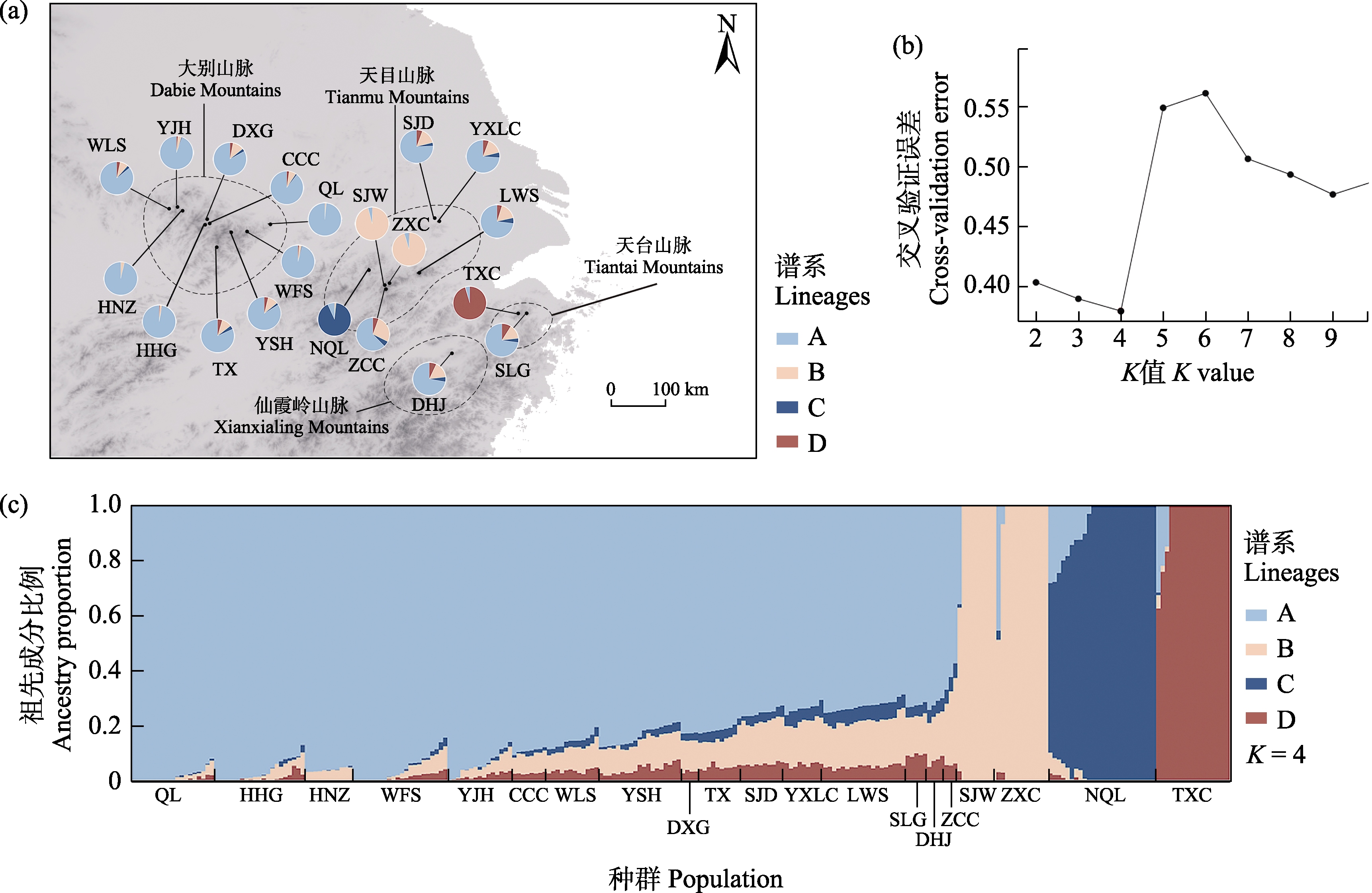
Fig. 2 ADMIXTURE analysis and cross-validation errors based on genome-wide single nucleotide polymorphism (SNP) from 254 resequenced individuals of Parrotia subaequalis. (a) Geographic distribution of P. subaequalis; (b) Cross-validation errors of the ADMIXTURE analyses; (c) Ancestry composition of 20 populations at K = 4. Each vertical bar represents an individual. The abbreviations and full names of populations are shown in Table 1.
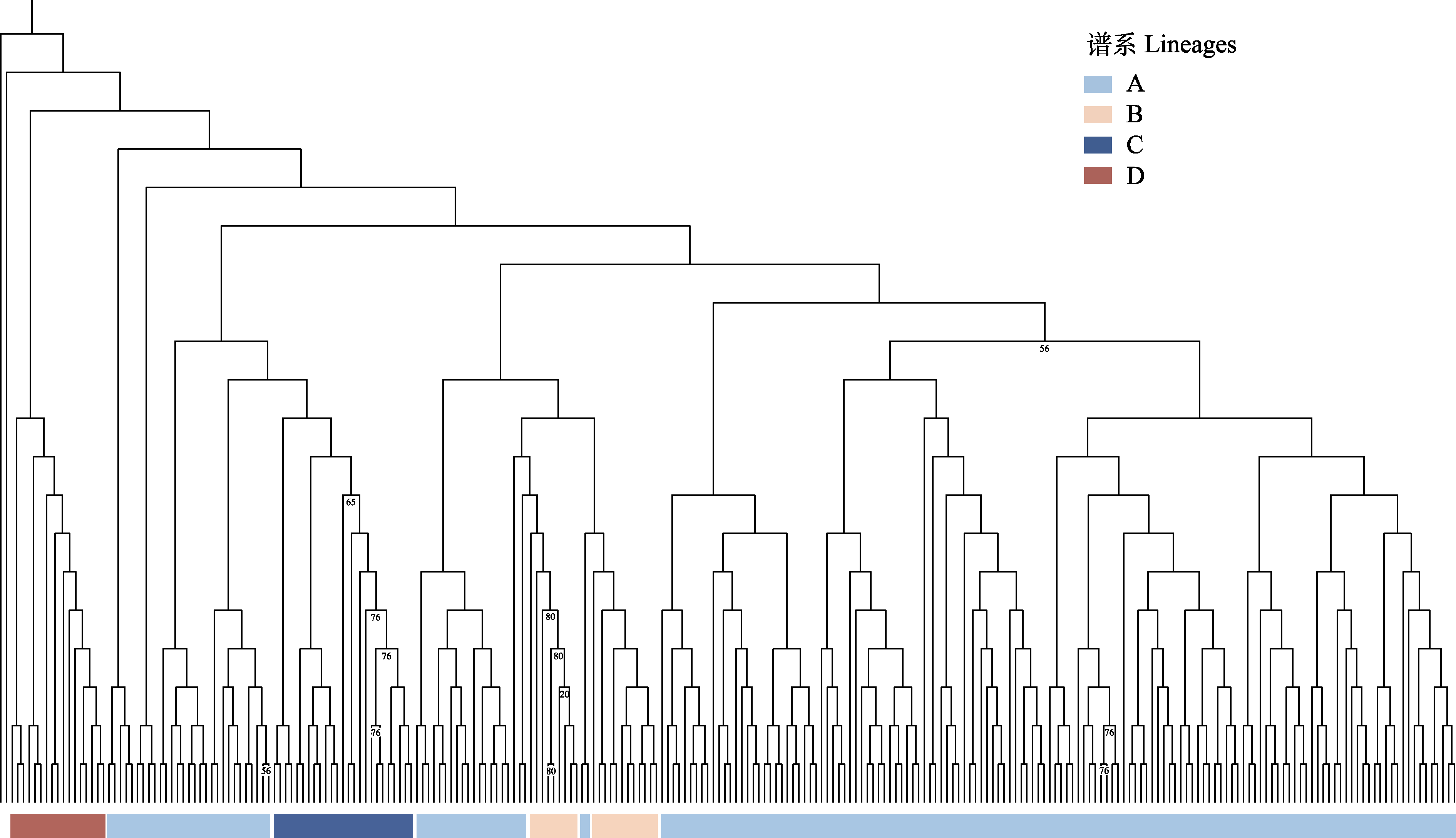
Fig. 3 Maximum likelihood phylogenetic tree of Parrotia subaequalis. Bootstrap support values are shown at the nodes; unlabeled nodes indicate bootstrap support > 80%.
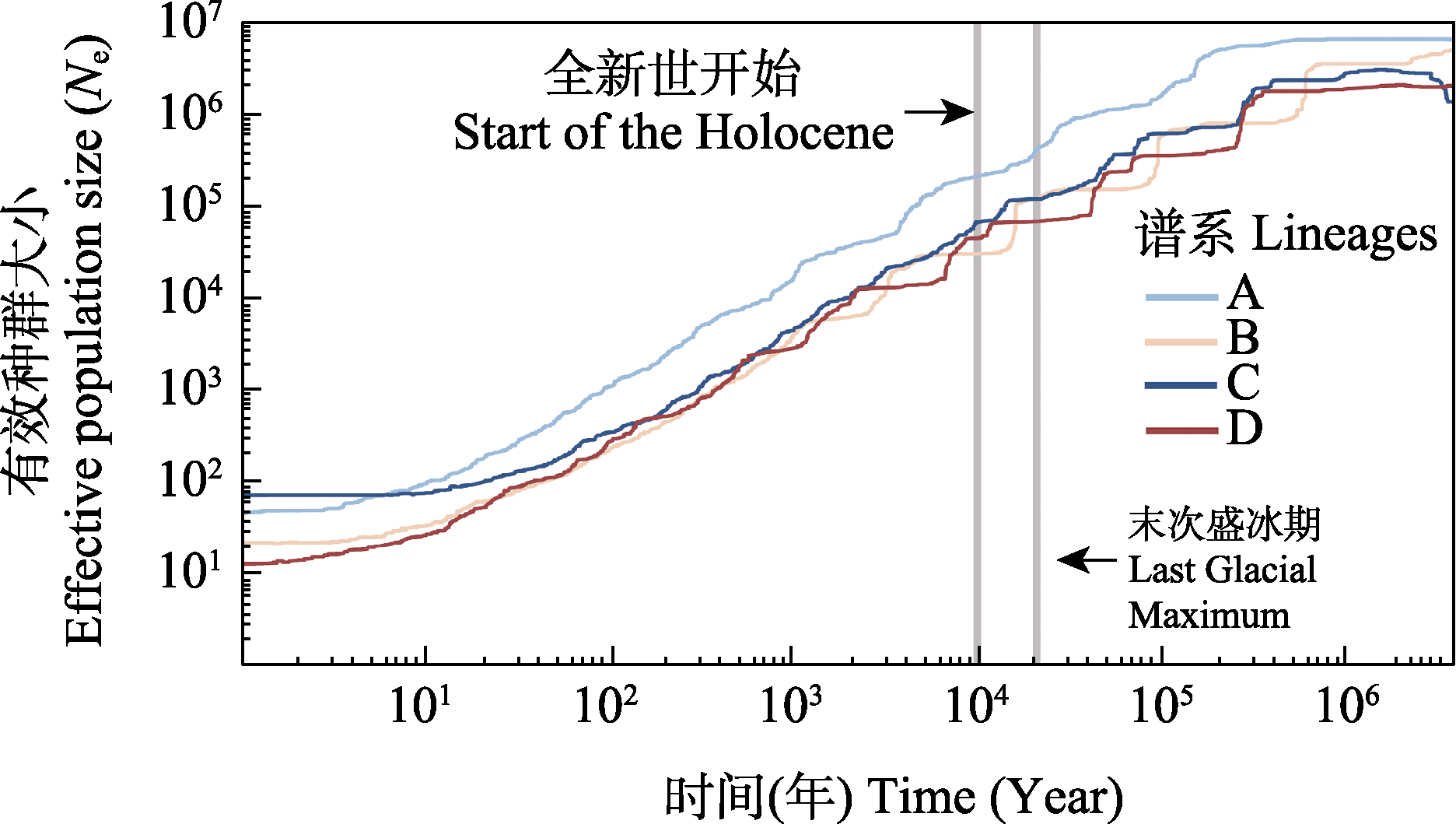
Fig. 4 Demographic histories of Parrotia subaequalis reconstructed using Stairway Plot 2 based on folded site frequency spectrum (SFS)
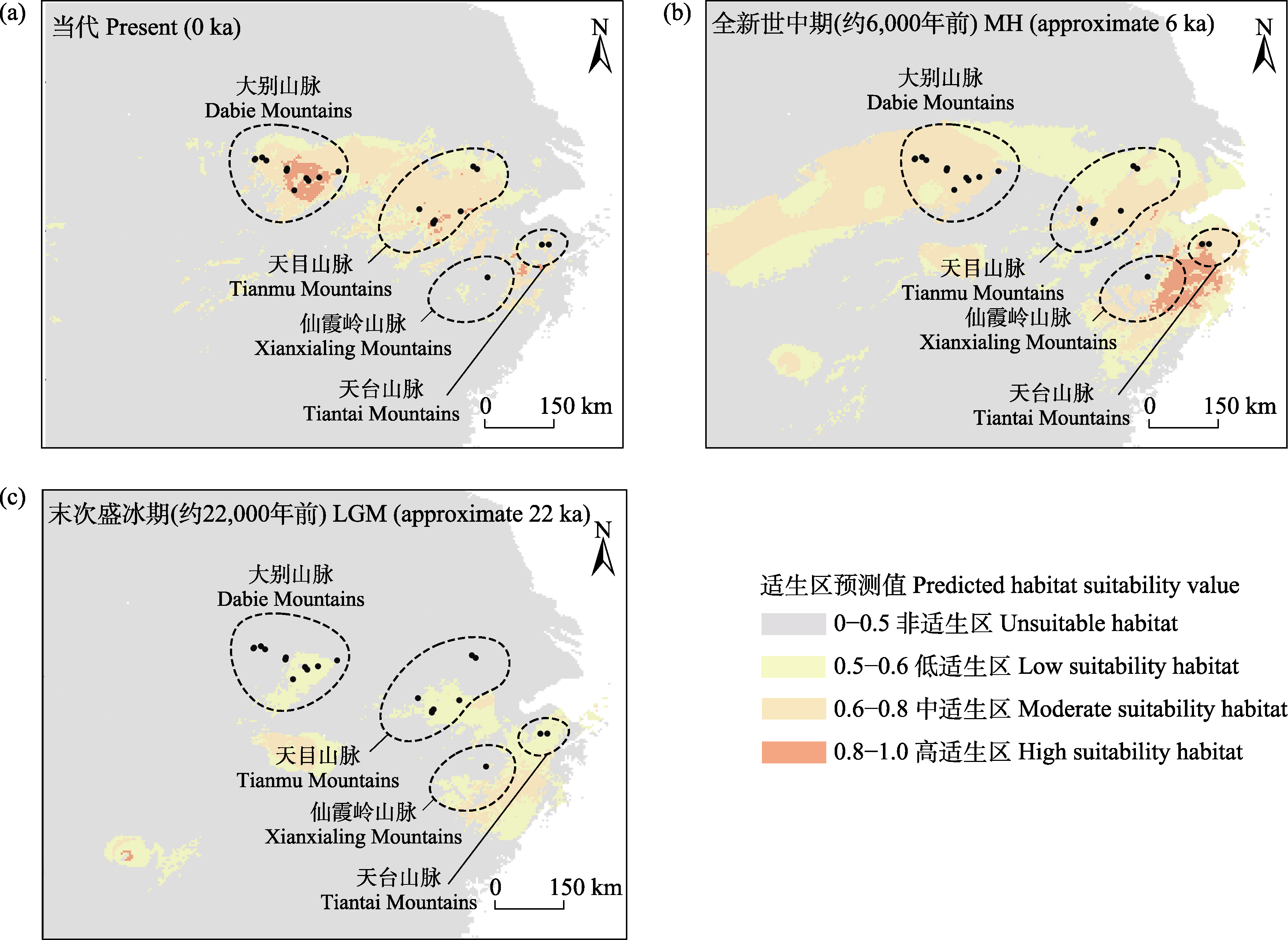
Fig. 5 Predicted suitable habitat of Parrotia subaequalis based on Biomod2. MH, Mid-Holocene; LGM, Last Glacial Maximum
| [1] | Alexander DH, Novembre J, Lange K (2009) Fast model-based estimation of ancestry in unrelated individuals. Genome Research, 19, 1655-1664. |
| [2] | An ZS, Kutzbach JE, Prell WL, Porter SC (2001) Evolution of Asian monsoons and phased uplift of the Himalaya-Tibetan Plateau since Late Miocene times. Nature, 411, 62-66. |
| [3] | Antonelli A, Fry C, Smith RJ (2023) State of the world’s plants and fungi 2023. Royal Botanic Gardens, Kew, 1-90. |
| [4] | Chen SF, Zhou YQ, Chen YR, Gu J (2018) Fastp: An ultra-fast all-in-one FASTQ preprocessor. Bioinformatics, 34, i884-i890. |
| [5] | Chen XY (2026) On the effective ex situ conservation of rare or endangered plants: Definition, standards and recommendations. Biodiversity Science, 34, 25448. (in Chinese with English abstract) |
| [陈小勇 (2026) 珍稀濒危植物有效迁地保护: 概念、标准和建议. 生物多样性, 34, 25448.] | |
| [6] | Coates DJ, Byrne M, Moritz C (2018) Genetic diversity and conservation units: Dealing with the species-population continuum in the age of genomics. Frontiers in Ecology and Evolution, 6, 165. |
| [7] | Danecek P, Auton A, Abecasis G, Albers CA, Banks E, DePristo MA, Handsaker RE, Lunter G, Marth GT, Sherry ST, McVean G, Durbin R, 1000 Genomes Project Analysis Group (2011) The variant call format and VCFtools. Bioinformatics, 27, 2156-2158. |
| [8] | Frankham R, Bradshaw CJA, Brook BW (2014) Genetics in conservation management: Revised recommendations for the 50/ 500 rules, Red List criteria and population viability analyses. Biological Conservation, 170, 56-63. |
| [9] | García-Alcalde F, Okonechnikov K, Carbonell J, Cruz LM, Götz S, Tarazona S, Dopazo J, Meyer TF, Conesa A (2012) Qualimap: Evaluating next-generation sequencing alignment data. Bioinformatics, 28, 2678-2679. |
| [10] | Geng QF, Yao ZG, Yang J, He J, Wang DB, Wang ZS, Liu H (2015) Effect of Yangtze River on population genetic structure of the relict plant Parrotia subaequalis in eastern China. Ecology and Evolution, 5, 4617-4627. |
| [11] | Hijmans RJ, Cameron SE, Parra JL, Jones PG, Jarvis A (2005) Very high resolution interpolated climate surfaces for global land areas. International Journal of Climatology, 25, 1965-1978. |
| [12] | Hu HH, Chaney RW (1940) A Miocene Flora from Shandong Province, China. Carnegie Institution of Washington Publication, Washington. |
| [13] | Huang ZW (2016) SPSS Statistical Analysis and Application, 3rd edn. Publishing House of Electronics Industry, Beijing. (in Chinese) |
| [黄中文 (2016) SPSS统计分析与应用(第3版). 电子工业出版社, 北京.] | |
| [14] | IUCN/SSC (International Union for Conservation of Nature/Species Survival Commission) (2014) Guidelines on the Use of Ex Situ Management for Species Conservation. Version 2.0. IUCN Species Survival Commission, Gland, Switzerland. |
| [15] | Jin JJ, Yu WB, Yang JB, Song Y, dePamphilis CW, Yi TS, Li DZ (2020) GetOrganelle: A fast and versatile toolkit for accurate de novo assembly of organelle genomes. Genome Biology, 21, 241. |
| [16] | Jin Y, Qian H (2022) V.PhyloMaker2: An updated and enlarged R package that can generate very large phylogenies for vascular plants. Plant Diversity, 44, 335-339. |
| [17] | Katoh K, Misawa K, Kuma K, Miyata T (2002) MAFFT: A novel method for rapid multiple sequence alignment based on fast Fourier transform. Nucleic Acids Research, 30, 3059-3066. |
| [18] | Kearse M, Moir R, Wilson A, Stones-Havas S, Cheung M, Sturrock S, Buxton S, Cooper A, Markowitz S, Duran C, Thierer T, Ashton B, Meintjes P, Drummond A (2012) Geneious Basic: An integrated and extendable desktop software platform for the organization and analysis of sequence data. Bioinformatics, 28, 1647-1649. |
| [19] | Kembel SW, Cowan PD, Helmus MR, Cornwell WK, Morlon H, Ackerly DD, Blomberg SP, Webb CO (2010) Picante: R tools for integrating phylogenies and ecology. Bioinformatics, 26, 1463-1464. |
| [20] | Korneliussen TS, Albrechtsen A, Nielsen R (2014) ANGSD: Analysis of next generation sequencing data. BMC Bioinformatics, 15, 356. |
| [21] | Li H, Durbin R (2009) Fast and accurate short read alignment with Burrows-Wheeler transform. Bioinformatics, 25, 1754-1760. |
| [22] | Li H, Handsaker B, Wysoker A, Fennell T, Ruan J, Homer N, Marth G, Abecasis G, Durbin R, 1000 Genome Project Data Processing Subgroup (2009) The sequence alignment/map format and SAMtools. Bioinformatics, 25, 2078-2079. |
| [23] | Li JH, Del Tredici P (2008) The Chinese Parrotia: A sibling species of the Persian Parrotia. Arnoldia, 66, 2-9. |
| [24] | Li W, Zhang GF (2015) Population structure and spatial pattern of the endemic and endangered subtropical tree Parrotia subaequalis (Hamamelidaceae). Flora, 212, 10-18. |
| [25] | Liu X, Fu YX (2020) Stairway Plot 2: Demographic history inference with folded SNP frequency spectra. Genome Biology, 21, 280. |
| [26] | Liu XJ, Sun QM, Dou J (2008) Observation on introduction of the rare tree Parrotia subaequalis. Jiangsu Agricultural Sciences, (4), 173-175. (in Chinese with English abstract) |
| [刘兴剑, 孙起梦, 窦剑 (2008) 珍稀树种银缕梅引种观察. 江苏农业科学, (4), 173-175.] | |
| [27] | Manchester SR, Chen ZD, Geng BY, Tao JR (2005) Middle Eocene flora of Huadian, Jilin Province, northeastern China. Acta Palaeobotanica, 45, 3-26. |
| [28] | Manichaikul A, Mychaleckyj JC, Rich SS, Daly K, Sale M, Chen WM (2010) Robust relationship inference in genome- wide association studies. Bioinformatics, 26, 2867-2873. |
| [29] | Marçais G, Delcher AL, Phillippy AM, Coston R, Salzberg SL, Zimin A (2018) MUMmer4: A fast and versatile genome alignment system. PLOS Computational Biology, 14, e1005944. |
| [30] | McGill BJ, Dornelas M, Gotelli NJ, Magurran AE (2015) Fifteen forms of biodiversity trend in the Anthropocene. Trends in Ecology and Evolution, 30, 104-113. |
| [31] | Minh BQ, Schmidt HA, Chernomor O, Schrempf D, Woodhams MD, von Haeseler A, Lanfear R (2020) IQ-TREE 2: New models and efficient methods for phylogenetic inference in the genomic era. Molecular Biology and Evolution, 37, 1530-1534. |
| [32] | Nadachowska-Brzyska K, Konczal M, Babik W (2022) Navigating the temporal continuum of effective population size. Methods in Ecology and Evolution, 13, 22-41. |
| [33] | Porebski S, Bailey LG, Baum BR (1997) Modification of a CTAB DNA extraction protocol for plants containing high polysaccharide and polyphenol components. Plant Molecular Biology Reporter, 15, 8-15. |
| [34] | Purcell S, Neale B, Todd-Brown K, Thomas L, Ferreira MAR, Bender D, Maller J, Sklar P, de Bakker PIW, Daly MJ, Sham PC (2007) PLINK: A tool set for whole-genome association and population-based linkage analyses. The American Journal of Human Genetics, 81, 559-575. |
| [35] | Qiu YX, Fu CX, Comes HP (2011) Plant molecular phylogeography in China and adjacent regions: Tracing the genetic imprints of Quaternary climate and environmental change in the world’s most diverse temperate flora. Molecular Phylogenetics and Evolution, 59, 225-244. |
| [36] | Qiu YX, Lu QX, Zhang YH, Cao YN (2017) Phylogeography of East Asia’s Tertiary relict plants: Current progress and future prospects. Biodiversity Science, 25, 136-146. (in Chinese with English abstract) |
| [邱英雄, 鹿启祥, 张永华, 曹亚男 (2017) 东亚第三纪孑遗植物的亲缘地理学: 现状与趋势. 生物多样性, 25, 136-146.] | |
| [37] | Qiu YX, Sun Y, Zhang XP, Lee J, Fu CX, Comes HP (2009) Molecular phylogeography of East Asian Kirengeshoma (Hydrangeaceae) in relation to Quaternary climate change and landbridge configurations. New Phytologist, 183, 480-495. |
| [38] | Qu XJ, Moore MJ, Li DZ, Yi TS (2019) PGA: A software package for rapid, accurate, and flexible batch annotation of plastomes. Plant Methods, 15, 50. |
| [39] | Tang CQ, Matsui T, Ohashi H, Dong YF, Momohara A, Herrando-Moraira S, Qian SH, Yang YC, Ohsawa M, Luu HT, ... , Gong HD, Song K, Song D, Li XS, Zhang ZY, Han PB, Shen LQ, Huang DS, Luo K, López-Pujol J (2018) Identifying long-term stable refugia for relict plant species in East Asia. Nature Communications, 9, 4488. |
| [40] | Thuiller W, Lafourcade B, Engler R, Araújo MB (2009) BIOMOD-A platform for ensemble forecasting of species distributions. Ecography, 32, 369-373. |
| [41] | Wang LS, Jia Y, Zhang XC, Qin HN (2015) Overview of higher plant diversity in China. Biodiversity Science, 23, 217-224. (in Chinese with English abstract) |
| [王利松, 贾渝, 张宪春, 覃海宁 (2015) 中国高等植物多样性. 生物多样性, 23, 217-224.] | |
| [42] | Warren DL, Glor RE, Turelli M (2010) ENMTools: A toolbox for comparative studies of environmental niche models. Ecography, 33, 607-611. |
| [43] | Webb CO (2000) Exploring the phylogenetic structure of ecological communities: An example for rain forest trees. The American Naturalist, 156, 145-155. |
| [44] | Webb CO, Ackerly DD, McPeek MA, Donoghue MJ (2002) Phylogenies and community ecology. Annual Review of Ecology and Systematics, 33, 475-505. |
| [45] | Wei XZ, Jiang MX (2021) Meta-analysis of genetic representativeness of plant populations under ex situ conservation in contrast to wild source populations. Conservation Biology, 35, 12-23. |
| [46] | Wu XT, Shu JW, Yin SX, Sadowski EM, Shi GL (2024) Parrotia flower blooming in Miocene rainforest. Journal of Systematics and Evolution, 62, 449-456. |
| [47] | Xiao ZQ, Liu H, Huang GY, Wu D, Qiu LW, Wu JH, Wei XZ, Jiang MX (2026) Spatially biased collections and the failure to cover all wild genetic clusters in plant populations under ex situ conservation. Plant Diversity, 48, 75-83. |
| [48] | Xu ZF, Huang JY, Hu HB, Zhou HF, Meng LZ (2008) A review on ex situ conservation and its research in China in recent 30 years. Guihaia, 28, 764-774. (in Chinese with English abstract) |
| [许再富, 黄加元, 胡华斌, 周惠芳, 孟令曾 (2008) 我国近30年来迁地保护及其研究的综述. 广西植物, 28, 764-774.] | |
| [49] | Yan C, Wang ZS, An SQ, Chen SN, Wei N, Lu XM (2008) Differences in photosynthetic capacity among different diameter-classes of Parrotia subaequalis populations and their implications to regeneration limitation. Acta Ecologica Sinica, 28, 4153-4161. (in Chinese with English abstract) |
| [颜超, 王中生, 安树青, 陈姝凝, 魏娜, 陆霞梅 (2008) 濒危植物银缕梅(Parrotia subaequalis)不同径级个体的光合能力差异与更新限制. 生态学报, 28, 4153-4161.] | |
| [50] | Yang YF, Luo LK, Ding C, Yin MY, Zhai W, Zhao K (2024) Effects of gibberellin on seed germination and seedling growth of Parrotia subaequalis, a rare and endangered plant species. Chinese Journal of Ecology, 43, 2026-2032. (in Chinese with English abstract) |
| [阳艳芳, 罗来开, 丁聪, 尹明月, 翟伟, 赵凯 (2024) 赤霉素对珍稀濒危植物银缕梅种子萌发及幼苗生长的影响. 生态学杂志, 43, 2026-2032.] | |
| [51] | Yi S, Saito Y, Zhao Q, Wang P (2003) Vegetation and climate changes in the Changjiang (Yangtze River) Delta, China, during the past 13,000 years inferred from pollen records. Quaternary Science Reviews, 22, 1501-1519. |
| [52] | Zachos J, Pagani M, Sloan L, Thomas E, Billups K (2001) Trends, rhythms, and aberrations in global climate 65 Ma to present. Science, 292, 686-693. |
| [53] | Zhang LB, Gilbert MG (2015) Comparison of classifications of vascular plants of China. Taxon, 64, 17-26. |
| [54] | Zhang LL, Wang XT, Chen Y, Zhu YF, Lu XY, Zaitseva SM, Yang HY (2026) Establishment of tissue culture and rapid propagation system of wild plant Parrotia subaequalis under national first class protection. Chinese Bulletin of Botany, 61, 114-122. (in Chinese with English abstract) |
| [张靓靓, 汪贤挺, 陈勇, 朱逸凡, 卢新元, Zaitseva Svetlana Mikhailovna, 杨海芸 (2026) 国家一级保护野生植物银缕梅组培快繁体系的建立. 植物学报, 61, 114-122.] | |
| [55] | Zhang YY, Li K, Feng Y, Li ZY, Hu YM, Yousefzadeh H, Nasiri M, Adroit B, Li PF, Lu S, Li P, Liu H, Peng Y, Xu C, Qiu YX, Wang ZS (2025a) Evolutionary legacy of the “living fossil” genus Parrotia (Hamamelidaceae): Genomic insights into species divergence and polygenic adaptation. The Plant Journal, 123, e70367. |
| [56] | Zhang YY, Li ZY, Chen QX, Wang YH, Wang S, Wang GZ, Li P, Liu H, Li PF, Xu C, Wang ZS (2025b) Phylogeography and population demography of Parrotia subaequalis, a Hamamelidaceous Tertiary relict “living fossil” tree endemic to East Asia refugia: Implications from molecular data and ecological niche modeling. Plants, 14, 1754. |
| [57] | Zhang YY, Shi E, Yang ZP, Geng QF, Qiu YX, Wang ZS (2018) Development and application of genomic resources in an endangered palaeoendemic tree, Parrotia subaequalis (Hamamelidaceae) from eastern China. Frontiers in Plant Science, 9, 246. |
| [58] | Zhao YP, Fan GY, Yin PP, Sun S, Li N, Hong XN, Hu G, Zhang H, Zhang FM, Han JD, Hao YJ, Xu QW, Yang XW, Xia WJ, Chen WB, Lin HY, Zhang R, Chen J, Zheng XM, Lee SMY, Lee J, Uehara K, Wang J, Yang HM, Fu CX, Liu X, Xu X, Ge S () Resequencing 545 ginkgo genomes across the world reveals the evolutionary history of the living fossil. Nature Communications, 10, 4201. |
| [59] | Zhu SS, Chen J, Zhao J, Comes HP, Li P, Fu CX, Xie X, Lu RS, Xu WQ, Feng Y, Ye WQ, Sakaguchi S, Isagi Y, Li LF, Lascoux M, Qiu YX (2020) Genomic insights on the contribution of balancing selection and local adaptation to the long-term survival of a widespread living fossil tree, Cercidiphyllum japonicum. New Phytologist, 228, 1674-1689. |
| [60] | Zhu XL, Wang J, Chen HF, Kang M (2024) Lineage differentiation and genomic vulnerability in a relict tree from subtropical forests. Evolutionary Applications, 17, e70033. |
| [1] | Peng Xie, Zhibo Zhou, Shaogang Fan, Ping Mo, Kerui Huang, Aihua Deng, Youwei Yang, Fei Wu, Dewei Xiao, Yun Wang. Soil microbial diversity, network structure, and functional potential differ between natural and plantation forests of Cathaya argyrophylla [J]. Biodiv Sci, 2026, 34(7): 26122-. |
| [2] | Xiao-Yong Chen. On the effective ex situ conservation of rare or endangered plants: Definition, standards and recommendations [J]. Biodiv Sci, 2026, 34(4): 25448-. |
| [3] | Yu Luo, Xuyan Zheng, Li Cao, Bo Wang, Yanqiong Peng, Yinling Luo, Huiping Zhou, Xiaofang Yang, Baige Miao, Chaoya Wang, Jie Gao. Habitat simplification reshapes the fig-fig wasp interaction network: Adaptive responses of volatile composition and community structure [J]. Biodiv Sci, 2026, 34(2): 25328-. |
| [4] | Ruixiang Xue, Xuerong Ma, Jiongwen Wu, Aijun Liu, Xiquan Zhang, Congliang Ji, Yingshan Yin, Weijian Zhu, Qingbin Luo. Genetic diversity and genetic structure of Zhongshan partridge duck populations [J]. Biodiv Sci, 2025, 33(8): 24592-. |
| [5] | Dongmei Jin, Tuo He, Hui Dong, Qixia Ma, Yonghong Hu. Conserving plant diversity: The role of a botanical garden network in China [J]. Biodiv Sci, 2025, 33(6): 24441-. |
| [6] | Su Liu, Cheng Du, Yonghong Hu. Ex situ conservation should have clear flexibility [J]. Biodiv Sci, 2024, 32(2): 24037-. |
| [7] | Jin Chen, Xi Yang. Discussion on the plant ex situ conservation [J]. Biodiv Sci, 2024, 32(2): 24064-. |
| [8] | Chen Feng, Jie Zhang, Hongwen Huang. Parallel situ conservation: A new plant conservation strategy to integrate in situ and ex situ conservation of plants [J]. Biodiv Sci, 2023, 31(9): 23184-. |
| [9] | Shifeng Wen, Zhihua Zhou, Tuo He, Hui Dong, Liangchen Yuan, Zeyang Lu, Yongteng Wang, Lin Guo, Jiangping Shu, Kaifan Li. Formulating the National Botanical Garden System Layout Plan of China: Background, procedures, ideas and key considerations [J]. Biodiv Sci, 2023, 31(9): 23193-. |
| [10] | Hai Ren, Tuo He, Shifeng Wen, Hui Dong. The main features of the world-class national botanical garden with Chinese characteristics [J]. Biodiv Sci, 2023, 31(9): 23192-. |
| [11] | Lisong Wang, Qingqing Zhan, Jingping Liao, Hongwen Huang. Vascular plant diversity of National Key Protected Wild Plants, threatened species, and endemic species ex situ conserved in botanic gardens of China [J]. Biodiv Sci, 2023, 31(2): 22495-. |
| [12] | Rui Luo, Ya Chen, Hanma Zhang. Research progress on whole-genome resequencing in Brassica [J]. Biodiv Sci, 2023, 31(10): 23237-. |
| [13] | Zaifu Xu. The “principle of plan as a whole” for the national botanical gardens’ constructive system [J]. Biodiv Sci, 2023, 31(1): 22470-. |
| [14] | Hai Ren, Xiangying Wen, Jingping Liao, Xiangci Zheng, Ming Yang, Ju Zhou. The view on functional changes of botanical gardens and the establishment of China’s national botanical garden system [J]. Biodiv Sci, 2022, 30(4): 22113-. |
| [15] | Lingling Zhang, Ziyue Liu, Ruijiang Wang. The conservation status of orchids in Guangdong Province [J]. Biodiv Sci, 2020, 28(7): 787-795. |
| Viewed | ||||||
|
Full text |
|
|||||
|
Abstract |
|
|||||
Copyright © 2026 Biodiversity Science
Editorial Office of Biodiversity Science, 20 Nanxincun, Xiangshan, Beijing 100093, China
Tel: 010-62836137, 62836665 E-mail: biodiversity@ibcas.ac.cn
