

Biodiv Sci ›› 2026, Vol. 34 ›› Issue (6): 26152. DOI: 10.17520/biods.2026152 cstr: 32101.14.biods.2026152
• Original Papers: Genetic Diversity • Previous Articles Next Articles
Xing Kong1,2,3( ), Xiangqian Sun1,2,3(), Benqin Zhao1,2,3(), Xun Gong2(), Jie Cai1(), Jie Liu1,2,*()(
 )
)
Received:2026-04-25
Accepted:2026-05-15
Online:2026-06-20
Published:2026-07-30
Contact:
*E-mail: liujie@mail.kib.ac.cn
Supported by:Xing Kong, Xiangqian Sun, Benqin Zhao, Xun Gong, Jie Cai, Jie Liu. Origin and dispersal history of Tibetan peach in the Third Pole[J]. Biodiv Sci, 2026, 34(6): 26152.
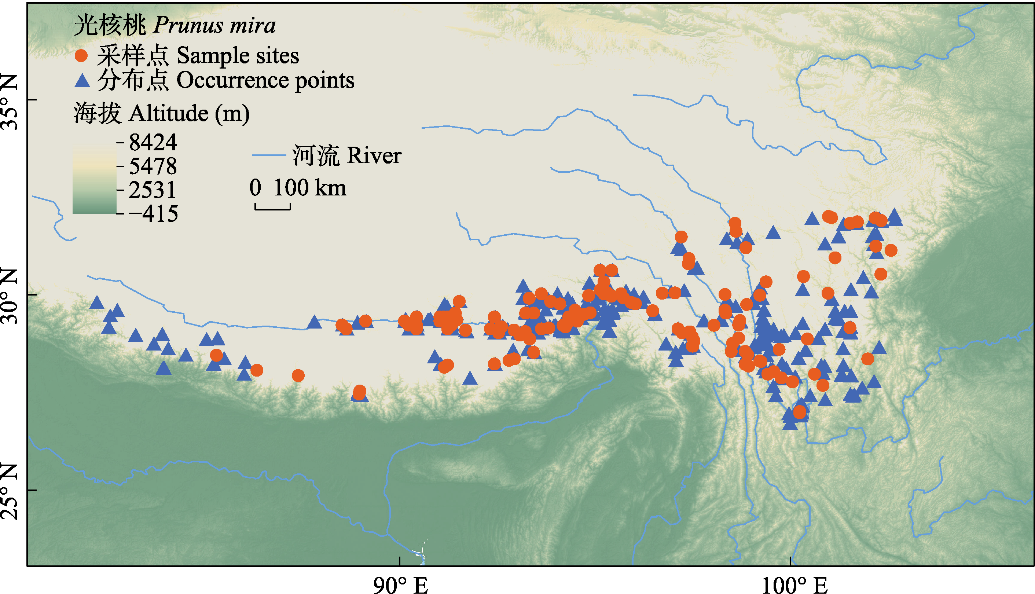
Fig. 1 Sample sites and occurrence points of Prunus mira. Occurrence data were obtained from the Plant Photo Bank of China (PPBC, http://ppbc.iplant.cn/), Chinese Virtual Herbarium (CVH, http://www.cvh.ac.cn/), Global Biodiversity Information Facility (GBIF, https://www.gbif.org/), and relevant literature.
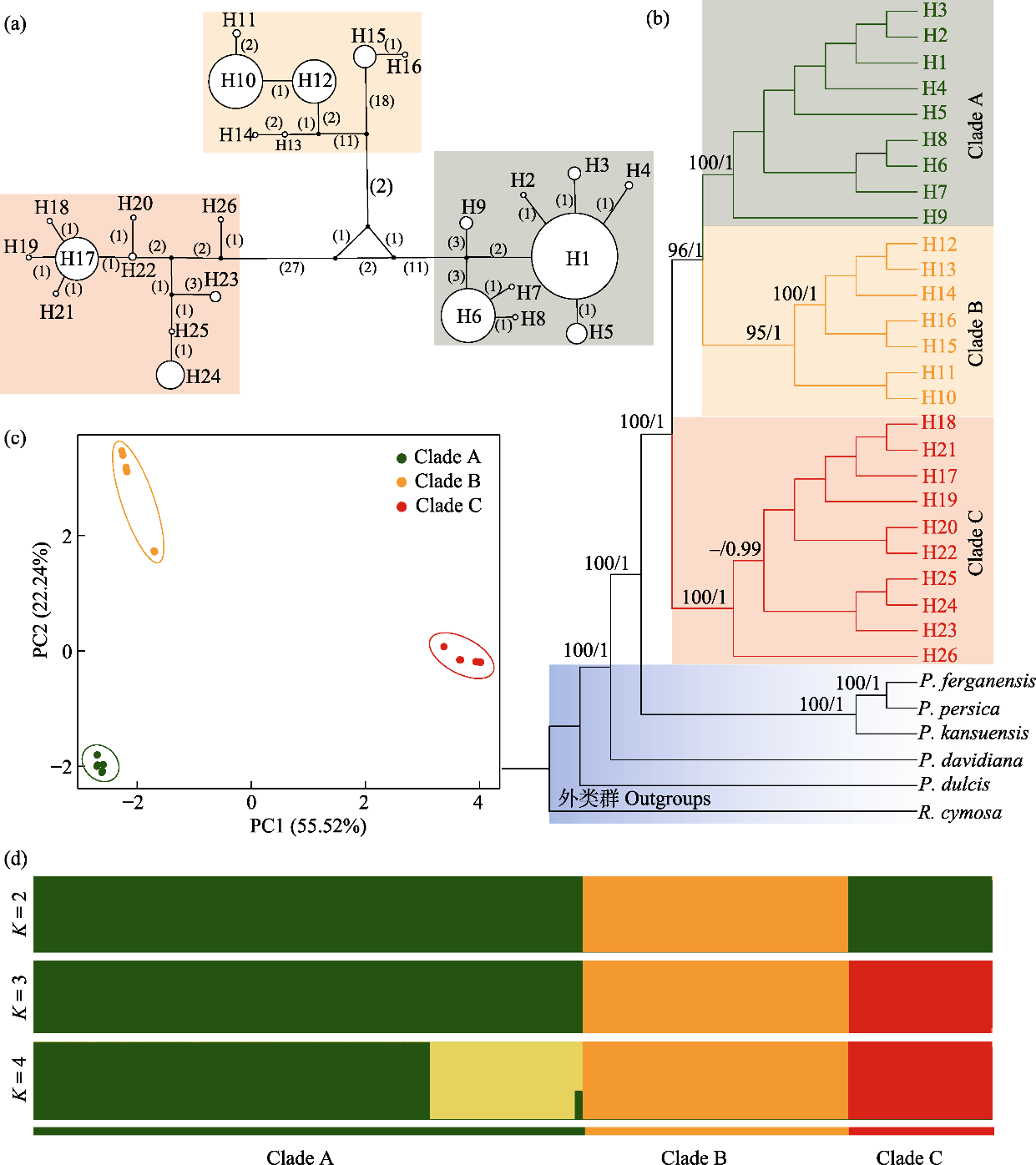
Fig. 2 Phylogenetic relationships and population structure of Prunus mira as revealed by plastid genome data, different colors represent three clades (green represents Clade A; orange represents Clade B; red represents Clade C). (a) Haplotype network generated using the Templeton Crandall Singh (TCS) approach. Circle sizes reflect the relative frequencies of haplotypes, and the numbers of mutational steps between pairs of haplotypes are indicated along the connecting lines. (b) Maximum likelihood (ML) and Bayesian Inference (BI) phylogenetic tree. Branches of the three major clades are color-coded, with bootstrap values (BS > 95%) and posterior probabilities (PP > 0.95) shown at the corresponding nodes. (c) Principal component analysis (PCA) plot of haplotypes, illustrating genetic differentiation among the three clades. (d) Bayesian population assignment results from STRUCTURE at K = 2-4, where each individual is represented as a vertical bar partitioned into K colored segments representing membership coefficients. Outgroups: P. ferganensis, Prunus ferganensis; P. persica, Prunus persica; P. kansuensis, Prunus kansuensis; P. davidiana, Prunus davidiana; P. dulcis, Prunus dulcis; R. cymosa, Rosa cymosa.
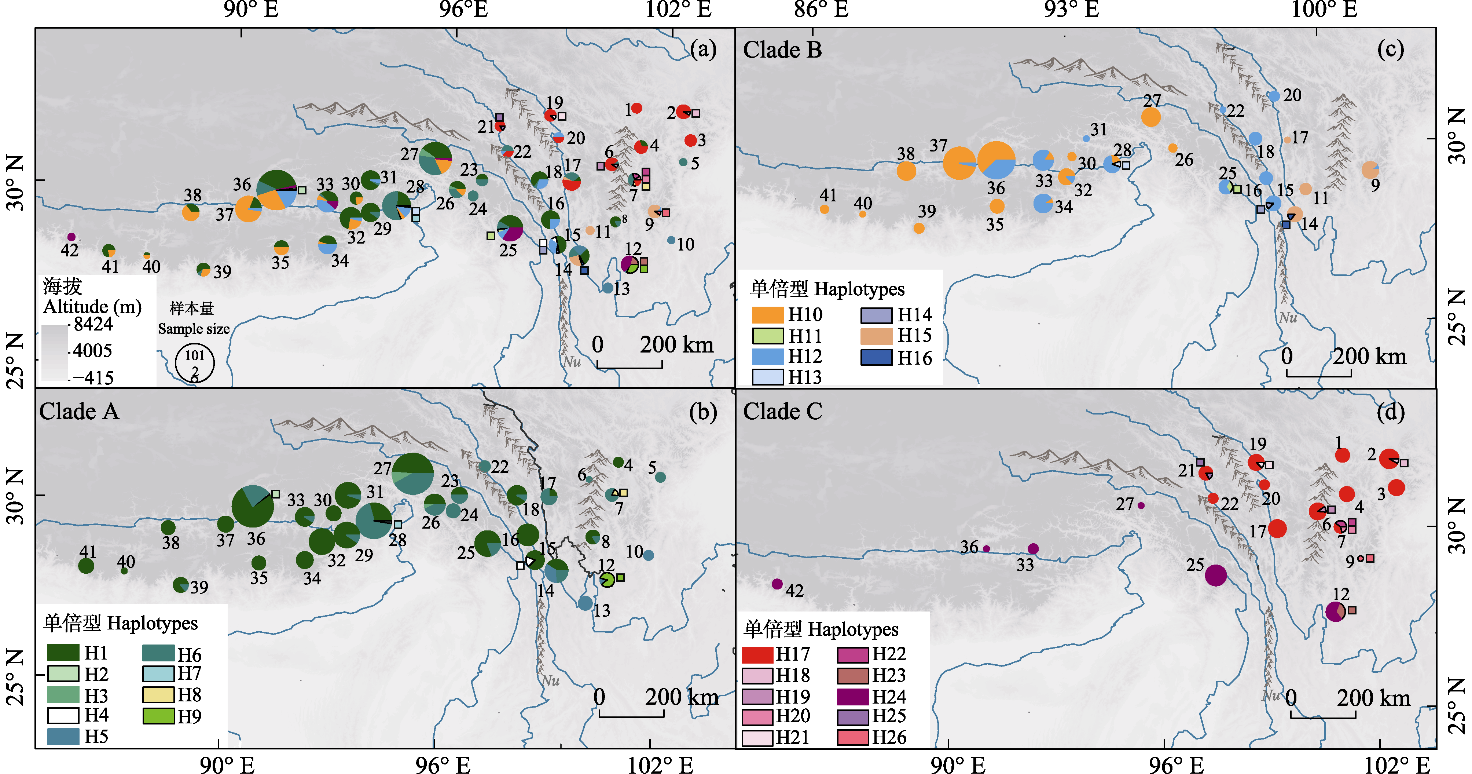
Fig. 3 Geographical distribution of haplotypes of Prunus mira based on plastid genome data. The figure illustrates the spatial distribution patterns of haplotypes across species (a) and different clades, including Clade A (b), Clade B (c) and Clade C (d). Different colors within each pie chart represent distinct haplotype types, and the area of each pie chart is proportional to the sample size of the corresponding haplotype. The bars adjacent to each pie chart indicate the types and numbers of private haplotypes present in each population. Blue lines represent rivers. The map marks mountain ranges that act as a barrier according to Liu et al. (2022).
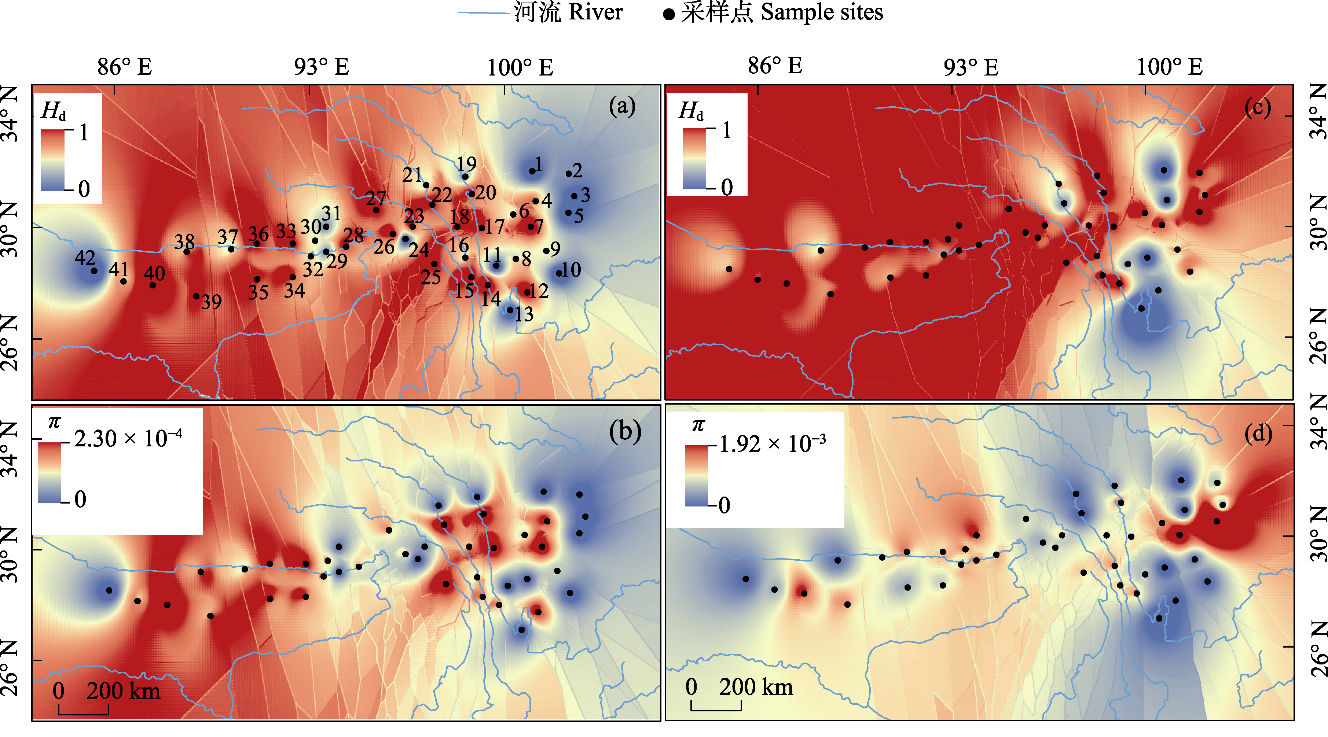
Fig. 4 Spatial interpolation of genetic diversity of Prunus mira using the inverse distance weighting (IDW) method based on different datasets. (a) and (b) present the haplotype diversity (Hd) and nucleotide diversity (π) of each population based on plastid genome data, respectively. (c) and (d) show the spatial distribution of Hd and π based on nuclear ribosomal DNA (nrDNA) sequences, respectively. Diversity values are represented by a color ramp ranging from blue (low) to red (high).
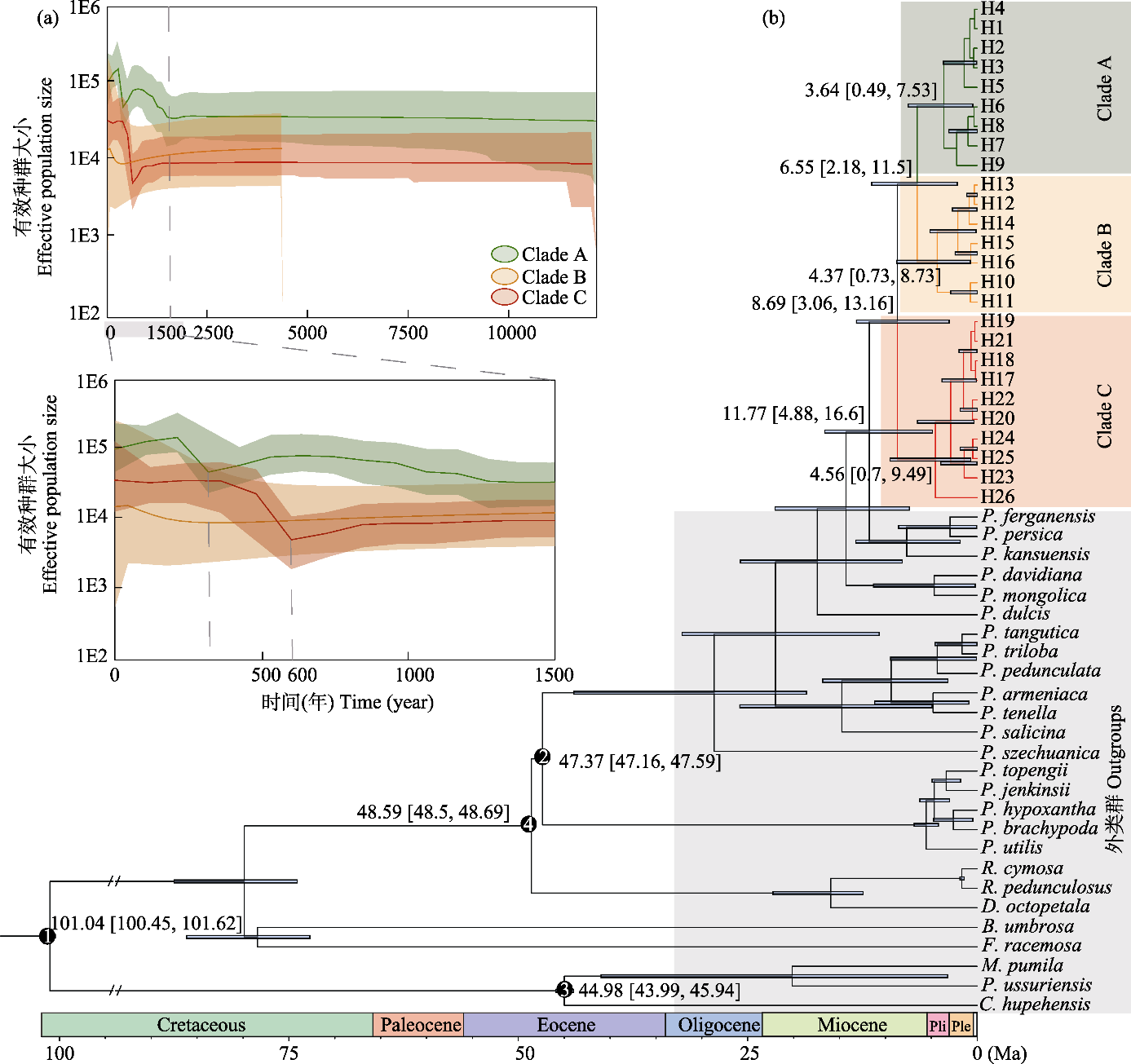
Fig. 5 Population demography and divergence times of different clades of Prunus mira based on plastid genome data. (a) Bayesian skyline plots for different clades. Solid lines represent the median estimates of effective population sizes, with light-shaded areas indicating the 95% highest posterior density intervals (HPD). The horizontal axis represents time, and the vertical axis represents the effective population size at different periods. Different colors denote distinct clades (green represents Clade A; orange represents Clade B; red represents Clade C). (b) Divergence time tree based on haplotypes. Numbers above nodes indicate divergence times (Ma), and blue bars at nodes and values in brackets represent the 95% HPD. The gray shaded areas represent the outgroups used, including species of Prunus (P.) and Rosa cymose (R. cymose), Rubus pedunculosus (R. pedunculosus), Dryas octopetala (D. octopetala), Boehmeria umbrosa (B. umbrosa), Ficus racemosa (F. racemosa), Malus pumila (M. pumila), Pyrus ussuriensis (P. ussuriensis), and Crataegus hupehensis (C. hupehensis). Black circles with numbers denote fossil calibration points. Pli, Pliocene; Ple, Pleistocene.
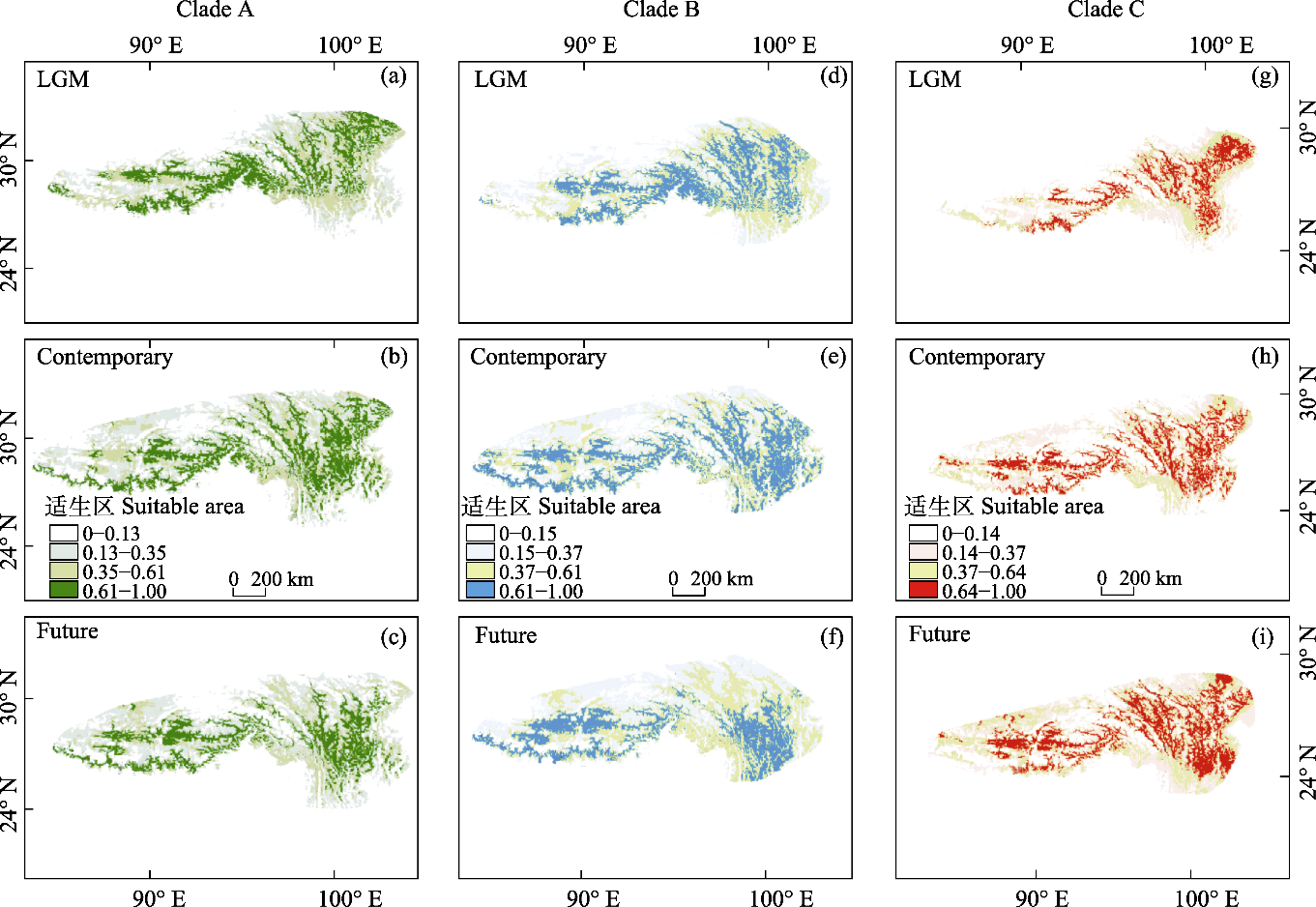
Fig. 6 Potential distribution areas of different clades of Prunus mira under different climatic periods. Each column represents a clade (Clade A, B, and C), and each row represents a climatic period (LGM, Contemporary, and Future). The color ramp from dark to light represents habitat suitability from high to low. LGM, Last Glacial Maximum; Contemporary, Contemporary (1970‒2000) climate scenarios; Future, Future (2081-2100) RCP8.5 high-emission scenario.
| [1] | Álvarez I, Wendel JF (2003) Ribosomal ITS sequences and plant phylogenetic inference. Molecular Phylogenetics and Evolution, 29, 417-434. |
| [2] | An ZS, Kutzbach JE, Prell WL, Porter SC (2001) Evolution of Asian monsoons and phased uplift of the Himalaya-Tibetan Plateau since Late Miocene times. Nature, 411, 62-66. |
| [3] | Avise JC (2000) Phylogeography:The History and Formation of Species. Harvard University Press, Cambridge, USA. |
| [4] | Bao FH, Bao WQ, Ao D, Chen JX, Wuyun TN, Bai YE, He YH, Wang L (2024) Genetic diversity and phylogeography of the endemic species Prunus mira in the Qinghai-Tibetan Plateau. BMC Plant Biology, 24, 1215. |
| [5] | Bao WQ, Wuyun TN, Li TZ, Liu HM, Jiang ZM, Zhu XC, Du HY, Bai YE (2017) Genetic diversity and population structure of Prunus mira (Koehne) from the Tibet Plateau in China and recommended conservation strategies. PLoS ONE, 12, e0188685. |
| [6] | Barton NH, Charlesworth B (1984) Genetic revolutions, founder effects, and speciation. Annual Review of Ecology and Systematics, 15, 133-164. |
| [7] | Bock R (2007) Cell and Molecular Biology of Plastids. Springer, Berlin, Germany. |
| [8] | Cao K, Peng Z, Zhao X, Li Y, Liu KZ, Arus P, Fang WC, Chen CW, Wang XW, Wu JL, Fei ZJ, Wang LR (2022) Chromosome-level genome assemblies of four wild peach species provide insights into genome evolution and genetic basis of stress resistance. BMC Biology, 20, 139. |
| [9] | Ding WN, Ree RH, Spicer RA, Xing YW (2020) Ancient orogenic and monsoon-driven assembly of the world’s richest temperate alpine flora. Science, 369, 578-581. |
| [10] | Doyle JJ, Doyle JL (1987) A rapid DNA isolation procedure for small quantities of fresh leaf tissue. Phytochemical Bulletin, 19, 11-15. |
| [11] | Drummond AJ, Rambaut A (2007) BEAST: Bayesian evolutionary analysis by sampling trees. BMC Evolutionary Biology, 7, 214. |
| [12] | Drummond AJ, Suchard MA, Xie D, Rambaut A (2012) Bayesian phylogenetics with BEAUti and the BEAST 1.7. Molecular Biology and Evolution, 29, 1969-1973. |
| [13] | Duan L, Fu L, Chen HF (2023) Phylogenomic cytonuclear discordance and evolutionary histories of plants and animals. Science China: Life Sciences, 66, 2946-2948. |
| [14] | Eckert CG, Samis KE, Lougheed SC (2008) Genetic variation across species’ geographical ranges: The central-marginal hypothesis and beyond. Molecular Ecology, 17, 1170-1188. |
| [15] | Ellis EC (2011) Anthropogenic transformation of the terrestrial biosphere. Philosophical Transactions of the Royal Society A: Mathematical, Physical and Engineering Sciences, 369, 1010-1035. |
| [16] | Excoffier L, Ray N (2008) Surfing during population expansions promotes genetic revolutions and structuration. Trends in Ecology & Evolution, 23, 347-351. |
| [17] | Fan PZ, Zhu GF, Wambulwa MC, Milne RI, Wu ZY, Luo YH, Shahi Shavvon R, Jump AS, Maity D, Gao LM (2026) Genetic origins and climate-induced erosion in economically important Asian walnuts. Conservation Biology, 40, e70125. |
| [18] | Favre A, Päckert M, Pauls SU, Jähnig SC, Uhl D, Michalak I, Muellner-Riehl AN (2015) The role of the uplift of the Qinghai-Tibetan Plateau for the evolution of Tibetan biotas. Biological Reviews, 90, 236-253. |
| [19] | Feng X, Peterson AT, Aguirre-López LJ, Burger JR, Chen X, Papeş M (2024) Rethinking ecological niches and geographic distributions in face of pervasive human influence in the Anthropocene. Biological Reviews, 99, 1481-1503. |
| [20] | Freeman M, Ahmed S (2011) Tea Horse Road: China’s Ancient Trade Road to Tibet. River Books, Bangkok. |
| [21] | Fu XG, Liu J, Milne RI, Monro AK, Liu SY, Tian Q, Stull GW, Kipkoech A, Yi TS, Li DZ, Wu ZY (2026) A robust phylogenomic framework supports a revised intrafamilial classification of Urticaceae. Plant Diversity, 48, 289-306. |
| [22] | Gao QB, Zhang DJ, Duan YZ, Zhang FQ, Li YH, Fu PC, Chen SL (2012) Intraspecific divergences of Rhodiola alsia (Crassulaceae) based on plastid DNA and internal transcribed spacer fragments. Botanical Journal of the Linnean Society, 168, 204-215. |
| [23] | Gu C, Barthlomew B (2003) Rosaceae (Amygdaloideae). In: Flora of China, Vol. 9 (eds Wu ZY, Raven PH, Hong DY), pp. 396-434. Science Press, Beijing & Missouri Botanical Garden Press, St. Louis. |
| [24] | Gu MZ (1999) Diversity of crop germplasm resources in Xizang and its protection and management status and prospect. Tibetan Journal of Agricultural Sciences, 21(1), 1-7. (in Chinese with English abstract) |
| [顾茂芝 (1999) 西藏作物种质资源多样性及其保护管理现状与展望. 西藏农业科技, 21(1), 1-7.] | |
| [25] | Guan FC, Wang SP, Li RQ, Peng M, Meng FJ (2014) Genetic diversity of wild peach (Prunus mira Koehne kov et. kpst) from different altitudes in the Tibetan Plateau by pollen morphous and RAPD markers. HortScience, 49, 1017-1022. |
| [26] | Hewitt G (2000) The genetic legacy of the Quaternary ice ages. Nature, 405, 907-913. |
| [27] | Hodel RGJ, Zimmer E, Wen J (2021) A phylogenomic approach resolves the backbone of Prunus (Rosaceae) and identifies signals of hybridization and allopolyploidy. Molecular Phylogenetics and Evolution, 160, 107118. |
| [28] | Jin JJ, Yu WB, Yang JB, Song Y, de Pamphilis CW, Yi TS, Li DZ (2020) GetOrganelle: A fast and versatile toolkit for accurate de novo assembly of organelle genomes. Genome Biology, 21, 241. |
| [29] | Katoh K, Standley DM (2013) MAFFT multiple sequence alignment software version 7: Improvements in performance and usability. Molecular Biology and Evolution, 30, 772-780. |
| [30] | Kearse M, Moir R, Wilson A, Stones-Havas S, Cheung M, Sturrock S, Buxton S, Cooper A, Markowitz S, Duran C, Thierer T, Ashton B, Meintjes P, Drummond A (2012) Geneious basic: An integrated and extendable desktop software platform for the organization and analysis of sequence data. Bioinformatics, 28, 1647-1649. |
| [31] | Khan R, Wu ZY, Sun ZY, Mambo WW, Kipkoech A, Ahmad M, Luo YH, Li ZH, Li DZ, Liu J (2025) Heterogeneous landscape shaped the phylogeographical pattern of Debregeasia orientalis (Urticaceae) in southwestern China. Botanical Journal of the Linnean Society, boaf094. |
| [32] | Kumar S, Tamura K, Nei M (1994) MEGA: Molecular evolutionary genetics analysis software for microcomputers. Bioinformatics, 10, 189-191. |
| [33] | Leigh JW, Bryant D, Nakagawa S (2015) POPART: Full-feature software for haplotype network construction. Methods in Ecology and Evolution, 6, 1110-1116. |
| [34] | Li HT, Luo Y, Gan L, Ma PF, Gao LM, Yang JB, Cai J, Gitzendanner MA, Fritsch PW, Zhang T, Jin JJ, Zeng CX, Wang H, Yu WB, Zhang R, van der Bank M, Olmstead RG, Hollingsworth PM, Chase MW, Soltis DE, Soltis PS, Yi TS, Li DZ (2021) Plastid phylogenomic insights into relationships of all flowering plant families. BMC Biology, 19, 232. |
| [35] | Li TF, Liu JR, Xie YN, Wang QY, Meng FJ (2014) Analysis of genetic diversity in Prunus mira Koehne ex Sargent populations using AFLP markers. Plant Systematics and Evolution, 300, 475-482. |
| [36] | Li Y, Arús P, Wu JL, Zhu GR, Fang WC, Chen CW, Wang XW, Cao K, Wang LR (2025) Panvariome and pangenome of 1,020 global peach accessions shed light on evolution patterns, hidden natural variations, and efficient gene discovery. Molecular Plant, 18, 995-1013. |
| [37] | Li Y, Cao K, Li N, Zhu GR, Fang WC, Chen CW, Wang XW, Guo J, Wang Q, Ding TY, Wang J, Guan LP, Wang JX, Liu KZ, Guo WW, Arús P, Huang SW, Fei ZJ, Wang LR (2021) Genomic analyses provide insights into peach local adaptation and responses to climate change. Genome Research, 31, 592-606. |
| [38] | Li Y, Smith T, Liu CJ, Awasthi N, Yang J, Wang YF, Li CS (2011a) Endocarps of Prunus (Rosaceae: Prunoideae) from the early Eocene of Wutu, Shandong Province, China. Taxon, 60, 555-564. |
| [39] | Li Y, Zhai SN, Qiu YX, Guo YP, Ge XJ, Comes HP (2011b) Glacial survival east and west of the “Mekong-Salween Divide” in the Himalaya-Hengduan Mountains region as revealed by AFLPs and cpDNA sequence variation in Sinopodophyllum hexandrum (Berberidaceae). Molecular Phylogenetics and Evolution, 59, 412-424. |
| [40] | Liu J, Gao LM (2011) Comparative analysis of three different methods of total DNA extraction used in Taxus. Guihaia, 31, 244-249. (in Chinese with English abstract) |
| [刘杰, 高连明 (2011) 红豆杉属植物三种不同总DNA提取方法的分析比较. 广西植物, 31, 244-249.] | |
| [41] | Liu J, Milne RI, Zhu GF, Spicer RA, Wambulwa MC, Wu ZY, Boufford DE, Luo YH, Provan J, Yi TS, Cai J, Wang H, Gao LM, Li DZ (2022) Name and scale matter: Clarifying the geography of Tibetan Plateau and adjacent mountain regions. Global and Planetary Change, 215, 103893. |
| [42] | Liu J, Möller M, Provan J, Gao LM, Poudel RC, Li DZ (2013) Geological and ecological factors drive cryptic speciation of yews in a biodiversity hotspot. New Phytologist, 199, 1093-1108. |
| [43] | Liu J, Qi HL, Fan PZ, Liu CM, Wu ZY, Luo YH, Milne RI, Khan R, Gao LM, Wang YH (2026) Tracing the Holocene hybrid origin of cultivated walnut in southwestern China. Forestry Research, 6, e018. |
| [44] | Loveless MD, Hamrick JL (1984) Ecological determinants of genetic structure in plant populations. Annual Review of Ecology and Systematics, 15, 65-95. |
| [45] | Lu HY (2023) Analysis into development of the ancient Tea Horse Road in the southwest of China and the multi-ethnic culture communication. Intercultural Communication Studies, (1), 54-82. (in Chinese with English abstract) |
| [陆晗昱 (2023) 试论西南茶马古道的发展与多民族文化交流. 跨文化传播研究, (1), 54-82.] | |
| [46] | Petit RJ, Aguinagalde I, de Beaulieu JL, Bittkau C, Brewer S, Cheddadi R, Ennos R, Fineschi S, Grivet D, Lascoux M, Mohanty A, Müller-Starck G, Demesure-Musch B, Palmé A, Martín JP, Rendell S, Vendramin GG (2003) Glacial refugia: Hotspots but not melting pots of genetic diversity. Science, 300, 1563-1565. |
| [47] | Petit RJ, Excoffier L (2009) Gene flow and species delimitation. Trends in Ecology & Evolution, 24, 386-393. |
| [48] | Phillips SJ, Anderson RP, Schapire RE (2006) Maximum entropy modeling of species geographic distributions. Ecological Modelling, 190, 231-259. |
| [49] | Posada D (2008) jModelTest: Phylogenetic model averaging. Molecular Biology and Evolution, 25, 1253-1256. |
| [50] | Pritchard JK, Stephens M, Donnelly P (2000) Inference of population structure using multilocus genotype data. Genetics, 155, 945-959. |
| [51] | Qin HT, Mӧller M, Milne R, Luo YH, Zhu GF, Li DZ, Liu J, Gao LM (2023) Multiple paternally inherited chloroplast capture events associated with Taxus speciation in the Hengduan Mountains. Molecular Phylogenetics and Evolution, 189, 107915. |
| [52] | Qiu J (2008) China: The Third pole. Nature, 454, 393-396. |
| [53] | Qiu YX, Fu CX, Comes HP (2011) Plant molecular phylogeography in China and adjacent regions: Tracing the genetic imprints of Quaternary climate and environmental change in the world’s most diverse temperate flora. Molecular Phylogenetics and Evolution, 59, 225-244. |
| [54] | Rambaut A, Drummond AJ, Xie D, Baele G, Suchard MA (2018) Posterior summarization in Bayesian phylogenetics using Tracer 1.7. Systematic Biology, 67, 901-904. |
| [55] | Ronquist F, Teslenko M, van der Mark P, Ayres DL, Darling A, Höhna S, Larget B, Liu L, Suchard MA, Huelsenbeck JP (2012) MrBayes 3.2: Efficient Bayesian phylogenetic inference and model choice across a large model space. Systematic Biology, 61, 539-542. |
| [56] | Royden LH, Burchfiel BC, van der Hilst RD (2008) The geological evolution of the Tibetan Plateau. Science, 321, 1054-1058. |
| [57] | Rozas J, Ferrer-Mata A, Sánchez-DelBarrio JC, Guirao-Rico S, Librado P, Ramos-Onsins SE, Sánchez-Gracia A (2017) DnaSP 6: DNA sequence polymorphism analysis of large data sets. Molecular Biology and Evolution, 34, 3299-3302. |
| [58] | Shi S, Li JL, Sun JH, Yu J, Zhou SL (2013) Phylogeny and classification of Prunus sensu lato (Rosaceae). Journal of Integrative Plant Biology, 55, 1069-1079. |
| [59] | Song XY, Wambulwa MC, Milne R, Mambo WW, Wu ZY, Li ZH, Luo YH, Vu DD, Cai J, Zhu GF, Li ZP, Cai L, Li DZ, Liu J (2024) Deep plastid phylogeographic divergence of beaked hickory (Carya sinensis) calls for transboundary conservation in a biodiversity hotspot. Tree Genetics & Genomes, 20, 50. |
| [60] | Spengler RN (2020) Fruit from the Sands: The Silk Road Origins of the Foods We Eat. University of California Press, Oakland, USA. |
| [61] | Spicer RA, Farnsworth A, Su T (2020) Cenozoic topography, monsoons and biodiversity conservation within the Tibetan Region: An evolving story. Plant Diversity, 42, 229-254. |
| [62] | Stamatakis A (2014) RAxML version 8: A tool for phylogenetic analysis and post-analysis of large phylogenies. Bioinformatics, 30, 1312-1313. |
| [63] | Tang LY, Shen CM (1996) Vegetation history and climatic characteristics of the Late Cenozoic on the Tibetan Plateau. Acta Micropalaeontologica Sinica, 13, 321-337. (in Chinese with English abstract) |
| [唐领余, 沈才明 (1996) 青藏高原晚新生代植被史及其气候特征. 微体古生物学报, 13, 321-337.] | |
| [64] | Tian Y, Xing C, Cao Y, Wang C, Guan FC, Li RQ, Meng FJ (2015) Evaluation of genetic diversity on Prunus mira Koehne by using ISSR and RAPD markers. Biotechnology & Biotechnological Equipment, 29, 1053-1061. |
| [65] | Velasco R, Zharkikh A, Affourtit J, Dhingra A, Cestaro A, Kalyanaraman A, Fontana P, Bhatnagar SK, Troggio M, Pruss D, Salvi S, Pindo M, Baldi P, Castelletti S, Cavaiuolo M, Coppola G, Costa F, Cova V, Dal Ri A, Goremykin V, Komjanc M, Longhi S, Magnago P, Malacarne G, Malnoy M, Micheletti D, Moretto M, Perazzolli M, Si-Ammour A, Vezzulli S, Zini E, Eldredge G, Fitzgerald LM, Gutin N, Lanchbury J, Macalma T, Mitchell JT, Reid J, Wardell B, Kodira C, Chen ZT, Desany B, Niazi F, Palmer M, Koepke T, Jiwan D, Schaeffer S, Krishnan V, Wu CJ, Chu VT, King ST, Vick J, Tao QZ, Mraz A, Stormo A, Stormo K, Bogden R, Ederle D, Stella A, Vecchietti A, Kater MM, Masiero S, Lasserre P, Lespinasse Y, Allan AC, Bus V, Chagné D, Crowhurst RN, Gleave AP, Lavezzo E, Fawcett JA, Proost S, Rouzé P, Sterck L, Toppo S, Lazzari B, Hellens RP, Durel CE, Gutin A, Bumgarner RE, Gardiner SE, Skolnick M, Egholm M, Van de Peer Y, Salamini F, Viola R (2010) The genome of the domesticated apple (Malus × domestica Borkh.). Nature Genetics, 42, 833-839. |
| [66] | Wakhungu DA, Li ZP, Kipkoech A, Wambulwa MC, Oyebanji OO, Milne RI, Dudley C, Mambo WW, Xu B, Liu J (2026) Phylogeographic perspectives on conserving the endangered monotypic genus Acanthochlamys (Velloziaceae). Conservation Genetics Resources, 18, 20. |
| [67] | Wambulwa MC, Zhu GF, Luo YH, Wu ZY, Provan J, Cadotte MW, Jump AS, Wachira FN, Gao LM, Yi TS, Cai J, Wang H, Li DZ, Liu J (2025) Incorporating genetic diversity to optimize the plant conservation network in the Third Pole. Global Change Biology, 31, e70122. |
| [68] | Wang HC, Moore MJ, Soltis PS, Bell CD, Brockington SF, Alexandre R, Davis CC, Latvis M, Manchester SR, Soltis DE (2009) Rosid radiation and the rapid rise of angiosperm-dominated forests. Proceedings of the National Academy of Sciences, USA, 106, 3853-3858. |
| [69] | Wang X, Liu SJ, Zuo H, Zheng WK, Zhang SS, Huang Y, Pingcuo GS, Ying H, Zhao F, Li YR, Liu JW, Yi TS, Zan YJ, Larkin RM, Deng XX, Zeng XL, Xu Q (2021) Genomic basis of high-altitude adaptation in Tibetan Prunus fruit trees. Current Biology, 31, 3848-3860. |
| [70] | Wang ZH, Zhuang EJ (2001) China Fruit-plant Monograph (Peach Flora). China Forestry Publishing House, Beijing. (in Chinese) |
| [汪祖华, 庄恩及 (2001) 中国果树志(桃卷). 中国林业出版社, 北京.] | |
| [71] | Weiss S, Ferrand N (2007) Phylogeography of Southern European Refugia. Springer, Dordrecht, Netherlands. |
| [72] | Wendel JF, Doyle JJ (1998) Phylogenetic incongruence:Window into genome history and molecular evolution. In: Molecular Systematics of Plants II: DNA Sequencing (eds Soltis DE, Soltis PS, Doyle JJ), pp. 265-296. Springer, Boston. |
| [73] | Wick RR, Schultz MB, Zobel J, Holt KE (2015) Bandage: Interactive visualization of de novo genome assemblies. Bioinformatics, 31, 3350-3352. |
| [74] | Xue C, Geng FD, Li JJ, Zhang DQ, Gao F, Huang L, Zhang XH, Kang JQ, Zhang JQ, Ren Y (2021) Divergence in the Aquilegia ecalcarata complex is correlated with geography and climate oscillations: Evidence from plastid genome data. Molecular Ecology, 30, 5796-5813. |
| [75] | Yazbek M, Oh SH (2013) Peaches and almonds: Phylogeny of Prunus subg. Amygdalus (Rosaceae) based on DNA sequences and morphology. Plant Systematics and Evolution, 299, 1403-1418. |
| [76] | You JL, Lougheed SC, Zhao Y, Zhang GJ, Liu WS, Lu F, Wang YG, Zhang WJ, Yang J, Qiong L, Song ZP (2022) Comparative phylogeography study reveals introgression and incomplete lineage sorting during rapid diversification of Rhodiola. Annals of Botany, 129, 185-200. |
| [77] | Zeng XL, Liao R, Cui HJ (2011) Conception of development and utilization of peach tourism resources in Xizang. Tibet’s Science & Technology, 33(4), 31-34. (in Chinese) |
| [曾秀丽, 廖嵘, 崔惠军 (2011) 西藏桃旅游资源开发利用的构想. 西藏科技, 33(4), 31-34.] | |
| [78] | Zhou Y, Zhang JW, Chen WY, Li XL, Fu K, Sun WJ, Liang Y, Xu M, Zhang J, Fan G, Yin HX, Wang Z (2022) Identification of hair growth promoting components in the kernels of Prunus mira koehne and their mechanism of action. Molecules, 27, 5242. |
| [79] | Zurawski G, Clegg MT, Brown AHD (1984) The nature of nucleotide sequence divergence between barley and maize chloroplast DNA. Genetics, 106, 735-749. |
| [1] | Fengying Wang, Zengyuan Wu, Han Cui, Yinlei Li, Lijuan Deng, Hong Wang, Jie Liu. Species boundaries of cannabina Clade of Urtica in the Third Pole [J]. Biodiv Sci, 2025, 33(8): 25138-. |
| [2] | Hu Ying, Wang Xi, Zhang Xinxin, Zhou Wei, Chen Xiaoyang, Hu Xinsheng. Advancing phylogeography with chloroplast DNA markers [J]. Biodiv Sci, 2019, 27(2): 219-234. |
| [3] | Xinyu Du, Jinmei Lu, Dezhu Li. Advances in the evolution of plastid genome structure in lycophytes and ferns [J]. Biodiv Sci, 2019, 27(11): 1172-1183. |
| [4] | Zhigang Jiang,Lili Li,Yiming Hu,Huijian Hu,Chunwang Li,Xiaoge Ping,Zhenhua Luo. Diversity and endemism of ungulates on the Qinghai-Tibetan Plateau: Evolution and conservation [J]. Biodiv Sci, 2018, 26(2): 158-170. |
| [5] | Yingxiong Qiu, Qixiang Lu, Yonghua Zhang, Yanan Cao. Phylogeography of East Asia’s Tertiary relict plants: current progress and future prospects [J]. Biodiv Sci, 2017, 25(2): 136-146. |
| [6] | Zhenjie Ding, Dan Yu, Xinwei Xu. Phylogeography of Typha laxmannii in the northeast Qinghai-Tibet Plateau and adjacent areas [J]. Biodiv Sci, 2015, 23(6): 759-766. |
| [7] |
Keping Ma.
New opportunities for mainstreaming biodiversity conservation [J]. Biodiv Sci, 2015, 23(5): 557-558. |
| [8] | Dexing Zhang. Unorthodox reflections on molecular ecology research in China [J]. Biodiv Sci, 2015, 23(5): 559-569. |
| [9] | Hongyu Niu, Hao Shen, Wanhui Ye. Whole-range studies on alien plant invasion: recent progress and future prospects [J]. Biodiv Sci, 2010, 18(6): 559-568. |
| Viewed | ||||||
|
Full text |
|
|||||
|
Abstract |
|
|||||
Copyright © 2026 Biodiversity Science
Editorial Office of Biodiversity Science, 20 Nanxincun, Xiangshan, Beijing 100093, China
Tel: 010-62836137, 62836665 E-mail: biodiversity@ibcas.ac.cn
