

Biodiv Sci ›› 2026, Vol. 34 ›› Issue (3): 25357. DOI: 10.17520/biods.2025357 cstr: 32101.14.biods.2025357
• Original Papers: Plant Diversity • Previous Articles Next Articles
Li Huang1,#, Zhifa Liu2,#( ), Yuening Gong2, Buhang Li1, Jian Zhang1,*()(
 )
)
Received:2025-09-04
Accepted:2026-03-07
Online:2026-03-20
Published:2026-04-09
Contact:
*E-mail: About author:#Co-first authors
Supported by:Li Huang, Zhifa Liu, Yuening Gong, Buhang Li, Jian Zhang. Plant community composition and structure of sixteen 1-ha forest dynamics monitoring plots of Nanling Mountains in Guangdong Province[J]. Biodiv Sci, 2026, 34(3): 25357.
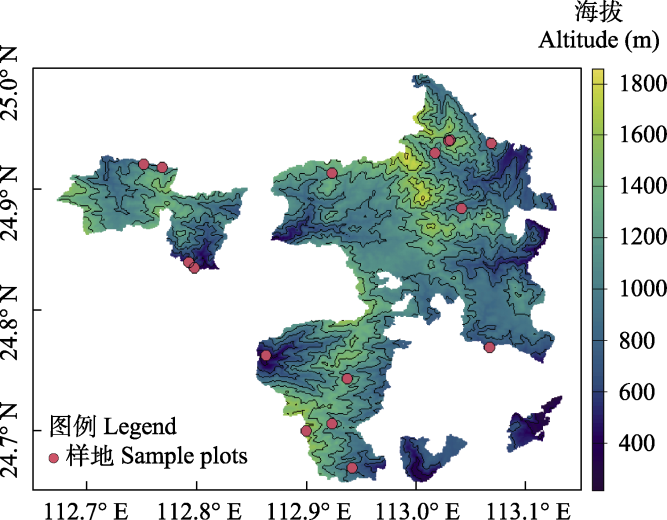
Fig. 1 The locations of the study area and 16 1-ha forest dynamics monitoring plots in the Nanling Mountains of Guangdong Province
| 样地编号 Plot ID | 海拔 Altitude (m) | 物种数 No. of species (DBH ≥ 1 cm) | 科数 No. of families | 属数 No. of genera | 总个体数 No. of individuals | 植被类型 Vegetation type | 乔木层优势种 Dominant species in tree layer |
|---|---|---|---|---|---|---|---|
| NL01 | 324 | 92 | 38 | 62 | 8,774 | 常绿针阔叶混 交林 ECBF | 马尾松 Pinus massoniana 鼠刺 Itea chinensis 油茶 Camellia oleifera |
| NL02 | 393 | 172 | 49 | 97 | 5,609 | 常绿阔叶林 EBLF | 木荷 Schima superba 西南臀果木 Prunus arborea 硬壳桂 Cryptocarya chingii |
| NL03 | 447 | 185 | 56 | 113 | 9,538 | 常绿阔叶林 EBLF | 硬壳桂 Cryptocarya chingii 鼠刺 Itea chinensis 檵木 Loropetalum chinense |
| NL04 | 600 | 229 | 54 | 110 | 6,409 | 常绿阔叶林 EBLF | 蕈树 Liquidambar chinensis 双齿山茉莉 Huodendron biaristatum 米槠 Castanopsis carlesii |
| NL05 | 850 | 197 | 52 | 96 | 5,644 | 常绿落叶阔叶混 交林 EDBF | 南酸枣 Choerospondias axillaris 贵州木瓜红 Rehderodendron kweichowense 栲 Castanopsis fargesii |
| NL06 | 861 | 188 | 52 | 104 | 8,805 | 常绿阔叶林 EBLF | 杉木 Cunninghamia lanceolata 红楠 Machilus thunbergii 枫香树 Liquidambar formosana |
| NL07 | 879 | 170 | 48 | 85 | 4,117 | 常绿阔叶林 EBLF | 赤杨叶 Alniphyllum fortunei 小叶青冈 Quercus myrsinaefolia 刺毛杜鹃 Rhododendron championiae |
| NL08 | 916 | 168 | 45 | 80 | 7,418 | 常绿落叶阔叶混 交林 EDBF | 弯蒴杜鹃 Rhododendron henryi 水青冈 Fagus longipetiolata 枫香树 Liquidambar formosana |
| NL09 | 972 | 187 | 53 | 96 | 7,167 | 常绿阔叶林 EBLF | 栲 Castanopsis fargesii 木莲 Magnolia fordiana 尖叶川杨桐 Adinandra bockiana |
| NL10 | 1,083 | 198 | 52 | 93 | 5,687 | 常绿阔叶林 EBLF | 木莲 Magnolia fordiana 罗浮锥 Castanopsis fabri 枫香树 Liquidambar formosana |
| NL11 | 1,206 | 170 | 49 | 88 | 6,313 | 常绿阔叶林 EBLF | 红楠 Machilus thunbergii 香港四照花 Cornus hongkongensis 罗浮锥 Castanopsis fabri |
| NL12 | 1,234 | 154 | 39 | 71 | 6,909 | 常绿针阔叶混 交林 ECBF | 米槠 Castanopsis carlesii 弯蒴杜鹃 Rhododendron henryi 长苞铁杉 Nothotsuga longibracteata |
| NL13 | 1,300 | 148 | 38 | 69 | 4,353 | 常绿落叶阔叶混 交林 EDBF | 黄丹木姜子 Litsea elongata 金毛柯 Lithocarpus chrysocomus 木荷 Schima superba |
| NL14 | 1,378 | 163 | 40 | 70 | 8,675 | 常绿阔叶林 EBLF | 木荷 Schima superba 枫香树 Liquidambar formosana 银钟花 Perkinsiodendron macgregorii |
| NL15 | 1,393 | 124 | 37 | 58 | 2,710 | 常绿落叶阔叶混 交林 EDBF | 厚叶红淡比 Cleyera pachyphylla 黄丹木姜子 Litsea elongata 红楠 Machilus thunbergii |
| NL16 | 1,620 | 87 | 27 | 41 | 2,795 | 常绿阔叶矮林 EBDF | 罗浮锥 Castanopsis fabri 假地枫皮 Illicium jiadifengpi 红楠 Machilus thunbergii |
Table 1 The characteristics of 16 1-ha forest dynamics monitoring plots in subtropical forests in the Nanling Mountains
| 样地编号 Plot ID | 海拔 Altitude (m) | 物种数 No. of species (DBH ≥ 1 cm) | 科数 No. of families | 属数 No. of genera | 总个体数 No. of individuals | 植被类型 Vegetation type | 乔木层优势种 Dominant species in tree layer |
|---|---|---|---|---|---|---|---|
| NL01 | 324 | 92 | 38 | 62 | 8,774 | 常绿针阔叶混 交林 ECBF | 马尾松 Pinus massoniana 鼠刺 Itea chinensis 油茶 Camellia oleifera |
| NL02 | 393 | 172 | 49 | 97 | 5,609 | 常绿阔叶林 EBLF | 木荷 Schima superba 西南臀果木 Prunus arborea 硬壳桂 Cryptocarya chingii |
| NL03 | 447 | 185 | 56 | 113 | 9,538 | 常绿阔叶林 EBLF | 硬壳桂 Cryptocarya chingii 鼠刺 Itea chinensis 檵木 Loropetalum chinense |
| NL04 | 600 | 229 | 54 | 110 | 6,409 | 常绿阔叶林 EBLF | 蕈树 Liquidambar chinensis 双齿山茉莉 Huodendron biaristatum 米槠 Castanopsis carlesii |
| NL05 | 850 | 197 | 52 | 96 | 5,644 | 常绿落叶阔叶混 交林 EDBF | 南酸枣 Choerospondias axillaris 贵州木瓜红 Rehderodendron kweichowense 栲 Castanopsis fargesii |
| NL06 | 861 | 188 | 52 | 104 | 8,805 | 常绿阔叶林 EBLF | 杉木 Cunninghamia lanceolata 红楠 Machilus thunbergii 枫香树 Liquidambar formosana |
| NL07 | 879 | 170 | 48 | 85 | 4,117 | 常绿阔叶林 EBLF | 赤杨叶 Alniphyllum fortunei 小叶青冈 Quercus myrsinaefolia 刺毛杜鹃 Rhododendron championiae |
| NL08 | 916 | 168 | 45 | 80 | 7,418 | 常绿落叶阔叶混 交林 EDBF | 弯蒴杜鹃 Rhododendron henryi 水青冈 Fagus longipetiolata 枫香树 Liquidambar formosana |
| NL09 | 972 | 187 | 53 | 96 | 7,167 | 常绿阔叶林 EBLF | 栲 Castanopsis fargesii 木莲 Magnolia fordiana 尖叶川杨桐 Adinandra bockiana |
| NL10 | 1,083 | 198 | 52 | 93 | 5,687 | 常绿阔叶林 EBLF | 木莲 Magnolia fordiana 罗浮锥 Castanopsis fabri 枫香树 Liquidambar formosana |
| NL11 | 1,206 | 170 | 49 | 88 | 6,313 | 常绿阔叶林 EBLF | 红楠 Machilus thunbergii 香港四照花 Cornus hongkongensis 罗浮锥 Castanopsis fabri |
| NL12 | 1,234 | 154 | 39 | 71 | 6,909 | 常绿针阔叶混 交林 ECBF | 米槠 Castanopsis carlesii 弯蒴杜鹃 Rhododendron henryi 长苞铁杉 Nothotsuga longibracteata |
| NL13 | 1,300 | 148 | 38 | 69 | 4,353 | 常绿落叶阔叶混 交林 EDBF | 黄丹木姜子 Litsea elongata 金毛柯 Lithocarpus chrysocomus 木荷 Schima superba |
| NL14 | 1,378 | 163 | 40 | 70 | 8,675 | 常绿阔叶林 EBLF | 木荷 Schima superba 枫香树 Liquidambar formosana 银钟花 Perkinsiodendron macgregorii |
| NL15 | 1,393 | 124 | 37 | 58 | 2,710 | 常绿落叶阔叶混 交林 EDBF | 厚叶红淡比 Cleyera pachyphylla 黄丹木姜子 Litsea elongata 红楠 Machilus thunbergii |
| NL16 | 1,620 | 87 | 27 | 41 | 2,795 | 常绿阔叶矮林 EBDF | 罗浮锥 Castanopsis fabri 假地枫皮 Illicium jiadifengpi 红楠 Machilus thunbergii |
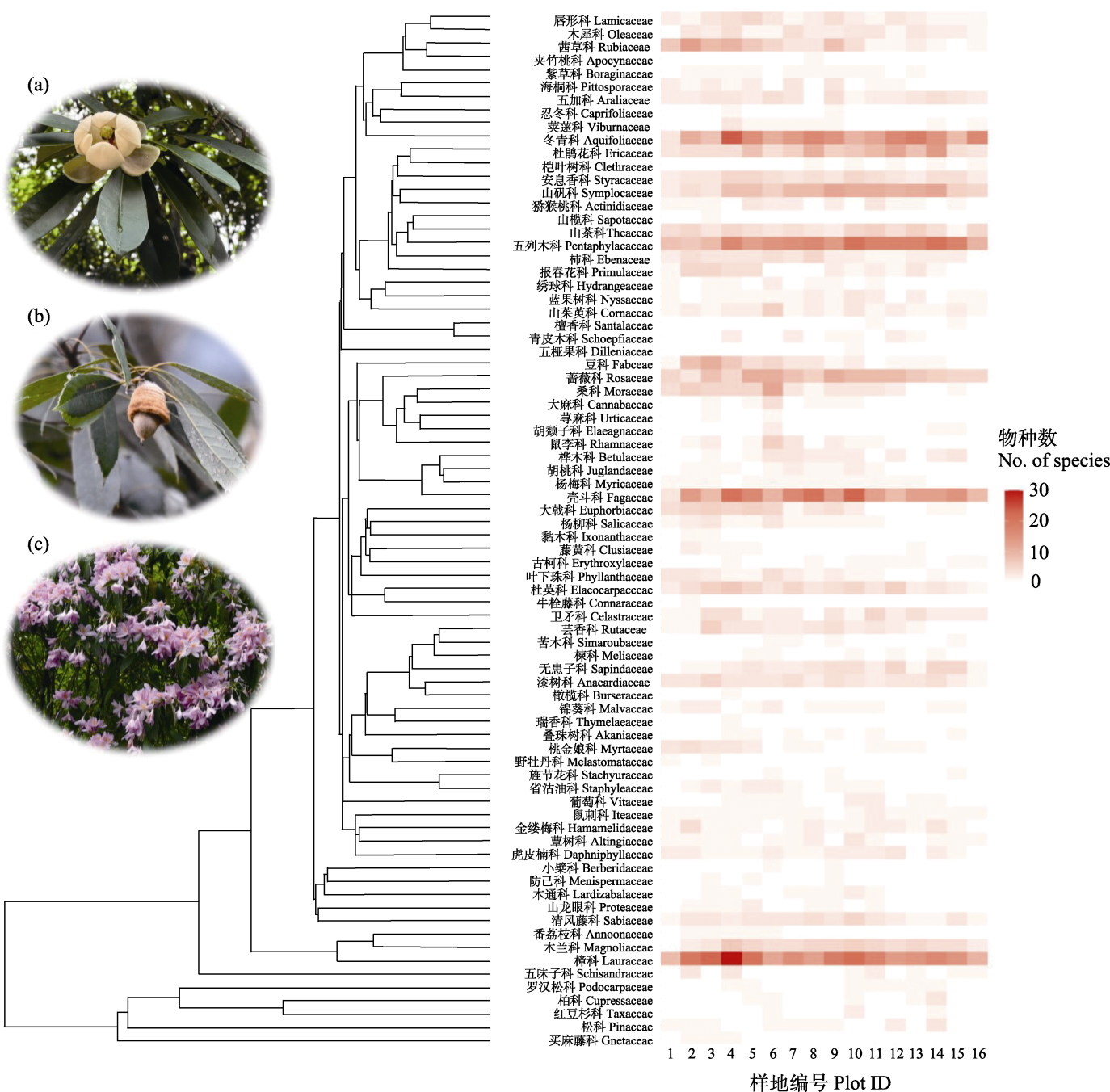
Fig. 2 Phylogenetic placement and species richness of 78 families for 582 species in 16 1-ha plots. Photographs show three representative species in the study area: (a) Manglietia pachyphylla (Magnoliaceae); (b) Quercus myrsinifolia (Fagaceae); (c) Rhododendron henryi (Ericaceae). Family names in both Chinese and Latin are labeled at the tips of the phylogenetic tree. The color gradient matrix on the right indicates the species richness of each family within the corresponding plots.
| 代码 Code | 分布类型 Areal type | 属数 No. of genera (%) | 物种数 No. of species (%) |
|---|---|---|---|
| 1 | 世界分布 Cosmopolitan | 3 (1.36) | 10 (1.72) |
| 2 | 泛热带分布 Pantropic | 42 (19.09) | 135 (23.20) |
| 3 | 东亚及热带美洲间断分布 Tropical Asia and Tropical America disjunction | 16 (7.27) | 106 (18.21) |
| 4 | 旧世界热带分布 Old World Tropic | 14 (6.36) | 30 (5.15) |
| 5 | 热带亚洲至热带大洋洲分布 Tropical Asia to Tropical Australia | 17 (7.73) | 30 (5.15) |
| 6 | 热带亚洲至热带非洲分布 Tropical Asia to Tropical Africa | 8 (3.64) | 16 (2.75) |
| 7 | 热带亚洲分布 Tropical Asia | 40 (18.18) | 81 (13.92) |
| 热带成分小计(分布型2‒7) Subtotal in tropical elements (Types 2‒7) | 137 (62.27) | 398 (68.38) | |
| 8 | 北温带分布 North Temperate | 26 (11.82) | 78 (13.40) |
| 9 | 东亚及北美间断分布 East Asia and North America disjunction | 22 (10) | 51 (8.76) |
| 10 | 旧世界温带分布 Old World Temperate | 3 (1.36) | 5 (0.86) |
| 11 | 温带亚洲分布 Temperate Asia | 0 (0) | 0 (0) |
| 12 | 地中海、西亚至中亚分布 Mediterranean, West Asia to Center Asia | 2 (0.91) | 2 (0.34) |
| 13 | 中亚分布 Central Asia | 0 (0) | 0 (0) |
| 14 | 东亚分布 East Asia | 20 (9.09) | 31 (5.33) |
| 15 | 中国特有分布 Endemic to China | 7 (3.18) | 7 (1.20) |
| 温带成分小计(分布型8‒15) Subtotal in temperate elements (Types 8‒15) | 80 (36.36) | 174 (29.90) | |
| 总计 Total | 220 (100) | 582 (100) | |
Table 2 Areal types for the genera of seed plants in 16 1-ha plots in the Nanling Mountains
| 代码 Code | 分布类型 Areal type | 属数 No. of genera (%) | 物种数 No. of species (%) |
|---|---|---|---|
| 1 | 世界分布 Cosmopolitan | 3 (1.36) | 10 (1.72) |
| 2 | 泛热带分布 Pantropic | 42 (19.09) | 135 (23.20) |
| 3 | 东亚及热带美洲间断分布 Tropical Asia and Tropical America disjunction | 16 (7.27) | 106 (18.21) |
| 4 | 旧世界热带分布 Old World Tropic | 14 (6.36) | 30 (5.15) |
| 5 | 热带亚洲至热带大洋洲分布 Tropical Asia to Tropical Australia | 17 (7.73) | 30 (5.15) |
| 6 | 热带亚洲至热带非洲分布 Tropical Asia to Tropical Africa | 8 (3.64) | 16 (2.75) |
| 7 | 热带亚洲分布 Tropical Asia | 40 (18.18) | 81 (13.92) |
| 热带成分小计(分布型2‒7) Subtotal in tropical elements (Types 2‒7) | 137 (62.27) | 398 (68.38) | |
| 8 | 北温带分布 North Temperate | 26 (11.82) | 78 (13.40) |
| 9 | 东亚及北美间断分布 East Asia and North America disjunction | 22 (10) | 51 (8.76) |
| 10 | 旧世界温带分布 Old World Temperate | 3 (1.36) | 5 (0.86) |
| 11 | 温带亚洲分布 Temperate Asia | 0 (0) | 0 (0) |
| 12 | 地中海、西亚至中亚分布 Mediterranean, West Asia to Center Asia | 2 (0.91) | 2 (0.34) |
| 13 | 中亚分布 Central Asia | 0 (0) | 0 (0) |
| 14 | 东亚分布 East Asia | 20 (9.09) | 31 (5.33) |
| 15 | 中国特有分布 Endemic to China | 7 (3.18) | 7 (1.20) |
| 温带成分小计(分布型8‒15) Subtotal in temperate elements (Types 8‒15) | 80 (36.36) | 174 (29.90) | |
| 总计 Total | 220 (100) | 582 (100) | |
| 样地 编号 Plot ID | 木荷 Schima superba | 红楠 Machilus thunbergii | 罗浮锥 Castanopsis fabri | 马尾松 Pinus massoniana | 木莲 Magnolia fordiana | 赤杨叶 Alniphyllum fortunei | 米槠 Castanopsis carlesii | 黄丹木姜子 Litsea elongata | 枫香树 Liquidambar formosana | 鼠刺 Itea chinensis |
|---|---|---|---|---|---|---|---|---|---|---|
| NL01 | 55 (1.71) | 0 (0.00) | 0 (0.00) | 341 (34.10) | 0 (0.00) | 36 (3.11) | 1 (0.00) | 2 (0.15) | 13 (1.68) | 4,074 (19.23) |
| NL02 | 574 (17.04) | 0 (0.00) | 5 (0.12) | 5 (0.68) | 0 (0.00) | 34 (2.55) | 0 (0.00) | 9 (0.18) | 22 (1.81) | 200 (2.00) |
| NL03 | 93 (3.99) | 1 (0.00) | 2 (0.00) | 4 (0.28) | 1 (0.00) | 66 (6.31) | 6 (0.09) | 94 (0.57) | 3 (0.61) | 1,222 (7.47) |
| NL04 | 6 (0.23) | 2 (0.14) | 40 (1.59) | 0 (0.00) | 20 (1.11) | 2 (0.08) | 486 (7.45) | 140 (1.62) | 0 (0.00) | 105 (0.74) |
| NL05 | 31 (0.86) | 32 (0.64) | 29 (0.88) | 0 (0.00) | 186 (4.32) | 20 (1.32) | 7 (0.31) | 251 (2.26) | 0 (0.00) | 206 (0.33) |
| NL06 | 4 (0.11) | 658 (14.03) | 3 (0.17) | 0 (0.00) | 13 (0.31) | 42 (1.67) | 7 (0.17) | 30 (0.32) | 96 (5.69) | 2 (0.00) |
| NL07 | 8 (0.17) | 55 (1.95) | 66 (2.19) | 15 (3.45) | 130 (3.04) | 88 (4.83) | 33 (2.17) | 48 (0.57) | 0 (0.00) | 9 (0.15) |
| NL08 | 112 (3.39) | 125 (2.01) | 176 (3.45) | 4 (0.12) | 82 (1.27) | 161 (4.12) | 0 (0.00) | 154 (1.38) | 153 (5.03) | 54 (0.12) |
| NL09 | 103 (1.03) | 173 (2.34) | 209 (2.97) | 15 (3.12) | 283 (4.72) | 119 (2.97) | 0 (0.00) | 310 (3.22) | 0 (0.00) | 0 (0.00) |
| NL10 | 50 (1.10) | 253 (3.32) | 208 (4.94) | 0 (0.00) | 303 (11.81) | 67 (3.85) | 0 (0.00) | 373 (2.25) | 43 (4.12) | 5 (0.00) |
| NL11 | 3 (0.20) | 532 (14.19) | 147 (7.05) | 0 (0.00) | 204 (4.27) | 27 (1.37) | 140 (4.70) | 152 (2.48) | 0 (0.00) | 11 (0.06) |
| NL12 | 73 (2.13) | 313 (5.52) | 125 (4.18) | 40 (3.15) | 35 (0.85) | 62 (3.29) | 618 (21.03) | 119 (1.08) | 0 (0.00) | 13 (0.08) |
| NL13 | 105 (6.26) | 28 (2.03) | 27 (0.91) | 0 (0.00) | 35 (0.60) | 0 (0.00) | 42 (1.83) | 263 (7.11) | 0 (0.00) | 14 (0.27) |
| NL14 | 1,358 (36.23) | 188 (2.06) | 2 (0.00) | 49 (3.53) | 94 (1.38) | 41 (1.11) | 0 (0.00) | 79 (0.35) | 339 (7.54) | 26 (0.08) |
| NL15 | 18 (2.94) | 100 (4.76) | 14 (1.91) | 0 (0.00) | 43 (3.26) | 0 (0.00) | 4 (0.12) | 278 (6.05) | 12 (2.49) | 11 (0.00) |
| NL16 | 1 (0.11) | 94 (9.73) | 117 (14.74) | 0 (0.00) | 39 (2.92) | 0 (0.00) | 0 (0.00) | 3 (0.26) | 0 (0.00) | 1 (0.00) |
Table 3 The number of individuals and importance value (%) of 10 selected tree species in 16 1-ha plots in the Nanling Mountains
| 样地 编号 Plot ID | 木荷 Schima superba | 红楠 Machilus thunbergii | 罗浮锥 Castanopsis fabri | 马尾松 Pinus massoniana | 木莲 Magnolia fordiana | 赤杨叶 Alniphyllum fortunei | 米槠 Castanopsis carlesii | 黄丹木姜子 Litsea elongata | 枫香树 Liquidambar formosana | 鼠刺 Itea chinensis |
|---|---|---|---|---|---|---|---|---|---|---|
| NL01 | 55 (1.71) | 0 (0.00) | 0 (0.00) | 341 (34.10) | 0 (0.00) | 36 (3.11) | 1 (0.00) | 2 (0.15) | 13 (1.68) | 4,074 (19.23) |
| NL02 | 574 (17.04) | 0 (0.00) | 5 (0.12) | 5 (0.68) | 0 (0.00) | 34 (2.55) | 0 (0.00) | 9 (0.18) | 22 (1.81) | 200 (2.00) |
| NL03 | 93 (3.99) | 1 (0.00) | 2 (0.00) | 4 (0.28) | 1 (0.00) | 66 (6.31) | 6 (0.09) | 94 (0.57) | 3 (0.61) | 1,222 (7.47) |
| NL04 | 6 (0.23) | 2 (0.14) | 40 (1.59) | 0 (0.00) | 20 (1.11) | 2 (0.08) | 486 (7.45) | 140 (1.62) | 0 (0.00) | 105 (0.74) |
| NL05 | 31 (0.86) | 32 (0.64) | 29 (0.88) | 0 (0.00) | 186 (4.32) | 20 (1.32) | 7 (0.31) | 251 (2.26) | 0 (0.00) | 206 (0.33) |
| NL06 | 4 (0.11) | 658 (14.03) | 3 (0.17) | 0 (0.00) | 13 (0.31) | 42 (1.67) | 7 (0.17) | 30 (0.32) | 96 (5.69) | 2 (0.00) |
| NL07 | 8 (0.17) | 55 (1.95) | 66 (2.19) | 15 (3.45) | 130 (3.04) | 88 (4.83) | 33 (2.17) | 48 (0.57) | 0 (0.00) | 9 (0.15) |
| NL08 | 112 (3.39) | 125 (2.01) | 176 (3.45) | 4 (0.12) | 82 (1.27) | 161 (4.12) | 0 (0.00) | 154 (1.38) | 153 (5.03) | 54 (0.12) |
| NL09 | 103 (1.03) | 173 (2.34) | 209 (2.97) | 15 (3.12) | 283 (4.72) | 119 (2.97) | 0 (0.00) | 310 (3.22) | 0 (0.00) | 0 (0.00) |
| NL10 | 50 (1.10) | 253 (3.32) | 208 (4.94) | 0 (0.00) | 303 (11.81) | 67 (3.85) | 0 (0.00) | 373 (2.25) | 43 (4.12) | 5 (0.00) |
| NL11 | 3 (0.20) | 532 (14.19) | 147 (7.05) | 0 (0.00) | 204 (4.27) | 27 (1.37) | 140 (4.70) | 152 (2.48) | 0 (0.00) | 11 (0.06) |
| NL12 | 73 (2.13) | 313 (5.52) | 125 (4.18) | 40 (3.15) | 35 (0.85) | 62 (3.29) | 618 (21.03) | 119 (1.08) | 0 (0.00) | 13 (0.08) |
| NL13 | 105 (6.26) | 28 (2.03) | 27 (0.91) | 0 (0.00) | 35 (0.60) | 0 (0.00) | 42 (1.83) | 263 (7.11) | 0 (0.00) | 14 (0.27) |
| NL14 | 1,358 (36.23) | 188 (2.06) | 2 (0.00) | 49 (3.53) | 94 (1.38) | 41 (1.11) | 0 (0.00) | 79 (0.35) | 339 (7.54) | 26 (0.08) |
| NL15 | 18 (2.94) | 100 (4.76) | 14 (1.91) | 0 (0.00) | 43 (3.26) | 0 (0.00) | 4 (0.12) | 278 (6.05) | 12 (2.49) | 11 (0.00) |
| NL16 | 1 (0.11) | 94 (9.73) | 117 (14.74) | 0 (0.00) | 39 (2.92) | 0 (0.00) | 0 (0.00) | 3 (0.26) | 0 (0.00) | 1 (0.00) |
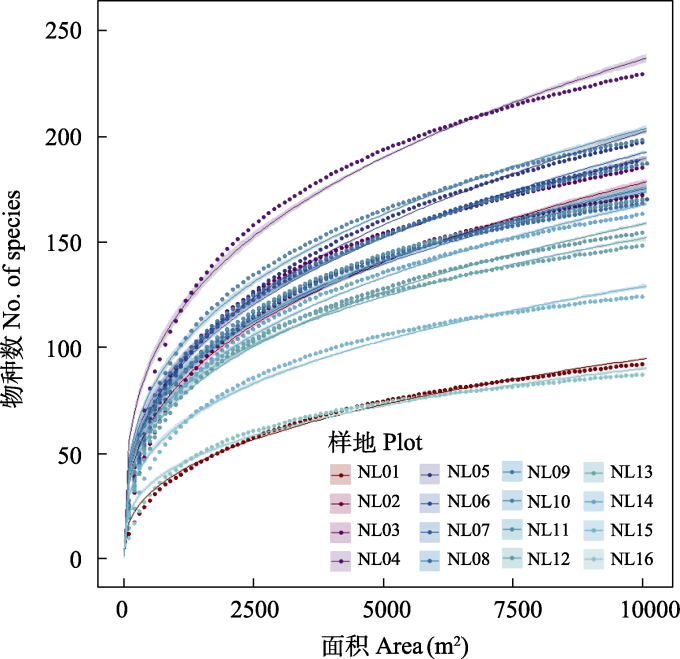
Fig. 3 Species‒area relationship of woody plants in 16 1-ha plots in the Nanling Mountains
| 样地编号 Plot ID | 物种数占比 Percentage of species richness | |||||||
|---|---|---|---|---|---|---|---|---|
| 20% | 30% | 40% | 50% | 60% | 70% | 80% | 90% | |
| NL01 | 220 | 467 | 830 | 1,386 | 2,167 | 3,218 | 4,936 | 7,052 |
| NL02 | 247 | 468 | 802 | 1,260 | 1,910 | 2,932 | 4,534 | 6,719 |
| NL03 | 184 | 365 | 665 | 1,110 | 1,746 | 2,778 | 4,313 | 6,564 |
| NL04 | 199 | 379 | 649 | 1,052 | 1,685 | 2,627 | 4,221 | 6,554 |
| NL05 | 236 | 455 | 804 | 1,322 | 2,044 | 3,099 | 4,650 | 6,939 |
| NL06 | 208 | 414 | 737 | 1,253 | 2,070 | 3,263 | 4,915 | 7,040 |
| NL07 | 207 | 386 | 659 | 1,103 | 1,722 | 2,665 | 4,135 | 6,437 |
| NL08 | 177 | 341 | 595 | 1,023 | 1,640 | 2,543 | 3,916 | 6,188 |
| NL09 | 185 | 370 | 658 | 1,155 | 1,933 | 3,109 | 4,746 | 7,057 |
| NL10 | 194 | 362 | 619 | 1,020 | 1,644 | 2,622 | 4,077 | 6,305 |
| NL11 | 214 | 418 | 682 | 1,087 | 1,666 | 2,601 | 3,938 | 6,218 |
| NL12 | 188 | 379 | 655 | 1,112 | 1,824 | 2,925 | 4,436 | 6,767 |
| NL13 | 166 | 312 | 545 | 912 | 1,485 | 2,454 | 4,017 | 6,407 |
| NL14 | 195 | 399 | 706 | 1,145 | 1,813 | 2,843 | 4,373 | 6,649 |
| NL15 | 217 | 391 | 663 | 1,083 | 1,696 | 2,627 | 4,100 | 6,280 |
| NL16 | 201 | 398 | 697 | 1,135 | 1,737 | 2,608 | 4,135 | 6,405 |
| 平均面积 Mean area (m2) | 202 | 394 | 685 | 1,135 | 1,799 | 2,807 | 4,340 | 6,599 |
Table 4 Relationship between the cumulative species percentage and sampling plot size (m2) in 16 1-ha plots in the Nanling Mountains
| 样地编号 Plot ID | 物种数占比 Percentage of species richness | |||||||
|---|---|---|---|---|---|---|---|---|
| 20% | 30% | 40% | 50% | 60% | 70% | 80% | 90% | |
| NL01 | 220 | 467 | 830 | 1,386 | 2,167 | 3,218 | 4,936 | 7,052 |
| NL02 | 247 | 468 | 802 | 1,260 | 1,910 | 2,932 | 4,534 | 6,719 |
| NL03 | 184 | 365 | 665 | 1,110 | 1,746 | 2,778 | 4,313 | 6,564 |
| NL04 | 199 | 379 | 649 | 1,052 | 1,685 | 2,627 | 4,221 | 6,554 |
| NL05 | 236 | 455 | 804 | 1,322 | 2,044 | 3,099 | 4,650 | 6,939 |
| NL06 | 208 | 414 | 737 | 1,253 | 2,070 | 3,263 | 4,915 | 7,040 |
| NL07 | 207 | 386 | 659 | 1,103 | 1,722 | 2,665 | 4,135 | 6,437 |
| NL08 | 177 | 341 | 595 | 1,023 | 1,640 | 2,543 | 3,916 | 6,188 |
| NL09 | 185 | 370 | 658 | 1,155 | 1,933 | 3,109 | 4,746 | 7,057 |
| NL10 | 194 | 362 | 619 | 1,020 | 1,644 | 2,622 | 4,077 | 6,305 |
| NL11 | 214 | 418 | 682 | 1,087 | 1,666 | 2,601 | 3,938 | 6,218 |
| NL12 | 188 | 379 | 655 | 1,112 | 1,824 | 2,925 | 4,436 | 6,767 |
| NL13 | 166 | 312 | 545 | 912 | 1,485 | 2,454 | 4,017 | 6,407 |
| NL14 | 195 | 399 | 706 | 1,145 | 1,813 | 2,843 | 4,373 | 6,649 |
| NL15 | 217 | 391 | 663 | 1,083 | 1,696 | 2,627 | 4,100 | 6,280 |
| NL16 | 201 | 398 | 697 | 1,135 | 1,737 | 2,608 | 4,135 | 6,405 |
| 平均面积 Mean area (m2) | 202 | 394 | 685 | 1,135 | 1,799 | 2,807 | 4,340 | 6,599 |
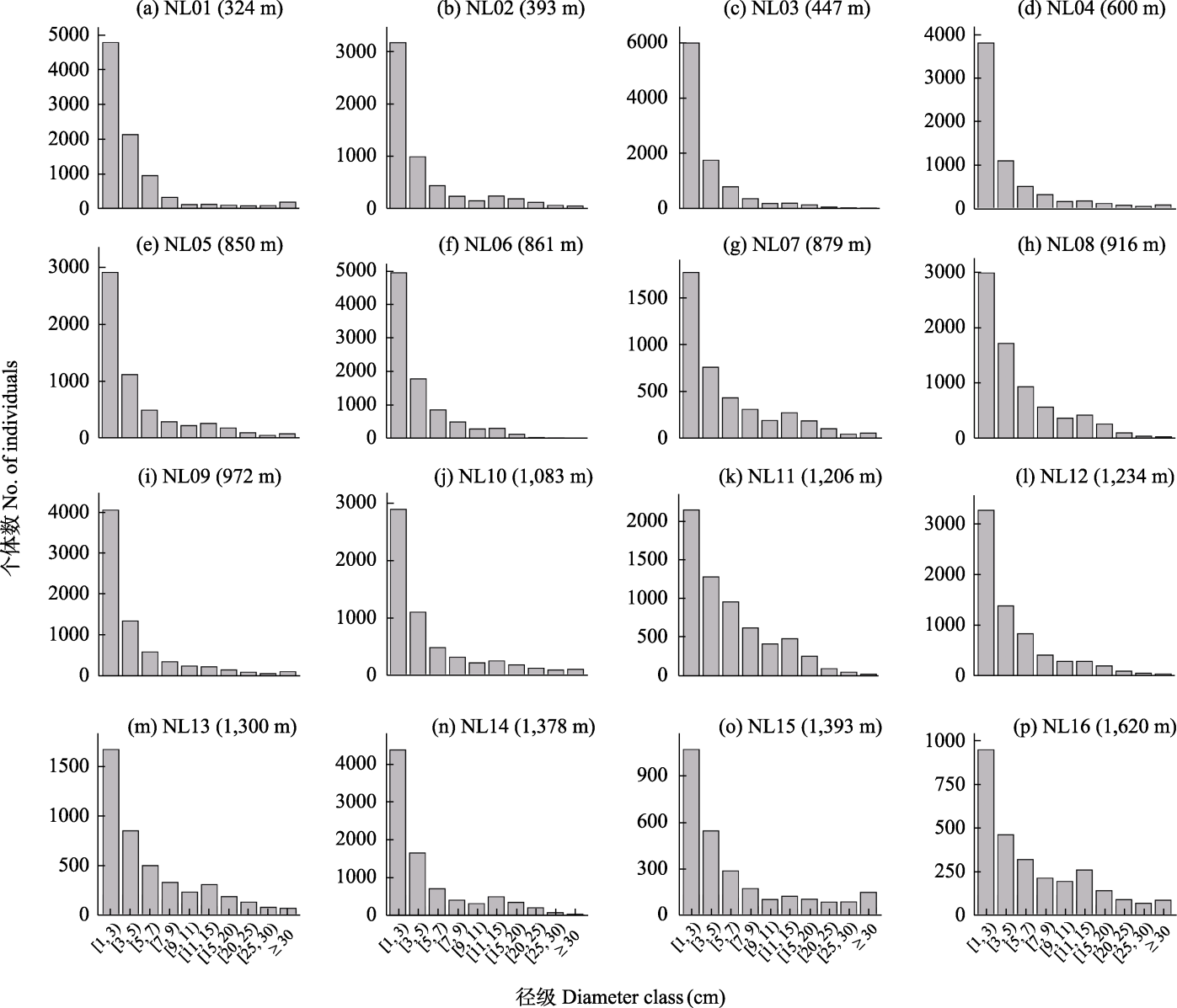
Fig. 4 Diameter-class distributions of woody plants in 16 1-ha plots in the Nanling Mountains
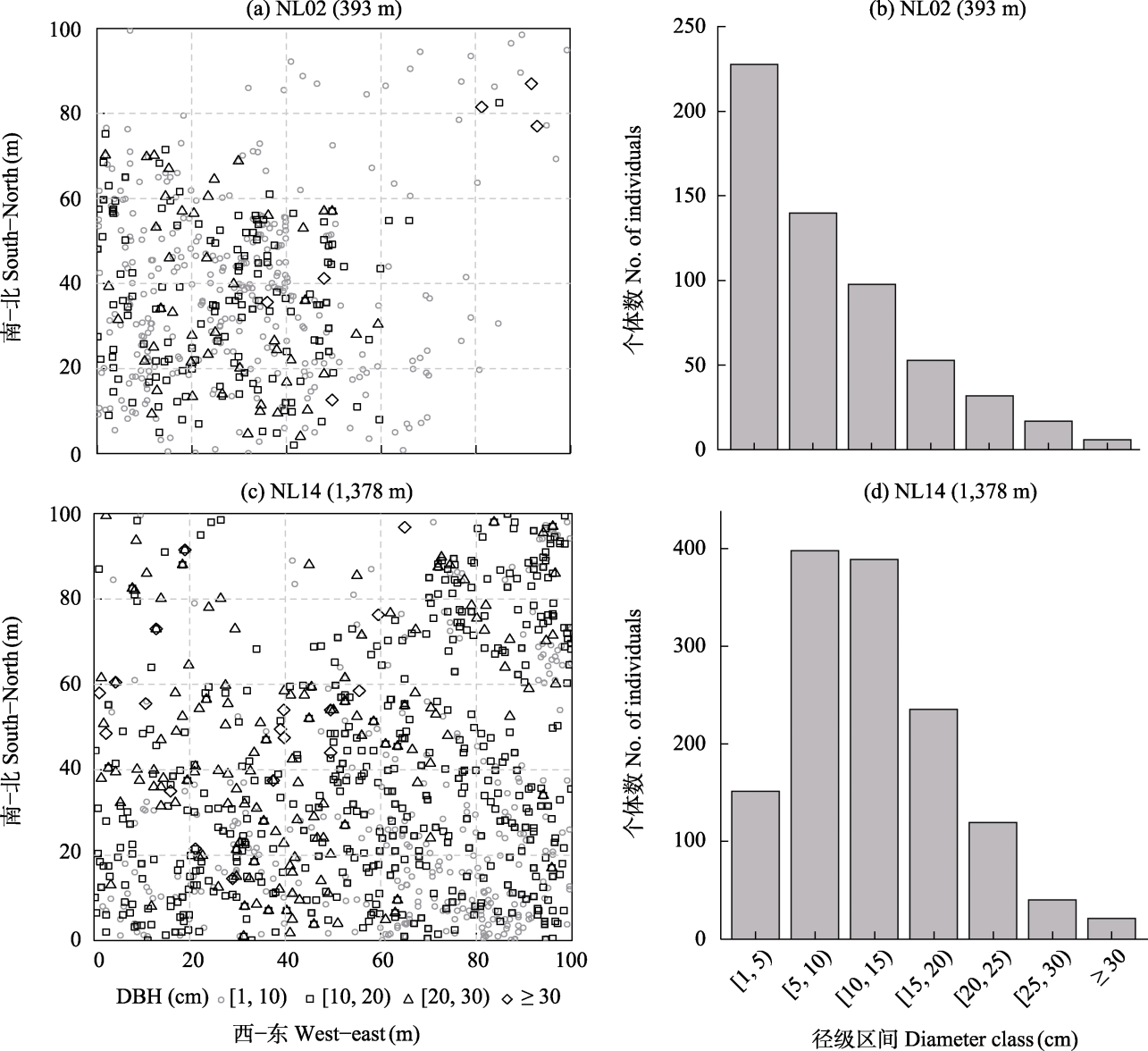
Fig. 5 Spatial distribution and diameter-class structure of Schima superba in the two plots NL02 (a‒b) and NL14 (c‒d)
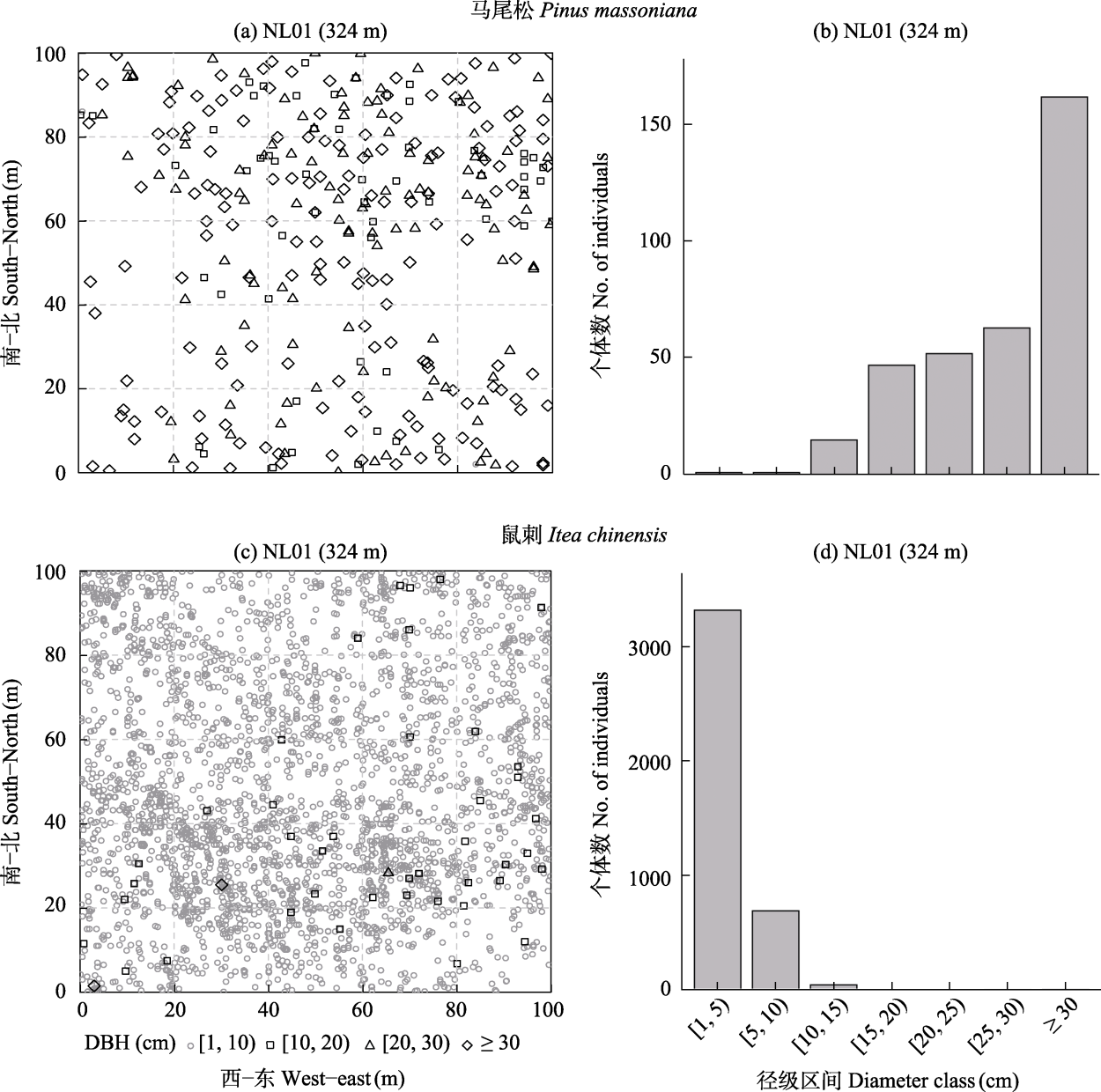
Fig. 6 Spatial distribution and diameter-class structure of Pinus massoniana (a‒b) and Itea chinensis (c‒d) in the plot NL01
| [1] | Cao HL, Wu LF, Wang ZG, Huang ZL, Li L, Wei SG, Lian JY, Ye WH (2013) Dinghushan Lower Subtropical Forest Dynamics Plot:Tree Species and Their Distribution Patterns. China Forestry Publishing House, Beijing. (in Chinese) |
| [曹洪麟, 吴林芳, 王志高, 黄忠良, 李林, 魏识广, 练琚愉, 叶万辉 (2013) 鼎湖山南亚热带森林——树种及其分布格局. 中国林业出版社, 北京.] | |
| [2] | Chen BG, Su ZY, Li ZK (1997) Structural characteristics of montane broadleaved evergreen forest on Mount Tianjingshan, Guangdong. Journal of South China Agricultural University, 18(3), 45-50. (in Chinese with English abstract) |
| [陈北光, 苏志尧, 李镇魁 (1997) 广东天井山山地常绿阔叶林的结构特征. 华南农业大学学报, 18(3), 45-50.] | |
| [3] | Chen HF, Deng SW (2024) Inventory of Vascular Plants Diversity of Nanling Mountains. Huazhong University of Science and Technology Press, Wuhan. (in Chinese) |
| [陈红锋, 邓双文 (2024) 南岭山地维管植物多样性编目. 华中科技大学出版社, 武汉.] | |
| [4] | Chen LZ (1993) Biodiversity in China:Current Status and Conservation Strategies. Science Press, Beijing. (in Chinese) |
| [陈灵芝 (1993) 中国的生物多样性——现状及其保护对策. 科学出版社, 北京.] | |
| [5] | Chen T, Zhang HD (1994) Study on the floristic geography of Nanling. I. Composition and characteristics of flora. Journal of Tropical and Subtropical Botany, 2, 10-23. (in Chinese with English abstract) |
| [陈涛, 张宏达 (1994) 南岭植物区系地理学研究. I. 植物区系的组成和特点. 热带亚热带植物学报, 2, 10-23.] | |
| [6] | Chen T, Zhang HD (1996) Study on the floristic geography of Nanling. II. Analysis of seed plant flora. Sun Yat-sen University Forum, 2, 102-109. (in Chinese with English abstract) |
| [陈涛, 张宏达 (1996) 南岭植物区系地理学研究. Ⅱ. 种子植物区系分析. 中山大学学报论丛, 2, 102-109.] | |
| [7] | Condit R (1998) Tropical Forest Census Plots: Methods and Results from Barro Colorado Island, Panama and a Comparison with Other Plots. Springer-Verlag, Berlin. |
| [8] |
Condit R, Ashton PS, Baker P, Bunyavejchewin S, Gunatilleke S, Gunatilleke N, Hubbell SP, Foster RB, Itoh A, LaFrankie JV, Lee HS, Losos E, Manokaran N, Sukumar R, Yamakura T (2000) Spatial patterns in the distribution of tropical tree species. Science, 288, 1414-1418.
DOI PMID |
| [9] |
Drakare S, Lennon JJ, Hillebrand H (2006) The imprint of the geographical, evolutionary and ecological context on species-area relationships. Ecology Letters, 9, 215-227.
DOI PMID |
| [10] | Gu YK, Chen BG, Su ZY, Xie ZS, Ouyang XG, Chen S (2003) Study on dynamics of main forest types in Guangdong Nanling National Nature Reserve. In: Biodiversity Research of Guangdong Nanling National Nature Reserve (ed. Pang XF), pp.286-304. Guangdong Science and Technology Press, Guangzhou. (in Chinese) |
| [古炎坤, 陈北光, 苏志尧, 谢正生, 欧阳学工, 陈苏 (2003) 广东南岭国家级自然保护区主要森林类型动态的研究. 见: 广东南岭国家级自然保护区生物多样性研究(庞雄飞主编), 286-304页. 广东科技出版社, 广州.] | |
| [11] | Guangdong Forest Editorial Committee (1990) Guangdong Forest. Guangdong Science and Technology Press, Guangzhou & China Forestry Publishing House, Beijing. (in Chinese) |
| [广东森林编辑委员会 (1990) 广东森林. 广东科技出版社, 广州 & 中国林业出版社, 北京.] | |
| [12] | Guangdong Institute of Botany (1976) Guangdong Vegetation. Science Press, Beijing. (in Chinese) |
| [广东省植物研究所 (1976) 广东植被. 科学出版社, 北京.] | |
| [13] |
Harrison S, Grace JB (2007) Biogeographic affinity helps explain productivity-richness relationships at regional and local scales. The American Naturalist, 170, S5-S15.
DOI URL |
| [14] |
Jin Y, Qian H (2023) U.PhyloMaker: An R package that can generate large phylogenetic trees for plants and animals. Plant Diversity, 45, 347-352.
DOI |
| [15] | Li BH, Wu ZH, Bin Y, Xiao RG, Song XJ, Shu ZF, Chu CJ (2020) Chebaling Mid-Subtropical Evergreen Broad-Leaved Forest Dynamics Plot:Species Composition and Community Structure. Guangdong Science and Technology Press, Guangzhou. (in Chinese) |
| [李步杭, 吴智宏, 宾粤, 肖荣高, 宋相金, 束祖飞, 储诚进 (2020) 车八岭中亚热带常绿阔叶林监测样地——物种组成与群落结构. 广东科技出版社, 广州.] | |
| [16] | Li DZ, Chen ZD, Wang H, Lu AM, Luo Y, Yu WB (2018) Flora of China:Families and Genera of Vascular Plants. Science Press, Beijing. (in Chinese) |
| [李德铢, 陈之端, 王红, 路安民, 骆洋, 郁文彬 (2018) 中国维管植物科属志. 科学出版社, 北京.] | |
| [17] |
Li YZ, Jiang Y, Shipley B, Li BH, Luo WQ, Chen YF, Zhao KN, He D, Rodríguez-Hernández DI, Chu CJ (2021) The complexity of trait-environment performance landscapes in a local subtropical forest. New Phytologist, 229, 1388-1397.
DOI PMID |
| [18] | Lin Y (1965) On the nature of vegetation in the Nanling Mountains and its position in China’s vegetation regionalization. Acta Phytoecologica et Geobotanica Sinica, 3, 50-74. (in Chinese) |
| [林英 (1965) 论南岭山地植被的性质及其在中国植被区划中的位置问题. 植物生态学与地植物学丛刊, 3, 50-74.] | |
| [19] |
Lyons SK, Willig MR (2002) Species richness, latitude, and scale-sensitivity. Ecology, 83, 47-58.
DOI URL |
| [20] |
Palmer MW, White PS (1994) Scale dependence and the species- area relationship. The American Naturalist, 144, 717-740.
DOI URL |
| [21] | Pang XF, Zhuang XY, Tian MY, Pang H (2003) Nanling and Lingnan:Megabiodiversity hotspots. In: Research on Biodiversity of Guangdong Nanling National Nature Reserve (ed. Pang XF), pp.28-64. Guangdong Science and Technology Press, Guangzhou. (in Chinese) |
| [庞雄飞, 庄雪影, 田明义, 庞虹 (2003) 南岭和岭南——生物多样性特丰产地. 见: 广东南岭国家级自然保护区生物多样性研究(庞雄飞主编), 28-64页. 广东科技出版社, 广州.] | |
| [22] | Qi CJ, Xiao YT, Cao TR, Lin QZ (1992) Study on vegetation of Nanling Mountains. Journal of Central South University of Forestry and Technology, 12, 1-10. (in Chinese with English abstract) |
| [祁承经, 萧育檀, 曹铁如, 林亲众 (1992) 南岭植被的研究. 中南林学院学报, 12, 1-10.] | |
| [23] | R Core Team (2024) R: A Language and Environment for Statistical Computing. R Foundation for Statistical Computing, Vienna. |
| [24] |
Radomski T (2026) The ecology of geographic range limits. Biological Reviews, 101, 39-59.
DOI URL |
| [25] |
Shen GC, He FL, Waagepetersen R, Sun IF, Hao ZQ, Chen ZS, Yu MJ (2013) Quantifying effects of habitat heterogeneity and other clustering processes on spatial distributions of tree species. Ecology, 94, 2436-2443.
PMID |
| [26] | Shen Y, Gong YN, Mei QM, Liu ZF, Wu LF, Zhang Q (2024) Subtropical Forests of Guangdong Nanling:Tree Species and Distribution Patterns. China Forestry Publishing House, Beijing. (in Chinese) |
| [沈勇, 龚粤宁, 梅启明, 刘志发, 吴林芳, 张强 (2024) 广东南岭亚热带森林——树种及其分布格局. 中国林业出版社, 北京.] | |
| [27] | Song YC (2016) Vegetation Ecology, 2nd edn. Higher Education Press, Beijing. (in Chinese) |
| [宋永昌 (2016) 植被生态学(第二版). 高等教育出版社, 北京.] | |
| [28] |
Song YC, Yan ER, Song K (2015) Synthetic comparison of eight dynamics plots in evergreen broadleaf forests, China. Biodiversity Science, 23, 139-148. (in Chinese with English abstract)
DOI |
|
[宋永昌, 阎恩荣, 宋坤 (2015) 中国常绿阔叶林八大动态监测样地植被的综合比较. 生物多样性, 23, 139-148.]
DOI |
|
| [29] | Su ZY, Chen BG, Gu YK (1995) Floristic composition and structural characteristics of forest communities in Babaoshan Nature Reserve, North Guangdong. Guihaia, 15, 124-130. (in Chinese with English abstract) |
| [苏志尧, 陈北光, 古炎坤 (1995) 粤北八宝山森林群落的组成和结构特征. 广西植物, 15, 124-130.] | |
| [30] | Vellend M (2016) The Theory of Ecological Communities. Princeton University Press, Princeton, NJ. |
| [31] | Vellend M (translated by Zhang J, Zhang ZC, Wang YZ, Liu XY, Song HJ, Gao ZW, Wang X, Zhang R (2020) The Theory of Ecological Communities. Higher Education Press, Beijing. (in Chinese) |
| [张健, 张昭臣, 王宇卓, 刘翔宇, 宋厚娟, 高志文, 王昕, 张然(译)(2020) 生态群落理论. 高等教育出版社, 北京.] | |
| [32] | Wang FG, Chen ZM, Chen HF, Xing FW, Dong AQ (2013) Flora and Vegetation of Nanling National Nature Reserve. Huazhong University of Science and Technology Press, Wuhan. (in Chinese) |
| [王发国, 陈振明, 陈红锋, 邢福武, 董安强 (2013) 南岭国家级自然保护区植物区系与植被. 华中科技大学出版社, 武汉.] | |
| [33] | WFO (World Flora Online Consortium) (2024) World Flora Online. http://www.worldfloraonline.org. (accessed on 2024-06-14) |
| [34] |
Wiegand T, Wang XG, Fischer SM, Kraft NJB, Bourg NA, Brockelman WY, Cao GH, Cao M, Chanthorn W, Chu CJ, Davies S, Ediriweera S, Gunatilleke CSV, Gunatilleke IAUN, Hao ZQ, Howe R, Jiang MX, Jin GZ, Kress WJ, Li BH, Lian JY, Lin LX, Liu F, Ma KP, McShea W, Mi XC, Myers JA, Nathalang A, Orwig DA, Shen GC, Su SH, Sun IF, Wang XH, Wolf A, Yan ER, Ye WH, Zhu Y, Huth A (2025) Latitudinal scaling of aggregation with abundance and coexistence in forests. Nature, 640, 967-973.
DOI |
| [35] | Wu ZY, Raven PH, Hong DY (1994-2013) (1994-2013) Flora of China (Vols. 1-25). Science Press, Beijing & Missouri Botanical Garden Press, St. Louis. |
| [36] | Wu ZY, Sun H, Zhou ZK, Li DZ, Peng H (2011) Floristic Geography of Seed Plants in China. Science Press, Beijing. (in Chinese) |
| [吴征镒, 孙航, 周浙昆, 李德铢, 彭华 (2011) 中国种子植物区系地理. 科学出版社, 北京.] | |
| [37] | Xie ZS, Gu YK, Chen BG, Su ZY (2003) Species diversity of the natural forest communities in Nanling National Nature Reserve, Guangdong. In: Biodiversity Research of Guangdong Nanling National Nature Reserve (ed. Pang XF), pp.305-311. Guangdong Science and Technology Press, Guangzhou. (in Chinese) |
| [谢正生, 古炎坤, 陈北光, 苏志尧 (2003) 广东南岭国家级自然保护区森林群落物种多样性分析. 见: 广东南岭国家级自然保护区生物多样性研究(庞雄飞主编), 305-311页. 广东科技出版社, 广州.] | |
| [38] | Xu YQ (1993) The significance of establishing Nanling National Nature Reserve. Ecological Science, 13, 14-20. (in Chinese with English abstract) |
| [徐燕千 (1993) 建立南岭国家级自然保护区的重大意义. 生态科学, 13, 14-20.] | |
| [39] | Ye WH, Cao HL, Huang ZL, Lian JY, Wang ZG, Li L, Wei SG, Wang ZM (2008) Effects of vertical stratification on community structure and functions in a subtropical, evergreen broad-leaved forest in the Dinghushan National Nature Reserve. Journal of Plant Ecology (Chinese Version), 32, 274-286. (in Chinese with English abstract) |
|
[叶万辉, 曹洪麟, 黄忠良, 练琚愉, 王志高, 李林, 魏识广, 王章明 (2008) 鼎湖山南亚热带常绿阔叶林20公顷样地群落特征研究. 植物生态学报, 32, 274-286.]
DOI |
|
| [40] |
Zanne AE, Tank DC, Cornwell WK, Eastman JM, Smith SA, FitzJohn RG, McGlinn DJ, O’Meara BC, Moles AT, Reich PB, Royer DL, Soltis DE, Stevens PF, Westoby M, Wright IJ, Aarssen L, Bertin RI, Calaminus A, Govaerts R, Hemmings F, Leishman MR, Oleksyn J, Soltis PS, Swenson NG, Warman L, Beaulieu JM (2014) Three keys to the radiation of angiosperms into freezing environments. Nature, 506, 89-92.
DOI |
| [41] | Zhang HD (2003) Study on the seed plant flora of Nanling Mountains. In: Research on Biodiversity of Guangdong Nanling National Nature Reserve (ed. Pang XF), pp.98-123. Guangdong Science and Technology Press, Guangzhou. (in Chinese) |
| [张宏达 (2003) 南岭山地的种子植物区系研究. 见: 广东南岭国家级自然保护区生物多样性研究(庞雄飞主编), 98-123页. 广东科技出版社, 广州.] | |
| [42] |
Zhang J, Qian H (2023) U.Taxonstand: An R package for standardizing scientific names of plants and animals. Plant Diversity, 45, 1-5.
DOI |
| [43] |
Zhang J, Qian H, Wang XY (2025) An online version and some updates of R package U.Taxonstand for standardizing scientific names in plant and animal species. Plant Diversity, 47, 166-168.
DOI |
| [44] | Zhang JQ (1993) Vegetation characteristics of Babao Mountain Nature Reserve in Ruyang, Guangdong. Ecological Science, 1, 39-124. (in Chinese with English abstract) |
| [张金泉 (1993) 广东乳阳八宝山自然保护区的植被特点. 生态科学, 1, 39-124.] | |
| [45] |
Zhang ZC, Wang F, Wang XR, Sun MF, Zheng P, Zhao JC, Chen JH, Guan M, Liu PG, Shang XF, Lu YS, Yang QP, Song QN, Chen L, Zhong QY, Zhang J (2025) Biogeographic affinity partly shapes woody plant diversity along an elevational gradient in subtropical forests. Plant Diversity, 47, 784-792.
DOI PMID |
| [46] | Zhou GY, Zhang HO, Zhou P (2018) Multidisciplinary comprehensive research value of Nanling Mountains. Tropical Geography, 38, 293-298. (in Chinese with English abstract) |
| [周国逸, 张虹鸥, 周平 (2018) 南岭山地的多学科综合研究价值. 热带地理, 38, 293-298.] |
| [1] | Kaifei Li, Jinling Gong, Feifei Hu, Xuemei Li, Zhaoyuan Lu, Mingzhong Luo, Tingbing Zhu. Characteristics of fish community structure and driving factors in Lugu Lake [J]. Biodiv Sci, 2026, 34(6): 25339-. |
| [2] | Yinrun Xiao, Yuanchun Qiu, Yunping Wang, Jiping Ma, Qiping Zhong, Suzhen Wang, Guoxiang Zhong, Cheng Zhang. Distribution and inventory of macrofungal diversity in Jiulianshan, Jiangxi Province [J]. Biodiv Sci, 2026, 34(6): 26103-. |
| [3] | Junce Liang, Kaizhi Li, Yehui Tan. Species diversity and distribution of pteropods in the South China Sea [J]. Biodiv Sci, 2026, 34(5): 25487-. |
| [4] | Yuzhuo Huang, Ziying Wang, Weilong Zhou, Jiayao Mo, Minhua Zhang, Chunhui Hao, Rongguang Lan, Peiyang Ye, Yu Liu. Distribution patterns of leaf herbivory intensity and their influencing factors in woody plants across the 25-ha subtropical forest dynamics plot at Baishanzu, Zhejiang Province [J]. Biodiv Sci, 2026, 34(4): 25406-. |
| [5] | Dongpo Xia, Jing Li, Jundong Tian, Zhonghao Huang, Chengfeng Wu, Shiwang Chen, Jinhua Li. Research progress of wild Macaca species in China [J]. Biodiv Sci, 2026, 34(3): 25460-. |
| [6] | Tingting Zhou, Haomiao Zhang, Haojie Wang, Jian Liao, Xiaodan Chen, Nan Yang, Bo-Ping Han, Zhenyuan Liu. Geographical patterns and key influence factors of Odonata species diversity in Guangdong Province [J]. Biodiv Sci, 2026, 34(2): 25337-. |
| [7] | Shiyun Yang, Lujie Hu, Qinxiu Huang, Shiqi Zeng, Jiajun Wang, Tong Zhang, Cancan Zhang, Wensheng Bu. Post-snowstorm community dynamics in an evergreen broad-leaved forest of Jiulian Mountains, Jiangxi Province [J]. Biodiv Sci, 2025, 33(9): 25005-. |
| [8] | Yang Yang, Rui Zou, Yaqin Qiao, Xiang Meng, Feiyun Tu. The species diversity of terrestrial mammals in Hainan Province, China [J]. Biodiv Sci, 2025, 33(8): 25044-. |
| [9] | Ying Feng, Feng Song, Guangzhao Jin, Komiljon Tojibaev, Xuejun Ge. Distribution patterns and species diversity of the genus Calligonum in the desert regions of Central Asia [J]. Biodiv Sci, 2025, 33(8): 25086-. |
| [10] | Xinbo Hou, Xiuhai Zhao, Huaijiang He, Chunyu Zhang, Juan Wang, Xueying Ren, Xinna Zhang. Responses of rhizosphere and non-rhizosphere microbial communities to the soil carbon and nitrogen in Quercus mongolica pure forest [J]. Biodiv Sci, 2025, 33(7): 25119-. |
| [11] | Yang Zhang, Yanping Wang. A review of the SLOSS debate: Analysis methods, theoretical mechanisms and conservation practices [J]. Biodiv Sci, 2025, 33(7): 25081-. |
| [12] | Zhengdong Pan, Xirong Lin, Hua Xue, Zhiying Hu, Hongyi Guo, Ya Zhang, Enuo Wu, Wenqiao Tang. Fish species diversity background and community structure in the main inland water bodies of Shanghai [J]. Biodiv Sci, 2025, 33(6): 24290-. |
| [13] | Wen Peng, Zeshuai Deng, Wenbao Zheng, Lingxuan Gong, Yufeng Zeng, Hao Meng, Jun Chen, Daode Yang. Application of eDNA technology in amphibian surveys: A case study of Hunan Mangshan National Nature Reserve [J]. Biodiv Sci, 2025, 33(6): 24552-. |
| [14] | Lulu Zhang, Zhaojie Ren, Ningning Yu, Fengxi Zhao, Zuntian Zhao. List of bryophytes in Gansu Province, China [J]. Biodiv Sci, 2025, 33(6): 24451-. |
| [15] | Xiaoqing Wu, Meihui Zhang, Suting Ge, Manshu Li, Liangjun Da, Kun Song, Guochun Shen, Jian Zhang. Spatiotemporal dynamics of woody plant species diversity and aboveground biomass during near-nature forest reconstruction in Shanghai: A case study from the eco-island in Minhang District [J]. Biodiv Sci, 2025, 33(5): 24444-. |
| Viewed | ||||||
|
Full text |
|
|||||
|
Abstract |
|
|||||
Copyright © 2026 Biodiversity Science
Editorial Office of Biodiversity Science, 20 Nanxincun, Xiangshan, Beijing 100093, China
Tel: 010-62836137, 62836665 E-mail: biodiversity@ibcas.ac.cn

