

Biodiv Sci ›› 2025, Vol. 33 ›› Issue (12): 25295. DOI: 10.17520/biods.2025295 cstr: 32101.14.biods.2025295
• Conservation and Governance • Previous Articles Next Articles
Xiaoshuang Li, Jianzhong Ma*( )
)
Received:2025-07-23
Accepted:2025-11-01
Online:2025-12-20
Published:2026-01-09
Supported by:Xiaoshuang Li, Jianzhong Ma. Ancient tree biocultural micro-conservation site: An innovative conservation pathway synergizing biological and cultural elements[J]. Biodiv Sci, 2025, 33(12): 25295.
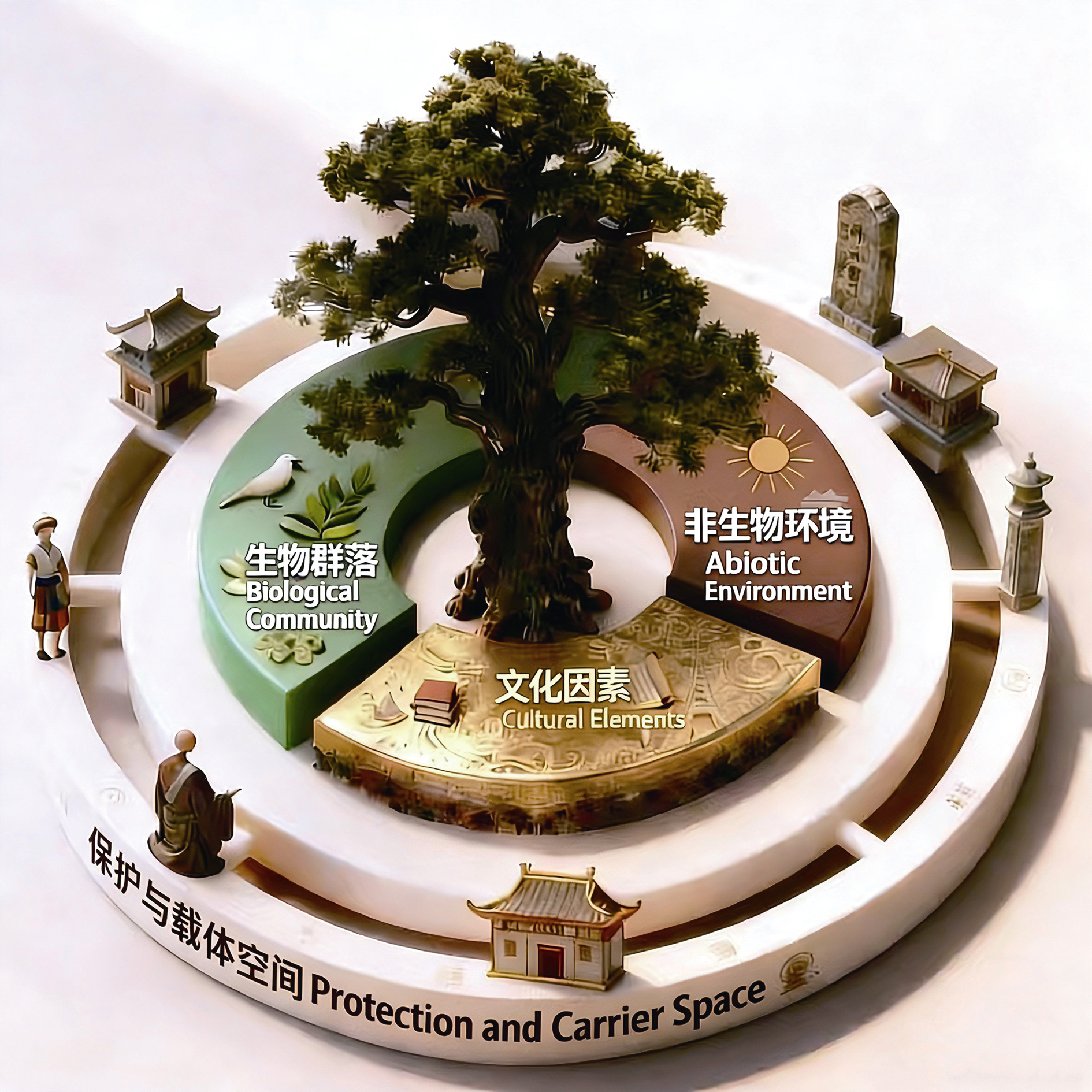
Fig. 1 Conceptual framework for the ancient tree biocultural micro-conservation site
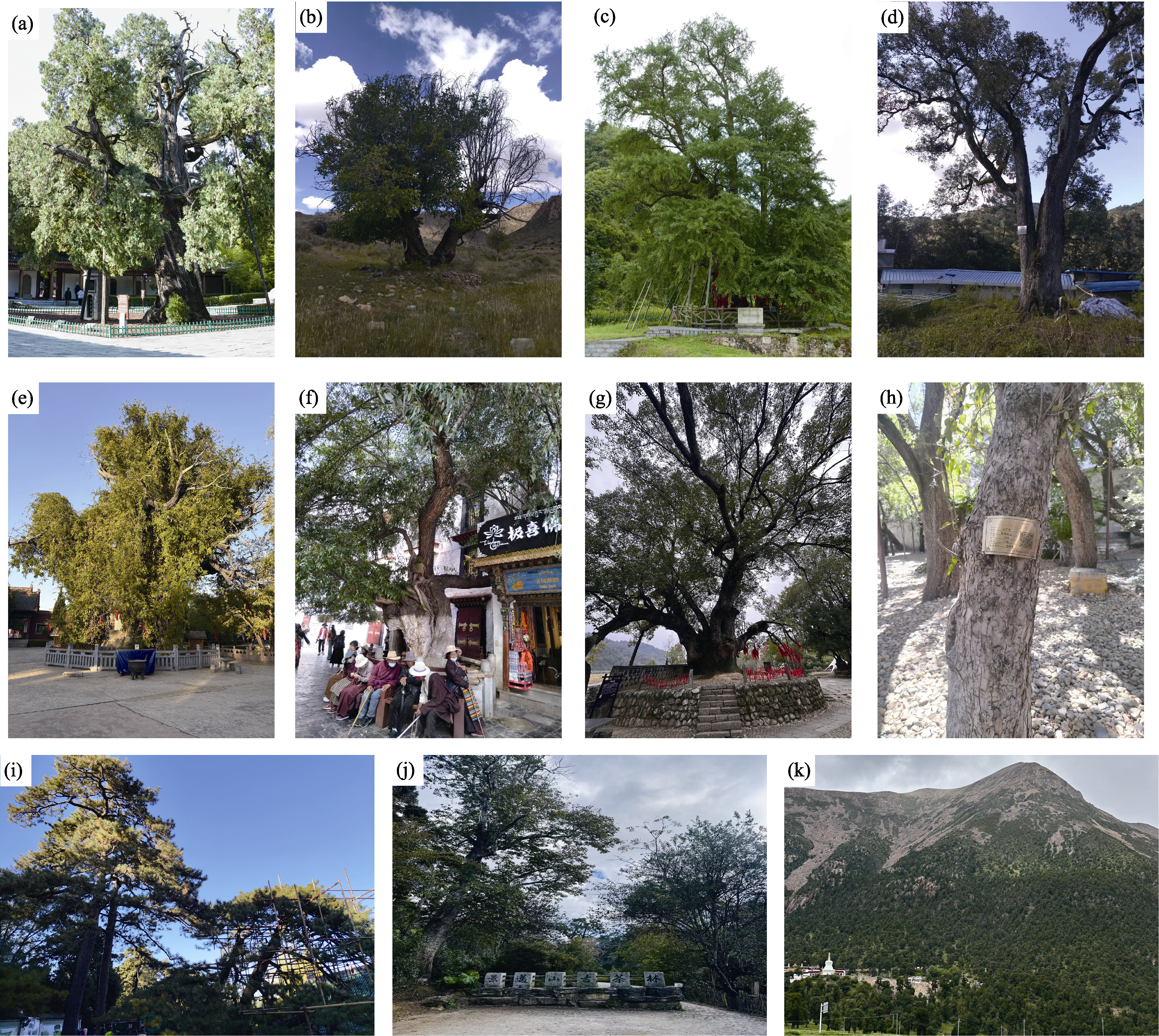
Fig. 2 Typology and typical examples of core conservation objects for ancient tree biocultural micro-conservation site, categorized by spatial distribution pattern, origin type, and habitat type. (a) The Xuanyuan Cypress (Platycladus orientalis) ancient tree at the Mausoleum of the Yellow Emperor in Huangling County, Shaanxi (Single and cultivated ancient tree); (b) The Juglans regia ancient tree in Dadong Village, Doilungdêqên District, Lhasa City, Xizang (Single, natural, and rural ancient tree); (c) The Ginkgo biloba ancient tree in Yuyou Village, Machangping Sub-district Office, Fuquan City, Qiannan Buyi and Miao Autonomous Prefecture, Guizhou (Single, natural, and rural ancient tree); (d) The Cyclobalanopsis delavayi ancient tree in Leju Ancient Village, Tuanjie Township, Xishan District, Kunming City, Yunnan (Single, natural, and rural ancient tree); (e) The Styphnolobium japonicum ancient tree in Hongtong County, Linfen City, Shanxi (Single, natural, and rural ancient tree); (f) The Salix matsudana f. tortuosa ancient tree at the Jokhang Temple in Chengguan District, Lhasa City, Xizang (Single, cultivated, and urban ancient tree); (g) The camphor ancient tree in Yantian Village, Fuchun Town, Wuyuan County, Shangrao City, Jiangxi (Single, natural, and rural ancient tree); (h) Small-scale ancient tree cluster in Gandan Podrang Courtyard, Drepung Monastery, Chengguan District, Lhasa City, Xizang; (i) “Five Famous Pines” small-scale ancient tree cluster at Jietai Temple, Beijing; (j) The thousand-year-old ancient tea plantation covering ten thousand mu on Jingmai Mountain in Lancang Lahu Autonomous County, Pu’er City, Yunnan (Large-scale ancient tree cluster); (k) Large-scale ancient tree cluster of Juniperus tibetica at Reting Monastery in Lhünzhub County, Lhasa City, Xizang.
| 类型 Type | 生态特征 Ecological characteristics | 生态功能 Ecological function | 文化价值 Cultural value | 保护策略 Conservation strategy | 文献 References | 图例 Illustrative |
|---|---|---|---|---|---|---|
| 空间分布格局 Spatial distribution pattern | ||||||
| 单株古树 Single ancient tree | 孤立生长, 生境异质性低, 生态关联度弱 Grows in isolation, with low habitat heterogeneity and weak ecological correlation | 调节局部微气候, 构建树洞微生境(庇护微生物、小型无脊椎动物) Regulates local microclimate, constructs tree hole microhabitats (shelters microorganisms and small invertebrates) | 单一文化符号(如村口“神树”、历史事件见证树) Single cultural symbol (e.g., “sacred tree” at the village entrance, witness tree of historical events) | 1. 根系透气铺装; 2. 树体健康实时监测; 3. 建立古树记忆档案 1. Root breathable pavement; 2. Real-time monitoring of tree health; 3. Establishment of ancient tree memory archives | 毕鹏伟和徐晶晶, | |
| 小型古树群(< 20株) Small ancient tree group (< 20 trees) | 多株聚集, 生境连通性高, 物种交互频繁 Multiple trees gather, with high habitat connectivity and frequent species interaction | 提供关键栖息地, 维持局地生物多样性, 增强水土保持功能 Provides key habitats, maintains local biodiversity, and enhances soil and water conservation functions | 文化场景集中(如宗祠林、风水林) Concentrated cultural scenarios (e.g., ancestral temple forests, Fengshui forests) | 1. 生境完整性保护: 划定核心保护边界, 保留群内自然连通廊道; 2. 群落协同管理: 开展生态友好型病虫害防治, 补植乡土伴生树种; 3. 社区参与: 联合在地群体延续传统护林习俗 1. Habitat integrity protection: demarcate core protection boundaries and retain natural connectivity corridors within the group; 2. Community collaborative management: conduct ecologically friendly pest and disease control and supplement native associated tree species; 3. Community participation: collaborate with local groups to continue traditional forest protection customs | 矫松原, | |
| 起源方式 Origin type | ||||||
| 自然古树 Natural ancient tree | 原生境生长, 物种共生网络完整, 遗传多样性高 Grows in the original habitat, with a complete species symbiosis network and high genetic diversity | 维持原生生态系统结构完整性, 庇护珍稀附生植物(如兰科植物) Maintains the structural integrity of the original ecosystem and shelters rare epiphytic plants (e.g., Orchidaceae plants) | 承载自然崇拜与传统生态智慧(“神山圣树” 信仰) Carries nature worship and traditional ecological wisdom (belief in “sacred mountains and holy trees”) | 1. 最小干预: 禁止人工修剪、保留枯落物层; 2. 物种普查: 记录伴生动植物及微生物群落; 3. 知识传承: 整理原住民传统管理知识 1. Minimum intervention: prohibit artificial pruning and retain the litter layer; 2. Species census: record associated animals, plants and microbial communities; 3. Knowledge inheritance: organize the traditional management knowledge of indigenous people | Asbeck et al, | |
| 栽培古树 Cultivated ancient tree | 人工选育定植, 常见于园林、寺庙, 物种 组成单一 Artificially selected and planted, commonly found in gardens and temples, with a single species composition | 景观生态功能, 缓解城市热岛效应 Landscape ecological function, alleviates the urban heat island effect | 园林艺术与宗教文化载体(如寺庙古柏) Carrier of garden art and religious culture (e.g., ancient cypresses in temples) | 1. 精细化养护(定制微生物肥料); 2. 病虫害综合防治; 3. 园林文化科普导览 1. Refined maintenance (customized microbial fertilizer); 2. Comprehensive pest and disease control; 3. Popular science and guided tours of garden culture | 蔡晓梅等, | |
| 生境类型 Habitat type | ||||||
| 城市古树Urban ancient tree | 生长于公园、街道, 生境破碎化, 人为干扰强度高 Grows in parks and streets, with fragmented habitat and high intensity of human disturbance | 净化空气, 提供市民休憩生态空间 Purifies air and provides ecological space for citizens’ leisure | 城市历史记忆、公共文化认同(如老城区古槐) Urban historical memory and public cultural identity (e.g., ancient pagoda trees in old urban areas) | 1. 干扰控制(透水铺装、游客限流); 2. 组建志愿者守护团队; 3. 纳入城市绿地系统规划 1. Disturbance control (permeable pavement, tourist flow restriction); 2. Establish a volunteer guardian team; 3. Integrate into urban green space system planning | 高吉喜等, | |
| 乡村古树 Rural ancient tree | 生长于村落、田野, 生境相对完整, 与农业生态系统关联紧密 Grows in villages and fields, with a relatively complete habitat and close connection with agricultural ecosystems | 调节农业生态系统, 维持乡村生物多样性 Regulates agricultural ecosystems and maintains rural biodiversity | 宗族认同、民俗活动依托(如端午祭树) Foundation for clan identity and folk activities (e.g., tree worship during the Dragon Boat Festival) | 1. 保护纳入乡村振兴规划; 2. 对护树村民实施生态补偿; 3. 乡村学校开设古树文化课程 1. Integrate protection into rural revitalization planning; 2. Implement ecological compensation for villagers who protect trees; 3. Offer ancient tree culture courses in rural schools | 黄宝荣等, | |
Table 1 Typology, eco-cultural characteristics, and differentiated conservation strategies for core conservation objects of ancient tree biocultural micro-conservation site
| 类型 Type | 生态特征 Ecological characteristics | 生态功能 Ecological function | 文化价值 Cultural value | 保护策略 Conservation strategy | 文献 References | 图例 Illustrative |
|---|---|---|---|---|---|---|
| 空间分布格局 Spatial distribution pattern | ||||||
| 单株古树 Single ancient tree | 孤立生长, 生境异质性低, 生态关联度弱 Grows in isolation, with low habitat heterogeneity and weak ecological correlation | 调节局部微气候, 构建树洞微生境(庇护微生物、小型无脊椎动物) Regulates local microclimate, constructs tree hole microhabitats (shelters microorganisms and small invertebrates) | 单一文化符号(如村口“神树”、历史事件见证树) Single cultural symbol (e.g., “sacred tree” at the village entrance, witness tree of historical events) | 1. 根系透气铺装; 2. 树体健康实时监测; 3. 建立古树记忆档案 1. Root breathable pavement; 2. Real-time monitoring of tree health; 3. Establishment of ancient tree memory archives | 毕鹏伟和徐晶晶, | |
| 小型古树群(< 20株) Small ancient tree group (< 20 trees) | 多株聚集, 生境连通性高, 物种交互频繁 Multiple trees gather, with high habitat connectivity and frequent species interaction | 提供关键栖息地, 维持局地生物多样性, 增强水土保持功能 Provides key habitats, maintains local biodiversity, and enhances soil and water conservation functions | 文化场景集中(如宗祠林、风水林) Concentrated cultural scenarios (e.g., ancestral temple forests, Fengshui forests) | 1. 生境完整性保护: 划定核心保护边界, 保留群内自然连通廊道; 2. 群落协同管理: 开展生态友好型病虫害防治, 补植乡土伴生树种; 3. 社区参与: 联合在地群体延续传统护林习俗 1. Habitat integrity protection: demarcate core protection boundaries and retain natural connectivity corridors within the group; 2. Community collaborative management: conduct ecologically friendly pest and disease control and supplement native associated tree species; 3. Community participation: collaborate with local groups to continue traditional forest protection customs | 矫松原, | |
| 起源方式 Origin type | ||||||
| 自然古树 Natural ancient tree | 原生境生长, 物种共生网络完整, 遗传多样性高 Grows in the original habitat, with a complete species symbiosis network and high genetic diversity | 维持原生生态系统结构完整性, 庇护珍稀附生植物(如兰科植物) Maintains the structural integrity of the original ecosystem and shelters rare epiphytic plants (e.g., Orchidaceae plants) | 承载自然崇拜与传统生态智慧(“神山圣树” 信仰) Carries nature worship and traditional ecological wisdom (belief in “sacred mountains and holy trees”) | 1. 最小干预: 禁止人工修剪、保留枯落物层; 2. 物种普查: 记录伴生动植物及微生物群落; 3. 知识传承: 整理原住民传统管理知识 1. Minimum intervention: prohibit artificial pruning and retain the litter layer; 2. Species census: record associated animals, plants and microbial communities; 3. Knowledge inheritance: organize the traditional management knowledge of indigenous people | Asbeck et al, | |
| 栽培古树 Cultivated ancient tree | 人工选育定植, 常见于园林、寺庙, 物种 组成单一 Artificially selected and planted, commonly found in gardens and temples, with a single species composition | 景观生态功能, 缓解城市热岛效应 Landscape ecological function, alleviates the urban heat island effect | 园林艺术与宗教文化载体(如寺庙古柏) Carrier of garden art and religious culture (e.g., ancient cypresses in temples) | 1. 精细化养护(定制微生物肥料); 2. 病虫害综合防治; 3. 园林文化科普导览 1. Refined maintenance (customized microbial fertilizer); 2. Comprehensive pest and disease control; 3. Popular science and guided tours of garden culture | 蔡晓梅等, | |
| 生境类型 Habitat type | ||||||
| 城市古树Urban ancient tree | 生长于公园、街道, 生境破碎化, 人为干扰强度高 Grows in parks and streets, with fragmented habitat and high intensity of human disturbance | 净化空气, 提供市民休憩生态空间 Purifies air and provides ecological space for citizens’ leisure | 城市历史记忆、公共文化认同(如老城区古槐) Urban historical memory and public cultural identity (e.g., ancient pagoda trees in old urban areas) | 1. 干扰控制(透水铺装、游客限流); 2. 组建志愿者守护团队; 3. 纳入城市绿地系统规划 1. Disturbance control (permeable pavement, tourist flow restriction); 2. Establish a volunteer guardian team; 3. Integrate into urban green space system planning | 高吉喜等, | |
| 乡村古树 Rural ancient tree | 生长于村落、田野, 生境相对完整, 与农业生态系统关联紧密 Grows in villages and fields, with a relatively complete habitat and close connection with agricultural ecosystems | 调节农业生态系统, 维持乡村生物多样性 Regulates agricultural ecosystems and maintains rural biodiversity | 宗族认同、民俗活动依托(如端午祭树) Foundation for clan identity and folk activities (e.g., tree worship during the Dragon Boat Festival) | 1. 保护纳入乡村振兴规划; 2. 对护树村民实施生态补偿; 3. 乡村学校开设古树文化课程 1. Integrate protection into rural revitalization planning; 2. Implement ecological compensation for villagers who protect trees; 3. Offer ancient tree culture courses in rural schools | 黄宝荣等, | |
| 保护模式 Conservation model | 核心保护对象 Core conservation object | 文化维度 Cultural dimension | 空间尺度 Spatial scale | 治理主体 Governing entities | 核心特色 Core features | 文献 References |
|---|---|---|---|---|---|---|
| 古树生物文化微保护地 ATBMS | 单株或小型古树群及其完整的生境与文化空间 Individual ancient trees or small-scale ancient tree clusters, along with their complete habitats and cultural spaces | 核心内涵(古树为文化符号, 保护融文化实践) Core connotation (ancient trees serve as cultural symbols, and conservation integrates cultural practices) | 较小(一般为数百到数千平方米) Relatively small (generally ranging from several hundred to several thousand square meters) | 多元协同(政府 + 社区 + 科研), 社区为核心 Multi-stakeholder collaboration (government + community + scientific research), with the community as the core | 生态-文化协同保护, 填补小微尺度文化保护空缺 Eco-cultural collaborative conservation, filling the gap in micro-scale cultural conservation | 段超, |
| 其他有效的区域保护措施 Other effective area-based conservation measures (OECMs) | 多样(虽不以生物多样性保护为主要目标, 但可实现长期就地保护) Diverse (though biodiversity conservation is not its primary goal, it can achieve long-term in-situ conservation) | 可选要素(非必需, 侧重生物多样性保护) Optional element (non-essential, focusing on biodiversity conservation) | 灵活, 大小不一Flexible, with varying sizes | 多元治理(政府、NGO、企业), 根据区域资源灵活调整Diverse governance (government, NGOs, enterprises), flexibly adjusted based on regional resources | 覆盖保护地外区域, 灵活性强 Covers areas outside protected areas, with high flexibility | IUCN, |
| 植物微型保护区 Plant micro-reserve | 特定珍稀濒危植物种群及其生境 Specific populations of rare and endangered plants and their habitats | 无(仅关注物种生存) None (only focuses on species survival) | 通常较小(几至几百平方米) Typically small (ranging from several square meters to several hundred square meters) | 科研机构 + 政府, 技术主导 Research institutions + government, technology-led | 单一物种精准保护 Precise conservation of a single species | Laguna, |
| 自然保护小区 Nature conservation community | 区域性生物多样性热点(如湿地、森林片段) Regional biodiversity hotspots (e.g., wetlands, forest fragments) | 可选要素(非首要目标, 生态优先) Optional element (not the primary goal, with ecology as the priority) | 较大(数万到数百万平方米) Relatively large (ranging from tens of thousands to millions of square meters) | 社区参与度高, 常由村集体管理 High community participation, often managed by village collectives | 就地保护, 填补自然保护区网络空缺 In-situ conservation, filling the gap in the nature reserve network | 廖凌云等, |
Table 2 Core characteristics comparison of ancient tree biocultural micro-conservation sites (ATBMS) and relevant non-traditional conservation models. NGO, Non-governmental organizations.
| 保护模式 Conservation model | 核心保护对象 Core conservation object | 文化维度 Cultural dimension | 空间尺度 Spatial scale | 治理主体 Governing entities | 核心特色 Core features | 文献 References |
|---|---|---|---|---|---|---|
| 古树生物文化微保护地 ATBMS | 单株或小型古树群及其完整的生境与文化空间 Individual ancient trees or small-scale ancient tree clusters, along with their complete habitats and cultural spaces | 核心内涵(古树为文化符号, 保护融文化实践) Core connotation (ancient trees serve as cultural symbols, and conservation integrates cultural practices) | 较小(一般为数百到数千平方米) Relatively small (generally ranging from several hundred to several thousand square meters) | 多元协同(政府 + 社区 + 科研), 社区为核心 Multi-stakeholder collaboration (government + community + scientific research), with the community as the core | 生态-文化协同保护, 填补小微尺度文化保护空缺 Eco-cultural collaborative conservation, filling the gap in micro-scale cultural conservation | 段超, |
| 其他有效的区域保护措施 Other effective area-based conservation measures (OECMs) | 多样(虽不以生物多样性保护为主要目标, 但可实现长期就地保护) Diverse (though biodiversity conservation is not its primary goal, it can achieve long-term in-situ conservation) | 可选要素(非必需, 侧重生物多样性保护) Optional element (non-essential, focusing on biodiversity conservation) | 灵活, 大小不一Flexible, with varying sizes | 多元治理(政府、NGO、企业), 根据区域资源灵活调整Diverse governance (government, NGOs, enterprises), flexibly adjusted based on regional resources | 覆盖保护地外区域, 灵活性强 Covers areas outside protected areas, with high flexibility | IUCN, |
| 植物微型保护区 Plant micro-reserve | 特定珍稀濒危植物种群及其生境 Specific populations of rare and endangered plants and their habitats | 无(仅关注物种生存) None (only focuses on species survival) | 通常较小(几至几百平方米) Typically small (ranging from several square meters to several hundred square meters) | 科研机构 + 政府, 技术主导 Research institutions + government, technology-led | 单一物种精准保护 Precise conservation of a single species | Laguna, |
| 自然保护小区 Nature conservation community | 区域性生物多样性热点(如湿地、森林片段) Regional biodiversity hotspots (e.g., wetlands, forest fragments) | 可选要素(非首要目标, 生态优先) Optional element (not the primary goal, with ecology as the priority) | 较大(数万到数百万平方米) Relatively large (ranging from tens of thousands to millions of square meters) | 社区参与度高, 常由村集体管理 High community participation, often managed by village collectives | 就地保护, 填补自然保护区网络空缺 In-situ conservation, filling the gap in the nature reserve network | 廖凌云等, |
| [1] |
Angold PG, Sadler JP, Hill MO, Pullin A, Rushton S, Austin K, Small E, Wood B, Wadsworth R, Sanderson R, Thompson K (2006) Biodiversity in urban habitat patches. Science of the Total Environment, 360, 196-204.
DOI PMID |
| [2] |
Arnold W, Gewirtzman J, Raymond PA, Duguid MC, Brodersen CR, Brown C, Norbraten N, Wood QTV, Bradford MA, Peccia J (2025) A diverse and distinct microbiome inside living trees. Nature, 644, 1039-1048.
DOI |
| [3] |
Arzoo E, Bhatia R, Singh MC, Singh L, Gowthami GV (2022) Conservation of old trees—A review. Journal of Ornamental Horticulture, 25, 97-104.
DOI URL |
| [4] |
Asbeck T, Großmann J, Paillet Y, Winiger N, Bauhus J (2021) The use of tree-related microhabitats as forest biodiversity indicators and to guide integrated forest management. Current Forestry Reports, 7, 59-68.
DOI |
| [5] | Bancheva S, Goranova V, Pedashenko H, Vladimirov V (2014) Bulgarian national network of small protected sites:Plant micro-reserves. In: A Pilot Network of Small Protected Sites for Conservation of Rare Plants in Bulgaria (ed. Vladimirov V), pp. 30-153. IBER-BAS & MoEW, Sofia, Bulgaria. |
| [6] | Bi PW, Xu JJ (2024) Innovate the protection and development model of ancient tree resources and explore the construction of high-quality ancient tree parks. Land Greening, (12), 48-50. (in Chinese) |
| [毕鹏伟, 徐晶晶 (2024) 创新古树资源保护与发展模式探索建设高品质古树公园. 国土绿化, (12), 48-50.] | |
| [7] |
Blicharska M, Mikusiński G (2013) Old trees: Cultural value. Science, 339, 904.
DOI PMID |
| [8] |
Blicharska M, Mikusiński G (2014) Incorporating social and cultural significance of large old trees in conservation policy. Conservation Biology, 28, 1558-1567.
DOI PMID |
| [9] |
Cai XM, Su Y, Xu WH, Zhou SJ, He SY, Zang ZH, Wang L, Lü ZM, Yin D, Su XB (2005) New theories, methods and legal guarantees for the construction of nature reserve system in the context of Chinese modernization. Journal of Natural Resources, 40, 1429-1450. (in Chinese with English abstract)
DOI URL |
| [蔡晓梅, 苏杨, 徐卫华, 周绍杰, 何思源, 臧振华, 王蕾, 吕忠梅, 尹铎, 苏晓波 (2005) 中国式现代化背景下自然保护地体系建设的新理论、新方法与法制保障. 自然资源学报, 40, 1429-1450.] | |
| [10] | Cao SP (2019) From “Indian wilderness” to “uninhabited wilderness”: Changes of white Americans’ wilderness concept and the American Indians’ expulsion from the region of Yellowstone National Park. Journal of Ludong University (Philosophy and Social Sciences Edition), 36(4), 32-37. (in Chinese with English abstract) |
| [曹少朋 (2019) 从“印第安人的荒野”到“无人居住的荒野”: 美国白人荒野观念的转变与黄石国家公园地区印第安人的驱逐. 鲁东大学学报(哲学社会科学版), 36(4), 32-37.] | |
| [11] |
Cheng Z, Lu XP, Fan YX, Cui QJ, Hu X, Long CL (2025) Traditional knowledge promotes the protection of large old trees: A case from China’s richest biocultural diversity area. People and Nature, 7, 2700-2713.
DOI URL |
| [12] | Cong RC (2024) How to protect ancient trees? Land Greening, (6), 24-27. (in Chinese) |
| [丛日晨 (2024) 古树群如何保护? 国土绿化, (6), 24-27.] | |
| [13] | Duan C (2015) Construction of the heritage monitoring and early warning system and research on the protection management model for ancient and famous trees in the temple of heaven. In: Proceedings of the 2015 Annual Conference of the Chinese Society of Landscape Architecture (ed. Chinese Society of Landscape Architecture), pp. 493-496. China Architecture & Building Press, Beijing. (in Chinese with English abstract) |
| [段超 (2015) 天坛古树名木遗产监测预警体系的构建与保护管理模式研究. 见: 中国风景园林学会2015年会论文集(中国风景园林学会编), 493-496页. 中国建筑工业出版社, 北京.] | |
| [14] | Dudley N (2008) Guidelines for Applying Protected Area Management Categories. IUCN, Gland, Switzerland. |
| [15] |
Ehrhart S, Soliku O, Schraml U (2022) Conservation conflicts in the context of protected areas in Ghana and Germany: Commonalities, differences and lessons for conflict analysis and management. GeoJournal, 87, 2787-2803.
DOI |
| [16] | Fu YX, Wang Q, Zhang GX, Feng YQ, Zhang DC (2023) Patterns of system-based wetland protection in Suzhou City and gap analysis. Wetland Science and Management, 19(5), 39-42, 47. (in Chinese with English abstract) |
| [付元祥, 王群, 张冠湘, 冯育青, 张大才 (2023) 基于系统保护的苏州湿地保护格局与保护空缺分析. 湿地科学与管理, 19(5), 39-42, 47.] | |
| [17] | Gao JX, Xu MJ, Zou CX (2019) Development achievement of natural conservation in 70 years of new China. Chinese Journal of Environmental Management, 11(4), 25-29. (in Chinese with English abstract) |
| [高吉喜, 徐梦佳, 邹长新 (2019) 中国自然保护地70年发展历程与成效. 中国环境管理, 11(4), 25-29.] | |
| [18] |
Gómez-Campo C, Herranz-Sanz J (1993) Conservation of Iberian endemic plants: The botanical reserve of La Encantada (Villarrobledo, Albacete, Spain). Biological Conservation, 64, 155-160.
DOI URL |
| [19] |
Huang BR, Zhang CL, Deng R (2020) The systemic solution to historical problems in China’s natural protected areas. Biodiversity Science, 28, 1255-1265. (in Chinese with English abstract)
DOI URL |
|
[黄宝荣, 张丛林, 邓冉 (2020) 我国自然保护地历史遗留问题的系统解决方案. 生物多样性, 28, 1255-1265.]
DOI |
|
| [20] | Huang L, Jin C, Pan YJ, Zhou LH, Hu SW, Guo YP, Meng YY, Song K, Pang MY, Li H, Lin DM, Xu XT, Minor J, Coggins C, Jim CY, Yan ER, Yang YC, Tang ZY, Lindenmayer DB (2023) Human activities and species biological traits drive the long-term persistence of old trees in human-dominated landscapes. Nature Plants, 9, 898-907. |
| [21] | Huang L, Tian LJ, Huang LL, Jin C, Hu SW, Zhang ZM, Yan ER, Jim CY, Yang YC, Lindenmayer DB, Tang ZY (2025) Religious temples are long-term refuges for old trees in human-dominated landscapes in China. Current Biology, 35, 2994-3000. |
| [22] | Huang L, Tian LJ, Zhou LH, Jin C, Qian SH, Jim CY, Lin DM, Zhao L, Minor J, Coggins C, Yang YC (2020) Local cultural beliefs and practices promote conservation of large old trees in an ethnic minority region in southwestern China. Urban Forestry & Urban Greening, 49, 126584. |
| [23] | IPBES (2019) Summary for Policymakers of the Global Assessment Report on Biodiversity and Ecosystem Services of the Intergovernmental Science-Policy Platform on Biodiversity and Ecosystem Services. IPBES Secretariat, Bonn, Germany. |
| [24] | IUCN (2022) Post-2020 Global Biodiversity Framework. https://www.iucn.org/resources/issues-brief/post-2020-global-biodiversity-framework. (accessed on 2015-07-12) |
| [25] | Jiao SY (2021) Beijing actively explores new models for the protection of ancient and famous trees. Land Greening, (5), 55. (in Chinese) |
| [矫松原 (2021) 北京积极探索古树名木保护新模式. 国土绿化, (5), 55.] | |
| [26] | Jin T, Bu JY, Ma JZ (2022) Other-effective area-based measures of global experiences and implications for post-2020 biodiversity conservation in China. Journal of West China Forestry Science, 51(1), 1-8. (in Chinese with English abstract) |
| [靳彤, 卜君玉, 马建忠 (2022) 其他有效的区域保护措施的国际经验及对中国2020年后生物多样性保护的启示. 西部林业科学, 51(1), 1-8.] | |
| [27] | Jonas HD, MacKinnon K, Marnewick D, Wood P (2023) Site-level Tool for Identifying Other Effective Area-based Conservation Measures (OECMs). IUCN, Gland, Switzerland. |
| [28] | Jonsell M (2004) Old park trees: A highly desirable resource for both history and beetle diversity. Arboriculture & Urban Forestry, 30, 238-244. |
| [29] | KBA Standards and Appeals Committee(2019) Guidelines for Using a Global Standard for the Identification of Key Biodiversity Areas Version 1.0. IUCN, Gland, Switzerland. |
| [30] | Kozák D, Svitok M, Zemlerová V, Mikoláš M, Lachat T, Larrieu L, Paillet Y, Buechling A, Bače R, Keeton WS, Vítková L, Begovič K, Čada V, Dušátko M, Ferenčík M, Frankovič M, Gloor R, Hofmeister J, Janda P, Kameniar O, Kníř T, Majdanová L, Mejstřík M, Pavlin J, Ralhan D, Rodrigo R, Roibu CC, Synek M, Vostarek O, Svoboda M (2023) Importance of conserving large and old trees to continuity of tree-related microhabitats. Conservation Biology, 37, e14066. |
| [31] | Labadi S (2014) UNESCO World Heritage Convention (1972). In: Encyclopedia of Global Archaeology (ed. Smith C), pp.7434-7439. Springer, New York. |
| [32] | Laguna E (2001) The micro-reserves as a tool for conservation of threatened plants in Europe. In: Nature and Environment Series no. 121, pp. 13-106. Council of Europe, Strasbourg. |
| [33] | Li FF, Luo BS, Cui X, Long CL (2023) Plant culture construction and plant diversity protection and management in the China National Botanical Garden. Guihaia, 43, 1383-1391. (in Chinese with English abstract) |
| [李飞飞, 罗斌圣, 崔夏, 龙春林 (2023) 国家植物园植物文化建设与植物多样性保护和管理. 广西植物, 43, 1383-1391.] | |
| [34] | Li HP, Xiao J (2009) Analysis on the types and composing of cultural landscapes of China. Chinese Landscape Architecture, 25(2), 90-94. (in Chinese with English abstract) |
| [李和平, 肖竞 (2009) 我国文化景观的类型及其构成要素分析. 中国园林, 25(2), 90-94.] | |
| [35] | Li M, Zhou DQ, Xia X, Jiang MK (2014) Status quo of in situ conservation and protection gaps for natural vegetation in Jilin Province, China. Journal of Ecology and Rural Environment, 30, 289-293. (in Chinese with English abstract) |
| [李敏, 周大庆, 夏欣, 蒋明康 (2014) 吉林省自然植被就地保护现状及保护空缺分析. 生态与农村环境学报, 30, 289-293.] | |
| [36] | Li XS, Ma JZ (2024) Natural sacred sites and ancient tree conservation. Journal of West China Forestry Science, 53(6), 2-7, 18. (in Chinese with English abstract) |
| [李小双, 马建忠 (2024) 自然圣境与古树保护. 西部林业科学, 53(6), 2-7, 18.] | |
| [37] | Liao LY, Zhao ZC, Yang R (2017) Model analysis of community participation in protection of China’s protected areas based on a comparative study of six cases. Chinese Landscape Architecture, 33(8), 30-33. (in Chinese with English abstract) |
| [廖凌云, 赵智聪, 杨锐 (2017) 基于6个案例比较研究的中国自然保护地社区参与保护模式解析. 中国园林, 33(8), 30-33.] | |
| [38] | Lindenmayer DB (2017) Conserving large old trees as small natural features. Biological Conservation, 211, 51-59. |
| [39] | Liu JJ, Lindenmayer DB, Yang WJ, Ren Y, Campbell MJ, Wu CP, Luo YQ, Zhong L, Yu MJ (2019) Diversity and density patterns of large old trees in China. Science of the Total Environment, 655, 255-262. |
| [40] |
Liu Y, Zhao WW, Zhang ZJ, Hua T, Santos Ferreira CS (2023) The role of nature reserves in conservation effectiveness of ecosystem services in China. Journal of Environmental Management, 342, 118228.
DOI URL |
| [41] |
Long CL (2025) The significance of traditional culture for biodiversity conservation. Biodiversity Science, 33, 25230. (in Chinese)
DOI |
|
[龙春林 (2025) 传统文化在生物多样性保护中的特殊意义. 生物多样性, 33, 25230.]
DOI |
|
| [42] |
Lundholm JT, Richardson PJ (2010) Habitat analogues for reconciliation ecology in urban and industrial environments. Journal of Applied Ecology, 47, 966-975.
DOI URL |
| [43] | Maffi L (2001) On Biocultural Diversity: Linking Language, Knowledge, and the Environment, pp. 248-262. Smithsonian Press, Washington, DC. |
| [44] | Ostalé-Valriberas E, Sempere-Valverde J, Pavón-Paneque A, Coppa S, Espinosa F, García-Gómez JC (2022) Artificial marine micro-reserves as a new ecosystem-based management tool for marine conservation: The case of Patella ferruginea (Gastropoda, Patellidae), one of the most endangered marine invertebrates of the Mediterranean.Marine Policy. 136, 104917. |
| [45] | Saldaña A, Amich F, Fernández-González Puente E, Rico E (2013) Plant micro-reserves in Castilla y Leόn (Spain). In: Plant Micro-reserves: From Theory to Practice (eds Kadis C, Thanos CA, Laguna Lumbreras E), pp. 97-100. Utopia Publishing, Athens. |
| [46] | Schenk W (2011) Historische Geographie. Wissenschaftliche Buchgesellschaft, Darmstadt. |
| [47] |
Simberloff D, Gotelli N (1984) Effects of insularisation on plant species richness in the prairie-forest ecotone. Biological Conservation, 29, 27-46.
DOI URL |
| [48] | UNEP-WCMC, IUCN (2024) Protected Planet Report 2024. UNEP-WCMC, Cambridge, United Kingdom & IUCN, Gland, Switzerland. |
| [49] | UNESCO (2003) Convention for the Safeguarding of Intangible Cultural Heritage. UNESCO, Paris. |
| [50] | Wang JY (2021) Historical Investigation of Ecological Management in Yellowstone National Park, USA: 1872-1995. China Social Sciences Press, Beijing. (in Chinese) |
| [王俊勇 (2021)美国黄石国家公园生态管理的历史考察: 1872-1995. 中国社会科学出版社, 北京.] | |
| [51] | Wang PF, An WL (2011) National parks and national identity: Case study of Yellowstone National Park. Journal of Capital Normal University (Natural Science Edition), 32(6), 63-69. (in Chinese with English abstract) |
| [王鹏飞, 安维亮 (2011) 国家公园与国家认同——以黄石公园诞生为例. 首都师范大学学报(自然科学版), 32(6), 63-69.] | |
| [52] | Wei Y, He JY (2021) Beijing’s first ancient tree conservation communities established in Fangshan’s Shangfangshan. Greening and Life, (12), 54-55. (in Chinese) |
| [魏瑶, 何建勇 (2021) 北京首批古树保护小区“落户”房山上方山. 绿化与生活, (12), 54-55.] | |
| [53] | Wu HY, Ma XY, Liu JF, Jia ZR, Chang EM (2025) Structure and functional analysis of microbial communities in the tree hollows of ancient Platycladus orientalis trees. Forest Research, 38(2), 67-77. (in Chinese with English abstract) |
| [吴昊宇, 马晓燕, 刘建锋, 贾子瑞, 常二梅 (2025) 侧柏古树树洞微生物群落的结构及功能分析. 林业科学研究, 38(2), 67-77.] | |
| [54] | Xie Y (2016) Comparison and reference of nature reserves in China and IUCN protected area management categories. World Environment, (S1), 53-56. (in Chinese) |
| [解焱 (2016) 我国自然保护区与IUCN自然保护地分类管理体系的比较与借鉴. 世界环境, (S1), 53-56.] | |
| [55] | Yu YH, Yang ZH (2024) A review of research on conservation and development of protected areas. Natural Resource Economics of China, 37(10), 18-27. (in Chinese with English abstract) |
| [于元赫, 杨子涵 (2024) 自然保护地保护与发展研究综述. 中国国土资源经济, 37(10), 18-27.] | |
| [56] | Zhang Y, Wang L, Zhong L, Li B (2023) Research on the empowerment levels and influencing factors of community-based co-management (CBCM) in China’s protected areas. Classical Chinese Garden, 39(4), 65-70. (in Chinese with English abstract) |
| [张引, 王柳川, 钟乐, 李波 (2023) 中国自然保护地社区共管的赋权程度及影响因素研究. 中国园林, 39(4), 65-70.] | |
| [57] | Zhang YL, Xiao X, Cao RB, Zheng CH, Guo YR, Gong WX, Wei ZC (2020) How important is community participation to eco-environmental conservation in protected areas? From the perspective of predicting locals’ pro-environmental behaviours. Science of the Total Environment, 39, 139889. |
| [58] | Zheng PJ (1994) Research on establishing nature conservation communities. Environment and Development, 9, 289-293. (in Chinese) |
| [郑磐基 (1994) 关于建立自然保护小区的研究. 环境与开发, 9, 289-293.] | |
| [59] |
Zhou DQ, Grumbine RE (2011) National parks in China: Experiments with protecting nature and human livelihoods in Yunnan Province, Peoples’ Republic of China (PRC). Biological Conservation, 144, 1314-1321.
DOI URL |
| [1] | Cuiyi Jiang, Zhijing Xie, Zhongping Tian, Yueying Li, Mingxin Zheng, Shuai Fang, Mierkamili Maimaiti, Erfan Akberjan, Meixiang Gao, Jian Zhang. The role of microtopography in shaping forest soil Collembola community assembly in western Tianshan Mountains of Xinjiang [J]. Biodiv Sci, 2026, 34(4): 25300-. |
| [2] | Yan Kang, Jing Gan, Linlin Yu, Chenjing He, Liqing Zhang, Jingbin Wu. Design pattern and network development of urban microhabitat based on nature-based solutions (NbS): A case study of habitat gardens in Changning District, Shanghai [J]. Biodiv Sci, 2025, 33(5): 24528-. |
| [3] | Zhao Weiyang, Wang Wei, Ma Bingran. Advances and prospects in research on other effective area-based conservation measures (OECMs) [J]. Biodiv Sci, 2025, 33(3): 24525-. |
| [4] | Junhan Shen, Haiyang Gao, Song Sun, Fei Wu, Nan He, He Wang, Yan Hua, Zhengjun Wu. Microhabitat selection characteristics and conservation implications of the Chinese crocodile lizard (Shinisaurus crocodilurus) [J]. Biodiv Sci, 2025, 33(11): 25203-. |
| [5] | Zhuo Cheng, Chen Lin, Chunlin Long. Traditional livelihood and biodiversity management of Dulong people [J]. Biodiv Sci, 2023, 31(9): 23019-. |
| [6] | Wenqian Xiang, Wenjuan Wang, Mingxun Ren. Traditional biodiversity knowledge in Bombax ceiba cultures: Inheritance and utilization [J]. Biodiv Sci, 2023, 31(3): 22524-. |
| [7] | Tingting Li, Xihong Zhu, Guangnian Wu, Xiao Song, Aichun Xu. Spawning ground microhabitat selection by the Chinhai spiny newt (Echinotriton chinhaiensis) [J]. Biodiv Sci, 2023, 31(1): 22293-. |
| [8] | Zhuo Cheng, Qing Zhang, Chunlin Long. Research status of ethnobotany (2017-2022) [J]. Biodiv Sci, 2022, 30(7): 22372-. |
| [9] | Tianxiang Zhou, Hualin Yang, Guiquan Zhang, Jian Yang, Xi Feng, Qiang Hu, Yuehong Cheng, Jindong Zhang, Bin Wang, Caiquan Zhou. Temporal and spatial niche differentiation among three alpine Galliformes with sympatric distribution in the Wolong National Nature Reserve, Sichuan Province [J]. Biodiv Sci, 2022, 30(6): 22026-. |
| [10] | Yanan Chu, Chen Lin, Wenhui Mao, Chunlin Long. New progress in biocultural diversity studies [J]. Biodiv Sci, 2022, 30(10): 22463-. |
| [11] | Siqi Chen, Yujun Zhang. Research progress on biodiversity in the rural landscape [J]. Biodiv Sci, 2021, 29(10): 1411-1424. |
| [12] | Wei Fu, Ning Wang, Fang Pang, Yulong Huang, Jun Wu, Shanshan Qi, Zhicong Dai, Daolin Du. Soil microbiota and plant invasions: current and future [J]. Biodiv Sci, 2017, 25(12): 1295-1302. |
| [13] | Jing Liu, Hong Miao, Zhiyun Ouyang, Weihua Xu, Hua Zheng. Analyzing the effectiveness of community management in Chinese nature reserves [J]. Biodiv Sci, 2008, 16(4): 389-398. |
| [14] | JIANG Hong-Xing, CHU Guo-Zhong, QIAN Fa-Wen, LU Jun. Breeding microhabitat selection of Saunders′ Gull ( Larus saundersi ) in Yancheng of Jiangsu Province, China [J]. Biodiv Sci, 2002, 10(2): 170-174. |
| Viewed | ||||||
|
Full text |
|
|||||
|
Abstract |
|
|||||
Copyright © 2026 Biodiversity Science
Editorial Office of Biodiversity Science, 20 Nanxincun, Xiangshan, Beijing 100093, China
Tel: 010-62836137, 62836665 E-mail: biodiversity@ibcas.ac.cn

