

Biodiv Sci ›› 2025, Vol. 33 ›› Issue (12): 25146. DOI: 10.17520/biods.2025146 cstr: 32101.14.biods.2025146
• Technology and Methodology • Previous Articles Next Articles
Ke Wang1,2, Peng Zhao1, Guomei Fan3, Fang Wang3, Shiliang Liu1, Jing Huang4, Lei Cai1, Liwei Zhou1,*( )
)
Received:2025-04-25
Accepted:2025-06-27
Online:2025-12-20
Published:2026-01-09
Supported by:Ke Wang, Peng Zhao, Guomei Fan, Fang Wang, Shiliang Liu, Jing Huang, Lei Cai, Liwei Zhou. Assessment method and the first catalogue of strategic microbial resources[J]. Biodiv Sci, 2025, 33(12): 25146.
| 微生物战略等级 Categories of strategic microorganism | 得分 Score (S) |
|---|---|
| 重要战略微生物 Important strategic microorganism | S ≥ 35 |
| 普通战略微生物 General strategic microorganism | 35 > S ≥ 25 |
| 战略微生物近缘物种 Possibly strategic microorganism | 25 > S ≥ 15 |
| 暂无战略价值微生物 Not strategic microorganism | S < 15 |
Table 1 Category delimitation of strategic microbial resources
| 微生物战略等级 Categories of strategic microorganism | 得分 Score (S) |
|---|---|
| 重要战略微生物 Important strategic microorganism | S ≥ 35 |
| 普通战略微生物 General strategic microorganism | 35 > S ≥ 25 |
| 战略微生物近缘物种 Possibly strategic microorganism | 25 > S ≥ 15 |
| 暂无战略价值微生物 Not strategic microorganism | S < 15 |
| 一级指标 Primary criteria | 二级指标 Secondary criteria | 三级指标 Tertiary criteria | 赋分 Score | ||||
|---|---|---|---|---|---|---|---|
| G 国家保护策略 National conservation strategy | G1 是否入选“国家或省级保护名录” Included in the national or provincial protection list | 入选国家级保护名录 Included in the national protection list | 3 | ||||
| 入选省级保护名录 Included in the provincial protection list | 1 | ||||||
| 未入选保护名录 Not included in protection list | 1 | ||||||
| A 保护情况: 野外生存现状 Conservation status: Living status in the wild | A1 红色名录等级及分布范围 Red List categories and distribution range | 疑似灭绝 Possibly Extinct | 5 | ||||
| 极危/1个分布区 Critically Endangered or 1 distribution area | 5 | ||||||
| 濒危/2个分布区 Endangered or 2 distribution areas | 4 | ||||||
| 易危/3个分布区 Vulnerable or 3 distribution areas | 3 | ||||||
| 近危/4个分布区 Near Threatened or 4 distribution areas | 2 | ||||||
| 无危/5个及以上分布区 Least Concern or 5 distribution areas | 1 | ||||||
| 数据缺乏 Data Deficient | 1 | ||||||
| 未评估 Not Evaluated | 1 | ||||||
| A2 特有性 Endemism | 中国特有种A Endemic species A in China | 5 | |||||
| 中国特有种B Endemic species B in China | 4 | ||||||
| 非中国特有A Not endemic A to China | 3 | ||||||
| 非中国特有B Not endemic B to China | 2 | ||||||
| 世界广布 Worldwide distribution | 0 | ||||||
| B 种群生物学 Population biology | B1 可培养性 Cultivability | 无法人工培养 Unculturable | 5 | ||||
| 尚未培养成功 Not yet cultivated | 4 | ||||||
| 较难实现人工培养 Hard to cultivated | 3 | ||||||
| 有限的人工培养 Limited cultivation | 2 | ||||||
| 容易人工培养 Easy to cultivated | 1 | ||||||
| B2 潜在的人为破坏 Potential vandalism | 强烈 Strong | 4 | |||||
| 中等 Moderate | 2 | ||||||
| 暂无 Not yet | 0 | ||||||
| C 经济价值 Economic value | C1 食用价值 Edible value | 高食用价值 High edible value | 3 | ||||
| 一般食用价值 Moderate edible value | 2 | ||||||
| 潜在食用价值 Potential edible value | 1 | ||||||
| C2 药用价值 Medicinal value | 高药用价值 High medicinal value | 3 | |||||
| 一般药用价值 Moderate medicinal value | 2 | ||||||
| 潜在药用价值 Potential medicinal value | 1 | ||||||
| C3 食品工业 Food industry | 已得到应用 Applied value | 2 | |||||
| 潜在价值 Potential value | 1 | ||||||
| C4 制药工业 Pharmacy industry | 已得到应用 Applied value | 2 | |||||
| 潜在价值 Potential value | 1 | ||||||
| C5 能源工业 Energy industry | 已得到应用 Applied value | 2 | |||||
| 潜在价值 Potential value | 1 | ||||||
| C6 冶金工业 Metallurgical industry | 已得到应用 Applied value | 2 | |||||
| 潜在价值 Potential value | 1 | ||||||
| C7 合成生物学 Synthetic biology | 已得到应用 Applied value | 2 | |||||
| 潜在价值 Potential value | 1 | ||||||
| C8 生物农药 Biopesticide | 已得到应用 Applied value | 2 | |||||
| 潜在价值 Potential value | 1 | ||||||
| C 经济价值 Economic value | C9 生物防治 Biological control | 已得到应用 Applied value | 2 | ||||
| 潜在价值 Potential value | 1 | ||||||
| C10 生物肥料 Biofertilizer | 已得到应用 Applied value | 2 | |||||
| 潜在价值 Potential value | 1 | ||||||
| C11 其他经济价值 Other value | 已得到应用 Applied value | 2 | |||||
| 潜在价值 Potential value | 1 | ||||||
| D 类群特性: 生物安全属性 Taxa specialty: Biosecurity | D1 已有流失案例 Lost cases | 3次及以上 3 or more times | 3 | ||||
| 2次 2 times | 2 | ||||||
| 1次 1 time | 1 | ||||||
| 0次 None | 0 | ||||||
| D2 病害严重程度 Disease severity | 可造成严重病害 Causing serious disease | 3 | |||||
| 可造成中等病害 Causing moderate disease | 2 | ||||||
| 可造成轻微病害 Causing mild disease | 1 | ||||||
| D3 病害传播范围 Spread of disease | 传播或分布范围广泛 Widely spread | 3 | |||||
| 传播或分布范围中等 Moderate spread | 2 | ||||||
| 传播或分布范围小 Limited spread | 1 | ||||||
| D4 防治或控制治理难易程度 Disease control | 难 Hard | 3 | |||||
| 容易 Easy | 1 | ||||||
| E 其他价值 Other value | E1 文化价值 Cultural value | 有 With cultural value | 2 | ||||
| 暂无 No cultural value | 0 | ||||||
| E2 科研价值 Research value | 极其重要 Very important | 3 | |||||
| 重要 Important | 2 | ||||||
| 一般 Moderate | 1 | ||||||
| E3 潜在应用价值 Potential value | 极其重要 Very important | 3 | |||||
| 重要 Important | 2 | ||||||
| 一般 Moderate | 1 | ||||||
| F 战略前沿 Strategic frontier | F1 前沿应用 Cutting-edge application | 生物燃料 Biofuel | 3 | ||||
| 环保材料 Eco-friendly material | 3 | ||||||
| 生物工程 Bioengineering | 3 | ||||||
| 污染物降解 Pollution degradation | 3 | ||||||
| 其他前沿应用 Other application | 3 | ||||||
| F2 交叉领域 Crossing field | 仿生科技 Bionic technology | 3 | |||||
| 基因测序 Sequencing | 3 | ||||||
| 环境修复 Environmental modification | 3 | ||||||
| 新型储能 Energy storage | 3 | ||||||
| 生物降解 Biodegradation | 3 | ||||||
Table 2 Assessment criteria of strategic microbial resources
| 一级指标 Primary criteria | 二级指标 Secondary criteria | 三级指标 Tertiary criteria | 赋分 Score | ||||
|---|---|---|---|---|---|---|---|
| G 国家保护策略 National conservation strategy | G1 是否入选“国家或省级保护名录” Included in the national or provincial protection list | 入选国家级保护名录 Included in the national protection list | 3 | ||||
| 入选省级保护名录 Included in the provincial protection list | 1 | ||||||
| 未入选保护名录 Not included in protection list | 1 | ||||||
| A 保护情况: 野外生存现状 Conservation status: Living status in the wild | A1 红色名录等级及分布范围 Red List categories and distribution range | 疑似灭绝 Possibly Extinct | 5 | ||||
| 极危/1个分布区 Critically Endangered or 1 distribution area | 5 | ||||||
| 濒危/2个分布区 Endangered or 2 distribution areas | 4 | ||||||
| 易危/3个分布区 Vulnerable or 3 distribution areas | 3 | ||||||
| 近危/4个分布区 Near Threatened or 4 distribution areas | 2 | ||||||
| 无危/5个及以上分布区 Least Concern or 5 distribution areas | 1 | ||||||
| 数据缺乏 Data Deficient | 1 | ||||||
| 未评估 Not Evaluated | 1 | ||||||
| A2 特有性 Endemism | 中国特有种A Endemic species A in China | 5 | |||||
| 中国特有种B Endemic species B in China | 4 | ||||||
| 非中国特有A Not endemic A to China | 3 | ||||||
| 非中国特有B Not endemic B to China | 2 | ||||||
| 世界广布 Worldwide distribution | 0 | ||||||
| B 种群生物学 Population biology | B1 可培养性 Cultivability | 无法人工培养 Unculturable | 5 | ||||
| 尚未培养成功 Not yet cultivated | 4 | ||||||
| 较难实现人工培养 Hard to cultivated | 3 | ||||||
| 有限的人工培养 Limited cultivation | 2 | ||||||
| 容易人工培养 Easy to cultivated | 1 | ||||||
| B2 潜在的人为破坏 Potential vandalism | 强烈 Strong | 4 | |||||
| 中等 Moderate | 2 | ||||||
| 暂无 Not yet | 0 | ||||||
| C 经济价值 Economic value | C1 食用价值 Edible value | 高食用价值 High edible value | 3 | ||||
| 一般食用价值 Moderate edible value | 2 | ||||||
| 潜在食用价值 Potential edible value | 1 | ||||||
| C2 药用价值 Medicinal value | 高药用价值 High medicinal value | 3 | |||||
| 一般药用价值 Moderate medicinal value | 2 | ||||||
| 潜在药用价值 Potential medicinal value | 1 | ||||||
| C3 食品工业 Food industry | 已得到应用 Applied value | 2 | |||||
| 潜在价值 Potential value | 1 | ||||||
| C4 制药工业 Pharmacy industry | 已得到应用 Applied value | 2 | |||||
| 潜在价值 Potential value | 1 | ||||||
| C5 能源工业 Energy industry | 已得到应用 Applied value | 2 | |||||
| 潜在价值 Potential value | 1 | ||||||
| C6 冶金工业 Metallurgical industry | 已得到应用 Applied value | 2 | |||||
| 潜在价值 Potential value | 1 | ||||||
| C7 合成生物学 Synthetic biology | 已得到应用 Applied value | 2 | |||||
| 潜在价值 Potential value | 1 | ||||||
| C8 生物农药 Biopesticide | 已得到应用 Applied value | 2 | |||||
| 潜在价值 Potential value | 1 | ||||||
| C 经济价值 Economic value | C9 生物防治 Biological control | 已得到应用 Applied value | 2 | ||||
| 潜在价值 Potential value | 1 | ||||||
| C10 生物肥料 Biofertilizer | 已得到应用 Applied value | 2 | |||||
| 潜在价值 Potential value | 1 | ||||||
| C11 其他经济价值 Other value | 已得到应用 Applied value | 2 | |||||
| 潜在价值 Potential value | 1 | ||||||
| D 类群特性: 生物安全属性 Taxa specialty: Biosecurity | D1 已有流失案例 Lost cases | 3次及以上 3 or more times | 3 | ||||
| 2次 2 times | 2 | ||||||
| 1次 1 time | 1 | ||||||
| 0次 None | 0 | ||||||
| D2 病害严重程度 Disease severity | 可造成严重病害 Causing serious disease | 3 | |||||
| 可造成中等病害 Causing moderate disease | 2 | ||||||
| 可造成轻微病害 Causing mild disease | 1 | ||||||
| D3 病害传播范围 Spread of disease | 传播或分布范围广泛 Widely spread | 3 | |||||
| 传播或分布范围中等 Moderate spread | 2 | ||||||
| 传播或分布范围小 Limited spread | 1 | ||||||
| D4 防治或控制治理难易程度 Disease control | 难 Hard | 3 | |||||
| 容易 Easy | 1 | ||||||
| E 其他价值 Other value | E1 文化价值 Cultural value | 有 With cultural value | 2 | ||||
| 暂无 No cultural value | 0 | ||||||
| E2 科研价值 Research value | 极其重要 Very important | 3 | |||||
| 重要 Important | 2 | ||||||
| 一般 Moderate | 1 | ||||||
| E3 潜在应用价值 Potential value | 极其重要 Very important | 3 | |||||
| 重要 Important | 2 | ||||||
| 一般 Moderate | 1 | ||||||
| F 战略前沿 Strategic frontier | F1 前沿应用 Cutting-edge application | 生物燃料 Biofuel | 3 | ||||
| 环保材料 Eco-friendly material | 3 | ||||||
| 生物工程 Bioengineering | 3 | ||||||
| 污染物降解 Pollution degradation | 3 | ||||||
| 其他前沿应用 Other application | 3 | ||||||
| F2 交叉领域 Crossing field | 仿生科技 Bionic technology | 3 | |||||
| 基因测序 Sequencing | 3 | ||||||
| 环境修复 Environmental modification | 3 | ||||||
| 新型储能 Energy storage | 3 | ||||||
| 生物降解 Biodegradation | 3 | ||||||
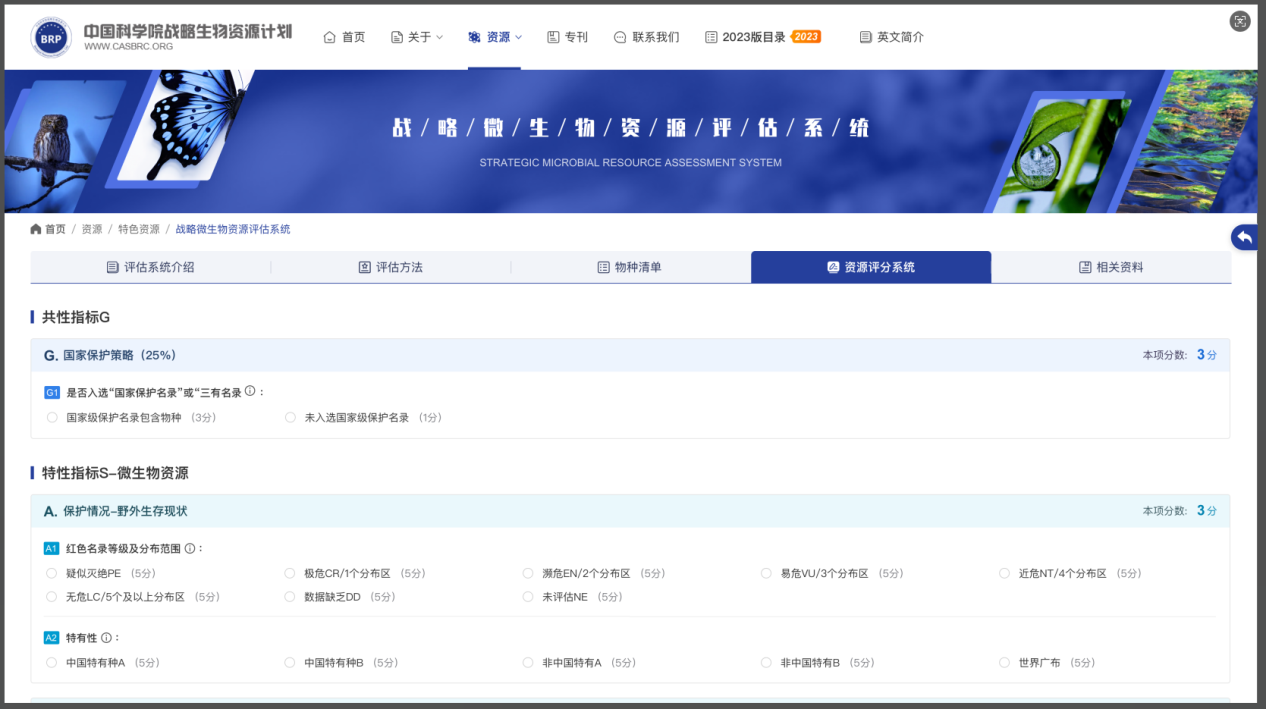
Fig. 1 Online assessment function of the assessment system for strategic microbial resources
| [1] |
Bai M, Zhou LW, Tong YJ, Yin F (2023) Risk assessment and warning system for strategic biological resources in China. The Innovation Life, 1, 100004.
DOI URL |
| [2] |
Blackburn HD (2006) The national animal germplasm program: Challenges and opportunities for poultry genetic resources. Poultry Science, 85, 210-215.
DOI URL |
| [3] |
Dai YC, Yang ZL, Cui BK, Wu G, Yuan HS, Zhou LW, He SH, Ge ZW, Wu F, Wei YL, Yuan Y, Si J (2021) Diversity and systematics of the important macrofungi in Chinese forests. Mycosystema, 40, 770-805. (in Chinese with English abstract)
DOI |
|
[戴玉成, 杨祝良, 崔宝凯, 吴刚, 袁海生, 周丽伟, 何双辉, 葛再伟, 吴芳, 魏玉莲, 员瑗, 司静 (2021) 中国森林大型真菌重要类群多样性和系统学研究. 菌物学报, 40, 770-805.]
DOI |
|
| [4] | Fan JA, Zhao XQ (1997) Study on risk assessment system and methods of invasive pests in crops. Plant Quarantine, 11(2), 75-81. (in Chinese with English abstract) |
| [范京安, 赵学谦 (1997) 农作物外来有害生物风险评估体系与方法研究. 植物检疫, 11(2), 75-81.] | |
| [5] |
Gao RF, Wang Y, Zhong YT, Zheng MS, Liu J, Xian JH, Zhang GM (2024) Research progress on DNA barcoding of quarantine fungi. Mycosystema, 43, 230270. (in Chinese with English abstract)
DOI |
|
[高瑞芳, 汪莹, 钟友婷, 郑铭森, 刘建, 冼嘉恒, 章桂明 (2024) 检疫性真菌DNA条形码研究进展. 菌物学报, 43, 230270.]
DOI |
|
| [6] | International Standards for Phytosanitary Measures (2021) ISPM 21, Pest Risk Analysis for Regulated Non-quarantine Pests. International Plant Protection Convention, Rome. |
| [7] | IUCN (International Union for Conservation of Nature) (2012a) Guidelines for Application of IUCN Red List Criteria at Regional and National Levels, Version 4.0. IUCN, Gland, Switzerland & Cambridge, UK. |
| [8] | IUCN (International Union for Conservation of Nature) (2012b) IUCN Red List Categories and Criteria, Version 3.1, 2nd edn. IUCN, Gland, Switzerland & Cambridge, UK. |
| [9] | IUCN (International Union for Conservation of Nature) (2024) The IUCN Red List of Threatened Species 2024. https://www.iucnredlist.org. (accessed on 2024-03-20) |
| [10] | Li Y (2018) The status, opportunities and challenges of edible fungi industry in China: Develop with Chinese characteristics, realize the dream of powerful mushroom industrial country. Journal of Fungal Research, 16, 125-131. (in Chinese with English abstract) |
| [李玉 (2018) 中国食用菌产业发展现状、机遇和挑战——走中国特色菇业发展之路, 实现食用菌产业强国之梦. 菌物研究, 16, 125-131.] | |
| [11] | Li Y, Li TH, Yang ZL, Bau T, Dai YC (2015) Atlas of Chinese Macrofungal Resources. Zhongyuan Farmers Press, Zhengzhou. (in Chinese) |
| [李玉, 李泰辉, 杨祝良, 图力古尔, 戴玉成 (2015) 中国大型菌物资源图鉴. 中原农民出版社, 郑州.] | |
| [12] | Liang JM, Wang K, Du Z, Zhao MJ, Cai L, Dai YC (2025) Typification and genome analyses of early described fungal species: A case study of Lysurus mokusin, the first new fungal species described in China. Mycosystema, 44, 240296. (in Chinese with English abstract) |
|
[梁俊敏, 王科, 杜卓, 赵明君, 蔡磊, 戴玉成 (2025) 早期描述物种的模式标定及基因组解析: 以中国第一个被描述的真菌新种五棱散尾鬼笔为例. 菌物学报, 44, 240296.]
DOI |
|
| [13] | Ministry of Agriculture and Rural Affairs of the People’s Republic of China (2020) List of Crop Pests and Diseases I. (in Chinese) |
| [ 中华人民共和国农业农村部 (2020) 一类农作物病虫害名录.] https://www.moa.gov.cn/nybgb/2020/202010/202011/t20201130_6357326.htm.(accessedon2025-01-10) | |
| [14] | Ministry of Commerce of the People’s Republic of China, Ministry of Science, Technology of the People’s Republic of Chin(2020) Amendments to the Catalogue of Technologies Prohibited or Restricted for Export from China. (in Chinese) |
| [ 中华人民共和国商务部, 中华人民共和国科学技术部 (2020) 《中国禁止出口限制出口技术目录》调整内容.] https://www.gov.cn/zhengce/zhengceku/2020-08/29/5538299/files/135c5cdd6baa46a986ac5e51a1a49ac3.pdf. (accessed on 2025-01-10) | |
| [15] | Ministry of Ecology and Environment of the People’s Republic of China, Chinese Academy of Sciences (2018) Red List of China’s Biodiversity—Macrofungi. (in Chinese) |
| [ 中华人民共和国生态环境部, 中国科学院 (2018) 中国生物多样性红色名录——大型真菌卷.] https://www.mee.gov.cn/xxgk2018/xxgk/xxgk01/201805/t20180524_629586.html. (accessed on 2025-01-10) | |
| [16] | National Forestry and Grassland Administration, Ministry of Agriculture and Rural Affairs of the People’s Republic of China(2021) List of National Key Protected Wild Plants. (in Chinese) |
| [国家林业和草原局, [农业农村部 (2021) 国家重点保护野生植物名录.] https://www.forestry.gov.cn/c/www/gkml/11057.jhtml.(accessedon2025-01-10) | |
| [17] | Qin YF, Zhao P, Han SL, Liu F, Wang K, Duan WJ, Gong WF, Wang HX, Cai L (2024) Taxonomic status of quarantine-significant Fusarium species of China. Mycosystema, 43, 240024. (in Chinese with English abstract) |
|
[秦玉凡, 赵鹏, 韩士玲, 刘芳, 王科, 段维军, 巩文峰, 王海香, 蔡磊 (2024) 我国进境检疫性镰孢属物种的分类现状. 菌物学报, 43, 240024.]
DOI |
|
| [18] | State Council of the People’s Republic of China (2002) Regulations on Export Control of Dual-Use Biologics and Related Equipment & Technologies. (in Chinese) |
| [ 中华人民共和国国务院 (2002) 中华人民共和国生物两用品及相关设备和技术出口管制条例.] https://www.gov.cn/gongbao/content/2002/content_61806.htm. (accessed on 2025-01-10) | |
| [19] |
Wang K, Cai L (2023) Overview of the historical and current status of fungal taxonomy and diversity in China. Mycosystema, 42, 50-62. (in Chinese with English abstract)
DOI |
|
[王科, 蔡磊 (2023) 中国菌物分类学和多样性研究的历史与现状概况. 菌物学报, 42, 50-62.]
DOI |
|
| [20] |
Wang K, Liu DM, Cai L, Wu HJ, Li Y, Wei TZ, Wang YH, Wu HM, Wei XD, Li BB, Li JS, Yao YJ (2020) Methods and procedures of the red list assessment of macrofungi in China. Biodiversity Science, 28, 11-19. (in Chinese with English abstract)
DOI |
|
[王科, 刘冬梅, 蔡蕾, 吴海军, 李熠, 魏铁铮, 王永会, 吴红梅, 卫晓丹, 李斌斌, 李俊生, 姚一建 (2020) 中国大型真菌红色名录评估方法和程序. 生物多样性, 28, 11-19.]
DOI |
|
| [21] | Yamazaki Y, Akashi R, Banno Y, Endo T, Ezura H, Fukami-Kobayashi K, Inaba K, Isa T, Kamei K, Kasai F, Kobayashi M, Kurata N, Kusaba M, Matuzawa T, Mitani S, Nakamura T, Nakamura Y, Nakatsuji N, Naruse K, Niki H, Nitasaka E, Obata Y, Okamoto H, Okuma M, Sato K, Serikawa T, Shiroishi T, Sugawara H, Urushibara H, Yamamoto M, Yaoita Y, Yoshiki A, Kohara Y (2010) NBRP databases: Databases of biological resources in Japan. Nucleic Acids Research, 38, D26-D32. |
| [22] |
Yang YM, Li DM (2024) A new species and a new record of human pathogenic fungi in China. Mycosystema, 43, 240115. (in Chinese with English abstract)
DOI |
|
[杨亚敏, 李东明 (2024) 人类病原真菌一个新种和一个中国新记录种. 菌物学报, 43, 240115.]
DOI |
|
| [23] | Yuan Y, Bian LS, Wu YD, Chen JJ, Wu F, Liu HG, Zeng GY, Dai YC (2023) Species diversity of pathogenic wood-rotting fungi (Agaricomycetes, Basidiomycota) in China. Mycology, 14, 204-226. |
| [24] | Zeng Y, Zhou J (2019) Strengthening effective protection and sustainable utilization of strategic biological resources in China. Bulletin of Chinese Academy of Sciences, 34, 1345-1350. (in Chinese with English abstract) |
| [曾艳, 周桔 (2019) 加强我国战略生物资源有效保护与可持续利用. 中国科学院院刊, 34, 1345-1350.] | |
| [25] |
Zhuang WY, Li Y, Zheng HD, Zeng ZQ, Wang XC (2020) Threat status of non-lichenized macro-ascomycetes in China and its threatening factors. Biodiversity Science, 28, 26-40. (in Chinese with English abstract)
DOI |
|
[庄文颖, 李熠, 郑焕娣, 曾昭清, 王新存 (2020) 中国非地衣型大型子囊菌受威胁现状评估及致危因素. 生物多样性, 28, 26-40.]
DOI |
| [1] | Shurong Tian, Ying Wei, Fen Xiao, Yunyun Zhou, Yixing Xie, Cheng Wang, Fen Song, Zhiqiang Liang, Xiaojie Gui. Population dynamics and conservation strategies of Andrias davidianus in Hunan Zhangjiajie Giant Salamander National Nature Reserve, China [J]. Biodiv Sci, 2025, 33(7): 24581-. |
| [2] | Yi Murong, Lu Ping, Peng Yong, Tang Yong, Xu Jiuheng, Yin Haoping, Zhang Luyang, Weng Xiaodong, Di Mingxiao, Lei Juan, Lu Chenqi, Cao Rujun, Dai Nianhua, Zhan Deyang, Tong Mei, Lou Zhiming, Ding Yonggang, Chai Jing, Che Jing. Population status and habitat of Critically Endangered Jiangxi giant salamander (Andrias jiangxiensis) [J]. Biodiv Sci, 2025, 33(4): 24145-. |
| [3] | Fangtao Cai, Sheng Wang, Xingkun Hu, Xiping Yuan, Dongdong Zhai, Yuanyuan Chen, Yanfu Que, Fei Xiong, Hongyan Liu, Xinbin Duan. Multivariate morphological characteristics of different populations of Ochetobius elongatus in the middle and lower reaches of the Yangtze River [J]. Biodiv Sci, 2025, 33(11): 25136-. |
| [4] | Yunrui Ji, Xuelei Wei, Guofeng Zhang, Minggui Xiang, Yongchao Wang, Renhu Gong, Yang Hu, Diqiang Li, Fang Liu. Diversity and composition of bird species in the Hubei Wufeng Houhe National Nature Reserve [J]. Biodiv Sci, 2022, 30(7): 21475-. |
| [5] | Yanyan Liu, Chang Liu, Xiaoxin Wei. Current status of taxonomy, systematics and conservation of the white pines in China and adjacent regions [J]. Biodiv Sci, 2022, 30(2): 21344-. |
| [6] | Yong Yang, Chao Tan, Zhi Yang. Conservation of gymnosperms in China: Perspectives from the List of National Key Protected Wild Plants [J]. Biodiv Sci, 2021, 29(12): 1591-1598. |
| [7] | Wenting Wang, Tingting Yang, Lei Jin, Jiamin Jiang. Vulnerability of two Rhodiola species under climate change in the future [J]. Biodiv Sci, 2021, 29(12): 1620-1628. |
| [8] | Yuanyuan Dong. Constructing a biosafety evaluation system based on DPSEEA model: A case study of Shenzhen [J]. Biodiv Sci, 2021, 29(11): 1530-1538. |
| [9] | Zhongcheng Liu, Zhong Zhang, Yong Lan, Wanyi Zhao, Jia Liu, Chunquan Chen, Wenbo Liao, Lei Wang. Status and management strategy for rare and endangered key protected wild plants in the Luoxiao Mountains [J]. Biodiv Sci, 2020, 28(7): 867-875. |
| [10] | Zhigang Jiang, Jianping Jiang, Yuezhao Wang, E Zhang, Yanyun Zhang, Bo Cai. Significance of country red lists of endangered species for biodiversity conservation [J]. Biodiv Sci, 2020, 28(5): 558-565. |
| [11] | Yanjie Ma, Haopeng He, Wenjing Shen, Biao Liu, Kun Xue. Effects of transgenic maize on arthropod diversity [J]. Biodiv Sci, 2019, 27(4): 419-432. |
| [12] | Qiujie Zhou, Yacheng Cai, Wei Lun Ng, Wei Wu, Seping Dai, Feng Wang, Renchao Zhou. Molecular evidence for natural hybridization between two Melastoma species endemic to Hainan and their widespread congeners [J]. Biodiv Sci, 2017, 25(6): 638-646. |
| [13] | Zhigang Jiang, Lili Li, Zhenhua Luo, Songhua Tang, Chunwang Li, Huijian Hu, Yong Ma, Yi Wu, Yingxiang Wang, Kaiya Zhou, Shaoying Liu, Zuojian Feng, Lei Cai, Chunxin Zang, Yan Zeng, Zhibin Meng, Xiaoge Ping, Hongxia Fang. Evaluating the status of China’s mammals and analyzing their causes of endangerment through the red list assessment [J]. Biodiv Sci, 2016, 24(5): 552-567. |
| [14] | Aihong Yang, Jinju Zhang, Hua Tian, Xiaohong Yao, Hongwen Huang. Microsatellite genetic diversity and fine-scale spatial genetic structure within a natural stand of Liriodendron chinense (Magnoliaceae) in Lanmushan, Duyun City, Guizhou Province [J]. Biodiv Sci, 2014, 22(3): 375-384. |
| [15] | Zhigang Jiang, Zhenhua Luo. Assessing species endangerment status: progress in research and an example from China [J]. Biodiv Sci, 2012, 20(5): 612-622. |
| Viewed | ||||||
|
Full text |
|
|||||
|
Abstract |
|
|||||
Copyright © 2026 Biodiversity Science
Editorial Office of Biodiversity Science, 20 Nanxincun, Xiangshan, Beijing 100093, China
Tel: 010-62836137, 62836665 E-mail: biodiversity@ibcas.ac.cn

