

生物多样性 ›› 2026, Vol. 34 ›› Issue (8): 26055. DOI: 10.17520/biods.2026055 cstr: 32101.14.biods.2026055
普晓妍1,2,6( ), 岩光3, 吉馗4, 周鑫雨2,8, 冯磊鋆2, 段志宇4,7, 杨雄显5,7, 杨南3, 卢华正2,*()(
 )
收稿日期:2026-02-24
接受日期:2026-07-02
出版日期:2026-08-20
发布日期:2026-10-21
通讯作者:
*E-mail: luhuazheng@xtbg.org.cn
基金资助:
Xiaoyan Pu1,2,6(), Guang Yan3, Kui Ji4, Xinyu Zhou2,8, Leiyun Feng2, Zhiyu Duan4,7, Xiongxian Yang5,7, Nan Yang3, Huazheng Lu2,*()()
Received:2026-02-24
Accepted:2026-07-02
Online:2026-08-20
Published:2026-10-21
Contact:
*E-mail: luhuazheng@xtbg.org.cn
Supported by:摘要:
在调查覆盖受限条件下, 准确识别外来入侵植物薇甘菊(Mikania micrantha)的相对发生集中区域和优先核查单元, 可以为保护地外来入侵植物巡查布设、斑块复核和动态监测提供空间参考。本文以西双版纳国家级自然保护区及其周边区域为研究区, 基于薇甘菊的发生记录和调查航迹开展空间分析。共获得薇甘菊发生记录336条, 整合调查航迹线要素283个, 累计航迹长度为737.75 km。计算发生点至最近调查航迹的距离, 以调查航迹两侧200 m缓冲区构建空间分析支持范围。在该范围内, 采用带宽为2 km、分辨率为200 m的高斯核密度估计方法估计相对发生强度; 依据核密度值的第50、第75和第90百分位数(P50、P75和P90)划分低、中、高和极高4类相对发生风险区; 通过局部极大值识别和邻近合并确定高发生强度节点, 并依据节点2 km局部调查支持范围内斑块面积密度的P50和P75, 将节点划分为一级(斑块面积密度 ≥ P75)、二级(P50 ≤ 斑块面积密度 < P75)和三级(斑块面积密度 < P50)优先核查节点。结果表明, 336条发生记录均位于最近调查航迹200 m范围内, 发生点至最近调查航迹的平均距离为0.96 m, 最大距离为10.90 m; 空间分析支持范围面积为282.96 km2。高风险区和极高风险区合计占支持范围面积的25.01%, 包含74.11%的发生记录; 其中, 极高风险区占10.01%, 包含44.94%的发生记录。共识别出6个高发生强度节点, 其中S4和S1为一级重点核查节点, S3为二级重点核查节点, S2、S5和S6为三级一般核查节点。薇甘菊发生记录与调查航迹之间具有较强的空间对应关系。基于调查航迹构建空间分析支持范围, 可在不外推未调查区域风险的前提下, 识别支持范围内的相对发生风险分区和优先核查节点。该方法可为调查覆盖受限条件下外来入侵植物的空间化巡查和复核提供参考。
普晓妍, 岩光, 吉馗, 周鑫雨, 冯磊鋆, 段志宇, 杨雄显, 杨南, 卢华正 (2026) 调查支持范围内薇甘菊相对发生风险分区与优先核查节点识别. 生物多样性, 34, 26055. DOI: 10.17520/biods.2026055.
Xiaoyan Pu, Guang Yan, Kui Ji, Xinyu Zhou, Leiyun Feng, Zhiyu Duan, Xiongxian Yang, Nan Yang, Huazheng Lu (2026) Relative occurrence-risk zoning and identification of priority verification nodes for Mikania micrantha within the survey-supported spatial extent. Biodiversity Science, 34, 26055. DOI: 10.17520/biods.2026055.
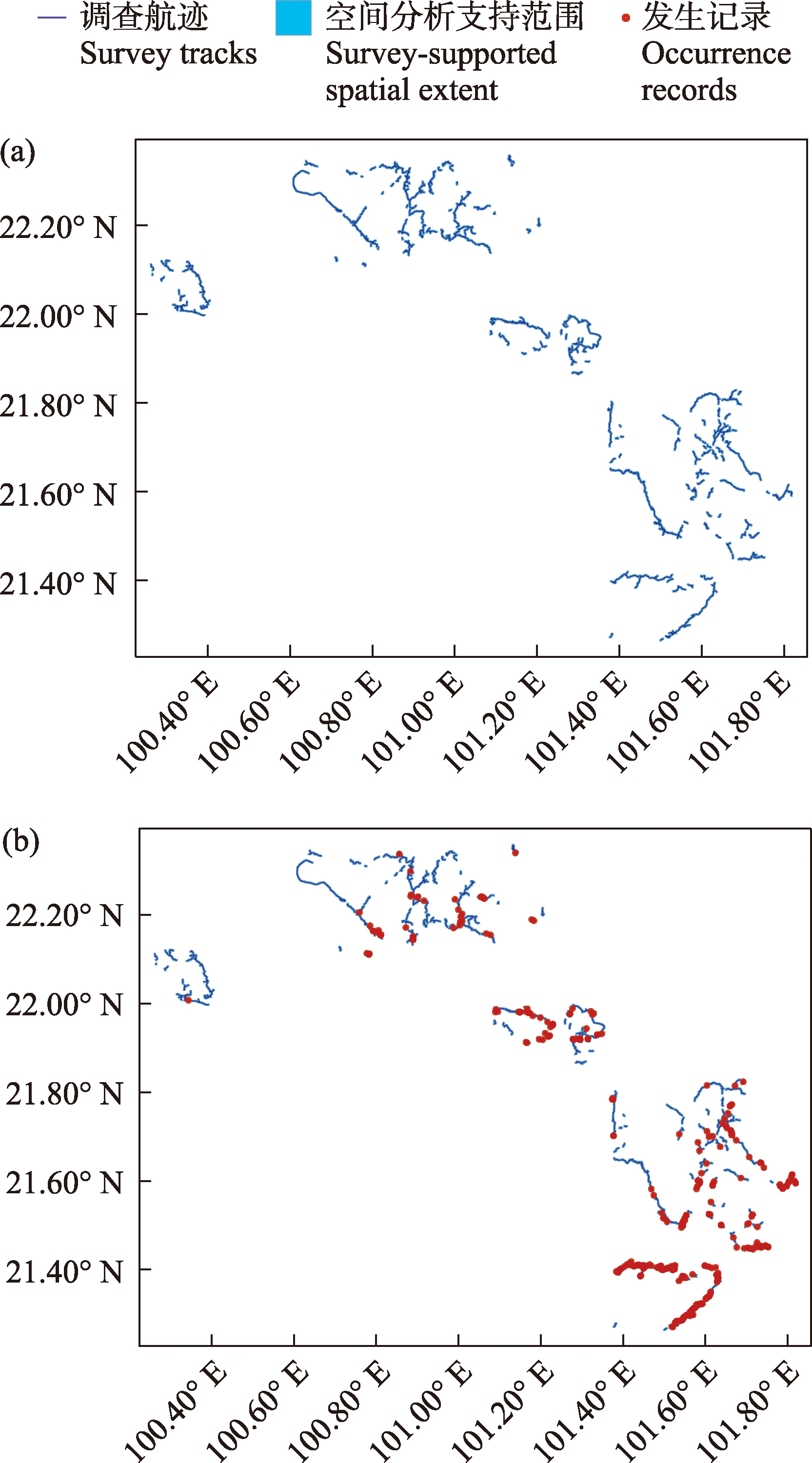
图1 西双版纳国家级自然保护区及其周边区域薇甘菊的调查航迹、发生记录与空间分析支持范围。空间分析支持范围由调查航迹两侧200 m缓冲区构建。
Fig. 1 Survey tracks, occurrence records of Mikania micrantha, and the survey-supported spatial extent in and around Xishuangbanna National Nature Reserve, China. The survey-supported spatial extent was defined by a 200-m buffer on both sides of survey tracks.
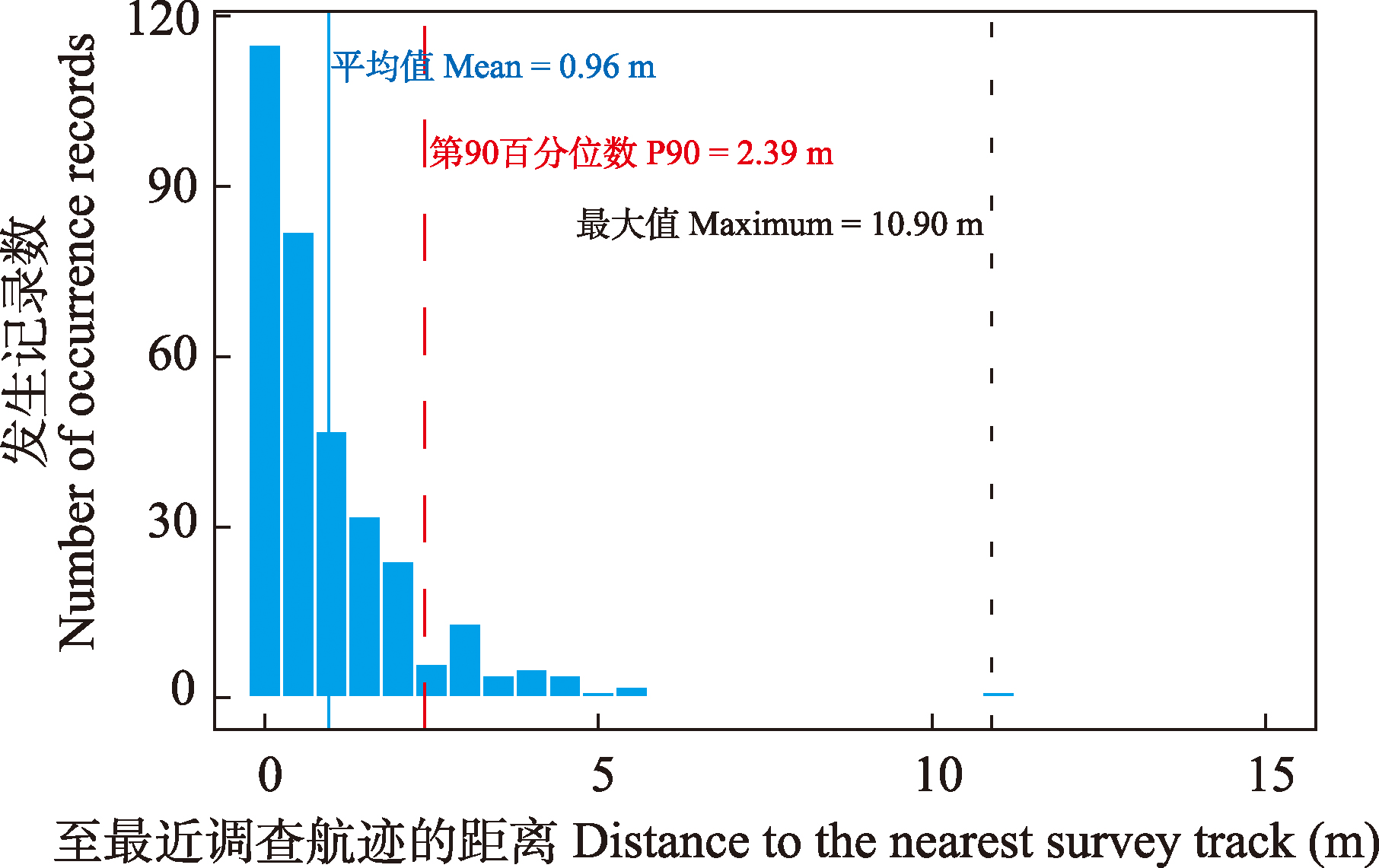
图2 薇甘菊发生记录至最近调查航迹的距离分布
Fig. 2 Distribution of distances from Mikania micrantha occurrence records to the nearest survey track
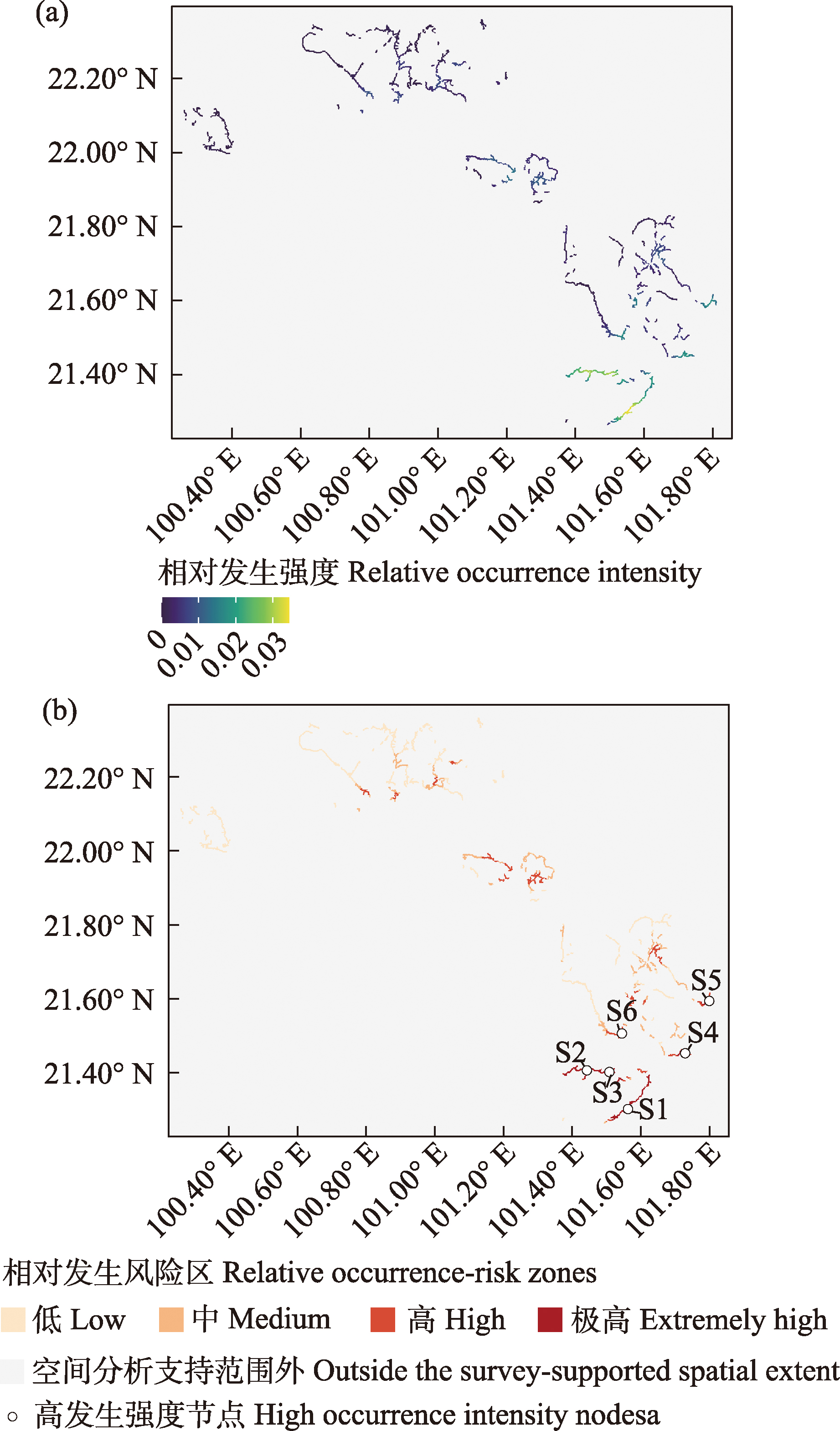
图3 空间分析支持范围内薇甘菊相对发生强度(a)与相对发生风险分区及高发生强度节点(b)。低、中、高和极高风险区依据核密度值的P50、P75和P90划分。
Fig. 3 Relative occurrence intensity (a) and relative occurrence-risk zones and high occurrence intensity nodes (b) of Mikania micrantha within the survey-supported spatial extent. Low, medium, high, and extremely high risk zones were classified using the P50, P75, and P90 thresholds of kernel density values.
| 相对发生风险区 Relative occurrence risk zone | 面积 Area (km2) | 比例 Proportion (%) | 发生记录数 No. of occurrence records |
|---|---|---|---|
| 低风险区 Low risk zone | 141.48 | 50.00 | 18 |
| 中风险区 Medium risk zone | 70.72 | 24.99 | 69 |
| 高风险区 High risk zone | 42.44 | 15.00 | 98 |
| 极高风险区 Extremely high risk zone | 28.32 | 10.01 | 151 |
| 合计 Total | 282.96 | 100.00 | 336 |
表1 空间分析支持范围内不同相对发生风险区的面积、比例与薇甘菊发生记录数
Table 1 Area, proportion, and number of Mikania micrantha occurrence records in relative occurrence risk zones within the survey-supported spatial extent
| 相对发生风险区 Relative occurrence risk zone | 面积 Area (km2) | 比例 Proportion (%) | 发生记录数 No. of occurrence records |
|---|---|---|---|
| 低风险区 Low risk zone | 141.48 | 50.00 | 18 |
| 中风险区 Medium risk zone | 70.72 | 24.99 | 69 |
| 高风险区 High risk zone | 42.44 | 15.00 | 98 |
| 极高风险区 Extremely high risk zone | 28.32 | 10.01 | 151 |
| 合计 Total | 282.96 | 100.00 | 336 |
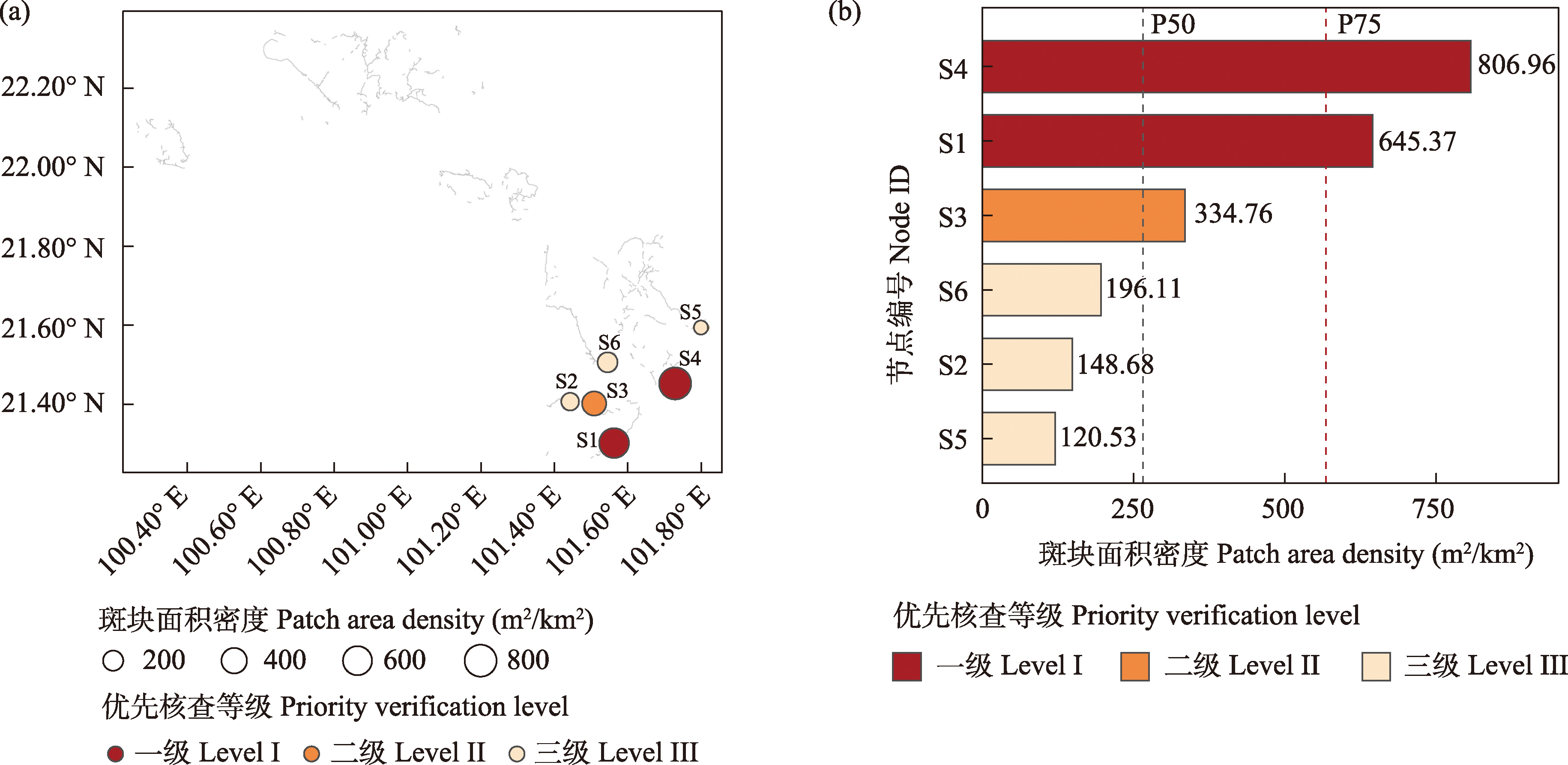
图4 高发生强度节点(S1-S6)的空间分布与优先核查等级(a)及局部斑块面积密度(b)
Fig. 4 Spatial distribution and priority verification levels (a) and local patch-area density (b) of high occurrence intensity nodes (S1-S6)
| 节点编号 Node ID | 节点核密度估计值 Node kernel density estimate | 局部支持面积 Local support area (km2) | 局部发生记录数 No. of local occurrence records | 总斑块面积 Total patch area (m2) | 斑块面积密度 Patch area density (m2/km2) | 优先核查等级 Priority verification level |
|---|---|---|---|---|---|---|
| S4 | 0.01856 | 3.02 | 11 | 2,440 | 806.96 | 一级重点核查节点 Level I node (priority verification) |
| S1 | 0.03438 | 2.49 | 18 | 1,605 | 645.37 | 一级重点核查节点 Level I node (priority verification) |
| S3 | 0.03058 | 2.69 | 19 | 900 | 334.76 | 二级重点核查节点 Level II node (priority verification) |
| S6 | 0.01735 | 2.68 | 11 | 525 | 196.11 | 三级一般核查节点 Level III node (routine verification) |
| S2 | 0.03089 | 2.76 | 16 | 410 | 148.68 | 三级一般核查节点 Level III node (routine verification) |
| S5 | 0.01810 | 3.19 | 12 | 385 | 120.53 | 三级一般核查节点 Level III node (routine verification) |
表2 高发生强度节点的局部发生负荷与优先核查等级
Table 2 Local occurrence burden and priority verification levels of high-occurrence-intensity nodes
| 节点编号 Node ID | 节点核密度估计值 Node kernel density estimate | 局部支持面积 Local support area (km2) | 局部发生记录数 No. of local occurrence records | 总斑块面积 Total patch area (m2) | 斑块面积密度 Patch area density (m2/km2) | 优先核查等级 Priority verification level |
|---|---|---|---|---|---|---|
| S4 | 0.01856 | 3.02 | 11 | 2,440 | 806.96 | 一级重点核查节点 Level I node (priority verification) |
| S1 | 0.03438 | 2.49 | 18 | 1,605 | 645.37 | 一级重点核查节点 Level I node (priority verification) |
| S3 | 0.03058 | 2.69 | 19 | 900 | 334.76 | 二级重点核查节点 Level II node (priority verification) |
| S6 | 0.01735 | 2.68 | 11 | 525 | 196.11 | 三级一般核查节点 Level III node (routine verification) |
| S2 | 0.03089 | 2.76 | 16 | 410 | 148.68 | 三级一般核查节点 Level III node (routine verification) |
| S5 | 0.01810 | 3.19 | 12 | 385 | 120.53 | 三级一般核查节点 Level III node (routine verification) |
| [1] | Adriaensen F, Chardon JP, De Blust G, Swinnen E, Villalba S, Gulinck H, Matthysen E (2003) The application of least-cost modelling as a functional landscape model. Landscape and Urban Planning, 64, 233-247. |
| [2] | Baddeley A, Rubak E, Turner R (2015) Spatial Point Patterns: Methodology and Applications with R. Chapman & Hall/CRC Press, London. |
| [3] | Bellard C, Thuiller W, Leroy B, Genovesi P, Bakkenes M, Courchamp F (2013) Will climate change promote future invasions? Global Change Biology, 19, 3740-3748. |
| [4] | Boakes EH, McGowan PJK, Fuller RA, Ding CQ, Clark NE, O’Connor K, Mace GM (2010) Distorted views of biodiversity: Spatial and temporal bias in species occurrence data. PLoS Biology, 8, e1000385. |
| [5] | Brown JH, Whitham TG, Morgan Ernest SK, Gehring CA (2001) Complex species interactions and the dynamics of ecological systems: Long-term experiments. Science, 293, 643-650. |
| [6] | Cao X, Han SC, Lü X, Li ZG, Fan ZW (2010) Effects of simulated acid rain on seed germination and seedling growth of Mikania micrantha. Ecology and Environmental Sciences, 19, 679-685. (in Chinese with English abstract) |
| [曹欣, 韩诗畴, 吕欣, 李志刚, 范志伟 (2010) 模拟酸雨对薇甘菊种子萌发和幼苗生长的影响. 生态环境学报, 19, 679-685.] | |
| [7] | Catford JA, Jansson R, Nilsson C (2009) Reducing redundancy in invasion ecology by integrating hypotheses into a single theoretical framework. Diversity and Distributions, 15, 22-40. |
| [8] | CBD (Convention on Biological Diversity)(2022) Kunming-Montreal Global Biodiversity Framework. CBD Secretariat, Montreal. |
| [9] | Dennis EB, Morgan BJT, Freeman SN, Brereton TM, Roy DB (2019) Bias correction and Bayesian methods for modelling species distributions with presence-only data. Methods in Ecology and Evolution, 10, 2093-2106. |
| [10] | D’Antonio CM, Levine JM, Thomsen M (2001) Ecosystem resistance to invasion and the role of propagule supply: A California perspective. Journal of Mediterranean Ecology, 2, 233-245. |
| [11] | Early R, Bradley BA, Dukes JS, Lawler JJ, Olden JD, Blumenthal DM, Gonzalez P, Grosholz ED, Ibañez I, Miller LP, Sorte CJB, Tatem AJ (2016) Global threats from invasive alien species in the twenty-first century and national response capacities. Nature Communications, 7, 12485. |
| [12] | Elton CS (1958) The Ecology of Invasions by Animals and Plants. Methuen, London. |
| [13] | Epanchin-Niell RS, Hastings A (2010) Controlling established invaders: Integrating economics and spread dynamics to determine optimal management. Ecology Letters, 13, 528-541. |
| [14] | Feng HL (2004) The Invasiveness and Ecological Control of Exotic Plant Mikania micrantha H.B.K. in China. PhD dissertation, South China Botanical Garden, Chinese Academy of Sciences, Guangzhou. (in Chinese with English abstract) |
| [冯惠玲 (2004) 外来种薇甘菊入侵特性与生态控制的研究. 博士学位论文, 中国科学院华南植物园, 广州.] | |
| [15] | Forman RTT, Alexander LE (1998) Roads and their major ecological effects. Annual Review of Ecology and Systematics, 29, 207-231. |
| [16] | Foxcroft LC, Pickett STA, Cadenasso ML, McGrath B (2011) Expanding the conceptual frameworks of plant invasion ecology. Perspectives in Plant Ecology, Evolution and Systematics, 13, 89-100. |
| [17] | Foxcroft LC, Pyšek P, Richardson DM, Genovesi P (2013) Plant Invasions in Protected Areas: Patterns, Problems and Challenges. Springer, Dordrecht. |
| [18] | Guillera-Arroita G (2017) Modelling of species distributions, range dynamics and communities under imperfect detection: Advances, challenges and opportunities. Ecography, 40, 281-295. |
| [19] | Guillera-Arroita G, Lahoz-Monfort JJ, Elith J, Gordon A, Kujala H, Lentini PE, McCarthy MA, Tingley R, Wintle BA (2015) Is my species distribution model fit for purpose? Matching data and models to applications. Global Ecology and Biogeography, 24, 276-292. |
| [20] | Guo CD, Zhu JF, Liu XY, Zhao CY, Li JS (2021) Contrasting biodiversity of invasive herbs inside and outside nature reserves in Guizhou. Biodiversity Science, 29, 596-604. (in Chinese with English abstract) |
| [郭朝丹, 朱金方, 柳晓燕, 赵彩云, 李俊生 (2021) 贵州典型自然保护区内外外来入侵草本植物的比较. 生物多样性, 29, 596-604.] | |
| [21] | Guo Q, Fei S, Dukes JS, Oswalt CM, Iannone BV III, Potter KM (2021) Global change and biological invasions: Challenges and opportunities. Biological Invasions, 23, 1-14. |
| [22] | Hastings A, Cuddington K, Davies KF, Dugaw CJ, Elmendorf S, Freestone A, Harrison S, Holland M, Lambrinos J, Malvadkar U, Melbourne BA, Moore K, Taylor C, Thomson D (2005) The spatial spread of invasions: New developments in theory and evidence. Ecology Letters, 8, 91-101. |
| [23] | Holm LG, Plucknett DL, Pancho JV, Herberger JP (1977) The World’s Worst Weeds:Distribution and Biology. University Press of Hawaii, Honolulu. |
| [24] | Huang DG, Zhou XY, Zan QJ, Wang YJ, Liao WB (2007) The chemical control of Mikania micrantha in the country park of Hong Kong. Journal of South China Normal University (Natural Science Edition), 39(3), 109-114, 131. (in Chinese with English abstract) |
| [黄东光, 周先叶, 昝启杰, 王勇军, 廖文波 (2007) 香港郊野公园薇甘菊的化学防除研究. 华南师范大学学报(自然科学版), 39(3), 109-114, 131.] | |
| [25] | Hulme PE (2009) Trade, transport and trouble: Managing invasive species pathways in an era of globalization. Journal of Applied Ecology, 46, 10-18. |
| [26] | Isaac NJB, Pocock MJO (2015) Bias and information in biological records. Biological Journal of the Linnean Society, 115, 522-531. |
| [27] | Isaac NJB, van Strien AJ, August TA, de Zeeuw MP, Roy DB (2014) Statistics for citizen science: Extracting signals of change from noisy ecological data. Methods in Ecology and Evolution, 5, 1052-1060. |
| [28] | Kadoya T, Ishii HS, Kikuchi R, Suda SI, Washitani I (2020) Using monitoring data to detect biodiversity change. Biological Conservation, 248, 108650. |
| [29] | Lawton JH, Brown VK (1994) Redundancy in ecosystems. In: Biodiversity and Ecosystem Function (eds Schulze ED, Mooney HA), pp. 255-270. Springer-Verlag, New York. |
| [30] | Leung B, Lodge DM, Finnoff D, Shogren JF, Lewis MA, Lamberti G (2002) An ounce of prevention or a pound of cure:Bioeconomic risk analysis of invasive species. Proceedings of the Royal Society B: Biological Sciences, 269, 2407-2413. |
| [31] | Liu XW, Zhou YL, Qi CM, Li Y, Wang QX, Guo MX, Yan DD, Cao AC (2012) Effects of invasive plant Mikania micrantha on soil nutrient contents and enzyme activities. Ecology and Environmental Sciences, 21, 1960-1965. (in Chinese with English abstract) |
| [刘小文, 周益林, 齐成媚, 李园, 王秋霞, 郭美霞, 颜冬冬, 曹坳程 (2012) 入侵植物薇甘菊对土壤养分和酶活性的影响. 生态环境学报, 21, 1960-1965.] | |
| [32] | Lockwood JL, Cassey P, Blackburn T (2005) The role of propagule pressure in explaining species invasions. Trends in Ecology & Evolution, 20, 223-228. |
| [33] | Lonsdale WM (1999) Global patterns of plant invasions and the concept of invasibility. Ecology, 80, 1522-1536. |
| [34] | Lowe S, Browne M, Boudjelas S, De Poorter M (2000) 100 of the World’s Worst Invasive Alien Species: A Selection from the Global Invasive Species Database. Invasive Species Specialist Group (ISSG), IUCN Species Survival Commission (SSC), Auckland. |
| [35] | Ma KP (2023) Kunming-Montreal Global Biodiversity Framework: An important global agenda for biodiversity conservation. Biodiversity Science, 31, 23133. (in Chinese) |
| [马克平 (2023) 《昆明-蒙特利尔全球生物多样性框架》是重要的全球生物多样性保护议程. 生物多样性, 31, 23133.] | |
| [36] | Mack RN, Simberloff D, Lonsdale WM, Evans H, Clout M, Bazzaz FA (2000) Biotic invasions: Causes, epidemiology, global consequences, and control. Ecological Applications, 10, 689-710. |
| [37] | Mainka SA, Howard GW (2010) Climate change and invasive species: Double jeopardy. Integrative Zoology, 5, 102-111. |
| [38] | Margules CR, Pressey RL (2000) Systematic conservation planning. Nature, 405, 243-253. |
| [39] | McRae BH, Dickson BG, Keitt TH, Shah VB (2008) Using circuit theory to model connectivity in ecology, evolution, and conservation. Ecology, 89, 2712-2724. |
| [40] | Ouyang ZY, Du A, Xu WH (2020) Research on China’s protected area system classification. Acta Ecologica Sinica, 40, 7207-7215. (in Chinese with English abstract) |
| [欧阳志云, 杜傲, 徐卫华 (2020) 中国自然保护地体系分类研究. 生态学报, 40, 7207-7215.] | |
| [41] | Phillips SJ, Anderson RP, Schapire RE (2006) Maximum entropy modeling of species geographic distributions. Ecological Modelling, 190, 231-259. |
| [42] | Phillips SJ, Dudík M, Elith J, Graham CH, Lehmann A, Leathwick J, Ferrier S (2009) Sample selection bias and presence-only distribution models: Implications for background and pseudo-absence data. Ecological Applications, 19, 181-197. |
| [43] | Pyšek P, Hulme PE, Simberloff D, Bacher S, Blackburn TM, Carlton JT, Dawson W, Essl F, Foxcroft LC, Genovesi P, Jeschke JM, Kühn I, Liebhold AM, Mandrak NE, Meyerson LA, Pauchard A, Pergl J, Roy HE, Seebens H, van Kleunen M, Vilà M, Wingfield MJ, Richardson DM (2020) Scientists’ warning on invasive alien species. Biological Reviews, 95, 1511-1534. |
| [44] | Pyšek P, Richardson DM (2010) Invasive species, environmental change and management, and health. Annual Review of Environment and Resources, 35, 25-55. |
| [45] | Rocchini D, Hortal J, Lengyel S, Lobo JM, Jiménez-Valverde A, Ricotta C, Bacaro G, Chiarucci A (2011) Accounting for uncertainty when mapping species distributions: The need for maps of ignorance. Progress in Physical Geography: Earth and Environment, 35, 211-226. |
| [46] | Royle JA, Chandler RB, Yackulic C, Nichols JD (2012) Likelihood analysis of species occurrence probability from presence-only data for modelling species distributions. Methods in Ecology and Evolution, 3, 545-554. |
| [47] | Schnitzer SA, Bongers F (2002) The ecology of lianas and their role in forests. Trends in Ecology & Evolution, 17, 223-230. |
| [48] | Seebens H, Blackburn TM, Dyer EE, Genovesi P, Hulme PE, Jeschke JM, Pagad S, Pyšek P, Winter M, Arianoutsou M,..., Roy HE, Scalera R, Schindler S, Štajerová K, Tokarska-Guzik B, van Kleunen M, Walker K, Weigelt P, Yamanaka T, Essl F (2017) No saturation in the accumulation of alien species worldwide. Nature Communications, 8, 14435. |
| [49] | Shao H, Peng SL, Zhang C, Xiang YC, Nan P (2003) Allelopathy potential of Mikania micrantha. Chinese Journal of Ecology, 22(5), 62-65. (in Chinese with English abstract) |
| [邵华, 彭少麟, 张弛, 向言词, 南蓬 (2003) 薇甘菊的化感作用研究. 生态学杂志, 22(5), 62-65.] | |
| [50] | Shen SC, Xu GF, Zhang FD, Li TL, Jin GM, Zhang YH (2013) Characteristics of the seed banks and seedling banks of Mikania micrantha-invaded soils different in type of habitat. Journal of Ecology and Rural Environment, 29, 483-488. (in Chinese with English abstract) |
| [申时才, 徐高峰, 张付斗, 李天林, 金桂梅, 张玉华 (2013) 不同生境薇甘菊土壤种子库与幼苗库的特征. 生态与农村环境学报, 29, 483-488.] | |
| [51] | Silverman BW (1986) Density Estimation for Statistics and Data Analysis. Chapman & Hall, London. |
| [52] | Spear SF, Balkenhol N, Fortin MJ, McRae BH, Scribner K (2010) Use of resistance surfaces for landscape genetic studies: Considerations for parameterization and analysis. Molecular Ecology, 19, 3576-3591. |
| [53] | Vitousek PM, D’Antonio CM, Loope LL, Rejmánek M, Westbrooks R (1997) Introduced species: A significant component of human-caused global change. New Zealand Journal of Ecology, 21, 1-16. |
| [54] | Wilson JR, Dormontt EE, Prentis PJ, Lowe AJ, Richardson DM (2009) Something in the way you move: Dispersal pathways affect invasion success. Trends in Ecology & Evolution, 24, 136-144. |
| [55] | With KA (2002) The landscape ecology of invasive spread. Conservation Biology, 16, 1192-1203. |
| [56] | Worton BJ (1989) Kernel methods for estimating the utilization distribution in home-range studies. Ecology, 70, 164-168. |
| [57] | Xiu C, Zheng H, Ouyang ZY (2016) Community characteristics of riparian alien plants influenced by different types of human disturbance: A case study of Yongding River, Beijing. Acta Ecologica Sinica, 36, 4689-4698. (in Chinese with English abstract) |
| [修晨, 郑华, 欧阳志云 (2016) 不同类型人类活动干扰对河岸带外来植物群落的影响--以北京永定河为例. 生态学报, 36, 4689-4698.] | |
| [58] | Xu M, Tian DS, Wang YH, He YC, Cui QG, Li YL, Shen XL, Yuan ZQ, Wang Y (2022) Construction and application of the indicator system for ecosystem monitoring network in the protected areas on a national scale. Chinese Journal of Plant Ecology, 46, 1219-1233. (in Chinese with English abstract) |
| [徐梦, 田大栓, 王易恒, 何奕成, 崔清国, 李跃林, 申小莉, 原作强, 王扬 (2022) 国家尺度自然保护地生态系统联网监测指标体系构建与应用研究. 植物生态学报, 46, 1219-1233.] | |
| [59] | Yackulic CB, Chandler R, Zipkin EF, Royle JA, Nichols JD, Campbell Grant EH, Veran S (2013) Presence-only modelling using MaxEnt: When can we trust the inferences? Methods in Ecology and Evolution, 4, 236-243. |
| [60] | Yang R, Shen XL, Ma KP (2019) Recommendations on building up China’s National-park-centric Protected Area System. Biodiversity Science, 27, 137-139. (in Chinese) |
| [杨锐, 申小莉, 马克平 (2019) 关于贯彻落实“建立以国家公园为主体的自然保护地体系”的六项建议. 生物多样性, 27, 137-139.] | |
| [61] | Zang ZH, Zhang D, Wang N, Du A, Kong LQ, Xu WH, Ouyang ZY (2020) Experiences, achievement, problems and recommendations of the first batch of China’s national park system pilots. Acta Ecologica Sinica, 40, 8839-8850. (in Chinese with English abstract) |
| [臧振华, 张多, 王楠, 杜傲, 孔令桥, 徐卫华, 欧阳志云 (2020) 中国首批国家公园体制试点的经验与成效、问题与建议. 生态学报, 40, 8839-8850.] | |
| [62] | Zeller KA, McGarigal K, Whiteley AR (2012) Estimating landscape resistance to movement: A review. Landscape Ecology, 27, 777-797. |
| [63] | Zhang WY, Wang BS, Li MG, Zan QJ, Wang YJ (2002) The branching pattern and biomass of Mikania micrantha modules in Acacia confusa community and Miscanthus sinensis community. Acta Phytoecologica Sinica, 26, 346-350. (in Chinese with English abstract) |
| [张炜银, 王伯荪, 李鸣光, 昝启杰, 王勇军 (2002) 台湾相思林和芒草草丛中薇甘菊枝构件的分枝格局及其生物量. 植物生态学报, 26, 346-350.] | |
| [64] | Zhao CY, Liu XY, Li FF, Zhu JF, Guo CD, Li JS (2022) The distribution pattern and determinant factors of the main invasive alien plants in national nature reserves in China. Acta Ecologica Sinica, 42, 2532-2541. (in Chinese with English abstract) |
| [赵彩云, 柳晓燕, 李飞飞, 朱金方, 郭朝丹, 李俊生 (2022) 我国国家级自然保护区主要外来入侵植物分布格局及成因. 生态学报, 42, 2532-2541.] |
| [1] | 周铝, 郭画, 姚世贸, 田成. 王朗国家级自然保护区红腹角雉时空分布模式[J]. 生物多样性, 2025, 33(7): 24537-. |
| [2] | 周天祥, 杨华林, 张贵权, 杨建, 冯茜, 胡强, 程跃红, 张晋东, 王彬, 周材权. 四川卧龙国家级自然保护区三种高山同域鸡形目鸟类的时空生态位比较[J]. 生物多样性, 2022, 30(6): 22026-. |
| [3] | 陈立军,束祖飞,肖治术. 应用红外相机数据研究动物活动节律——以广东车八岭保护区鸡形目鸟类为例[J]. 生物多样性, 2019, 27(3): 266-272. |
| [4] | 王家宜, 余涵霞, 赖玉芳, 万方浩, 钱万强, 彭长连, 李伟华. 入侵杂草薇甘菊与本地植物粉葛对水分胁迫的生理响应[J]. 生物多样性, 2017, 25(12): 1267-1275. |
| 阅读次数 | ||||||
|
全文 |
|
|||||
|
摘要 |
|
|||||
备案号:京ICP备16067583号-7
Copyright © 2026 版权所有 《生物多样性》编辑部
地址: 北京香山南辛村20号, 邮编:100093
电话: 010-62836137, 62836665 E-mail: biodiversity@ibcas.ac.cn
