

生物多样性 ›› 2026, Vol. 34 ›› Issue (7): 26080. DOI: 10.17520/biods.2026080 cstr: 32101.14.biods.2026080
温昊1,2( ), 林波3, 陈婧1,2, 尚鹤1, 陈展1,2,*(
 )
收稿日期:2026-03-10
接受日期:2026-05-28
出版日期:2026-07-20
发布日期:2026-09-21
通讯作者:
陈展
基金资助:
Hao Wen1,2(), Bo Lin3, Jing Chen1,2, He Shang1, Zhan Chen1,2,*()
Received:2026-03-10
Accepted:2026-05-28
Online:2026-07-20
Published:2026-09-21
Contact:
Zhan Chen
Supported by:摘要:
为揭示高山松(Pinus densata)林火烧迹地土壤微生物群落的恢复特征, 本研究以高山松林火烧迹地为研究对象, 利用Illumina MiSeq高通量测序技术, 探究火干扰后恢复5年与14年的土壤微生物群落状态。结果表明: (1)恢复14年后, 部分土壤养分指标恢复并超过未受火干扰样地, 其中0-5 cm土层的有机质、全氮、全磷、硝态氮、pH值升高较为显著(P < 0.05); 5-10 cm有机质、全磷和硝态氮升高较为显著(P < 0.05)。(2)恢复5年和14年后, 0-5 cm细菌群落的Shannon指数显著高于未受火干扰样地(CK) (P < 0.05), 而5-10 cm的细菌和两个土层真菌在不同恢复阶段间均无显著差异(P > 0.05)。(3)两个土层细菌群落以放线菌门、变形菌门、酸杆菌门为主; 真菌群落以子囊菌门和担子菌门为主。恢复14年后细菌绝对丰度高于CK, 而真菌绝对丰度仍低于CK。(4)共生型和腐生型真菌在不同土层表现出差异化恢复趋势, 多营养类型真菌相对丰度表现为先增加后降低。(5)火干扰后的恢复时间显著影响两个土层细菌和真菌的群落结构(P < 0.05)。pH值、有机质及氮磷养分等因子与微生物群落分异密切相关。本研究表明, 火干扰后恢复时间是驱动高山松林浅层土壤微生物群落重建的重要因素, 可为高山松林火干扰后土壤生态恢复评估提供科学依据。
温昊, 林波, 陈婧, 尚鹤, 陈展 (2026) 高山松林火烧迹地不同恢复阶段土壤微生物多样性和群落特征. 生物多样性, 34, 26080. DOI: 10.17520/biods.2026080.
Hao Wen, Bo Lin, Jing Chen, He Shang, Zhan Chen (2026) Soil microbial diversity and community characteristics at different post-fire recovery stages of Pinus densata forests. Biodiversity Science, 34, 26080. DOI: 10.17520/biods.2026080.
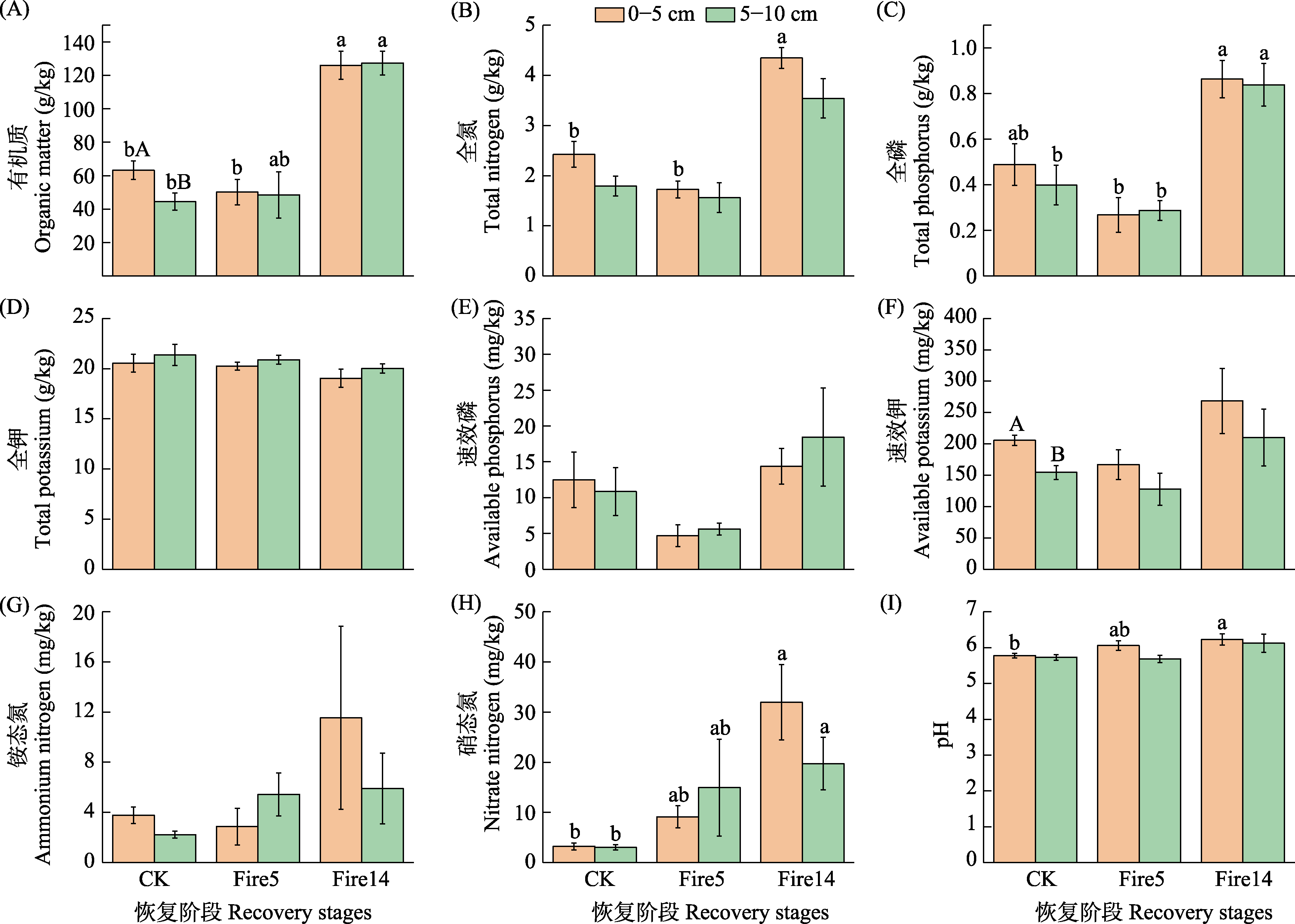
图1 火干扰后不同恢复阶段各土层(0-5 cm和5-10 cm)的土壤理化性质。不同小写字母表示同一土层不同恢复阶段差异显著(P < 0.05), 不同大写字母表示同一恢复阶段不同土层之间差异显著(P < 0.05)。CK: 未受火干扰; Fire5: 火干扰后5年; Fire14: 火干扰后14年。
Fig. 1 Soil physicochemical properties in different soil layers (0-5 cm and 5-10 cm) at different recovery stages after fire disturbance. Different lowercase letters indicate significant differences among recovery stages within the same soil layer (P < 0.05), and different uppercase letters indicate significant differences among soil layers within the same recovery stage (P < 0.05). CK, Unburned; Fire5, 5 years post-fire; Fire14, 14 years post-fire.
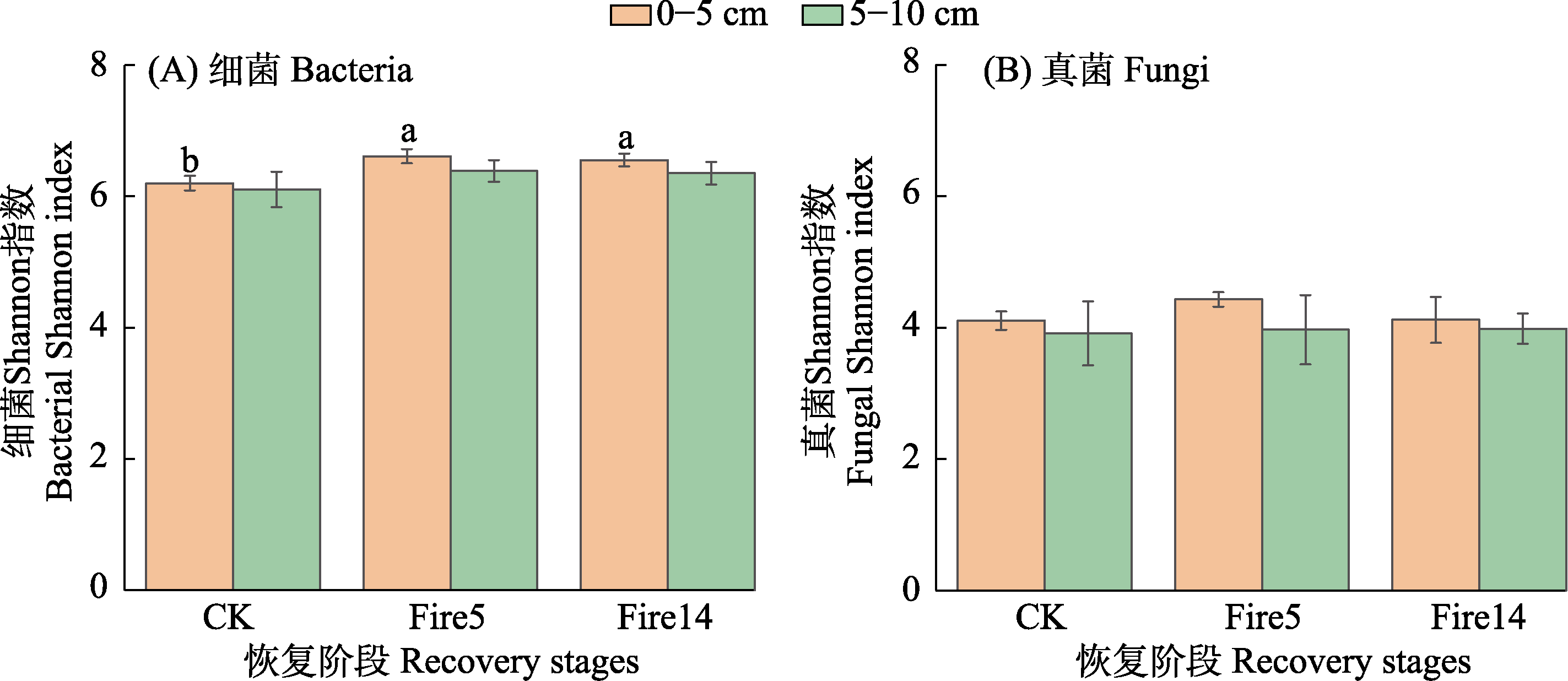
图2 火干扰后不同恢复阶段各土层(0-5 cm和5-10 cm)细菌(A)和真菌(B)的Shannon指数。不同小写字母表示同一土层不同恢复阶段差异显著。CK: 未受火干扰; Fire5: 火干扰后5年; Fire14: 火干扰后14年
Fig. 2 Bacterial (A) and fungal (B) Shannon indices in different soil layers (0-5 cm and 5-10 cm) at different recovery stages after fire disturbance. Different lowercase letters indicate significant differences in Shannon indices across different recovery stages within the same soil layer. CK, Unburned; Fire5, 5 years post-fire; Fire14, 14 years post-fire.
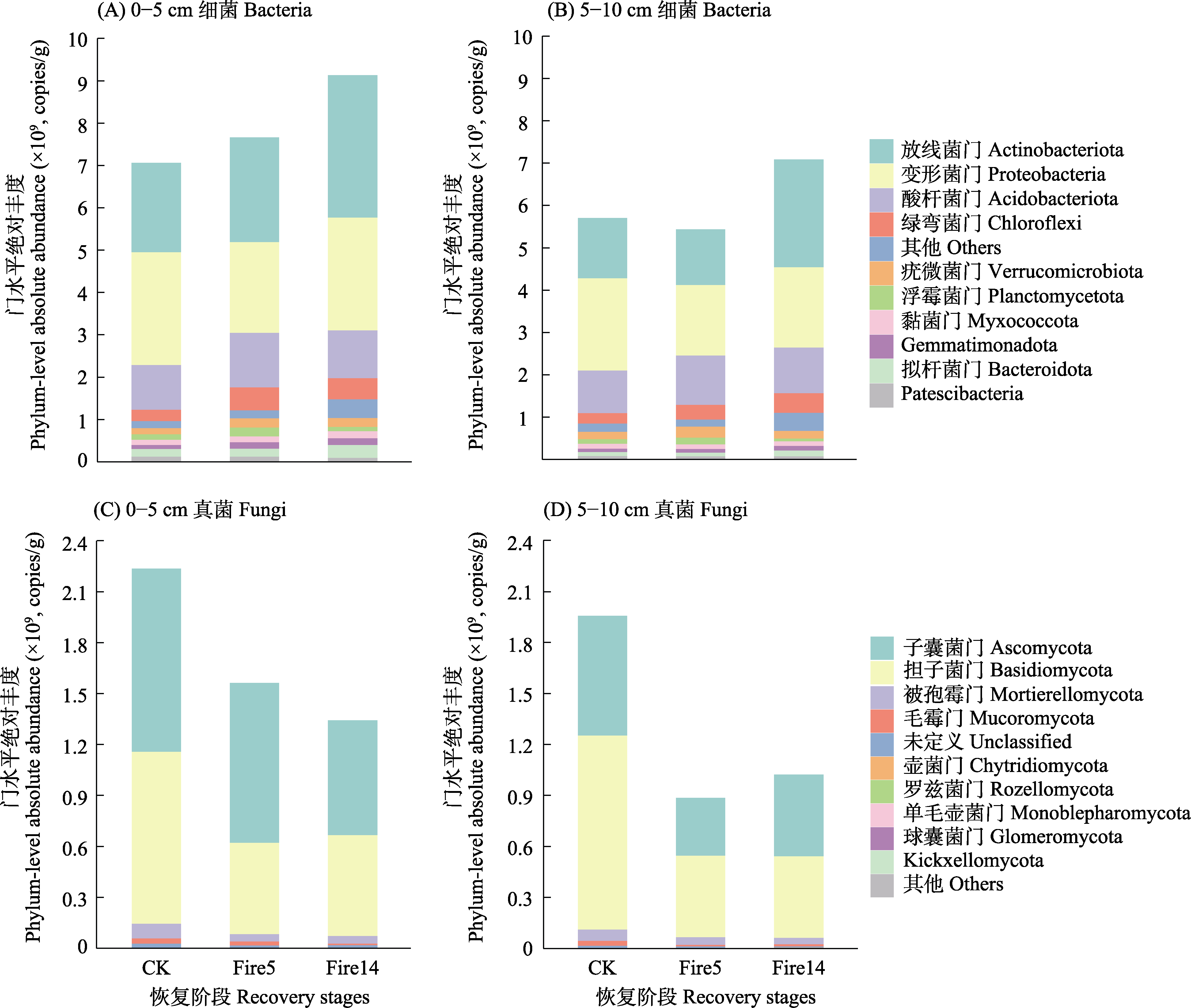
图3 不同恢复阶段各土层(0-5 cm和5-10 cm)土壤微生物优势菌门的绝对丰度。CK: 未受火干扰; Fire5: 火干扰后5年; Fire14: 火干扰后14年。
Fig. 3 Absolute abundance of dominant phyla of soil microorganisms in different soil layers (0-5 cm and 5-10 cm) at different recovery stages. CK, Unburned; Fire5, 5 years post-fire; Fire14, 14 years post-fire.
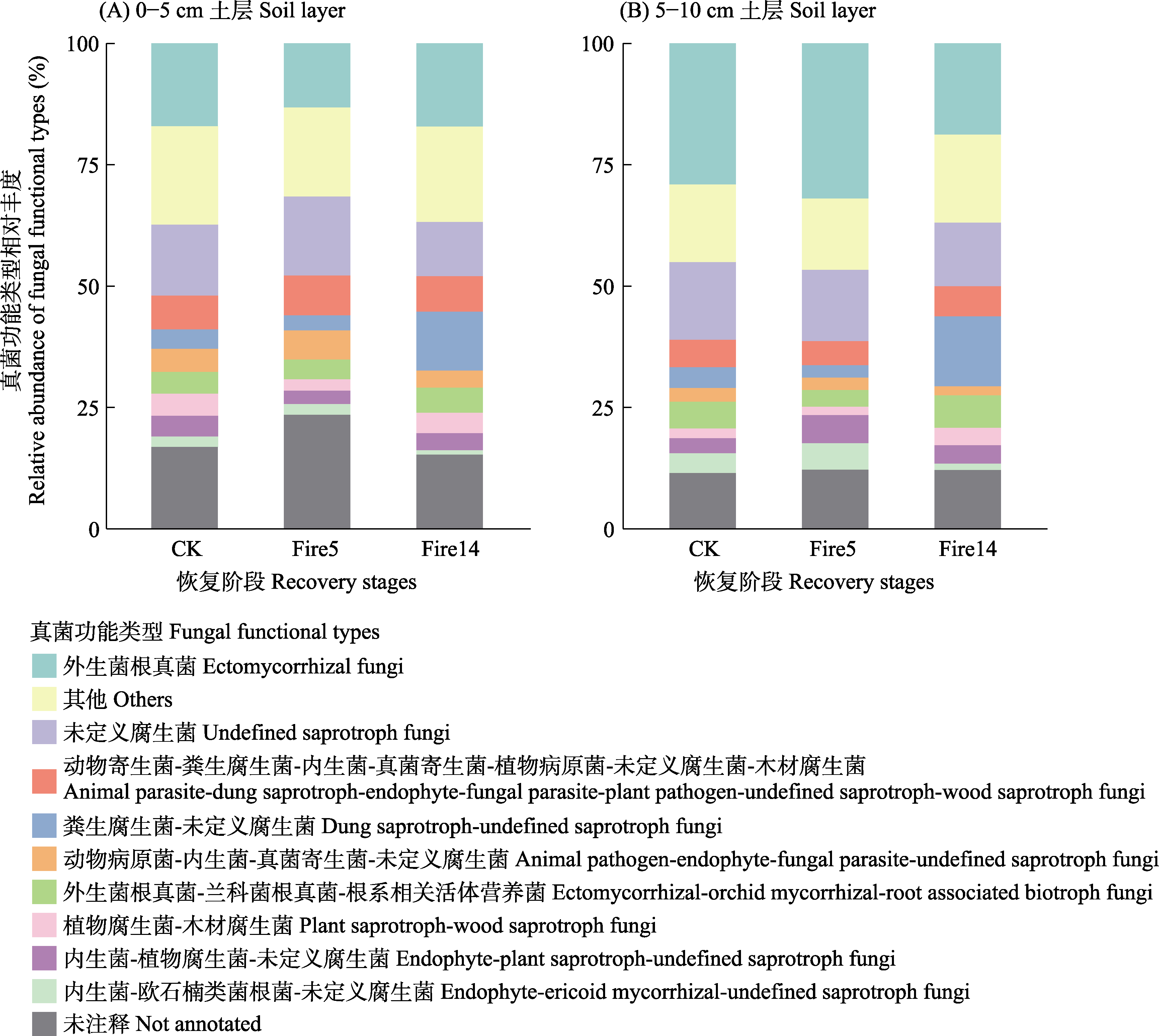
图4 不同恢复阶段各土层土壤真菌功能预测。CK: 未受火干扰; Fire5: 火干扰后5年; Fire14: 火干扰后14年。
Fig. 4 Prediction of soil fungal functions at different recovery stages. CK, Unburned; Fire5, 5 years post-fire; Fire14, 14 years post-fire.
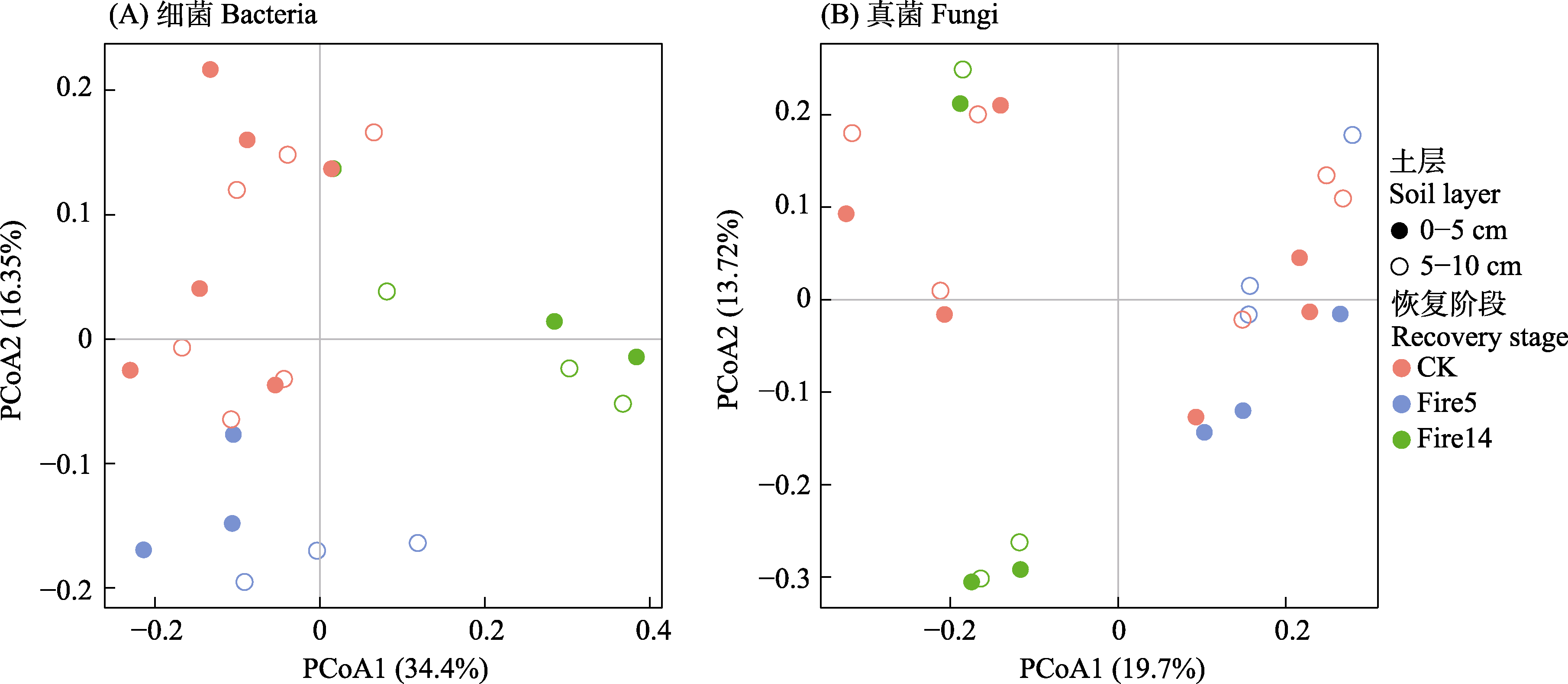
图5 不同恢复阶段各土层土壤细菌(A)和真菌(B)的主坐标分析(PCoA)。CK: 未受火干扰; Fire5: 火干扰后5年; Fire14: 火干扰后14年。
Fig. 5 Principal coordinates analysis (PCoA) of soil bacteria (A) and fungi (B) in different soil layers at different recovery stages. CK, Unburned; Fire5, 5 years post-fire; Fire14, 14 years post-fire.
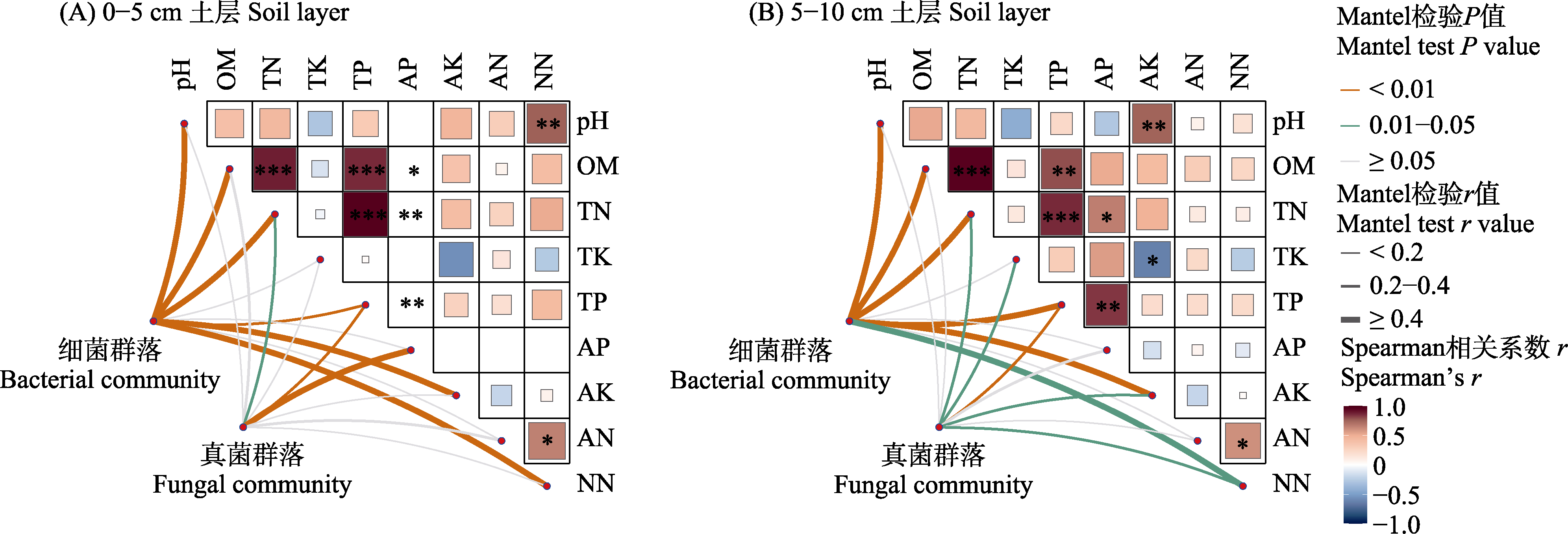
图6 不同土层土壤微生物群落和土壤理化性质的Mantel分析。* P < 0.05; ** P < 0.01; *** P < 0.001。OM: 有机质; TN: 全氮; TK: 全钾; TP: 全磷; AP: 速效磷; AK: 速效钾; AN: 铵态氮; NN: 硝态氮。
Fig. 6 Mantel test of soil microbial community and soil physicochemical properties in different soil layers. * P < 0.05; ** P < 0.01; *** P < 0.001. OM, Organic matter; TN, Total nitrogen; TK, Total potassium; TP, Total phosphorus; AP, Available phosphorus; AK, Available potassium; AN, Ammonium nitrogen; NN, Nitrate nitrogen.
| [1] |
Agbeshie AA, Abugre S, Atta-Darkwa T, Awuah R (2022) A review of the effects of forest fire on soil properties. Journal of Forestry Research, 33, 1419-1441.
DOI |
| [2] |
Bai AQ, Fu BJ, Qu LY, Huang YY, Wang LH (2012) The characteristics of soil microbial communities at burned forest sites for the Great Xingan Mountains. Acta Ecologica Sinica, 32, 4762-4771. (in Chinese with English abstract)
DOI URL |
| [白爱芹, 傅伯杰, 曲来叶, 黄元元, 王丽华 (2012) 大兴安岭火烧迹地恢复初期土壤微生物群落特征. 生态学报, 32, 4762-4771.] | |
| [3] |
Bai ZY, Zheng LB, Bai ZJ, Jia AM, Wang MJ (2022) Long-term cultivation alter soil bacterial community in a forest-grassland transition zone. Frontiers in Microbiology, 13, 1001781.
DOI URL |
| [4] | Bao SD (2000) Soil Agricultural Chemistry Analysis, 3rd edn. China Agriculture Press, Beijing. (in Chinese) |
| [鲍士旦 (2000) 土壤农化分析(第3版). 中国农业出版社, 北京.] | |
| [5] |
Bárcenas-Moreno G, Bååth E (2009) Bacterial and fungal growth in soil heated at different temperatures to simulate a range of fire intensities. Soil Biology and Biochemistry, 41, 2517-2526.
DOI URL |
| [6] | Bowd EJ, Banks SC, Strong CL, Lindenmayer DB (2019) Long-term impacts of wildfire and logging on forest soils. Nature Geoscience, 12, 113-118. |
| [7] |
Bowd EJ, Egidi E, Lindenmayer DB, Wardle DA, Kardol P, Cary GJ, Foster C (2022) Direct and indirect effects of fire on microbial communities in a pyrodiverse dry-sclerophyll forest. Journal of Ecology, 110, 1687-1703.
DOI URL |
| [8] |
Bruns TD, Chung JA, Carver AA, Glassman SI (2020) A simple pyrocosm for studying soil microbial response to fire reveals a rapid, massive response by Pyronema species. PLoS ONE, 15, e0222691.
DOI URL |
| [9] | Chen DF, Wang MY, Si LQ, Zhao FJ, Li W, Li WK, Shu LF (2023) Temporal and spatial distribution characteristics and the influencing factors of lightning fires in Sichuan. Scientia Silvae Sinicae, 59(10), 32-40. (in Chinese with English abstract) |
| [陈涤非, 王明玉, 司莉青, 赵凤君, 李威, 李伟克, 舒立福 (2023) 四川省雷击火时空分布特征及影响因素分析. 林业科学, 59(10), 32-40.] | |
| [10] |
Eilers KG, Debenport S, Anderson S, Fierer N (2012) Digging deeper to find unique microbial communities: The strong effect of depth on the structure of bacterial and archaeal communities in soil. Soil Biology and Biochemistry, 50, 58-65.
DOI URL |
| [11] |
Fernández-Calviño D, Martín A, Arias-Estévez M, Bååth E, Díaz-Raviña M (2010) Microbial community structure of vineyard soils with different pH and copper content. Applied Soil Ecology, 46, 276-282.
DOI URL |
| [12] |
Fierer N, Schimel JP, Holden PA (2003) Variations in microbial community composition through two soil depth profiles. Soil Biology and Biochemistry, 35, 167-176.
DOI URL |
| [13] |
Glassman SI, Levine CR, DiRocco AM, Battles JJ, Bruns TD (2016) Ectomycorrhizal fungal spore bank recovery after a severe forest fire: Some like it hot. The ISME Journal, 10, 1228-1239.
DOI URL |
| [14] |
Hamman ST, Burke IC, Stromberger ME (2007) Relationships between microbial community structure and soil environmental conditions in a recently burned system. Soil Biology and Biochemistry, 39, 1703-1711.
DOI URL |
| [15] | Hannula SE, Kielak AM, Steinauer K, Huberty M, Jongen R, De Long JR, Heinen R, Bezemer TM (2019) Time after time: Temporal variation in the effects of grass and forb species on soil bacterial and fungal communities. mBio, 10, e02635-19. |
| [16] |
Hartmann M, Lee S, Hallam SJ, Mohn WW (2009) Bacterial, archaeal and eukaryal community structures throughout soil horizons of harvested and naturally disturbed forest stands. Environmental Microbiology, 11, 3045-3062.
DOI PMID |
| [17] | He YT, Shi PL, Xu LL (2009) Biomass of fine root in different community type on the Tibetan vegetation transect. Scientia Silvae Sinicae, 45(10), 148-151. (in Chinese with English abstract) |
| [何永涛, 石培礼, 徐玲玲 (2009) 拉萨-林芝植被样带不同群落类型的细根生物量. 林业科学, 45(10), 148-151.] | |
| [18] |
Hobbie EA, Rice SF, Weber NS, Smith JE (2016) Isotopic evidence indicates saprotrophy in post-fire Morchella in Oregon and Alaska. Mycologia, 108, 638-645.
DOI PMID |
| [19] |
Jenkins SN, Rushton SP, Lanyon CV, Whiteley AS, Waite IS, Brookes PC, Kemmitt S, Evershed RP, O’Donnell AG (2010) Taxon-specific responses of soil bacteria to the addition of low level C inputs. Soil Biology and Biochemistry, 42, 1624-1631.
DOI URL |
| [20] |
Liu X, Chen CR, Wang WJ, Hughes JM, Lewis T, Hou EQ, Shen JP (2015) Vertical distribution of soil denitrifying communities in a wet sclerophyll forest under long-term repeated burning. Microbial Ecology, 70, 993-1003.
DOI PMID |
| [21] |
Lou J, Yang L, Wang HZ, Wu LS, Xu JM (2018) Assessing soil bacterial community and dynamics by integrated high-throughput absolute abundance quantification. PeerJ, 6, e4514.
DOI URL |
| [22] |
Naylor D, Naasko K, Smith M, Couvillion S, Nicora C, Trejo J, Fransen S, Danczak R, McClure R, Hofmockel KS, Jansson JK (2023) Interactive effects of depth and differential irrigation on soil microbiome composition and functioning. Frontiers in Microbiomes, 2, 1078024.
DOI URL |
| [23] |
Plassard C, Louche J, Ali MA, Duchemin M, Legname E, Cloutier-Hurteau B (2011) Diversity in phosphorus mobilisation and uptake in ectomycorrhizal fungi. Annals of Forest Science, 68, 33-43.
DOI URL |
| [24] | Qi H, Ji ML, Ma JH, Qi LY, Xu Q, Yang JY, Wang D, Liu MZ, Miao Y, Dong XD (2026) Direct effects of fire severity on soil microbial diversity and network assembly in a transitional climate forest. Journal of Plant Ecology, 19, rtaf126. |
| [25] |
Rao MV, Rice RA, Fleischer RC, Muletz-Wolz CR (2020) Soil fungal communities differ between shaded and sun-intensive coffee plantations in El Salvador. PLoS ONE, 15, e0231875.
DOI URL |
| [26] |
Salo K, Domisch T, Kouki J (2019) Forest wildfire and 12 years of post-disturbance succession of saprotrophic macrofungi (Basidiomycota, Ascomycota). Forest Ecology and Management, 451, 117454.
DOI URL |
| [27] |
Sasaki T, Ishii NI, Makishima D, Sutou R, Goto A, Kawai Y, Taniguchi H, Okano K, Matsuo A, Lochner A, Cesarz S, Suyama Y, Hikosaka K, Eisenhauer N (2022) Plant and microbial community composition jointly determine moorland multifunctionality. Journal of Ecology, 110, 2507-2521.
DOI URL |
| [28] |
Sinsabaugh RL, Lauber CL, Weintraub MN, Ahmed B, Allison SD, Crenshaw C, Contosta AR, Cusack D, Frey S, Gallo ME, Gartner TB, Hobbie SE, Holland K, Keeler BL, Powers JS, Stursova M, Takacs-Vesbach C, Waldrop MP, Wallenstein MD, Zak DR, Zeglin LH (2008) Stoichiometry of soil enzyme activity at global scale. Ecology Letters, 11, 1252-1264.
DOI PMID |
| [29] |
Steenwerth KL, Jackson LE, Calderón FJ, Stromberg MR, Scow KM (2002) Soil microbial community composition and land use history in cultivated and grassland ecosystems of coastal California. Soil Biology and Biochemistry, 34, 1599-1611.
DOI URL |
| [30] | Sun Y, Yang YQ, Zhou FP, Yang M, Yang XY (2025) Effect of fire disturbance factors on the physicochemical properties of forest soil. Journal of Sichuan Forestry Science and Technology, 46(4), 38-46. (in Chinese with English abstract) |
| [孙玉, 杨耀权, 周发平, 杨敏, 杨晓燕 (2025) 火干扰因子对森林土壤理化性质的影响. 四川林业科技, 46(4), 38-46.] | |
| [31] | Tang J, Chen ZL, Fang JP (2019) Estimation of soil conservation value of Tibet forestry ecosystem based on energy value. Journal of Plateau Agriculture, 3, 1-8, 14. (in Chinese with English abstract) |
| [唐佳, 陈芝兰, 方江平 (2019) 基于能值分析的西藏森林生态系统保育土壤价值估算. 高原农业, 3, 1-8, 14.] | |
| [32] | Tao YZ, Di XY (2013) Fire interference on forest soil microbial communities and the mechanism: A review. Scientia Silvae Sinicae, 49(11), 146-157. (in Chinese with English abstract) |
| [陶玉柱, 邸雪颖 (2013) 火对森林土壤微生物群落的干扰作用及其机制研究进展. 林业科学, 49(11), 146-157.] | |
| [33] | Teng YL, Gong JX, Gao WW, Hou L (2025) Response of soil fungal communities to forest fire intensity in Pinus densata forests of Southeast Xizang. Journal of West China Forestry Science, 54(5), 72-80. (in Chinese with English abstract) |
| [滕亚玲, 巩佳鑫, 高宛宛, 侯磊 (2025) 藏东南高山松林土壤真菌群落对林火强度的响应. 西部林业科学, 54(5), 72-80.] | |
| [34] |
Vincent AG, Sundqvist MK, Wardle DA, Giesler R (2014) Bioavailable soil phosphorus decreases with increasing elevation in a subarctic tundra landscape. PLoS ONE, 9, e92942.
DOI URL |
| [35] | Wang HQ, Guo AX, Di XY (2011) Immediate changes in soil organic carbon and microbial biomass carbon after an experimental fire in Great Xing’an Mountains. Journal of Northeast Forestry University, 39(5), 72-76. (in Chinese with English abstract) |
| [王海淇, 郭爱雪, 邸雪颖 (2011) 大兴安岭林火点烧对土壤有机碳和微生物量碳的即时影响. 东北林业大学学报, 39(5), 72-76.] | |
| [36] |
Yu MJ, Su WQ, Huang LB, Parikh SJ, Tang CX, Dahlgren RA, Xu JM (2021) Bacterial community structure and putative nitrogen-cycling functional traits along a charosphere gradient under waterlogged conditions. Soil Biology and Biochemistry, 162, 108420.
DOI URL |
| [37] | Zhang HY, Zhang XD, Li J, Wang DM (2005) Outline of soil microbial biomass measurement methods. Journal of Microbiology, 25(4), 95-99. (in Chinese with English abstract) |
| [张海燕, 张旭东, 李军, 王冬梅 (2005) 土壤微生物量测定方法概述. 微生物学杂志, 25(4), 95-99.] | |
| [38] | Zhao B, Sun L, Hu HQ, Sun ZH (2011) Post-fire soil microbial biomass and nutrient content of Larix gmelinii forest in autumn. Journal of Natural Resources, 26, 450-459. (in Chinese with English abstract) |
| [赵彬, 孙龙, 胡海清, 孙志虎 (2011) 兴安落叶松林火后对土壤养分和土壤微生物生物量的影响. 自然资源学报, 26, 450-459.] | |
| [39] |
Zhao F, Wang J, Li Y, Xu X, He L, Wang J, Ren C, Guo Y (2022) Microbial functional genes driving the positive priming effect in forest soils along an elevation gradient. Soil Biology and Biochemistry, 165, 108498.
DOI URL |
| [40] |
Zheng CY, Chai MM, Jiang SS, Zhang SB, Christie P, Zhang JL (2015) Foraging capability of extraradical mycelium of arbuscular mycorrhizal fungi to soil phosphorus patches and evidence of carry-over effect on new host plant. Plant and Soil, 387, 201-217.
DOI URL |
| [41] | Zheng Q, Cui XY, Di XY, Jin S (2012) Effects of different forest fire intensities on microbial community functional diversity in forest soil in Daxing’anling. Scientia Silvae Sinicae, 48(5), 95-100. (in Chinese with English abstract) |
| [郑琼, 崔晓阳, 邸雪颖, 金森 (2012) 不同林火强度对大兴安岭偃松林土壤微生物功能多样性的影响. 林业科学, 48(5), 95-100.] |
| [1] | 李发扬, 李滢钰, 蒋文妮, 刘曙光, 霍超, 孙巧奇, 邹红菲. 火后恢复时间影响大兴安岭寒温带森林内部与边缘鸟类多样性[J]. 生物多样性, 2023, 31(7): 22665-. |
| 阅读次数 | ||||||
|
全文 |
|
|||||
|
摘要 |
|
|||||
备案号:京ICP备16067583号-7
Copyright © 2026 版权所有 《生物多样性》编辑部
地址: 北京香山南辛村20号, 邮编:100093
电话: 010-62836137, 62836665 E-mail: biodiversity@ibcas.ac.cn
