

生物多样性 ›› 2026, Vol. 34 ›› Issue (3): 24560. DOI: 10.17520/biods.2024560 cstr: 32101.14.biods.2024560
• 研究报告: 动物多样性 • 下一篇
朱浩友1, 周友兵2, 罗怡1,3, 周昭敏1,3,*( )
)
收稿日期:2024-12-13
接受日期:2025-11-26
出版日期:2026-03-20
发布日期:2026-04-09
通讯作者:
*E-mail:
Haoyou Zhu1, Youbing Zhou2, Yi Luo1,3, Zhaomin Zhou1,3,*()
Received:2024-12-13
Accepted:2025-11-26
Online:2026-03-20
Published:2026-04-09
Contact:
*E-mail: 摘要:
在过去20年里, 中国投入了大量资金与资源开展生态城市建设, 以实现城市生态系统的可持续发展。由于历史基准数据的缺失, 城市生物多样性在生态城市建设过程中的变化情况仍然缺乏评估。基于2002-2004年南充市城区繁殖鸟类种类和鸟巢数的调查报告, 本文于2023年2-7月开展了5轮重复调查, 分别采用样点法或样线法调查14个斑块绿地和22个行道绿地中的繁殖鸟物种数和巢数。共记录了28种繁殖鸟1,599个巢(冠层筑巢鸟类17种1,451个巢、地面/灌丛筑巢鸟类6种87个巢、树洞筑巢鸟类4种31个巢、人工建筑筑巢鸟类1种30个巢)。与历史数据对比表明: 城区繁殖鸟类的物种数增加了1种, 但是样地物种数平均值减少了1.3种(21.4%, P = 0.025), 样地巢数平均值减少了90.4个(67.1%, P < 0.001); 繁殖鸟类群落受到筑巢类型和样地类型的交互作用, 其中冠层筑巢鸟类、地面/灌丛筑巢鸟类和人工建筑筑巢鸟类的样地物种数、样地巢数和Shannon-Wiener多样性指数在斑块绿地或行道绿地中发生了显著下降(P < 0.05)。此外, 物种优势度排序发生显著变化, 其中第一次调查中优势度排名前5的2种地面/灌丛筑巢鸟类和1种洞穴筑巢鸟类被冠层筑巢鸟类替代。因此, 在南充市过去20年的生态城市建设中, 繁殖鸟类没有广泛获得积极的生态收益, 使得其群落组成在小空间尺度上发生了显著改变。我们建议, 城市绿地的规划建设应兼顾不同生态类群, 更全面地提高城市建设的生态效益, 从而为可持续的城市生物多样性和生态服务功能提供保障。
朱浩友, 周友兵, 罗怡, 周昭敏 (2026) 南充市城区繁殖鸟类群落20年前后的变化. 生物多样性, 34, 24560. DOI: 10.17520/biods.2024560.
Haoyou Zhu, Youbing Zhou, Yi Luo, Zhaomin Zhou (2026) Changes in breeding bird community in an urban area of Nanchong over two decades. Biodiversity Science, 34, 24560. DOI: 10.17520/biods.2024560.
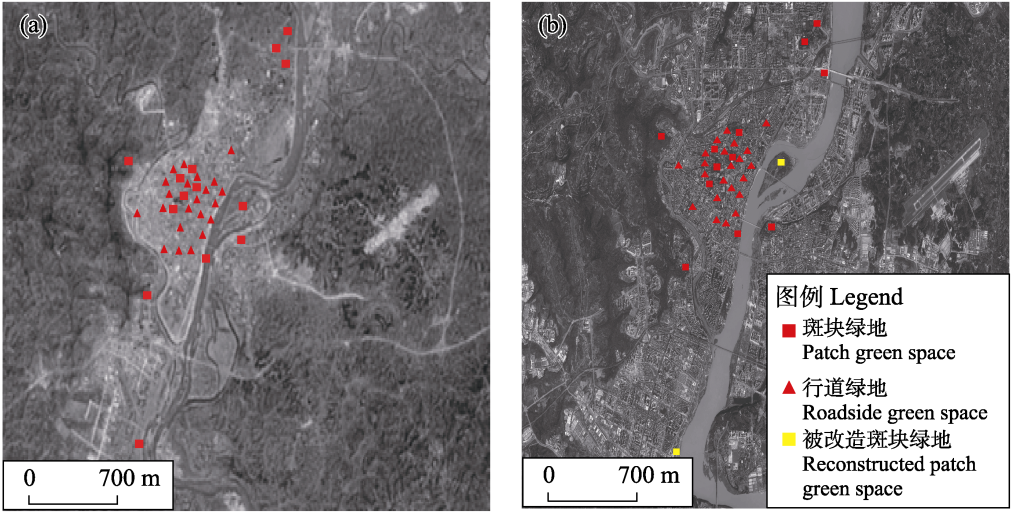
图1 第一次调查(a)和第二次调查(b)中, 南充市城区14个斑块绿地和22个行道绿地位置图。在滨江公园和上中坝湿地公园(被改造斑块绿地), 植被和景观发生明显变化。
Fig. 1 Location map of 14 patch green spaces and 22 roadside green spaces in Nanchong’s urban areas during the first survey (a) and the second survey (b). Vegetation and landscape greatly changed in Binjiang Park and Shangzhongba Wetland Park (reconstructed patch green spaces).
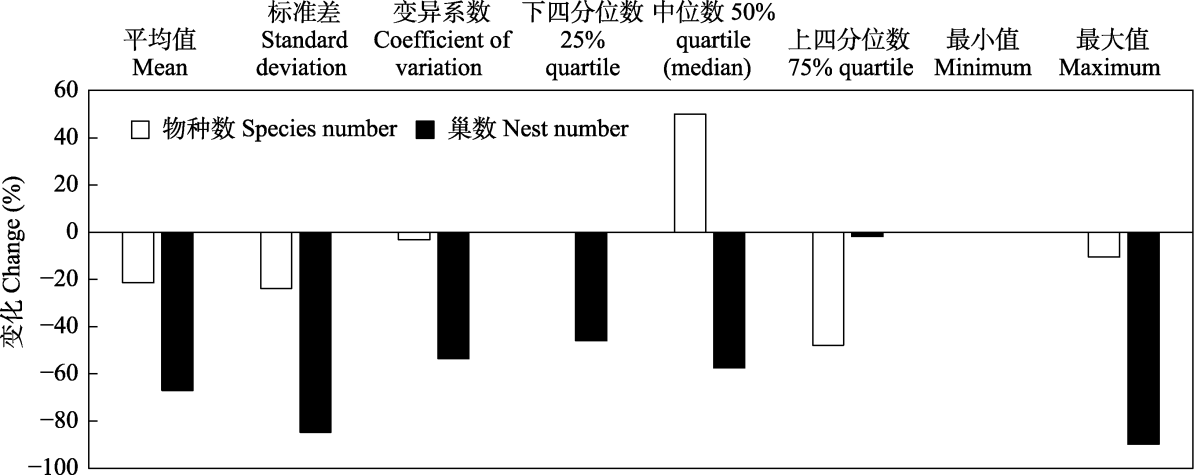
图2 在两次鸟类调查中, 36个样地繁殖鸟类群落物种数和巢数分布参数变化
Fig. 2 Changes in species number and nest number in breeding bird communities across the 36 sampling sites between the two surveys
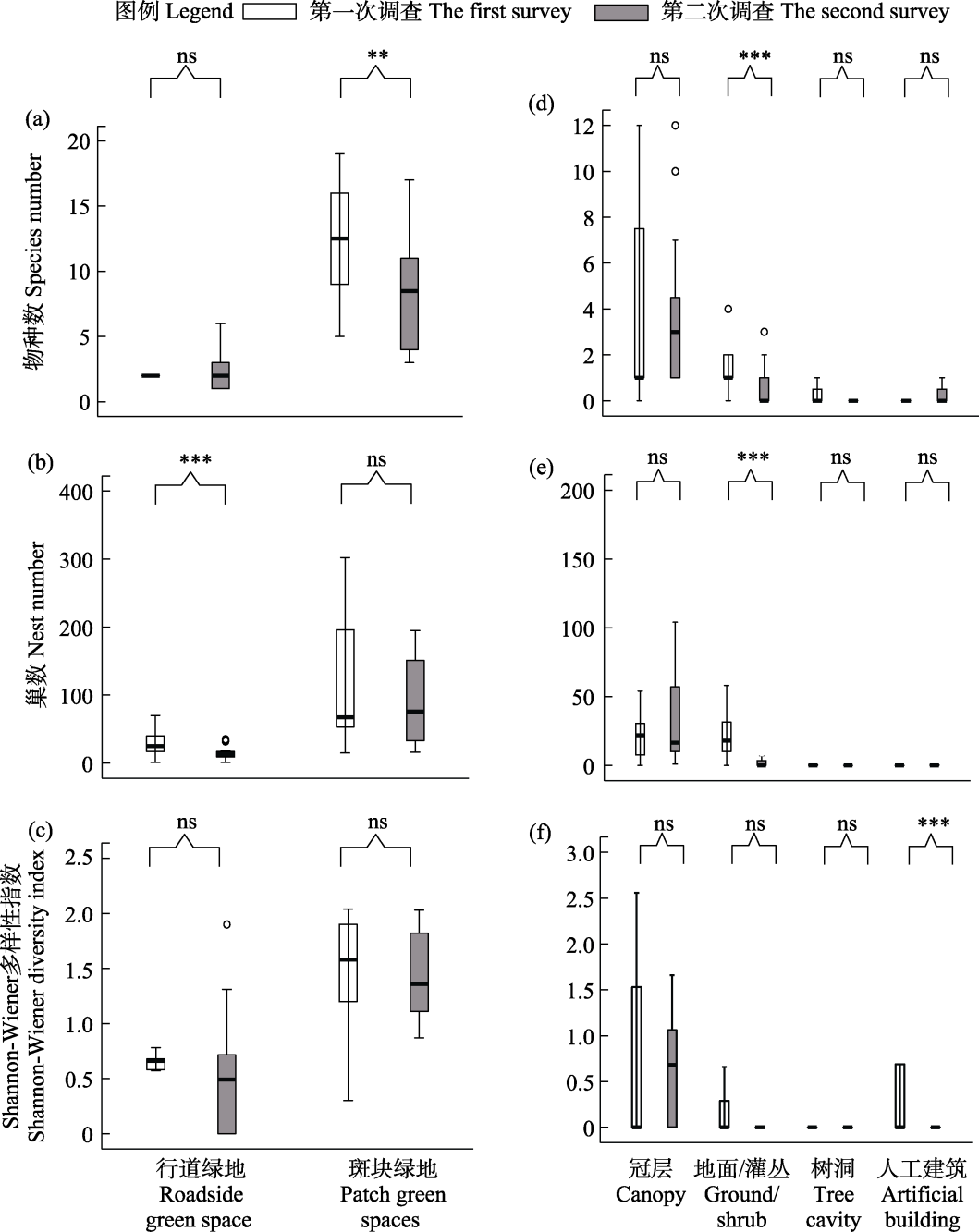
图3 在两次调查中, 不同绿地类型繁殖鸟类物种数(a)、繁殖鸟类巢数(b)、Shannon-Wiener多样性指数(c)以及不同生境类型繁殖鸟类物种数(d)、繁殖鸟类巢数(e)、Shannon-Wiener多样性指数(f)发生变化。箱式图上方和下方的线段分别表示上四分位数和下四分位数, 箱式图内部的横线表示数据的中位数。** P < 0.01; *** P < 0.001; ns: P > 0.05。
Fig. 3 Variations in species number (a), nest number (b) and Shannon-Wiener diversity index (c) of breeding birds in roadside and patch sites between the two surveys, and variations in these indices of birds nesting in canopy, ground/shrub, tree cavity and artificial building (d, e, f). The lines above and below the boxplots represent the upper and lower quartiles, respectively; the horizontal line inside the box indicates the median. ** P < 0.01; *** P < 0.001; ns, P > 0.05.
| [1] | Arimitsu ML, Romano MD, Piatt JF (2004) Ground-nesting marine birds and potential for human disturbance in Glacier Bay National Park. In: Proceedings of the Fourth Glacier Bay Science Symposium (eds Piatt JF, Gende SM), pp. 196-200. U. S. Geological Survey, Juneau, Alaska. |
| [2] |
Benton TG, Vickery JA, Wilson JD (2003) Farmland biodiversity: Is habitat heterogeneity the key? Trends in Ecology & Evolution, 18, 182-188.
DOI URL |
| [3] |
Botes CM, Zanni AM (2021) Trees, ground vegetation, sidewalks, cycleways: Users’ preferences and economic values for different elements of an urban street—A case study in Taipei. Environmental Economics and Policy Studies, 23, 145-171.
DOI |
| [4] |
Burhans DE, Thompson FR III (2006) Songbird abundance and parasitism differ between urban and rural shrublands. Ecological Applications, 16, 394-405.
PMID |
| [5] | Catano CP, Fristoe TS, LaManna JA, Myers JA (2020) Local species diversity, β-diversity and climate influence the regional stability of bird biomass across North America. Proceedings of the Royal Society B: Biological Sciences, 287, 20192520. |
| [6] |
Chen XJ, Wang Q, Cui BS, Chen GG, Xie T, Yang WX (2023) Ecological time lags in biodiversity response to habitat changes. Journal of Environmental Management, 346, 118965.
DOI URL |
| [7] | Deng QX, Hu JC, Yu ZW, Chen HX (1980) Report on the Nanchong bird survey. Journal of Nanchong Teachers College (Natural Sciences Edition), 2, 46-88. (in Chinese) |
| [邓其祥, 胡锦矗, 余志伟, 陈鸿熙 (1980) 南充地区鸟类调查报告. 南充师院学报(自然科学版), 2, 46-88.] | |
| [8] | Desalegn T, Abebe B (2024) Diversity and distribution of avifauna in the northeast of Addis Ababa, central Ethiopia. The Scientific World Journal, 2024, 5592074. |
| [9] |
Fang Z, Ding TH, Chen JY, Xue S, Zhou Q, Wang YD, Wang YX, Huang ZD, Yang SL (2022) Impacts of land use/land cover changes on ecosystem services in ecologically fragile regions. Science of the Total Environment, 831, 154967.
DOI URL |
| [10] |
Fuller RJ, Hinsley SA, Swetnam RD (2004) The relevance of non-farmland habitats, uncropped areas and habitat diversity to the conservation of farmland birds. Ibis, 146, 22-31.
DOI URL |
| [11] | Hall M, Nimmo D, Bennett AF (2016) At the crossroads: Does the configuration of roadside vegetation affect woodland bird communities in rural landscapes? PLoS ONE, 11, e0155219. |
| [12] | Hu JC (1960) New records of non-passerine birds in Sichuan Province. Chinese Journal of Zoology, 7, 307-309. (in Chinese) |
| [胡锦矗 (1960) 四川省非雀形目鸟类的新纪录. 动物学杂志, 7, 307-309.] | |
| [13] | Ikin K, Knight E, Lindenmayer DB, Fischer J, Manning AD (2012) Linking bird species traits to vegetation characteristics in a future urban development zone: Implications for urban planning. Urban Ecosystems, 15, 961-977. |
| [14] |
Jim CY (2004) Green-space preservation and allocation for sustainable greening of compact cities. Cities, 21, 311-320.
DOI URL |
| [15] |
Leal AI, Correia RA, Palmeirim JM, Granadeiro JP (2013) Does canopy pruning affect foliage-gleaning birds in managed cork oak woodlands? Agroforestry Systems, 87, 355-363.
DOI URL |
| [16] | Liu JY, Zheng Z, Dong TF (2019) Density and characteristics of tree holes in different forest types in Xishuangbanna. Acta Ecologica Sinica, 39, 494-501. (in Chinese with English abstract) |
| [刘俊雁, 郑征, 董廷发 (2019) 西双版纳不同森林类型的树洞密度及其特征. 生态学报, 39, 494-501.] | |
| [17] |
Liu S, Yu WH, Li F, Zhao J, Yin RY, Zhou ZM, Pan B (2018) Fertilizer application in rural cropland drives cadmium enrichment in bats dwelling in an urban area. Environmental Pollution, 242, 970-975.
DOI PMID |
| [18] | Ma KP (1994) Measurement of biotic community diversity. I. α diversity (Part 1). Chinese Biodiversity, 2, 162-168. (in Chinese) |
| [马克平 (1994) 生物群落多样性的测度方法. I. α多样性的测度方法(上). 生物多样性, 2, 162-168.] | |
| [19] | Ma KP, Liu YM (1994) Measurement of biotic community diversity. I. α diversity (Part 2). Chinese Biodiversity, 2, 231-239. (in Chinese) |
| [马克平, 刘玉明 (1994) 生物群落多样性的测度方法. I. α多样性的测度方法(下). 生物多样性, 2, 231-239.] | |
| [20] | Magre JM, Juncà MB, Campanera JM, Pagès AB, Mallén IR, Zaragoza RM, Mateo SS, Barberà MP, Lozano CB (2019) How urban green management is influencing passerine birds’ nesting in the Mediterranean: A case study in a Catalan city. Urban Forestry & Urban Greening, 41, 221-229. |
| [21] |
Mainwaring MC (2015) The use of man-made structures as nesting sites by birds: A review of the costs and benefits. Journal for Nature Conservation, 25, 17-22.
DOI URL |
| [22] |
Marja R, Uuemaa E, Mander Ü, Elts J, Truu J (2013) Landscape pattern and census area as determinants of the diversity of farmland avifauna in Estonia. Regional Environmental Change, 13, 1013-1020.
DOI URL |
| [23] | McHarg IL (1969) Design with Nature. American Museum of Natural History, New York. |
| [24] |
Ning Z, Chen C, Zhu Z, Xie T, Wang Q, Cui B, Bouma TJ (2021) Tidal channel-mediated gradients facilitate Spartina alterniflora invasion in coastal ecosystems: Implications for invasive species management. Marine Ecology Progress Series, 659, 59-73.
DOI URL |
| [25] |
Patankar S, Jambhekar R, Suryawanshi KR, Nagendra H (2021) Which traits influence bird survival in the city? A review. Land, 10, 92.
DOI URL |
| [26] |
Schipper AM, Belmaker J, de Miranda MD, Navarro LM, Böhning-Gaese K, Costello MJ, Dornelas M, Foppen R, Hortal J, Huijbregts MAJ, Martín-López B, Pettorelli N, Queiroz C, Rossberg AG, Santini L, Schiffers K, Steinmann ZJN, Visconti P, Rondinini C, Pereira HM (2016) Contrasting changes in the abundance and diversity of North American bird assemblages from 1971 to 2010. Global Change Biology, 22, 3948-3959.
DOI PMID |
| [27] |
Schultz A, Glemnitz M, Stachow U, Schwierz F (2022) Changes in a bird community in an agricultural landscape in northeast Germany between 1999 and 2015. Land, 11, 2115.
DOI URL |
| [28] |
Slankard KG, Leffew B, Patton MD, Baird LK, Miller J, Stoelb D, Pelly D, Barnard JO, Taylor L, Burford LS (2024) The effects of native grass and shrub restoration on nesting and fall migrant songbirds in central Kentucky. Diversity, 16, 615.
DOI URL |
| [29] | Suzuki H, Dastur A, Moffatt S, Yabuki N, Maruyama H (2010) Eco2 Cities: Ecological Cities as Economic Cities. The World Bank, Washington, DC. |
| [30] | Wang HY, Wang HQ, Chen XY, Han BL, Shu CJ, Zhang T, Ding SY (2023) A review of research on urban biodiversity assessment and enhancement in China and abroad. Acta Ecologica Sinica, 43, 2995-3006. (in Chinese with English abstract) |
| [王海洋, 王浩琪, 陈禧悦, 韩宝龙, 束承继, 张童, 丁仕宇 (2023) 国内外城市生物多样性评价与提升研究综述. 生态学报, 43, 2995-3006.] | |
| [31] | Wu F, Zhang J (2020) Explore urban sustainable ecology construction from bio-design perspective. In: Advances in Human Factors in Architecture, Sustainable Urban Planning and Infrastructure (ed. Kacprzyk J), pp.71-77. Springer International Publishing, Cham. |
| [32] | Xie TZ, Chen JH, Xie C, Liu YD, He JM, Gong GT, Mu CL (2022) Analysis of urban forest structural characteristics in the main urban area of Nanchong City. Journal of Sichuan Forestry Science and Technology, 43(2), 118-123. (in Chinese with English abstract) |
| [谢天资, 陈俊华, 谢川, 刘一丁, 何家敏, 龚固堂, 慕长龙 (2022) 南充市主城区城市森林结构特征分析. 四川林业科技, 43(2), 118-123.] | |
| [33] |
Yang B, Li SJ (2016) Design with nature: Ian McHarg’s ecological wisdom as actionable and practical knowledge. Landscape and Urban Planning, 155, 21-32.
DOI URL |
| [34] | Zhou ZM, Zhou YB, Hu JC, Zhuang H, Zhu W, Chen T (2004) Vocalization behavior of male sand martins (Riparia riparia) during the breeding season. Chinese Journal of Zoology, 39(6), 77-81. (in Chinese with English abstract) |
| [周昭敏, 周友兵, 胡锦矗, 庄华, 朱维, 陈涛 (2004) 崖沙燕繁殖期雄鸟的鸣叫行为. 动物学杂志, 39(6), 77-81.] |
| [1] | 陈璐露, 汤皓婷, 冷红, 袁青, 杨昕悦. 城市街区建成环境对生物多样性的影响[J]. 生物多样性, 2026, 34(2): 25286-. |
| [2] | 杨军, 杨旭东, 刘心怡, 周景. 面向《昆蒙框架》目标12的中国城市生物多样性研究展望[J]. 生物多样性, 2025, 33(5): 25104-. |
| [3] | 胡敏, 李彬彬, Coraline Goron. 只绿是不够的: 一个生物多样性友好的城市公园管理框架[J]. 生物多样性, 2025, 33(5): 24483-. |
| [4] | 臧明月, 刘立, 马月, 徐徐, 胡飞龙, 卢晓强, 李佳琦, 于赐刚, 刘燕. 《昆明-蒙特利尔全球生物多样性框架》下的中国城市生物多样性保护[J]. 生物多样性, 2025, 33(5): 24482-. |
| [5] | 苏荣菲, 陈睿山, 俞霖琳, 吴婧彬, 康燕. 基于红外相机调查的上海市长宁区社区生境花园生物多样性[J]. 生物多样性, 2024, 32(8): 24068-. |
| [6] | 王怡涵, 赵倩倩, 刁奕欣, 顾伯健, 翁悦, 张卓锦, 陈泳滨, 王放. 基于红外相机调查上海市区小灵猫的活动节律、栖息地利用及其对人类活动的响应[J]. 生物多样性, 2023, 31(2): 22294-. |
| [7] | 牛铜钢, 刘为. 双碳战略背景下城市生态系统的碳汇功能与生物多样性可以兼得[J]. 生物多样性, 2022, 30(8): 22168-. |
| [8] | 史丹阳, 廖书跃, 朱磊, 李彬彬. 鸟撞建筑现象概述及系统性调查案例分析[J]. 生物多样性, 2022, 30(3): 21321-. |
| [9] | 刘继亮, 李锋瑞. 干旱区绿洲扩张方式对土壤生物优势类群及功能的影响[J]. 生物多样性, 2018, 26(10): 1116-1126. |
| [10] | 吴奕如, 斯幸峰, 陈传武, 曾頔, 赵郁豪, 李家琦, 丁平. 千岛湖陆桥岛屿繁殖鸟类的扩散能力差异 对群落动态的影响[J]. 生物多样性, 2016, 24(10): 1135-1145. |
| [11] | 徐德琳, 邹长新, 徐梦佳, 游广永, 吴丹. 基于生态保护红线的生态安全格局构建[J]. 生物多样性, 2015, 23(6): 740-746. |
| [12] | 叶属峰, 陆健健. 无脊椎动物金属硫蛋白(MTs)多样性及其生态服务功能[J]. 生物多样性, 2000, 08(3): 317-324. |
| 阅读次数 | ||||||
|
全文 |
|
|||||
|
摘要 |
|
|||||
备案号:京ICP备16067583号-7
Copyright © 2026 版权所有 《生物多样性》编辑部
地址: 北京香山南辛村20号, 邮编:100093
电话: 010-62836137, 62836665 E-mail: biodiversity@ibcas.ac.cn
