

生物多样性 ›› 2026, Vol. 34 ›› Issue (5): 25494. DOI: 10.17520/biods.2025494 cstr: 32101.14.biods.2025494
李杨1,2( ), 吕晓琴1,2(), 伍英1,2(), 陈孝旺1,2(), 颜国浩1,2(), 王晓月1,2,*()(
 )
)
收稿日期:2025-12-11
接受日期:2026-03-29
出版日期:2026-05-20
发布日期:2026-07-01
通讯作者:
王晓月
基金资助:
Yang Li1,2(), Xiaoqin Lü1,2(), Ying Wu1,2(), Xiaowang Chen1,2(), Guohao Yan1,2(), Xiaoyue Wang1,2,*()()
Received:2025-12-11
Accepted:2026-03-29
Online:2026-05-20
Published:2026-07-01
Contact:
Xiaoyue Wang
Supported by:摘要:
传粉者介导的花形态变异多集中在特化的传粉系统中, 对于广泛分布且泛化传粉的植物, 其形态特征以及传粉者类群如何随着地理环境而产生变异, 以及二者与经纬度、海拔因子的相关性, 目前尚不清楚。我们前期的研究发现川续断科植物川续断(Dipsacus asper)在我国西南地区广泛分布, 具有典型的泛化传粉系统, 为探究该问题提供了理想材料。本研究以川续断为研究对象, 在湖北、四川、云南和贵州13个野生川续断的集中分布居群开展实验, 通过测量植物的形态特征, 比较了其在不同居群内和居群间的变异系数; 观察每个川续断居群访花昆虫的类型并计算了访花频率, 测量了主要传粉熊蜂的虫体特征; 统计了川续断不同居群的自然结实率。结果表明, 川续断不同居群的形态特征有显著变化, 叶片和茎的变异系数较大, 而花序大小的变异系数较小, 其中小金、建始、盐源和习水居群的花序大于其他居群。川续断主要的传粉者为熊蜂属(Bombus)、蜜蜂属(Apis)、管状蚜蝇属(Eristalis)、蛾蝶类等, 其中蜂类是重要的传粉者。川续断不同居群的传粉者类型以及访花频率存在显著差异, 小金、建始、盐源和习水居群主要是由虫体较大的熊蜂传粉, 川续断的花管长和广泛分布的弗里熊蜂(Bombus friseanus)的吻长没有显著相关性。川续断的植株高度、茎、叶、花序大小和弗里熊蜂的虫体长等特征均随着海拔的升高显著减小; 植株高度、弗里熊蜂的吻长随着经度的增加显著增加, 茎、叶、花序大小、弗里熊蜂腹部随着经度的增加显著减小; 叶、花序大小、弗里熊蜂头和胸的厚度、腹部随着纬度的增加显著增加, 弗里熊蜂的吻长随着纬度的增加显著减小。不同地理分布的川续断自然结实率随着经度的增加而增加, 随纬度的增加显著减小, 随着海拔升高呈现增加的趋势。广布种的形态特征和传粉者的多样性随着地理梯度的变化呈现显著变异, 这种变异可能源于植物与传粉者以及生境中经纬度以及海拔因子的共同作用。不同地理环境中的植物通过花形态的变化并借助多样化的传粉者来保障自身的繁殖成功。
李杨, 吕晓琴, 伍英, 陈孝旺, 颜国浩, 王晓月 (2026) 不同生境川续断形态特征以及传粉者多样性的地理变异模式. 生物多样性, 34, 25494. DOI: 10.17520/biods.2025494.
Yang Li, Xiaoqin Lü, Ying Wu, Xiaowang Chen, Guohao Yan, Xiaoyue Wang (2026) Geographic variation patterns in morphological traits and pollinator diversity of Dipsacus asper across different habitats. Biodiversity Science, 34, 25494. DOI: 10.17520/biods.2025494.
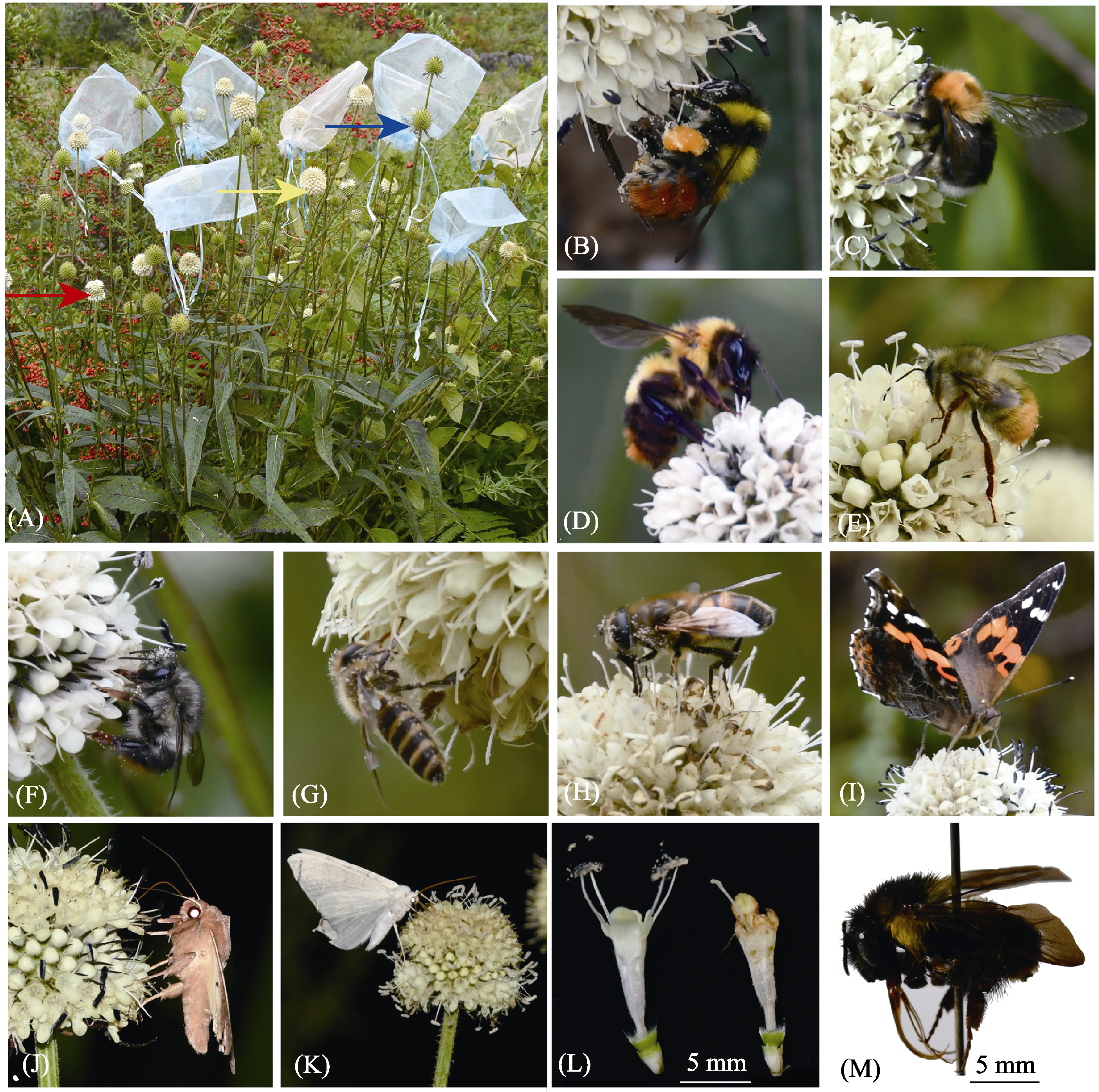
图1 川续断的花序、单花以及主要传粉昆虫。(A)川续断植株及其雄期花序(红色箭头)、雌期花序(黄色箭头)和果序(蓝色箭头); (B)弗里熊蜂; (C)白背熊蜂; (D)三条熊蜂; (E)疏熊蜂; (F)克什米尔熊蜂; (G)蜜蜂属一种; (H)管状蚜蝇属一种; (I)大红蛱蝶; (J)夜蛾; (K)尺蛾; (L)川续断的雄花期单花(左)和雌花期单花(右); (M)弗里熊蜂的标本。
Fig. 1 Inflorescences and single flowers of D. asper and its major pollinators. (A) D. asper plant with its male inflorescence (red arrow), female inflorescence (yellow arrow), and infructescence (blue arrow); (B) Bombus friseanus; (C) B. festivus; (D) B. trifasciatus; (E) B. remotus; (F) B. kashmiensis; (G) Apis sp.; (H) Eristalis sp.; (I) Vanessa indica; (J) Noctuidae moth; (K) Geometridae moth; (L) A single male-phase flower (left) and a single female-phase flower (right) of D. asper; (M) B. friseanus specimen.
| 居群编号 Population code | 地理位置 Geography location | 经度 Latitude | 纬度 Longitude | 海拔 Altitude (m) | 生境 Habitat |
|---|---|---|---|---|---|
| XS | 贵州省遵义市习水县温水镇 Wenshui Town, Xishui County, Zunyi City, Guizhou Province | 106.2° E | 28.33° N | 1,117 | 乡镇公路边草丛 Grassy vegetation along township roads |
| GY | 贵州省贵阳市花溪区红岩峡谷景区 Hongyan Gorge Scenic Area, Huaxi District, Guiyang City, Guizhou Province | 106.49° E | 26.17° N | 1,445 | 公路边草丛 Grassy vegetation along roadsides |
| XC | 四川省凉山彝族自治州西昌市礼州古镇 Lizhou Ancient Town, Xichang City, Liangshan Yi Autonomous Prefecture, Sichuan Province | 102.19° E | 28.05° N | 1,618 | 田埂边草丛 Grassy vegetation along field margins |
| JS | 湖北省恩施土家族苗族自治州建始县业州镇 Yezhou Town, Jianshi County, Enshi Tujia and Miao Autonomous Prefecture, Hubei Province | 109.72° E | 30.64° N | 1,845 | 公路边草丛 Grassy vegetation along roadsides |
| MLP | 云南省文山壮族苗族自治州麻栗坡县老山自然保护区 Laoshan Nature Reserve, Malipo County, Wenshan Zhuang and Miao Autonomous Prefecture, Yunnan Province | 104.49° E | 23.94° N | 2,246 | 田埂边草丛 Grassy vegetation along field margins |
| KM | 云南省昆明市盘龙区马大丫口 Madayakou, Panlong District, Kunming City, Yunnan Province | 102.75° E | 25.21° N | 2,427 | 山腰乡村路边草坡 Grassy slope along a rural road on a mountainside |
| LJ | 云南省丽江市金虹山 Jinhong Mountain, Lijiang City, Yunnan Province | 100.24° E | 26.88° N | 2,485 | 公路边草丛 Grassy vegetation along roadsides |
| YY | 四川省凉山彝族自治州盐源县盐塘镇 Yantang Town, Yanyuan County, Liangshan Yi Autonomous Prefecture, Sichuan Province | 101.21° E | 27.45° N | 2,513 | 山腰乡村路边草坡 Grassy slope along a rural road on a mountainside |
| XD | 四川省凉山彝族自治州喜德县洛哈镇 Luoha Town, Xide County, Liangshan Yi Autonomous Prefecture, Sichuan Province | 102.54° E | 28.04° N | 2,519 | 乡镇公路边草丛 Grassy vegetation along township roads |
| DL | 云南省大理白族自治州大理市晴云山 Qingyun Mountain, Dali City, Dali Bai Autonomous Prefecture, Yunnan Province | 100.37° E | 25.6° N | 2,850 | 高山草丛 Alpine grassy vegetation |
| WC | 四川省阿坝藏族羌族自治州汶川县卧龙镇 Wolong Town, Wenchuan County, Aba Tibetan and Qiang Autonomous Prefecture, Sichuan Province | 103.14° E | 30.45° N | 3,043 | 高山草丛 Alpine grassy vegetation |
| XJ | 四川省阿坝藏族羌族自治州小金县四姑娘山 Siguniang Mountain, Xiaojin County, Aba Tibetan and Qiang Autonomous Prefecture, Sichuan Province | 102.84° E | 31.01° N | 3,296 | 高山草甸 Alpine meadow |
| SGRL | 云南省迪庆藏族自治州香格里拉市桑那水库 Sangna Reservoir, Shangri-La City, Diqing Tibetan Autonomous Prefecture, Yunnan Province | 99.39° E | 27.86° N | 3,300 | 公路边草丛 Grassy vegetation along roadsides |
表1 13个川续断野生居群的地理位置及生境情况
Table 1 Geographic distribution and habitat information of 13 wild populations of Dipsacus asper
| 居群编号 Population code | 地理位置 Geography location | 经度 Latitude | 纬度 Longitude | 海拔 Altitude (m) | 生境 Habitat |
|---|---|---|---|---|---|
| XS | 贵州省遵义市习水县温水镇 Wenshui Town, Xishui County, Zunyi City, Guizhou Province | 106.2° E | 28.33° N | 1,117 | 乡镇公路边草丛 Grassy vegetation along township roads |
| GY | 贵州省贵阳市花溪区红岩峡谷景区 Hongyan Gorge Scenic Area, Huaxi District, Guiyang City, Guizhou Province | 106.49° E | 26.17° N | 1,445 | 公路边草丛 Grassy vegetation along roadsides |
| XC | 四川省凉山彝族自治州西昌市礼州古镇 Lizhou Ancient Town, Xichang City, Liangshan Yi Autonomous Prefecture, Sichuan Province | 102.19° E | 28.05° N | 1,618 | 田埂边草丛 Grassy vegetation along field margins |
| JS | 湖北省恩施土家族苗族自治州建始县业州镇 Yezhou Town, Jianshi County, Enshi Tujia and Miao Autonomous Prefecture, Hubei Province | 109.72° E | 30.64° N | 1,845 | 公路边草丛 Grassy vegetation along roadsides |
| MLP | 云南省文山壮族苗族自治州麻栗坡县老山自然保护区 Laoshan Nature Reserve, Malipo County, Wenshan Zhuang and Miao Autonomous Prefecture, Yunnan Province | 104.49° E | 23.94° N | 2,246 | 田埂边草丛 Grassy vegetation along field margins |
| KM | 云南省昆明市盘龙区马大丫口 Madayakou, Panlong District, Kunming City, Yunnan Province | 102.75° E | 25.21° N | 2,427 | 山腰乡村路边草坡 Grassy slope along a rural road on a mountainside |
| LJ | 云南省丽江市金虹山 Jinhong Mountain, Lijiang City, Yunnan Province | 100.24° E | 26.88° N | 2,485 | 公路边草丛 Grassy vegetation along roadsides |
| YY | 四川省凉山彝族自治州盐源县盐塘镇 Yantang Town, Yanyuan County, Liangshan Yi Autonomous Prefecture, Sichuan Province | 101.21° E | 27.45° N | 2,513 | 山腰乡村路边草坡 Grassy slope along a rural road on a mountainside |
| XD | 四川省凉山彝族自治州喜德县洛哈镇 Luoha Town, Xide County, Liangshan Yi Autonomous Prefecture, Sichuan Province | 102.54° E | 28.04° N | 2,519 | 乡镇公路边草丛 Grassy vegetation along township roads |
| DL | 云南省大理白族自治州大理市晴云山 Qingyun Mountain, Dali City, Dali Bai Autonomous Prefecture, Yunnan Province | 100.37° E | 25.6° N | 2,850 | 高山草丛 Alpine grassy vegetation |
| WC | 四川省阿坝藏族羌族自治州汶川县卧龙镇 Wolong Town, Wenchuan County, Aba Tibetan and Qiang Autonomous Prefecture, Sichuan Province | 103.14° E | 30.45° N | 3,043 | 高山草丛 Alpine grassy vegetation |
| XJ | 四川省阿坝藏族羌族自治州小金县四姑娘山 Siguniang Mountain, Xiaojin County, Aba Tibetan and Qiang Autonomous Prefecture, Sichuan Province | 102.84° E | 31.01° N | 3,296 | 高山草甸 Alpine meadow |
| SGRL | 云南省迪庆藏族自治州香格里拉市桑那水库 Sangna Reservoir, Shangri-La City, Diqing Tibetan Autonomous Prefecture, Yunnan Province | 99.39° E | 27.86° N | 3,300 | 公路边草丛 Grassy vegetation along roadsides |
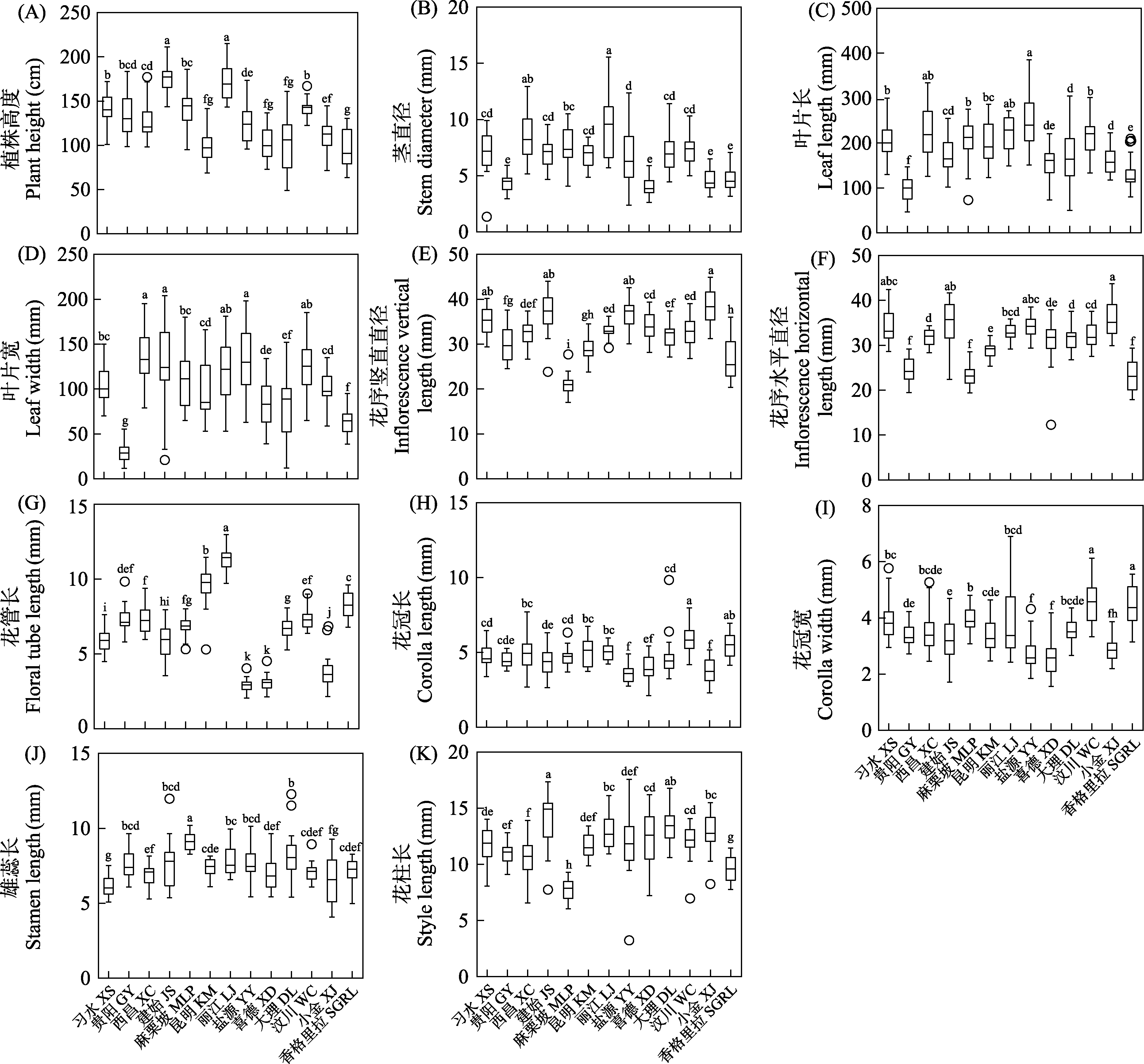
图2 13个地理居群川续断的形态特征比较(平均值 ± 标准误, 广义线性模型)。13个地理居群的详细信息见表1。不同小写字母表示该特征在不同居群间差异显著。
Fig. 2 Comparison of Dipsacus asper morphological traits among 13 geographic populations (mean ± SE, generalized linear model). More details for 13 geographic populations see Table 1. Different lowercase letters indicate significant differences in the morphological traits among different populations.
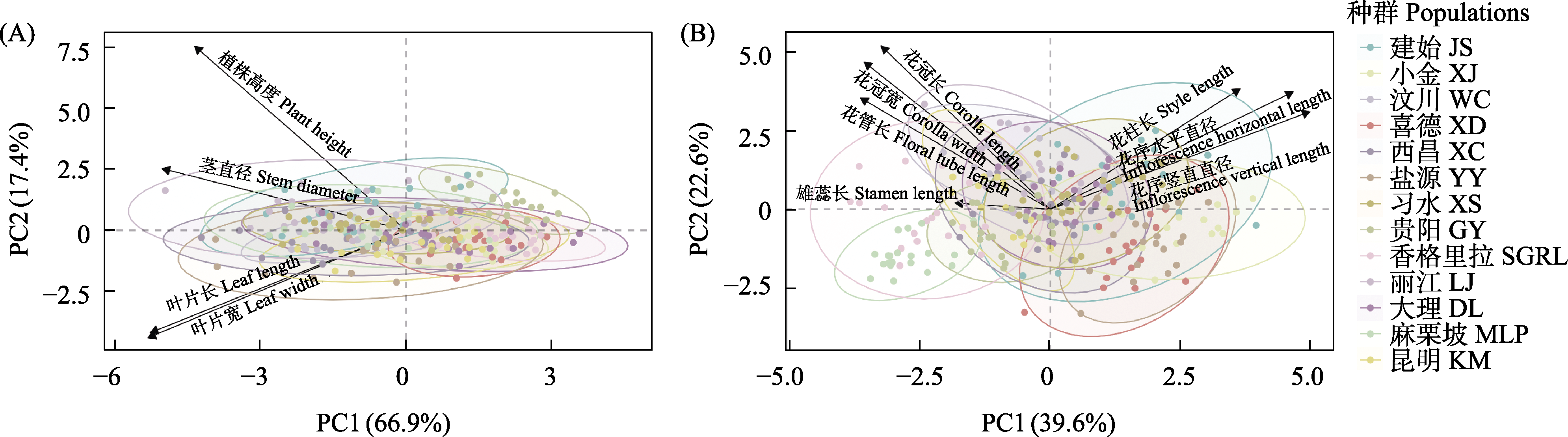
图3 13个地理居群川续断营养器官(A)和繁殖器官(B)形态特征的主成分分析(PCA)结果。13个地理居群的详细信息见表1。
Fig. 3 Principal component analysis (PCA) of the vegetative traits (A) and reproductive traits (B) of 13 geographic populations of Dipsacus asper. More details for 13 geographic populations see Table 1.
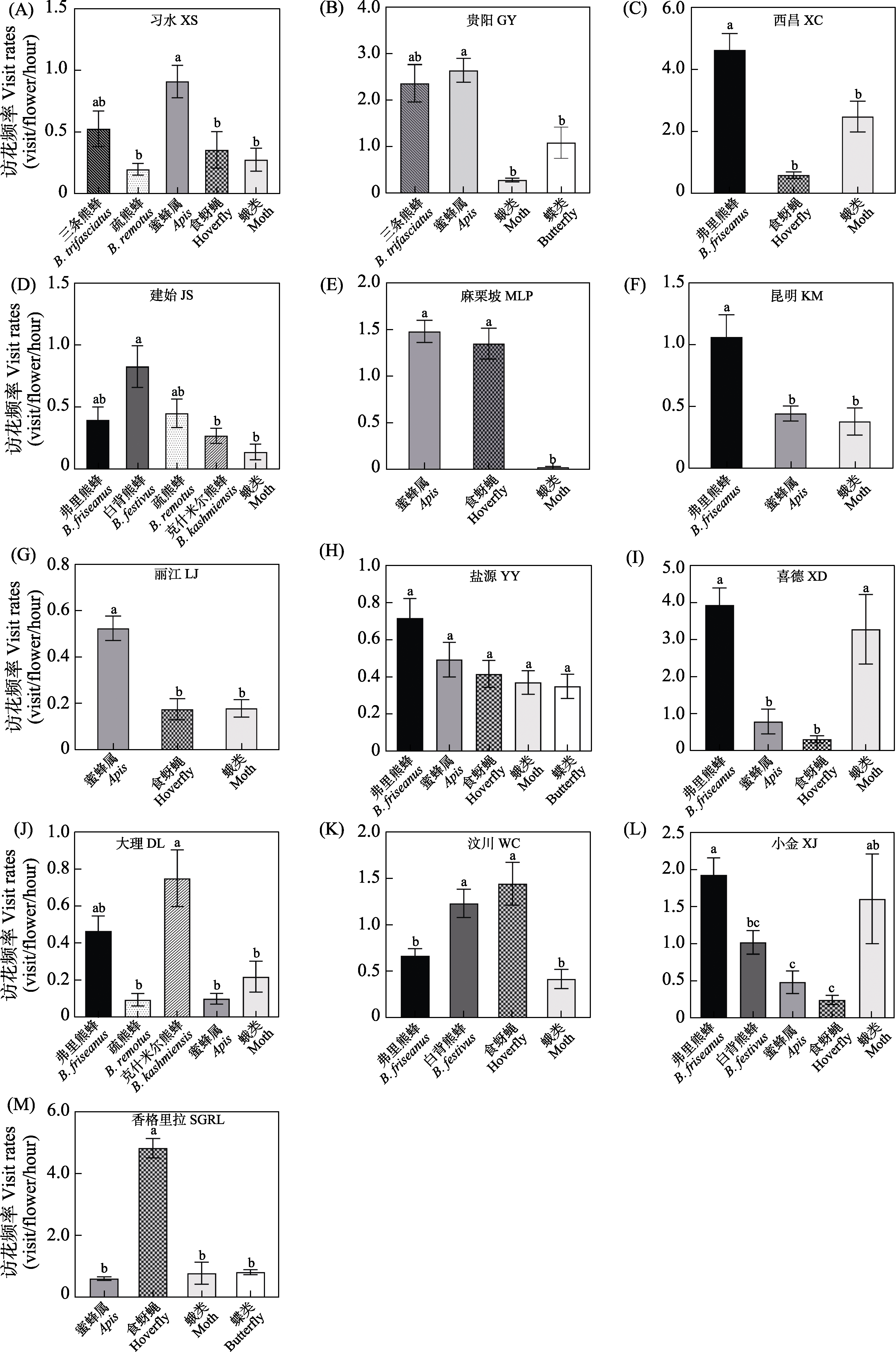
图4 13个川续断地理居群访花者类型以及访花频率的比较(广义线性模型)。13个地理居群的详细信息见表1。不同小写字母表明每个居群不同访花者之间的访花频率存在显著差异(P < 0.005)。
Fig. 4 Floral visitor types and comparison of visit frequencies (analyzed by generalized linear model) among 13 geographic populations of Dipsacus asper. More details for 13 geographic populations see Table 1. Different lowercase letters indicate significant differences (P < 0.005) in visit frequencies among different floral visitor types within each population.
| 居群 Populations | 熊蜂属 Bombus | 蜜蜂属 Apis | 食蚜蝇 Hoverfly | 蛾类 Moth | 蝶类 Butterfly |
|---|---|---|---|---|---|
| 贵阳 Guiyang (GY) | 43 | 199 | / | 12 | 1 |
| 香格里拉 Shangri-La (SGRL) | 1 | 51 | 483 | / | 112 |
| 麻栗坡 Malipo (MLP) | 12 | 244 | 146 | 1 | / |
表2 3个居群川续断整个花期白天访问昆虫的种类和数量
Table 2 Species and abundance of insect visitors during daytime throughout the flowering period of Dipsacus asper across three populations
| 居群 Populations | 熊蜂属 Bombus | 蜜蜂属 Apis | 食蚜蝇 Hoverfly | 蛾类 Moth | 蝶类 Butterfly |
|---|---|---|---|---|---|
| 贵阳 Guiyang (GY) | 43 | 199 | / | 12 | 1 |
| 香格里拉 Shangri-La (SGRL) | 1 | 51 | 483 | / | 112 |
| 麻栗坡 Malipo (MLP) | 12 | 244 | 146 | 1 | / |
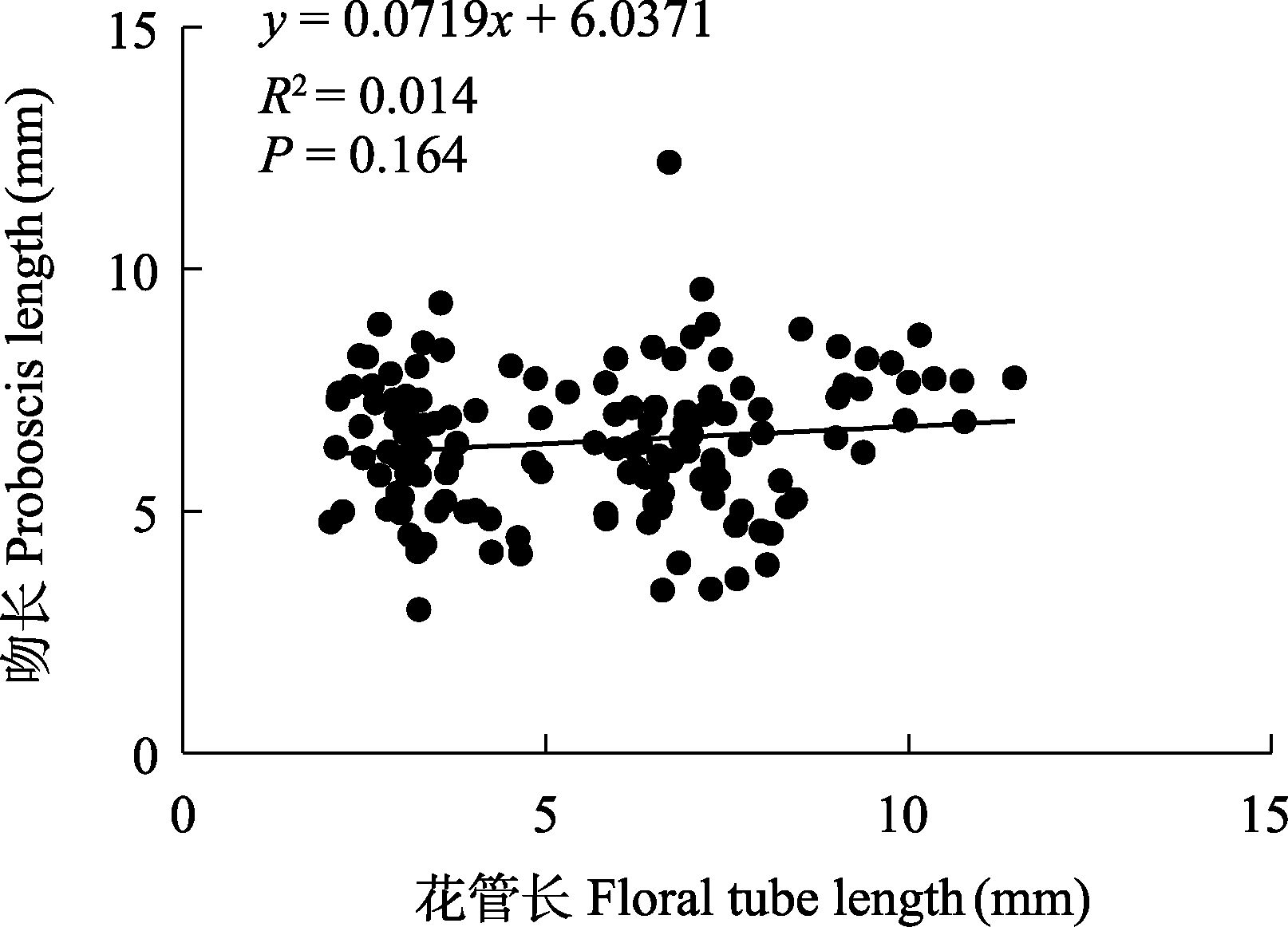
图5 川续断花管长和弗里熊蜂吻长的相关分析
Fig. 5 Correlation between floral tube length of Dipsacus asper and proboscis length of Bombus friseanus
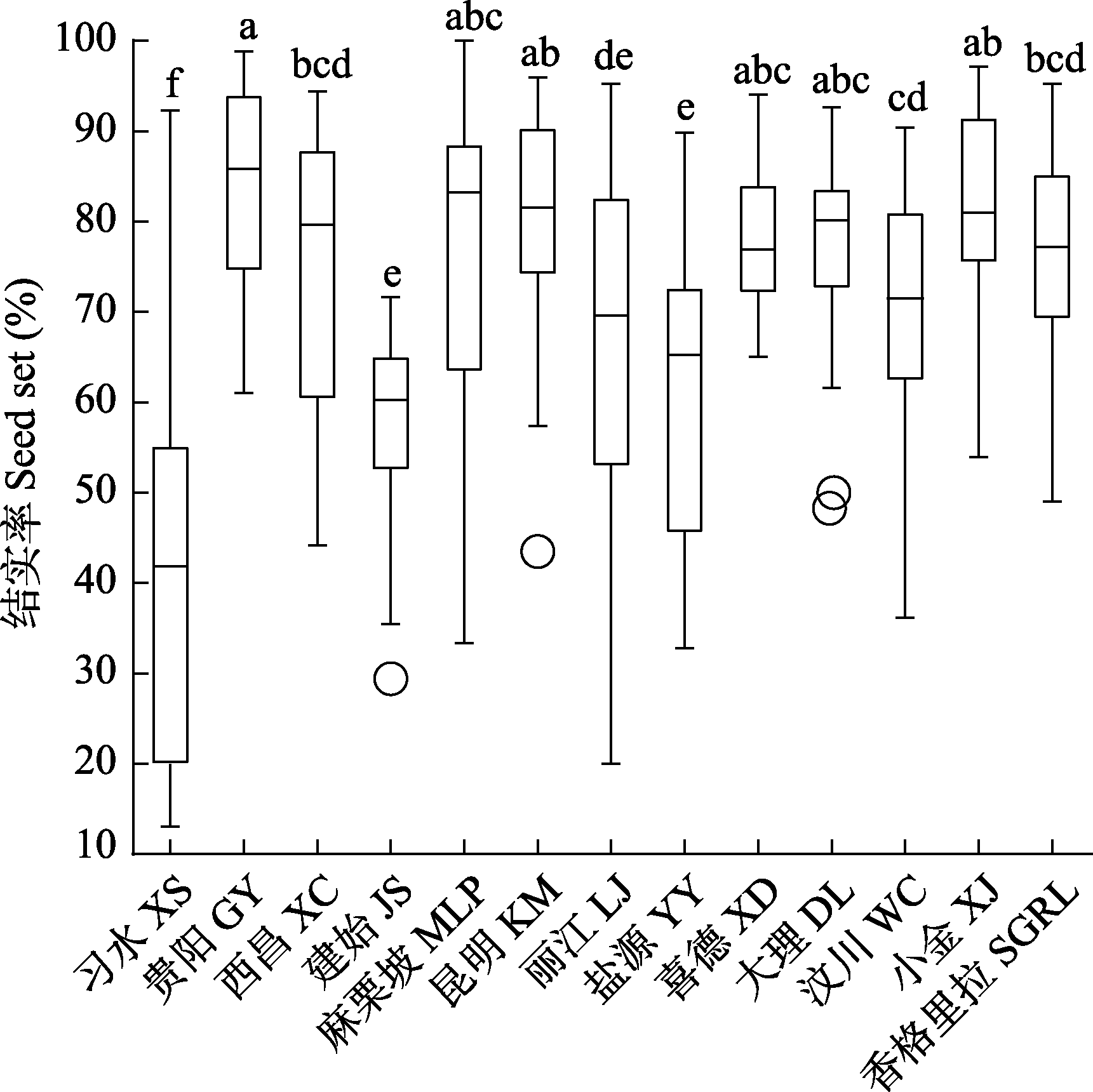
图6 13个川续断地理居群的自然结实率比较。13个地理居群的详细信息见表1。不同小写字母表明居群间的结实率存在显著差异(P < 0.005)。
Fig. 6 Comparison of natural seed set among 13 geographic populations of Dipsacus asper. More details for 13 geographic populations see Table 1. Different lowercase letters indicate significant differences in seed set among populations (P < 0.005).
| 特征 Traits | 经度 Longitude | 纬度 Latitude | 海拔 Elevation | 模型 Model | |||||
|---|---|---|---|---|---|---|---|---|---|
| β | P | β | P | β | P | 调整R2 Adjusted R2 | F | P | |
| 形态特征 Morphological traits | |||||||||
| 植株高度 Plant height (cm) | 0.322 | < 0.001 | 0.120 | 0.059 | -0.167 | 0.044 | 0.222 | 25.783 | < 0.001 |
| 茎直径 Stem diameter | -0.237 | 0.012 | -0.008 | 0.909 | -0.322 | < 0.001 | 0.049 | 5.441 | < 0.001 |
| 叶片长 Leaf length | -0.362 | < 0.001 | 0.161 | 0.022 | -0.318 | < 0.001 | 0.048 | 5.357 | < 0.001 |
| 叶片宽 Leaf width | -0.147 | 0.113 | 0.307 | < 0.001 | -0.179 | 0.049 | 0.062 | 6.739 | < 0.001 |
| 花序竖直直径 Inflorescence length (vert.) | -0.242 | < 0.001 | 0.702 | < 0.001 | -0.316 | < 0.001 | 0.387 | 55.768 | < 0.001 |
| 花序水平直径 Inflorescence length (hori.) | -0.235 | 0.004 | 0.607 | < 0.001 | -0.287 | < 0.001 | 0.282 | 35.068 | < 0.001 |
| 花管长 Floral tube length | -0.122 | 0.181 | -0.280 | < 0.001 | -0.072 | 0.420 | 0.100 | 10.595 | < 0.001 |
| 花冠长 Corolla length | -0.109 | 0.408 | -0.011 | 0.908 | 0.034 | 0.789 | 0.008 | 1.662 | 0.176 |
| 花冠宽 Corolla width | -0.011 | 0.932 | -0.078 | 0.425 | 0.139 | 0.266 | 0.012 | 2.059 | 0.106 |
| 雄蕊长 Stamen length | 0.372 | < 0.001 | -0.546 | < 0.001 | 0.420 | < 0.001 | 0.221 | 25.641 | < 0.001 |
| 花柱长 Style length | 0.001 | 0.989 | 0.349 | < 0.001 | 0.007 | 0.934 | 0.113 | 12.027 | < 0.001 |
| 虫体特征 Morphological traits | |||||||||
| 体长 Body length | 0.010 | 0.912 | -0.011 | 0.912 | -0.387 | < 0.001 | 0.141 | 11.166 | < 0.001 |
| 吻长 Proboscis length | 0.308 | < 0.001 | -0.455 | < 0.001 | -0.029 | 0.733 | 0.171 | 13.830 | < 0.001 |
| 头长 Head length | 0.034 | 0.704 | 0.078 | 0.414 | -0.399 | < 0.001 | 0.137 | 10.863 | < 0.001 |
| 头宽 Head width | 0.002 | 0.985 | 0.109 | 0.249 | -0.433 | < 0.001 | 0.163 | 11.909 | < 0.001 |
| 头厚 Head height | -0.066 | 0.475 | 0.358 | < 0.001 | -0.304 | < 0.001 | 0.094 | 7.440 | < 0.001 |
| 胸长 Thorax length | -0.024 | 0.797 | -0.009 | 0.927 | -0.263 | 0.004 | 0.059 | 4.894 | 0.003 |
| 胸宽 Thorax width | -0.174 | 0.062 | 0.076 | 0.435 | -0.358 | < 0.001 | 0.087 | 6.899 | < 0.001 |
| 胸厚 Thorax height | -0.096 | 0.297 | 0.263 | 0.007 | -0.405 | < 0.001 | 0.102 | 8.128 | < 0.001 |
| 腹长 Abdomen length | -0.019 | 0.840 | -0.058 | 0.557 | -0.279 | 0.002 | 0.093 | 6.231 | < 0.001 |
| 腹宽 Abdomen width | -0.201 | 0.030 | 0.264 | 0.007 | -0.434 | < 0.001 | 0.104 | 8.207 | < 0.001 |
| 腹厚 Abdomen height | -0.189 | 0.036 | 0.378 | < 0.001 | -0.496 | < 0.001 | 0.154 | 12.308 | < 0.001 |
| 自然结实率 Natural seed set | 0.171 | 0.050 | -0.327 | < 0.001 | 0.443 | < 0.001 | 0.137 | 15.013 | < 0.001 |
表3 川续断形态特征、弗里熊蜂虫体特征以及川续断自然结实率与经纬度、海拔的回归模型及其回归系数(β), P < 0.005。
Table 3 Linear regression models and the regression coefficients (β) for morphological traits of Dipsacus asper, morphological traits of Bombus friseanus, and natural seed set of D. asper in relation to longitude, latitude, and elevation (P < 0.005)
| 特征 Traits | 经度 Longitude | 纬度 Latitude | 海拔 Elevation | 模型 Model | |||||
|---|---|---|---|---|---|---|---|---|---|
| β | P | β | P | β | P | 调整R2 Adjusted R2 | F | P | |
| 形态特征 Morphological traits | |||||||||
| 植株高度 Plant height (cm) | 0.322 | < 0.001 | 0.120 | 0.059 | -0.167 | 0.044 | 0.222 | 25.783 | < 0.001 |
| 茎直径 Stem diameter | -0.237 | 0.012 | -0.008 | 0.909 | -0.322 | < 0.001 | 0.049 | 5.441 | < 0.001 |
| 叶片长 Leaf length | -0.362 | < 0.001 | 0.161 | 0.022 | -0.318 | < 0.001 | 0.048 | 5.357 | < 0.001 |
| 叶片宽 Leaf width | -0.147 | 0.113 | 0.307 | < 0.001 | -0.179 | 0.049 | 0.062 | 6.739 | < 0.001 |
| 花序竖直直径 Inflorescence length (vert.) | -0.242 | < 0.001 | 0.702 | < 0.001 | -0.316 | < 0.001 | 0.387 | 55.768 | < 0.001 |
| 花序水平直径 Inflorescence length (hori.) | -0.235 | 0.004 | 0.607 | < 0.001 | -0.287 | < 0.001 | 0.282 | 35.068 | < 0.001 |
| 花管长 Floral tube length | -0.122 | 0.181 | -0.280 | < 0.001 | -0.072 | 0.420 | 0.100 | 10.595 | < 0.001 |
| 花冠长 Corolla length | -0.109 | 0.408 | -0.011 | 0.908 | 0.034 | 0.789 | 0.008 | 1.662 | 0.176 |
| 花冠宽 Corolla width | -0.011 | 0.932 | -0.078 | 0.425 | 0.139 | 0.266 | 0.012 | 2.059 | 0.106 |
| 雄蕊长 Stamen length | 0.372 | < 0.001 | -0.546 | < 0.001 | 0.420 | < 0.001 | 0.221 | 25.641 | < 0.001 |
| 花柱长 Style length | 0.001 | 0.989 | 0.349 | < 0.001 | 0.007 | 0.934 | 0.113 | 12.027 | < 0.001 |
| 虫体特征 Morphological traits | |||||||||
| 体长 Body length | 0.010 | 0.912 | -0.011 | 0.912 | -0.387 | < 0.001 | 0.141 | 11.166 | < 0.001 |
| 吻长 Proboscis length | 0.308 | < 0.001 | -0.455 | < 0.001 | -0.029 | 0.733 | 0.171 | 13.830 | < 0.001 |
| 头长 Head length | 0.034 | 0.704 | 0.078 | 0.414 | -0.399 | < 0.001 | 0.137 | 10.863 | < 0.001 |
| 头宽 Head width | 0.002 | 0.985 | 0.109 | 0.249 | -0.433 | < 0.001 | 0.163 | 11.909 | < 0.001 |
| 头厚 Head height | -0.066 | 0.475 | 0.358 | < 0.001 | -0.304 | < 0.001 | 0.094 | 7.440 | < 0.001 |
| 胸长 Thorax length | -0.024 | 0.797 | -0.009 | 0.927 | -0.263 | 0.004 | 0.059 | 4.894 | 0.003 |
| 胸宽 Thorax width | -0.174 | 0.062 | 0.076 | 0.435 | -0.358 | < 0.001 | 0.087 | 6.899 | < 0.001 |
| 胸厚 Thorax height | -0.096 | 0.297 | 0.263 | 0.007 | -0.405 | < 0.001 | 0.102 | 8.128 | < 0.001 |
| 腹长 Abdomen length | -0.019 | 0.840 | -0.058 | 0.557 | -0.279 | 0.002 | 0.093 | 6.231 | < 0.001 |
| 腹宽 Abdomen width | -0.201 | 0.030 | 0.264 | 0.007 | -0.434 | < 0.001 | 0.104 | 8.207 | < 0.001 |
| 腹厚 Abdomen height | -0.189 | 0.036 | 0.378 | < 0.001 | -0.496 | < 0.001 | 0.154 | 12.308 | < 0.001 |
| 自然结实率 Natural seed set | 0.171 | 0.050 | -0.327 | < 0.001 | 0.443 | < 0.001 | 0.137 | 15.013 | < 0.001 |
| [1] |
Amato B, Petit S (2017) A review of the methods for storing floral nectars in the field. Plant Biology, 19, 497-503.
DOI PMID |
| [2] |
Bingham RA, Orthner AR (1998) Efficient pollination of alpine plants. Nature, 391, 238-239.
DOI |
| [3] | Fenster CB, Armbruster WS, Wilson P, Dudash MR, Thomson JD (2004) Pollination syndromes and floral specialization. Annual Review of Ecology, Evolution, and Systematics, 35, 375-403. |
| [4] |
Gfrerer E, Laina D, Gibernau M, Comes HP, Hörger AC, Dötterl S (2023) Variation in scent amount but not in composition correlates with pollinator visits within populations of deceptive Arum maculatum L. (Araceae). Frontiers in Plant Science, 13, 1046532.
DOI URL |
| [5] |
Hao K, Liu TT, Hembry DH, Luo SX (2023) Trait matching in a multi-species geographic mosaic of leafflower plants, brood pollinators, and cheaters. Ecology and Evolution, 13, e10228.
DOI URL |
| [6] | Hao K, Wu YH, Sun QL, Dong WC, Luo SX (2024) Geographic variations of floral traits and pollinator guilds in a specialized pollination mutualism, Kadsura longipedunculata and gall midges. Biological Diversity, 21, 110-119. |
| [7] | Hattori M, Nagano Y, Itino T (2014) Geographic flower trait variation of Aquilegia buergeriana Sieb. et Zucc. var. buergeriana on Mt. Norikura and the Utsukushigahara Highland, Japan. American Journal of Plant Sciences, 5, 2686-2692. |
| [8] |
Hegland SJ, Nielsen A, Lázaro A, Bjerknes AL, Totland Ø (2009) How does climate warming affect plant-pollinator interactions? Ecology Letters, 12, 184-195.
DOI PMID |
| [9] |
Hou J, Liu M, Yang K, Liu B, Liu HH, Liu JQ (2025) Genetic variation for adaptive evolution in response to changed environments in plants. Journal of Integrative Plant Biology, 67, 2265-2293.
DOI |
| [10] |
Hu YB, Wang XP, Xu YC, Yang H, Tong ZY, Tian R, Xu SH, Yu L, Guo YL, Shi P, Huang SQ, Yang G, Shi SH, Wei FW (2023) Molecular mechanisms of adaptive evolution in wild animals and plants. Science China Life Sciences, 66, 453-495.
DOI |
| [11] | Huang SQ (2014) Most effective pollinator principle of floral evolution: Evidence and query. Chinese Bulletin of Life Sciences, 26, 118-124. (in Chinese) |
| [黄双全 (2014) 花部特征演化的最有效传粉者原则: 证据与疑问. 生命科学, 26, 118-124.] | |
| [12] | Johnson SD (2025) Pollination ecotypes and the origin of plant species. Proceedings of the Royal Society B: Biological Sciences, 292, 20242787. |
| [13] |
Körner C, Neumayer M, Menendez-Riedl SP, Smeets-Scheel A (1989) Functional morphology of mountain plants. Flora, 182, 353-383.
DOI URL |
| [14] |
Layek U, Das AD, Das U, Karmakar P (2024) Spatial and temporal variations in richness, diversity and abundance of floral visitors of curry plants (Bergera koenigii L.): Insights on plant-pollinator Interactions. Insects, 15, 83.
DOI URL |
| [15] |
Li B, Suzuki JI, Hara T (1998) Latitudinal variation in plant size and relative growth rate in Arabidopsis thaliana. Oecologia, 115, 293-301.
DOI URL |
| [16] |
Li HD, Ren ZX, Wu ZK, Xu K, Wang H (2015) Variation in floral traits of distylous Primula poissonii (Primulaceae) along geographic gradients. Biodiversity Science, 23, 747-758. (in Chinese with English abstract)
DOI URL |
|
[李海东, 任宗昕, 吴之坤, 许琨, 王红 (2015) 二型花柱植物海仙花报春花部性状随地理梯度的变异. 生物多样性, 23, 747-758.]
DOI |
|
| [17] |
Liang ZC, Liu TT, Chen XY, Xu WJ, Dong TF, Liu QS, Xu X (2023) Twigs of dove tree in high-latitude region tend to increase biomass accumulation in vegetative organs but decrease it in reproductive organs. Frontiers in Plant Science, 13, 1088955.
DOI URL |
| [18] | Liu XW (2025) Review on the elevation adaptive mechanisms of alpine plants based on different research methods. Journal of Tropical and Subtropical Botany, 33, 352-362. (in Chinese with English abstract) |
| [刘兴文 (2025) 基于不同研究方法的高山植物海拔适应性机制研究概述. 热带亚热带植物学报, 33, 352-362.] | |
| [19] |
Mao YY, Huang SQ (2009) Pollen resistance to water in 80 angiosperm species: Flower structures protect rain susceptible pollen. New Phytologist, 183, 892-899.
DOI URL |
| [20] |
Medeiros LP, Garcia G, Thompson JN, Guimarães PR Jr (2018) The geographic mosaic of coevolution in mutualistic networks. Proceeding of the National Academy of Sciences, USA, 115, 12017-12022.
DOI URL |
| [21] | Miao LL, Liu MX, Xiao YD, Yang CL, Wang QY, Wang M (2024) Studies on phylogeny and functional traits structure of plant communities at different latitudes. Acta Ecologica Sinica, 44, 317-329. (in Chinese with English abstract) |
| [苗乐乐, 刘旻霞, 肖音迪, 杨春亮, 王千月, 王敏 (2024) 不同纬度植物群落系统发育与功能性状结构研究. 生态学报, 44, 317-329.] | |
| [22] |
Moir M, Butler H, Peter C, Dold T, Newman E (2025) A test of the Grant-Stebbins pollinator-shift model of floral evolution. New Phytologist, 245, 2322-2335.
DOI PMID |
| [23] |
Nepal S, Trunschke J, Ren ZX, Burgess KS, Wang H (2023) Community-wide patterns in pollen and ovule production, their ratio (P/O), and other floral traits along an elevation gradient in southwestern China. BMC Plant Biology, 23, 425.
DOI PMID |
| [24] |
Ollerton J, Winfree R, Tarrant S (2011) How many flowering plants are pollinated by animals? Oikos, 120, 321-326.
DOI URL |
| [25] | Pacheco DA, Dudley LS, Cabezas J, Cavieres LA, Arroyo MTK (2016) Plastic responses contribute to explaining altitudinal and temporal variation in potential flower longevity in high Andean Rhodolirion montanum. PLoS ONE, 11, e0166350. |
| [26] |
Paudel BR, Shrestha M, Burd M, Adhikari S, Sun YS, Li QJ (2016) Coevolutionary elaboration of pollination-related traits in an alpine ginger (Roscoea purpurea) and a tabanid fly in the Nepalese Himalayas. New Phytologist, 211, 1402-1411.
DOI PMID |
| [27] |
Pauw A, Stofberg J, Waterman RJ (2009) Flies and flowers in Darwin’s race. Evolution, 63, 268-279.
DOI URL |
| [28] |
Pi HQ, Quan QM, Wu B, Lü XW, Shen LM, Huang SQ (2021) Altitude-related shift of relative abundance from insect to sunbird pollination in Elaeagnus umbellata (Elaeagnaceae). Journal of Systematics and Evolution, 59, 1266-1275.
DOI URL |
| [29] |
Ramos SE, Schiestl FP (2019) Rapid plant evolution driven by the interaction of pollination and herbivory. Science, 364, 193-196.
DOI PMID |
| [30] |
Reich D, Berger A, von Balthazar M, Chartier M, Sherafati M, Schönenberger J, Manafzadeh S, Staedler YM (2020) Modularity and evolution of flower shape: The role of function, development, and spandrels in Erica. New Phytologist, 226, 267-280.
DOI PMID |
| [31] |
Rodriguez-Peña RA, Wolfe AD (2023) Flower morphology variation in five species of Penstemon (Plantaginaceae) displaying Hymenoptera pollination syndrome. Botanical Sciences, 101, 217-232.
DOI URL |
| [32] |
Shi YH, Ren ZX, Zhao YH, Wang H (2021) Effect of climate change on the distribution and phenology of plants, insect pollinators, and their interactions. Biodiversity Science, 29, 495-506. (in Chinese with English abstract)
DOI |
|
[施雨含, 任宗昕, 赵延会, 王红 (2021) 气候变化对植物-传粉昆虫的分布区和物候及其互作关系的影响. 生物多样性, 29, 495-506.]
DOI |
|
| [33] | Stanley AM, Martel C, Arceo-Gómez G (2021) Spatial variation in bidirectional pollinator-mediated interactions between two co-flowering species in serpentine plant communities. AoB Plants, 13, plab069. |
| [34] |
Stebbins GL (1970) Adaptive radiation of reproductive characteristics in angiosperms. I. Pollination mechanisms. Annual Review of Ecology and Systematics, 1, 307-326.
DOI URL |
| [35] |
Sun JF, Gong YB, Renner SS, Huang SQ (2008) Multifunctional bracts in the dove tree Davidia involucrata (Nyssaceae: Cornales): Rain protection and pollinator attraction. The American Naturalist, 171, 119-124.
DOI URL |
| [36] |
Todesco M, Bercovich N, Kim A, Imerovski I, Owens GL, Dorado Ruiz Ó, Holalu SV, Madilao LL, Jahani M, Légaré JS, Blackman BK, Rieseberg LH (2022) Genetic basis and dual adaptive role of floral pigmentation in sunflowers. eLife, 11, e72072.
DOI URL |
| [37] |
Toji T, Ishimoto N, Egawa S, Nakase Y, Hattori M, Itino T (2021) Intraspecific convergence of floral size correlates with pollinator size on different mountains: A case study of a bumblebee-pollinated Lamium (Lamiaceae) flowers in Japan. BMC Ecology and Evolution, 21, 64.
DOI |
| [38] | Thompson JN (1994) The Coevolutionary Process. University of Chicago Press, Chicago. |
| [39] |
Thompson JN (1999) Specific hypotheses on the geographic mosaic of coevolution. The American Naturalist, 153(S5), S1-S14.
DOI URL |
| [40] | Thompson JN (2005) The Geographic Mosaic of Coevolution. University of Chicago Press, Chicago. |
| [41] | Tong ZY, Wu LY, Feng HH, Zhang M, Armbruster WS, Renner SS, Huang SQ (2023) New calculations indicate that 90% of flowering plant species are animal-pollinated. National Science Review, 10, nwad219. |
| [42] | Wang XY (2017) Pollen Chemical Defense Mechanism of Two Dipsacus Species. PhD dissertation, Wuhan University, Wuhan. (in Chinese with English abstract) |
| [王晓月 (2017) 川续断属两种植物花粉的化学防御机制研究. 博士学位论文, 武汉大学, 武汉.] | |
| [43] | Wang Y, Hu XF, Song HL, Zhou QS, Wu QT, Kong WN, Zhu CD, Li J (2022) Effect of habitat type on pollinator diversity. Chinese Journal of Applied Entomology, 59, 1259-1268. (in Chinese with English abstract) |
| [王怡, 胡学丰, 宋怀磊, 周青松, 吴清涛, 孔维娜, 朱朝东, 李捷 (2022) 生境类型对传粉昆虫多样性的影响. 应用昆虫学报, 59, 1259-1268.] | |
| [44] |
Wasserthal LT (1997) The pollinators of the Malagasy star orchids Angraecum sesquipedale, A. sororium and A. compactum and the evolution of extremely long spurs by pollinator shift. Botanica Acta, 110, 343-359.
DOI URL |
| [45] | Wenzell KE, Skogen KA, Fant JB (2023) Range-wide floral trait variation reflects shifts in pollinator assemblages consistent with pollinator-mediated divergence despite generalized visitation. Oikos, 2023, e09708. |
| [46] | Willmer P (2011) Pollination and Floral Ecology. Princeton University Press, Princeton. |
| [47] |
Xiang X, Huang YM, Yang CY, Li ZQ, Chen HY, Pan YP, Huo JX, Ren L (2021) Effect of altitude on community-level plant functional traits in the Qinghai Lake Basin, China. Chinese Journal of Plant Ecology, 45, 456-466. (in Chinese with English abstract)
DOI URL |
| [向响, 黄永梅, 杨崇曜, 李泽卿, 陈慧颖, 潘莹萍, 霍佳璇, 任梁 (2021) 海拔对青海湖流域群落水平植物功能性状的影响. 植物生态学报, 45, 456-466.] | |
| [48] | Yao RX, Chen Y, Lü XQ, Wang JH, Yang FJ, Wang XY (2023) Altitude-related environmental factors shape the phenotypic characteristics and chemical profile of Rhododendron. Biodiversity Science, 31, 23003. (in Chinese with English abstract) |
| [姚仁秀, 陈燕, 吕晓琴, 王江湖, 杨付军, 王晓月 (2023) 海拔及环境因子影响杜鹃属植物的表型特征和化学性状. 生物多样性, 31, 23003.] |
| [1] | 王顺雨, 李杨, 吕晓琴, 李欣, 范权秀, 王晓月. 熊蜂盗蜜的花色偏好及对长距忍冬繁殖适合度的影响[J]. 生物多样性, 2025, 33(4): 24554-. |
| [2] | 张婵, 赵苏雅, 张欣然, 王依凡, 王林林. 外来传粉者对本地植物‒传粉者相互作用的影响[J]. 生物多样性, 2025, 33(2): 24443-. |
| [3] | 陈静, 张丙昌, 刘燕晋, 武杰, 赵康, 明姣. 荒漠生物结皮细鞘丝藻类(Leptolyngbya-like)蓝藻多样性[J]. 生物多样性, 2024, 32(9): 24186-. |
| [4] | 巴苏艳, 赵春艳, 刘媛, 方强. 通过虫体花粉识别构建植物‒传粉者网络: 人工模型与AI模型高度一致[J]. 生物多样性, 2024, 32(6): 24088-. |
| [5] | 丁翔, 余元钧, 宋希强, 罗毅波. 具有泛化访花者的海芋特化传粉系统[J]. 生物多样性, 2024, 32(6): 24069-. |
| [6] | 王江, 赵一凡, 屈彦福, 张财文, 张亮, 陈传武, 王彦平. 中国蛇类形态、生活史和生态学特征数据集[J]. 生物多样性, 2023, 31(7): 23126-. |
| [7] | 钟雨茜, 陈传武, 王彦平. 中国蜥蜴类生活史和生态学特征数据集[J]. 生物多样性, 2022, 30(4): 22071-. |
| [8] | 丁晨晨, 梁冬妮, 信文培, 李春旺, 蒋志刚. 中国哺乳动物形态、生活史和生态学特征数据集[J]. 生物多样性, 2022, 30(2): 21520-. |
| [9] | 王彦平, 宋云枫, 钟雨茜, 陈传武, 赵郁豪, 曾頔, 吴亦如, 丁平. 中国鸟类的生活史和生态学特征数据集[J]. 生物多样性, 2021, 29(9): 1149-1153. |
| [10] | 俞正森, 宋娜, 本村浩之, 高天翔. 中国银口天竺鲷属鱼类的分类厘定[J]. 生物多样性, 2021, 29(7): 971-979. |
| [11] | 李慢如, 张玲. 桑寄生植物繁殖物候研究概述[J]. 生物多样性, 2020, 28(7): 833-841. |
| [12] | 贾翔宇, 白彬, 张洁清, 黄艺. IPBES评估报告对全球生物多样性保护的影响——以美国传粉者保护政策为例[J]. 生物多样性, 2018, 26(5): 527-534. |
| [13] | 黄家兴, 安建东. 中国熊蜂多样性、人工利用与保护策略[J]. 生物多样性, 2018, 26(5): 486-497. |
| [14] | 田昊, 廖万金. 克隆生长对被子植物传粉过程的影响[J]. 生物多样性, 2018, 26(5): 468-475. |
| [15] | 童泽宇, 徐环李, 黄双全. 探讨监测传粉者的方法[J]. 生物多样性, 2018, 26(5): 433-444. |
| 阅读次数 | ||||||
|
全文 |
|
|||||
|
摘要 |
|
|||||
备案号:京ICP备16067583号-7
Copyright © 2026 版权所有 《生物多样性》编辑部
地址: 北京香山南辛村20号, 邮编:100093
电话: 010-62836137, 62836665 E-mail: biodiversity@ibcas.ac.cn
