

生物多样性 ›› 2026, Vol. 34 ›› Issue (5): 25489. DOI: 10.17520/biods.2025489 cstr: 32101.14.biods.2025489
郝晨阳1,2,#, 高少羽2,3,#, 程跃华2,4, 扎西尼玛2, 徐波1,*( ), 杨扬2,*()
收稿日期:2025-12-10
接受日期:2026-02-19
出版日期:2026-05-20
发布日期:2026-07-01
通讯作者:
*共同通讯作者:E-mail: yangyang@mail.kib.ac.cn; alpine_flora@swfu.edu.cn
作者简介:#共同第一作者
基金资助:
Chenyang Hao1,2,#, Shaoyu Gao2,3,#, Yuehua Cheng2,4, Zhaxinima2, Bo Xu1,*(), Yang Yang2,*()
Received:2025-12-10
Accepted:2026-02-19
Online:2026-05-20
Published:2026-07-01
Contact:
*Co-corresponding authors.E-mail: yangyang@mail.kib.ac.cn; alpine_flora@swfu.edu.cn
About author:#Co-first authors
Supported by:摘要:
温室结构是横断山区高山冰缘带植物高度特化适应结构的典型代表之一, 其显著特征为包裹花序的巨大半透明苞片, 主要代表类群有蓼科大黄属(Rheaum)的塔黄(R. nobile)和水黄(R. alexandrae)以及菊科风毛菊属(Saussurea)雪莲亚属(Subgen. Amphilaena)的苞叶雪莲(S. obvallata)和毡毛雪莲(S. velutina)等。然而, 与塔黄、水黄以及苞叶雪莲花序在整个生长季节始终由苞片完全包裹不同, 伴随生长季节的推进, 毡毛雪莲选择将其头状花序突出于苞片包围结构之外直至果期种子成熟, 关于此阶段的植物生态适应机制还未有报道。本研究对毡毛雪莲头状花序突出苞片包围结构之后的热力学特性以及此时期的苞片光学特性及其在传粉者吸引和种子生成方面的功能进行了探索。结果表明, 全天、白天和夜间毡毛雪莲头状花序内部平均温度均显著高于周围气温(与植株等高处, 距离地面15-20 cm) 3-5 K (卡尔文温度系数, 以表示温度差异), 在晴天天气状况下两者之间的温度差异更是可以超过20 K; 在晴天、多云和雨天天气状况下头状花序的聚热效益均 > 40%, 并且与周围气温相比, 头状花序具备近100 min的温度缓冲能力。同时, 研究发现毡毛雪莲附着于头状花序的紫红色苞片虽然具备对与增温效果相关的红光和红外光波段入射光的选择滤过性(24.4%-36.0%), 但将苞片完全打开处理却并未对植物的种子数量和质量产生显著影响。光谱视觉分析数据显示, 苞片与叶片之间的色觉反差(0.30 ± 0.02 CH, CH为熊蜂色彩六边形距离单位)显著高于熊蜂(Bombus)可识别色彩距离阈值(0.11 CH), 所以苞片可能可以被熊蜂从叶片背景识别出来。本研究证实毡毛雪莲的头状花序凭借其紧实结构和黑褐颜色实现的聚热增温和缓冲保温功能是高山冰缘植物应对高寒生境内夏季冷凉气候和短暂生长期的适应策略, 其紫红色苞片可能具有吸引传粉昆虫的作用, 但仍需在原生地开展更多观测与实验, 例如量化苞片对传粉者访花频率的影响, 以进一步探索和验证其功能。
郝晨阳, 高少羽, 程跃华, 扎西尼玛, 徐波, 杨扬 (2026) 横断山区高山冰缘植物毡毛雪莲紧实深色头状花序的生态功能. 生物多样性, 34, 25489. DOI: 10.17520/biods.2025489.
Chenyang Hao, Shaoyu Gao, Yuehua Cheng, Zhaxinima, Bo Xu, Yang Yang (2026) Ecological significance of the compact and dark inflorescence of Saussurea velutina (Asteraceae) in Hengduan Mountains, Southwestern China. Biodiversity Science, 34, 25489. DOI: 10.17520/biods.2025489.
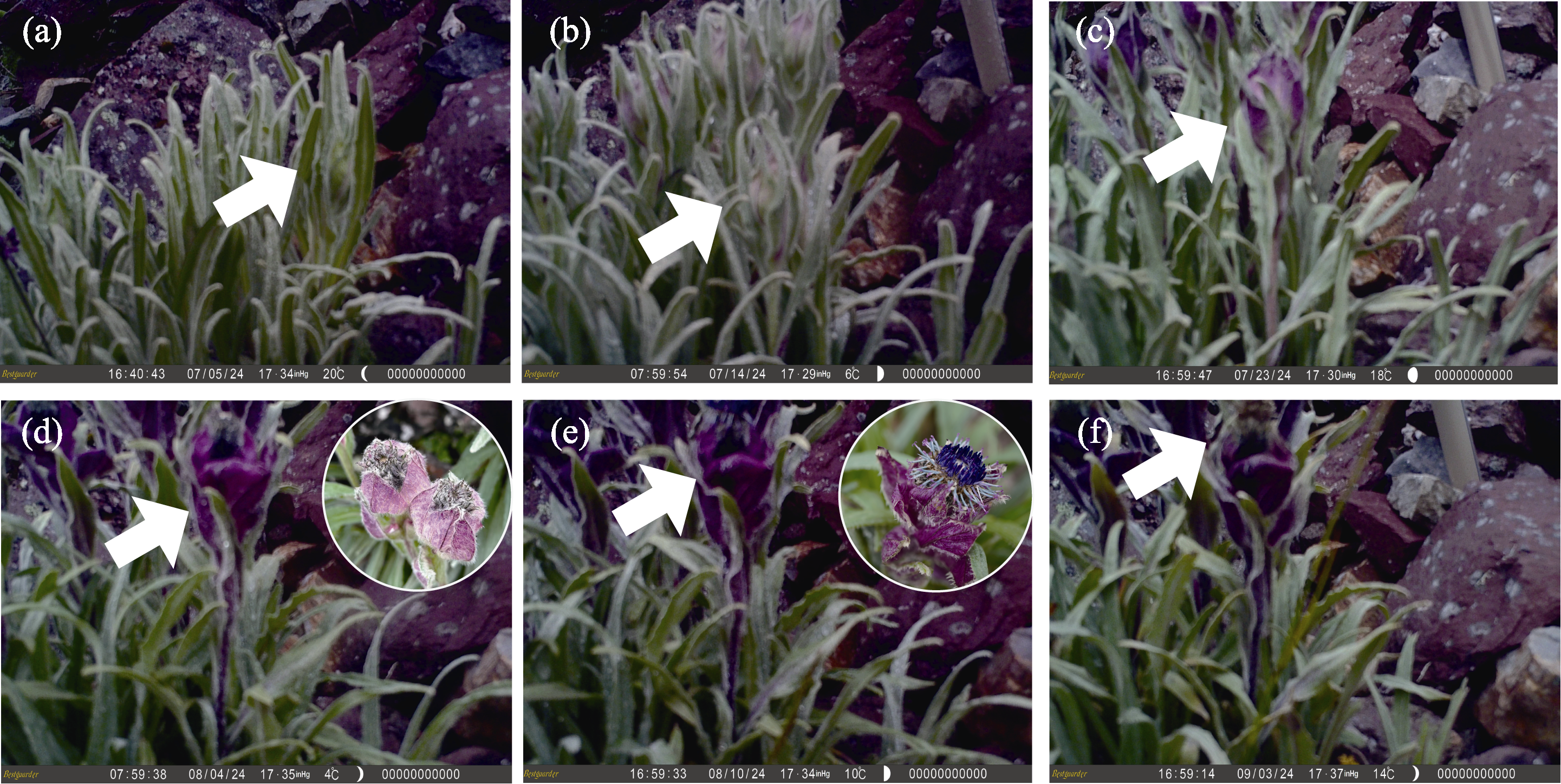
图1 2024年7-9月毡毛雪莲物候变化。(a)生长季节初期, 目标植物头状花序由黄绿色苞片包裹; (b-c)伴随生长发育进程, 包裹目标植物头状花序的苞片颜色逐渐变为紫红色; (d)目标植物头状花序突出于苞片包裹; (e)目标植物头状花序小花开放; (f)目标植物进入果期。白色箭头指示物候事件观测点, (d-e)右上图像为对应物候时期, 在研究地点进行踏查时以相机拍摄植株照片。
Fig. 1 Phenological changes of Saussurea velutina from July to September 2024. (a) During the early growing season, the inflorescence of S. velutina was covered by yellow-green colored bracts; (b-c) Along with the progresses of growing season, the color of the bracts that covered the inflorescence of S. velutina gradually changed from yellow and green to deep pink-purple; (d) The inflorescence of S. velutina extruded from the cover of bracts; (e) Florets in the inflorescences were in flowering time; (f) S. velutina entered into fruiting period. For each pictures, arrow point as reference points for observing the event of the morphological change. The upper right picture inserted into (d) and (e) indicates the corresponding phenological stages, which were recorded by camera during the regular site visits.
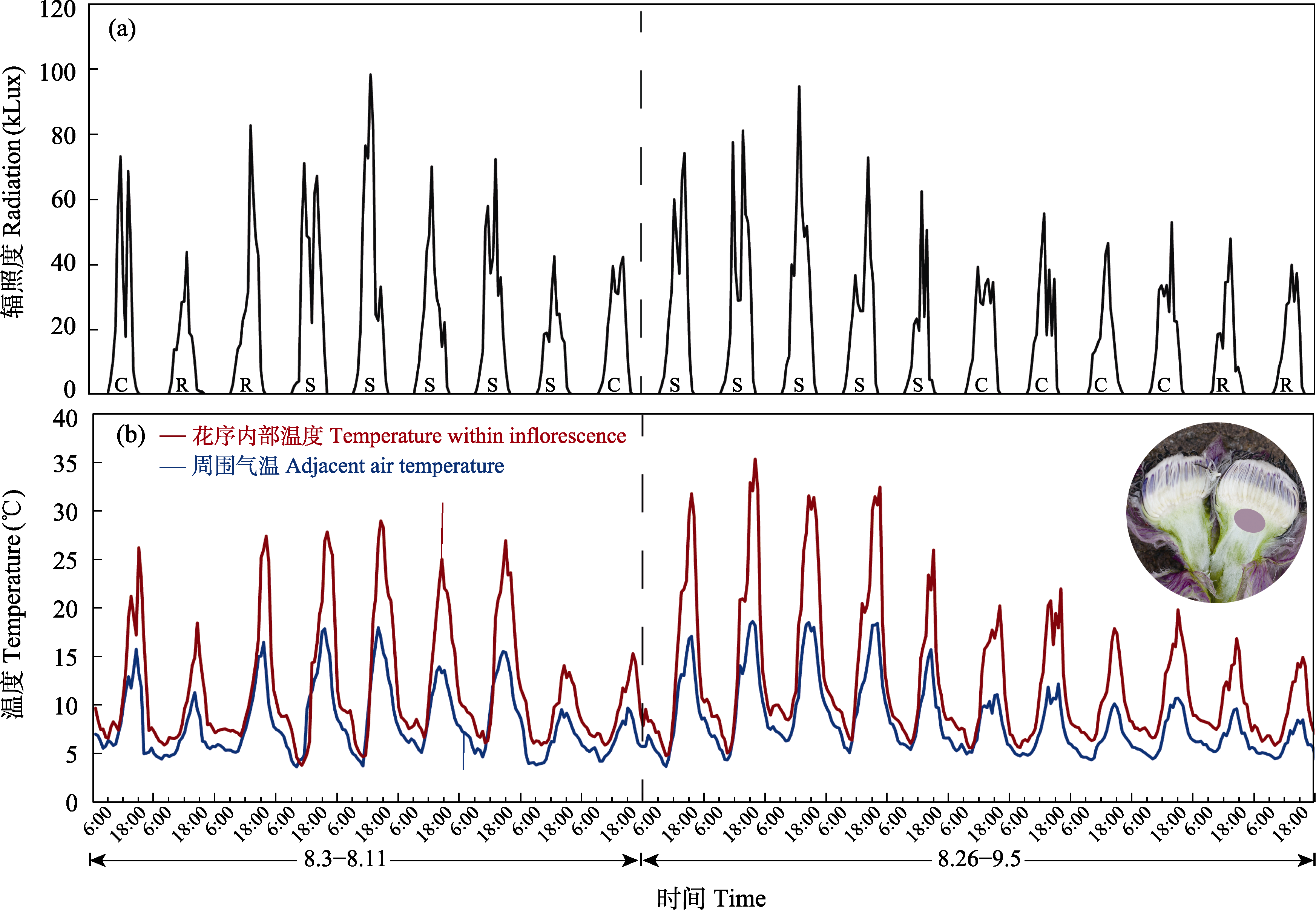
图2 2024年8-9月(共计20 d)野外监测期间植物原生地的入射辐照强度(a)和毡毛雪莲花序内部及周围气温(与植株等高处, 距离地面15-20 cm) (b)。S: 晴天; C: 多云; R: 雨天。(b)右侧花序纵切照片中粉红色区域指示测量花序内部温度位置(子房处)。
Fig. 2 In situ incident radiation (a), temperature within inflorescence of Saussurea velutina and the adjacent air temperature (at the same height of plant individual, 15-20 cm aboveground) (b) during the on-site measurements from August to September 2024 (a total of 20 d). S, Sunny day; C, Cloudy day; R, Rainy day. The pink area in the insert picture in (b) indicates the position (ovary) of measurement of temperature within inflorescence.
| 日均温 Daily mean temperature | 白天均温(08:00-19:00) Mean temperature during daytime (08:00-19:00) | 夜间均温(20:00-07:00) Mean temperature during nighttime (20:00-07:00) | 极端低温 The lowest temperature | 极端高温 The highest temperature | |
|---|---|---|---|---|---|
| 8月3-11日 Aug. 3 to 11 | 8.1 ± 0.5℃ | 9.4 ± 0.6℃ | 6.9 ± 0.4℃ | 3.6℃ | 17.9℃ |
| 8月26日至9月5日 Aug. 26 to Sept. 5 | 8.1 ± 0.5℃ | 9.2 ± 0.6℃ | 7.1 ± 0.5℃ | 3.6℃ | 18.5℃ |
表1 不同监测时间段植物原生地周围气温
Table 1 Adjacent air temperature of Saussurea velutina at different monitoring time periods in situ
| 日均温 Daily mean temperature | 白天均温(08:00-19:00) Mean temperature during daytime (08:00-19:00) | 夜间均温(20:00-07:00) Mean temperature during nighttime (20:00-07:00) | 极端低温 The lowest temperature | 极端高温 The highest temperature | |
|---|---|---|---|---|---|
| 8月3-11日 Aug. 3 to 11 | 8.1 ± 0.5℃ | 9.4 ± 0.6℃ | 6.9 ± 0.4℃ | 3.6℃ | 17.9℃ |
| 8月26日至9月5日 Aug. 26 to Sept. 5 | 8.1 ± 0.5℃ | 9.2 ± 0.6℃ | 7.1 ± 0.5℃ | 3.6℃ | 18.5℃ |
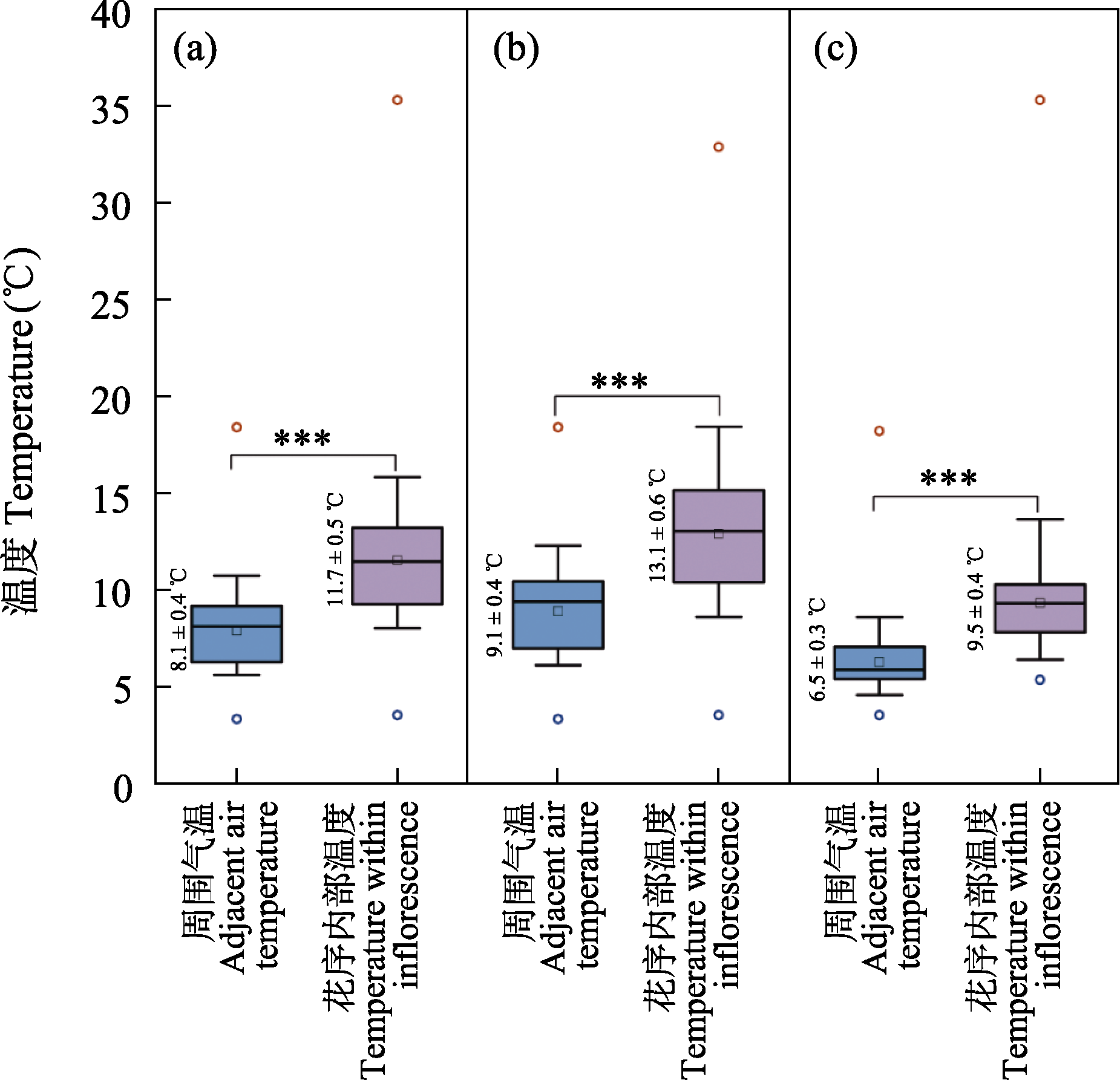
图3 2024年8-9月野外监测期间植物原生地毡毛雪莲头状花序与周围气温全天平均温度(a)、白天(08:00-19:00)平均温度(b)和夜间(20:00-07:00)平均温度(c)比较(n = 20 d)。框内须线代表中位数; 上下须线代表均温波动范围, 空心矩形代表均值; 红色空心圆为最高温, 蓝色空心圆为最低温。*** P < 0.001。
Fig. 3 During the on-site measurements from August to September 2024, in situ daily mean temperature (a), mean temperature during daytime (08:00-19:00) (b) and nighttime (20:00-07:00) (b) within the inflorescence of Saussurea velutina and the adjacent air temperature. For each temperature parameter, n = 20 d. Boxes indicate the mean temperature, with lines indicating median, upper and lower whiskers indicating the range of the mean temperature. Red and blue empty dots in each box indicate the highest and the lowest temperature, respectively. *** P < 0.001.
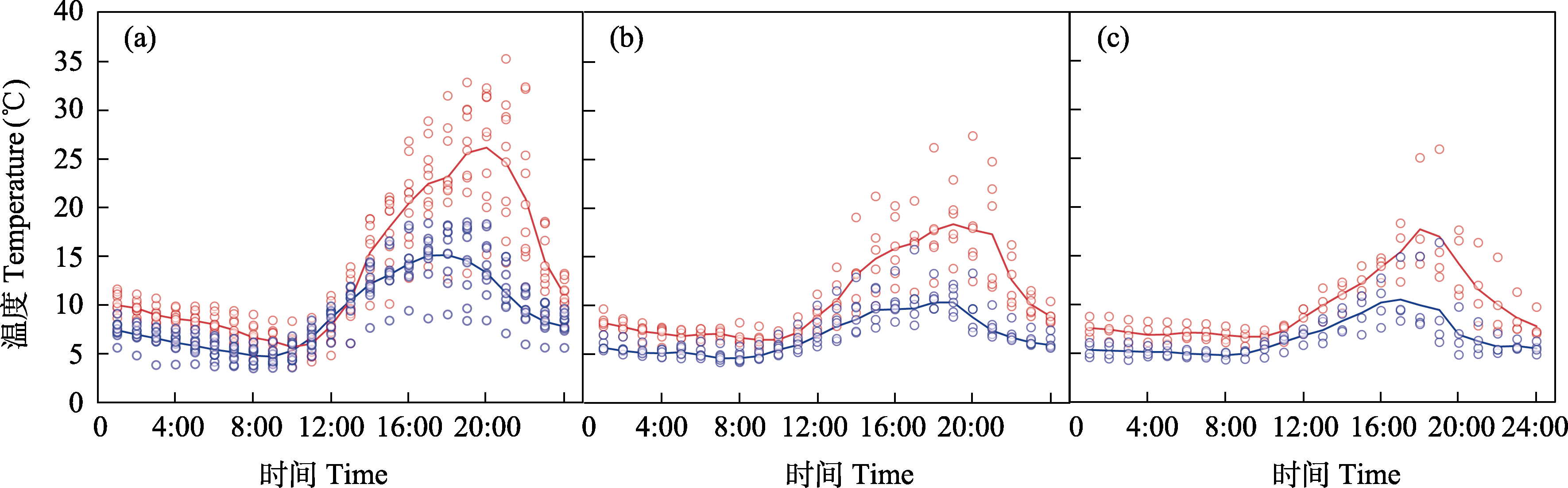
图4 2024年8-9月野外监测期间晴天(a)、多云(b)和雨天(c)天气状况下毡毛雪莲头状花序内部温度每小时均温(红色线, n = 晴天、多云、雨天天数)及对应的天气状况下各天每小时温度(红点)与周围气温每小时均温(蓝色线)、各天每小时温度(蓝色点)
Fig. 4 During the on-site measurements from August to September 2024, under sunny (a), cloudy (b), and rainy (c) days, the hourly mean temperature within the inflorescence of Saussurea velutina (red line) and the adjacent air temperature (blue line) (n = number of sunny, cloudy and rainy days) and the hourly temperature of each days (red dots: inflorescence temperature; blue dots: adjacent air temperature) under the corresponding weather conditions (i.e. sunny day, cloudy day and rainy day).
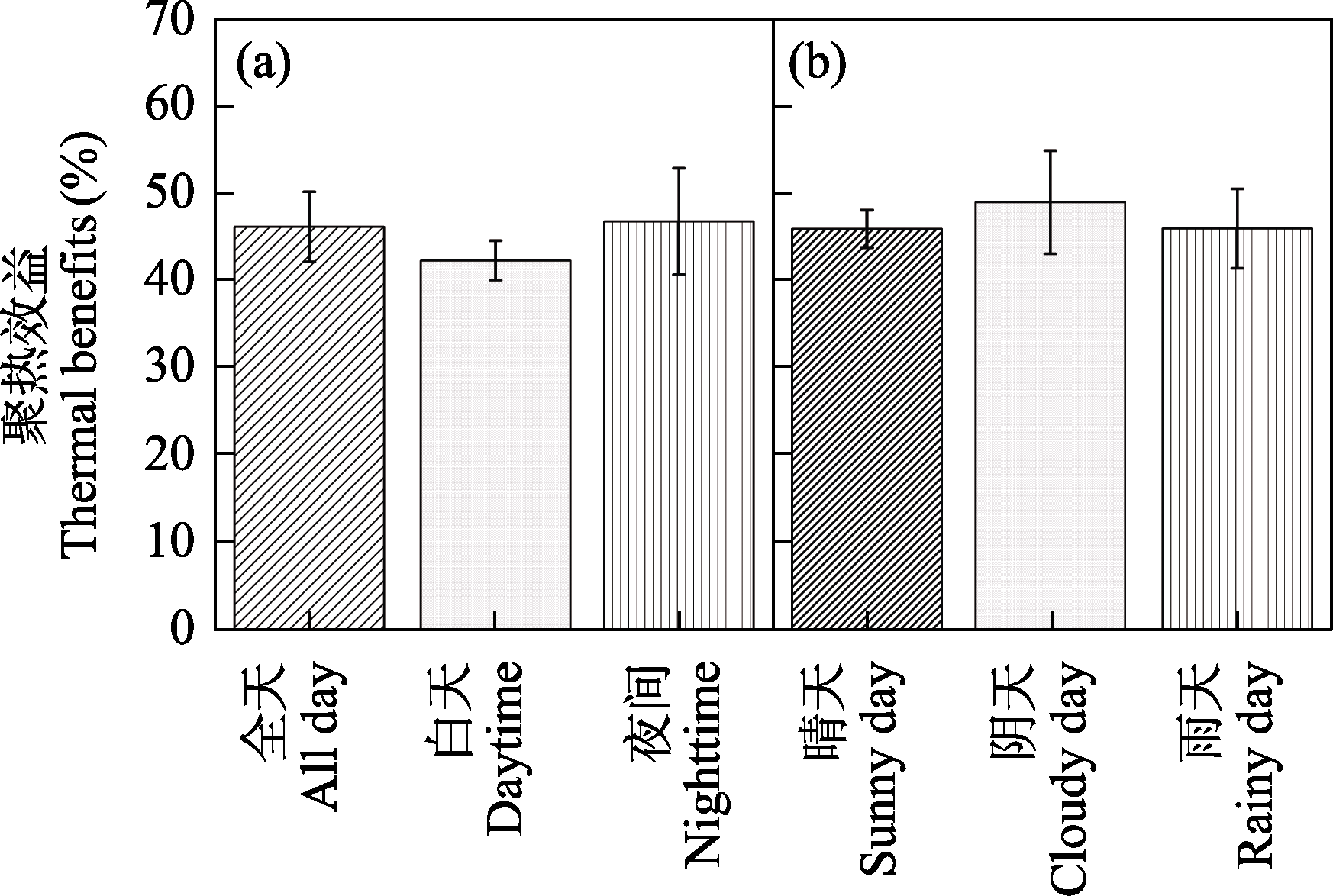
图5 全天、白天、夜间(a)以及晴天、多云和雨天(b)天气状况下毡毛雪莲头状花序的聚热效益
Fig. 5 Thermal benefits obtained from the inflorescent of Saussurea velutina during entire day, daytime, and nighttime (a) and during sunny day, cloudy day, and rainy day (b)
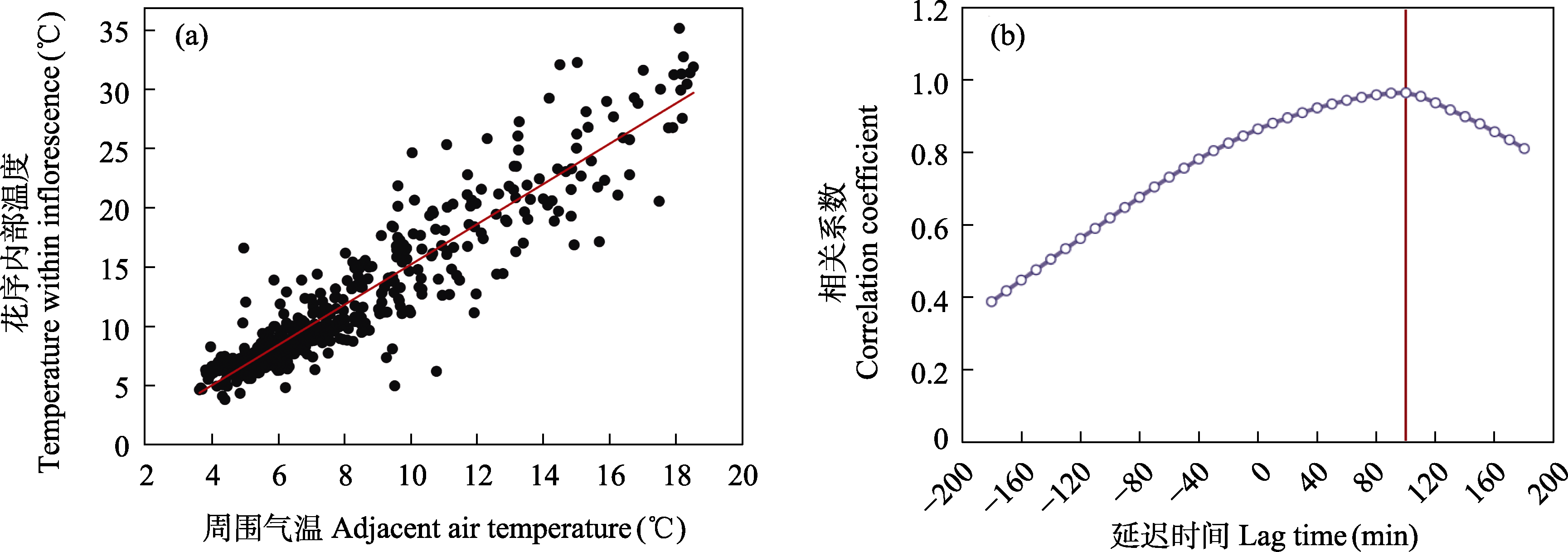
图6 毡毛雪莲花序内部温度与周围气温的相关性(a)及对周围气温的缓冲效应(b)
Fig. 6 Significant positive correlation (a) and buffering effects (b) between the temperature within inflorescence of Saussurea velutina with the adjacent air temperature
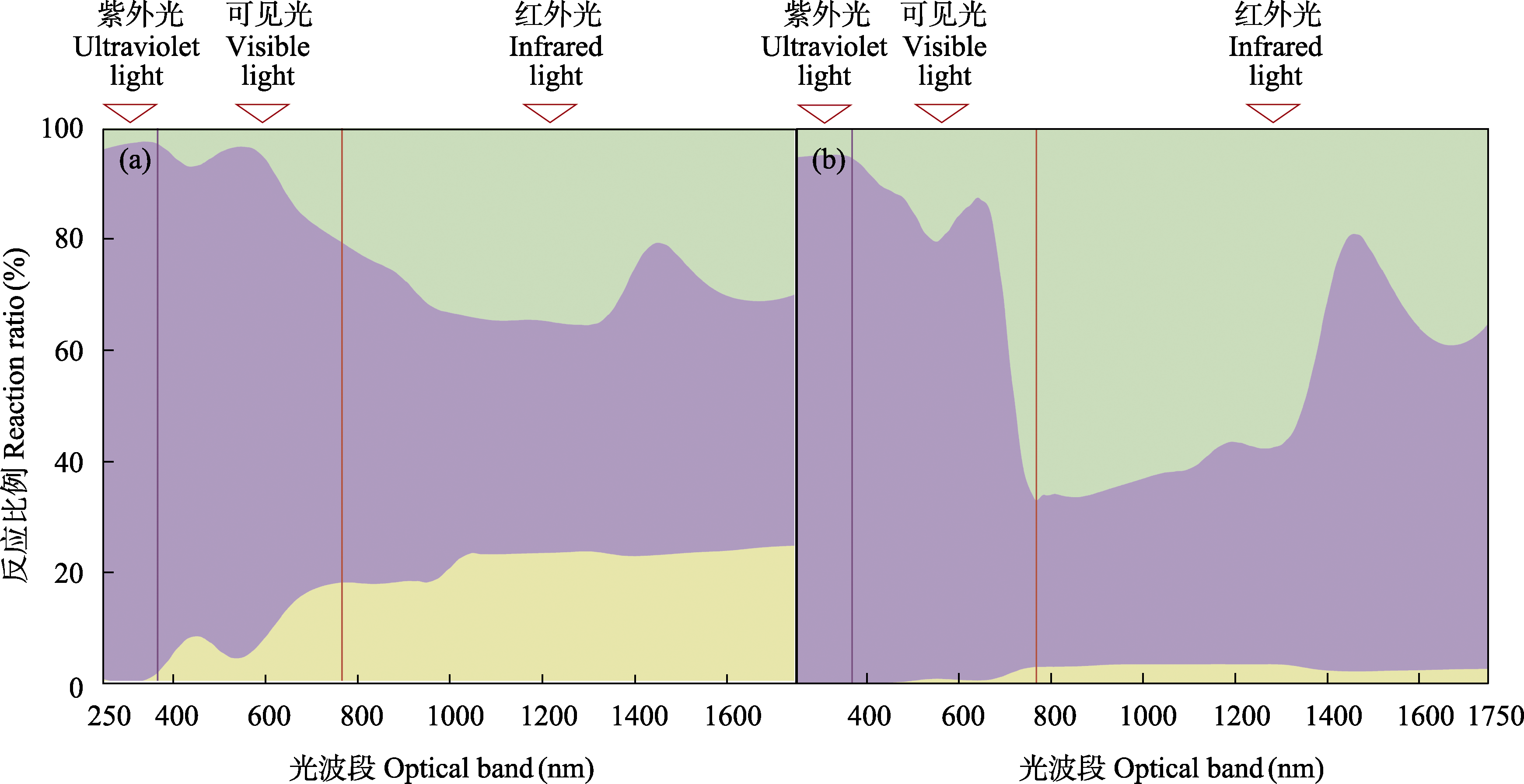
图7 毡毛雪莲苞片(a)与叶片(b)对250-1,750 nm波段入射光的反射率(绿色面积)、吸收率(紫色面积)和透射率(黄色面积)
Fig. 7 The reflectance (green area), absorptance (purple area), and transmittance (yellow area) of bracts (a) and leaves (b) to 250-1,750 nm incoming radiation
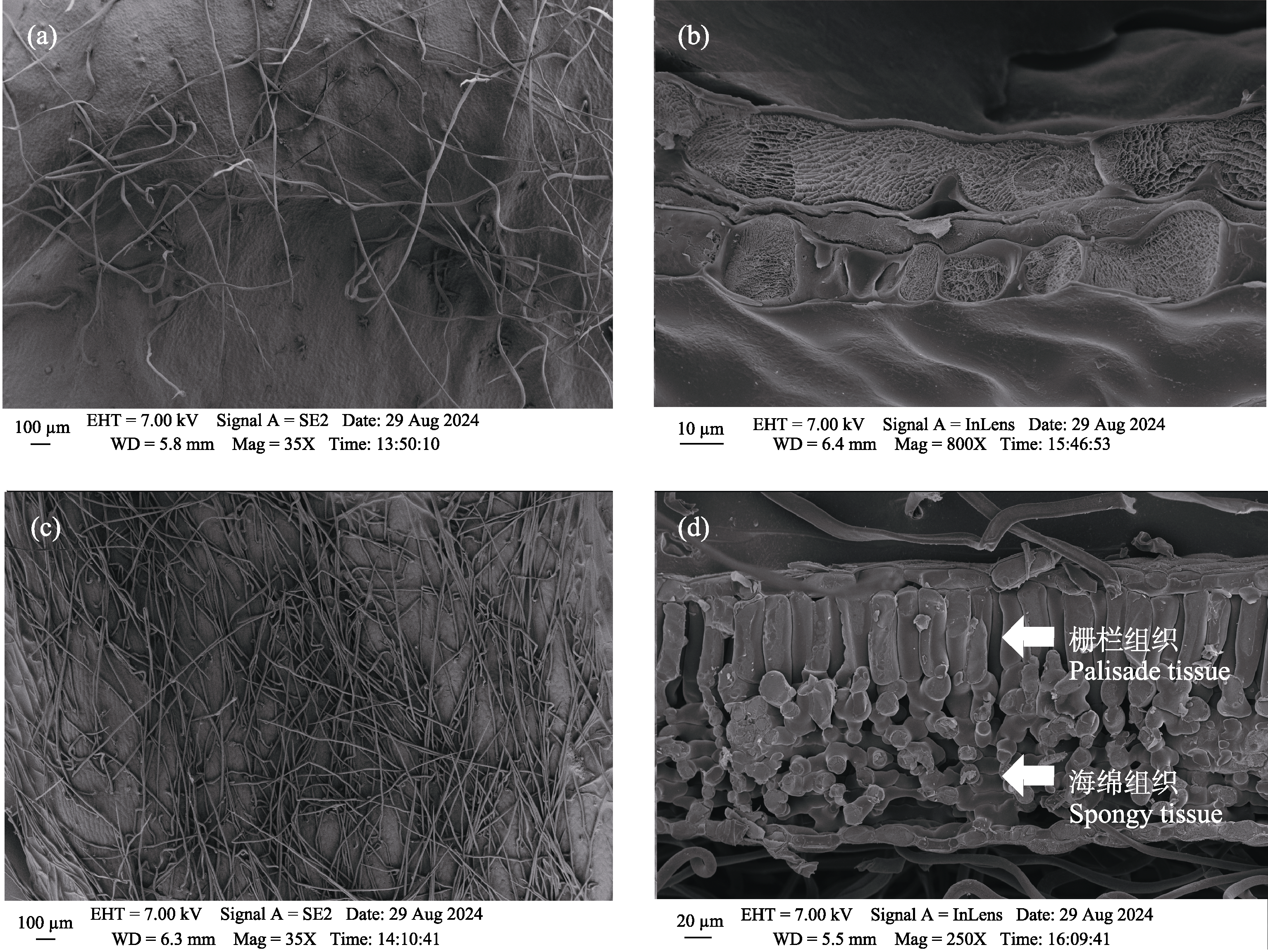
图8 苞叶雪莲苞片上表皮(a)和纵截面(b)与叶片上表皮(c)和纵截面(d)电镜扫描图像
Fig. 8 Scanning electron micrograph of bract and leaves portions of Saussurea velutina. (a) (c) Upper surface; (b) (d) Vertical section.
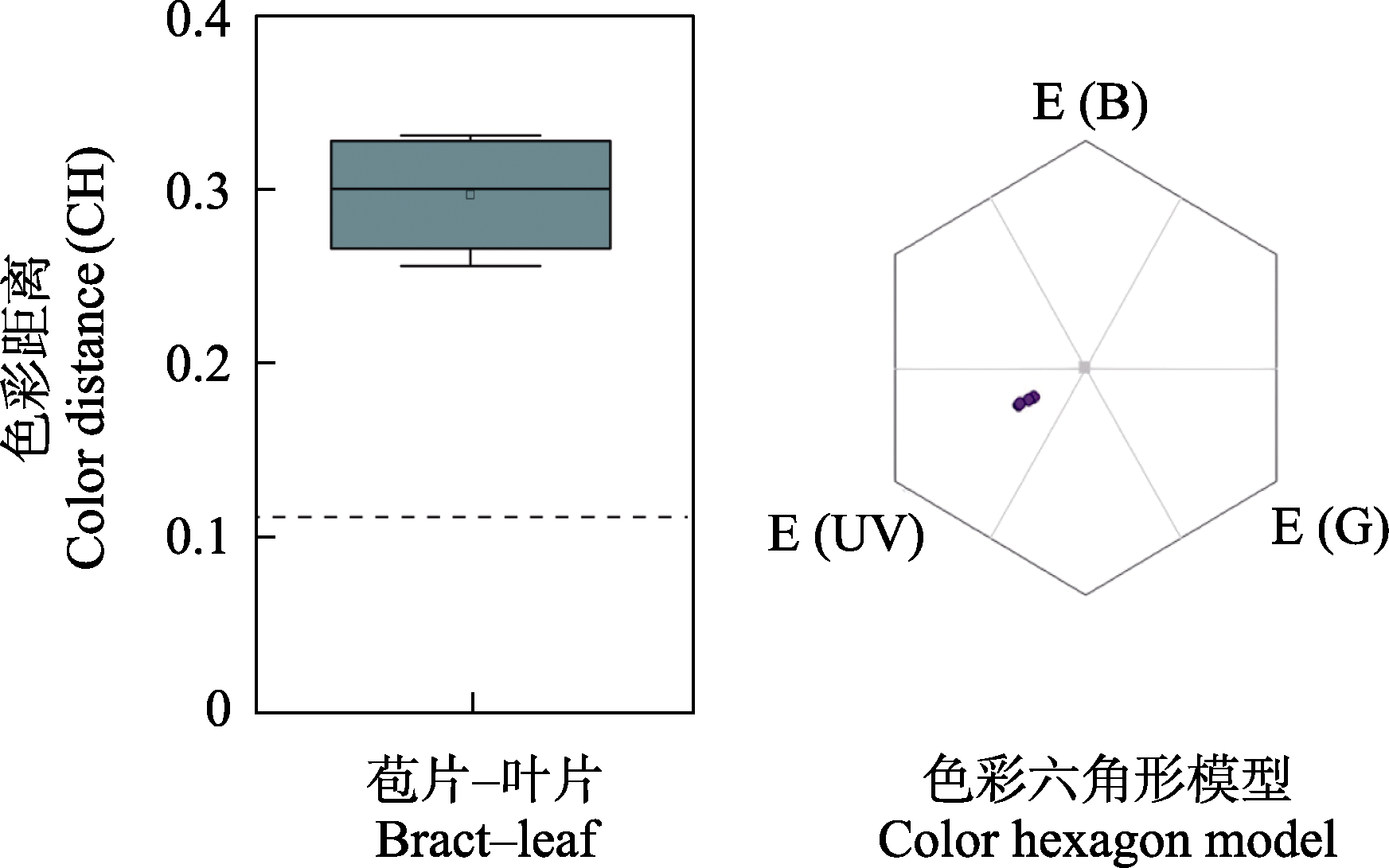
图9 以毡毛雪莲叶片为参照测定的苞片的色彩距离及色彩六边形模型, 图中虚线代表0.11 CH的熊蜂色觉识别阈值。色彩六边形图中, E (UV)、E (UV)、E (B)依次对应熊蜂视觉系统中紫外、蓝色和绿色受体信号对目标的色度响应方向。
Fig. 9 Color distance and visual hexagon model of bracts in Saussurea velutina with leaves as background. Dot line in left diagram indicates the threshold value of 0.11 CH for identification by bumblebee (Bombus terrestris). In the color hexagon model, E (UV), E (B), and E (G) denote the chromatic response directions of the UV, blue, and green photoreceptor signals, respectively, toward the target in the visual system of bumblebee.
| [1] |
Barfod AS, Hagen M, Borchsenius F (2011) Twenty-five years of progress in understanding pollination mechanisms in palms (Arecaceae). Annals of Botany, 108, 1503-1516.
DOI PMID |
| [2] | Barlow BA (1986) Flora and Fauna of Alpine Australasia:Ages and Origins. CSIRO Publishing, Clayton. |
| [3] |
Beck E, Scheibe R, Senser M, Müller W (1980) Estimation of leaf and stem growth of unbranched Senecio keniodendron trees. Flora, 170, 68-76.
DOI URL |
| [4] |
Billings WD, Mooney HA (1968) The ecology of Arctic and alpine plants. Biological Reviews, 43, 481-529.
DOI URL |
| [5] |
Borges RM, Gowda V, Zacharias M (2003) Butterfly pollination and high-contrast visual signals in a low-density distylous plant. Oecologia, 136, 571-573.
PMID |
| [6] | Chen L, Dong HJ, Peng H (2013) Diversity and distribution of higher plants in Yunnan, China. Biodiversity Science, 21, 359-363. (in Chinese with English abstract) |
|
[陈丽, 董洪进, 彭华 (2013) 云南省高等植物多样性与分布状况. 生物多样性, 21, 359-363.]
DOI |
|
| [7] | Chen YZ, Lu CF (2002) Freezing tolerance of calli and suspension cell cultures in alpine plant Saussurea meduasa Maxim. Chinese Bulletin of Botany, 19, 219-223. (in Chinese with English abstract) |
| [陈玉珍, 卢存福 (2002) 水母雪莲愈伤组织和悬浮培养细胞的抗冻性研究. 植物学通报, 19, 219-223.] | |
| [8] | Chittka L (1992) The colour hexagon: A chromaticity diagram based on photoreceptor excitations as a generalized representation of colour opponency. Journal of Comparative Physiology A: Neuroethology, Sensory, Neural, and Behavioral Physiology, 170, 533-543. |
| [9] | Dyer AG, Chittka L (2004) Biological significance of distinguishing between similar colours in spectrally variable illumination: Bumblebees (Bombus terrestris) as a case study. Journal of Comparative Physiology A: Neuroethology, Sensory, Neural, and Behavioral Physiology, 190, 105-114. |
| [10] |
Gessner U, Naeimi V, Klein I, Kuenzer C, Klein D, Dech S (2013) The relationship between precipitation anomalies and satellite-derived vegetation activity in Central Asia. Global and Planetary Change, 110, 74-87.
DOI URL |
| [11] | Hedberg O (1964) Features of afroalpine plant ecology. Acta Phytogeographica Suecica, 49, 1-144. |
| [12] | Ives JD, Barry RG (1974) Arctic and Alpine Environments. Routledge, London. |
| [13] |
Keasar T, Pollak G, Arnon R, Cohen D, Shmida A (2006) Honesty of signaling and pollinator attraction: The case of flag-like bracts. Israel Journal of Plant Sciences, 54, 119-128.
DOI URL |
| [14] |
Kikvidze Z, Brooker RW, Butterfield BJ, Callaway RM, Cavieres LA, Cook BJ, Lortie CJ, Michalet R, Pugnaire FI, Xiao S, Anthelme F, Björk RG, Cranston BH, Gavilán RG, Kanka R, Lingua E, Maalouf JP, Noroozi J, Parajuli R, Phoenix GK, Reid A, Ridenour WM, Rixen C, Schöb C (2015) The effects of foundation species on community assembly: A global study on alpine cushion plant communities. Ecology, 96, 2064-2069.
PMID |
| [15] | Körner C (2001) Alpine Plant Life: Functional Plant Ecology of High Mountain Ecosystems. Springer, Heidelberg. |
| [16] |
Krog J (1955) Notes on temperature measurements indicative of special organization in Arctic and subarctic plants for utilization of radiated heat from the sun. Physiologia Plantarum, 8, 836-839.
DOI URL |
| [17] | Kudo G (1995) Ecological significance of flower heliotropism in the spring ephemeral Adonis ramosa (Ranunculaceae). Oikos, 72, 14-20. |
| [18] | Mani MS, Giddings LE (1980) Ecology of Highlands. Springer, Dordrecht. |
| [19] |
Meng FS, Shi PL, Yan W, He YT (2013) The function of cushion plants in alpine ecosystems: Patterns and mechanisms. Chinese Journal of Applied and Environmental Biology, 19, 561-568. (in Chinese with English abstract)
DOI URL |
| [孟丰收, 石培礼, 闫巍, 何永涛 (2013) 垫状植物在高山生态系统中的功能: 格局与机制. 应用与环境生物学报, 19, 561-568.] | |
| [20] |
Myers N, Mittermeier RA, Mittermeier CG, da Fonseca GAB, Kent J (2000) Biodiversity hotspots for conservation priorities. Nature, 403, 853-858.
DOI |
| [21] | Pang J, Du ZQ, Zhang XY (2015) Time-lagged response of vegetation to hydro-thermal factors in Xinjiang region. Chinese Journal of Agricultural Resources and Regional Planning, 36(7), 82-88. (in Chinese with English abstract) |
| [庞静, 杜自强, 张霄羽 (2015) 新疆地区植被对水热条件的时滞响应. 中国农业资源与区划, 36(7), 82-88.] | |
| [22] |
Phillips N, Oren R, Zimmermann R, Wright SJ (1999) Temporal patterns of water flux in trees and lianas in a Panamanian moist forest. Trees, 14, 116-123.
DOI URL |
| [23] | Richard Y, Martiny N, Fauchereau N, Reason C, Rouault M, Vigaud N, Tracol Y (2008) Interannual memory effects for spring NDVI in semi-arid South Africa. Geophysical Research Letters, 35, 2008GL034119. |
| [24] | Shih C, Jin SY (1999) Compositae (8): Cynareae [Saussurea]. In: Flora Reipublicae Popularis Sinicae, Tomus 78 (ed. Delectis Florae Reipublicae Popularis Sinicae Agendae Academiae Sinicae Edita), p. 31. Science Press, Beijing. (in Chinese) |
| [石铸, 靳淑英 (1999) 菊科(8): 菜蓟族[风毛菊属]. 见: 中国植物志(第78卷) (中国科学院中国植物志编辑委员会), p. 31. 科学出版社, 北京.] | |
| [25] | Skorupski P, Döring TF, Chittka L (2007) Photoreceptor spectral sensitivity in island and mainland populations of the bumblebee, Bombus terrestris. Journal of Comparative Physiology A: Neuroethology, Sensory, Neural, and Behavioral Physiology, 193, 485-494. |
| [26] |
Song B, Chen JQ, Lev-Yadun S, Niu Y, Gao YQ, Ma R, Armbruster WS, Sun H (2024) Multifunctionality of angiosperm floral bracts: A review. Biological Reviews, 99, 1100-1120.
DOI URL |
| [27] |
Song B, Stöcklin J, Peng DL, Gao YQ, Sun H (2015) The bracts of the alpine ‘glasshouse’ plant Rheum alexandrae (Polygonaceae) enhance reproductive fitness of its pollinating seed-consuming mutualist. Botanical Journal of the Linnean Society, 179, 349-359.
DOI URL |
| [28] |
Song B, Zhang ZQ, Stöcklin J, Yang Y, Niu Y, Chen JG, Sun H (2013) Multifunctional bracts enhance plant fitness during flowering and seed development in Rheum nobile (Polygonaceae), a giant herb endemic to the high Himalayas. Oecologia, 172, 359-370.
DOI PMID |
| [29] |
Tsukaya H, Fujikawa K, Wu SG (2002) Thermal insulation and accumulation of heat in the downy inflorescences of Saussurea medusa (Asteraceae) at high elevation in Yunnan, China. Journal of Plant Research, 115, 263-268.
DOI URL |
| [30] |
Tsukaya H, Tsuge T (2001) Morphological adaptation of inflorescences in plants that develop at low temperatures in early spring: The convergent evolution of “downy plants”. Plant Biology, 3, 536-543.
DOI URL |
| [31] | Wu LL, Ren ZY, Zhang C (2014) Response of NDVI to temperature and precipitation changes and its lag time in North Shaanxi. Chinese Journal of Agrometeorology, 35(1), 103-108. (in Chinese with English abstract) |
| [吴丽丽, 任志远, 张翀 (2014) 陕北地区植被指数对水热条件变化的响应及其时滞分析. 中国农业气象, 35(1), 103-108.] | |
| [32] | Wu ZY, Sun H, Zhou ZK, Peng H, Li DZ (2005) Origin and differentiation of endemism in the flora of China. Acta Botanica Yunnanica, 27, 577-604. (in Chinese with English abstract) |
| [吴征镒, 孙航, 周浙昆, 彭华, 李德铢 (2005) 中国植物区系中的特有性及其起源和分化. 云南植物研究, 27, 577-604.] | |
| [33] |
Xu LS, Song ZQ, Li T, Jin ZC, Zhang BY, Du SY, Liao SY, Zhong XJ, Chen YS (2025) New insights into the phylogeny and infrageneric taxonomy of Saussurea based on hybrid capture phylogenomics (Hyb-Seq). Plant Diversity, 47, 21-33.
DOI URL |
| [34] |
Yang Y, Körner C, Sun H (2008) The ecological significance of pubescence in Saussurea medusa, a high-elevation Himalayan “woolly plant”. Arctic, Antarctic, and Alpine Research, 40, 250-255.
DOI URL |
| [35] | Yang Y, Sun H (2006) Advances in the functional ecology of alpine and Arctic plants. Acta Botanica Yunnanica, 28, 43-53. (in Chinese with English abstract) |
| [杨扬, 孙航 (2006) 高山和极地植物功能生态学研究进展. 云南植物研究, 28, 43-53.] | |
| [36] |
Yang Y, Sun H (2009) The bracts of Saussurea velutina (Asteraceae) protect inflorescences from fluctuating weather at high elevations of the Hengduan Mountains, southwestern China. Arctic, Antarctic, and Alpine Research, 41, 515-521.
DOI URL |
| [37] | Young TP (1984) Solar irradiation increases floral development rates in afro-alpine Lobelia telekii. Biotropica, 16, 243-245. |
| [1] | 龚正达, 吴厚永, 段兴德, 冯锡光, 张云智, 刘泉. 云南横断山区蚤类物种丰富度与区系的垂直分布格局[J]. 生物多样性, 2005, 13(4): 279-289. |
| [2] | 龚正达, 吴厚永, 段兴德, 冯锡光, 张云智, 刘泉. 云南横断山区蚤类物种多样性的地理分布趋势与重要环境因素的关系[J]. 生物多样性, 2001, 09(4): 319-328. |
| [3] | 龚正达, 吴厚永, 段兴德, 冯锡光, 张云智, 刘泉. 云南横断山区小型兽类物种多样性与地理分布趋势[J]. 生物多样性, 2001, 09(1): 73-79. |
| 阅读次数 | ||||||
|
全文 |
|
|||||
|
摘要 |
|
|||||
备案号:京ICP备16067583号-7
Copyright © 2026 版权所有 《生物多样性》编辑部
地址: 北京香山南辛村20号, 邮编:100093
电话: 010-62836137, 62836665 E-mail: biodiversity@ibcas.ac.cn
