

Biodiv Sci ›› 2026, Vol. 34 ›› Issue (8): 26067. DOI: 10.17520/biods.2026067 cstr: 32101.14.biods.2026067
• Technology and Methodology • Previous Articles Next Articles
Qiuju Zhong1( ), Juanjuan Zhang1(), Youxian Jia1(), Xuecong Zhang1(), Zhiye Ren1(), Ganxin Feng1(), Jing Yang2(), Yunlin Jiang2(), Huixuan Liao1(), Minxia Liang1,*()(
 )
Received:2026-03-03
Accepted:2026-06-21
Online:2026-08-20
Published:2026-10-21
Contact:
*E-mail: liangmx3@mail.sysu.edu.cn
Supported by:Qiuju Zhong, Juanjuan Zhang, Youxian Jia, Xuecong Zhang, Zhiye Ren, Ganxin Feng, Jing Yang, Yunlin Jiang, Huixuan Liao, Minxia Liang. Construction and application of multi-taxon successional reference frameworks in newly formed tropical island ecosystems based on species distribution data[J]. Biodiv Sci, 2026, 34(8): 26067.
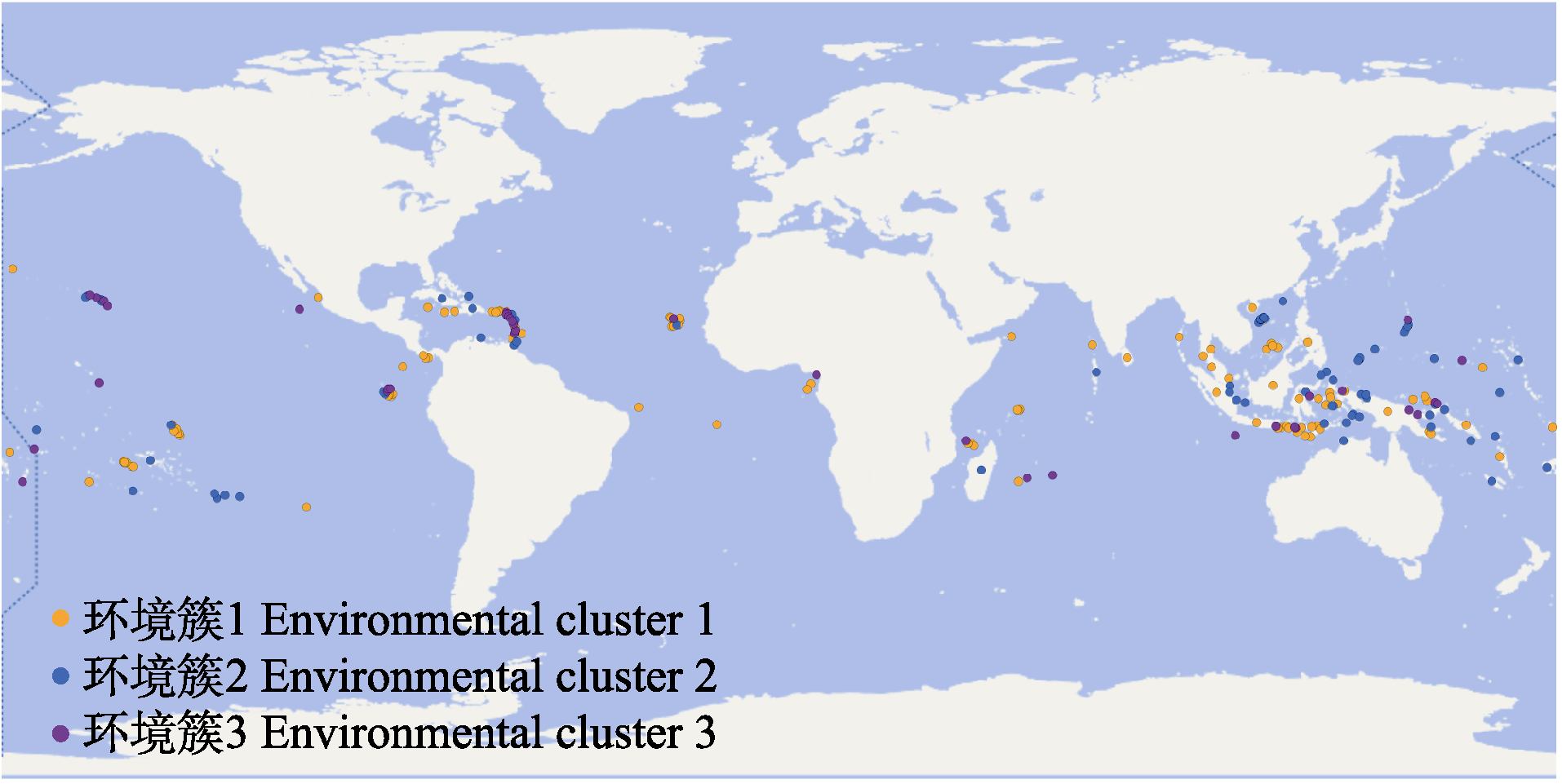
Fig. 1 Spatial distribution of the 241 global tropical islands included in the construction of the successional reference framework. Dots of different colors represent islands belonging to different environmental clusters.
| 生物类群 Taxonomic groups | 包含时间的分布记录 Distribution records with temporal information | 岛屿数量 Number of islands |
|---|---|---|
| 植物 Plants | 572,381 | 88 |
| 昆虫 Insects | 375,705 | 67 |
| 鸟类 Birds | 17,920,489 | 219 |
Table 1 Distribution records and number of islands for the three major taxonomic groups used in constructing the successional reference framework
| 生物类群 Taxonomic groups | 包含时间的分布记录 Distribution records with temporal information | 岛屿数量 Number of islands |
|---|---|---|
| 植物 Plants | 572,381 | 88 |
| 昆虫 Insects | 375,705 | 67 |
| 鸟类 Birds | 17,920,489 | 219 |
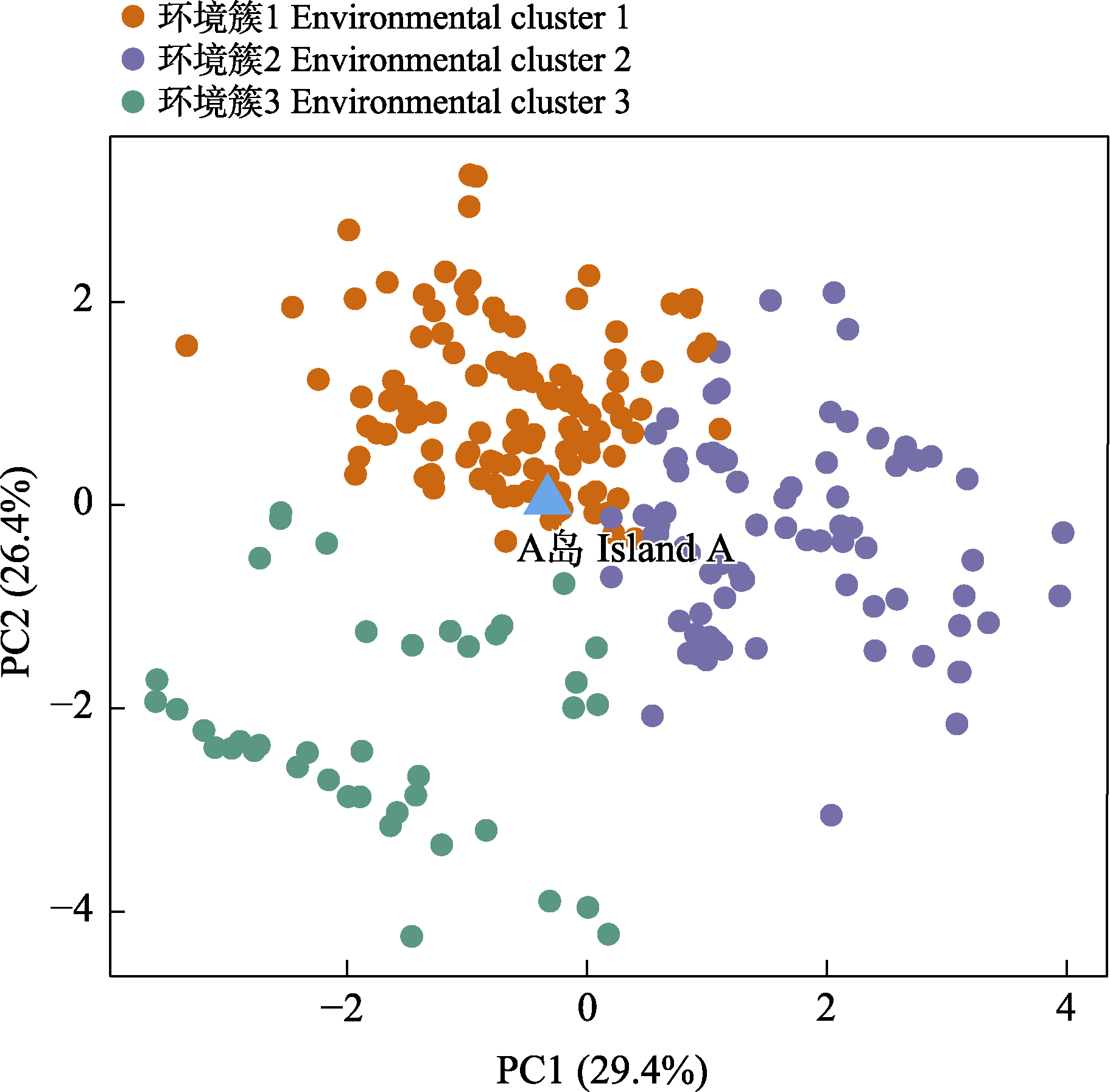
Fig. 2 Results of k-means clustering of global tropical islands based on climatic and soil factors (k = 3)
| 环境变量 Environmental variable | 环境簇1 Environmental cluster 1 | 环境簇2 Environmental cluster 2 | 环境簇3 Environmental cluster 3 |
|---|---|---|---|
| 岛屿数量 Number of islands | 117 | 84 | 40 |
| 年均温 Mean annual temperature (℃) | 25.47 ± 1.55 | 23.51 ± 2.86 | 25.31 ± 2.19 |
| 温度季节性变化 Temperature seasonality (SD × 100) | 66.1 ± 29.6 | 179.9 ± 42.1 | 100.7 ± 57.5 |
| 年降水量 Annual precipitation (mm) | 2,269 ± 826 | 1,076 ± 582 | 1,875 ± 809 |
| 降水变异系数 Coefficient of variation of precipitation (%) | 39.17 ± 21.23 | 76.08 ± 38.11 | 46.71 ± 24.59 |
| 总氮 Total nitrogen (g/kg) | 1.21 ± 0.52 | 1.19 ± 0.61 | 4.65 ± 1.32 |
| 有机碳 Organic carbon (%) | 1.46 ± 0.78 | 1.38 ± 0.73 | 6.47 ± 1.82 |
| 土壤pH Soil pH | 6.00 ± 0.78 | 5.74 ± 0.78 | 5.45 ± 0.31 |
| C/N比 Carbon-to-nitrogen ratio | 11.54 ± 1.10 | 11.64 ± 1.15 | 12.90 ± 2.27 |
Table 2 Comparison of climatic and soil characteristics among the three environmental clusters derived from k-means clustering (mean ± SD)
| 环境变量 Environmental variable | 环境簇1 Environmental cluster 1 | 环境簇2 Environmental cluster 2 | 环境簇3 Environmental cluster 3 |
|---|---|---|---|
| 岛屿数量 Number of islands | 117 | 84 | 40 |
| 年均温 Mean annual temperature (℃) | 25.47 ± 1.55 | 23.51 ± 2.86 | 25.31 ± 2.19 |
| 温度季节性变化 Temperature seasonality (SD × 100) | 66.1 ± 29.6 | 179.9 ± 42.1 | 100.7 ± 57.5 |
| 年降水量 Annual precipitation (mm) | 2,269 ± 826 | 1,076 ± 582 | 1,875 ± 809 |
| 降水变异系数 Coefficient of variation of precipitation (%) | 39.17 ± 21.23 | 76.08 ± 38.11 | 46.71 ± 24.59 |
| 总氮 Total nitrogen (g/kg) | 1.21 ± 0.52 | 1.19 ± 0.61 | 4.65 ± 1.32 |
| 有机碳 Organic carbon (%) | 1.46 ± 0.78 | 1.38 ± 0.73 | 6.47 ± 1.82 |
| 土壤pH Soil pH | 6.00 ± 0.78 | 5.74 ± 0.78 | 5.45 ± 0.31 |
| C/N比 Carbon-to-nitrogen ratio | 11.54 ± 1.10 | 11.64 ± 1.15 | 12.90 ± 2.27 |
| 生物类群 Taxonomic groups | 参照系总时长 Reference framework duration (yr) | “逐渐上升”类群(代表科/目) Gradually increasing groups (representative families/orders) | 参照系关键年份及比例 Key years and proportions in the reference framework | A岛“逐渐上升”类群占比 Proportion of gradually increasing groups on Island A (%) | 判定阶段 Determined successional stage |
|---|---|---|---|---|---|
| 植物 Plants | 35 | 豆科、野牡丹科、桃金娘科等 Fabaceae, Melastomataceae, Myrtaceae, etc. | 0年(0 yr): 18.1% 10年(10 yr): 30.3% 25年(25 yr): 48.5% 35年(35 yr): 60.6% | 30.2 | 约10年 About 10 yr |
| 昆虫 Insects | 30 | 半翅目、膜翅目 Hemiptera, Hymenoptera | 0年(0 yr): 6.7% 10年(10 yr): 20.8% 20年(20 yr): 34.9% 30年(30 yr): 49.0% | 19.2 | 约10年 About 10 yr |
| 鸟类 Birds | 90 | 鸦科、鹦鹉科、椋鸟科等 Corvidae, Psittacidae, Sturnidae, etc. | 0年(0 yr): 15.2% 10年(10 yr): 17.5% 20年(20 yr): 19.7% 90年(90 yr): 35.3% | 19.2 | 约20年 About 20 yr |
Table 3 Determined successional stages and successional asynchrony of the three major taxonomic groups on Island A
| 生物类群 Taxonomic groups | 参照系总时长 Reference framework duration (yr) | “逐渐上升”类群(代表科/目) Gradually increasing groups (representative families/orders) | 参照系关键年份及比例 Key years and proportions in the reference framework | A岛“逐渐上升”类群占比 Proportion of gradually increasing groups on Island A (%) | 判定阶段 Determined successional stage |
|---|---|---|---|---|---|
| 植物 Plants | 35 | 豆科、野牡丹科、桃金娘科等 Fabaceae, Melastomataceae, Myrtaceae, etc. | 0年(0 yr): 18.1% 10年(10 yr): 30.3% 25年(25 yr): 48.5% 35年(35 yr): 60.6% | 30.2 | 约10年 About 10 yr |
| 昆虫 Insects | 30 | 半翅目、膜翅目 Hemiptera, Hymenoptera | 0年(0 yr): 6.7% 10年(10 yr): 20.8% 20年(20 yr): 34.9% 30年(30 yr): 49.0% | 19.2 | 约10年 About 10 yr |
| 鸟类 Birds | 90 | 鸦科、鹦鹉科、椋鸟科等 Corvidae, Psittacidae, Sturnidae, etc. | 0年(0 yr): 15.2% 10年(10 yr): 17.5% 20年(20 yr): 19.7% 90年(90 yr): 35.3% | 19.2 | 约20年 About 20 yr |
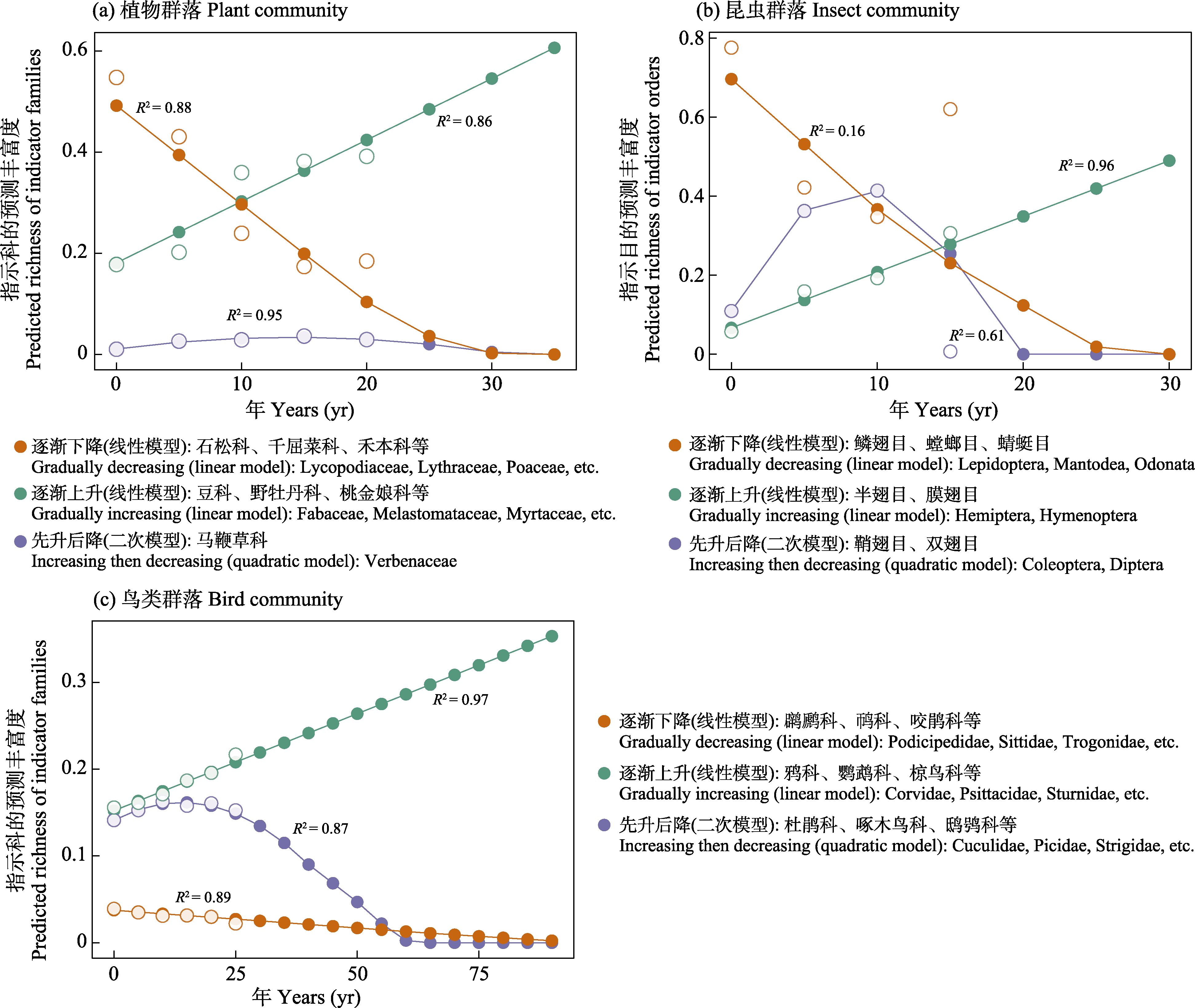
Fig. 3 Successional dynamics of the three major taxa (plants, insects, and birds) within the reference framework of environmental cluster 1. Open circles represent observed data, calculated as the sum of the mean richness of all families/orders within the same successional group. Solid circles and solid lines represent model-fitted and predicted successional trends. The best-fitting model type and the overall goodness-of-fit statistic (R2) are shown in each panel. The R2 value is the square of the Pearson correlation coefficient between observed and predicted values and reflects the agreement between the aggregated predicted trend and the observed fluctuations.
| 生物类群 Taxonomic groups | 参照系总时长 Reference framework duration (yr) | 参照系关键年份及相对占比 Key years and relative proportions in the reference framework | A岛“逐渐上升”类群相对占比 Relative proportion of gradually increasing groups on Island A (%) | 判定阶段 Determined successional stage |
|---|---|---|---|---|
| 植物 Plants | 35 | 0年(0 yr): 26.5% 15年(15 yr): 60.9% 20年(20 yr): 76.0% 35年(35 yr): 100.0% | 72.7 | 约15-20年 About 15-20 yr |
| 昆虫 Insects | 30 | 0年(0 yr): 7.7% 10年(10 yr): 21.1% 15年(15 yr): 36.4% 30年(30 yr): 100.0% | 27.8 | 约10-15年 About 10-15 yr |
| 鸟类 Birds | 90 | 0年(0 yr): 46.1% 40年(40 yr): 68.6% 45年(45 yr): 74.2% 90年(90 yr): 100.0% | 71.4 | 约40-45年 About 40-45 yr |
Table 4 Validation of successional stages of the three major taxonomic groups on Island A after excluding non-reference species
| 生物类群 Taxonomic groups | 参照系总时长 Reference framework duration (yr) | 参照系关键年份及相对占比 Key years and relative proportions in the reference framework | A岛“逐渐上升”类群相对占比 Relative proportion of gradually increasing groups on Island A (%) | 判定阶段 Determined successional stage |
|---|---|---|---|---|
| 植物 Plants | 35 | 0年(0 yr): 26.5% 15年(15 yr): 60.9% 20年(20 yr): 76.0% 35年(35 yr): 100.0% | 72.7 | 约15-20年 About 15-20 yr |
| 昆虫 Insects | 30 | 0年(0 yr): 7.7% 10年(10 yr): 21.1% 15年(15 yr): 36.4% 30年(30 yr): 100.0% | 27.8 | 约10-15年 About 10-15 yr |
| 鸟类 Birds | 90 | 0年(0 yr): 46.1% 40年(40 yr): 68.6% 45年(45 yr): 74.2% 90年(90 yr): 100.0% | 71.4 | 约40-45年 About 40-45 yr |
| [1] | Armanuos AM, Al-Ansari N, Yaseen ZM (2020) Cross assessment of twenty-one different methods for missing precipitation data estimation. Atmosphere, 11, 389. |
| [2] | Atkinson J, Brudvig LA, Mallen-Cooper M, Nakagawa S, Moles AT, Bonser SP (2022) Terrestrial ecosystem restoration increases biodiversity and reduces its variability, but not to reference levels: A global meta-analysis. Ecology Letters, 25, 1725-1737. |
| [3] | Burnham KP, Anderson DR (2002) Model Selection and Multimodel Inference: A Practical Information-theoretic Approach, 2nd edn. Springer, New York. |
| [4] | Chang CC, Turner BL (2019) Ecological succession in a changing world. Journal of Ecology, 107, 503-509. |
| [5] | Chen CW, Holyoak M, Wang YP, Si XF, Ding P (2019) Spatiotemporal distribution of seasonal bird assemblages on land-bridge islands: Linking dynamic and static views of metacommunities. Avian Research, 10, 25. |
| [6] | Comer PJ, Eckert GE, Gann GD (2025) Establishing reference models for ecological restoration: Case study from Colorado National Monument, USA. Land, 14, 1871. |
| [7] | Connell JH (1978) Diversity in tropical rain forests and coral reefs. Science, 199, 1302-1310. |
| [8] | de Lange PJ (2015) Recent vegetation succession and flora of Macauley Island, southern Kermadec Islands. Bulletin of the Auckland Museum, 20, 115-137. |
| [9] | Dini-Andreote F, Stegen JC, van Elsas JD, Salles JF (2015) Disentangling mechanisms that mediate the balance between stochastic and deterministic processes in microbial succession. Proceedings of the National Academy of Sciences, USA, 112, E1326-E1332. |
| [10] | Erwin RM, Allen DH, Jenkins D (2003) Created versus natural coastal islands: Atlantic waterbird populations, habitat choices, and management implications. Estuaries, 26, 949-955. |
| [11] | Ferretti A, Maggini I, Fusani L (2021) How to recover after sea crossing: The importance of small islands for passerines during spring migration. Ethology Ecology & Evolution, 33, 307-320. |
| [12] | Ferretti A, Maggini I, Lupi S, Cardinale M, Fusani L (2019) The amount of available food affects diurnal locomotor activity in migratory songbirds during stopover. Scientific Reports, 9, 19027. |
| [13] | Gann GD, McDonald T, Walder B, Aronson J, Nelson CR, Hallett JG, Guariguata MR, Gonzales EK, Hua F, Echeverría C, Eisenberg C, Liu J, Decleer K, Barr ZE, Bartholomew DC, Best M, Chazdon R, Cliquet A, Cortina-Segarra J, Kalirai H, MacCallum K, Mosyaftiani A, Pedrini S, Young R, Dixon KW (2026) International principles and standards for the practice of ecological restoration, third edition. Restoration Ecology, 34, e70441. |
| [14] | Griffiths ME, Orians CM (2004) Salt spray effects on forest succession in rare coastal sandplain heathlands: Evidence from field surveys and Pinus rigida transplant experiments. Journal of the Torrey Botanical Society, 131, 23-31. |
| [15] | Hartigan JA, Wong MA (1979) Algorithm AS 136: A k-means clustering algorithm. Journal of the Royal Statistical Society C: Applied Statistics, 28, 100-108. |
| [16] | Hubbell SP (2001) The Unified Neutral Theory of Biodiversity and Biogeography. Princeton University Press, Princeton. |
| [17] | James Reynolds S, Ibáñez-Álamo JD, Sumasgutner P, Mainwaring MC (2019) Urbanisation and nest building in birds: A review of threats and opportunities. Journal of Ornithology, 160, 841-860. |
| [18] | Jian SG, Ren H (2017) Atlas on Tool Species for Vegetation Restoration on Tropical Coral Islands. China Forestry Publishing House, Beijing. (in Chinese) |
| [简曙光, 任海 (2017) 热带珊瑚岛植被恢复工具种图谱. 中国林业出版社, 北京.] | |
| [19] | Josse J, Husson F (2016) missMDA: A package for handling missing values in multivariate data analysis. Journal of Statistical Software, 70, 1-31. |
| [20] | Kraft NJB, Adler PB, Godoy O, James EC, Fuller S, Levine JM (2015) Community assembly, coexistence and the environmental filtering metaphor. Functional Ecology, 29, 592-599. |
| [21] | Levey DR, Patten MA, Enríquez PL, Navarro-Sigüenza AG, Sonawane C, Dirzo R, MacGregor-Fors I, Daily GC (2025) Contrasting patterns of land use by resident and migratory bird assemblages in a tropical working landscape. Oikos, 2025, e11302. |
| [22] | Li J, Hughes AC, Dudgeon D (2019) Mapping wader biodiversity along the East Asian-Australasian flyway. PLoS ONE, 14, e0210552. |
| [23] | Li ZA (2021) Soil Properties and Improvement of Tropical Coral Islands in China. Guangdong Science & Technology Press, Guangzhou. (in Chinese) |
| [李志安 (2021) 中国热带珊瑚岛土壤性状与改良. 广东科技出版社, 广州.] | |
| [24] | MacArthur RH, Wilson EO (1967) The Theory of Island Biogeography. Princeton University Press, Princeton. |
| [25] | Maggini I, Trez M, Cardinale M, Fusani L (2020) Stopover dynamics of 12 passerine migrant species in a small Mediterranean island during spring migration. Journal of Ornithology, 161, 793-802. |
| [26] | Magnússon B, Magnússon SH, Ólafsson E, Sigurdsson BD (2014) Plant colonization, succession and ecosystem development on Surtsey with reference to neighbouring islands. Biogeosciences, 11, 5521-5537. |
| [27] | Mainwaring MC (2015) The use of man-made structures as nesting sites by birds: A review of the costs and benefits. Journal for Nature Conservation, 25, 17-22. |
| [28] | Nilsson S (2022) Twenty-two years of vegetation succession on the constructed Danish island Peberholm. Nordic Journal of Botany, 2022, e03721. |
| [29] | Odum EP (1969) The strategy of ecosystem development. Science, 164, 262-270. |
| [30] | Peng SL, Hou YP, Chen BM (2010) Establishment of Markov successional model and its application for forest restoration reference in southern China. Ecological Modelling, 221, 1317-1324. |
| [31] | Ren YJ, Lü YH, Fu BJ (2016) Quantifying the impacts of grassland restoration on biodiversity and ecosystem services in China: A meta-analysis. Ecological Engineering, 95, 542-550. |
| [32] | Rousseeuw PJ (1987) Silhouettes: A graphical aid to the interpretation and validation of cluster analysis. Journal of Computational and Applied Mathematics, 20, 53-65. |
| [33] | Russell JC, Kueffer C (2019) Island biodiversity in the Anthropocene. Annual Review of Environment and Resources, 44, 31-60. |
| [34] | Scarton F, Cecconi G, Cerasuolo C, Valle R (2013) The importance of dredge islands for breeding waterbirds: A three-year study in the Venice Lagoon (Italy). Ecological Engineering, 54, 39-48. |
| [35] | Shi ZY, Cao JT, Wang ZY, Zhang L, Niu SS, Wang WQ (2025) Revelation of native vegetation succession on tropical coral island ecological restoration. Ecosphere, 16, e70245. |
| [36] | Siddig AAH, Ellison AM, Ochs A, Villar-Leeman C, Lau MK (2016) How do ecologists select and use indicator species to monitor ecological change? Insights from 14 years of publication in Ecological Indicators. Ecological Indicators, 60, 223-230. |
| [37] | Silva CM, Pereira JAC, Gusmões JDSP, Mendes BEP, Valente H, Morgan AP, Goulart D, Hasui É (2020) Birds’ gap-crossing in open matrices depends on landscape structure, tree size, and predation risk. Perspectives in Ecology and Conservation, 18, 73-82. |
| [38] | Spatz DR, Young LC, Holmes ND, Jones HP, VanderWerf EA, Lyons DE, Kress S, Miskelly CM, Taylor GA (2023) Tracking the global application of conservation translocation and social attraction to reverse seabird declines. Proceedings of the National Academy of Sciences, USA, 120, e2214574120. |
| [39] | Stoddard JL, Larsen DP, Hawkins CP, Johnson RK, Norris RH (2006) Setting expectations for the ecological condition of streams: The concept of reference condition. Ecological Applications, 16, 1267-1276. |
| [40] | Stoddard MT, Roccaforte JP, Meador AJS, Huffman DW, Fulé PZ, Waltz AEM, Covington WW (2021) Ecological restoration guided by historical reference conditions can increase resilience to climate change of southwestern U.S. ponderosa pine forests. Forest Ecology and Management, 493, 119256. |
| [41] | Storlazzi CD, Gingerich SB, van Dongeren A, Cheriton OM, Swarzenski PW, Quataert E, Voss CI, Field DW, Annamalai H, Piniak GA, McCall R (2018) Most atolls will be uninhabitable by the mid-21st century because of sea-level rise exacerbating wave-driven flooding. Science Advances, 4, eaap9741. |
| [42] | Ulrich W, Zaplata MK, Winter S, Schaaf W, Fischer A, Soliveres S, Gotelli NJ (2016) Species interactions and random dispersal rather than habitat filtering drive community assembly during early plant succession. Oikos, 125, 698-707. |
| [43] | Vellend M (2010) Conceptual synthesis in community ecology. Quarterly Review of Biology, 85, 183-206. |
| [44] | Weiher E, Freund D, Bunton T, Stefanski A, Lee T, Bentivenga S (2011) Advances, challenges and a developing synthesis of ecological community assembly theory. Philosophical Transactions of the Royal Society B: Biological Sciences, 366, 2403-2413. |
| [45] | Whittaker RJ (2000) Scale, succession and complexity in island biogeography: Are we asking the right questions? Global Ecology and Biogeography, 9, 75-85. |
| [46] | Worthy SJ, Rubio VE, Staiger K, Ngouajio B, Yang J, Swenson NG (2021) Site-specific impacts of a major hurricane on alpha and beta diversity in tropical forest seedling communities. Ecosphere, 12, e03651. |
| [47] | Wu WJ, Wang J, Yan BY, Mou ZJ, Yuan Y, Li Y, Zhang J, Kuang LH, Cai HY, Tong FC, Jian SG, Lu HF, Ren H, Liu ZF (2024) Giant African snail invasion homogenizes seasonal soil biodiversity in tropical coral islands. Plant and Soil, 500, 571-585. |
| [48] | Yesson C, Brewer PW, Sutton T, Caithness N, Pahwa JS, Burgess M, Gray WA, White RJ, Jones AC, Bisby FA, Culham A (2007) How global is the Global Biodiversity Information Facility? PLoS ONE, 2, e1124. |
| [49] | Yin DY, Jian SG, Lu HF, Zhang QM, Ren H (2025) Primary saltmarsh succession on a tropical coral island in the South China Sea: Human influences initiate and accelerate the process of succession. Ecological Solutions and Evidence, 6, e70064. |
| [50] | Yong DL, Liu Y, Low BW, Española CP, Choi CY, Kawakami K (2015) Migratory songbirds in the East Asian-Australasian Flyway: A review from a conservation perspective. Bird Conservation International, 25, 1-37. |
| [51] | Zhang C, Jiao JH, Wang Z, Feng C, Zhang YC, Du YG (2020) Main chemical properties and microbial community structure of surface soil in coral reefs. Environmental Ecology, 2(6), 1-6. (in Chinese with English abstract) |
| [张琛, 焦建会, 王倬, 冯翠, 张毓宸, 杜昱光 (2020) 珊瑚岛屿表层土壤的主要化学性质和微生物群落结构研究. 环境生态学, 2(6), 1-6.] |
| Viewed | ||||||
|
Full text |
|
|||||
|
Abstract |
|
|||||
Copyright © 2026 Biodiversity Science
Editorial Office of Biodiversity Science, 20 Nanxincun, Xiangshan, Beijing 100093, China
Tel: 010-62836137, 62836665 E-mail: biodiversity@ibcas.ac.cn
