

Biodiv Sci ›› 2026, Vol. 34 ›› Issue (8): 26245. DOI: 10.17520/biods.2026245 cstr: 32101.14.biods.2026245
• Original Papers: Biosafety and Nature Conservation • Previous Articles Next Articles
Yihao Pan1,2( ), Bingran Ma1(), Leshan Du1(), Yanpeng Zhu1(), Xiangwen Fang2(), Fangzheng Liu1,*()(
 )
Received:2026-06-23
Accepted:2026-08-10
Online:2026-08-20
Published:2026-10-21
Contact:
*E-mail: liufz@craes.org.cn
Supported by:Yihao Pan, Bingran Ma, Leshan Du, Yanpeng Zhu, Xiangwen Fang, Fangzheng Liu. Characteristics of artificial light at night disturbance in the Beijing-Tianjin-Hebei region and its nature reserves[J]. Biodiv Sci, 2026, 34(8): 26245.
| 序号 No. | 空间单元类型 Spatial unit types | 像元数 Pixel counts | 自然保护区数量 Number of nature reserves |
|---|---|---|---|
| 1 | 京津冀区域 Beijing-Tianjin-Hebei region | 872,755 | 60 |
| 2 | 自然保护区网络 Nature reserve network | 34,263 | 60 |
| 3.1 | 国家级自然保护区 National nature reserves | 12,712 | 18 |
| 3.2 | 地方级自然保护区 Local nature reserves | 21,551 | 42 |
| 4.1 | 北京自然保护区 Nature reserves in Beijing | 4,040 | 14 |
| 4.2 | 天津自然保护区 Nature reserves in Tianjin | 3,777 | 7 |
| 4.3 | 河北自然保护区 Nature reserves in Hebei | 26,446 | 39 |
| 5.1 | 森林草地类型自然保护区 Forest and grassland nature reserves | 24,597 | 35 |
| 5.2 | 湿地类型自然保护区 Wetland nature reserves | 8,175 | 16 |
| 5.3 | 地质遗迹类型自然保护区 Geological heritage nature reserves | 1,491 | 9 |
| 6.1 | 核心区 Core zone | 10,572 | - |
| 6.2 | 缓冲区 Buffer zone | 7,861 | - |
| 6.3 | 实验区 Experimental zone | 15,803 | - |
Table 1 Spatial unit types, pixel counts and number of nature reserves in the Beijing-Tianjin-Hebei region
| 序号 No. | 空间单元类型 Spatial unit types | 像元数 Pixel counts | 自然保护区数量 Number of nature reserves |
|---|---|---|---|
| 1 | 京津冀区域 Beijing-Tianjin-Hebei region | 872,755 | 60 |
| 2 | 自然保护区网络 Nature reserve network | 34,263 | 60 |
| 3.1 | 国家级自然保护区 National nature reserves | 12,712 | 18 |
| 3.2 | 地方级自然保护区 Local nature reserves | 21,551 | 42 |
| 4.1 | 北京自然保护区 Nature reserves in Beijing | 4,040 | 14 |
| 4.2 | 天津自然保护区 Nature reserves in Tianjin | 3,777 | 7 |
| 4.3 | 河北自然保护区 Nature reserves in Hebei | 26,446 | 39 |
| 5.1 | 森林草地类型自然保护区 Forest and grassland nature reserves | 24,597 | 35 |
| 5.2 | 湿地类型自然保护区 Wetland nature reserves | 8,175 | 16 |
| 5.3 | 地质遗迹类型自然保护区 Geological heritage nature reserves | 1,491 | 9 |
| 6.1 | 核心区 Core zone | 10,572 | - |
| 6.2 | 缓冲区 Buffer zone | 7,861 | - |
| 6.3 | 实验区 Experimental zone | 15,803 | - |
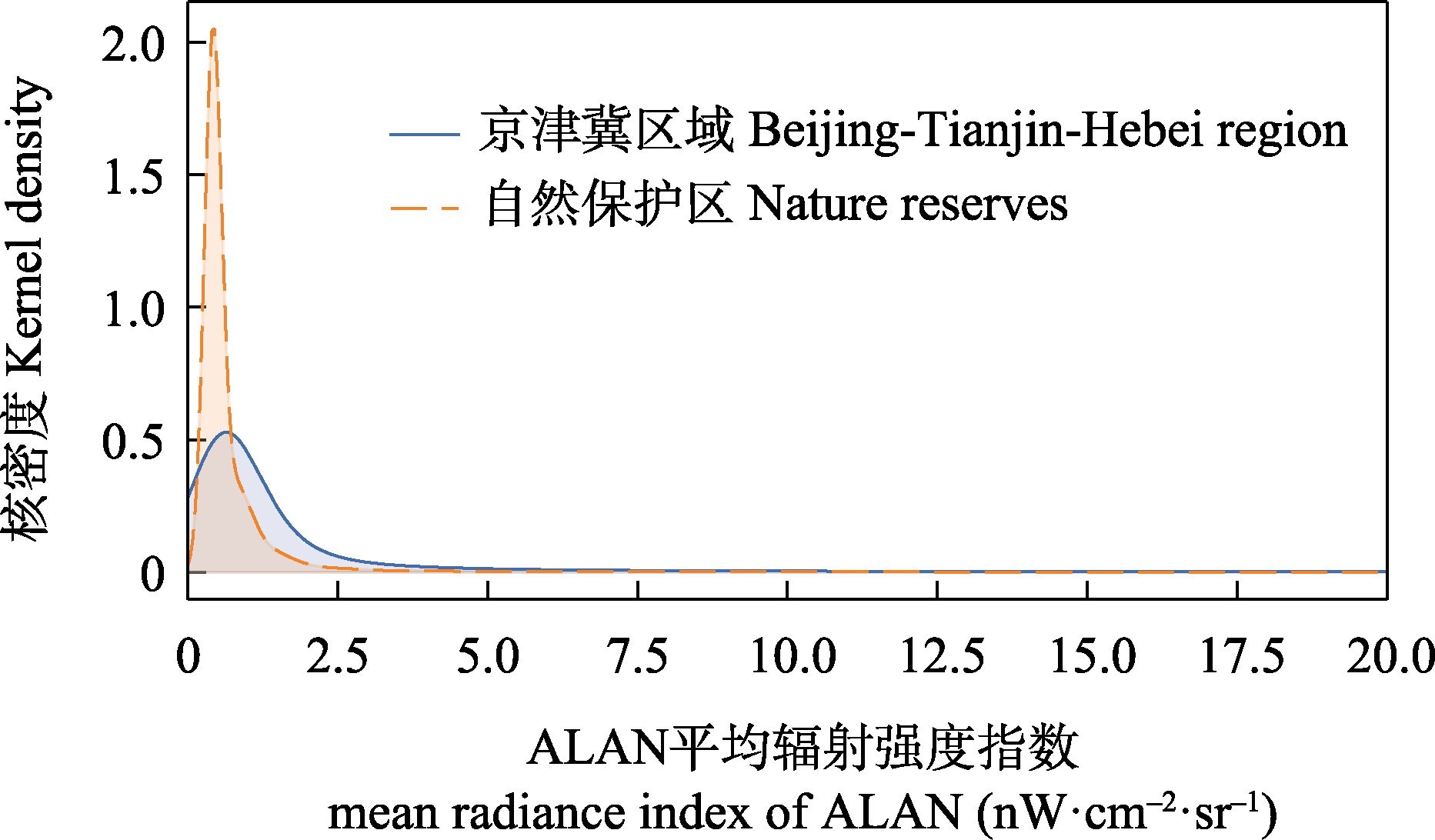
Fig. 1 Kernel density curve of mean radiance index of artificial light at night (ALAN) in the Beijing-Tianjin-Hebei region and its nature reserves in 2024
| 等级 Grade | ALAN辐射强度 ALAN radiance (nW·cm-2·sr-1) | 描述 Description |
|---|---|---|
| I | [0, 0.45) | 无干扰。京津冀区域ALAN低值像元分布区间, 自然保护区ALAN辐射强度中位数位于本区间内。说明像元或特定空间单元内基本没有人工灯光的干扰, 处于自然黑暗状态。No disturbance. This interval covers low-value ALAN pixels across the Beijing-Tianjin-Hebei region, and the median ALAN radiance of nature reserves falls within this interval. It indicates that pixels or specific spatial units suffer barely any interference from artificial lighting and remain in a naturally dark condition. |
| II | [0.45, 0.74) | 低度干扰。京津冀区域ALAN像元辐射强度排序后分布的25%-50%所在区间, 自然保护区ALAN辐射强度的均值位于本区间内。说明像元或特定空间单元内有较低程度的人工灯光干扰, 处于较为黑暗的状态。Low disturbance. This interval corresponds to the 25%-50% quantile range of sorted ALAN radiance of pixels in the Beijing-Tianjin-Hebei region, and the average ALAN radiance of nature reserves lies within this range. It means pixels or specific spatial units are subject to mild artificial light interference and maintain a relatively dark environment. |
| III | [0.74, 2.28) | 中度干扰。已经超出自然保护区ALAN辐射强度的平均水平。说明像元或特定空间单元内有较多的人工灯光干扰。 Moderate disturbance. The radiance intensity exceeds the average ALAN radiance of nature reserves, indicating that pixels or specific spatial units are affected by considerable artificial light interference. |
| IV | [2.28, ∞) | 高度干扰。已经超出京津冀区域ALAN辐射强度的平均水平。说明像元或特定空间单元内有大量的人工灯光干扰, 人为照明强烈, 不再黑暗。High disturbance. The radiance is higher than the average ALAN radiance across the Beijing-Tianjin-Hebei region, which means pixels or specific spatial units experience substantial artificial light interference with intense human lighting, resulting in a non-dark environment. |
Table 2 Disturbance intensity grades of artificial light at night (ALAN) in the Beijing-Tianjin-Hebei region
| 等级 Grade | ALAN辐射强度 ALAN radiance (nW·cm-2·sr-1) | 描述 Description |
|---|---|---|
| I | [0, 0.45) | 无干扰。京津冀区域ALAN低值像元分布区间, 自然保护区ALAN辐射强度中位数位于本区间内。说明像元或特定空间单元内基本没有人工灯光的干扰, 处于自然黑暗状态。No disturbance. This interval covers low-value ALAN pixels across the Beijing-Tianjin-Hebei region, and the median ALAN radiance of nature reserves falls within this interval. It indicates that pixels or specific spatial units suffer barely any interference from artificial lighting and remain in a naturally dark condition. |
| II | [0.45, 0.74) | 低度干扰。京津冀区域ALAN像元辐射强度排序后分布的25%-50%所在区间, 自然保护区ALAN辐射强度的均值位于本区间内。说明像元或特定空间单元内有较低程度的人工灯光干扰, 处于较为黑暗的状态。Low disturbance. This interval corresponds to the 25%-50% quantile range of sorted ALAN radiance of pixels in the Beijing-Tianjin-Hebei region, and the average ALAN radiance of nature reserves lies within this range. It means pixels or specific spatial units are subject to mild artificial light interference and maintain a relatively dark environment. |
| III | [0.74, 2.28) | 中度干扰。已经超出自然保护区ALAN辐射强度的平均水平。说明像元或特定空间单元内有较多的人工灯光干扰。 Moderate disturbance. The radiance intensity exceeds the average ALAN radiance of nature reserves, indicating that pixels or specific spatial units are affected by considerable artificial light interference. |
| IV | [2.28, ∞) | 高度干扰。已经超出京津冀区域ALAN辐射强度的平均水平。说明像元或特定空间单元内有大量的人工灯光干扰, 人为照明强烈, 不再黑暗。High disturbance. The radiance is higher than the average ALAN radiance across the Beijing-Tianjin-Hebei region, which means pixels or specific spatial units experience substantial artificial light interference with intense human lighting, resulting in a non-dark environment. |
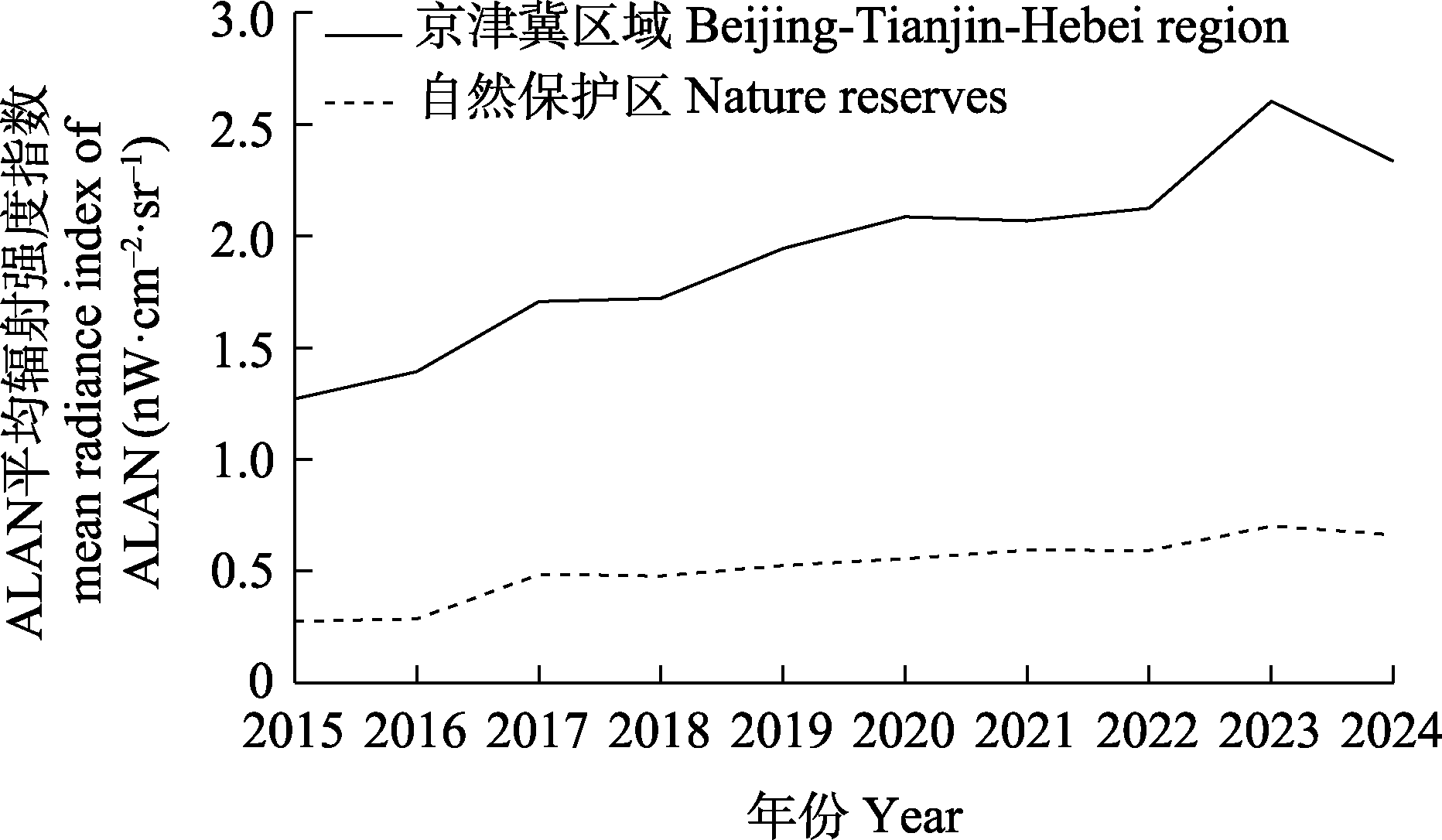
Fig. 2 Mean radiance index of artificial light at night (ALAN) in the Beijing-Tianjin-Hebei region and its nature reserves during 2015-2024
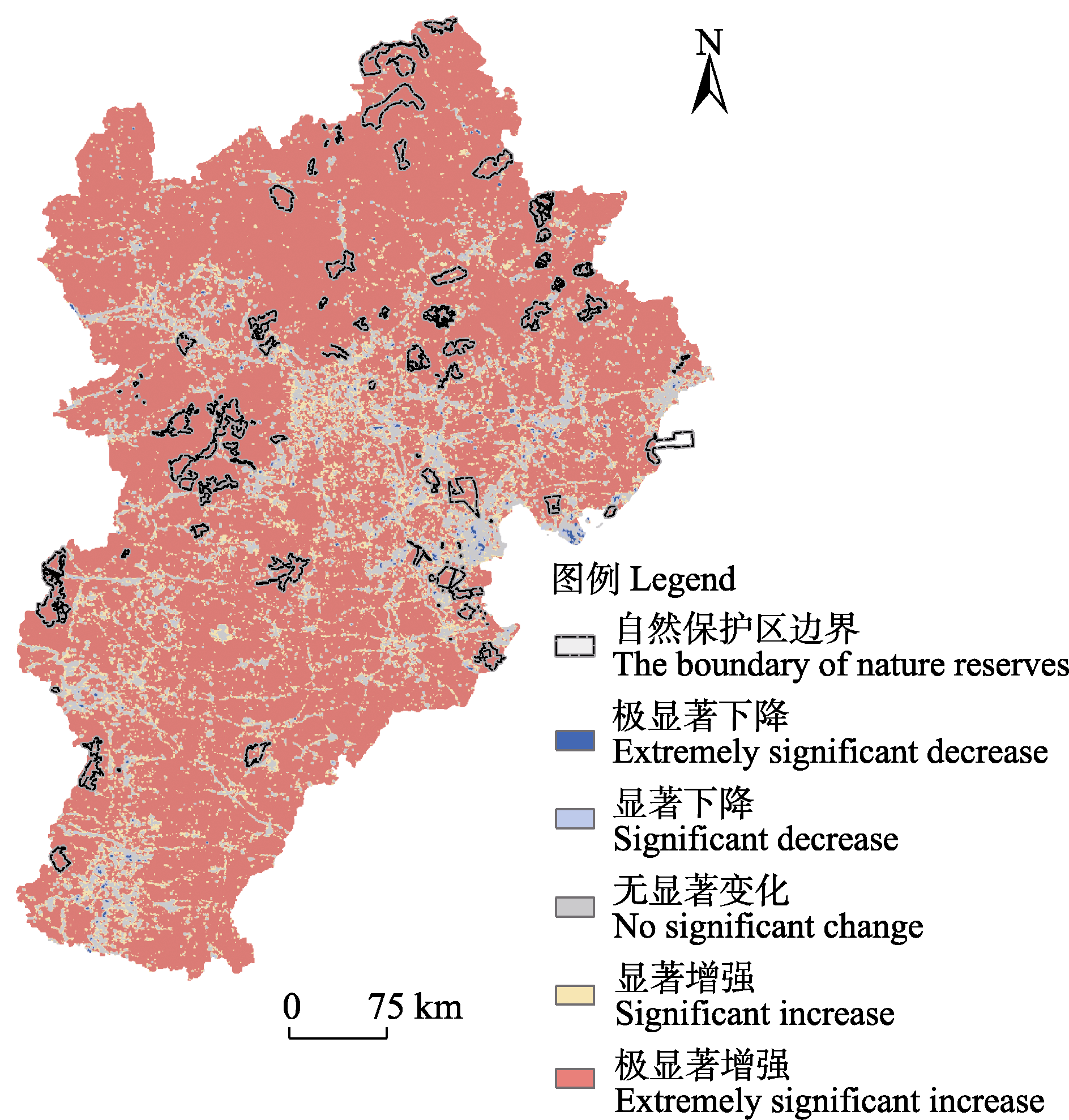
Fig. 3 Results of Mann-Kendall trend test of artificial light at night in the Beijing-Tianjin-Hebei region and its nature reserves during 2015-2024
| 变化趋势 Trends | 所属行政区域 Administrative region | 建设管理等级 Construction and management level | 保护对象类型 Protected object type | |||||
|---|---|---|---|---|---|---|---|---|
| 北京 Beijing | 天津 Tianjin | 河北 Hebei | 国家级 National | 地方级 Local | 森林草地 Forest and grassland | 湿地 Wetland | 地质遗迹 Geological heritage | |
| 极显著增长 Extremely significant increase | 11 | 6 | 36 | 16 | 37 | 32 | 12 | 9 |
| 显著增长 Significant increase | 2 | 1 | 3 | 2 | 4 | 3 | 3 | 0 |
| 无显著变化 No significant change | 1 | 1 | 1 | 0 | ||||
| 总数 Total | 14 | 7 | 39 | 18 | 42 | 35 | 16 | 9 |
Table 3 Trends in artificial light at night under different attribute categories of nature reserves in the Beijing-Tianjin-Hebei region
| 变化趋势 Trends | 所属行政区域 Administrative region | 建设管理等级 Construction and management level | 保护对象类型 Protected object type | |||||
|---|---|---|---|---|---|---|---|---|
| 北京 Beijing | 天津 Tianjin | 河北 Hebei | 国家级 National | 地方级 Local | 森林草地 Forest and grassland | 湿地 Wetland | 地质遗迹 Geological heritage | |
| 极显著增长 Extremely significant increase | 11 | 6 | 36 | 16 | 37 | 32 | 12 | 9 |
| 显著增长 Significant increase | 2 | 1 | 3 | 2 | 4 | 3 | 3 | 0 |
| 无显著变化 No significant change | 1 | 1 | 1 | 0 | ||||
| 总数 Total | 14 | 7 | 39 | 18 | 42 | 35 | 16 | 9 |
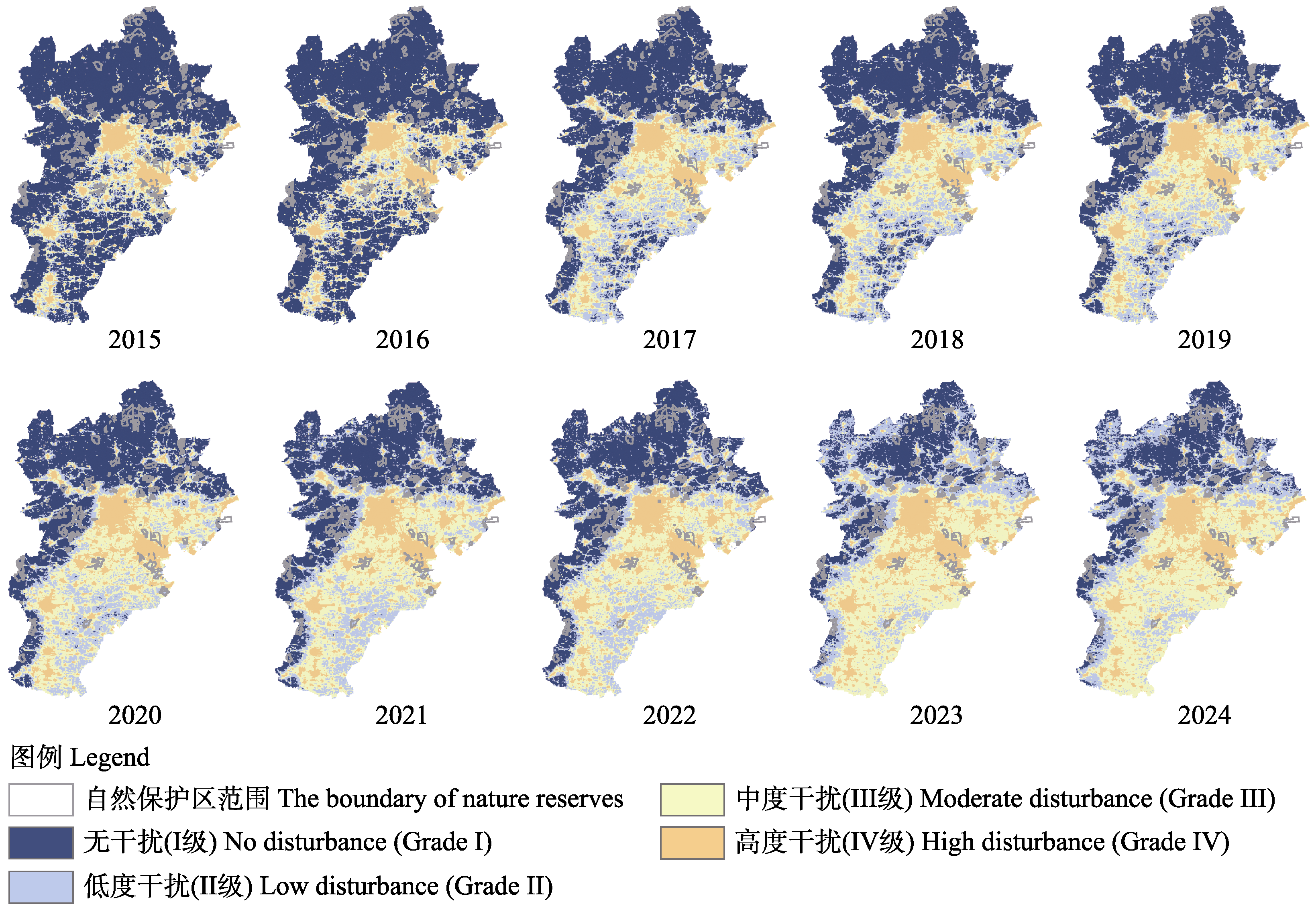
Fig. 4 Disturbance intensity grades of artificial light at night in the Beijing-Tianjin-Hebei region and its nature reserves during 2015-2024
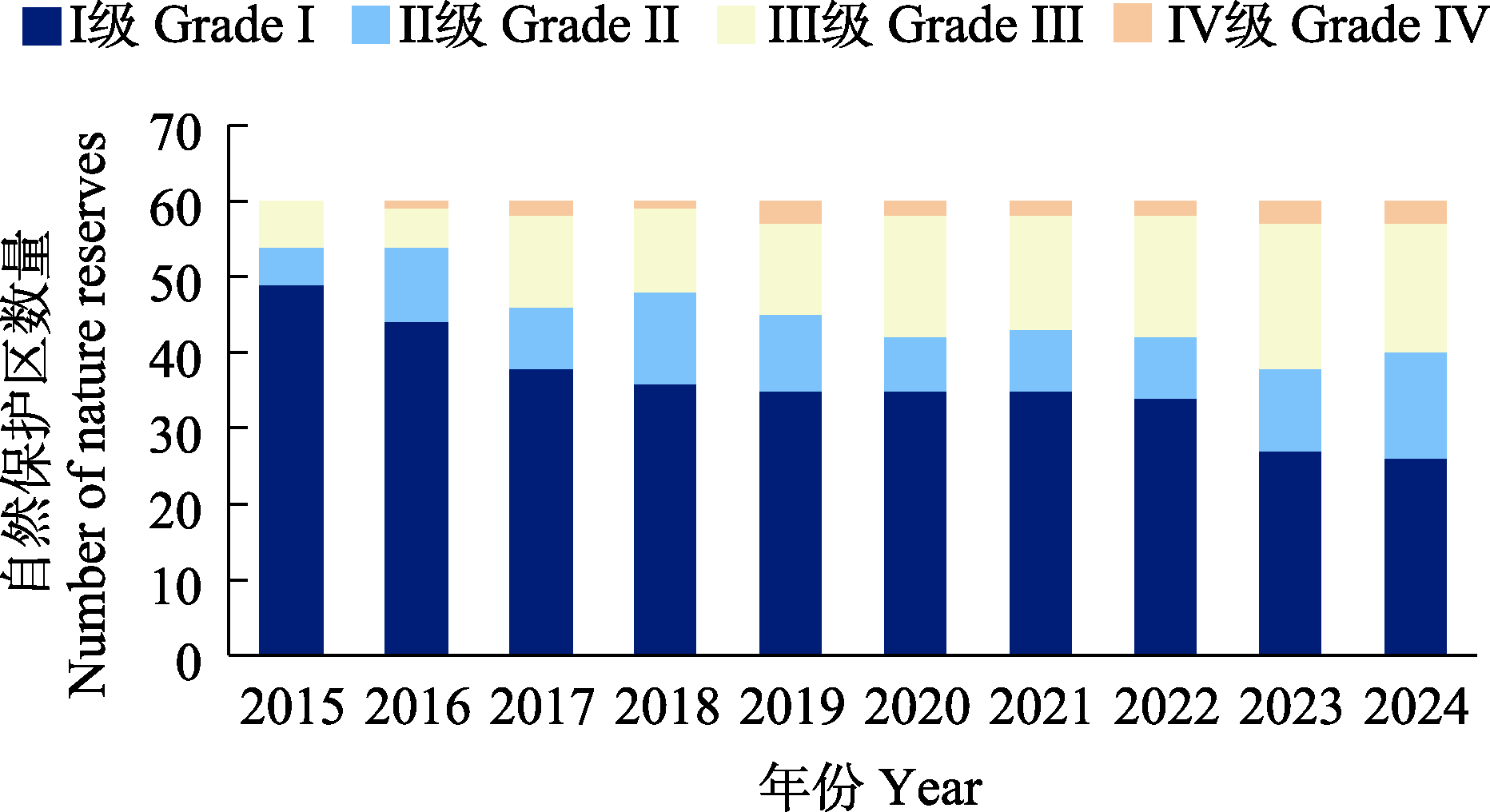
Fig. 5 Temporal variations in the number of nature reserves within different artificial light at night disturbance grades in the Beijing-Tianjin-Hebei region during 2015-2024
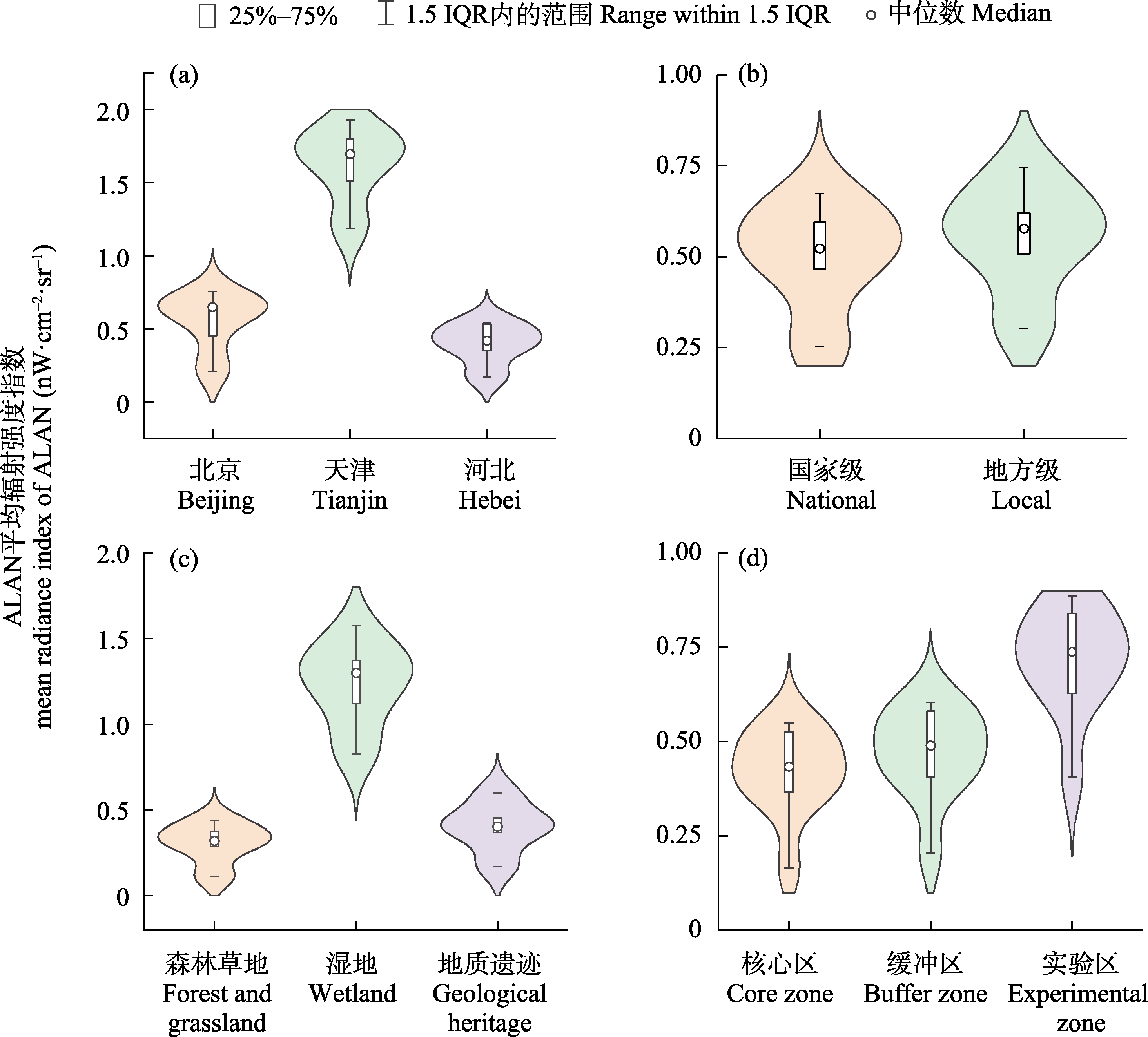
Fig. 6 Differences in the mean radiance index of artificial light at night (ALAN) among nature reserves with different attributes. (a) Across different provincial-level administrative regions; (b) Across different construction and management levels; (c) Across different protected object types; (d) Across different functional zones. IQR, Interquartile range.
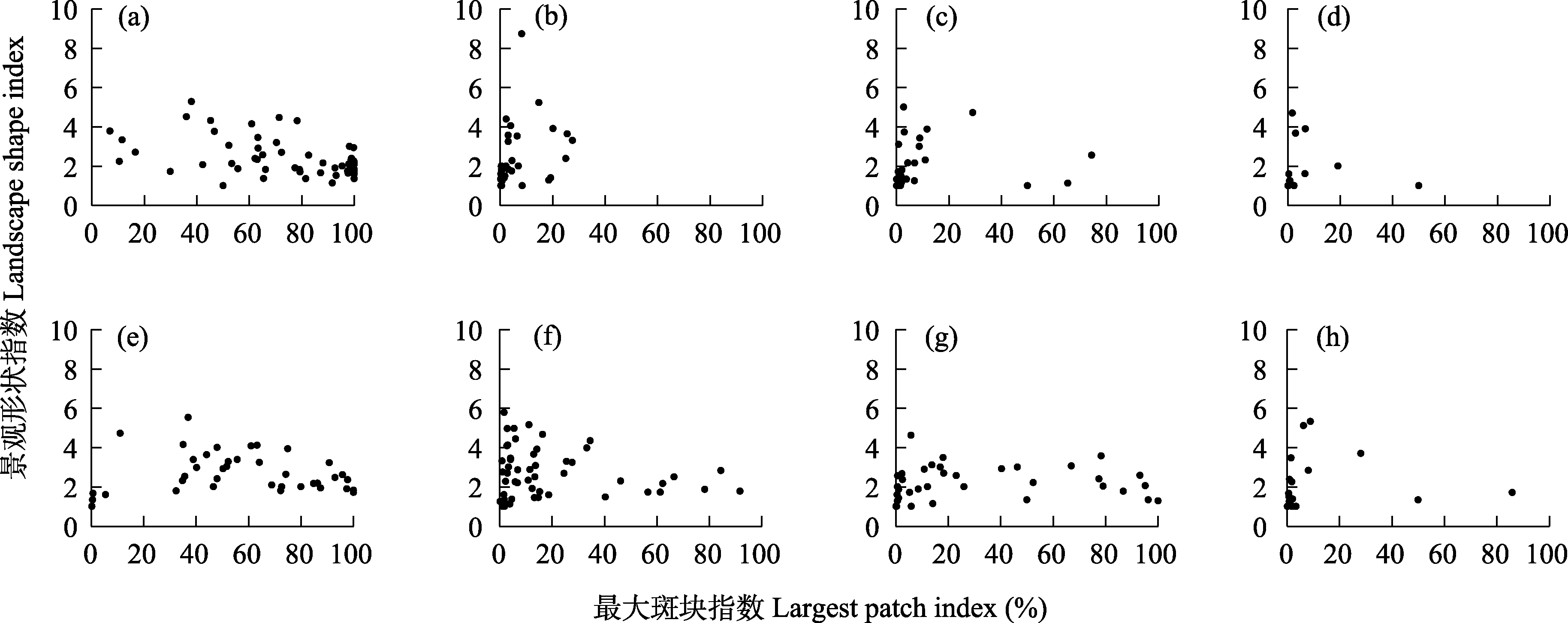
Fig. 7 Scatter plots of the largest patch index and landscape shape index for artificial light at night disturbance patches within nature reserves. (a-d) Disturbance intensity grades: no disturbance (grade I), low disturbance (grade II), moderate disturbance (grade III), and high disturbance (grade IV) in 2015, respectively; (e-h) Disturbance intensity grades I, II, III, and IV in 2024, respectively.
| [1] | Aubrecht C, Jaiteh MS, de Sherbinin A (2010) Global Assessment of Light Pollution Impact on Protected Areas. https://ciesin.columbia.edu/sites/ciesin.columbia.edu/files/content/light-pollution-Jan2010.cleaned.pdf. (accessed on 2025-05-07) |
| [2] | Bennie J, Davies TW, Cruse D, Gaston KJ (2016) Ecological effects of artificial light at night on wild plants. Journal of Ecology, 104, 611-620. |
| [3] | Buckley RC, Underdahl S, Keto A, Chauvenet ALM (2024) Conservation threats from tourism land grabs and greenwash. Biological Conservation, 299, 110792. |
| [4] | Cai ZJ, Xu J, He P, Wang DW (2025) Avian resilience to tourism development disturbances in Qilihai Wetland, Tianjin. Journal of Environmental Engineering Technology, 15, 1850-1860. (in Chinese with English abstract) |
| [蔡紫君, 徐杰, 何萍, 王德旺 (2025) 天津七里海湿地鸟类对旅游开发活动干扰的韧性研究. 环境工程技术学报, 15, 1850-1860.] | |
| [5] | Cazalis V, Princé K, Mihoub JB, Kelly J, Butchart SHM, Rodrigues ASL (2020) Effectiveness of protected areas in conserving tropical forest birds. Nature Communications, 11, 4461. |
| [6] | Chen XH, Cai SJ, Qiang HJ, Chen J, Hu DB, Geng Y, Wang YJ (2026) Institution authority and the protection efficacy of nature reserves: Evidence from China. Land Use Policy, 167, 108035. |
| [7] | Chicco D, Sichenze A, Jurman G (2025) A simple guide to the use of Student’s t-test, Mann-Whitney U test, Chi-squared test, and Kruskal-Wallis test in biostatistics. BioData Mining, 18, 56. |
| [8] | Davies TW, Duffy JP, Bennie J, Gaston KJ (2014) The nature, extent, and ecological implications of marine light pollution. Frontiers in Ecology and the Environment, 12, 347-355. |
| [9] | Davies TW, Smyth T (2018) Why artificial light at night should be a focus for global change research in the 21st century. Global Change Biology, 24, 872-882. |
| [10] | Dimitriadis C, Fournari-Konstantinidou I, Sourbès L, Koutsoubas D, Mazaris AD (2018) Reduction of sea turtle population recruitment caused by nightlight: Evidence from the Mediterranean region. Ocean & Coastal Management, 153, 108-115. |
| [11] | Elvidge CD, Zhizhin M, Ghosh T, Hsu FC, Taneja J (2021) Annual time series of global VIIRS nighttime lights derived from monthly averages: 2012 to 2019. Remote Sensing, 13, 922. |
| [12] | Gaston KJ, Visser ME, Hölker F (2015) The biological impacts of artificial light at night: The research challenge. Philosophical Transactions of the Royal Society B: Biological Sciences, 370, 20140133. |
| [13] | Gaveau DLA, Epting J, Lyne O, Linkie M, Kumara I, Kanninen M, Leader-Williams N (2009) Evaluating whether protected areas reduce tropical deforestation in Sumatra. Journal of Biogeography, 36, 2165-2175. |
| [14] | Güçlü YS (2020) Improved visualization for trend analysis by comparing with classical Mann-Kendall test and ITA. Journal of Hydrology, 584, 124674. |
| [15] | Guetté A, Godet L, Juigner M, Robin M (2018) Worldwide increase in artificial light at night around protected areas and within biodiversity hotspots. Biological Conservation, 223, 97-103. |
| [16] | Hölker F, Moss T, Griefahn B, Kloas W, Voigt CC, Henckel D, Hänel A, Kappeler PM, Völker S, Schwope A, Franke S, Uhrlandt D, Fischer J, Klenke R, Wolter C, Tockner K (2010) The dark side of light: A transdisciplinary research agenda for light pollution policy. Ecology and Society, 15, art13. |
| [17] | Hull V, Xu WH, Liu W, Zhou SQ, Viña A, Zhang JD, Tuanmu MN, Huang JY, Linderman M, Chen XD, Huang Y, Ouyang ZY, Zhang HM, Liu JG (2011) Evaluating the efficacy of zoning designations for protected area management. Biological Conservation, 144, 3028-3037. |
| [18] | Jones KR, Venter O, Fuller RA, Allan JR, Maxwell SL, Negret PJ, Watson JEM (2018) One-third of global protected land is under intense human pressure. Science, 360, 788-791. |
| [19] | Kyba CCM, Kuester T, Sánchez de Miguel A, Baugh K, Jechow A, Hölker F, Bennie J, Elvidge CD, Gaston KJ, Guanter L (2017) Artificially lit surface of Earth at night increasing in radiance and extent. Science Advances, 3, e1701528. |
| [20] | Langhammer PF, Bull JW, Bicknell JE, Oakley JL, Brown MH, Bruford MW, Butchart SHM, Carr JA, Church D, Cooney R, Cutajar S, Foden W, Foster MN, Gascon C, Geldmann J, Genovesi P, Hoffmann M, Howard-McCombe J, Lewis T, MacFarlane NBW, Melvin ZE, Merizalde RS, Morehouse MG, Pagad S, Polidoro B, Sechrest W, Segelbacher G, Smith KG, Steadman J, Strongin K, Williams J, Woodley S, Brooks TM (2024) The positive impact of conservation action. Science, 384, 453-458. |
| [21] | LaRoe J, Holmes CM, Schad T (2022) Nightlight intensity change surrounding nature reserves: A case study in Orbroicher Bruch Nature Reserve, Germany. Remote Sensing, 14, 3876. |
| [22] | Li C, Wang J, Li XW, Bai JH (2009) Eco-environmental water requirement based on scheme of wetland restoration in Hengshui National Nature Reserve. Resources Science, 31, 772-779. (in Chinese with English abstract) |
| [黎聪, 王冀, 李晓文, 白军红 (2009) 衡水湖自然保护区湿地恢复预案的生态环境需水研究. 资源科学, 31, 772-779.] | |
| [23] | Li SC, Wu JS, Gong J, Li SW (2018) Human footprint in Tibet: Assessing the spatial layout and effectiveness of nature reserves. Science of the Total Environment, 621, 18-29. |
| [24] | Li T, Wang ZS, Kyba CCM, Román MO, Seto KC, Yang Y, Qiu S, Kuester T, Fragkias M, Chen X, Meyer TH, Rittenhouse CD, Tai XN, Cullerton M, Hong FL, Grinstead A, Song KX, Suh JW, Yang XC, Kalb VL, Deng CB, Zhu Z (2026) Satellite imagery reveals increasing volatility in human night-time activity. Nature, 652, 379-386. |
| [25] | Li X, Bubuli Y, Zheng JC, Mei L (2025) Evaluation of the effectiveness of light pollution control in Shenzhen Xichong dark sky preserve based on nighttime light remote sensing. Tropical Geography, 45, 1373-1387. (in Chinese with English abstract) |
| [李熙, 布布莉·叶尔勒克, 郑建川, 梅林 (2025) 基于夜光遥感的深圳西涌暗夜保护社区光污染控制有效性评估. 热带地理, 45, 1373-1387.] | |
| [26] | Lin MJ, Chen DK, Shi LY (2023) Ecological risk assessment of water balance of Baiyangdian Lake. Wetland Science, 21, 28-34. (in Chinese with English abstract) |
| [林梦婧, 陈丁楷, 石龙宇 (2023) 白洋淀水量平衡生态风险评价. 湿地科学, 21, 28-34.] | |
| [27] | Liu FZ, Feng CT, Zhou Y, Zhang LB, Du JH, Huang WJ, Luo JW, Wang W (2022) Effectiveness of functional zones in National Nature Reserves for the protection of forest ecosystems in China. Journal of Environmental Management, 308, 114593. |
| [28] | Liu FZ, Zhang P, Zhang YB, Chen B, Du JH, Wang W, Li JS (2017) Assessment of the space neighborhood effect on nature reserves based on temporal and spatial changes of artificial objects: A case study on Shapotou National Nature Reserve. Biodiversity Science, 25, 1105-1113. (in Chinese with English abstract) |
| [刘方正, 张鹏, 张玉波, 陈冰, 杜金鸿, 王伟, 李俊生 (2017) 基于人工地物时空变化的自然保护区空间近邻效应评估: 以沙坡头国家级自然保护区为例. 生物多样性, 25, 1105-1113.] | |
| [29] | Liu SL, Li WP, Qiao W, Wang QQ, Hu YB, Wang ZK (2019) Effect of natural conditions and mining activities on vegetation variations in arid and semiarid mining regions. Ecological Indicators, 103, 331-345. |
| [30] | Liu X, Blackburn TM, Song TJ, Wang XY, Huang C, Li YM (2020) Animal invaders threaten protected areas worldwide. Nature Communications, 11, 2892. |
| [31] | Liu XM, Fu Z, Wen RH, Jin CP, Wang XF, Wang C, Xiao RL, Hou P (2020) Characteristics of human activities and the spatio-temporal changes of national nature reserves in China. Geographical Research, 39, 2391-2402. (in Chinese with English abstract) |
| [刘晓曼, 付卓, 闻瑞红, 靳川平, 王雪峰, 王超, 肖如林, 侯鹏 (2020) 中国国家级自然保护区人类活动及变化特征. 地理研究, 39, 2391-2402.] | |
| [32] | Liu ZL, Hu LL, Yan BQ, Zhang PQ (2022) Ecological benefit evaluation and influencing factors analysis of the protected areas in Beijing. Acta Ecologica Sinica, 42, 10060-10071. (in Chinese with English abstract) |
| [刘增力, 胡理乐, 闫伯前, 张鹏骞 (2022) 北京市自然保护地生态效益及其影响因素. 生态学报, 42, 10060-10071.] | |
| [33] | Lü XF (2024) Study on the high-quality development of night-time economy in the Beijing-Tianjin-Hebei region from the perspective of cultural and tourism integration. Urban Insight, (2), 60-70, 161. (in Chinese with English abstract) |
| [吕晓凤 (2024) 文旅融合视域下京津冀夜间经济高质量发展研究. 城市观察, (2), 60-70, 161.] | |
| [34] | Lü YH, Chen LD, Fu BJ (2004) The analysis of human activities and landscape patterns at the county level. Acta Ecologica Sinica, 24, 1833-1838. (in Chinese with English abstract) |
| [吕一河, 陈利顶, 傅伯杰 (2004) 县域人类活动与景观格局分析. 生态学报, 24, 1833-1838.] | |
| [35] | Moaraf S, Heiblum R, Scharf I, Hefetz A, Okuliarová M, Zeman M, Barnea A (2025) Counteracting the effects of artificial light at night: The role of melatonin in brain plasticity and nighttime activity in a songbird. Science of the Total Environment, 975, 179251. |
| [36] | Nowakowski AJ, Watling JI, Murray A, Deichmann JL, Akre TS, Muñoz Brenes CL, Todd BD, McRae L, Freeman R, Frishkoff LO (2023) Protected areas slow declines unevenly across the tetrapod tree of life. Nature, 622, 101-106. |
| [37] | Ovando D, Liu O, Molina R, Parma A, Szuwalski C (2023) Global effects of marine protected areas on food security are unknown. Nature, 621, E34-E36. |
| [38] | Rands MRW, Adams WM, Bennun L, Butchart SHM, Clements A, Coomes D, Entwistle A, Hodge I, Kapos V, Scharlemann JPW, Sutherland WJ, Vira B (2010) Biodiversity conservation: Challenges beyond 2010. Science, 329, 1298-1303. |
| [39] | Ściężor T, Iwanicki G, Kunz M, Kotarba AZ, Skorb K, Tabaka P (2025) Ecological light pollution (ELP) scale as a measure of light pollution impact on protected areas: Case study of Poland. Sustainability, 17, 4824. |
| [40] | Shi KF, Huang C, Chen Y, Li LY (2018) Remotely sensed nighttime lights reveal increasing human activities in protected areas of China mainland. Remote Sensing Letters, 9, 467-476. |
| [41] | Theodorsson-Norheim E (1986) Kruskal-Wallis test: BASIC computer program to perform nonparametric one-way analysis of variance and multiple comparisons on ranks of several independent samples. Computer Methods and Programs in Biomedicine, 23, 57-62. |
| [42] | Tian YY, Jiang GH, Zhou DY, Ding KS, Su S, Zhou T, Chen DB (2019) Regional industrial transfer in the Jingjinji urban agglomeration, China: An analysis based on a new “transferring area-undertaking area-dynamic process” model. Journal of Cleaner Production, 235, 751-766. |
| [43] | Vieira-Alencar JPS, Carmignotto AP, Sawaya RJ, Silveira LF, Valdujo PH, de Campos Nogueira C (2025) Hotspot getting hotter: Increased knowledge on tetrapod endemism, habitat loss and the plight of the most threatened savanna in the world. Biological Conservation, 305, 111087. |
| [44] | Wang TY, Kaida N, Kaida K (2023) Effects of outdoor artificial light at night on human health and behavior: A literature review. Environmental Pollution, 323, 121321. |
| [45] | Watson JEM, Dudley N, Segan DB, Hockings M (2014) The performance and potential of protected areas. Nature, 515, 67-73. |
| [46] | Wei J, Zhong YD, Chen AM, Tang H, Li DL (2025) Space-time cube reveals escalating light pollution in China’s national parks: Impact of boundary geometry and human activities (1992-2021). Environmental Pollution, 377, 126462. |
| [47] | Wei W, Li XX, Qi MD, Li SN, Ma MY (2025) The impact of urban expansion on the spatiotemporal evolution of wetlands in the Beijing-Tianjin-Hebei Region from 1980 to 2023. Wetland Science & Management, 21(6), 28-34. (in Chinese with English abstract) |
| [韦玮, 李肖夏, 齐梦頔, 李胜男, 马牧源 (2025) 1980-2023年京津冀地区城市扩张对湿地时空演变的影响. 湿地科学与管理, 21(6), 28-34.] | |
| [48] | Wen CH, Long TF, He GJ, Jiao WL, Jiang W (2025) Temporally enhanced RSEI and nighttime lights reveal long-term ecological changes and effective protection in China’s inaugural national parks. Ecological Indicators, 170, 112981. |
| [49] | Widmer K, Beloconi A, Marnane I, Vounatsou P (2022) Review and Assessment of Available Information on Light Pollution in Europe. European Topic Centre on Human Health and the Environment c/o Norwegian Institute for Air Research, Kjeller, Norway. |
| [50] | Wittemyer G, Elsen P, Bean WT, Burton ACO, Brashares JS (2008) Accelerated human population growth at protected area edges. Science, 321, 123-126. |
| [51] | Wolf C, Levi T, Ripple WJ, Zárrate-Charry DA, Betts MG (2021) A forest loss report card for the world’s protected areas. Nature Ecology & Evolution, 5, 520-529. |
| [52] | Xu PF, Wang Q, Jin J, Jin PB (2019) An increase in nighttime light detected for protected areas in mainland China based on VIIRS DNB data. Ecological Indicators, 107, 105615. |
| [53] | Yao XL, Zhou L, Wu TX, Ren MX (2022) Landscape dynamics and ecological risk of the expressway crossing section in the Hainan Rainforest National Park. Acta Ecologica Sinica, 42, 6695-6703. (in Chinese with English abstract) |
| [姚小兰, 周琳, 吴挺勋, 任明迅 (2022) 海南热带雨林国家公园高速公路穿越段景观动态与生态风险评估. 生态学报, 42, 6695-6703.] | |
| [54] | Zeng YW, Senior RA, Crawford CL, Wilcove DS (2023) Gaps and weaknesses in the global protected area network for safeguarding at-risk species. Science Advances, 9, eadg288. |
| [55] | Zhang HB, Xiao L, Liu YJ (2025) Effects of artificial light at night on the diversity and growth of invasive alien and native plants. Biodiversity Science, 33, 24553. (in Chinese with English abstract) |
| [张浩斌, 肖路, 刘艳杰 (2025) 夜间灯光对外来入侵植物和本地植物群落多样性和生长的影响. 生物多样性, 33, 24553.] | |
| [56] | Zhang LY, Zhen Q, Cheng M, Ouyang ZY (2019) The main drivers of wetland changes in the Beijing-Tianjin-Hebei Region. International Journal of Environmental Research and Public Health, 16, 2619. |
| [57] | Zhang Y, Zhu TX, Guo HY, Yang XH (2023) Analysis of the coupling coordination degree of the Society-Economy- Resource-Environment system in urban areas: Case study of the Jingjinji urban agglomeration, China. Ecological Indicators, 146, 109851. |
| [58] | Zhang ZM, Sherman R, Yang ZJ, Wu RD, Wang WL, Yin M, Yang GH, Ou XK (2013) Integrating a participatory process with a GIS-based multi-criteria decision analysis for protected area zoning in China. Journal for Nature Conservation, 21, 225-240. |
| [59] | Zheng YM, Zhang HY, Niu ZG, Gong P (2012) Protection efficacy of national wetland reserves in China. Chinese Science Bulletin, 57, 207-230. (in Chinese) |
| [郑姚闽, 张海英, 牛振国, 宫鹏 (2012) 中国国家级湿地自然保护区保护成效初步评估. 科学通报, 57, 207-230.] | |
| [60] | Zheng ZH, Wu ZF, Chen YB, Guo GH, Cao Z, Yang ZW, Marinello F (2021) Africa’s protected areas are brightening at night: A long-term light pollution monitor based on nighttime light imagery. Global Environmental Change, 69, 102318. |
| Viewed | ||||||
|
Full text |
|
|||||
|
Abstract |
|
|||||
Copyright © 2026 Biodiversity Science
Editorial Office of Biodiversity Science, 20 Nanxincun, Xiangshan, Beijing 100093, China
Tel: 010-62836137, 62836665 E-mail: biodiversity@ibcas.ac.cn
