

Biodiv Sci ›› 2026, Vol. 34 ›› Issue (8): 26285. DOI: 10.17520/biods.2026285 cstr: 32101.14.biods.2026285
• Original Papers: Animal Diversity • Previous Articles
Hong Xiao1,2, Hongyu Xie1,2( ), Zhipeng Kang1,2(), Yu Liu1,2(), Peng Wu1,2(), Yong Liu1,2,*()(
 ), Teng Wang1,2,*()()
Received:2026-07-08
Accepted:2026-07-25
Online:2026-08-20
Published:2026-10-21
Contact:
*Co-authors for correspondence: E-mail: liuyong@scsfri.ac.cn;
wt3074589@163.com
Supported by:Hong Xiao, Hongyu Xie, Zhipeng Kang, Yu Liu, Peng Wu, Yong Liu, Teng Wang. Fish diversity in reef waters adjacent to Wanshan Island in the Pearl River Estuary[J]. Biodiv Sci, 2026, 34(8): 26285.
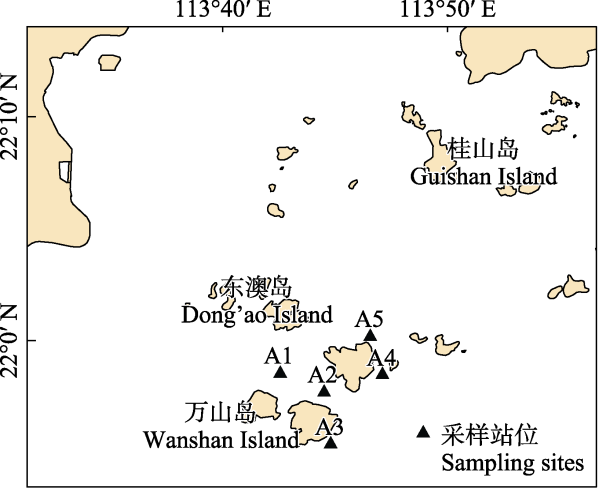
Fig. 1 Distribution of fish sampling sites in waters adjacent to Wanshan Island in the Pearl River Estuary
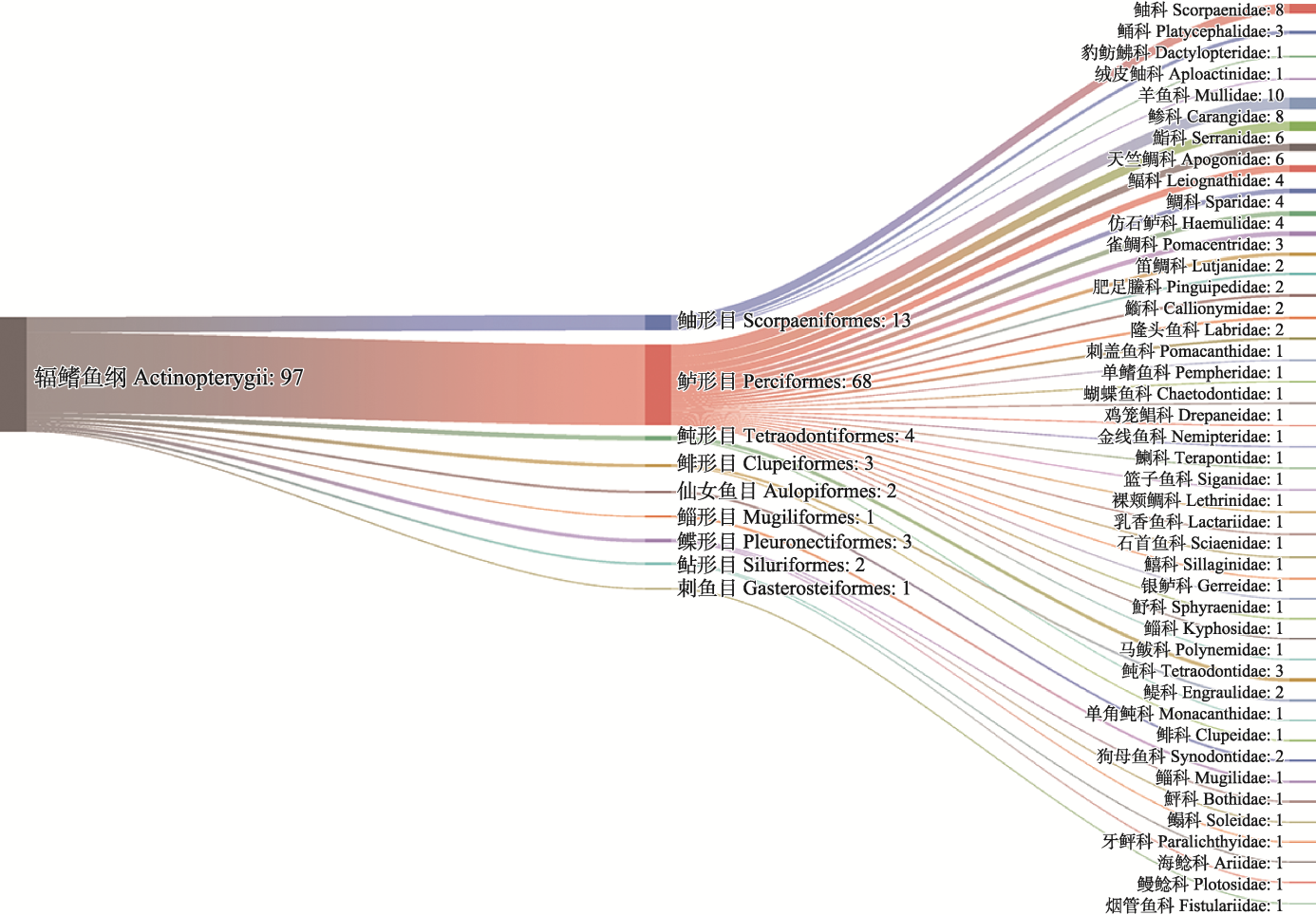
Fig. 2 Fish species composition based on combined spring and autumn surveys in waters adjacent to Wanshan Island in the Pearl River Estuary. Numbers following taxon names indicate the number of species in each taxon.
| 种名 Species | 重量百分比 Weight percentage (%) | 尾数百分比 Individual percentage (%) | 尾均重 Mean individual weight (g) | 种名 Species | 重量百分比 Weight percentage (%) | 尾数百分比 Individual percentage (%) | 尾均重 Mean individual weight (g) |
|---|---|---|---|---|---|---|---|
| 黑稍单鳍鱼 Pempheris oualensis | 14.44 | 13.11 | 77.05 | 条尾光鳃鱼 Chromis ternatensis | 2.24 | 5.85 | 26.83 |
| 三线矶鲈 Parapristipoma trilineatum | 10.77 | 9.60 | 78.49 | 李氏波光鳃鱼 Pomachromis richardsoni | 1.38 | 3.04 | 31.82 |
| 裸胸若鲹 Carangoides gymnostethus | 6.38 | 4.53 | 98.67 | 黑斑绯鲤 Upeneus tragula | 1.30 | 0.62 | 145.87 |
| 平鲷 Rhabdosargus sarba | 6.16 | 4.76 | 90.52 | 鳞烟管鱼 Fistularia petimba | 1.23 | 0.31 | 276.50 |
| 卵形鲳鲹 Trachinotus ovatus | 5.29 | 1.87 | 197.70 | 多带副绯鲤 Parupeneus multifasciatus | 1.23 | 0.94 | 92.08 |
| 云斑海猪鱼 Halichoeres nigrescens | 5.23 | 8.74 | 41.83 | 凹鳍鲬 Kumococius rodericensis | 1.17 | 0.31 | 263.26 |
| 长鳍篮子鱼 Siganus canaliculatus | 4.30 | 6.48 | 46.40 | 弯角䲗 Callionymus richardsoni | 0.77 | 1.17 | 46.13 |
| 圆口副绯鲤 Parupeneus cyclostomus | 4.07 | 3.36 | 84.88 | 须拟鲉 Scorpaenopsis cirrosa | 0.75 | 1.25 | 41.82 |
| 鞍带石斑鱼 Epinephelus lanceolatus | 4.02 | 0.08 | 3,600.00 | 短吻鲾 Leiognathus brevirostris | 0.48 | 1.33 | 25.23 |
| 长圆银鲈 Gerres oblongus | 3.79 | 4.92 | 53.90 | 细纹鲾 Leiognathus berbis | 0.48 | 1.48 | 22.41 |
| 双带黄鲈 Diploprion bifasciatum | 3.00 | 5.07 | 41.38 | 其他 Others | 18.88 | 21.08 | - |
| 条斑胡椒鲷 Plectorhinchus vittatus | 2.62 | 0.08 | 2,350.00 |
Table 1 Characteristics of fish assemblage composition in waters adjacent to Wanshan Island in the Pearl River Estuary. Data from spring and autumn were combined, and only species accounting for more than 1% of the total weight or individuals are listed.
| 种名 Species | 重量百分比 Weight percentage (%) | 尾数百分比 Individual percentage (%) | 尾均重 Mean individual weight (g) | 种名 Species | 重量百分比 Weight percentage (%) | 尾数百分比 Individual percentage (%) | 尾均重 Mean individual weight (g) |
|---|---|---|---|---|---|---|---|
| 黑稍单鳍鱼 Pempheris oualensis | 14.44 | 13.11 | 77.05 | 条尾光鳃鱼 Chromis ternatensis | 2.24 | 5.85 | 26.83 |
| 三线矶鲈 Parapristipoma trilineatum | 10.77 | 9.60 | 78.49 | 李氏波光鳃鱼 Pomachromis richardsoni | 1.38 | 3.04 | 31.82 |
| 裸胸若鲹 Carangoides gymnostethus | 6.38 | 4.53 | 98.67 | 黑斑绯鲤 Upeneus tragula | 1.30 | 0.62 | 145.87 |
| 平鲷 Rhabdosargus sarba | 6.16 | 4.76 | 90.52 | 鳞烟管鱼 Fistularia petimba | 1.23 | 0.31 | 276.50 |
| 卵形鲳鲹 Trachinotus ovatus | 5.29 | 1.87 | 197.70 | 多带副绯鲤 Parupeneus multifasciatus | 1.23 | 0.94 | 92.08 |
| 云斑海猪鱼 Halichoeres nigrescens | 5.23 | 8.74 | 41.83 | 凹鳍鲬 Kumococius rodericensis | 1.17 | 0.31 | 263.26 |
| 长鳍篮子鱼 Siganus canaliculatus | 4.30 | 6.48 | 46.40 | 弯角䲗 Callionymus richardsoni | 0.77 | 1.17 | 46.13 |
| 圆口副绯鲤 Parupeneus cyclostomus | 4.07 | 3.36 | 84.88 | 须拟鲉 Scorpaenopsis cirrosa | 0.75 | 1.25 | 41.82 |
| 鞍带石斑鱼 Epinephelus lanceolatus | 4.02 | 0.08 | 3,600.00 | 短吻鲾 Leiognathus brevirostris | 0.48 | 1.33 | 25.23 |
| 长圆银鲈 Gerres oblongus | 3.79 | 4.92 | 53.90 | 细纹鲾 Leiognathus berbis | 0.48 | 1.48 | 22.41 |
| 双带黄鲈 Diploprion bifasciatum | 3.00 | 5.07 | 41.38 | 其他 Others | 18.88 | 21.08 | - |
| 条斑胡椒鲷 Plectorhinchus vittatus | 2.62 | 0.08 | 2,350.00 |
| 种名 Species | 春季 Spring | 秋季 Autumn | ||||||
|---|---|---|---|---|---|---|---|---|
| 尾数百分比 Individual percentage (%) | 重量百分比 Weight percentage (%) | 出现频率 Frequency of occurrence (%) | 相对重要性 指数 Index of relative importance | 尾数百分比 Individual percentage (%) | 重量百分比 Weight percentage (%) | 出现频率 Frequency of occurrence (%) | 相对重要性 指数 Index of relative importance | |
| 三线矶鲈 Parapristipoma trilineatum | 14.52 | 16.65 | 100.00 | 3,117.00 | 5.19 | 5.39 | 60.00 | 634.41 |
| 云斑海猪鱼 Halichoeres nigrescens | 14.69 | 8.38 | 80.00 | 1,845.31 | 3.41 | 2.34 | 40.00 | 229.91 |
| 长鳍篮子鱼 Siganus canaliculatus | 8.91 | 5.64 | 100.00 | 1,454.95 | 4.30 | 3.07 | 80.00 | 589.12 |
| 条尾光鳃鱼 Chromis ternatensis | 12.38 | 4.70 | 80.00 | 1,365.81 | - | - | - | - |
| 卵形鲳鲹 Trachinotus ovatus | 3.80 | 10.69 | 60.00 | 869.04 | 0.15 | 0.35 | 20.00 | 10.03 |
| 裸胸若鲹 Carangoides gymnostethus | 9.57 | 13.36 | 20.00 | 458.57 | - | - | - | - |
| 长圆银鲈 Gerres oblongus | 3.47 | 2.77 | 60.00 | 374.15 | 6.22 | 4.72 | 80.00 | 875.48 |
| 短吻鲾 Leiognathus brevirostris | 2.81 | 1.00 | 60.00 | 228.38 | - | - | - | - |
| 鞍带石斑鱼 Epinephelus lanceolatus | 0.17 | 8.40 | 20.00 | 171.35 | - | - | - | - |
| 黑稍单鳍鱼 Pempheris oualensis | 1.98 | 0.86 | 60.00 | 170.13 | 23.11 | 26.88 | 60.00 | 2,999.69 |
| 黑斑绯鲤 Upeneus tragula | 1.32 | 2.72 | 40.00 | 161.75 | - | - | - | - |
| 黄背牙鲷 Dentex hypselosomus | 1.98 | 1.28 | 40.00 | 130.28 | - | - | - | - |
| 金带细鲹 Selaroides leptolepis | 1.98 | 1.27 | 40.00 | 130.08 | - | - | - | - |
| 条斑胡椒鲷 Plectorhinchus vittatus | 0.17 | 5.48 | 20.00 | 113.00 | - | - | - | - |
| 平鲷 Rhabdosargus sarba | - | - | - | - | 9.04 | 11.80 | 60.00 | 1,250.35 |
| 圆口副绯鲤 Parupeneus cyclostomus | - | - | - | - | 6.37 | 7.80 | 80.00 | 1,133.74 |
| 李氏波光鳃鱼 Pomachromis richardsoni | - | - | - | - | 5.78 | 2.65 | 60.00 | 505.81 |
| 双带黄鲈 Diploprion bifasciatum | - | - | - | - | 9.63 | 5.75 | 20.00 | 307.58 |
| 多带副绯鲤 Parupeneus multifasciatus | - | - | - | - | 1.78 | 2.36 | 40.00 | 165.58 |
| 多鳞鱚 Sillago sihama | 0.33 | 0.37 | 40.00 | 28.01 | 1.19 | 1.42 | 60.00 | 156.42 |
| 须拟鲉 Scorpaenopsis cirrosa | 0.99 | 0.48 | 60.00 | 88.14 | 1.48 | 0.99 | 60.00 | 148.39 |
| 双斑长鳍天竺鲷 Archamia biguttata | - | - | - | - | 1.48 | 0.67 | 60.00 | 129.16 |
| 真鲷 Pagrus major | - | - | - | - | 1.19 | 1.73 | 40.00 | 116.51 |
Table 2 Composition of dominant and common fish species identified in spring or autumn in waters adjacent to Wanshan Island, Pearl River Estuary
| 种名 Species | 春季 Spring | 秋季 Autumn | ||||||
|---|---|---|---|---|---|---|---|---|
| 尾数百分比 Individual percentage (%) | 重量百分比 Weight percentage (%) | 出现频率 Frequency of occurrence (%) | 相对重要性 指数 Index of relative importance | 尾数百分比 Individual percentage (%) | 重量百分比 Weight percentage (%) | 出现频率 Frequency of occurrence (%) | 相对重要性 指数 Index of relative importance | |
| 三线矶鲈 Parapristipoma trilineatum | 14.52 | 16.65 | 100.00 | 3,117.00 | 5.19 | 5.39 | 60.00 | 634.41 |
| 云斑海猪鱼 Halichoeres nigrescens | 14.69 | 8.38 | 80.00 | 1,845.31 | 3.41 | 2.34 | 40.00 | 229.91 |
| 长鳍篮子鱼 Siganus canaliculatus | 8.91 | 5.64 | 100.00 | 1,454.95 | 4.30 | 3.07 | 80.00 | 589.12 |
| 条尾光鳃鱼 Chromis ternatensis | 12.38 | 4.70 | 80.00 | 1,365.81 | - | - | - | - |
| 卵形鲳鲹 Trachinotus ovatus | 3.80 | 10.69 | 60.00 | 869.04 | 0.15 | 0.35 | 20.00 | 10.03 |
| 裸胸若鲹 Carangoides gymnostethus | 9.57 | 13.36 | 20.00 | 458.57 | - | - | - | - |
| 长圆银鲈 Gerres oblongus | 3.47 | 2.77 | 60.00 | 374.15 | 6.22 | 4.72 | 80.00 | 875.48 |
| 短吻鲾 Leiognathus brevirostris | 2.81 | 1.00 | 60.00 | 228.38 | - | - | - | - |
| 鞍带石斑鱼 Epinephelus lanceolatus | 0.17 | 8.40 | 20.00 | 171.35 | - | - | - | - |
| 黑稍单鳍鱼 Pempheris oualensis | 1.98 | 0.86 | 60.00 | 170.13 | 23.11 | 26.88 | 60.00 | 2,999.69 |
| 黑斑绯鲤 Upeneus tragula | 1.32 | 2.72 | 40.00 | 161.75 | - | - | - | - |
| 黄背牙鲷 Dentex hypselosomus | 1.98 | 1.28 | 40.00 | 130.28 | - | - | - | - |
| 金带细鲹 Selaroides leptolepis | 1.98 | 1.27 | 40.00 | 130.08 | - | - | - | - |
| 条斑胡椒鲷 Plectorhinchus vittatus | 0.17 | 5.48 | 20.00 | 113.00 | - | - | - | - |
| 平鲷 Rhabdosargus sarba | - | - | - | - | 9.04 | 11.80 | 60.00 | 1,250.35 |
| 圆口副绯鲤 Parupeneus cyclostomus | - | - | - | - | 6.37 | 7.80 | 80.00 | 1,133.74 |
| 李氏波光鳃鱼 Pomachromis richardsoni | - | - | - | - | 5.78 | 2.65 | 60.00 | 505.81 |
| 双带黄鲈 Diploprion bifasciatum | - | - | - | - | 9.63 | 5.75 | 20.00 | 307.58 |
| 多带副绯鲤 Parupeneus multifasciatus | - | - | - | - | 1.78 | 2.36 | 40.00 | 165.58 |
| 多鳞鱚 Sillago sihama | 0.33 | 0.37 | 40.00 | 28.01 | 1.19 | 1.42 | 60.00 | 156.42 |
| 须拟鲉 Scorpaenopsis cirrosa | 0.99 | 0.48 | 60.00 | 88.14 | 1.48 | 0.99 | 60.00 | 148.39 |
| 双斑长鳍天竺鲷 Archamia biguttata | - | - | - | - | 1.48 | 0.67 | 60.00 | 129.16 |
| 真鲷 Pagrus major | - | - | - | - | 1.19 | 1.73 | 40.00 | 116.51 |
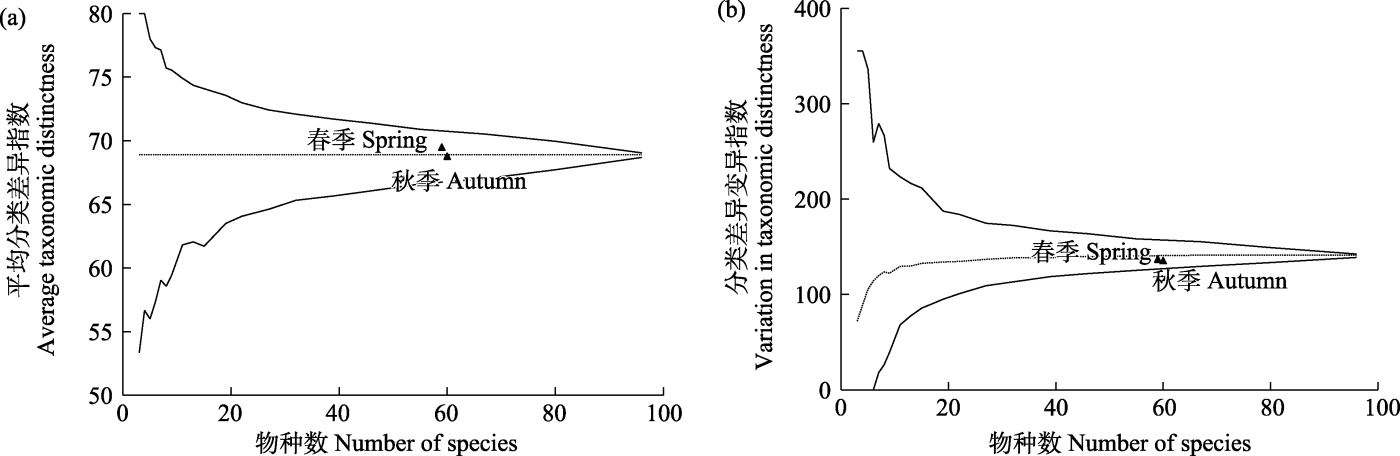
Fig. 3 95% confidence interval funnel plots of taxonomic distinctness indices in spring and autumn in waters adjacent to Wanshan Island in the Pearl River Estuary
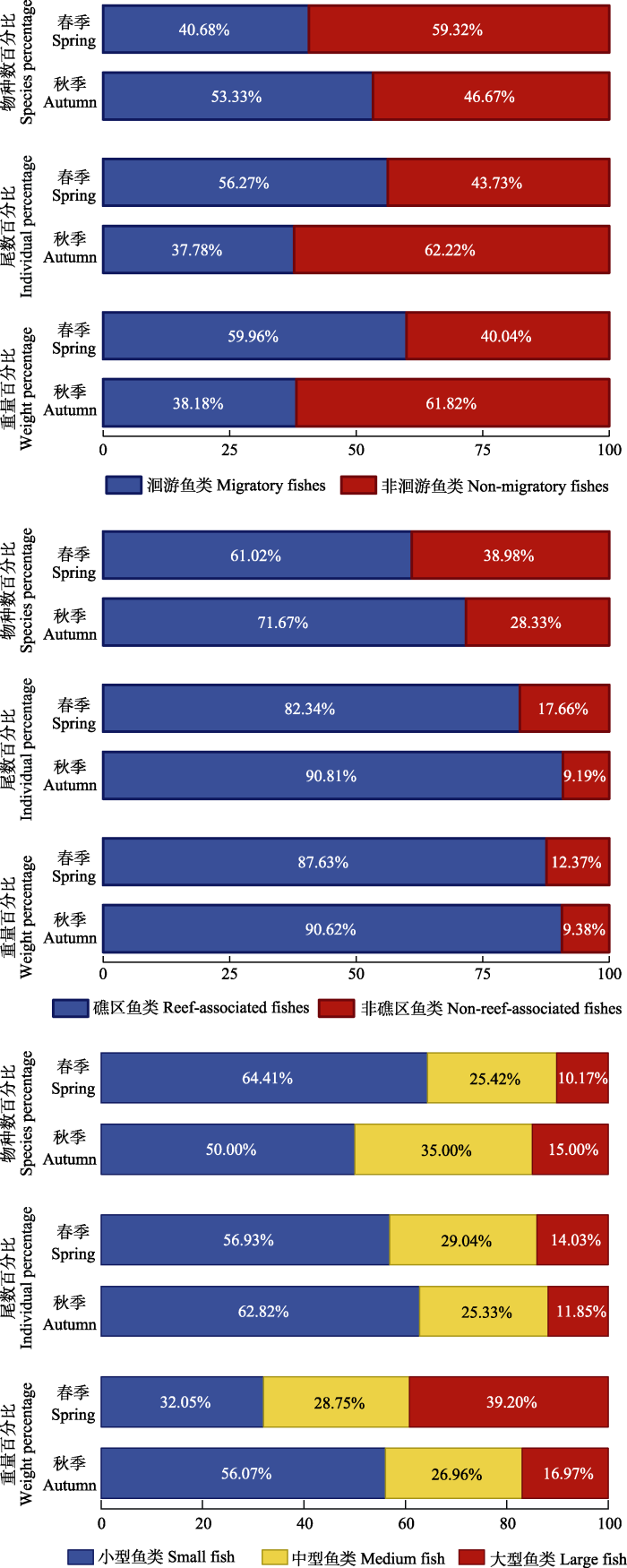
Fig. 4 Comparison of percentage composition by migratory type, habitat type, and body-size class between spring and autumn in waters adjacent to Wanshan Island in the Pearl River Estuary
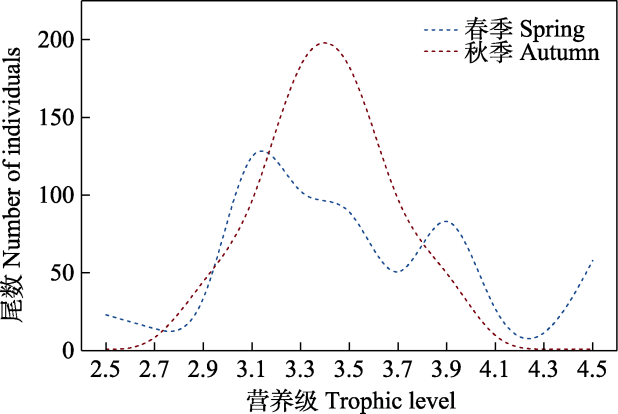
Fig. 5 Trophic-level distributions of fish assemblages in spring and autumn in waters adjacent to Wanshan Island in the Pearl River Estuary
| [1] | Acosta AR, Appeldoorn RS (1995) Catching efficiency and selectivity of gillnets and trammel nets in coral reefs from southwestern Puerto Rico. Fisheries Research, 22, 175-196. |
| [2] | Baselga A (2010) Partitioning the turnover and nestedness components of beta diversity. Global Ecology and Biogeography, 19, 134-143. |
| [3] | Bellwood DR, Hughes TP (2001) Regional-scale assembly rules and biodiversity of coral reefs. Science, 292, 1532-1535. |
| [4] | Bevilacqua S, Terlizzi A (2020) Nestedness and turnover unveil inverse spatial patterns of compositional and functional β-diversity at varying depth in marine benthos. Diversity and Distributions, 26, 743-757. |
| [5] | Carvalho JC, Cardoso P, Gomes P (2012) Determining the relative roles of species replacement and species richness differences in generating beta-diversity patterns. Global Ecology and Biogeography, 21, 760-771. |
| [6] | Cattani AP, Ribeiro GC, Cardoso OR, Afonso MG, Hostim- Silva M, Pichler HA, Spach HL (2019) Diversity and space- time dynamics of fish assemblages in a coastal lagoon, western Atlantic. Neotropical Biology and Conservation, 14, 221-239. |
| [7] | Clarke KR, Warwick RM (2001) A further biodiversity index applicable to species lists: Variation in taxonomic distinctness. Marine Ecology Progress Series, 216, 265-278. |
| [8] | Coker DJ, Wilson SK, Pratchett MS (2014) Importance of live coral habitat for reef fishes. Reviews in Fish Biology and Fisheries, 24, 89-126. |
| [9] | de Oliveira Lima SA, Andrade HA, Sousa RGC (2024) Effects of hydrological and spatial seasonality on taxonomic and functional diversity of fish assemblages in an Amazonian floodplain lake. Ecology of Freshwater Fish, 33, e12770. |
| [10] | Denney NH, Jennings S, Reynolds JD (2002) Life-history correlates of maximum population growth rates in marine fishes. Proceedings of the Royal Society B: Biological Sciences, 269, 2229-2237. |
| [11] | Doty MS, Oguri M (1956) The island mass effect. ICES Journal of Marine Science, 22, 33-37. |
| [12] | Echevarría G, González N (2022) Environmental filtering and low trait redundancy characterise fish assemblages in Lake Mamo, Orinoco River floodplain, Venezuela. Nature Conservation Research, 7, 31-41. |
| [13] | Elliott M, Whitfield AK, Potter IC, Blaber SJM, Cyrus DP, Nordlie FG, Harrison TD (2007) The guild approach to categorizing estuarine fish assemblages: A global review. Fish and Fisheries, 8, 241-268. |
| [14] | Franco ACS, dos Santos LN (2018) Habitat-dependent responses of tropical fish assemblages to environmental variables in a marine-estuarine transitional system. Estuarine, Coastal and Shelf Science, 211, 110-117. |
| [15] | Gatts P, Franco M, dos Santos L, Rocha D, de Sá F, Netto E, Machado P, Masi B, Zalmon I (2015) Impact of artificial patchy reef design on the ichthyofauna community of seasonally influenced shores at Southeastern Brazil. Aquatic Ecology, 49, 343-355. |
| [16] | Genin A (2004) Bio-physical coupling in the formation of zooplankton and fish aggregations over abrupt topographies. Journal of Marine Systems, 50, 3-20. |
| [17] | Gove JM, McManus MA, Neuheimer AB, Polovina JJ, Drazen JC, Smith CR, Merrifield MA, Friedlander AM, Ehses JS, Young CW, Dillon AK, Williams GJ (2016) Near-island biological hotspots in barren ocean basins. Nature Communications, 7, 10581. |
| [18] | Graham NAJ, Nash KL (2013) The importance of structural complexity in coral reef ecosystems. Coral Reefs, 32, 315-326. |
| [19] | Greenstreet SPR, Rogers SI, Rice JC, Piet GJ, Guirey EJ, Fraser HM, Fryer RJ (2011) Development of the EcoQO for the North Sea fish community. ICES Journal of Marine Science, 68, 1-11. |
| [20] | Guillemot N, Kulbicki M, Chabanet P, Vigliola L (2011) Functional redundancy patterns reveal non-random assembly rules in a species-rich marine assemblage. PLoS ONE, 6, e26735. |
| [21] | Han XD, Zhang SY, Wang ZH, Wang K, Lin J, Deng MX, Wu XC (2019) Fish community structure and its relationship with environmental factors in the Ma’an Archipelago and its eastern waters. Journal of Fisheries of China, 43, 1483-1497. (in Chinese with English abstract) |
| [韩旭东, 章守宇, 汪振华, 王凯, 林军, 邓明星, 吴星辰 (2019) 马鞍列岛及其东部海域鱼类群落格局与环境因子之间的关系. 水产学报, 43, 1483-1497.] | |
| [22] | Hooper DU, Chapin FS III, Ewel JJ, Hector A, Inchausti P, Lavorel S, Lawton JH, Lodge DM, Loreau M, Naeem S, Schmid B, Setälä H, Symstad AJ, Vandermeer J, Wardle DA (2005) Effects of biodiversity on ecosystem functioning: A consensus of current knowledge. Ecological Monographs, 75, 3-35. |
| [23] | Huang JW, Sun DR, Liu Y, Liu SN, Shan BB, Yang CP, Li T (2018) Diversity of fish community in Sousa chinensis Nature Reserve of Pearl River Estuary. Journal of Southern Agriculture, 49, 1000-1007. (in Chinese with English abstract) |
| [黄吉万, 孙典荣, 刘岩, 刘胜男, 单斌斌, 杨长平, 李腾 (2018) 珠江口中华白海豚自然保护区鱼类群落多样性分析. 南方农业学报, 49, 1000-1007.] | |
| [24] | Jackson AL, Inger R, Parnell AC, Bearhop S (2011) Comparing isotopic niche widths among and within communities: SIBER-Stable Isotope Bayesian Ellipses in R. Journal of Animal Ecology, 80, 595-602. |
| [25] | Jennings S, Blanchard JL (2004) Fish abundance with no fishing: Predictions based on macroecological theory. Journal of Animal Ecology, 73, 632-642. |
| [26] | Jennings S, Reynolds JD, Mills SC (1998) Life history correlates of responses to fisheries exploitation. Proceedings of the Royal Society B: Biological Sciences, 265, 333-339. |
| [27] | Ke S, Zhang P, Ou SJ, Zhang JX, Chen JY, Zhang JB (2022) Spatiotemporal nutrient patterns, composition, and implications for eutrophication mitigation in the Pearl River Estuary, China. Estuarine, Coastal and Shelf Science, 266, 107749. |
| [28] | Lai H, Bi S, Yi HD, Guo DL, Li HY, Wang GP, Liu XG, Chen QX, Chen JH, Zhang ZL, Wei XC, Liu S, Li GF (2022) Seasonal variation in the functional structure of demersal fish communities and response to the environmental changes in the Pearl River Estuary, China. Ecological Indicators, 144, 109525. |
| [29] | Laliberté E, Legendre P (2010) A distance-based framework for measuring functional diversity from multiple traits. Ecology, 91, 299-305. |
| [30] | Layman CA, Arrington DA, Montaña CG, Post DM (2007) Can stable isotope ratios provide for community-wide measures of trophic structure? Ecology, 88, 42-48. |
| [31] | Li YZ, Chen GB, Sun DR (2000) Analysis of the composition of fishes in the Pearl River estuarine waters. Journal of Fisheries of China, 24, 312-317. (in Chinese with English abstract) |
| [李永振, 陈国宝, 孙典荣 (2000) 珠江口鱼类组成分析. 水产学报, 24, 312-317.] | |
| [32] | Lin K, Mai GM, Wang LF, Wang XF (2020) Structure and stability of the fish community in the Pearl River Estuary coastal waters from 2015 to 2018. Journal of Fisheries of China, 44, 1841-1850. (in Chinese with English abstract) |
| [林坤, 麦广铭, 王力飞, 王学锋 (2020) 2015-2018年珠江口近岸海域鱼类群落结构及其稳定性. 水产学报, 44, 1841-1850.] | |
| [33] | Liu XZ, Li YL, Wang WB, Duan Y, Chai Y, Wang XL, Dong J (2015) The fish community structure and diversity in the north of Liaodong Bay. Journal of Fisheries of China, 39, 1155-1165. (in Chinese with English abstract) |
| [刘修泽, 李玉龙, 王文波, 段妍, 柴雨, 王小林, 董婧 (2015) 辽东湾北部海域鱼类群落结构及多样性. 水产学报, 39, 1155-1165.] | |
| [34] | Ma JJ, Chen HG, Zhang Z, Tian F, Tang ZZ, Xiong Q, Zhang LB (2024) Interannual variation of fish communities and their environmental factors in Pearl River Estuary from 2018 to 2023. South China Fisheries Science, 20(6), 62-73. (in Chinese with English abstract) |
| [马菁菁, 陈海刚, 张喆, 田斐, 唐振朝, 熊倩, 张林宝 (2024) 2018-2023年珠江口鱼类群落结构变化及其与环境因子的关系. 南方水产科学, 20(6), 62-73.] | |
| [35] | Margalef R (1968) Perspectives in Ecological Theory. University of Chicago Press, Chicago. |
| [36] | Mason NWH, Mouillot D, Lee WG, Wilson JB (2005) Functional richness, functional evenness and functional divergence: The primary components of functional diversity. Oikos, 111, 112-118. |
| [37] | McLusky DS, Elliott M (2007) Transitional waters: A new approach, semantics or just muddying the waters? Estuarine, Coastal and Shelf Science, 71, 359-363. |
| [38] | Mouillot D, Villéger S, Parravicini V, Kulbicki M, Arias- González JE, Bender M, Chabanet P, Floeter SR, Friedlander A, Vigliola L, Bellwood DR (2014) Functional over-redundancy and high functional vulnerability in global fish faunas on tropical reefs. Proceedings of the National Academy of Sciences, USA, 111, 13757-13762. |
| [39] | Nagelkerken I, Roberts CM, van der Velde G, Dorenbosch M, van Riel MC, de la Morinière EC, Nienhuis PH (2002) How important are mangroves and seagrass beds for coral-reef fish? The nursery hypothesis tested on an island scale. Marine Ecology Progress Series, 244, 299-305. |
| [40] | Olin M, Malinen T, Ruuhijärvi J (2009) Gillnet catch in estimating the density and structure of fish community- Comparison of gillnet and trawl samples in a eutrophic lake. Fisheries Research, 96, 88-94. |
| [41] | Pauly D, Christensen V, Dalsgaard J, Froese R, Torres F Jr (1998) Fishing down marine food webs. Science, 279, 860-863. |
| [42] | Petchey OL, Gaston KJ (2002) Functional diversity (FD), species richness and community composition. Ecology Letters, 5, 402-411. |
| [43] | Pielou EC (1966a) Species-diversity and pattern-diversity in the study of ecological succession. Journal of Theoretical Biology, 10, 370-383. |
| [44] | Pielou EC (1966b) The measurement of diversity in different types of biological collections. Journal of Theoretical Biology, 13, 131-144. |
| [45] | Piet GJ, Jennings S (2005) Response of potential fish community indicators to fishing. ICES Journal of Marine Science, 62, 214-225. |
| [46] | Pinkas L, Oliphant MS, Iverson ILK (1971) Food habits of albacore, bluefin tuna, and bonito in California waters. Fish Bulletin, 152, 1-105. |
| [47] | Potter IC, Tweedley JR, Elliott M, Whitfield AK (2015) The ways in which fish use estuaries: A refinement and expansion of the guild approach. Fish and Fisheries, 16, 230-239. |
| [48] | Ricotta C, Kosman E, Laroche F, Pavoine S (2021) Beta redundancy for functional ecology. Methods in Ecology and Evolution, 12, 1062-1069. |
| [49] | Roberts CM, McClean CJ, Veron JE, Hawkins JP, Allen GR, McAllister DE, Mittermeier CG, Schueler FW, Spalding M, Wells F, Vynne C, Werner TB (2002) Marine biodiversity hotspots and conservation priorities for tropical reefs. Science, 295, 1280-1284. |
| [50] | Rochet MJ, Trenkel VM (2003) Which community indicators can measure the impact of fishing? A review and proposals. Canadian Journal of Fisheries and Aquatic Sciences, 60, 86-99. |
| [51] | Shi J, Wang T, Li CH, Zhao JF, Kang ZP, Song XY, Liu Y (2024) Food web structure and trophic diversity for the fishes of four islands in the Pearl River Estuary, China. Ecological Indicators, 160, 111916. |
| [52] | Shi Y, He XB, Li J, Shen C, Feng C, Guo JH, Zhao CX, Kang B (2018) Seasonal variation in trophic structure of fish community in Minjiang Estuary based on stable isotope technique. Chinese Journal of Applied Ecology, 29, 3457-3463. (in Chinese with English abstract) |
| [石焱, 何雄波, 李军, 沈忱, 冯晨, 郭峻宏, 招春旭, 康斌 (2018) 基于稳定同位素方法的闽江口常见鱼类群落营养结构的季节性变化. 应用生态学报, 29, 3457-3463.] | |
| [53] | Shin YJ, Rochet MJ, Jennings S, Field JG, Gislason H (2005) Using size-based indicators to evaluate the ecosystem effects of fishing. ICES Journal of Marine Science, 62, 384-396. |
| [54] | Stuart-Smith RD, Bates AE, Lefcheck JS, Duffy JE, Baker SC, Thomson RJ, Stuart-Smith JF, Hill NA, Kininmonth SJ, Airoldi L, Becerro MA, Campbell SJ, Dawson TP, Navarrete SA, Soler GA, Strain EMA, Willis TJ, Edgar GJ (2013) Integrating abundance and functional traits reveals new global hotspots of fish diversity. Nature, 501, 539-542. |
| [55] | Sun DR, Lin ZJ, Qiu YS, Wang XH (2005) Fish fauna of coral reef waters of the Xisha Islands. South China Fisheries Science, 1(5), 18-25. (in Chinese with English abstract) |
| [孙典荣, 林昭进, 邱永松, 王雪辉 (2005) 西沙群岛重要珊瑚礁海域鱼类区系. 南方水产, 1(5), 18-25.] | |
| [56] | Sun J, Peng JH, Tan ZY, Chen JM, She SS, Liu M (2020) Impact of trawling on demersal fishery resources of the Pearl River Estuary near Hong Kong waters. Journal of Guangdong Ocean University, 40(1), 64-68. (in Chinese with English abstract) |
| [孙颉, 彭俊豪, 谭振耀, 陈金满, 佘书生, 刘敏 (2020) 底拖网作业对珠江口香港海域底层鱼类的影响. 广东海洋大学学报, 40(1), 64-68.] | |
| [57] | Tang GL, He ZH, Liu Y, Xiao YY, Bi S, Sun Y, Liang JM, Wu P, Wang T, Ye JY, Li CH (2023) Acanthopagrus latus migration patterns and habitat use in Wanshan Islands, Pearl River Estuary, determined using otolith microchemical analysis. Frontiers in Marine Science, 10, 1104528. |
| [58] | Villéger S, Brosse S, Mouchet M, Mouillot D, Vanni MJ (2017) Functional ecology of fish: Current approaches and future challenges. Aquatic Sciences, 79, 783-801. |
| [59] | Villéger S, Grenouillet G, Brosse S (2013) Decomposing functional β-diversity reveals that low functional β-diversity is driven by low functional turnover in European fish assemblages. Global Ecology and Biogeography, 22, 671-681. |
| [60] | Villéger S, Mason NWH, Mouillot D (2008) New multidimensional functional diversity indices for a multifaceted framework in functional ecology. Ecology, 89, 2290-2301. |
| [61] | Wang D, Lin ZJ (2006) Spatial and temporal variations of fish community structure in the Pearl River Estuary waters. South China Fisheries Science, 2(4), 37-45. (in Chinese with English abstract) |
| [王迪, 林昭进 (2006) 珠江口鱼类群落结构的时空变化. 南方水产, 2(4), 37-45.] | |
| [62] | Wang LR, Zhao HT (2001) The general characteristics of the coral reef ecosystem. Chinese Journal of Ecology, 20(6), 41-45. (in Chinese with English abstract) |
| [王丽荣, 赵焕庭 (2001) 珊瑚礁生态系的一般特点. 生态学杂志, 20(6), 41-45.] | |
| [63] | Wang T, Liu Y, Quan QM, Xiao YY, Wu P, Li CH (2022) Species composition characteristics analysis of Qilianyu Reef fishes of Xisha Islands. Journal of Fishery Sciences of China, 29, 102-117. (in Chinese with English abstract) |
| [王腾, 刘永, 全秋梅, 肖雅元, 吴鹏, 李纯厚 (2022) 七连屿珊瑚礁鱼类种类组成特征分析. 中国水产科学, 29, 102-117.] | |
| [64] | Wu P, Liu Y, Xiao YY, Xie YF, Tang GL, Lin L, Wang T, Li CH (2022) Evaluation of fisheries ecological environment in adjacent sea areas of Wanshan Archipelago in Pearl River Estuary in spring. South China Fisheries Science, 18(5), 1-8. (in Chinese with English abstract) |
| [吴鹏, 刘永, 肖雅元, 谢雨芳, 唐广隆, 林琳, 王腾, 李纯厚 (2022) 春季珠江口万山群岛毗邻海域渔业生态环境状况评价. 南方水产科学, 18(5), 1-8.] | |
| [65] | Xu SN, Guo JZ, Liu Y, Fan JT, Xiao YY, Xu YW, Li CH, Barati B (2021) Evaluation of fish communities in Daya Bay using biomass size spectrum and ABC curve. Frontiers in Environmental Science, 9, 663169. |
| [66] | Zeng ZY, Cheung WWL, Lai H, Yi HD, Bi S, Li HY, Chen XL, Su YQ, Liu XG, Chen QX, Zhang ZL, Wei XC, Chen JH, Li GF (2022) Species and functional dynamics of the demersal fish community and responses to disturbances in the Pearl River Estuary. Frontiers in Marine Science, 9, 921595. |
| [67] | Zhan HG (1998) Study on fish community structure in the Zhujiang Estuary and adjacent waters. Haiyang Xuebao, 20(3), 91-97. (in Chinese) |
| [詹海刚 (1998) 珠江口及邻近水域鱼类群落结构研究. 海洋学报, 20(3), 91-97.] | |
| [68] | Zhan QP, Sun X, Dong JY, Zhang YY, Zhang XM (2022) Community structure and functional traits of attached organisms on an artificial reef near Furong Island, Laizhou Bay. Journal of Fishery Sciences of China, 29, 704-719. (in Chinese with English abstract) |
| [詹启鹏, 孙昕, 董建宇, 张宇洋, 张秀梅 (2022) 莱州芙蓉岛海域人工鱼礁附着生物的群落结构和功能性状. 中国水产科学, 29, 704-719.] | |
| [69] | Zhang NH, Tian T, Shen L, Yang J, Wu ZX, Liu M, Gao DK, Yin ZQ (2022) Research and application progress of artificial reef construction materials: A review. Journal of Dalian Ocean University, 37, 352-362. (in Chinese with English abstract) |
| [张年华, 田涛, 沈璐, 杨军, 吴忠鑫, 刘敏, 高东奎, 尹增强 (2022) 人工鱼礁建礁材料研究应用进展. 大连海洋大学学报, 37, 352-362.] | |
| [70] | Zhou WG, Ding DW, Suo AN, He WH, Tian T (2021) Key functional groups selection in marine ranching fishery resources from the Pearl River Estuary. Journal of Fisheries of China, 45, 433-443. (in Chinese with English abstract) |
| [周卫国, 丁德文, 索安宁, 何伟宏, 田涛 (2021) 珠江口海洋牧场渔业资源关键功能群的遴选方法. 水产学报, 45, 433-443.] | |
| [71] | Zintzen V, Anderson MJ, Roberts CD, Diebel CE (2011) Increasing variation in taxonomic distinctness reveals clusters of specialists in the deep sea. Ecography, 34, 306-317. |
| [72] | Zou QD, Wang ZH, Zhang SY, Cheng XP, Chen YH, Zhou Y (2024) Characteristics of fish community structure in the sea area of Dachen Island. Chinese Journal of Ecology, 43, 795-803. (in Chinese with English abstract) |
| [邹沁东, 汪振华, 章守宇, 程晓鹏, 陈怡卉, 周怡 (2024) 大陈岛礁海域鱼类群落结构特征. 生态学杂志, 43, 795-803.] |
| [1] | Hang Tang, Mufan Sun, Xiaotian Lin, Yi Chen, Fengqin Cao, Yan Yang. Impact of habitat types and monthly variation on the diversity and community structure of tropical bees and wasps [J]. Biodiv Sci, 2026, 34(8): 26172-. |
| [2] | Wenfang Zheng, Lijuan Zhao, Yanping Zhang, Jianghai Dong, Rongjiao Li, Ruihe Gao. Spatiotemporal distribution patterns of functional traits of soil Collembola in the poplar-birch forests of Guandi Mountains and their environmental drivers [J]. Biodiv Sci, 2026, 34(7): 26072-. |
| [3] | Jianwei Cheng, Qirui Liang, Haojie Wen, Haibin Liang, Na Huo, Yongjing Dou, Baihui Hao, Xinmin Liu, Xinyu Wang, Wenhong Ma. Effects of nitrogen addition on nematode community structure and ecological indices in a typical steppe of Inner Mongolia [J]. Biodiv Sci, 2026, 34(7): 26190-. |
| [4] | Kaifei Li, Jinling Gong, Feifei Hu, Xuemei Li, Zhaoyuan Lu, Mingzhong Luo, Tingbing Zhu. Fish community structure and driving factors in Lugu Lake, Southwest China [J]. Biodiv Sci, 2026, 34(6): 25339-. |
| [5] | Luhong Wang, Bo Li, Panyan Yang, Jiaqin Huang, Yuting Xie, Xin Du, Yi Wen, Bin Wang. Effects of ecological factors on the multidimensional diversity of breeding birds communities in Sichuan Province [J]. Biodiv Sci, 2026, 34(4): 25464-. |
| [6] | Li Huang, Zhifa Liu, Yuening Gong, Buhang Li, Jian Zhang. Plant community composition and structure of sixteen 1-ha forest dynamics monitoring plots of Nanling Mountains in Guangdong Province [J]. Biodiv Sci, 2026, 34(3): 25357-. |
| [7] | Xiaoqiang Lu, Dan Rui, Jiangfeng Zhang, Bingxin Yin, Yulu Wang, Yuting Cen, Yichen Cui, Wanxia Yang. Impacts of nitrogen inputs-driven key ecological processes on biodiversity and their management implications [J]. Biodiv Sci, 2026, 34(2): 25368-. |
| [8] | Zhenyuan Liu, Tingting Zhou, Weimin Wang, Bo-Ping Han, Zhicai Xie. Impacts and driving mechanisms of urbanization on taxonomic and functional diversity of river macroinvertebrates in Shenzhen, South China [J]. Biodiv Sci, 2025, 33(9): 25135-. |
| [9] | Qilong Yu, Minhui Hao, Huaijiang He, Chunyu Zhang, Xiuhai Zhao. Relationships of biodiversity and productivity change with forest succession in Changbai Mountains: Insights from species, traits, and phylogeny [J]. Biodiv Sci, 2025, 33(8): 25060-. |
| [10] | Xinbo Hou, Xiuhai Zhao, Huaijiang He, Chunyu Zhang, Juan Wang, Xueying Ren, Xinna Zhang. Responses of rhizosphere and non-rhizosphere microbial communities to the soil carbon and nitrogen in Quercus mongolica pure forest [J]. Biodiv Sci, 2025, 33(7): 25119-. |
| [11] | Zhengdong Pan, Xirong Lin, Hua Xue, Zhiying Hu, Hongyi Guo, Ya Zhang, Enuo Wu, Wenqiao Tang. Fish species diversity background and community structure in the main inland water bodies of Shanghai [J]. Biodiv Sci, 2025, 33(6): 24290-. |
| [12] | Zhang Mingyi, Wang Xiaomei, Zheng Yanxin, Wu Nan, Li Donghao, Fan Enyuan, Li Na, Shan Xiujuan, Yu Tao, Zhao Chunnuan, Li Bo, Xu Shuai, Wu Yuping, Ren Liqun. Resource status and habitat function of typical oyster reef areas in the Yellow River Estuary [J]. Biodiv Sci, 2025, 33(4): 24208-. |
| [13] | Tong Miao, Wang Huan, Zhang Wenshuang, Wang Chao, Song Jianxiao. Distribution characteristics of antibiotic resistance genes in soil bacterial communities exposed to heavy metal pollution [J]. Biodiv Sci, 2025, 33(3): 24101-. |
| [14] | Li Yanpeng, Chen Jie, Lu Chunyang, Xu Han. Community characteristics of a 64-ha secondary forest dynamics plot in a tropical montane rainforest in Jianfengling, Hainan [J]. Biodiv Sci, 2025, 33(2): 24445-. |
| [15] | Liu Zhixiang, Xie Hua, Zhang Hui, Huang Xiaolei. Functional diversity and regulation of cuticular hydrocarbons in social insects [J]. Biodiv Sci, 2025, 33(2): 24302-. |
| Viewed | ||||||
|
Full text |
|
|||||
|
Abstract |
|
|||||
Copyright © 2026 Biodiversity Science
Editorial Office of Biodiversity Science, 20 Nanxincun, Xiangshan, Beijing 100093, China
Tel: 010-62836137, 62836665 E-mail: biodiversity@ibcas.ac.cn
