

Biodiv Sci ›› 2026, Vol. 34 ›› Issue (8): 26142. DOI: 10.17520/biods.2026142 cstr: 32101.14.biods.2026142
• Original Papers: Plant Diversity • Previous Articles Next Articles
Junwei Ye1( ), Mengjing Dai2, Xiangyu Tian2, Wenting Shi2, Lei Bao2, Jianping Ge2, Hongfang Wang2,*()(
 )
Received:2026-04-20
Accepted:2026-06-09
Online:2026-08-20
Published:2026-10-21
Contact:
*. E-mail: wanghf@bnu.edu.cn
Supported by:Junwei Ye, Mengjing Dai, Xiangyu Tian, Wenting Shi, Lei Bao, Jianping Ge, Hongfang Wang. Evolutionary patterns and causes of phenotypic and physiological traits of the Tertiary relict plant Lindera obtusiloba in East Asia[J]. Biodiv Sci, 2026, 34(8): 26142.
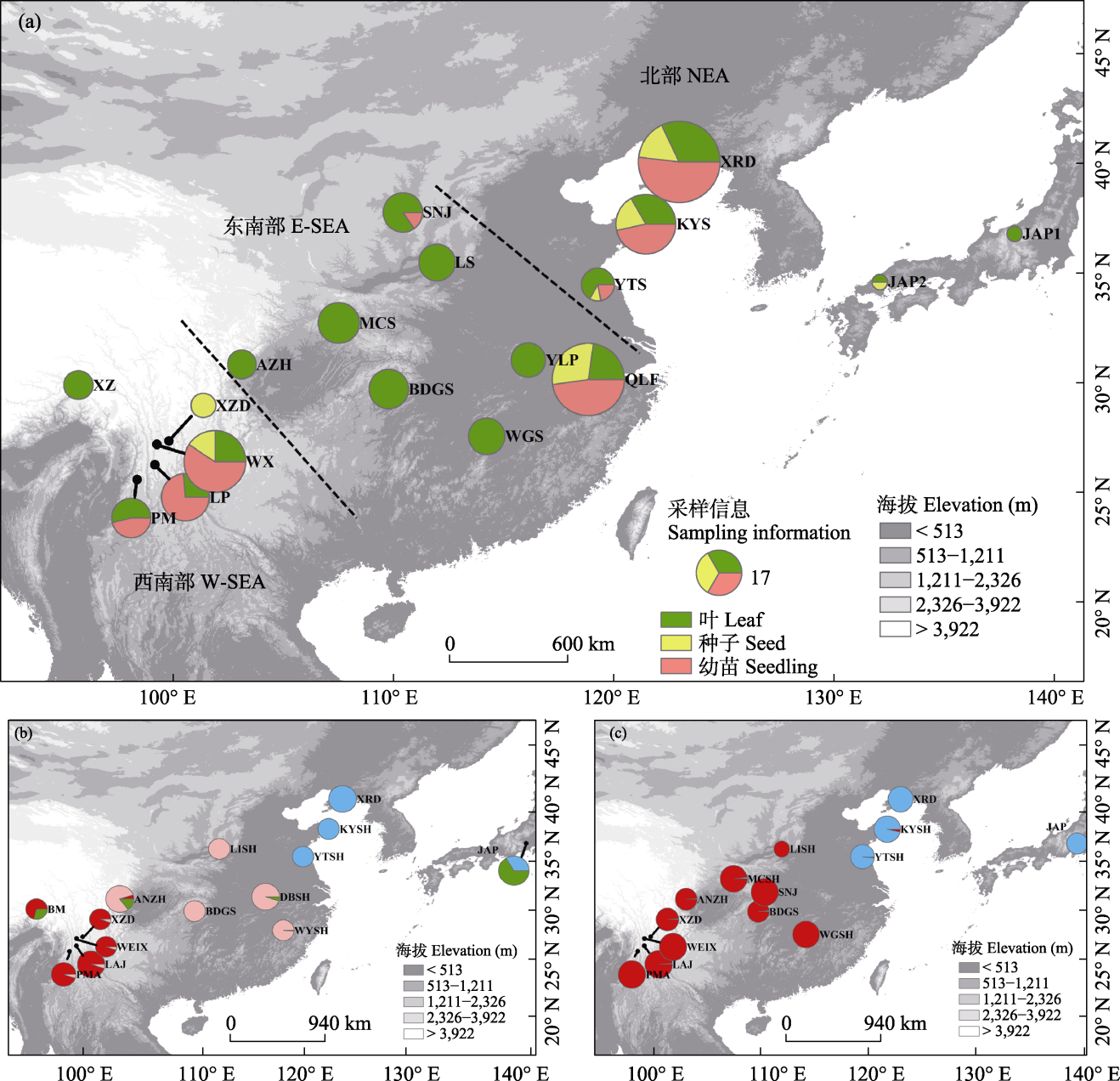
Fig. 1 Sampling locations and genetic structure of Lindera obtusiloba. (a) Sampling sites of leaves and seeds from field surveys and seedlings used in the common garden experiment. For details see Appendix 1. The regions of North East Asia (NEA), Eastern South East Asia (E-SEA) and Western South East Asia (W-SEA) are separated by dashed lines; (b) Genetic structure based on low copy nuclear genes (K = 4, cited from Ye et al., 2026); (c) Genetic structure based on nuclear microsatellites (K = 2, cited from Ye et al., 2017). Circle size is proportional to sample sizes. In panels (b) and (c), population names follow those used in the original literature.
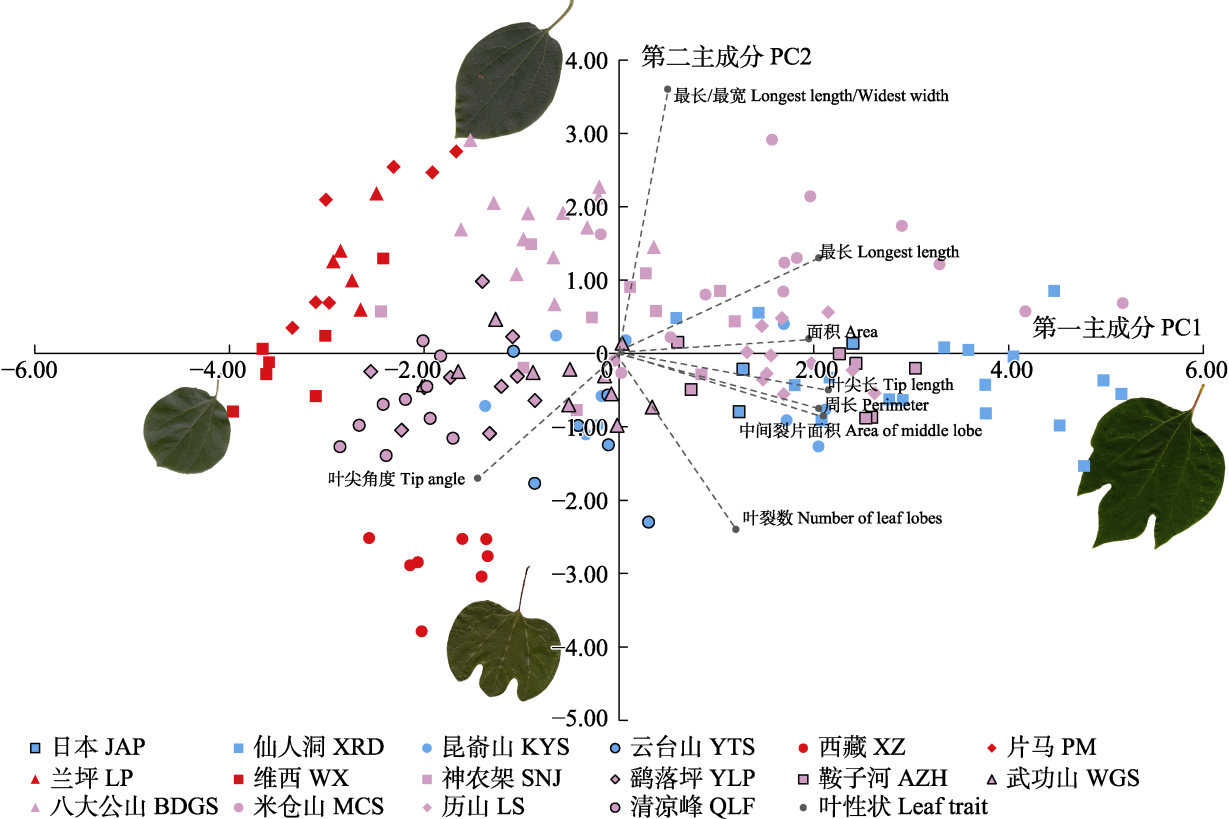
Fig. 2 Principal component analysis (PCA) of leaf traits in Lindera obtusiloba populations across various regions in field surveys (For details see Fig. 1 and Appendix 1). Populations of North East Asia (NEA), Eastern South East Asia (E-SEA) and Western South East Asia (W-SEA) regions are represented by blue, pink and red respectively, and different populations are indicated by distinct shapes. The positions of leaf trait vectors correspond to their standardized loadings of principal component 1 (PC1) and principal component 2 (PC2). Note, JAP population was combined by JAP1 and JAP2 populations.
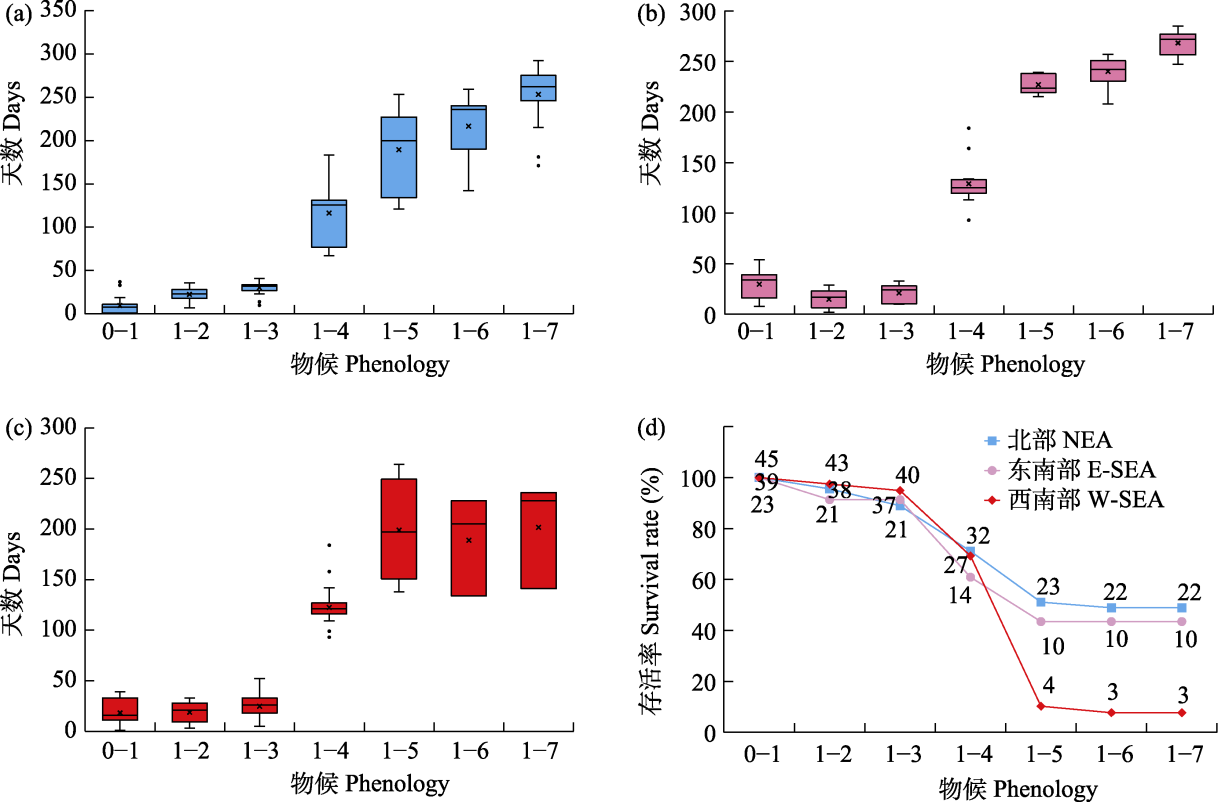
Fig. 3 Phenological stage durations (days; a‒c) and seedling survival rates (d) of Lindera obtusiloba in the North East Asia (NEA, a), Eastern South East Asia (E-SEA, b) and Western South East Asia (W-SEA, c) regions. Phenological stages: 0‒1, bud phenology; 1‒2, leaf emergence phenology; 1‒3, unfolding phenology; 1‒4, open bud phenology; 1‒5, mature bud phenology; 1‒6, yellow leaf phenology; 1‒7, leaf fall phenology. In the box plots (a‒c), × represents the mean value, and the internal horizontal line represents the median value.
| 区域 Region | 样本量 Sample size | 平均值 ± 标准误 Mean ± SE |
|---|---|---|
| 北部 North East Asia (NEA) | 30 | 1.10 ± 1.41a |
| 东南部 Eastern South East Asia (E-SEA) | 11 | 3.30 ± 1.92b |
| 西南部 Western South East Asia (W-SEA) | 27 | 1.44 ± 2.33a |
Table 1 Differences in relative growth rates of Lindera obtusiloba in different regions
| 区域 Region | 样本量 Sample size | 平均值 ± 标准误 Mean ± SE |
|---|---|---|
| 北部 North East Asia (NEA) | 30 | 1.10 ± 1.41a |
| 东南部 Eastern South East Asia (E-SEA) | 11 | 3.30 ± 1.92b |
| 西南部 Western South East Asia (W-SEA) | 27 | 1.44 ± 2.33a |
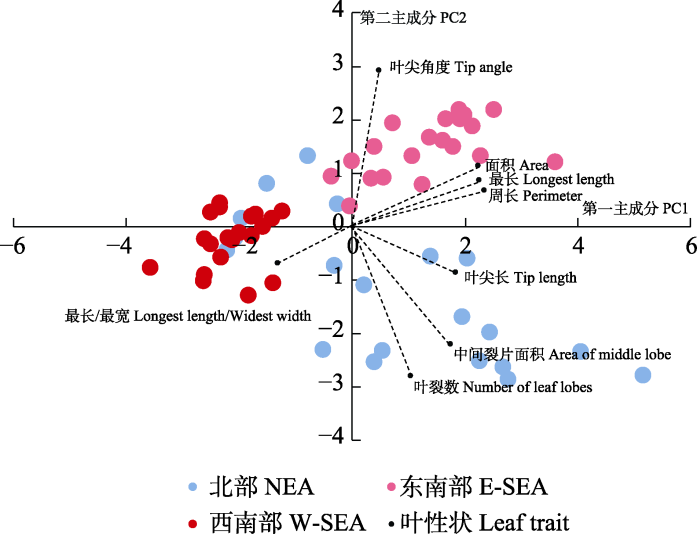
Fig. 4 Principal component analysis (PCA) of leaf traits of Lindera obtusiloba from different regions in the common garden experiment. The North East Asia (NEA), Eastern South East Asia (E-SEA) and Western South East Asia (W-SEA) regions are represented by blue, pink and red, respectively. The positions of different leaf traits are correlated with their standardized loadings on principal component 1 (PC1) and principal component 2 (PC2).
| 区域 Region | 光饱和点 Light saturation point (μmol·m‒2·s‒1) | 光补偿点 Light compensation point (μmol·m‒2·s‒1) | 最大净光合速率 Maximum net photosynthetic rate (μmol CO2·m‒2·s‒1) | R2 |
|---|---|---|---|---|
| 北部 North East Asia (NEA) | 208.38 ± 24.48a | 6.10 ± 1.14a | 5.32 ± 0.90a | 0.860‒0.994 |
| 东南部 Eastern South East Asia (E-SEA) | 238.52 ± 24.60a | 15.18 ± 5.08ab | 7.69 ± 0.42b | 0.973‒0.998 |
| 西南部 Western South East Asia (W-SEA) | 262.14 ± 13.04a | 17.80 ± 1.41b | 4.69 ± 0.31a | 0.968‒0.995 |
Table 2 Parameters (mean ± SE) of light response curves for individuals of Lindera obtusiloba in different regions
| 区域 Region | 光饱和点 Light saturation point (μmol·m‒2·s‒1) | 光补偿点 Light compensation point (μmol·m‒2·s‒1) | 最大净光合速率 Maximum net photosynthetic rate (μmol CO2·m‒2·s‒1) | R2 |
|---|---|---|---|---|
| 北部 North East Asia (NEA) | 208.38 ± 24.48a | 6.10 ± 1.14a | 5.32 ± 0.90a | 0.860‒0.994 |
| 东南部 Eastern South East Asia (E-SEA) | 238.52 ± 24.60a | 15.18 ± 5.08ab | 7.69 ± 0.42b | 0.973‒0.998 |
| 西南部 Western South East Asia (W-SEA) | 262.14 ± 13.04a | 17.80 ± 1.41b | 4.69 ± 0.31a | 0.968‒0.995 |
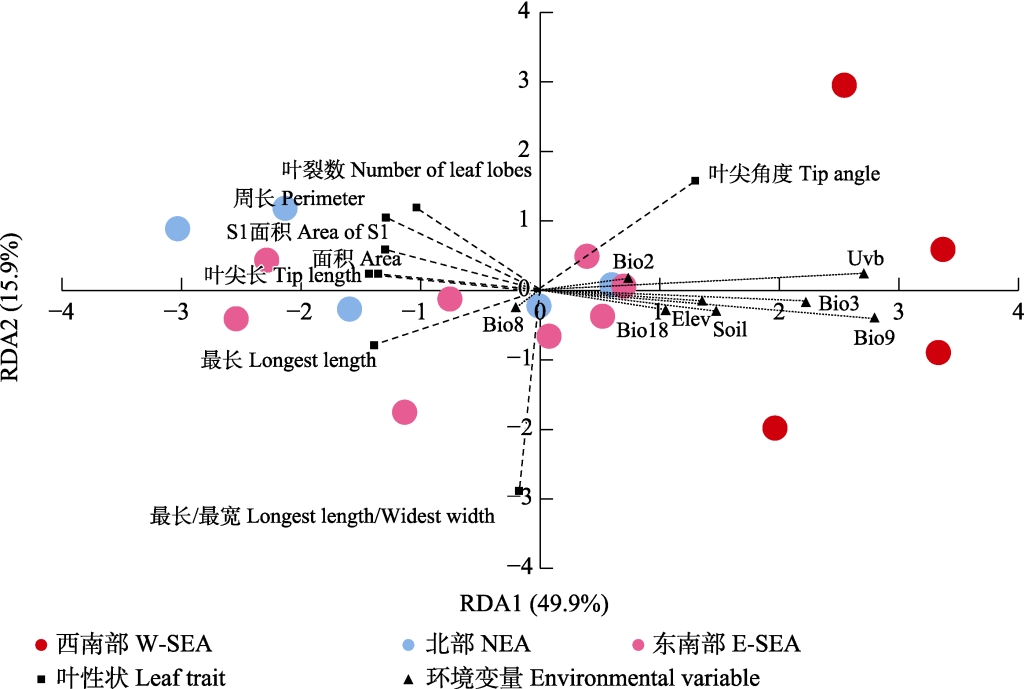
Fig. 5 Redundancy analysis (RDA) of leaf traits (For details see Appendix 2) and environmental variables in wild populations of North East Asia (NEA), Eastern South East Asia (E-SEA) and Western South East Asia (W-SEA) regions in Lindera obtusiloba. Bio2, Mean diurnal range; Bio3, Isothermality; Bio8, Mean Temperature of wettest quarter; Bio9, Mean temperature of driest quarter; Bio18, Precipitation of warmest quarter; Soil, Available water capacity for rootable depth; Elev, Elevation; Uvb, Annual mean ultraviolet-b radiation.
| 环境变量 Environmental variables | 面积 Leaf area | 周长 Leaf perimeter | 叶尖角度 Tip angle | 最长 Longest length | 最长/最宽 Longest length/ Widest width | 中间裂片面积 Area of middle lobe | 叶尖长 Tip length | 叶裂数 No. of leaf lobes |
|---|---|---|---|---|---|---|---|---|
| 海拔 Elev | 0.04 | ‒0.29 | 0.60 | ‒0.08 | 0.01 | ‒0.52 | ‒0.38 | ‒0.36 |
| 土壤有效持水量 Soil | ‒0.59 | ‒0.31 | 0.03 | ‒0.47 | 0.09 | ‒0.27 | ‒0.43 | ‒0.19 |
| 年平均紫外线辐射 Uvb | ‒0.49 | ‒0.48 | 0.88 | ‒0.61 | ‒0.16 | ‒0.64 | ‒0.72 | ‒0.61 |
| 日温度平均范围 Bio2 | ‒0.02 | 0.08 | 0.40 | ‒0.13 | ‒0.01 | ‒0.16 | ‒0.22 | ‒0.25 |
| 等温性 Bio3 | ‒0.31 | ‒0.40 | 0.74 | ‒0.41 | 0.10 | ‒0.56 | ‒0.60 | ‒0.65 |
| 最湿季平均温度 Bio8 | ‒0.30 | 0.08 | ‒0.29 | ‒0.18 | 0.05 | 0.27 | 0.03 | 0.02 |
| 最干季平均温度 Bio9 | ‒0.73 | ‒0.78 | 0.51 | ‒0.68 | 0.08 | ‒0.64 | ‒0.67 | ‒0.59 |
| 最暖季降水量 Bio18 | ‒0.37 | ‒0.40 | 0.03 | ‒0.29 | 0.08 | ‒0.19 | ‒0.25 | ‒0.07 |
Table 3 Correlations between leaf traits of Lindera obtusiloba and environmental variables. Correlation coefficients (r) with absolute values greater than 0.5 are shown in bold. The meanings of the environmental variables are shown in Fig. 5.
| 环境变量 Environmental variables | 面积 Leaf area | 周长 Leaf perimeter | 叶尖角度 Tip angle | 最长 Longest length | 最长/最宽 Longest length/ Widest width | 中间裂片面积 Area of middle lobe | 叶尖长 Tip length | 叶裂数 No. of leaf lobes |
|---|---|---|---|---|---|---|---|---|
| 海拔 Elev | 0.04 | ‒0.29 | 0.60 | ‒0.08 | 0.01 | ‒0.52 | ‒0.38 | ‒0.36 |
| 土壤有效持水量 Soil | ‒0.59 | ‒0.31 | 0.03 | ‒0.47 | 0.09 | ‒0.27 | ‒0.43 | ‒0.19 |
| 年平均紫外线辐射 Uvb | ‒0.49 | ‒0.48 | 0.88 | ‒0.61 | ‒0.16 | ‒0.64 | ‒0.72 | ‒0.61 |
| 日温度平均范围 Bio2 | ‒0.02 | 0.08 | 0.40 | ‒0.13 | ‒0.01 | ‒0.16 | ‒0.22 | ‒0.25 |
| 等温性 Bio3 | ‒0.31 | ‒0.40 | 0.74 | ‒0.41 | 0.10 | ‒0.56 | ‒0.60 | ‒0.65 |
| 最湿季平均温度 Bio8 | ‒0.30 | 0.08 | ‒0.29 | ‒0.18 | 0.05 | 0.27 | 0.03 | 0.02 |
| 最干季平均温度 Bio9 | ‒0.73 | ‒0.78 | 0.51 | ‒0.68 | 0.08 | ‒0.64 | ‒0.67 | ‒0.59 |
| 最暖季降水量 Bio18 | ‒0.37 | ‒0.40 | 0.03 | ‒0.29 | 0.08 | ‒0.19 | ‒0.25 | ‒0.07 |
| [1] | Bai WN, Wang WT, Zhang DY (2016) Phylogeographic breaks within Asian butternuts indicate the existence of a phytogeographic divide in East Asia. New Phytologist, 209, 1757-1772. |
| [2] | Cao YN, Comes HP, Sakaguchi S, Chen LY, Qiu YX (2016) Evolution of East Asia’s Arcto-Tertiary relict Euptelea (Eupteleaceae) shaped by Late Neogene vicariance and Quaternary climate change. BMC Evolutionary Biology, 16, 66. |
| [3] | Cao YN, Zhu SS, Chen J, Comes HP, Wang IJ, Chen LY, Sakaguchi S, Qiu YX (2020) Genomic insights into historical population dynamics, local adaptation, and climate change vulnerability of the East Asian Tertiary relict Euptelea (Eupteleaceae). Evolutionary Applications, 13, 2038-2055. |
| [4] | Dang DY (2001) A new ornamental plant: Lindera obtusiloba Bl. Journal of Beijing Forestry University, 23(S2), 134-134. (in Chinese with English abstract) |
| [党东雨 (2001) 三桠乌药的特性与其开发利用. 北京林业大学学报, 23(S2), 134-134.] | |
| [5] | Du Y, He HJ, Zhang ZF, Yang YJ, Li LY, Yang XY (2014) Correlation of seed mass with elevation. Plant Diversity and Resources, 36, 109-115. (in Chinese with English abstract) |
| [杜燕, 何华杰, 张志峰, 杨娅娟, 李涟漪, 杨湘云 (2014) 种子重量与海拔的相关性分析. 植物分类与资源学报, 36, 109-115.] | |
| [6] | Dupont YL, Kato M (1999) Phenology and flower-visiting entomofauna of six species of Lindera (Lauraceae) in Japan. Nordic Journal of Botany, 19, 707-718. |
| [7] | Farquhar GD, von Caemmerer S, Berry JA (1980) A biochemical model of photosynthetic CO2 assimilation in leaves of C3 species. Planta, 149, 78-90. |
| [8] | Gong H, Wang LK, Liu YJ, Xu YF, Yu ZY, Wu KL, Cao QL, Jia XC (2025) Comparative study on leaf anatomy and photosynthetic characteristics of 3 tropical tea-oil Camellia. Journal of Southwest Forestry University (Natural Science), 45(11), 45-51. (in Chinese with English abstract) |
| [龚涵, 王林凯, 刘艳菊, 徐玉芬, 于钊妍, 吴坤林, 曹秋林, 贾效成 (2025) 热带地区3种油茶叶片解剖及光合生理特性比较. 西南林业大学学报(自然科学), 45(11), 45-51.] | |
| [9] | Guo XD, Wang HF, Bao L, Wang TM, Bai WN, Ye JW, Ge JP (2014) Evolutionary history of a widespread tree species Acer mono in East Asia. Ecology and Evolution, 4, 4332-4345. |
| [10] | Guo ZT, Sun B, Zhang ZS, Peng SZ, Xiao GQ, Ge JY, Hao QZ, Qiao YS, Liang MY, Liu JF, Yin QZ, Wei JJ (2008) A major reorganization of Asian climate by the early Miocene. Climate of the Past, 4, 153-174. |
| [11] | Hu HH, Ye JF, Liu B, Mao LF, Smith SA, Barrett RL, Soltis PS, Soltis DE, Chen ZD, Lu LM (2022) Temporal and spatial comparisons of angiosperm diversity between eastern Asia and North America. National Science Review, 9, nwab199. |
| [12] | Kong Y, Du Z, Zhao YQ (2024) Research progress on phenotypic plasticity. Chinese Science Bulletin, 69, 1881-1892. (in Chinese with English abstract) |
| [孔源, 杜茁, 赵毅强 (2024) 表型可塑性的研究进展. 科学通报, 69, 1881-1892.] | |
| [13] | Li XW, Li J (1993) A preliminary floristic study on the seed plants from the region of Hengduan Mountains. Acta Botanica Yunnanica, 15, 217-231. (in Chinese with English abstract) |
| [李锡文, 李捷 (1993) 横断山脉地区种子植物区系的初步研究. 云南植物研究, 15, 217-231.] | |
| [14] | Manchester SR, Chen ZD, Lu AM, Uemura K (2009) Eastern Asian endemic seed plant genera and their paleogeographic history throughout the Northern Hemisphere. Journal of Systematics and Evolution, 47, 1-42. |
| [15] | Meng H, Wei X, Franklin SB, Wu H, Jiang M (2017) Geographical variation and the role of climate in leaf traits of a relict tree species across its distribution in China. Plant Biology, 19, 552-561. |
| [16] | Milne RI, Abbott RJ (2002) The origin and evolution of Tertiary relict floras. Advances in Botanical Research, 38, 281-314. |
| [17] | Moles AT, Westoby M (2000) Do small leaves expand faster than large leaves, and do shorter expansion times reduce herbivore damage? Oikos, 90, 517-524. |
| [18] | Qi XS, Chen C, Comes HP, Sakaguchi S, Liu YH, Tanaka N, Sakio H, Qiu YX (2012) Molecular data and ecological niche modelling reveal a highly dynamic evolutionary history of the East Asian Tertiary relict Cercidiphyllum (Cercidiphyllaceae). New Phytologist, 196, 617-630. |
| [19] | Qiu YX, Lu QX, Zhang YH, Cao YN (2017) Phylogeography of East Asia’s Tertiary relict plants: Current progress and future prospects. Biodiversity Science, 25, 136-146. (in Chinese with English abstract) |
| [邱英雄, 鹿启祥, 张永华, 曹亚男 (2017) 东亚第三纪孑遗植物的亲缘地理学: 现状与趋势. 生物多样性, 25, 136-146.] | |
| [20] | Sakaguchi S, Qiu YX, Liu YH, Qi XS, Kim SH, Han JY, Takeuchi Y, Worth JRP, Yamasaki M, Sakurai S, Isagi Y (2012) Climate oscillation during the Quaternary associated with landscape heterogeneity promoted allopatric lineage divergence of a temperate tree Kalopanax septemlobus (Araliaceae) in East Asia. Molecular Ecology, 21, 3823-3838. |
| [21] | Schwinning S, Lortie CJ, Esque TC, DeFalco LA (2022) What common-garden experiments tell us about climate responses in plants. Journal of Ecology, 110, 986-996. |
| [22] | Shao WW, Fan GZ, He ZZ, Song ZP (2023) Phenotypic plasticity and local adaptation of Oryza rufipogon revealed by common garden trials. Biodiversity Science, 31, 22311. (in Chinese with English abstract) |
| [邵雯雯, 范国祯, 何知舟, 宋志平 (2023) 多地同质园实验揭示普通野生稻的表型可塑性与本地适应性. 生物多样性, 31, 22311.] | |
| [23] | She CQ, Yang WX, Fang SZ, Shang XL (2009) Phenotypic diversity of natural Cyclocarya paliurus populations seed traits. Chinese Journal of Applied Ecology, 20, 2351-2356. (in Chinese with English abstract) |
| [佘诚棋, 杨万霞, 方升佐, 尚旭岚 (2009) 青钱柳天然群体种子性状表型多样性. 应用生态学报, 20, 2351-2356.] | |
| [24] | Smith CG III, Hamel PB, Devall MS, Schiff NM (2004) Hermit thrush is the first observed dispersal agent for pondberry (Lindera melissifolia). Castanea, 69, 1-8. |
| [25] | Song SS, Wu H, Lü LY, Xiao ZQ, Yang T, Shi HW, Wei XZ (2024) Geographic patterns of leaf functional traits and environmental drivers of national key protected wild plant Davidia involucrata Baillon. Plant Science Journal, 42, 160-169. (in Chinese with English abstract) |
| [宋帅帅, 吴浩, 吕林玉, 肖之强, 杨腾, 史红文, 魏新增 (2024) 国家重点保护植物珙桐叶片功能性状地理格局及其驱动因素. 植物科学学报, 42, 160-169.] | |
| [26] | Sun M, Tian K, Zhang Y, Wang H, Guan DX, Yue HT (2017) Research on leaf functional traits and their environmental adaptation. Plant Science Journal, 35, 940-949. (in Chinese with English abstract) |
| [孙梅, 田昆, 张贇, 王行, 管东旭, 岳海涛 (2017) 植物叶片功能性状及其环境适应研究. 植物科学学报, 35, 940-949.] | |
| [27] | Tian XY, Guo J, Song Y, Yu QF, Liu C, Fu ZX, Shi YH, Shao YZ, Yuan ZL (2024) Intraspecific differentiation of Lindera obtusiloba as revealed by comparative plastomic and evolutionary analyses. Ecology and Evolution, 14, e11119. |
| [28] | Tsui HP (1987) A study on the system of Lindera. Acta Phytotaxonomica Sinica, 25, 161-171. (in Chinese with English abstract) |
| [崔鸿宾 (1987) 山胡椒属系统的研究. 植物分类学报, 25, 161-171.] | |
| [29] | Wan MW, Liu XZ (1979) Methods of Phenological Observation in China. Science Press, Beijing. (in Chinese) |
| [宛敏渭, 刘秀珍 (1979) 中国物候观测方法. 科学出版社, 北京.] | |
| [30] | Ward FK (1921) The Mekong-Salween divide as a geographical barrier. The Geographical Journal, 58, 49-56. |
| [31] | Wu ZY, Wu SG (1996) A proposal for a new floristic kingdom (realm)-The E. Asiatic Kingdom, its delimitation and characteristics. In:Proceedings of the First International Symposium on Floristic Characteristics and Diversity of East Asian Plants (eds Zhang AL, Wu SG), pp. 3-42. Higher Education Press, Beijing. |
| [32] | Ye JW, Bai WN, Bao L, Wang TM, Wang HF, Ge JP (2017) Sharp genetic discontinuity in the aridity-sensitive Lindera obtusiloba (Lauraceae): Solid evidence supporting the Tertiary floral subdivision in East Asia. Journal of Biogeography, 44, 2082-2095. |
| [33] | Ye JW, Tian B, Li DZ (2022) Monsoon intensification in East Asia triggered the evolution of its flora. Frontiers in Plant Science, 13, 1046538. |
| [34] | Ye JW, Yang R, Bao L, Dai MJ, Wang HF, Ge JP (2026) Complex evolution of East Asian Tertiary relict species revealed by the phylogeography of Lindera obtusiloba. BMC Plant Biology, 26, 74. |
| [35] | Yu SL, Chen HW, Li H (2007) Review of advances in ecology of seed mass. Journal of Plant Ecology (Chinese Version), 31, 989-997. (in Chinese with English abstract) |
| [于顺利, 陈宏伟, 李晖 (2007) 种子重量的生态学研究进展. 植物生态学报, 31, 989-997.] | |
| [36] | Zhao HX, Zhang YJ, Xu MZ, Wei TZ, Mao J, Luo Y, Jia X, Zha TS (2022) Effects of leaf nitrogen allocation on seasonal variation in maximum net photosynthetic rate in Artemisia ordosica. Acta Ecologica Sinica, 42, 7156-7166. (in Chinese with English abstract) |
| [赵洪贤, 张洋军, 徐铭泽, 卫腾宙, 毛军, 雒宇, 贾昕, 查天山 (2022) 油蒿叶片氮分配对其最大净光合速率季节变异的影响. 生态学报, 42, 7156-7166.] | |
| [37] | Zhao Y, Bi QX, Ju J, Yu D, Fan SQ, Chen MY, Cui YF, Fu GH, Wang LB (2019) Geographic variation of seed and seedling growing traits in Xanthoceras sorbifolium. Forest Research, 32, 160-168. (in Chinese with English abstract) |
| [赵阳, 毕泉鑫, 句娇, 于丹, 范思琪, 陈梦圆, 崔艺凡, 傅光辉, 王利兵 (2019) 文冠果种子及苗期生长性状地理种源变异. 林业科学研究, 32, 160-168.] | |
| [38] | Zhao YJ, Lu YZ, Liu LJ, Yang HP, Wu FS, Zhai L (2018) Seed phenotypic diversity of Lindera obtusiloba natural populations. Shandong Agricultural Sciences, 50(2), 19-23. (in Chinese with English abstract) |
| [赵永军, 鲁仪增, 刘立江, 杨海平, 吴府胜, 翟利 (2018) 三桠乌药天然群体种子表型多样性研究. 山东农业科学, 50(2), 19-23.] | |
| [39] | Zhu XB, Liu YM, Sun SC (2005) Leaf expansion of the dominant woody species of three deciduous oak forests in Nanjing, East China. Acta Phytoecologica Sinica, 29, 128-136. (in Chinese with English abstract) |
| [朱旭斌, 刘娅梅, 孙书存 (2005) 南京地区落叶栎林主要木本植物的展叶动态研究. 植物生态学报, 29, 128-136.] |
| [1] | Siyu Liu, Chunhuan Li, Yumei Pan, Xiuhai Zhao, Chunyu Zhang, Naili Zhang. Influence of ectomycorrhizal tree dominance on seedling recruitment in temperate forests at different successional stages [J]. Biodiv Sci, 2025, 33(9): 25268-. |
| [2] | Yi Murong, Lu Ping, Peng Yong, Tang Yong, Xu Jiuheng, Yin Haoping, Zhang Luyang, Weng Xiaodong, Di Mingxiao, Lei Juan, Lu Chenqi, Cao Rujun, Dai Nianhua, Zhan Deyang, Tong Mei, Lou Zhiming, Ding Yonggang, Chai Jing, Che Jing. Population status and habitat of Critically Endangered Jiangxi giant salamander (Andrias jiangxiensis) [J]. Biodiv Sci, 2025, 33(4): 24145-. |
| [3] | Panlong Tong, Hanwen Zhang, Yanmei Wang, Shunzhong Wang, Yan Zhu. Drivers of temporal beta diversity in woody seedlings in Donglingshan, Beijing [J]. Biodiv Sci, 2025, 33(11): 25309-. |
| [4] | Wenqing Chang, Lihui Zhang, Yiling Wang, Xinyang Zhong, Yongfu Xu. A dataset on the checklist and geographical distribution of wild seed plants in Hunan, China [J]. Biodiv Sci, 2025, 33(10): 25202-. |
| [5] | Wenjie Qu, Lei Wang, Wenyan Kang, Xinguo Yang, Jianjun Qu, Xue Zhang. Seed supply and regeneration potential of sand-fixing vegetation with different establishment years in the southeastern edge of the Tengger Desert [J]. Biodiv Sci, 2025, 33(1): 24254-. |
| [6] | Yang Ding, Yingqun Feng, Jinyu Zhang, Bo Wang. Seed predation and dispersal by animals of an endangered endemic species Pinus dabeshanensis [J]. Biodiv Sci, 2024, 32(3): 23401-. |
| [7] | Zhichao Xu, Meihui Zhu, Zikun Mao, Xugao Wang. Effects of nitrogen addition on seedling dynamics in a broad-leaved Korean pine forest in Northeast China [J]. Biodiv Sci, 2024, 32(12): 24255-. |
| [8] | Minghui Wang, Zhaoquan Chen, Shuaifeng Li, Xiaobo Huang, Xuedong Lang, Zihan Hu, Ruiguang Shang, Wande Liu. Spatial pattern of dominant species with different seed dispersal modes in a monsoon evergreen broad-leaved forest in Pu’er, Yunnan Province [J]. Biodiv Sci, 2023, 31(9): 23147-. |
| [9] | Bingyang Ding, Xiaofeng Jin, Yonghua Zhang, Genyou Li, Zhenghai Chen, Fanggang Zhang. Distribution pattern and floristic regionalization of wild seed plants in Zhejiang Province, China [J]. Biodiv Sci, 2023, 31(4): 22515-. |
| [10] | Jiming Cheng, Huimin He, Hongyu Niu, Hongmao Zhang. Research progress on the effect of intraspecific personality differences on seed dispersal in rodents [J]. Biodiv Sci, 2023, 31(4): 22446-. |
| [11] | Zhenghao Wu, Zhifeng Ding, Zhixin Zhou, Jianchao Liang, Zhuoting Wang, Yaning Zhang, Yiming Hu, Huijian Hu. Development status and document analysis: A review on terrestrial vertebrate field surveys in China [J]. Biodiv Sci, 2023, 31(3): 22363-. |
| [12] | Xiaofeng Jin, Yifei Lu, Bingyang Ding, Genyou Li, Zhenghai Chen, Fanggang Zhang. Species cataloging of the seed plants in Zhejiang, East China [J]. Biodiv Sci, 2022, 30(6): 21408-. |
| [13] | Zhengyan Hu, Quanjing Zheng, Qiyong Mu, Zhiqiang Du, Lin Liu, Yaowu Xing, Ting-Shen Han. The mating system and reproductive assurance of Rorippa elata (Brassicaceae) across latitude [J]. Biodiv Sci, 2021, 29(6): 712-721. |
| [14] | Chen Shao, Yaoqi Li, Ao Luo, Zhiheng Wang, Zhenxiang Xi, Jianquan Liu, Xiaoting Xu. Relationship between functional traits and genome size variation of angiosperms with different life forms [J]. Biodiv Sci, 2021, 29(5): 575-585. |
| [15] | Yuhan Shi, Zongxin Ren, Yanhui Zhao, Hong Wang. Effect of climate change on the distribution and phenology of plants, insect pollinators, and their interactions [J]. Biodiv Sci, 2021, 29(4): 495-506. |
| Viewed | ||||||
|
Full text |
|
|||||
|
Abstract |
|
|||||
Copyright © 2026 Biodiversity Science
Editorial Office of Biodiversity Science, 20 Nanxincun, Xiangshan, Beijing 100093, China
Tel: 010-62836137, 62836665 E-mail: biodiversity@ibcas.ac.cn
