

Biodiv Sci ›› 2026, Vol. 34 ›› Issue (8): 26115. DOI: 10.17520/biods.2026115 cstr: 32101.14.biods.2026115
• Original Papers: Animal Diversity • Previous Articles Next Articles
Chenchao Zhu1, Lingzhen Gu2, Liangyu Zhou1, Shujun Yan1,*( ), Yuxuan Zeng1, Peng Ye1
Received:2026-04-06
Accepted:2026-07-01
Online:2026-08-20
Published:2026-10-21
Contact:
*E-mail: fjyansj@126.com
Supported by:Chenchao Zhu, Lingzhen Gu, Liangyu Zhou, Shujun Yan, Yuxuan Zeng, Peng Ye. Diversity and network differences of flower-visiting insects between invasive and non-invasive plants in urban parks[J]. Biodiv Sci, 2026, 34(8): 26115.
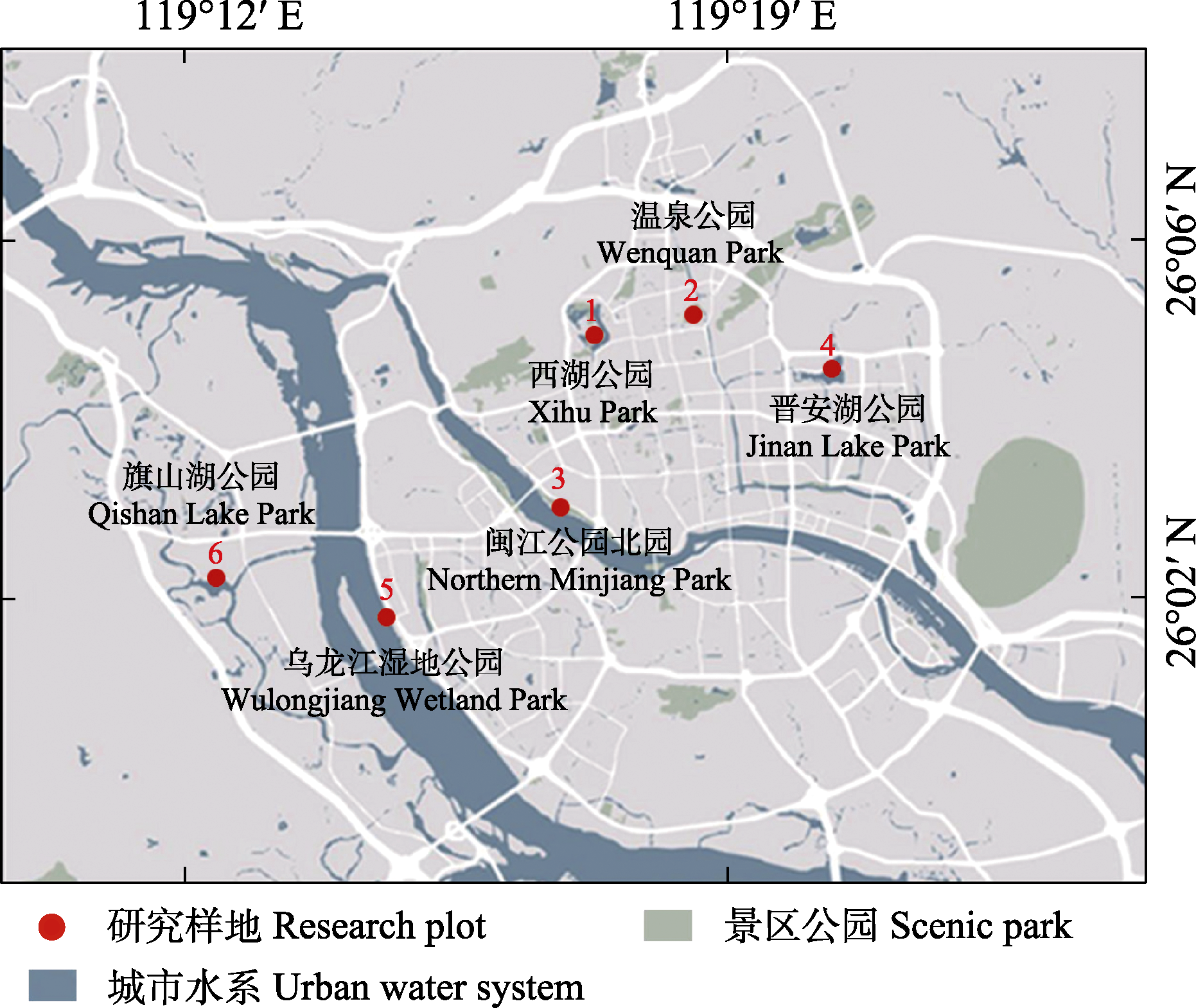
Fig. 1 Spatial distribution of six urban parks in Fuzhou
| 目 Order | 科数 Family number | 物种数 Species number | 个体数 Individual number | |||
|---|---|---|---|---|---|---|
| 入侵植物 Invasive plants (%) | 非入侵植物 Non-invasive plants (%) | 入侵植物 Invasive plants (%) | 非入侵植物 Non-invasive plants (%) | 入侵植物 Invasive plants (%) | 非入侵植物 Non-invasive plants (%) | |
| 膜翅目 Hymenoptera | 10 (27.78) | 14 (30.43) | 51 (35.42) | 66 (42.31) | 895 (53.18) | 1,360 (64.82) |
| 双翅目 Diptera | 9 (25.00) | 12 (26.09) | 39 (27.08) | 40 (25.64) | 365 (21.69) | 202 (9.63) |
| 鳞翅目 Lepidoptera | 8 (22.22) | 7 (15.22) | 36 (25.00) | 30 (19.23) | 369 (21.93) | 355 (16.92) |
| 鞘翅目 Coleoptera | 3 (8.33) | 6 (13.04) | 7 (4.86) | 11 (7.05) | 28 (1.66) | 100 (4.77) |
| 半翅目 Hemiptera | 4 (11.11) | 3 (6.52) | 9 (6.25) | 3 (1.92) | 15 (0.89) | 3 (0.14) |
| 缨翅目 Thysanoptera | 2 (5.56) | 2 (4.35) | 2 (1.39) | 4 (2.57) | 11 (0.65) | 75 (3.58) |
| 直翅目 Orthoptera | 0 (0.00) | 2 (4.35) | 0 (0.00) | 2 (1.28) | 0 (0.00) | 3 (0.14) |
| 总计 Total | 36 (100.00) | 46 (100.00) | 144 (100.00) | 156 (100.00) | 1,683 (100.00) | 2,098 (100.00) |
Table 1 Species composition of flower-visiting insects on invasive and non-invasive plants in six urban parks in Fuzhou
| 目 Order | 科数 Family number | 物种数 Species number | 个体数 Individual number | |||
|---|---|---|---|---|---|---|
| 入侵植物 Invasive plants (%) | 非入侵植物 Non-invasive plants (%) | 入侵植物 Invasive plants (%) | 非入侵植物 Non-invasive plants (%) | 入侵植物 Invasive plants (%) | 非入侵植物 Non-invasive plants (%) | |
| 膜翅目 Hymenoptera | 10 (27.78) | 14 (30.43) | 51 (35.42) | 66 (42.31) | 895 (53.18) | 1,360 (64.82) |
| 双翅目 Diptera | 9 (25.00) | 12 (26.09) | 39 (27.08) | 40 (25.64) | 365 (21.69) | 202 (9.63) |
| 鳞翅目 Lepidoptera | 8 (22.22) | 7 (15.22) | 36 (25.00) | 30 (19.23) | 369 (21.93) | 355 (16.92) |
| 鞘翅目 Coleoptera | 3 (8.33) | 6 (13.04) | 7 (4.86) | 11 (7.05) | 28 (1.66) | 100 (4.77) |
| 半翅目 Hemiptera | 4 (11.11) | 3 (6.52) | 9 (6.25) | 3 (1.92) | 15 (0.89) | 3 (0.14) |
| 缨翅目 Thysanoptera | 2 (5.56) | 2 (4.35) | 2 (1.39) | 4 (2.57) | 11 (0.65) | 75 (3.58) |
| 直翅目 Orthoptera | 0 (0.00) | 2 (4.35) | 0 (0.00) | 2 (1.28) | 0 (0.00) | 3 (0.14) |
| 总计 Total | 36 (100.00) | 46 (100.00) | 144 (100.00) | 156 (100.00) | 1,683 (100.00) | 2,098 (100.00) |
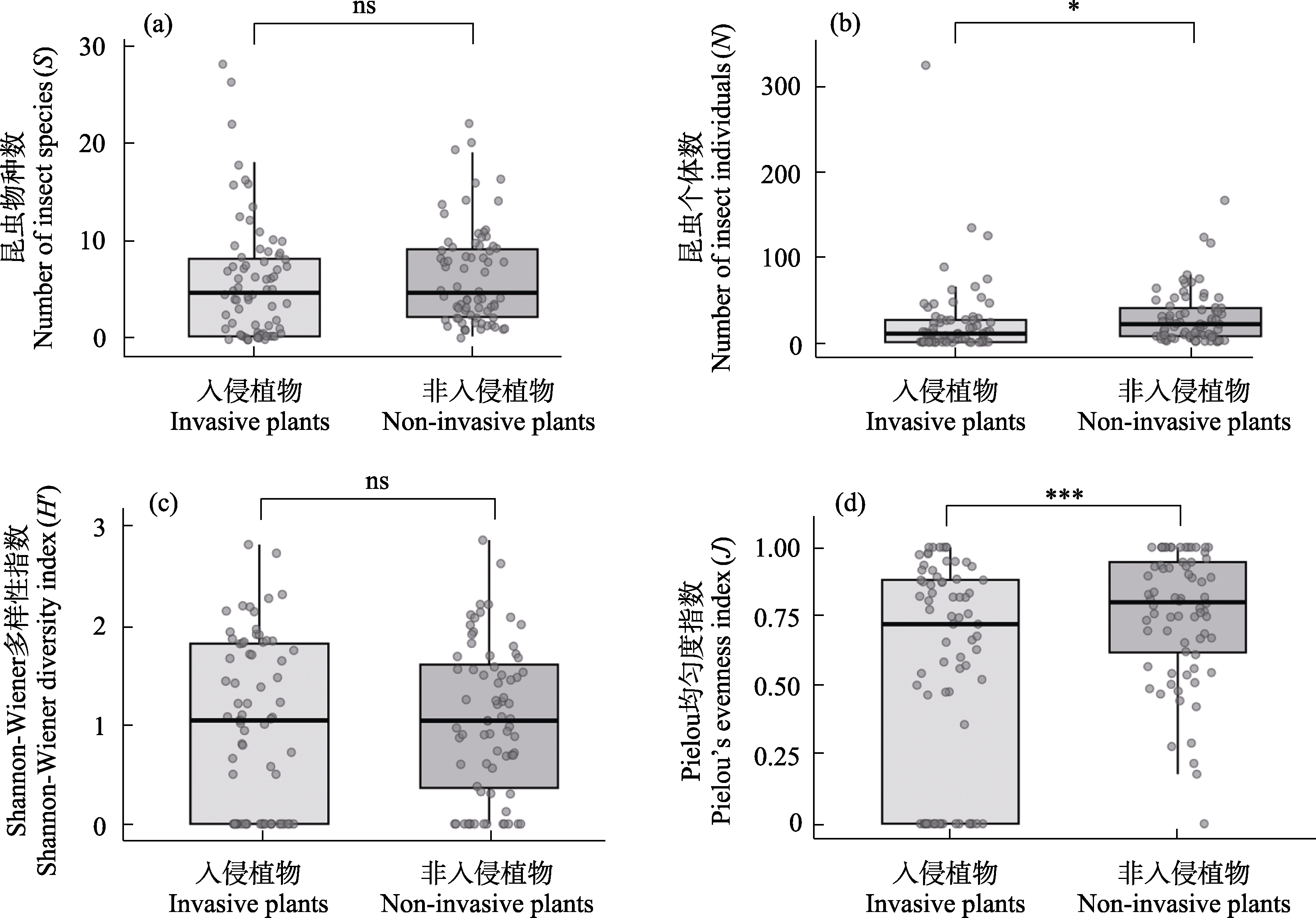
Fig. 2 Comparison of α-diversity of flower-visiting insects between invasive and non-invasive plants in six urban parks in Fuzhou. ns, Not significant; * P < 0.05; *** P < 0.001.
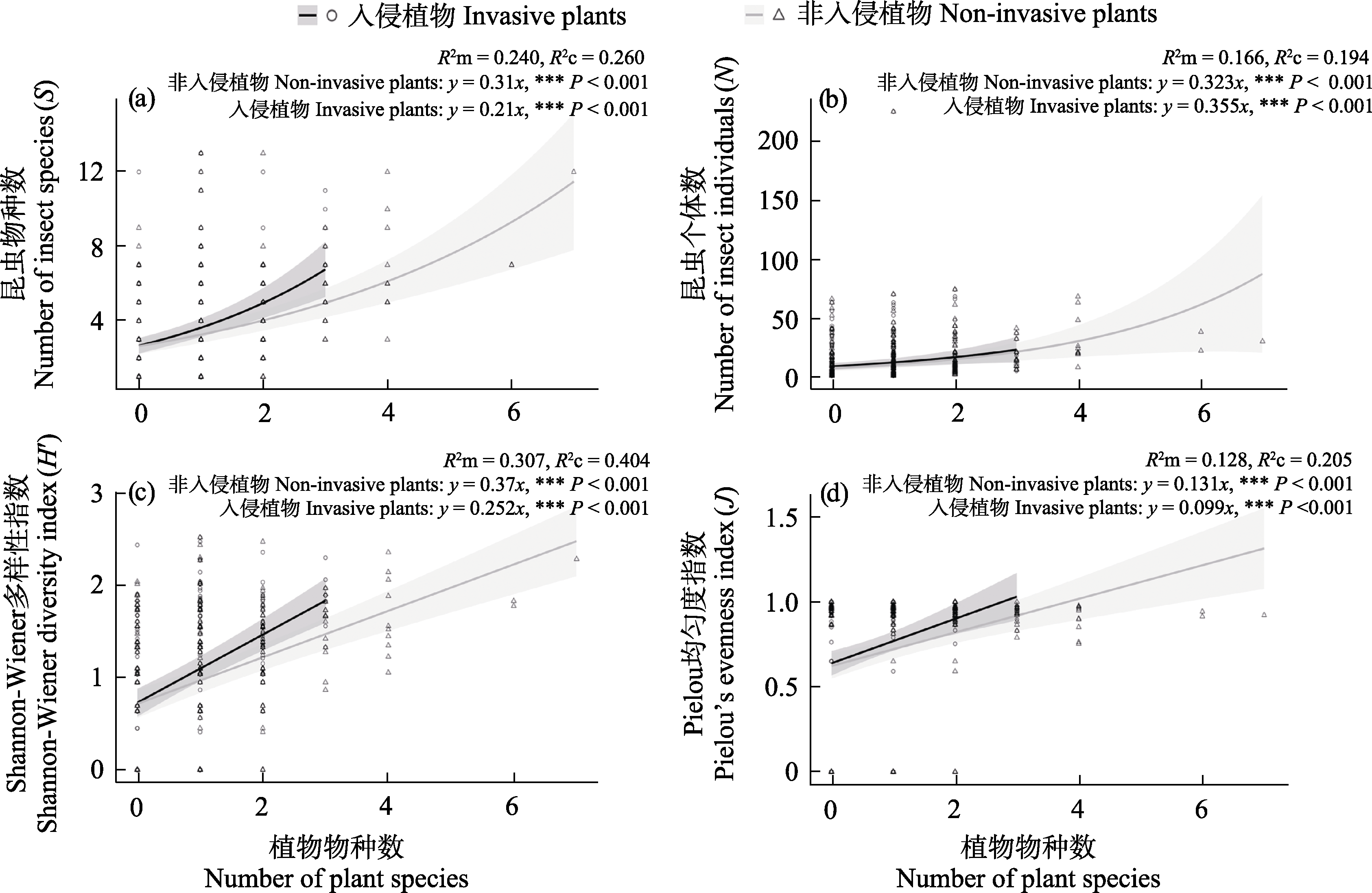
Fig. 3 Relationship between plant species number and α-diversity of flower-visiting insects. R2m, Marginal R2; R2c, Conditional R2. Shaded area represents the 95% confidence interval.
| 响应变量 Response variable | 预测变量 Predictor variable | 估计值 Estimate (b) | 标准误 SE | 自由度 df | 统计量 Statistic | P | 边际R2 Marginal R | 条件R2 Conditional R |
|---|---|---|---|---|---|---|---|---|
| 昆虫物种数 Number of insect species | 截距 Intercept | 0.724 | 0.089 | 8.151 | < 0.001*** | 0.240 | 0.260 | |
| 入侵植物物种数 Number of invasive plant species | 0.310 | 0.042 | 7.341 | < 0.001*** | ||||
| 非入侵植物物种数 Number of non-invasive plant species | 0.210 | 0.027 | 7.722 | < 0.001*** | ||||
| 昆虫个体数 Number of insect individuals | 截距 Intercept | 1.723 | 0.191 | 9.038 | < 0.001*** | 0.166 | 0.194 | |
| 入侵植物物种数 Number of invasive plant species | 0.323 | 0.086 | 3.774 | < 0.001*** | ||||
| 非入侵植物物种数 Number of non-invasive plant species | 0.355 | 0.064 | 5.584 | < 0.001*** | ||||
| Shannon-Wiener多样性指数 Shannon-Wiener diversity index | 截距 Intercept | 0.418 | 0.088 | 18.04 | 4.750 | < 0.001*** | 0.307 | 0.404 |
| 入侵植物物种数 Number of invasive plant species | 0.370 | 0.046 | 218.20 | 8.055 | < 0.001*** | |||
| 非入侵植物物种数 Number of non-invasive plant species | 0.252 | 0.032 | 216.35 | 7.979 | < 0.001*** | |||
| Pielou均匀度指数 Pielou’s evenness index | 截距 Intercept | 0.517 | 0.046 | 46.66 | 11.156 | < 0.001*** | 0.128 | 0.205 |
| 入侵植物物种数 Number of invasive plant species | 0.131 | 0.030 | 232.39 | 4.390 | < 0.001*** | |||
| 非入侵植物物种数 Number of non-invasive plant species | 0.099 | 0.020 | 228.83 | 4.824 | < 0.001*** |
Table 2 Statistics table of linear mixed model
| 响应变量 Response variable | 预测变量 Predictor variable | 估计值 Estimate (b) | 标准误 SE | 自由度 df | 统计量 Statistic | P | 边际R2 Marginal R | 条件R2 Conditional R |
|---|---|---|---|---|---|---|---|---|
| 昆虫物种数 Number of insect species | 截距 Intercept | 0.724 | 0.089 | 8.151 | < 0.001*** | 0.240 | 0.260 | |
| 入侵植物物种数 Number of invasive plant species | 0.310 | 0.042 | 7.341 | < 0.001*** | ||||
| 非入侵植物物种数 Number of non-invasive plant species | 0.210 | 0.027 | 7.722 | < 0.001*** | ||||
| 昆虫个体数 Number of insect individuals | 截距 Intercept | 1.723 | 0.191 | 9.038 | < 0.001*** | 0.166 | 0.194 | |
| 入侵植物物种数 Number of invasive plant species | 0.323 | 0.086 | 3.774 | < 0.001*** | ||||
| 非入侵植物物种数 Number of non-invasive plant species | 0.355 | 0.064 | 5.584 | < 0.001*** | ||||
| Shannon-Wiener多样性指数 Shannon-Wiener diversity index | 截距 Intercept | 0.418 | 0.088 | 18.04 | 4.750 | < 0.001*** | 0.307 | 0.404 |
| 入侵植物物种数 Number of invasive plant species | 0.370 | 0.046 | 218.20 | 8.055 | < 0.001*** | |||
| 非入侵植物物种数 Number of non-invasive plant species | 0.252 | 0.032 | 216.35 | 7.979 | < 0.001*** | |||
| Pielou均匀度指数 Pielou’s evenness index | 截距 Intercept | 0.517 | 0.046 | 46.66 | 11.156 | < 0.001*** | 0.128 | 0.205 |
| 入侵植物物种数 Number of invasive plant species | 0.131 | 0.030 | 232.39 | 4.390 | < 0.001*** | |||
| 非入侵植物物种数 Number of non-invasive plant species | 0.099 | 0.020 | 228.83 | 4.824 | < 0.001*** |
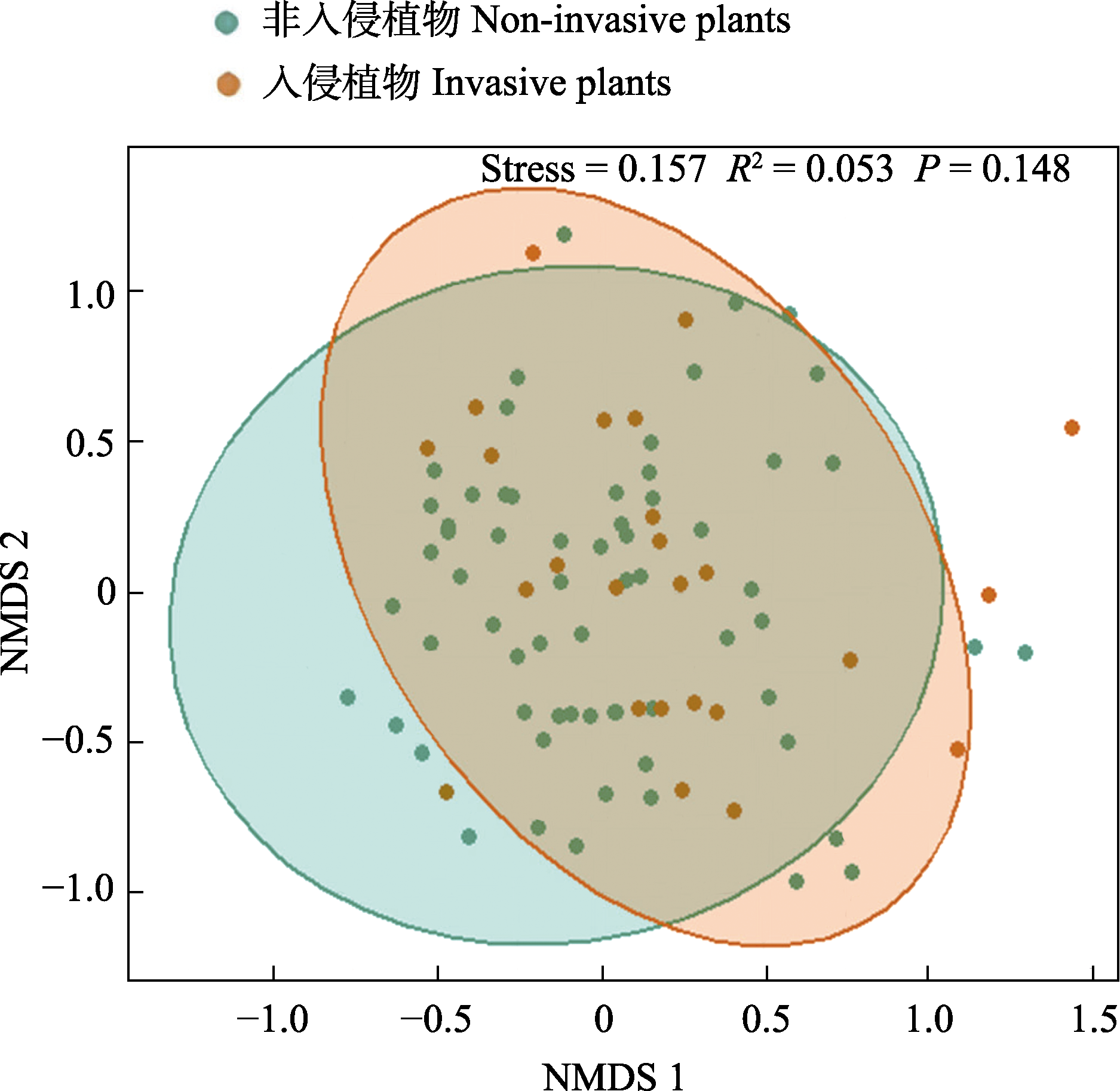
Fig. 4 Non-metric multidimensional scaling (NMDS) analysis of flower-visiting insect functional groups on invasive versus non-invasive plants
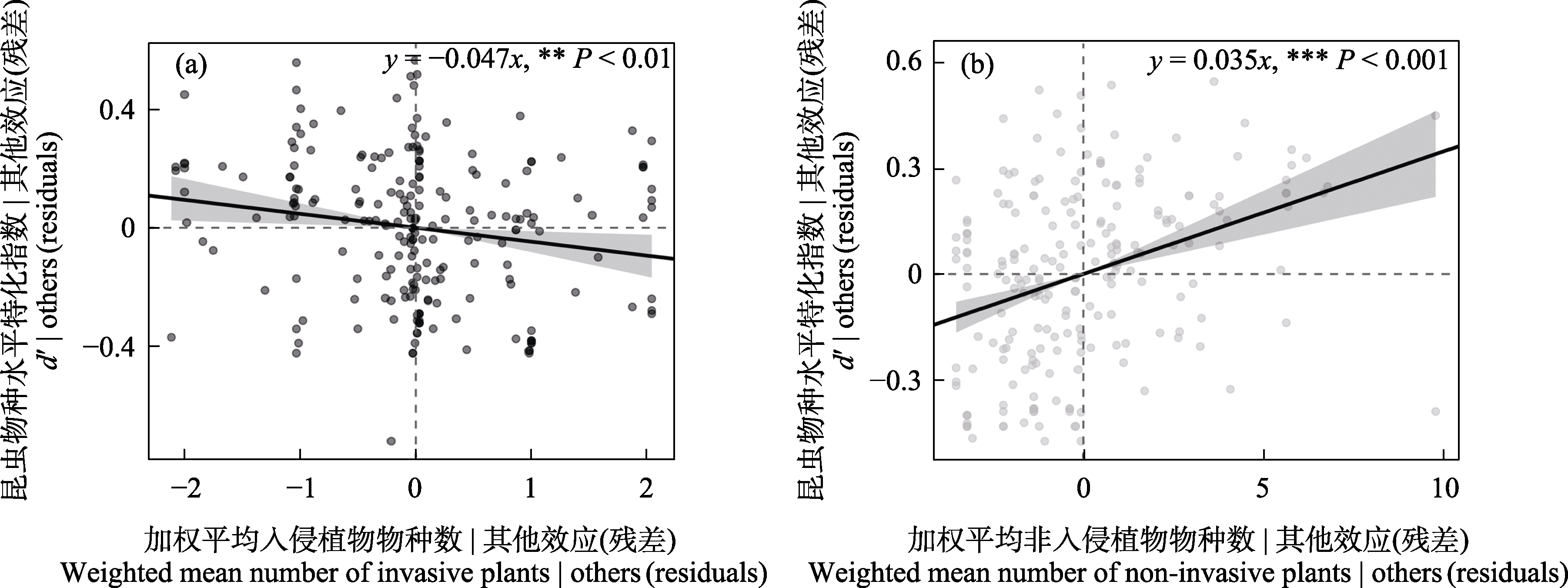
Fig. 5 Multiple linear regression analysis between the number of invasive and non-invasive plant species and the insect species-level specialization index (d')
| 预测变量 Predictor variable | 估计值 Estimate (b) | 标准误 SE | t | P | VIF |
|---|---|---|---|---|---|
| 截距 Intercept | 0.381 | 0.047 | 8.114 | < 0.001*** | − |
| 加权平均入侵植物物种数 Weighted mean number of invasive plants | −0.047 | 0.018 | −2.629 | 0.009** | 1.003 |
| 加权平均非入侵植物物种数 Weighted mean number of non-invasive plants | 0.035 | 0.006 | 5.525 | < 0.001*** | 1.003 |
| 模型拟合 Model fit | |||||
| 多重R2 Multiple R | 0.143 | ||||
| 校正R2 Adjusted R | 0.135 | ||||
| F2,216 | 18.0 | < 0.001*** |
Table 3 Statistics table of multiple linear regression
| 预测变量 Predictor variable | 估计值 Estimate (b) | 标准误 SE | t | P | VIF |
|---|---|---|---|---|---|
| 截距 Intercept | 0.381 | 0.047 | 8.114 | < 0.001*** | − |
| 加权平均入侵植物物种数 Weighted mean number of invasive plants | −0.047 | 0.018 | −2.629 | 0.009** | 1.003 |
| 加权平均非入侵植物物种数 Weighted mean number of non-invasive plants | 0.035 | 0.006 | 5.525 | < 0.001*** | 1.003 |
| 模型拟合 Model fit | |||||
| 多重R2 Multiple R | 0.143 | ||||
| 校正R2 Adjusted R | 0.135 | ||||
| F2,216 | 18.0 | < 0.001*** |
| [1] | Aizen MA, Morales CL, Morales JM (2008) Invasive mutualists erode native pollination webs. PLoS Biology, 6, e31. |
| [2] | Albrecht M, Padrón B, Bartomeus I, Traveset A (2014) Consequences of plant invasions on compartmentalization and species’ roles in plant-pollinator networks. Proceedings of the Royal Society B: Biological Sciences, 281, 20140773. |
| [3] | Artamendi M, Martin PA, Bartomeus I, Magrach A (2025) Loss of pollinator diversity consistently reduces reproductive success for wild and cultivated plants. Nature Ecology & Evolution, 9, 296-313. |
| [4] | Baselga A (2010) Partitioning the turnover and nestedness components of beta diversity. Global Ecology and Biogeography, 19, 134-143. |
| [5] | Compilation Group of Flora of Fujian, Fujian Provincial Science and Technology Commission (1988) Flora of Fujian, Vol. 3. Fujian Science and Technology Press, Fuzhou. (in Chinese) |
| [福建省科学技术委员会福建植物志编写组 (1988) 福建植物志(第三卷). 福建科学技术出版社, 福州.] | |
| [6] | Editorial Committee of Zoologica Sinica,Chinese Academy of Sciences (1959-1997) Economic Insect Fauna of China. Science Press, Beijing. (in Chinese) |
| [中国科学院中国动物志编辑委员会 (1959-1997) 中国经济昆虫志. 科学出版社, 北京.] | |
| [7] | Egawa C, Yuta T, Koyama A (2023) Specific alien plant species predominantly deliver nectar sugar and pollen but are not preferentially visited by wild pollinating insects in suburban riparian ecosystems. Ecology and Evolution, 13, e10441. |
| [8] | He JH, Chen XX, Fan JJ, Li Q, Liu CM (2004) Hymenopteran Insects Fauna of Zhejiang. Science Press, Beijing. (in Chinese) |
| [何俊华, 陈学新, 樊晋江, 李强, 刘长明 (2004) 浙江蜂类志. 科学出版社, 北京.] | |
| [9] | Huang BK (1999-2003) Fauna of Insects in Fujian Province of China. Fujian Science and Technology Press, Fuzhou. (in Chinese) |
| [黄邦侃(1999-2003) 福建昆虫志. 福建科学技术出版社, 福州.] | |
| [10] | Jakobsson A, Padrón B (2014) Does the invasive Lupinus polyphyllus increase pollinator visitation to a native herb through effects on pollinator population sizes? Oecologia, 174, 217-226. |
| [11] | Ji S, Yang L, Yan SJ, Ye JW, Liao JW (2023) Research advances in the interactions between floral traits and flower-visiting insects. World Forestry Research, 36(2), 26-31. (in Chinese with English abstract) |
| [纪霜, 杨丽, 闫淑君, 叶佳伟, 廖剑威 (2023) 植物花部特征与访花昆虫互作关系研究进展. 世界林业研究, 36(2), 26-31.] | |
| [12] | Kovács-Hostyánszki A, Szigeti V, Miholcsa Z, Sándor D, Soltész Z, Török E, Fenesi A (2022) Threats and benefits of invasive alien plant species on pollinators. Basic and Applied Ecology, 64, 89-102. |
| [13] | Lopezaraiza-Mikel ME, Hayes RB, Whalley MR, Memmott J (2007) The impact of an alien plant on a native plant-pollinator network: An experimental approach. Ecology Letters, 10, 539-550. |
| [14] | Ma KP, Huang JH, Yu SL, Chen LZ (1995) Plant community diversity in Dongling Mountain, Beijing, China. II. Species richness, evenness and species diversities. Acta Ecologica Sinica, 15, 268-277. (in Chinese with English abstract) |
| [马克平, 黄建辉, 于顺利, 陈灵芝 (1995) 北京东灵山地区植物群落多样性的研究. II. 丰富度、均匀度和物种多样性指数. 生态学报, 15, 268-277.] | |
| [15] | Mitchell RJ, Flanagan RJ, Brown BJ, Waser NM, Karron JD (2009) New frontiers in competition for pollination. Annals of Botany, 103, 1403-1413. |
| [16] | Moragues E, Traveset A (2005) Effect of Carpobrotus spp. on the pollination success of native plant species of the Balearic Islands. Biological Conservation, 122, 611-619. |
| [17] | Moroń D, Lenda M, Skórka P, Szentgyörgyi H, Settele J, Woyciechowski M (2009) Wild pollinator communities are negatively affected by invasion of alien goldenrods in grassland landscapes. Biological Conservation, 142, 1322-1332. |
| [18] | Olesen JM, Stefanescu C, Traveset A (2011) Strong, long-term temporal dynamics of an ecological network. PLoS ONE, 6, e26455. |
| [19] | Ollerton J, Winfree R, Tarrant S (2011) How many flowering plants are pollinated by animals? Oikos, 120, 321-326. |
| [20] | Palladini JD, Maron JL (2014) Reproduction and survival of a solitary bee along native and exotic floral resource gradients. Oecologia, 176, 789-798. |
| [21] | Shi JY, Zhu HB, Liu D, Mamut J, Shao CL, Huang DH (2025) Spring dynamics of the plant-pollinator interaction network in the gravel desert of the Kalamaili Mountain Nature Reserve, Xinjiang. Acta Ecologica Sinica, 45, 923-938. (in Chinese with English abstract) |
| [石靖宇, 祝洪波, 刘丹, 吉乃提汗·马木提, 邵长亮, 黄代红 (2025) 卡拉麦里山自然保护区砾质荒漠植物-传粉者互作网络的春季动态. 生态学报, 45, 923-938.] | |
| [22] | Shrestha UB, Shrestha BB (2019) Climate change amplifies plant invasion hotspots in Nepal. Diversity and Distributions, 25, 1599-1612. |
| [23] | Staab M, Pereira-Peixoto MH, Klein AM (2020) Exotic garden plants partly substitute for native plants as resources for pollinators when native plants become seasonally scarce. Oecologia, 194, 465-480. |
| [24] | Vilà M, Bartomeus I, Dietzsch AC, Petanidou T, Steffan-Dewenter I, Stout JC, Tscheulin T (2009) Invasive plant integration into native plant-pollinator networks across Europe. Proceedings of the Royal Society B: Biological Sciences, 276, 3887-3893. |
| [25] | Wang H, Ran N, Jiang HQ, Wang QQ, Ye M, Bowler PA, Jin XF, Ye ZM (2024) Complex floral traits shape pollinator attraction to flowering plants in urban greenspaces. Urban Forestry & Urban Greening, 91, 128165. |
| [26] | Wang K, Qi YX, Hu YD, Han D (2025) Distribution and influences on butterfly diversity in urban park green spaces: A case study of Harbin, China. Ecology and Evolution, 15, e71554. |
| [27] | Wang W, Du J, He ZB, Ma DK, Zhao P (2023) A review on phenological mismatches between plants and their pollinators. Acta Ecologica Sinica, 43, 6465-6474. (in Chinese with English abstract) |
| [王文, 杜军, 何志斌, 马登科, 赵鹏 (2023) 植物与传粉者物候错配效应研究进展. 生态学报, 43, 6465-6474.] | |
| [28] | Wardhaugh CW (2015) How many species of arthropods visit flowers? Arthropod-Plant Interactions, 9, 547-565. |
| [29] | Wei N, Kaczorowski RL, Arceo-Gómez G, O’Neill EM, Hayes RA, Ashman TL (2021) Pollinators contribute to the maintenance of flowering plant diversity. Nature, 597, 688-692. |
| [30] | Wu YR (2000) Fauna Sinica·Insecta, Vol. 20, Hymenoptera·Melittidae·Apidae. Science Press, Beijing. (in Chinese) |
| [吴燕如 (2000) 中国动物志·昆虫纲(第二十卷):膜翅目·准蜂科·蜜蜂科. 科学出版社, 北京.] | |
| [31] | Yang L, Yan SJ, Ji S, Liao JW, Ye JW (2022) Research progress of flower visiting insects in China. World Forestry Research, 35(4), 70-75. (in Chinese with English abstract) |
| [杨丽, 闫淑君, 纪霜, 廖剑威, 叶佳伟 (2022) 中国访花昆虫研究进展. 世界林业研究, 35(4), 70-75.] | |
| [32] | Yu GY (2019) Photographic Atlas of Beijing Flower-visiting Insects. Publishing House of Electronics Industry, Beijing. (in Chinese) |
| [虞国跃 (2019) 北京访花昆虫图谱. 电子工业出版社, 北京.] | |
| [33] | Yu SY, Wang YN, Li ZX, Jiang L, Hu LH (2024) The correlation between urban flower border plants and flower-visiting insects of Hangzhou in different spatio-temporal scenarios. Journal of Zhejiang Sci-Tech University (Natural Sciences Edition), 51, 229-237. (in Chinese with English abstract) |
| [俞诗音, 王雅男, 李泽勋, 江玲, 胡立辉 (2024) 不同时空情境下杭州市城市花境植物与访花昆虫间的相关性. 浙江理工大学学报(自然科学版), 51, 229-237.] | |
| [34] | Zhang WW, Li YS (2011) Chinese Insects Illustrated. Chongqing University Press, Chongqing. (in Chinese) |
| [张巍巍, 李元胜 (2011) 中国昆虫生态大图鉴. 重庆大学出版社, 重庆.] | |
| [35] | Zhou Y (1994) Monographia Rhopalocerorum Sinensium. Henan Science and Technology Press, Zhengzhou. (in Chinese) |
| [周尧 (1994) 中国蝶类志. 河南科学技术出版社, 郑州.] |
| [1] | Qiuju Zhong, Juanjuan Zhang, Youxian Jia, Xuecong Zhang, Zhiye Ren, Ganxin Feng, Jing Yang, Yunlin Jiang, Huixuan Liao, Minxia Liang. Construction and application of multi-taxon successional reference frameworks in newly formed tropical island ecosystems based on species distribution data [J]. Biodiv Sci, 2026, 34(8): 26067-. |
| [2] | Xiaoqiang Lu, Wanxia Yang, Yue Ma, Wei Liu, Xu Xu, Li Liu, Yan Liu. Analyzing China’s biodiversity governance pathways based on the IPBES transformative change framework [J]. Biodiv Sci, 2026, 34(8): 26131-. |
| [3] | Zhou Shen, Haiwei Yin, Fanhua Kong, Shuping Huang, Hongqing Liu, Zikang Su, Jiehui Zhang. Surrogate species approach in urban-rural ecological spatial governance: Cognitive reconstruction, path embedding, and implementation framework [J]. Biodiv Sci, 2026, 34(8): 26078-. |
| [4] | Meng Zhang, Yanping Wang. A review of zeta diversity: Analysis methods, conservation applications, and future perspectives [J]. Biodiv Sci, 2026, 34(8): 26138-. |
| [5] | Yu Cai, Xiaochuan Zhang, Mengjia Lian. Urban dragonfly habitats: Ecological stressors, habitat requirements and restoration strategies [J]. Biodiv Sci, 2026, 34(8): 26096-. |
| [6] | Han Li, Xingcheng He, Shangmingyu Zhang, Yiwei Cao, Jiayu Zhang, Kexin Peng, Yongjie Wu. Avian checklist of the Hengduan Mountains [J]. Biodiv Sci, 2026, 34(7): 25375-. |
| [7] | Ming Li, Yuru Zhu, Xiangling Qin, Qiaokun Li, Wei Xing. Underlying logic, system architecture, and operational models of biodiversity investment [J]. Biodiv Sci, 2026, 34(7): 26157-. |
| [8] | Zhongjun Gong, Weizheng Li, Yongsheng Yao, Xuqi Zuo, Yuqing Wu, Jin Miao. Distribution characteristics of arthropod eDNA in the solid, liquid, and gas phases of farmland soil [J]. Biodiv Sci, 2026, 34(7): 26146-. |
| [9] | Huan Zheng. The design logic and tool construction of the biodiversity net gain system under China’s territorial spatial planning framework [J]. Biodiv Sci, 2026, 34(7): 25440-. |
| [10] | Yu Tian, Yijia Geng, Junsheng Li, Ming Li. Scale discrepancies between global goals and implementation of the Kunming-Montreal Global Biodiversity Framework and pathways to resolution [J]. Biodiv Sci, 2026, 34(6): 26086-. |
| [11] | Fangyuan Hua, Shuangqi Liu, Yangjing Peng, Shanxing Gong, Xiaoli Shen, Kun Jin. A framework for synergistically addressing the risk sources of biodiversity loss and climate change in protected areas and Ecological Conservation Redlines [J]. Biodiv Sci, 2026, 34(6): 25492-. |
| [12] | Jie Zhang, Haoming Lu, Jiajie Chen, Jiangyuan Chen, Yufan Mao, Junxi Hu, Baowei Zhang. Latin-English-Chinese-Japanese checklist of Chinese chondrichthyans and a comparison of diversity among marine regions [J]. Biodiv Sci, 2026, 34(6): 25522-. |
| [13] | Li Cai, Liping Ge, Danxiao Peng, Haihua Hu, Zhiduan Chen, Yanting Niu. Comparison of potential distribution of East Asian-North American disjunct distribution genera in response to future climate change [J]. Biodiv Sci, 2026, 34(6): 25478-. |
| [14] | Neng Wei, Yadong Zhou, Caifeng Zhang, Shengwei Wang, Guangwan Hu, Geoffrey Mwachala, Qingfeng Wang. Compilation overview and the phase-specific outcomes of Flora of Kenya [J]. Biodiv Sci, 2026, 34(5): 25423-. |
| [15] | Lijie Zhou, Minhui Huang, Huaijiang He, Yanxia Cheng, Chunyu Zhang, Xiuhai Zhao. Disentangling the patterns, components, and influencing factors of forest β diversity in the Xiaoxing’an Mountains, Northeast China [J]. Biodiv Sci, 2026, 34(4): 25443-. |
| Viewed | ||||||
|
Full text |
|
|||||
|
Abstract |
|
|||||
Copyright © 2026 Biodiversity Science
Editorial Office of Biodiversity Science, 20 Nanxincun, Xiangshan, Beijing 100093, China
Tel: 010-62836137, 62836665 E-mail: biodiversity@ibcas.ac.cn
