

Biodiv Sci ›› 2026, Vol. 34 ›› Issue (5): 25261. DOI: 10.17520/biods.2025261 cstr: 32101.14.biods.2025261
• Original Papers: Animal Diversity • Previous Articles Next Articles
Jie Feng1,#( ), Yanzhi Li1,#, Shuli Wang1, Lanxi Li1, Pengfei Ding1, Bingwei Lü1, Ji Meng2, Xiangying Shi1,3,*()(
 ), Xueyang Li1,4,*()()
Received:2025-07-06
Accepted:2026-01-20
Online:2026-05-20
Published:2026-07-01
Contact:
Xiangying Shi, Xueyang Li
About author:First author contact:#Co-first authors
Supported by:Jie Feng, Yanzhi Li, Shuli Wang, Lanxi Li, Pengfei Ding, Bingwei Lü, Ji Meng, Xiangying Shi, Xueyang Li. Dynamics of ungulate habitat use and their environmental drivers in the Southwest Mountains: A camera trap monitoring case study from Guanba[J]. Biodiv Sci, 2026, 34(5): 25261.
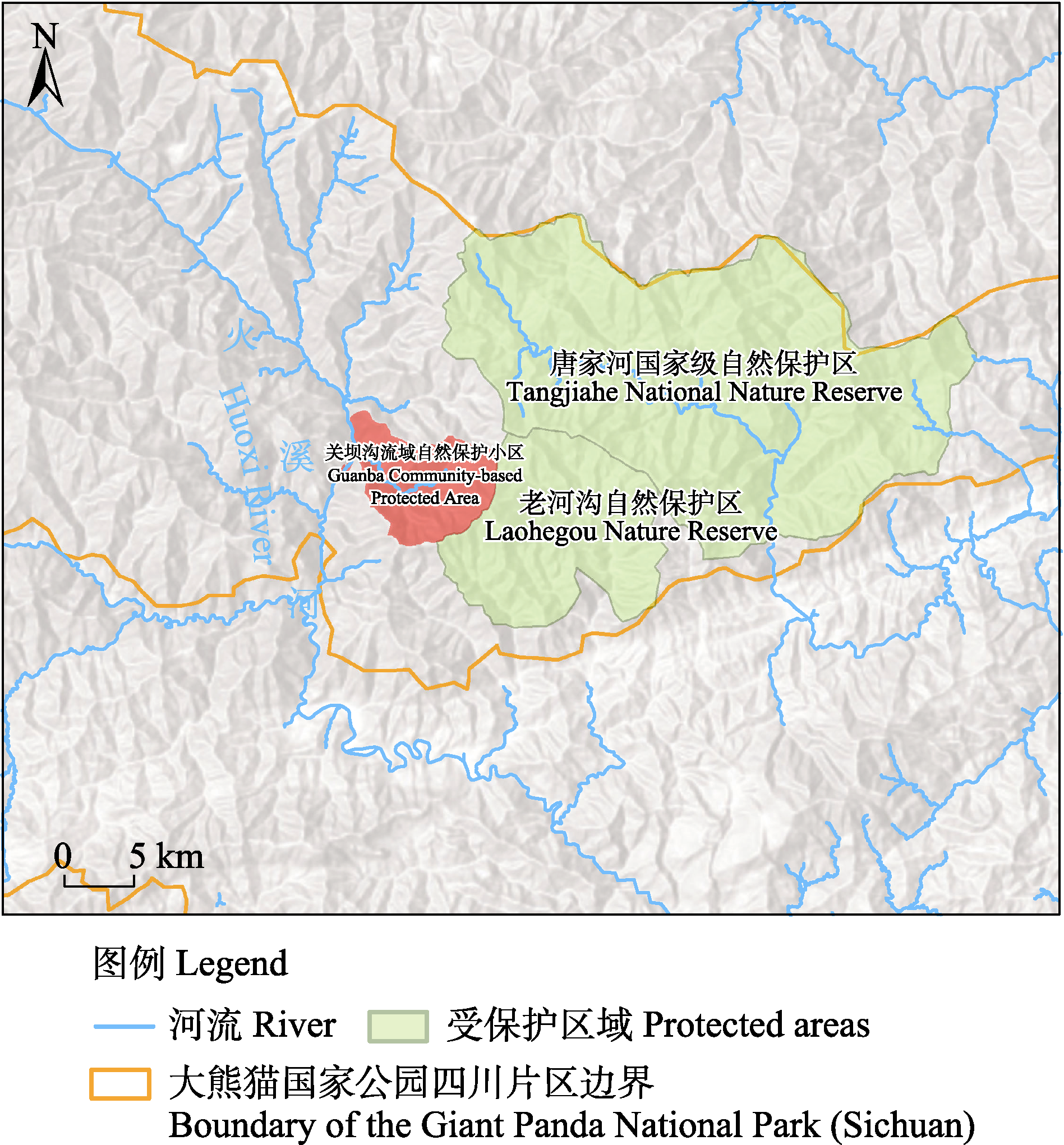
Fig. 1 The location of Guanba Community-based Protected Area, Pingwu County, Sichuan Province
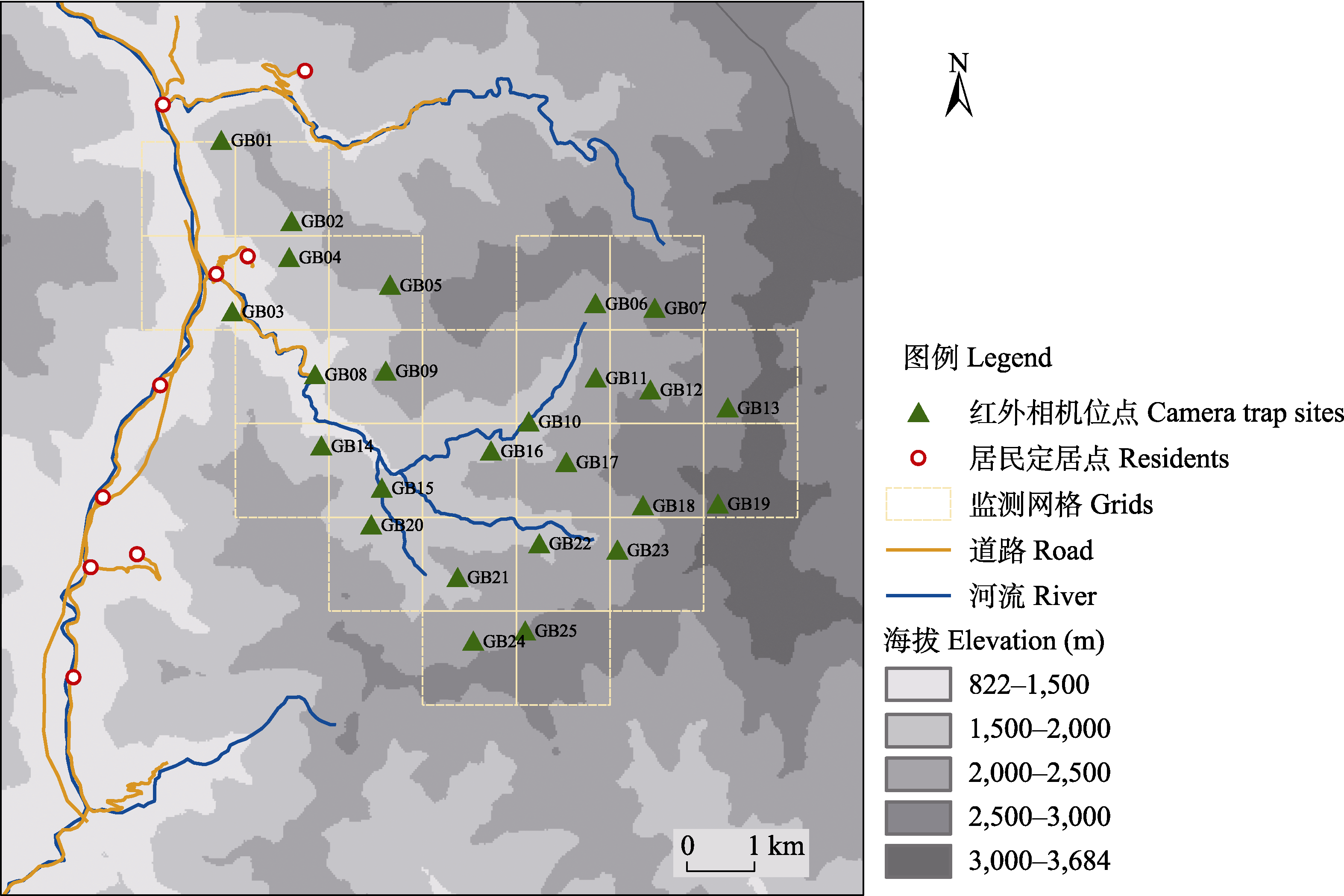
Fig. 2 The grids of infrared-camera monitoring in Guanba Community-based Protected Area, Pingwu County, Sichuan Province
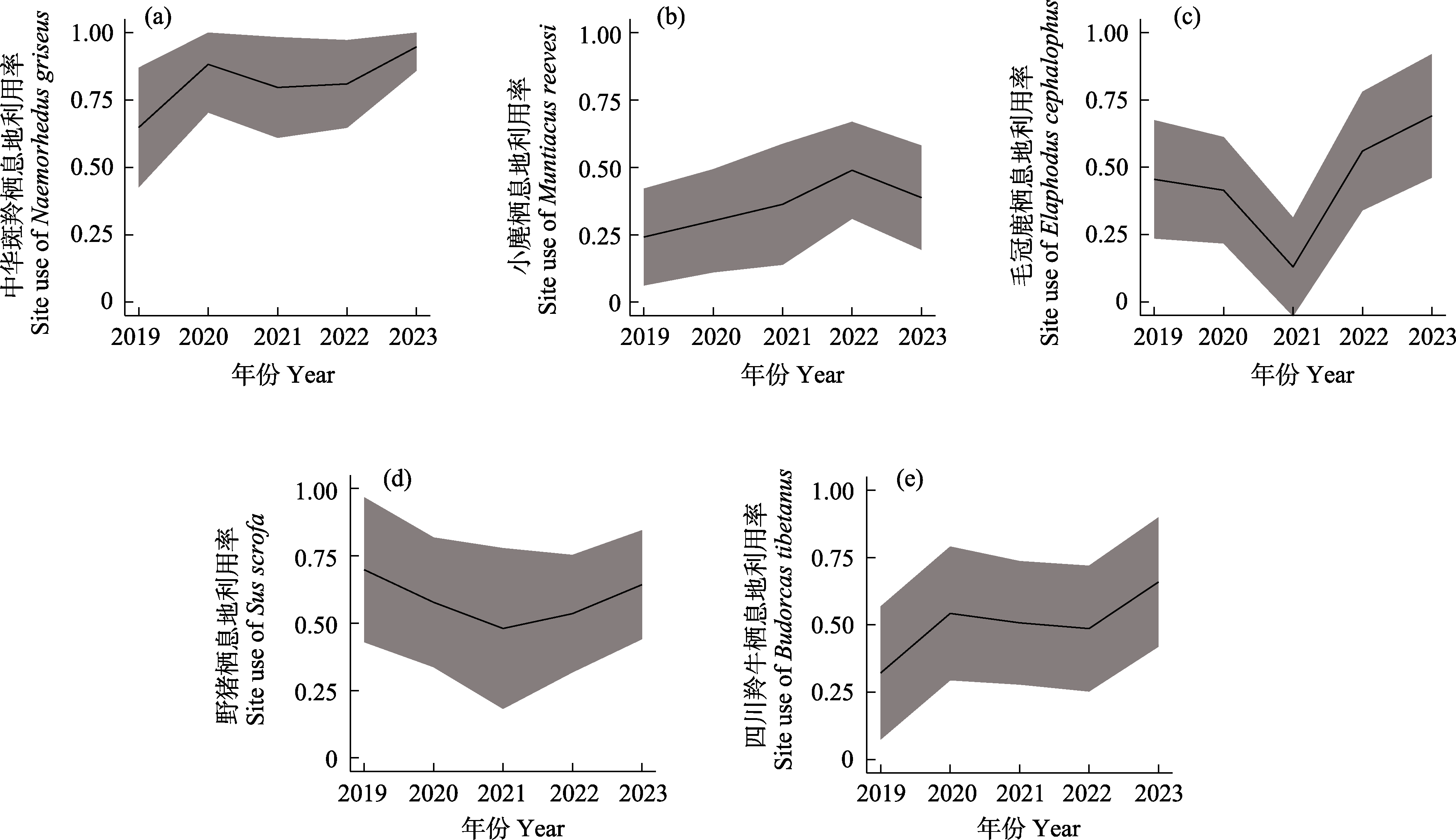
Fig. 3 The site use and 95% confidence interval (indicated by the gray area) of five common ungulate species in Guanba Community-based Protected Area, Pingwu County, Sichuan Province, from 2019 to 2023
| 物种 Species | 年份 Year | ||||||
|---|---|---|---|---|---|---|---|
| 2019 | 2020 | 2021 | 2022 | 2023 | |||
| 中华斑羚 Naemorhedus griseus | 占域率 Occupancy | 0.80 ± 0.25 | 0.98 ± 0.06 | 0.96 ± 0.09 | 0.97 ± 0.10 | 0.97 ± 0.07 | |
| 探测率 Detection probability | 0.38 ± 0.06 | 0.50 ± 0.04 | 0.43 ± 0.05 | 0.37 ± 0.04 | 0.48 ± 0.04 | ||
| 距河流距离 Distance to river | 0.75 ± 1.12 | 3.80 ± 4.74 | 1.56 ± 2.83 | 3.94 ± 4.34 | 1.22 ± 1.45 | ||
| 距道路距离 Distance to road | 1.59 ± 1.35* | 0.96 ± 1.29 | 1.16 ± 0.95 | 3.55 ± 3.94 | −1.32 ± 2.06 | ||
| 常绿阔叶林占比 Proportion of evergreen broad-leaved forest | 0.16 ± 0.92 | −1.68 ± 1.95 | −1.55 ± 2.30 | 1.72 ± 1.86 | −0.71 ± 1.30 | ||
| 落叶阔叶林占比 Proportion of deciduous broad-leaved forest | −2.17 ± 2.75 | 4.31 ± 7.07 | −0.74 ± 2.10 | - | 1.61 ± 4.51 | ||
| 2019-2023年每年家畜的红外相机相对多度总和 Pooled relative abundance index (RAI) of livestock from 2019 to 2023 | −0.65 ± 0.85 | - | - | −4.24 ± 6.61 | - | ||
| 坡度 Slope | 1.55 ± 1.24 | 1.44 ± 1.65 | −3.94 ± 3.37 | 0.39 ± 1.28 | −2.25 ± 1.66* | ||
| 崎岖度 Vector ruggedness measure | 3.85 ± 3.62 | 3.12 ± 3.16 | 1.07 ± 1.41 | 1.59 ± 3.03 | - | ||
| 小麂 Muntiacus reevesi | 占域率 Occupancy | 0.02 ± 0.09 | 0.01 ± 0.05 | 0.16 ± 0.13 | 0.47 ± 0.16 | 0.06 ± 0.12 | |
| 探测率 Detection probability | 0.90 ± 0.20 | 0.38 ± 0.09 | 0.34 ± 0.10 | 0.31 ± 0.06 | 0.30 ± 0.07 | ||
| 距河流距离 Distance to river | - | −1.09 ± 1.47 | 0.10 ± 1.10 | −0.68 ± 0.87 | −0.08 ± 1.38 | ||
| 距道路距离 Distance to road | -1.01 ± 1.33 | −3.21 ± 2.76* | −1.11 ± 0.90* | −0.92 ± 0.76 | −2.39 ± 1.68* | ||
| 常绿阔叶林占比 Proportion of evergreen broad-leaved forest | 2.21 ± 2.20 | 0.70 ± 1.58 | 0.15 ± 0.82 | 0.11 ± 0.77 | −0.76 ± 1.08 | ||
| 落叶阔叶林占比 Proportion of deciduous broad-leaved forest | −6.06 ± 9.58 | 2.00 ± 2.03 | 0.18 ± 1.44 | −0.77 ± 0.96 | −5.67 ± 5.81* | ||
| 2019-2023年每年家畜的红外相机相对多度总和 Pooled relative abundance index (RAI) of livestock from 2019 to 2023 | - | - | - | −0.90 ± 1.68 | 1.79 ± 2.68 | ||
| 坡度 Slope | 0.20 ± 1.04 | 2.93 ± 3.42 | 1.26 ± 1.16 | −0.18 ± 0.71 | 0.59 ± 1.06 | ||
| 崎岖度 Vector ruggedness measure | −3.54 ± 3.98 | −5.75 ± 6.84 | −1.67 ± 2.05 | 1.15 ± 1.49 | −4.53 ± 3.53* | ||
| 毛冠鹿 Elaphodus cephalophus | 占域率 Occupancy | 0.18 ± 0.33 | 0.27 ± 0.16 | 0.09 ± 0.11 | 0.75 ± 0.31 | 0.64 ± 0.20 | |
| 探测率 Detection probability | 0.30 ± 0.06 | 0.47 ± 0.08 | 0.46 ± 0.11 | 0.24 ± 0.06 | 0.33 ± 0.06 | ||
| 距河流距离 Distance to river | −0.47 ± 0.99 | 4.60 ± 4.75* | 0.82 ± 1.45 | −0.36 ± 1.19 | 0.41 ± 0.77 | ||
| 距道路距离 Distance to road | 0.23 ± 1.04 | −0.41 ± 1.00 | −1.22 ± 0.95 | −3.52 ± 2.66* | −0.69 ± 0.72 | ||
| 常绿阔叶林占比 Proportion of evergreen broad-leaved forest | 2.13 ± 1.34* | 3.81 ± 3.70* | 1.33 ± 1.32 | 0.50 ± 0.75 | −0.11 ± 0.70 | ||
| 落叶阔叶林占比 Proportion of deciduous broad-leaved forest | −5.79 ± 6.36* | 0.66 ± 0.95 | −3.09 ± 4.00 | −0.65 ± 1.57 | 2.63 ± 3.50 | ||
| 2019-2023年每年家畜的红外相机相对多度总和 Pooled relative abundance index (RAI) of livestock from 2019 to 2023 | 0.11 ± 0.90 | - | - | - | - | ||
| 坡度 Slope | −0.91 ± 2.09 | 0.73 ± 0.87 | 0.42 ± 1.07 | 0.80 ± 1.08 | −0.56 ± 0.71 | ||
| 崎岖度 Vector ruggedness measure | 1.47 ± 1.85 | 2.15 ± 1.85* | −0.43 ± 1.38 | 0.46 ± 0.86 | −1.25 ± 1.65 | ||
| 野猪 Sus scrofa | 占域率 Occupancy | 0.81 ± 0.35 | 0.02 ± 0.06 | - | 0.58 ± 0.26 | 0.41 ± 0.12 | |
| 探测率 Detection probability | 0.17 ± 0.05 | 0.30 ± 0.09 | - | 0.17 ± 0.05 | 0.38 ± 0.07 | ||
| 距河流距离 Distance to river | −2.66 ± 3.18 | −1.35 ± 1.56 | - | 0.10 ± 0.97 | −0.52 ± 0.57 | ||
| 距道路距离 Distance to road | −0.43 ± 0.80 | −2.58 ± 2.24* | - | −1.75 ± 1.26* | −0.32 ± 0.55 | ||
| 常绿阔叶林占比 Proportion of evergreen broad-leaved forest | 0.70 ± 1.41 | 0.42 ± 1.35 | - | - | 0.05 ± 0.55 | ||
| 落叶阔叶林占比 Proportion of deciduous broad-leaved forest | 4.63 ± 6.20 | −5.07 ± 4.49* | - | −0.70 ± 1.62 | −0.09 ± 0.87 | ||
| 野猪 Sus scrofa | 2019-2023年每年家畜的红外相机相对多度总和 Pooled relative abundance index (RAI) of livestock from 2019 to 2023 | - | - | - | - | 0.26 ± 0.48 | |
| 坡度 Slope | −1.65 ± 2.00 | 1.02 ± 0.96 | - | −1.62 ± 1.98 | −0.29 ± 0.49 | ||
| 崎岖度 Vector ruggedness measure | −0.41 ± 1.47 | −4.37 ± 6.61 | - | −1.69 ± 2.14 | −0.15 ± 0.48 | ||
| 四川羚牛 Budorcas tibetanus | 占域率 Occupancy | 0.12 ± 0.14 | 0.07 ± 0.22 | 0.04 ± 0.13 | 0.32 ± 0.27 | 0.74 ± 0.46 | |
| 探测率 Detection probability | 0.24 ± 0.10 | 0.21 ± 0.08 | 0.19 ± 0.05 | 0.18 ± 0.07 | 0.21 ± 0.06 | ||
| 距河流距离 Distance to river | 0.04 ± 1.41 | 0.57 ± 1.76 | 1.48 ± 3.26 | 1.55 ± 1.81 | −1.76 ± 2.55 | ||
| 距道路距离 Distance to road | 2.58 ± 1.92* | - | 6.63 ± 5.65* | 1.25 ± 1.46 | 1.49 ± 1.38* | ||
| 常绿阔叶林占比 Proportion of evergreen broad-leaved forest | −0.68 ± 0.94 | −1.06 ± 0.86* | 0.17 ± 1.49 | −0.34 ± 1.18 | −2.72 ± 3.49* | ||
| 落叶阔叶林占比 Proportion of deciduous broad-leaved forest | 0.35 ± 1.80 | −6.71 ± 8.09* | - | −3.14 ± 1.85* | −1.78 ± 3.52 | ||
| 2019-2023年每年家畜的红外相机相对多度总和 Pooled relative abundance index (RAI) of livestock from 2019 to 2023 | - | - | - | - | 0.34 ± 1.11 | ||
| 坡度 Slope | 0.69 ± 1.07 | 0.81 ± 1.10 | −0.03 ± 1.18 | 1.95 ± 2.16 | −0.19 ± 1.08 | ||
| 崎岖度 Vector ruggedness measure | 0.79 ± 0.93 | 0.08 ± 0.87 | −1.62 ± 1.95 | 2.08 ± 3.26* | 0.50 ± 2.97 | ||
Table 1 The occupancy, detection probability of ungulate species, β coefficients and weights of environmental variables (* represents weight > 0.5) from 2019 to 2023
| 物种 Species | 年份 Year | ||||||
|---|---|---|---|---|---|---|---|
| 2019 | 2020 | 2021 | 2022 | 2023 | |||
| 中华斑羚 Naemorhedus griseus | 占域率 Occupancy | 0.80 ± 0.25 | 0.98 ± 0.06 | 0.96 ± 0.09 | 0.97 ± 0.10 | 0.97 ± 0.07 | |
| 探测率 Detection probability | 0.38 ± 0.06 | 0.50 ± 0.04 | 0.43 ± 0.05 | 0.37 ± 0.04 | 0.48 ± 0.04 | ||
| 距河流距离 Distance to river | 0.75 ± 1.12 | 3.80 ± 4.74 | 1.56 ± 2.83 | 3.94 ± 4.34 | 1.22 ± 1.45 | ||
| 距道路距离 Distance to road | 1.59 ± 1.35* | 0.96 ± 1.29 | 1.16 ± 0.95 | 3.55 ± 3.94 | −1.32 ± 2.06 | ||
| 常绿阔叶林占比 Proportion of evergreen broad-leaved forest | 0.16 ± 0.92 | −1.68 ± 1.95 | −1.55 ± 2.30 | 1.72 ± 1.86 | −0.71 ± 1.30 | ||
| 落叶阔叶林占比 Proportion of deciduous broad-leaved forest | −2.17 ± 2.75 | 4.31 ± 7.07 | −0.74 ± 2.10 | - | 1.61 ± 4.51 | ||
| 2019-2023年每年家畜的红外相机相对多度总和 Pooled relative abundance index (RAI) of livestock from 2019 to 2023 | −0.65 ± 0.85 | - | - | −4.24 ± 6.61 | - | ||
| 坡度 Slope | 1.55 ± 1.24 | 1.44 ± 1.65 | −3.94 ± 3.37 | 0.39 ± 1.28 | −2.25 ± 1.66* | ||
| 崎岖度 Vector ruggedness measure | 3.85 ± 3.62 | 3.12 ± 3.16 | 1.07 ± 1.41 | 1.59 ± 3.03 | - | ||
| 小麂 Muntiacus reevesi | 占域率 Occupancy | 0.02 ± 0.09 | 0.01 ± 0.05 | 0.16 ± 0.13 | 0.47 ± 0.16 | 0.06 ± 0.12 | |
| 探测率 Detection probability | 0.90 ± 0.20 | 0.38 ± 0.09 | 0.34 ± 0.10 | 0.31 ± 0.06 | 0.30 ± 0.07 | ||
| 距河流距离 Distance to river | - | −1.09 ± 1.47 | 0.10 ± 1.10 | −0.68 ± 0.87 | −0.08 ± 1.38 | ||
| 距道路距离 Distance to road | -1.01 ± 1.33 | −3.21 ± 2.76* | −1.11 ± 0.90* | −0.92 ± 0.76 | −2.39 ± 1.68* | ||
| 常绿阔叶林占比 Proportion of evergreen broad-leaved forest | 2.21 ± 2.20 | 0.70 ± 1.58 | 0.15 ± 0.82 | 0.11 ± 0.77 | −0.76 ± 1.08 | ||
| 落叶阔叶林占比 Proportion of deciduous broad-leaved forest | −6.06 ± 9.58 | 2.00 ± 2.03 | 0.18 ± 1.44 | −0.77 ± 0.96 | −5.67 ± 5.81* | ||
| 2019-2023年每年家畜的红外相机相对多度总和 Pooled relative abundance index (RAI) of livestock from 2019 to 2023 | - | - | - | −0.90 ± 1.68 | 1.79 ± 2.68 | ||
| 坡度 Slope | 0.20 ± 1.04 | 2.93 ± 3.42 | 1.26 ± 1.16 | −0.18 ± 0.71 | 0.59 ± 1.06 | ||
| 崎岖度 Vector ruggedness measure | −3.54 ± 3.98 | −5.75 ± 6.84 | −1.67 ± 2.05 | 1.15 ± 1.49 | −4.53 ± 3.53* | ||
| 毛冠鹿 Elaphodus cephalophus | 占域率 Occupancy | 0.18 ± 0.33 | 0.27 ± 0.16 | 0.09 ± 0.11 | 0.75 ± 0.31 | 0.64 ± 0.20 | |
| 探测率 Detection probability | 0.30 ± 0.06 | 0.47 ± 0.08 | 0.46 ± 0.11 | 0.24 ± 0.06 | 0.33 ± 0.06 | ||
| 距河流距离 Distance to river | −0.47 ± 0.99 | 4.60 ± 4.75* | 0.82 ± 1.45 | −0.36 ± 1.19 | 0.41 ± 0.77 | ||
| 距道路距离 Distance to road | 0.23 ± 1.04 | −0.41 ± 1.00 | −1.22 ± 0.95 | −3.52 ± 2.66* | −0.69 ± 0.72 | ||
| 常绿阔叶林占比 Proportion of evergreen broad-leaved forest | 2.13 ± 1.34* | 3.81 ± 3.70* | 1.33 ± 1.32 | 0.50 ± 0.75 | −0.11 ± 0.70 | ||
| 落叶阔叶林占比 Proportion of deciduous broad-leaved forest | −5.79 ± 6.36* | 0.66 ± 0.95 | −3.09 ± 4.00 | −0.65 ± 1.57 | 2.63 ± 3.50 | ||
| 2019-2023年每年家畜的红外相机相对多度总和 Pooled relative abundance index (RAI) of livestock from 2019 to 2023 | 0.11 ± 0.90 | - | - | - | - | ||
| 坡度 Slope | −0.91 ± 2.09 | 0.73 ± 0.87 | 0.42 ± 1.07 | 0.80 ± 1.08 | −0.56 ± 0.71 | ||
| 崎岖度 Vector ruggedness measure | 1.47 ± 1.85 | 2.15 ± 1.85* | −0.43 ± 1.38 | 0.46 ± 0.86 | −1.25 ± 1.65 | ||
| 野猪 Sus scrofa | 占域率 Occupancy | 0.81 ± 0.35 | 0.02 ± 0.06 | - | 0.58 ± 0.26 | 0.41 ± 0.12 | |
| 探测率 Detection probability | 0.17 ± 0.05 | 0.30 ± 0.09 | - | 0.17 ± 0.05 | 0.38 ± 0.07 | ||
| 距河流距离 Distance to river | −2.66 ± 3.18 | −1.35 ± 1.56 | - | 0.10 ± 0.97 | −0.52 ± 0.57 | ||
| 距道路距离 Distance to road | −0.43 ± 0.80 | −2.58 ± 2.24* | - | −1.75 ± 1.26* | −0.32 ± 0.55 | ||
| 常绿阔叶林占比 Proportion of evergreen broad-leaved forest | 0.70 ± 1.41 | 0.42 ± 1.35 | - | - | 0.05 ± 0.55 | ||
| 落叶阔叶林占比 Proportion of deciduous broad-leaved forest | 4.63 ± 6.20 | −5.07 ± 4.49* | - | −0.70 ± 1.62 | −0.09 ± 0.87 | ||
| 野猪 Sus scrofa | 2019-2023年每年家畜的红外相机相对多度总和 Pooled relative abundance index (RAI) of livestock from 2019 to 2023 | - | - | - | - | 0.26 ± 0.48 | |
| 坡度 Slope | −1.65 ± 2.00 | 1.02 ± 0.96 | - | −1.62 ± 1.98 | −0.29 ± 0.49 | ||
| 崎岖度 Vector ruggedness measure | −0.41 ± 1.47 | −4.37 ± 6.61 | - | −1.69 ± 2.14 | −0.15 ± 0.48 | ||
| 四川羚牛 Budorcas tibetanus | 占域率 Occupancy | 0.12 ± 0.14 | 0.07 ± 0.22 | 0.04 ± 0.13 | 0.32 ± 0.27 | 0.74 ± 0.46 | |
| 探测率 Detection probability | 0.24 ± 0.10 | 0.21 ± 0.08 | 0.19 ± 0.05 | 0.18 ± 0.07 | 0.21 ± 0.06 | ||
| 距河流距离 Distance to river | 0.04 ± 1.41 | 0.57 ± 1.76 | 1.48 ± 3.26 | 1.55 ± 1.81 | −1.76 ± 2.55 | ||
| 距道路距离 Distance to road | 2.58 ± 1.92* | - | 6.63 ± 5.65* | 1.25 ± 1.46 | 1.49 ± 1.38* | ||
| 常绿阔叶林占比 Proportion of evergreen broad-leaved forest | −0.68 ± 0.94 | −1.06 ± 0.86* | 0.17 ± 1.49 | −0.34 ± 1.18 | −2.72 ± 3.49* | ||
| 落叶阔叶林占比 Proportion of deciduous broad-leaved forest | 0.35 ± 1.80 | −6.71 ± 8.09* | - | −3.14 ± 1.85* | −1.78 ± 3.52 | ||
| 2019-2023年每年家畜的红外相机相对多度总和 Pooled relative abundance index (RAI) of livestock from 2019 to 2023 | - | - | - | - | 0.34 ± 1.11 | ||
| 坡度 Slope | 0.69 ± 1.07 | 0.81 ± 1.10 | −0.03 ± 1.18 | 1.95 ± 2.16 | −0.19 ± 1.08 | ||
| 崎岖度 Vector ruggedness measure | 0.79 ± 0.93 | 0.08 ± 0.87 | −1.62 ± 1.95 | 2.08 ± 3.26* | 0.50 ± 2.97 | ||
| [1] |
Abudusaimaiti M, Wang Y, Tao SC, Kong YP, Wang H, Lü Z (2022) Research status and challenges of road impacts on wildlife in China. Biodiversity Science, 30, 22209. (in Chinese with English abstract)
DOI |
|
[阿卜杜赛麦提·买尔迪亚力,王云, 陶双成, 孔亚平, 王昊, 吕植 (2022) 我国道路对野生动物影响研究的现状与挑战. 生物多样性, 30, 22209.]
DOI |
|
| [2] | Burnham KP, Anderson DR (2002) Model Selection and Multimodel Inference: A Practical Information-Theoretic Approach. Springer, New York. |
| [3] |
Chen LJ, Shu ZF, Xiao ZS (2019) Application of camera-trapping data to study daily activity patterns of Galliformes in Guangdong Chebaling National Nature Reserve. Biodiversity Science, 27, 266-272. (in Chinese with English abstract)
DOI |
|
[陈立军, 束祖飞, 肖治术 (2019) 应用红外相机数据研究动物活动节律——以广东车八岭保护区鸡形目鸟类为例. 生物多样性, 27, 266-272.]
DOI |
|
| [4] |
Ciuti S, Northrup JM, Muhly TB, Simi S, Musiani M, Pitt JA, Boyce MS (2012) Effects of humans on behaviour of wildlife exceed those of natural predators in a landscape of fear. PLoS ONE, 7, e50611.
DOI URL |
| [5] |
Engeman RM, Massei G, Sage M, Gentle MN (2013) Monitoring wild pig populations: A review of methods. Environmental Science and Pollution Research, 20, 8077-8091.
DOI URL |
| [6] |
Gong CF, Wei W, Luo G, Han YM, Wu PC, He MN, Min QY, Fu Q, Chen P (2025) Spatial distribution and coexistence of ungulates in Chongzhou Area of Giant Panda National Park. Biodiversity Science, 33, 24260. (in Chinese with English abstract)
DOI |
|
[龚翠凤, 韦伟, 罗概, 韩一敏, 吴鹏程, 何梦楠, 闵清悦, 付强, 陈鹏 (2025) 大熊猫国家公园崇州片区有蹄类动物空间分布及共存关系. 生物多样性, 33, 24260.]
DOI |
|
| [7] | Guan TP, Ge BM, Chen LM, You ZQ, Tang ZH, Liu H, Song YL (2015) Home range and fidelity of Sichuan takin. Acta Ecologica Sinica, 35, 1862-1868. (in Chinese with English abstract) |
| [官天培, 葛宝明, 谌利民, 游章强, 唐中海, 刘昊, 宋延龄 (2015) 四川羚牛的家域与忠诚度. 生态学报, 35, 1862-1868.] | |
| [8] |
Han YM, Xiao M, He MN, Li MF, Hou R, Wu PC, He F, Chen LM, Hu J, Chen P (2024) The activity rhythm and space utilization among six species of ungulates in Tangjiahe National Nature Reserve, Sichuan, China. Acta Theriologica Sinica, 44, 598-610. (in Chinese with English abstract)
DOI |
|
[韩一敏, 肖梅, 何梦楠, 李明富, 侯蓉, 吴鹏程, 何芳, 谌利民, 胡杰, 陈鹏 (2024) 唐家河国家级自然保护区同域分布六种偶蹄类动物的活动节律与空间利用. 兽类学报, 44, 598-610.]
DOI |
|
| [9] |
Jánoska F, Farkas A, Marosán M, Fodor JT (2018) Wild boar (Sus scrofa) home range and habitat use in two Romanian habitats. Acta Silvatica et Lignaria Hungarica, 14, 51-63.
DOI URL |
| [10] |
Ji YR, Tao Y, Li CL, Li DQ, Zhao D, Liu F (2021) Using camera traps to survey mammals and birds in Sichuan Xuebaoding National Nature Reserve. Biodiversity Science, 29, 805-810. (in Chinese with English abstract)
DOI URL |
| [姬云瑞, 陶义, 李昌林, 李迪强, 赵定, 刘芳 (2021) 利用红外相机调查四川雪宝顶国家级自然保护区鸟类和兽类多样性. 生物多样性, 29, 805-810.] | |
| [11] | Laundré JW, Hernández L, Ripple WJ (2010) The landscape of fear: Ecological implications of being afraid. The Open Ecology Journal, 3, 1-7. |
| [12] |
Li JL, Li JQ, Wang L, Pei PZ, Ma DH, Zhuo MY, Bao XK (2020) The analysis on activity rhythms of several ungulates in extreme arid desert region based on infrared camera data. Acta Theriologica Sinica, 40, 120-128. (in Chinese with English abstract)
DOI |
| [李建亮, 李佳琦, 王亮, 裴鹏祖, 马东辉, 禚孟雅, 包新康 (2020) 基于红外相机技术分析极旱荒漠有蹄类动物的活动节律. 兽类学报, 40, 120-128.] | |
| [13] | Li S, McShea WJ, Wang DJ, Gu XD, Zhang XF, Zhang L, Shen XL (2020) Retreat of large carnivores across the giant panda distribution range. Nature Ecology & Evolution, 4, 1327-1331. |
| [14] |
Linden DW, Fuller AK, Royle JA, Hare MP (2017) Examining the occupancy-density relationship for a low-density carnivore. Journal of Applied Ecology, 54, 2043-2052.
DOI URL |
| [15] | MacKenzie DI, Nichols JD, Lachman GB, Droege S, Royle JA, Langtimm CA (2002) Estimating site occupancy rates when detection probabilities are less than one. Ecology, 83, 2248-2255. |
| [16] | MacKenzie DI, Nichols JD, Royle JA, Pollock KH, Bailey LL, Hines JE (2006) Occupancy Estimation and Modeling:Inferring Patterns and Dynamics of Species Occurrence. Academic Press, San Diego. |
| [17] |
McCullough DR, Pei KCJ, Wang Y (2000) Home range, activity patterns, and habitat relations of Reeves’ muntjacs in Taiwan. Journal of Wildlife Management, 64, 430-441.
DOI URL |
| [18] |
McNaughton SJ (1976) Serengeti migratory wildebeest: Facilitation of energy flow by grazing. Science, 191, 92-94.
PMID |
| [19] | Meng BS, Huang XL, Xie B, Wang WX, Huang JC, Zhang T, Ran JC, Zhang MM (2023) Distribution of suitable habitat for ungulates in Fanjingshan National Nature Reserve, Guizhou Province. Acta Theriologica Sinica, 43, 664-675. (in Chinese with English abstract) |
|
[蒙秉顺, 黄小龙, 谢波, 王维熙, 黄继池, 张涛, 冉景丞, 张明明 (2023) 贵州梵净山国家级自然保护区有蹄类动物适宜栖息地分布. 兽类学报, 43, 664-675.]
DOI |
|
| [20] |
Muhly TB, Hebblewhite M, Paton D, Pitt JA, Boyce MS, Musiani M (2013) Humans strengthen bottom-up effects and weaken trophic cascades in a terrestrial food web. PLoS ONE, 8, e64311.
DOI URL |
| [21] |
Myers N, Mittermeier RA, Mittermeier CG, da Fonseca GAB, Kent J (2000) Biodiversity hotspots for conservation priorities. Nature, 403, 853-858.
DOI |
| [22] |
Pierce BM, Bleich VC, Monteith KL, Bowyer RT (2012) Top-down versus bottom-up forcing: Evidence from mountain lions and mule deer. Journal of Mammalogy, 93, 977-988.
DOI URL |
| [23] |
Ramirez JI, Jansen PA, Poorter L (2018) Effects of wild ungulates on the regeneration, structure and functioning of temperate forests: A semi-quantitative review. Forest Ecology and Management, 424, 406-419.
DOI URL |
| [24] | Ran JH, Liu SY, Sun ZY, Liu SC, Wang HJ, Liu XG, He WH (2002) Main associated animals in giant panda habitat in Qingchuan County, Sichuan. Sichuan Journal of Zoology, 21, 50-52. (in Chinese) |
| [冉江洪, 刘少英, 孙治宇, 刘世昌, 王鸿加, 刘小庚, 何万红 (2002) 四川青川县大熊猫栖息地主要伴生哺乳动物调查. 四川动物, 21, 50-52.] | |
| [25] |
Ripple WJ, Beschta RL (2008) Trophic cascades involving cougar, mule deer, and black oaks in Yosemite National Park. Biological Conservation, 141, 1249-1256.
DOI URL |
| [26] | Smith AT, Xie Y (2009) A Guide to the Mammals of China. Hunan Education Press, Changsha. (in Chinese) |
| [ Smith AT, 解焱 (2009) 中国兽类野外手册. 湖南教育出版社, 长沙.] | |
| [27] |
Tian J, Zhu SY, Zhang XF, He LW, Gu XD, Guan TP, Li S (2021) The diversity of large- and medium-sized terrestrial mammals and birds in the Giant Panda National Park: A meta-analysis based on camera-trapping data. Biodiversity Science, 29, 1490-1504. (in Chinese with English abstract)
DOI |
|
[田佳, 朱淑怡, 张晓峰, 何礼文, 古晓东, 官天培, 李晟 (2021) 大熊猫国家公园的地栖大中型鸟兽多样性现状: 基于红外相机数据的分析. 生物多样性, 29, 1490-1504.]
DOI |
|
| [28] | Wang W, Zhang J, Ma JZ, Liu HB (2007) Analysis on wild boars home ranges in south Lesser Khingan Mountains. Acta Theriologica Sinica, 27, 257-262. (in Chinese with English abstract) |
| [王文, 张静, 马建章, 刘海波 (2007) 小兴安岭南坡野猪家域分析. 兽类学报, 27, 257-262.] | |
| [29] | Wang YH, Yang AX, Yang QY, Kong XB, Fan H (2023) Spatiotemporal characteristics of human-boar conflicts in China and its implications for ecosystem “anti-service”. Acta Geographica Sinica, 78, 163-176. (in Chinese with English abstract) |
|
[王亚辉, 杨遨郗, 杨庆媛, 孔祥斌, 樊辉 (2023) 中国人-野猪冲突时空特征及对生态系统“反服务”的启示. 地理学报, 78, 163-176.]
DOI |
|
| [30] | Weir L, Fiske IJ, Royle JA (2009) Trends in anuran occupancy from northeastern states of the North American Monitoring Program. Herpetological Conservation and Biology, 4, 389-402. |
| [31] | Wirth R, Meyer ST, Leal IR, Tabarelli M (2008) Plant herbivore interactions at the forest edge. In: Progress in Botany, Vol. 69 (eds Lüttge U, Beyschlag W, Murata J), pp. 423-448. Springer, Berlin, Heidelberg. |
| [32] |
Wolf C, Ripple WJ (2017) Range contractions of the world’s large carnivores. Royal Society Open Science, 4, 170052.
DOI URL |
| [33] | Xiao M, Wang H, He F, Cai LJ, Li MF, Yang X, Chen LM, Li SQ (2025) Camera-trapping survey of wild mammals and birds in Tangjiahe National Nature Reserve, Sichuan Province. Journal of Sichuan Forestry Science and Technology, 46(1), 11-21. (in Chinese with English abstract) |
| [肖梅, 王红, 何芳, 蔡丽君, 李明富, 杨旭, 谌利民, 李生强 (2025) 利用红外相机监测四川唐家河国家级自然保护区鸟兽多样性. 四川林业科技, 46(1), 11-21.] | |
| [34] |
Yin YQ, Tang SP, Teng Y, Han ZY, Wu LJ, Gao FL, Bao WD (2024) A pilot study on home range of female Chinese goral (Naemorhedus griseus): Exploring GPS tracking data in a cliff landscape. Journal of Forest Research, 29, 123-129.
DOI URL |
| [35] | Zheng RQ, Bao YX (2004) Study methods and procedures for ungulate food habits. Acta Ecologica Sinica, 24, 1532-1539. (in Chinese with English abstract) |
| [郑荣泉, 鲍毅新 (2004) 有蹄类食性研究方法及研究进展. 生态学报, 24, 1532-1539.] |
| [1] | Hua Guo, Yutian Luo, Yili Dong, Lü Zhou, Shimao Yao, Xufei Zhu, Cheng Tian. Effects of livestock grazing on the spatio-temporal distribution of Tragopan temminckii in Wanglang National Nature Reserve [J]. Biodiv Sci, 2026, 34(6): 25501-. |
| [2] | Meng Zhang, Rongjun Cao, Gongfang Wang, Qiongjiu Zou, Linting Wu, Weichang Fu, Youbing Zhou, Gangzhi Peng. Impacts of road disturbance on Artiodactyla: A case study from Hubei Dalaoling National Nature Reserve, China [J]. Biodiv Sci, 2026, 34(6): 26050-. |
| [3] | Qianqian Wang, Xiaoguo Chen, Ruifeng Zhu, Mingchun Zhang, Xin Wang, Shilin Li, Jiangcuo Renzeng, Wu Peng, Biao Yang. Ecological adaptation differences of the black musk deer and sympatric ungulates in southeastern Xizang [J]. Biodiv Sci, 2026, 34(5): 25433-. |
| [4] | Tong Zhang, Liwen Liang, Changjian Wang, Fu Shu, Lu Wang, Zeguang Guo, quzhen Zhuoma, Qian Qian, Anli Jiang, Junjie Ao, Xingwen Peng, Xiaogang Wu, Zuofu Xiang, Keji Guo, Ziyan Liao. Camera-trap-based assessment of bird and mammal diversity and seasonal occupancy patterns of representative species in the Mangkang Yunnan Snub-nosed Monkey National Nature Reserve, Xizang, China [J]. Biodiv Sci, 2026, 34(4): 25435-. |
| [5] | Chunying Wu, Viorel D. Popescu, Yinqiu Ji. Hierarchical occupancy models as solutions to challenges in biodiversity assessment [J]. Biodiv Sci, 2026, 34(1): 25386-. |
| [6] | Guangtai Fan, Yining Chen, Jibai He, Hailong Dou, Jiyuan Chen, Haitao Yang, Qiu Shen, Hongcan Guan. Investigating the adaptation of Eurasian otters (Lutra lutra) to human disturbance and the coexistence with sympatric species using camera trapping: A case study from Jintang Island, Zhejiang Province, China [J]. Biodiv Sci, 2025, 33(9): 25148-. |
| [7] | Shurong Tian, Ying Wei, Fen Xiao, Yunyun Zhou, Yixing Xie, Cheng Wang, Fen Song, Zhiqiang Liang, Xiaojie Gui. Population dynamics and conservation strategies of Andrias davidianus in Hunan Zhangjiajie Giant Salamander National Nature Reserve, China [J]. Biodiv Sci, 2025, 33(7): 24581-. |
| [8] | Fengxiang Zhou, Xixia Lu, Liming Yong, Qianhui Zeng, Liangliang Yang, Ping Li, Yuke Zhang, Xianyan Wang. Research progress on acoustic monitoring of cetaceans [J]. Biodiv Sci, 2025, 33(7): 24556-. |
| [9] | Jicai Li, Changliang Shao, Shuaishuai Gao, Jia Li. Summer water source utilization patterns, activity range and suitable habitat distribution of Equus hemionus in Xinjiang Kalamaili National Park candidate area [J]. Biodiv Sci, 2025, 33(7): 24509-. |
| [10] | Jing Mao, Jing Wang, Jie Huang, Shuhong Xiong, Ziliang Zhang, Youxiang Zhang, Tao Wu. Bird and mammal diversity monitoring dataset in Gaowangjie National Nature Reserve (2021-2023) [J]. Biodiv Sci, 2025, 33(6): 24489-. |
| [11] | Min Luo, Yongchuan Yang, Cheng Jin, Lihua Zhou, Yuxiao Long. Composition characteristics of mammals and their responses to human activities in urban forests of Chongqing central urban area [J]. Biodiv Sci, 2025, 33(5): 24402-. |
| [12] | Gong Cuifeng, Wei Wei, Luo Gai, Han Yimin, Wu Pengcheng, He Mengnan, Min Qingyue, Fu Qiang, Chen Peng. Spatial distribution and coexistence of ungulates in Chongzhou Area of Giant Panda National Park [J]. Biodiv Sci, 2025, 33(3): 24260-. |
| [13] | Rongfei Su, Ruishan Chen, Linlin Yu, Jingbin Wu, Yan Kang. Biodiversity in community habitat gardens in Changning District, Shanghai based on camera trapping [J]. Biodiv Sci, 2024, 32(8): 24068-. |
| [14] | Jiayu Lu, Xiaoyi Shi, Li’an Duo, Tianming Wang, Zhilin Li. Circadian rhythms of urban terrestrial mammals in Tianjin based on camera trapping method [J]. Biodiv Sci, 2024, 32(8): 23369-. |
| [15] | Mingjun Zhang, Hesheng Wang, Wenbo Yan, Yunnan Fu, Qi Wang, Zhigao Zeng. Diel activity and habitat selection of small Indian civets (Viverricula indica) in Hainan Datian National Nature Reserve [J]. Biodiv Sci, 2024, 32(6): 23420-. |
| Viewed | ||||||
|
Full text |
|
|||||
|
Abstract |
|
|||||
Copyright © 2026 Biodiversity Science
Editorial Office of Biodiversity Science, 20 Nanxincun, Xiangshan, Beijing 100093, China
Tel: 010-62836137, 62836665 E-mail: biodiversity@ibcas.ac.cn

