

Biodiv Sci ›› 2025, Vol. 33 ›› Issue (9): 25135. DOI: 10.17520/biods.2025135 cstr: 32101.14.biods.2025135
• Original Papers: Animal Diversity • Previous Articles Next Articles
Zhenyuan Liu1,2( ), Tingting Zhou1(), Weimin Wang3,4,5(), Bo-Ping Han1(), Zhicai Xie2,*(
 )
)
Received:2025-04-11
Accepted:2025-08-05
Online:2025-09-20
Published:2025-10-31
Contact:
*E-mail: zhcxie@ihb.ac.cn
Supported by:Zhenyuan Liu, Tingting Zhou, Weimin Wang, Bo-Ping Han, Zhicai Xie. Impacts and driving mechanisms of urbanization on taxonomic and functional diversity of river macroinvertebrates in Shenzhen, South China[J]. Biodiv Sci, 2025, 33(9): 25135.
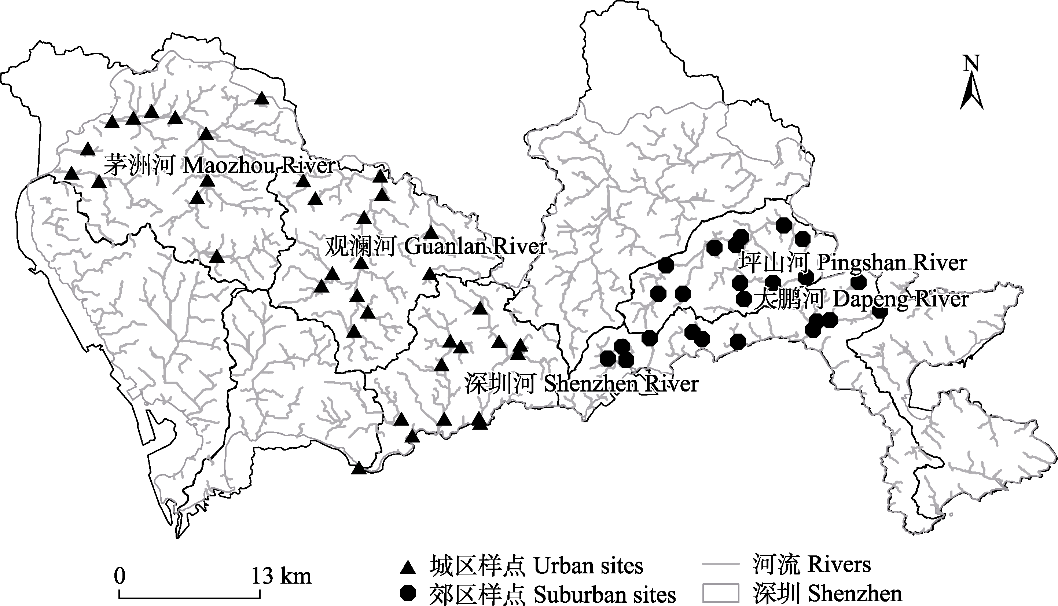
Fig. 1 Localities of 62 sampling sites across five rivers with different levels of urbanization in Shenzhen area
| 功能性状 Functional trait | 功能性状类别 Functional trait categories |
|---|---|
| 化性 Voltinism | 少于1世代 Semivoltine (< 1 generation/year) |
| 1世代 Univoltine (1 generation/year) | |
| 多于1世代 Multivoltine (> 1 generation/year) | |
| 生长发育速率 Development rate | 快季节性 Fast seasonal |
| 慢季节性 Slow seasonal | |
| 无季节性 Nonseasonal | |
| 成虫寿命 Adult life span | 极短(小于1周) Very short (< 1 week) |
| 短(小于1月) Short (< 1 month) | |
| 长(长于1月) Long (> 1 month) | |
| 身体大小 Body size | 小型 Small (< 9 mm) |
| 中型 Medium (9-16 mm) | |
| 大型 Large (> 16 mm) | |
| 漂流性 Drift | 极少 Rare |
| 一般 Common | |
| 较多 Abundant | |
| 生活型 Habit | 掘穴者 Burrower |
| 攀附者 Climber | |
| 爬行者 Sprawler | |
| 附着者 Clinger | |
| 游泳者 Swimmer | |
| 呼吸方式 Respiration | 表皮呼吸 Respiration tegument |
| 鳃呼吸 Gills | |
| 气管、气门和气膜 Spiracles, tracheae, plastrons | |
| 功能摄食类群 Functional feeding group | 直接收集者 Collector-gatherer |
| 过滤收集者 Collector-filterer | |
| 植食者/刮食者 Herbivore/Scraper | |
| 捕食者 Predator | |
| 撕食者 Shredder |
Table 1 Functional traits and trait categories of the macroinvertebrates
| 功能性状 Functional trait | 功能性状类别 Functional trait categories |
|---|---|
| 化性 Voltinism | 少于1世代 Semivoltine (< 1 generation/year) |
| 1世代 Univoltine (1 generation/year) | |
| 多于1世代 Multivoltine (> 1 generation/year) | |
| 生长发育速率 Development rate | 快季节性 Fast seasonal |
| 慢季节性 Slow seasonal | |
| 无季节性 Nonseasonal | |
| 成虫寿命 Adult life span | 极短(小于1周) Very short (< 1 week) |
| 短(小于1月) Short (< 1 month) | |
| 长(长于1月) Long (> 1 month) | |
| 身体大小 Body size | 小型 Small (< 9 mm) |
| 中型 Medium (9-16 mm) | |
| 大型 Large (> 16 mm) | |
| 漂流性 Drift | 极少 Rare |
| 一般 Common | |
| 较多 Abundant | |
| 生活型 Habit | 掘穴者 Burrower |
| 攀附者 Climber | |
| 爬行者 Sprawler | |
| 附着者 Clinger | |
| 游泳者 Swimmer | |
| 呼吸方式 Respiration | 表皮呼吸 Respiration tegument |
| 鳃呼吸 Gills | |
| 气管、气门和气膜 Spiracles, tracheae, plastrons | |
| 功能摄食类群 Functional feeding group | 直接收集者 Collector-gatherer |
| 过滤收集者 Collector-filterer | |
| 植食者/刮食者 Herbivore/Scraper | |
| 捕食者 Predator | |
| 撕食者 Shredder |
| 环境变量 Environmental variables | 丰水期 Wet season | 枯水期 Dry season | ||||||
|---|---|---|---|---|---|---|---|---|
| 城区样点 Urban sites | 郊区样点 Suburban sites | W | P | 城区样点 Urban sites | 郊区样点 Suburban sites | W | P | |
| 水温 Water temperature (WT) (℃) | 28.79 ± 4.14 | 28.23 ± 2.50 | 608 | < 0.05 | 21.63 ± 2.53 | 21.29 ± 2.91 | 484 | > 0.05 |
| 浊度 Turbidity (NTU) | 46.72 ± 60.13 | 24.93 ± 29.10 | 589 | > 0.05 | 11.50 ± 14.82 | 6.64 ± 6.99 | 602 | < 0.05 |
| 河宽 River width (RW) (m) | 52.42 ± 54.56 | 20.73 ± 15.68 | 637 | < 0.01 | 27.16 ± 22.33 | 11.28 ± 8.80 | 692 | < 0.001 |
| 水深 Water depth (WD) (m) | 0.99 ± 1.28 | 0.32 ± 0.19 | 576 | > 0.05 | 0.59 ± 0.85 | 0.27 ± 0.17 | 578 | > 0.05 |
| 流速 Velocity (m/s) | 0.18 ± 0.14 | 0.34 ± 0.20 | 232 | < 0.01 | 0.24 ± 0.21 | 0.28 ± 0.17 | 359 | > 0.05 |
| 大石占比 Percentage of boulder (%) | 1.05 ± 4.37 | 23.33 ± 33.84 | 252 | < 0.001 | 0.92 ± 3.65 | 24.17 ± 35.86 | 271 | < 0.001 |
| 鹅卵石占比 Percentage of cobble (%) | 5.26 ± 17.78 | 22.50 ± 31.35 | 304 | < 0.01 | 5.26 ± 18.12 | 17.71 ± 25.45 | 285 | < 0.01 |
| 圆石占比 Percentage of pebble (%) | 7.24 ± 19.27 | 11.88 ± 13.25 | 296 | < 0.01 | 6.32 ± 18.59 | 14.58 ± 15.94 | 298 | < 0.01 |
| 碎石占比 Percentage of gravel (%) | 11.05 ± 22.12 | 6.88 ± 9.76 | 456 | > 0.05 | 9.21 ± 21.76 | 6.88 ± 10.82 | 429 | > 0.05 |
| 砂和淤泥占比 Percentage of sand and silt (%) | 75.39 ± 38.40 | 35.42 ± 43.26 | 680 | < 0.001 | 78.29 ± 37.24 | 36.67 ± 41.88 | 673 | < 0.001 |
| 底质异质性指数 Substrate heterogeneity index | 0.15 ± 0.12 | 0.34 ± 0.28 | 276 | < 0.01 | 0.12 ± 0.20 | 0.36 ± 0.30 | 276 | < 0.01 |
| 溶解氧 Dissolved oxygen (DO) (mg/L) | 4.30 ± 2.19 | 7.00 ± 1.02 | 108 | < 0.001 | 5.21 ± 2.14 | 6.83 ± 1.49 | 249 | < 0.01 |
| pH | 7.36 ± 0.36 | 7.21 ± 0.25 | 572 | > 0.05 | 7.63 ± 0.90 | 7.85 ± 0.46 | 398 | > 0.05 |
| 电导率 Conductivity (µS/cm) | 500.68 ± 277.00 | 111.40 ± 104.96 | 878 | < 0.001 | 627.60 ± 833.50 | 414.78 ± 1,249.15 | 795 | < 0.001 |
| 高锰酸盐指数 Permanganate index (PI) (mg/L) | 3.82 ± 2.33 | 1.81 ± 0.51 | 804 | < 0.001 | 3.16 ± 0.89 | 1.62 ± 0.80 | 822 | < 0.001 |
| 化学需氧量 Chemical oxygen demand (CODGr) (mg/L) | 17.95 ± 16.98 | 7.24 ± 2.53 | 779 | < 0.001 | 11.56 ± 5.12 | 9.01 ± 4.42 | 621 | < 0.05 |
| 五日生化需氧量 Five-day biochemical oxygen demand (BOD5) (mg/L) | 4.03 ± 5.72 | 0.81 ± 0.63 | 841 | < 0.001 | 2.21 ± 1.02 | 1.99 ± 1.58 | 552 | > 0.05 |
| 铵氮 Ammonium nitrogen (NH4+-N) (mg/L) | 3.36 ± 4.64 | 0.21 ± 0.28 | 863 | < 0.001 | 0.85 ± 0.65 | 0.68 ± 1.07 | 631 | < 0.05 |
| 总磷 Total phosphorus (TP) (mg/L) | 0.41 ± 0.47 | 0.04 ± 0.05 | 832 | < 0.001 | 0.20 ± 0.10 | 0.07 ± 0.08 | 756 | < 0.001 |
| 总氮 Total nitrogen (TN) (mg/L) | 7.66 ± 4.40 | 0.78 ± 0.64 | 894 | < 0.001 | 8.51 ± 4.57 | 1.58 ± 1.79 | 848 | < 0.001 |
Table 2 Local physical environmental and water chemical variables across urban and suburban river sites during the wet season and dry season in Shenzhen area (mean ± SD)
| 环境变量 Environmental variables | 丰水期 Wet season | 枯水期 Dry season | ||||||
|---|---|---|---|---|---|---|---|---|
| 城区样点 Urban sites | 郊区样点 Suburban sites | W | P | 城区样点 Urban sites | 郊区样点 Suburban sites | W | P | |
| 水温 Water temperature (WT) (℃) | 28.79 ± 4.14 | 28.23 ± 2.50 | 608 | < 0.05 | 21.63 ± 2.53 | 21.29 ± 2.91 | 484 | > 0.05 |
| 浊度 Turbidity (NTU) | 46.72 ± 60.13 | 24.93 ± 29.10 | 589 | > 0.05 | 11.50 ± 14.82 | 6.64 ± 6.99 | 602 | < 0.05 |
| 河宽 River width (RW) (m) | 52.42 ± 54.56 | 20.73 ± 15.68 | 637 | < 0.01 | 27.16 ± 22.33 | 11.28 ± 8.80 | 692 | < 0.001 |
| 水深 Water depth (WD) (m) | 0.99 ± 1.28 | 0.32 ± 0.19 | 576 | > 0.05 | 0.59 ± 0.85 | 0.27 ± 0.17 | 578 | > 0.05 |
| 流速 Velocity (m/s) | 0.18 ± 0.14 | 0.34 ± 0.20 | 232 | < 0.01 | 0.24 ± 0.21 | 0.28 ± 0.17 | 359 | > 0.05 |
| 大石占比 Percentage of boulder (%) | 1.05 ± 4.37 | 23.33 ± 33.84 | 252 | < 0.001 | 0.92 ± 3.65 | 24.17 ± 35.86 | 271 | < 0.001 |
| 鹅卵石占比 Percentage of cobble (%) | 5.26 ± 17.78 | 22.50 ± 31.35 | 304 | < 0.01 | 5.26 ± 18.12 | 17.71 ± 25.45 | 285 | < 0.01 |
| 圆石占比 Percentage of pebble (%) | 7.24 ± 19.27 | 11.88 ± 13.25 | 296 | < 0.01 | 6.32 ± 18.59 | 14.58 ± 15.94 | 298 | < 0.01 |
| 碎石占比 Percentage of gravel (%) | 11.05 ± 22.12 | 6.88 ± 9.76 | 456 | > 0.05 | 9.21 ± 21.76 | 6.88 ± 10.82 | 429 | > 0.05 |
| 砂和淤泥占比 Percentage of sand and silt (%) | 75.39 ± 38.40 | 35.42 ± 43.26 | 680 | < 0.001 | 78.29 ± 37.24 | 36.67 ± 41.88 | 673 | < 0.001 |
| 底质异质性指数 Substrate heterogeneity index | 0.15 ± 0.12 | 0.34 ± 0.28 | 276 | < 0.01 | 0.12 ± 0.20 | 0.36 ± 0.30 | 276 | < 0.01 |
| 溶解氧 Dissolved oxygen (DO) (mg/L) | 4.30 ± 2.19 | 7.00 ± 1.02 | 108 | < 0.001 | 5.21 ± 2.14 | 6.83 ± 1.49 | 249 | < 0.01 |
| pH | 7.36 ± 0.36 | 7.21 ± 0.25 | 572 | > 0.05 | 7.63 ± 0.90 | 7.85 ± 0.46 | 398 | > 0.05 |
| 电导率 Conductivity (µS/cm) | 500.68 ± 277.00 | 111.40 ± 104.96 | 878 | < 0.001 | 627.60 ± 833.50 | 414.78 ± 1,249.15 | 795 | < 0.001 |
| 高锰酸盐指数 Permanganate index (PI) (mg/L) | 3.82 ± 2.33 | 1.81 ± 0.51 | 804 | < 0.001 | 3.16 ± 0.89 | 1.62 ± 0.80 | 822 | < 0.001 |
| 化学需氧量 Chemical oxygen demand (CODGr) (mg/L) | 17.95 ± 16.98 | 7.24 ± 2.53 | 779 | < 0.001 | 11.56 ± 5.12 | 9.01 ± 4.42 | 621 | < 0.05 |
| 五日生化需氧量 Five-day biochemical oxygen demand (BOD5) (mg/L) | 4.03 ± 5.72 | 0.81 ± 0.63 | 841 | < 0.001 | 2.21 ± 1.02 | 1.99 ± 1.58 | 552 | > 0.05 |
| 铵氮 Ammonium nitrogen (NH4+-N) (mg/L) | 3.36 ± 4.64 | 0.21 ± 0.28 | 863 | < 0.001 | 0.85 ± 0.65 | 0.68 ± 1.07 | 631 | < 0.05 |
| 总磷 Total phosphorus (TP) (mg/L) | 0.41 ± 0.47 | 0.04 ± 0.05 | 832 | < 0.001 | 0.20 ± 0.10 | 0.07 ± 0.08 | 756 | < 0.001 |
| 总氮 Total nitrogen (TN) (mg/L) | 7.66 ± 4.40 | 0.78 ± 0.64 | 894 | < 0.001 | 8.51 ± 4.57 | 1.58 ± 1.79 | 848 | < 0.001 |
| 土地利用 Land-use types | 城区样点 Urban sites | 郊区样点 Suburban sites | W | P |
|---|---|---|---|---|
| 耕地 Farmland (%) | 0.44 ± 2.70 | 4.21 ± 7.82 | 262 | < 0.001 |
| 草地 Grassland (%) | 16.03 ± 11.16 | 11.35 ± 15.68 | 598 | < 0.05 |
| 水体 Water (%) | 4.84 ± 9.76 | 0.64 ± 1.68 | 616 | < 0.01 |
| 裸地 Bareland (%) | 0.22 ± 0.82 | 0.93 ± 1.56 | 358 | < 0.05 |
| 城市用地 Urban land (%) | 64.66 ± 26.55 | 34.57 ± 29.48 | 704 | < 0.001 |
| 林地 Forest (%) | 11.50 ± 21.34 | 47.68 ± 38.18 | 196 | < 0.001 |
| 其他不透水面 Other impervious surfaces (%) | 2.33 ± 10.56 | 0.65 ± 1.42 | 437 | > 0.05 |
Table 3 Land-use variables across urban and suburban river sites in Shenzhen area (mean ± SD)
| 土地利用 Land-use types | 城区样点 Urban sites | 郊区样点 Suburban sites | W | P |
|---|---|---|---|---|
| 耕地 Farmland (%) | 0.44 ± 2.70 | 4.21 ± 7.82 | 262 | < 0.001 |
| 草地 Grassland (%) | 16.03 ± 11.16 | 11.35 ± 15.68 | 598 | < 0.05 |
| 水体 Water (%) | 4.84 ± 9.76 | 0.64 ± 1.68 | 616 | < 0.01 |
| 裸地 Bareland (%) | 0.22 ± 0.82 | 0.93 ± 1.56 | 358 | < 0.05 |
| 城市用地 Urban land (%) | 64.66 ± 26.55 | 34.57 ± 29.48 | 704 | < 0.001 |
| 林地 Forest (%) | 11.50 ± 21.34 | 47.68 ± 38.18 | 196 | < 0.001 |
| 其他不透水面 Other impervious surfaces (%) | 2.33 ± 10.56 | 0.65 ± 1.42 | 437 | > 0.05 |
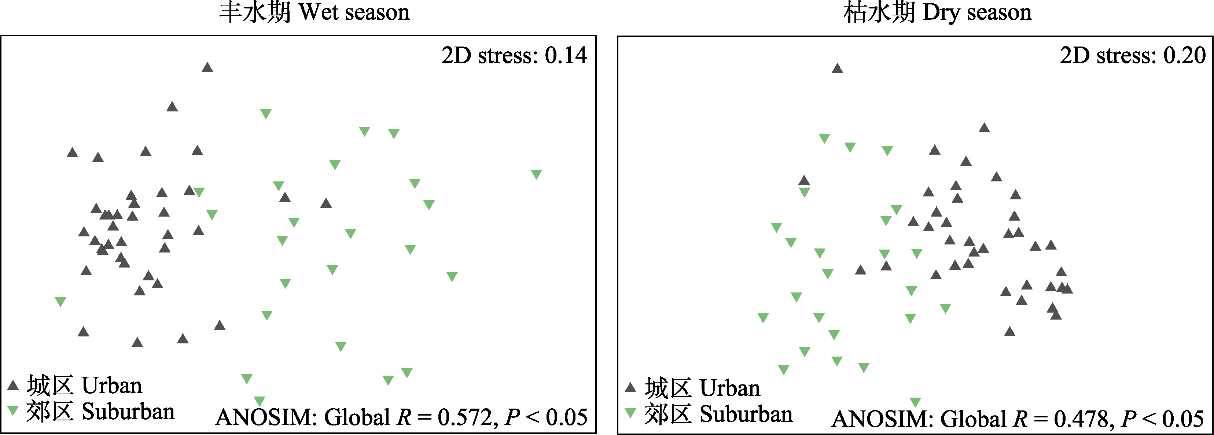
Fig. 2 Non-metric multidimensional scaling (NMDS) of macroinvertebrate communities in urban and suburban rivers during wet season and dry season in Shenzhen area
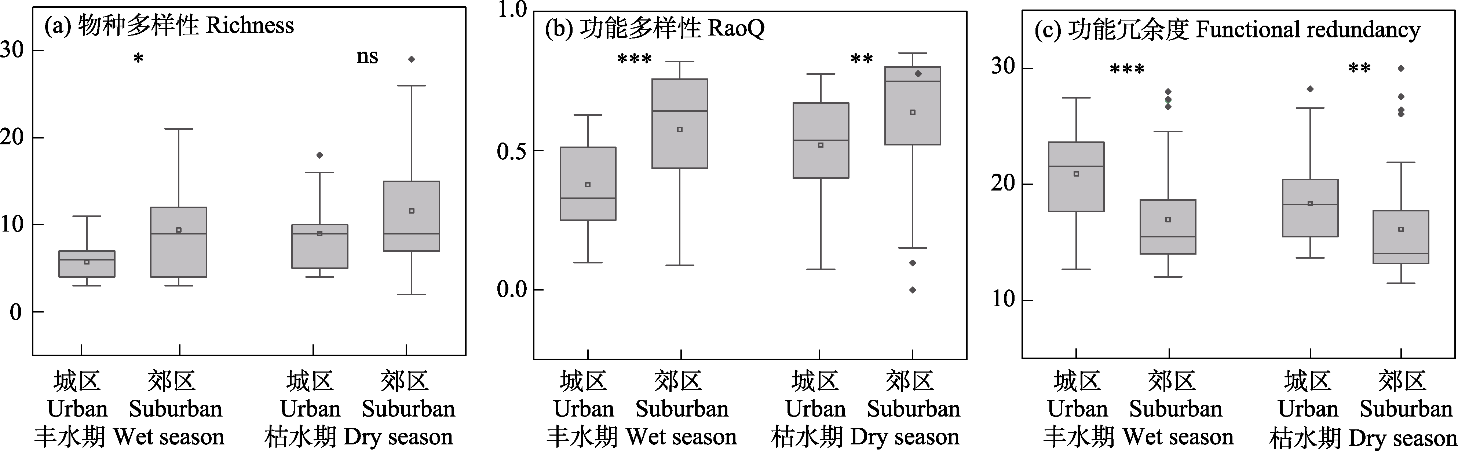
Fig. 3 Taxonomic diversity (richness), functional diversity (RaoQ) and functional redundancy of macroinvertebrate communities in the urban and suburban rivers during wet season and dry season in Shenzhen area. * P < 0.05; ** P < 0.01; *** P < 0.001.
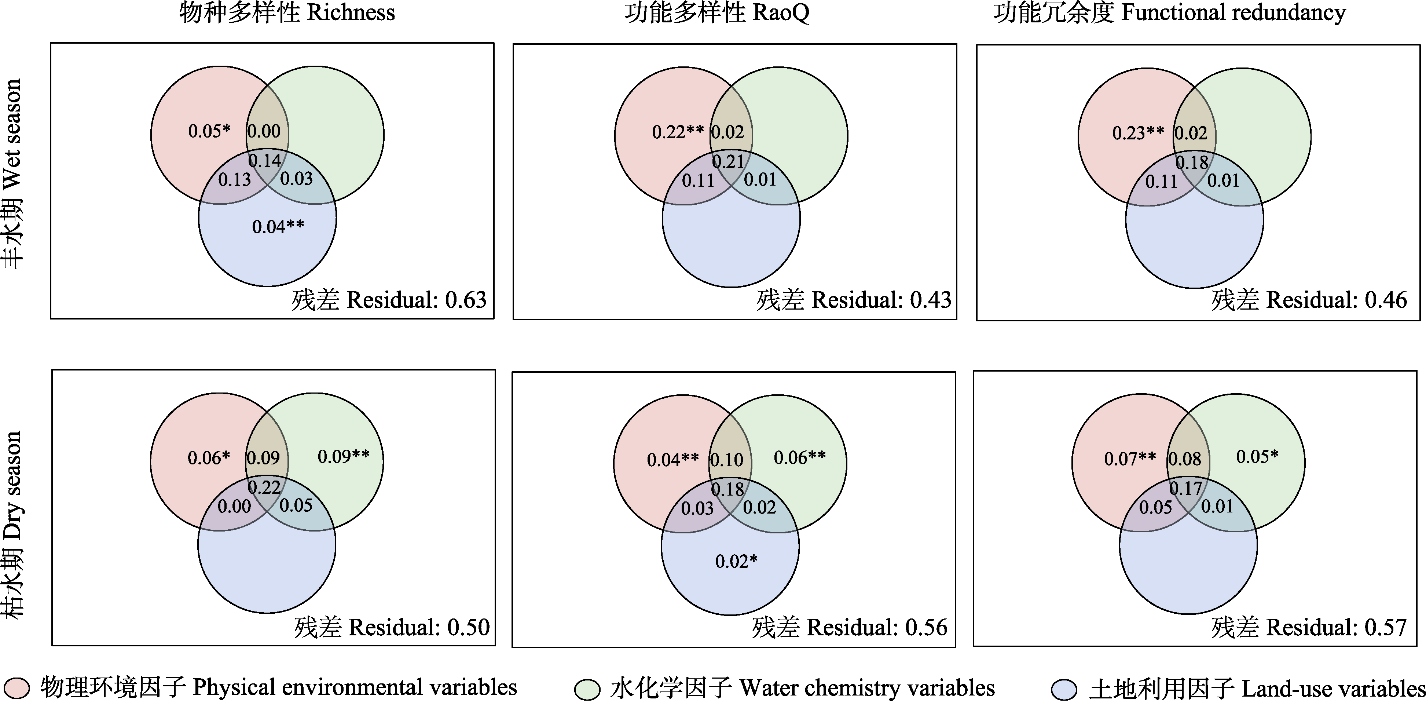
Fig. 4 Variation in taxonomic diversity (richness), functional diversity (RaoQ) and functional redundancy of macroinvertebrate communities explained by local physical environment, water chemistry, and land-use variables during wet season and dry season
| 丰水期 Wet season | 枯水期 Dry season | |||
|---|---|---|---|---|
| 关键变量 Key variables | Adjust R2 | 关键变量 Key variables | Adjust R2 | |
| 物种多样性 Richness | 鹅卵石占比, 河宽, 流速 % cobble, river width, and velocity | 0.32 | 底质异质性, 大石占比 Substrate heterogeneity index and % boulder | 0.37 |
| 高锰酸盐指数 Permanganate index | 0.18 | 高锰酸盐指数, 电导率 Permanganate index and conductivity | 0.45 | |
| 城市用地占比, 水体占比 % urban land and % water | 0.34 | 城市用地占比, 水体占比, 裸地占比 % urban land, % water, and % bareland | 0.26 | |
| 功能多样性 RaoQ | 水深, 大石占比, 鹅卵石占比 Water depth, % boulder, and % cobble | 0.56 | 河宽, 砂和淤泥占比 River width and % sand and silt | 0.35 |
| 总氮 Total nitrogen | 0.24 | 高锰酸盐指数 Permanganate index | 0.36 | |
| 城市用地占比, 水体占比 % urban land and % water | 0.33 | 水体占比, 草地占比 % water and % grassland | 0.25 | |
| 功能冗余度 Functional redundancy | 水深, 大石占比, 鹅卵石占比 River depth, % boulder, and % cobble | 0.54 | 河宽, 砂和淤泥占比, 水深 River width, % sand and silt, and river depth | 0.37 |
| 总氮 Total nitrogen | 0.21 | 高锰酸盐指数 Permanganate index | 0.31 | |
| 城市用地占比, 水体占比 % urban land and % water | 0.29 | 水体占比, 草地占比 % water and % grassland | 0.23 | |
Table 4 Summary of the forward selection procedure, showing significant local physical environmental, water chemistry and land-use variables correlated with taxonomic diversity (richness), functional diversity (RaoQ) and functional redundancy indices of macroinvertebrate communities
| 丰水期 Wet season | 枯水期 Dry season | |||
|---|---|---|---|---|
| 关键变量 Key variables | Adjust R2 | 关键变量 Key variables | Adjust R2 | |
| 物种多样性 Richness | 鹅卵石占比, 河宽, 流速 % cobble, river width, and velocity | 0.32 | 底质异质性, 大石占比 Substrate heterogeneity index and % boulder | 0.37 |
| 高锰酸盐指数 Permanganate index | 0.18 | 高锰酸盐指数, 电导率 Permanganate index and conductivity | 0.45 | |
| 城市用地占比, 水体占比 % urban land and % water | 0.34 | 城市用地占比, 水体占比, 裸地占比 % urban land, % water, and % bareland | 0.26 | |
| 功能多样性 RaoQ | 水深, 大石占比, 鹅卵石占比 Water depth, % boulder, and % cobble | 0.56 | 河宽, 砂和淤泥占比 River width and % sand and silt | 0.35 |
| 总氮 Total nitrogen | 0.24 | 高锰酸盐指数 Permanganate index | 0.36 | |
| 城市用地占比, 水体占比 % urban land and % water | 0.33 | 水体占比, 草地占比 % water and % grassland | 0.25 | |
| 功能冗余度 Functional redundancy | 水深, 大石占比, 鹅卵石占比 River depth, % boulder, and % cobble | 0.54 | 河宽, 砂和淤泥占比, 水深 River width, % sand and silt, and river depth | 0.37 |
| 总氮 Total nitrogen | 0.21 | 高锰酸盐指数 Permanganate index | 0.31 | |
| 城市用地占比, 水体占比 % urban land and % water | 0.29 | 水体占比, 草地占比 % water and % grassland | 0.23 | |
| [1] |
Allan JD (2004) Landscapes and riverscapes: The influence of land use on stream ecosystems. Annual Review of Ecology, Evolution, and Systematics, 35, 257-284.
DOI URL |
| [2] |
Ao SC, Chiu MC, Lin XW, Cai QH (2023) Trait selection strategy for functional diversity in freshwater systems: A case framework of macroinvertebrates. Ecological Indicators, 153, 110450.
DOI URL |
| [3] | Barbour MT, Gerritsen J, Snyder BD, Stribling J (1999) Rapid Bioassessment for Use in Streams and Wadable Rivers: Periphyton, Benthic Macroinvertebrates and Fish, 2nd edn. United States Environmental Protection Agency, Washington, DC. |
| [4] |
Barnum TR, Weller DE, Williams M (2017) Urbanization reduces and homogenizes trait diversity in stream macroinvertebrate communities. Ecological Applications, 27, 2428-2442.
DOI PMID |
| [5] |
Botta-Dukát Z (2005) Rao’s quadratic entropy as a measure of functional diversity based on multiple traits. Journal of Vegetation Science, 16, 533-540.
DOI URL |
| [6] | Brinkhurst RO (1986) Guide to the Freshwater Aquatic Microdrile Oligochaetes of North America. Department of Fisheries and Oceans, Ottawa. |
| [7] | Chen C, Zhu KP, Liu Y, Li JX, Tan Y, Wang L (2022) Composition and water ecology indication of functional feeding groups of zoobenthos in Liuxi River. Pearl River, 43(9), 1-10. (in Chinese with English abstract) |
| [陈慈, 朱昆鹏, 刘玥, 李佳旭, 谭颖, 王璐 (2022) 流溪河底栖动物功能摄食类群组成及其水生态指示作用. 人民珠江, 43(9), 1-10.] | |
| [8] | Chen YQ (2017) Functional diversity: A new view point in the relationship between biodiversity and ecosystem functioning research. Journal of Yunnan University (Natural Sciences Edition), 39, 1082-1088. (in Chinese with English abstract) |
| [陈又清 (2017) 功能多样性——生物多样性与生态系统功能关系研究的新视角. 云南大学学报(自然科学版), 39, 1082-1088.] | |
| [9] | Delettre Y, Tréhen P, Grootaert P (1992) Space heterogeneity, space use and short-range dispersal in Diptera: A case study. Landscape Ecology, 6, 175-181. |
| [10] |
Ding N, Yang WF, Zhou YL, González-Bergonzoni I, Zhang J, Chen K, Vidal N, Jeppesen E, Liu ZW, Wang BX (2017) Different responses of functional traits and diversity of stream macroinvertebrates to environmental and spatial factors in the Xishuangbanna watershed of the upper Mekong River Basin, China. Science of the Total Environment, 574, 288-299.
DOI URL |
| [11] | Du YZ (1995) Taxonomy of Perlidae from China (Placoptera: Perloidea). PhD dissertation, Northwest Agricultural University, Xianyang. (in Chinese with English abstract) |
| [杜予州 (1995) 中国襀科分类研究(襀翅目: 襀总科). 博士学位论文, 西北农业大学, 咸阳.] | |
| [12] | Epler JH (2001) Identification Manual for the Larval Chironomidae (Diptera) of North and South Carolina, Version 1.0. North Carolina Department of Environment and Natural Resources, Division of Water Quality, North Carolina. |
| [13] |
Firmiano KR, Castro DMP, Linares MS, Callisto M (2020) Functional responses of aquatic invertebrates to anthropogenic stressors in riparian zones of Neotropical savanna streams. Science of the Total Environment, 753, 141865.
DOI URL |
| [14] |
Gál B, Szivák I, Heino J, Schmera D (2019) The effect of urbanization on freshwater macroinvertebrates—Knowledge gaps and future research directions. Ecological Indicators, 104, 357-364.
DOI URL |
| [15] | Gao J (2023) The Effects and Mechanisms of Land Use on Taxonomic and Functional Diversity of Macroinvertebrate Assemblages in Qiantang River Streams. PhD dissertation, Nanjing Agricultural University, Nanjing. (in Chinese with English abstract) |
| [高晋 (2023) 土地利用对钱塘江溪流底栖动物群落物种和功能多样性的影响及机制. 博士学位论文, 南京农业大学, 南京.] | |
| [16] | Gao WQ, Lu Y, Qu X, Liu H, Xin W, Yu WJ, Zhou WQ, Wang WM, Chen YS (2021) River habitat assessment under urbanization: A case study in Shenzhen. Acta Ecologica Sinica, 41, 8783-8793. (in Chinese with English abstract) |
| [高雯琪, 陆颖, 屈霄, 刘晗, 辛未, 虞文娟, 周伟奇, 王伟民, 陈宇顺 (2021) 城镇化背景下河流生境评价——以深圳市为例. 生态学报, 41, 8783-8793.] | |
| [17] | Guan ZY, Zheng XH, Huang SY, Lin JZ, Wen JY, Lai ZH, Zhou RJ, Xiao YD, Dong YB, Xu XX (2018) Macroinvertebrate community structure of Longgang River. Shandong Chemical Industry, 47(14), 188-190, 194. (in Chinese with English abstract) |
| [官昭瑛, 郑训皓, 黄思源, 林嘉智, 温俊颖, 赖震海, 周日建, 肖亚迪, 董一博, 徐晓霞 (2018) 龙岗河流域底栖动物群落结构. 山东化工, 47(14), 188-190, 194.] | |
| [18] | Han BP, Li QH, Xu YP, Tang QH (2022) Origin and development of gradient analysis for biological communities and the generalized dissimilarity modelling with its application. Journal of Guizhou Normal University (Natural Sciences), 40(2), 1-10. (in Chinese with English abstract) |
| [韩博平, 李秋华, 徐玉萍, 唐鹊辉 (2022) 生物群落梯度分析方法的由来、发展及广义非相似性模拟方法与应用. 贵州师范大学学报(自然科学版), 40(2), 1-10.] | |
| [19] | Harrell JFE (2023) Hmisc: Harrell Miscellaneous. R package version 4.7-2. https://CRAN.R-project.org/package=Hmisc. (accessed on 2025-03-10) |
| [20] |
Heino J, Tolonen KT (2017) Ecological drivers of multiple facets of beta diversity in a lentic macroinvertebrate metacommunity. Limnology and Oceanography, 62, 2431-2444.
DOI URL |
| [21] | Laliberté E, Legendre P, Shipley B (2014) FD: Measuring Functional Diversity (FD) from Multiple Traits, and Other Tools for Functional Ecology. R package version 1.0-12.3. https://cran.r-project.org/web/packages/FD. (accessed on 2025-03-16) |
| [22] |
Li ZF, Wang J, Liu ZY, Meng XL, Heino J, Jiang XK, Xiong X, Jiang XM, Xie ZC (2019) Different responses of taxonomic and functional structures of stream macroinvertebrate communities to local stressors and regional factors in a subtropical biodiversity hotspot. Science of the Total Environment, 655, 1288-1300.
DOI URL |
| [23] | Li ZF, Wang J, Xie ZC, Ding CZ, Jiang XM (2016) Relationship between zoobenthos biodiversity and environmental factors in Nanla River. Chinese Journal of Ecology, 35, 3364-3373. (in Chinese with English abstract) |
| [李正飞, 王军, 谢志才, 丁城志, 蒋小明 (2016) 南腊河底栖动物多样性与环境因子的关系. 生态学杂志, 35, 3364-3373.] | |
| [24] | Liang XQ (2004) Fauna Sinica∙Invertebrata (Vol. 36): Decapoda∙Atyidae. Science Press, Beijing. (in Chinese) |
| [梁象秋 (2004) 中国动物志∙无脊椎动物(第36卷): 十足目∙匙指虾科. 科学出版社, 北京.] | |
| [25] | Liu C, Liu XY, Zhou JC, Tan L, Liu ZY, Wang WM, Chen YS, Tang T (2022) Response of stream benthic algal diversity to urbanization: A case study in Shenzhen. Acta Ecologica Sinica, 42, 10041-10050. (in Chinese with English abstract) |
| [刘婵, 刘心怡, 周佳诚, 谭路, 刘振元, 王伟民, 陈宇顺, 唐涛 (2022) 河流着生藻类多样性对城镇化的响应——以深圳市为例. 生态学报, 42, 10041-10050.] | |
| [26] | Liu YY, Zhang WZ, Wang YX (1979) Economic Fauna of China:Freshwater Mollusk. Science Press, Beijing. (in Chinese) |
| [刘月英, 张文珍, 王耀先 (1979) 中国经济动物: 淡水软体动物. 科学出版社, 北京.] | |
| [27] | Liu YY, Zhang WZ, Wang YX (1993) Medical Malacology. China Ocean Press, Beijing. (in Chinese) |
| [刘月英, 张文珍, 王耀先 (1993) 医学贝类学. 海洋出版社, 北京.] | |
| [28] |
Liu ZY, Heino J, Ge YH, Zhou TT, Jiang YN, Mo YX, Cui YD, Wang WM, Chen YS, Zhang JQ, Xie ZC (2023) A refined functional group approach reveals novel insights into effects of urbanization on river macroinvertebrate communities. Landscape Ecology, 38, 3791-3808.
DOI |
| [29] |
Liu ZY, Heino J, Soininen J, Zhou TT, Wang WM, Cui YD, Chen YS, Li ZF, Zhang JQ, Xie ZC (2022a) Different responses of incidence-weighted and abundance-weighted multiple facets of macroinvertebrate beta diversity to urbanization in a subtropical river system. Ecological Indicators, 143, 109357.
DOI URL |
| [30] |
Liu ZY, Zhou TT, Heino J, Castro DMP, Cui YD, Li ZF, Wang WM, Chen YS, Xie ZC (2022b) Land conversion induced by urbanization leads to taxonomic and functional homogenization of a river macroinvertebrate metacommunity. Science of the Total Environment, 825, 153940.
DOI URL |
| [31] | Lundquist MJ, Zhu WX (2018) Aquatic insect functional diversity and nutrient content in urban streams in a medium-sized city. Ecosphere, 9, e02284. |
| [32] |
Luo K, Hu XB, He Q, Wu ZS, Cheng H, Hu ZL, Mazumder A (2018) Impacts of rapid urbanization on the water quality and macroinvertebrate communities of streams: A case study in Liangjiang New Area, China. Science of the Total Environment, 621, 1601-1614.
DOI URL |
| [33] |
Mason NWH, Mouillot D, Lee WG, Wilson JB (2005) Functional richness, functional evenness and functional divergence: The primary components of functional diversity. Oikos, 111, 112-118.
DOI URL |
| [34] | Morse JC, Yang L, Tian L (1994) Aquatic Insects of China Useful for Monitoring Water Quality. Hohai University Press, Nanjing. |
| [35] |
Mouillot D, Graham NAJ, Villéger S, Mason NWH, Bellwood DR (2013) A functional approach reveals community responses to disturbances. Trends in Ecology and Evolution, 28, 167-177.
DOI URL |
| [36] | Oksanen J, Blanchet FGB, Friendly MF, Kindt R, Legendre PM, Minchin PR, O’Hrar RB, Simpson GL, Solymos P, Stevns MHH, Szoecs E, Wagner H (2019) vegan: Community Ecology Package. R package version 2.5-7. https://CRAN.R-project.org/package=vegan. (accessed on 2025-03-16) |
| [37] |
Petchey OL, Gaston KJ (2006) Functional diversity: Back to basics and looking forward. Ecology Letters, 9, 741-758.
DOI PMID |
| [38] |
Poff NL, Olden JD, Vieira NKM, Finn DS, Simmons MP, Kondratieff BC (2006) Functional trait niches of North American lotic insects: Traits-based ecological applications in light of phylogenetic relationships. Journal of the North American Benthological Society, 25, 730-755.
DOI URL |
| [39] |
Qiao JL, Liu Y, Fu HX, Chu L, Yan YZ (2022) Urbanization affects the taxonomic and functional alpha and beta diversity of fish assemblages in streams of subtropical China. Ecological Indicators, 144, 109441.
DOI URL |
| [40] | Qu XD, Chen J, Chen HY, Zhang M, Peng WQ, Zhu L, Lei X (2021) Application of rapid bioassessment indices of macroinvertebrates in ecological evaluation of urban streams. Journal of Hydroecology, 42(3), 14-22. (in Chinese with English abstract) |
| [渠晓东, 陈军, 陈皓阳, 张敏, 彭文启, 朱磊, 雷璇 (2021) 大型底栖动物快速生物评价指数在城市河流生态评估中的应用. 水生态学杂志, 42(3), 14-22.] | |
| [41] | R Core Team (2024) R: A Language and Environment for Statistical Computing. R Foundation for Statistical Computing. https://www.R-project.org/. (accessed on 2024-12-22) |
| [42] |
Ricotta C, de Bello F, Moretti M, Caccianiga M, Cerabolini BEL, Pavoine S (2016) Measuring the functional redundancy of biological communities: A quantitative guide. Methods in Ecology and Evolution, 7, 1386-1395.
DOI URL |
| [43] |
Rosenfeld JS (2002) Functional redundancy in ecology and conservation. Oikos, 98, 156-162.
DOI URL |
| [44] |
Schmera D, Heino J, Podani J, Erős T, Dolédec S (2017) Functional diversity: A review of methodology and current knowledge in freshwater macroinvertebrate research. Hydrobiologia, 787, 27-44.
DOI URL |
| [45] | Southwood TRE (1977) Habitat, the templet for ecological strategies? Journal of Animal Ecology, 46, 337-365. |
| [46] | State Environmental Protection Administration (2002) The Water and Wastewater Monitoring Analysis Method, 4th edn. China Environmental Science Press, Beijing. (in Chinese) |
| [国家环境保护总局 (2002) 水和废水监测分析方法(第四版). 中国环境科学出版社, 北京.] | |
| [47] |
Talaga S, Dézerald O, Carteron A, Leroy C, Carrias JF, Céréghino R, Dejean A (2017) Urbanization impacts the taxonomic and functional structure of aquatic macroinvertebrate communities in a small Neotropical city. Urban Ecosystems, 20, 1001-1009.
DOI URL |
| [48] | Tan Y, Zheng XH, Chen C, Liu Y, Wang L, Guan ZY, Yang HJ, Han BP (2021) Temporal and spatial distributions of macroinvertebrates and their influencing environmental factors. Acta Ecologica Sinica, 41, 747-760. (in Chinese with English abstract) |
| [谭颖, 郑训皓, 陈慈, 刘玥, 王璐, 官昭瑛, 杨海军, 韩博平 (2021) 流溪河大型底栖动物群落的时空分布及其影响因子. 生态学报, 41, 747-760.] | |
| [49] |
Townsend CR, Hildrew AG (1994) Species traits in relation to a habitat templet for river systems. Freshwater Biology, 31, 265-275.
DOI URL |
| [50] |
Urban MC, Skelly DK, Burchsted D, Price W, Lowry S (2006) Stream communities across a rural-urban landscape gradient. Diversity and Distributions, 12, 337-350.
DOI URL |
| [51] |
Usseglio-Polatera P, Bournaud M, Richoux P, Tachet H (2000) Biological and ecological traits of benthic freshwater macroinvertebrates: Relationships and definition of groups with similar traits. Freshwater Biology, 43, 175-205.
DOI URL |
| [52] |
Verberk WCEP, Siepel H, Esselink H (2008) Applying life-history strategies for freshwater macroinvertebrates to lentic waters. Freshwater Biology, 53, 1739-1753.
DOI URL |
| [53] | Wang BX, Yang LF, Hu BJ, Shan LN (2005) A preliminary study on the assessment of stream ecosystem health in south of Anhui Province using Benthic-Index of Biotic Integrity. Acta Ecologica Sinica, 25, 1481-1490. (in Chinese with English abstract) |
| [王备新, 杨莲芳, 胡本进, 单林娜 (2005) 应用底栖动物完整性指数B-IBI评价溪流健康. 生态学报, 25, 1481-1490.] | |
| [54] | Wang HZ (2002) Studies on Taxonomy, Distribution and Ecology of Microdrile Oligochaetes of China, with descriptions of two new species from the vicinity of the Great Wall Station of China, Antarctica. Higher Education Press, Beijing. (in Chinese) |
| [王洪铸 (2002) 中国小蚓类研究: 附中国南极长城站附近地区两新种. 高等教育出版社, 北京.] | |
| [55] | Wang JC, Wang XH (2011) Tendipes in the North of China. China Yan Shi Press, Beijing. (in Chinese) |
| [王俊才, 王新华 (2011) 中国北方摇蚊幼虫. 中国言实出版社, 北京.] | |
| [56] |
Wang L, Li JX, Tan L, Han BP (2023) Seasonal patterns of functional alpha and beta redundancies of macroinvertebrates in a disturbed (sub)tropical river. Ecological Indicators, 146, 109777.
DOI URL |
| [57] | Wang Q, Pang X, Wang ZJ, Yuan XZ, Zhang YG (2017) Advances in research on the influence of urbanization on stream benthic macroinvertebrate communities. Acta Ecologica Sinica, 37, 6275-6288. (in Chinese with English abstract) |
| [王强, 庞旭, 王志坚, 袁兴中, 张耀光 (2017) 城市化对河流大型底栖动物群落的影响研究进展. 生态学报, 37, 6275-6288.] | |
| [58] |
Wu X, Liu XY, Liu C, Tan L, Chen YS, Tang T (2025) Eco-morphological traits inform responses of diatom assemblages to urbanization in rivers in China. Hydrobiologia, 852, 593-608.
DOI |
| [59] | Yang T (1996) Fauna Sinica∙Annelida∙Hirudinea. Science Press, Beijing. (in Chinese) |
| [杨潼 (1996) 中国动物志∙环节动物门∙蛭纲. 科学出版社, 北京.] | |
| [60] |
Zeni JO, Hoeinghaus DJ, Roa-Fuentes CA, Casatti L (2020) Stochastic species loss and dispersal limitation drive patterns of spatial and temporal beta diversity of fish assemblages in tropical agroecosystem streams. Hydrobiologia, 847, 3829-3843.
DOI |
| [61] | Zhang HM (2012) Systematic Study of Anisoptera Larvae in China (Insecta: Odonata). PhD dissertation, South China Agricultural University, Guangzhou. (in Chinese with English abstract) |
| [张浩淼 (2012) 中国差翅亚目稚虫的物种研究(昆虫纲: 蜻蜓目). 博士学位论文, 华南农业大学, 广州.] | |
| [62] | Zhou CF (2002) A Taxonomic Study on Mayflies from China’s Mainland (Insecta: Ephemeroptera). PhD dissertation, Nankai University, Tianjin. (in Chinese with English abstract) |
| [周长发 (2002) 中国大陆蜉蝣目分类研究. 博士学位论文, 南开大学, 天津.] |
| [1] | Luhong Wang, Bo Li, Panyan Yang, Jiaqin Huang, Yuting Xie, Xin Du, Yi Wen, Bin Wang. Effects of ecological factors on the multidimensional diversity of breeding birds communities in Sichuan Province [J]. Biodiv Sci, 2026, 34(4): 25464-. |
| [2] | Xiaoqiang Lu, Dan Rui, Jiangfeng Zhang, Bingxin Yin, Yulu Wang, Yuting Cen, Yichen Cui, Wanxia Yang. Impacts of nitrogen inputs-driven key ecological processes on biodiversity and their management implications [J]. Biodiv Sci, 2026, 34(2): 25368-. |
| [3] | Qilong Yu, Minhui Hao, Huaijiang He, Chunyu Zhang, Xiuhai Zhao. Relationships of biodiversity and productivity change with forest succession in Changbai Mountains: Insights from species, traits, and phylogeny [J]. Biodiv Sci, 2025, 33(8): 25060-. |
| [4] | Liu Zhixiang, Xie Hua, Zhang Hui, Huang Xiaolei. Functional diversity and regulation of cuticular hydrocarbons in social insects [J]. Biodiv Sci, 2025, 33(2): 24302-. |
| [5] | Xue Bai, Zhengfei Li, Yang Liu, Junqian Zhang, Duopeng Zhang, Xin Luo, Jiali Yang, Lina Du, Xuankong Jiang, Ruiwen Wu, Zhicai Xie. Species diversity and maintenance mechanisms of benthic macroinvertebrate assemblages in the Xijiang River [J]. Biodiv Sci, 2024, 32(7): 23499-. |
| [6] | Teng Wang, Chunhou Li, Guanghua Wang, Jinfa Zhao, Juan Shi, Hongyu Xie, Yong Liu, Yu Liu. Species composition and succession of coral reef fishes on Qilianyu Island, Xisha Islands [J]. Biodiv Sci, 2024, 32(6): 23481-. |
| [7] | Kexin Cao, Jingwen Wang, Guo Zheng, Pengfeng Wu, Yingbin Li, Shuyan Cui. Effects of precipitation regime change and nitrogen deposition on soil nematode diversity in the grassland of northern China [J]. Biodiv Sci, 2024, 32(3): 23491-. |
| [8] | Xingyu Wang, Jinghui Meng, Siyuan Ren, Yan Zhu. Relationship between biodiversity and aboveground biomass in the warm temperate deciduous broad-leaved forest of Donglingshan, Beijing [J]. Biodiv Sci, 2024, 32(12): 24230-. |
| [9] | Junhan Huang, Fandong Yu, Yuxiang Wang, Zhe Huang, Mingsi Zhang, Miao Fang, Lu Shu, Meng Xu, Hui Wei, Xuejie Wang, Dang’en Gu, Si Luo. The current status of invasive fish and their interrelationships with environmental factors in the middle and lower reaches of the Huadi River [J]. Biodiv Sci, 2024, 32(11): 24249-. |
| [10] | Yasu Cao, Min Fan, Yu Peng, Jiaxun Xin, Nanyi Peng. Effects of landscape pattern dynamics on plant species and functional diversity in Hunshandak Sandland [J]. Biodiv Sci, 2023, 31(8): 23048-. |
| [11] | Fayang Li, Yingyu Li, Wenni Jiang, Shuguang Liu, Chao Huo, Qiaoqi Sun, Hongfei Zou. How forest fires affect bird diversity over time in boreal forest interiors and edges in the Greater Khingan Mountains [J]. Biodiv Sci, 2023, 31(7): 22665-. |
| [12] | Xiaocheng Chen, Pengzhan Zhang, Bin Kang, Linshan Liu, Liang Zhao. Species and functional diversity of the passerine birds in the Tibetan Plateau based on specimens from the collection of Northwest Institute of Plateau Biology, Chinese Academy of Sciences [J]. Biodiv Sci, 2023, 31(5): 22638-. |
| [13] | Chang Deng, Jiewei Hao, De Gao, Mingxun Ren, Lina Zhang. Identification and protection of suitable habitat hotspots for threatened bryophytes in Hainan [J]. Biodiv Sci, 2023, 31(4): 22580-. |
| [14] | Wei Zhang, Dongdong Zhai, Fei Xiong, Hongyan Liu, Yuanyuan Chen, Ying Wang, Chuansong Liao, Xinbin Duan, Huiwu Tian, Huatang Deng, Daqing Chen. Community structure and functional diversity of fishes in the Three Gorges Reservoir [J]. Biodiv Sci, 2023, 31(2): 22136-. |
| [15] | Caifang Luo, Tao Yang, Qiuyu Zhang, Xinpei Wang, Zehao Shen. Plant functional traits, community functional diversity and their environmental determinants of the semi-humid evergreen broad-leaved forest in the Central Yunnan Plateau [J]. Biodiv Sci, 2023, 31(11): 23215-. |
| Viewed | ||||||
|
Full text |
|
|||||
|
Abstract |
|
|||||
Copyright © 2026 Biodiversity Science
Editorial Office of Biodiversity Science, 20 Nanxincun, Xiangshan, Beijing 100093, China
Tel: 010-62836137, 62836665 E-mail: biodiversity@ibcas.ac.cn

