

Biodiv Sci ›› 2026, Vol. 34 ›› Issue (7): 26044. DOI: 10.17520/biods.2026044 cstr: 32101.14.biods.2026044
• Technology and Methodology • Previous Articles Next Articles
Rigui Yi1,2( ), Delin Qi1, Shihai Zhu2, Tingting Yang1,2, Dan Liu1, Qiang Gao1, Mingzhe Xia1, Wei Wang1, Miaomiao Nie1, Junmei Jia1, Cunfang Zhang1,*()(
 )
Received:2026-02-08
Accepted:2026-06-14
Online:2026-07-20
Published:2026-09-21
Contact:
Cunfang Zhang
Supported by:Rigui Yi, Delin Qi, Shihai Zhu, Tingting Yang, Dan Liu, Qiang Gao, Mingzhe Xia, Wei Wang, Miaomiao Nie, Junmei Jia, Cunfang Zhang. Species identification of Triplophysa fishes based on Cyt b sequences: A comparison between phylogenetic and machine learning methods[J]. Biodiv Sci, 2026, 34(7): 26044.
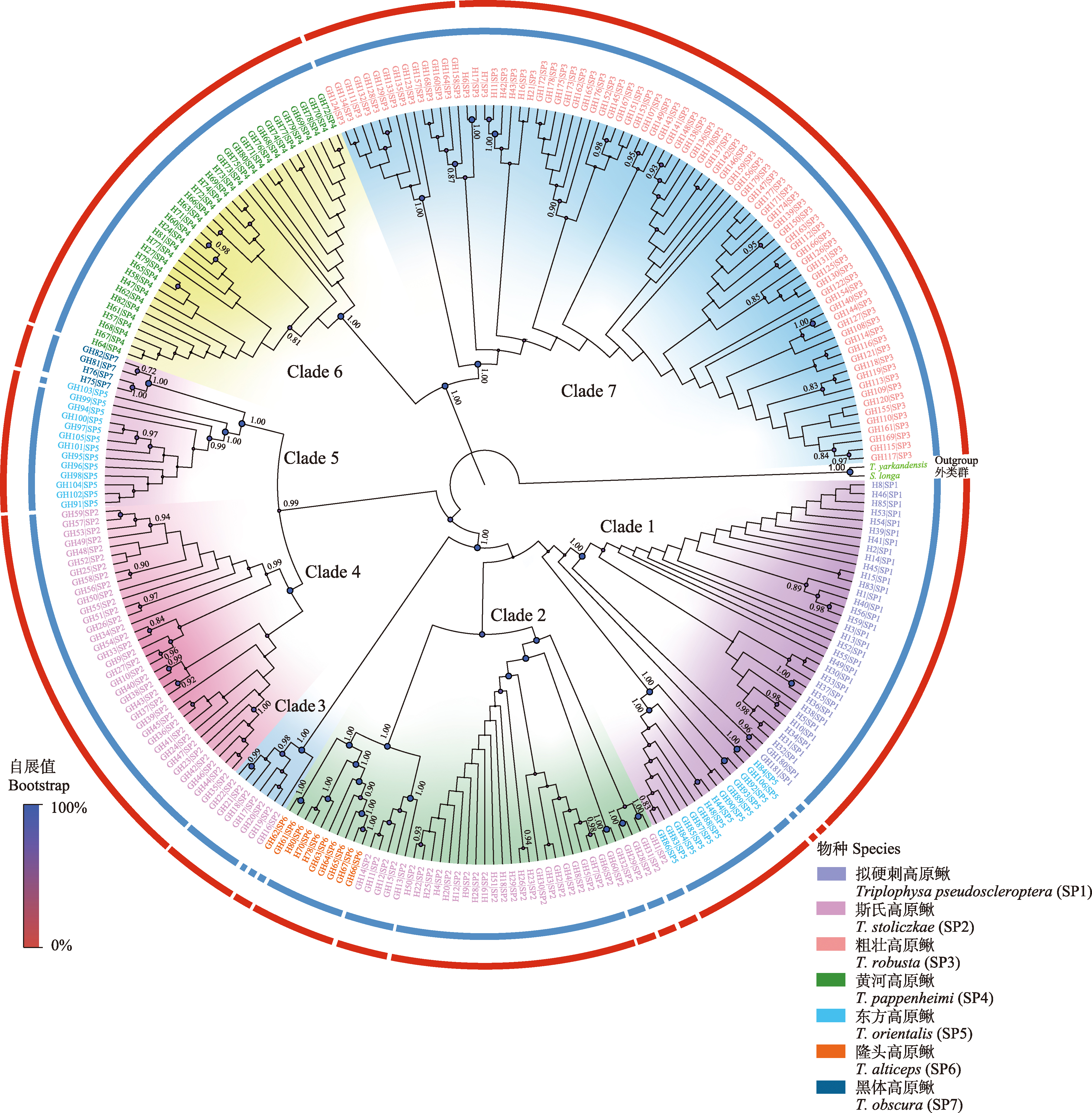
Fig. 1 Neighbor-joining (NJ) phylogenetic tree based on Cyt b sequences for seven Triplophysa species. Dots on the nodes represent bootstrap values, numbers on branches indicate Bayesian posterior probabilities, with only values ≥ 0.7 shown. Blue inner circle denotes the GMYC partitioning results. Red outer circle indicates the bPTP partitioning results. Outgroups, Hedinichthys yarkandensis and Schistura longa.
| 物种 Species | SP1 | SP2 | SP3 | SP4 | SP5 | SP6 | SP7 |
|---|---|---|---|---|---|---|---|
| SP1 | 0.0043 | - | - | - | - | - | - |
| SP2 | 0.1206 | 0.0929 | - | - | - | - | - |
| SP3 | 0.1875 | 0.1919 | 0.0074 | - | - | - | - |
| SP4 | 0.1687 | 0.1869 | 0.1198 | 0.0061 | - | - | - |
| SP5 | 0.1292 | 0.1414 | 0.1968 | 0.1853 | 0.0987 | - | - |
| SP6 | 0.0892 | 0.1024 | 0.1912 | 0.1745 | 0.1271 | 0.0127 | - |
| SP7 | 0.1630 | 0.1600 | 0.1920 | 0.1832 | 0.1059 | 0.1554 | 0.0059 |
Table 1 Genetic distances within-species (the diagonal) and between-species (below the diagonal) of seven Triplophysa species based on Cyt b gene
| 物种 Species | SP1 | SP2 | SP3 | SP4 | SP5 | SP6 | SP7 |
|---|---|---|---|---|---|---|---|
| SP1 | 0.0043 | - | - | - | - | - | - |
| SP2 | 0.1206 | 0.0929 | - | - | - | - | - |
| SP3 | 0.1875 | 0.1919 | 0.0074 | - | - | - | - |
| SP4 | 0.1687 | 0.1869 | 0.1198 | 0.0061 | - | - | - |
| SP5 | 0.1292 | 0.1414 | 0.1968 | 0.1853 | 0.0987 | - | - |
| SP6 | 0.0892 | 0.1024 | 0.1912 | 0.1745 | 0.1271 | 0.0127 | - |
| SP7 | 0.1630 | 0.1600 | 0.1920 | 0.1832 | 0.1059 | 0.1554 | 0.0059 |
| 指标 Indicator | 测试集 Test dataset | 训练集 Training dataset |
|---|---|---|
| 序列数 Number of sequences | 53 | 213 |
| 正确分类序列数 Number of correctly classified sequences | 51 | 213 |
| 正确分类序列占比 Percentage of correctly classified sequences (%) | 96.23 | 100.00 |
| 错误分类序列数 Number of misclassified sequences | 1 | 0 |
| 错误分类序列占比 Percentage of misclassified sequences (%) | 1.89 | 0 |
| 未分类序列数 Number of unclassified sequences | 1 | 0 |
| 未分类序列占比 Percentage of unclassified sequences (%) | 1.89 | 0 |
Table 2 Statistics of training and test datasets in BLOG
| 指标 Indicator | 测试集 Test dataset | 训练集 Training dataset |
|---|---|---|
| 序列数 Number of sequences | 53 | 213 |
| 正确分类序列数 Number of correctly classified sequences | 51 | 213 |
| 正确分类序列占比 Percentage of correctly classified sequences (%) | 96.23 | 100.00 |
| 错误分类序列数 Number of misclassified sequences | 1 | 0 |
| 错误分类序列占比 Percentage of misclassified sequences (%) | 1.89 | 0 |
| 未分类序列数 Number of unclassified sequences | 1 | 0 |
| 未分类序列占比 Percentage of unclassified sequences (%) | 1.89 | 0 |
| 物种 Species | 置信度 Confidence | 逻辑规则 Logical rules |
|---|---|---|
| SP1 | 0.824 | pos 849 = T and pos 1020 = C |
| SP2 | 0.909 | pos 258 = A and pos 753 = G and pos 873 = C |
| SP3 | 0.917 | pos 810 = A |
| SP4 | 0.838 | pos 810 = G |
| SP5 | 0.793 | pos 405 = A and pos 627 = T and pos 1020 = T |
| SP6 | 0.600 | pos 873 = A and pos 885 = G |
| SP7 | 0.400 | pos 141 = G |
Table 3 Logic rules in the form of diagnostic locus generated by BLOG for discriminating seven Triplophysa species
| 物种 Species | 置信度 Confidence | 逻辑规则 Logical rules |
|---|---|---|
| SP1 | 0.824 | pos 849 = T and pos 1020 = C |
| SP2 | 0.909 | pos 258 = A and pos 753 = G and pos 873 = C |
| SP3 | 0.917 | pos 810 = A |
| SP4 | 0.838 | pos 810 = G |
| SP5 | 0.793 | pos 405 = A and pos 627 = T and pos 1020 = T |
| SP6 | 0.600 | pos 873 = A and pos 885 = G |
| SP7 | 0.400 | pos 141 = G |
| 分类器 Classifier | 正确分类序列占比 Correctly classified instances (%) | 平均绝对误差 Mean absolute error (MAE) | 均方根误差 Root mean squared error (RMSE) |
|---|---|---|---|
| SMO | 100.00 | 0.2041 | 0.3011 |
| J48 | 98.87 | 0.0032 | 0.0568 |
| JRip | 98.50 | 0.0048 | 0.0662 |
| Naïve Bayes | 98.50 | 0.0056 | 0.0635 |
Table 4 Identification performance of different classifiers for seven Triplophysa species based on WEKA platform
| 分类器 Classifier | 正确分类序列占比 Correctly classified instances (%) | 平均绝对误差 Mean absolute error (MAE) | 均方根误差 Root mean squared error (RMSE) |
|---|---|---|---|
| SMO | 100.00 | 0.2041 | 0.3011 |
| J48 | 98.87 | 0.0032 | 0.0568 |
| JRip | 98.50 | 0.0048 | 0.0662 |
| Naïve Bayes | 98.50 | 0.0056 | 0.0635 |
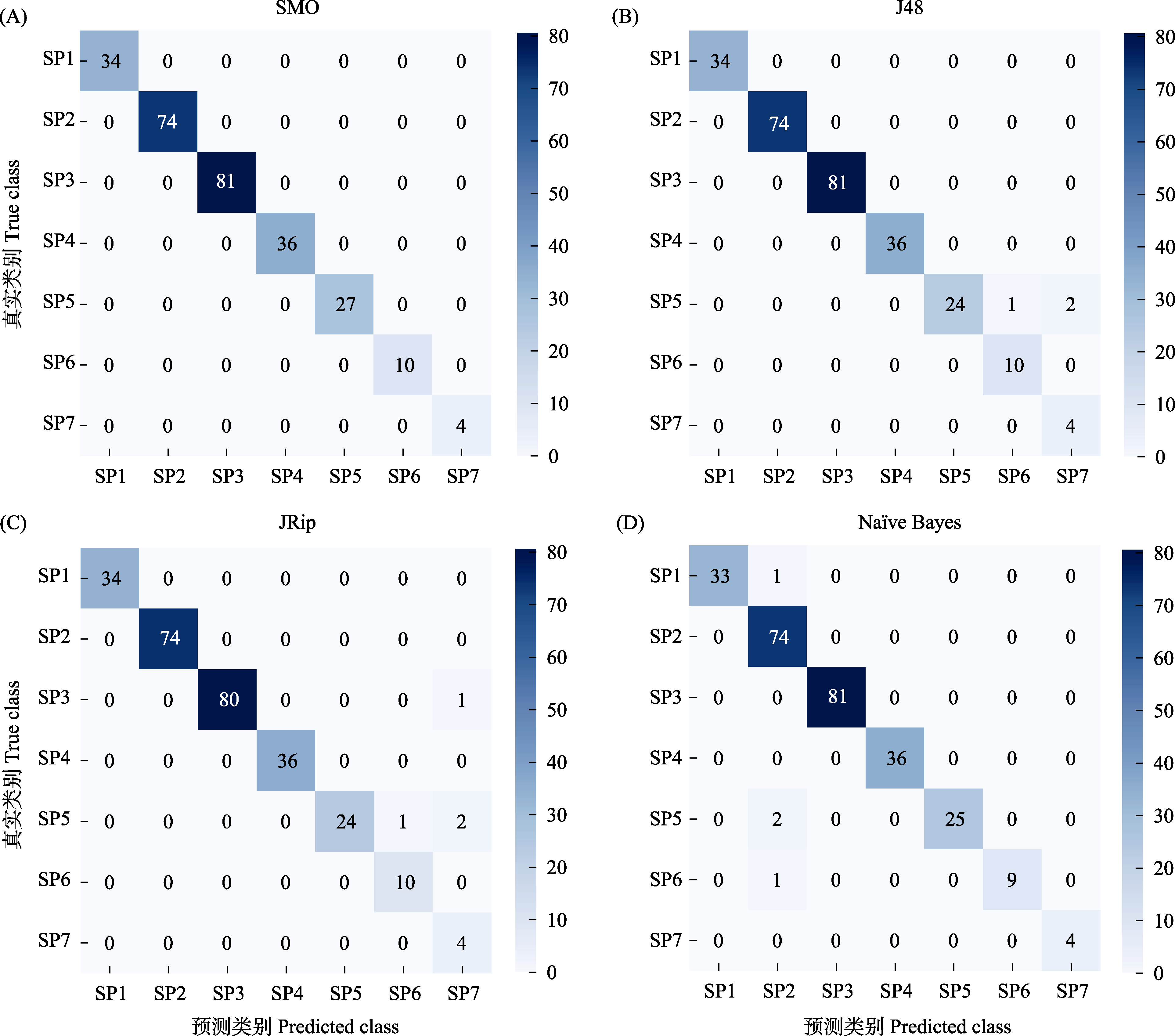
Fig. 2 Confusion matrix of WEKA four classifiers based on Cyt b sequences of seven Triplophysa species. Values on the diagonal, correctly classified samples. Off-diagonal values, misclassifications. Color intensity indicates sample size. SP1, T. pseudoscleroptera; SP2, T. stoliczkae; SP3, T. robusta; SP4, T. pappenheimi; SP5, T. orientalis; SP6, T. alticeps; SP7, T. obscura.
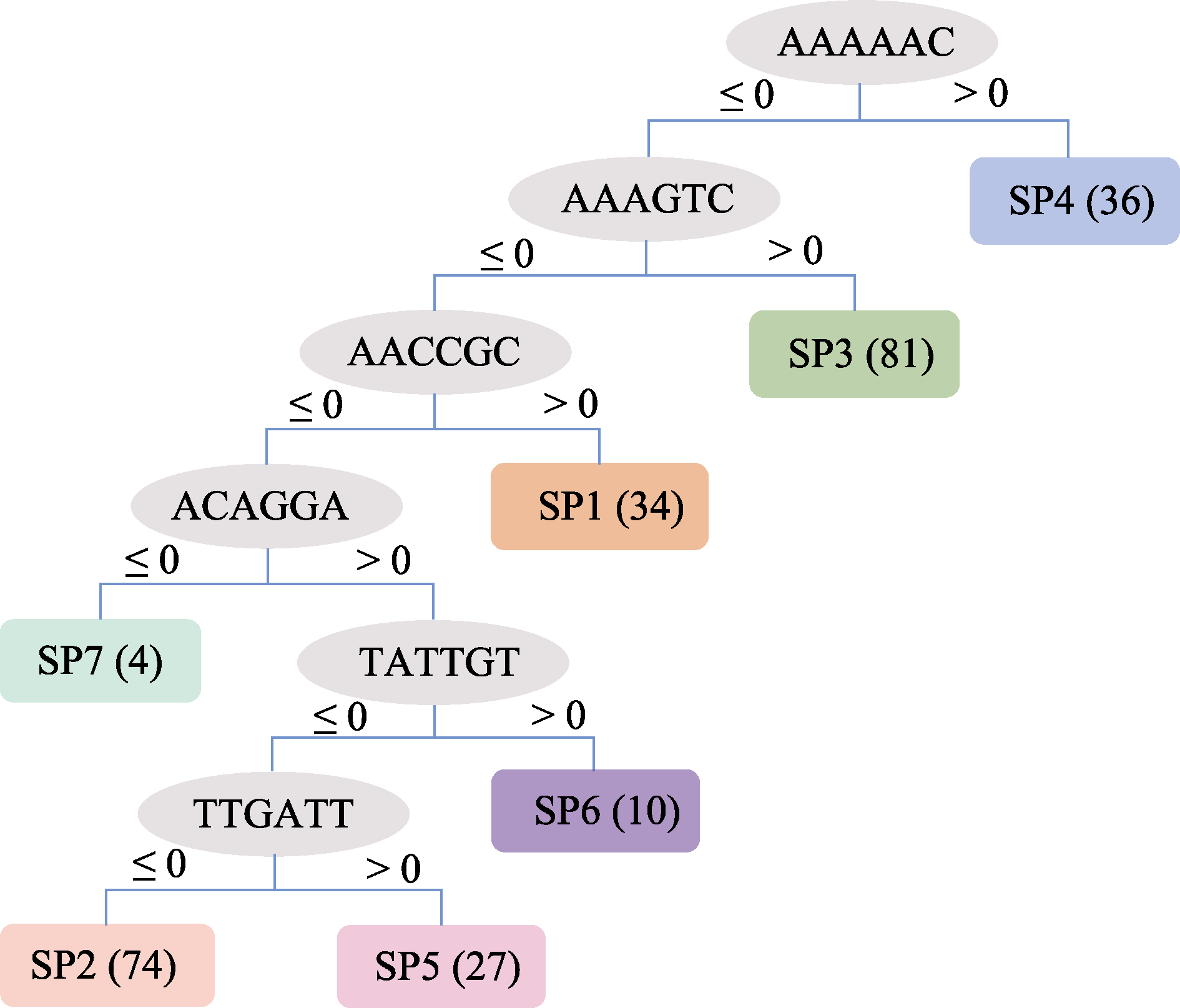
Fig. 3 Visualisation results of J48 decision tree for seven Triplophysa species based on Cyt b sequences. The number in parentheses at each leaf node represents the number of training samples reaching the node. SP1, T. pseudoscleroptera; SP2, T. stoliczkae; SP3, T. robusta; SP4, T. pappenheimi; SP5, T. orientalis; SP6, T. alticeps; SP7, T. obscura.
| [1] | Badirli S, Picard CJ, Mohler G, Akata Z, Dundar M (2021) Classifying the unknown: Identification of insects by deep open-set Bayesian learning. BioRxiv, doi:10.1101/2021.09.15.460492. |
| [2] | Blackman RC, Walser JC, Rüber L, Brantschen J, Villalba S, Brodersen J, Seehausen O, Altermatt F (2022) General principles for assignments of communities from eDNA: Open versus closed taxonomic databases. Environmental DNA, 5, 326-342. |
| [3] |
Bouckaert R, Vaughan TG, Barido-Sottani J, Duchêne S, Fourment M, Gavryushkina A, Heled J, Jones G, Kühnert D, De Maio N, Matschiner M, Mendes FK, Müller NF, Ogilvie HA, du Plessis L, Popinga A, Rambaut A, Rasmussen D, Siveroni I, Suchard MA, Wu CH, Xie D, Zhang C, Stadler T, Drummond AJ (2019) BEAST 2.5: An advanced software platform for Bayesian evolutionary analysis. PLoS Computational Biology, 15, e1006650.
DOI URL |
| [4] | Cao WX (2024) Fauna Sinica·Osteichthyes·Cypriniformes(Vol. 1). Science Press, Beijing. (in Chinese) |
| [曹文宣 (2024) 中国动物志·硬骨鱼纲·鲤形目(上卷). 科学出版社, 北京.] | |
| [5] |
Chen WX, Yang KX, Yu ZW, Shi YF, Chen CLP (2024) A survey on imbalanced learning: Latest research, applications and future directions. Artificial Intelligence Review, 57, 137.
DOI |
| [6] |
Córdova M, da Silva Torres R, van Helmond A, Kootstra G (2025) Novelty recognition: Fish species classification via open-set recognition. Sensors, 25, 1570.
DOI URL |
| [7] | Feng CG (2018) Biogeography and Population Genetics of Triplophysa Fish in the Northeastern Part of the Qinghai-Tibet Plateau. PhD dissertation, Northwest Institute of Plateau Biology, Chinese Academy of Sciences, Xining. (in Chinese with English abstract) |
| [冯晨光 (2018) 青藏高原东北部高原鳅属鱼类的生物地理与群体遗传学研究. 博士学位论文, 中国科学院西北高原生物研究所, 西宁.] | |
| [8] |
Feng CG, Zhou WW, Tang YT, Gao Y, Chen JM, Tong C, Liu SJ, Wanghe K, Zhao K (2019) Molecular systematics of the Triplophysa robusta (Cobitoidea) complex: Extensive gene flow in a depauperate lineage. Molecular Phylogenetics and Evolution, 132, 275-283.
DOI URL |
| [9] |
Flück B, Mathon L, Manel S, Valentini A, Dejean T, Albouy C, Mouillot D, Thuiller W, Murienne J, Brosse S, Pellissier L (2022) Applying convolutional neural networks to speed up environmental DNA annotation in a highly diverse ecosystem. Scientific Reports, 12, 10247.
DOI PMID |
| [10] |
Gao H, Fu SX, Xing M, Zhou YH, Wu TH, Chen X, He CJ, Liu QK, Liu HX, Lei L, Xiao SJ, Liu F, Zhou Y, Su J, Zhou CW, Huang BY, Liu HP (2025) A high-throughput phenome-based analysis of morphological variation and environmental adaptation in extremely high-altitude schizothoracine fishes. Water Biology and Security, 4, 100381.
DOI URL |
| [11] |
Guo XG, He SP, Zhang YG (2005) Phylogeny and biogeography of Chinese sisorid catfishes re-examined using mitochondrial cytochrome b and 16S rRNA gene sequences. Molecular Phylogenetics and Evolution, 35, 344-362.
PMID |
| [12] |
Hall M, Frank E, Holmes G, Pfahringer B, Reutemann P, Witten IH (2009) The WEKA data mining software: An update. ACM SIGKDD Explorations Newsletter, 11(1), 10-18.
DOI URL |
| [13] | He CL, Song ZB, Zhang E (2011) Triplophysa fishes in China and the status of its taxonomic studies. Sichuan Journal of Zoology, 30, 150-155. (in Chinese with English abstract) |
| [何春林, 宋昭彬, 张鹗 (2011) 中国高原鳅属鱼类及其分类研究现状. 四川动物, 30, 150-155.] | |
| [14] | He DK, Chen YX, Chen YF (2006) Molecular phylogeny and biogeography of Triplophysa. Progress in Natural Science, 16, 1395-1404. (in Chinese) |
| [何德奎, 陈咏霞, 陈毅峰 (2006) 高原鳅属(Triplophysa)鱼类的分子系统发育和生物地理学研究. 自然科学进展, 16, 1395-1404.] | |
| [15] | He T (2019) Study on Wood Identification Methods for Dalbergia and Pterocarpus Species in Combination with Machine Learning. PhD dissertation, Chinese Academy of Forestry, Beijing. (in Chinese with English abstract) |
| [何拓 (2019) 基于机器学习的黄檀属与紫檀属木材识别方法研究. 博士学位论文, 中国林业科学研究院, 北京.] | |
| [16] |
He T, Jiao LC, Wiedenhoeft AC, Yin YF (2019) Machine learning approaches outperform distance-and tree-based methods for DNA barcoding of Pterocarpus wood. Planta, 249, 1617-1625.
DOI |
| [17] | Kuang JR, Liu QZ, Dai JP, Tan ZJ, Lin YX, Gao XX, Zhu S (2024) Molecular identification of Dalbergia species based on ITS barcode with machine learning approaches. Chinese Traditional and Herbal Drugs, 55, 3825-3834. (in Chinese with English abstract) |
| [邝家荣, 刘巧珍, 代江鹏, 谭智杰, 林月霞, 高晓霞, 朱爽 (2024) 基于ITS条形码及机器学习的黄檀属物种分子鉴别研究. 中草药, 55, 3825-3834.] | |
| [18] |
Lu SX, Fang CC, Zeng HH, Hu RT, Wei CJ, Miao RL, Gan XN, Guo BC, Yao M, He SP (2026) Advancing biological taxonomy in the AI era: Deep learning applications, challenges, and future directions. Science China Life Sciences, 69, 37-50.
DOI |
| [19] |
Luo AR, Ling C, Ho SYW, Zhu CD (2018) Comparison of methods for molecular species delimitation across a range of speciation scenarios. Systematic Biology, 67, 830-846.
DOI PMID |
| [20] |
Nguyen LT, Schmidt HA, von Haeseler A, Minh BQ (2015) IQ-TREE: A fast and effective stochastic algorithm for estimating maximum-likelihood phylogenies. Molecular Biology and Evolution, 32, 268-274.
DOI URL |
| [21] | Prokofiev AM (2001) Four new species of the Triplophysa stoliczkai-complex from China (Pisces: Cypriniformes: Balitoridae). Zoosystematica Rossica, 10, 193-207. |
| [22] |
Qi DL, Guo SC, Chao Y, Kong QH, Li CZ, Xia MZ, Xie BS, Zhao K (2015) The biogeography and phylogeny of schizothoracine fishes (Schizopygopsis) in the Qinghai-Tibetan Plateau. Zoologica Scripta, 44, 523-533.
DOI URL |
| [23] |
Qi DL, Guo SC, Zhao XQ, Yang J, Tang WJ (2007) Genetic diversity and historical population structure of Schizopygopsis pylzovi (Teleostei: Cyprinidae) in the Qinghai-Tibetan Plateau. Freshwater Biology, 52, 1090-1104.
DOI URL |
| [24] | Qian YT, Meng MH, Zhou CW, Liu HP, Jiang HF, Xu YW, Chen WJ, Ding ZF, Liu Y, Gong X, Wang C, Lei Y, Wang T, Wang Y, Gan XN, Meyer A, He SP, Yang LD (2023) The role of introgression during the radiation of endemic fishes adapted to living at extreme altitudes in the Xizang Plateau. Molecular Biology and Evolution, 40, msad129. |
| [25] |
Rezvani S, Pourpanah F, Lim CP, Wu QMJ (2024) Methods for class-imbalanced learning with support vector machines: A review and an empirical evaluation. Soft Computing, 28, 11873-11894.
DOI |
| [26] |
Ross HA, Murugan S, Sibon Li WL (2008) Testing the reliability of genetic methods of species identification via simulation. Systematic Biology, 57, 216-230.
DOI PMID |
| [27] | Rozas J, Sánchez-DelBarrio JC, Messeguer X, Rozas R (2003) DnaSP, DNA polymorphism analyses by the coalescent and other methods. Bioinformatics, 19, 2496-2497. |
| [28] |
Srivathsan A, Meier R (2012) On the inappropriate use of Kimura-2-parameter (K2P) divergences in the DNA-barcoding literature. Cladistics, 28, 190-194.
DOI PMID |
| [29] |
Talavera G, Dincă V, Vila R (2013) Factors affecting species delimitations with the GMYC model: Insights from a butterfly survey. Methods in Ecology and Evolution, 4, 1101-1110.
DOI URL |
| [30] |
Tamura K, Stecher G, Kumar S (2021) MEGA11: Molecular evolutionary genetics analysis version 11. Molecular Biology and Evolution, 38, 3022-3027.
DOI PMID |
| [31] |
Wang T, Zhang YP, Yang ZY, Liu Z, Du YY (2020) DNA barcoding reveals cryptic diversity in the underestimated genus Triplophysa (Cypriniformes: Cobitidae, Nemacheilinae) from the northeastern Qinghai-Tibet Plateau. BMC Evolutionary Biology, 20, 151.
DOI PMID |
| [32] | Wang YJ, Rosli MM, Musa N, Li F (2024) Multi-class imbalanced data classification: A systematic mapping study. Engineering, Technology & Applied Science Research, 14, 14183-14190. |
| [33] |
Weitschek E, Van Velzen R, Felici G, Bertolazzi P (2013) BLOG 2.0: A software system for character-based species classification with DNA Barcode sequences. What it does, how to use it. Molecular Ecology Resources, 13, 1043-1046.
DOI PMID |
| [34] | Wu YF, Wu CZ (1992) Fishes of the Qinghai-Tibet Plateau. Sichuan Science and Technology Press, Chengdu. (in Chinese) |
| [武云飞, 吴翠珍 (1992) 青藏高原鱼类. 四川科学技术出版社, 成都.] | |
| [35] |
Xiao WH, Zhang YP, Liu HZ (2001) Molecular systematics of Xenocyprinae (Teleostei: Cyprinidae): Taxonomy, biogeography, and coevolution of a special group restricted in East Asia. Molecular Phylogenetics and Evolution, 18, 163-173.
DOI PMID |
| [36] |
Yang B, Zhang ZX, Yang CQ, Wang Y, Orr MC, Wang HB, Zhang AB (2022) Identification of species by combining molecular and morphological data using convolutional neural networks. Systematic Biology, 71, 690-705.
DOI URL |
| [37] |
Ye B, Xia JF, Wan X, Wu M, Chiba S (2026) Multi-barcoding-based species identification using a hierarchical attention network with staged curriculum learning. Methods in Ecology and Evolution, 17, 1143-1160.
DOI URL |
| [38] | Yi RG, Gao Q, Liu D, Nie MM, Chao Y, Zhang CF, Qi DL, Zhu SH (2023) Cyt b gene-based species identification of the Triplophysa complex in the upper reaches of Yellow River. Sichuan Journal of Zoology, 42, 271-279. (in Chinese with English abstract) |
| [伊日贵, 高强, 刘丹, 聂苗苗, 晁燕, 张存芳, 祁得林, 朱世海 (2023) 基于Cyt b基因的黄河上游高原鳅复合体的物种鉴定. 四川动物, 42, 271-279.] | |
| [39] |
Zhang D, Gao FL, Jakovlić I, Zou H, Zhang J, Li WX, Wang GT (2020) PhyloSuite: An integrated and scalable desktop platform for streamlined molecular sequence data management and evolutionary phylogenetics studies. Molecular Ecology Resources, 20, 348-355.
DOI PMID |
| [40] | Zhang F (2017) Phylogeny and Biogeography of Triplophysa (Nemacheilinae: Cypriniformes) of the Qilian Mountains Area. PhD dissertation, Lanzhou University, Lanzhou. (in Chinese with English abstract) |
| [张芬 (2017) 祁连山地区高原鳅属系统发育关系及生物地理学研究. 博士学位论文, 兰州大学, 兰州.] | |
| [41] | Zhu GP, Cao D, Chen YW (2025) Application of machine learning in fish species identification and stock discrimination. Journal of Fisheries of China, 49(11), 12-25. (in Chinese with English abstract) |
| [朱国平, 曹丹, 陈毓雯 (2025) 机器学习在鱼类物种识别和种群判别中的应用. 水产学报, 49(11), 12-25.] | |
| [42] | Zhu SQ (1989) Notes on China Loach. Jiangsu Science and Technology Press, Nanjing. (in Chinese) |
| [朱松泉 (1989) 中国条鳅志. 江苏科学技术出版社, 南京.] |
| [1] | Yishuo Zhao, Yazhen Ma, Tianrui Wang, Qi Zhou, Feng Ling, Qichi Yang, Qing Wang, Yingang Li, Yingxiong Qiu. Resolving population genetic structure and developing an ex situ conservation framework for Parrotia subaequalis [J]. Biodiv Sci, 2026, 34(8): 26207-. |
| [2] | Yafei Shi, Furong Niu, Xiaomin Huang, Xing Hong, Xiangwen Gong, Yanli Wang, Dong Lin, Xiaoni Liu. Interpretable machine learning and its applications in ecology [J]. Biodiv Sci, 2026, 34(1): 25210-. |
| [3] | Deju Yu, Yunyun He, Min Cao, Gang Wang, Jie Yang. Coexistence mechanism of tropical forest tree species based on metabolomics and transcriptomics technologies: Taking Ficus species as an example [J]. Biodiv Sci, 2025, 33(7): 24475-. |
| [4] | Hong Deyuan. A brief discussion on methodology in taxonomy [J]. Biodiv Sci, 2025, 33(2): 24541-. |
| [5] | Yajun Sun. What do higher or lower organisms mean—Clarify the meaning and validity of the biological ladder implied by On the Origin of Species [J]. Biodiv Sci, 2025, 33(1): 24394-. |
| [6] | Hua He, Dunyan Tan, Xiaochen Yang. Cryptic dioecy in angiosperms: Diversity, phylogeny and evolutionary significance [J]. Biodiv Sci, 2024, 32(6): 24149-. |
| [7] | Yanyu Ai, Haixia Hu, Ting Shen, Yuxuan Mo, Jinhua Qi, Liang Song. Vascular epiphyte diversity and the correlation analysis with host tree characteristics: A case in a mid-mountain moist evergreen broad-leaved forest, Ailao Mountains [J]. Biodiv Sci, 2024, 32(5): 24072-. |
| [8] | Yanwen Lv, Ziyun Wang, Yu Xiao, Zihan He, Chao Wu, Xinsheng Hu. Advances in lineage sorting theories and their detection methods [J]. Biodiv Sci, 2024, 32(4): 23400-. |
| [9] | Chen-Kun Jiang, Wen-Bin Yu, Guang-Yuan Rao, Huaicheng Li, Julien B. Bachelier, Hartmut H. Hilger, Theodor C. H. Cole. Plant Phylogeny Posters—An educational project on plant diversity from an evolutionary perspective [J]. Biodiv Sci, 2024, 32(11): 24210-. |
| [10] | Yufei Huang, Chunyan Lu, Mingming Jia, Zili Wang, Yue Su, Yanlin Su. Plant species classification of coastal wetlands based on UAV images and object- oriented deep learning [J]. Biodiv Sci, 2023, 31(3): 22411-. |
| [11] | Huiyin Song, Zhengyu Hu, Guoxiang Liu. Assessing advances in taxonomic research on Chlorellaceae (Chlorophyta) [J]. Biodiv Sci, 2023, 31(2): 22083-. |
| [12] | Zhizhong Li, Shuai Peng, Qingfeng Wang, Wei Li, Shichu Liang, Jinming Chen. Cryptic diversity of the genus Ottelia in China [J]. Biodiv Sci, 2023, 31(2): 22394-. |
| [13] | Xiaohu Shen, Xiangyu Zhu, Hongfei Shi, Chuanzhi Wang. Research progress of birdsong recognition algorithms based on machine learning [J]. Biodiv Sci, 2023, 31(11): 23272-. |
| [14] | Keyi Wu, Wenda Ruan, Difeng Zhou, Qingchen Chen, Chengyun Zhang, Xinyuan Pan, Shang Yu, Yang Liu, Rongbo Xiao. Syllable clustering analysis-based passive acoustic monitoring technology and its application in bird monitoring [J]. Biodiv Sci, 2023, 31(1): 22370-. |
| [15] | Ting Wang, Jiangping Shu, Yufeng Gu, Yanqing Li, Tuo Yang, Zhoufeng Xu, Jianying Xiang, Xianchun Zhang, Yuehong Yan. Insight into the studies on diversity of lycophytes and ferns in China [J]. Biodiv Sci, 2022, 30(7): 22381-. |
| Viewed | ||||||
|
Full text |
|
|||||
|
Abstract |
|
|||||
Copyright © 2026 Biodiversity Science
Editorial Office of Biodiversity Science, 20 Nanxincun, Xiangshan, Beijing 100093, China
Tel: 010-62836137, 62836665 E-mail: biodiversity@ibcas.ac.cn
