

Biodiv Sci ›› 2025, Vol. 33 ›› Issue (11): 25131. DOI: 10.17520/biods.2025131 cstr: 32101.14.biods.2025131
• Original Papers: Microbial Diversity • Previous Articles Next Articles
Lili Wang( ), Zhen Li, Yuping Yang, Li Liu*(
 ), Li Gao*()()
Received:2025-04-07
Accepted:2025-07-11
Online:2025-11-20
Published:2025-12-22
Contact:
Li Liu, Li Gao
Supported by:Lili Wang, Zhen Li, Yuping Yang, Li Liu, Li Gao. Correlation between the gut bacteria and host physiological indices of Cyprinidae fish species in the Nanhai Wetland of Baotou City[J]. Biodiv Sci, 2025, 33(11): 25131.
| 编号 Code | 物种名 Species name | 分类地位 Taxonomy | 食性生态类型 Dietary niche type | 参考文献 References |
|---|---|---|---|---|
| LY1-LY3 | 鲢 Hypophthalmichthys molitrix | 鲢属 Hypophthalmichthys | 滤食性(浮游植物) Filter-feeding (phytoplankton) | 赵志刚, |
| BY1-BY3 | 鳊 Parabramis pekinensis | 鳊属 Parabramis | 草食性 Herbivory | 宋文, |
| YY1-YY3 | 鳙 Aristichthys nobilis | 鳙属 Aristichthys | 滤食性(浮游动物) Filter-feeding (zooplankton) | 赵志刚, |
| QZB1-QZB3 | 翘嘴鲌 Culter alburnus | 鲌属 Culter | 肉食性 Carnivory | 王伟, |
| JY1-JY3 | 鲫 Carassius auratus | 鲫属 Carassius | 杂食性 Omnivory | 黄业辉, 2020②(②黄业辉 (2020) 鲫(Carassius auratus)对浅水水体水质的影响: 中型系统实验. 硕士学位论文, 暨南大学, 广州.) |
| TTF1-TTF3 | 团头鲂 Megalobrama amblycephala | 鲂属 Megalobrama | 草食性 Herbivory | 宋文, |
Table 1 Classification and dietary niche type of six Cyprinidae fish species in Nanhai Wetland of Baotou City
| 编号 Code | 物种名 Species name | 分类地位 Taxonomy | 食性生态类型 Dietary niche type | 参考文献 References |
|---|---|---|---|---|
| LY1-LY3 | 鲢 Hypophthalmichthys molitrix | 鲢属 Hypophthalmichthys | 滤食性(浮游植物) Filter-feeding (phytoplankton) | 赵志刚, |
| BY1-BY3 | 鳊 Parabramis pekinensis | 鳊属 Parabramis | 草食性 Herbivory | 宋文, |
| YY1-YY3 | 鳙 Aristichthys nobilis | 鳙属 Aristichthys | 滤食性(浮游动物) Filter-feeding (zooplankton) | 赵志刚, |
| QZB1-QZB3 | 翘嘴鲌 Culter alburnus | 鲌属 Culter | 肉食性 Carnivory | 王伟, |
| JY1-JY3 | 鲫 Carassius auratus | 鲫属 Carassius | 杂食性 Omnivory | 黄业辉, 2020②(②黄业辉 (2020) 鲫(Carassius auratus)对浅水水体水质的影响: 中型系统实验. 硕士学位论文, 暨南大学, 广州.) |
| TTF1-TTF3 | 团头鲂 Megalobrama amblycephala | 鲂属 Megalobrama | 草食性 Herbivory | 宋文, |
| 编号 Code | 全长 Total length (mm) | 体长 Body length (mm) | 体质量 Body mass (g) | 内脏质量 Viscera mass (g) | 脏体比 Viscerosomatic index (VSI, %) | 肥满度 Condition factor (CF, %) | 年龄 Age | 性别 Sex | 性腺发育期 Gonad stage | 肠管充塞度 Intestine fullness | |||||||||||
|---|---|---|---|---|---|---|---|---|---|---|---|---|---|---|---|---|---|---|---|---|---|
| ♂ | ♀ | I | II | III | IV | V | VI | 0 | I | III | III | IV | V | ||||||||
| LY1 | 390 | 331 | 570 | 40 | 7.02 | 1.57 | 1 | 1 | 1 | 1 | |||||||||||
| LY2 | 453 | 378 | 790 | 50 | 6.33 | 1.46 | 2 | 1 | 1 | 1 | |||||||||||
| LY3 | 420 | 350 | 710 | 90 | 12.68 | 1.66 | 3 | 1 | 1 | 1 | |||||||||||
| BY1 | 269 | 218 | 180 | 10 | 5.56 | 1.74 | 1 | 1 | 1 | 1 | |||||||||||
| BY2 | 240 | 196 | 120 | 10 | 8.33 | 1.59 | 1 | 1 | 1 | 1 | |||||||||||
| BY3 | 247 | 205 | 100 | 30 | 30.00 | 1.16 | 1 | 1 | 1 | 1 | |||||||||||
| YY1 | 601 | 515 | 2,690 | 270 | 10.04 | 1.97 | 3 | 1 | 1 | 1 | |||||||||||
| YY2 | 450 | 379 | 990 | 80 | 8.08 | 1.82 | 2 | 1 | 1 | 1 | |||||||||||
| YY3 | 451 | 359 | 820 | 50 | 6.10 | 1.77 | 1 | 1 | 1 | 1 | |||||||||||
| JY1 | 200 | 163 | 110 | 10 | 9.09 | 2.54 | 4 | 1 | 1 | 1 | |||||||||||
| JY2 | 160 | 125 | 50 | 20 | 40.00 | 2.56 | 3 | 1 | 1 | 1 | |||||||||||
| JY3 | 110 | 90 | 20 | 5 | 25.00 | 2.74 | 3 | 1 | 1 | 1 | |||||||||||
| QZB1 | 340 | 290 | 260 | 50 | 19.23 | 1.07 | 1 | 1 | 1 | 1 | |||||||||||
| QZB2 | 246 | 200 | 140 | 10 | 7.14 | 1.75 | 2 | 1 | 1 | 1 | |||||||||||
| QZB3 | 208 | 182 | 70 | 10 | 14.29 | 1.16 | 1 | 1 | 1 | 1 | |||||||||||
| TTF1 | 336 | 275 | 360 | 50 | 13.89 | 1.73 | 4 | 1 | 1 | 1 | |||||||||||
| TTF2 | 116 | 98 | 250 | 40 | 16.00 | 1.64 | 3 | 1 | 1 | 1 | |||||||||||
| TTF3 | 283 | 236 | 210 | 20 | 9.52 | 1.60 | 2 | 1 | 1 | 1 | |||||||||||
Table 2 Biological characteristics of six Cyprinidae fish species in Nanhai Wetland of Baotou City
| 编号 Code | 全长 Total length (mm) | 体长 Body length (mm) | 体质量 Body mass (g) | 内脏质量 Viscera mass (g) | 脏体比 Viscerosomatic index (VSI, %) | 肥满度 Condition factor (CF, %) | 年龄 Age | 性别 Sex | 性腺发育期 Gonad stage | 肠管充塞度 Intestine fullness | |||||||||||
|---|---|---|---|---|---|---|---|---|---|---|---|---|---|---|---|---|---|---|---|---|---|
| ♂ | ♀ | I | II | III | IV | V | VI | 0 | I | III | III | IV | V | ||||||||
| LY1 | 390 | 331 | 570 | 40 | 7.02 | 1.57 | 1 | 1 | 1 | 1 | |||||||||||
| LY2 | 453 | 378 | 790 | 50 | 6.33 | 1.46 | 2 | 1 | 1 | 1 | |||||||||||
| LY3 | 420 | 350 | 710 | 90 | 12.68 | 1.66 | 3 | 1 | 1 | 1 | |||||||||||
| BY1 | 269 | 218 | 180 | 10 | 5.56 | 1.74 | 1 | 1 | 1 | 1 | |||||||||||
| BY2 | 240 | 196 | 120 | 10 | 8.33 | 1.59 | 1 | 1 | 1 | 1 | |||||||||||
| BY3 | 247 | 205 | 100 | 30 | 30.00 | 1.16 | 1 | 1 | 1 | 1 | |||||||||||
| YY1 | 601 | 515 | 2,690 | 270 | 10.04 | 1.97 | 3 | 1 | 1 | 1 | |||||||||||
| YY2 | 450 | 379 | 990 | 80 | 8.08 | 1.82 | 2 | 1 | 1 | 1 | |||||||||||
| YY3 | 451 | 359 | 820 | 50 | 6.10 | 1.77 | 1 | 1 | 1 | 1 | |||||||||||
| JY1 | 200 | 163 | 110 | 10 | 9.09 | 2.54 | 4 | 1 | 1 | 1 | |||||||||||
| JY2 | 160 | 125 | 50 | 20 | 40.00 | 2.56 | 3 | 1 | 1 | 1 | |||||||||||
| JY3 | 110 | 90 | 20 | 5 | 25.00 | 2.74 | 3 | 1 | 1 | 1 | |||||||||||
| QZB1 | 340 | 290 | 260 | 50 | 19.23 | 1.07 | 1 | 1 | 1 | 1 | |||||||||||
| QZB2 | 246 | 200 | 140 | 10 | 7.14 | 1.75 | 2 | 1 | 1 | 1 | |||||||||||
| QZB3 | 208 | 182 | 70 | 10 | 14.29 | 1.16 | 1 | 1 | 1 | 1 | |||||||||||
| TTF1 | 336 | 275 | 360 | 50 | 13.89 | 1.73 | 4 | 1 | 1 | 1 | |||||||||||
| TTF2 | 116 | 98 | 250 | 40 | 16.00 | 1.64 | 3 | 1 | 1 | 1 | |||||||||||
| TTF3 | 283 | 236 | 210 | 20 | 9.52 | 1.60 | 2 | 1 | 1 | 1 | |||||||||||
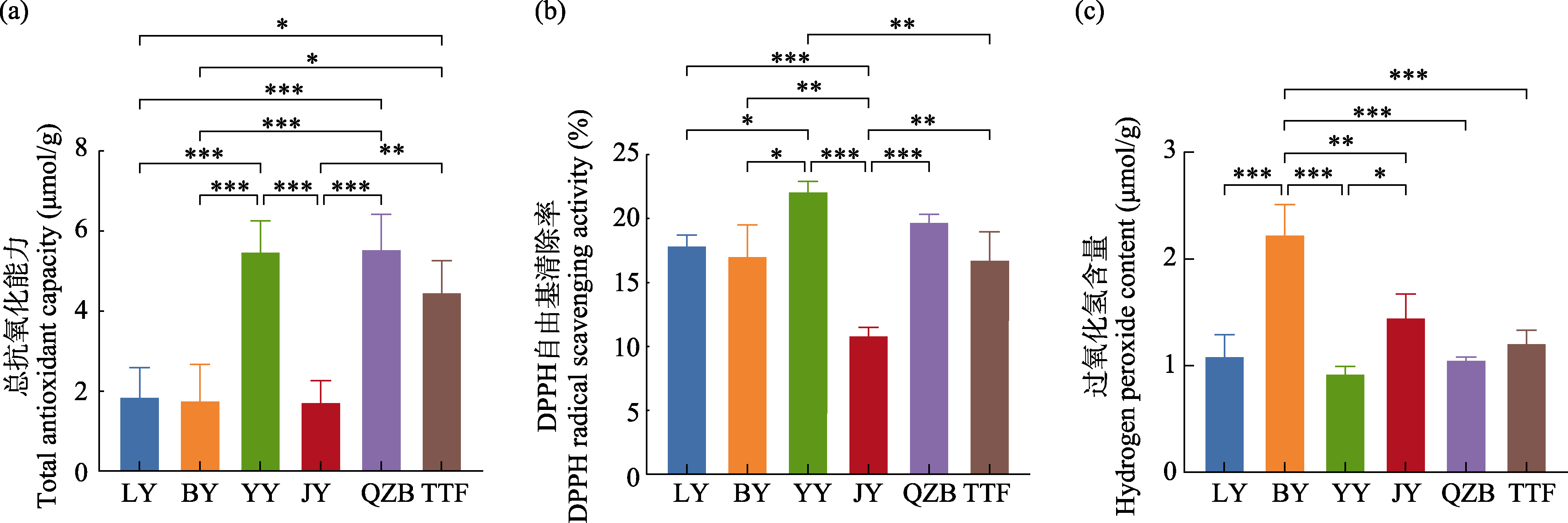
Fig. 1 Comparison of antioxidant capacity in intestinal tissues of six cyprinid fish species. (a) Total antioxidant capacity (T-AOC); (b) 2,2-Diphenyl-1-picrylhydrazyl (DPPH) radical scavenging activity; (c) Hydrogen peroxide (H2O2) content. LY, Hypophthalmichthys molitrix; BY, Parabramis pekinensis; YY, Aristichthys nobilis; JY, Carassius auratus; QZB, Culter alburnus; TTF, Megalobrama amblycephala. * P < 0.05; ** P < 0.01; *** P < 0.001.
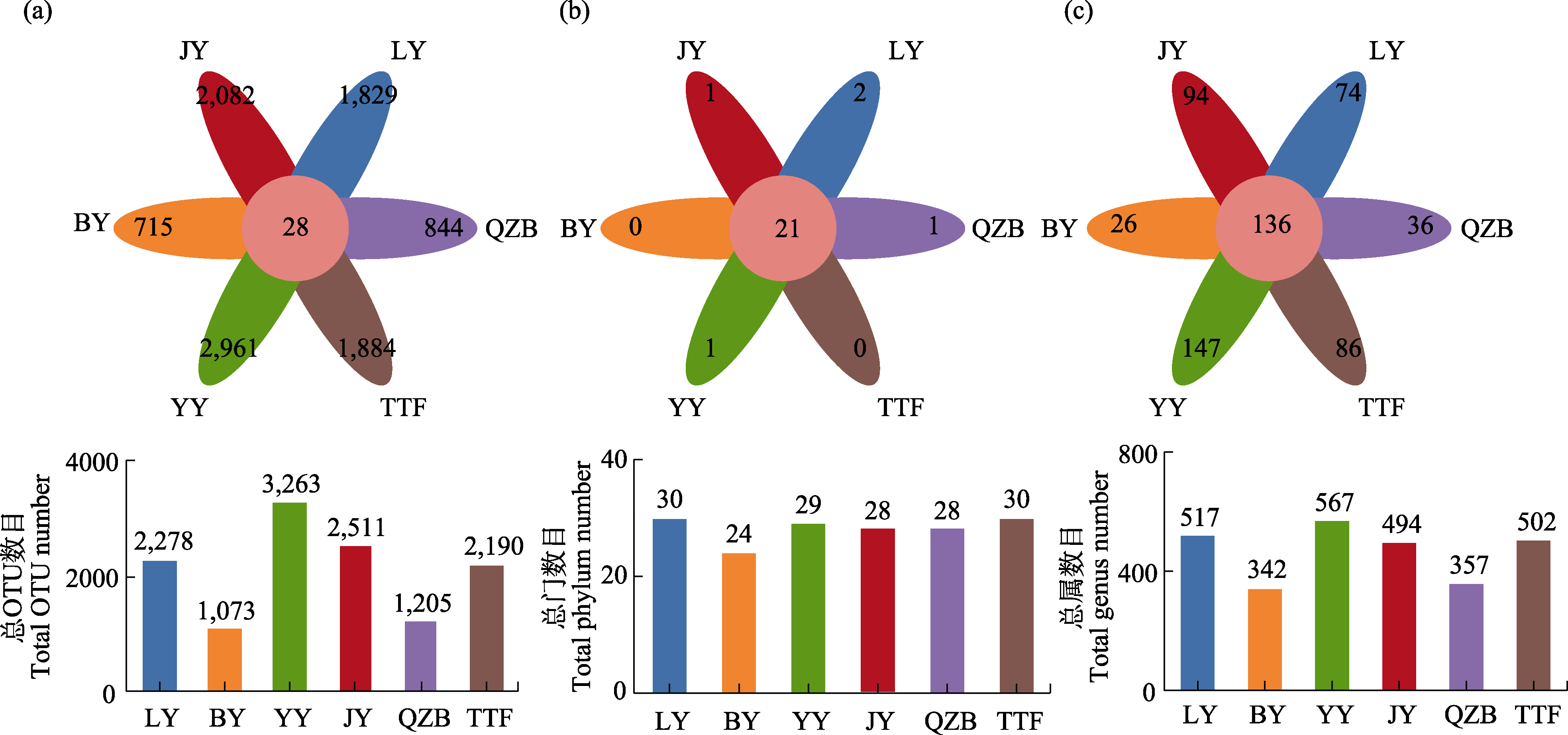
Fig. 2 Statistical overview of gut bacterial 16S rRNA sequences from six cyprinid fish species. (a) Venn diagram and bar chart of bacterial community at OTU level; (b) Venn diagram and bar chart of bacterial community at phylum level; (c) Venn diagram and bar chart of bacterial community at genus level. LY, Hypophthalmichthys molitrix; BY, Parabramis pekinensis; YY, Aristichthys nobilis; JY, Carassius auratus; QZB, Culter alburnus; TTF, Megalobrama amblycephala.
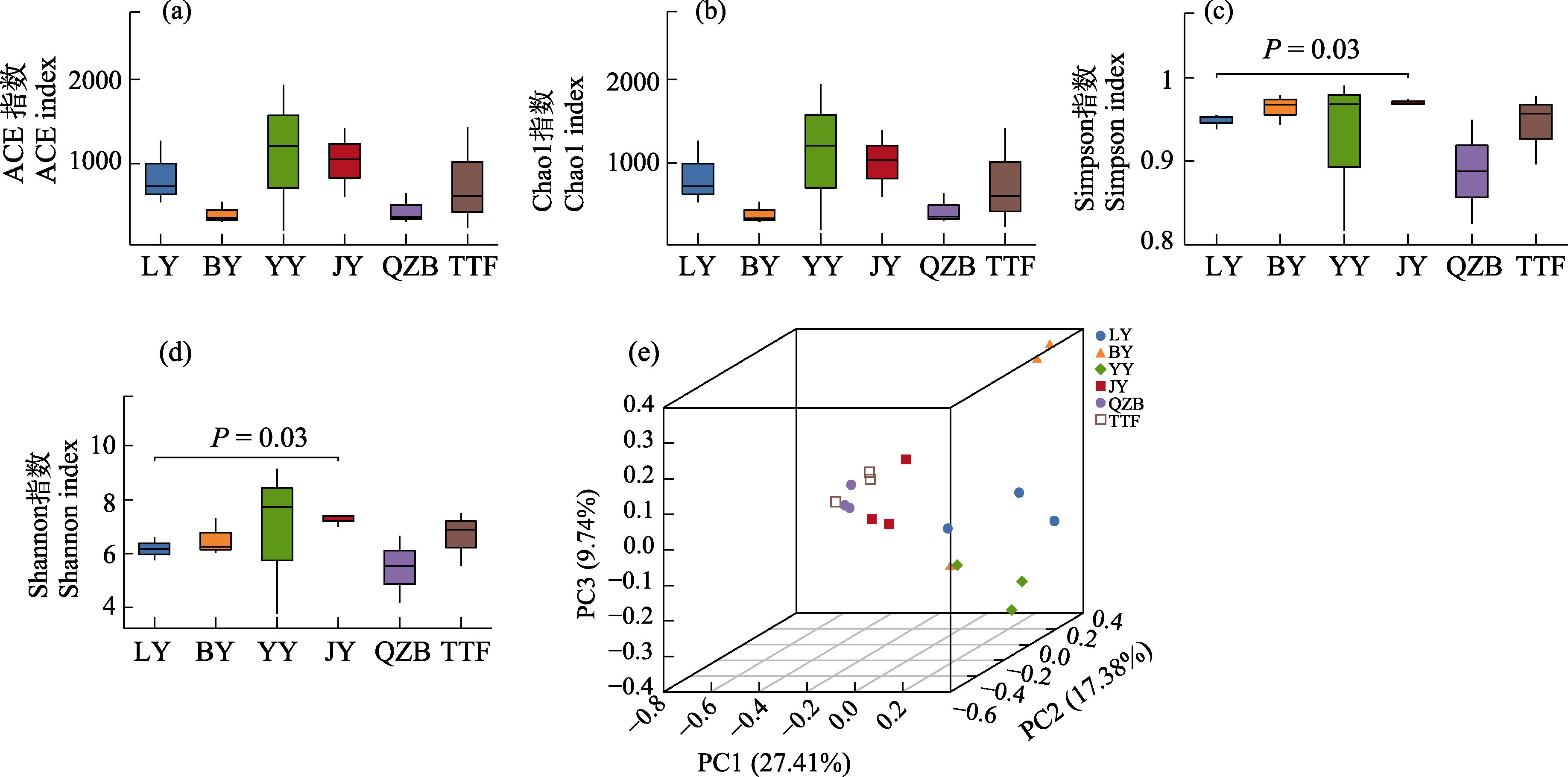
Fig. 3 α and β diversity analysis of gut bacteria in six cyprinid fish species. (a) ACE index; (b) Chao1 index; (c) Simpson index; (d) Shannon index; (e) Three-dimensional principal coordinates analysis (PCoA) plot. LY, Hypophthalmichthys molitrix; BY, Parabramis pekinensis; YY, Aristichthys nobilis; JY, Carassius auratus; QZB, Culter alburnus; TTF, Megalobrama amblycephala.
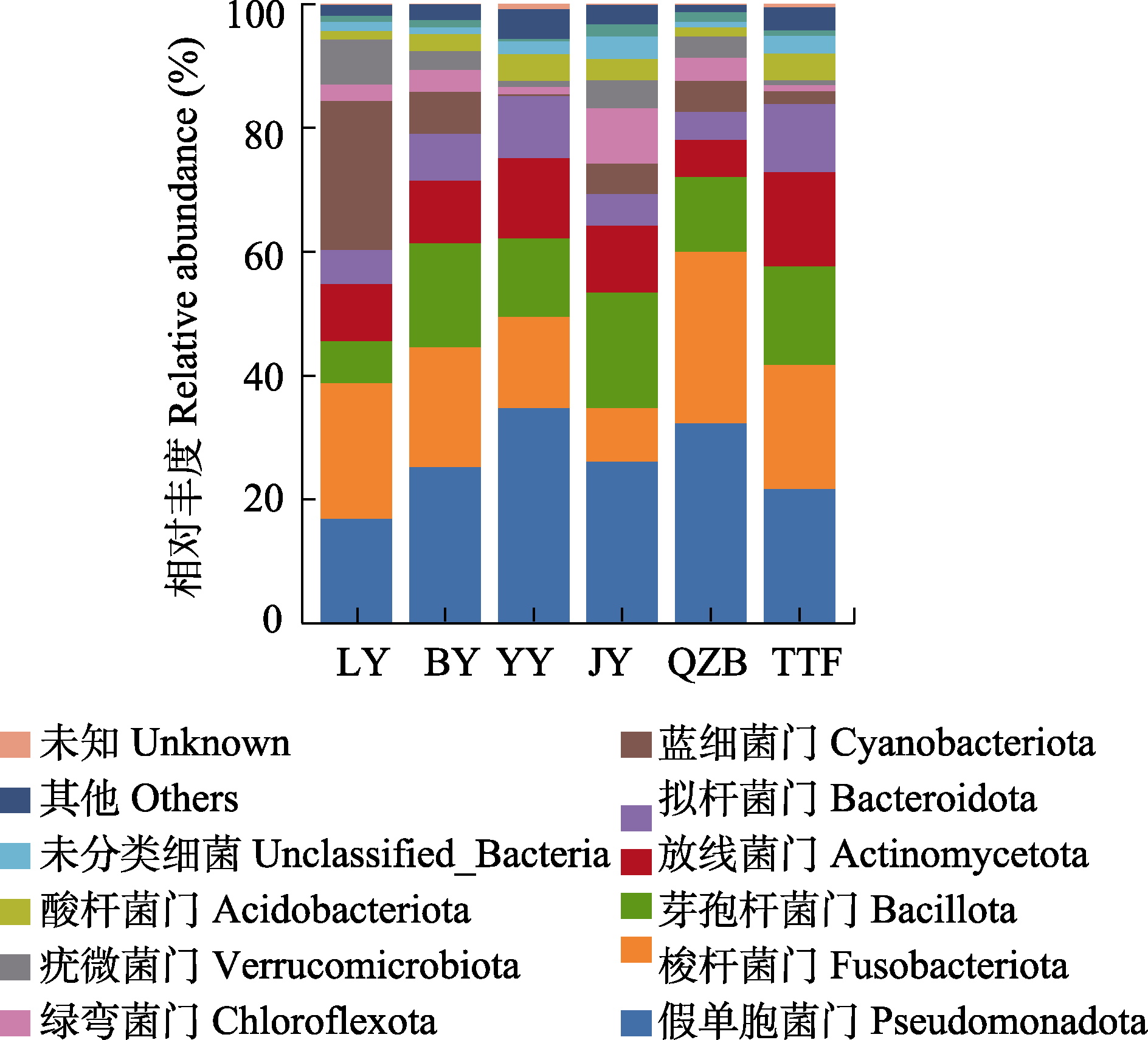
Fig. 4 Relative abundance of gut bacterial communities at the phylum level in six cyprinid fish species. LY, Hypophthalmichthys molitrix; BY, Parabramis pekinensis; YY, Aristichthys nobilis; JY, Carassius auratus; QZB, Culter alburnus; TTF, Megalobrama amblycephala.
| 组别 Groups | 属名 Genera | LY (%) | BY (%) | YY (%) | JY (%) | QZB (%) | TTF (%) | 参考文献 References |
|---|---|---|---|---|---|---|---|---|
| 具潜在有益功能的属 Genera with potential beneficial functions | 鲸杆菌属 Cetobacterium | 22.11 | 18.13 | 13.09 | 7.30 | 27.12 | 17.13 | Wang et al, |
| 拟杆菌属 Bacteroides | 1.94 | 1.29 | 4.57 | 2.40 | 1.52 | 4.47 | Wang et al, | |
| 芽孢杆菌属 Bacillus | 0.09 | 0.35 | 0.19 | 0.14 | 0.23 | 0.52 | 张宇柔等, | |
| 阿克曼菌属 Akkermansia | 0.15 | 0.10 | 0.25 | 0.09 | 0.04 | 0.26 | Wang et al, | |
| 乳酸菌属 Lacticaseibacillus | 0.10 | 0.07 | 0.21 | 0.12 | 0.09 | 0.13 | 李鹏飞等, | |
| 总计 Total | 24.39 | 19.95 | 18.30 | 10.05 | 29.01 | 22.52 | ||
| 包含致病菌种的属 Genera containing pathogenic species | 弧菌属 Vibrio | 0.02 | 0.42 | 12.67 | 0.00 | 4.49 | 1.64 | Roh, |
| 气单胞菌属 Aeromonas | 0.00 | 0.00 | 2.52 | 0.00 | 11.75 | 0.05 | Semwal et al, | |
| 葡萄球菌属 Staphylococcus | 1.13 | 1.69 | 2.50 | 1.78 | 1.04 | 2.78 | Hussein et al, | |
| 梭杆菌属 Fusobacterium | 0.49 | 1.07 | 1.92 | 1.20 | 0.31 | 2.67 | 孟晓林等, | |
| 邻单胞菌属 Plesiomonas | 0.00 | 0.00 | 3.99 | 0.00 | 0.15 | 0.00 | 陈美群等, | |
| 脱硫杆菌属 Desulfobacca | 0.72 | 0.56 | 0.01 | 1.09 | 1.07 | 0.06 | 黄国鑫等, | |
| 不动杆菌属 Acinetobacter | 0.18 | 1.31 | 0.23 | 0.22 | 0.42 | 0.86 | Zhou et al, | |
| 嗜麦芽窄食单胞菌属 Stenotrophomonas | 0.42 | 0.35 | 0.52 | 0.41 | 0.20 | 0.75 | Abraham et al, | |
| 大肠杆菌-志贺氏菌属 Escherichia-Shigella | 0.21 | 0.38 | 0.32 | 0.32 | 0.14 | 0.46 | Sun et al, | |
| 假单胞菌属 Pseudomonas | 0.07 | 0.30 | 0.12 | 0.13 | 0.07 | 0.13 | 周琳, 2015①(① 周琳 (2015) 大黄鱼源变形假单胞菌的致病性研究. 硕士学位论文, 集美大学, 福建厦门.) | |
| 黄杆菌属 Flavobacterium | 0.09 | 0.19 | 0.02 | 0.11 | 0.11 | 0.22 | 柴静茹等, | |
| 链球菌属 Streptococcus | 0.12 | 0.19 | 0.27 | 0.28 | 0.25 | 0.17 | He et al, | |
| 微囊藻属 Microcystis | 2.02 | 0.42 | 0.00 | 0.03 | 0.11 | 0.11 | 毕相东, | |
| 希瓦氏菌属 Shewanella | 0.10 | 1.61 | 0.01 | 0.00 | 0.83 | 0.04 | 叶明皓等, | |
| 总计 Total | 5.57 | 8.49 | 25.09 | 5.57 | 20.96 | 9.93 |
Table 3 Relative abundance of bacterial genera with potential beneficial or pathogenic functions in the gut microbiota of six cyprinid fish species
| 组别 Groups | 属名 Genera | LY (%) | BY (%) | YY (%) | JY (%) | QZB (%) | TTF (%) | 参考文献 References |
|---|---|---|---|---|---|---|---|---|
| 具潜在有益功能的属 Genera with potential beneficial functions | 鲸杆菌属 Cetobacterium | 22.11 | 18.13 | 13.09 | 7.30 | 27.12 | 17.13 | Wang et al, |
| 拟杆菌属 Bacteroides | 1.94 | 1.29 | 4.57 | 2.40 | 1.52 | 4.47 | Wang et al, | |
| 芽孢杆菌属 Bacillus | 0.09 | 0.35 | 0.19 | 0.14 | 0.23 | 0.52 | 张宇柔等, | |
| 阿克曼菌属 Akkermansia | 0.15 | 0.10 | 0.25 | 0.09 | 0.04 | 0.26 | Wang et al, | |
| 乳酸菌属 Lacticaseibacillus | 0.10 | 0.07 | 0.21 | 0.12 | 0.09 | 0.13 | 李鹏飞等, | |
| 总计 Total | 24.39 | 19.95 | 18.30 | 10.05 | 29.01 | 22.52 | ||
| 包含致病菌种的属 Genera containing pathogenic species | 弧菌属 Vibrio | 0.02 | 0.42 | 12.67 | 0.00 | 4.49 | 1.64 | Roh, |
| 气单胞菌属 Aeromonas | 0.00 | 0.00 | 2.52 | 0.00 | 11.75 | 0.05 | Semwal et al, | |
| 葡萄球菌属 Staphylococcus | 1.13 | 1.69 | 2.50 | 1.78 | 1.04 | 2.78 | Hussein et al, | |
| 梭杆菌属 Fusobacterium | 0.49 | 1.07 | 1.92 | 1.20 | 0.31 | 2.67 | 孟晓林等, | |
| 邻单胞菌属 Plesiomonas | 0.00 | 0.00 | 3.99 | 0.00 | 0.15 | 0.00 | 陈美群等, | |
| 脱硫杆菌属 Desulfobacca | 0.72 | 0.56 | 0.01 | 1.09 | 1.07 | 0.06 | 黄国鑫等, | |
| 不动杆菌属 Acinetobacter | 0.18 | 1.31 | 0.23 | 0.22 | 0.42 | 0.86 | Zhou et al, | |
| 嗜麦芽窄食单胞菌属 Stenotrophomonas | 0.42 | 0.35 | 0.52 | 0.41 | 0.20 | 0.75 | Abraham et al, | |
| 大肠杆菌-志贺氏菌属 Escherichia-Shigella | 0.21 | 0.38 | 0.32 | 0.32 | 0.14 | 0.46 | Sun et al, | |
| 假单胞菌属 Pseudomonas | 0.07 | 0.30 | 0.12 | 0.13 | 0.07 | 0.13 | 周琳, 2015①(① 周琳 (2015) 大黄鱼源变形假单胞菌的致病性研究. 硕士学位论文, 集美大学, 福建厦门.) | |
| 黄杆菌属 Flavobacterium | 0.09 | 0.19 | 0.02 | 0.11 | 0.11 | 0.22 | 柴静茹等, | |
| 链球菌属 Streptococcus | 0.12 | 0.19 | 0.27 | 0.28 | 0.25 | 0.17 | He et al, | |
| 微囊藻属 Microcystis | 2.02 | 0.42 | 0.00 | 0.03 | 0.11 | 0.11 | 毕相东, | |
| 希瓦氏菌属 Shewanella | 0.10 | 1.61 | 0.01 | 0.00 | 0.83 | 0.04 | 叶明皓等, | |
| 总计 Total | 5.57 | 8.49 | 25.09 | 5.57 | 20.96 | 9.93 |
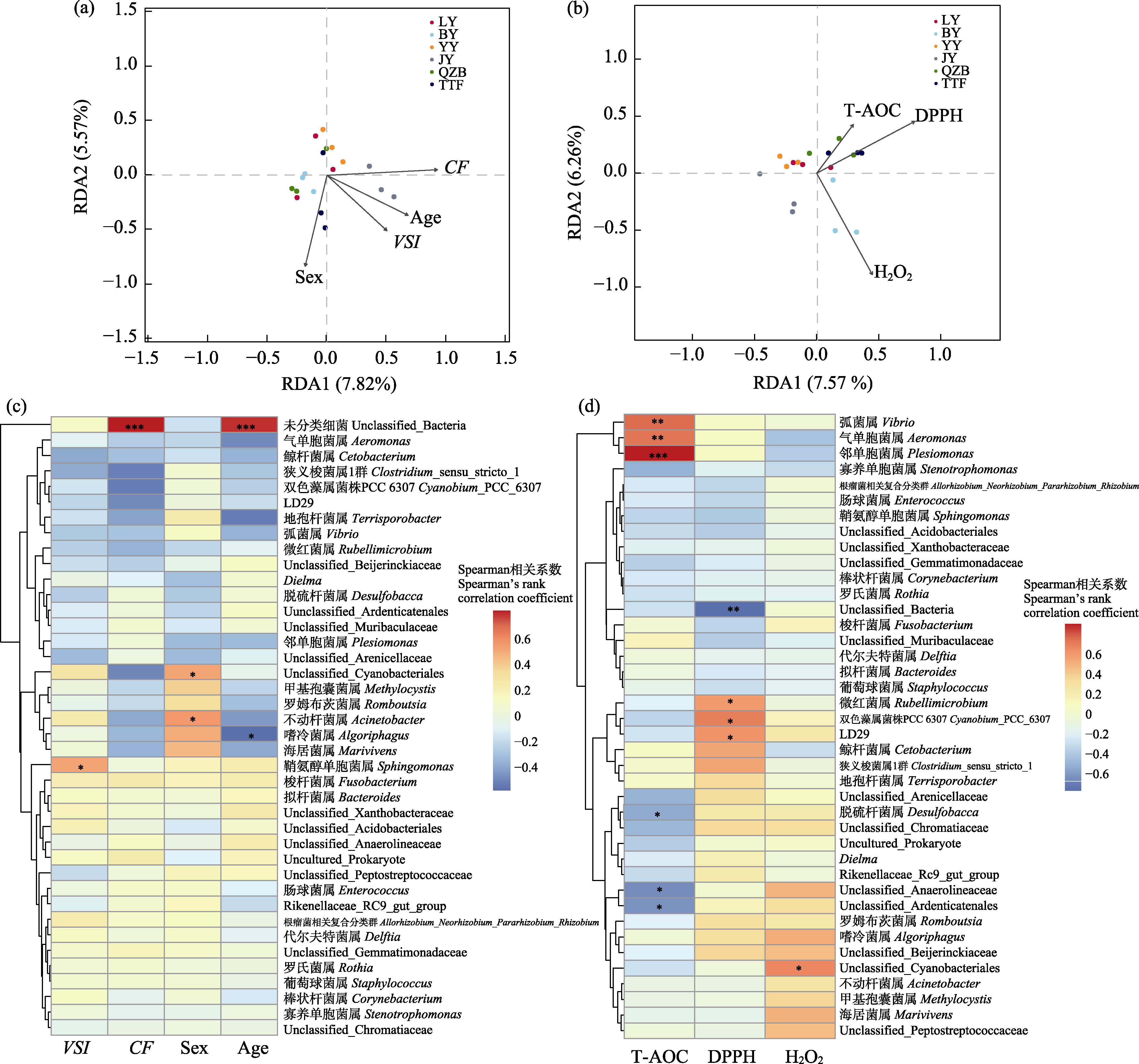
Fig. 5 Correlation analysis of gut microbiota with host growth performance and antioxidant capacity in six cyprinid fish species. Constrained ordination plots from redundancy analysis (RDA) showing the relationships between bacterial community structure and (a) growth performance or (b) antioxidant parameters. Heatmaps of Spearman’s rank correlation coefficients between the relative abundances of the top 40 bacterial genera and (c) growth performance or (d) antioxidant parameters. Growth parameters: VSI, viscerosomatic index; CF, Condition factor; Sex, Sex; Age, Age. Antioxidant parameters: T-AOC, Total antioxidant capacity; DPPH, 2,2-Diphenyl-1-picrylhydrazyl (DPPH) radical scavenging rate; H2O2, Hydrogen peroxide content. Fish species: LY, Hypophthalmichthys molitrix; BY, Parabramis pekinensis; YY, Aristichthys nobilis; JY, Carassius auratus; QZB, Culter alburnus; TTF, Megalobrama amblycephala. * P < 0.05; ** P < 0.01; *** P < 0.001.
| [1] |
Abraham TJ, Paul P, Adikesavalu H, Patra A, Banerjee S (2016) Stenotrophomonas maltophilia as an opportunistic pathogen in cultured African catfish Clarias gariepinus (Burchell, 1822). Aquaculture, 450, 168-172.
DOI URL |
| [2] | Bi XD (2021) Research progress on the harm and control of microcystins (MCs) in freshwater pond aquaculture: A review. Journal of Dalian Ocean University, 36, 535-545. (in Chinese with English abstract) |
| [ 毕相东 (2021) 微囊藻毒素(MCs)对淡水池塘养殖业的危害及防控研究进展. 大连海洋大学学报, 36, 535-545.] | |
| [3] |
Bolnick DI, Snowberg LK, Hirsch PE, Lauber CL, Org E, Parks B, Lusis AJ, Knight R, Caporaso JG, Svanbäck R (2014) Individual diet has sex-dependent effects on vertebrate gut microbiota. Nature Communications, 5, 4500.
DOI PMID |
| [4] | Chai JR, Wang D, Lu TY, Cao YS, Li SW (2021) Isolation, identification and pathogenicity of Flavobacterium psychrophilum from Oncorhynchus mykiss. Journal of Fisheries of China, 45, 929-939. (in Chinese with English abstract) |
| [ 柴静茹, 王荻, 卢彤岩, 曹永生, 李绍戊 (2021) 虹鳟源嗜冷黄杆菌的分离鉴定及致病性. 水产学报, 45, 929-939.] | |
| [5] | Chen MQ, Wang DP, Pan YZ, Zhang C, Zhaxilamu, Tian Y (2020) A review of research progress on pathogenic Plesiomonas shigelloides from fish. Fisheries Science, 39, 780-786. (in Chinese with English abstract) |
| [ 陈美群, 王冬平, 潘瑛子, 张驰, 扎西拉姆, 田云 (2020) 鱼源致病性类志贺邻单胞菌的研究进展. 水产科学, 39, 780-786.] | |
| [6] |
d’Afflitto M, Upadhyaya A, Green A, Peiris M (2022) Association between sex hormone levels and gut microbiota composition and diversity: A systematic review. Journal of Clinical Gastroenterology, 56, 384-392.
DOI URL |
| [7] |
He RZ, Li ZC, Li SY, Li AX (2021) Development of an immersion challenge model for Streptococcus agalactiae in Nile tilapia (Oreochromis niloticus). Aquaculture, 531, 735877.
DOI URL |
| [8] | Huang GX, Wang JY, Zheng YL, Li QN, Su JY, Xiao WL (2022) The association between sulfate-reducing bacteria and gut-related diseases: A review. Microbiology China, 49, 2789-2804. (in Chinese with English abstract) |
| [ 黄国鑫, 王婧怡, 郑伊琳, 李庆南, 苏冀彦, 萧文鸾 (2022) 硫酸盐还原菌与肠道疾病相关性的研究进展. 微生物学通报, 49, 2789-2804.] | |
| [9] |
Hussein MA, Merwad AMA, Elabbasy MT, Suelam IIA, Abdelwahab AM, Taha MA (2019) Prevalence of enterotoxigenic Staphylococcus aureus and Shiga toxin producing Escherichia coli in fish in Egypt: Quality parameters and public health hazard. Vector Borne and Zoonotic Diseases, 19, 255-264.
DOI URL |
| [10] |
Kormas K, Nikouli E, Kousteni V, Damalas D (2023) Midgut bacterial microbiota of 12 fish species from a marine protected area in the Aegean Sea (Greece). Microbial Ecology, 86, 1405-1415.
DOI |
| [11] |
Leclère V, Imbert M, Blondeau R, Gancel F, Chotteau-Lelièvre A (2001) Occurrence of two superoxide dismutases in Aeromonas hydrophila: Molecular cloning and differential expression of the sodA and sodB genes. Microbiology, 147, 3105-3111.
PMID |
| [12] | Li PF, Liao WY, Huang L, Yu Q, Liu MZ, Huang J, Mu RL, Chen J, Huang DH, Wei DD, Wang Y (2024) Application status and prospects of probiotics and their metabolites in aquaculture. Journal of Guangdong Ocean University, 44(3), 150-158. (in Chinese with English abstract) |
| [ 李鹏飞, 廖文钰, 黄琳, 余庆, 刘明珠, 黄静, 牟容丽, 陈嘉, 黄德华, 韦冬冬, 王尧 (2024) 益生菌及其代谢产物在水产养殖中的应用及展望. 广东海洋大学学报, 44(3), 150-158.] | |
| [13] |
Li TT, Long M, Gatesoupe FJ, Zhang QQ, Li AH, Gong XN (2015) Comparative analysis of the intestinal bacterial communities in different species of carp by pyrosequencing. Microbial Ecology, 69, 25-36.
DOI PMID |
| [14] |
Lin X, Chen YF, Ruenkoed S, Li XQ, Leng XJ (2023) Dietary effects of supplementing Clostridium butyricum culture or sodium butyrate in low fishmeal diet on growth, serum indicators, intestinal histology and microbiota of largemouth bass (Micropterus salmoides). Aquaculture Reports, 33, 101827.
DOI URL |
| [15] | Lv SJ, Zhao W, Shi ZG, Wang S, Wei J (2018) Comparative study of the intestinal microbial community of wild and cultured Kaluga sturgeon, Huso dauricus. Aquaculture Research, 49, 2938-2944. |
| [16] | Meng XL, Li WJ, Nie GX (2019) Effect of different factors on the fish intestinal microbiota. Journal of Fisheries of China, 43, 145-157. (in Chinese with English abstract) |
| [ 孟晓林, 李文均, 聂国兴 (2019) 鱼类肠道菌群影响因子研究进展. 水产学报, 43, 145-157.] | |
| [17] | Meng XL, Nie GX (2019) Advances of intestinal microbiota and lipid metabolism of fish. Journal of Fishery Sciences of China, 26, 1221-1229. (in Chinese with English abstract) |
| [ 孟晓林, 聂国兴 (2019) 鱼类肠道菌群与机体脂质代谢关系研究进展. 中国水产科学, 26, 1221-1229.] | |
| [18] | Ministry of Agriculture and Rural Affairs, Department of Fisheries and Fishery Administration, General Station of Aquatic Technology Extension, Chinese Society of Fisheries(2023) 2023 China Fisheries Statistical Yearbook. China Agriculture Press, Beijing. (in Chinese) |
| [ 农业农村部渔业渔政管理局, 全国水产技术推广总站, 中国水产学会 (2023) 2023中国渔业统计年鉴. 中国农业出版社, 北京.] | |
| [19] | Ministry of Environmental Protection of the People’s Republic of China (2014) Technical Guidelines for Biodiversity Monitoring—Inland Water Fish (HJ 710.7- 2014). China Environmental Science Press, Beijing. (in Chinese) |
| [ 中华人民共和国环境保护部 (2014) 生物多样性观测技术导则内陆水域鱼类(HJ 710.7- 2014). 中国环境科学出版社, 北京.] | |
| [20] | National Technical Committee on Aquaculture of Standardization Administration of China (2008) Inspection of Germplasm for Cultured Fishes—Part 5:Analysis of Feeding Habits (GB/T 18654.5-2008). Standards Press of China, Beijing. (in Chinese) |
| [ 全国水产标准化技术委员会 (2008) 养殖鱼类种质检验第5部分: 食性分析(GB/T18654.5-2008). 中国标准出版社, 北京.] | |
| [21] |
Refardt D (2011) Within-host competition determines reproductive success of temperate bacteriophages. The ISME Journal, 5, 1451-1460.
DOI URL |
| [22] |
Roh H (2022) A genome-wide association study of the occurrence of genetic variations in Edwardsiella piscicida, Vibrio harveyi, and Streptococcus parauberis under stressed environments. Journal of Fish Diseases, 45, 1373-1388.
DOI URL |
| [23] |
Romero J, Díaz O, Miranda CD, Rojas R (2022) Red cusk-eel (Genypterus chilensis) gut microbiota description of wild and aquaculture specimens. Microorganisms, 10, 105.
DOI URL |
| [24] | Semwal A, Kumar A, Kumar N (2023) A review on pathogenicity of Aeromonas hydrophila and their mitigation through medicinal herbs in aquaculture. Heliyon, 9, e14088. |
| [25] |
Shankregowda AM, Siriyappagouder P, Kuizenga M, Bal TMP, Abdelhafiz Y, Eizaguirre C, Fernandes JMO, Kiron V, Raeymaekers JAM (2023) Host habitat rather than evolutionary history explains gut microbiome diversity in sympatric stickleback species. Frontiers in Microbiology, 14, 1232358.
DOI URL |
| [26] | Song W (2016) Studies on Morphology and Genetic Structure of the Genus Megalobrama and Parabramis. PhD dissertation, Huazhong Agricultural University, Wuhan. (in Chinese with English abstract) |
| [ 宋文 (2016) 鳊鲂属鱼类形态学与遗传结构研究. 博士学位论文, 华中农业大学, 武汉.] | |
| [27] |
Sun FL, Wang YS, Wang CZ, Zhang L, Tu K, Zheng ZP (2019) Insights into the intestinal microbiota of several aquatic organisms and association with the surrounding environment. Aquaculture, 507, 196-202.
DOI URL |
| [28] | Tong YX, Liang YC (2014) The gut microbiota and human health. Letters in Biotechnology, 25, 896-900. (in Chinese with English abstract) |
| [ 童雨心, 梁迎春 (2014) 肠道微生物与人体健康研究进展. 生物技术通讯, 25, 896-900.] | |
| [29] | Wang AR, Zhang Z, Ding QW, Yang YL, Bindelle J, Ran C, Zhou ZG (2021) Intestinal Cetobacterium and acetate modify glucose homeostasis via parasympathetic activation in zebrafish. Gut Microbes, 13, e1900996. |
| [30] |
Wang EL, Zhou Y, Liang Y, Ling F, Xue XS, He XL, Zhai XL, Xue Y, Zhou CL, Tang G, Wang GX (2022) Rice flowering improves the muscle nutrient, intestinal microbiota diversity, and liver metabolism profiles of tilapia (Oreochromis niloticus) in rice-fish symbiosis. Microbiome, 10, 231.
DOI PMID |
| [31] | Wang W (2007) Study on Population Genetic Diversity of Culter alburnus and Phylogeny of Cultrinae. PhD dissertation, East China Normal University, Shanghai. (in Chinese with English abstract) |
| [ 王伟 (2007) 翘嘴鲌(Culter alburnus)群体遗传多样性及鲌亚科鱼类系统发生的研究. 博士学位论文, 华东师范大学, 上海.] | |
| [32] |
Wang YW, Huang ZY, Gui ZW, Yang BY, You F, Yang GK, Zhang XD, Chang XL, Meng XL (2024) Supplementation with Akkermansia muciniphila improved intestinal barrier and immunity in zebrafish (Danio rerio). Fish and Shellfish Immunology, 154, 109935.
DOI URL |
| [33] | Xiang JL, Li Y, Song PQ, Liu SG, Wang R, Li H, Miao X, Zhang R, Lin LS (2022) Research progress on gut microbial diversity of fish and its relationship with environmental factors. Journal of Fisheries Research, 44(2), 187-195. (in Chinese with English abstract) |
|
[ 向佳丽, 李渊, 宋普庆, 刘世刚, 王芮, 李海, 妙星, 张然, 林龙山 (2022) 鱼类肠道微生物多样性及其与环境因子关系的研究进展. 渔业研究, 44(2), 187-195.]
DOI |
|
| [34] | Yang WH, Shi DJ, Zhang Y, Li WP, Jing SY, Yu LH (2020) Community characteristics of denitrifying microorganisms in plateau lake sediments—Taking Nanhaihu Lake as example. China Environmental Science, 40, 431-438. (in Chinese with English abstract) |
| [ 杨文焕, 石大钧, 张元, 李卫平, 敬双怡, 于玲红 (2020) 高原湖泊沉积物中反硝化微生物的群落特征——以包头南海湖为例. 中国环境科学, 40, 431-438.] | |
| [35] | Ye MH, Hu XC, Lü AJ, Sun JF, Liu XX, Bai J (2018) Isolation, identification and antibiotic sensitivity of the pathogenic Shewanella putrefaciens from the grass carp Ctenopharyngodon idellus. Journal of Tianjin Agricultural University, 25(4), 52-57. (in Chinese with English abstract) |
|
[ 叶明皓, 胡秀彩, 吕爱军, 孙敬锋, 刘小雪, 白杰 (2018) 草鱼致病性腐败希瓦氏菌的分离鉴定及药敏特性研究. 天津农学院学报, 25(4), 52-57.]
DOI |
|
| [36] | Zhang YR, Chen YK, Yu MN, Lei XY, Wang JJ, Gao YS, Wang QJ, Elsadek M, Zhang DM (2022) Research progress on effect of probiotic Bacillus on fish growth and disease resistance. Fisheries Science, 41, 325-335. (in Chinese with English abstract) |
| [ 张宇柔, 陈玉珂, 于梦楠, 雷新雨, 王嘉婧, 高永生, 王秋举, Mahmoud Elsadek, 张东鸣 (2022) 益生芽孢杆菌对鱼类生长与抗病力影响的研究进展. 水产科学, 41, 325-335.] | |
| [37] | Zhao ZG (2011) The Relationships between Breathing and Feeding and Their Regulatory Mechanism in Silver Carp Hypophthalmichthys molitrix Val. and grass carp Ctenopharyngodon idellus. PhD dissertation, Ocean University of China, Qingdao, Shandong. (in Chinese with English abstract) |
| [ 赵志刚 (2011) 鲢(Hypophthalmichthys molitrix Val.)、草鱼(Ctenopharyngodon idellus)的呼吸与摄食的关系及其调节机制. 博士学位论文, 中国海洋大学, 山东青岛.] | |
| [38] |
Zhou L, Lin KT, Gan L, Sun JJ, Guo CJ, Liu L, Huang XD (2019) Intestinal microbiota of grass carp fed faba beans: A comparative study. Microorganisms, 7, 465.
DOI URL |
| [39] | Zhou YF, Zhang XZ, Zhou YF, Xu DP, Wang CH, Guo SY, Jiang SL, You Y (2024) Characteristics of microbial communities and their association with immunity and metabolism at the early developmental stage of Protosalanx chinensis. Journal of Zhejiang University (Agriculture and Life Sciences), 50, 129-142. (in Chinese with English abstract) |
| [ 周依帆, 张希昭, 周彦锋, 徐东坡, 王晨赫, 郭世越, 蒋书伦, 尤洋 (2024) 大银鱼早期发育阶段微生物群落特征及其与免疫和代谢的关联. 浙江大学学报(农业与生命科学版), 50, 129-142.] |
| [1] | Cao Hao, Donghui Wu, Lingzi Mo, Guoliang Xu. A review on gut microbial diversity and function of overwintering animals [J]. Biodiv Sci, 2024, 32(3): 23407-. |
| [2] | Xiao Yaqian,Liu Chuan,Xiao Liang. The role of model animals in the study of symbiotic microorganisms [J]. Biodiv Sci, 2019, 27(5): 505-515. |
| [3] | Zhang Xue, Li Xing’an, Su Qinzhi, Cao Qina, Li Chenyi, Niu Qingsheng, Zheng Hao. A curated 16S rRNA reference database for the classification of honeybee and bumblebee gut microbiota [J]. Biodiv Sci, 2019, 27(5): 557-566. |
| Viewed | ||||||
|
Full text |
|
|||||
|
Abstract |
|
|||||
Copyright © 2026 Biodiversity Science
Editorial Office of Biodiversity Science, 20 Nanxincun, Xiangshan, Beijing 100093, China
Tel: 010-62836137, 62836665 E-mail: biodiversity@ibcas.ac.cn

