

Biodiv Sci ›› 2026, Vol. 34 ›› Issue (6): 25501. DOI: 10.17520/biods.2025501 cstr: 32101.14.biods.2025501
• Original Papers: Animal Diversity • Previous Articles Next Articles
Hua Guo1( ), Yutian Luo2, Yili Dong3(), Lü Zhou1(), Shimao Yao1, Xufei Zhu1, Cheng Tian1,*()(
 )
)
Received:2025-12-18
Accepted:2026-03-19
Online:2026-06-20
Published:2026-07-30
Contact:
*E-mail: tiancheng@sxau.edu.cn
Supported by:Hua Guo, Yutian Luo, Yili Dong, Lü Zhou, Shimao Yao, Xufei Zhu, Cheng Tian. Effects of livestock grazing on the spatio-temporal distribution of Tragopan temminckii in Wanglang National Nature Reserve[J]. Biodiv Sci, 2026, 34(6): 25501.
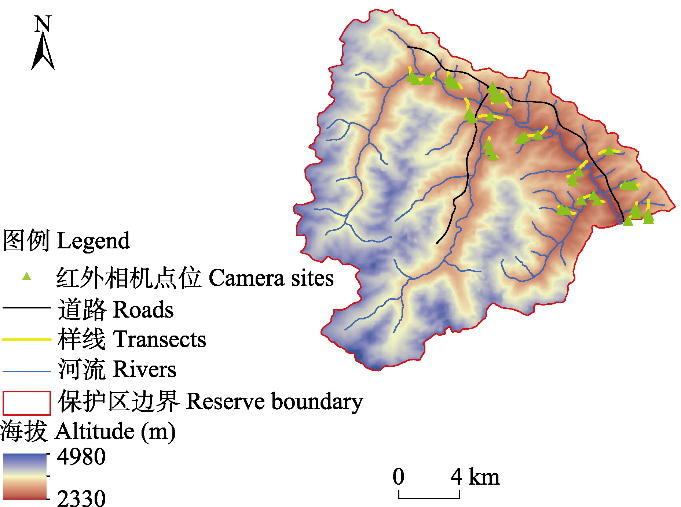
Fig. 1 Location of the study area and map of the 50 camera sites
| 环境协变量 Environmental covariates | 描述 Description | 协变量类型 Covariate type |
|---|---|---|
| 相机监测天数 Camera monitoring days (d) | 每个相机的监测天数 Monitoring days of each camera | 探测协变量(p) |
| 海拔 Altitude (m) | 每个相机位点的海拔高度 Altitude of each camera | 占域协变量(ψ) |
| 郁闭度 Canopy closure (%) | 20 m × 20 m样方中乔木树冠比例 Proportion of tree crowns in a 20 m × 20 m quadrat | 占域协变量(ψ) |
| 草本盖度 Herbaceous coverage (%) | 20 m × 20 m样方中草本覆盖比例 Proportion of herbaceous coverage in a 20 m × 20 m quadrat | 占域协变量(ψ) |
| 灌木盖度 Shrub coverage (%) | 20 m × 20 m样方中灌木覆盖比例 Proportion of shrub coverage in a 20 m × 20 m quadrat | 占域协变量(ψ) |
| 竹子盖度 Bamboo coverage (%) | 20 m × 20 m样方中竹子覆盖比例 Proportion of bamboo coverage in a 20 m × 20 m quadrat | 占域协变量(ψ) |
| 凋落物 Litter layer (cm) | 20 m × 20 m样方中凋落物的厚度 Thickness of litter in a 20 m × 20 m quadrat | 占域协变量(ψ) |
| 距最近河流距离 Distance to the nearest river (m) | 基于ArcGIS 10.8提取相机监测点位距最近水源的距离 The distance from the camera monitoring point to the nearest water source (extracted using ArcGIS 10.8) | 占域协变量(ψ) |
Table 1 Eight environmental covariates used for modelling purposes
| 环境协变量 Environmental covariates | 描述 Description | 协变量类型 Covariate type |
|---|---|---|
| 相机监测天数 Camera monitoring days (d) | 每个相机的监测天数 Monitoring days of each camera | 探测协变量(p) |
| 海拔 Altitude (m) | 每个相机位点的海拔高度 Altitude of each camera | 占域协变量(ψ) |
| 郁闭度 Canopy closure (%) | 20 m × 20 m样方中乔木树冠比例 Proportion of tree crowns in a 20 m × 20 m quadrat | 占域协变量(ψ) |
| 草本盖度 Herbaceous coverage (%) | 20 m × 20 m样方中草本覆盖比例 Proportion of herbaceous coverage in a 20 m × 20 m quadrat | 占域协变量(ψ) |
| 灌木盖度 Shrub coverage (%) | 20 m × 20 m样方中灌木覆盖比例 Proportion of shrub coverage in a 20 m × 20 m quadrat | 占域协变量(ψ) |
| 竹子盖度 Bamboo coverage (%) | 20 m × 20 m样方中竹子覆盖比例 Proportion of bamboo coverage in a 20 m × 20 m quadrat | 占域协变量(ψ) |
| 凋落物 Litter layer (cm) | 20 m × 20 m样方中凋落物的厚度 Thickness of litter in a 20 m × 20 m quadrat | 占域协变量(ψ) |
| 距最近河流距离 Distance to the nearest river (m) | 基于ArcGIS 10.8提取相机监测点位距最近水源的距离 The distance from the camera monitoring point to the nearest water source (extracted using ArcGIS 10.8) | 占域协变量(ψ) |
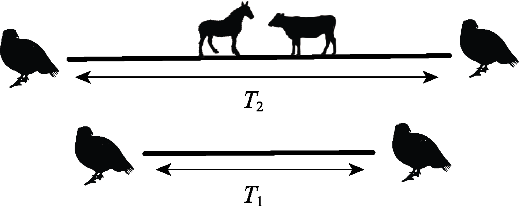
Fig. 2 The model of the time response between the activities of Tragopan temminckii and livestock
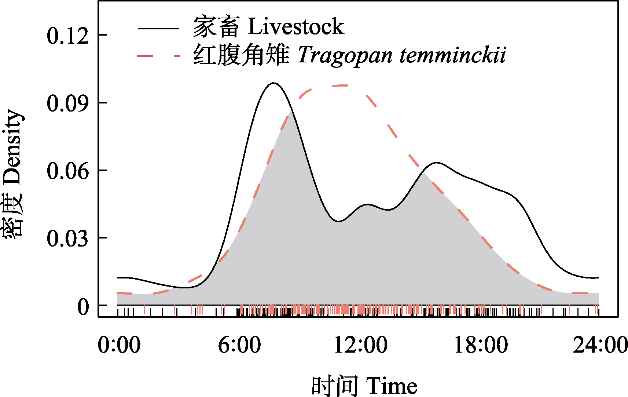
Fig. 3 Comparison of daily activity rhythm of Tragopan temminckii and livestock. The shaded areas are overlapping region.
| 模型选择 Model selection | 参数个数 (K) | 似然对数 (logLik) | 基于小样本量修正的赤池信息量准则(AICc) | AICc差值 AICc differences | 权重 Weight |
|---|---|---|---|---|---|
| 红腹角雉 Tragopan temminckii | |||||
| p(day), ψ(herb) | 4 | -365.39 | 738.95 | 0.00 | 0.12 |
| p(day), ψ(litter + herb + shrub) | 6 | -358.53 | 739.13 | 0.17 | 0.11 |
| p(day), ψ(litter + herb) | 5 | -361.88 | 739.16 | 0.21 | 0.11 |
| p(day), ψ(litter + herb + altitude) | 6 | -358.53 | 739.16 | 0.21 | 0.11 |
| p(day), ψ(herb + altitude) | 5 | -362.10 | 739.65 | 0.69 | 0.09 |
| p(day), ψ(herb + bamboo) | 5 | -362.11 | 739.68 | 0.72 | 0.08 |
| p(day), ψ(litter + herb + bamboo) | 6 | -358.73 | 740.15 | 1.19 | 0.07 |
| p(day), ψ(herb + shrub) | 5 | -362.40 | 740.21 | 1.26 | 0.06 |
| p(day), ψ(litter + herb + altitude + shrub) | 7 | -352.34 | 740.40 | 1.45 | 0.06 |
| p(day), ψ(litter+ herb + altitude + bamboo) | 7 | -352.43 | 740.56 | 1.61 | 0.05 |
| p(day), ψ(herb +bamboo +altitude) | 6 | -358.90 | 740.68 | 1.73 | 0.05 |
| p(day), ψ(litter + herb + bamboo + shrub) | 7 | -352.54 | 740.86 | 1.91 | 0.05 |
| p(day), ψ(herb + canopy) | 5 | -362.66 | 740.89 | 1.93 | 0.05 |
| 家畜 Livestock | |||||
| p(.), ψ(canopy + altitude + shrub) | 5 | -184.68 | 394.67 | 0.00 | 0.12 |
| p(.), ψ(canopy + shrub) | 4 | -188.38 | 395.04 | 0.37 | 0.10 |
| p(.), ψ(shrub) | 3 | -191.91 | 395.15 | 0.48 | 0.10 |
| p(.), ψ(altitude + shrub) | 4 | -188.47 | 395.33 | 0.66 | 0.09 |
| p(.), ψ(canopy + bamboo + altitude + shrub) | 6 | -181.72 | 395.53 | 0.86 | 0.08 |
| p(.), ψ(canopy) | 3 | -192.00 | 395.68 | 1.01 | 0.07 |
| p(.), ψ(canopy + bamboo + shrub) | 5 | -184.85 | 395.75 | 1.08 | 0.07 |
| p(.), ψ(bamboo + shrub) | 4 | -188.58 | 395.93 | 1.26 | 0.07 |
| p(.), ψ(bamboo + altitude + shrub) | 5 | -185.04 | 396.23 | 1.56 | 0.06 |
| p(.), ψ(litter + canopy + altitude + shrub) | 6 | -181.82 | 396.29 | 1.62 | 0.05 |
| p(.), ψ(.) | 2 | -195.33 | 396.37 | 1.70 | 0.05 |
| p(.), ψ(canopy + altitude + river + shrub) | 6 | -181.93 | 396.57 | 1.90 | 0.05 |
| p(.), ψ(canopy + river + shrub) | 5 | -185.11 | 396.63 | 1.96 | 0.04 |
| p(.), ψ(litter + canopy) | 4 | -188.66 | 396.65 | 1.98 | 0.04 |
Table 2 Single-species occupancy model selection results
| 模型选择 Model selection | 参数个数 (K) | 似然对数 (logLik) | 基于小样本量修正的赤池信息量准则(AICc) | AICc差值 AICc differences | 权重 Weight |
|---|---|---|---|---|---|
| 红腹角雉 Tragopan temminckii | |||||
| p(day), ψ(herb) | 4 | -365.39 | 738.95 | 0.00 | 0.12 |
| p(day), ψ(litter + herb + shrub) | 6 | -358.53 | 739.13 | 0.17 | 0.11 |
| p(day), ψ(litter + herb) | 5 | -361.88 | 739.16 | 0.21 | 0.11 |
| p(day), ψ(litter + herb + altitude) | 6 | -358.53 | 739.16 | 0.21 | 0.11 |
| p(day), ψ(herb + altitude) | 5 | -362.10 | 739.65 | 0.69 | 0.09 |
| p(day), ψ(herb + bamboo) | 5 | -362.11 | 739.68 | 0.72 | 0.08 |
| p(day), ψ(litter + herb + bamboo) | 6 | -358.73 | 740.15 | 1.19 | 0.07 |
| p(day), ψ(herb + shrub) | 5 | -362.40 | 740.21 | 1.26 | 0.06 |
| p(day), ψ(litter + herb + altitude + shrub) | 7 | -352.34 | 740.40 | 1.45 | 0.06 |
| p(day), ψ(litter+ herb + altitude + bamboo) | 7 | -352.43 | 740.56 | 1.61 | 0.05 |
| p(day), ψ(herb +bamboo +altitude) | 6 | -358.90 | 740.68 | 1.73 | 0.05 |
| p(day), ψ(litter + herb + bamboo + shrub) | 7 | -352.54 | 740.86 | 1.91 | 0.05 |
| p(day), ψ(herb + canopy) | 5 | -362.66 | 740.89 | 1.93 | 0.05 |
| 家畜 Livestock | |||||
| p(.), ψ(canopy + altitude + shrub) | 5 | -184.68 | 394.67 | 0.00 | 0.12 |
| p(.), ψ(canopy + shrub) | 4 | -188.38 | 395.04 | 0.37 | 0.10 |
| p(.), ψ(shrub) | 3 | -191.91 | 395.15 | 0.48 | 0.10 |
| p(.), ψ(altitude + shrub) | 4 | -188.47 | 395.33 | 0.66 | 0.09 |
| p(.), ψ(canopy + bamboo + altitude + shrub) | 6 | -181.72 | 395.53 | 0.86 | 0.08 |
| p(.), ψ(canopy) | 3 | -192.00 | 395.68 | 1.01 | 0.07 |
| p(.), ψ(canopy + bamboo + shrub) | 5 | -184.85 | 395.75 | 1.08 | 0.07 |
| p(.), ψ(bamboo + shrub) | 4 | -188.58 | 395.93 | 1.26 | 0.07 |
| p(.), ψ(bamboo + altitude + shrub) | 5 | -185.04 | 396.23 | 1.56 | 0.06 |
| p(.), ψ(litter + canopy + altitude + shrub) | 6 | -181.82 | 396.29 | 1.62 | 0.05 |
| p(.), ψ(.) | 2 | -195.33 | 396.37 | 1.70 | 0.05 |
| p(.), ψ(canopy + altitude + river + shrub) | 6 | -181.93 | 396.57 | 1.90 | 0.05 |
| p(.), ψ(canopy + river + shrub) | 5 | -185.11 | 396.63 | 1.96 | 0.04 |
| p(.), ψ(litter + canopy) | 4 | -188.66 | 396.65 | 1.98 | 0.04 |
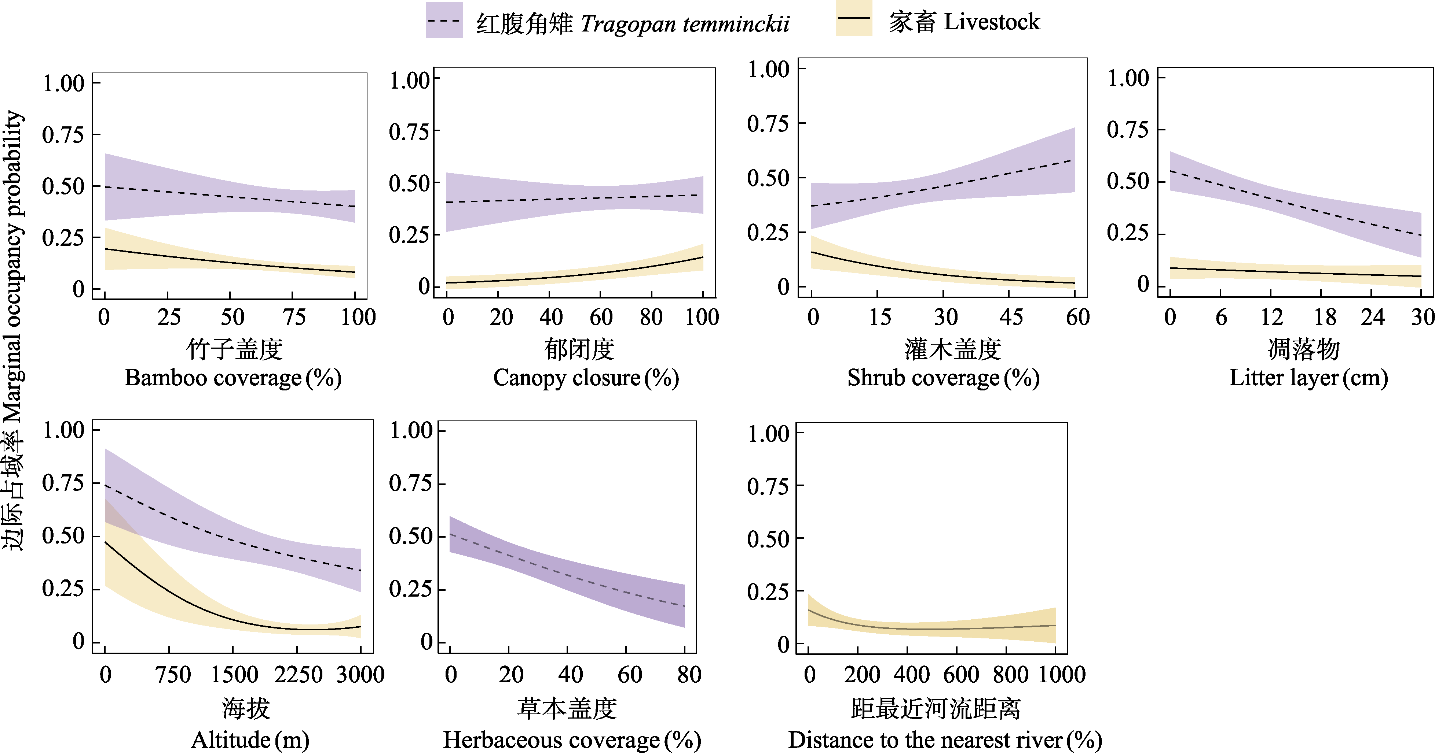
Fig. 4 Marginal occupancy probability of Tragopan temminckii and livestock are influenced by optimal occupancy covariates. The shaded areas are 95% credible intervals.
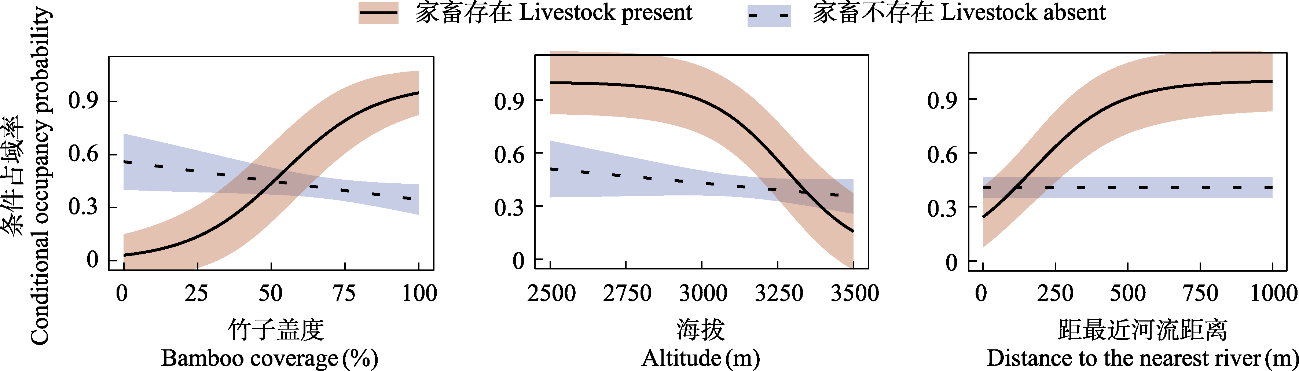
Fig. 5 Under the presence and absence of livestock, the occupancy probability of Tragopan temminckii varies along the gradients of bamboo coverage, altitude, and distance to the nearest river. The shaded areas are 95% credible intervals.
| [1] | Akaike H (1974) A new look at the statistical model identification. IEEE Transactions on Automatic Control, 19, 716-723. |
| [2] | Akashi N, Unno A, Uno H (2021) The protective effect of dwarf bamboo on broad-leaved seedlings against deer browsing. Forest Ecology and Management, 494, 119273. |
| [3] | Bernués A, Ruiz R, Olaizola A, Villalba D, Casasús I (2011) Sustainability of pasture-based livestock farming systems in the European Mediterranean context: Synergies and trade-offs. Livestock Science, 139, 44-57. |
| [4] | Burnham KP, Anderson DR (2002) Model Selection and Multi-model Inference: A Practical Information-Theoretic Approach, 2nd edn. 2nd edn. Springer, New York. |
| [5] | Burton AC, Neilson E, Moreira D, Ladle A, Steenweg R, Fisher JT, Bayne E, Boutin S (2015) Wildlife camera trapping: A review and recommendations for linking surveys to ecological processes. Journal of Applied Ecology, 52, 675-685. |
| [6] | Chen X, Shang XT, Fan F, Zheng Y, Zhao LJ, Sun HO, Li S, Zhang L (2024) Impacts of livestock grazing on blue-eared pheasants (Crossoptilon auritum) survival in subalpine forests of Southwest China. Integrative Conservation, 2, 201-213. |
| [7] | Ding P, Zhang ZW, Liang W, Li XT (2019) The Birds in the Forest of China. Hunan Science & Technology Press, Changsha. (in Chinese) |
| [丁平, 张正旺, 梁伟, 李湘涛 (2019) 中国森林鸟类. 湖南科学技术出版社, 长沙.] | |
| [8] | Dong SK, Gao HW, Xu GC, Hou XY, Long RJ, Kang MY, Lassoie JP (2007) Farmer and professional attitudes to the large-scale ban on livestock grazing of grasslands in China. Environmental Conservation, 34, 246-254. |
| [9] | Drouilly M, O’Riain MJ (2019) Wildlife winners and losers of extensive small-livestock farming: A case study in the South African Karoo. Biodiversity and Conservation, 28, 1493-1511. |
| [10] | Fan F, Bu HL, McShea WJ, Shen XL, Li BV, Li S (2020) Seasonal habitat use and activity patterns of blood pheasant Ithaginis cruentusbe in the presence of free-ranging livestock. Global Ecology and Conservation, 23, e01155. |
| [11] | Feng X, Hu Q, Shi XG, Wang ML, Qu CM, Jin SL (2021) Study on suitable habitat and activity rhythm of Tragopan temminckii in Wolong National Nature Reserve. Journal of Sichuan Forestry Science and Technology, 42(4), 12-19. (in Chinese with English abstract) |
| [冯茜, 胡强, 施小刚, 王茂麟, 瞿春茂, 金森龙 (2021) 卧龙国家级自然保护区红腹角雉适宜栖息地与活动节律研究. 四川林业科技, 42(4), 12-19.] | |
| [12] | Fiske I, Chandler R (2011) unmarked: An R package for fitting hierarchical models of wildlife occurrence and abundance. Journal of Statistical Software, 43, 1-13. |
| [13] | Fuller AK, Linden DW, Royle JA (2016) Management decision making for fisher populations informed by occupancy modeling. The Journal of Wildlife Management, 80, 794-802. |
| [14] | Geddes C, Miller GR (2012) Will climate change counteract the benefits of sheep-grazing in conserving a rare alpine dwarf-herb community? New Journal of Botany, 2, 92-99. |
| [15] | Guo H, Wu JB, Zhou L, Yao SM, Dayananda B, Tian C (2025) Co-occurrence and interactions among sympatric wildlife: Insights from a multi-species occupancy study in Wanglang National Nature Reserve, China. Journal of Zoology, 327, 302-312. |
| [16] | Guo Y, Xu XR, Pu GH, Yin HK, Fu LQ, Huang YH, Bai WK, Wang B, Zhang JD, Zhou CQ (2025) Occupancy pattern and influencing factors of three representative forest pheasants. Journal of China West Normal University (Natural Sciences), 46, 1-11. (in Chinese with English abstract) |
| [郭艳, 许兴如, 蒲冠桦, 尹华康, 付励强, 黄耀华, 白文科, 王彬, 张晋东, 周材权 (2025) 三种典型森林雉类的占域模式及影响因子. 西华师范大学学报(自然科学版), 46, 1-11.] | |
| [17] | Kang DW (2015) Research on the Habitat Selection of Giant Pandas. PhD dissertation, Beijing Forestry University, Beijing. (in Chinese with English abstract) |
| [康东伟 (2015) 大熊猫的生境选择研究. 博士学位论文, 北京林业大学, 北京.] | |
| [18] | Keesing F, Ostfeld RS, Okanga S, Huckett S, Bayles BR, Chaplin-Kramer R, Fredericks LP, Hedlund T, Kowal V, Tallis H, Warui CM, Wood SA, Allan BF (2018) Consequences of integrating livestock and wildlife in an African savanna. Nature Sustainability, 1, 566-573. |
| [19] | Kéry M, Royle JA (2015) Applied Hierarchical Modeling in Ecology:Analysis of Distribution, Abundance and Species Richness in R and BUGS. Academic Press, London. |
| [20] | Li BV, Pimm SL, Li S, Zhao LJ, Luo CP (2017) Free-ranging livestock threaten the long-term survival of giant pandas. Biological Conservation, 216, 18-25. |
| [21] | Liang LY, Wan YQ, Chen BP, Wang SF, Wang Q, Fu YQ (2025) Study on nestling habitat selection by Arborophila rufipectus. Sichuan Journal of Zoology, 44, 405-412. (in Chinese with English abstract) |
| [梁灵玥, 万永清, 陈本平, 汪淑芳, 王琼, 付义强 (2025) 四川山鹧鸪育雏栖息地选择研究. 四川动物, 44, 405-412.] | |
| [22] | Liu W, Wu YJ, DuBay SG, Zhao CH, Wang B, Ran JH (2019) Dung-associated arthropods influence foraging ecology and habitat selection in black-necked cranes (Grus nigricollis) on the Qinghai-Tibet Plateau. Ecology and Evolution, 9, 2096-2105. |
| [23] | Lu X, Zheng GM (2001) Habitat selection and use by a hybrid of white and Tibetan eared pheasants in eastern Tibet during the post-incubation period. Canadian Journal of Zoology, 79, 319-324. |
| [24] | Ma ZW, Wang YX, Wang H, A BM, Zhang ZM, Hou FJ (2017) Litter and its functions in grazing ecosystems. Acta Prataculturae Sinica, 26(7), 201-212. (in Chinese with English abstract) |
| [马周文, 王迎新, 王宏, 阿不满, 张贞明, 侯扶江 (2017) 放牧生态系统枯落物及其作用. 草业学报, 26(7), 201-212.] | |
| [25] | MacKenzie DI, Bailey LL (2004) Assessing the fit of site-occupancy models. Journal of Agricultural, Biological, and Environmental Statistics, 9, 300-318. |
| [26] | MacKenzie DI, Nichols JD, Royle JA, Pollock KH, Bailey LL, Hines JE (2006) Occupancy Estimation and Modeling:Inferring Patterns and Dynamics of Species Occurrence. Academic Press, London. |
| [27] | Mandema FS, Tinbergen JM, Ens BJ, Bakker JP (2013) Livestock grazing and trampling of birds’ nests: An experiment using artificial nests. Journal of Coastal Conservation, 17, 409-416. |
| [28] | Monterroso P, Alves PC, Ferreras P (2014) Plasticity in circadian activity patterns of mesocarnivores in Southwestern Europe: Implications for species coexistence. Behavioral Ecology and Sociobiology, 68, 1403-1417. |
| [29] | Naimi B, Hamm NAS, Groen TA, Skidmore AK, Toxopeus AG (2014) Where is positional uncertainty a problem for species distribution modelling? Ecography, 37, 191-203. |
| [30] | Parsons AW, Bland C, Forrester T, Baker-Whatton MC, Schuttler SG, McShea WJ, Costello R, Kays R (2016) The ecological impact of humans and dogs on wildlife in protected areas in eastern North America. Biological Conservation, 203, 75-88. |
| [31] | Pauler CM, Zehnder T, Staudinger M, Lüscher A, Kreuzer M, Berard J, Schneider MK (2022) Thinning the thickets: Foraging of hardy cattle, sheep and goats in green alder shrubs. Journal of Applied Ecology, 59, 1394-1405. |
| [32] | R Core Team (2024) R: A Language and Environment for Statistical Computing. R Foundation for Statistical Computing, Vienna, Austria. |
| [33] | Ran JH, Liu SY, Wang HJ, Sun ZY, Zeng ZY, Liu SC (2003) Habitat selection by giant pandas and grazing livestock in the Xiaoxiangling Mountains of Sichuan Province. Acta Ecologica Sinica, 23, 2253-2259. (in Chinese with English abstract) |
| [冉江洪, 刘少英, 王鸿加, 孙治宇, 曾宗永, 刘世昌 (2003) 小相岭大熊猫与放牧家畜的生境选择. 生态学报, 23, 2253-2259.] | |
| [34] | Rashid W, Shi JB, Rahim IU, Sultan H, Dong SK, Ahmad L (2020) Research trends and management options in human-snow leopard conflict. Biological Conservation, 242, 108413. |
| [35] | Ridout MS, Linkie M (2009) Estimating overlap of daily activity patterns from camera trap data. Journal of Agricultural, Biological, and Environmental Statistics, 14, 322-337. |
| [36] | Rota CT, Ferreira MAR, Kays RW, Forrester TD, Kalies EL, McShea WJ, Parsons AW, Millspaugh JJ (2016) A multispecies occupancy model for two or more interacting species. Methods in Ecology and Evolution, 7, 1164-1173. |
| [37] | Rowcliffe JM, Kays R, Kranstauber B, Carbone C, Jansen PA (2014) Quantifying levels of animal activity using camera trap data. Methods in Ecology and Evolution, 5, 1170-1179. |
| [38] | Ryschawy J, Joannon A, Gibon A (2014) Mixed crop-livestock farm: Definitions and research issues. Cahiers Agricultures, 23, 346-356. |
| [39] | Shang XT, Luo CP, Li B, Zheng Y, Zhou ZQ, Zhang L, Li S (2020) Diversity and fauna composition of birds in the Wanglang National Nature Reserve, Sichuan. Sichuan Journal of Zoology, 39, 93-106. (in Chinese with English abstract) |
| [尚晓彤, 罗春平, 李斌, 郑勇, 周智强, 张立, 李晟 (2020) 四川王朗国家级自然保护区鸟类多样性与区系组成. 四川动物, 39, 93-106.] | |
| [40] | Shi HT, Zheng GM (1998) The study on diet of Temmink’s tragopan. Zoological Research, 19, 225-229. (in Chinese with English abstract) |
| [史海涛, 郑光美 (1998) 红腹角雉的食性研究. 动物学研究, 19, 225-229.] | |
| [41] | Shi Y, Fan XJ, Liu JL, Zhang RB, He YX, Fu XL, He CJ, Fan ZZ, He JL, Liu MZ, Wang D (2024) Effects of litter inputs on soil nematode community structure and metabolic footprint in a Robinia pseudoacacia forest. Acta Ecologica Sinica, 44, 11276-11285. (in Chinese with English abstract) |
| [施赟, 樊晓婧, 刘俊利, 张若冰, 贺雨轩, 付鑫磊, 何长江, 凡转转, 何京隆, 刘梦舟, 王冬 (2024) 凋落物输入对刺槐林土壤线虫群落结构和代谢足迹的影响. 生态学报, 44, 11276-11285.] | |
| [42] | Sichuan Forestry Department (2015) The Pandas of Sichuan: The 4th Survey Report on Giant Panda in Sichuan Province. Sichuan Publishing House of Science & Technology, Chengdu. (in Chinese) |
| [四川省林业厅 (2015) 四川的大熊猫: 四川省第四次大熊猫调查报告. 四川科学技术出版社, 成都.] | |
| [43] | Song XS, Kang FF, Han HR, Yu XW, Zhou B, Cheng XQ (2014) Hydrological effects of forest litters and soil in Pinus tabulaeformis plantation under different degrees of canopy coverage in Taiyue Mountains. Bulletin of Soil and Water Conservation, 34(3), 102-108. (in Chinese with English abstract) |
| [宋小帅, 康峰峰, 韩海荣, 于晓文, 周彬, 程小琴 (2014) 太岳山不同郁闭度油松人工林枯落物及土壤水文效应. 水土保持通报, 34(3), 102-108.] | |
| [44] | Steinfeld H, Gerber P, Wassenaar T, Castel V, Rosales M, Haan CD (2006) Livestock’s Long Shadow—Environmental Issues and Options. FAO, Rome. |
| [45] | Still CJ, Page G, Rastogi B, Griffith DM, Aubrecht DM, Kim Y, Burns SP, Hanson CV, Kwon H, Hawkins L, Meinzer FC, Sevanto S, Roberts D, Goulden M, Pau S, Detto M, Helliker B, Richardson AD (2022) No evidence of canopy-scale leaf thermoregulation to cool leaves below air temperature across a range of forest ecosystems. Proceedings of the National Academy of Sciences, USA, 119, e2205682119. |
| [46] | Strauss SY, Irwin RE (2004) Ecological and evolutionary consequences of multispecies plant-animal interactions. Annual Review of Ecology, Evolution, and Systematics, 35, 435-466. |
| [47] | Su RN, Cheng JH, Chen DM, Bai YF, Jin H, Chao L, Wang ZJ, Li JQ (2017) Effects of grazing on spatiotemporal variations in community structure and ecosystem function on the grasslands of Inner Mongolia, China. Scientific Reports, 7, 40. |
| [48] | Suraci JP, Gaynor KM, Allen ML, Alexander P, Brashares JS, Cendejas-Zarelli S, Crooks K, Elbroch LM, Forrester T, Green AM, Haight J, Harris NC, Hebblewhite M, Isbell F, Johnston B, Kays R, Lendrum PE, Lewis JS, McInturff A, McShea W, Murphy TW, Palmer MS, Parsons A, Parsons MA, Pendergast ME, Pekins C, Prugh LR, Sager-Fradkin KA, Schuttler S, Şekercioğlu ÇH, Shepherd B, Whipple L, Whittington J, Wittemyer G, Wilmers CC (2021) Disturbance type and species life history predict mammal responses to humans. Global Change Biology, 27, 3718-3731. |
| [49] | Suryawanshi KR, Redpath SM, Bhatnagar YV, Ramakrishnan U, Chaturvedi V, Smout SC, Mishra C (2017) Impact of wild prey availability on livestock predation by snow leopards. Royal Society Open Science, 4, 170026. |
| [50] | Sydes C, Grime JP (1981) Effects of tree leaf litter on herbaceous vegetation in deciduous woodland. The Journal of Ecology, 69, 249-262. |
| [51] | Tian C (2020) Study on Spatial-Temporal Distribution and Driving Factors of Wildlife in Habitat of Giant Pandas. PhD dissertation, Beijing Forestry University, Beijing. (in Chinese with English abstract) |
| [田成 (2020) 熊猫栖息地野生动物时空分布及驱动因素研究. 博士学位论文, 北京林业大学, 北京.] | |
| [52] | Tian C, Li JQ, Yang XY, Yu L, Yuan D, Li YX (2018) Preliminary surveys of wild animals using infrared camera in Wanglang National Nature Reserve, Sichuan Province. Biodiversity Science, 26, 620-626. (in Chinese with English abstract) |
| [田成, 李俊清, 杨旭煜, 余鳞, 袁丹, 黎运喜 (2018) 利用红外相机技术对四川王朗国家级自然保护区野生动物物种多样性的初步调查. 生物多样性, 26, 620-626.] | |
| [53] | Tian C, Zhang YY, Liu ZX, Dayananda B, Fu XB, Yuan D, Tu ZB, Luo CP, Li JQ (2020) Temporal niche patterns of large mammals in Wanglang National Nature Reserve, China. Global Ecology and Conservation, 22, e01015. |
| [54] | Twining JP, Sutherland C, Reid N, Tosh DG (2022) Habitat mediates coevolved but not novel species interactions. Proceedings of the Royal Society B: Biological Sciences, 289, 20212338. |
| [55] | Viviano A, Mori E, Fattorini N, Mazza G, Lazzeri L, Panichi A, Strianese L, Mohamed WF (2021) Spatiotemporal overlap between the European brown hare and its potential predators and competitors. Animals, 11, 562. |
| [56] | Wale OA, Adewunmi DG (2020) Evaluation of nutritional and phytochemical properties of Eucalyptus camaldulensis, Hibiscus sabdariffa and Morinda lucida from Ogun State, Nigeria. Journal of Stress Physiology & Biochemistry, 16, 45-56. |
| [57] | Wang D, Li QB, Hou LY, Su X, Lian XM (2024) Spatiotemporal overlap among snow leopard, bharal, and free-ranging livestock: Suggestions on mitigating human- snow leopard conflict. Global Ecology and Conservation, 53, e03029. |
| [58] | Wang DL, Gu JF, He P (2009) Analysis on vegetation selection of Temminck’s tragopan on Mt. Badagongshan. Journal of Shandong University (Natural Science), 44(3), 17-21. (in Chinese with English abstract) |
| [王德良, 辜娇峰, 何平 (2009) 八大公山红腹角雉对植被因素选择的分析. 山东大学学报(理学版), 44(3), 17-21.] | |
| [59] | Wang F, McShea WJ, Wang DJ, Li S (2015) Shared resources between giant panda and sympatric wild and domestic mammals. Biological Conservation, 186, 319-325. |
| [60] | Wang LR, Lu YT, Cai YF, Ji LL, Pang DP, Zhou MS, Cheng Y, Pu FG, Zhang BW (2025) The spatial relationship between two sympatric pheasant species and various human disturbance activities. Animals, 15, 95. |
| [61] | Wang MJ, Li JQ (2008) Research on habitat restoration of giant panda after a grave disturbance of earthquake in Wanglang Nature Reserve, Sichuan Province. Acta Ecologica Sinica, 28, 5848-5855. (in Chinese with English abstract) |
| [王梦君, 李俊清 (2008) 四川省王朗自然保护区地震干扰后大熊猫栖息地的恢复. 生态学报, 28, 5848-5855.] | |
| [62] | Wang P, Zhou EH, Zhang K, Wang DY, Li YH, Hu J (2022) Spatial and temporal niche differentiation of Ithaginis cruentus and Tragopan temminckii in the Xiaoxiangling Mountains. Sichuan Journal of Zoology, 41, 416-424. (in Chinese with English abstract) |
| [王芃, 周恩华, 张勘, 王大勇, 李艳红, 胡杰 (2022) 小相岭山系血雉与红腹角雉的时空生态位分化. 四川动物, 41, 416-424.] | |
| [63] | Wu Y, Chen DM, Delgado-Baquerizo M, Liu SG, Wang B, Wu JP, Hu SJ, Bai YF (2022) Long-term regional evidence of the effects of livestock grazing on soil microbial community structure and functions in surface and deep soil layers. Soil Biology and Biochemistry, 168, 108629. |
| [64] | Xia SS, Hu DM, Deng Y, Zhong X, Bai WK, Zhang JD, Wang B, Zhou CQ (2019) Habitat partitioning between sympatric golden pheasant and Temminck’s tragopan at different spatial scales. Acta Ecologica Sinica, 39, 1627-1638. (in Chinese with English abstract) |
| [夏珊珊, 胡大明, 邓玥, 钟雪, 白文科, 张晋东, 王彬, 周材权 (2019) 同域分布红腹锦鸡和红腹角雉在不同空间尺度下的生境分化. 生态学报, 39, 1627-1638.] | |
| [65] | Xiao WH, Shu ZF, Chen LJ, Yao WT, Ma Y, Zhang YM, Xiao ZS (2019) Using occupancy models in wildlife camera-trapping monitoring and the study case. Biodiversity Science, 27, 249-256. (in Chinese with English abstract) |
| [肖文宏, 束祖飞, 陈立军, 姚武韬, 马勇, 张应明, 肖治术 (2019) 占域模型的原理及在野生动物红外相机研究中的应用案例. 生物多样性, 27, 249-256.] | |
| [66] | Xu XR, Guo Y, Chen L, Zhou TX, Yang HL, Cheng YH, Wang B (2024) Seasonal changes in occupancy pattern of Tragopan temminckii in the Fengtongzhai National Nature Reserve, Sichuan. Sichuan Journal of Zoology, 43, 385-395. (in Chinese with English abstract) |
| [许兴如, 郭艳, 陈黎, 周天祥, 杨华林, 程跃红, 王彬 (2024) 四川蜂桶寨国家级自然保护区红腹角雉占域模式及其季节性变化. 四川动物, 43, 385-395.] | |
| [67] | Zanni M, Brivio F, Grignolio S, Apollonio M (2021) Estimation of spatial and temporal overlap in three ungulate species in a Mediterranean environment. Mammal Research, 66, 149-162. |
| [68] | Zhang ZW, Ding CQ, Ding P, Zheng GM (2003) The current status and a conservation strategy for species of Galliformes in China. Biodiversity Science, 11, 414-421. (in Chinese with English abstract) |
| [张正旺, 丁长青, 丁平, 郑光美 (2003) 中国鸡形目鸟类的现状与保护对策. 生物多样性, 11, 414-421.] | |
| [69] | Zheng GM (2015) Pheasants in China. Higher Education Press, Beijing. (in Chinese) |
| [郑光美 (2015) 中国雉类. 高等教育出版社, 北京.] | |
| [70] | Zheng GM, Wang QS (1998) China Red Data Book of Endangered Animals:Aves. Science Press, Beijing. (in Chinese) |
| [郑光美, 王岐山 (1998) 中国濒危动物红皮书(鸟类). 科学出版社, 北京.] | |
| [71] | Zheng SW, Liao YF (1983) Studies on habits, activities, food and reproduction of the blue-eared pheasant. Acta Zoologica Sinica, 29, 71-85. (in Chinese with English abstract) |
| [郑生武, 廖炎发 (1983) 蓝马鸡的栖息地、活动、食性与繁殖研究. 动物学报, 29, 71-85.] | |
| [72] | Zhou L, Guo H, Yao SM, Tian C (2025) The spatio-temporal distribution patterns of Tragopan temminckii in Wanglang National Nature Reserve. Biodiversity Science, 33, 24537. (in Chinese with English abstract) |
| [周铝, 郭画, 姚世贸, 田成 (2025) 王朗国家级自然保护区红腹角雉时空分布模式. 生物多样性, 33, 24537.] | |
| [73] | Zhou L, Kang ZZ, Guo H, Yao SM, Dayananda B, Tian C (2026) Habitat suitability assessment of ungulates in Wanglang National Nature Reserve. Ecological Frontiers, 46, 145-156. |
| [74] | Zhou SQ, Zhang JD, Hull V, Huang JY, Liu D, Xie H, Zou XY, Zhang HM (2021) Comparison of the bamboo-grazing behavior of giant pandas and livestock. Chinese Journal of Applied and Environmental Biology, 27, 1203-1209. (in Chinese with English abstract) |
| [周世强, 张晋东, Vanessa Hull, 黄金燕, 刘巅, 谢浩, 邹晓艳, 张和民 (2021) 野生大熊猫与放牧家畜采食竹子行为的比较. 应用与环境生物学报, 27, 1203-1209.] | |
| [75] | Zuur AF, Ieno EN, Elphick CS (2010) A protocol for data exploration to avoid common statistical problems: Data exploration. Methods in Ecology and Evolution, 1, 3-14. |
| [1] | Meng Zhang, Rongjun Cao, Gongfang Wang, Qiongjiu Zou, Linting Wu, Weichang Fu, Youbing Zhou, Gangzhi Peng. Impacts of road disturbance on Artiodactyla: A case study from Hubei Dalaoling National Nature Reserve, China [J]. Biodiv Sci, 2026, 34(6): 26050-. |
| [2] | Qianqian Wang, Xiaoguo Chen, Ruifeng Zhu, Mingchun Zhang, Xin Wang, Shilin Li, Jiangcuo Renzeng, Wu Peng, Biao Yang. Ecological adaptation differences of the black musk deer and sympatric ungulates in southeastern Xizang [J]. Biodiv Sci, 2026, 34(5): 25433-. |
| [3] | Jie Feng, Yanzhi Li, Shuli Wang, Lanxi Li, Pengfei Ding, Bingwei Lü, Ji Meng, Xiangying Shi, Xueyang Li. Dynamics of ungulate habitat use and their environmental drivers in the Southwest Mountains: A camera trap monitoring case study from Guanba [J]. Biodiv Sci, 2026, 34(5): 25261-. |
| [4] | Tong Zhang, Liwen Liang, Changjian Wang, Fu Shu, Lu Wang, Zeguang Guo, quzhen Zhuoma, Qian Qian, Anli Jiang, Junjie Ao, Xingwen Peng, Xiaogang Wu, Zuofu Xiang, Keji Guo, Ziyan Liao. Camera-trap-based assessment of bird and mammal diversity and seasonal occupancy patterns of representative species in the Mangkang Yunnan Snub-nosed Monkey National Nature Reserve, Xizang, China [J]. Biodiv Sci, 2026, 34(4): 25435-. |
| [5] | Lü Zhou, Shimao Yao, Zhanhe Zhao, Hua Guo, Cheng Tian. Spatiotemporal coexistence patterns of Capreolus pygargus and Sus scrofa in Pangquangou National Nature Reserve [J]. Biodiv Sci, 2026, 34(2): 25327-. |
| [6] | Chunying Wu, Viorel D. Popescu, Yinqiu Ji. Hierarchical occupancy models as solutions to challenges in biodiversity assessment [J]. Biodiv Sci, 2026, 34(1): 25386-. |
| [7] | Kexin Yue, Zhonghui Niu, Nian Liu, Lin Xu, Weiwei Lü, Maohong Xu, Shaopeng Cui. Circadian activity rhythms and lunar-cycle effects of three sympatric carnivores in Lishan Mountain, Shanxi [J]. Biodiv Sci, 2025, 33(9): 25084-. |
| [8] | Guangtai Fan, Yining Chen, Jibai He, Hailong Dou, Jiyuan Chen, Haitao Yang, Qiu Shen, Hongcan Guan. Investigating the adaptation of Eurasian otters (Lutra lutra) to human disturbance and the coexistence with sympatric species using camera trapping: A case study from Jintang Island, Zhejiang Province, China [J]. Biodiv Sci, 2025, 33(9): 25148-. |
| [9] | Lü Zhou, Hua Guo, Shimao Yao, Cheng Tian. The spatio-temporal distribution patterns of Tragopan temminckii in Wanglang National Nature Reserve [J]. Biodiv Sci, 2025, 33(7): 24537-. |
| [10] | Jicai Li, Changliang Shao, Shuaishuai Gao, Jia Li. Summer water source utilization patterns, activity range and suitable habitat distribution of Equus hemionus in Xinjiang Kalamaili National Park candidate area [J]. Biodiv Sci, 2025, 33(7): 24509-. |
| [11] | Fengxiang Zhou, Xixia Lu, Liming Yong, Qianhui Zeng, Liangliang Yang, Ping Li, Yuke Zhang, Xianyan Wang. Research progress on acoustic monitoring of cetaceans [J]. Biodiv Sci, 2025, 33(7): 24556-. |
| [12] | Jing Mao, Jing Wang, Jie Huang, Shuhong Xiong, Ziliang Zhang, Youxiang Zhang, Tao Wu. Bird and mammal diversity monitoring dataset in Gaowangjie National Nature Reserve (2021-2023) [J]. Biodiv Sci, 2025, 33(6): 24489-. |
| [13] | Dingxu Huang, Wenhong Xiao, Xiaojie Bai, Bangyou Liu, Yuanjun Li, Sheng Liang, Zhishu Xiao, Wei Liu. Comparing circadian activity rhythms of sympatric small- and medium-sized carnivores in Guizhou Chishui Alsophila National Nature Reserve, China [J]. Biodiv Sci, 2025, 33(6): 24376-. |
| [14] | Min Luo, Yongchuan Yang, Cheng Jin, Lihua Zhou, Yuxiao Long. Composition characteristics of mammals and their responses to human activities in urban forests of Chongqing central urban area [J]. Biodiv Sci, 2025, 33(5): 24402-. |
| [15] | Gong Cuifeng, Wei Wei, Luo Gai, Han Yimin, Wu Pengcheng, He Mengnan, Min Qingyue, Fu Qiang, Chen Peng. Spatial distribution and coexistence of ungulates in Chongzhou Area of Giant Panda National Park [J]. Biodiv Sci, 2025, 33(3): 24260-. |
| Viewed | ||||||
|
Full text |
|
|||||
|
Abstract |
|
|||||
Copyright © 2026 Biodiversity Science
Editorial Office of Biodiversity Science, 20 Nanxincun, Xiangshan, Beijing 100093, China
Tel: 010-62836137, 62836665 E-mail: biodiversity@ibcas.ac.cn

