

Biodiv Sci ›› 2026, Vol. 34 ›› Issue (4): 25464. DOI: 10.17520/biods.2025464 cstr: 32101.14.biods.2025464
• Original Papers: Animal Diversity • Previous Articles Next Articles
Luhong Wang1,2,#, Bo Li3,#, Panyan Yang4, Jiaqin Huang1,2, Yuting Xie1,2, Xin Du5, Yi Wen5, Bin Wang1,6,*( )(
)( )
)
Received:2025-11-20
Accepted:2026-01-22
Online:2026-04-20
Published:2026-05-28
Contact:
*E-mail: wangbin513@cwnu.edu.cn
About author:#Co-first authors
Supported by:Luhong Wang, Bo Li, Panyan Yang, Jiaqin Huang, Yuting Xie, Xin Du, Yi Wen, Bin Wang. Effects of ecological factors on the multidimensional diversity of breeding birds communities in Sichuan Province[J]. Biodiv Sci, 2026, 34(4): 25464.
| 目名 Order | 科数 No. of families | 种数 No. of species | 占比 Percentage |
|---|---|---|---|
| 雀形目 Passeriformes | 32 | 251 | 65.9% |
| 鹰形目 Accipitriformes | 1 | 18 | 4.7% |
| 鸻形目 Charadriiformes | 6 | 16 | 4.2% |
| 鸡形目 Galliformes | 1 | 14 | 3.7% |
| 雁形目 Anseriformes | 1 | 13 | 3.4% |
| 鹈形目 Pelecaniformes | 1 | 11 | 2.9% |
| 啄木鸟目 Piciformes | 2 | 9 | 2.4% |
| 佛法僧目 Coraciiformes | 3 | 8 | 2.1% |
| 鸽形目 Columbiformes | 1 | 8 | 2.1% |
| 鹤形目 Gruiformes | 2 | 7 | 1.8% |
| 鹃形目 Cuculiformes | 1 | 7 | 1.8% |
| 雨燕目 Apodiformes | 1 | 4 | 1.0% |
| 䴙䴘目 Podicipediformes | 1 | 3 | 0.8% |
| 隼形目 Falconiformes | 1 | 3 | 0.8% |
| 鸮形目 Strigiformes | 1 | 3 | 0.8% |
| 鹳形目 Ciconiiformes | 1 | 2 | 0.5% |
| 鲣鸟目 Suliformes | 1 | 1 | 0.3% |
| 犀鸟目 Bucerotiformes | 1 | 1 | 0.3% |
| 夜鹰目 Caprimulgiformes | 1 | 1 | 0.3% |
| 鹦鹉目 Psittaciformes | 1 | 1 | 0.3% |
| 总计 Total | 60 | 381 | 100.0% |
Table 1 Number of species by order of breeding birds in Sichuan Province
| 目名 Order | 科数 No. of families | 种数 No. of species | 占比 Percentage |
|---|---|---|---|
| 雀形目 Passeriformes | 32 | 251 | 65.9% |
| 鹰形目 Accipitriformes | 1 | 18 | 4.7% |
| 鸻形目 Charadriiformes | 6 | 16 | 4.2% |
| 鸡形目 Galliformes | 1 | 14 | 3.7% |
| 雁形目 Anseriformes | 1 | 13 | 3.4% |
| 鹈形目 Pelecaniformes | 1 | 11 | 2.9% |
| 啄木鸟目 Piciformes | 2 | 9 | 2.4% |
| 佛法僧目 Coraciiformes | 3 | 8 | 2.1% |
| 鸽形目 Columbiformes | 1 | 8 | 2.1% |
| 鹤形目 Gruiformes | 2 | 7 | 1.8% |
| 鹃形目 Cuculiformes | 1 | 7 | 1.8% |
| 雨燕目 Apodiformes | 1 | 4 | 1.0% |
| 䴙䴘目 Podicipediformes | 1 | 3 | 0.8% |
| 隼形目 Falconiformes | 1 | 3 | 0.8% |
| 鸮形目 Strigiformes | 1 | 3 | 0.8% |
| 鹳形目 Ciconiiformes | 1 | 2 | 0.5% |
| 鲣鸟目 Suliformes | 1 | 1 | 0.3% |
| 犀鸟目 Bucerotiformes | 1 | 1 | 0.3% |
| 夜鹰目 Caprimulgiformes | 1 | 1 | 0.3% |
| 鹦鹉目 Psittaciformes | 1 | 1 | 0.3% |
| 总计 Total | 60 | 381 | 100.0% |
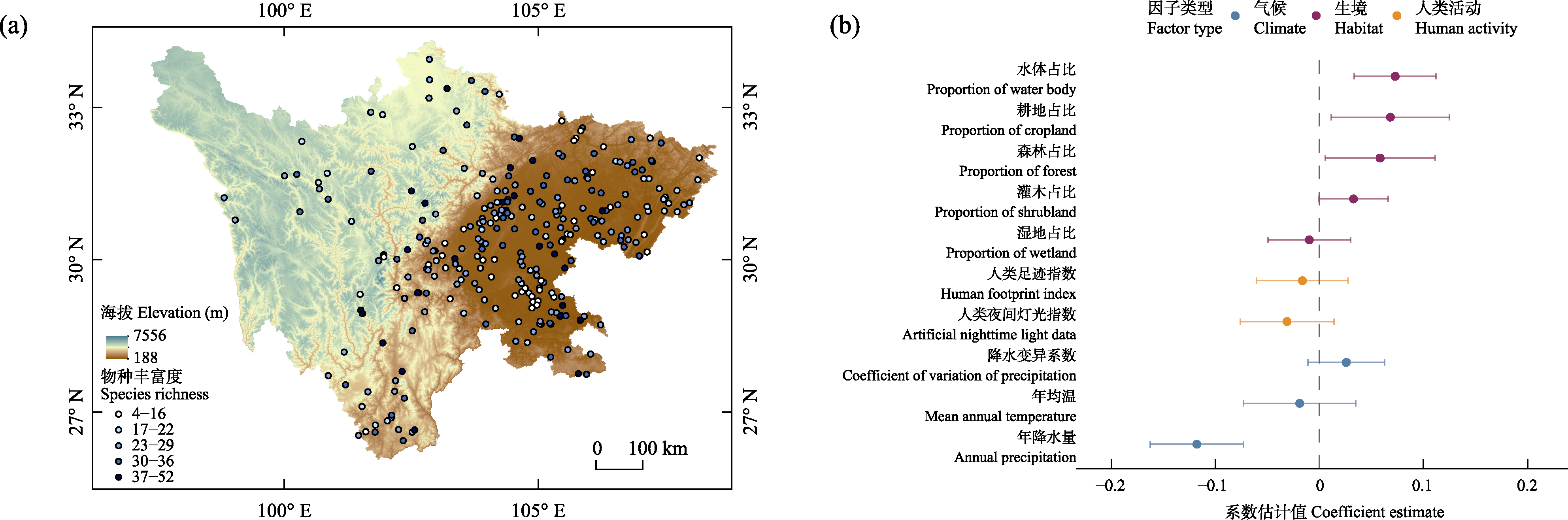
Fig. 1 Spatial distribution patterns of taxonomic diversity (species richness) of breeding bird communities in Sichuan Province (a) and the effects of different ecological factors on taxonomic diversity estimated by generalized linear regression models (b), showing the model-averaged standardized coefficient estimates and their 95% confidence intervals.
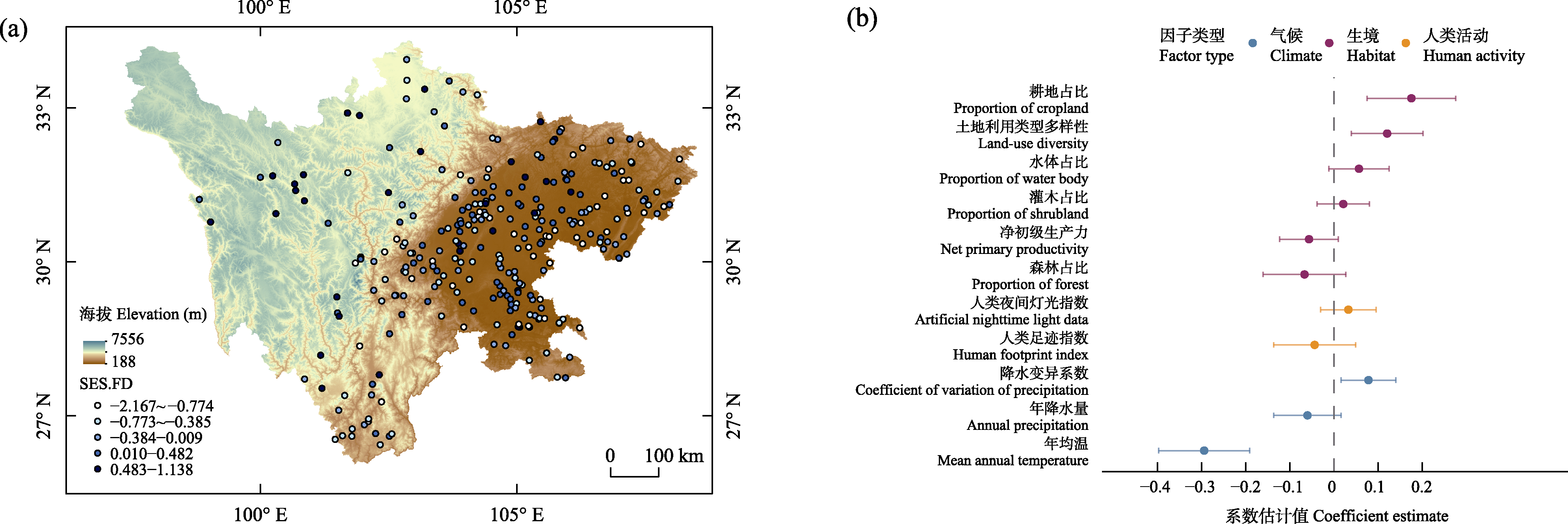
Fig. 2 Spatial distribution patterns of functional diversity (standardized effect size of functional diversity, SES.FD) of breeding bird communities in Sichuan Province (a) and the effects of different ecological factors on functional diversity estimated by generalized linear regression models (b), showing the model-averaged standardized coefficient estimates and their 95% confidence intervals.
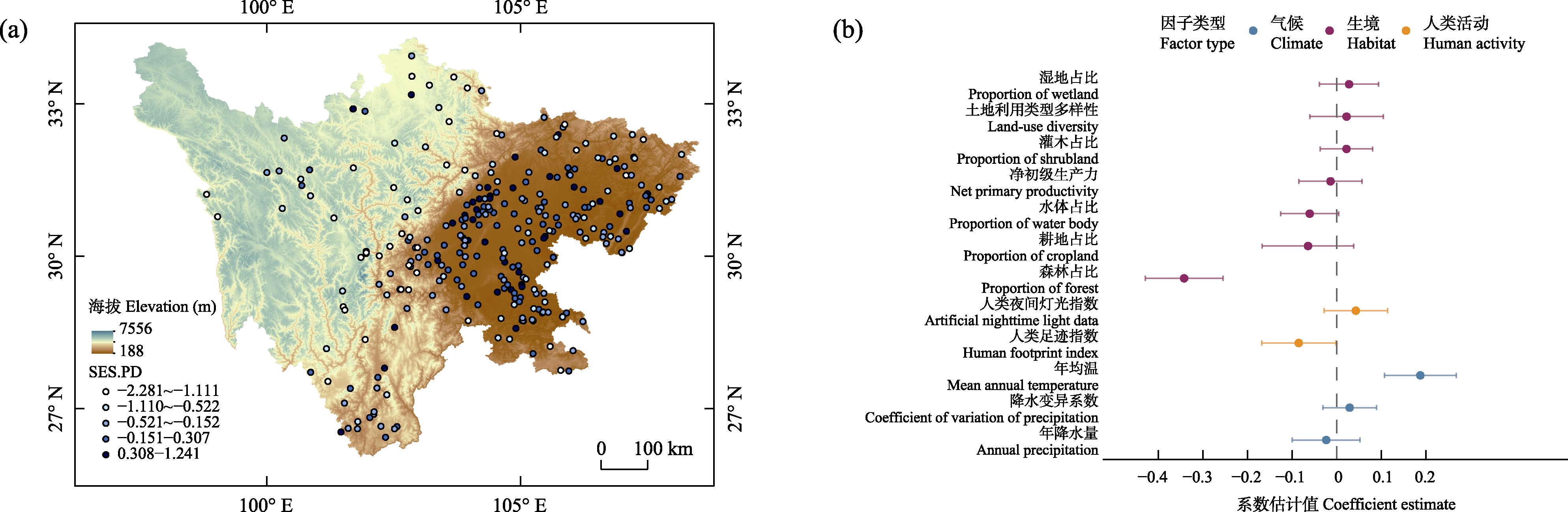
Fig. 3 Spatial distribution patterns of phylogenetic diversity (standardized effect size of phylogenetic diversity, SES.PD) of breeding bird communities in Sichuan Province (a) and the effects of different ecological factors on phylogenetic diversity estimated by generalized linear regression models (b), showing the model-averaged standardized coefficient estimates and their 95% confidence intervals.
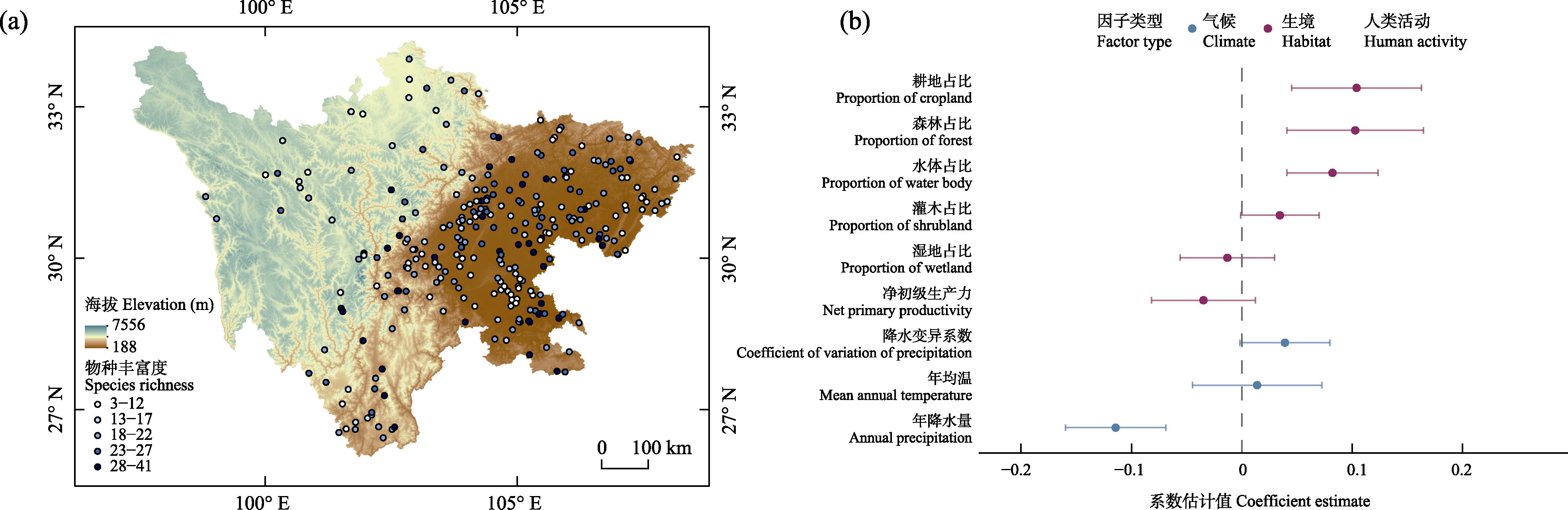
Fig. 4 Spatial distribution patterns of taxonomic diversity (species richness) of breeding non-migratory bird communities in Sichuan Province (a) and the effects of different ecological factors on taxonomic diversity estimated by generalized linear regression models (b), showing the model-averaged standardized coefficient estimates and their 95% confidence intervals.
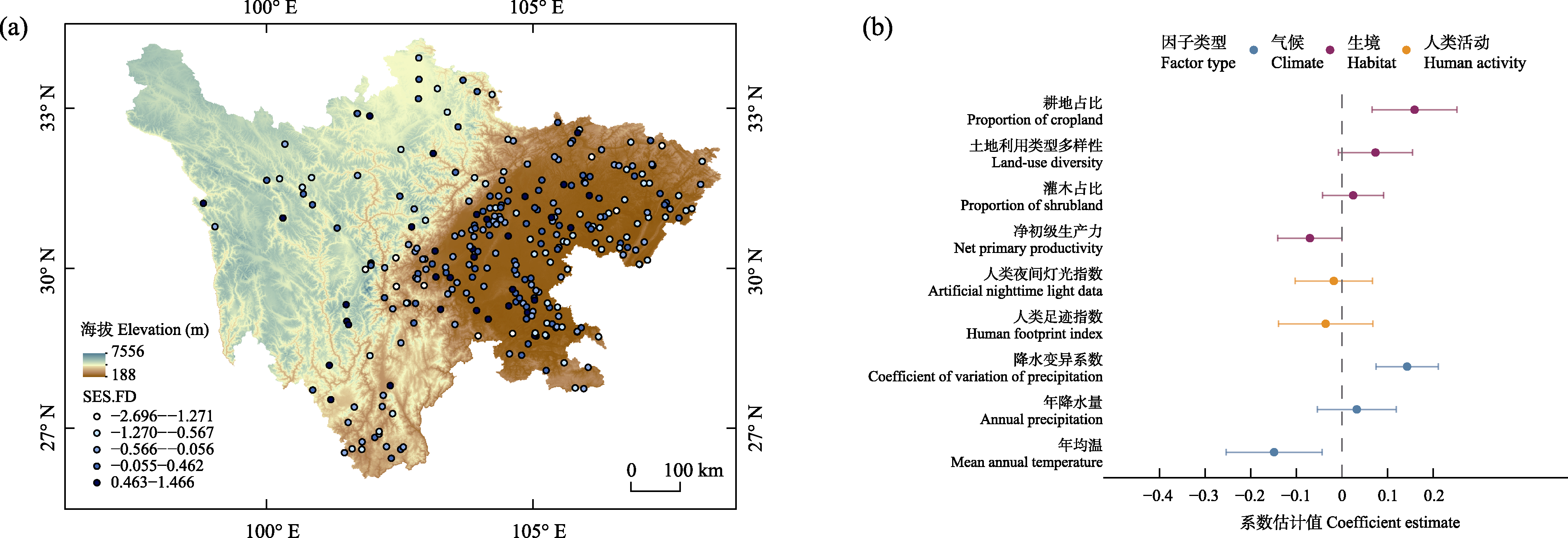
Fig. 5 Spatial distribution patterns of functional diversity (standardized effect size of functional diversity, SES.FD) of breeding non-migratory bird communities in Sichuan Province (a) and the effects of different ecological factors on functional diversity estimated by generalized linear regression models (b), showing the model-averaged standardized coefficient estimates and their 95% confidence intervals.
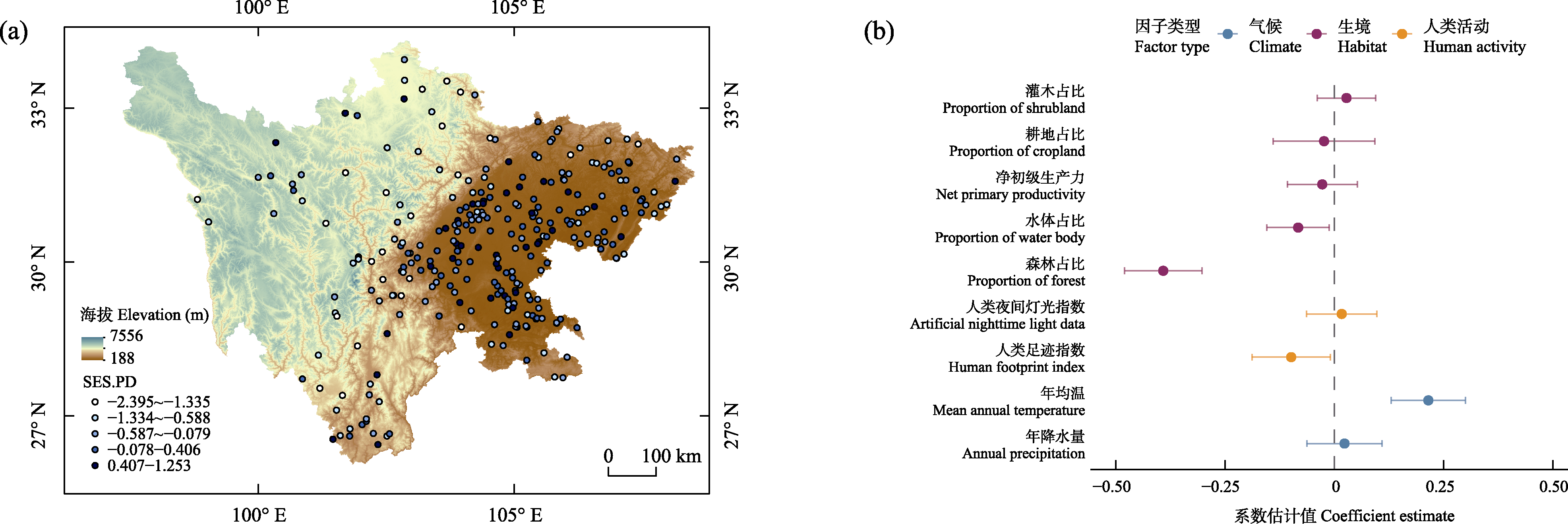
Fig. 6 Spatial distribution patterns of phylogenetic diversity (standardized effect size of phylogenetic diversity, SES.PD) of breeding non-migratory bird communities in Sichuan Province (a) and the effects of different ecological factors on phylogenetic diversity estimated by generalized linear regression models (b), showing the model-averaged standardized coefficient estimates and their 95% confidence intervals.
| [1] |
Alexandrino ER, Buechley ER, Piratelli AJ, de Andrade Moral R, Şekercioğlu ÇH, Silva WR, do Couto HTZ (2016) Bird sensitivity to disturbance as an indicator of forest patch conditions: An issue in environmental assessments. Ecological Indicators, 66, 369-381.
DOI URL |
| [2] |
Asefa A, Davies AB, Mckechnie AE, Kinahan AA, van Rensburg BJ (2017) Effects of anthropogenic disturbance on bird diversity in Ethiopian montane forests. The Condor, 119, 416-430.
DOI URL |
| [3] | Bantihun G, Tadele S, Ameha A (2020) Avian diversity in Dilifekar Block, Arsi Mountains National Park, Ethiopia. Advances in Bioscience and Bioengineering, 8, 6-11. |
| [4] | Barnagaud JY, Kissling WD, Tsirogiannis C, Fisikopoulos V, Villéger S, Sekercioglu CH, Svenning JC (2017) Biogeographical, environmental and anthropogenic determinants of global patterns in bird taxonomic and trait turnover. Global Ecology and Biogeography, 26, 1190-1200. |
| [5] |
Barrios P, Martinez-Nuñez C (2024) Bird phylogenetic diversity increases with temperature worldwide. Diversity and Distributions, 30, e13930.
DOI URL |
| [6] | Bartoń K (2025) MuMIn: Multi-Model Inference. R package version 1.48.11. (accessed on 2025-12-18) |
| [7] |
Bełcik M, Lenda M, Amano T, Skórka P (2020) Different response of the taxonomic, phylogenetic and functional diversity of birds to forest fragmentation. Scientific Reports, 10, 20320.
DOI PMID |
| [8] |
Bennett JM, Sunday J, Calosi P, Villalobos F, Martínez B, Molina-Venegas R, Araújo MB, Algar AC, Clusella-Trullas S, Hawkins BA, Keith SA, Kühn I, Rahbek C, Rodríguez L, Singer A, Morales-Castilla I, Olalla-Tárraga MÁ (2021) The evolution of critical thermal limits of life on Earth. Nature Communications, 12, 1198.
DOI PMID |
| [9] | Brum FT, Graham CH, Costa GC, Hedges SB, Penone C, Radeloff VC, Rondinini C, Loyola R, Davidson AD (2017) Global priorities for conservation across multiple dimensions of mammalian diversity. Proceedings of the National Academy of Sciences, USA, 114, 7641-7646. |
| [10] | Burnham KP, Anderson DR (2002) Model Selection and Multimodel Inference: A Practical Information-Theoretic Approac. Springer, New York. |
| [11] |
Cadotte MW, Carboni M, Si XF, Tatsumi S (2019) Do traits and phylogeny support congruent community diversity patterns and assembly inferences? Journal of Ecology, 107, 2065-2077.
DOI |
| [12] |
Carbonell JA, Stoks R (2020) Thermal evolution of life history and heat tolerance during range expansions toward warmer and cooler regions. Ecology, 101, e03134.
DOI URL |
| [13] | Cardoso P, Mammola S, Rigal F, Carvalho J (2024) BAT: Biodiversity Assessment Tools. R package Version 2.11.0. https://CRAN.R-project.org/package=BAT. (accessed on 2025-12-17) |
| [14] |
Chowfin SM, Leslie AJ (2021) Using birds as biodindicators of forest restoration progress: A preliminary study. Trees, Forests and People, 3, 100048.
DOI URL |
| [15] |
Cosset CCP, Edwards DP (2017) The effects of restoring logged tropical forests on avian phylogenetic and functional diversity. Ecological Applications, 27, 1932-1945.
DOI PMID |
| [16] |
Devictor V, Mouillot D, Meynard C, Jiguet F, Thuiller W, Mouquet N (2010) Spatial mismatch and congruence between taxonomic, phylogenetic and functional diversity: The need for integrative conservation strategies in a changing world. Ecology Letters, 13, 1030-1040.
DOI PMID |
| [17] |
Dormann CF, Elith J, Bacher S, Buchmann C, Carl G, Carré G, Márquez JRG, Gruber B, Lafourcade B, Leitão PJ, Münkemüller T, Mcclean C, Osborne P, Reineking B, Schröder B, Skidmore AK, Zurell D, Lautenbach S (2013) Collinearity: A review of methods to deal with it and a simulation study evaluating their performance. Ecography, 36, 27-46.
DOI URL |
| [18] |
Doxa A, Bas Y, Paracchini ML, Pointereau P, Terres JM, Jiguet F (2010) Low-intensity agriculture increases farmland bird abundances in France. Journal of Applied Ecology, 47, 1348-1356.
DOI URL |
| [19] |
Drummond AJ, Rambaut A (2007) BEAST: Bayesian evolutionary analysis by sampling trees. BMC Evolutionary Biology, 7, 214.
PMID |
| [20] |
Erwin DH (2009) Climate as a driver of evolutionary change. Current Biology, 19, R575-R583.
DOI URL |
| [21] |
Faith DP (1992) Conservation evaluation and phylogenetic diversity. Biological Conservation, 61, 1-10.
DOI URL |
| [22] | Ficetola GF, Mazel F, Thuiller W (2017) Global determinants of zoogeographical boundaries. Nature Ecology & Evolution, 1, 0089. |
| [23] | Gaston KJ, Spicer JI. (2004) Biodiversity: An Introduction, 2nd edn. Wiley-Blackwell, Hoboke. |
| [24] |
Gong Z, Liu YC, Feng HZ, Zhu TS (2024) Fish diversity evaluation and community assembly process analysis in the Yarlung Tsang-po River based on multi-faceted indices. Journal of Lake Sciences, 36, 213-222.(in Chinese with English abstract)
DOI URL |
| [巩政, 刘艳超, 冯慧喆, 朱天顺 (2024) 基于多维度指数的雅鲁藏布江鱼类多样性评价及群落构建过程分析. 湖泊科学, 36, 213-222.] | |
| [25] |
Gotelli NJ, Entsminger GL (2003) Swap algorithms in null model analysis. Ecology, 84, 532-535.
DOI URL |
| [26] |
Hiley JR, Bradbury RB, Thomas CD (2016) Impacts of habitat change and protected areas on alpha and beta diversity of Mexican birds. Diversity and Distributions, 22, 1245-1254.
DOI URL |
| [27] |
Howard C, Stephens PA, Pearce-Higgins JW, Gregory RD, Willis SG (2015) The drivers of avian abundance: Patterns in the relative importance of climate and land use. Global Ecology and Biogeography, 24, 1249-1260.
DOI URL |
| [28] |
Hua FY, Wang XY, Zheng XL, Fisher B, Wang L, Zhu JG, Tang Y, Yu DW, Wilcove DS (2016) Opportunities for biodiversity gains under the world’s largest reforestation programme. Nature Communications, 7, 12717.
DOI |
| [29] |
Hughes EC, Edwards DP, Sayer CA, Martin PA, Thomas GH (2020) The effects of tropical secondary forest regeneration on avian phylogenetic diversity. Journal of Applied Ecology, 57, 1351-1362.
DOI |
| [30] | Hunter ML Jr (1999) Maintaining Biodiversity in Forest Ecosystems. Cambridge University Press, Cambridge. |
| [31] |
Ibáñez-Álamo JD, Rubio E, Benedetti Y, Morelli F (2017) Global loss of avian evolutionary uniqueness in urban areas. Global Change Biology, 23, 2990-2998.
DOI PMID |
| [32] |
Jetz W, Thomas GH, Joy JB, Hartmann K, Mooers AO (2012) The global diversity of birds in space and time. Nature, 491, 444-448.
DOI |
| [33] |
Katuwal HB, Bhattarai BP, Regmi S, Nepali A, Sabin KC, Gautam R, Rokka P, Pradhan N, Koirala S, Mandal DN, Sharma HP, Quan RC (2025) Anthropogenic pressures drive the multidimensional homogenisation of bird diversity in a South Asian landscape. Journal of Environmental Management, 394, 127628.
DOI URL |
| [34] |
Kembel SW, Cowan PD, Helmus MR, Cornwell WK, Morlon H, Ackerly DD, Blomberg SP, Webb CO (2010) Picante: R tools for integrating phylogenies and ecology. Bioinformatics, 26, 1463-1464.
DOI PMID |
| [35] |
Kim JY, Yoon J, Choi YS, Eo SH (2022) The influencing factors for distribution patterns of resident and migrant bird species richness along elevational gradients. PeerJ, 10, e13258.
DOI URL |
| [36] |
Kozak KH, Wiens JJ (2010) Accelerated rates of climatic-niche evolution underlie rapid species diversification. Ecology Letters, 13, 1378-1389.
DOI PMID |
| [37] |
Li JX, Mammides C, Zhou LP, Sun JJ, Tan XC, Jiang AW (2022) Bird diversity in different habitats under agriculturalization in Guangxi, China. Biodiversity Science, 30, 21515.(in Chinese with English abstract)
DOI |
|
[李家兴, Christos Mammides, 周丽萍, 孙家杰, 谭筱彩, 蒋爱伍 (2022) 广西山地农业化背景下鸟类多样性比较. 生物多样性, 30, 21515.]
DOI |
|
| [38] | Liang CX (2020) Analysis on the Characteristics and Formation Mechanisms of Breeding Bird Diversity in Inner Mongolia. PhD dissertation, Inner Mongolia University, Hohhot. (in Chinese with English abstract) |
| [梁晨霞 (2020) 内蒙古繁殖鸟类多样性特征及其形成机制分析. 博士学位论文, 内蒙古大学, 呼和浩特.] | |
| [39] | Liang CX, Feng G, Si XF, Mao LF, Yang GS, Svenning JC, Yang J (2018) Bird species richness is associated with phylogenetic relatedness, plant species richness, and altitudinal range in Inner Mongolia. Ecology and Evolution, 8, 53-58. |
| [40] |
Liao J, Liao T, He XC, Zhang TX, Li DR, Luo XH, Wu YJ, Ran JH (2020) The effects of agricultural landscape composition and heterogeneity on bird diversity and community structure in the Chengdu Plain China. Global Ecology and Conservation, 24, e01191.
DOI URL |
| [41] |
Lin HX, Wang XY, Zhong MJ, Tang K, Du YB, Xu HG, Yi JF, Liu W, Hu JH (2024) Elevational patterns and assembly processes of multifaceted bird diversity in a subtropical mountain system. Journal of Biogeography, 51, 1276-1289.
DOI URL |
| [42] |
Liu Y, Zhu Y, Wu S, Wang Y, Xie J, Zhang K, Xu Y (2024) Determinants of taxonomic, functional, and phylogenetic beta diversity in breeding birds within urban remnant woodlots: Implications for conservation. Ecology and Evolution, 14, e11426.
DOI URL |
| [43] |
Lu XH, Jia YF, Wang YC (2024) The effect of landscape composition, complexity, and heterogeneity on bird richness: A systematic review and meta-analysis on a global scale. Landscape Ecology, 39, 132.
DOI |
| [44] |
MacArthur RH (1958) Population ecology of some warblers of northeastern coniferous forests. Ecology, 39, 599-619.
DOI URL |
| [45] |
Matthews TJ, Triantis KA, Wayman JP, Martin TE, Hume JP, Cardoso P, Faurby S, Mendenhall CD, Dufour P, Rigal F, Cooke R, Whittaker RJ, Pigot AL, Thébaud C, Jørgensen MW, Benavides E, Soares FC, Ulrich W, Kubota Y, Sadler JP, Tobias JA, Sayol F (2024) The global loss of avian functional and phylogenetic diversity from anthropogenic extinctions. Science, 386, 55-60.
DOI PMID |
| [46] |
McCain CM (2009) Global analysis of bird elevational diversity. Global Ecology and Biogeography, 18, 346-360.
DOI URL |
| [47] | Mittermeier R, Gil P, Hoffmann M, Pilgrim J, Brooks T, Mittermeier C, Lamoreux J, Fonseca G (2004) Hotspots Revisited: Earth’s Biologically Richest and Most Endangered Terrestrial Ecoregions. Cemex, Mexico. |
| [48] | Monnet AC, Jiguet F, Meynard CN, Mouillot D, Mouquet N, Thuiller W, Devictor V (2014) Asynchrony of taxonomic, functional and phylogenetic diversity in birds. Global Ecology and Biogeography, 23, 780-788. |
| [49] |
Montaño-Centellas F, Baiser B, McGrew A, Trotta L, Li DJ (2022) Global patterns and drivers of raptor phylogenetic and functional diversity. Global Ecology and Biogeography, 32, 281-294.
DOI URL |
| [50] |
Mu HW, Li XC, Wen YN, Huang JX, Du PJ, Su W, Miao SX, Geng M (2023) A global record of annual terrestrial human footprint dataset from 2000 to 2018. Scientific Data, 9, 176.
DOI |
| [51] |
O’Brien EM (1998) Water-energy dynamics, climate, and prediction of woody plant species richness: An interim general model. Journal of Biogeography, 25, 379-398.
DOI URL |
| [52] | Pan XY, Liang D, Zeng W, Hu YM, Liang JC, Wang XW, Robinson SK, Luo X, Liu Y (2019) Climate, human disturbance and geometric constraints drive the elevational richness pattern of birds in a biodiversity hotspot in Southwest China. Global Ecology and Conservation, 18, e00630. |
| [53] | Pellissier V, Barnagaud JY, Kissling WD, Şekercioğlu Ç, Svenning JC (2018) Niche packing and expansion account for species richness-productivity relationships in global bird assemblages. Global Ecology and Biogeography, 27, 604-615. |
| [54] |
Petchey OL, Gaston KJ (2002) Functional diversity (FD), species richness and community composition. Ecology Letters, 5, 402-411.
DOI URL |
| [55] |
Pfister C, Harrington BA, Lavine M (1992) The impact of human disturbance on shorebirds at a migration staging area. Biological Conservation, 60, 115-126.
DOI URL |
| [56] |
Pio DV, Broennimann O, Barraclough TG, Reeves G, Rebelo AG, Thuiller W, Guisan A, Salamin N (2011) Spatial predictions of phylogenetic diversity in conservation decision making. Conservation Biology, 25, 1229-1239.
DOI PMID |
| [57] |
Pollock LJ, O’Connor LMJ, Mokany K, Rosauer DF, Talluto L, Thuiller W (2020) Protecting biodiversity (in all its complexity): New models and methods. Trends in Ecology & Evolution, 35, 1119-1128.
DOI URL |
| [58] | R Core Team (2025) R: A Language and Environment for Statistical Computing. https://www.R-project.org. (accessed on 2025-12-17) |
| [59] |
Şekercioğlu ÇH, Primack RB, Wormworth J (2012) The effects of climate change on tropical birds. Biological Conservation, 148, 1-18.
DOI URL |
| [60] |
Sreekar R, Si XF, Sam K, Liu JJ, Dayananda S, Goodale U, Kotagama S, Goodale E (2021) Land use and elevation interact to shape bird functional and phylogenetic diversity and structure: Implications for designing optimal agriculture landscapes. Journal of Applied Ecology, 58, 1738-1748.
DOI URL |
| [61] |
Stein A, Gerstner K, Kreft H (2014) Environmental heterogeneity as a universal driver of species richness across taxa, biomes and spatial scales. Ecology Letters, 17, 866-880.
DOI PMID |
| [62] |
Stewart PS, Voskamp A, Santini L, Biber MF, Devenish AJM, Hof C, Willis SG, Tobias JA (2022) Global impacts of climate change on avian functional diversity. Ecology Letters, 25, 673-685.
DOI PMID |
| [63] | Tian YH, Zheng JW, Zhang ZB, Zhang T, Li SJ, Yan DM, Xu B (2025) Extended VIIRS-Like Artificial Nighttime Night Dataset of China (1986-2024). National Tibetan Plateau Data Center. https://cstr.cn/18406.11.HumanNat.tpdc.302930. (accessed on 2025-09-25) |
| [64] |
Tobias JA (2022) A bird in the hand: Global-scale morphological trait datasets open new frontiers of ecology, evolution and ecosystem science. Ecology Letters, 25, 573-580.
DOI PMID |
| [65] | Tobias JA, Sheard C, Pigot AL, Devenish AJM, Yang JY, Sayol F, Neate-Clegg MHC, Alioravainen N, Weeks TL, Barber RA, Walkden PA, MacGregor HEA, Jones SEI, Vincent C, Phillips AG, Marples NM, Montaño-Centellas FA, Leandro-Silva V, Claramunt S, Darski B, Freeman BG, Bregman TP, Cooney CR, Hughes EC, Capp EJR, Varley ZK, Friedman NR, Korntheuer H, Corrales-Vargas A, Trisos CH, Weeks BC, Hanz DM, Töpfer T, Bravo GA, Remeš V, Nowak L, Carneiro LS, Moncada RAJ, Matysioková B, Baldassarre DT, Martínez-Salinas A, Wolfe JD, Chapman PM, Daly BG, Sorensen MC, Neu A, Ford MA, Mayhew RJ, Fabio Silveira L, Kelly DJ, Annorbah NND, Pollock HS, Grabowska-Zhang AM, McEntee JP, Carlos T. Gonzalez J, Meneses CG, Muñoz MC, Powell LL, Jamie GA, Matthews TJ, Johnson O, Brito GRR, Zyskowski K, Crates R, Harvey MG, Jurado Zevallos M, Hosner PA, Bradfer-Lawrence T, Maley JM, Stiles FG, Lima HS, Provost KL, Chibesa M, Mashao M, Howard JT, Mlamba E, Chua MAH, Li BC, Gómez MI, García NC, Päckert M, Fuchs J, Ali JR, Derryberry EP, Carlson ML, Urriza RC, Brzeski KE, Prawiradilaga DM, Rayner MJ, Miller ET, Bowie RCK, Lafontaine RM, Scofield RP, Lou YQ, Somarathna L, Lepage D, Illif M, Neuschulz EL, Templin M, Dehling DM, Cooper JC, Pauwels OSG, Analuddin K, Fjeldså J, Seddon N, Sweet PR, DeClerck FAJ, Naka LN, Brawn JD, Aleixo A, Böhning-Gaese K, Rahbek C, Fritz SA, Thomas GH, Schleuning M (2022) AVONET: Morphological, ecological and geographical data for all birds. Ecology Letters, 25, 581-597. |
| [66] | Tu HM, Fan MW, Ko JC (2020) Different habitat types affect bird richness and evenness. Scientific Reports, 10, 1221. |
| [67] |
Villéger S, Mason NWH, Mouillot D (2008) New multidimensional functional diversity indices for a multifaceted framework in functional ecology. Ecology, 89, 2290-2301.
DOI PMID |
| [68] |
Voskamp A, Baker DJ, Stephens PA, Valdes PJ, Willis SG (2017) Global patterns in the divergence between phylogenetic diversity and species richness in terrestrial birds. Journal of Biogeography, 44, 709-721.
DOI URL |
| [69] | Wang C, Hu Y, Li MM, Ran JH, Tang RH (2022) Spatial distribution pattern of birds in the list of wild animals under state priority conservation in Sichuan Province. Sichuan Journal of Zoology, 41, 601-610.(in Chinese with English abstract) |
| [王灿, 胡烨, 李明明, 冉江洪, 唐荣华 (2022) 四川省国家重点保护野生鸟类的空间分布格局. 四川动物, 41, 601-610.] | |
| [70] |
Ye YC, Lin WP, Song J, Wei QM, Zheng YF (2025) Spatial mismatches and multi-dimensional conservation priorities for urban birds in China. Journal of Environmental Management, 379, 124905.
DOI URL |
| [71] |
Zhai ZR, Liu SY, Li ZM, Ma RJ, Ge XY, Feng HD, Shi Y, Gu C (2024) The spatiotemporal distribution patterns and impact factors of bird species richness: A case study of urban built-up areas in Beijing, China. Ecological Indicators, 169, 112847.
DOI URL |
| [72] |
Zhang X, Zhao TT, Xu H, Liu WD, Wang JQ, Chen XD, Liu LY (2024) GLC_FCS30D: The first global 30 m land-cover dynamics monitoring product with a fine classification system for the period from 1985 to 2022 generated using dense-time-series Landsat imagery and the continuous change-detection method. Earth System Science Data, 16, 1353-1381.
DOI URL |
| [73] | Zhou Y (2024) Comprehensive benefit evaluation of the project of returning farmland to forest and grassland in Sichuan Province. Rural Scientific Experiment, (22), 48-50.(in Chinese) |
| [周勇 (2024) 四川省退耕还林还草工程的综合效益评价. 农村科学实验, (22), 48-50.] | |
| [74] | Zhou YT, Xu JH, Hu DF, Zhao Y, Li QH, Sun JX, Chen W, Chang Q, Li P, Hu CC (2023) Functional and phylogenetic bird diversity and bird strike avoidance at Nanjing Lukou International Airport. Journal of Nanjing Normal University (Natural Science Edition), 46(3), 69-78.(in Chinese with English abstract) |
| [周雨桐, 徐嘉晖, 胡东方, 赵阳, 李权衡, 孙健翔, 陈婉, 常青, 李鹏, 胡超超 (2023) 南京禄口国际机场鸟类群落功能和谱系多样性及鸟击防范研究. 南京师大学报(自然科学版), 46(3), 69-78.] |
| [1] | Xiaoqiang Lu, Dan Rui, Jiangfeng Zhang, Bingxin Yin, Yulu Wang, Yuting Cen, Yichen Cui, Wanxia Yang. Impacts of nitrogen inputs-driven key ecological processes on biodiversity and their management implications [J]. Biodiv Sci, 2026, 34(2): 25368-. |
| [2] | Zhenyuan Liu, Tingting Zhou, Weimin Wang, Bo-Ping Han, Zhicai Xie. Impacts and driving mechanisms of urbanization on taxonomic and functional diversity of river macroinvertebrates in Shenzhen, South China [J]. Biodiv Sci, 2025, 33(9): 25135-. |
| [3] | Qilong Yu, Minhui Hao, Huaijiang He, Chunyu Zhang, Xiuhai Zhao. Relationships of biodiversity and productivity change with forest succession in Changbai Mountains: Insights from species, traits, and phylogeny [J]. Biodiv Sci, 2025, 33(8): 25060-. |
| [4] | Liu Zhixiang, Xie Hua, Zhang Hui, Huang Xiaolei. Functional diversity and regulation of cuticular hydrocarbons in social insects [J]. Biodiv Sci, 2025, 33(2): 24302-. |
| [5] | Yixiu Kou, Zhaohong Weng, Fenfen Ji, Kit Yue Kwan, Yangjie Xie, Jiaqiao Wang, Hangzhao Pan, Yunting Zhao, Kun Ye. Applications of environmental DNA techniques in monitoring endangered aquatic animals [J]. Biodiv Sci, 2025, 33(11): 24574-. |
| [6] | Teng Wang, Chunhou Li, Guanghua Wang, Jinfa Zhao, Juan Shi, Hongyu Xie, Yong Liu, Yu Liu. Species composition and succession of coral reef fishes on Qilianyu Island, Xisha Islands [J]. Biodiv Sci, 2024, 32(6): 23481-. |
| [7] | Kexin Cao, Jingwen Wang, Guo Zheng, Pengfeng Wu, Yingbin Li, Shuyan Cui. Effects of precipitation regime change and nitrogen deposition on soil nematode diversity in the grassland of northern China [J]. Biodiv Sci, 2024, 32(3): 23491-. |
| [8] | Xingyu Wang, Jinghui Meng, Siyuan Ren, Yan Zhu. Relationship between biodiversity and aboveground biomass in the warm temperate deciduous broad-leaved forest of Donglingshan, Beijing [J]. Biodiv Sci, 2024, 32(12): 24230-. |
| [9] | Linjun He, Wenjing Yang, Yuhao Shi, Kezhemo Ashuo, Yu Fan, Guoyan Wang, Jingji Li, Songlin Shi, Guihua Yi, Peihao Peng. Effects of plant community phylogeny and functional diversity on Ageratina adenophora invasion under fire disturbance [J]. Biodiv Sci, 2024, 32(11): 24269-. |
| [10] | Shiyi Long, Bobo Zhang, Yuchen Xia, Yangfan Fei, Yani Meng, Bingwei Lü, Yueqing Song, Pu Zheng, Taoran Guo, Jian Zhang, Shaopeng Li. Effects of diversity and temporal stability of native communities on the biomass of invasive species Solidago canadensis [J]. Biodiv Sci, 2024, 32(11): 24263-. |
| [11] | Yasu Cao, Min Fan, Yu Peng, Jiaxun Xin, Nanyi Peng. Effects of landscape pattern dynamics on plant species and functional diversity in Hunshandak Sandland [J]. Biodiv Sci, 2023, 31(8): 23048-. |
| [12] | Fayang Li, Yingyu Li, Wenni Jiang, Shuguang Liu, Chao Huo, Qiaoqi Sun, Hongfei Zou. How forest fires affect bird diversity over time in boreal forest interiors and edges in the Greater Khingan Mountains [J]. Biodiv Sci, 2023, 31(7): 22665-. |
| [13] | Xiaocheng Chen, Pengzhan Zhang, Bin Kang, Linshan Liu, Liang Zhao. Species and functional diversity of the passerine birds in the Tibetan Plateau based on specimens from the collection of Northwest Institute of Plateau Biology, Chinese Academy of Sciences [J]. Biodiv Sci, 2023, 31(5): 22638-. |
| [14] | Yuanyuan Xiao, Wei Feng, Yangui Qiao, Yuqing Zhang, Shugao Qin. Effects of soil microbial community characteristics on soil multifunctionality in sand-fixation shrublands [J]. Biodiv Sci, 2023, 31(4): 22585-. |
| [15] | Chufei Tang, Cheng Ge, Ye Cao, Hongyi Cao, Xiaoxiao Song, Huaijian Liao. Insect diversity in different stand types of urban forest: A case study at the southern foot of Zijin Mountain, Nanjing [J]. Biodiv Sci, 2023, 31(2): 22357-. |
| Viewed | ||||||
|
Full text |
|
|||||
|
Abstract |
|
|||||
Copyright © 2026 Biodiversity Science
Editorial Office of Biodiversity Science, 20 Nanxincun, Xiangshan, Beijing 100093, China
Tel: 010-62836137, 62836665 E-mail: biodiversity@ibcas.ac.cn

