

生物多样性 ›› 2026, Vol. 34 ›› Issue (6): 25499. DOI: 10.17520/biods.2025499 cstr: 32101.14.biods.2025499
方姣1( ), 覃黎明1, 谌嘉丽1, 金涵玉1, 桂思媛1, 吕诗颖1, 郑伊可1, 胡征宇2, 朱欢2, 刘国祥2,*()(
 )
)
收稿日期:2025-12-18
接受日期:2026-04-14
出版日期:2026-06-20
发布日期:2026-07-31
通讯作者:
*E-mail: liugx@ihb.ac.cn
基金资助:
Jiao Fang1(), Liming Qin1, Jiali Shen1, Hanyu Jin1, Siyuan Gui1, Shiying Lü1, Yike Zheng1, Zhengyu Hu2, Huan Zhu2, Guoxiang Liu2,*()()
Received:2025-12-18
Accepted:2026-04-14
Online:2026-06-20
Published:2026-07-31
Contact:
*E-mail: liugx@ihb.ac.cn
Supported by:摘要: 头孢藻属(Cephaleuros)隶属于绿藻门石莼纲橘色藻目橘色藻科, 是重要的植物病原藻类, 可侵染多种经济植物, 引发“藻斑病”或者“红锈病”; 部分物种还作为光合共生藻参与地衣形成。本文系统综述了头孢藻属分类学研究的进展、困境及未来方向。该属早期分类依赖藻体形态、孢子囊结构及侵染深度等特征, 但因模式标本遗失、表型可塑性强、种间形态重叠等问题, 导致分类混乱与物种误判。近年来, 基于18S rDNA、ITS和rbcL等分子标记的系统发育研究, 明确了该属的单系性及其在橘色藻目中的系统位置, 揭示了茂盛头孢藻(C. virescens)等物种的复系性, 暗示属内存在大量隐存种。然而, 这些研究也凸显出形态数据与分子结果冲突、物种取样不全面、传统分子标记分辨率不足等问题。组学时代的到来为该属的分类研究提供了新机遇, 叶绿体基因组分析为该属的单系起源提供了进一步支持, 但目前仅报道了6个头孢藻叶绿体基因组数据, 线粒体与核基因组的研究尚属空白。未来研究需重点关注以下方面: (1)加强全球范围的样本采集与分子数据扩充; (2)重新厘定模式物种身份, 建立可靠的分类基准; (3)构建融合形态、分子、寄主特异性及多组学数据的“整合分类学”框架, 并积极探索人工智能在特征识别与数据整合中的应用。通过多学科交叉与协作, 有望建立更为稳定、客观的头孢藻属分类体系, 从而为其所致病害的防控、生物资源的可持续利用以及藻类陆地化研究提供坚实的科学基础。
方姣, 覃黎明, 谌嘉丽, 金涵玉, 桂思媛, 吕诗颖, 郑伊可, 胡征宇, 朱欢, 刘国祥 (2026) 头孢藻属的分类学困境与物种多样性: 从形态学、分子系统学到组学. 生物多样性, 34, 25499. DOI: 10.17520/biods.2025499.
Jiao Fang, Liming Qin, Jiali Shen, Hanyu Jin, Siyuan Gui, Shiying Lü, Yike Zheng, Zhengyu Hu, Huan Zhu, Guoxiang Liu (2026) Taxonomic challenges and species diversity of the genus Cephaleuros: A review from morphology to molecular systematics to omics. Biodiversity Science, 34, 25499. DOI: 10.17520/biods.2025499.
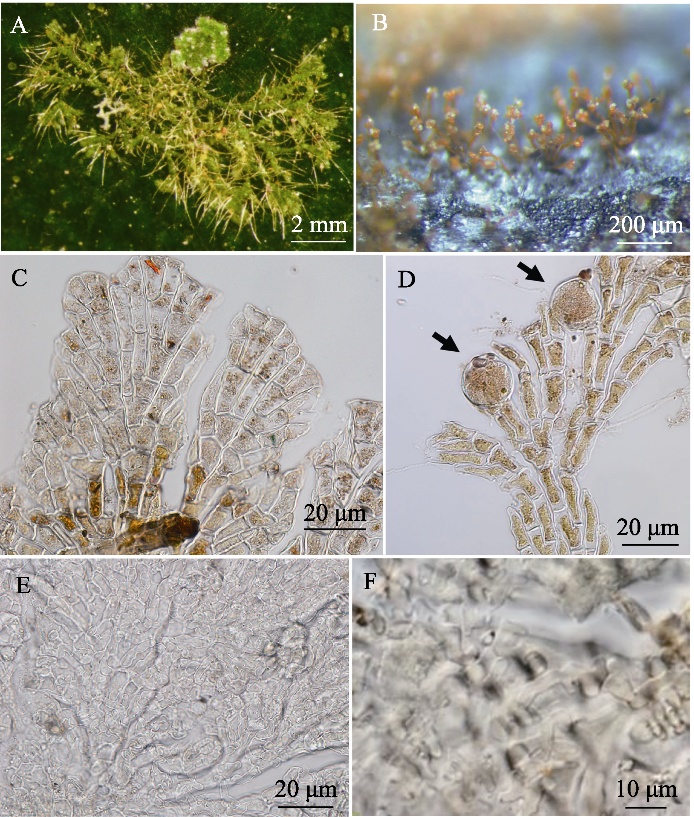
图1 头孢藻属物种形态特征。A: 不育毛; B: 孢子囊梗; C: 匍匐层藻体; D: 配子囊(黑色箭头所指); E-F: 假根。
Fig. 1 Morphological characteristics of Cephaleuros species. A, Sterile hairs; B, Sporangiophore; C, Prostrate algal thallus; D, Gametangia (indicated by black arrows); E-F, Rhizoids.
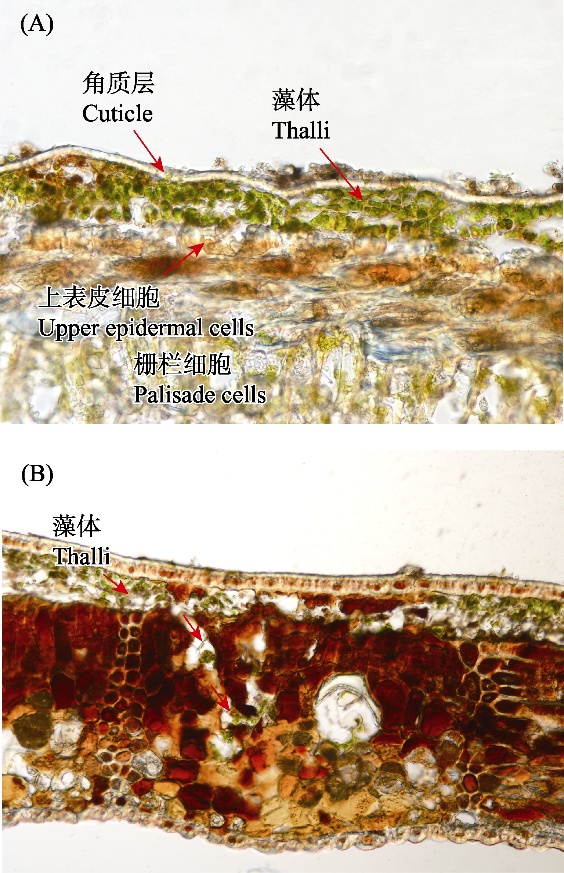
图2 头孢藻属物种的两种宿主入侵类型。A: 藻体生长在角质层与上表皮细胞之间; B: 藻体穿过上表皮细胞, 入侵到宿主叶肉组织内。
Fig. 2 Two host invasion types of Cephaleuros. A, Thalli growth between the cuticle and upper epithelial cells; B, Algal penetration through upper epidermal cells, invading the host mesophyll tissue.
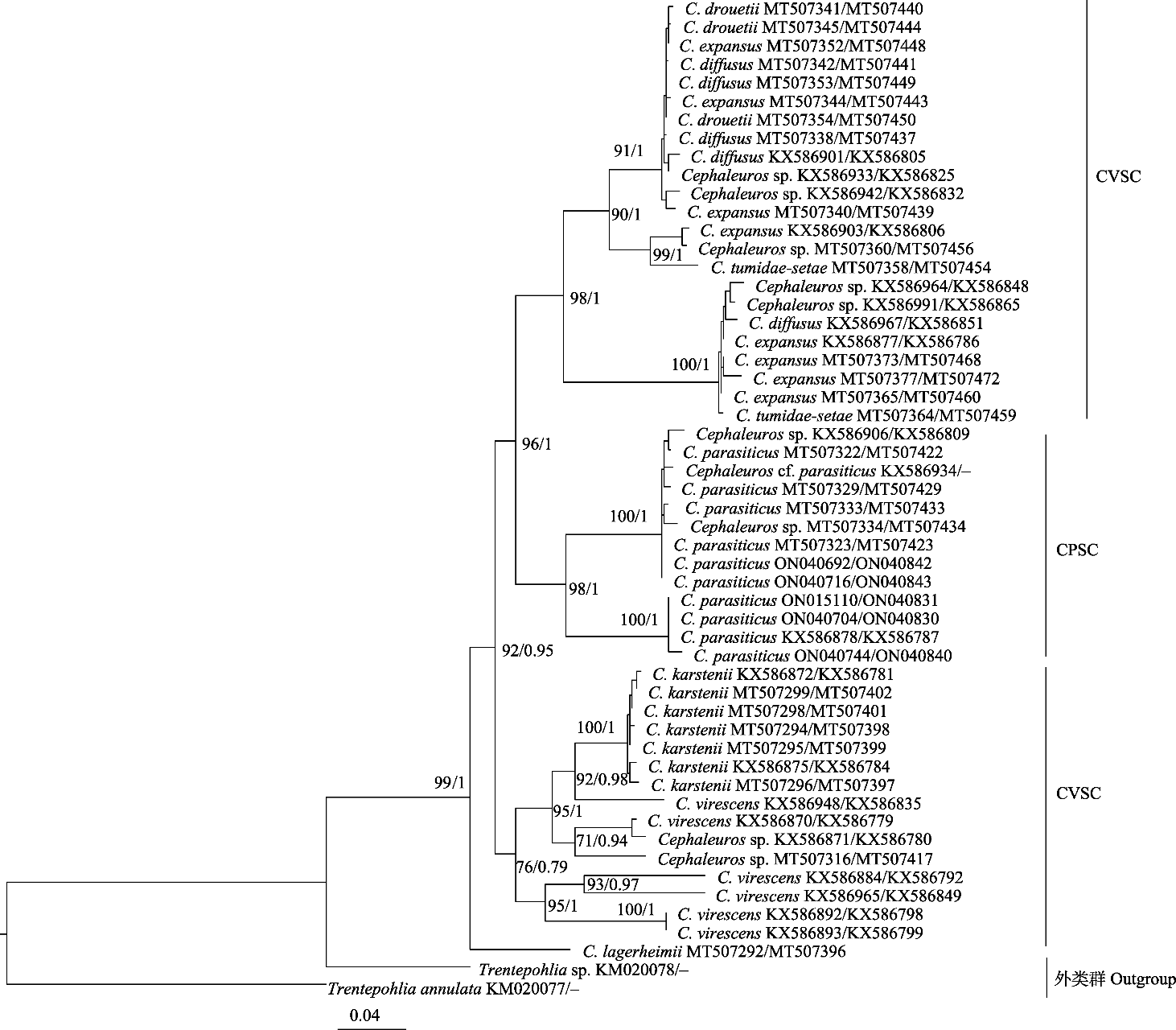
图3 基于头孢藻属18S rDNA和ITS序列联合构建的系统发育树。种名后面斜线左边是18S rDNA序列的GenBank号(来源于美国国家生物技术信息中心数据库(NCBI), https://www.ncbi.nlm.nih.gov/), 右边是ITS序列的GenBank号, -代表序列缺失。系统发育树分支上的值从左至右分别代表Bootstrap支持值(%)和Bayesian后验概率。CVSC代表藻体生长在角质层与上表皮细胞之间的头孢藻属物种, CPSC代表藻体穿透上表皮细胞, 侵入到叶肉组织的头孢藻属物种。
Fig. 3 Phylogenetic tree of the genus Cephaleuros constructed using concatenated 18S rDNA and ITS sequences. GenBank accession numbers (obtained from the National Center for Biotechnology Information database (NCBI), https://www.ncbi.nlm.nih.gov/) for 18S rDNA and ITS are provided after the species names, separated by a slash. Branch labels show bootstrap support values (%) (left) and Bayesian posterior probabilities (right). CVSC represents the Cephaleuros species that grow between the cuticle and upper epithelial cells of leaves. CPSC represents the Cephaleuros species whose thalli penetrate the upper epidermal cells and invade the mesophyll tissue.
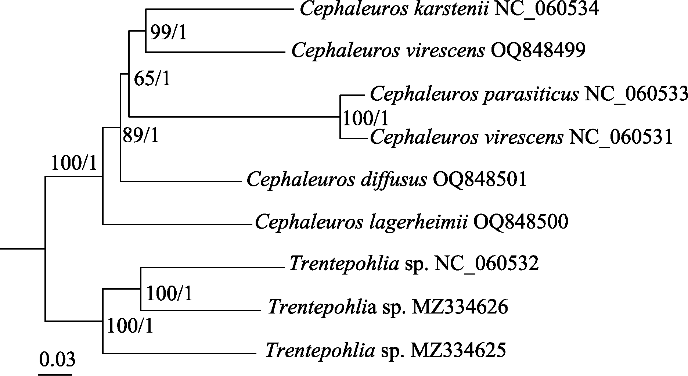
图4 基于65个叶绿体蛋白编码基因构建的头孢藻属系统发育树。种名后面对应的是NCBI (美国国家生物技术信息中心, https://www.ncbi.nlm.nih.gov/)数据库中的GenBank号。系统发育树采用PhyloSuite v1.2.3 (Zhang et al., 2020)软件进行构建, 分支上的值从左至右分别代表Bootstrap支持值(%)和Bayesian后验概率。
Fig. 4 Phylogenetic tree of the genus Cephaleuros inferred from 65 chloroplast protein-coding genes. The species names are followed by their corresponding GenBank accession numbers from the NCBI database. The tree was constructed using PhyloSuite v1.2.3 (Zhang et al., 2020). The values at the branches represent the bootstrap support values (%) and Bayesian posterior probabilities (from left to right).
| [1] | Brooks FE, Rindi F, Suto Y, Ohtani S, Green M (2015) The Trentepohliales (Ulvophyceae, Chlorophyta): An unusual algal order and its novel plant pathogen—Cephaleuros. Plant Disease, 99, 740-753. |
| [2] | Cai ZY, Shi YP, Dai LM, Liu YX, Li LL, Jiang GZ, Yao YL, Mu HJ (2020) The foliicolous parasitic alga Cephaleuros virescens on Hevea brasiliensis. Journal of Northwest Forestry University, 35(1), 183-188. (in Chinese with English abstract) |
| [蔡志英, 施玉萍, 戴利铭, 刘一贤, 李岚岚, 蒋桂芝, 姚永林, 穆洪军 (2020) 寄生橡胶树叶上的头孢藻. 西北林学院学报, 35(1), 183-188.] | |
| [3] | Cocquyt E, Verbruggen H, Leliaert F, De Clerck O (2010) Evolution and cytological diversification of the green seaweeds (Ulvophyceae). Molecular Biology and Evolution, 27, 2052-2061. |
| [4] | Cunningham DD (1879) On Mycoidea parasitica, a new genus of parasitic algae, and the part which it plays in the formation of certain lichens. Transactions of the Linnean Society of London: Botany, 1, 301-316. |
| [5] | Du XY, Lu JM, Li DZ (2019) Advances in the evolution of plastid genome structure in lycophytes and ferns. Biodiversity Science, 27, 1172-1183. (in Chinese with English abstract) |
| [杜新宇, 卢金梅, 李德铢 (2019) 石松类和蕨类植物质体基因组结构演化研究进展. 生物多样性, 27, 1172-1183.] | |
| [6] | Fang J, Li SY, Liu BW, Liu GX, Hu ZY, Zhu H (2021a) Molecular phylogeny and morphology of Cephaleuros (Trentepohliales, Chlorophyta) from southern China. Phycologia, 60, 189-199. |
| [7] | Fang J, Liu BW, Liu GX, Verbruggen H, Zhu H (2021b) Six newly sequenced chloroplast genomes from Trentepohliales: The inflated genomes, alternative genetic code and dynamic evolution. Frontiers in Plant Science, 12, 780054. |
| [8] | Fang J, Zheng LL, Liu GX, Zhu H (2024) Comparative analysis of chloroplast genomes in Cephaleuros and its related genus (Trentepohlia): Insights into adaptive evolution. Genes, 15, 839. |
| [9] | Fang J, Zhu H, Liu GX, Hu ZY (2020) Newly recorded species of Cephaleuros in China. Plant Science Journal, 38, 47-57. (in Chinese with English abstract) |
| [方姣, 朱欢, 刘国祥, 胡征宇 (2020) 头孢藻属中国新记录种. 植物科学学报, 38, 47-57.] | |
| [10] | Fritsch FE (1942) Chrooderma, a new genus of subaerial algae. Annals of Botany, 6, 565-575. |
| [11] | Guiry MD, Guiry GM (2025) AlgaeBase. National University of Ireland, Galway. https://www.algaebase.org. (accessed on 2025-11-22) |
| [12] | Hariot MP (1889) Notes sur le genre Cephaleuros. Journal of Botany, 3, 128-149. |
| [13] | Holcomb GE, Henk C (1984) Spot of Magnolia grandiflora. Phytopathology, 74, 822. |
| [14] | Huang YC, Tsai CY, Wang CL (2023) Host invasion type is a phylogenetically conserved characteristic of Cephaleuros. Plant Disease, 107, 3222-3229. |
| [15] | Jiang SH, Lücking R, Xavier-Leite AB, Cáceres MES, Aptroot A, Portilla CV, Wei JC (2020) Reallocation of foliicolous species of the genus Strigula into six genera (Lichenized Ascomycota, Dothideomycetes, Strigulaceae). Fungal Diversity, 102, 257-291. |
| [16] | Karbstein K, Kösters L, Hodač L, Hofmann M, Hörandl E, Tomasello S, Wagner ND, Emerson BC, Albach DC, Scheu S, Bradler S, de Vries J, Irisarri I, Li H, Soltis P, Patrick Mäder P, Wäldchen J (2024) Species delimitation 4.0: Integrative taxonomy meets artificial intelligence. Trends in Ecology & Evolution, 39, 771-784. |
| [17] | Karsten G (1891) Untersuchungen über die Familie der Chroolepideen. Annales du Jardin Botanique de Buitenzorg, 10, 1-66. |
| [18] | Kosecka M, Jabłońska A, Flakus A, Rodriguez-Flakus P, Kukwa M, Guzow-Krzemińska B (2020) Trentepohlialean algae (Trentepohliales, Ulvophyceae) show preference to selected mycobiont lineages in lichen symbioses. Journal of Phycology, 56, 979-993. |
| [19] | Kumar V, Anal AKD, Gupta AK, Nath V (2019) Occurrence of algal leaf spot on longan (Dimocarpus longan) caused by Cephaleuros virescens in India. Indian Journal of Agricultural Sciences, 89, 1241-1244. |
| [20] | Li SH, Bi LJ (1998) Flora Algarum Sinicarum Aquae Dulcis, Tomus V: Chlorophyta. Science Press, Beijing. (in Chinese) |
| [黎尚豪, 毕列爵 (1998) 中国淡水藻志(第五卷):绿藻门. 科学出版社, 北京.] | |
| [21] | Li X, Hou Z, Xu CJ, Shi X, Yang LX, Lewis LA, Zhong BJ (2021) Large phylogenomic data sets reveal deep relationships and trait evolution in chlorophyte green algae. Genome Biology and Evolution, 13, evab101. |
| [22] | Li X, Shi X, Cheng H, Zhang SY, Yang ZP, Ma XY, Zhong BJ (2023) Chloroplast phylogenomics of unicellular and colonial Volvocales provides perspectives on the evolution of morphological characters. Journal of Systematics and Evolution, 61, 127-142. |
| [23] | Li YH, Fang J, Ma XY, Wang H, Zhang SY, Peng Y, Chen L, Liu GX, Zhu H, Zhang ZH, Zhong BJ (2026) Genome of aerial alga Trentepohlia odorata reveals insights into the evolution of terrestrial lifestyle in green algae. Journal of Genetics and Genomics, 53, 433-446. |
| [24] | Li YJ (1983) Studies on Cephaleuros virescens groun on Camellia oleifera. Journal of Wuhan University (Natural Science Edition), 29(1), 61-65. (in Chinese with English abstract) |
| [李益健 (1983) 对寄生油茶上的头孢藻的研究. 武汉大学学报(自然科学版), 29(1), 61-65.] | |
| [25] | López-Bautista JM, Rindi F, Guiry MD (2006) Molecular systematics of the subaerial green algal order Trentepohliales: An assessment based on morphological and molecular data. International Journal of Systematic and Evolutionary Microbiology, 56, 1709-1715. |
| [26] | Ma Y, López-Pujol J, Yan DQ, Deng ZK, Zhou Z, Niu JM (2025) Complete mitochondrial genomes of the hemiparasitic genus Cymbaria (Orobanchaceae): Insights into repeat-mediated recombination, phylogenetic relationships, and horizontal gene transfer. BMC Genomics, 26, 314. |
| [27] | Muthukumar T, Uma E, Priyadharsini P (2015) Occurrence of foliicolous parasitic alga Cephaleuros virescens on cultivated ornamental plants in southern India. Botanica Lithuanica, 20, 87-98. |
| [28] | Nelson SC (2008) Cephaleuros species, the plant-parasitic green algae. Plant Disease, 43, 1-6. |
| [29] | Printz H (1939) Vorarbeiten zu einer monographie der Trentepohliaceen. Nytt Magasin für Naturvidenskaberne, 80, 137-210. |
| [30] | Printz H (1964) Die chaetophoralen der binnengewässer. Hydrobiologia, 24, 1-376. |
| [31] | Raciborski M (1900) Parasitische Algen und Pilze Java’s. Staatsdruckerei, Batavia. |
| [32] | Ramya M, Ponmurugan P, Saravanan D (2013) Management of Cephaleuros parasiticaus Karst (Trentepohliales: Trentepohliaceae), an algal pathogen of tea plant, Camellia sinsensis (L) (O. Kuntze). Crop Protection, 44, 66-74. |
| [33] | Reynolds DR, Dunn PH (1982) Foliicolous fungi from Brazil: The new genus Veralucia. Mycologia, 74, 854-857. |
| [34] | Reynolds DR, Dunn PH (1984) A fungus-like alga. Mycologia, 76, 719-721. |
| [35] | Richardson AO, Rice DW, Young GJ, Alverson AJ, Palmer JD (2013) The “fossilized” mitochondrial genome of Liriodendron tulipifera: Ancestral gene content and order, ancestral editing sites, and extraordinarily low mutation rate. BMC Biology, 11, 29. |
| [36] | Rindi F, Lam DW, López-Bautista JM (2009) Phylogenetic relationships and species circumscription in Trentepohlia and Printzina (Trentepohliales, Chlorophyta). Molecular Phylogenetics and Evolution, 52, 329-339. |
| [37] | Sarma P (1986) The Freshwater Chaetophorales of New Zealand. Schweizerbart Science Publisher, Stuttgart. |
| [38] | Schmidle W (1898) Üeber einige von professor lagerheim in ecuador und jamaika gesammelte Blattalgen. Hedwigia, 37, 61-75. |
| [39] | Schmidle W (1902) Notizen zu einigen Süsswasseralgen. Hedwigia, 41, 150-163. |
| [40] | Singh N (2025) Taxonomy in trouble—An impediment to life on earth. Zootaxa, 5642, 395-400. |
| [41] | Song Y, Yu WB, Tan YH, Liu B, Yao X, Jin JJ, Padmanaba M, Yang JB, Corlett RT (2017) Evolutionary comparisons of the chloroplast genome in Lauraceae and insights into loss events in the Magnoliids. Genome Biology and Evolution, 9, 2354-2364. |
| [42] | Suto Y, Ganesan EK, West JA (2014) Comparative observations on Cephaleuros parasiticus and C. virescens (Trentepohliaceae, Chlorophyta) from India. Algae, 29, 121-126. |
| [43] | Suto Y, Ohtani S (2009) Morphology and taxonomy of five Cephaleuros species (Trentepohliaceae, Chlorophyta) from Japan, including three new species. Phycologia, 48, 213-236. |
| [44] | Suto Y, Ohtani S (2011) Morphological features and chromosome numbers in cultures of five Cephaleuros species (Trentepohliaceae, Chlorophyta) from Japan. Phycological Research, 59, 42-51. |
| [45] | Thompson RH, Wujek DE (1997) Trentepohliales: Cephaleuros, Phycopeltis, and Stomatochroon: Morphology, Taxonomy, and Ecology. Science Publishers, Enfield. |
| [46] | Tiburtini M, Bacchetta G, Sarigu M, Cambria S, Caputo P, De Luca D, Domina G, Turini A, Peruzzi L (2023) Integrative taxonomy of Armeria taxa (Plumbaginaceae) endemic to Sardinia and Corsica. Plants, 12, 2229. |
| [47] | Wang T, Feng H, Zhu CC, Diao RJ, Zhong BJ (2025) Phylotranscriptomics provides insights into the Mesoproterozoic-Neoproterozoic origin and diversification of green algae Trebouxiophyceae. Cell Reports, 44, 115890. |
| [48] | Wang YY, Peng Y, Zhu H, Zhou WJ, Bi YH, Chen L, Liu TZ (2025) Filamentous microalgae screening for carotenoid and lipid production: A promising candidate with high ammonium tolerance for wastewater treatment. Applied Biochemistry and Biotechnology, 197, 7198-7214. |
| [49] | Wille N (1909) Conjugatae und Chlorophyceae. In: Die natürlichen Pflanzenfamilien nebst ihren Gattungen und wichtigeren Arten, insbesondere den Nutzpflanzen, unter Mitwirkung zahlreicher hervorragender Fachgelehrten begründet (eds Engler A, Prantl K), pp. 1-134. Verlag von Wilhelm Engelmann, Leipzig. |
| [50] | Xie G, Xuan J, Liu B, Luo YB, Wang YF, Zou XH, Li M (2024) FlowerMate 2.0: Identifying plants in China with artificial intelligence. The Innovation, 5, 100636. |
| [51] | Zaman W, Ayaz A, Park S (2025) Integrating morphological and molecular data in plant taxonomy. Pakistan Journal of Botany, 57, 1453-1466. |
| [52] | Zhang D, Gao FL, Jakovlić I, Zou H, Zhang J, Li WX, Wang GT (2020) PhyloSuite: An integrated and scalable desktop platform for streamlined molecular sequence data management and evolutionary phylogenetics studies. Molecular Ecology Resources, 20, 348-355. |
| [53] | Zhang Q, Sun TT, Omollo WO, Le CT, Nguyen VH, Chen ZD, Lin QW, Yang Y, Liu B (2024) An integrative taxonomy of Asian Caryodaphnopsis (Lauraceae) based on morphology and phylogenomics. Taxon, 73, 949-970. |
| [54] | Zhang T, Long JJ (2025) Critical assessment of several filamentous algae as bioeconomic energy under different culture conditions. Algal Research, 88, 103992. |
| [55] | Zhang YJ, Li DZ (2011) Advances in phylogenomics based on complete chloroplast genomes. Plant Diversity and Resources, 33, 365-375. (in Chinese with English abstract) |
| [张韵洁, 李德铢 (2011) 叶绿体系统发育基因组学的研究进展. 植物分类与资源学报, 33, 365-375.] | |
| [56] | Zhu H, Hu ZY, Liu GX (2017) Morphology and molecular phylogeny of Trentepohliales (Chlorophyta) from China. European Journal of Phycology, 52, 330-341. |
| [57] | Zhu H, Zhao ZJ, Xia S, Hu ZY, Liu GX (2014) Morphology and phylogenetic position of Stomatochroon reniformis var. chinensis var. nov. (Trentepohliales, Ulvophyceae), a rare endobiotic alga from China. Phycologia, 53, 493-501. |
| [1] | 宋会银, 张琪, 胡愈炘, 刘国祥, 胡征宇. 球状绿藻的隐性生物多样性及其分类学进展[J]. 生物多样性, 2015, 23(3): 383-397. |
| [2] | 董志军, 黄晖, 黄良民, 李元超, 李秀保. 运用PCR-RFLP方法研究三亚鹿回头岸礁造礁石珊瑚共生藻的组成[J]. 生物多样性, 2008, 16(5): 498-502. |
| 阅读次数 | ||||||
|
全文 |
|
|||||
|
摘要 |
|
|||||
备案号:京ICP备16067583号-7
Copyright © 2026 版权所有 《生物多样性》编辑部
地址: 北京香山南辛村20号, 邮编:100093
电话: 010-62836137, 62836665 E-mail: biodiversity@ibcas.ac.cn
