




北极及邻近地区纬度较高, 岛屿众多, 地质历史复杂, 海洋环境、海岸线和栖息地受北半球古气候影响显著, 解析该地区生物多样性的分布模式与演化机制是海洋分子生态学和生物地理学的永恒主题(Vermeij, 2005; Maggs et al, 2008; Song et al, 2016; Popescu et al, 2021; Signore et al, 2023)。古生物学证据认为北太平洋是北极主要动物区系的祖先起源地, 它借助5.0-3.5百万年前白令海峡(Bering Strait)缺口的打开进入到北冰洋(Marincovich & Gladenov, 1999)。此后, 在更新世(Pleistocene, 约2.6百万年至1.18万年前)期间, 北半球至少发生了11次重要的冰期-间冰期更替事件, 使得北极的海洋生物继续扩散至北大西洋(Briggs, 2003), 继而因冰期-间冰期海岸线反复变迁而产生种群隔离或因扩散使得种群相互连通(Laughinghouse et al, 2015)。
大型海藻(低等孢子植物, 难以形成化石)缺乏与海洋动物类似的古生物学证据, 但现有研究表明北极海藻可能具有同北极海洋动物相同的进化起源(Lindstrom, 2001; Adey et al, 2008)。其中, 在北半球广布的墨角藻属(Fucus, 俗称岩藻, rockweed)提供了最具代表性的研究范例(van Oppen et al, 1995)。在墨角藻科中, 二裂墨角藻(Fucus distichus, 图1a)是唯一在北极和近北极(合称泛北极)地区都有分布的耐低温种类。Coyer等(2011)利用线粒体23S rRNA-tRNA-Val基因间区(23S mtDNA IGS)和细胞素色氧化酶亚基I (mtDNA COX1)研究了泛北极地区二裂墨角藻种群的遗传变异, 发现它至少经历了两次从北太平洋到北大西洋的独立侵入事件(图1b), 时间约在末次冰盛期(last glacial maximum, 约2.0-1.8万年前)。其中, 第一次侵入源自西北太平洋(日本列岛/阿留申群岛), 第二次侵入源自东北太平洋(阿拉斯加湾)。在到达北大西洋后, 末次冰盛期引起的海平面急剧下降使得二裂墨角藻至少存留于两个独立的海洋冰期避难所内: 加拿大的新斯科舍省(Nova Scotia)-纽芬兰一带和挪威北部的安多亚(Andøya) (Coyer et al, 2011)。末次冰盛期的冰盖消退后海平面逐渐上升, 北大西洋的二裂墨角藻则在更新世末期(如全新世Holocene, 约1.2万年前)继续发生跨地域扩散和多样化及本地适应等(图1b)。
图1
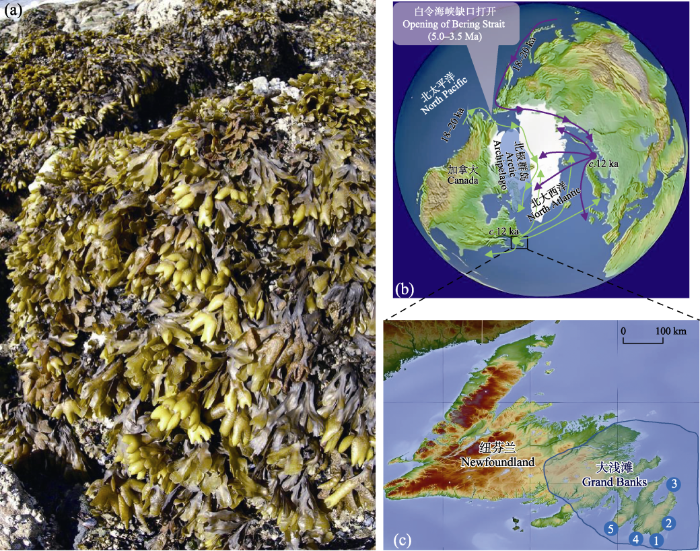
图1
二裂墨角藻简况。(a)二裂墨角藻外部形态及栖息地(加拿大不列颠哥伦比亚省温哥华)。(b)二裂墨角藻在泛北极地区的大致扩散历史。深紫色和绿色箭头显示二裂墨角藻北太平洋祖先在末次冰盛期两次跨北极侵入到北大西洋。挪威北部(绿色圆点)和加拿大纽芬兰(深紫色圆点)为北大西洋东西两岸的冰期避难所, 在此存留的祖先种群约在1.2万年前发生跨地区扩散形成现今分布格局。Ma: 百万年前; ka: 千年前。(c)纽芬兰大浅滩二裂墨角藻种群采样地点, 其中蓝线区域为大浅滩的大致范围。
Fig. 1
The brief description of the brown alga Fucus distichus. (a) The morphology and habitat of F. distichus (Vancouver, British Columbia, Canada); (b) The general dispersal history of F. distichus in the Pan-Arctic. The purple and green arrows indicate two separate trans-Arctic migration events of the ancestral F. distichus in the North Pacific into the North Atlantic. The purple and green circles represent two marine glacial refugia during the last glacial maximum on the northeast (northern Norway) and northwest (Newfoundland, Canada) Atlantic, where the survived ancestral populations expanded c. 12 ka to consequently form present-day distribution patterns. Ma, Million years ago; ka, Thousand years ago. (c) Sampling locations of F. distichus from the Grand Banks of Newfoundland, Canada.
针对在北大西洋东西两岸(东北大西洋、西北大西洋)的多样性研究现状和古气候变动过程, 我们提出两个关于二裂墨角藻生物地理演化过程的假设。假设1: 在冰期向间冰期过渡时, 泛北极地区海平面上升和高温期的延长(相对于现在)可能使得北极的二裂墨角藻种群发生首次大规模跨越加拿大北极群岛(Canadian Arctic Archipelago, 图1b)的南向入侵(Adey & Hayek, 2011), 从而抵达西北大西洋近北极岩礁地区(如加拿大滨海诸省和美国缅因湾) (Laughinghouse et al, 2015)。当随后的冰期来临, 北美的劳伦冰盖(Laurentian ice sheet)边缘的岩礁潮间带部分区域(如新斯科舍省和纽芬兰东南部的大浅滩(Grand Banks, 图1c))未被冰层覆盖, 从而形成冰期避难所, 二裂墨角藻得以在此存留下来(Dyke & Prest, 1987; Maggs et al, 2008; 胡自民等, 2021), 成为西北大西洋现今二裂墨角藻的祖先。假设2: 在冰期向间冰期过渡时, 北极的二裂墨角藻首先扩散到东北大西洋。当随后的冰期来临, 东北大西洋的二裂墨角藻在多个冰期避难所(如冰岛、挪威北部、法罗群岛、爱尔兰西南部和英吉利海峡)内存留下来, 它们作为祖先种群通过跨大西洋扩散到达西北大西洋, 进而形成现今的地理分布格局。这一进化模式已在多种潮间带海洋生物中得到证实(Wares & Cunningham, 2001; Vermeij, 2005), 包括北大西洋特有的齿缘墨角藻(Fucus serratus) (Brawley et al, 2009)和皱波角叉菜(Chondrus crispus) (Hu et al, 2010)。因此, 针对北大西洋的特殊地质历史(如冰盛期时的潜在海洋避难所), 本文重点关注分布在加拿大纽芬兰大浅滩地区的二裂墨角藻种群, 拟通过分子谱系多样性和结构特征分析对上述两个假设进行检验。
多年生的二裂墨角藻是泛北极地区的近岸优势物种, 它的顶篷状(canopy-forming)形态能形成三维空间的潮间带景观(intertidal landscape), 为其他生物提供食物和栖息地等, 在生态层面具有重要的基础物种功能。在挪威东北部的斯瓦尔巴群岛(Svalbard Archipelago), 二裂墨角藻种群分化出对环境变动(如气候变暖驱动的冰层融化, 进而导致海水盐度降低和光线透射减弱)具有预适应能力的生态型(ecotype) (Smolina et al, 2016)。藻体抗氧化能力、光化学反应、营养组分和硝酸盐吸收能力等一系列生理生化行为的变动使得它们不易受环境影响(Umanzor et al, 2023), 甚至能从中受益(Weslawski et al, 2010)。这导致在北极某些未受侵扰的栖息地, 二裂墨角藻生物量可达25 kg/m2 (Sukhoveeva & Podkorytova, 2006)。二裂墨角藻营养丰富, 蛋白质、脂质、可溶性碳水化合物和矿物质在干重中的占比分别高达8.1%-10.0%、1.1%-3.0%、17.6%-26.7%和18.6%-20.5% (Catarino et al, 2018)。二裂墨角藻还富含岩藻多糖(fucoidan)、甘露醇(mannitol)和褐藻酸(alginic acid)等活性成分, 其中岩藻多糖具有抗炎和抗凝活性功能(Cumashi et al, 2007), 具有重要的工业和医药价值。在地理演化方面, 线粒体和微卫星标记显示该物种的遗传多样性总体较低, 北太平洋线粒体单倍型之间的分化历史明显早于北大西洋(Coyer et al, 2011), 但该研究缺乏来自加拿大纽芬兰东南部地区(如大浅滩)的样品。随后, 基于泛北极地区不同地点单样本单基因系统发育重建发现, 纽芬兰南部的费里兰(Ferryland)和维特力斯湾(Witless Bay)及北部的Nameless cove等地存在多个独特的线粒体基因型, 且它们与其他基因型之间存在高度分化(Laughinghouse et al, 2015)。这些研究为我们以纽芬兰东南部为切入点, 通过补充采集特征地点的种群进而揭示二裂墨角藻的遗传多样性和地理演化模式提供了重要理论依据(Laughinghouse et al, 2015)。
本研究采集了加拿大纽芬兰大浅滩的5个二裂墨角藻种群样品, 利用IGS和COX1标记进行种群遗传变异和谱系结构分析, 通过将其与Coyer等(2011)发表的数据进行比较整合, 鉴定具有较高遗传变异和特有基因型的种群, 最终基于末次冰盛期以来纽芬兰海岸线的变动过程推断二裂墨角藻在该地区的潜在存留位置。本研究对系统解读北半球墨角藻属(包括其他海藻)多样性的维持机制和进化历史具有重要借鉴意义。
1 材料与方法
1.1 样品采集
二裂墨角藻呈深褐色, 大面积丛生, 藻体每个分支的顶端呈典型的二裂状, 易于区分(图1a)。我们通过国际合作者David Sturge博士于2012年9月从纽芬兰大浅滩采集到5个研究地点的种群样品(图1c)。每个种群采集10-30个数量不等的个体, 个体间距保持10 m以上以避免其来自同一祖先。用干净海水清洗样品表面的泥沙和附生物, 用吸水纸吸干水分后放在自封袋中, 利用硅胶干燥保存。这5个种群中最北端(GB3)的经纬度是47°44′ N/52°46′ W, 最南端(GB4)是46°36′ N/53°32′ W, 其纬度明显低于Coyer等(2011)采集的两个纽芬兰二裂墨角藻种群: 拱门(Arches) (50°08′ N/57°38′ W)和诺斯特(Nordstead) (51°35′ N/55°30′ W)。
1.2 基因组提取和线粒体标记扩增与测序
样品运送到实验室后, 将硅胶干燥的藻体用海水重新浸润使其恢复正常形态, 用灭菌刀片截取其顶端约0.2 g样品, 采用FastPure® Plant DNA Isolation Mini Kit试剂盒(南京诺唯赞医疗科技有限公司, 南京)提取基因组DNA。用1%琼脂糖凝胶电泳和Nano Drop® ND-2000分光光度计(Thermo Fisher Scientific, Wilmington, DE, USA)检测DNA质量与浓度。将检测合格的DNA稀释至30-50 ng/μL, 置于-20℃冰箱保存备用。
为充分整合已发表的二裂墨角藻分子数据, 我们参照Coyer等(2011)所用的引物组合、PCR反应体系和反应条件, 对线粒体IGS和COX1分别进行扩增。其中, 引物由上海生工生物工程股份有限公司合成。PCR扩增产物用1%琼脂糖凝胶电泳进行检测。纯化后的PCR产物在3730xl DNA分析仪(Applied Biosystems, CA, USA)上进行Sanger双向测序。
1.3 数据分析
参考Coyer等(2011)提交到GenBank的单倍型序列(COX1: GU366068-GU366070; IGS: GU366071- GU366077), 结合测序峰图, 利用MEGA X (Kumar et al, 2018)分别对IGS和COX1测序结果进行比对和人工校对, 确定其起点和终点。利用DnaSP v6.12.03 (Rozas et al, 2017)统计每个标记产生的单倍型数目。比较本研究产生的COX1和IGS单倍型与Coyer等(2011)报道的单倍型之间的异同, 利用NETWORK v4.611 (Bandelt et al, 1999)的Median Joining算法构建全部单倍型的网络关系图, 分析不同单倍型之间的进化关系。利用Arlequin 3.5 (Excoffier & Lischer, 2010)计算不同种群的单倍型多样性(h)和核苷酸多样性(π)。
从GenBank中获取现有的二裂墨角藻COX1序列(3条)和IGS序列(21条) (Coyer et al, 2011; Laughinghouse et al, 2015), 将其分别整合到本研究所获得的单倍型数据集中, 构建系统进化树。对于COX1数据集, 选择同属种Fucus vesiculosus (LN877839)和F. spiralis (LN877854)作为外类群; 对于IGS数据集, 同理选择F. vesiculosus (HM583794)和F. spiralis (HM583777)作为外类群。利用MEGA X在赤池信息准则(Akaike information criterion)下分别筛选适用于COX1和IGS单倍型数据集的最佳核苷酸替代模型(COX1: HKY; IGS: T92), 然后在该模型下进行最大似然法(maximum likelihood, ML)和邻接法(neighbour joining, NJ)分析, 评估不同单倍型之间的进化关系。每个分析中自展值(bootstrap value)设为1,000, 空位或缺失位点均当作配对删除处理。系统树通过iTOL (Interactive Tree of Life)网站(
2 结果
因样品保存和长途运输等原因, 我们最终只获得纽芬兰大浅滩4个种群(GB1, GB2, GB3, GB5)的67条COX1和72条IGS序列(表1)。其中, COX1长度414 bp, 共产生4个单倍型(Hap-1-Hap-4); IGS长度182 bp, 共产生10个单倍型(Hap1-Hap10) (表1)。Coyer等(2011)分析了北太平洋和北大西洋的23个二裂墨角藻种群, 他们在276个序列中检测到3个COX1基因型(c1, c2, c3), 在607个序列中检测到7个IGS单倍型(i1, i2, i3, i4, i5, i6, i7)。通过与其比较, 我们发现本研究的Hap-1对应于c1 (数量最多, 在北太平洋和北大西洋广泛分布), 而Hap-2-Hap-4为首次发现, 且为纽芬兰本地特有(表1); Hap1对应于i1 (数量最多, 在北大西洋广泛分布), 而Hap2-Hap10为首次发现, 且为纽芬兰本地特有(表1)。另外, 本研究发现的IGS单倍型Hap1-Hap10完全不同于Laughinghouse等(2015)报道的14个IGS基因型。COX1显示GB1、GB2和GB3这3个种群都只有1个单倍型Hap-1, 而GB5则含有全部的4个单倍型Hap-1-Hap-4。IGS显示GB1和GB3这两个种群都含有3个单倍型Hap1-Hap3, GB2也含有3个单倍型Hap1、Hap2和Hap5, 而GB5则含有除Hap5以外的其他9个单倍型(Hap1-Hap4, Hap6-Hap10) (表1)。比较Coyer等(2011)的结果还显示, 北太平洋、东北大西洋和西北大西洋遗传多样性最高的群体含有的COX1或IGS单倍型数目只有1-2个, 美国阿拉斯加威廉王子湾(Prince Williams Sound)含有的IGS单倍型最多(3个) (表1)。
表1 纽芬兰大浅滩二裂墨角藻的遗传多样性(粗体字)与Coyer等(2011)研究中遗传多样性最高的种群(背景浅灰色)的比较
Table 1
| 采样地点 Sampling localities | 23S mtDNA基因间区 23S mtDNA intergenic spacer (IGS) | 细胞色素c氧化酶亚基 Cytochrome c oxidase subunit I (COX1) | 数据来源 Data source | ||||||
|---|---|---|---|---|---|---|---|---|---|
| n | h | π | hi | n | h | π | hi | ||
| 加拿大纽芬兰大浅滩 Grand banks, Newfoundland, Canada (GB1) | 27 | 0.5014 | 0.0046 | Hap1 (i1)-Hap3 | 27 | 0.0000 | 0.0000 | Hap-1 (c1) | 本研究 This study |
| 加拿大纽芬兰大浅滩 Grand banks, Newfoundland, Canada (GB2) | 6 | 0.7333 | 0.0054 | Hap1 (i1), Hap2, Hap5 | 10 | 0.0000 | 0.0000 | Hap-1 (c1) | 本研究 This study |
| 加拿大纽芬兰大浅滩 Grand banks, Newfoundland, Canada (GB3) | 10 | 0.6889 | 0.0078 | Hap1 (i1)-Hap3 | 6 | 0.0000 | 0.0000 | Hap-1 (c1) | 本研究 This study |
| 加拿大纽芬兰大浅滩 Grand banks, Newfoundland, Canada (GB5) | 29 | 0.6897 | 0.0088 | Hap1 (i1)-Hap4, Hap6-Hap10 | 24 | 0.3080 | 0.0036 | Hap-1 (c1) -Hap-4 | 本研究 This study |
| 加拿大纽芬兰拱门 Arches, Newfoundland, Canada | 27 | 0.0000 | 0.0000 | i1 | 12 | 0.3273 | 0.0008 | c1, c2 | Coyer et al, 2011 |
| 加拿大纽芬兰诺斯特德 Norstead, Newfoundland, Canada | 24 | 0.0000 | 0.0000 | i1 | 12 | 0.0000 | 0.0000 | c1 | Coyer et al, 2011 |
| 美国阿拉斯加阿图岛 Attu Island, Alaska, USA | 26 | 0.3624 | 0.0046 | i4, i5 | 12 | 0.0000 | 0.0000 | c1 | Coyer et al, 2011 |
| 美国阿拉斯加威廉王子湾 Prince Williams Sound, Alaska, USA | 26 | 0.5200 | 0.0138 | i4, i5, i7 | 12 | 0.1667 | 0.0004 | c1, c2 | Coyer et al, 2011 |
| 美国缅因阿普尔多尔岛 Appledore Island, Maine, USA | 24 | 0.0000 | 0.0000 | i1 | 12 | 0.5303 | 0.0013 | c1, c3 | Coyer et al, 2011 |
| 冰岛伊萨菲厄泽 Isafjörður, Iceland | 32 | 0.0000 | 0.0000 | i1 | 12 | 0.5303 | 0.0013 | c1, c2 | Coyer et al, 2011 |
| 冰岛格林达维克 Grindavik, Iceland | 28 | 0.3042 | 0.0017 | i1, i2 | 12 | 0.1667 | 0.0004 | c1, c2 | Coyer et al, 2011 |
| 冰岛布雷兹达斯维克 Breiðalsvik, Iceland | 30 | 0.0667 | 0.0004 | i1, i3 | 12 | 0.5000 | 0.0013 | c1, c2 | Coyer et al, 2011 |
| 丹麦法罗群岛斯特罗莫岛 Streymoy, Faroe Islands, Danmark | 16 | 0.2333 | 0.0013 | i1, i2 | 12 | 0.0000 | 0.0000 | c1 | Coyer et al, 2011 |
| 挪威哈默菲斯特 Hammerfest, Norway | 30 | 0.0000 | 0.0000 | i1 | 12 | 0.5303 | 0.0013 | c1, c2, c3 | Coyer et al, 2011 |
n: 种群大小; h: 单倍型多样性; π: 核苷酸多样性; hi: 单倍型数目。
n, Population size; h, Haplotype diversity; π, Nucleotide diversity; hi, Number of haplotypes.
在Coyer等(2011)的研究中, 位于北大西洋美国(缅因)、冰岛和挪威的4个种群COX1单倍型和核苷酸多样性最高(h = 0.5000-0.5303, π = 0.0013), 而IGS数据显示位于东北太平洋美国(阿拉斯加)和冰岛的另3个种群单倍型和核苷酸多样性最高(h = 0.3042-0.5200, π = 0.0017-0.0138) (表1)。对于纽芬兰大浅滩的4个种群, COX1数据显示GB5的单倍型和核苷酸多样性最高(h = 0.3080, π = 0.0036), 而IGS单倍型多样性介于0.5014-0.7333之间, 其中GB5的单倍型和核苷酸多样性分别为0.6897和0.0088 (表1)。IGS数据显示, 加拿大纽芬兰大浅滩地区二裂墨角藻的种群遗传多样性水平明显高于东北太平洋和东北大西洋两岸的其他种群。
COX1单倍型网络图(图2a)显示, 在6个单倍型中Hap-1 (c1)为祖先单倍型, 它在北太平洋、东北大西洋和西北大西洋(包括纽芬兰大浅滩)广泛分布, 其中在大浅滩分布的数目超过总量的25%。在纽芬兰大浅滩特有的3个单倍型中, Hap-2与Hap-1 (c1)亲缘关系较近(仅1个核苷酸突变), 前者直接由后者演化而来, 而Hap-3和Hap-4则和Hap-1 (c1)隔离较远, 两者间存在5个或11个核苷酸突变。
图2
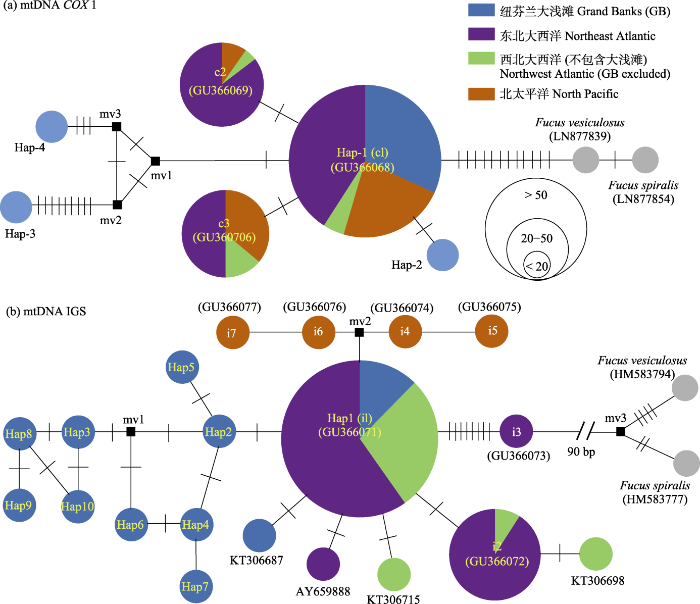
图2
基于mtDNA COX1 (a)和23S mtDNA IGS (b)构建的单倍型网络图。c1-c3和i1-i7分别对应Coyer等(2011)报道的COX1和IGS单倍型, 其中c1和i1分别与本研究中的Hap-1和Hap1相同。黑色方框(如mv)表示丧失或未采集到的单倍型。
Fig. 2
The constructed haplotype network based on mtDNA COX1 (a) and 23S mtDNA IGS datasets (b). c1-c3 and i1-i7 are COX1 and IGS haplotypes reported by Coyer et al (2011), respectively, of which c1 and i1 are identical to Hap-1 and Hap1, respectively identified in this study. The black boxes (e.g. mv) represent the lost or missed haplotypes.
COX1单倍型系统树(图3)显示, 纽芬兰大浅滩特有的单倍型Hap-2与来自北太平洋(日本北海道室兰 + 美国阿拉斯加)和东北大西洋(挪威诺尔兰 + 美国缅因)的单倍型亲缘关系更近, 而大浅滩的另两个特有单倍型Hap-3和Hap-4则与其他单倍型的亲缘关系较远(ML和NJ自展值分别为88和87)。IGS系统树(图4)显示北太平洋(如美国阿拉斯加和华盛顿及日本北海道)单倍型亲缘关系较近, 尽管ML/NJ自展值不高, 但仍聚为一个亚支。纽芬兰大浅滩特有的3个单倍型(Hap2, Hap3, Hap5)与其他大多来自西北大西洋(如美国缅因、加拿大曼尼托巴(Maniotba))和纽芬兰(大浅滩除外)的单倍型(包括祖先单倍型Hap1 (i1))亲缘关系更近。大浅滩地区另外6个IGS单倍型(Hap4, Hap6-Hap10)的核苷酸突变位点更为独特且相似(图4), 并且存在特殊的插入/缺失(indels), 显示它们可能由共同的祖先演化而来, 这也使得它们与其他单倍型的亲缘关系较远。
图3
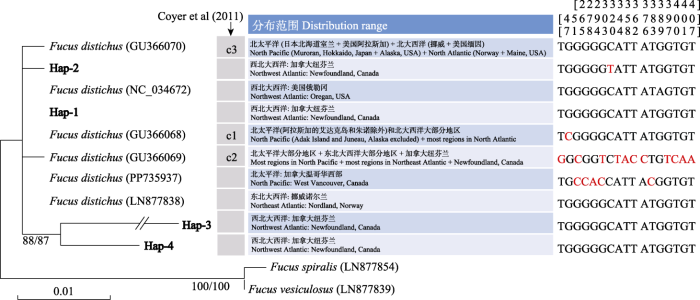
图3
基于mtDNA COX1单倍型构建的邻接系统进化树。字体加粗的Hap-1-Hap-4为本研究报道的纽芬兰大浅滩的单倍型。进化树上括号内的字符为相应序列的GenBank注册号, 斜线两侧的数字为邻接和最大似然算法自展值(1,000次重复)。箭头所示为Coyer等(2011)报道的COX1单倍型。每个COX1单倍型在不同位置(即比对碱基上方的数字)的碱基变异用红色凸显。
Fig. 3
Neighbour joining phylogenetic tree constructed using mtDNA COX1 haplotypes. Hap-1-Hap-4 in bold font are haplotypes identified from the Grand Banks of Newfoundland in this study. The characters in parentheses are GenBank accession numbers for each sequence, and the numbers on both sides of the slash are bootstrap values of neighbour joining and maximum likelihood algorithm (1,000 replicates). The arrow indicates the COX1 haplotypes reported by Coyer et al (2011). The nucleotide variations of each COX1 haplotype at different numbering sites (i.e. the numbers above the aligned nucleotides) are highlighted in red color.
图4
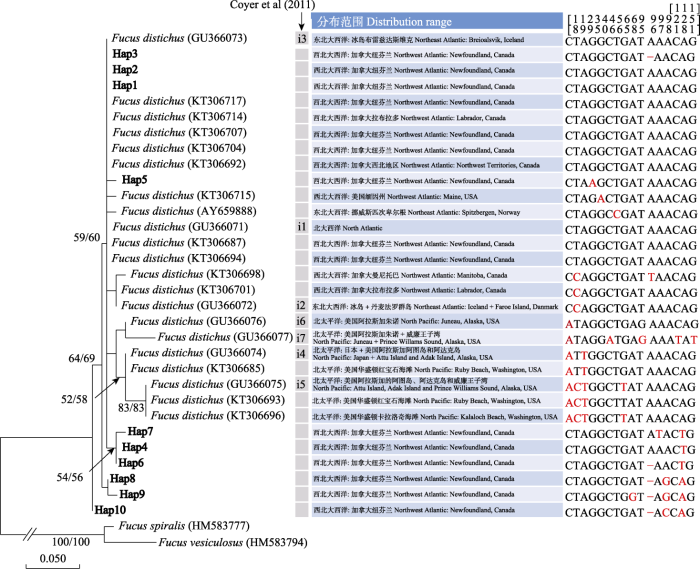
图4
基于23S mtDNA IGS单倍型构建的邻接系统进化树。加粗的Hap1-Hap10为本研究报道的纽芬兰大浅滩的单倍型。进化树上括号内的字符为相应序列的GenBank注册号, 斜线两侧的数字为邻接和最大似然算法自展值(1,000次重复)。箭头所示为Coyer等(2011)报道的IGS单倍型。核酸比对中的“-”表示碱基缺失。
Fig. 4
Neighbour joining phylogenetic tree constructed using 23S mtDNA IGS haplotypes. Hap1-Hap10 in bold font are haplotypes identified from the Grand Banks of Newfoundland in this study. The characters in parentheses are GenBank accession numbers for each sequence, and the numbers on both sides of the slash are bootstrap values of neighbour joining and maximum likelihood algorithm (1,000 replicates). The arrow indicates the IGS haplotypes reported by Coyer et al (2011). The nucleotide variations of each IGS haplotype at different numbering sites (i.e. the numbers above the aligned nucleotides) are highlighted in red color. “-” in aligned sequences indicates missed nucleotide.
3 讨论
本文结果显示IGS虽然序列较短, 但具有比COX1更为丰富的多态信息位点。IGS单倍型网络图和系统进化树支持二裂墨角藻的祖先中心种群位于加拿大北极群岛的观点, 该祖先可能在更新世末期的间冰期侵入到北太平洋和东北大西洋近岸, 后者在全新世期间发生了从欧洲到北美的跨大西洋入侵。因此, 本研究总体支持前文中提出的假设2。另外, 结合谱系多样性数据和纽芬兰地区末次冰盛期以来海平面的变动, 本研究认为加拿大纽芬兰大浅滩可能存在一个更新世末期海洋避难所(如弗莱明角(Flemish Cap), 图5), 它使得二裂墨角藻在冰盛期海平面急剧下降时作为祖先种群在此存留, 在冰期消退后再扩散至大浅滩附近, 从而形成现今的地理分布格局。
图5
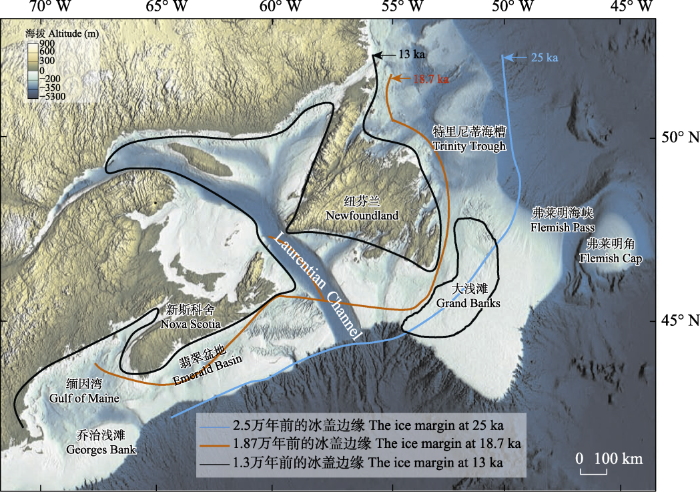
图5
弗莱明角相对于大浅滩的地理位置以及2.5万年前(蓝色线)、1.87万年前(褐色线)和1.3万年前(黑色线)纽芬兰周边冰盖边缘的大致位置。修改自Shaw (2006)和Fan等(2024)。ka: 千年前。
Fig. 5
The geographic location of the Flemish Cap relative to the Grand Banks, and the ice margin around Newfoundland at 25 ka (blue line), 18.7 ka (brown line), and 13 ka (black line). Modified from Shaw (2006) and Fan et al (2024). ka, Thousands years ago.
3.1 墨角藻起源与演化
虽然墨角藻科被认为起源于北太平洋, 但也有研究提出现今北大西洋的二裂墨角藻祖先可能分布在北大西洋/北极(白令海峡大西洋一侧), 它们在更新世末期的间冰期侵入到北太平洋(Cánovas et al, 2011)。Laughinghouse等(2015)基于23S mtDNA IGS的系统发育分析发现, 东北太平洋和西北大西洋现存的二裂墨角藻含有4个支系, 其中3个为多系起源。在地理上, 一个多系分支位于北太平洋(包括太平洋东北部的美国华盛顿和英属哥伦比亚), 另一个位于泛北极(包括加拿大曼尼托巴、努纳武特(Nunavut)和纽芬兰北部等), 第三个位于美国缅因湾和加拿大纽芬兰南部, 这与Coyer等(2011)和Cánovas等(2011)提出的二裂墨角藻多系起源观点一致。不过, 北太平洋支系与地理上更接近的泛北极支系的亲缘关系却更远。Laughinghouse等(2015)认为泛北极的一个独特基因型可能是北太平洋和北大西洋的共同祖先, 这与我们报道的COX1和IGS祖先单倍型(Hap-1 (c1)和Hap1 (i1), 图2)广泛分布于北大西洋的结果一致。
墨角藻属含有两个主要谱系: 谱系1包括齿缘墨角藻(F. serratus)、F. gardneri、枯墨角藻(F. evanescens)和二裂墨角藻, 谱系2包括墨角藻(F. vesiculosus)、螺旋墨角藻(F. spiralis)、F. ceranoides、F. virsoides和F. radicans (Serräo et al, 1999)。这两个谱系均起源于北太平洋祖先, 后者在白令海峡缺口打开后约在5.5-2.3百万年前跨过北极, 到达北大西洋后受冰期的驱动经历辐射演化, 形成当前的物种多样性和地理分布格局(Coyer et al, 2006; Hoarau et al, 2007)。墨角藻属物种在北大西洋的动态演化一直不断推进。如在末次冰盛期后, 北极附近的斯堪的纳维亚冰盖(Scandinavian ice sheet)逐渐消退, 这使得海平面缓慢上升, 进而导致波罗的海(Baltic Sea)与北海(North Sea)重新连通, 这一气候-地质事件是波罗的海特有墨角藻物种F. radicans在过去2,000-4,000年间得以形成的重要原因(Pereyra et al, 2009)。
3.2 纽芬兰大浅滩弗莱明角——潜在的更新世末期冰期避难所
分子谱系地理学通常认为避难所种群具有较高的遗传多样性和特有基因型, 而侵入地(源自单个种群扩张)的遗传多样性则普遍偏低。多个不同种群扩张到同一侵入地后会导致基因型混合而呈现较高遗传多样性, 但混合或多次引入不会导致侵入地产生特有基因型(Maggs et al, 2008; Hu et al, 2018)。因此, 高遗传多样性(特别是特有基因型数量)是推断冰期避难所的重要依据之一。另外, 统计简约网络假定祖先和后代之间的关系不呈现叉状分支模式, 相反它将亲缘关系非常近的单倍型聚在一起, 因而被广泛用来解决亲缘关系较近的物种间(如二裂墨角藻和枯墨角藻)的生物地理学问题(Fenberg et al, 2014)。在本研究中, 我们发现纽芬兰大浅滩的二裂墨角藻种群不仅遗传多样性高, 而且具有大量的特有基因型(如IGS单倍型), 这些数据(表1)和单倍型网络图模式(图2)显示该地区极有可能存在一个潜在的海洋冰期避难所。
海洋冰期避难所研究目前主要集中在热适应(分布于中低纬度)的生物类群, 后者在冰期时收缩至北半球南部的避难所, 在随后的间冰期温度适宜时则向北进行扩散和侵殖(Maggs et al, 2008; Hu et al, 2011, 2018; Zhong et al, 2020; Liu et al, 2022), 相反对冷适应(中高纬度, 如10℃等温线)的物种关注较少。Coyer等(2011)认为二裂墨角藻在北大西洋出现的时间约在3.4-1.5万年前, 这明显早于白令海峡最近一次打开的时间(约1.4万年前)。在末次冰盛期, 多年性海冰填满北半球冰盖间的海面空隙, 在整个北极形成一个巨大的固体冰原, 其南部边缘延伸至北大西洋的纽芬兰-格陵兰岛南部-冰岛-挪威北部一带(Frenzel et al, 1992)。尽管如此, 东北大西洋许多冷适应的潮间带物种仍存留在法国的布列塔尼(Britttany)至葡萄牙中部之间, 而西北大西洋的物种则存留在加拿大滨海诸省(Frenzel et al, 1992; Shaw, 2006; Shaw et al, 2006)。在纽芬兰周边很多地区如大浅滩、乔治沙洲(Georges Bank)东部和弗莱明角未被冰层覆盖且相互隔离(图5) (Dyke & Prest, 1987; Shaw, 2006; Shaw et al, 2006), 使得它们具备作为海洋冰期避难所的地质条件。类似的海洋生物谱系地理学研究, 包括无脊椎动物(Wares & Cunningham, 2001; Maggs et al, 2008; Kelly et al, 2009)和大型海藻瘤状囊叶藻(Ascophyllum nodosum) (Olsen et al, 2010), 也都显示纽芬兰附近的新斯科舍省存在一个海洋冰期避难所, 而纽芬兰大浅滩东部的弗莱明角则可能是另一个潜在的冰期避难所。
弗莱明角是位于纽芬兰大浅滩东部的一个离岸浅滩(图5), 当前的最浅深度为126 m (比冰期时浅10 m), 它与大浅滩之间被弗莱明海峡隔断, 后者深度超过1,000 m。末次冰盛期后, 北美东部的冰川消退从纽芬兰东北部开始并一直向缅因湾缓慢推进, 1.8万年前到达新斯科舍省南部的翡翠盆地(Emerald Basin), 1.4万年前冰层快速消退至纽芬兰南部和西南部海岸(图5) (Shaw, 2006)。在1.3-1.0万年前, 海平面上升导致纽芬兰大浅滩边缘被海水浸没, 形成一个连接大浅滩和新英格兰近岸的群岛, 其中最大的岛屿位于大浅滩上, 其海拔高达60 m (Shaw, 2006)。在约1.0万年前, 新斯科舍省开始无冰层覆盖, 而大浅滩腹地的冰层很快也完全消失, 海平面急剧上升使得弗莱明角最浅处的深度亦达到50 m (Shaw, 2006)。因此, 弗莱明角在末次冰盛期及以前始终没有被冰层覆盖(浸没在海水中), 它成为海洋生物在冰盛期时得以存留的避难场所之一(Shaw, 2003, 2006; Shaw et al, 2006)。当然, 该假设的提出完全基于谱系多样性证据和地质历史变动, 它还需在纽芬兰近海其他底栖生物(特别是扩散能力较弱的物种)中加以佐证。另外, 气候变化(特别是温度变动)是影响潮间带海藻地理分布的主要因素之一, 它可直接改变后者的适宜分布范围(如扩张、收缩和迁移)。因此, 下一步可利用物种分布模型(species distribution modelling, SDMs)研究北半球末次冰盛期海平面波动如何影响二裂墨角藻的分布格局和历史变动, 进而推断北大西洋东西两岸潜在的冰期避难所位置(Assis et al, 2018; Song et al, 2021), 这将为本论文的假设提供额外的生态位进化证据。
3.3 二裂墨角藻的遗传变异与生态适应
微卫星数据显示北太平洋和北大西洋二裂墨角藻种群间分化较弱(FST均值 = 0.265, Coyer et al, 2011), 而线粒体标记进一步显示其种群间遗传分化不明显, 这可能与二裂墨角藻的独特繁殖方式有关。二裂墨角藻为雌雄同体(hermaphrodite)。不同于其他海藻, 二裂墨角藻生殖托(繁殖器官)的形成和胚子发育受光周期(而非温度)调控(Bird & McLachlan, 1976), 而光周期也是决定其在北大西洋南部边缘分布的关键因子之一(Hiscock et al, 2004)。在繁殖期间, 成熟二裂墨角藻释放的卵子通常能快速附着到潮间带基质上。为确保卵子释放的信息素(其效力仅维持在微米-毫米的距离范围内)能被精子高效识别并受精, 配子(包括精子和卵子)一般需在静水中释放, 这样能保证近100%的受精率(Pearson & Brawley, 1996; Berndt et al, 2002)。因此, 墨角藻配子和合子的扩散通常局限在亲本周围1-5 m以内(Serräo et al, 1997; Engel et al, 2005), 这导致其在繁殖过程中呈现出高度的近交(inbreeding)。尽管不同地区间可能存在差别, 但这种近亲交配极大地削减了二裂墨角藻的有效种群大小。虽然成熟的藻体从固着器上脱落后可经海流驱动进行长距离扩散(Norton, 1992), 实现微小地理尺度(如10 m-1 km, Tatarenkov et al, 2005)到大地理尺度(如70 km, Coyer et al, 2003)的跨地域入侵, 但个体间的高度自交则导致种群间无显著遗传分化(Coleman & Brawley, 2005)。另外, 遗传多样性水平受有效种群大小、基因流、选择、遗传漂变和突变等多种因素的影响, 而有效种群大小在其中承担重要角色。对二裂墨角藻而言, 较小的有效种群通常伴随着适合度(fitness)的丢失(Coyer et al, 2008), 这表明末次冰盛期以来存留在纽芬兰大浅滩地区的二裂墨角藻种群(独特的遗传多样性和有限的种群大小)具有重要的多样性保护价值。
二裂墨角藻表型可塑性较高, 生物和非生物因子(如干露(desiccation)、海流、光照、波浪、温度和地理分布等)通过自然选择塑造其表型, 进而影响其适应性(借助表型和基因型的整合)。在斯瓦尔巴群岛, 二裂墨角藻在冰层覆盖时能存活几个月(Svendsen et al, 2002; Laughinghouse et al, 2015)。在阿拉斯加东南部, 受冰川影响较大的水域(水温更低、光照更弱、冰层更厚)的二裂墨角藻生物量远超过受冰川影响小的地区(McCabe & Konar, 2021)。这些研究表明二裂墨角藻对极端环境(如低温胁迫、营养盐变动)具有较强的适应能力(Lindeberg & Lindstrom, 2010)。在机制层面, 这得益于二裂墨角藻热激蛋白(heat-shock protein, HSP)基因HSP70和HSP90在低温下的高量表达, 同时其细胞组分如甘氨酸甜菜碱(glycinebetaine)能强化光化学反应的稳定, 而解毒酶(detoxifying enzymes)能保护光系统II免于活性氧(reactive oxygen species, ROS)损伤, 使得其正常进行光合作用(Allakhverdiev et al, 2008; Smolina et al, 2016)。但受全球气候变暖影响, 二裂墨角藻种群遗传多样性和分布区面临缩减的风险, 其具有的低温耐受性能极有可能被削弱甚至丧失(Jueterbock et al, 2016)。因此, 继续研究二裂墨角藻关键种群(如冰期避难所种群)的生态生理功能以及分布区内中心与边缘种群的遗传与生态差异等(Wahl et al, 2011; Ferreira et al, 2014), 对于深入理解二裂墨角藻的生态、适应和进化及开展资源保护等具有重要科学意义。
尽管如此, 本文中用于分析的大浅滩种群和样本数量稍显不足, 还不足以代表整个纽芬兰地区二裂墨角藻的种群遗传结构特征, 而且COX1和IGS的结果之间存在一定差异, 两组分子证据链之间的协同性不够充分。在后续研究中, 应考虑增加纽芬兰地区的二裂墨角藻采样范围和种群数量, 可以将线粒体基因间区作为重点标记进行补充分析, 以提高数据的代表性、可靠性和协同性。同时, 结合该地区其他底栖海洋生物(如软体动物等)的谱系结构和多样性分布研究结果, 进一步夯实本文的冰期避难所观点。
参考文献
Elucidating marine biogeography with macrophytes: Quantitative analysis of the North Atlantic supports the thermogeographic model and demonstrates a distinct subarctic region in the northwestern Atlantic
The biogeographic origin of Arctic endemic sea weeds: A thermogeographic view
Heat stress: An overview of molecular responses in photosynthesis
Projected climate changes threaten ancient refugia of kelp forests in the North Atlantic
Median-joining networks for inferring intraspecific phylogenies
DOI:10.1093/oxfordjournals.molbev.a026036
PMID:10331250
[本文引用: 1]

Reconstructing phylogenies from intraspecific data (such as human mitochondrial DNA variation) is often a challenging task because of large sample sizes and small genetic distances between individuals. The resulting multitude of plausible trees is best expressed by a network which displays alternative potential evolutionary paths in the form of cycles. We present a method ("median joining" [MJ]) for constructing networks from recombination-free population data that combines features of Kruskal's algorithm for finding minimum spanning trees by favoring short connections, and Farris's maximum-parsimony (MP) heuristic algorithm, which sequentially adds new vertices called "median vectors", except that our MJ method does not resolve ties. The MJ method is hence closely related to the earlier approach of Foulds, Hendy, and Penny for estimating MP trees but can be adjusted to the level of homoplasy by setting a parameter epsilon. Unlike our earlier reduced median (RM) network method, MJ is applicable to multistate characters (e.g., amino acid sequences). An additional feature is the speed of the implemented algorithm: a sample of 800 worldwide mtDNA hypervariable segment I sequences requires less than 3 h on a Pentium 120 PC. The MJ method is demonstrated on a Tibetan mitochondrial DNA RFLP data set.
Gamete concentrations and timing and success of fertilization in a rocky shore seaweed
Control of formation of receptacles in Fucus distichus L. subsp
Historical invasions of the intertidal zone of Atlantic North America associated with distinctive patterns of trade and emigration
Marine centres of origin as evolutionary engines
Driving south: A multi-gene phylogeny of the brown algal family Fucaceae reveals relationships and recent drivers of a marine radiation
DOI:10.1186/1471-2148-11-371
PMID:22188734
[本文引用: 2]
Background: Understanding the processes driving speciation in marine ecosystems remained a challenge until recently, due to the unclear nature of dispersal boundaries. However, recent evidence for marine adaptive radiations and ecological speciation, as well as previously undetected patterns of cryptic speciation is overturning this view. Here, we use multi-gene phylogenetics to infer the family-level evolutionary history of Fucaceae (intertidal brown algae of the northern Pacific and Atlantic) in order to investigate recent and unique patterns of radiative speciation in the genus Fucus in the Atlantic, in contrast with the mainly monospecific extant genera.;Results: We developed a set of markers from 13 protein coding genes based on polymorphic cDNA from EST libraries, which provided novel resolution allowing estimation of ancestral character states and a detailed reconstruction of the recent radiative history. Phylogenetic reconstructions yielded similar topologies and revealed four independent trans-Arctic colonization events by Fucaceae lineages, two of which also involved transitions from hermaphroditism to dioecy associated with Atlantic invasions. More recently, reversion of dioecious ancestral lineages towards hermaphroditism has occurred in the genus Fucus, particularly coinciding with colonization of more extreme habitats. Novel lineages in the genus Fucus were also revealed in association with southern habitats. These most recent speciation events occurred during the Pleistocene glaciations and coincided with a shift towards selfing mating systems, generally southward shifts in distribution, and invasion of novel habitats.;Conclusions: Diversification of the family occurred in the Late-Mid Miocene, with at least four independent trans-Artic lineage crossings coincident with two reproductive mode transitions. The genus Fucus arose in the Pliocene but radiated within a relatively short time frame about 2.5 million years ago. Current species distributions of Fucus suggest that climatic factors promoted differentiation between the two major clades, while the recent and rapid species radiation in the temperate clade during Pleistocene glacial cycles coincided with several potential speciation drivers.
Phycochemical constituents and biological activities of Fucus spp
Are life history characteristics good predictors of genetic diversity and structure? A case study of the intertidal alga Fucus spiralis (Heterokontophyta; Phaeophyceae)
A mtDNA-based phylogeny of the brown algal genus Fucus (Heterokontophyta; Phaeophyta)
Trans-Pacific and trans-Arctic pathways of the intertidal macroalga Fucus distichus L. reveal multiple glacial refugia and colonizations from the North Pacific to the North Atlantic
Being abundant is not enough: A decrease in effective population size over eight generations in a Norwegian population of the seaweed, Fucus serratus
DOI:10.1098/rsbl.2008.0403
PMID:18765350
[本文引用: 1]
The brown alga Fucus serratus is a key foundation species on rocky intertidal shores of northern Europe. We sampled the same population off the coast of southern Norway in 2000 and 2008, and using 26 microsatellite loci, we estimated the changes in genetic diversity and effective population size (Ne). The unexpectedly low Ne (73-386) and Ne/N ratio (10-3-10-4), in combination with a significant decrease (14%) in allelic richness over the 8-year period, suggests an increased local extinction risk. If small Ne proves to be a common feature of F. serratus, then being abundant may not be enough for the species to weather future environmental changes.
Post-ice age recolonization and differentiation of Fucus serratus L. (Fucaceae: Phaeophyta) populations in Northern Europe
DOI:10.1046/j.1365-294x.2003.01850.x
PMID:12803634
[本文引用: 1]
The seaweed Fucus serratus is hypothesized to have evolved in the North Atlantic and present populations are thought to reflect recolonization from a southern refugium since the last glacial maximum 18 000-20 000 years bp. We examined genetic structure across several spatial scales by analysing seven microsatellite loci in populations collected from 21 localities throughout the species' range. Spatial auto-correlation analysis of seven microsatellite loci revealed no evidence for spatial clustering of alleles on a scale of 100 m despite limited gamete dispersal in F. serratus of approximately 2 m from parental individuals. Pairwise theta analysis suggested that the minimal panmictic unit for F. serratus was between 0.5 and 2 km. Isolation by distance was significant along some contiguous coastlines. Population differentiation was strong within the Skagerrak-Kattegat-Baltic Seas (SKB) (global theta= 0.17) despite a short history of approximately 7500 years. A neighbour-joining tree based on Reynold's distances computed from the microsatellite data revealed a central assemblage of populations on the Brittany Peninsula surrounded by four well-supported clusters consisting of the SKB, the North Sea (Ireland, Helgoland), and two populations from the northern Spanish coast. Samples from Iceland and Nova Scotia were most closely aligned with northwest Sweden and Brittany, respectively. When sample sizes were standardized (N = 41), allelic diversity was twofold higher for Brittany populations than for populations to the north and threefold higher than southern populations. The Brittany region may be a refugium or a recolonized area, whereas the Spanish populations most likely reflect present-day edge populations that have undergone repeated bottlenecks as a consequence of thermally induced cycles of recolonization and extinction.
A comparative study of the anti-inflammatory, anticoagulant, antiangiogenic, and antiadhesive activities of nine different fucoidans from brown seaweeds
DOI:10.1093/glycob/cwm014
PMID:17296677
[本文引用: 1]
The anti-inflammatory, antiangiogenic, anticoagulant, and antiadhesive properties of fucoidans obtained from nine species of brown algae were studied in order to examine the influence of fucoidan origin and composition on their biological activities. All fucoidans inhibited leucocyte recruitment in an inflammation model in rats, and neither the content of fucose and sulfate nor other structural features of their polysaccharide backbones significantly affected the efficacy of fucoidans in this model. In vitro evaluation of P-selectin-mediated neutrophil adhesion to platelets under flow conditions revealed that only polysaccharides from Laminaria saccharina, L. digitata, Fucus evanescens, F. serratus, F. distichus, F. spiralis, and Ascophyllum nodosum could serve as P-selectin inhibitors. All fucoidans, except that from Cladosiphon okamuranus carrying substantial levels of 2-O-alpha-D-glucuronopyranosyl branches in the linear (1-->3)-linked poly-alpha-fucopyranoside chain, exhibited anticoagulant activity as measured by activated partial thromboplastin time whereas only fucoidans from L. saccharina, L. digitata, F. serratus, F. distichus, and F. evanescens displayed strong antithrombin activity in a platelet aggregation test. The last fucoidans potently inhibited human umbilical vein endothelial cell (HUVEC) tubulogenesis in vitro and this property correlated with decreased levels of plasminogen-activator inhibitor-1 in HUVEC supernatants, suggesting a possible mechanism of fucoidan-induced inhibition of tubulogenesis. Finally, fucoidans from L. saccharina, L. digitata, F. serratus, F. distichus, and F. vesiculosus strongly blocked MDA-MB-231 breast carcinoma cell adhesion to platelets, an effect which might have critical implications in tumor metastasis. The data presented herein provide a new rationale for the development of potential drugs for thrombosis, inflammation, and tumor progression.
Late Wisconsinan and Holocene history of the Laurentide Ice Sheet
Genetic entities and mating system in hermaphroditic Fucus spiralis and its close dioecious relative F. vesiculosus (Fucaceae, Phaeophyceae)
DOI:10.1111/j.1365-294X.2005.02558.x
PMID:15910325
[本文引用: 1]
To date, molecular markers have not settled the question of the specific status of the closely related, but phylogenetically unresolved, brown seaweeds, hermaphroditic Fucus spiralis and dioecious Fucus vesiculosus, nor their propensity for natural hybridization. To test the degree of species integrity and to assess effect of the mating system on the population genetic structure, 288 individuals coming from parapatric (discontinuous) and sympatric (contiguous) spatial configurations at two sites were genotyped with five microsatellite loci. Using a Bayesian admixture analysis, our results show that F. spiralis and F. vesiculosus comprise clearly distinct genetic entities (clusters) generally characterized by cosexual and unisexual individuals, respectively. Genetic diversity within each entity suggests that F. spiralis reproduces primarily through selfing while F. vesiculosus is characterized by an endogamous breeding regime. Nevertheless, aberrant sexual phenotypes were observed in each cluster, no diagnostic alleles were revealed and 10% of study individuals were intermediate between the two genetic entities. This pattern can be explained by recent divergence of two taxa with retention of ancestral polymorphism or asymmetrical, introgressive hybridization. However, given (i) coincident monomorphism at three loci in spiralis clusters and (ii) that significantly more intermediates were observed in sympatric stations than in parapatric stations, we argue that interspecific gene flow has occurred after divergence of the two taxa. Finally, we show that whether recently separated or recently introgressive, the divergent breeding systems probably contribute to species integrity in these two taxa.
Arlequin suite ver 3.5: A new series of programs to perform population genetics analyses under Linux and Windows
DOI:10.1111/j.1755-0998.2010.02847.x
PMID:21565059
[本文引用: 1]
We present here a new version of the Arlequin program available under three different forms: a Windows graphical version (Winarl35), a console version of Arlequin (arlecore), and a specific console version to compute summary statistics (arlsumstat). The command-line versions run under both Linux and Windows. The main innovations of the new version include enhanced outputs in XML format, the possibility to embed graphics displaying computation results directly into output files, and the implementation of a new method to detect loci under selection from genome scans. Command-line versions are designed to handle large series of files, and arlsumstat can be used to generate summary statistics from simulated data sets within an Approximate Bayesian Computation framework.© 2010 Blackwell Publishing Ltd.
Ichnological analysis of glacially-influenced sediments from the late Pleistocene to Holocene on the southeastern Canadian margin: Implications for palaeoclimate and palaeoceanography
Historical and recent processes shaping the geographic range of a rocky intertidal gastropod: Phylogeography, ecology, and habitat availability
DOI:10.1002/ece3.1181
PMID:25473477
[本文引用: 1]
Factors shaping the geographic range of a species can be identified when phylogeographic patterns are combined with data on contemporary and historical geographic distribution, range-wide abundance, habitat/food availability, and through comparisons with codistributed taxa. Here, we evaluate range dynamism and phylogeography of the rocky intertidal gastropod Mexacanthina lugubris lugubris across its geographic range - the Pacific coast of the Baja peninsula and southern California. We sequenced mitochondrial DNA (CO1) from ten populations and compliment these data with museum records, habitat availability and range-wide field surveys of the distribution and abundance of M. l. lugubris and its primary prey (the barnacle Chthamalus fissus). The geographic range of M. l. lugubris can be characterized by three different events in its history: an old sundering in the mid-peninsular region of Baja (∼ 417,000 years ago) and more recent northern range expansion and southern range contraction. The mid-peninsular break is shared with many terrestrial and marine species, although M. l. lugubris represents the first mollusc to show it. This common break is often attributed to a hypothesized ancient seaway bisecting the peninsula, but for M. l. lugubris it may result from large habitat gaps in the southern clade. Northern clade populations, particularly near the historical northern limit (prior to the 1970s), have high local abundances and reside in a region with plentiful food and habitat - which makes its northern range conducive to expansion. The observed southern range contraction may result from the opposite scenario, with little food or habitat nearby. Our study highlights the importance of taking an integrative approach to understanding the processes that shape the geographic range of a species via combining range-wide phylogeography data with temporal geographic distributions and spatial patterns of habitat/food availability.
Physiological response of fucoid algae to environmental stress: Comparing range centre and southern populations
DOI:10.1111/nph.12749
PMID:24580117
[本文引用: 1]
Climate change has led to alterations in assemblage composition. Species of temperate macroalgae at their southern limits in the Iberian Peninsula have shown shifts in geographical range and a decline in abundance ultimately related to climate, but with the proximate factors largely unknown. We performed manipulative experiments to compare physiological responses of Fucus vesiculosus and Fucus spiralis from Portugal and Wales (UK), representing, respectively, southern and central areas of their distribution, to different intensities of solar radiation and different air temperatures. Following exposure to stressful emerged conditions, Portuguese and Welsh individuals of both fucoid species showed increased frond temperature, high desiccation levels and reduced photophysiological performance that was evident even after a 16 h recovery period, with light and temperature acting in an additive, not an interactive, manner. The level of physiological decline was influenced by geographical origin of populations and species identity, with algae from the south and those living higher on the shore coping better with stressful conditions. The negative effect of summer conditions on photophysiology may contribute to changes in fucoid abundance and distribution in southern Europe. Our results emphasise how physiological performance of geographically distinct populations can differ, which is particularly relevant when predicting responses to climate change.© 2014 The Authors. New Phytologist © 2014 New Phytologist Trust.
Atlas of Paleoclimates and Paleoenvironments of the Northern Hemisphere: Late Pleistocene-Holocene
Effects of changing temperature on benthic marine life in Britain and Ireland
Glacial refugia and recolonization patterns in the brown seaweed Fucus serratus
DOI:10.1111/j.1365-294X.2007.03408.x
PMID:17845434
[本文引用: 1]
The last glacial maximum (20,000-18,000 years ago) dramatically affected extant distributions of virtually all northern European biota. Locations of refugia and postglacial recolonization pathways were examined in Fucus serratus (Heterokontophyta; Fucaceae) using a highly variable intergenic spacer developed from the complete mitochondrial genome of Fucus vesiculosus. Over 1,500 samples from the entire range of F. serratus were analysed using fluorescent single strand conformation polymorphism. A total of 28 mtDNA haplotypes was identified and sequenced. Three refugia were recognized based on high haplotype diversities and the presence of endemic haplotypes: southwest Ireland, the northern Brittany-Hurd Deep area of the English Channel, and the northwest Iberian Peninsula. The Irish refugium was the source for a recolonization sweep involving a single haplotype via northern Scotland and throughout Scandinavia, whereas recolonization from the Brittany-Hurd Deep refugium was more limited, probably because of unsuitable soft-bottom habitat in the Bay of Biscay and along the Belgian and Dutch coasts. The Iberian populations reflect a remnant refugium at the present-day southern boundary of the species range. A generalized skyline plot suggested exponential population expansion beginning in the mid-Pleistocene with maximal growth during the Eems interglacial 128,000-67,000 years ago, implying that the last glacial maximum mainly shaped population distributions rather than demography.
Phylogeographic patterns and genetic connectivity of marine plants: A review
海洋植物谱系地理模式与遗传连通性研究进展
Phylogeographic patterns indicate trans-Atlantic migration from Europe to North America in the red seaweed Chondrus crispus (Gigartinales, Rhodophyta)
A late Pleistocene marine glacial refugium in the south-west of Hainan Island, China: Phylogeographical insights from the brown alga Sargassum polycystum
Phylogeographic heterogeneity of the brown macroalga Sargassum horneri (Fucaceae) in the northwestern Pacific in relation to late Pleistocene glaciation and tectonic configurations
The fate of the Arctic seaweed Fucus distichus under climate change: an ecological niche modelling approach
DOI:10.1002/ece3.2001
PMID:27087933
[本文引用: 1]
Rising temperatures are predicted to melt all perennial ice cover in the Arctic by the end of this century, thus opening up suitable habitat for temperate and subarctic species. Canopy-forming seaweeds provide an ideal system to predict the potential impact of climate-change on rocky-shore ecosystems, given their direct dependence on temperature and their key role in the ecological system. Our primary objective was to predict the climate-change induced range-shift of Fucus distichus, the dominant canopy-forming macroalga in the Arctic and subarctic rocky intertidal. More specifically, we asked: which Arctic/subarctic and cold-temperate shores of the northern hemisphere will display the greatest distributional change of F. distichus and how will this affect niche overlap with seaweeds from temperate regions? We used the program MAXENT to develop correlative ecological niche models with dominant range-limiting factors and 169 occurrence records. Using three climate-change scenarios, we projected habitat suitability of F. distichus - and its niche overlap with three dominant temperate macroalgae - until year 2200. Maximum sea surface temperature was identified as the most important factor in limiting the fundamental niche of F. distichus. Rising temperatures were predicted to have low impact on the species' southern distribution limits, but to shift its northern distribution limits poleward into the high Arctic. In cold-temperate to subarctic regions, new areas of niche overlap were predicted between F. distichus and intertidal macroalgae immigrating from the south. While climate-change threatens intertidal seaweeds in warm-temperate regions, seaweed meadows will likely flourish in the Arctic intertidal. Although this enriches biodiversity and opens up new seaweed-harvesting grounds, it will also trigger unpredictable changes in the structure and functioning of the Arctic intertidal ecosystem.
Vicariance and dispersal effects on phylogeographic structure and speciation in a widespread estuarine invertebrate
MEGA X: Molecular evolutionary genetics analysis across computing platforms
DOI:10.1093/molbev/msy096
PMID:29722887
[本文引用: 1]
The Molecular Evolutionary Genetics Analysis (Mega) software implements many analytical methods and tools for phylogenomics and phylomedicine. Here, we report a transformation of Mega to enable cross-platform use on Microsoft Windows and Linux operating systems. Mega X does not require virtualization or emulation software and provides a uniform user experience across platforms. Mega X has additionally been upgraded to use multiple computing cores for many molecular evolutionary analyses. Mega X is available in two interfaces (graphical and command line) and can be downloaded from www.megasoftware.net free of charge.
Evolution of the northern rockweed, Fucus distichus, in a regime of glacial cycling: Implications for benthic algal phylogenetics
The Bering Strait connection: Dispersal and speciation in boreal macroalgae
The invasive alga Gracilaria vermiculophylla in the native northwest Pacific under ocean warming: Southern genetic consequence and northern range expansion
Evaluating signatures of glacial refugia for north Atlantic benthic marine taxa
Evidence for an earlier opening of the Bering Strait
Influence of environmental attributes on intertidal community structure in glacial estuaries
The phylogeographic architecture of the fucoid seaweed Ascophyllum nodosum: An intertidal ‘marine tree’ and survivor of more than one glacial- interglacial cycle
Reproductive ecology of Fucus distichus (Phaeophyceae): An intertidal alga with successful external fertilization
Rapid speciation in a newly opened postglacial marine environment, the Baltic Sea.
DOI:10.1186/1471-2148-9-70
PMID:19335884
[本文引用: 1]
Theory predicts that speciation can be quite rapid. Previous examples comprise a wide range of organisms such as sockeye salmon, polyploid hybrid plants, fruit flies and cichlid fishes. However, few studies have shown natural examples of rapid evolution giving rise to new species in marine environments.Using microsatellite markers, we show the evolution of a new species of brown macroalga (Fucus radicans) in the Baltic Sea in the last 400 years, well after the formation of this brackish water body ~8-10 thousand years ago. Sympatric individuals of F. radicans and F. vesiculosus (bladder wrack) show significant reproductive isolation. Fucus radicans, which is endemic to the Baltic, is most closely related to Baltic Sea F. vesiculosus among north Atlantic populations, supporting the hypothesis of a recent divergence. Fucus radicans exhibits considerable clonal reproduction, probably induced by the extreme conditions of the Baltic. This reproductive mode is likely to have facilitated the rapid foundation of the new taxon.This study represents an unparalleled example of rapid speciation in a species-poor open marine ecosystem and highlights the importance of increasing our understanding on the role of these habitats in species formation. This observation also challenges presumptions that rapid speciation takes place only in hybrid plants or in relatively confined geographical places such as postglacial or crater lakes, oceanic islands or rivers.
Mangrove distribution and diversity during three Cenozoic thermal maxima in the Northern Hemisphere (pollen records from the Arctic-North Atlantic-Mediterranean regions)
DnaSP 6: DNA sequence polymorphism analysis of large datasets
Evolution of the Fucaceae (Phaeophyceae) inferred from nrDNA-ITS
Gamete dispersal and pre-recruitment mortality in Baltic Fucus vesiculosus
Submarine moraines in Newfoundland coastal waters: Implications for the deglaciation of Newfoundland and adjacent areas
Palaeogeography of Atlantic Canadian continental shelves from the last glacial maximum to the present, with an emphasis on Flemish Cap
A conceptual model of the deglaciation of Atlantic Canada
Evolution of an extreme hemoglobin phenotype contributed to the sub-Arctic specialization of extinct Steller’s sea cows
Variation in thermal stress response in two populations of the brown seaweed, Fucus distichus, from the Arctic and subarctic intertidal
Climate-induced range shifts shaped the present and threaten the future genetic variability of a marine brown alga in the Northwest Pacific
A new deep-sea hydroid (Cnidaria: Hydrozoa) from the Bering Sea Basin reveals high genetic relevance to Arctic and adjacent shallow-water species
Commercial Algae and Grasses of the Seas of the Far East: Biology, Distribution, Stocks, Processing Technology
The physical environment of Kongsfjorden-Krossfjorden, an Arctic fjord system in Svalbard
Intriguing asexual life in marginal populations of the brown seaweed Fucus vesiculosus
DOI:10.1111/j.1365-294X.2005.02425.x
PMID:15660953
[本文引用: 1]
Reproduction of attached large brown algae is known to occur only by sexual zygotes. Using microsatellites we show evolution of asexual reproduction in the bladder wrack promoting population persistence in the brackish water Baltic Sea (< 6 psu). Here a dwarf morph of Fucus vesiculosus is dominated by a single clone but clonal reproduction is also present in the common form of the species. We describe a possible mechanism for vegetative reproduction of attached algae, and conclude that clonality plays an important role in persistence and dispersal of these marginal populations, in which sexual reproduction is impaired by low salinity.
Ecophysiological responses of the intertidal seaweed Fucus distichus to temperature changes and reduced light driven by tides and glacial input
Multiple trans-Arctic passages in the red alga Phycodrys rubens: Evidence from nuclear rDNA ITS sequences
From Europe to America:Pliocene to recent trans-Atlantic expansion of cold-water North Atlantic molluscs
Stress ecology in Fucus:Abiotic, biotic and genetic interactions
In: Advances in Marine Biology (ed. Lesser M), pp. 37-105.
Phylogeography and historical ecology of the North Atlantic intertidal
DOI:10.1111/j.0014-3820.2001.tb00760.x
PMID:11831661
[本文引用: 2]
Recent glaciation covered the full extent of rocky intertidal habitat along the coasts of New England and the Canadian Maritimes. To test whether this glaciation in fact caused wholesale extinction of obligate rocky intertidal invertebrates, and thus required a recolonization from Europe, we compared American and European populations using allelic diversity and techniques adapted from coalescent theory. Mitochondrial DNA sequences were collected from amphi-Atlantic populations of three cold-temperate obligate rocky intertidal species (a barnacle, Semibalanus balanoides, and two gastropods, Nucella lapillus and Littorina obtusata) and three cold-temperate habitat generalist species (a seastar, Asterias rubens; a mussel, Mytilus edulis, and an isopod, Idotea balthica). For many of these species we were able to estimate the lineage-specific mutation rate based on trans-Arctic divergences between Pacific and Atlantic taxa. These data indicate that some obligate rocky intertidal taxa have colonized New England from European populations. However, the patterns of persistence in North America indicate that other life-history traits, including mech anisms of dispersal, may be more important for surviving dramatic environmental and climatic change.
Increase in biodiversity in the Arctic rocky littoral, Sorkappland, Svalbard, after 20 years of climate warming
MtDNA-based phylogeography of the red alga Agarophyton vermiculophyllum (Gigartinales, Rhodophyta) in the native Northwest Pacific


