

生物多样性 ›› 2026, Vol. 34 ›› Issue (6): 26007. DOI: 10.17520/biods.2026007 cstr: 32101.14.biods.2026007
路昊明1,2( ), 徐浩3(), 张利峰4, 李延5(), 胡骏熙2,6(), 张保卫1(), 张洁2,*()(
 )
)
收稿日期:2026-01-07
接受日期:2026-04-27
出版日期:2026-06-20
发布日期:2026-07-30
通讯作者:
*E-mail: zhangjie@ioz.ac.cn
基金资助:
Haoming Lu1,2(), Hao Xu3(), Lifeng Zhang4, Yan Li5(), Junxi Hu2,6(), Baowei Zhang1(), Jie Zhang2,*()()
Received:2026-01-07
Accepted:2026-04-27
Online:2026-06-20
Published:2026-07-30
Contact:
*E-mail: zhangjie@ioz.ac.cn
Supported by:摘要: 软骨鱼类是演化历史最悠久, 分布最广泛的脊椎动物类群之一, 在海洋生态系统中发挥着重要作用。中国是软骨鱼类重要的栖息地, 但长期以来研究较为薄弱。随着多种因素导致的软骨鱼类资源衰退, 该类群在国际自然保护领域日益受到关注, 区域渔业组织和国际公约对软骨鱼类的资源利用和贸易进行了强制性约束。其中《濒危野生动植物种国际贸易公约》(Convention on International Trade in Endangered Species of Wild Fauna and Flora, CITES)要求在进行附录II物种的国际贸易及附录I物种的非商业性贸易时, 缔约方科学机构须进行“非致危性判定” (Non-detriment Findings, NDFs)。考虑到开展软骨鱼类NDF应参考周边国家和地区同类物种多样性信息及生活史参数, 本研究通过文献调查厘定了日本、澳大利亚、新西兰和东南亚地区海域的软骨鱼类物种名录, 使用Jaccard相似性系数将其与中国海域软骨鱼类物种组成相似性进行对比, 并对CITES软骨鱼类相关履约技术进行了探讨。结果表明: 日本有软骨鱼类225种, 东南亚有284种, 澳大利亚有338种, 新西兰有120种, 以上国家和地区与中国软骨鱼类(共259种)的Jaccard相似性系数分别为0.6080、0.4403、0.2159和0.1416。截至2026年3月, CITES附录共列入软骨鱼类6目14科35属216种(其中我国分布有72种), 共有15个公约缔约方针对56个附录软骨鱼类物种提交了127份NDF。中国作为CITES重要的缔约方, 对附录I和附录II软骨鱼类物种的NDF开展尚处于起步阶段。本文选择了代表性物种镰状真鲨(Carcharhinus falciformis), 依6大步骤构建了CITES附录II鲨鱼的从海上引进NDF框架, 初步判断镰状真鲨从海上引进的整体风险等级为中等。当CITES履约机构为镰状真鲨从海上引进的具体案例开展正式NDF时, 本研究框架可为其提供方法和数据的支撑, 并能显示哪些环节需要进一步补充数据或经专家组研判。本研究进一步厘清了中国及周边海域的软骨鱼类多样性格局, 并为中国的CITES履约提供了本底信息和技术支持, 对中国和周边海域的软骨鱼类多样性保护和资源可持续利用提供了参考。
路昊明, 徐浩, 张利峰, 李延, 胡骏熙, 张保卫, 张洁 (2026) 中国与周边海域软骨鱼类相似性比较及CITES相关履约技术支持. 生物多样性, 34, 26007. DOI: 10.17520/biods.2026007.
Haoming Lu, Hao Xu, Lifeng Zhang, Yan Li, Junxi Hu, Baowei Zhang, Jie Zhang (2026) Similarity comparison of chondrichthyan fishes in China and surrounding waters and technical support for CITES compliance. Biodiversity Science, 34, 26007. DOI: 10.17520/biods.2026007.
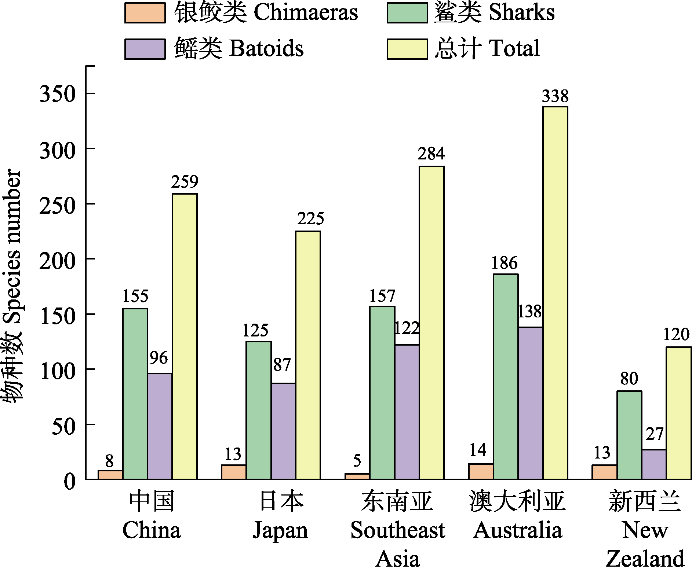
图1 中国及周边国家和地区软骨鱼类物种组成
Fig. 1 Species composition of chondrichthyan fishes in China and adjacent countries and regions
| 鲨类 Sharks | 鳐类 Batoids | 银鲛类 Chimaeras | 总体 Total | |
|---|---|---|---|---|
| 中国-日本 China-Japan | 0.6667 | 0.5378 | 0.5000 | 0.6080 |
| 中国-东南亚 China-Southeast Asia | 0.5220 | 0.3540 | 0.1818 | 0.4403 |
| 中国-澳大利亚 China-Australia | 0.2772 | 0.1359 | 0.2222 | 0.2159 |
| 中国-新西兰 China-New Zealand | 0.2051 | 0.0424 | 0.1053 | 0.1416 |
表1 中国与周边国家和地区软骨鱼类物种组成的Jaccard相似性系数比较
Table 1 Comparison of Jaccard similarity index of chondrichthyan species composition between China and adjacent countries and regions
| 鲨类 Sharks | 鳐类 Batoids | 银鲛类 Chimaeras | 总体 Total | |
|---|---|---|---|---|
| 中国-日本 China-Japan | 0.6667 | 0.5378 | 0.5000 | 0.6080 |
| 中国-东南亚 China-Southeast Asia | 0.5220 | 0.3540 | 0.1818 | 0.4403 |
| 中国-澳大利亚 China-Australia | 0.2772 | 0.1359 | 0.2222 | 0.2159 |
| 中国-新西兰 China-New Zealand | 0.2051 | 0.0424 | 0.1053 | 0.1416 |
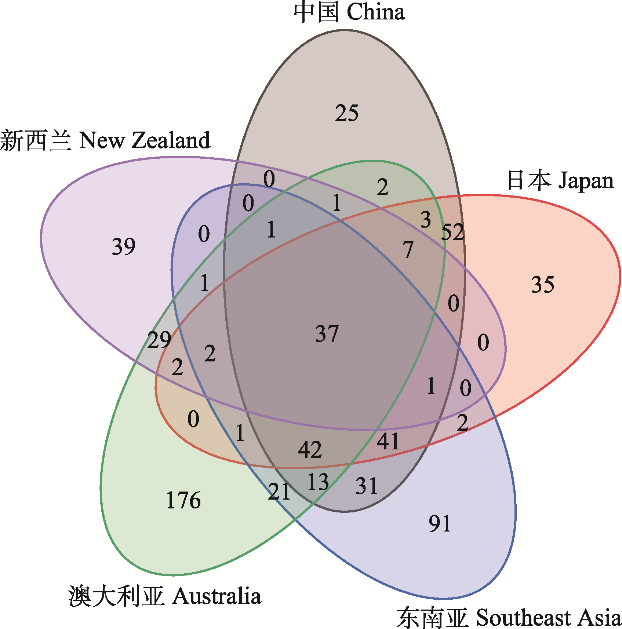
图2 中国与周边国家和地区软骨鱼类共有物种数
Fig. 2 Number of shared chondrichthyan species between China and adjacent countries and regions
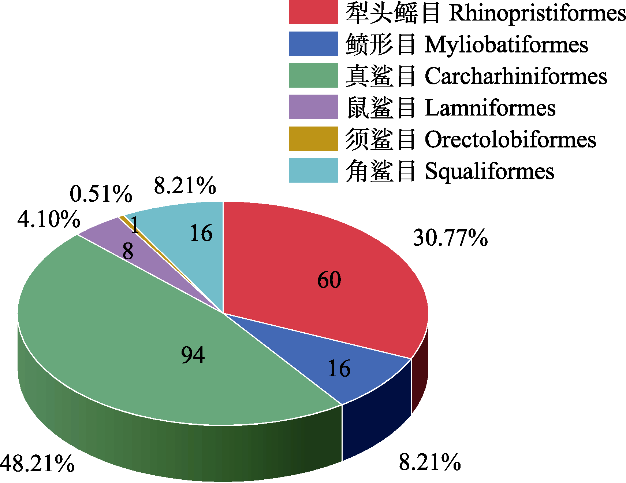
图3 CITES附录I及附录II涉及到非致危性判定(NDFs)提交的软骨鱼类物种组成状况
Fig. 3 Chondrichthyan species composition of CITES Appendix I and II related to Non-detriment Findings (NDFs) submission
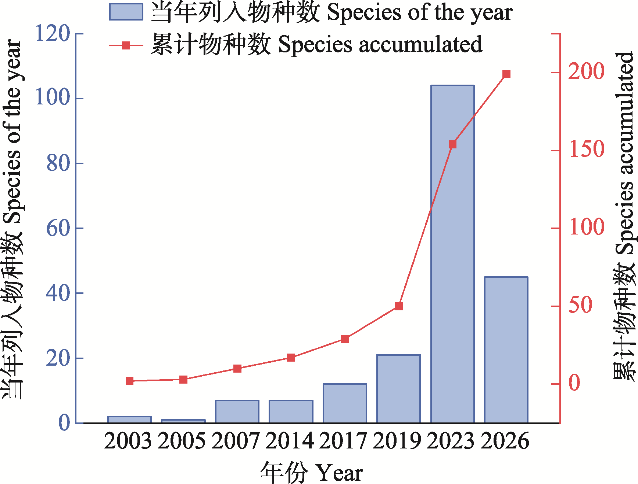
图4 CITES附录I及附录II软骨鱼类物种列入情况(按年份)
Fig. 4 Listing history of Chondrichthyan species into CITES Appendix I and II (by year)
| 国家 Country | NDF提交年份 Year of NDF submission |
|---|---|
| 斯里兰卡 Sri Lanka | 2017 |
| 印度尼西亚 Indonesia | 2018 |
| 新西兰 New Zealand | 2018 |
| 印度 India | 2019 |
| 哥斯达黎加 Costa Rica | 2020, 2022, 2023 |
| 危地马拉 Guatemala | 2021, 2023 |
| 孟加拉 Bangladesh | 2022 |
| 萨尔瓦多 El Salvador | 2024 |
表2 CITES缔约方镰状真鲨非致危性判定(NDFs)报告提交状况
Table 2 Non-detriment Findings (NDFs) for Carcharhinus falciformis submitted by CITES parties
| 国家 Country | NDF提交年份 Year of NDF submission |
|---|---|
| 斯里兰卡 Sri Lanka | 2017 |
| 印度尼西亚 Indonesia | 2018 |
| 新西兰 New Zealand | 2018 |
| 印度 India | 2019 |
| 哥斯达黎加 Costa Rica | 2020, 2022, 2023 |
| 危地马拉 Guatemala | 2021, 2023 |
| 孟加拉 Bangladesh | 2022 |
| 萨尔瓦多 El Salvador | 2024 |
| 衡量指标 Measurement indicators | 判定结果 Result | 风险等级 Risk level |
|---|---|---|
| (一)初步考虑及信息收集 Preliminary consideration | ||
| 物种是否需要提交NDF Is NDF necessary | CITES附录II, 需要进行NDF CITES appendix II and NDF needed | |
| (二)生物学脆弱性与保护 Intrinsic biological vulnerability and conservation | ||
| 性成熟年龄 Age at maturity | 5-15年 5-15 years | 中风险 Medium risk |
| 性成熟体长 Size at maturity | 超过200 cm Over 200 cm | 高风险 High risk |
| 最大年龄 Maximum age | 10-25年 10-25 years | 中风险 Medium risk |
| 最大体长 Maximum size | 超过300 cm Over 300 cm | 高风险 High risk |
| 自然死亡率 Natural mortality rate | 约0.17-0.4 Approximately 0.17-0.4 | 中风险 Medium risk |
| 成熟雌性产仔量 Pup production per mature female | 2-15胎仔 2-15 pups | 中风险 Medium risk |
| 种群内禀增长率 Intrinsic rate of population increase | 低于0.15 Lower than 0.15 | 高风险 High risk |
| 渔业资源的地理分布 Geographic distribution of stock | 世界三大洋 All three oceans | 低风险 Low risk |
| 现存资源量剩余 Current stock size relative to historic abundance | 约30%-50% About 30%-50% | 中风险 Medium risk |
| 行为因素 Behavioural factors | 幼体部分行为增加脆弱性 Behavior of juveniles adding vulnerability | 中风险 Medium risk |
| 营养级 Trophic level | 4.6 ± 0.4 | 高风险 High risk |
| 总体生物学脆弱性 Overall intrinsic biological vulnerability | 中等风险 Medium risk | |
| 保护问题的地理范围 Geographic extent of conservation concern | ||
| 该物种是否进行过渔业资源评估 Stock assessment status | 是 Yes | 高风险 High risk |
| 国家物种红色名录评估 National redlist assessment | 否 No | 高风险 High risk |
| 地区性IUCN红色名录评估等级 Regional IUCN Redlist status | 数据缺乏(DD) (欧洲) Data Deficient (DD) (Europe) | 中风险 Medium risk |
| 全球性IUCN红色名录评估等级 Global IUCN Redlist status | 易危 Vulnerable (VU) | 中风险 Medium risk |
| 种群变化趋势 Population trend | 正在减少, 约为历史水平的47%-50% Declining, 47%-50% of historical records | 中风险 Medium risk |
| 总体保护问题的地理范围 Overall geographic extent of conservation concern | 高风险 High risk | |
| (三)物种所受压力评估 Pressure on species | ||
| 物种所受合法贸易压力 Legal trade | 在香港和广东鱼翅市场约占12%-19% Accounts for 12%-19% in Hongkong and Guangdong sharkfin markets | 中风险 Medium risk |
| 物种所受非法贸易压力 Illegal trade | 海关调查显示少量针对此物种的非法鱼翅贸易存在 Illegal trade exist in customs | 中风险 Medium risk |
| 整体贸易压力 Overall trade pressure | 中等风险 Medium risk | |
| 物种捕捞死亡率 Fishing mortality | 中国远洋船队围网兼捕镰状真鲨死亡率约为20%-70% Mortality in Chinese purse seine fisheries 20%-70% | 中风险 Medium risk |
| 丢弃死亡率 Discard mortality | 不明 Uncertain | 高风险 High risk |
| 捕捞是否具有年龄/性别/体型选择性 Age/Sex/Size selectiveness | 中国兼捕的个体最大可达200 cm以上 Largest individual over 200 cm | 中风险 Medium risk |
| IUU渔业(非法、未上报、不受管理)规模 IUU fishery | 不明, 中国不存在以鲨鱼为目标物种的捕捞活动 Uncertain, no fisheries targeting sharks exist in China | 高风险 High risk |
| 整体捕捞压力 Overall fishing pressure | 中等风险 Medium risk | |
| (四)现有的保护和管理措施 Current conservation and management measures | ||
| (1)渔业许可证制度 Fishery licensing system | ||
| (2)渔业投入及产出控制制度 Fishery input and output control system | ||
| (3)完善数据收集与报送体系 Improve the data collection and reporting system | ||
| (4)远洋渔业国家观察员制度 National observer system for distant water fisheries | ||
| 衡量指标 Measurement indicators | 判定结果 Result | 风险等级 Risk level |
| (5)远洋渔业渔捞日志制度 Fishery logbook system | ||
| (6)伏季休渔制度 Summer fishing moratorium | ||
| (7)关于进一步做好鲨鱼和蝠鲼物种履约管理工作的通知 Notice on further improving the management of convention compliance for shark and manta ray | ||
| (8)加强远洋水产品进出口监管 Strengthening the supervision of import and export of highsea aquatic products | ||
| (9)严厉打击非法渔业活动 Severe crackdown on illegal fishing activities | ||
| (10)海关严厉打击走私野生动物制品活动 Customs cracks down on smuggling of wildlife products | ||
| (11)公务接待不再提供鱼翅 Stop offering sharkfin soup | ||
| 措施的制定情况和实施效果未知, 需要专家进一步讨论, 高风险 Unkown effects requring further discussion of experts, high risk | ||
| (五)整体风险等级: 中等风险 Overall risk level: Medium risk | ||
| (六)进一步建议 Further suggestions | ||
| (1)科研和管理部门的通力合作 Foster close cooperation between scientific research and regulatory agencies | ||
| (2)开展系统全面的资源调查和科学研究 Conduct systematic, comprehensive resource surveys and scientific research | ||
| (3)建立完善的软骨鱼类监测管理机制 Establish a well-developed monitoring and management mechanism for chondrichthyans | ||
| (4)组织相关专家对保护和管理措施的制定和实施效果进行研判 Organize relevant experts to evaluate the formulation and implementation effectiveness of conservation and management measures | ||
| (5)建立软骨鱼类保护的区域合作机制 Establish regional cooperation mechanisms for chondrichthyan conservation | ||
| (6)关注国际和国内软骨鱼类保护的不对称性 Address the asymmetries between domestic and international chondrichthyan conservation efforts | ||
表3 中国镰状真鲨非致危性判定(NDFs)框架
Table 3 Chinese Non-detriment Findings (NDFs) framework for Carcharhinus falciformis
| 衡量指标 Measurement indicators | 判定结果 Result | 风险等级 Risk level |
|---|---|---|
| (一)初步考虑及信息收集 Preliminary consideration | ||
| 物种是否需要提交NDF Is NDF necessary | CITES附录II, 需要进行NDF CITES appendix II and NDF needed | |
| (二)生物学脆弱性与保护 Intrinsic biological vulnerability and conservation | ||
| 性成熟年龄 Age at maturity | 5-15年 5-15 years | 中风险 Medium risk |
| 性成熟体长 Size at maturity | 超过200 cm Over 200 cm | 高风险 High risk |
| 最大年龄 Maximum age | 10-25年 10-25 years | 中风险 Medium risk |
| 最大体长 Maximum size | 超过300 cm Over 300 cm | 高风险 High risk |
| 自然死亡率 Natural mortality rate | 约0.17-0.4 Approximately 0.17-0.4 | 中风险 Medium risk |
| 成熟雌性产仔量 Pup production per mature female | 2-15胎仔 2-15 pups | 中风险 Medium risk |
| 种群内禀增长率 Intrinsic rate of population increase | 低于0.15 Lower than 0.15 | 高风险 High risk |
| 渔业资源的地理分布 Geographic distribution of stock | 世界三大洋 All three oceans | 低风险 Low risk |
| 现存资源量剩余 Current stock size relative to historic abundance | 约30%-50% About 30%-50% | 中风险 Medium risk |
| 行为因素 Behavioural factors | 幼体部分行为增加脆弱性 Behavior of juveniles adding vulnerability | 中风险 Medium risk |
| 营养级 Trophic level | 4.6 ± 0.4 | 高风险 High risk |
| 总体生物学脆弱性 Overall intrinsic biological vulnerability | 中等风险 Medium risk | |
| 保护问题的地理范围 Geographic extent of conservation concern | ||
| 该物种是否进行过渔业资源评估 Stock assessment status | 是 Yes | 高风险 High risk |
| 国家物种红色名录评估 National redlist assessment | 否 No | 高风险 High risk |
| 地区性IUCN红色名录评估等级 Regional IUCN Redlist status | 数据缺乏(DD) (欧洲) Data Deficient (DD) (Europe) | 中风险 Medium risk |
| 全球性IUCN红色名录评估等级 Global IUCN Redlist status | 易危 Vulnerable (VU) | 中风险 Medium risk |
| 种群变化趋势 Population trend | 正在减少, 约为历史水平的47%-50% Declining, 47%-50% of historical records | 中风险 Medium risk |
| 总体保护问题的地理范围 Overall geographic extent of conservation concern | 高风险 High risk | |
| (三)物种所受压力评估 Pressure on species | ||
| 物种所受合法贸易压力 Legal trade | 在香港和广东鱼翅市场约占12%-19% Accounts for 12%-19% in Hongkong and Guangdong sharkfin markets | 中风险 Medium risk |
| 物种所受非法贸易压力 Illegal trade | 海关调查显示少量针对此物种的非法鱼翅贸易存在 Illegal trade exist in customs | 中风险 Medium risk |
| 整体贸易压力 Overall trade pressure | 中等风险 Medium risk | |
| 物种捕捞死亡率 Fishing mortality | 中国远洋船队围网兼捕镰状真鲨死亡率约为20%-70% Mortality in Chinese purse seine fisheries 20%-70% | 中风险 Medium risk |
| 丢弃死亡率 Discard mortality | 不明 Uncertain | 高风险 High risk |
| 捕捞是否具有年龄/性别/体型选择性 Age/Sex/Size selectiveness | 中国兼捕的个体最大可达200 cm以上 Largest individual over 200 cm | 中风险 Medium risk |
| IUU渔业(非法、未上报、不受管理)规模 IUU fishery | 不明, 中国不存在以鲨鱼为目标物种的捕捞活动 Uncertain, no fisheries targeting sharks exist in China | 高风险 High risk |
| 整体捕捞压力 Overall fishing pressure | 中等风险 Medium risk | |
| (四)现有的保护和管理措施 Current conservation and management measures | ||
| (1)渔业许可证制度 Fishery licensing system | ||
| (2)渔业投入及产出控制制度 Fishery input and output control system | ||
| (3)完善数据收集与报送体系 Improve the data collection and reporting system | ||
| (4)远洋渔业国家观察员制度 National observer system for distant water fisheries | ||
| 衡量指标 Measurement indicators | 判定结果 Result | 风险等级 Risk level |
| (5)远洋渔业渔捞日志制度 Fishery logbook system | ||
| (6)伏季休渔制度 Summer fishing moratorium | ||
| (7)关于进一步做好鲨鱼和蝠鲼物种履约管理工作的通知 Notice on further improving the management of convention compliance for shark and manta ray | ||
| (8)加强远洋水产品进出口监管 Strengthening the supervision of import and export of highsea aquatic products | ||
| (9)严厉打击非法渔业活动 Severe crackdown on illegal fishing activities | ||
| (10)海关严厉打击走私野生动物制品活动 Customs cracks down on smuggling of wildlife products | ||
| (11)公务接待不再提供鱼翅 Stop offering sharkfin soup | ||
| 措施的制定情况和实施效果未知, 需要专家进一步讨论, 高风险 Unkown effects requring further discussion of experts, high risk | ||
| (五)整体风险等级: 中等风险 Overall risk level: Medium risk | ||
| (六)进一步建议 Further suggestions | ||
| (1)科研和管理部门的通力合作 Foster close cooperation between scientific research and regulatory agencies | ||
| (2)开展系统全面的资源调查和科学研究 Conduct systematic, comprehensive resource surveys and scientific research | ||
| (3)建立完善的软骨鱼类监测管理机制 Establish a well-developed monitoring and management mechanism for chondrichthyans | ||
| (4)组织相关专家对保护和管理措施的制定和实施效果进行研判 Organize relevant experts to evaluate the formulation and implementation effectiveness of conservation and management measures | ||
| (5)建立软骨鱼类保护的区域合作机制 Establish regional cooperation mechanisms for chondrichthyan conservation | ||
| (6)关注国际和国内软骨鱼类保护的不对称性 Address the asymmetries between domestic and international chondrichthyan conservation efforts | ||
| [1] | Ahmad A, Lim APK (2012) Field Guide to Sharks of the Southeast Asian Region. SEAFDEC/MFRDMD, Kuala Terengganu. |
| [2] | Ahmad A, Lim APK, Fahmi, Dharmadi, Tassapon K (2019) Identification Guide to Sharks, Rays and Skates of the Southeast Asia Region, 2nd edn. SEAFDEC/MFRDMD, Kuala Terengganu. |
| [3] | Ahmad A, Lim APK, Fahmi, Tassapon K, Dharmadi (2020) Identification Guide to Sharks, Rays, Skates and Chimaeras of the Southeast Asia Region, Vol. 2. SEAFDEC/MFRDMD, Kuala Terengganu. |
| [4] | Amandè MJ, Ariz J, Chassot E, de Molina AD, Gaertner D, Murua H, Pianet R, Ruiz J, Chavance P (2010) Bycatch of the European purse seine tuna fishery in the Atlantic Ocean for the 2003-2007 period. Aquatic Living Resources, 23, 353-362. |
| [5] | Araujo G, Baylina N, Huveneers C, Peddemors V, Simeon BM, Séret B (2024) Socio-economic significance—Tourism. In: The Global Status of Sharks, Rays, and Chimaeras (eds Jabado RW, Morata AZA, Bennett RH, Finucci B, Ellis JR, Fowler SL, Grant MI, Barbosa AP, Sinclair SL), pp. 57-60. IUCN, Gland. |
| [6] | Barber PH, Cheng SH, Erdmann MV, Tenggardjaja K, Ambariyanto A (2011) Evolution and conservation of marine biodiversity in the Coral Triangle: Insights from stomatopod Crustacea. Crustacean Issues, 19, 129-156. |
| [7] | Baum JK, Worm B (2009) Cascading top-down effects of changing oceanic predator abundances. Journal of Animal Ecology, 78, 699-714. |
| [8] | Beerkircher LR, Cortés E, Shivji MS (2002) Characteristics of shark bycatch observed on pelagic longlines off the southeastern United States, 1992-2000. Marine Fisheries Review, 64(4), 40-49. |
| [9] | Bonfil R (2008) The biology and ecology of the silky shark, Carcharhinus falciformis. In: Sharks of the Open Ocean: Biology, Fisheries and Conservation (eds Camhi MD, Pikitch EK, Babcock EA), pp. 114-127. Blackwell Publishing, Oxford. |
| [10] | Borsa P, Arlyza IS, Hoareau TB, Shen KN (2018) Diagnostic description and geographic distribution of four new cryptic species of the blue-spotted maskray species complex (Myliobatoidei: Dasyatidae; Neotrygon spp.) based on DNA sequences. Journal of Oceanology and Limnology, 36, 827-841. |
| [11] | Branstetter S (1987) Age, growth and reproductive biology of the silky shark, Carcharhinus falciformis, and the scalloped hammerhead, Sphyrna lewini, from the northwestern Gulf of Mexico. Environmental Biology of Fishes, 19, 161-173. |
| [12] | Butler AJ, Rees T, Beesley P, Bax NJ (2010) Marine biodiversity in the Australian region. PLoS ONE, 5, e11831. |
| [13] | Cardeñosa D, Fields AT, Babcock EA, Zhang HR, Feldheim K, Shea SK, Fischer GA, Chapman DD (2018) CITES-listed sharks remain among the top species in the contemporary fin trade. Conservation Letters, 11, e12457. |
| [14] | Cardeñosa D, Shea SK, Zhang HR, Fischer GA, Simpfendorfer CA, Chapman DD (2022) Two thirds of species in a global shark fin trade hub are threatened with extinction: Conservation potential of international trade regulations for coastal sharks. Conservation Letters, 15, e12910. |
| [15] | Carrier JC, Musick JA, Heithaus MR (2012) Biology of Sharks and Their Relatives, 2nd edn. CRC Press, Boca Raton. |
| [16] | Castello L, Stewart DJ (2010) Assessing CITES non-detriment findings procedures for Arapaima in Brazil. Journal of Applied Ichthyology, 26, 49-56. |
| [17] | Clarke CR, Karl SA, Horn RL, Bernard AM, Lea JS, Hazin FH, Prodöhl PA, Shivji MS (2015) Global mitochondrial DNA phylogeography and population structure of the silky shark, Carcharhinus falciformis. Marine Biology, 162, 945-955. |
| [18] | Clarke S, Langley A, Lennert-Cody C, Aires-da-Silva A, Maunder M (2018) Pacific-wide silky shark (Carcharhinus falciformis) stock status assessment. In: Scientific Committee Fourteenth Regular Session, Western and Central Pacific Fisheries Commission (WCPFC), Working Paper WCPFC-SC14-2018/SA-WP-08. Busan. |
| [19] | Clarke SC, Magnussen JE, Abercrombie DL, McAllister MK, Shivji MS (2006) Identification of shark species composition and proportion in the Hong Kong shark fin market based on molecular genetics and trade records. Conservation Biology, 20, 201-211. |
| [20] | Coelho R, Fernandez-Carvalho J, Lino PG, Santos MN (2012) An overview of the hooking mortality of elasmobranchs caught in swordfish pelagic longline fishery in the Atlantic Ocean. Aquatic Living Resources, 25, 311-319. |
| [21] | Compagno LJV (1984) FAO Species Catalogue. Vol. 4 Sharks of the World. An Annotated and Illustrated Catalogue of Shark Species Known to Date. Part 2-Carcharhiniformes. Food & Agriculture Organisation, Rome. |
| [22] | Cortés E (1999) Standardized diet compositions and trophic levels of sharks. ICES Journal of Marine Science, 56, 707-717. |
| [23] | Cortés E (2002) Incorporating uncertainty into demographic modeling: Application to shark populations and their conservation. Conservation Biology, 16, 1048-1062. |
| [24] | Cortés E, Domigo A, Miller P, Forselledo R, Mas F, Arocha F, Campana S, Coelho R, Da Silva C, Hazin FHV, Holtzhausen H, Keene K, Lucena F, Ramirez K, Santos MN, Semba-Murakami Y, Yokawa K (2015) Expanded ecological risk assessment of pelagic sharks caught in Atlantic pelagic longline fisheries. Collective Volume of Scientific Papers, ICCAT, 71, 2637-2688. |
| [25] | Ding PP, Dai XJ, Gao CX, Wu F, Wang T (2017) Preliminary study of biological information for silky shark in the Western and Central Pacific Ocean. Marine Sciences, 41(10), 33-40. (in Chinese with English abstract) |
| [丁朋朋, 戴小杰, 高春霞, 吴峰, 王腾 (2017) 中西太平洋镰状真鲨的生物学信息初步研究. 海洋科学, 41(10), 33-40.] | |
| [26] | Dulvy NK, Pacoureau N, Rigby CL, Pollom RA, Jabado RW, Ebert DA, Finucci B, Pollock CM, Cheok J, Derrick DH, Herman KB, Sherman CS, Vanderwright WG, Lawson JM, Walls RHL, Carlson JK, Charvet P, Bineesh KK, Fernando D, Ralph GM, Matsushiba JH, Hilton-Taylor C, Fordham SV, Simpfendorfer CA (2021) Overfishing drives over one-third of all sharks and rays toward a global extinction crisis. Current Biology, 31, 4773-4787. |
| [27] | Ebert DA, Dando M, Fowler S (2021) Sharks of the World:A Complete Guide. Princeton University Press, Princeton. |
| [28] | Ebert DA, Jang JJ (2022) Galeus friedrichi (Carcharhiniformes: Pentanchidae), a new sawtail catshark from the Philippines. Journal of the Ocean Science Foundation, 39, 45-53. |
| [29] | Ebert DA, Krajangdara T, Kemper JM (2024) Chimaera supapae (Holocephali: Chimaeriformes: Chimaeridae), a new species of chimaera from the Andaman Sea of Thailand. Raffles Bulletin of Zoology, 72, 84-90. |
| [30] | Eddy C, Brill R, Bernal D (2016) Rates of at-vessel mortality and post-release survival of pelagic sharks captured with tuna purse seines around drifting fish aggregating devices (FADs) in the equatorial eastern Pacific Ocean. Fisheries Research, 174, 109-117. |
| [31] | Faria VV, McDavitt MT, Charvet P, Wiley TR, Simpfendorfer CA, Naylor GJP (2013) Species delineation and global population structure of Critically Endangered sawfishes (Pristidae). Zoological Journal of the Linnean Society, 167, 136-164. |
| [32] | Finucci B, Didier D, Ebert DA, Green ME, Kemper JM (2024) Harriotta avia sp. nov.—A new rhinochimaerid (Chimaeriformes: Rhinochimaeridae) described from the Southwest Pacific. Environmental Biology of Fishes, 107, 841-865. |
| [33] | Finucci B, White WT, Kemper JM, Naylor GJP (2018) Redescription of Chimaera ogilbyi (Chimaeriformes; Chimaeridae) from the Indo-Australian region. Zootaxa, 4375, 191-210. |
| [34] | Furlong-Estrada E, Tovar-Avila J, Rios-Jara E (2014) Ecological risk assessment of artisanal capture methods on sharks fished at the entrance of the Gulf of California. Hidrobiológica, 24, 83-97. |
| [35] | Gallagher AJ, Klimley AP (2018) The biology and conservation status of the large hammerhead shark complex: The great, scalloped, and smooth hammerheads. Reviews in Fish Biology and Fisheries, 28, 777-794. |
| [36] | Gaylard S, Waycott M, Lavery P (2020) Review of coast and marine ecosystems in temperate Australia demonstrates a wealth of ecosystem services. Frontiers in Marine Science, 7, 453. |
| [37] | Grant MI, Smart JJ, White WT, Chin A, Baje L, Simpfendorfer CA (2018) Life history characteristics of the silky shark Carcharhinus falciformis from the central west Pacific. Marine and Freshwater Research, 69, 562-573. |
| [38] | Habib KA, Islam MJ (2021) Description of a new species of giant guitarfish, Glaucostegus younholeei sp. nov. (Rhinopristiformes: Glaucostegidae) from the northern Bay of Bengal, Bangladesh. Zootaxa, 4995, 129-146. |
| [39] | Hall NG, Bartron C, White WT, Dharmadi, Potter IC (2012) Biology of the silky shark Carcharhinus falciformis (Carcharhinidae) in the eastern Indian Ocean, including an approach to estimating age when timing of parturition is not well defined. Journal of Fish Biology, 80, 1320-1341. |
| [40] | Harry AV, Simpfendorfer CA, Huveneers C, Peddemors V, Heupel MR, Mukherji S, Gutteridge A, D’Alberto BM, Braccini M, Smart J, Johnson G, Usher M, Flanagan E (2024) Australia. In: The Global Status of Sharks, Rays, and Chimaeras (eds Jabado RW, Morata AZA, Bennett RH, Finucci B, Ellis JR, Fowler SL, Grant MI, Barbosa AP, Sinclair SL), pp. 1829-1844. IUCN, Gland. |
| [41] | Heemstra PC, Heemstra E, Ebert DA, Holleman W, Randall JE (2022) Coastal Fishes of the Western Indian Ocean, Vol. I. South African Institute for Aquatic Biodiversity, Makhanda. |
| [42] | Heinrich S, Shepherd CR, Sy EY (2022) Using CITES appendix III to protect native species found in international trade: The case of the Philippines. Philippine Journal of Science, 151, 127-137. |
| [43] | Hutchinson MR, Itano DG, Muir JA, Holland KN (2015) Post-release survival of juvenile silky sharks captured in a tropical tuna purse seine fishery. Marine Ecology Progress Series, 521, 143-154. |
| [44] | Hutchinson MR, Itano DG, Muir JA, Leroy B, Holland KN (2013) Fishery interactions and post-release survival rates of silky sharks caught in purse seine fishing gear. In: Scientific Committee Ninth Regular Session, Western and Central Pacific Fisheries Commission (WCPFC), WCPFC-SC9-2013/EB-WP-12. Pohnpei. |
| [45] | Iwatsuki Y, Miyamoto K, Nakaya K, Zhang J (2011) A review of the genus Platyrhina (Chondrichthys: Platyrhinidae) from the northwestern Pacific, with descriptions of two new species. Zootaxa, 2738, 26-40. |
| [46] | Jiang ZG (2011) Non-detrimental Findings should be enhanced for the management of international trade in endangered species of wild fauna and flora. Biodiversity Science, 19, 495-496. (in Chinese) |
| [蒋志刚 (2011) 濒危野生动植物种国际贸易管理亟待加强贸易物种的非致危性判定. 生物多样性, 19, 495-496.] | |
| [47] | Joung SJ, Chen CT, Lee HH, Liu KM (2008) Age, growth, and reproduction of silky shark, Carcharhinus falciformis, in northeastern Taiwan waters. Fisheries Research, 90, 78-85. |
| [48] | Koeda K, Itou M, Yamada M, Motomura H (2021) Rhynchobatus mononoke, a new species of wedgefish (Rhinopristiformes: Rhinidae) from Japan, with comments on Rhynchobatus laevis (Bloch and Schneider 1801). Ichthyological Research, 68, 223-238. |
| [49] | Kroon FJ, Thorburn P, Schaffelke B, Whitten S (2016) Towards protecting the Great Barrier Reef from land-based pollution. Global Change Biology, 22, 1985-2002. |
| [50] | Last PR, Stewart AL, Séret B (2016a) A new temperate deepwater skate of the genus Bathyraja (Rajoidei: Arhynchobatidae) from the South-West Pacific. Zootaxa, 4132, 107-117. |
| [51] | Last PR, White WT, de Carvalho MR, Séret B, Stehmann MFW, Naylor GJP (2016b) Rays of the World. CSIRO Publishing, Clayton. |
| [52] | Li CY, Tsai WP, Ranatunga RR, Samidon M, Liu SY (2023) Genetic stock structure of the silky shark Carcharhinus falciformis in the Indo-Pacific Ocean. PLoS ONE, 18, e0292743. |
| [53] | Li MT, He T, Li W, Liao J, Zeng Y (2025) Regulating international trade in wild fauna and flora: An analysis of CITES terminology. Biodiversity Science, 33, 24545. (in Chinese with English abstract) |
| [李沫潼, 何拓, 李薇, 廖菁, 曾岩 (2025) 从CITES的术语看野生动植物国际贸易监管规则. 生物多样性, 33, 24545.] | |
| [54] | Li YK, Gao XD, Wang LY, Fang L (2018) Trophic niche partitioning of pelagic sharks in Central Eastern Pacific inferred from stable isotope analysis. Chinese Journal of Applied Ecology, 29, 309-313. (in Chinese with English abstract) |
| [李云凯, 高小迪, 王琳禹, 方琳 (2018) 东太平洋中部中上层鲨鱼群落营养生态位分化. 应用生态学报, 29, 309-313.] | |
| [55] | Misawa R, Babaran RP, Motomura H (2023) Okamejei panayensis sp. nov., a new skate (Rajiformes: Rajidae) from the Philippines. Ichthyological Research, 70, 161-176. |
| [56] | Moore A (2017) Are guitarfishes the next sawfishes? Extinction risk and an urgent call for conservation action. Endangered Species Research, 34, 75-88. |
| [57] | Mundy-Taylor V, Crook V, Foster S, Fowler S, Sant G, Rice J (2014) CITES Non-detriment Findings Guidance for Shark Species (Second, Revised Version). A Framework to assist Authorities in making Non-detriment Findings (NDFs) for species listed in CITES Appendix II. Report prepared for the Germany Federal Agency for Nature Conservation. Bundesamt für Naturschutz, Bonn. |
| [58] | Musyl MK, Brill RW, Curran DS, Fragoso NM, McNaughton LM, Nielsen A, Kikkawa BS, Moyes CD (2011) Post release survival, vertical and horizontal movements, and thermal habitats of five species of pelagic sharks in the central Pacific Ocean. Fishery Bulletin, 109, 341-368. |
| [59] | Myers RA, Baum JK, Shepherd TD, Powers SP, Peterson CH (2007) Cascading effects of the loss of apex predatory sharks from a coastal ocean. Science, 315, 1846-1850. |
| [60] | Nakabo T (2013) Fishes of Japan with Pictorial Keys to the Species, 3rd edn. Tokai University Press, Hadano. (in Japanese) |
| [中坊徹次 (2013) 日本產魚類検索: 全種の同定, 第三版. 東海大學出版会, 秦野.] | |
| [61] | Nakaya K, Séret B (2000) Re-description and taxonomy of Pentanchus profundicolus Smith & Radcliffe, based on a second specimen from the Philippines (Chondrichthyes, Carcharhiniformes, Scyliorhinidae). Ichthyological Research, 47, 373-378. |
| [62] | Nakayama N, Matsunuma M, Endo H (2020) A preliminary review and in situ observations of the spookfish genus Harriotta (Holocephali: Rhinochimaeridae). Ichthyological Research, 67, 82-91. |
| [63] | Notarbartolo di Sciara G, Adnet S, Bennett M, Broadhurst MK, Fernando D, Jabado RW, Laglbauer BJ, Stevens G (2020) Taxonomic status, biological notes, and conservation of the longhorned pygmy devil ray Mobula eregoodoo (Cantor, 1849). Aquatic Conservation: Marine and Freshwater Ecosystems, 30, 104-122. |
| [64] | Ocean SP (1993) Checklist of the coastal fishes of Lord Howe, Norfolk, and Kermadec Islands. Pacific Science, 47, 136-170. |
| [65] | Okamura O, Kitajima T (1984) Fishes of the Okinawa Trough and the Adjacent Waters, Vol. 1. Japan Fisheries Resource Conservation Association, Tokyo. |
| [66] | Oshitani S, Nakano S, Tanaka S (2003) Age and growth of the silky shark Carcharhinus falciformis from the Pacific Ocean. Fisheries Science, 69, 456-464. |
| [67] | Pacoureau N, Rigby CL, Kyne PM, Sherley RB, Winker H, Carlson JK, Fordham SA, Barreto R, Fernando D, Francis MP, Jabado RW, Herman KB, Liu KM, Marshall AD, Pollom RA, Romanov EV, Simpfendorfer CA, Yin JS, Kindsvater HK, Dulvy NK (2021) Half a century of global decline in oceanic sharks and rays. Nature, 589, 567-571. |
| [68] | Poisson F, Filmalter JD, Vernet AL Dagorn L (2014) Mortality rate of silky sharks (Carcharhinus falciformis) caught in the tropical tuna purse seine fishery in the Indian Ocean. Canadian Journal of Fisheries and Aquatic Sciences, 71, 795-798. |
| [69] | Qi JW, Pan HJ, Wang XC, Xuan ZY, Pan XF, Li XZ, Shen Y, Yang J, Zhang J, Li M (2023) Genomic insights into the postintroduction failure of the Asian icefish Protosalanx chinensis in China. Molecular Ecology, 32, 3942-3959. |
| [70] | Qi JW, Shi FL, Zhang BW, Chen X, Xing J, Furumitsu K, Corush JB, Yamaguchi A, Zhang J (2022) Insights into genetic variation and demographic history of sharpnose rays: Examinations of three species of Telatrygon (Elasmobranchii, Dasyatidae) from the Indo-West Pacific. Integrative Zoology, 17, 1063-1077. |
| [71] | Rice J, Harley S (2013) Updated stock assessment of silky sharks in the Western and Central Pacific Ocean. In: Scientific Committee Ninth Regular Session, Western and Central Pacific Fisheries Commission (WCPFC), WCPFC-SC9-2013/SA-WP-03. Pohnpei. |
| [72] | Rigby CL, Bin Ali A, Chen X, Derrick D, Dharmadi, Ebert DA, Fahmi, Gautama DA, Herman K, Ho H, Hsu H, Krajangdara T, Seyha L, Sianipar A, Vo VQ, Yuneni RR, Zhang J (2020) Hemitrygon bennetti. The IUCN Red List of Threatened Species: e. T161533A104115348. https://dx.doi.org/10.2305/IUCN.UK.2020-3.RLTS.T161533A104115348.en. (accessed on 2026-03-17) |
| [73] | Roberts CD (1991) Fishes of the Chatham Islands, New Zealand: A trawl survey and summary of the ichthyofauna. New Zealand Journal of Marine and Freshwater Research, 25, 1-19. |
| [74] | Roberts CD, Stewart AL, Struthers CD (2015) The Fishes of New Zealand, Vol. 2. Te Papa Press, Wellington. |
| [75] | Séret B, Last PR (2007) Four new species of deep-water catsharks of the genus Parmaturus (Carcharhiniformes: Scyliorhinidae) from New Caledonia, Indonesia and Australia. Zootaxa, 1657, 23-39. |
| [76] | Shen YF, Zang DS, Wu F, Dai XJ, Li YK (2023) Age and growth of silky shark, Carcharhinus falciformis, from the Eastern Pacific by vertebrae. Journal of Fisheries of China, 47(8), 97-108. (in Chinese with English abstract) |
| [沈永富, 臧东升, 吴峰, 戴小杰, 李云凯 (2023) 东太平洋镰状真鲨年龄和生长. 水产学报, 47(8), 97-108.] | |
| [77] | Sjafrie ND, Oktaviyani S, Kurniawan W (2020) Domestic utilization of shark and ray: An example from Muncar Subdistrict, Banyuwangi Regency, East Java Province, Indonesia. Aquaculture, Aquarium, Conservation & Legislation, 13, 3309-3321. |
| [78] | Smith SE, Au DW, Show C (1998) Intrinsic rebound potentials of 26 species of Pacific sharks. Marine and Freshwater Research, 49, 663-678. |
| [79] | Spalding MD, Fox HE, Allen GR, Davidson N, Ferdaña ZA, Finlayson MA, Halpern BS, Jorge MA, Lombana AL, Lourie SA, Martin KD (2007) Marine ecoregions of the world: A bioregionalization of coastal and shelf areas. BioScience, 57, 573-583. |
| [80] | Stein RW, Mull CG, Kuhn TS, Aschliman NC, Davidson LNK, Joy JB, Smith GJ, Dulvy NK, Mooers AO (2018) Global priorities for conserving the evolutionary history of sharks, rays and chimaeras. Nature Ecology & Evolution, 2, 288-298. |
| [81] | Stevens JD, Bonfil R, Dulvy NK, Walker PA (2000) The effects of fishing on sharks, rays, and chimaeras (chondrichthyans), and the implications for marine ecosystems. ICES Journal of Marine Science, 57, 476-494. |
| [82] | Sun K, Dai XJ, Gao CX, Wu F, Wang XF (2021) The analysis of catch rate and mortality on the bycatch of silky shark (Carcharhinus falciformis) in different operating modes of purse seine in the Western and Central Pacific Ocean. Marine Science Bulletin, 40, 434-440. (in Chinese with English abstract) |
| [孙康, 戴小杰, 高春霞, 吴峰, 王学昉 (2021) 中西太平洋围网不同作业方式兼捕镰状真鲨渔获率和死亡率分析. 海洋科学通报, 40, 434-440.] | |
| [83] | Taniuchi T, Tachikawa H, Kurata Y, Nose Y (1985) Galapagos shark, Carcharhinus galapagensis, from the Ogasawara Islands, Japan. Japanese Journal of Ichthyology, 31, 449-452. |
| [84] | Tassapon K 2019 New record of cartilaginous fishes found in Thai waters and the adjacent areas and an updated species list in 2019. Burapha Science Journal, 24, 599-621. |
| [85] | Teramura A, Senou H, Hirase S (2025) Chimaera stellata, a new species described from the northwestern Pacific Ocean, with the redescription of Chimaera owstoni Tanaka 1905 (Chondrichthyes: Chimaeridae). Ichthyological Research, 72, 117-129. |
| [86] | Tian YN, Ahat P, Issak M, Tumur A (2020) Numerical classification and species diversity of terricolous lichen communities in Bogda Mountain of Xinjiang, China. Acta Ecologica Sinica, 40, 4605-4616. (in Chinese with English abstract) |
| [田雅楠, 帕丽旦·艾海提, 买吾拉江·衣沙克, 艾尼瓦尔·吐米尔 (2020) 新疆博格达山地面生地衣群落数量分类及物种多样性. 生态学报, 40, 4605-4616.] | |
| [87] | Wada H, Furuhashi R, Yamada M, Fujii T, Yoshida T, Wibowo K, Araki M, Ito D, Akaike T, Nakagawa R, Shibuya S, Koreeda R, Dewa YN, Mochida I, Motomura H (2021) First records of 122 fish species from Tokunoshima island, the Amami Islands, Kagoshima, Japan. Ichthy, Natural History of Fishes of Japan, 7, 35-52. |
| [88] | Weigmann S (2016) Annotated checklist of the living sharks, batoids and chimaeras (Chondrichthyes) of the world, with a focus on biogeographical diversity. Journal of Fish Biology, 88, 837-1037. |
| [89] | Weigmann S, Didier D, Finucci B, Nakaya K, Naylor GJP, Séret B, Straube N, Vaz DFB (2024) Biodiversity, taxonomy, and systematics of extant chondrichthyan fishes. In: The Global Status of Sharks, Rays, and Chimaeras (eds Jabado RW, Morata AZA, Bennett RH, Finucci B, Ellis JR, Fowler SL, Grant MI, Barbosa AP, Sinclair SL), pp. 7-23. IUCN, Gland. |
| [90] | Wheeler CR, Gervais CR, Johnson MS (2020) Anthropogenic stressors influence reproduction and development in elasmobranch fishes. Reviews in Fish Biology and Fisheries, 30, 373-386. |
| [91] | White WT, Arunrugstichai S, Naylor GJP (2021) Revision of the genus Mustelus (Carcharhiniformes: Triakidae) in the northern Indian Ocean, with description of a new species and a discussion on the validity of M. walkeri and M. ravidus. Marine Biodiversity, 51, 42. |
| [92] | White WT, Corrigan S, Yang L, Henderson AC, Bazinet AL, Swofford DL, Naylor GJP (2018) Phylogeny of the manta and devilrays (Chondrichthyes: Mobulidae), with an updated taxonomic arrangement for the family. Zoological Journal of the Linnean Society, 182, 50-75. |
| [93] | White WT, Kyne PM, Harris M (2019) Lost before found: A new species of whaler shark Carcharhinus obsolerus from the Western Central Pacific known only from historic records. PLoS ONE, 14, e0209387. |
| [94] | White WT, Stewart AL, O’Neill HL, Naylor GJP (2024) Dichichthyidae, a new family of deepwater sharks (Carcharhiniformes) from the Indo-West Pacific, with description of a new species. Fishes, 9, 121. |
| [95] | Xu J, Cui XJ, Zhang YF, Wu C, Sun YD (2024) Fish diversity and distribution in the Nanling Region. Biodiversity Science, 32, 23482. (in Chinese with English abstract) |
| [许佳, 崔小娟, 张翼飞, 吴昌, 孙远东 (2024) 南岭地区鱼类多样性及其地理分布. 生物多样性, 32, 23482.] | |
| [96] | Yamaguchi A, Tanaka S (2024) Japan. In: The Global Status of Sharks, Rays, and Chimaeras (eds Jabado RW, Morata AZA, Bennett RH, Finucci B, Ellis JR, Fowler SL, Grant MI, Barbosa AP, Sinclair SL), pp. 1687-1695. IUCN, Gland. |
| [97] | Zeng Y, Wu ZZ, Zhang CG, Meng ZB, Jiang ZG, Zhang J (2016) DNA barcoding of mobulid ray gill rakers for implementing CITES on elasmobranch in China. Scientific Reports, 6, 37567. |
| [98] | Zhang J, Chen JJ, Lu HM (2024) China. In: The Global Status of Sharks, Rays, and Chimaeras (eds Jabado RW, Morata AZA, Bennett RH, Finucci B, Ellis JR, Fowler SL, Grant MI, Barbosa AP, Sinclair SL), pp. 1629-1645. IUCN, Gland. |
| [99] | Zhang J, Lu HM, Chen JJ, Chen JY, Mao YF, Hu JX, Zhang BW (2026) Latin-English-Chinese-Japanese checklist of Chinese chondrichthyans and a comparison of diversity among marine regions. Biodiversity Science, 34, 25522. (in Chinese with English abstract) |
| [张洁, 路昊明, 陈佳杰, 陈江源, 毛宇帆, 胡骏熙, 张保卫 (2026) 中国软骨鱼类拉-英-汉-日物种名录及各海域多样性比较. 生物多样性, 34, 25522.] | |
| [100] | Zhang J, Yamaguchi A, Zhou Q, Zhang C (2010) Rare occurrences of Dasyatis bennettii (Chondrichthyes: Dasyatidae) in freshwaters of Southern China. Journal of Applied Ichthyology, 26, 939-941. |
| [101] | Zhang J, Yang BJ, Yamaguchi A, Furumitsu K, Zhang BW (2015) Mitochondrial genome of longheaded eagle ray Aetobatus flagellum (Chondrichthyes: Myliobatidae). Mitochondrial DNA, 26, 763-764. |
| [102] | Zhang QR, Yang SY (2005) Species composition, distribution and resources of Chinese chondrichthyan fishes. Journal of Xiamen University (Natural Science), 44(B06), 207-211. (in Chinese with English abstract) |
| [张清榕, 杨圣云 (2005) 中国软骨鱼类种类、地理分布及资源. 厦门大学学报(自然科学版), 44(B06), 207-211.] | |
| [103] | Zhu YD, Meng QW (2001) Fauna Sinica∙Cyclostomata∙ Chondrichthyes. Science Press, Beijing. (in Chinese) |
| [朱元鼎, 孟庆闻 (2001) 中国动物志∙圆口纲, 软骨鱼纲. 科学出版社, 北京.] |
| [1] | 张洁, 路昊明, 陈佳杰, 陈江源, 毛宇帆, 胡骏熙, 张保卫. 中国软骨鱼类拉-英-汉-日物种名录及各海域多样性比较[J]. 生物多样性, 2026, 34(6): 25522-. |
| [2] | 王文琪, 杨永川, 昌维, 胡四维, 牟文博, 曾岩. 不同生境下甘松群落结构、生长特征及潜在资源量估算[J]. 生物多样性, 2025, 33(11): 25382-. |
| 阅读次数 | ||||||
|
全文 |
|
|||||
|
摘要 |
|
|||||
备案号:京ICP备16067583号-7
Copyright © 2026 版权所有 《生物多样性》编辑部
地址: 北京香山南辛村20号, 邮编:100093
电话: 010-62836137, 62836665 E-mail: biodiversity@ibcas.ac.cn
