

生物多样性 ›› 2025, Vol. 33 ›› Issue (12): 25186. DOI: 10.17520/biods.2025186 cstr: 32101.14.biods.2025186
罗颖璐1, 崔巍2, 朱代博3, 卜书海4, 郑雪莉1,*( )
)
收稿日期:2025-05-19
接受日期:2025-10-23
出版日期:2025-12-20
发布日期:2026-01-09
通讯作者:
*E-mail: zhengxueli@nwsuaf.edu.com
基金资助:
Yinglu Luo1, Wei Cui2, Daibo Zhu3, Shuhai Bu4, Xueli Zheng1,*()
Received:2025-05-19
Accepted:2025-10-23
Online:2025-12-20
Published:2026-01-09
Supported by:摘要:
明晰物种间的空间关联网络是理解群落结构的关键, 有利于揭示种间生态学关系和阐述物种的共存机制。在秦岭北坡的复杂生境中, 黄喉貂(Martes flavigula)为中型食肉动物的代表, 对动物种群规模及植被资源分配的影响逐渐增加。本研究对秦岭主梁北坡2019-2024年所获83台红外相机数据进行分析, 构建黄喉貂与该区域地栖鸟兽的种间关联网络。结果显示: (1)在拍摄到的6目13科29种地栖动物中, 黄喉貂与14个物种存在空间关联, 其中黄喉貂与野猪(Sus scrofa)、小麂(Muntiacus reevesi)、中华扭角羚(Budorcas tibetana)和毛冠鹿(Elaphodus cephalophus) 4个物种呈偏利生态关系, 与其余10个物种呈对称生态学关系。(2)黄喉貂对该区域群落稳定性的贡献率排名第二, 仅次于川金丝猴(Rhinopithecus roxellana)。关联网络中共识别出14个核心物种(如川金丝猴、毛冠鹿和亚洲黑熊Ursus thibetanus等)和9个外周物种(如中华鬣羚Capricornis milneedwardsii和隐纹花鼠Tamiops swinhoei等)。黄喉貂在食物网中占据核心节点, 是网络中最积极的物种之一, 特别在大型食肉动物稀少的秦岭森林生态系统中, 对维持群落稳定发挥着重要作用。
罗颖璐, 崔巍, 朱代博, 卜书海, 郑雪莉 (2025) 秦岭主梁北坡黄喉貂的种间关联与保护. 生物多样性, 33, 25186. DOI: 10.17520/biods.2025186.
Yinglu Luo, Wei Cui, Daibo Zhu, Shuhai Bu, Xueli Zheng (2025) Interspecific associations and conservation implications of the yellow-throated marten (Martes flavigula) on the northern slope of the Qinling Mountains. Biodiversity Science, 33, 25186. DOI: 10.17520/biods.2025186.
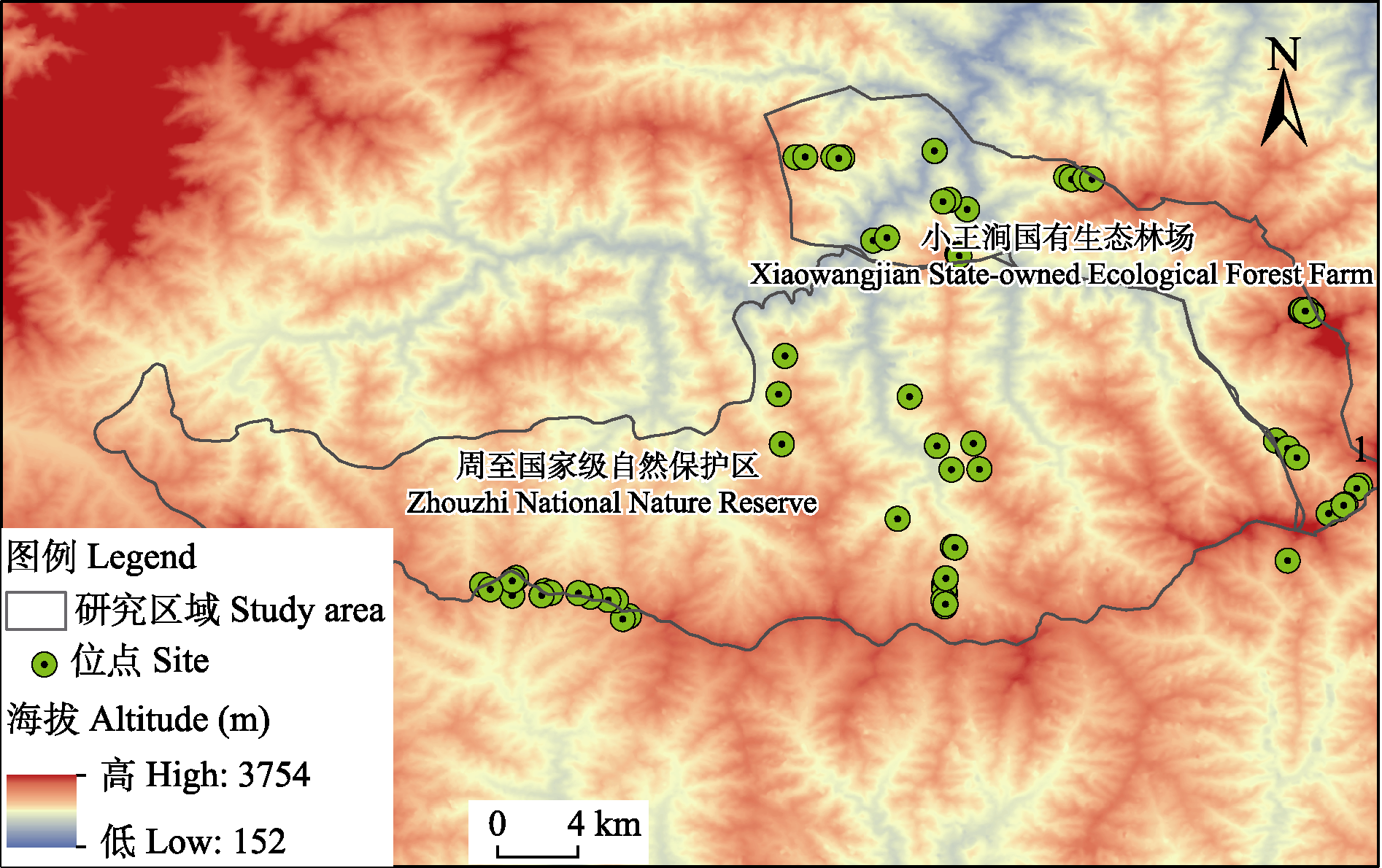
图1 秦岭主梁北坡红外相机位点分布
Fig. 1 Distribution of infrared camera sites on the northern slope of the Qinling Mountains’ main ridge
| 目 Order | 科 Family | 种 Species | 保护级别 Protection category | 独立有效照片数 No. of independent valid photos | 位点占有率 Site occupancy |
|---|---|---|---|---|---|
| 食肉目 Carnivora | 熊科 Ursidae | 亚洲黑熊 Ursus thibetanus | II | 61 | 35% |
| 鼬科 Mustelidae | 猪獾 Arctonyx collaris | 233 | 33% | ||
| 亚洲狗獾 Meles leucurus | 1 | 1% | |||
| 黄喉貂 Martes flavigula | II | 188 | 41% | ||
| 黄鼬 Mustela sibirica | 7 | 2% | |||
| 猫科 Felidae | 豹 Panthera pardus | I | 31 | 14% | |
| 豹猫 Prionailurus bengalensis | II | 71 | 24% | ||
| 金猫 Catopuma temminckii | I | 1 | 1% | ||
| 灵猫科 Viverridae | 花面狸 Paguma larvata | 49 | 13% | ||
| 鲸偶蹄目 Cetartiodactyla | 牛科 Bovidae | 中华扭角羚 Budorcas tibetana | I | 1,257 | 76% |
| 中华斑羚 Naemorhedus griseus | II | 206 | 40% | ||
| 中华鬣羚 Capricornis milneedwardsii | II | 113 | 37% | ||
| 鹿科 Cervidae | 小麂 Muntiacus reevesi | 1,793 | 77% | ||
| 毛冠鹿 Elaphodus cephalophus | II | 628 | 75% | ||
| 麝科 Moschidae | 林麝 Moschus berezovskii | I | 34 | 25% | |
| 猪科 Suidae | 野猪 Sus scrofa | 1,503 | 80% | ||
| 劳亚食虫目 Eulipotyphla | 猬科 Erinaceidae | 东方林猬 Mesechinus orientalis | 6 | 4% | |
| 啮齿目 Rodentia | 豪猪科 Hystricidae | 马来豪猪 Hystrix brachyura | 366 | 48% | |
| 松鼠科 Sciuridae | 岩松鼠 Sciurotamias davidianus | 1,524 | 43% | ||
| 隐纹花鼠 Tamiops swinhoei | 19 | 6% | |||
| 花鼠 Tamias sibiricus | 59 | 7% | |||
| 珀氏长吻松鼠 Dremomys pernyi | 7 | 2% | |||
| 灵长目 Primates | 猴科 Cercopithecidae | 川金丝猴 Rhinopithecus roxellana | I | 288 | 59% |
| 鸡形目 Galliformes | 雉科 Phasianidae | 血雉 Ithaginis cruentus | II | 5 | 4% |
| 红腹角雉 Tragopan temminckii | II | 44 | 23% | ||
| 勺鸡 Pucrasia macrolopha | II | 36 | 14% | ||
| 雉鸡 Phasianus colchicus | 3 | 4% | |||
| 红腹锦鸡 Chrysolophus pictus | II | 137 | 20% | ||
| 灰胸竹鸡 Bambusicola thoracicus | 3 | 1% |
表1 秦岭主梁北坡野生动物监测名录
Table 1 Wildlife monitoring list of the northern slope of the Qinling Mountain main ridge
| 目 Order | 科 Family | 种 Species | 保护级别 Protection category | 独立有效照片数 No. of independent valid photos | 位点占有率 Site occupancy |
|---|---|---|---|---|---|
| 食肉目 Carnivora | 熊科 Ursidae | 亚洲黑熊 Ursus thibetanus | II | 61 | 35% |
| 鼬科 Mustelidae | 猪獾 Arctonyx collaris | 233 | 33% | ||
| 亚洲狗獾 Meles leucurus | 1 | 1% | |||
| 黄喉貂 Martes flavigula | II | 188 | 41% | ||
| 黄鼬 Mustela sibirica | 7 | 2% | |||
| 猫科 Felidae | 豹 Panthera pardus | I | 31 | 14% | |
| 豹猫 Prionailurus bengalensis | II | 71 | 24% | ||
| 金猫 Catopuma temminckii | I | 1 | 1% | ||
| 灵猫科 Viverridae | 花面狸 Paguma larvata | 49 | 13% | ||
| 鲸偶蹄目 Cetartiodactyla | 牛科 Bovidae | 中华扭角羚 Budorcas tibetana | I | 1,257 | 76% |
| 中华斑羚 Naemorhedus griseus | II | 206 | 40% | ||
| 中华鬣羚 Capricornis milneedwardsii | II | 113 | 37% | ||
| 鹿科 Cervidae | 小麂 Muntiacus reevesi | 1,793 | 77% | ||
| 毛冠鹿 Elaphodus cephalophus | II | 628 | 75% | ||
| 麝科 Moschidae | 林麝 Moschus berezovskii | I | 34 | 25% | |
| 猪科 Suidae | 野猪 Sus scrofa | 1,503 | 80% | ||
| 劳亚食虫目 Eulipotyphla | 猬科 Erinaceidae | 东方林猬 Mesechinus orientalis | 6 | 4% | |
| 啮齿目 Rodentia | 豪猪科 Hystricidae | 马来豪猪 Hystrix brachyura | 366 | 48% | |
| 松鼠科 Sciuridae | 岩松鼠 Sciurotamias davidianus | 1,524 | 43% | ||
| 隐纹花鼠 Tamiops swinhoei | 19 | 6% | |||
| 花鼠 Tamias sibiricus | 59 | 7% | |||
| 珀氏长吻松鼠 Dremomys pernyi | 7 | 2% | |||
| 灵长目 Primates | 猴科 Cercopithecidae | 川金丝猴 Rhinopithecus roxellana | I | 288 | 59% |
| 鸡形目 Galliformes | 雉科 Phasianidae | 血雉 Ithaginis cruentus | II | 5 | 4% |
| 红腹角雉 Tragopan temminckii | II | 44 | 23% | ||
| 勺鸡 Pucrasia macrolopha | II | 36 | 14% | ||
| 雉鸡 Phasianus colchicus | 3 | 4% | |||
| 红腹锦鸡 Chrysolophus pictus | II | 137 | 20% | ||
| 灰胸竹鸡 Bambusicola thoracicus | 3 | 1% |
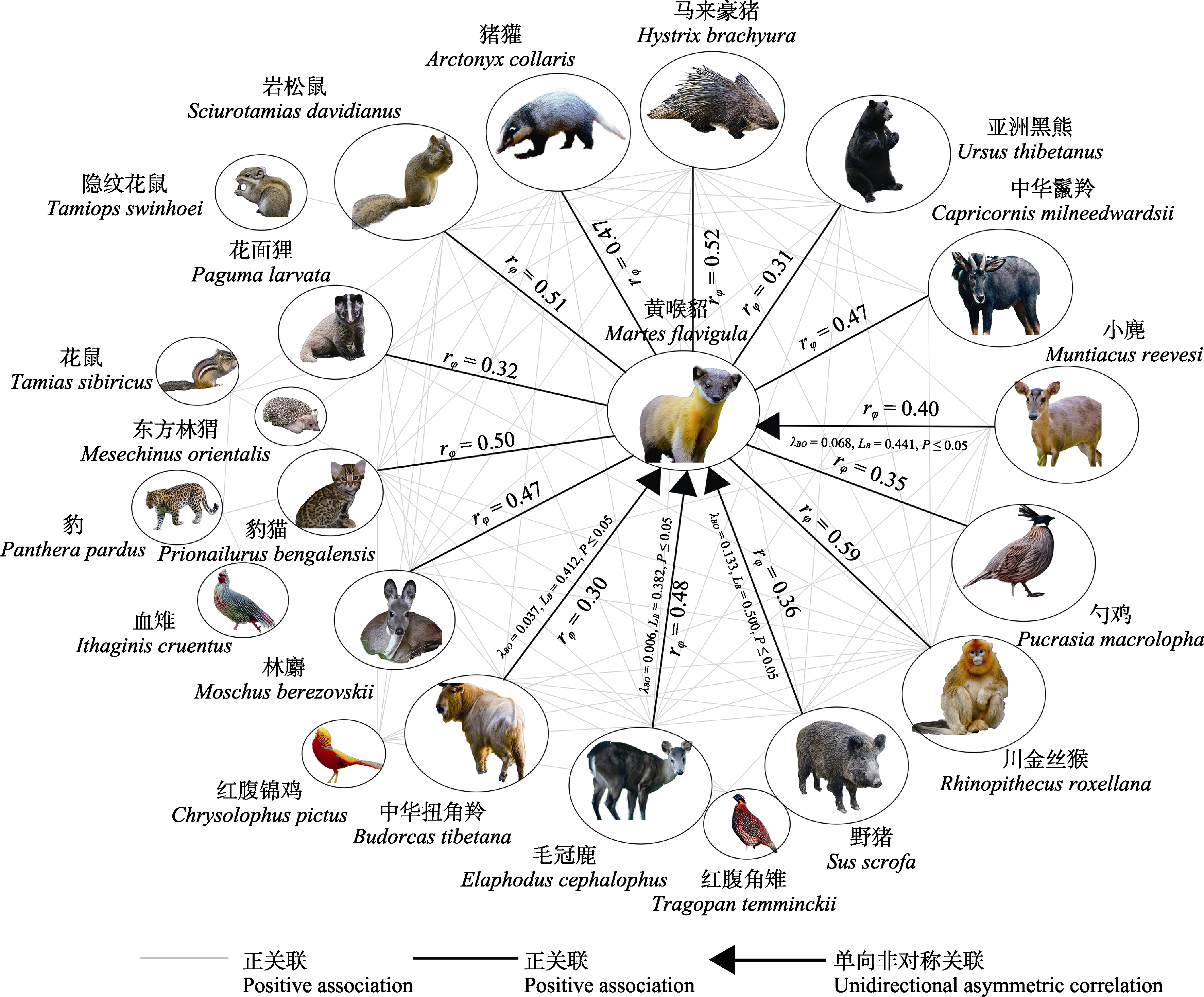
图2 黄喉貂与地栖物种的空间关联网络
Fig. 2 Spatial association network between Martes flavigula and ground-dwelling species
| 物种 Species | Phi值 Phi coefficient (rφ) | 显著值 Significance (χ2) | P |
|---|---|---|---|
| 川金丝猴 Rhinopithecus roxellana | 0.59 | 26.90 | < 0.05 |
| 马来豪猪 Hystrix brachyura | 0.52 | 20.41 | < 0.05 |
| 岩松鼠 Sciurotamias davidianus | 0.51 | 19.29 | < 0.05 |
| 豹猫 Prionailurus bengalensis | 0.50 | 18.80 | < 0.05 |
| 毛冠鹿 Elaphodus cephalophus | 0.48 | 17.31 | < 0.05 |
| 中华鬣羚 Capricornis milneedwardsii | 0.47 | 16.49 | < 0.05 |
| 林麝 Moschus berezovskii | 0.47 | 16.44 | < 0.05 |
| 猪獾 Arctonyx collaris | 0.47 | 16.17 | < 0.05 |
| 小麂 Muntiacus reevesi | 0.40 | 11.14 | < 0.05 |
| 野猪 Sus scrofa | 0.36 | 9.13 | < 0.05 |
| 勺鸡 Pucrasia macrolopha | 0.35 | 8.47 | < 0.05 |
| 花面狸 Paguma larvata | 0.32 | 6.91 | < 0.05 |
| 亚洲黑熊 Ursus thibetanus | 0.31 | 6.92 | < 0.05 |
| 中华扭角羚 Budorcas tibetana | 0.30 | 6.00 | < 0.05 |
表2 与黄喉貂存在显著正关联的物种及空间关联强度(rφ)
Table 2 Significant positive spatial association (rφ) of species with Martes flavigula
| 物种 Species | Phi值 Phi coefficient (rφ) | 显著值 Significance (χ2) | P |
|---|---|---|---|
| 川金丝猴 Rhinopithecus roxellana | 0.59 | 26.90 | < 0.05 |
| 马来豪猪 Hystrix brachyura | 0.52 | 20.41 | < 0.05 |
| 岩松鼠 Sciurotamias davidianus | 0.51 | 19.29 | < 0.05 |
| 豹猫 Prionailurus bengalensis | 0.50 | 18.80 | < 0.05 |
| 毛冠鹿 Elaphodus cephalophus | 0.48 | 17.31 | < 0.05 |
| 中华鬣羚 Capricornis milneedwardsii | 0.47 | 16.49 | < 0.05 |
| 林麝 Moschus berezovskii | 0.47 | 16.44 | < 0.05 |
| 猪獾 Arctonyx collaris | 0.47 | 16.17 | < 0.05 |
| 小麂 Muntiacus reevesi | 0.40 | 11.14 | < 0.05 |
| 野猪 Sus scrofa | 0.36 | 9.13 | < 0.05 |
| 勺鸡 Pucrasia macrolopha | 0.35 | 8.47 | < 0.05 |
| 花面狸 Paguma larvata | 0.32 | 6.91 | < 0.05 |
| 亚洲黑熊 Ursus thibetanus | 0.31 | 6.92 | < 0.05 |
| 中华扭角羚 Budorcas tibetana | 0.30 | 6.00 | < 0.05 |
| 预测物种 Predicting species | 被预测物种 Predicted species | LB (上限 Upper) | λBO (下限 Lower) | P |
|---|---|---|---|---|
| 小麂 Muntiacus reevesi | 黄喉貂 Martes flavigula | 0.441 | 0.068 | ≤ 0.05 |
| 毛冠鹿 Elaphodus cephalophus | 黄喉貂 Martes flavigula | 0.382 | 0.006 | ≤ 0.05 |
| 中华扭角羚 Budorcas tibetana | 黄喉貂 Martes flavigula | 0.412 | 0.037 | ≤ 0.05 |
| 野猪 Sus scrofa | 黄喉貂 Martes flavigula | 0.500 | 0.133 | ≤ 0.05 |
| 黄喉貂 Martes flavigula | 小麂 Muntiacus reevesi | -0.789 | -1.715 | > 0.05 |
| 黄喉貂 Martes flavigula | 毛冠鹿 Elaphodus cephalophus | -0.619 | -1.398 | > 0.05 |
| 黄喉貂 Martes flavigula | 中华扭角羚 Budorcas tibetana | -0.700 | -1.548 | > 0.05 |
| 黄喉貂 Martes flavigula | 野猪 Sus scrofa | -1.000 | -2.118 | > 0.05 |
表3 黄喉貂与其关联物种之间的预测性(Lambda系数检验)
Table 3 Predictability between Martes flavigula and its associated species (Lambda coefficient test)
| 预测物种 Predicting species | 被预测物种 Predicted species | LB (上限 Upper) | λBO (下限 Lower) | P |
|---|---|---|---|---|
| 小麂 Muntiacus reevesi | 黄喉貂 Martes flavigula | 0.441 | 0.068 | ≤ 0.05 |
| 毛冠鹿 Elaphodus cephalophus | 黄喉貂 Martes flavigula | 0.382 | 0.006 | ≤ 0.05 |
| 中华扭角羚 Budorcas tibetana | 黄喉貂 Martes flavigula | 0.412 | 0.037 | ≤ 0.05 |
| 野猪 Sus scrofa | 黄喉貂 Martes flavigula | 0.500 | 0.133 | ≤ 0.05 |
| 黄喉貂 Martes flavigula | 小麂 Muntiacus reevesi | -0.789 | -1.715 | > 0.05 |
| 黄喉貂 Martes flavigula | 毛冠鹿 Elaphodus cephalophus | -0.619 | -1.398 | > 0.05 |
| 黄喉貂 Martes flavigula | 中华扭角羚 Budorcas tibetana | -0.700 | -1.548 | > 0.05 |
| 黄喉貂 Martes flavigula | 野猪 Sus scrofa | -1.000 | -2.118 | > 0.05 |
| 物种 Species | 种对数 No. of associated species (N) | Shannon-Wiener指数 Shannon-Wiener index (H) | 网络复杂性贡献率 Network complexity contribution rate (Ci) (%) |
|---|---|---|---|
| 川金丝猴 Rhinopithecus roxellana* | 15 | 2.670 | 6.61 |
| 黄喉貂 Martes flavigula* | 14 | 2.618 | 6.48 |
| 豹猫 Prionailurus bengalensis* | 14 | 2.613 | 6.47 |
| 毛冠鹿 Elaphodus cephalophus* | 14 | 2.608 | 6.45 |
| 林麝 Moschus berezovskii* | 12 | 2.465 | 6.10 |
| 马来豪猪 Hystrix brachyura* | 12 | 2.464 | 6.10 |
| 猪獾 Arctonyx collaris* | 11 | 2.379 | 5.89 |
| 岩松鼠 Sciurotamias davidianus* | 11 | 2.375 | 5.88 |
| 野猪 Sus scrofa* | 10 | 2.282 | 5.65 |
| 中华扭角羚 Budorcas tibetana* | 9 | 2.185 | 5.41 |
| 红腹锦鸡 Chrysolophus pictus* | 9 | 2.160 | 5.35 |
| 亚洲黑熊 Ursus thibetanus* | 8 | 2.069 | 5.12 |
| 花面狸 Paguma larvata* | 8 | 2.057 | 5.09 |
| 小麂 Muntiacus reevesi* | 6 | 1.775 | 4.39 |
| 中华鬣羚 Capricornis milneedwardsii | 5 | 1.601 | 3.96 |
| 红腹角雉 Tragopan temminckii | 5 | 1.570 | 3.89 |
| 花鼠 Tamias sibiricus | 4 | 1.374 | 3.40 |
| 勺鸡 Pucrasia macrolopha | 4 | 1.367 | 3.38 |
| 中华斑羚 Naemorhedus griseus | 3 | 1.105 | 2.82 |
| 豹 Panthera pardus | 3 | 1.096 | 2.71 |
| 东方林猬 Mesechinus orientalis | 2 | 0.677 | 1.67 |
| 血雉 Ithaginis cruentus | 1 | 0.000 | 0.00 |
| 隐纹花鼠 Tamiops swinhoei | 1 | 0.000 | 0.00 |
表4 物种关联的Shannon-Wiener指数及其对网络复杂性的贡献率
Table 4 Shannon-Wiener index of species and its contribution rate to network complexity
| 物种 Species | 种对数 No. of associated species (N) | Shannon-Wiener指数 Shannon-Wiener index (H) | 网络复杂性贡献率 Network complexity contribution rate (Ci) (%) |
|---|---|---|---|
| 川金丝猴 Rhinopithecus roxellana* | 15 | 2.670 | 6.61 |
| 黄喉貂 Martes flavigula* | 14 | 2.618 | 6.48 |
| 豹猫 Prionailurus bengalensis* | 14 | 2.613 | 6.47 |
| 毛冠鹿 Elaphodus cephalophus* | 14 | 2.608 | 6.45 |
| 林麝 Moschus berezovskii* | 12 | 2.465 | 6.10 |
| 马来豪猪 Hystrix brachyura* | 12 | 2.464 | 6.10 |
| 猪獾 Arctonyx collaris* | 11 | 2.379 | 5.89 |
| 岩松鼠 Sciurotamias davidianus* | 11 | 2.375 | 5.88 |
| 野猪 Sus scrofa* | 10 | 2.282 | 5.65 |
| 中华扭角羚 Budorcas tibetana* | 9 | 2.185 | 5.41 |
| 红腹锦鸡 Chrysolophus pictus* | 9 | 2.160 | 5.35 |
| 亚洲黑熊 Ursus thibetanus* | 8 | 2.069 | 5.12 |
| 花面狸 Paguma larvata* | 8 | 2.057 | 5.09 |
| 小麂 Muntiacus reevesi* | 6 | 1.775 | 4.39 |
| 中华鬣羚 Capricornis milneedwardsii | 5 | 1.601 | 3.96 |
| 红腹角雉 Tragopan temminckii | 5 | 1.570 | 3.89 |
| 花鼠 Tamias sibiricus | 4 | 1.374 | 3.40 |
| 勺鸡 Pucrasia macrolopha | 4 | 1.367 | 3.38 |
| 中华斑羚 Naemorhedus griseus | 3 | 1.105 | 2.82 |
| 豹 Panthera pardus | 3 | 1.096 | 2.71 |
| 东方林猬 Mesechinus orientalis | 2 | 0.677 | 1.67 |
| 血雉 Ithaginis cruentus | 1 | 0.000 | 0.00 |
| 隐纹花鼠 Tamiops swinhoei | 1 | 0.000 | 0.00 |
| [1] | Bu SH, Zheng XL (2015) Atlas of Common Animals in Huoditang, Qinling Mountains. Science Press, Beijing. (in Chinese) |
| [卜书海, 郑雪莉 (2015) 秦岭火地塘常见动物图鉴. 科学出版社, 北京.] | |
| [2] | Chen EJ, Guan TP, Li S (2022) The sex ratio, social structure and activity pattern of Reeves’ muntjac (Muntiacus reevesi) in Minshan Mountains Sichuan Province, Acta Theriologica Sinica, 42, 1-11. (in Chinese with English abstract) |
|
[陈尔骏, 官天培, 李晟 (2022) 四川岷山小麂的种群性比、社会结构和活动节律. 兽类学报, 42, 1-11.]
DOI |
|
| [3] |
Davis CL, Rich LN, Farris ZJ, Kelly MJ, Di Bitetti MS, Di Blanco Y, Albanesi S, Farhadinia MS, Gholikhani N, Hamel S, Harmsen BJ, Wultsch C, Kane MD, Martins Q, Murphy AJ, Steenweg R, Sunarto S, Taktehrani A, Thapa K, Tucker JM, Whittington J, Widodo FA, Yoccoz NG, Miller DAW (2018) Ecological correlates of the spatial co-occurrence of sympatric mammalian carnivores worldwide. Ecology Letters, 21, 1401-1412.
DOI PMID |
| [4] | Huang XL, Meng BS, Li HB, Ran W, Yang W, Wang C, Xie B, Zhang X, Ran JC, Zhang MM (2024) Interspecific associations between Rhinopithecus brelichi and its sympatric species using infrared cameras. Biodiversity Science, 32, 23402. (in Chinese with English abstract) |
|
[黄小龙, 蒙秉顺, 李海波, 冉伟, 杨伟, 王丞, 谢波, 张旭, 冉景丞, 张明明 (2024) 基于红外相机的黔金丝猴及其同域分布物种种间关联. 生物多样性, 32, 23402.]
DOI |
|
| [5] |
Lee S, Lee SM, Song W, Lee MJ (2017) Habitat potential mapping of marten (Martes flavigula) and leopard cat (Prionailurus bengalensis) in south Korea using artificial neural network machine learning. Applied Sciences, 7, 912.
DOI URL |
| [6] | Li AN, Deng SY, Zan LS (2024) Advance in conservation biological research of Chinese serow (Capricornis milneedwardsii). Acta Agriculturae Boreali-occidentalis Sinica, 33, 981-988. (in Chinese with English abstract) |
| [李安宁, 邓帅豫, 昝林森 (2024) 中华鬣羚的保护生物学研究进展. 西北农业学报, 33, 981-988.] | |
| [7] | Li J, Xue YD, Wu B, Li DQ (2022) Assessing vulnerability of suitable golden takins (Budorcas taxicolor bedfordi) habitat and adaptive conservation strategies to climate change in Qinling Mountains, China. Acta Ecologica Sinica, 42, 7484-7494. (in Chinese with English abstract) |
| [李佳, 薛亚东, 吴波, 李迪强 (2022) 气候变化背景下秦岭地区羚牛生境脆弱性评估及适应性保护对策. 生态学报, 42, 7484-7494.] | |
| [8] | Li Q, Zhong Y, Zhou HX, Liu ZT, Wang XJ, Shi XG, Li ZY (2022) Analysis on interspecific association of sambars community in Wolong National Nature Reserve, Sichuan, China. Chinese Journal of Wildlife, 43, 314-322. (in Chinese with English abstract) |
| [李谦, 钟义, 周厚熊, 刘卓涛, 王晓娟, 施小刚, 李兆元 (2022) 卧龙国家级自然保护区水鹿在群落中的种间关联初步分析. 野生动物学报, 43, 314-322.] | |
| [9] | Li YK, Jiang ZG, Miao T (2013) Diet and its seasonality of golden snub-nosed monkeys (Rhinopithecus roxellana) in Qingmuchuan Nature Reserve, Shaanxi Province, China. Acta Theriologica Sinica, 33, 246-257. (in Chinese with English abstract) |
| [李言阔, 蒋志刚, 缪涛 (2013) 青木川自然保护区川金丝猴食性的季节性变化. 兽类学报, 33, 246-257.] | |
| [10] | Li ZY, Liu P (2018) Practical Statistical Methods. Science Press, Beijing. (in Chinese) |
| [李兆元, 刘萍 (2018) 实用统计学方法. 科学出版社, 北京.] | |
| [11] | Liu ZT, Zhong Y, Wang XJ, Li Q, Zhou HX, Shi XG, Li ZY (2022) Analysis on the community environment of Sichuan snub-nosed monkeys (Rhinopithecus roxellana) in Wolong, China. Chinese Journal of Wildlife, 43, 614-622. (in Chinese with English abstract) |
| [刘卓涛, 钟义, 王晓娟, 李谦, 周厚熊, 施小刚, 李兆元 (2022) 卧龙国家级自然保护区川金丝猴的群落环境分析. 野生动物学报, 43, 614-622.] | |
| [12] | Mackinnon J, Phillipps K, He FQ (2000) A Field Guide to the Birds of China. Hunan Education Publishing House, Changsha. (in Chinese) |
| [约翰∙马敬能, 卡伦∙菲利普斯, 何芬奇 (2000) 中国鸟类野外手册. 湖南教育出版社, 长沙.] | |
| [13] |
O’Brien TG, Kinnaird MF, Wibisono HT (2003) Crouching tigers, hidden prey: Sumatran tiger and prey populations in a tropical forest landscape. Animal Conservation, 6, 131-139.
DOI URL |
| [14] |
Roemer GW, Gompper ME, Van Valkenburgh B (2009) The ecological role of the mammalian mesocarnivore. BioScience, 59, 165-173.
DOI URL |
| [15] | Smith AT, Xie Y (2009) A Guide to the Mammals of China. Hunan Education Press, Changsha. (in Chinese) |
| [ Andrew T. Smith, 解焱 (2009) 中国兽类野外手册. 湖南教育出版社, 长沙.] | |
| [16] | Su TW (2022) Study of Diversity and Spatial Association of Mammals and Landfowls in Gansu Liancheng National Nature Reserve, China. PhD dissertation, Beijing Forestry University, Beijing. (in Chinese with English abstract) |
| [苏腾伟 (2022) 甘肃连城国家级自然保护区地栖鸟兽多样性及其空间关联研究. 博士学位论文, 北京林业大学, 北京.] | |
| [17] | Wang P, Li S, Chen H, Huang H, Li YH, Hu J (2022) A preliminary study on spatial-temporal relationship between blood pheasant and its predator yellow-throated marten. Chinese Journal of Zoology, 57, 855-865. (in Chinese with English abstract) |
| [王芃, 李晟, 陈红, 黄豪, 李艳红, 胡杰 (2022) 血雉与其捕食者黄喉貂的时空关系初探. 动物学杂志, 57, 855-865.] | |
| [18] | Wang XJ, Chen LM, Zhong Y, Li ZY, Liu ZT, Li Q (2023) Species associations and conservation of Sichuan snub-nosed monkey in the Tangjiahe National Nature Reserve. Chinese Journal of Wildlife, 44, 1-13. (in Chinese with English abstract) |
| [王晓娟, 谌利民, 钟义, 李兆元, 刘卓涛, 李谦 (2023) 唐家河国家级自然保护区川金丝猴的种间关联和保护. 野生动物学报, 44, 1-13.] | |
| [19] | Wang Y, Li L, Zheng NZ, Yu L, Tong GP, Fu WY, Song X, Zhao SS, Xu AC (2025) Population density, activity rhythm, and habitat utilization of hog badger Arctonyx albogularis in the Zhejiang Qingliangfeng National Nature Reserve. Acta Theriologica Sinica, 45, 49-59. (in Chinese with English abstract) |
| [王扬, 厉亮, 郑南忠, 俞遴, 童根平, 付文燕, 宋虓, 赵闪闪, 徐爱春 (2025) 浙江清凉峰国家级自然保护区猪獾种群密度、活动节律和栖息地利用特征. 兽类学报, 45, 49-59.] | |
| [20] | Yang MD, Deng ZS, Cao Y, Kang ZJ, Zhang YZ, Xiang JJ, Tang LP, Yang DD (2025) Assessing habitat suitability of Elaphodus cephalophus in Hunan Province based on MaxEnt model. Chinese Journal of Ecology, 44, 1314-1320. (in Chinese with English abstract) |
| [杨梦蝶, 邓泽帅, 曹越, 康祖杰, 张裕中, 向建军, 唐隆平, 杨道德 (2025) 基于MaxEnt模型的湖南省毛冠鹿潜在生境适宜性评价. 生态学杂志, 44, 1314-1320.] | |
| [21] | Yu LB, Zhang XM, Chang MY, Dong W, Bu SH, Guo M, Zheng XL (2025) Spatio-temporal niche differentiation of three ungulates in Changqing Nature Reserve, Shaanxi Province. Chinese Journal of Zoology, 60, 651-662. (in Chinese with English abstract) |
| [余丽冰, 张希明, 常美悦, 董伟, 卜书海, 郭明, 郑雪莉 (2025) 陕西长青自然保护区3种小型有蹄类的时空生态位分化. 动物学杂志, 60, 651-662.] | |
| [22] | Zhang B, Si KC, Guo B, Chen C, Jing JF, Liu YT, Bu SH (2021) Research on the activity regularity of giant pandas in Zhouzhi Nature Reserve. Bulletin of Biology, 56(4), 43-46. (in Chinese) |
| [张波, 司开创, 郭斌, 陈琛, 景建飞, 刘一通, 卜书海 (2021) 周至自然保护区大熊猫活动规律研究. 生物学通报, 56(4), 43-46.] | |
| [23] | Zhao Y, Zhu XY, Li WQ, Han XH, Yang XM, Wang Z, Xu SC, Zhu MY (2024) Evaluation of potential suitable habitat for Martes flavigula in northern Shaanxi forest region based on MaxEnt model. Journal of Yan’an University (Natural Science Edition), 43(4), 28-35. (in Chinese with English abstract) |
| [赵玥, 朱晓雅, 李卫强, 韩兴华, 杨小妹, 王震, 徐世才, 朱梦炎 (2024) 基于MaxEnt模型的陕北林区黄喉貂潜在适宜生境评估. 延安大学学报(自然科学版), 43(4), 28-35.] | |
| [24] | Zhou HX, Jiang N, Li J, Yang H, Wu YR, Wang PY, Shi XG, Li ZY (2021) Study on the terrestrial animal community that Panthera uncia lived in Wolong National Nature Reserve, Sichuan Province, China. Chinese Journal of Wildlife, 42, 645-653. (in Chinese with English abstract) |
| [周厚熊, 姜楠, 李君, 杨虎, 吴艳蓉, 王鹏彦, 施小刚, 李兆元 (2021) 四川卧龙国家级自然保护区雪豹地栖动物群落初探. 野生动物学报, 42, 645-653.] | |
| [25] |
Zhou YB, Chen WW, Kaneko Y, Newman C, Liao ZH, Zhu XQ, Buesching CD, Xie ZQ, MacDonald DW (2015) Seasonal dietary shifts and food resource exploitation by the hog badger (Arctonyx collaris) in a Chinese subtropical forest. European Journal of Wildlife Research, 61, 125-133.
DOI URL |
| [26] |
Zhou YB, Newman C, Buesching CD, Zalewski A, Kaneko Y, MacDonald DW, Xie ZQ (2011) Diet of an opportunistically frugivorous carnivore, Martes flavigula, in subtropical forest. Journal of Mammalogy, 92, 611-619.
DOI URL |
| [27] | Zhu BW, Wang B, Ran JH, Li B, Huang F, Li XQ, Gu XD (2019) Seasonal variation of daily activity patterns and diet of yellow-throated marten (Martes flavigula). Acta Theriologica Sinica, 39, 52-61. (in Chinese with English abstract) |
| [朱博伟, 王彬, 冉江洪, 李波, 黄蜂, 李晓清, 古晓东 (2019) 黄喉貂日活动节律及食性的季节变化. 兽类学报, 39, 52-61.] |
| [1] | 王明慧, 陈昭铨, 李帅锋, 黄小波, 郎学东, 胡子涵, 尚瑞广, 刘万德. 云南普洱季风常绿阔叶林不同种子扩散方式的优势种空间点格局分析[J]. 生物多样性, 2023, 31(9): 23147-. |
| [2] | 余玉群, 吴建平, 郭松涛, 何鹏举, 姬明周, 胡永乐. 秦岭北坡雉类种群密度和群落结构的初步研究[J]. 生物多样性, 2000, 08(1): 60-64. |
| 阅读次数 | ||||||
|
全文 |
|
|||||
|
摘要 |
|
|||||
备案号:京ICP备16067583号-7
Copyright © 2026 版权所有 《生物多样性》编辑部
地址: 北京香山南辛村20号, 邮编:100093
电话: 010-62836137, 62836665 E-mail: biodiversity@ibcas.ac.cn
