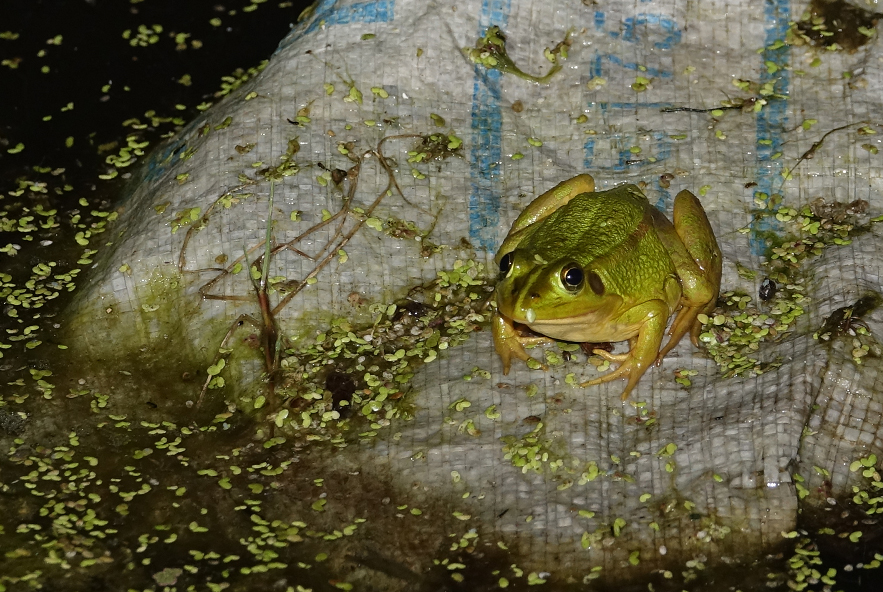
Potential spatial distribution pattern and landscape connectivity of Pelophylax plancyi in Shanghai, China
Received date: 2022-12-23
Accepted date: 2023-03-29
Online published: 2023-08-14
Aims: Habitat fragmentation and loss caused by urbanization are important factors that threaten the survival of wildlife globally. Urbanization has caused amphibians to become one of the most severely threatened groups of terrestrial vertebrates. Studying the spatial distribution pattern and exploring how landscape connectivity affects the gene flow among fragmented populations of amphibians in urban areas would provide a deeper understanding of the impacts of urbanization on wildlife and offer theoretical guidance for local biodiversity conservation.
Methods: In this study, we selected the eastern golden frog (Pelophylax plancyi) as the primary research subject and obtained landscape and environmental data about land cover, normalized difference vegetation index (NDVI) and land surface temperature in the Shanghai region using Landsat-8 satellite images (
Results: The habitat suitability of P. plancyi significantly decreased along the rural-to-urban gradient. NDVI was the main factor affecting the MaxEnt modelling and indicated that the P. plancyi prefer to inhabit areas with higher vegetation coverage. There was no significant correlation between genetic distance and geographical distance, while genetic distance increased significantly with the resistance distance.
Conclusions: The protection and maintenance of continuous suitable habitats in suburbs and isolated habitat patches in urban areas that still exist is the primary measure of conservation for native amphibians such as P. plancyi. Furthermore, optimizing urban landscape structure, strengthening the construction of corridors suitable for various groups of wildlife, and promoting the gene exchange among local populations are effective methods to achieve the self-sustainment of populations and long-term conservation of biodiversity in urbanized areas.
Key words: urbanization; MaxEnt; circuit theory; isolation by resistance; Pelophylax plancyi; Shanghai
Tingwei Dong , Meiling Huang , Xu Wei , Shuo Ma , Qu Yue , Wenli Liu , Jiaxin Zheng , Gang Wang , Rui Ma , Youzhong Ding , Shunqi Bo , Zhenghuan Wang . Potential spatial distribution pattern and landscape connectivity of Pelophylax plancyi in Shanghai, China[J]. Biodiversity Science, 2023 , 31(8) : 22692 . DOI: 10.17520/biods.2022692
| [1] | Botzat A, Fischer LK, Kowarik I (2016) Unexploited opportunities in understanding liveable and biodiverse cities. A review on urban biodiversity perception and valuation. Global Environmental Change, 39, 220-233. |
| [2] | Danecek P, Auton A, Abecasis G, Albers CA, Banks E, DePristo MA, Handsaker RE, Lunter G, Marth GT, Sherry ST, McVean G, Durbin R, 1000 Genomes Project Analysis Group (2011) The variant call format and VCFtools. Bioinformatics, 27, 2156-2158. |
| [3] | Deng SB, Du HJ, Xu EH, Chen JQ (2014) ENVI Remote Sensing Image Processing Method, 2nd edn. Higher Education Press, Beijing. (in Chinese) |
| [3] | [ 邓书斌, 杜会建, 徐恩惠, 陈秋锦 (2014) ENVI遥感图像处理方法(第二版). 高等教育出版社, 北京.] |
| [4] | Diao YX, Zhao QQ, Weng Y, Huang ZX, Wu YQ, Gu BJ, Zhao Q, Wang F (2022) Predicting current and future species distribution of the raccoon dog (Nyctereutes procyonoides) in Shanghai, China. Landscape and Urban Planning, 228, 104581. |
| [5] | Dray S, Dufour AB (2007) The ade 4 package: Implementing the duality diagram for ecologists. Journal of Statistical Software, 22(4), 1-20. |
| [6] | Excoffier L, Laval G, Schneider S (2007) Arlequin (version 3.0): An integrated software package for population genetics data analysis. Evolutionary Bioinformatics Online, 1, 47-50. |
| [7] | Gippet JMW, Mondy N, Diallo-Dudek J, Bellec A, Dumet A, Mistler L, Kaufmann B (2017) I’m not like everybody else: Urbanization factors shaping spatial distribution of native and invasive ants are species-specific. Urban Ecosystems, 20, 157-169. |
| [8] | Grimm NB, Faeth SH, Golubiewski NE, Redman CL, Wu JG, Bai XM, Briggs JM (2008) Global change and the ecology of cities. Science, 319, 756-760. |
| [9] | Guzy JC, McCoy ED, Deyle AC, Gonzalez SM, Halstead N, Mushinsky HR (2012) Urbanization interferes with the use of amphibians as indicators of ecological integrity of wetlands. Journal of Applied Ecology, 49, 941-952. |
| [10] | Hamer AJ, McDonnell MJ (2008) Amphibian ecology and conservation in the urbanising world: A review. Biological Conservation, 141, 2432-2449. |
| [11] | Hu HY (1987) Demography in China (Shanghai Part). China Financial & Economic Publishing House, Beijing. (in Chinese) |
| [11] | [ 胡焕庸 (1987) 中国人口(上海分册). 中国财政经济出版社, 北京.] |
| [12] | Huang ZY, Tang ZY, Zong Y (1980) Amphibian and reptile species in Shanghai. Natural Science, (3), 17-20. (in Chinese) |
| [12] | [ 黄正一, 唐子英, 宗愉 (1980) 上海地区的两栖爬行动物. 博物, (3), 17-20.] |
| [13] | IUCN International Union for Conservation of Nature (2021) The IUCN Red List of Threatened Species, Version, Version 2021-3. https://www.iucnredlist.org/. (accessed on 2022-07-12) |
| [14] | Johnson MTJ, Munshi-South J (2017) Evolution of life in urban environments. Science, 358, eaam8327. |
| [15] | Kuang WH, Chi WF, Lu DS, Dou YY (2014) A comparative analysis of megacity expansions in China and the U.S.: Patterns, rates and driving forces. Landscape and Urban Planning, 132, 121-135. |
| [16] | Li B, Zhang W, Shu XX, Pei EL, Yuan X, Wang TH, Wang ZH (2018) Influence of breeding habitat characteristics and landscape heterogeneity on anuran species richness and abundance in urban parks of Shanghai, China. Urban Forestry & Urban Greening, 32, 56-63. |
| [17] | Lin P, Yang L, Zhao SQ (2020) Urbanization effects on Chinese mammal and amphibian richness: A multi-scale study using the urban-rural gradient approach. Environmental Research Communications, 2, 125002. |
| [18] | Magle SB, Hunt VM, Vernon M, Crooks KR (2012) Urban wildlife research: Past, present, and future. Biological Conservation, 155, 23-32. |
| [19] | Mantel N (1967) The detection of disease clustering and a generalized regression approach. Cancer Research, 27, 209-220. |
| [20] | McRae BH (2006) Isolation by resistance. Evolution, 60, 1551-1561. |
| [21] | McRae BH, Beier P (2007) Circuit theory predicts gene flow in plant and animal populations. Proceedings of the National Academy of Sciences, USA, 104, 19885-19890. |
| [22] | Munshi-South J, Zolnik CP, Harris SE (2016) Population genomics of the Anthropocene: Urbanization is negatively associated with genome-wide variation in white-footed mouse populations. Evolutionary Applications, 9, 546-564. |
| [23] | Phillips SJ, Anderson RP, Schapire RE (2006) Maximum entropy modeling of species geographic distributions. Ecological Modelling, 190, 231-259. |
| [24] | Rousset F (1997) Genetic differentiation and estimation of gene flow from F-statistics under isolation by distance. Genetics, 145, 1219-1228. |
| [25] | Semlitsch RD (2000) Principles for management of aquatic- breeding amphibians. The Journal of Wildlife Management, 64, 615-631. |
| [26] | Semlitsch RD (2008) Differentiating migration and dispersal processes for pond-breeding amphibians. The Journal of Wildlife Management, 72, 260-267. |
| [27] | Seto KC, Güneralp B, Hutyra LR (2012) Global forecasts of urban expansion to 2030 and direct impacts on biodiversity and carbon pools. Proceedings of the National Academy of Sciences, USA, 109, 16083-16088. |
| [28] | Shanghai Bureau of Statistics (2022) Shanghai Statistical Yearbook 2022. China Statistics Press, Beijing. (in Chinese) |
| [28] | [ 上海市统计局 (2022) 2022年上海统计年鉴. 中国统计出版社, 北京.] |
| [29] | Smith MA, Green DM (2005) Dispersal and the metapopulation paradigm in amphibian ecology and conservation: Are all amphibian populations metapopulations? Ecography, 28, 110-128. |
| [30] | Swets JA (1988) Measuring the accuracy of diagnostic systems. Science, 240, 1285-1293. |
| [31] | Tewksbury JJ, Levey DJ, Haddad NM, Sargent S, Orrock JL, Weldon A, Danielson BJ, Brinkerhoff J, Damschen EI, Townsend P (2002) Corridors affect plants, animals, and their interactions in fragmented landscapes. Proceedings of the National Academy of Sciences, USA, 99, 12923-12926. |
| [32] | Tsuji M, Ushimaru A, Osawa T, Mitsuhashi H (2011) Paddy-associated frog declines via urbanization: A test of the dispersal-dependent-decline hypothesis. Landscape and Urban Planning, 103, 318-325. |
| [33] | United Nations (2019) World Urbanization Prospects: The 2018 Revision. https://esa.un.org/unpd/wup/publications. (accessed on 2022-11-28) |
| [34] | Wang IJ (2013) Examining the full effects of landscape heterogeneity on spatial genetic variation: A multiple matrix regression approach for quantifying geographic and ecological isolation. Evolution, 67, 3403-3411. |
| [35] | Wang IJ, Glor RE, Losos JB (2013) Quantifying the roles of ecology and geography in spatial genetic divergence. Ecology Letters, 16, 175-182. |
| [36] | Wang M, Li JX, Kuang SJ, He YJ, Chen GJ, Huang Y, Song CH, Anderson P, ?owicki D (2020) Plant diversity along the urban-rural gradient and its relationship with urbanization degree in Shanghai, China. Forests, 11, 171. |
| [37] | Wang YH, Yang KC, Bridgman CL, Lin LK (2008) Habitat suitability modelling to correlate gene flow with landscape connectivity. Landscape Ecology, 23, 989-1000. |
| [38] | Ward DF (2007) Modelling the potential geographic distribution of invasive ant species in New Zealand. Biological Invasions, 9, 723-735. |
| [39] | Wei X, Huang ML, Yue Q, Ma S, Li B, Mu ZQ, Peng C, Gao WX, Liu WL, Zheng JX, Weng XD, Sun XH, Zuo QQ, Bo SQ, Yuan X, Zhang W, Yang G, Ding YZ, Wang XM, Wang TH, Hua PY, Wang ZH (2020) Long-term urbanization impacts the eastern golden frog (Pelophylax plancyi) in Shanghai City: Demographic history, genetic structure, and implications for amphibian conservation in intensively urbanizing environments. Evolutionary Applications, 14, 117-135. |
| [40] | Wright S (1943) Isolation by distance. Genetics, 28, 114-138. |
| [41] | Yang L, Zhao SQ, Liu SG (2022) A global analysis of urbanization effects on amphibian richness: Patterns and drivers. Global Environmental Change, 73, 102476. |
| [42] | Zhang W, Li B, Shu XX, Pei EL, Yuan X, Sun YJ, Wang TH, Wang ZH (2016) Responses of anuran communities to rapid urban growth in Shanghai, China. Urban Forestry & Urban Greening, 20, 365-374. |
| [43] | Zhao SQ, Da LJ, Tang ZY, Fang HJ, Song K, Fang JY (2006) Ecological consequences of rapid urban expansion: Shanghai, China. Frontiers in Ecology and the Environment, 4, 341-346. |
/
| 〈 |
|
〉 |
Copyright © 2026 Biodiversity Science
Editorial Office of Biodiversity Science, 20 Nanxincun, Xiangshan, Beijing 100093, China
Tel: 010-62836137, 62836665 E-mail: biodiversity@ibcas.ac.cn