

Biodiv Sci ›› 2026, Vol. 34 ›› Issue (4): 25427. DOI: 10.17520/biods.2025427 cstr: 32101.14.biods.2025427
• Data Papers • Previous Articles Next Articles
Mingtai An1,2,*( )(
)( ), Xu Wu1,2, Jianghong Yu3, Guoxiong Hu³3, Kun Wang4, Feng Liu3, Tianrou Wu5, Qin Xu1,6, Hao Zhang1,2, Jian Xu7, Yanbing Yang8, Wei Cao3, Lingbin Yan3, He Li8, Zhi Li1,2, Dehui Yu9, Lang Huang8, Zhiping Chen8, Xiaofang Li7, Huakai Zou1,2, Min Long1,2, Weihao Gu1,2, Yuhang Ma1,2, Jian Qiu1,2
Received:2025-10-28
Accepted:2026-03-04
Online:2026-04-20
Published:2026-05-28
Contact:
Mingtai An
Supported by:Mingtai An, Xu Wu, Jianghong Yu, Guoxiong Hu³, Kun Wang, Feng Liu, Tianrou Wu, Qin Xu, Hao Zhang, Jian Xu, Yanbing Yang, Wei Cao, Lingbin Yan, He Li, Zhi Li, Dehui Yu, Lang Huang, Zhiping Chen, Xiaofang Li, Huakai Zou, Min Long, Weihao Gu, Yuhang Ma, Jian Qiu. A dataset on inventory and geographical distributions of higher plants in Guizhou, China[J]. Biodiv Sci, 2026, 34(4): 25427.
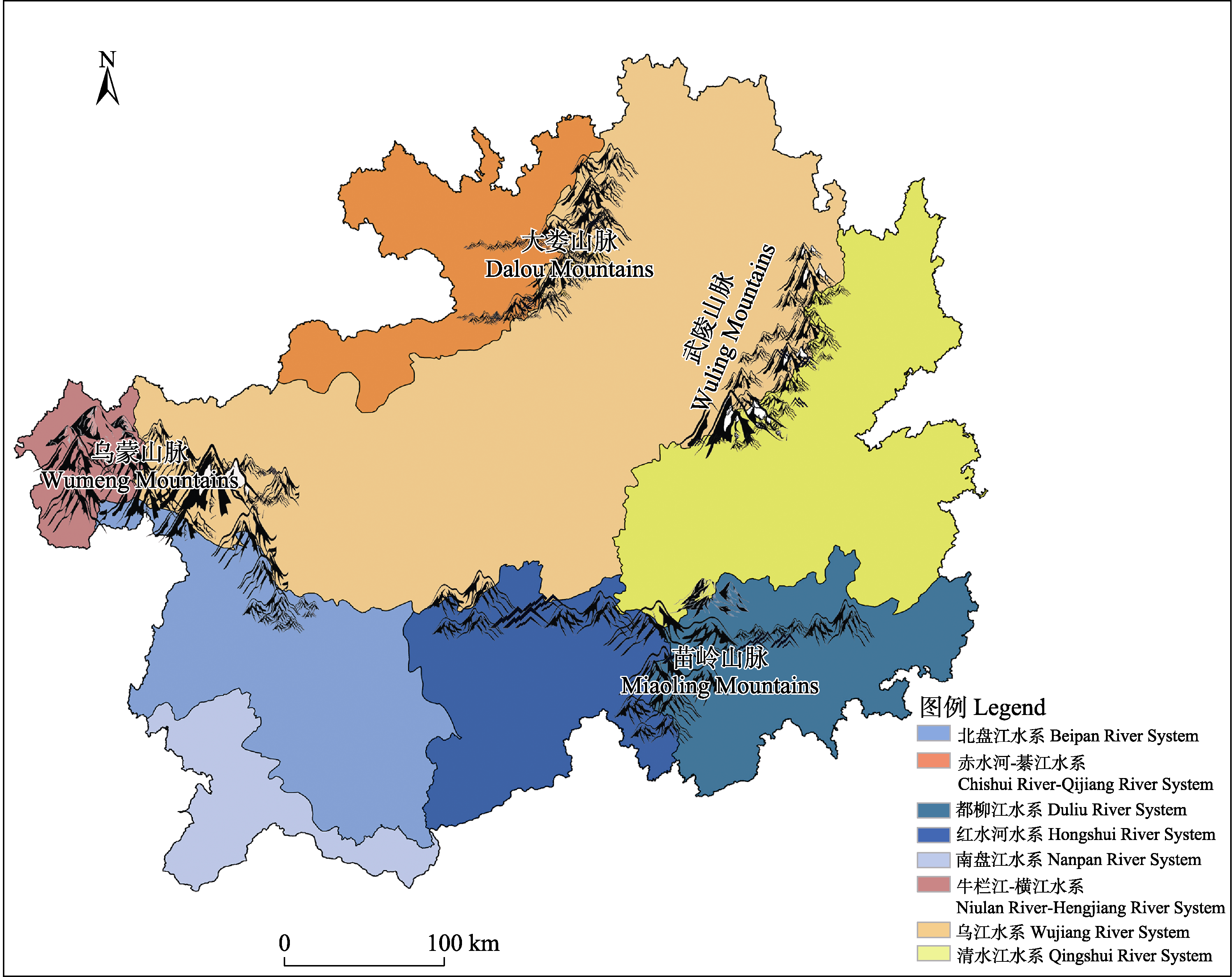
Fig. 1 Schematic diagram of the distribution of four major mountain ranges and eight major water systems in Guizhou Province (Based primarily on Zhu et al., 2021)
| 植物类别 Plant category | 国家重点保护野生植物 National key protected wild plants | 占贵州野生高等植物物种总数的百分比 Percentage of total wild higher plant species in Guizhou (%) | 省级重点保护野生高等植物 Provincial key protected wild higher plants | 占贵州野生高等植物物种总数的百分比 Percentage of total wild higher plant species in Guizhou (%) | |
|---|---|---|---|---|---|
| I | II | ||||
| 苔藓植物 Bryophytes | 3 | 0.03 | 3 | 0.03 | |
| 石松类和蕨类植物 Lycophytes and ferns | 1 | 19 | 0.18 | 2 | 0.02 |
| 裸子植物 Gymnosperms | 9 | 19 | 0.25 | 6 | 0.05 |
| 被子植物 Angiosperms | 15 | 190 | 1.87 | 44 | 0.40 |
| 总计 Total | 25 | 231 | 2.33 | 55 | 0.50 |
Table 1 Statistics of key protected species of wild higher plants in Guizhou Province
| 植物类别 Plant category | 国家重点保护野生植物 National key protected wild plants | 占贵州野生高等植物物种总数的百分比 Percentage of total wild higher plant species in Guizhou (%) | 省级重点保护野生高等植物 Provincial key protected wild higher plants | 占贵州野生高等植物物种总数的百分比 Percentage of total wild higher plant species in Guizhou (%) | |
|---|---|---|---|---|---|
| I | II | ||||
| 苔藓植物 Bryophytes | 3 | 0.03 | 3 | 0.03 | |
| 石松类和蕨类植物 Lycophytes and ferns | 1 | 19 | 0.18 | 2 | 0.02 |
| 裸子植物 Gymnosperms | 9 | 19 | 0.25 | 6 | 0.05 |
| 被子植物 Angiosperms | 15 | 190 | 1.87 | 44 | 0.40 |
| 总计 Total | 25 | 231 | 2.33 | 55 | 0.50 |
| 山脉 Mountain | 苔藓植物 Bryophytes (%) | 石松类和蕨类植物Lycophytes and ferns (%) | 裸子植物Gymnosperms (%) | 被子植物Angiosperms (%) | 总计 Total (%) | 贵州境内主峰 Highest peak within Guizhou | 参考文献 Reference |
|---|---|---|---|---|---|---|---|
| 乌蒙山脉 Wumeng Mountains | 624 (5.69) | 446 (4.07) | 26 (0.24) | 2,581 (24.21) | 3,677 (33.53) | 韭菜坪 Jiucaiping Mountain, 2,900.6 m | 袁淑杰, |
| 苗岭山脉 Miaoling Mountains | 1,023 (9.33) | 621 (5.66) | 43 (0.39) | 4,653 (42.43) | 6,340 (57.81) | 雷公山 Leigong Mountain, 2,178.8 m | 丁访军, |
| 武陵山脉 Wuling Mountains | 1,164 (10.61) | 409 (3.73) | 33 (0.31) | 3,454 (31.49) | 5,060 (46.14) | 梵净山 Fanjingshan, 2,572 m | 胡萍, |
| 大娄山脉 Dalou Mountains | 825 (7.52) | 399 (3.64) | 28 (0.26) | 3,479 (31.72) | 4,731 (43.14) | 柏枝山 Baizhishan, 2,227 m | 徐宁和魏刚, |
Table 2 Statistics of wild higher plant species (excluding species with unclear distribution) and its percentage of total wild higher plant species in Guizhou (%) in the four major mountain ranges of Guizhou Province
| 山脉 Mountain | 苔藓植物 Bryophytes (%) | 石松类和蕨类植物Lycophytes and ferns (%) | 裸子植物Gymnosperms (%) | 被子植物Angiosperms (%) | 总计 Total (%) | 贵州境内主峰 Highest peak within Guizhou | 参考文献 Reference |
|---|---|---|---|---|---|---|---|
| 乌蒙山脉 Wumeng Mountains | 624 (5.69) | 446 (4.07) | 26 (0.24) | 2,581 (24.21) | 3,677 (33.53) | 韭菜坪 Jiucaiping Mountain, 2,900.6 m | 袁淑杰, |
| 苗岭山脉 Miaoling Mountains | 1,023 (9.33) | 621 (5.66) | 43 (0.39) | 4,653 (42.43) | 6,340 (57.81) | 雷公山 Leigong Mountain, 2,178.8 m | 丁访军, |
| 武陵山脉 Wuling Mountains | 1,164 (10.61) | 409 (3.73) | 33 (0.31) | 3,454 (31.49) | 5,060 (46.14) | 梵净山 Fanjingshan, 2,572 m | 胡萍, |
| 大娄山脉 Dalou Mountains | 825 (7.52) | 399 (3.64) | 28 (0.26) | 3,479 (31.72) | 4,731 (43.14) | 柏枝山 Baizhishan, 2,227 m | 徐宁和魏刚, |
| 水系 River system | 苔藓植物 Bryophytes (%) | 石松类和蕨类植物 Lycophytes and ferns (%) | 裸子植物 Gymnosperms (%) | 被子植物 Angiosperms (%) | 总计 Total (%) |
|---|---|---|---|---|---|
| 赤水河-綦江水系 Chishui River-Qijiang River System | 877 (8.00) | 492 (4.49) | 26 (0.24) | 3,397 (30.97) | 4,792 (43.69) |
| 乌江水系 Wujiang River System | 1,498 (13.66) | 777 (7.08) | 56 (0.51) | 6,401 (58.37) | 8,732 (79.62) |
| 清水江水系 Qingshui River System | 1,354 (12.35) | 654 (5.96) | 44 (0.40) | 5,179 (47.22) | 7,231 (65.93) |
| 牛栏江-横江水系 Niulan River-Hengjiang River System | 251 (2.29) | 318 (2.90) | 19 (0.17) | 1,601 (14.60) | 2,189 (19.96) |
| 都柳江水系 Duliu River System | 1,119 (10.20) | 650 (5.93) | 38 (0.35) | 5,109 (46.59) | 6,916 (63.06) |
| 北盘江水系 Beipan River System | 759 (6.92) | 611 (5.57) | 41 (0.37) | 4,669 (42.57) | 6,080 (55.44) |
| 南盘江水系 Nanpan River System | 513 (4.68) | 363 (3.31) | 30 (0.27) | 3,793 (34.59) | 4,699 (42.85) |
| 红水河水系 Hongshui River System | 1,002 (9.14) | 722 (6.58) | 42 (0.38) | 5,470 (49.88) | 7,236 (65.98) |
Table 3 Statistics of wild higher plant species (excluding species with unclear distribution) and its percentage of total wild higher plant species in Guizhou (%) in the eight major river systems of Guizhou Province
| 水系 River system | 苔藓植物 Bryophytes (%) | 石松类和蕨类植物 Lycophytes and ferns (%) | 裸子植物 Gymnosperms (%) | 被子植物 Angiosperms (%) | 总计 Total (%) |
|---|---|---|---|---|---|
| 赤水河-綦江水系 Chishui River-Qijiang River System | 877 (8.00) | 492 (4.49) | 26 (0.24) | 3,397 (30.97) | 4,792 (43.69) |
| 乌江水系 Wujiang River System | 1,498 (13.66) | 777 (7.08) | 56 (0.51) | 6,401 (58.37) | 8,732 (79.62) |
| 清水江水系 Qingshui River System | 1,354 (12.35) | 654 (5.96) | 44 (0.40) | 5,179 (47.22) | 7,231 (65.93) |
| 牛栏江-横江水系 Niulan River-Hengjiang River System | 251 (2.29) | 318 (2.90) | 19 (0.17) | 1,601 (14.60) | 2,189 (19.96) |
| 都柳江水系 Duliu River System | 1,119 (10.20) | 650 (5.93) | 38 (0.35) | 5,109 (46.59) | 6,916 (63.06) |
| 北盘江水系 Beipan River System | 759 (6.92) | 611 (5.57) | 41 (0.37) | 4,669 (42.57) | 6,080 (55.44) |
| 南盘江水系 Nanpan River System | 513 (4.68) | 363 (3.31) | 30 (0.27) | 3,793 (34.59) | 4,699 (42.85) |
| 红水河水系 Hongshui River System | 1,002 (9.14) | 722 (6.58) | 42 (0.38) | 5,470 (49.88) | 7,236 (65.98) |
| [1] | An MT, Hu GX, Yu JH (2026) Higher Plants of Guizhou Province. Shanghai Scientific & Technical Publishers, Shanghai. (in press) (in Chinese) |
| [安明态, 胡国雄, 余江洪 (2026) 贵州省高等植物. 上海科学技术出版社, 上海. (印刷中) ] | |
| [2] |
APG IV (Angiosperm Phylogeny Group IV) (2016) An update of the Angiosperm Phylogeny Group classification for the orders and families of flowering plants: APG IV. Botanical Journal of the Linnean Society, 181, 1-20.
DOI URL |
| [3] | Cardot J, Theriot I (1904) Mousses du Kouy-Tsheou (Chine), recoltes par Em. Bodinier et determined par J. Cardot et I. Theriot. Bulletin of the International Academy of Botanical Geography, 13, 81-84. (in French) |
| [4] | CBD (Convention on Biological Diversity) (2022) The Kunming-Montreal Global Biodiversity Framework. Montreal. https://www.cbd.int/meetings/COP-15. (accessed on 2025-12-19) |
| [5] | Chen DS, Zhu JY, Fan YM (2019) A Field Guide to the Wild Orchids of Guizhou. Guizhou Science and Technology Press, Guiyang.(in Chinese) |
| [陈东升, 朱惊毅, 范云美 (2019) 贵州野生兰科植物鉴别手册. 贵州科技出版社, 贵阳.] | |
| [6] | Chen QH (2004) Flora of Guizhou, Vol. 10. Guizhou Science and Technology Press, Guiyang.(in Chinese) |
| [陈谦海 (2004) 贵州植物志(第十卷). 贵州科技出版社, 贵阳.] | |
| [7] | Ding FJ, Pan ZS, Wu P, Cui YC, Zhou FJ (2015) Carbon accumulation and distribution characteristics of the evergreen and deciduous broad-leaved mixed forest in eastern Guizhou. Acta Ecologica Sinica, 35, 1761-1768.(in Chinese with English abstract) |
| [丁访军, 潘忠松, 吴鹏, 崔迎春, 周凤娇 (2015) 贵州东部常绿落叶阔叶混交林碳素积累及其分配特征. 生态学报, 35, 1761-1768.] | |
| [8] | Frey W (2009) Syllabus of Plant Families (Vol. 3): Bryophytes and Seedless Vascular Plants. Gebriider Borntraeger Verlag, Stuttgart. |
| [9] | Guizhou Forest Editorial Committee (1992) Forests of Guizhou. Guizhou Science and Technology Press, Guiyang & China Forestry Publishing House, Beijing.(in Chinese) |
| [贵州森林编辑委员会 (1992) 贵州森林. 贵州科技出版社, 贵阳 & 中国林业出版社, 北京.] | |
| [10] | Hou XY (1952) The Plant communities of southern Guizhou Province. Acta Botanica Sinica, 1, 65-106.(in Chinese) |
| [侯学煜 (1952) 贵州省南部的植物群落. 植物学报, 1, 65-116.] | |
| [11] | Hou XY (1957) Preliminary Observation on the Ecological Environment of Cryptogams in Guizhou and Adjacent Areas. Science Press, Beijing.(in Chinese) |
| [侯学煜 (1957) 贵州省及其邻近地区的蕨类植物生态环境的初步观察. 科学出版社, 北京.] | |
| [12] | Hou XY (1986) Series of China’s Physical Geography. Science Press, Beijing.(in Chinese) |
| [侯学煜 (1986) 中国自然地理(上册). 科学出版社, 北京.] | |
| [13] | Huang WL, Tu YL, Yang L (1988) Vegetation of Guizhou. Guizhou People’s Publishing House, Guiyang.(in Chinese) |
| [黄威廉, 屠玉麟, 杨龙 (1988) 贵州植被. 贵州人民出版社, 贵阳.] | |
| [14] | Hu P, Zhang LJ, Ran GJ, Xu DH, Yang EB (2023) Analysis of the causes of the extreme rainstorm in Tongren, Guizhou under the northwest airflow. Mid-Low Latitude Mountain Meteorology, 47, 8-16.(in Chinese with English abstract) |
| [胡萍, 张李娟, 冉光镜, 徐大红, 杨恩波 (2023) 高空西北气流下贵州铜仁特大暴雨的成因分析. 中低纬山地气象, 47, 8-16.] | |
| [15] |
Isbell F, Calcagno V, Hector A, Connolly J, Harpole WS, Reich PB, Scherer-Lorenzen M, Schmid B, Tilman D, van Ruijven J, Weigelt A, Wilsey BJ, Zavaleta ES, Loreau M (2011) High plant diversity is needed to maintain ecosystem services. Nature, 477, 199-202.
DOI |
| [16] | Léveillé, H (1914). Flore du Kouy-Tchéou. Le Mans, 1-30. |
| [17] | Li YK (1982-1989) Flora of Guizhou, Vols. 1-9. Guizhou People’s Publishing House, Guiyang. (in Chinese) |
| [李永康 (1982-1989) 贵州植物志(第一至九卷). 贵州人民出版社, 贵阳.] | |
| [18] | Liu B et al. (2024) China Checklist of Higher Plants. In: Catalogue of Life China: 2024 Annual Checklist (ed. The Biodiversity Committee of Chinese Academy of Sciences), Beijing. |
| [19] |
Liu B, Qin HN (2022) Recent advances in the national inventory of higher plant species in China. Biodiversity Science, 30, 22397.(in Chinese with English abstract)
DOI |
| [刘冰, 覃海宁 (2022) 中国高等植物多样性编目进展. 生物多样性, 30, 22397.] | |
| [20] | Luo Y, Deng LX (2015) Guizhou Vascular Plants Catalogue. China Forestry Publishing House, Beijing.(in Chinese) |
| [罗扬, 邓伦秀 (2015) 贵州维管束植物编目. 中国林业出版社, 北京.] | |
| [21] | Ma JS (2020) The Checklist of the Alien Invasive Plants in China, Vols. 1-5. Shanghai Jiao Tong University Press, Shanghai.(in Chinese) |
| [马金双 (2020) 中国外来入侵植物志(全五册). 上海交通大学出版社, 上海.] | |
| [22] | Ma JS, Li HR (2018) Catalogue of Alien Invasive Plants in China. Higher Education Press, Beijing.(in Chinese) |
| [马金双, 李惠茹 (2018) 中国外来入侵植物名录. 高等教育出版社, 北京.] | |
| [23] |
PPG I (2016) A community-derived classification for extant lycophytes and ferns. Journal of Systematics and Evolution, 54, 563-603.
DOI |
| [24] | Söderström L, Hagborg A, von Konrat M, Bartholomew-Began S, Bell D, Briscoe L, Brown E, Cargill DC, da Costa DP, Crandall-Stotler BJ, Cooper E, Dauphin G, Engel J, Feldberg K, Glenny D, Gradstein SR, He XL, Hentschel J, Ilkiu-Borges AL, Katagiri T, Konstantinova NA, Larraín J, Long D, Nebel M, Pócs T, Puche F, Reiner-Drehwald E, Renner M, Sass-Gyarmati A, Schäfer-Verwimp A, Segarra-Moragues J, Stotler RE, Sukkharak P, Thiers B, Uribe J, Váňa J, Villarreal JC, Wigginton M, Zhang L, Zhu RL (2016) World checklist of hornworts and liverworts. PhytoKeys, 59, 1-828. |
| [25] | Villarreal JC, Cargill DC, Hagborg A, Söderström L, Renzaglia KS (2010) A synthesis of hornwort diversity: Patterns, causes and future work. Phytotaxa, 9, 150-166. |
| [26] | Wang PS, Pan LT (2018) Flora of Lycophytes and Ferns of Guizhou. Guizhou Science and Technology Press, Guiyang.(in Chinese) |
| [王培善, 潘炉台 (2018) 贵州石松类和蕨类植物志. 贵州科技出版社, 贵阳.] | |
| [27] | Xiong YX (2011) Illustrated Flora of Bryophytes in Guizhou. Guizhou Science and Technology Press, Guiyang.(in Chinese) |
| [熊源新 (2011) 贵州苔藓植物图志. 贵州科技出版社, 贵阳.] | |
| [28] | Xiong YX (2014) Flora of Bryophytes in Guizhou, Vols. 1-2. Guizhou Science and Technology Press, Guiyang.(in Chinese) |
| [熊源新 (2014) 贵州苔藓植物志(第一至二卷). 贵州科技出版社, 贵阳.] | |
| [29] | Xiong YX, Cao W (2018) Flora of Bryophytes in Guizhou, Vol. 3. Guizhou Science and Technology Press, Guiyang.(in Chinese) |
| [熊源新, 曹威 (2018) 贵州苔藓植物志(第三卷). 贵州科技出版社, 贵阳.] | |
| [30] | Xiong YX, Yang L, Cao W (2021) Checklist of Non-vascular Plants in Guizhou Province. China Forestry Publishing House, Beijing.(in Chinese) |
| [熊源新, 杨林, 曹威 (2021) 贵州省非维管束植物名录. 中国林业出版社, 北京.] | |
| [31] | Xu N, Wei G (2007) Amphibian in Karst Platform Forest Nature Reserve of Baiqing in Guizhou. Sichuan Journal of Zoology, 26, 350-353.(in Chinese with English abstract) |
| [徐宁, 魏刚 (2007) 贵州柏箐喀斯特台原森林自然保护区两栖动物研究. 四川动物, 26, 350-353.] | |
| [32] |
Yang Y, Ferguson DK, Liu B, Mao KS, Gao LM, Zhang SZ, Wan T, Rushforth K, Zhang ZX (2022) Recent advances on phylogenomics of gymnosperms and a new classification. Plant Diversity, 44, 340-350.
DOI |
| [33] | Yuan G, Ren QF (2020) Aquatic Plants in Guizhou. Guizhou Science and Technology Press, Guiyang.(in Chinese) |
| [袁果, 任启飞 (2020) 贵州水生植物. 贵州科技出版社, 贵阳.] | |
| [34] |
Yuan SJ, Gu XP, Miao QL, Kang WM, Yu F, Qiu XF (2009) Distributed simulation of monthly mean daily maximum temperature over complex terrains on Guizhou Plateau. Acta Geographica Sinica, 64, 888-896.(in Chinese)
DOI |
| [袁淑杰, 谷晓平, 缪启龙, 康为民, 于飞, 邱新法 (2009) 贵州高原复杂地形下月平均日最高气温分布式模拟. 地理学报, 64, 888-896.] | |
| [35] | Zhang HH, Zhou Q, Li CR (2022) Seed Plant Resources and Geographical Distribution in Guizhou. Guizhou Science and Technology Press, Guiyang.(in Chinese) |
| [张华海, 周庆, 李从瑞 (2022) 贵州种子植物资源及地理分布. 贵州科技出版社, 贵阳.] | |
| [36] |
Zhou YR, Li HL, Ma KP (2022) Celebrating Biodiversity Science 30th anniversary: A retrospective evaluation. Biodiversity Science, 30, 22618.(in Chinese with English abstract)
DOI URL |
|
[周玉荣, 李会丽, 马克平 (2022) 不懈探索, 努力引领中国生物多样性科学发展——《生物多样性》创刊三十周年回顾. 生物多样性, 30, 22618.]
DOI |
|
| [37] | Zhu JY, Chen DS, Ran JC (2021) Research on Conservation Strategies for Rare and Endangered Plants in Guizhou Province. Guizhou Science and Technology Press, Guiyang.(in Chinese) |
| [朱惊毅, 陈东升, 冉景丞 (2021) 贵州省珍稀濒危植物保护策略研究. 贵州科技出版社, 贵阳.] |
| [1] | Yinbo Zhang, Jingxuan Fu, Yingli Liu, Fan Bai, Weiguo Sang. Delimiting protection redline of rare and endangered plants in China [J]. Biodiv Sci, 2015, 23(6): 733-739. |
| Viewed | ||||||
|
Full text |
|
|||||
|
Abstract |
|
|||||
Copyright © 2026 Biodiversity Science
Editorial Office of Biodiversity Science, 20 Nanxincun, Xiangshan, Beijing 100093, China
Tel: 010-62836137, 62836665 E-mail: biodiversity@ibcas.ac.cn

