

Biodiv Sci ›› 2026, Vol. 34 ›› Issue (5): 26004. DOI: 10.17520/biods.2026004 cstr: 32101.14.biods.2026004
• Original Papers: Animal Diversity • Previous Articles Next Articles
Bing Xie1( ), Haitao Yang2(), Jixin Cao3, Jinyu Li3, Maoliang Wang3, Wei Zhang4, Jianqiang Li1(), Jiliang Xu1,*(
 )
)
Received:2026-01-04
Accepted:2026-03-13
Online:2026-05-20
Published:2026-07-01
Contact:
Jiliang Xu
Supported by:Bing Xie, Haitao Yang, Jixin Cao, Jinyu Li, Maoliang Wang, Wei Zhang, Jianqiang Li, Jiliang Xu. LiDAR-based investigation of the mechanisms governing nocturnal roost selection by crows in the Beijing urban area[J]. Biodiv Sci, 2026, 34(5): 26004.
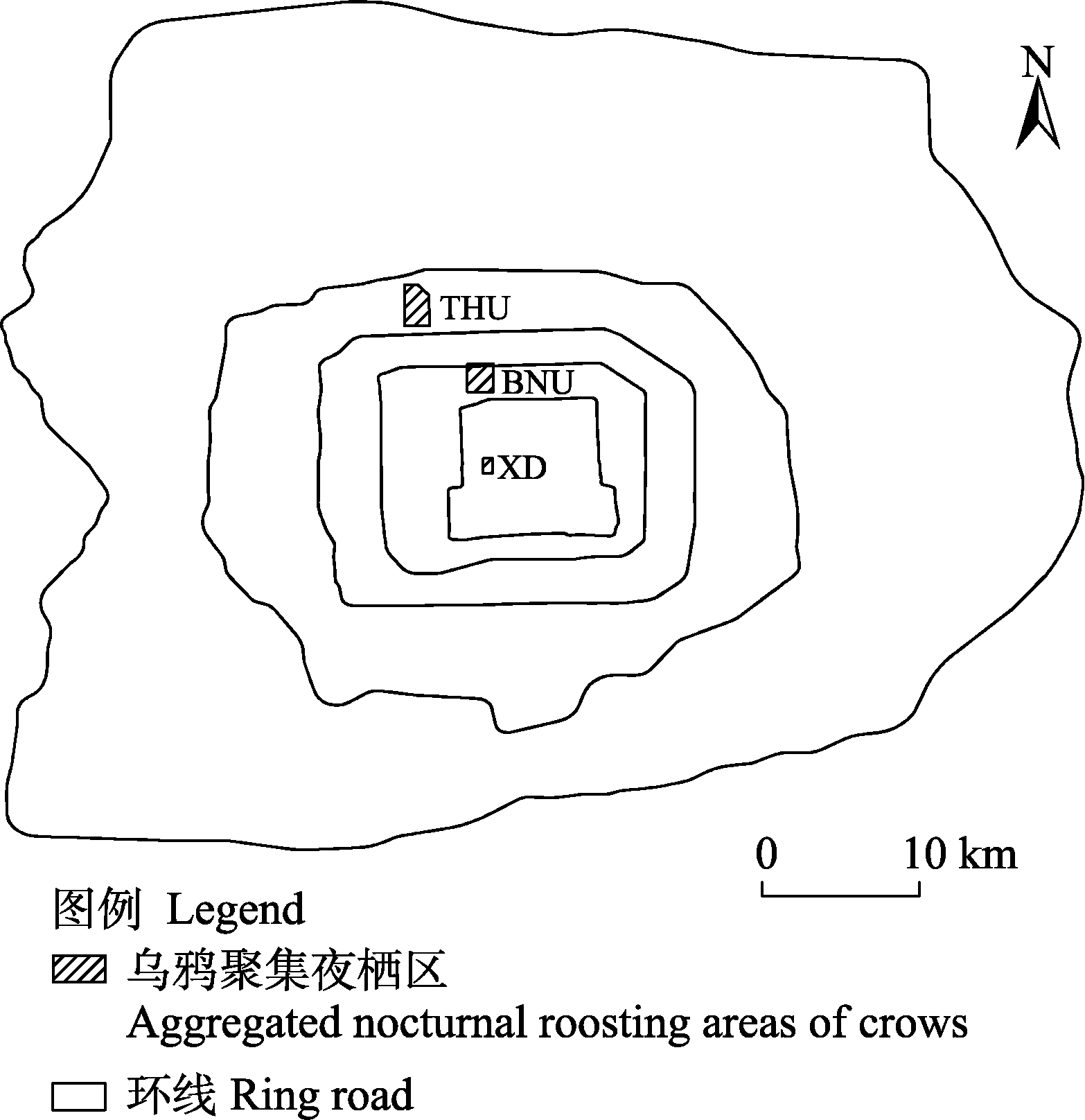
Fig. 1 Major aggregated nocturnal roosting areas of crows in the urban area of Beijing. THU, Tsinghua University and its surrounding area; BNU, Beijing Normal University and its surrounding area; XD, Xidan.
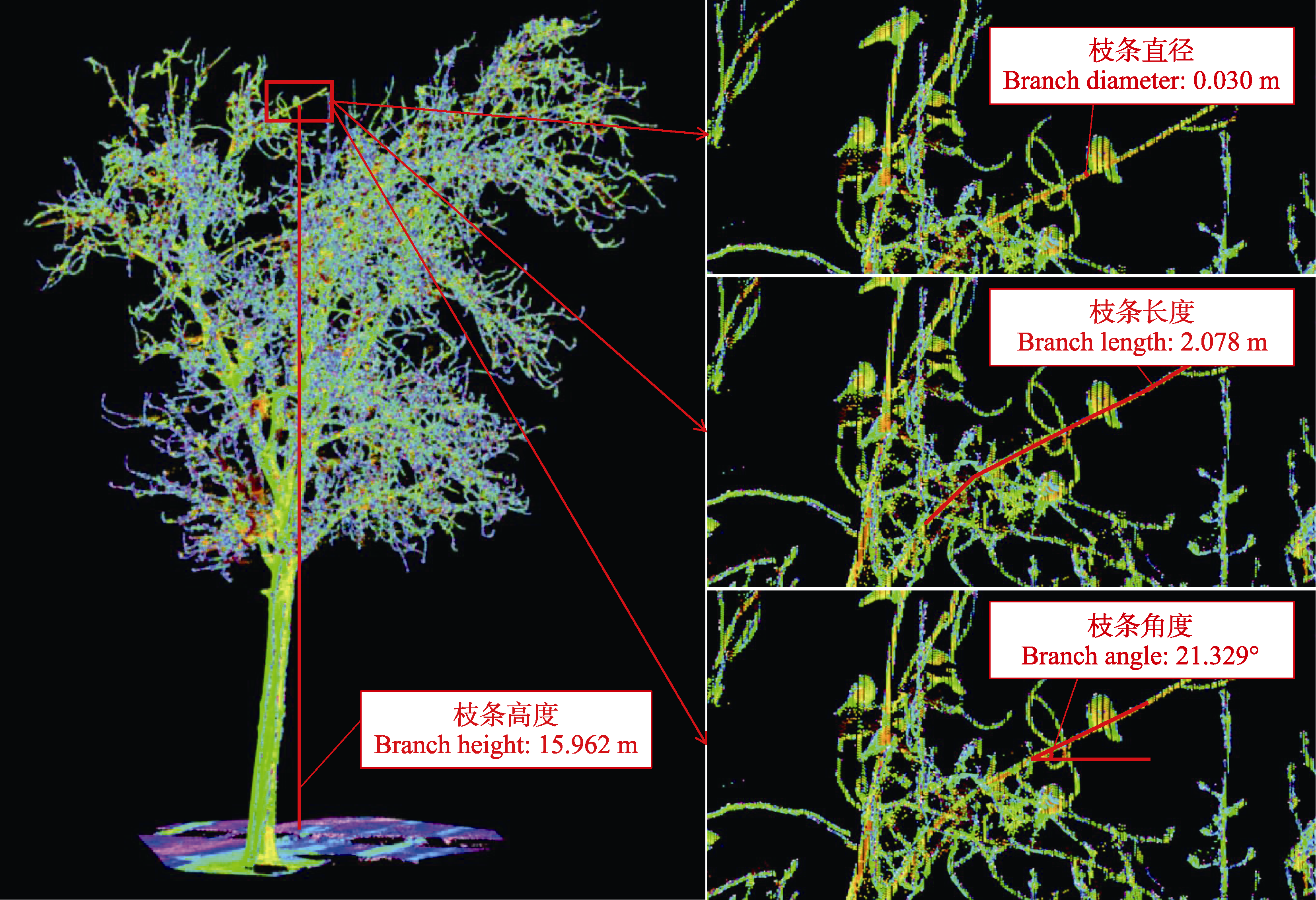
Fig. 2 Schematic of point cloud-based branch variable measurement
| 变量 Variables | 夜栖样方 Roosting plot (n = 36) | 对照样方 Control plot (n = 36) | T/Z | χ2 | P |
|---|---|---|---|---|---|
| 树高 Tree height (m) | 15.58 ± 0.69 | 12.18 ± 0.47 | 4.18 | < 0.001 | |
| 胸径 Diameter at breast height (cm) | 44.76 ± 19.38 | 34.92 ± 12.98 | -1.76 | 0.078 | |
| 冠幅 Crown width (m) | 11.26 ± 0.52 | 9.63 ± 0.52 | 2.04 | 0.049 | |
| 郁闭度 Canopy closure | 2.31 ± 0.87 | 1.83 ± 0.85 | -2.51 | 0.012 | |
| 噪声 Noise (dB) | 70.89 ± 1.31 | 64.23 ± 1.50 | 4.24 | < 0.001 | |
| 照度 Illuminance (lx) | 6.67 ± 11.44 | 2.71 ± 2.56 | -2.58 | 0.010 | |
| 温度 Temperature (℃) | 1.90 ± 0.37 | 1.73 ± 0.34 | 0.89 | 0.382 | |
| 风速 Wind speed (m/s) | 0.82 ± 0.67 | 0.97 ± 0.78 | -1.01 | 0.314 | |
| 到最近水体距离 Distance to the nearest water (m) | 1,329.80 ± 71.54 | 1,353.85 ± 75.13 | -0.80 | 0.429 | |
| 人流量 Pedestrian flow (person/min) | 13.47 ± 16.34 | 9.49 ± 10.08 | -0.87 | 0.386 | |
| 车流量 Traffic flow (vehicle/min) | 40.09 ± 38.51 | 30.77 ± 34.55 | -1.27 | 0.204 | |
| 到最近道路距离 Distance to the nearest road (m) | 3.03 ± 4.43 | 2.30 ± 4.03 | -0.16 | 0.867 | |
| 最近道路宽度 Width of the nearest road (m) | 17.86 ± 13.00 | 15.48 ± 12.27 | -0.75 | 0.456 | |
| 建筑密度 Building side count (count) | 1.72 ± 0.78 | 1.72 ± 0.85 | -0.08 | 0.938 | |
| 到最近建筑距离 Distance to the nearest building (m) | 15.63 ± 9.95 | 17.70 ± 14.20 | -0.58 | 0.561 | |
| 最近建筑高度 Height of the nearest building (m) | 30.83 ± 17.35 | 29.18 ± 25.88 | -0.66 | 0.509 | |
| 街道走向 Street orientation | - | - | 1.89 | 0.596 | |
| 最近建筑是否高于栖树 Whether the nearest building is higher than the roosting tree | - | - | 1.69 | 0.242 |
Table 1 Comparison of habitat variables between roosting plots and control plots
| 变量 Variables | 夜栖样方 Roosting plot (n = 36) | 对照样方 Control plot (n = 36) | T/Z | χ2 | P |
|---|---|---|---|---|---|
| 树高 Tree height (m) | 15.58 ± 0.69 | 12.18 ± 0.47 | 4.18 | < 0.001 | |
| 胸径 Diameter at breast height (cm) | 44.76 ± 19.38 | 34.92 ± 12.98 | -1.76 | 0.078 | |
| 冠幅 Crown width (m) | 11.26 ± 0.52 | 9.63 ± 0.52 | 2.04 | 0.049 | |
| 郁闭度 Canopy closure | 2.31 ± 0.87 | 1.83 ± 0.85 | -2.51 | 0.012 | |
| 噪声 Noise (dB) | 70.89 ± 1.31 | 64.23 ± 1.50 | 4.24 | < 0.001 | |
| 照度 Illuminance (lx) | 6.67 ± 11.44 | 2.71 ± 2.56 | -2.58 | 0.010 | |
| 温度 Temperature (℃) | 1.90 ± 0.37 | 1.73 ± 0.34 | 0.89 | 0.382 | |
| 风速 Wind speed (m/s) | 0.82 ± 0.67 | 0.97 ± 0.78 | -1.01 | 0.314 | |
| 到最近水体距离 Distance to the nearest water (m) | 1,329.80 ± 71.54 | 1,353.85 ± 75.13 | -0.80 | 0.429 | |
| 人流量 Pedestrian flow (person/min) | 13.47 ± 16.34 | 9.49 ± 10.08 | -0.87 | 0.386 | |
| 车流量 Traffic flow (vehicle/min) | 40.09 ± 38.51 | 30.77 ± 34.55 | -1.27 | 0.204 | |
| 到最近道路距离 Distance to the nearest road (m) | 3.03 ± 4.43 | 2.30 ± 4.03 | -0.16 | 0.867 | |
| 最近道路宽度 Width of the nearest road (m) | 17.86 ± 13.00 | 15.48 ± 12.27 | -0.75 | 0.456 | |
| 建筑密度 Building side count (count) | 1.72 ± 0.78 | 1.72 ± 0.85 | -0.08 | 0.938 | |
| 到最近建筑距离 Distance to the nearest building (m) | 15.63 ± 9.95 | 17.70 ± 14.20 | -0.58 | 0.561 | |
| 最近建筑高度 Height of the nearest building (m) | 30.83 ± 17.35 | 29.18 ± 25.88 | -0.66 | 0.509 | |
| 街道走向 Street orientation | - | - | 1.89 | 0.596 | |
| 最近建筑是否高于栖树 Whether the nearest building is higher than the roosting tree | - | - | 1.69 | 0.242 |
| 模型参数 Model parameters | df | Log(L) | AICc | ΔAICc | 权重 Weight |
|---|---|---|---|---|---|
| TH + SO(N-S) + N + IL | 8 | -29.89 | 78.07 | 0 | 0.23 |
| TH + DBH + SO(N-S) + N + IL | 9 | -29.10 | 79.11 | 1.03 | 0.14 |
| TH + N + IL | 5 | -34.52 | 79.94 | 1.87 | 0.09 |
Table 2 Results of model selection for key habitat factors affecting the nocturnal habitat selection of crows
| 模型参数 Model parameters | df | Log(L) | AICc | ΔAICc | 权重 Weight |
|---|---|---|---|---|---|
| TH + SO(N-S) + N + IL | 8 | -29.89 | 78.07 | 0 | 0.23 |
| TH + DBH + SO(N-S) + N + IL | 9 | -29.10 | 79.11 | 1.03 | 0.14 |
| TH + N + IL | 5 | -34.52 | 79.94 | 1.87 | 0.09 |
| 变量 Variables | 估计值 Estimate | 标准误 Standard error | Wald Z | 相对重要性 Relative importance | P |
|---|---|---|---|---|---|
| 树高 Tree height | 1.23 | 0.46 | 2.70 | 0.95 | 0.007 |
| 噪声 Noise | 1.04 | 0.42 | 2.46 | 0.93 | 0.014 |
| 照度 Illuminance | 1.41 | 0.83 | 1.70 | 0.83 | 0.089 |
| 街道走向(南北走向) Street orientation (north-south) | -0.21 | 0.73 | 0.29 | 0.72 | 0.772 |
| 胸径 Diameter at breast height | 0.56 | 0.53 | 1.06 | 0.37 | 0.290 |
Table 3 Significance of retained variables in generalized linear mixed models with ΔAICc < 2
| 变量 Variables | 估计值 Estimate | 标准误 Standard error | Wald Z | 相对重要性 Relative importance | P |
|---|---|---|---|---|---|
| 树高 Tree height | 1.23 | 0.46 | 2.70 | 0.95 | 0.007 |
| 噪声 Noise | 1.04 | 0.42 | 2.46 | 0.93 | 0.014 |
| 照度 Illuminance | 1.41 | 0.83 | 1.70 | 0.83 | 0.089 |
| 街道走向(南北走向) Street orientation (north-south) | -0.21 | 0.73 | 0.29 | 0.72 | 0.772 |
| 胸径 Diameter at breast height | 0.56 | 0.53 | 1.06 | 0.37 | 0.290 |
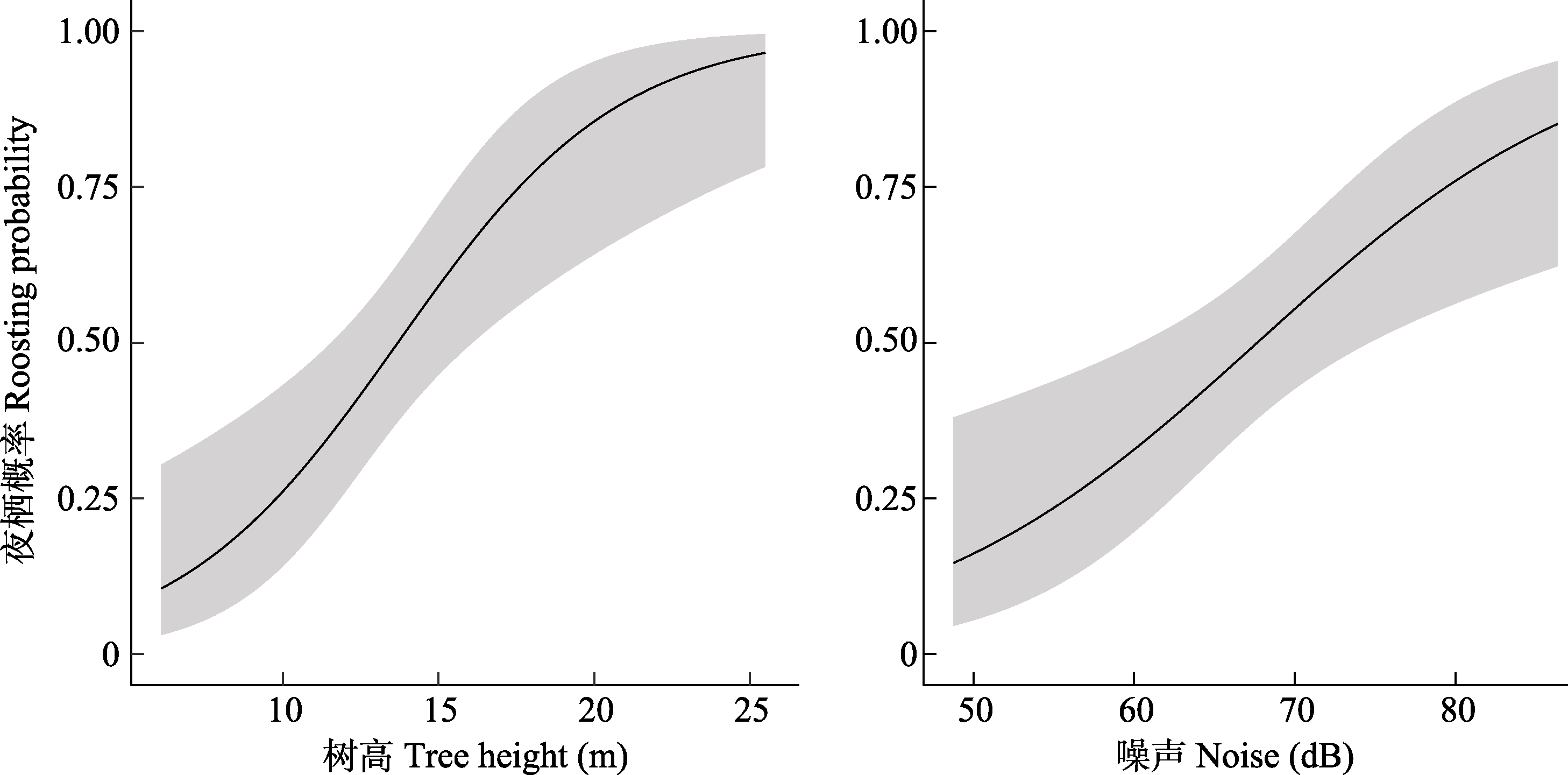
Fig. 3 Regression curves of significant habitat variables on roost-site selection probability. Gray shading indicates 95% confidence interval.
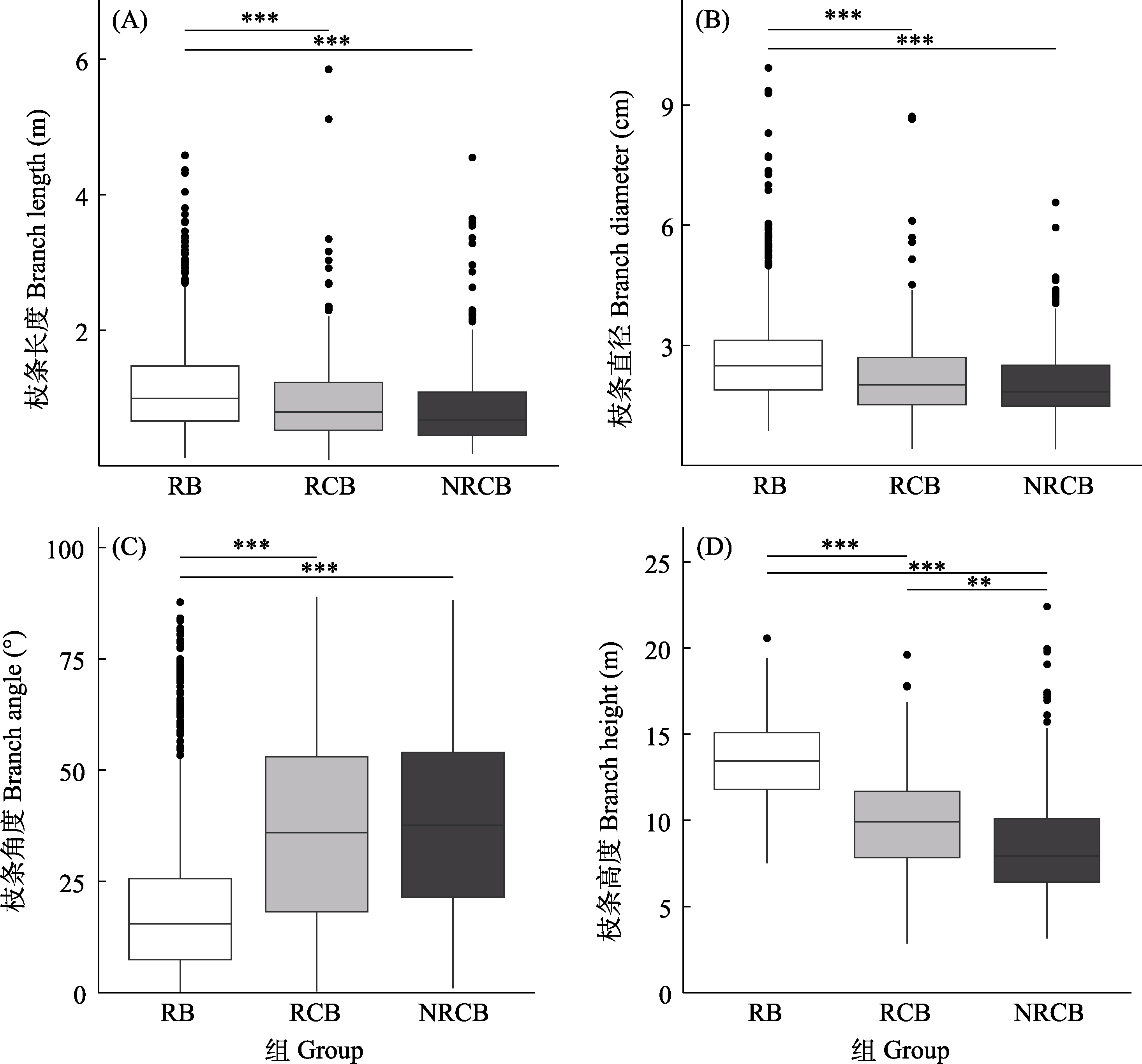
Fig. 4 Comparison between nocturnal roosting branches and control branches from different sources. RB, Roosting branches; RCB, Control branches from roosting trees; NRCB, Control branches from non-roosting trees. ** P < 0.01; *** P < 0.001.
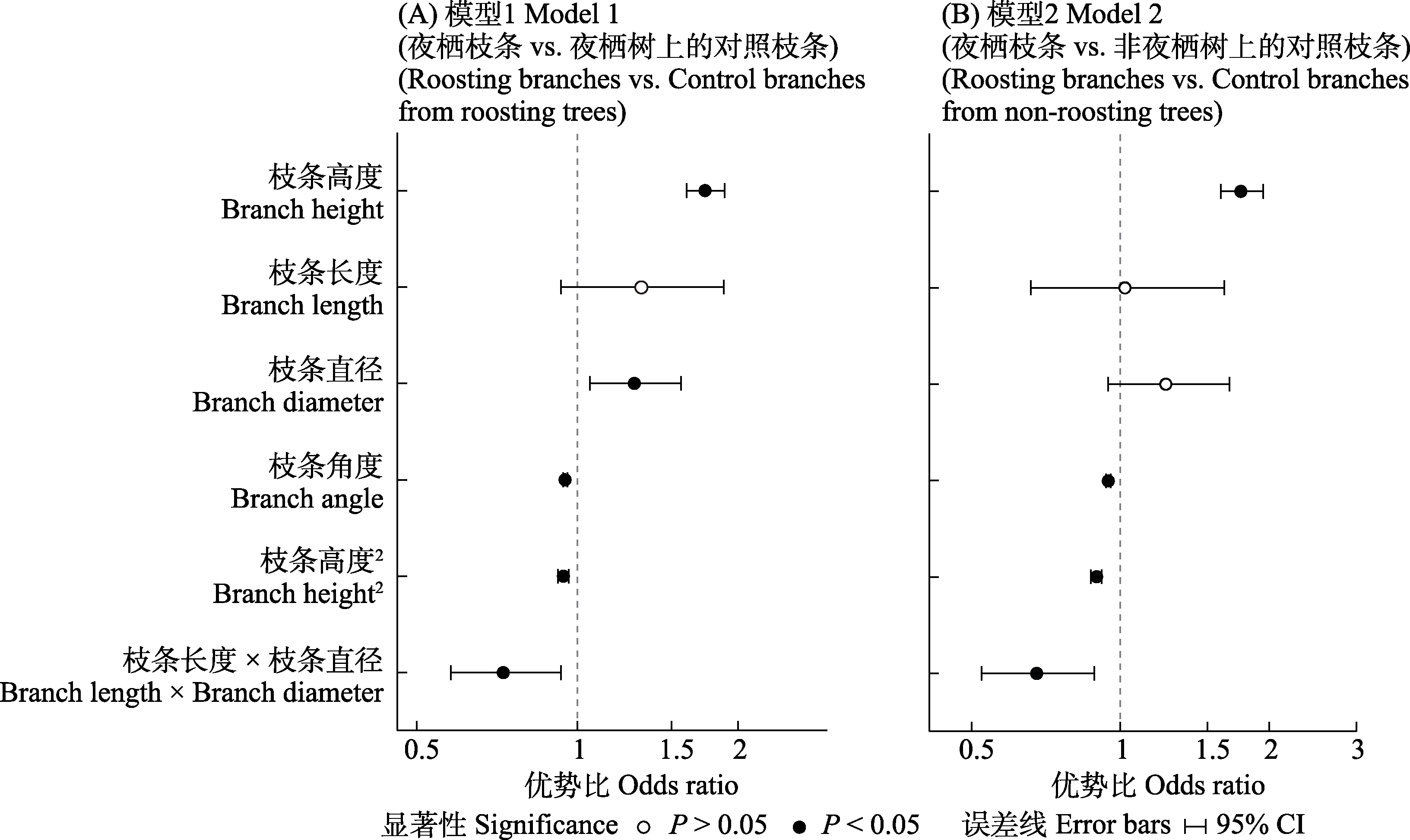
Fig. 5 Forest plot of effect sizes for factors influencing crow roosting branch selection
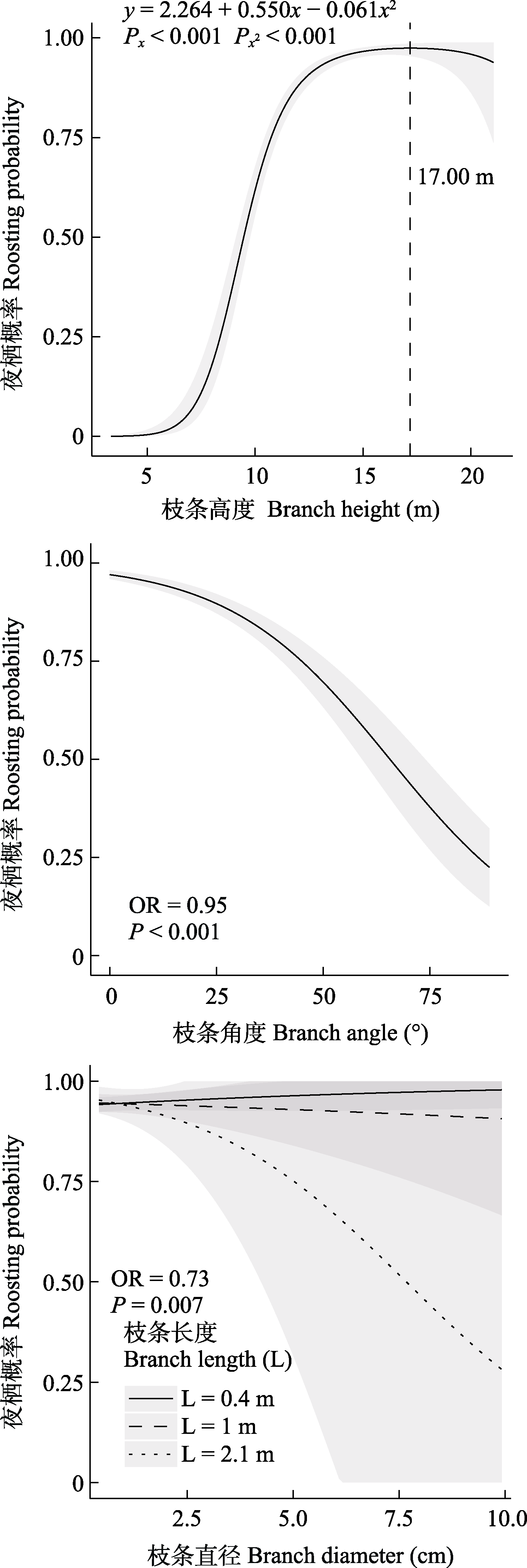
Fig. 6 Response curves of branch variables on roosting probability based on Model 1 (including roosting branches and control branches on the roosting trees). Gray shading indicates 95% confidence interval. OR, Odds ratio.
| [1] |
Ackers SH, Davis RJ, Olsen KA, Dugger KM (2015) The evolution of mapping habitat for northern spotted owls (Strix occidentalis caurina): A comparison of photo-interpreted, landsat-based, and LiDAR-based habitat maps. Remote Sensing of Environment, 156, 361-373.
DOI URL |
| [2] | Antczak M (2010) Winter nocturnal roost selection by a solitary passerine bird, the great grey shrike Lanius excubitor. Ornis Fennica, 87(3), 99-105. |
| [3] |
Bai ZT, Wang C, Qi ZY (2026) Biophony responses to different vegetation structure in urban central parks of Beijing. Biodiversity Science, 34, 25218. (in Chinese with English abstract)
DOI |
|
[白梓彤, 王成, 齐志勇 (2026) 北京中心城区公园中生物声对植被三维结构的响应. 生物多样性, 34, 25218.]
DOI |
|
| [4] |
Benmazouz I, Jokimäki J, Lengyel S, Juhász L, Kaisanlahti-Jokimäki ML, Kardos G, Paládi P, Kövér L (2021) Corvids in urban environments: A systematic global literature review. Animals, 11, 3226.
DOI URL |
| [5] | Bock WJ (1965) Experimental analysis of the avian passive perching mechanism. American Zoologist, 5, 681. |
| [6] |
Burnham KP, Anderson DR, Huyvaert KP (2011) AIC model selection and multimodel inference in behavioral ecology: Some background, observations, and comparisons. Behavioral Ecology and Sociobiology, 65, 23-35.
DOI URL |
| [7] |
Chen J, Elsgaard L, Van Groenigen KJ, Olesen JE, Liang Z, Jiang Y, Lærke PE, Zhang YF, Luo YQ, Hungate BA, Sinsabaugh RL, Jørgensen U (2020) Soil carbon loss with warming: New evidence from carbon-degrading enzymes. Global Change Biology, 26, 1944-1952.
DOI URL |
| [8] |
Ciach M, Fröhlich A (2017) Habitat type, food resources, noise and light pollution explain the species composition, abundance and stability of a winter bird assemblage in an urban environment. Urban Ecosystems, 20, 547-559.
DOI URL |
| [9] |
Clergeau P, Quenot F (2007) Roost selection flexibility of European starlings aids invasion of urban landscape. Landscape and Urban Planning, 80, 56-62.
DOI URL |
| [10] |
Cunningham SJ, Madden CF, Barnard P, Amar A (2016) Electric crows: Powerlines, climate change and the emergence of a native invader. Diversity and Distributions, 22, 17-29.
DOI URL |
| [11] | Davies AB, Ancrenaz M, Oram F, Asner GP (2017) Canopy structure drives orangutan habitat selection in disturbed Bornean forests. Proceedings of the National Academy of Sciences, USA, 114, 8307-8312. |
| [12] |
Disney MI, Boni Vicari M, Burt A, Calders K, Lewis SL, Raumonen P, Wilkes P (2018) Weighing trees with lasers: Advances, challenges and opportunities. Interface Focus, 8, 20170048.
DOI URL |
| [13] |
Dormann CF, Elith J, Bacher S, Buchmann C, Carl G, Carré G, Marquéz JRG, Gruber B, Lafourcade B, Leitão PJ, Münkemüller T, McClean C, Osborne PE, Reineking B, Schröder B, Skidmore AK, Zurell D, Lautenbach S (2013) Collinearity: A review of methods to deal with it and a simulation study evaluating their performance. Ecography, 36, 27-46.
DOI URL |
| [14] |
Feng JY, Wang MM, Zhang QY, Xia CW (2025) Winter roost preferences of crows in Beijing City. Ecology and Evolution, 15, e70931.
DOI URL |
| [15] |
Fröhlich A, Ciach M (2019) Nocturnal noise and habitat homogeneity limit species richness of owls in an urban environment. Environmental Science and Pollution Research, 26, 17284-17291.
DOI |
| [16] | Galton PM, Shepherd JD (2012) Experimental analysis of perching in the European starling (Sturnus vulgaris: Passeriformes; Passeres), and the automatic perching mechanism of birds. Journal of Experimental Zoology, Part A: Ecological Genetics and Physiology, 317, 205-215. |
| [17] | Gorenzel WP, Salmon TP (1995) Characteristics of American crow urban roosts in California. The Journal of Wildlife Management, 59, 638. |
| [18] |
Granatosky MC, Young MW, Herr V, Chai C, Raidah A, Kairo JN, Anaekwe A, Havens A, Zou B, Ding B, Chen C, De Leon D, Shah H, Valentin J, Hildreth L, Castro T, Li T, Yeung A, Dickinson E, Youlatos D (2022) Positional behavior of introduced monk parakeets (Myiopsitta monachus) in an urban landscape. Animals, 12, 2372.
DOI URL |
| [19] |
Holland A, Gibbons P, Thompson J, Roudavski S (2024) Terrestrial LiDAR reveals new information about habitats provided by large old trees. Biological Conservation, 292, 110507.
DOI URL |
| [20] |
Huang ZP, Chen YL, Yang HT, Fang YH, Cheng K, Guan HC, Grueter CC, Xiao W, Guo QH (2025) Associations between forest vertical structure and habitat preferences of black-and-white snub-nosed monkeys (Rhinopithecus bieti) in high-elevation environments. Ecological Informatics, 90, 103269.
DOI URL |
| [21] | Jiang XY, Zhang CJ, Zhou B, Liang W (2021) Sleeping in a noisy world: Roosting sites of large aggregations of white wagtails Motacilla alba in a tropical city, China. Ornithological Science, 20, 109-113. |
| [22] |
Kleist NJ, Guralnick RP, Cruz A, Francis CD (2017) Sound settlement: Noise surpasses land cover in explaining breeding habitat selection of secondary cavity-nesting birds. Ecological Applications, 27, 260-273.
DOI PMID |
| [23] | Le Roux C (2017) Nocturnal Roost Tree, Roost Site and Landscape Characteristics of Carnaby’s Black-Cockatoo (Calyptorynchus latirostris) on the Swan Coastal Plain. PhD dissertation, Edith Cowan University, Perth. |
| [24] |
Li S, Zou L, Gong YN, Yang HT, Wang TM, Feng LM, Ge JP (2019) Advances in LiDAR technology in the field of animal ecology. Biodiversity Science, 27, 1021-1031. (in Chinese with English abstract)
DOI |
|
[李顺, 邹亮, 宫一男, 杨海涛, 王天明, 冯利民, 葛剑平 (2019) 激光雷达技术在动物生态学领域的研究进展. 生物多样性, 27, 1021-1031.]
DOI |
|
| [25] | Lu J, Liu XZ, Meng WL, Li HJ (2021) Methodology of individual tree 3D reconstruction based on terrestrial laser scanning point cloud data. Journal of Nanjing Forestry University (Natural Sciences Edition), 45(6), 193-199. (in Chinese) |
|
[卢军, 刘宪钊, 孟维亮, 李红军 (2021) 基于地面激光点云数据的单木三维重建方法. 南京林业大学学报(自然科学版), 45(6), 193-199.]
DOI |
|
| [26] |
MacDonald DW, Bothwell HM, Kaszta Ż, Ash E, Bolongon G, Burnham D, Can ÖE, Campos-Arceiz A, Channa P, Clements GR, Hearn AJ, Hedges L, Htun S, Kamler JF, Kawanishi K, MacDonald EA, Mohamad SW, Moore J, Naing H, Onuma M, Penjor U, Rasphone A, Mark Rayan D, Ross J, Singh P, Tan CKW, Wadey J, Yadav BP, Cushman SA (2019) Multi-scale habitat modelling identifies spatial conservation priorities for mainland clouded leopards (Neofelis nebulosa). Diversity and Distributions, 25, 1639-1654.
DOI URL |
| [27] |
Martínez-Marivela I, Morales MB, Iglesias-Merchán C, Delgado MP, Tarjuelo R, Traba J (2018) Traffic noise pollution does not influence habitat selection in the endangered little bustard. Ardeola, 65, 261.
DOI URL |
| [28] |
Moraes ALB, Da Silveira NSD, Pizo MA (2018) Nocturnal roosting behavior of the pale-breasted thrush (Turdus leucomelas) and its relation with daytime area of use. The Wilson Journal of Ornithology, 130, 828-833.
DOI URL |
| [29] |
Nyhus PJ (2016) Human-wildlife conflict and coexistence. Annual Review of Environment and Resources, 41, 143-171.
DOI URL |
| [30] | Peh KS, Sodhi NS (2002) Characteristics of nocturnal roosts of house crows in Singapore. The Journal of Wildlife Management, 66, 1128. |
| [31] |
Proppe DS, Sturdy CB, St. Clair CC (2013) Anthropogenic noise decreases urban songbird diversity and may contribute to homogenization. Global Change Biology, 19, 1075-1084.
DOI PMID |
| [32] | R Core Team (2024) R: A Language and Environment for Statistical Computing. R Foundation for Statistical Computing. (accessed on 2024-05-08) |
| [33] |
Russo NJ, Takuo JM, Tegebong V, LeBreton M, Dean M, Ferraz A, Barbier N, Wikelski M, Ordway EM, Saatchi S, Smith TB (2025) Spaceborne and UAV-LiDAR reveal hammer-headed bat preference for intermediate canopy height and diverse structure in a Central African rainforest. Movement Ecology, 13, 30.
DOI PMID |
| [34] | Sasaki T, Imanishi J, Fukui W, Morimoto Y (2016) Fine-scale characterization of bird habitat using airborne LiDAR in an urban park in Japan. Urban Forestry & Urban Greening, 17, 16-22. |
| [35] |
Sherry TW, Holmes RT (1996) Winter habitat quality, population limitation, and conservation of Neotropical- Nearctic migrant birds. Ecology, 77, 36-48.
DOI URL |
| [36] |
Shokirov S, Jucker T, Levick SR, Manning AD, Bonnet T, Yebra M, Youngentob KN (2023) Habitat highs and lows: Using terrestrial and UAV LiDAR for modelling avian species richness and abundance in a restored woodland. Remote Sensing of Environment, 285, 113326.
DOI URL |
| [37] |
Sol D, Lapiedra O, González-Lagos C (2013) Behavioural adjustments for a life in the city. Animal Behaviour, 85, 1101-1112.
DOI URL |
| [38] |
Tao SL, Wang D, Xie H, Zhang WM, Zhang ZM, Dong XJ, Chen YP, Qi JB, Cheng K, Yang ZK, Qi ZY, Li WK, Su YJ, Hu TY, Ma Q, Li Y, Cai SS, Wang B, Yang HT, Ren Y, Jin SC, Zhang XT, Bai H, Yang ZY, Hu XM, Asadilla Yusup, Huang HG, Xu Q, Guo QH (2025) Review and prospects of the development of LiDAR in ecology and geosciences. National Remote Sensing Bulletin, 29, 1963-2004. (in Chinese with English abstract)
DOI URL |
| [陶胜利, 王迪, 谢欢, 张吴明, 张志明, 董秀军, 陈一平, 漆建波, 程凯, 杨泽坤, 齐志勇, 李文楷, 苏艳军, 胡天宇, 马勤, 李媛, 蔡尚书, 王彬, 杨海涛, 任淯, 金时超, 张欣彤, 白皓, 杨子炎, 胡晓梅, 艾萨迪拉·玉苏甫, 黄华国, 许强, 郭庆华 (2025) 激光雷达在生态与地学领域的发展回顾与展望. 遥感学报, 29, 1963-2004.] | |
| [39] |
Thiel D, Unger C, Kéry M, Jenni L (2007) Selection of night roosts in winter by capercaillie Tetrao urogallus in Central Europe. Wildlife Biology, 13(Suppl.1), 73-86.
DOI URL |
| [40] |
Urbanowicz RJ, Meeker M, La Cava W, Olson RS, Moore JH (2018) Relief-based feature selection: Introduction and review. Journal of Biomedical Informatics, 85, 189-203.
DOI PMID |
| [41] | Wang N, Zhang ZW, Zhang Y (2016) Urban crows of Beijing. Forest & Humankind, (2), 66-81. (in Chinese) |
| [王宁, 张正旺, 张瑜 (2016) 京城乌鸦. 森林与人类, (2), 66-81.] | |
| [42] | Yang HT, Li S, Hou R, Song WT, Fu YW, Li YB, Wang XW, He G, Chapman CA, Guo QH, Li BG (2023) Three-dimensional assessment of movement patterns of Sichuan snub-nosed monkeys affected by habitat structure in temperate forests. Zoological Research, 44, 361-365. |
| [43] |
Yang HT, Su YJ, Li BG, Guo QH (2025) Synchronizing 3D LiDAR-based reconstruction of animals and environment for in situ ecosystem characterization. Information Geography, 1, 100019.
DOI URL |
| [44] | Yang Y, Wen JB, Hu DF (2011) A review on avian habitat research. Scientia Silvae Sinicae, 47(11), 172-180. (in Chinese with English abstract) |
| [杨勇, 温俊宝, 胡德夫 (2011) 鸟类栖息地研究进展. 林业科学, 47(11), 172-180.] | |
| [45] | Yuan BD, Jiang AW, Li XD, Lu CH (2012) Roost habitat selection by birds: A review. Chinese Journal of Ecology, 31, 2145-2151. (in Chinese with English abstract) |
| [原宝东, 蒋爱伍, 李晓东, 鲁长虎 (2012) 鸟类夜栖地选择研究进展. 生态学杂志, 31, 2145-2151.] | |
| [46] | Yuan BD, Yan YF, Cheng ZY, Lu CH (2017) Roost habitat characteristics and differences of Mrs Hume’s pheasant (Syrmaticus humiae) in spring and summer night. Scientia Silvae Sinicae, 53(9), 143-150. (in Chinese with English abstract) |
| [原宝东, 闫永峰, 程志营, 鲁长虎 (2017) 黑颈长尾雉春夏夜栖地特征与差异性分析. 林业科学, 53(9), 143-150.] | |
| [47] |
Zhao YX, Zhang JY, Li ZH, Xie Q, Deng X, Zhang CX, Wang N (2024) Use of evergreen and deciduous plants by nocturnal-roosting birds: A case study in Beijing. Avian Research, 15, 100177.
DOI URL |
| [1] | Yexi Zhao, Jiayu Zhang, Zihan Li, Qinmijia Xie, Xin Deng, Nan Wang. Use of native and alien plants during night roosting by urban birds in Beijing [J]. Biodiv Sci, 2023, 31(3): 22399-. |
| Viewed | ||||||
|
Full text |
|
|||||
|
Abstract |
|
|||||
Copyright © 2026 Biodiversity Science
Editorial Office of Biodiversity Science, 20 Nanxincun, Xiangshan, Beijing 100093, China
Tel: 010-62836137, 62836665 E-mail: biodiversity@ibcas.ac.cn

