

生物多样性 ›› 2026, Vol. 34 ›› Issue (3): 25442. DOI: 10.17520/biods.2025442 cstr: 32101.14.biods.2025442
• 中国灵长类研究历史与进展——纪念Jane Goodall专题 • 上一篇 下一篇
向左甫*( )(
)( )
)
收稿日期:2025-11-05
接受日期:2026-03-29
出版日期:2026-03-20
发布日期:2026-04-09
通讯作者:
*E-mail: 基金资助:
Zuofu Xiang*()()
Received:2025-11-05
Accepted:2026-03-29
Online:2026-03-20
Published:2026-04-09
Contact:
*E-mail: Supported by:摘要:
金丝猴(Rhinopithecus spp.)是主要分布于我国的半树栖叶食性灵长类动物, 因外形漂亮而受到公众广泛关注; 同时, 由于森林退化、农业开发、偷猎对其生存造成威胁, 已成为野生动物保护的旗舰物种。金丝猴社会系统是以一雄多雌为基本社会单元的重层社会, 常数百只聚成超大群集体, 是灵长类动物中最为复杂的社会组织类型之一, 常受到动物学、人类学和心理学领域学者关注。金丝猴拥有容易辨识的“仰鼻”, 早在公元前770年成书的古籍中就有记载, 然而旨在提升金丝猴自然历史认知和保护的野外研究(生态研究与保护实践)自新中国成立后才逐渐起步, 改革开放后得以全面开展, 直到21世纪初才达到国际研究水平。本文除对中国金丝猴生态、保护及社会行为各个阶段的研究进行简单回顾外, 还重点分析了与重层社会适应优势和维持机制相关的社会行为, 如雄性杀婴、雌性防杀婴策略、雄性合作、非母亲照料、理毛网络、社会单元形成等行为的研究进展。过去几十年, 由于国家和地方政府的强力支持, 绝大多数金丝猴种群都得到良好保护, 金丝猴行为、生态及保护研究也逐渐得到国际关注。未来, 野外研究应加强不同地点特定种群行为生态与保护生物学研究, 探索金丝猴与同域分布其他哺乳动物之间的共存关系, 继续开展社会行为研究, 聚焦于揭示金丝猴社会集体活动的凝聚力形成及维持机制。
向左甫 (2026) 中国金丝猴生态、保护与社会行为研究简史及进展. 生物多样性, 34, 25442. DOI: 10.17520/biods.2025442.
Zuofu Xiang (2026) The brief research history and progress of snub-nosed monkeys in ecology, conservation and social behavior. Biodiversity Science, 34, 25442. DOI: 10.17520/biods.2025442.
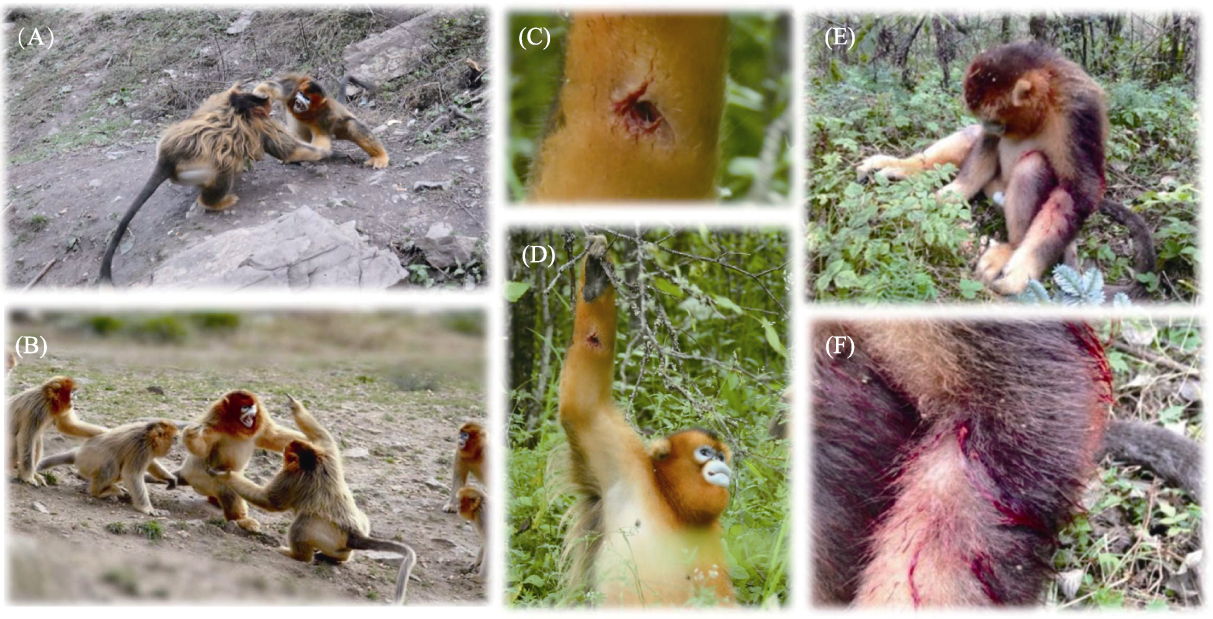
图1 金丝猴成年雄性之间的冲突。(A-B)社会单元主雄之间的仪式化冲突; (C-F)全雄群成年雄猴取代会导致单元主雄间的肢体冲突和身体伤害。图片来源: (A)刘佳茗; (B-F)向左甫。
Fig. 1 Conflicts among adult male snub-nosed monkeys. (A-B) Ritualization conflicts among resident males; (C-F) Conflicts of male replacement between resident male in one-male unit and the male in all-male unit. Photo contribution: (A) Jiaming Liu; (B-F) Zuofu Xiang.
| [1] | Allen GM (1938) Mammals of China and Mongolia:Part I, Natural History of Central Asia. American Museum of Natural History, New York. |
| [2] | Bai SC, Zou SQ, Lin S, Tuo D, Tu Z, Zhong T (1987) A preliminary observation on distribution, number and population structure of Rhinopithecus bieti in Baima Xueshan Natural Reserve, Yunnan, China. Zoological Research, 8, 413-419. (in Chinese with English abstract) |
| [白寿昌, 邹淑荃, 林苏, 拖丁, 土扎, 忠态 (1987) 白马雪山自然保护区滇金丝猴数量分布及种群结构的初步观察. 动物学研究, 8, 413-419.] | |
| [3] | Bissell H (2014) The Nutritional Ecology of the Black-and-white Snub-nosed Monkey. PhD dissertation, The University of Wisconsin-Madison, Madison. |
| [4] | Bleisch WV, Xie JH (1998) Ecology and behavior of the Guizhou snub-nosed langur (Rhinopithecus [Rhinopithecus] brelichi), with a discussion of socioecology in the genus. In: The Natural History of the Doucs and Snub-nosed Monkeys (ed. Jablonski NG), pp.217-239. World Scientific, Singapore. |
| [5] | Bronson FH (1989) Mammalian Reproductive Biology. University of Chicago Press, Chicago. |
| [6] | Chen FG (1989) Progress in the Studies of Golden Monkey. Northwest University Press, Xi’an. (in Chinese) |
| [陈服官 (1989) 金丝猴研究进展. 西北大学出版社, 西安.] | |
| [7] | Chen FG, Min ZL, Luo SY, Xie WZ (1983) An observation on the behaviour and some ecological habits of the golden monkey (Rhinopithecus roxellana) in Qinling Mountains. Acta Theriologica Sinica, 3, 141-146. (in Chinese with English abstract) |
| [陈服官, 闵芝兰, 罗时有, 解文治 (1983) 秦岭地区金丝猴(Rhinopithecus roxellana)的群体行为与生态习性的观察. 兽类学报, 3, 141-146.] | |
| [8] | Chen YX (2024) The Study on Conservation Status and Behavioral Adaptions on Diets and Activity Rhythms of Black Snub-nosed Monkeys (Rhinopithecus strykeri) in Pianma Region, Yunnan Province, China. PhD dissertation, Central South University of Forestry & Technology, Changsha. (in Chinese with English abstract) |
| [陈奕欣 (2024) 云南片马地区怒江金丝猴的保护现状和食性、行为节律适应机制研究. 博士学位论文, 中南林业科技大学, 长沙.] | |
| [9] |
Chen YX, Xiang ZF, Wang XW, Xiao W, Xiao ZS, Ren BP, He CX, Sang CH, Li HS, Li M (2015) Preliminary study of the newly discovered primate species Rhinopithecus strykeri at Pianma, Yunnan, China using infrared camera traps. International Journal of Primatology, 36, 679-690.
DOI URL |
| [10] | Chen YX, Yu Y, Li C, Xiao ZS, Zhou GW, Zhang ZJ, Wang XW, Xiang ZF, Chang J, Li M (2022) Population and conservation status of a transboundary group of black snub-nosed monkeys (Rhinopithecus strykeri) between China and Myanmar. Zoological Research, 43, 523-527. |
| [11] | Cui LW (2003) Altitudinal Ranging, Sleeping Site Selection and Social Organization of Rhinopithecus bieti at Baima Snow Mountain, and Its Sexual Behaviour and Birth Seasonality in Captivity. PhD dissertation, Kunming Institute of Zoology, Chinese Academy of Sciences, Kunming. (in Chinese with English abstract) |
| [崔亮伟 (2003) 白马雪山黑白仰鼻猴Rhinopithecus bieti的生境垂直利用、过夜地选择和社会组织, 笼样群性行为和出生季节. 博士学位论文, 中国科学院昆明动物研究所, 昆明.] | |
| [12] |
Cui LW (2003) A note on an interaction between Rhinopithecus bieti and a buzzard at Baima Snow Mountain. Folia Primatologica, 74, 51-53.
DOI URL |
| [13] |
Cui LW, Sheng AH, He SC, Xiao W (2006) Birth seasonality and interbirth interval of captive Rhinopithecus bieti. American Journal of Primatology, 68, 457-463.
DOI URL |
| [14] | Ding W (2003) Feeding Ecology, Social Organization and Conservation Biology of Rhinopithecus bieti at Tacheng, Yunnan. PhD dissertation, Kunming Institute of Zoology, Chinese Academy of Sciences, Kunming. (in Chinese with English abstract) |
| [丁伟 (2003) 塔城黑白仰鼻猴Rhinopithecus bieti的觅食生态学和社会组织, 兼论其保护现状. 博士学位论文, 中国科学院昆明动物研究所, 昆明.] | |
| [15] | Dong GX, Zhang P, Li BG, Long YC (2025) Illustrated Guide to the Primate of the World. The Commercial Press, Beijing. (in Chinese) |
| [董贵信, 张鹏, 李保国, 龙勇诚 (2025) 世界灵长类图鉴. 商务印书馆, 北京.] | |
| [16] | Dunbar RIM (1988) Primate Social Systems. Comstock Publishing Associates, New York. |
| [17] | Fang G, Chen J, Pan RL, Qi XG, Li BG (2018a) Female choice impacts residential male takeover in golden snub-nosed monkeys (Rhinopithecus roxellana). Zoological Research, 39, 266-271. |
| [18] | Fang G, Li M, Liu XJ, Guo WJ, Jiang YT, Huang ZP, Tang SY, Li DY, Yu J, Jin T, Liu XG, Wang JM, Li S, Qi XG, Li BG (2018b) Preliminary report on Sichuan golden snub-nosed monkeys (Rhinopithecus roxellana roxellana) at Laohegou Nature Reserve, Sichuan, China. Scientific Reports, 8, 16183. |
| [19] | Fang YH, Tian YP, Li Q, Duan JP, Li YP, Li GS, Huang ZP, Xiao W (2025) A new population of the black snub-nosed monkey (Rhinopithecus strykeri) discovered in Gaoligong Mountains in China. Journal of West China Forestry Science, 54(2), 74-80. (in Chinese with English abstract) |
| [房以好, 田应平, 李谦, 段建萍, 李延鹏, 李光松, 黄志旁, 肖文 (2025) 中国高黎贡山北段黑仰鼻猴新种群. 西部林业科学, 54(2), 74-80.] | |
| [20] |
Garber PA (2018) Why China is important in advancing the field of primatology. Zoological Research, 39, 241-243.
DOI PMID |
| [21] |
Geissmann T, Lwin N, Aung SS, Aung TN, Aung ZM, Hla TH, Grindley M, Momberg F (2011) A new species of snub-nosed monkey, genus Rhinopithecus Milne-Edwards, 1872 (Primates, Colobinae), from northern Kachin State, northeastern Myanmar. American Journal of Primatology, 73, 96-107.
DOI PMID |
| [22] | Grueter CC (2009) Determinants of Modular Societies in Snub-nosed Monkeys (Rhinopithecus bieti) and Other Asian Colobines. PhD dissertation, University of Zurich, Zurich. |
| [23] |
Grueter CC, Chapais B, Zinner D (2012) Evolution of multilevel social systems in nonhuman primates and humans. International Journal of Primatology, 33, 1002-1037.
PMID |
| [24] |
Grueter CC, van Schaik CP (2010) Evolutionary determinants of modular societies in colobines. Behavioral Ecology, 21, 63-71.
DOI URL |
| [25] | Grueter CC, Zinner D (2004) Nested societies: Convergent adaptations of baboons and snub-nosed monkeys? Primate Report, 70, 1-98. |
| [26] |
Guo ST, He SJ, Zhang H, Bai RF, Zhang SM, Hou R, Grueter CC, Chapman CA, Dunn DW, Li BG (2020) Male social rank and food competition in a primate multi-level society. American Journal of Physical Anthropology, 173, 630-642.
DOI URL |
| [27] |
Guo ST, Ji WH, Li M, Chang HL, Li BG (2010) The mating system of the Sichuan snub-nosed monkey (Rhinopithecus roxellana). American Journal of Primatology, 72, 25-32.
DOI PMID |
| [28] | Guo ST, Li BG, Tan CL (2004) Determinants of ranging behavior in Rhinopithecus roxellana. Folia Primatologica, 75 (Suppl.), 336. |
| [29] |
Guo ST, Li BG, Watanabe K (2007) Diet and activity budget of Rhinopithecus roxellana in the Qinling Mountains, China. Primates, 48, 268-276.
DOI URL |
| [30] | Guo YQ, Zhou J, Song XH, Deng HQ, Qiu Y, Shi L, Zhou J (2017) The population of Rhinopithecus brelichi in Fanjingshan National Nature Reserve, Guizhou, China. Acta Theriologica Sinica, 37, 104-108. (in Chinese with English abstract) |
| [郭艳清, 周俊, 宋先华, 邓怀庆, 邱阳, 石磊, 周江 (2017) 贵州省梵净山自然保护区黔金丝猴的种群数量. 兽类学报, 37, 104-108.] | |
| [31] |
He SJ, Yang Y, Hu ZF, Wu F, Wang CL, Tian WY, Bai RF, Qi G, Xie YL, Li BG, Guo ST, Dunn DW (2025) Social rank, female competition for food, and behavioral time-budgets in the golden snub-nosed monkey Rhinopithecus roxellana multi-level society. American Journal of Primatology, 87, e70007.
DOI URL |
| [32] | He YH (1991) On the geographical distribution and evolution of golden monkey. Collections of Essays on Chinese Historical Geography, 6(4), 111-131. (in Chinese) |
| [何业恒 (1991) 试论金丝猴的地理分布及其演变. 中国历史地理论丛, 6(4), 111-131.] | |
| [33] | He YH (1993) Historical Changes of Rare Mammals in China. Hunan Science and Technology Press, Changsha. (in Chinese) |
| [何业恒 (1993) 中国珍稀兽类的历史变迁. 湖南科学技术出版社, 长沙.] | |
| [34] | He YH, Zhang WR (1992) Historical changes of Rhinopithecus. Chinese Wildlife, 13(6), 11-14, 19. (in Chinese) |
| [何业恒, 张伟然 (1992) 川、黔、滇金丝猴地理分布的变迁. 野生动物, 13(6), 11-14, 19.] | |
| [35] |
Hrdy SB (1979) Infanticide among animals: A review, classification, and examination of the implications for the reproductive strategies of females. Ethology and Sociobiology, 1, 13-40.
DOI URL |
| [36] | Hu JC, Deng QX, Yu ZW, Zhou SD, Tian ZX (1980) Research on the ecology and biology of the giant panda, golden monkey, and other rare animals. Journal of Nanchong Teachers College (Natural Sciences), 1(2), 1-39, 125-132. (in Chinese) |
| [胡锦矗, 邓其祥, 余志伟, 周守德, 田致祥 (1980) 大熊猫金丝猴等珍稀动物生态生物学研究. 南充师院学报(自然科学版), 1(2), 1-39, 125-132.] | |
| [37] | Hu QL, Wu Y, Yao H, Yang WJ, Yu Y, Xiang ZF (2022) Allomaternal nursing by a nulliparous pregnant female just before first parturition in free-ranging golden snub-nosed monkeys. Acta Theriologica Sinica, 42, 345-348. (in Chinese with English abstract) |
|
[胡晴朗, 武阅, 姚辉, 杨万吉, 禹洋, 向左甫 (2022) 神农架川金丝猴初产雌性妊娠期异亲哺乳. 兽类学报, 42, 345-348.]
DOI |
|
| [38] | Huang GP, Ping XG, Xu WH, Hu YB, Chang J, Swaisgood RR, Zhou J, Zhan XJ, Zhang ZJ, Nie YG, Cui J, Bruford M, Zhang ZH, Li BG, Zhang L, Lv Z, Wei FW (2021) Wildlife conservation and management in China: Achievements, challenges and perspectives. National Science Review, 8, nwab042. |
| [39] |
Huang ZP, Bian K, Liu Y, Pan RL, Qi XG, Li BG (2017) Male dispersal pattern in golden snub-nosed monkey (Rhinopithecus roxellana) in Qinling Mountains and its conservation implication. Scientific Reports, 7, 46217.
DOI URL |
| [40] |
Huang ZP, Cui LW, Scott MB, Wang SJ, Xiao W (2012) Seasonality of reproduction of wild black-and-white snub-nosed monkeys (Rhinopithecus bieti) at Mt. Lasha, Yunnan, China. Primates, 53, 237-245.
DOI URL |
| [41] | Huo S (2005) Diet and Habitat Use of Rhinopithecus bieti at Mt. Longma, Yunnan and Phylogeny of the Family Viverridae in China. PhD dissertation, Kunming Institute of Zoology, Chinese Academy of Sciences, Kunming. (in Chinese with English abstract) |
| [霍晟 (2005) 云南龙马山黑白仰鼻猴(Rhinopithecus bieti)的食性与生境利用, 中国灵猫科(Family Viverridae)的支序系统学分析. 博士学位论文, 中国科学院昆明动物研究所, 昆明.] | |
| [42] | Kirkpatrick RC (1996) Ecology and Behavior of the Yunnan Snub-nosed Langur (Rhinopithecus bieti, Colobinae). PhD dissertation, University of California, Davis. |
| [43] | Kirkpatrick RC, Gu HJ, Zhou XP (1999) A preliminary report on Sichuan snub-nosed monkeys (Rhinopithecus roxellana) at Baihe Nature Reserve. Folia Primatologica, 70, 117-120. |
| [44] |
Kirkpatrick RC, Long YC, Zhong T, Xiao L (1998) Social organization and range use in the Yunnan snub-nosed monkey Rhinopithecus bieti. International Journal of Primatology, 19, 13-51.
DOI |
| [45] | Kummer H (1968) Social Organization of Hamadryas Baboon:A Field Study. University of Chicago Press, Chicago. |
| [46] |
Li BG, Chen C, Ji WH, Ren BP (2001) Seasonal home range changes of the Sichuan snub-nosed monkey (Rhinopithecus roxellana) in the Qinling Mountains of China. Folia Primatologica, 71, 375-386.
DOI URL |
| [47] |
Li BG, Ren BP, Gao YF (1999) A change in the summer home range of Sichuan snub-nosed monkeys in Yuhuangmiao, Qinling Mountains. Folia Primatologica, 70, 269-273.
PMID |
| [48] | Li BG, Zhang H, Li M, Jiang XL, Fan PF, Zhou J, Guo ST, Qi XG, Li JH, Lu JQ, Xia DP, Cui LW, Xiang ZF, Zhou QH, Huang ZP, Huang CM, Xiao W, Hu HJ, Zhou ZX, Chen MY, Li DY, Fan PL, Yang Y, Pan RL (2024) Achievements and challenges in primate conservation in China. Journal of Northwest University (Natural Science Edition), 54, 755-766. (in Chinese with English abstract) |
| [李保国, 张河, 李明, 蒋学龙, 范朋飞, 周江, 郭松涛, 齐晓光, 李进华, 路纪琪, 夏东坡, 崔亮伟, 向左甫, 周岐海, 黄志旁, 黄乘明, 肖文, 胡慧建, 周智鑫, 陈明勇, 黎大勇, 范鹏来, 杨寅, 潘汝亮 (2024) 中国灵长类动物保护的成就与挑战. 西北大学学报(自然科学版), 54, 755-766.] | |
| [49] | Li BG, Zhang P, Watanabe K, Tan CL (2002) Does allogrooming serve a hygienic function in the Sichuan snub-nosed monkey (Rhinopithecus roxellana)? Acta Zoologica Sinica, 48, 707-715. (in Chinese with English abstract) |
| [李保国, 张鹏, 渡边邦夫, 谈家伦 (2002) 川金丝猴的相互理毛行为是否具有卫生功能. 动物学报, 48, 707-715.] | |
| [50] | Li GS, Chen YX, Sun WM, Wang XW, Huang ZP, Li YP, Xiang ZF, Ding W, Xiao W, Li M (2014) Preliminary observation of population status and social organization of Rhinopithecus strykeri in Pianma Town, Nujiang County, China. Acta Theriologica Sinica, 34, 323-328. (in Chinese with English abstract) |
| [李光松, 陈奕欣, 孙文莫, 王新文, 黄志旁, 李延鹏, 向左甫, 丁伟, 肖文, 李明 (2014) 中国怒江片马地区怒江金丝猴种群动态及社会组织初探. 兽类学报, 34, 323-328.] | |
| [51] | Li TF (2013) Mother-Infant Interaction, Infant Behavioral Development and Alloparenting of the Yunnan Snub-nosed Monkey (Rhinopithecus bieti) in the Baimaxueshan National Nature Reserve. PhD dissertation, University of Chinese Academy of Sciences, Beijing. (in Chinese with English abstract) |
| [李腾飞 (2013) 滇金丝猴(Rhinopithecus bieti)母婴关系、婴猴发育及阿姨行为研究. 博士学位论文, 中国科学院大学, 北京.] | |
| [52] |
Li TF, Ren BP, Li DY, Zhu PF, Li M (2013) Mothering style and infant behavioral development in Yunnan snub-nosed monkeys (Rhinopithecus bieti) in China. International Journal of Primatology, 34, 681-695.
DOI URL |
| [53] |
Li W, Dong SX, Niu F, Li NL, Su ZY, Wang CL, Huang K, Zhao HT, Pan RL, Zhang P, Li BG (2024) Infanticide in golden snub-nosed monkeys with multilevel society. Current Zoology, 70, 273-275.
DOI URL |
| [54] |
Li YK, Jiang ZG, Li CW, Grueter CC (2010) Effects of seasonal folivory and frugivory on ranging patterns in Rhinopithecus roxellana. International Journal of Primatology, 31, 609-626.
DOI URL |
| [55] |
Li YM (2001) The seasonal diet of the Sichuan snub-nosed monkey (Pygathrix roxellana) in Shennongjia Nature Reserve, China. Folia Primatologica, 72, 40-43.
PMID |
| [56] |
Li YM (2006) Seasonal variation of diet and food availability in a group of Sichuan snub-nosed monkeys in Shennongjia Nature Reserve, China. American Journal of Primatology, 68, 217-233.
PMID |
| [57] |
Li YM, Liu XC, Liao MY, Yang JY, Stanford CB (2009) Characteristics of a group of Hubei golden snub-nosed monkeys (Rhinopithecus roxellana hubeiensis) before and after major snow storms. American Journal of Primatology, 71, 523-526.
DOI PMID |
| [58] | Li YP (2025) Study on the Adaptive Mechanism of Black-and-white Snub-nosed Monkey (Rhinopithecus bieti) to Alpine Environments. PhD dissertation, Central China Normal University, Wuhan. (in Chinese with English abstract) |
| [李延鹏 (2025) 滇金丝猴体型及行为对高寒山区环境的适应机制研究. 博士学位论文, 华中师范大学, 武汉.] | |
| [59] | Li ZX, Ma SL, Hua CH, Wang YX (1981) The distribution and habit of Yunnan snub-nosed monkey. Zoological Research, 2, 9-16. (in Chinese with English abstract) |
| [李致祥, 马世来, 华承惠, 王应祥 (1981) 滇金丝猴(Rhinopithecus bieti)的分布和习性. 动物学研究, 2, 9-16.] | |
| [60] | Liu JS, Zhu ZY, Yao H, Yang WJ, Yu Y, Xiang ZF (2021) Maternal benefit and influencing factors of allomaternal behavior of golden snub-nosed monkeys (Rhinopithecus roxellana): A case study at Shennongjia National Park, China. Acta Theriologica Sinica, 41, 144-155. (in Chinese with English abstract) |
|
[刘峻杉, 朱遵燕, 姚辉, 杨万吉, 禹洋, 向左甫 (2021) 川金丝猴非母亲照料行为的影响因素及其母亲获益——以神农架川金丝猴投食群为例. 兽类学报, 41, 144-155.]
DOI |
|
| [61] | Liu RS, Yao H, Yang WJ, Xiang ZF (2016) Mother-infant interaction in a provisioned group of golden snub-nosed monkeys (Rhinopithecus roxellana) in Shennongjia, China. Acta Theriologica Sinica, 36, 158-168. (in Chinese with English abstract) |
| [刘若爽, 姚辉, 杨万吉, 向左甫 (2016) 神农架川金丝猴投食群的母婴关系. 兽类学报, 36, 158-168.] | |
| [62] | Liu SF (1959) Preliminary investigation report on golden monkey in Qinling Mountains. Journal of Northwest University (Natural Science Edition), 3, 19-26. (in Chinese) |
| [刘诗峯 (1959) 秦岭金丝猴初步调查报告. 西北大学学报(自然科学版), 3, 19-26.] | |
| [63] |
Liu XC, Li F, Jiang J, Wang XJ, Li YM (2016) Age-sex analysis for the diet of Sichuan snub-nosed monkeys (Rhinopithecus roxellana) in Shennongjia National Nature Reserve, China. Primates, 57, 479-487.
DOI PMID |
| [64] | Liu ZH (2003) Ranging Behaviors and Selection of Sleeping Site of Rhinopithecus bieti at Mt. Fuhe, Yunnan. PhD dissertation, Kunming Institute of Zoology, Chinese Academy of Sciences, Kunming. (in Chinese with English abstract) |
| [刘泽华 (2003) 富和山黑白仰鼻猴Rhinopithecus bieti的游走行为及过夜地选择. 博士学位论文, 中国科学院昆明动物研究所, 昆明.] | |
| [65] | Long YC, Kirkpatrick RC, Zhong T, Xiao L (1994) Report on the distribution, population, and ecology of the Yunnan snub-nosed monkey (Rhinopithecus bieti). Primates, 35, 241-250. |
| [66] | Long YC, Kirkpatrick RC, Zhong T, Xiao L (1996) Status and conservation strategy of the Yunnan snub-nosed monkey. Chinese Biodiversity, 4, 145-152. (in Chinese with English abstract) |
| [龙勇诚, 柯瑞戈, 钟泰, 肖李 (1996) 滇金丝猴(Rhinopithecus bieti)现状及其保护对策研究. 生物多样性, 4, 145-152.] | |
| [67] |
Long YC, Momberg F, Ma J, Wang Y, Luo YM, Li HS, Yang GL, Li M (2012) Rhinopithecus strykeri found in China! American Journal of Primatology, 74, 871-873.
DOI URL |
| [68] |
Lowe AE, Hobaiter C, Newton-Fisher NE (2019) Countering infanticide: Chimpanzee mothers are sensitive to the relative risks posed by males on differing rank trajectories. American Journal of Physical Anthropology, 168, 3-9.
DOI PMID |
| [69] | Lu ZT, Lan GW, Li RY, Si XR, Liu XY, Mo C, Yao H, Qi DW, Xiang ZF (2024) The impact of climate on the birth pattern of Rhinopithecus roxellana in different regions. Acta Theriologica Sinica, 44, 26-36. (in Chinese with English abstract) |
|
[陆展滔, 兰官伟, 李瑞源, 司旭蕊, 刘星宇, 莫诚, 姚辉, 齐敦武, 向左甫 (2024) 气候对不同地区川金丝猴出生模式的影响. 兽类学报, 44, 26-36.]
DOI |
|
| [70] |
Ma C, Huang ZP, Zhao XF, Zhang LX, Sun WM, Scott MB, Wang XW, Cui LW, Xiao W (2014) Distribution and conservation status of Rhinopithecus strykeri in China. Primates, 55, 377-382.
DOI PMID |
| [71] |
Ma CY, Brockelman WY, Light LEO, Bartlett TQ, Fan PF (2019) Infant loss during and after male replacement in gibbons. American Journal of Primatology, 81, e23036.
DOI URL |
| [72] | Ma SL, Wang YX (1988) The recent distribution, status and conservation of primate in China. Acta Theriologica Sinica, 8, 250-260. (in Chinese with English abstract) |
| [马世来, 王应祥 (1988) 中国现代灵长类的分布、现状与保护. 兽类学报, 8, 250-260.] | |
| [73] | Ma SL, Wang YX, Jiang XL, Li JX, Xian RL (1989) Study on the social behavior and habitual speciality of Yunnan golden monkey. Acta Theriologica Sinica, 9, 161-167. (in Chinese with English abstract) |
| [马世来, 王应祥, 蒋学龙, 李健雄, 鲜汝伦 (1989) 滇金丝猴的社会行为和栖息特征的初步研究. 兽类学报, 9, 161-167.] | |
| [74] | Mori U (1979) Social structure of gelada baboon. In: Ecological and Sociological Studies of Gelada Baboons (ed. Kawai M), pp.243-250. Kodansha Press, Tokyo. |
| [75] | Nie SG, Xiang ZF, Li M (2009) Preliminary report on the diet and social structure of gray snub-nosed monkeys (Rhinopithecus brelichi) at Yangaoping, Guizhou, China. Acta Theriologica Sinica, 29, 326-331. (in Chinese with English abstract) |
| [聂帅国, 向左甫, 李明 (2009) 黔金丝猴食性及社会结构的初步研究. 兽类学报, 29, 326-331.] | |
| [76] | Palombit RA (2012) Infanticide:Male strategies and female counterstrategies. In: Evolution of Primate Societies (eds Mitani JC, Call JP, Kappeler PM, Palombit RA, Silk JB), pp. 432-468. University of Chicago Press, Chicago. |
| [77] |
Parker GA (2006) Sexual conflict over mating and fertilization: An overview. Philosophical Transactions of the Royal Society B: Biological Sciences, 361, 235-259.
DOI URL |
| [78] | Peng HS, Gao YT, Lu CK, Feng ZJ, Chen QX (1962) Report on mammals from southwestern Szechwan and northwestern Yunnan. Acta Zoologica Sinica, 14(Suppl.), 105-133. (in Chinese with English abstract) |
| [彭鸿绶, 高耀亭, 陆长坤, 冯祚建, 陈庆雄 (1962) 四川西南和云南西北部兽类的分类研究. 动物学报, 14(增刊), 105-133.] | |
| [79] | Peng HS, Li ZX, Yang DH (1965) A investigate research on ecology and habitat of Guizhou golden monkey (Rhinopithecus brelichi). In: 30th Anniversaries of China Zoological Society (ed. China Zoological Society), p.276. China Science and Technology Press, Beijing. (in Chinese) |
| [彭鸿绶, 李致祥, 杨德华 (1965) 黔金丝猴的习性及其栖息环境的调查研究. 见: 中国动物学会三十周年学术讨论会论文摘要汇编(中国动物学会主编), 276页. 中国科学技术出版社, 北京.] | |
| [80] | Primate Research Group, Department of Psychology, Peking University, Field Station of Hubei Shennongjia National Nature Reserve (2000) A Field Study of the Society of Rhinopithecus roxellana. Peking University Press, Beijing. (in Chinese) |
| [北京大学心理学系灵长类动物研究小组, 湖北省神农架国家级自然保护区科考站 (2000) 金丝猴的社会——野外研究. 北京大学出版社, 北京.] | |
| [81] |
Qi XG, Garber PA, Ji WH, Huang ZP, Huang K, Zhang P, Guo ST, Wang XW, He G, Zhang P, Li BG (2014) Satellite telemetry and social modeling offer new insights into the origin of primate multilevel societies. Nature Communications, 5, 5296.
DOI |
| [82] |
Qi XG, Grueter CC, Fang G, Huang PZ, Zhang J, Duan YM, Huang ZP, Garber PA, Li BG (2020) Multilevel societies facilitate infanticide avoidance through increased extrapair matings. Animal Behaviour, 161, 127-137.
DOI URL |
| [83] |
Qi XG, Li BG, Garber PA, Ji WH, Watanabe K (2009) Social dynamics of the golden snub-nosed monkey (Rhinopithecus roxellana): Female transfer and one-male unit succession. American Journal of Primatology, 71, 670-679.
DOI URL |
| [84] |
Qi XG, Wu JW, Zhao L, Wang L, Guang XM, Garber PA, Opie C, Yuan Y, Diao RJ, Li G, Wang K, Pan RL, Ji WH, Sun HL, Huang ZP, Xu CZ, Witarto AB, Jia R, Zhang C, Deng C, Qiu Q, Zhang GJ, Grueter CC, Wu DD, Li BG (2023) Adaptations to a cold climate promoted social evolution in Asian Colobine primates. Science, 380, eabl8621.
DOI URL |
| [85] | Quan GQ, Xie JH (2002) Research on the Golden Monkey. Shanghai Science and Technology Education Press, Shanghai. (in Chinese) |
| [全国强, 谢家骅 (2002) 金丝猴研究. 上海科技教育出版社, 上海.] | |
| [86] |
Ren BP, Li DY, Garber PA, Li M (2012) Evidence of allomaternal nursing across one-male units in the Yunnan snub-nosed monkey (Rhinopithecus bieti). PLoS ONE, 7, e30041.
DOI URL |
| [87] |
Ren BP, Li DY, He XM, Qiu JH, Li M (2011) Female resistance to invading males increases infanticide in langurs. PLoS ONE, 6, e18971.
DOI URL |
| [88] |
Ren BP, Li M, Long YC, Wei FW (2009) Influence of day length, ambient temperature, and seasonality on daily travel distance in the Yunnan snub-nosed monkey at Jinsichang, Yunnan, China. American Journal of Primatology, 71, 233-241.
DOI PMID |
| [89] |
Ren GP, Yang Y, He XD, Li GS, Gao Y, Huang ZP, Ma C, Wang W, Xiao W (2017) Habitat evaluation and conservation framework of the newly discovered and critically endangered black snub-nosed monkey. Biological Conservation, 209, 273-279.
DOI URL |
| [90] | Ren RM, Su YJ, Yan KH, Li JJ, Zhou Y, Zhu ZQ, Hu ZL, Hu YF (1998) Preliminary survey of the social organization of Rhinopithecus [Rhinopithecus] roxellana in Shennongjia National Nature Reserve, Hubei, China. In: The Natural History of the Doucs and Snub-nosed Monkeys (ed. Jablonski NG), pp.269-277. World Scientific, Singapore. |
| [91] |
Roberts EK, Lu A, Bergman TJ, Beehner JC (2012) A Bruce effect in wild geladas. Science, 335, 1222-1225.
DOI PMID |
| [92] | Shi DC, Li GH, Hu TQ (1982) Preliminary studies on the ecology of the golden-haired monkey. Zoological Research, 3, 105-110. (in Chinese with English abstract) |
| [史东仇, 李贵辉, 胡铁卿 (1982) 金丝猴生态的初步研究. 动物学研究, 3, 105-110.] | |
| [93] | Song ZM, Luo ZT (1959) Supplement to the geographical distribution and living habits of Rhinopithecus roxellana Milne-Edwards, a golden monkey. Chinese Journal of Zoology, 3, 549-550. (in Chinese) |
| [宋志明, 罗志腾 (1959) 关于金丝猴Rhinopithecus roxellana Milne-Edwards的地理分布及生活习性的补充. 动物学杂志, 3, 549-550.] | |
| [94] |
Su XK, Shen Y, Zhou W, Liu YQ, Cheng H, Yang MR, Zhou S, Zhao JY, Wan LF, Liu GH (2022) Land-use changes conservation network of an endangered primate (Rhinopithecus bieti) in the past 30 years in China. Diversity and Distributions, 28, 2898-2911.
DOI URL |
| [95] | Su YJ, Ren RM, Yan KH, Li JJ, Zhou Y, Zhu ZQ, Hu ZL, Hu YF (1998) Preliminary survey of the home range and ranging behavior of golden monkeys (Rhinopithecus [Rhinopithecus] roxellana) in Shennongjia National Nature Reserve, Hubei, China. In: The Natural History of the Doucs and Snub-nosed Monkeys (ed. Jablonski NG), pp.255-268. World Scientific, Singapore. |
| [96] |
Swedell L (2002) Affiliation among females in wild hamadryas baboons (Papio hamadryas hamadryas). International Journal of Primatology, 23, 1205-1226.
DOI |
| [97] |
Swedell L, Plummer T (2012) A papionin multilevel society as a model for hominin social evolution. International Journal of Primatology, 33, 1165-1193.
DOI URL |
| [98] | Thomas O (1903) On a new Chinese monkey. Processes of the Zoological Society of London, 1, 224-226. |
| [99] | Tobias JA, Bullock JM, Dicks LV, Forester BR, Razgour O (2025) Biodiversity conservation requires integration of species-centric and process-based strategies. Proceedings of the National Academy of Sciences, USA, 122, e2410936122. |
| [100] | Wang HH (2020) Study on Ecological Function of Rare and Endangered Rhinopithecus bieti in Cold-temperature Forest. PhD dissertation, Yunnan University, Kunming. (in Chinese with English abstract) |
| [王浩瀚 (2020) 珍稀濒危动物黑白仰鼻猴在寒温性森林群落中的生态功能研究. 博士学位论文, 云南大学, 昆明.] | |
| [101] |
Wang HH, Xu HM, Li YP, Xu ZM, Ding W, Xiao W, Ye H (2019) New distribution records for the endangered black-and-white snub-nosed monkeys (Rhinopithecus bieti) in Yunnan, China. Folia Zoologica, 68, 79-85.
DOI URL |
| [102] |
Wang XW, Wang CL, Qi XG, Guo ST, Zhao HT, Li BG (2013) A newly-found pattern of social relationships among adults within one-male units of golden snub-nosed monkeys (Rhinopithecus roxellana) in the Qinling Mountains, China. Integrative Zoology, 8, 400-409.
DOI URL |
| [103] |
Wei W, Qi XG, Guo ST, Zhao DP, Zhang P, Huang K, Li BG (2012) Market powers predict reciprocal grooming in golden snub-nosed monkeys (Rhinopithecus roxellana). PLoS ONE, 7, e36802.
DOI URL |
| [104] |
Wolff JO, MacDonald DW (2004) Promiscuous females protect their offspring. Trends in Ecology & Evolution, 19, 127-134.
DOI URL |
| [105] |
Wright PC (1995) Demography and life history of free-ranging Propithecus diadema edwardsi in Ranomafana National Park, Madagascar. International Journal of Primatology, 16, 835-854.
DOI URL |
| [106] | Wu BQ, He SJ (1989) A micro-quantitative analysis of types of residuary diets among excrements of a group of Rhinopithecus bieti in snowing season. Zoological Research, 10(Suppl.), 101-109. (in Chinese with English abstract) |
| [吴宝琦, 和顺进 (1989) 滇金丝猴(Rhinopithecus bieti)雪季粪便中食物类型的定量分析. 动物学研究, 10(增刊), 101-109.] | |
| [107] | Wu F, Liu J, Dunn DW, Shang YX, Jin SY, Du HH, Wu YC, Men YY, Chen GL, He G, Li BG, Guo ST (2025) Beyond the alpha: Extra-pair paternities and male reproductive success in a primate multilevel society. Ecology and Evolution, 15, e71749. |
| [108] |
Xi WZ, Li BG, Zhao DP, Ji WH, Zhang P (2008) Benefits to female helpers in wild Rhinopithecus roxellana. International Journal of Primatology, 29, 593-600.
DOI URL |
| [109] | Xia WC, Ji SN, Ren BP, He XM, Zhong T, Ali K, Tang Y, Li DY (2020a) Proximate causes of dispersal for female Yunnan snub-nosed monkeys. Zoological Research, 41, 78-83. |
| [110] | Xia WC, Zhang C, Zhuang HF, Ren BP, Zhou J, Shen J, Krzton A, Luan XF, Li DY (2020b) The potential distribution and disappearing of Yunnan snub-nosed monkey: Influences of habitat fragmentation. Global Ecology and Conservation, 21, e00835. |
| [111] | Xiang YL, Yu Y, Pan HJ, Li M (2023) Lower risk of male infanticide in multilevel primate societies. Zoological Research, 44, 370-373. |
| [112] | Xiang ZF (2005) Ecology and Behaviour Study on Rhinopithecus bieti in Hongla Xueshan Nature Reserve, Tibet. PhD dissertation, Kunming Institute of Zoology, Chinese Academy of Sciences, Kunming. (in Chinese with English abstract) |
| [向左甫 (2005) 西藏红拉雪山自然保护区黑白仰鼻猴Rhinopithecus bieti生态与行为研究. 博士学位论文, 中国科学院昆明动物研究所, 昆明.] | |
| [113] | Xiang ZF (2020) A review on the socioecology of snub-nosed monkeys. Chinese Bulletin of Life Sciences, 32, 692-703. (in Chinese with English abstract) |
| [向左甫 (2020) 金丝猴社会生态学研究进展. 生命科学, 32, 692-703.] | |
| [114] |
Xiang ZF, Fan PL, Chen HC, Liu RS, Zhang B, Yang WJ, Yao H, Grueter CC, Garber PA, Li M (2019) Routine allomaternal nursing in a free-ranging Old World monkey. Science Advances, 5, eaav0499.
DOI URL |
| [115] |
Xiang ZF, Grueter CC (2007) First direct evidence of infanticide and cannibalism in wild snub-nosed monkeys (Rhinopithecus bieti). American Journal of Primatology, 69, 249-254.
DOI URL |
| [116] |
Xiang ZF, Huo S, Wang L, Cui LW, Xiao W, Quan RC, Tai Z (2007a) Distribution, status and conservation of the black-and-white snub-nosed monkey Rhinopithecus bieti in Tibet. Oryx, 41, 525-531.
DOI URL |
| [117] |
Xiang ZF, Huo S, Xiao W (2010a) Male allocare in Rhinopithecus bieti at Xiaochangdu, Tibet: Is it related to energetic stress? Zoological Research, 31, 189-197.
DOI URL |
| [118] |
Xiang ZF, Huo S, Xiao W (2011) Habitat selection of black-and-white snub-nosed monkeys (Rhinopithecus bieti) in Tibet: Implications for species conservation. American Journal of Primatology, 73, 347-355.
DOI URL |
| [119] |
Xiang ZF, Huo S, Xiao W, Quan RC, Grueter CC (2007b) Diet and feeding behavior of Rhinopithecus bieti at Xiaochangdu, Tibet: Adaptations to a marginal environment. American Journal of Primatology, 69, 1141-1158.
DOI URL |
| [120] |
Xiang ZF, Liang WB, Nie SG, Li M (2012) Diet and feeding behavior of Rhinopithecus brelichi at Yangaoping, Guizhou. American Journal of Primatology, 74, 551-560.
DOI URL |
| [121] |
Xiang ZF, Liang WB, Nie SG, Li M (2013a) A short note on extractive foraging behavior in gray snub-nosed monkeys. Integrative Zoology, 8, 389-394.
DOI URL |
| [122] |
Xiang ZF, Nie SG, Chang ZF, Wei FW, Li M (2010b) Sleeping sites of Rhinopithecus brelichi at Yangaoping, Guizhou. International Journal of Primatology, 31, 59-71.
DOI URL |
| [123] |
Xiang ZF, Nie SG, Lei XP, Chang ZF, Wei FW, Li M (2009a) Current status and conservation of the gray snub-nosed monkey Rhinopithecus brelichi (Colobinae) in Guizhou, China. Biological Conservation, 142, 469-476.
DOI URL |
| [124] |
Xiang ZF, Sayers K (2009) Seasonality of mating and birth in wild black-and-white snub-nosed monkeys (Rhinopithecus bieti) at Xiaochangdu, Tibet. Primates, 50, 50-55.
DOI URL |
| [125] |
Xiang ZF, Sayers K, Grueter CC (2009b) Direct paternal care in black-and-white snub-nosed monkeys. Journal of Zoology, 278, 157-162.
DOI URL |
| [126] |
Xiang ZF, Xiao W, Huo S, Li M (2013b) Ranging pattern and population composition of Rhinopithecus bieti at Xiaochangdu, Tibet: Implications for conservation. Chinese Science Bulletin, 58, 2212-2219.
DOI URL |
| [127] |
Xiang ZF, Yang BH, Yu Y, Yao H, Grueter CC, Garber PA, Li M (2014) Males collectively defend their one-male units against bachelor males in a multi-level primate society. American Journal of Primatology, 76, 609-617.
DOI URL |
| [128] |
Xiang ZF, Yang WJ, Qi XG, Yao H, Grueter CC, Garber PA, Li BG, Li M (2017) An examination of factors potentially influencing birth distributions in golden snub-nosed monkeys (Rhinopithecus roxellana). PeerJ, 5, e2892.
DOI URL |
| [129] |
Xiang ZF, Yu Y, Yao H, Hu QL, Yang WJ, Li M (2022) Female countertactics to male feticide and infanticide in a multilevel primate society. Behavioral Ecology, 33, 679-687.
DOI URL |
| [130] |
Xiao W, Ding W, Cui LW, Zhou RL, Zhao QK (2003) Habitat degradation of Rhinopithecus bieti in Yunnan, China. International Journal of Primatology, 24, 389-398.
DOI |
| [131] |
Yang B, Anderson JR, Gou NN, Luo J, Hong B, Fu WW, Chen YF, Wang WF, Cao BJ, Chen SY, Wang KF, Li BG (2023) Leopard predation on wild Sichuan snub-nosed monkeys. Primates, 64, 589-594.
DOI PMID |
| [132] |
Yang BH, Ren BP, Xiang ZF, Yang JY, Yao H, Garber PA, Li M (2014) Major histocompatibility complex and mate choice in the polygynous primate: The Sichuan snub-nosed monkey (Rhinopithecus roxellana). Integrative Zoology, 9, 598-612.
DOI PMID |
| [133] | Yang SJ (2000) Habitat, Diet, Range Use and Social Organization of Rhinopithecus bieti at Jinsichang. PhD dissertation, Kunming Institute of Zoology, Chinese Academy of Sciences, Kunming. (in Chinese with English abstract) |
| [杨士剑 (2000) 金丝厂黑白仰鼻猴的生境植被、食性、家域和社会组织. 博士学位论文, 中国科学院昆明动物研究所, 昆明.] | |
| [134] |
Yang Y, Tian YP, He CX, Huang ZP, Dong SH, Wang B, Li GS, Xiang ZF, Long YC, Xiao W (2018) The critically endangered Myanmar snub-nosed monkey Rhinopithecus strykeri found in the Salween River Basin, China. Oryx, 52, 134-136.
DOI URL |
| [135] | Yang YQ, Lei XP, Yang CD (2002) Fanjingshan Research:Wild Ecology of the Guizhou Snub-nosed Monkey. Guizhou Science and Technology Press, Guiyang. (in Chinese) |
| [杨业勤, 雷孝平, 杨传东 (2002) 梵净山研究: 黔金丝猴的野外生态. 贵州科技出版社, 贵阳.] | |
| [136] |
Yao H, Liu XC, Stanford C, Yang JY, Huang TP, Wu F, Li YM (2011) Male dispersal in a provisioned multilevel group of Rhinopithecus roxellana in Shennongjia Nature Reserve, China. American Journal of Primatology, 73, 1280-1288.
DOI URL |
| [137] |
Yao H, Yu HL, Yang BH, Yang WJ, Xu HQ, Grueter CC, Li M, Xiang ZF (2016) Male infanticide in the golden snub-nosed monkey (Rhinopithecus roxellana), a seasonally breeding primate. International Journal of Primatology, 37, 175-184.
DOI URL |
| [138] |
Yin LJ, Jin T, Watanabe K, Qin DG, Wang DZ, Pan WS (2013) Male attacks on infants and infant death during male takeovers in wild white-headed langurs (Trachypithecus leucocephalus). Integrative Zoology, 8, 365-377.
DOI PMID |
| [139] | Yu Y, He G, Li D, Zhao X, Chang J, Liu X, Xiang ZF, Li BG, Li M (2022) Climate change challenge, extinction risk, and successful conservation experiences for a threatened primate in China: Golden snub-nosed monkey (Rhinopithecus roxellana). Zoological Research, 43, 940-944. |
| [140] |
Yu Y, Xiang ZF, Yao H, Grueter CC, Li M (2013) Female snub-nosed monkeys exchange grooming for sex and infant handling. PLoS ONE, 8, e74822.
DOI URL |
| [141] | Zaman M, Wei FY, Chen M, Chen LW, Yao H, Xiang ZF (2025) Preliminary field-based assessment of disease symptoms and physical wounds in endangered Shennongjia golden snub-nosed monkey (Rhinopithecus roxellana hubeiensis) colonies: Implications for conservation. Journal of Medical Primatology, 54, e70003. |
| [142] |
Zhang P, Watanabe K, Li BG, Qi XG (2008) Dominance relationships among one-male units in a provisioned free-ranging band of the Sichuan snub-nosed monkeys (Rhinopithecus roxellana) in the Qinling Mountains, China. American Journal of Primatology, 70, 634-641.
DOI PMID |
| [143] |
Zhang SY, Liang B, Wang LX (1999) Infanticide within captive groups of Sichuan golden snub-nosed monkeys (Rhinopithecus roxellana). Folia Primatologica, 70, 274-276.
PMID |
| [144] |
Zhang SY, Liang B, Wang LX (2000) Seasonality of matings and births in captive Sichuan golden monkeys (Rhinopithecus roxellana). American Journal of Primatology, 51, 265-269.
PMID |
| [145] | Zhao DP, Li BG (2009) 23 years research of Sichuan snub-nosed monkeys (Rhinopithecus roxellana) in Zhouzhi National Nature Reserve, China. Asian Primates Journal, 1(2), 19-23. |
| [146] |
Zhao QK, He SJ, Wu BQ, Nash LT (1988) Excrement distribution and habitat use in Rhinopithecus bieti in winter. American Journal of Primatology, 16, 275-284.
DOI URL |
| [147] |
Zhao XM, Ren BP, Garber PA, Li XH, Li M (2018) Impacts of human activity and climate change on the distribution of snub-nosed monkeys in China during the past 2000 years. Diversity and Distributions, 24, 92-102.
DOI URL |
| [148] |
Zhao XM, Ren BP, Li DY, Garber PA, Zhu PF, Xiang ZF, Grueter CC, Liu ZJ, Li M (2019a) Climate change, grazing, and collecting accelerate habitat contraction in an endangered primate. Biological Conservation, 231, 88-97.
DOI URL |
| [149] |
Zhao XM, Ren BP, Li DY, Xiang ZF, Garber PA, Li M (2019b) Effects of habitat fragmentation and human disturbance on the population dynamics of the Yunnan snub-nosed monkey from 1994 to 2016. PeerJ, 7, e6633.
DOI URL |
| [150] | Zhu PF (2017) Male Relationships of Yunnan Snub-nosed Monkeys (Rhinopithecus bieti). PhD dissertation, Institute of Zoology, Chinese Academy of Sciences, Beijing. (in Chinese with English abstract) |
| [朱平芬 (2017) 滇金丝猴(Rhinopithecus bieti)雄性社会关系研究. 博士学位论文, 中国科学院动物研究所, 北京.] |
| [1] | 张同, 梁力文, 王长剑, 舒服, 王璐, 郭泽光, 卓玛曲珍, 钱芊, 蒋安莉, 敖俊杰, 彭兴文, 伍小刚, 向左甫, 郭克疾, 廖梓延. 基于红外相机的西藏芒康滇金丝猴国家级自然保护区鸟兽多样性及代表性物种的季节性空间利用特征[J]. 生物多样性, 2026, 34(4): 25435-. |
| [2] | 夏东坡, 李静, 田军东, 黄中豪, 伍乘风, 陈仕望, 李进华. 中国野生猕猴属动物的研究进展[J]. 生物多样性, 2026, 34(3): 25460-. |
| [3] | 范鹏来, 姚维, 黄乘明, 周岐海. 中国叶猴的研究简史和保护进展[J]. 生物多样性, 2026, 34(3): 25446-. |
| [4] | 罗怀英, 张超, 钱长江, 李剑峰, 程搏幸, 何勇, 孙悦. 圈养川金丝猴行为谱、PAE编码系统及行为节律[J]. 生物多样性, 2025, 33(10): 25133-. |
| [5] | 黄小龙, 蒙秉顺, 李海波, 冉伟, 杨伟, 王丞, 谢波, 张旭, 冉景丞, 张明明. 基于红外相机的黔金丝猴及其同域分布物种种间关联[J]. 生物多样性, 2024, 32(2): 23402-. |
| [6] | 刘莹莹, 龚立新, 曾皓, 冯江, 董永军, 王磊, 江廷磊. 被动声学监测在蝙蝠研究中的应用[J]. 生物多样性, 2024, 32(10): 24233-. |
| [7] | 曾晨, 刘阳. 鸟类社会行为中的嗅觉通讯研究进展[J]. 生物多样性, 2022, 30(11): 22219-. |
| [8] | 龙勇诚, 柯瑞戈, 钟泰, 肖李. 滇金丝猴(Rhinopithecus bieti)现状及其保护对策研究[J]. 生物多样性, 1996, 04(3): 145-152. |
| [9] | 黄世强, 王保强. 川金丝猴的子二代繁殖研究[J]. 生物多样性, 1993, 01(1): 19-19. |
| 阅读次数 | ||||||
|
全文 |
|
|||||
|
摘要 |
|
|||||
备案号:京ICP备16067583号-7
Copyright © 2026 版权所有 《生物多样性》编辑部
地址: 北京香山南辛村20号, 邮编:100093
电话: 010-62836137, 62836665 E-mail: biodiversity@ibcas.ac.cn
