

生物多样性 ›› 2026, Vol. 34 ›› Issue (4): 25338. DOI: 10.17520/biods.2025338 cstr: 32101.14.biods.2025338
杨文高( ), 李兆光, 袁文珏, 和桂青, 王蕊, 和琼姬, 叶磊, 李燕, 侯志江*(
 )
)
收稿日期:2025-08-25
接受日期:2026-01-14
出版日期:2026-04-20
发布日期:2026-05-27
通讯作者:
*E-mail: houzhijiang123@126.com
基金资助:
Wengao Yang(), Zhaoguang Li, Wenjue Yuan, Guiqing He, Rui Wang, Qiongji He, Lei Ye, Yan Li, Zhijiang Hou*()
Received:2025-08-25
Accepted:2026-01-14
Online:2026-04-20
Published:2026-05-27
Contact:
*E-mail: houzhijiang123@126.com
Supported by:摘要:
土壤细菌群落作为维系植物-土壤互作过程的关键纽带, 在参与调控土壤生物地球化学循环、促进植物群落演替和驱动土壤生态功能恢复方面具有重要作用。目前, 对高海拔退化森林生态系统植被恢复进程中土壤细菌群落组成、多样性及功能演变特征及其影响因素的认识尚不清晰。本研究选取滇西北玉龙雪山退化森林火烧迹地, 以乡土植物乔木长苞冷杉(Abies georgei)和亚灌木滇牡丹(Paeonia delavayi)构建植被恢复1年、恢复3年、恢复6年及火烧后自然演替的裸地为对象, 通过测定滇牡丹根系土壤理化性质, 采用Illumina MiSeq高通量测序技术分析不同恢复年限土壤细菌群落组成、多样性和功能演替过程及其相关性。结果表明: (1)恢复3年土壤有机碳(SOC)、全氮(TN)、速效氮(AN)、全磷(TP)含量和含水量(SMC)均显著低于裸地, 而全钾(TK)含量和pH值则显著高于恢复1年、恢复6年和裸地; 恢复6年土壤速效磷(AP)和速效钾(AK)含量显著高于裸地。(2)恢复3年和6年土壤细菌群落Shannon-Wiener多样性指数、Simpson多样性指数和Pielou均匀度指数均显著低于恢复1年和裸地, 但Chao1指数在不同恢复年限间无显著差异。土壤细菌群落β多样性在不同恢复年限间发生极显著变化。相比裸地而言, 恢复1年、恢复3年和恢复6年土壤细菌假单胞菌门、酸杆菌门和疣微菌门相对丰度显著降低, 而放线菌门和芽单胞菌门显著升高, 绿弯菌门则在恢复1年时显著最高。恢复3年参与N循环的慢生根瘤菌属(Bradyrhizobium)、分枝杆菌属(Mycobacterium)和参与P循环的芽单胞菌属(Gemmatimonas)相对丰度显著高于裸地, 而恢复6年具有生物防治功能的雷氏菌属(Reyranella)、芽孢杆菌属(Bacillus)显著低于裸地。(3)冗余分析结果显示, 土壤AN、AK、TK、TN、SOC、SMC和pH显著影响了土壤细菌群落组成。结构方程模型表明, 恢复年限越长土壤细菌群落多样性越低, 同时SOC通过调控土壤全量养分和pH间接影响土壤细菌群落组成, 而恢复年限可以通过积极影响土壤速效养分间接提升土壤细菌群落组成。综上所述, 退化森林火烧迹地恢复3年是滇牡丹根系土壤理化性质特征、土壤细菌群落多样性、优势菌丰度及功能菌组成格局演替的关键拐点。推测土壤速效养分随着恢复年限不断改善, 土壤细菌群落组成在植被恢复后期会得到明显提高。
杨文高, 李兆光, 袁文珏, 和桂青, 王蕊, 和琼姬, 叶磊, 李燕, 侯志江 (2026) 玉龙雪山森林火烧迹地恢复年限对滇牡丹土壤细菌群落的影响. 生物多样性, 34, 25338. DOI: 10.17520/biods.2025338.
Wengao Yang, Zhaoguang Li, Wenjue Yuan, Guiqing He, Rui Wang, Qiongji He, Lei Ye, Yan Li, Zhijiang Hou (2026) The influence of restoration years on soil bacterial communities: A case study of Paeonia delavayi in post-fire forest sites of Yulong Snow Mountain, Yunnan, China. Biodiversity Science, 34, 25338. DOI: 10.17520/biods.2025338.
| 指标 Indicators | 裸地 Bare ground | 恢复1年 1-year restoration | 恢复3年 3-year restoration | 恢复6年 6-year restoration |
|---|---|---|---|---|
| 土壤有机碳 SOC (g/kg) | 44.77±5.22a | 32.90±2.80b | 28.28±3.32b | 34.70±1.94b |
| 全氮 TN (g/kg) | 3.07±0.06a | 2.09±0.02b | 1.62±0.16c | 2.27±0.12b |
| 全磷 TP (g/kg) | 1.65±0.04b | 1.36±0.02c | 1.02±0.02d | 1.87±0.01a |
| 全钾 TK (g/kg) | 6.40±0.40c | 10.13±0.16b | 11.52±0.46a | 9.54±0.23b |
| 速效氮 AN (mg/kg) | 0.35±0.01a | 0.24±0.01b | 0.18±0.01c | 0.25±0.01b |
| 速效磷 AP (mg/kg) | 8.02±0.45c | 14.80±3.22b | 4.55±0.54c | 27.23±3.86a |
| 速效钾 AK (mg/kg) | 144.62±4.21c | 189.68±5.76b | 137.32±9.95c | 244.65±22.48a |
| 土壤含水量 SMC (%) | 32.75±0.48a | 29.06±0.51b | 26.25±0.79b | 34.88±3.40a |
| pH | 6.12±0.12b | 6.06±0.06b | 6.67±0.12a | 6.04±0.03b |
表1 退化森林火烧迹地不同恢复年限的土壤理化性质
Table 1 Soil physicochemical properties in different restoration years of degraded post-fire forest sites
| 指标 Indicators | 裸地 Bare ground | 恢复1年 1-year restoration | 恢复3年 3-year restoration | 恢复6年 6-year restoration |
|---|---|---|---|---|
| 土壤有机碳 SOC (g/kg) | 44.77±5.22a | 32.90±2.80b | 28.28±3.32b | 34.70±1.94b |
| 全氮 TN (g/kg) | 3.07±0.06a | 2.09±0.02b | 1.62±0.16c | 2.27±0.12b |
| 全磷 TP (g/kg) | 1.65±0.04b | 1.36±0.02c | 1.02±0.02d | 1.87±0.01a |
| 全钾 TK (g/kg) | 6.40±0.40c | 10.13±0.16b | 11.52±0.46a | 9.54±0.23b |
| 速效氮 AN (mg/kg) | 0.35±0.01a | 0.24±0.01b | 0.18±0.01c | 0.25±0.01b |
| 速效磷 AP (mg/kg) | 8.02±0.45c | 14.80±3.22b | 4.55±0.54c | 27.23±3.86a |
| 速效钾 AK (mg/kg) | 144.62±4.21c | 189.68±5.76b | 137.32±9.95c | 244.65±22.48a |
| 土壤含水量 SMC (%) | 32.75±0.48a | 29.06±0.51b | 26.25±0.79b | 34.88±3.40a |
| pH | 6.12±0.12b | 6.06±0.06b | 6.67±0.12a | 6.04±0.03b |
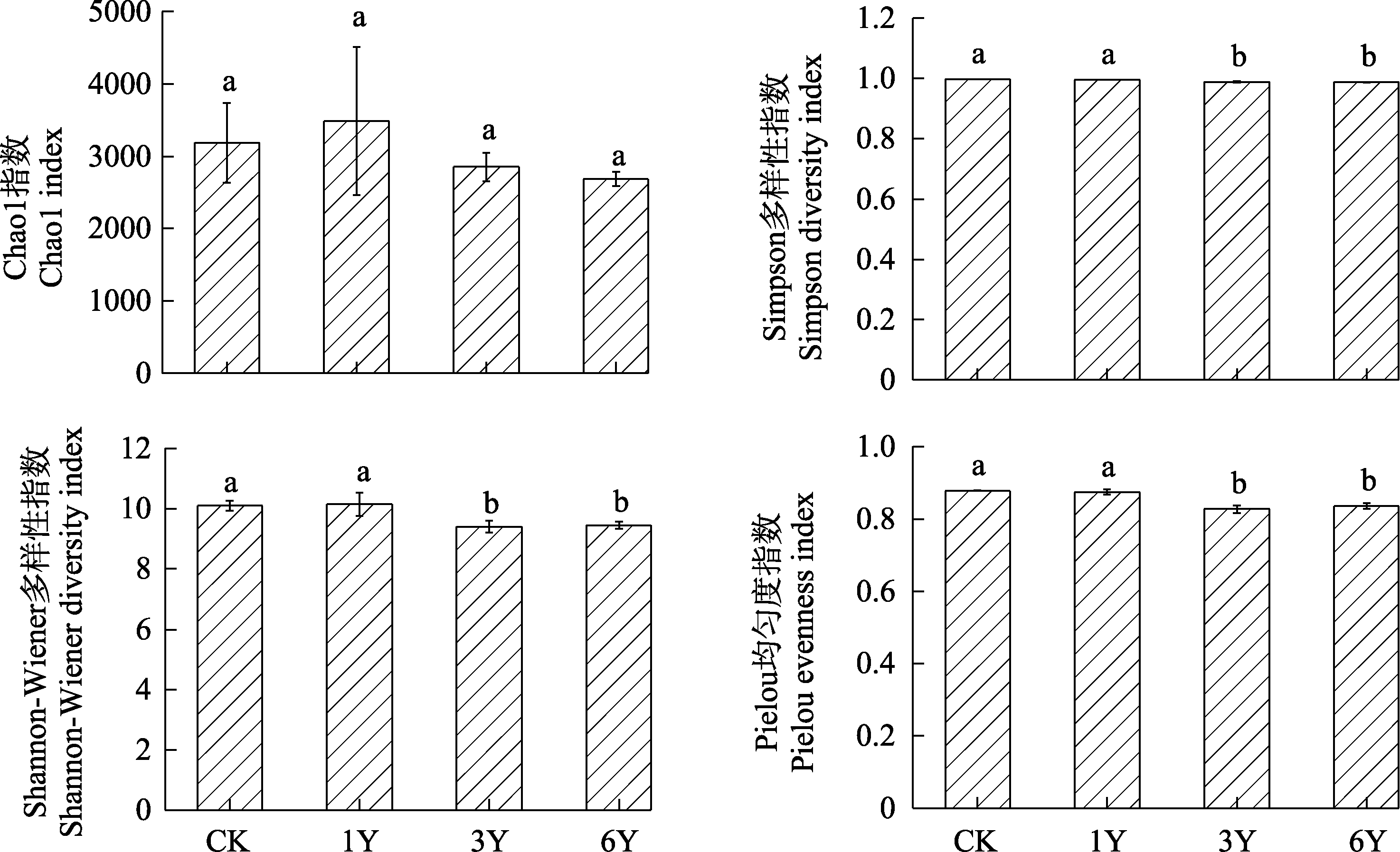
图1 退化森林火烧迹地不同恢复年限的土壤细菌群落α多样性。不同小写字母表示差异显著(P<0.05)。CK: 裸地; 1Y: 恢复1年; 3Y: 恢复3年; 6Y: 恢复6年。
Fig. 1 α diversity of soil bacterial community in different restoration years of degraded post-fire forest sites. Different lowercase letters indicate significant differences (P<0.05). CK, Bare ground; 1Y, 1-year restoration; 3Y, 3-year restoration; 6Y, 6-year restoration.
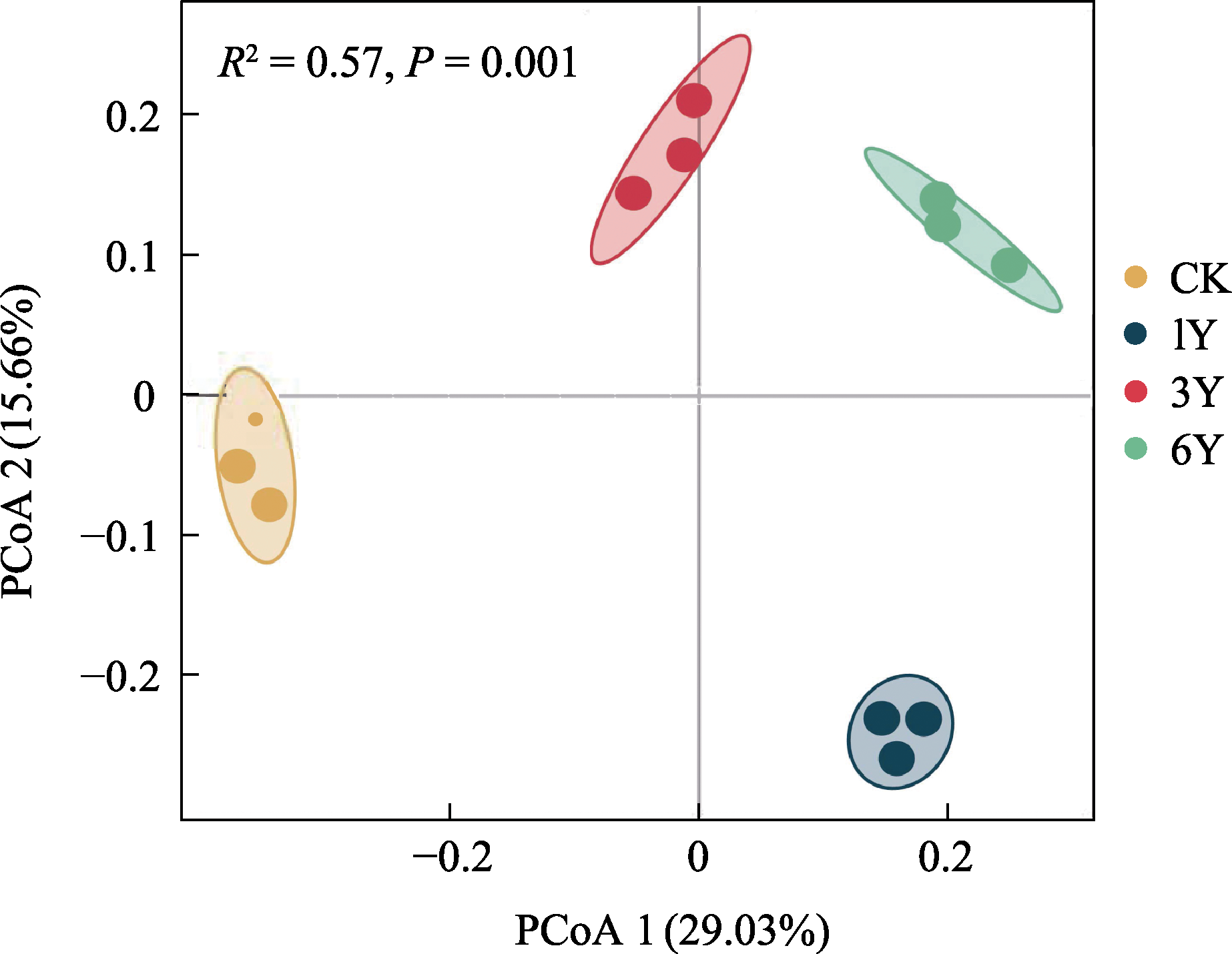
图2 退化森林火烧迹地不同恢复年限的土壤细菌群落β多样性。CK: 裸地; 1Y: 恢复1年; 3Y: 恢复3年; 6Y: 恢复6年。
Fig. 2 Soil bacterial community β-diversity in different restoration years in degraded post-fire forest sites. CK, Bare ground; 1Y, 1-year restoration; 3Y, 3-year restoration; 6Y, 6-year restoration.
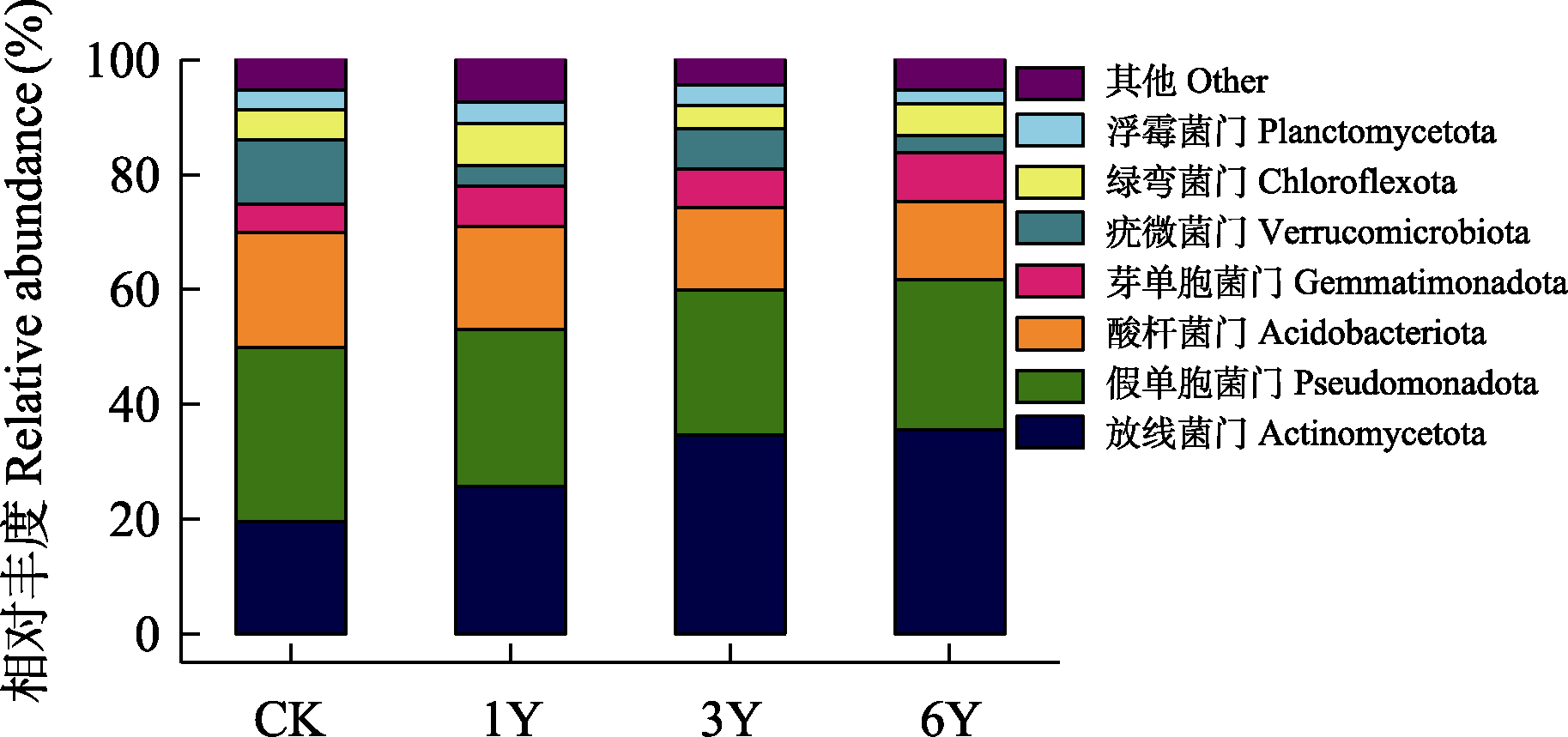
图3 退化森林火烧迹地不同恢复年限土壤细菌群落中门水平的相对丰度。CK: 裸地; 1Y: 恢复1年; 3Y: 恢复3年; 6Y: 恢复6年。
Fig. 3 Relative abundance of soil bacterial communities at the phylum in different restoration years in degraded post-fire forest sites. CK, Bare ground; 1Y, 1-year restoration; 3Y, 3-year restoration; 6Y, 6-year restoration.
| 细菌属 Bacterial genus | CK | 1Y | 3Y | 6Y | 功能 Function | 参考文献 References |
|---|---|---|---|---|---|---|
| 慢生根瘤菌属 Bradyrhizobium | 2.29±0.05b | 2.20±0.08b | 2.61±0.04a | 2.15±0.12b | 共生固氮 Symbiotic nitrogen fixation | 侯馨博等, |
| 芽单胞菌属 Gemmatimonas | 2.00±0.04b | 3.13±0.13a | 3.72±0.41a | 3.67±0.51a | 磷吸收 Phosphorus uptake | Mujakić et al., |
| 分枝杆菌属 Mycobacterium | 1.07±0.05b | 1.13±0.05b | 1.65±0.13a | 1.35±0.09b | 纤维素分解和固氮 Cellulose decomposition and nitrogen fixation | Rilling et al., |
| 雷氏菌属 Reyranella | 1.10±0.07a | 0.83±0.06bc | 0.91±0.06ab | 0.65±0.03c | 生物防治 Biocontrol | Lee & Kim, |
| 苔藓杆菌属 Bryobacter | 0.97±0.09ab | 1.13±0.09a | 0.73±0.03b | 1.04±0.15ab | 有机质分解 Organic matter decomposition | Pertile et al., |
| 芽孢杆菌属 Bacillus | 0.96±0.09a | 1.08±0.08a | 0.15±0.05c | 0.65±0.08b | 生物防治 Biocontrol | 崔冬晴等, |
| 厌氧黏杆菌属 Anaeromyxobacter | 0.92±0.04a | 0.44±0.02b | 0.81±0.14ab | 0.46±0.17b | 铁氨氧化 Feammox | 丁帮璟等, |
| 酸热菌属 Acidothermus | 0.90±0.07a | 0.48±0.03b | 0.53±0.14b | 0.40±0.06b | 纤维素分解 Cellulose decomposition | Shen et al., |
| 连接杆菌属 Conexibacter | 0.69±0.05a | 0.65±0.03ab | 0.47±0.02c | 0.52±0.07bc | 有机污染物降解 Organic pollutant degradation | Lei et al., |
表2 退化森林火烧迹地不同恢复年限土壤细菌群落中属水平的相对丰度及功能预测
Table 2 The relative abundance and functional prediction of soil bacterial genera in different restoration years of degraded post-fire forest sites
| 细菌属 Bacterial genus | CK | 1Y | 3Y | 6Y | 功能 Function | 参考文献 References |
|---|---|---|---|---|---|---|
| 慢生根瘤菌属 Bradyrhizobium | 2.29±0.05b | 2.20±0.08b | 2.61±0.04a | 2.15±0.12b | 共生固氮 Symbiotic nitrogen fixation | 侯馨博等, |
| 芽单胞菌属 Gemmatimonas | 2.00±0.04b | 3.13±0.13a | 3.72±0.41a | 3.67±0.51a | 磷吸收 Phosphorus uptake | Mujakić et al., |
| 分枝杆菌属 Mycobacterium | 1.07±0.05b | 1.13±0.05b | 1.65±0.13a | 1.35±0.09b | 纤维素分解和固氮 Cellulose decomposition and nitrogen fixation | Rilling et al., |
| 雷氏菌属 Reyranella | 1.10±0.07a | 0.83±0.06bc | 0.91±0.06ab | 0.65±0.03c | 生物防治 Biocontrol | Lee & Kim, |
| 苔藓杆菌属 Bryobacter | 0.97±0.09ab | 1.13±0.09a | 0.73±0.03b | 1.04±0.15ab | 有机质分解 Organic matter decomposition | Pertile et al., |
| 芽孢杆菌属 Bacillus | 0.96±0.09a | 1.08±0.08a | 0.15±0.05c | 0.65±0.08b | 生物防治 Biocontrol | 崔冬晴等, |
| 厌氧黏杆菌属 Anaeromyxobacter | 0.92±0.04a | 0.44±0.02b | 0.81±0.14ab | 0.46±0.17b | 铁氨氧化 Feammox | 丁帮璟等, |
| 酸热菌属 Acidothermus | 0.90±0.07a | 0.48±0.03b | 0.53±0.14b | 0.40±0.06b | 纤维素分解 Cellulose decomposition | Shen et al., |
| 连接杆菌属 Conexibacter | 0.69±0.05a | 0.65±0.03ab | 0.47±0.02c | 0.52±0.07bc | 有机污染物降解 Organic pollutant degradation | Lei et al., |
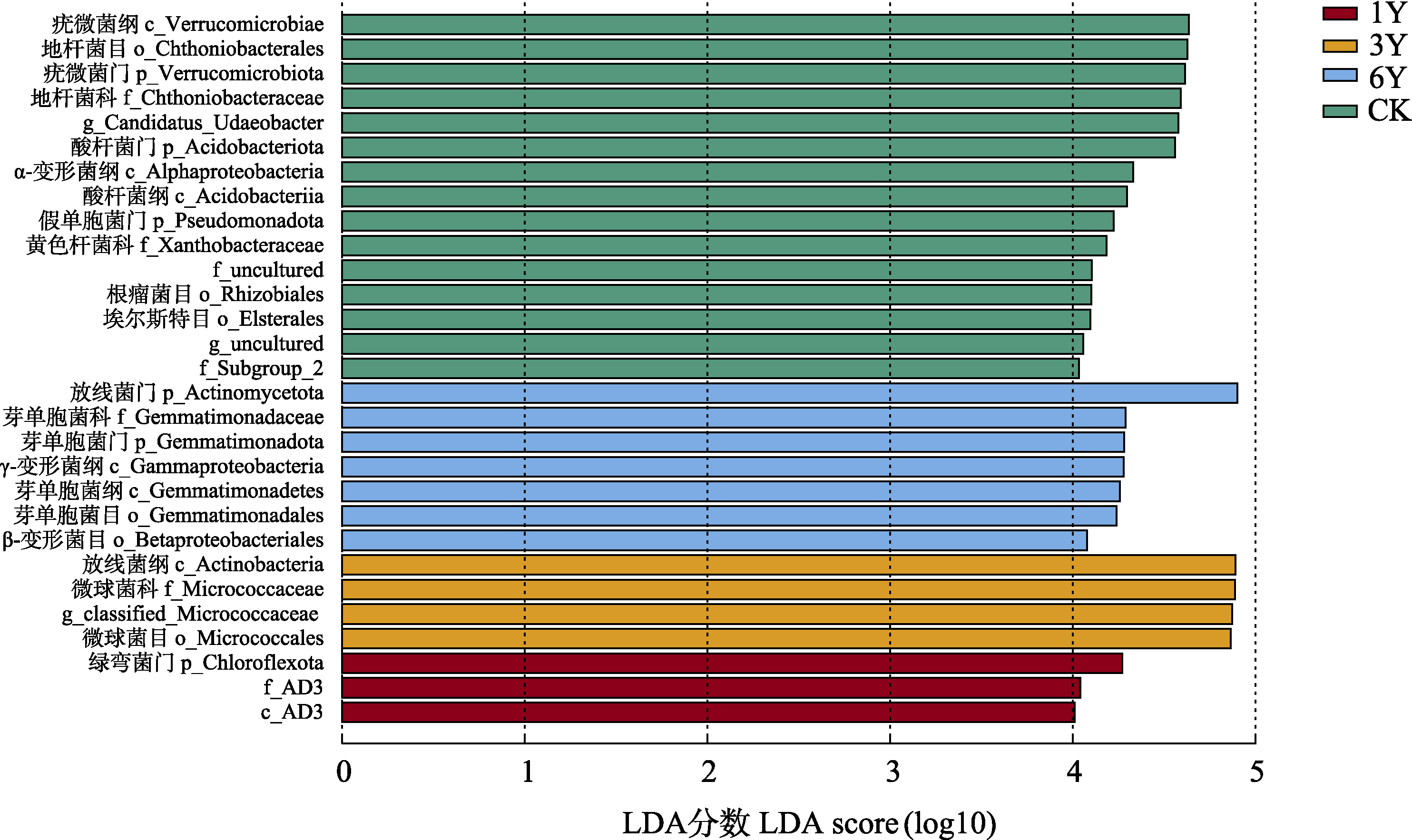
图4 退化森林火烧迹地不同恢复年限土壤细菌群落组成差异的线性判别分析(LEfSe)。CK: 裸地; 1Y: 恢复1年; 3Y: 恢复3年; 6Y: 恢复6年。
Fig. 4 Linear discriminant analysis effect size (LEfSe) showing soil bacterial community differences in different restoration years in degraded post-fire forest sites. CK, Bare ground; 1Y, 1-year restoration; 3Y, 3-year restoration; 6Y, 6-year restoration.
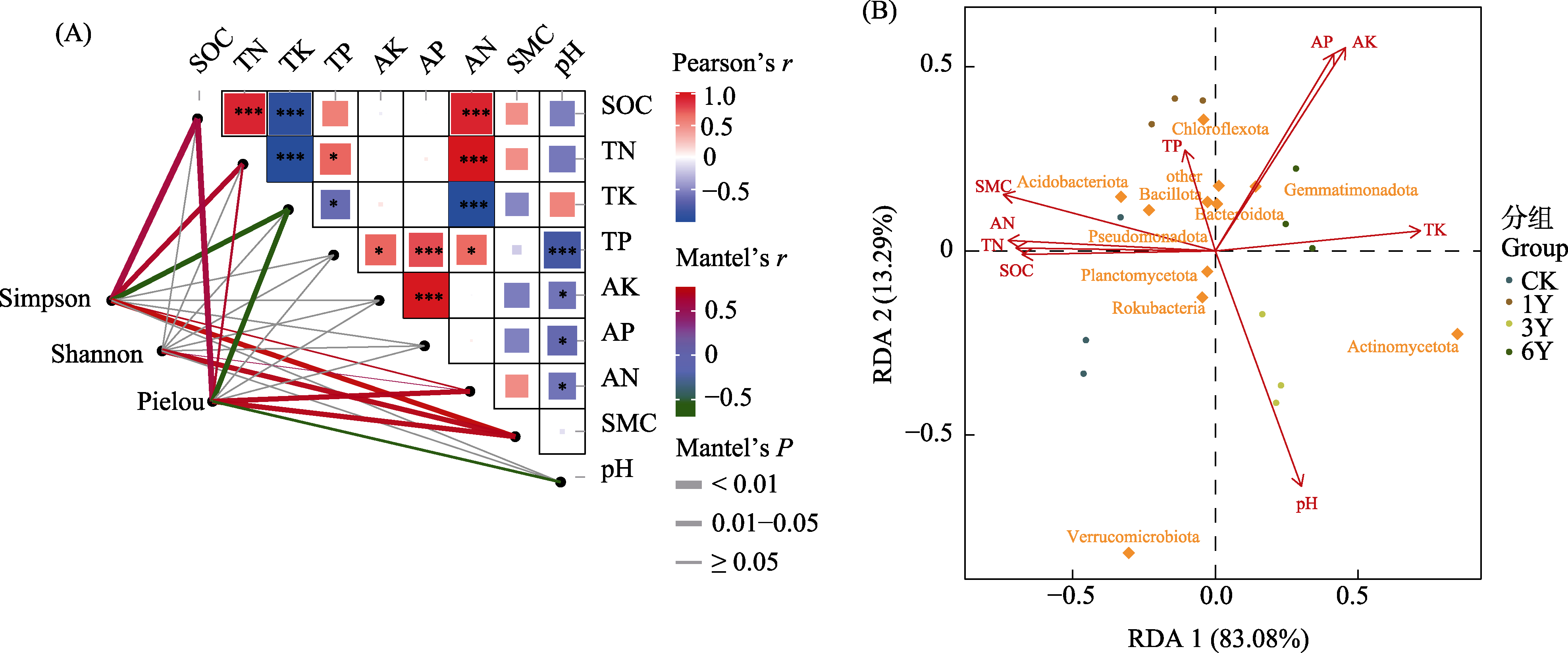
图5 退化森林火烧迹地不同恢复年限土壤理化性质与土壤细菌群落多样性的Mantel分析(A)及与细菌门组成的冗余分析(B)。Pearson’s r, Pearson相关性系数; Mantel’s r, Mantel检验的相关性系数; Mantel’s P, Mantel检验的差异显著性。CK: 裸地; 1Y: 恢复1年; 3Y: 恢复3年; 6Y: 恢复6年; SOC: 土壤有机碳; TN: 总氮; TP: 总磷; TK: 总钾; AN: 速效氮; AP: 速效磷; AK: 速效钾; SMC: 土壤含水量; pH: 土壤pH。Simpson: Simpson多样性指数; Shannon: Shannon-Wiener多样性指数; Pielou: Pielou均匀度指数。Actinomycetota: 放线菌门; Pseudomonadota: 假单胞菌门; Acidobacteriota: 酸杆菌门; Gemmatimonadota: 芽单胞菌门; Verrucomicrobiota: 疣微菌门; Chloroflexota: 绿弯菌门; Planctomycetota: 浮霉菌门; Rokubacteria: 罗库菌门; Bacillota: 芽孢杆菌门; Bacteroidota: 拟杆菌门; other: 其他。
Fig. 5 Relationships between soil physicochemical properties and bacterial community diversity in restoration years of degraded post-fire forest sites: (A) Mantel test for community diversity; (B) Redundancy analysis (RDA) for phylum-level composition. Pearson’s R, Pearson correlation coefficient; Mantel’s R, Mantel test correlation coefficient; Mantel’s P, The Mantel test statistical significance. CK, Bare ground; 1Y, 1-year restoration; 3Y, 3-year restoration; 6Y, 6-year restoration; SOC, Soil organic carbon; TN, Total nitrogen; TP, Total phosphorus; TK, Total potassium; AN, Available nitrogen; AP, Available phosphorus; AK, Available potassium; SMC, Soil moisture content; pH, Soil pH. Simpson, Simpson diversity index; Shannon, Shannon-Wiener diversity index; Pielou, Pielou evenness index.
| 相关性系数 Correlation coefficient | 土壤有机碳 SOC | 全氮 TN | 全磷 TP | 全钾 TK | 速效氮 AN | 速效磷 AP | 速效钾 AK | 土壤含水量 SMC | pH | |
|---|---|---|---|---|---|---|---|---|---|---|
| 门Phylum | 放线菌门 Actinomycetota | -0.70* | -0.73** | -0.14 | 0.75** | -0.77** | 0.38 | 0.42 | -0.79** | 0.39 |
| 假单胞菌门 Pseudomonadota | 0.81** | 0.82** | 0.35 | -0.81** | 0.84** | -0.17 | -0.23 | 0.72** | -0.45 | |
| 酸杆菌门 Acidobacteriota | 0.68* | 0.67* | 0.06 | -0.70* | 0.69* | -0.40 | -0.45 | 0.89** | -0.37 | |
| 芽单胞菌门 Gemmatimonadota | -0.58* | -0.54 | 0.21 | 0.59* | -0.56 | 0.76** | 0.79** | -0.72** | -0.15 | |
| 疣微菌门 Verrucomicrobiota | 0.50 | 0.52 | -0.10 | -0.58* | 0.52 | -0.69* | -0.73** | 0.38 | 0.25 | |
| 绿弯菌门 Chloroflexota | 0.09 | 0.20 | 0.33 | -0.14 | 0.24 | 0.46 | 0.45 | 0.25 | -0.74** | |
| 浮霉菌门 Planctomycetota | -0.12 | -0.14 | -0.47 | 0.16 | -0.13 | -0.43 | -0.38 | 0.15 | 0.31 | |
| 罗库菌门 Rokubacteria | 0.12 | 0.15 | -0.50 | -0.23 | 0.16 | -0.89** | -0.95** | 0.53 | 0.50 | |
| 芽孢杆菌门 Bacillota | 0.39 | 0.43 | 0.55 | -0.38 | 0.45 | 0.44 | 0.46 | 0.24 | -0.88** | |
| 拟杆菌门 Bacteroidota | -0.15 | -0.22 | 0.07 | 0.26 | -0.17 | 0.35 | 0.44 | -0.08 | -0.40 | |
| 属 Genus | 慢生根瘤菌属 Bradyrhizobium | -0.37 | -0.39 | -0.70* | 0.38 | -0.41 | -0.54 | -0.55 | 0.14 | 0.80** |
| 芽单胞菌属 Gemmatimonas | -0.65* | -0.71* | -0.23 | 0.76** | -0.73** | 0.36 | 0.44 | -0.54 | 0.29 | |
| 分枝杆菌属 Mycobacterium | -0.73** | -0.71* | -0.48 | 0.69* | -0.75** | -0.16 | -0.14 | -0.50 | 0.69* | |
| 雷氏菌属 Reyranella | 0.52 | 0.40 | -0.29 | -0.46 | 0.42 | -0.74** | -0.79** | 0.76** | 0.14 | |
| 厌氧黏杆菌属 Anaeromyxobacter | 0.20 | 0.20 | -0.24 | -0.30 | 0.22 | -0.70* | -0.78** | 0.28 | 0.34 | |
| 芽孢杆菌属 Bacillus | 0.54 | 0.61* | 0.47 | -0.58* | 0.62* | 0.20 | 0.19 | 0.57 | -0.81** | |
| 酸热菌属 Acidothermus | 0.73** | 0.68* | 0.06 | -0.70* | 0.67* | -0.44 | -0.48 | 0.73** | -0.01 | |
| 连接杆菌属 Conexibacter | 0.56 | 0.59* | 0.24 | -0.64* | 0.63* | -0.17 | -0.23 | 0.70* | -0.55 | |
| 苔藓杆菌属 Bryobacter | 0.45 | 0.32 | 0.43 | -0.24 | 0.34 | 0.49 | 0.53 | 0.22 | -0.67* |
表3 土壤细菌群落组成与土壤理化性质的相关性
Table 3 Pearson correlation analyses between the soil bacterial community composition and soil physicochemical properties
| 相关性系数 Correlation coefficient | 土壤有机碳 SOC | 全氮 TN | 全磷 TP | 全钾 TK | 速效氮 AN | 速效磷 AP | 速效钾 AK | 土壤含水量 SMC | pH | |
|---|---|---|---|---|---|---|---|---|---|---|
| 门Phylum | 放线菌门 Actinomycetota | -0.70* | -0.73** | -0.14 | 0.75** | -0.77** | 0.38 | 0.42 | -0.79** | 0.39 |
| 假单胞菌门 Pseudomonadota | 0.81** | 0.82** | 0.35 | -0.81** | 0.84** | -0.17 | -0.23 | 0.72** | -0.45 | |
| 酸杆菌门 Acidobacteriota | 0.68* | 0.67* | 0.06 | -0.70* | 0.69* | -0.40 | -0.45 | 0.89** | -0.37 | |
| 芽单胞菌门 Gemmatimonadota | -0.58* | -0.54 | 0.21 | 0.59* | -0.56 | 0.76** | 0.79** | -0.72** | -0.15 | |
| 疣微菌门 Verrucomicrobiota | 0.50 | 0.52 | -0.10 | -0.58* | 0.52 | -0.69* | -0.73** | 0.38 | 0.25 | |
| 绿弯菌门 Chloroflexota | 0.09 | 0.20 | 0.33 | -0.14 | 0.24 | 0.46 | 0.45 | 0.25 | -0.74** | |
| 浮霉菌门 Planctomycetota | -0.12 | -0.14 | -0.47 | 0.16 | -0.13 | -0.43 | -0.38 | 0.15 | 0.31 | |
| 罗库菌门 Rokubacteria | 0.12 | 0.15 | -0.50 | -0.23 | 0.16 | -0.89** | -0.95** | 0.53 | 0.50 | |
| 芽孢杆菌门 Bacillota | 0.39 | 0.43 | 0.55 | -0.38 | 0.45 | 0.44 | 0.46 | 0.24 | -0.88** | |
| 拟杆菌门 Bacteroidota | -0.15 | -0.22 | 0.07 | 0.26 | -0.17 | 0.35 | 0.44 | -0.08 | -0.40 | |
| 属 Genus | 慢生根瘤菌属 Bradyrhizobium | -0.37 | -0.39 | -0.70* | 0.38 | -0.41 | -0.54 | -0.55 | 0.14 | 0.80** |
| 芽单胞菌属 Gemmatimonas | -0.65* | -0.71* | -0.23 | 0.76** | -0.73** | 0.36 | 0.44 | -0.54 | 0.29 | |
| 分枝杆菌属 Mycobacterium | -0.73** | -0.71* | -0.48 | 0.69* | -0.75** | -0.16 | -0.14 | -0.50 | 0.69* | |
| 雷氏菌属 Reyranella | 0.52 | 0.40 | -0.29 | -0.46 | 0.42 | -0.74** | -0.79** | 0.76** | 0.14 | |
| 厌氧黏杆菌属 Anaeromyxobacter | 0.20 | 0.20 | -0.24 | -0.30 | 0.22 | -0.70* | -0.78** | 0.28 | 0.34 | |
| 芽孢杆菌属 Bacillus | 0.54 | 0.61* | 0.47 | -0.58* | 0.62* | 0.20 | 0.19 | 0.57 | -0.81** | |
| 酸热菌属 Acidothermus | 0.73** | 0.68* | 0.06 | -0.70* | 0.67* | -0.44 | -0.48 | 0.73** | -0.01 | |
| 连接杆菌属 Conexibacter | 0.56 | 0.59* | 0.24 | -0.64* | 0.63* | -0.17 | -0.23 | 0.70* | -0.55 | |
| 苔藓杆菌属 Bryobacter | 0.45 | 0.32 | 0.43 | -0.24 | 0.34 | 0.49 | 0.53 | 0.22 | -0.67* |
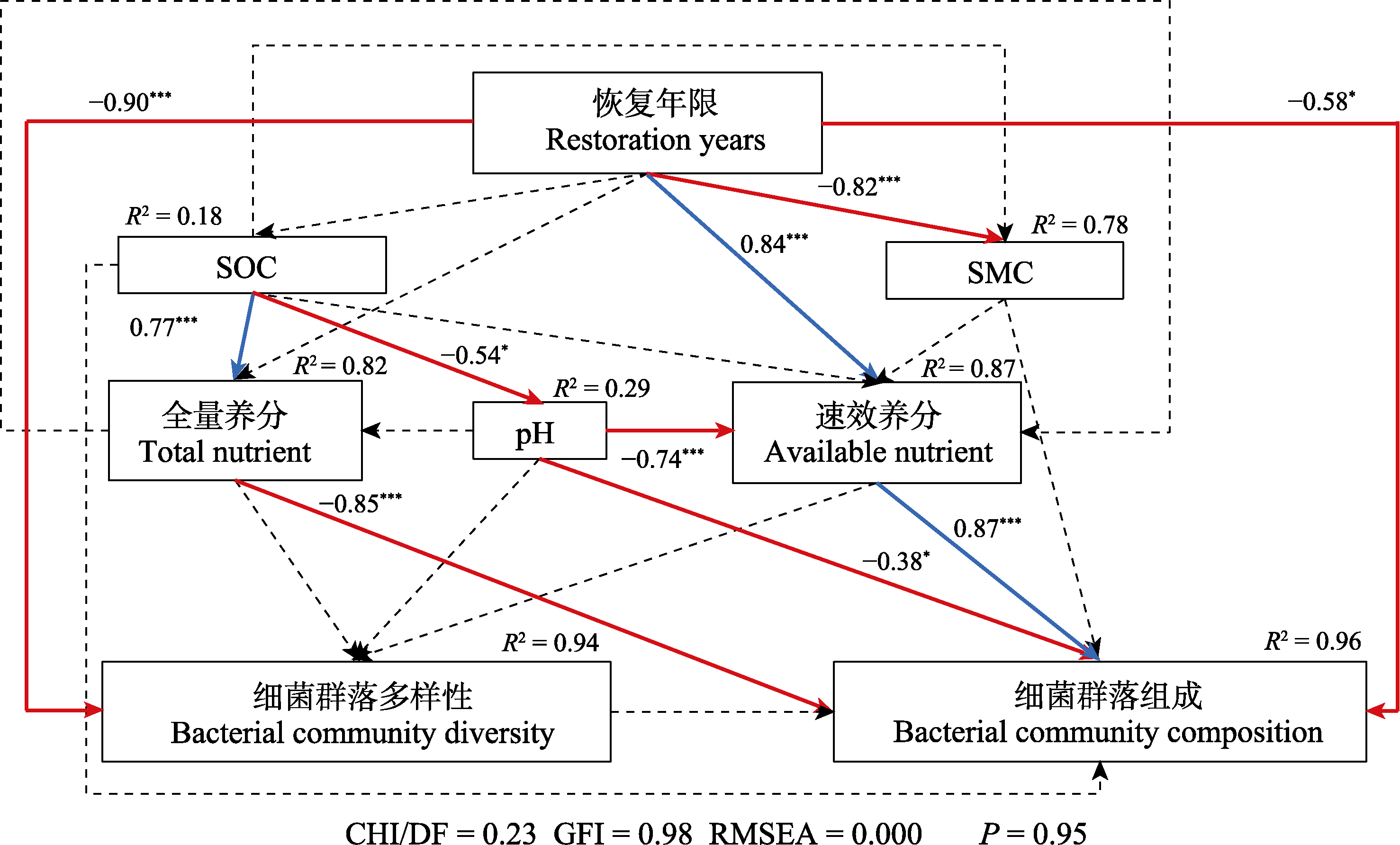
图6 退化森林火烧迹地不同恢复年限土壤细菌群落特征的结构方程模型。蓝色实线为显著正影响; 红色实线为显著负影响; 黑色虚线为不显著影响; 实线上数字代表路径系数。Chi/DF: 卡方/自由度; GFI: 适配度指数; RMSEA: 近似均方根误差; SOC: 土壤有机碳; SMC: 土壤含水量。*P<0.05; ***P<0.001。
Fig. 6 Structural equation modes of causal relationships among soil bacterial community diversity and composition with environmental variables in different restoration years of degraded post-fire forest sites. Blue full lines represent significant positive affect paths; Red full lines represent significant negative affect paths; black dotted lines represent non-significant affect paths; the number on solid lines represent path coefficient; *P<0.05; ***P<0.001. Chi/DF, Chi-square/degree of freedom; GFI, Goodness of fit index; RMSEA, Root mean square error of approximation; SOC, Soil organic carbon; SMC, Soil moisture content.
| [1] |
Ammer C (2019) Diversity and forest productivity in a changing climate. New Phytologist, 221, 50-66.
DOI PMID |
| [2] |
Banerjee S, van der Heijden MGA (2023) Soil microbiomes and one health. Nature Reviews Microbiology, 21, 6-20.
DOI |
| [3] |
Bever JD, Platt TG, Morton ER (2012) Microbial population and community dynamics on plant roots and their feedbacks on plant communities. Annual Review of Microbiology, 66, 265-283.
DOI PMID |
| [4] |
Chen KY, Xing S, Shi HL, Tang Y, Yang MX, Gu Q, Li YM, Zhang J, Ji BM (2023) Long-term fencing can’t benefit plant and microbial network stability of alpine meadow and alpine steppe in Three-River-Source National Park. Science of the Total Environment, 902, 166076.
DOI URL |
| [5] |
Coluccia M, Besaury L (2023) Acidobacteria members harbour an abundant and diverse carbohydrate-active enzymes (cazyme) and secreted proteasome repertoire, key factors for potential efficient biomass degradation. Molecular Genetics and Genomics, 298, 1135-1154.
DOI PMID |
| [6] |
Cui DQ, Tian C, Song HM, Lu XM, Sa QR, Xu GQ, Yang PZ, Bai YF, Tian JQ (2025) Response mechanisms of rhizosphere bacterial community diversity and functional group composition of dominant plants in typical grasslands to long-term grazing. Chinese Journal of Plant Ecology, 49, 1163-1176.(in Chinese with English abstract)
DOI URL |
|
[崔冬晴, 田晨, 宋慧敏, 鲁小名, 萨其日, 徐国庆, 杨培志, 白永飞, 田建卿 (2025) 典型草原优势植物根际细菌群落多样性和功能群组成对长期放牧的响应机制. 植物生态学报, 49, 1163-1176.]
DOI |
|
| [7] |
Cui L, Guo F, Zhang JL, Yang S, Wang JG, Meng JJ, Geng Y, Li XG, Wan SB (2019) Improvement of continuous microbial environment in peanut rhizosphere soil by Funneliformis mosseae. Chinese Journal of Plant Ecology, 43, 718-728.(in Chinese with English abstract)
DOI URL |
|
[崔利, 郭峰, 张佳蕾, 杨莎, 王建国, 孟静静, 耿耘, 李新国, 万书波 (2019) 摩西斗管囊霉改善连作花生根际土壤的微环境. 植物生态学报, 43, 718-728.]
DOI |
|
| [8] | Ding BJ, Li ZK, Zhu HJ, Chen S, Qin YB, Yang JH, Hu YY (2018) Insight into the mechanism of Feammox in the surface soils of a riparian zone. Environmental Science, 39, 1833-1839. (in Chinese English abstract) |
| [丁帮璟, 李正魁, 朱鸿杰, 陈湜, 覃云斌, 杨建华, 胡优优 (2018) 河岸带表层土壤的铁氨氧化(Feammox)脱氮机制的探究. 环境科学, 39, 1833-1839.] | |
| [9] |
Gao Y, He NP, Yu GR, Chen WL, Wang QF (2014) Long-term effects of different land use types on C, N, and P stoichiometry and storage in subtropical ecosystems: A case study in China. Ecological Engineering, 67, 171-181.
DOI URL |
| [10] |
Han WX, Fang JY, Reich PB, Woodward FI, Wang ZH (2011) Biogeography and variability of eleven mineral elements in plant leaves across gradients of climate, soil and plant functional type in China. Ecology Letters, 14, 788-796.
DOI PMID |
| [11] |
Hong DY, Zhou SL, He XJ, Yuan JH, Zhang YL, Cheng FY, Zeng XL, Wang Y, Zhang XX (2017) Current status of wild tree peony species with special reference to conservation. Biodiversity Science, 25, 781-793.(in Chinese with English abstract)
DOI URL |
|
[洪德元, 周世良, 何兴金, 袁军辉, 张延龙, 成仿云, 曾秀丽, 王雁, 张秀新 (2017) 野生牡丹的生存状况和保护. 生物多样性, 25, 781-793.]
DOI |
|
| [12] |
Hou XB, Zhao XH, He HJ, Zhang CY, Wang J, Ren XY, Zhang XN (2025) Responses of rhizosphere and non-rhizosphere microbial communities to the soil carbon and nitrogen in Quercus mongolica pure forest. Biodiversity Science, 33, 25119.(in Chinese with English abstract)
DOI URL |
|
[侯馨博, 赵秀海, 何怀江, 张春雨, 王娟, 任雪莹, 张新娜 (2025) 蒙古栎纯林根际与非根际微生物群落结构对土壤碳氮的响应. 生物多样性, 33, 25119.]
DOI |
|
| [13] | Hu HY, Zhang YL, Chu ZP, Huang CF, Wang SZ, Zhou CF (2021) Changes in soil enzyme activity and microbial diversity at different vegetation restoration stages in eroded red soil. Chinese Journal of Applied and Environmental Biology, 27, 734-741.(in Chinese with English abstract) |
| [胡华英, 张燕林, 褚昭沛, 黄彩凤, 王淑真, 周垂帆 (2021) 红壤侵蚀区不同植被恢复阶段土壤酶活性和微生物多样性变化. 应用与环境生物学报, 27, 734-741.] | |
| [14] |
Hu L, Zi HB, Wu PF, Wang Y, Lerdau M, Wu XW, Wang CT (2019) Soil bacterial communities in grasslands revegetated using Elymus nutans are largely influenced by soil pH and total phosphorus across restoration time. Land Degradation & Development, 30, 2243-2256.
DOI URL |
| [15] |
Hu MJ, Sardans J, Sun DY, Yan RB, Wu H, Ni RX, Peñuelas J (2024) Microbial diversity and keystone species drive soil nutrient cycling and multifunctionality following mangrove restoration. Environmental Research, 251, 118715.
DOI URL |
| [16] |
Huang YY, Chen YX, Castro-Izaguirre N, Baruffol M, Brezzi M, Lang A, Li Y, Härdtle W, Von Oheimb G, Yang XF, Liu XJ, Pei KQ, Both S, Yang B, Eichenberg D, Assmann T, Bauhus J, Behrens T, Buscot F, Chen XY, Chesters D, Ding BY, Durka W, Erfmeier A, Fang JY, Fischer M, Guo LD, Guo DL, Gutknecht JLM, He JS, He CL, Hector A, Hönig L, Hu RY, Klein AM, Kühn P, Liang Y, Li S, Michalski S, Scherer-Lorenzen M, Schmidt K, Scholten T, Schuldt A, Shi XZ, Tan MZ, Tang ZY, Trogisch S, Wang ZW, Welk E, Wirth C, Wubet T, Xiang WH, Yu MJ, Yu XD, Zhang JY, Zhang SR, Zhang NL, Zhou HZ, Zhu CD, Zhu L, Bruelheide H, Ma KP, Niklaus PA, Schmid B (2018) Impacts of species richness on productivity in a large-scale subtropical forest experiment. Science, 362, 80-83.
DOI PMID |
| [17] | Jiao K, Zhang XB, Xu M, Liu XJ, An QD, Zhang CY (2021) Depth-related characteristics of soil microbial community along the soil profile of typical dark coniferous forest in Southeast Tibet. Acta Ecologica Sinica, 41, 4864-4875.(in Chinese with English abstract) |
| [焦克, 张旭博, 徐梦, 刘晓洁, 安前东, 张崇玉 (2021) 藏东南典型暗针叶林不同土壤剖面微生物群落特征. 生态学报, 41, 4864-4875.] | |
| [18] |
Klatt CG, Liu ZF, Ludwig M, Kühl M, Jensen SI, Bryant DA, Ward DM (2013) Temporal metatranscriptomic patterning in phototrophic Chloroflexi inhabiting a microbial mat in a geothermal spring. The ISME Journal, 7, 1775-1789.
DOI URL |
| [19] | Knelman JE, Graham EB, Prevéy JS, Robeson MS, Kelly P, Hood E, Schmidt SK (2018) Interspecific plant interactions reflected in soil bacterial community structure and nitrogen cycling in primary succession. Frontiers in Microbiology, 9, 128. |
| [20] | Kong YL, Qin H, Zhu CQ, Tian WH, Zhu XF, Yu YJ, Zhang JH (2024) Research progress on the mechanism by which soil microorganisms affect soil health. Acta Pedologica Sinica, 61, 331-347.(in Chinese with English abstract) |
| [孔亚丽, 秦华, 朱春权, 田文昊, 朱晓芳, 虞轶俊, 张均华 (2024) 土壤微生物影响土壤健康的作用机制研究进展. 土壤学报, 61, 331-347.] | |
| [21] |
Lange M, Habekost M, Eisenhauer N, Roscher C, Bessler H, Engels C, Oelmann Y, Scheu S, Wilcke W, Schulze ED, Gleixner G (2014) Biotic and abiotic properties mediating plant diversity effects on soil microbial communities in an experimental grassland. PLoS ONE, 9, e96182.
DOI URL |
| [22] |
Lee DH, Kim SB (2024) Quorum quenching potential of Reyranella sp. isolated from riverside soil and description of Reyranella humidisoli sp. nov. Journal of Microbiology, 62, 449-461.
DOI |
| [23] |
Lei HX, Zhang JY, Huang J, Shen DJ, Li Y, Jiao R, Zhao RX, Li XY, Lin L, Li B (2023) New insights into lincomycin biodegradation by Conexibacter sp. LD01: Genomics characterization, biodegradation kinetics and pathways. Journal of Hazardous Materials, 441, 129824.
DOI URL |
| [24] |
Li K, Zheng BQ, Wang Y, Bu WS (2012) Numeric dynamics of natural populations of Paeonia delavayi (Paeoniaceae). Chinese Journal of Plant Ecology, 36, 522-529.(in Chinese with English abstract)
DOI URL |
|
[李奎, 郑宝强, 王雁, 卜文圣 (2012) 滇牡丹自然种群数量动态. 植物生态学报, 36, 522-529.]
DOI |
|
| [25] |
Li L, Sun Y, Yang XQ, Fang HD, Yan BG (2024) Response of endophytes in root nodules of Arachis hypogaea ‘Qicai’ to nitrogen addition and its relationship with plant stoichiometry characteristics. Chinese Journal of Plant Ecology, 48, 1374-1384.(in Chinese with English abstract)
DOI URL |
|
[李林, 孙毅, 杨晓琼, 方海东, 闫帮国 (2024) 七彩花生根瘤内生菌对氮添加的响应及其与植物化学计量特征的关系. 植物生态学报, 48, 1374-1384.]
DOI |
|
| [26] |
Li SX, Wang YL, Wang YQ, Yin YL (2021) Response of soil bacterial community characteristics to alpine meadow degradation. Biodiversity Science, 29, 53-64.(in Chinese with English abstract)
DOI URL |
| [李世雄, 王彦龙, 王玉琴, 尹亚丽 (2021) 土壤细菌群落特征对高寒草甸退化的响应. 生物多样性, 29, 53-64.] | |
| [27] |
Li WX, Wang KB, Wang PL, Yang PW, Xu ST, Tong JY, Zhang YM, Yang YH, Han LJ, Ye M, Shen SQ, Lei BK, Liu BY (2025) Impact of glyphosate on soil bacterial communities and degradation mechanisms in large-leaf tea plantations. Journal of Hazardous Materials, 483, 136626.
DOI URL |
| [28] |
Li YY, Zheng J, Yan XY, Li S, Luo L, Tong J, Zhao CZ (2024) Effects of warming on phyllosphere and rhizosphere bacterial communities in Picea asperata and Fargesia nitida. Chinese Journal of Plant Ecology, 48, 1692-1707.(in Chinese with English abstract)
DOI URL |
|
[李昀奕, 郑矜, 严晓艳, 李霜, 罗林, 童晋, 赵春章 (2024) 云杉和华西箭竹叶际与根际细菌群落对增温的响应. 植物生态学报, 48, 1692-1707.]
DOI |
|
| [29] | Liu B, Yang WQ, Wu FZ (2010) Advances in the subalpine forest ecosystem processes. Acta Ecologica Sinica, 30, 4476-4483.(in Chinese with English abstract) |
| [刘彬, 杨万勤, 吴福忠 (2010) 亚高山森林生态系统过程研究进展. 生态学报, 30, 4476-4483.] | |
| [30] |
Liu JJ, Sui YY, Yu ZH, Yao Q, Shi Y, Chu HY, Jin J, Liu XB, Wang GH (2016) Diversity and distribution patterns of acidobacterial communities in the black soil zone of Northeast China. Soil Biology and Biochemistry, 95, 212-222.
DOI URL |
| [31] | Liu Q, Wu Y, He H (2001) Ecological problems of subalpine coniferous forest in the Southwest of China. World Sci-Tech R&D, 23(2), 63-69.(in Chinese with English abstract) |
| [刘庆, 吴彦, 何海 (2001) 中国西南亚高山针叶林的生态学问题. 世界科技研究与发展, 23(2), 63-69.] | |
| [32] | Long ZL, Yang LX, Yang R, Lang BY, Wang J (2021) Medicinal ethnobotany research on Paeonia sect. Moutan through textual evidence. Guihaia, 41, 308-317.(in Chinese with English abstract) |
| [龙正莉, 杨立新, 杨蓉, 郎八一, 王娟 (2021) 牡丹组植物的药用民族植物学研究与考证. 广西植物, 41, 308-317.] | |
| [33] | Lu Y (2017) Study on Restoration of Degraded Subtropical Evergreen Broad-leaved Forests in Gaoligong Mountains in Northwest Yunnan, China. PhD dissertation, Yunnan University, Kunming.(in Chinese with English abstract) |
| [陆阳 (2017) 滇西北高黎贡山退化常绿阔叶林生态恢复研究. 博士学位论文, 云南大学, 昆明.] | |
| [34] |
Lu Y, Li K, Ni RQ, Liang Q, Li CR, Zhang CH (2018) Effects of fine root decomposition on bacterial community structure of four dominated tree species in Mount Taishan, China. Chinese Journal of Plant Ecology, 42, 1200-1210.(in Chinese with English abstract)
DOI |
|
[路颖, 李坤, 倪瑞强, 梁强, 李传荣, 张彩虹 (2018) 泰山4种优势造林树种细根分解对细菌群落结构的影响. 植物生态学报, 42, 1200-1210.]
DOI |
|
| [35] | Ma JM, Liu SR, Shi ZM, Liu XL, Miao N (2010) A review on restoration evaluation studies of degraded forest ecosystem. Acta Ecologica Sinica, 30, 3297-3303.(in Chinese with English abstract) |
| [马姜明, 刘世荣, 史作民, 刘兴良, 缪宁 (2010) 退化森林生态系统恢复评价研究综述. 生态学报, 30, 3297-3303.] | |
| [36] |
Mujakić I, Piwosz K, Koblížek M (2022) Phylum Gemmatimonadota and its role in the environment. Microorganisms, 10, 151.
DOI URL |
| [37] | Pang XY, Xiang S, Zhao WQ, Li DD, Liu Q (2021) Regeneration and growth-promoting constructive species in the subalpine secondary shrub ecosystem of southwestern China. Chinese Journal of Applied and Environmental Biology, 27, 667-676.(in Chinese with English abstract) |
| [庞学勇, 向双, 赵文强, 李丹丹, 刘庆 (2021) 西南亚高山次生灌丛促进建群树种更新恢复技术. 应用与环境生物学报, 27, 667-676.] | |
| [38] |
Pertile M, Sousa RMS, Mendes LW, Antunes JEL, de Souza Oliveira LM, de Araujo FF, Melo VMM, Araujo ASF (2021) Response of soil bacterial communities to the application of the herbicides imazethapyr and flumyzin. European Journal of Soil Biology, 102, 103252.
DOI URL |
| [39] |
Rilling JI, Acuña JJ, Sadowsky MJ, Jorquera MA (2018) Putative nitrogen-fixing bacteria associated with the rhizosphere and root endosphere of wheat plants grown in an andisol from southern Chile. Frontiers in Microbiology, 9, 2710.
DOI PMID |
| [40] |
Shen AR, Tan Y, Shen BM, Liu LN, Li JL, Tan ZM, Zeng LB (2024) The soil bacterial community structure in a Lactarius hatsudake Tanaka plantation during harvest. Microorganisms, 12, 1376.
DOI URL |
| [41] |
Shen CC, Ge Y, Yang T, Chu HY (2017) Verrucomicrobial elevational distribution was strongly influenced by soil pH and carbon/nitrogen ratio. Journal of Soils and Sediments, 17, 2449-2456.
DOI URL |
| [42] |
Song W, Cheng C, Wang JW, Wu JH (2025) Soil microbes regulate the relationships between plant diversity and ecosystem functions. Biodiversity Science, 33, 24579.(in Chinese with English abstract)
DOI |
|
[宋威, 程才, 王嘉伟, 吴纪华 (2025) 土壤微生物对植物多样性-生态系统功能关系的调控作用. 生物多样性, 33, 24579.]
DOI |
|
| [43] |
Spain AM, Krumholz LR, Elshahed MS (2009) Abundance, composition, diversity and novelty of soil Proteobacteria. The ISME Journal, 3, 992-1000.
DOI URL |
| [44] |
Tian D, Yan ZB, Fang JY (2021) Review on characteristics and main hypotheses of plant ecological stoichiometry. Chinese Journal of Plant Ecology, 45, 682-713.(in Chinese with English abstract)
DOI |
|
[田地, 严正兵, 方精云 (2021) 植物生态化学计量特征及其主要假说. 植物生态学报, 45, 682-713.]
DOI |
|
| [45] |
Wang PC, Ding LL, Zou C, Zhang YJ, Wang MY (2022) Rhizosphere element circling, multifunctionality, aboveground productivity and trade-offs are better predicted by rhizosphere rare taxa. Frontiers in Plant Science, 13, 985574.
DOI URL |
| [46] |
Wei SY, Song TJ, Luo JY, Zhang Y, Zhao ZX, Ru JW, Yi H, Lin YB (2024) Altitudinal distribution patterns of soil bacterial communities in the Huoditang coniferous forests of the Qinling Mountains. Biodiversity Science, 32, 24180.(in Chinese with English abstract)
DOI |
|
[魏诗雨, 宋天骄, 罗佳宜, 张燕, 赵子萱, 茹靖雯, 易华, 林雁冰 (2024) 秦岭火地塘针叶林土壤细菌群落的海拔分布格局. 生物多样性, 32, 24180.]
DOI |
|
| [47] | Wu ZY (1987) Vegetation of Yunnan. Science Press, Beijing.(in Chinese) |
| [吴征镒 (1987) 云南植被. 科学出版社, 北京.] | |
| [48] |
Xi NX, Zhang YY, Zhou SR (2023) Plant-soil feedbacks in community ecology. Chinese Journal of Plant Ecology, 47, 170-182.(in Chinese with English abstract)
DOI URL |
|
[席念勋, 张原野, 周淑荣 (2023) 群落生态学中的植物-土壤反馈研究. 植物生态学报, 47, 170-182.]
DOI |
|
| [49] |
Yang WG, Zi HB, Chen KY, Ade LJ, Hu L, Wang X, Wang GX, Wang CT (2019) Ecological stoichiometric characteristics of shrubs and soils in different forest types in Qinghai, China. Chinese Journal of Plant Ecology, 43, 352-364.(in Chinese with English abstract)
DOI URL |
|
[杨文高, 字洪标, 陈科宇, 阿的鲁骥, 胡雷, 王鑫, 王根绪, 王长庭 (2019) 青海森林生态系统中灌木层和土壤生态化学计量特征. 植物生态学报, 43, 352-364.]
DOI |
|
| [50] |
Yao B, Chen Y, Cao WJ, Gong XW, Luo YQ, Zheng CZ, Wang XY, Wang ZW, Li YQ (2025) Vegetation-soil interaction on carbon, nitrogen, and phosphorus and associated microbial driving mechanisms at Hulun Buir Sandy Land. Chinese Journal of Plant Ecology, 49, 59-73.(in Chinese with English abstract)
DOI |
|
[姚博, 陈云, 曹雯婕, 龚相文, 罗永清, 郑成卓, 王旭洋, 王正文, 李玉强 (2025) 呼伦贝尔退化沙地植被-土壤碳氮磷互馈关系及微生物驱动机制. 植物生态学报, 49, 59-73.]
DOI |
|
| [51] | Ye D, Wang R, Wang J, Yan P, Zhuo MJ, Liu D, Lin YH (2024) Response of soil bacterial communities and ecological networks to grazing enclosure and re-grazing in Zoige alpine wetland. Acta Ecologica Sinica, 44, 11229-11240.(in Chinese with English abstract) |
| [叶董, 王瑞, 王京, 言迫, 卓玛姐, 刘丹, 林英华 (2024) 若尔盖高寒湿地土壤细菌群落和生态网络对围封禁牧与恢复放牧的响应. 生态学报, 44, 11229-11240.] | |
| [52] | Zhang JF (2012) Research on Characteristics of Degraded Forest Ecosystem and Its Restoration Countermeasure in Sub-alpine of Northwest Yunnan. PhD dissertation, Yunnan University, Kunming.(in Chinese with English abstract) |
| [张劲峰 (2012) 滇西北亚高山退化森林生态系统特征及恢复对策研究. 博士学位论文, 云南大学, 昆明.] | |
| [53] |
Zhang K, Bao WK, Yang B, Hu B (2017) The effects of understory vegetation on soil microbial community composition and structure. Chinese Journal of Applied and Environmental Biology, 23, 1178-1184.(in Chinese with English abstract)
DOI URL |
| [张坤, 包维楷, 杨兵, 胡斌 (2017) 林下植被对土壤微生物群落组成与结构的影响. 应用与环境生物学报, 23, 1178-1184.] | |
| [54] |
Zhang Y, Yin DC, Tian K, Zhang WG, He RH, He WQ, Sun JM, Liu ZY (2018) Radial growth responses of Picea likiangensis to climate variabilities at different altitudes in Yulong Snow Mountain, southwest China. Chinese Journal of Plant Ecology, 42, 629-639.(in Chinese with English abstract)
DOI URL |
|
[张贇, 尹定财, 田昆, 张卫国, 和荣华, 和文清, 孙江梅, 刘振亚 (2018) 玉龙雪山不同海拔丽江云杉径向生长对气候变异的响应. 植物生态学报, 42, 629-639.]
DOI |
|
| [55] |
Zhao YY, Wu FZ, Yang WQ, Tan B, He W (2016) Variations in bacterial communities during foliar litter decomposition in the winter and growing seasons in an alpine forest of the eastern Tibetan Plateau. Canadian Journal of Microbiology, 62, 35-48.
DOI PMID |
| [56] |
Zheng XZ, Lin C, Guo BL, Yu JH, Ding H, Peng SY, Sveen TR, Zhang YS (2020) Effects of re-vegetation restoration on soil bacterial community structure in degraded land in subtropical China. European Journal of Soil Biology, 98, 103184.
DOI URL |
| [57] |
Zhou H, Zhang DG, Jiang ZH, Sun P, Xiao HL, Wu YX, Chen JG (2019) Changes in the soil microbial communities of alpine steppe at Qinghai-Tibetan Plateau under different degradation levels. Science of the Total Environment, 651, 2281-2291.
DOI URL |
| [58] | Zhou T, Chen BM, Liao HX, Peng SL (2024) Integrated development and future trends of restoration ecology. Scientia Sinica (Vitae), 54, 1614-1625.(in Chinese with English abstract) |
| [周婷, 陈宝明, 廖慧璇, 彭少麟 (2024) 恢复生态学的整合性发展与趋势. 中国科学: 生命科学, 54, 1614-1625.] | |
| [59] |
Zhu LY, Wang XH, Chen FF, Li CH, Wu LC (2019) Effects of the successive planting of Eucalyptus urophylla on soil bacterial and fungal community structure, diversity, microbial biomass, and enzyme activity. Land Degradation & Development, 30, 636-646.
DOI URL |
| [60] |
Zuo YW, Liu XN, Ma T, Zeng YL, Li WQ, Xia CY, Zhang H, Li ZF, Deng HP (2023) Distinctive patterns of soil microbial community during forest ecosystem restoration in southwestern China. Land Degradation & Development, 34, 4181-4194.
DOI URL |
| [1] | 李佳璐, 李启研, 赵珮杉, 高广磊, 丁国栋, 张英. 降水量与塔里木盆地南缘荒漠土壤细菌群落多样性和稳定性的相关性[J]. 生物多样性, 2025, 33(9): 25082-. |
| [2] | 魏诗雨, 宋天骄, 罗佳宜, 张燕, 赵子萱, 茹靖雯, 易华, 林雁冰. 秦岭火地塘针叶林土壤细菌群落的海拔分布格局[J]. 生物多样性, 2024, 32(9): 24180-. |
| [3] | 闫晓丽, 包维楷. 亚高山次生桦木林地表苔藓组成与多样性[J]. 生物多样性, 2011, 19(3): 327-334. |
| 阅读次数 | ||||||
|
全文 |
|
|||||
|
摘要 |
|
|||||
备案号:京ICP备16067583号-7
Copyright © 2026 版权所有 《生物多样性》编辑部
地址: 北京香山南辛村20号, 邮编:100093
电话: 010-62836137, 62836665 E-mail: biodiversity@ibcas.ac.cn
