The value of ringing for bird conservation
1
2009
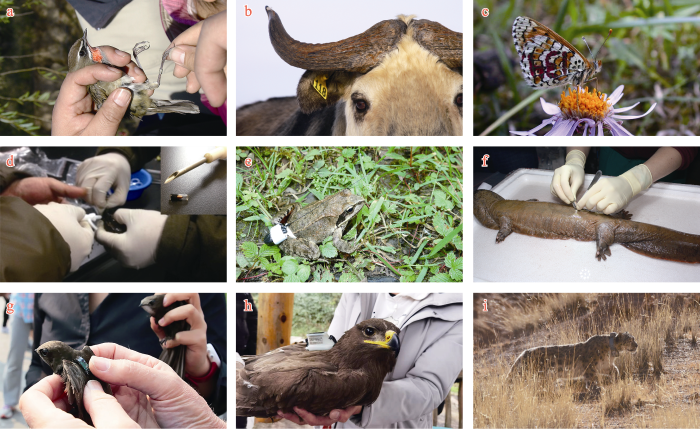
... 动物的标记、定位与追踪历史悠久.传统上主要使用带有编号或独特标志的物理标记, 依赖于对动物个体的重捕或重新观察从而进行空间定位和追踪, 早期可以追溯到19世纪晚期至20世纪初期对鸟类和鱼类使用彩带、脚环等进行的系统的物理标记(Whitney, 2022).脚环、脚旗、颈环等物理标记至今仍是鸟类环志(bird banding/ringing)的主要形式(Anderson & Green, 2009), 耳标、颈圈等物理标记在哺乳类动物的研究中被广泛使用(Powell & Proulx, 2003), 通过在翅上书写或粘贴标记编号的方式在蝴蝶等昆虫的迁飞、扩散研究中也被长期使用(Knight et al, 2008; Kanazawa et al, 2015) (图1 a-c).进入20世纪中期后, 无线电技术的引入使得基于传感器的标记与追踪成为可能, 研究者能够持续地、远距离地获取动物的空间位置信息; 随后, 卫星定位、微电子等各种新技术的快速发展, 使得传感器类型多样化、小型化, 动物追踪的手段愈加丰富和成熟, 应用到的动物类群和研究领域也日益广泛(Whitney, 2022).目前, 国际上野生动物追踪研究所使用的基于传感器的追踪技术主要包括5大类, 分别是无线电遥测(radio telemetry, RT)技术、基于Argos卫星系统(Argos satellite system, ASS)的卫星追踪技术、基于全球定位导航系统(global navigation satellite system, GNSS)的卫星追踪技术、无线射频识别(radio frequency identification, RFID)技术和光敏全球定位传感器(light-level global location sensor, GLS)技术. ...
China checklist of animals
1
2023
... 中国是全球“巨大生物多样性”国家(megadiversity countries)之一, 拥有全球最丰富的野生动物多样性(Mittermeier et al, 1997; Biodiversity Committee of Chinese Academy of Sciences, 2023).基于传感器的野生动物追踪技术在中国的应用起步较晚, 在20世纪80年代, RT技术被引入我国, 应用于野生大熊猫(Ailuropoda melanoleuca)的生态学研究(Schaller et al, 1985; Thomas et al, 2016); 2000年前后, 基于ASS与基于GNSS的卫星追踪技术相继被引入, 应用于绿海龟(Chelonia mydas)、滇金丝猴(Rhinopithecus bieti)、紫貂(Martes zibellina)等的野外研究(Cheng, 2000; 武瑞东, 2006①(①武瑞东 (2006) 基于“3S”技术的滇金丝猴(Rhinopithecus bieti)生境分析. 硕士学位论文, 西南林学院, 昆明.); Xie et al, 2006).此后, 中国的野生动物追踪研究发展迅速, 包括RFID与GLS在内的技术也被用于野生动物的追踪研究, 追踪的动物类群与研究领域随之迅速扩大(图1 d-i).针对某个动物物种或类群(古河祥等, 2007; Thomas et al, 2016)或某项技术(伍和启等, 2008; 沈纹等, 2017), 已有部分研究者对相关技术在我国野生动物研究中的应用进行了总结, 然而, 目前我们仍然缺乏对中国野生动物追踪技术应用现状的整体认识. ...
Technology on the move: Recent and forthcoming innovations for tracking migratory birds
1
2011
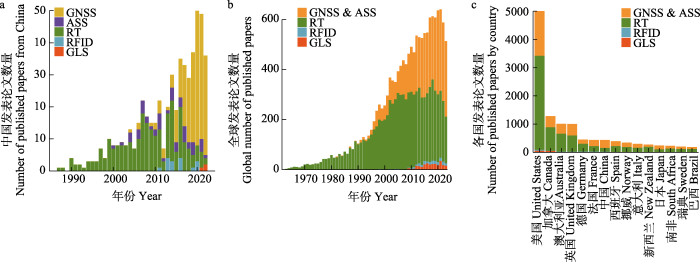
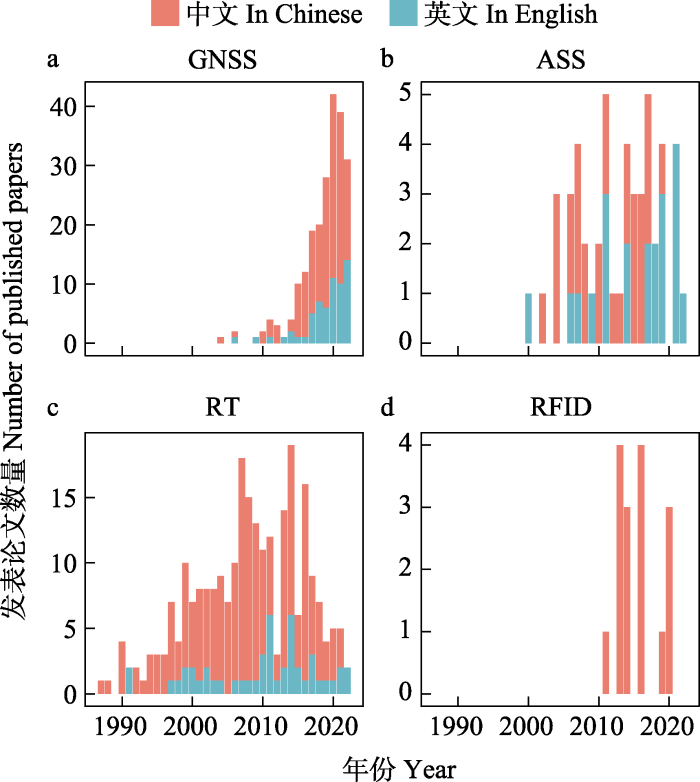
... Argos卫星(ASS)技术主要由以下组成部分构成: 发射器、Argos卫星星座(目前包含9颗极轨卫星)、NOAA卫星等星载传感器(美国NOAA卫星等卫星上所搭载的接收和再发射装置)、地面数据接收与处理站.动物所佩戴的发射器(颈圈或信标)会发出特定的无线电信号, 这些信号可以被经过发射器上空的Argos卫星接收并识别, 然后基于多普勒效应(Doppler effect)对发射器所在位置进行推算, NOAA卫星等星载传感器将相关数据转发至地面接收站进行处理和分发, 从而获取被追踪对象的地理位置等信息(https://www.argos-system.org/).此技术具备广泛的跟踪范围和较长的使用时间, 能够准确获取生物的迁徙时间、停留地点和迁徙路径等重要生物学信息(Bridge et al, 2011).然而, 根据系统的工作原理, 其定位仅在Argos卫星经过追踪器上空时才能进行, 使得能够获取的数据量有限, 空间定位精度相对较低(最高可至250 m) (Newton, 2007).在我国, ASS技术在2000年前后开始应用, 其应用数量在较低水平维持稳定(图2a, 图4b); 曾被用于大型陆生动物和海洋动物的迁徙和生态学研究(王华接等, 2002; Xu et al, 2019).随着技术的进步, ASS信标追踪近年来也被应用于鸟类迁徙研究等领域(Liu et al, 2014; Chen et al, 2021).近年来, 部分追踪装置将全球定位导航卫星(GNSS)模块整合入Argos终端发射器中, 利用Argos卫星星座与系统进行数据传输与发送, 进一步扩展了该系统在野生动物追踪领域的应用场景与应用范围. ...
Territoriality and home range concepts as applied to mammals
1
1943
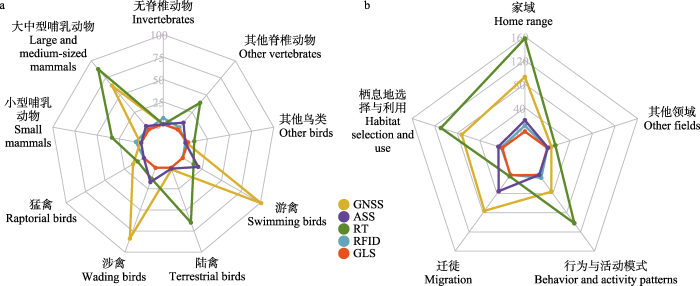
... 家域(home range)是动物在寻找食物、交配和照顾幼崽的正常活动中所穿越的区域(Burt, 1943), 理解家域对于揭示动物行为, 以及进行有效的野生动物管理和制定保护策略具有至关重要的科学和实践意义.在本研究中, 家域的研究内容包括活动范围和区域(端肖楠等, 2016)、活动模式(张飞宇等, 2020b)、日活动范围(蔡路昀等, 2007)、扩散(楚彬等, 2020)、迁移(刘嘉辉等, 2020)等.在检索获得的276篇相关文献中, 有157篇文献运用了RT术来研究家域(图5), 主要关注小型动物和鸟类的扩散、动物的巢址范围与活动范围、繁殖季家域变化等研究问题.最新的研究探讨了黄河滩中华鳖(Pelodiscus sinensis)的家域(Kong et al, 2021).92篇文献采用了GNSS追踪技术, 关注动物的季节性家域、重引入/野放个体的扩散与家域变化等.近五年来使用GNSS技术的文献数量明显增加.此外, 还有部分研究采用了ASS追踪技术和RFID标记技术, 其中RFID标记技术因其研究半径范围的限制, 主要应用于小型动物的家域研究. ...
Home range and daily moving distance of Elliot’s pheasant
1
2007
... 家域(home range)是动物在寻找食物、交配和照顾幼崽的正常活动中所穿越的区域(Burt, 1943), 理解家域对于揭示动物行为, 以及进行有效的野生动物管理和制定保护策略具有至关重要的科学和实践意义.在本研究中, 家域的研究内容包括活动范围和区域(端肖楠等, 2016)、活动模式(张飞宇等, 2020b)、日活动范围(蔡路昀等, 2007)、扩散(楚彬等, 2020)、迁移(刘嘉辉等, 2020)等.在检索获得的276篇相关文献中, 有157篇文献运用了RT术来研究家域(图5), 主要关注小型动物和鸟类的扩散、动物的巢址范围与活动范围、繁殖季家域变化等研究问题.最新的研究探讨了黄河滩中华鳖(Pelodiscus sinensis)的家域(Kong et al, 2021).92篇文献采用了GNSS追踪技术, 关注动物的季节性家域、重引入/野放个体的扩散与家域变化等.近五年来使用GNSS技术的文献数量明显增加.此外, 还有部分研究采用了ASS追踪技术和RFID标记技术, 其中RFID标记技术因其研究半径范围的限制, 主要应用于小型动物的家域研究. ...
白颈长尾雉的活动区和日活动距离
1
2007
... 家域(home range)是动物在寻找食物、交配和照顾幼崽的正常活动中所穿越的区域(Burt, 1943), 理解家域对于揭示动物行为, 以及进行有效的野生动物管理和制定保护策略具有至关重要的科学和实践意义.在本研究中, 家域的研究内容包括活动范围和区域(端肖楠等, 2016)、活动模式(张飞宇等, 2020b)、日活动范围(蔡路昀等, 2007)、扩散(楚彬等, 2020)、迁移(刘嘉辉等, 2020)等.在检索获得的276篇相关文献中, 有157篇文献运用了RT术来研究家域(图5), 主要关注小型动物和鸟类的扩散、动物的巢址范围与活动范围、繁殖季家域变化等研究问题.最新的研究探讨了黄河滩中华鳖(Pelodiscus sinensis)的家域(Kong et al, 2021).92篇文献采用了GNSS追踪技术, 关注动物的季节性家域、重引入/野放个体的扩散与家域变化等.近五年来使用GNSS技术的文献数量明显增加.此外, 还有部分研究采用了ASS追踪技术和RFID标记技术, 其中RFID标记技术因其研究半径范围的限制, 主要应用于小型动物的家域研究. ...
Stopover use of a large estuarine wetland by dunlins during spring and autumn migrations: Linking local refuelling conditions to migratory strategies
1
2022
... 迁徙(migration)是动物为了繁殖、寻找食物或逃避不适宜的季节性环境条件, 穿越大片地理空间的行为(Dingle, 2014).迁徙的研究对于理解动物种群动态、保护策略的制定, 以及人类活动对动物迁徙路径的影响具有重要意义(Moore et al, 1995; Newton, 2007; Wilcove & Wikelski, 2008).在迁徙研究中, ASS追踪技术能够跟踪长距离移动的动物并通过卫星及时回传数据, 适合于研究长距离迁徙的鸟类、海洋哺乳动物和海龟等, 共有35篇相关文献(王华接等, 2002; 韩家波等, 2013; Zhu et al, 2021).近年来, GNSS追踪技术被越来越多地应用于迁徙研究, 因为其可以提供更精确的位置信息和更大数据量的定位记录(Kays et al, 2015), 其使用规模也超过了ASS技术, 共有76篇相关文献, 主要用于研究鸟类的迁徙活动.GLS作为一项新兴的技术, 也被用于体型较小动物的研究迁徙(Turbek et al, 2022; Zhao et al, 2022).VHF无线电遥测技术通常并不直接用于在迁徙途中定位经纬度, 而是通过监测VHF发射器的信号来判断个体在停歇地的停留时长, 当信号消失时则代表个体离开停歇地继续迁徙(Catry et al, 2022). ...
Migration and distribution of released Acipenser sinensis in the sea based on Pop-up Archival Tag technique
1
2011
... 对于两栖、爬行类动物, RT是最常使用的技术, 被用于中国大鲵、扬子鳄(Alligator sinensis)等(Wang et al, 2011; 段玉宝等, 2015).而对于鱼类的研究, ASS技术更为常见, 如鲸鲨(Rhincodon typus)和中华鲟(Hsu et al, 2007; 陈锦辉等, 2011). ...
应用弹式卫星数据回收标志技术研究放流中华鲟幼鱼在海洋中的迁移与分布
1
2011
... 对于两栖、爬行类动物, RT是最常使用的技术, 被用于中国大鲵、扬子鳄(Alligator sinensis)等(Wang et al, 2011; 段玉宝等, 2015).而对于鱼类的研究, ASS技术更为常见, 如鲸鲨(Rhincodon typus)和中华鲟(Hsu et al, 2007; 陈锦辉等, 2011). ...
Home ranges, movements and activity patterns of leopard cats (Prionailurus bengalensis) and threats to them in Taiwan
1
2016
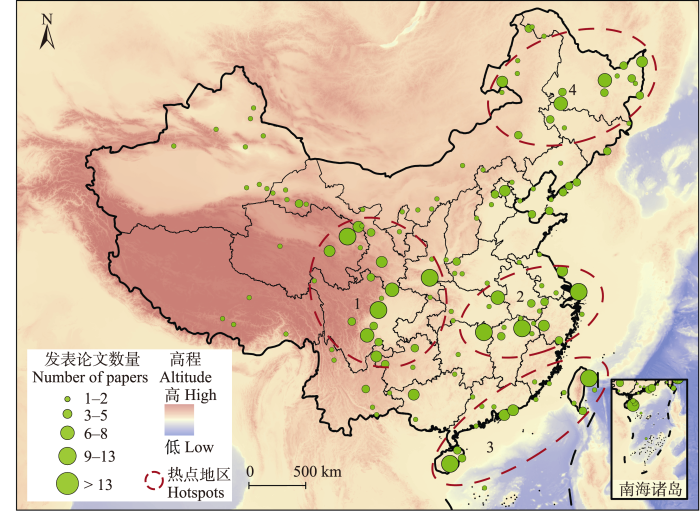
... (3)华东至华南沿海, 包括台湾岛与海南岛.该区域的主要研究对象为迁徙水鸟以及岛屿山地物种; 迁徙鸟类包括大滨鹬(Calidris tenuirostris)、黑腹滨鹬(C. alpina)、中杓鹬(Numenius phaeopus)等鸻鹬类(Ma et al, 2013; Choi et al, 2014; Kuang et al, 2022), 斑嘴鸭(Anas zonorhyncha)、针尾鸭(A. acuta)等雁鸭类(叶思嘉等, 2021; 赵闪闪, 2022), 白鹭(Egretta garzetta)、池鹭(Ardeola bacchus)等鹭科鸟类(赵天天等, 2021); 台湾岛屿物种包括琉球狐蝠(Pteropus dasymallus)、台湾鬣羚(Capricornis swinhoei)、豹猫(Prionailurus bengalensis)等(吴慧雯, 2010①(①吴慧雯 (2010) 台湾狐蝠生态研究之初探. 硕士学位论文, 台湾大学, 台北.); 游显光, 2014②(②游显光 (2014) 长鬃山羊感染穿孔疥癣螨与否的栖地利用及活动模式之比较. 硕士学位论文, 屏东科技大学, 台湾屏东.); Chen et al, 2016; Sun et al, 2018); 海南岛研究对象主要有海南山鹧鸪(Arborophila ardens)、海南孔雀雉(Polyplectron katsumatae)等雉类(汪继超和史海涛, 2002; Rao et al, 2017), 蟒(Python bivittatus)、黄额闭壳龟(Cuora galbinifrons)、锯缘闭壳龟(C. mouhotii)等爬行类(汪继超, 2007③(③汪继超 (2007) 黄额闭壳龟(Cuora galbinifrons)的活动家域和微生境利用. 硕士学位论文, 海南师范大学, 海口); 段玉宝等, 2015; 肖繁荣, 2017), 以及坡鹿(Rucervus eldii)、赤麂(Muntiacus vaginalis)等哺乳动物(Teng et al, 2004; 朱宜君, 2021④(④朱宜君 (2021) 海南坡鹿的运动生态学研究. 硕士学位论文, 陕西理工大学, 陕西汉中.)). ...
Migration routes, population status and important sites used by the globally threatened Black-faced Spoonbill (Platalea minor): A synthesis of surveys and tracking studies
1
2021
... Argos卫星(ASS)技术主要由以下组成部分构成: 发射器、Argos卫星星座(目前包含9颗极轨卫星)、NOAA卫星等星载传感器(美国NOAA卫星等卫星上所搭载的接收和再发射装置)、地面数据接收与处理站.动物所佩戴的发射器(颈圈或信标)会发出特定的无线电信号, 这些信号可以被经过发射器上空的Argos卫星接收并识别, 然后基于多普勒效应(Doppler effect)对发射器所在位置进行推算, NOAA卫星等星载传感器将相关数据转发至地面接收站进行处理和分发, 从而获取被追踪对象的地理位置等信息(https://www.argos-system.org/).此技术具备广泛的跟踪范围和较长的使用时间, 能够准确获取生物的迁徙时间、停留地点和迁徙路径等重要生物学信息(Bridge et al, 2011).然而, 根据系统的工作原理, 其定位仅在Argos卫星经过追踪器上空时才能进行, 使得能够获取的数据量有限, 空间定位精度相对较低(最高可至250 m) (Newton, 2007).在我国, ASS技术在2000年前后开始应用, 其应用数量在较低水平维持稳定(图2a, 图4b); 曾被用于大型陆生动物和海洋动物的迁徙和生态学研究(王华接等, 2002; Xu et al, 2019).随着技术的进步, ASS信标追踪近年来也被应用于鸟类迁徙研究等领域(Liu et al, 2014; Chen et al, 2021).近年来, 部分追踪装置将全球定位导航卫星(GNSS)模块整合入Argos终端发射器中, 利用Argos卫星星座与系统进行数据传输与发送, 进一步扩展了该系统在野生动物追踪领域的应用场景与应用范围. ...
Post-nesting migrations of green turtles (Chelonia mydas) at Wan-An Island, Penghu Archipelago, Taiwan
1
2000
... 中国是全球“巨大生物多样性”国家(megadiversity countries)之一, 拥有全球最丰富的野生动物多样性(Mittermeier et al, 1997; Biodiversity Committee of Chinese Academy of Sciences, 2023).基于传感器的野生动物追踪技术在中国的应用起步较晚, 在20世纪80年代, RT技术被引入我国, 应用于野生大熊猫(Ailuropoda melanoleuca)的生态学研究(Schaller et al, 1985; Thomas et al, 2016); 2000年前后, 基于ASS与基于GNSS的卫星追踪技术相继被引入, 应用于绿海龟(Chelonia mydas)、滇金丝猴(Rhinopithecus bieti)、紫貂(Martes zibellina)等的野外研究(Cheng, 2000; 武瑞东, 2006①(①武瑞东 (2006) 基于“3S”技术的滇金丝猴(Rhinopithecus bieti)生境分析. 硕士学位论文, 西南林学院, 昆明.); Xie et al, 2006).此后, 中国的野生动物追踪研究发展迅速, 包括RFID与GLS在内的技术也被用于野生动物的追踪研究, 追踪的动物类群与研究领域随之迅速扩大(图1 d-i).针对某个动物物种或类群(古河祥等, 2007; Thomas et al, 2016)或某项技术(伍和启等, 2008; 沈纹等, 2017), 已有部分研究者对相关技术在我国野生动物研究中的应用进行了总结, 然而, 目前我们仍然缺乏对中国野生动物追踪技术应用现状的整体认识. ...
The habitat use and home range analysis of dunlin (Calidris alpina) in Chongming Dongtan, China and their conservation implications
1
2014
... (3)华东至华南沿海, 包括台湾岛与海南岛.该区域的主要研究对象为迁徙水鸟以及岛屿山地物种; 迁徙鸟类包括大滨鹬(Calidris tenuirostris)、黑腹滨鹬(C. alpina)、中杓鹬(Numenius phaeopus)等鸻鹬类(Ma et al, 2013; Choi et al, 2014; Kuang et al, 2022), 斑嘴鸭(Anas zonorhyncha)、针尾鸭(A. acuta)等雁鸭类(叶思嘉等, 2021; 赵闪闪, 2022), 白鹭(Egretta garzetta)、池鹭(Ardeola bacchus)等鹭科鸟类(赵天天等, 2021); 台湾岛屿物种包括琉球狐蝠(Pteropus dasymallus)、台湾鬣羚(Capricornis swinhoei)、豹猫(Prionailurus bengalensis)等(吴慧雯, 2010①(①吴慧雯 (2010) 台湾狐蝠生态研究之初探. 硕士学位论文, 台湾大学, 台北.); 游显光, 2014②(②游显光 (2014) 长鬃山羊感染穿孔疥癣螨与否的栖地利用及活动模式之比较. 硕士学位论文, 屏东科技大学, 台湾屏东.); Chen et al, 2016; Sun et al, 2018); 海南岛研究对象主要有海南山鹧鸪(Arborophila ardens)、海南孔雀雉(Polyplectron katsumatae)等雉类(汪继超和史海涛, 2002; Rao et al, 2017), 蟒(Python bivittatus)、黄额闭壳龟(Cuora galbinifrons)、锯缘闭壳龟(C. mouhotii)等爬行类(汪继超, 2007③(③汪继超 (2007) 黄额闭壳龟(Cuora galbinifrons)的活动家域和微生境利用. 硕士学位论文, 海南师范大学, 海口); 段玉宝等, 2015; 肖繁荣, 2017), 以及坡鹿(Rucervus eldii)、赤麂(Muntiacus vaginalis)等哺乳动物(Teng et al, 2004; 朱宜君, 2021④(④朱宜君 (2021) 海南坡鹿的运动生态学研究. 硕士学位论文, 陕西理工大学, 陕西汉中.)). ...
Preliminary study on dispersal characteristics of populations of plateau zokor (Myospalax baileyi) on a small scale
3
2020
... 与可以自动定位的卫星追踪器相比, VHF无线电遥测的设备成本相对较低, 但需要研究人员进行野外主动获取数据; 遥测过程受到外界以及人为因素干扰较多, 很难达到极高的精度(沈纹等, 2017).基于其特点, VHF无线电遥测的应用在直接进行定位追踪之外也较为多样化, 例如通过遥测辅助追踪动物种群的大概位置, 进一步进行目视观测(马志军等, 2001); 利用发射器返回的电波频率变化判断动物活动情况(静息或运动), 进行活动节律的研究(曾治高和宋延龄, 2001); 通过是否能够接收到发射器信号判断动物是否已离开研究区域开始进行迁徙或扩散等(Kauhala et al, 2006; 楚彬等, 2020).此外, 目前部分卫星追踪颈圈也整合有VHF发射器模块, 以方便研究者在野外通过天线定位搜寻直接对动物个体进行观察, 或者在动物死亡、颈圈脱落等情况下, 方便再次找到、回收颈圈装置. ...
... 对于小型哺乳动物来说, RT也是应用最多的技术(82.50%), 被用于高原鼢鼠(Eospalax baileyi)、赤腹松鼠(Callosciurus erythraeus)、棕果蝠(Rousettus leschenaultii)等物种的研究(Tang et al, 2010; 袁耀华等, 2019; 张飞宇等, 2020a).RFID技术也有少部分应用, 主要用于花鼠和高原鼢鼠(杨慧等, 2013; 楚彬等, 2020). ...
... 家域(home range)是动物在寻找食物、交配和照顾幼崽的正常活动中所穿越的区域(Burt, 1943), 理解家域对于揭示动物行为, 以及进行有效的野生动物管理和制定保护策略具有至关重要的科学和实践意义.在本研究中, 家域的研究内容包括活动范围和区域(端肖楠等, 2016)、活动模式(张飞宇等, 2020b)、日活动范围(蔡路昀等, 2007)、扩散(楚彬等, 2020)、迁移(刘嘉辉等, 2020)等.在检索获得的276篇相关文献中, 有157篇文献运用了RT术来研究家域(图5), 主要关注小型动物和鸟类的扩散、动物的巢址范围与活动范围、繁殖季家域变化等研究问题.最新的研究探讨了黄河滩中华鳖(Pelodiscus sinensis)的家域(Kong et al, 2021).92篇文献采用了GNSS追踪技术, 关注动物的季节性家域、重引入/野放个体的扩散与家域变化等.近五年来使用GNSS技术的文献数量明显增加.此外, 还有部分研究采用了ASS追踪技术和RFID标记技术, 其中RFID标记技术因其研究半径范围的限制, 主要应用于小型动物的家域研究. ...
基于小尺度的高原鼢鼠(Myospalax baileyi)扩散初探
3
2020
... 与可以自动定位的卫星追踪器相比, VHF无线电遥测的设备成本相对较低, 但需要研究人员进行野外主动获取数据; 遥测过程受到外界以及人为因素干扰较多, 很难达到极高的精度(沈纹等, 2017).基于其特点, VHF无线电遥测的应用在直接进行定位追踪之外也较为多样化, 例如通过遥测辅助追踪动物种群的大概位置, 进一步进行目视观测(马志军等, 2001); 利用发射器返回的电波频率变化判断动物活动情况(静息或运动), 进行活动节律的研究(曾治高和宋延龄, 2001); 通过是否能够接收到发射器信号判断动物是否已离开研究区域开始进行迁徙或扩散等(Kauhala et al, 2006; 楚彬等, 2020).此外, 目前部分卫星追踪颈圈也整合有VHF发射器模块, 以方便研究者在野外通过天线定位搜寻直接对动物个体进行观察, 或者在动物死亡、颈圈脱落等情况下, 方便再次找到、回收颈圈装置. ...
... 对于小型哺乳动物来说, RT也是应用最多的技术(82.50%), 被用于高原鼢鼠(Eospalax baileyi)、赤腹松鼠(Callosciurus erythraeus)、棕果蝠(Rousettus leschenaultii)等物种的研究(Tang et al, 2010; 袁耀华等, 2019; 张飞宇等, 2020a).RFID技术也有少部分应用, 主要用于花鼠和高原鼢鼠(杨慧等, 2013; 楚彬等, 2020). ...
... 家域(home range)是动物在寻找食物、交配和照顾幼崽的正常活动中所穿越的区域(Burt, 1943), 理解家域对于揭示动物行为, 以及进行有效的野生动物管理和制定保护策略具有至关重要的科学和实践意义.在本研究中, 家域的研究内容包括活动范围和区域(端肖楠等, 2016)、活动模式(张飞宇等, 2020b)、日活动范围(蔡路昀等, 2007)、扩散(楚彬等, 2020)、迁移(刘嘉辉等, 2020)等.在检索获得的276篇相关文献中, 有157篇文献运用了RT术来研究家域(图5), 主要关注小型动物和鸟类的扩散、动物的巢址范围与活动范围、繁殖季家域变化等研究问题.最新的研究探讨了黄河滩中华鳖(Pelodiscus sinensis)的家域(Kong et al, 2021).92篇文献采用了GNSS追踪技术, 关注动物的季节性家域、重引入/野放个体的扩散与家域变化等.近五年来使用GNSS技术的文献数量明显增加.此外, 还有部分研究采用了ASS追踪技术和RFID标记技术, 其中RFID标记技术因其研究半径范围的限制, 主要应用于小型动物的家域研究. ...
Satellite-tracking migration route of great black-headed gulls breeding at Qinghai Lake, China
1
2008
... (1)青藏高原东缘及周边山地, 包括祁连山、横断山、秦岭等.该区域的主要研究对象为山地哺乳动物, 如大熊猫(Liu et al, 2011, 2015; 周世强等, 2019)、中华小熊猫(Ailurus styani) (韩宗先等, 2005, 2006; 杨建东等, 2006)、川金丝猴(Rhinopithecus roxellana) (栗其, 2016①(①栗其 (2016) 秦岭北坡川金丝猴(Rhinopithecus roxellana)栖息地选择差异的研究. 硕士学位论文, 西北大学, 西安.); 边坤, 2017②(②边坤 (2017) 秦岭金丝猴(Rhinopithecus roxellana)社群分离聚合规律及海拔分布模式的研究. 硕士学位论文, 西北大学, 西安.); 刘嘉辉, 2020③(③刘嘉辉 (2020) 秦岭川金丝猴(Rhinopithecus roxellana)移动成本与取食利益的季节性平衡策略. 硕士学位论文, 西北大学, 西安.))、中华扭角羚(Budorcas taxicolor) (曾治高和宋延龄, 2001; 宋延龄和曾治高, 2006; Yan et al, 2017a)等, 以及山地和高原繁殖鸟类, 如朱鹮(Nipponia nippon) (胡灿实, 2016; 朱梦, 2020④(④朱梦 (2020) 陕西宁陕朱鹮(Nipponia nippon)再引入种群的扩散生态学研究. 硕士学位论文, 陕西师范大学, 西安.))、血雉(Ithaginis cruentus) (贾陈喜等, 2004)、渔鸥(Ichthyaetus ichthyaetus)、斑头雁(Anser indicus)、普通鸬鹚(Phalacrocorax carbo) (楚国忠等, 2008; 张国钢等, 2008; Zhang et al, 2020)等. ...
卫星跟踪青海湖繁殖地渔鸥的迁徙路线
1
2008
... (1)青藏高原东缘及周边山地, 包括祁连山、横断山、秦岭等.该区域的主要研究对象为山地哺乳动物, 如大熊猫(Liu et al, 2011, 2015; 周世强等, 2019)、中华小熊猫(Ailurus styani) (韩宗先等, 2005, 2006; 杨建东等, 2006)、川金丝猴(Rhinopithecus roxellana) (栗其, 2016①(①栗其 (2016) 秦岭北坡川金丝猴(Rhinopithecus roxellana)栖息地选择差异的研究. 硕士学位论文, 西北大学, 西安.); 边坤, 2017②(②边坤 (2017) 秦岭金丝猴(Rhinopithecus roxellana)社群分离聚合规律及海拔分布模式的研究. 硕士学位论文, 西北大学, 西安.); 刘嘉辉, 2020③(③刘嘉辉 (2020) 秦岭川金丝猴(Rhinopithecus roxellana)移动成本与取食利益的季节性平衡策略. 硕士学位论文, 西北大学, 西安.))、中华扭角羚(Budorcas taxicolor) (曾治高和宋延龄, 2001; 宋延龄和曾治高, 2006; Yan et al, 2017a)等, 以及山地和高原繁殖鸟类, 如朱鹮(Nipponia nippon) (胡灿实, 2016; 朱梦, 2020④(④朱梦 (2020) 陕西宁陕朱鹮(Nipponia nippon)再引入种群的扩散生态学研究. 硕士学位论文, 陕西师范大学, 西安.))、血雉(Ithaginis cruentus) (贾陈喜等, 2004)、渔鸥(Ichthyaetus ichthyaetus)、斑头雁(Anser indicus)、普通鸬鹚(Phalacrocorax carbo) (楚国忠等, 2008; 张国钢等, 2008; Zhang et al, 2020)等. ...
Breeding success in a houbara bustard Chlamydotis [undulata] macqueenii population on the eastern fringe of the Jungar Basin, People’s Republic of China
2
2002
... 不属于上述4个领域的研究统一划分到“其他领域” (2.92%).不同的追踪技术结合动物个体观察、个体重捕或追踪器回收等方法, 被用于研究个体死亡原因、种群存活率、鸟撞风险等(Combreau et al, 2002; 李夏等, 2013; Wu et al, 2018b; 赵闪闪, 2022). ...
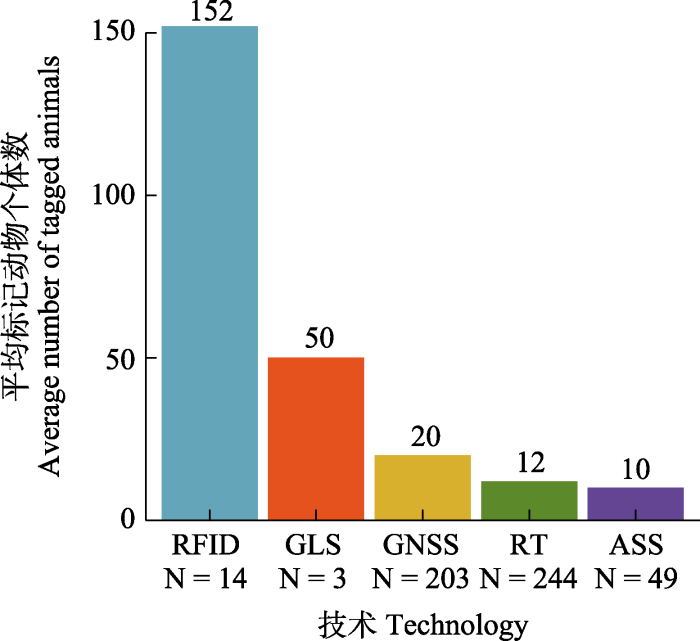
... 在使用VHF无线电遥测技术的研究中, 监测个体数最多的是一项关于圈养中华小熊猫的昼夜活动节律研究, 达87个个体(韩宗先等, 2005); 其次为波斑鸨(Chlamydotis macqueenii)的繁殖成功率研究和鸳鸯(Aix galericulata)的家域研究, 分别监测了82和81个个体(Combreau et al, 2002; Sun et al, 2014); 此外, 有39项研究标记的个体数为3, 32项研究标记的个体数为4.该技术在每项研究中平均能对单一个体获取数量级为百的有效定位点. ...
The roosting behavior and roost-site selection of Temminck’s tragopan (Tragopan temminckii) in Laojunshan Natural Reserve, Sichuan, China
1
2008
... 陆禽类的研究主要使用RT, 研究对象包括黑颈长尾雉(Syrmaticus humiae) (原宝东等, 2017)、红腹角雉(Tragopan temminckii) (丛培昊和郑光美, 2008)、斑尾榛鸡(Tetrastes sewerzowi) (石美等, 2013)等体型较大的鸡形目鸟类.2018年以来, GNSS追踪技术开始应用于猛禽类研究, 如猎隼(Falco cherrug) (王鹏华等, 2020)、凤头蜂鹰(Pernis ptilorhynchus) (于国祥等, 2022)等. ...
四川老君山地区红腹角雉的夜栖行为和夜栖地选择
1
2008
... 陆禽类的研究主要使用RT, 研究对象包括黑颈长尾雉(Syrmaticus humiae) (原宝东等, 2017)、红腹角雉(Tragopan temminckii) (丛培昊和郑光美, 2008)、斑尾榛鸡(Tetrastes sewerzowi) (石美等, 2013)等体型较大的鸡形目鸟类.2018年以来, GNSS追踪技术开始应用于猛禽类研究, 如猎隼(Falco cherrug) (王鹏华等, 2020)、凤头蜂鹰(Pernis ptilorhynchus) (于国祥等, 2022)等. ...
Biotelemetry: A mechanistic approach to ecology
1
2004
... 动物的运动(movement)被定义为个体的空间位置随时间的变化, 是动物个体完成其生活史的基础(Nathan et al, 2008).动物运动的模式与规律是其栖息地选择、个体扩散与领域建立、个体间与种间相互作用等生态过程的外在体现, 受到个体生理状态、个体间关系、种间关系、环境因子等诸多因素的影响.标记、定位与追踪动物个体, 是动物生态学研究的重要途径, 可以帮助我们获得动物空间移动的基础数据, 为进一步理解动物个体与环境交互的生态过程、种群动态、种群间基因交流、景观生态网络等多层次的问题提供了基础(Cooke et al, 2004; Jeltsch et al, 2013; 李月辉和胡远满, 2021). ...
Movement range and variation of re-introduced red-crowned cranes (Grus japonensis) in the early stages after release in the wild
1
2017
... GNSS技术从2005年前后开始在我国得到应用, 2015年前后开始大幅增长, 近5年来已经成为动物追踪研究中应用最多的技术(图2a, 图4a).现如今我国的研究多采用卫星定位追踪颈圈对野生脊椎动物进行监测, 因其具有高效、便利、可靠等多方面的优点(葛宝明等, 2012), 被广泛用于跟踪野生动物的活动以及栖息地利用(Ren et al, 2009; Yan et al, 2017b)、动物野化放归(古晓东等, 2011; 崔多英等, 2017)、鸟类迁徙(杨晓君等, 2005; 李秀明等, 2016)和物种间的相互影响(Li et al, 2017; Weng et al, 2022)等野生动物生态学研究. ...
重引入丹顶鹤野放初期活动范围及变化规律
1
2017
... GNSS技术从2005年前后开始在我国得到应用, 2015年前后开始大幅增长, 近5年来已经成为动物追踪研究中应用最多的技术(图2a, 图4a).现如今我国的研究多采用卫星定位追踪颈圈对野生脊椎动物进行监测, 因其具有高效、便利、可靠等多方面的优点(葛宝明等, 2012), 被广泛用于跟踪野生动物的活动以及栖息地利用(Ren et al, 2009; Yan et al, 2017b)、动物野化放归(古晓东等, 2011; 崔多英等, 2017)、鸟类迁徙(杨晓君等, 2005; 李秀明等, 2016)和物种间的相互影响(Li et al, 2017; Weng et al, 2022)等野生动物生态学研究. ...
Effects of radio-collar position and orientation on GPS radio-collar performance, and the implications of PDOP in data screening
1
2005
... 全球定位导航卫星(GNSS)技术利用全球卫星导航系统进行全球任意位点空间定位, 包括美国的GPS系统(global positioning system)、中国的北斗卫星导航系统(BDS)、俄罗斯的格洛纳斯系统(GLONASS)和欧洲的伽利略卫星导航系统(GALILEO)等.动物所佩戴的追踪器内置卫星定位导航芯片, 无需主动发射信号, 仅需接收定位卫星的信号, 即可完成基于精准测距(卫星与接收装置之间的距离)的定位计算; 部分追踪器可以兼容接收多个全球定位导航系统的信号(Misra & Enge, 2006).追踪器内定位数据的回收有多种方式, 常见的有本地存储(存储在追踪器内)、短距离UHF无线下载、GSM网络无线传输和卫星传输4种; 部分型号的追踪器可以同时整合使用其中的2种或多种方式.根据研究地点和对象的不同, 每种方式具有各自的优势(Tomkiewicz et al, 2010).全球卫星导航系统中, GPS卫星定位系统目前在我国的野生动物标记、定位和追踪研究中被广泛采用.尽管GNSS技术的成本较高(追踪器价格及数据传输费用高), 但其定位频率较高, 数据量大, 数据精度更高, 空间定位误差通常在数十米内, 甚至可以达到米级或亚米级, 具有多方面的优势(D’EON & Delparte, 2005). ...
Analysis and visualisation of movement: An interdisciplinary review
1
2015
... (2)加强多学科合作与技术创新.野生动物追踪研究的发展应进一步加强与地理信息、计算机、信息科学等多学科之间的合作, 推动对基于时空尺度的大量个体数据的分析方法的发展以及基于个体移动模式的生态模型的开发等, 进一步推动动物学、生态学以及相关领域的研究.例如, 欧洲跨学科合作项目European COST Action IC0903 “Knowledge Discovery from Moving Objects (MOVE)”将多学科的研究方法整合入动物空间移动轨迹的几何分析、动物空间移动与环境因素的相互作用以及从空间数据中识别动物行为等研究, 为动物追踪数据的深入挖掘和生态机制研究提供了具有创新性的视角(Demšar et al, 2015).在生物多样性野外监测的硬件与软件方面, 可以将动物追踪与迅速发展的物联网技术相结合, 借助大数据平台与人工智能(AI)技术对数据进行实时追踪、管理与监测, 实现更高效、全面的数据获取、分析与利用(Guo et al, 2015; Khan et al, 2020).动物追踪设备可以作为生物多样性监测网络中的野外传感器节点, 通过将追踪设备与物联网连接, 实现实时或近实时的数据传输和追踪; 这些数据和物联网中其他传感器节点所收集的其他生物、环境因子的数据可以同时传输到大数据平台, 进行存储和整合分析.大数据平台能够处理和存储庞大的数据集, 而人工智能技术可以应用于自动化的数据分析和模式识别, 帮助研究人员揭示动物的迁移模式、环境响应等规律, 并从中提取和生成可以用于量化评估生物多样性状态与动态的各类指标. ...
Spring migration duration exceeds that of autumn migration in Far East Asian Greater White-fronted Geese (Anser albifrons)
1
2019
... (4)进一步推动国产追踪设备的研发与完善.早期, 我国野生动物追踪所用的传感器设备均来自国外厂商, 在实际应用中面临设备价格昂贵、采购与进口贸易手续繁琐、售后服务困难、数据安全性难以保障等诸多问题.近十年来, 随着我国野生动物追踪研究的快速发展和追踪规模的扩大, 国内也出现了若干可以研发、生产用于野生动物追踪的卫星定位设备的科技公司, 相关追踪器产品在迁徙鸟类(例如Deng et al, 2019; Xu et al, 2022a)、哺乳类(例如Li et al, 2022; 孔玥峤等, 2022)等动物类群上得到大量应用.在此过程中, 国产设备与相关的数据服务在实践中得到检验, 其成熟度和可靠性逐步提升, 为我国野生动物追踪研究的开展提供了便利.但是, 相较于国际上的一些拥有较长历史的动物追踪器生产商及其产品相比, 部分国产设备在动物适配性、野外工作的可靠性和技术完善度等方面仍有待提高.这需要野生动物研究者、设备研发方、产品经销方、平台与服务提供方等多方共同合作, 在技术研发、质量控制、标准制定、人(动物)-机功效等各方面持续努力, 以提高国产设备的性能、质量和竞争力. ...
1
2014
... 迁徙(migration)是动物为了繁殖、寻找食物或逃避不适宜的季节性环境条件, 穿越大片地理空间的行为(Dingle, 2014).迁徙的研究对于理解动物种群动态、保护策略的制定, 以及人类活动对动物迁徙路径的影响具有重要意义(Moore et al, 1995; Newton, 2007; Wilcove & Wikelski, 2008).在迁徙研究中, ASS追踪技术能够跟踪长距离移动的动物并通过卫星及时回传数据, 适合于研究长距离迁徙的鸟类、海洋哺乳动物和海龟等, 共有35篇相关文献(王华接等, 2002; 韩家波等, 2013; Zhu et al, 2021).近年来, GNSS追踪技术被越来越多地应用于迁徙研究, 因为其可以提供更精确的位置信息和更大数据量的定位记录(Kays et al, 2015), 其使用规模也超过了ASS技术, 共有76篇相关文献, 主要用于研究鸟类的迁徙活动.GLS作为一项新兴的技术, 也被用于体型较小动物的研究迁徙(Turbek et al, 2022; Zhao et al, 2022).VHF无线电遥测技术通常并不直接用于在迁徙途中定位经纬度, 而是通过监测VHF发射器的信号来判断个体在停歇地的停留时长, 当信号消失时则代表个体离开停歇地继续迁徙(Catry et al, 2022). ...
The largest gray wolf (Canis lupus) home ranges in the world may exist in the Mount Kalamaili Ungulate Nature Reserve, Xinjiang, China
1
2016
... 家域(home range)是动物在寻找食物、交配和照顾幼崽的正常活动中所穿越的区域(Burt, 1943), 理解家域对于揭示动物行为, 以及进行有效的野生动物管理和制定保护策略具有至关重要的科学和实践意义.在本研究中, 家域的研究内容包括活动范围和区域(端肖楠等, 2016)、活动模式(张飞宇等, 2020b)、日活动范围(蔡路昀等, 2007)、扩散(楚彬等, 2020)、迁移(刘嘉辉等, 2020)等.在检索获得的276篇相关文献中, 有157篇文献运用了RT术来研究家域(图5), 主要关注小型动物和鸟类的扩散、动物的巢址范围与活动范围、繁殖季家域变化等研究问题.最新的研究探讨了黄河滩中华鳖(Pelodiscus sinensis)的家域(Kong et al, 2021).92篇文献采用了GNSS追踪技术, 关注动物的季节性家域、重引入/野放个体的扩散与家域变化等.近五年来使用GNSS技术的文献数量明显增加.此外, 还有部分研究采用了ASS追踪技术和RFID标记技术, 其中RFID标记技术因其研究半径范围的限制, 主要应用于小型动物的家域研究. ...
新疆卡拉麦里山有蹄类自然保护区冬季狼的家域
1
2016
... 家域(home range)是动物在寻找食物、交配和照顾幼崽的正常活动中所穿越的区域(Burt, 1943), 理解家域对于揭示动物行为, 以及进行有效的野生动物管理和制定保护策略具有至关重要的科学和实践意义.在本研究中, 家域的研究内容包括活动范围和区域(端肖楠等, 2016)、活动模式(张飞宇等, 2020b)、日活动范围(蔡路昀等, 2007)、扩散(楚彬等, 2020)、迁移(刘嘉辉等, 2020)等.在检索获得的276篇相关文献中, 有157篇文献运用了RT术来研究家域(图5), 主要关注小型动物和鸟类的扩散、动物的巢址范围与活动范围、繁殖季家域变化等研究问题.最新的研究探讨了黄河滩中华鳖(Pelodiscus sinensis)的家域(Kong et al, 2021).92篇文献采用了GNSS追踪技术, 关注动物的季节性家域、重引入/野放个体的扩散与家域变化等.近五年来使用GNSS技术的文献数量明显增加.此外, 还有部分研究采用了ASS追踪技术和RFID标记技术, 其中RFID标记技术因其研究半径范围的限制, 主要应用于小型动物的家域研究. ...
Bed-site habitat use of Burmese python (Python bivittatus) during early reintroduction in Hainan Yinggeling National Nature Reserve
2
2015
... (3)华东至华南沿海, 包括台湾岛与海南岛.该区域的主要研究对象为迁徙水鸟以及岛屿山地物种; 迁徙鸟类包括大滨鹬(Calidris tenuirostris)、黑腹滨鹬(C. alpina)、中杓鹬(Numenius phaeopus)等鸻鹬类(Ma et al, 2013; Choi et al, 2014; Kuang et al, 2022), 斑嘴鸭(Anas zonorhyncha)、针尾鸭(A. acuta)等雁鸭类(叶思嘉等, 2021; 赵闪闪, 2022), 白鹭(Egretta garzetta)、池鹭(Ardeola bacchus)等鹭科鸟类(赵天天等, 2021); 台湾岛屿物种包括琉球狐蝠(Pteropus dasymallus)、台湾鬣羚(Capricornis swinhoei)、豹猫(Prionailurus bengalensis)等(吴慧雯, 2010①(①吴慧雯 (2010) 台湾狐蝠生态研究之初探. 硕士学位论文, 台湾大学, 台北.); 游显光, 2014②(②游显光 (2014) 长鬃山羊感染穿孔疥癣螨与否的栖地利用及活动模式之比较. 硕士学位论文, 屏东科技大学, 台湾屏东.); Chen et al, 2016; Sun et al, 2018); 海南岛研究对象主要有海南山鹧鸪(Arborophila ardens)、海南孔雀雉(Polyplectron katsumatae)等雉类(汪继超和史海涛, 2002; Rao et al, 2017), 蟒(Python bivittatus)、黄额闭壳龟(Cuora galbinifrons)、锯缘闭壳龟(C. mouhotii)等爬行类(汪继超, 2007③(③汪继超 (2007) 黄额闭壳龟(Cuora galbinifrons)的活动家域和微生境利用. 硕士学位论文, 海南师范大学, 海口); 段玉宝等, 2015; 肖繁荣, 2017), 以及坡鹿(Rucervus eldii)、赤麂(Muntiacus vaginalis)等哺乳动物(Teng et al, 2004; 朱宜君, 2021④(④朱宜君 (2021) 海南坡鹿的运动生态学研究. 硕士学位论文, 陕西理工大学, 陕西汉中.)). ...
... 对于两栖、爬行类动物, RT是最常使用的技术, 被用于中国大鲵、扬子鳄(Alligator sinensis)等(Wang et al, 2011; 段玉宝等, 2015).而对于鱼类的研究, ASS技术更为常见, 如鲸鲨(Rhincodon typus)和中华鲟(Hsu et al, 2007; 陈锦辉等, 2011). ...
海南鹦哥岭缅甸蟒放归初期停卧地的利用
2
2015
... (3)华东至华南沿海, 包括台湾岛与海南岛.该区域的主要研究对象为迁徙水鸟以及岛屿山地物种; 迁徙鸟类包括大滨鹬(Calidris tenuirostris)、黑腹滨鹬(C. alpina)、中杓鹬(Numenius phaeopus)等鸻鹬类(Ma et al, 2013; Choi et al, 2014; Kuang et al, 2022), 斑嘴鸭(Anas zonorhyncha)、针尾鸭(A. acuta)等雁鸭类(叶思嘉等, 2021; 赵闪闪, 2022), 白鹭(Egretta garzetta)、池鹭(Ardeola bacchus)等鹭科鸟类(赵天天等, 2021); 台湾岛屿物种包括琉球狐蝠(Pteropus dasymallus)、台湾鬣羚(Capricornis swinhoei)、豹猫(Prionailurus bengalensis)等(吴慧雯, 2010①(①吴慧雯 (2010) 台湾狐蝠生态研究之初探. 硕士学位论文, 台湾大学, 台北.); 游显光, 2014②(②游显光 (2014) 长鬃山羊感染穿孔疥癣螨与否的栖地利用及活动模式之比较. 硕士学位论文, 屏东科技大学, 台湾屏东.); Chen et al, 2016; Sun et al, 2018); 海南岛研究对象主要有海南山鹧鸪(Arborophila ardens)、海南孔雀雉(Polyplectron katsumatae)等雉类(汪继超和史海涛, 2002; Rao et al, 2017), 蟒(Python bivittatus)、黄额闭壳龟(Cuora galbinifrons)、锯缘闭壳龟(C. mouhotii)等爬行类(汪继超, 2007③(③汪继超 (2007) 黄额闭壳龟(Cuora galbinifrons)的活动家域和微生境利用. 硕士学位论文, 海南师范大学, 海口); 段玉宝等, 2015; 肖繁荣, 2017), 以及坡鹿(Rucervus eldii)、赤麂(Muntiacus vaginalis)等哺乳动物(Teng et al, 2004; 朱宜君, 2021④(④朱宜君 (2021) 海南坡鹿的运动生态学研究. 硕士学位论文, 陕西理工大学, 陕西汉中.)). ...
... 对于两栖、爬行类动物, RT是最常使用的技术, 被用于中国大鲵、扬子鳄(Alligator sinensis)等(Wang et al, 2011; 段玉宝等, 2015).而对于鱼类的研究, ASS技术更为常见, 如鲸鲨(Rhincodon typus)和中华鲟(Hsu et al, 2007; 陈锦辉等, 2011). ...
Tracking migratory songbirds: Accuracy of light-level loggers (geolocators) in forest habitats
1
2012
... GLS最早用于海豹等海洋动物的追踪, 由于其结构较简单, 体积和重量可以做到极小, 近年来开始应用于小型鸟类的长距离迁徙研究, 尤其是那些由于体重限制而无法背负卫星定位传感器的物种(Roger, 1994; McKinnon & Love, 2018).由于能够记录光的遮蔽情况, 该技术也被应用于对动物筑巢、育雏情况的研究(Huang et al, 2021; Merkel et al, 2023).相比于卫星定位等技术, GLS的空间定位精度相对较低, 定位误差在数千米到数百千米不等, 受到环境条件、动物行为等因素影响, 因此大多被用于具有长距离(数千千米以上)移动的动物(Fudickar et al, 2012).在国内, GLS目前主要被应用于普通雨燕(Apus apus)、家燕(Hirundo rustica)等对巢址具有较高忠诚度(方便个体重捕与设备回收)的小型迁徙鸟类, 以研究其育雏及迁徙(Huang et al, 2021; Turbek et al, 2022; Zhao et al, 2022), 应用规模相对较小. ...
Migration strategy of the Bohai Bay wintering population of juvenile Oriental Storks (Ciconia boyciana)
1
2022
... (4)东北地区.该区域的主要研究对象为迁徙越冬鸟类, 如东方白鹳(Ciconia boyciana) (嘎日迪等, 2022)、白枕鹤(刘福剀, 2008⑤(⑤刘福剀 (2008) 扎龙湿地白枕鹤栖息地利用. 硕士学位论文, 东北林业大学, 哈尔滨.))、白琵鹭(Platalea leucorodia) (张余广等, 2018)等, 以及部分啮齿类哺乳动物, 如花鼠(Tamias sibiricus) (刘蓓蓓, 2016⑥(⑥刘蓓蓓 (2016) 阔叶红松林中西伯利亚花鼠种群的年际波动. 硕士学位论文, 东北林业大学, 哈尔滨.))、北松鼠(Sciurus vulgaris) (哈丽亚和戎可, 2013)等. ...
东方白鹳幼鸟渤海湾越冬群体的迁徙策略
1
2022
... (4)东北地区.该区域的主要研究对象为迁徙越冬鸟类, 如东方白鹳(Ciconia boyciana) (嘎日迪等, 2022)、白枕鹤(刘福剀, 2008⑤(⑤刘福剀 (2008) 扎龙湿地白枕鹤栖息地利用. 硕士学位论文, 东北林业大学, 哈尔滨.))、白琵鹭(Platalea leucorodia) (张余广等, 2018)等, 以及部分啮齿类哺乳动物, 如花鼠(Tamias sibiricus) (刘蓓蓓, 2016⑥(⑥刘蓓蓓 (2016) 阔叶红松林中西伯利亚花鼠种群的年际波动. 硕士学位论文, 东北林业大学, 哈尔滨.))、北松鼠(Sciurus vulgaris) (哈丽亚和戎可, 2013)等. ...
The applications of the GPS collar system in wild animal management and monitoring
2
2012
... GNSS技术从2005年前后开始在我国得到应用, 2015年前后开始大幅增长, 近5年来已经成为动物追踪研究中应用最多的技术(图2a, 图4a).现如今我国的研究多采用卫星定位追踪颈圈对野生脊椎动物进行监测, 因其具有高效、便利、可靠等多方面的优点(葛宝明等, 2012), 被广泛用于跟踪野生动物的活动以及栖息地利用(Ren et al, 2009; Yan et al, 2017b)、动物野化放归(古晓东等, 2011; 崔多英等, 2017)、鸟类迁徙(杨晓君等, 2005; 李秀明等, 2016)和物种间的相互影响(Li et al, 2017; Weng et al, 2022)等野生动物生态学研究. ...
... 在此过程中, 用于野生动物标记、定位和追踪的技术与设备在快速发展与更新.早期, 传统的VHF无线电遥测技术在我国应用较多, 该技术具有成本低的优势, 但其工作范围受限、人力需求高、数据量有限等局限性逐渐凸显, 因此近10年来其使用规模已逐渐下降(图2a, 图4c).自2010年以来, 随着新技术的出现、发展完善和成本的降低, GNSS技术的应用规模迅速增长(图2a, 图4a).GNSS设备的价格与数据服务费用较高, 同时在地形复杂区域的定位效果会受到一定影响(周世强等, 2012), 但与传统的VHF无线电遥测技术相比, GNSS技术具有许多显著优势, 如数据定位精度高、定位频次高、工作时间长、收集数据量大、不受动物活动范围限制、具有实时或近实时回传定位数据的能力等, 因此目前已经成为我国野生动物(尤其是鸟、兽等脊椎动物)追踪研究中所使用的主流技术(葛宝明等, 2012; 肖文宏, 2020). ...
GPS项圈系统在野生动物管理与监测中的应用
2
2012
... GNSS技术从2005年前后开始在我国得到应用, 2015年前后开始大幅增长, 近5年来已经成为动物追踪研究中应用最多的技术(图2a, 图4a).现如今我国的研究多采用卫星定位追踪颈圈对野生脊椎动物进行监测, 因其具有高效、便利、可靠等多方面的优点(葛宝明等, 2012), 被广泛用于跟踪野生动物的活动以及栖息地利用(Ren et al, 2009; Yan et al, 2017b)、动物野化放归(古晓东等, 2011; 崔多英等, 2017)、鸟类迁徙(杨晓君等, 2005; 李秀明等, 2016)和物种间的相互影响(Li et al, 2017; Weng et al, 2022)等野生动物生态学研究. ...
... 在此过程中, 用于野生动物标记、定位和追踪的技术与设备在快速发展与更新.早期, 传统的VHF无线电遥测技术在我国应用较多, 该技术具有成本低的优势, 但其工作范围受限、人力需求高、数据量有限等局限性逐渐凸显, 因此近10年来其使用规模已逐渐下降(图2a, 图4c).自2010年以来, 随着新技术的出现、发展完善和成本的降低, GNSS技术的应用规模迅速增长(图2a, 图4a).GNSS设备的价格与数据服务费用较高, 同时在地形复杂区域的定位效果会受到一定影响(周世强等, 2012), 但与传统的VHF无线电遥测技术相比, GNSS技术具有许多显著优势, 如数据定位精度高、定位频次高、工作时间长、收集数据量大、不受动物活动范围限制、具有实时或近实时回传定位数据的能力等, 因此目前已经成为我国野生动物(尤其是鸟、兽等脊椎动物)追踪研究中所使用的主流技术(葛宝明等, 2012; 肖文宏, 2020). ...
Review of tagging methods of sea turtles in China
1
2007
... 中国是全球“巨大生物多样性”国家(megadiversity countries)之一, 拥有全球最丰富的野生动物多样性(Mittermeier et al, 1997; Biodiversity Committee of Chinese Academy of Sciences, 2023).基于传感器的野生动物追踪技术在中国的应用起步较晚, 在20世纪80年代, RT技术被引入我国, 应用于野生大熊猫(Ailuropoda melanoleuca)的生态学研究(Schaller et al, 1985; Thomas et al, 2016); 2000年前后, 基于ASS与基于GNSS的卫星追踪技术相继被引入, 应用于绿海龟(Chelonia mydas)、滇金丝猴(Rhinopithecus bieti)、紫貂(Martes zibellina)等的野外研究(Cheng, 2000; 武瑞东, 2006①(①武瑞东 (2006) 基于“3S”技术的滇金丝猴(Rhinopithecus bieti)生境分析. 硕士学位论文, 西南林学院, 昆明.); Xie et al, 2006).此后, 中国的野生动物追踪研究发展迅速, 包括RFID与GLS在内的技术也被用于野生动物的追踪研究, 追踪的动物类群与研究领域随之迅速扩大(图1 d-i).针对某个动物物种或类群(古河祥等, 2007; Thomas et al, 2016)或某项技术(伍和启等, 2008; 沈纹等, 2017), 已有部分研究者对相关技术在我国野生动物研究中的应用进行了总结, 然而, 目前我们仍然缺乏对中国野生动物追踪技术应用现状的整体认识. ...
中国海龟标志方法纵览
1
2007
... 中国是全球“巨大生物多样性”国家(megadiversity countries)之一, 拥有全球最丰富的野生动物多样性(Mittermeier et al, 1997; Biodiversity Committee of Chinese Academy of Sciences, 2023).基于传感器的野生动物追踪技术在中国的应用起步较晚, 在20世纪80年代, RT技术被引入我国, 应用于野生大熊猫(Ailuropoda melanoleuca)的生态学研究(Schaller et al, 1985; Thomas et al, 2016); 2000年前后, 基于ASS与基于GNSS的卫星追踪技术相继被引入, 应用于绿海龟(Chelonia mydas)、滇金丝猴(Rhinopithecus bieti)、紫貂(Martes zibellina)等的野外研究(Cheng, 2000; 武瑞东, 2006①(①武瑞东 (2006) 基于“3S”技术的滇金丝猴(Rhinopithecus bieti)生境分析. 硕士学位论文, 西南林学院, 昆明.); Xie et al, 2006).此后, 中国的野生动物追踪研究发展迅速, 包括RFID与GLS在内的技术也被用于野生动物的追踪研究, 追踪的动物类群与研究领域随之迅速扩大(图1 d-i).针对某个动物物种或类群(古河祥等, 2007; Thomas et al, 2016)或某项技术(伍和启等, 2008; 沈纹等, 2017), 已有部分研究者对相关技术在我国野生动物研究中的应用进行了总结, 然而, 目前我们仍然缺乏对中国野生动物追踪技术应用现状的整体认识. ...
Home range and activity rhythm of the reintroduced giant Panda “Shenglin 1” in Dujiangyan, Sichuan Province
1
2011
... GNSS技术从2005年前后开始在我国得到应用, 2015年前后开始大幅增长, 近5年来已经成为动物追踪研究中应用最多的技术(图2a, 图4a).现如今我国的研究多采用卫星定位追踪颈圈对野生脊椎动物进行监测, 因其具有高效、便利、可靠等多方面的优点(葛宝明等, 2012), 被广泛用于跟踪野生动物的活动以及栖息地利用(Ren et al, 2009; Yan et al, 2017b)、动物野化放归(古晓东等, 2011; 崔多英等, 2017)、鸟类迁徙(杨晓君等, 2005; 李秀明等, 2016)和物种间的相互影响(Li et al, 2017; Weng et al, 2022)等野生动物生态学研究. ...
放归大熊猫“盛林1号”的活动范围和活动节律监测
1
2011
... GNSS技术从2005年前后开始在我国得到应用, 2015年前后开始大幅增长, 近5年来已经成为动物追踪研究中应用最多的技术(图2a, 图4a).现如今我国的研究多采用卫星定位追踪颈圈对野生脊椎动物进行监测, 因其具有高效、便利、可靠等多方面的优点(葛宝明等, 2012), 被广泛用于跟踪野生动物的活动以及栖息地利用(Ren et al, 2009; Yan et al, 2017b)、动物野化放归(古晓东等, 2011; 崔多英等, 2017)、鸟类迁徙(杨晓君等, 2005; 李秀明等, 2016)和物种间的相互影响(Li et al, 2017; Weng et al, 2022)等野生动物生态学研究. ...
The application of the internet of things to animal ecology
1
2015
... (2)加强多学科合作与技术创新.野生动物追踪研究的发展应进一步加强与地理信息、计算机、信息科学等多学科之间的合作, 推动对基于时空尺度的大量个体数据的分析方法的发展以及基于个体移动模式的生态模型的开发等, 进一步推动动物学、生态学以及相关领域的研究.例如, 欧洲跨学科合作项目European COST Action IC0903 “Knowledge Discovery from Moving Objects (MOVE)”将多学科的研究方法整合入动物空间移动轨迹的几何分析、动物空间移动与环境因素的相互作用以及从空间数据中识别动物行为等研究, 为动物追踪数据的深入挖掘和生态机制研究提供了具有创新性的视角(Demšar et al, 2015).在生物多样性野外监测的硬件与软件方面, 可以将动物追踪与迅速发展的物联网技术相结合, 借助大数据平台与人工智能(AI)技术对数据进行实时追踪、管理与监测, 实现更高效、全面的数据获取、分析与利用(Guo et al, 2015; Khan et al, 2020).动物追踪设备可以作为生物多样性监测网络中的野外传感器节点, 通过将追踪设备与物联网连接, 实现实时或近实时的数据传输和追踪; 这些数据和物联网中其他传感器节点所收集的其他生物、环境因子的数据可以同时传输到大数据平台, 进行存储和整合分析.大数据平台能够处理和存储庞大的数据集, 而人工智能技术可以应用于自动化的数据分析和模式识别, 帮助研究人员揭示动物的迁移模式、环境响应等规律, 并从中提取和生成可以用于量化评估生物多样性状态与动态的各类指标. ...
Ranging distance of squirrels in fragmented habitat during autumn and winter
1
2013
... (4)东北地区.该区域的主要研究对象为迁徙越冬鸟类, 如东方白鹳(Ciconia boyciana) (嘎日迪等, 2022)、白枕鹤(刘福剀, 2008⑤(⑤刘福剀 (2008) 扎龙湿地白枕鹤栖息地利用. 硕士学位论文, 东北林业大学, 哈尔滨.))、白琵鹭(Platalea leucorodia) (张余广等, 2018)等, 以及部分啮齿类哺乳动物, 如花鼠(Tamias sibiricus) (刘蓓蓓, 2016⑥(⑥刘蓓蓓 (2016) 阔叶红松林中西伯利亚花鼠种群的年际波动. 硕士学位论文, 东北林业大学, 哈尔滨.))、北松鼠(Sciurus vulgaris) (哈丽亚和戎可, 2013)等. ...
斑块化生境中松鼠的秋冬季活动距离研究
1
2013
... (4)东北地区.该区域的主要研究对象为迁徙越冬鸟类, 如东方白鹳(Ciconia boyciana) (嘎日迪等, 2022)、白枕鹤(刘福剀, 2008⑤(⑤刘福剀 (2008) 扎龙湿地白枕鹤栖息地利用. 硕士学位论文, 东北林业大学, 哈尔滨.))、白琵鹭(Platalea leucorodia) (张余广等, 2018)等, 以及部分啮齿类哺乳动物, 如花鼠(Tamias sibiricus) (刘蓓蓓, 2016⑥(⑥刘蓓蓓 (2016) 阔叶红松林中西伯利亚花鼠种群的年际波动. 硕士学位论文, 东北林业大学, 哈尔滨.))、北松鼠(Sciurus vulgaris) (哈丽亚和戎可, 2013)等. ...
dbscan: Fast density-based clustering with R
1
2019
... 使用R 4.3.1 (R core team, 2023)中的ggplot2包(Wickham, 2016), 根据文献发表年份绘制不同年份的文献数量堆积图, 以反映中国及全球追踪研究中各项技术的文献发表趋势, 以及全球15个主要追踪研究国家的文献发表数量.使用fmsb包(Nakazawa, 2019)绘制统计的各类群和研究领域的文献数量的蛛网图.使用dbscan包(Hahsler et al, 2019)对统计到的研究地点经纬度进行聚类, 使得距离较近的经纬度点归为同一个研究地区.使用ArcGIS 10.8软件(ESRI Inc., USA)绘制研究地点的空间分布图, 以反映研究的热点地区. ...
The habitat concept and a plea for standard terminology
1
1997
... 栖息地选择(habitat selection)是动物对栖息地类型的选择或偏爱, 包括觅食栖息地、夜宿栖息地、栖息地偏好等(尚玉昌, 1998; 康明江和郑光美, 2007; 王文等, 2008; 肖繁荣, 2017).栖息地利用(habitat use)则是指物种与环境相互作用和利用环境的方式, 包括动物在哪里找寻食物, 如何寻找避难所, 以及选择何处繁殖等(Hall et al, 1997).栖息地选择与利用会受到各种因素的影响, 包括资源的可用性、捕食者的存在以及栖息地本身的物理特征(Morris, 2003).VHF无线电遥测和GNSS追踪是我国野生动物栖息地选择与利用研究中最常使用的技术, 分别有109篇和72篇文献.对于栖息地选择与利用研究的范围覆盖较广, 小范围的研究常使用VHF无线电遥测技术, 如向海自然保护区内人造庇护所对于白条锦蛇(Elaphe dione)栖息地选择的影响(Yu et al, 2022), 大范围的研究常使用GNSS技术, 如对白鹤迁徙时的中途停歇栖息地特征进行研究(杨秀林, 2019①(①杨秀林 (2019) 白鹤的迁徙模式与中途停歇栖息地特征. 硕士学位论文, 中国林业科学研究院, 北京)). ...
Release studies on spotted seals (Phoca largha) using satellite telemetry tracking technique
1
2013
... 迁徙(migration)是动物为了繁殖、寻找食物或逃避不适宜的季节性环境条件, 穿越大片地理空间的行为(Dingle, 2014).迁徙的研究对于理解动物种群动态、保护策略的制定, 以及人类活动对动物迁徙路径的影响具有重要意义(Moore et al, 1995; Newton, 2007; Wilcove & Wikelski, 2008).在迁徙研究中, ASS追踪技术能够跟踪长距离移动的动物并通过卫星及时回传数据, 适合于研究长距离迁徙的鸟类、海洋哺乳动物和海龟等, 共有35篇相关文献(王华接等, 2002; 韩家波等, 2013; Zhu et al, 2021).近年来, GNSS追踪技术被越来越多地应用于迁徙研究, 因为其可以提供更精确的位置信息和更大数据量的定位记录(Kays et al, 2015), 其使用规模也超过了ASS技术, 共有76篇相关文献, 主要用于研究鸟类的迁徙活动.GLS作为一项新兴的技术, 也被用于体型较小动物的研究迁徙(Turbek et al, 2022; Zhao et al, 2022).VHF无线电遥测技术通常并不直接用于在迁徙途中定位经纬度, 而是通过监测VHF发射器的信号来判断个体在停歇地的停留时长, 当信号消失时则代表个体离开停歇地继续迁徙(Catry et al, 2022). ...
基于卫星信标跟踪的斑海豹放流效果研究
1
2013
... 迁徙(migration)是动物为了繁殖、寻找食物或逃避不适宜的季节性环境条件, 穿越大片地理空间的行为(Dingle, 2014).迁徙的研究对于理解动物种群动态、保护策略的制定, 以及人类活动对动物迁徙路径的影响具有重要意义(Moore et al, 1995; Newton, 2007; Wilcove & Wikelski, 2008).在迁徙研究中, ASS追踪技术能够跟踪长距离移动的动物并通过卫星及时回传数据, 适合于研究长距离迁徙的鸟类、海洋哺乳动物和海龟等, 共有35篇相关文献(王华接等, 2002; 韩家波等, 2013; Zhu et al, 2021).近年来, GNSS追踪技术被越来越多地应用于迁徙研究, 因为其可以提供更精确的位置信息和更大数据量的定位记录(Kays et al, 2015), 其使用规模也超过了ASS技术, 共有76篇相关文献, 主要用于研究鸟类的迁徙活动.GLS作为一项新兴的技术, 也被用于体型较小动物的研究迁徙(Turbek et al, 2022; Zhao et al, 2022).VHF无线电遥测技术通常并不直接用于在迁徙途中定位经纬度, 而是通过监测VHF发射器的信号来判断个体在停歇地的停留时长, 当信号消失时则代表个体离开停歇地继续迁徙(Catry et al, 2022). ...
Daily activity rhythm of red pandas (Ailurus fulgens) in summer and autumn
1
2006
... (1)青藏高原东缘及周边山地, 包括祁连山、横断山、秦岭等.该区域的主要研究对象为山地哺乳动物, 如大熊猫(Liu et al, 2011, 2015; 周世强等, 2019)、中华小熊猫(Ailurus styani) (韩宗先等, 2005, 2006; 杨建东等, 2006)、川金丝猴(Rhinopithecus roxellana) (栗其, 2016①(①栗其 (2016) 秦岭北坡川金丝猴(Rhinopithecus roxellana)栖息地选择差异的研究. 硕士学位论文, 西北大学, 西安.); 边坤, 2017②(②边坤 (2017) 秦岭金丝猴(Rhinopithecus roxellana)社群分离聚合规律及海拔分布模式的研究. 硕士学位论文, 西北大学, 西安.); 刘嘉辉, 2020③(③刘嘉辉 (2020) 秦岭川金丝猴(Rhinopithecus roxellana)移动成本与取食利益的季节性平衡策略. 硕士学位论文, 西北大学, 西安.))、中华扭角羚(Budorcas taxicolor) (曾治高和宋延龄, 2001; 宋延龄和曾治高, 2006; Yan et al, 2017a)等, 以及山地和高原繁殖鸟类, 如朱鹮(Nipponia nippon) (胡灿实, 2016; 朱梦, 2020④(④朱梦 (2020) 陕西宁陕朱鹮(Nipponia nippon)再引入种群的扩散生态学研究. 硕士学位论文, 陕西师范大学, 西安.))、血雉(Ithaginis cruentus) (贾陈喜等, 2004)、渔鸥(Ichthyaetus ichthyaetus)、斑头雁(Anser indicus)、普通鸬鹚(Phalacrocorax carbo) (楚国忠等, 2008; 张国钢等, 2008; Zhang et al, 2020)等. ...
小熊猫夏秋季的昼夜活动节律
1
2006
... (1)青藏高原东缘及周边山地, 包括祁连山、横断山、秦岭等.该区域的主要研究对象为山地哺乳动物, 如大熊猫(Liu et al, 2011, 2015; 周世强等, 2019)、中华小熊猫(Ailurus styani) (韩宗先等, 2005, 2006; 杨建东等, 2006)、川金丝猴(Rhinopithecus roxellana) (栗其, 2016①(①栗其 (2016) 秦岭北坡川金丝猴(Rhinopithecus roxellana)栖息地选择差异的研究. 硕士学位论文, 西北大学, 西安.); 边坤, 2017②(②边坤 (2017) 秦岭金丝猴(Rhinopithecus roxellana)社群分离聚合规律及海拔分布模式的研究. 硕士学位论文, 西北大学, 西安.); 刘嘉辉, 2020③(③刘嘉辉 (2020) 秦岭川金丝猴(Rhinopithecus roxellana)移动成本与取食利益的季节性平衡策略. 硕士学位论文, 西北大学, 西安.))、中华扭角羚(Budorcas taxicolor) (曾治高和宋延龄, 2001; 宋延龄和曾治高, 2006; Yan et al, 2017a)等, 以及山地和高原繁殖鸟类, 如朱鹮(Nipponia nippon) (胡灿实, 2016; 朱梦, 2020④(④朱梦 (2020) 陕西宁陕朱鹮(Nipponia nippon)再引入种群的扩散生态学研究. 硕士学位论文, 陕西师范大学, 西安.))、血雉(Ithaginis cruentus) (贾陈喜等, 2004)、渔鸥(Ichthyaetus ichthyaetus)、斑头雁(Anser indicus)、普通鸬鹚(Phalacrocorax carbo) (楚国忠等, 2008; 张国钢等, 2008; Zhang et al, 2020)等. ...
Daily activity rhythm of captive red pandas (Ailurus fulgens)
2
2005
... (1)青藏高原东缘及周边山地, 包括祁连山、横断山、秦岭等.该区域的主要研究对象为山地哺乳动物, 如大熊猫(Liu et al, 2011, 2015; 周世强等, 2019)、中华小熊猫(Ailurus styani) (韩宗先等, 2005, 2006; 杨建东等, 2006)、川金丝猴(Rhinopithecus roxellana) (栗其, 2016①(①栗其 (2016) 秦岭北坡川金丝猴(Rhinopithecus roxellana)栖息地选择差异的研究. 硕士学位论文, 西北大学, 西安.); 边坤, 2017②(②边坤 (2017) 秦岭金丝猴(Rhinopithecus roxellana)社群分离聚合规律及海拔分布模式的研究. 硕士学位论文, 西北大学, 西安.); 刘嘉辉, 2020③(③刘嘉辉 (2020) 秦岭川金丝猴(Rhinopithecus roxellana)移动成本与取食利益的季节性平衡策略. 硕士学位论文, 西北大学, 西安.))、中华扭角羚(Budorcas taxicolor) (曾治高和宋延龄, 2001; 宋延龄和曾治高, 2006; Yan et al, 2017a)等, 以及山地和高原繁殖鸟类, 如朱鹮(Nipponia nippon) (胡灿实, 2016; 朱梦, 2020④(④朱梦 (2020) 陕西宁陕朱鹮(Nipponia nippon)再引入种群的扩散生态学研究. 硕士学位论文, 陕西师范大学, 西安.))、血雉(Ithaginis cruentus) (贾陈喜等, 2004)、渔鸥(Ichthyaetus ichthyaetus)、斑头雁(Anser indicus)、普通鸬鹚(Phalacrocorax carbo) (楚国忠等, 2008; 张国钢等, 2008; Zhang et al, 2020)等. ...
... 在使用VHF无线电遥测技术的研究中, 监测个体数最多的是一项关于圈养中华小熊猫的昼夜活动节律研究, 达87个个体(韩宗先等, 2005); 其次为波斑鸨(Chlamydotis macqueenii)的繁殖成功率研究和鸳鸯(Aix galericulata)的家域研究, 分别监测了82和81个个体(Combreau et al, 2002; Sun et al, 2014); 此外, 有39项研究标记的个体数为3, 32项研究标记的个体数为4.该技术在每项研究中平均能对单一个体获取数量级为百的有效定位点. ...
圈养小熊猫的昼夜活动节律
2
2005
... (1)青藏高原东缘及周边山地, 包括祁连山、横断山、秦岭等.该区域的主要研究对象为山地哺乳动物, 如大熊猫(Liu et al, 2011, 2015; 周世强等, 2019)、中华小熊猫(Ailurus styani) (韩宗先等, 2005, 2006; 杨建东等, 2006)、川金丝猴(Rhinopithecus roxellana) (栗其, 2016①(①栗其 (2016) 秦岭北坡川金丝猴(Rhinopithecus roxellana)栖息地选择差异的研究. 硕士学位论文, 西北大学, 西安.); 边坤, 2017②(②边坤 (2017) 秦岭金丝猴(Rhinopithecus roxellana)社群分离聚合规律及海拔分布模式的研究. 硕士学位论文, 西北大学, 西安.); 刘嘉辉, 2020③(③刘嘉辉 (2020) 秦岭川金丝猴(Rhinopithecus roxellana)移动成本与取食利益的季节性平衡策略. 硕士学位论文, 西北大学, 西安.))、中华扭角羚(Budorcas taxicolor) (曾治高和宋延龄, 2001; 宋延龄和曾治高, 2006; Yan et al, 2017a)等, 以及山地和高原繁殖鸟类, 如朱鹮(Nipponia nippon) (胡灿实, 2016; 朱梦, 2020④(④朱梦 (2020) 陕西宁陕朱鹮(Nipponia nippon)再引入种群的扩散生态学研究. 硕士学位论文, 陕西师范大学, 西安.))、血雉(Ithaginis cruentus) (贾陈喜等, 2004)、渔鸥(Ichthyaetus ichthyaetus)、斑头雁(Anser indicus)、普通鸬鹚(Phalacrocorax carbo) (楚国忠等, 2008; 张国钢等, 2008; Zhang et al, 2020)等. ...
... 在使用VHF无线电遥测技术的研究中, 监测个体数最多的是一项关于圈养中华小熊猫的昼夜活动节律研究, 达87个个体(韩宗先等, 2005); 其次为波斑鸨(Chlamydotis macqueenii)的繁殖成功率研究和鸳鸯(Aix galericulata)的家域研究, 分别监测了82和81个个体(Combreau et al, 2002; Sun et al, 2014); 此外, 有39项研究标记的个体数为3, 32项研究标记的个体数为4.该技术在每项研究中平均能对单一个体获取数量级为百的有效定位点. ...
Temporal dynamics of the goose habitat in the middle and lower reaches of the Yangtze River
1
2022
... 根据每篇文献的研究内容与主题, 将所有研究划分为5类“研究领域”: 家域、栖息地选择与利用、迁徙、行为与活动节律、其他领域.统计各领域研究的文献数量, 如果一篇文献同时涉及多个领域, 则将其分别计入每个相关类群的文献数量中.例如, 一项关于长江中下游雁类的研究同时研究了雁类物种的家域和栖息地选择与利用(He et al, 2022), 则“家域”领域和“栖息地选择与利用”领域的文献数目各增加1. ...
Habitat selection and movement range of re-introduced Chinese water deer after release in Shanghai Binjiang Forest Park, China
1
2016
... 对于大中型哺乳动物来说, RT是应用最多(56.41%)的技术, 被用于大熊猫、亚洲黑熊(Ursus thibetanus)、藏狐(Vulpes ferrilata)、獐等物种的野外调查与研究(王文等, 2008; 刘群秀, 2009; Liu et al, 2015; 何鑫等, 2016).GNSS技术也有较多应用(39.74%), 包括大熊猫、麋鹿、滇金丝猴等物种(Ren et al, 2009; 周世强等, 2019; 夏昕等, 2021). ...
上海滨江森林公园重引入獐野放后的活动范围与栖息地选择
1
2016
... 对于大中型哺乳动物来说, RT是应用最多(56.41%)的技术, 被用于大熊猫、亚洲黑熊(Ursus thibetanus)、藏狐(Vulpes ferrilata)、獐等物种的野外调查与研究(王文等, 2008; 刘群秀, 2009; Liu et al, 2015; 何鑫等, 2016).GNSS技术也有较多应用(39.74%), 包括大熊猫、麋鹿、滇金丝猴等物种(Ren et al, 2009; 周世强等, 2019; 夏昕等, 2021). ...
The application potential of RFID technology in honeybees
3
2010
... 无线射频识别(RFID)技术利用射频信号的空间耦合实现无接触的信息传递, 其设备一般分为电子标签、天线和阅读器3个部分; 其中电子标签用于对目标的标记, 其信息能够被阅读器在短距离内通过天线读取(何旭江等, 2010).根据其通讯方式不同, RFID电子标签可以分为主动、半主动、被动3类; 主动与半主动电子标签内部均含电池供电, 体积和成本相对较大; 被动式电子标签不含内部电源, 能够在接收到射频信号后传输数据, 体积较小且成本较低, 是目前动物追踪领域应用最多的类型(黄孟选等, 2018).被动集成应答器(passive integrated transpoder, PIT)就是一种基于RFID的被动式电子标签, 将电子标签集成封装于长约8-12 mm的生化玻璃管中, 用于注射在目标动物皮下或体内, 从而进行个体标记, 具有不引发生物体排异反应、保护微芯片不被破坏、识别准确度高等优点(黄松林等, 2016).针对中华蜜蜂(Apis cerana)等小型无脊椎动物, 也开发有专用的可粘附于动物体表的微型标签(何旭江等, 2010). ...
... )等小型无脊椎动物, 也开发有专用的可粘附于动物体表的微型标签(何旭江等, 2010). ...
... 在野生动物研究中主要使用被动式RFID标签, 能够进行信息传递的距离一般在厘米至分米量级(何旭江等, 2010).电子标签体积小、重量轻, 在追踪研究中经常与标记重捕方法结合用于监测动物活动节律, 能够应用于体型小、难以进行个体识别、但较为方便进行重捕或重复观察的动物类群, 如中华鲟(Acipenser sinensis)、中华蜜蜂、中华蟾蜍、花鼠等(杨慧等, 2013; 郑志阳等, 2013; 王刚等, 2016; Wu et al, 2018a).在我国, RFID技术在近10年开始推广应用, 但应用规模相对较小(图2a, 图4d). ...
RFID技术在蜜蜂研究中的应用
3
2010
... 无线射频识别(RFID)技术利用射频信号的空间耦合实现无接触的信息传递, 其设备一般分为电子标签、天线和阅读器3个部分; 其中电子标签用于对目标的标记, 其信息能够被阅读器在短距离内通过天线读取(何旭江等, 2010).根据其通讯方式不同, RFID电子标签可以分为主动、半主动、被动3类; 主动与半主动电子标签内部均含电池供电, 体积和成本相对较大; 被动式电子标签不含内部电源, 能够在接收到射频信号后传输数据, 体积较小且成本较低, 是目前动物追踪领域应用最多的类型(黄孟选等, 2018).被动集成应答器(passive integrated transpoder, PIT)就是一种基于RFID的被动式电子标签, 将电子标签集成封装于长约8-12 mm的生化玻璃管中, 用于注射在目标动物皮下或体内, 从而进行个体标记, 具有不引发生物体排异反应、保护微芯片不被破坏、识别准确度高等优点(黄松林等, 2016).针对中华蜜蜂(Apis cerana)等小型无脊椎动物, 也开发有专用的可粘附于动物体表的微型标签(何旭江等, 2010). ...
... )等小型无脊椎动物, 也开发有专用的可粘附于动物体表的微型标签(何旭江等, 2010). ...
... 在野生动物研究中主要使用被动式RFID标签, 能够进行信息传递的距离一般在厘米至分米量级(何旭江等, 2010).电子标签体积小、重量轻, 在追踪研究中经常与标记重捕方法结合用于监测动物活动节律, 能够应用于体型小、难以进行个体识别、但较为方便进行重捕或重复观察的动物类群, 如中华鲟(Acipenser sinensis)、中华蜜蜂、中华蟾蜍、花鼠等(杨慧等, 2013; 郑志阳等, 2013; 王刚等, 2016; Wu et al, 2018a).在我国, RFID技术在近10年开始推广应用, 但应用规模相对较小(图2a, 图4d). ...
Data integration enables global biodiversity synthesis
1
2021
... (3)倡导并推动数据共享与合作.广泛、充分、规范的数据共享, 可以大大提升野生动物监测与合作研究的质量与影响力(McShea et al, 2020).在野生动物追踪方面, 目前国际上已有GBIF全球生物多样性信息(https://www.gbif.org)、MOVEBANK (https://www.movebank.org)、ZoaTrack (https://zoatrack.org)等网络平台开展了相关的数据集成、分享、展示、应用等方面诸多实践, 有力地推动了野生动物追踪及研究的开展(Heberling et al, 2021; Kays et al, 2022).以野生动物追踪数据共享平台MOVEBANK的数据统计为例, 目前动物追踪的有效定位数据约48亿条, 涉及1,288个动物分类群.通常, 对于单项的野生动物追踪研究来说, 标记、追踪的动物个体数、追踪时长和研究区域范围等均相对有限; 通过不同研究、不同团队之间的数据共享与合作, 研究者们可以在扩大样本量、数据量的基础上, 更全面、深入地揭示动物移动的大尺度时空模式, 探究其背后的驱动机制与关键影响因子.目前, 受多方面因素限制, 我国的野生动物追踪研究与国际追踪数据平台之间的合作还相对较少.因此, 我们应倡导和加强研究团队之间以及与国际上的交流、合作, 探讨数据共享规范与机制, 建立对追踪数据集进行描述的元数据(meta data)结构与标准, 完善数据管理, 并与已有的国内与国际生物多样性大数据平台建立关系, 推进中国野生动物追踪研究水平的提升, 加强其对保护管理的支持. ...
Satellite tracking of juvenile whale sharks, Rhincodon typus, in the Northwestern Pacific
1
2007
... 对于两栖、爬行类动物, RT是最常使用的技术, 被用于中国大鲵、扬子鳄(Alligator sinensis)等(Wang et al, 2011; 段玉宝等, 2015).而对于鱼类的研究, ASS技术更为常见, 如鲸鲨(Rhincodon typus)和中华鲟(Hsu et al, 2007; 陈锦辉等, 2011). ...
1
2016
... (1)青藏高原东缘及周边山地, 包括祁连山、横断山、秦岭等.该区域的主要研究对象为山地哺乳动物, 如大熊猫(Liu et al, 2011, 2015; 周世强等, 2019)、中华小熊猫(Ailurus styani) (韩宗先等, 2005, 2006; 杨建东等, 2006)、川金丝猴(Rhinopithecus roxellana) (栗其, 2016①(①栗其 (2016) 秦岭北坡川金丝猴(Rhinopithecus roxellana)栖息地选择差异的研究. 硕士学位论文, 西北大学, 西安.); 边坤, 2017②(②边坤 (2017) 秦岭金丝猴(Rhinopithecus roxellana)社群分离聚合规律及海拔分布模式的研究. 硕士学位论文, 西北大学, 西安.); 刘嘉辉, 2020③(③刘嘉辉 (2020) 秦岭川金丝猴(Rhinopithecus roxellana)移动成本与取食利益的季节性平衡策略. 硕士学位论文, 西北大学, 西安.))、中华扭角羚(Budorcas taxicolor) (曾治高和宋延龄, 2001; 宋延龄和曾治高, 2006; Yan et al, 2017a)等, 以及山地和高原繁殖鸟类, 如朱鹮(Nipponia nippon) (胡灿实, 2016; 朱梦, 2020④(④朱梦 (2020) 陕西宁陕朱鹮(Nipponia nippon)再引入种群的扩散生态学研究. 硕士学位论文, 陕西师范大学, 西安.))、血雉(Ithaginis cruentus) (贾陈喜等, 2004)、渔鸥(Ichthyaetus ichthyaetus)、斑头雁(Anser indicus)、普通鸬鹚(Phalacrocorax carbo) (楚国忠等, 2008; 张国钢等, 2008; Zhang et al, 2020)等. ...
1
2016
... (1)青藏高原东缘及周边山地, 包括祁连山、横断山、秦岭等.该区域的主要研究对象为山地哺乳动物, 如大熊猫(Liu et al, 2011, 2015; 周世强等, 2019)、中华小熊猫(Ailurus styani) (韩宗先等, 2005, 2006; 杨建东等, 2006)、川金丝猴(Rhinopithecus roxellana) (栗其, 2016①(①栗其 (2016) 秦岭北坡川金丝猴(Rhinopithecus roxellana)栖息地选择差异的研究. 硕士学位论文, 西北大学, 西安.); 边坤, 2017②(②边坤 (2017) 秦岭金丝猴(Rhinopithecus roxellana)社群分离聚合规律及海拔分布模式的研究. 硕士学位论文, 西北大学, 西安.); 刘嘉辉, 2020③(③刘嘉辉 (2020) 秦岭川金丝猴(Rhinopithecus roxellana)移动成本与取食利益的季节性平衡策略. 硕士学位论文, 西北大学, 西安.))、中华扭角羚(Budorcas taxicolor) (曾治高和宋延龄, 2001; 宋延龄和曾治高, 2006; Yan et al, 2017a)等, 以及山地和高原繁殖鸟类, 如朱鹮(Nipponia nippon) (胡灿实, 2016; 朱梦, 2020④(④朱梦 (2020) 陕西宁陕朱鹮(Nipponia nippon)再引入种群的扩散生态学研究. 硕士学位论文, 陕西师范大学, 西安.))、血雉(Ithaginis cruentus) (贾陈喜等, 2004)、渔鸥(Ichthyaetus ichthyaetus)、斑头雁(Anser indicus)、普通鸬鹚(Phalacrocorax carbo) (楚国忠等, 2008; 张国钢等, 2008; Zhang et al, 2020)等. ...
Application progress of RFID technology in individual animal behavior recognition
1
2018
... 无线射频识别(RFID)技术利用射频信号的空间耦合实现无接触的信息传递, 其设备一般分为电子标签、天线和阅读器3个部分; 其中电子标签用于对目标的标记, 其信息能够被阅读器在短距离内通过天线读取(何旭江等, 2010).根据其通讯方式不同, RFID电子标签可以分为主动、半主动、被动3类; 主动与半主动电子标签内部均含电池供电, 体积和成本相对较大; 被动式电子标签不含内部电源, 能够在接收到射频信号后传输数据, 体积较小且成本较低, 是目前动物追踪领域应用最多的类型(黄孟选等, 2018).被动集成应答器(passive integrated transpoder, PIT)就是一种基于RFID的被动式电子标签, 将电子标签集成封装于长约8-12 mm的生化玻璃管中, 用于注射在目标动物皮下或体内, 从而进行个体标记, 具有不引发生物体排异反应、保护微芯片不被破坏、识别准确度高等优点(黄松林等, 2016).针对中华蜜蜂(Apis cerana)等小型无脊椎动物, 也开发有专用的可粘附于动物体表的微型标签(何旭江等, 2010). ...
RFID技术在动物个体行为识别中的应用进展
1
2018
... 无线射频识别(RFID)技术利用射频信号的空间耦合实现无接触的信息传递, 其设备一般分为电子标签、天线和阅读器3个部分; 其中电子标签用于对目标的标记, 其信息能够被阅读器在短距离内通过天线读取(何旭江等, 2010).根据其通讯方式不同, RFID电子标签可以分为主动、半主动、被动3类; 主动与半主动电子标签内部均含电池供电, 体积和成本相对较大; 被动式电子标签不含内部电源, 能够在接收到射频信号后传输数据, 体积较小且成本较低, 是目前动物追踪领域应用最多的类型(黄孟选等, 2018).被动集成应答器(passive integrated transpoder, PIT)就是一种基于RFID的被动式电子标签, 将电子标签集成封装于长约8-12 mm的生化玻璃管中, 用于注射在目标动物皮下或体内, 从而进行个体标记, 具有不引发生物体排异反应、保护微芯片不被破坏、识别准确度高等优点(黄松林等, 2016).针对中华蜜蜂(Apis cerana)等小型无脊椎动物, 也开发有专用的可粘附于动物体表的微型标签(何旭江等, 2010). ...
The preliminary study on the potential bird strike risk due to flight behavior of domestic pigeon around airports
1
2022
... 在使用GNSS追踪技术的研究中, 监测个体数高于100的研究包括欧亚小天鹅(Cygnus columbianus bewickii)的种群现状与遗传多样性研究、鸿雁的迁徙连通性研究和家鸽(Columba livia)飞行行为的潜在鸟击风险研究(方蕾, 2020①(①方蕾 (2020) 基于遥测和分子生物学数据研究欧亚小天鹅(Cygnus columbianus bewickii)的种群现状与遗传多样性. 硕士学位论文, 中国科学技术大学, 合肥.); 祝芹, 2020; 黄尚等, 2022).其中, 前两项研究均涉及分子生物学研究方法.此外, 有39项研究标记的个体数为1, 38项研究标记的个体数为2, 33项研究标记的个体数为3.每项研究中, GNSS追踪技术平均能对单一个体获取数量级为千的有效定位点. ...
机场周边家鸽飞行行为的潜在鸟击风险初步研究
1
2022
... 在使用GNSS追踪技术的研究中, 监测个体数高于100的研究包括欧亚小天鹅(Cygnus columbianus bewickii)的种群现状与遗传多样性研究、鸿雁的迁徙连通性研究和家鸽(Columba livia)飞行行为的潜在鸟击风险研究(方蕾, 2020①(①方蕾 (2020) 基于遥测和分子生物学数据研究欧亚小天鹅(Cygnus columbianus bewickii)的种群现状与遗传多样性. 硕士学位论文, 中国科学技术大学, 合肥.); 祝芹, 2020; 黄尚等, 2022).其中, 前两项研究均涉及分子生物学研究方法.此外, 有39项研究标记的个体数为1, 38项研究标记的个体数为2, 33项研究标记的个体数为3.每项研究中, GNSS追踪技术平均能对单一个体获取数量级为千的有效定位点. ...
Study on application of passive integrated transponder (PIT) in wildlife individual identification
1
2016
... 无线射频识别(RFID)技术利用射频信号的空间耦合实现无接触的信息传递, 其设备一般分为电子标签、天线和阅读器3个部分; 其中电子标签用于对目标的标记, 其信息能够被阅读器在短距离内通过天线读取(何旭江等, 2010).根据其通讯方式不同, RFID电子标签可以分为主动、半主动、被动3类; 主动与半主动电子标签内部均含电池供电, 体积和成本相对较大; 被动式电子标签不含内部电源, 能够在接收到射频信号后传输数据, 体积较小且成本较低, 是目前动物追踪领域应用最多的类型(黄孟选等, 2018).被动集成应答器(passive integrated transpoder, PIT)就是一种基于RFID的被动式电子标签, 将电子标签集成封装于长约8-12 mm的生化玻璃管中, 用于注射在目标动物皮下或体内, 从而进行个体标记, 具有不引发生物体排异反应、保护微芯片不被破坏、识别准确度高等优点(黄松林等, 2016).针对中华蜜蜂(Apis cerana)等小型无脊椎动物, 也开发有专用的可粘附于动物体表的微型标签(何旭江等, 2010). ...
PIT标记在野生动物个体识别中的应用研究
1
2016
... 无线射频识别(RFID)技术利用射频信号的空间耦合实现无接触的信息传递, 其设备一般分为电子标签、天线和阅读器3个部分; 其中电子标签用于对目标的标记, 其信息能够被阅读器在短距离内通过天线读取(何旭江等, 2010).根据其通讯方式不同, RFID电子标签可以分为主动、半主动、被动3类; 主动与半主动电子标签内部均含电池供电, 体积和成本相对较大; 被动式电子标签不含内部电源, 能够在接收到射频信号后传输数据, 体积较小且成本较低, 是目前动物追踪领域应用最多的类型(黄孟选等, 2018).被动集成应答器(passive integrated transpoder, PIT)就是一种基于RFID的被动式电子标签, 将电子标签集成封装于长约8-12 mm的生化玻璃管中, 用于注射在目标动物皮下或体内, 从而进行个体标记, 具有不引发生物体排异反应、保护微芯片不被破坏、识别准确度高等优点(黄松林等, 2016).针对中华蜜蜂(Apis cerana)等小型无脊椎动物, 也开发有专用的可粘附于动物体表的微型标签(何旭江等, 2010). ...
Study on the migration routes of overwintering Cygnus columbianus in Dongting Lake based on satellite tracking
1
2018
... (2)长江中下游区域, 包括鄱阳湖、洞庭湖等.该区域的主要研究对象包括湿地越冬水禽, 如白枕鹤(Grus vipio) (吴海峰等, 2018)、白鹤(G. leucogeranus) (李秀明等, 2016; 况绍祥等, 2020)、小天鹅(Cygnus columbianus) (黄田等, 2018; 邵瑞清, 2021⑤(⑤邵瑞清 (2021) 鄱阳湖景观格局变化对越冬小天鹅栖息地选择的影响. 硕士学位论文, 江西师范大学, 南昌.))、白额雁(曹开强, 2020⑥(⑥曹开强 (2020) 鄱阳湖豆雁和白额雁越冬种群迁徙路线与活动特征. 硕士学位论文, 江西师范大学, 南昌.))等, 以及重引入的麋鹿(Elaphurus davidianus)、獐(Hydropotes inermis) (张娜, 2019⑦(⑦张娜 (2019) 鄱阳湖湿地枯水期獐(Hydropotes inermis)野放初期的家域和生境选择. 硕士学位论文, 江西师范大学, 南昌.); 吕尚标等, 2020; 申锦, 2021⑧(⑧申锦 (2021) 基于3S技术研究鄱阳湖野放河麂的家域利用模式. 硕士学位论文, 江西师范大学, 南昌.))等哺乳动物. ...
基于卫星跟踪的洞庭湖越冬小天鹅迁徙路线研究
1
2018
... (2)长江中下游区域, 包括鄱阳湖、洞庭湖等.该区域的主要研究对象包括湿地越冬水禽, 如白枕鹤(Grus vipio) (吴海峰等, 2018)、白鹤(G. leucogeranus) (李秀明等, 2016; 况绍祥等, 2020)、小天鹅(Cygnus columbianus) (黄田等, 2018; 邵瑞清, 2021⑤(⑤邵瑞清 (2021) 鄱阳湖景观格局变化对越冬小天鹅栖息地选择的影响. 硕士学位论文, 江西师范大学, 南昌.))、白额雁(曹开强, 2020⑥(⑥曹开强 (2020) 鄱阳湖豆雁和白额雁越冬种群迁徙路线与活动特征. 硕士学位论文, 江西师范大学, 南昌.))等, 以及重引入的麋鹿(Elaphurus davidianus)、獐(Hydropotes inermis) (张娜, 2019⑦(⑦张娜 (2019) 鄱阳湖湿地枯水期獐(Hydropotes inermis)野放初期的家域和生境选择. 硕士学位论文, 江西师范大学, 南昌.); 吕尚标等, 2020; 申锦, 2021⑧(⑧申锦 (2021) 基于3S技术研究鄱阳湖野放河麂的家域利用模式. 硕士学位论文, 江西师范大学, 南昌.))等哺乳动物. ...
Using light-level geolocations to monitor incubation behaviour of a cavity- nesting bird Apus apus pekinensis
3
2021
... GLS最早用于海豹等海洋动物的追踪, 由于其结构较简单, 体积和重量可以做到极小, 近年来开始应用于小型鸟类的长距离迁徙研究, 尤其是那些由于体重限制而无法背负卫星定位传感器的物种(Roger, 1994; McKinnon & Love, 2018).由于能够记录光的遮蔽情况, 该技术也被应用于对动物筑巢、育雏情况的研究(Huang et al, 2021; Merkel et al, 2023).相比于卫星定位等技术, GLS的空间定位精度相对较低, 定位误差在数千米到数百千米不等, 受到环境条件、动物行为等因素影响, 因此大多被用于具有长距离(数千千米以上)移动的动物(Fudickar et al, 2012).在国内, GLS目前主要被应用于普通雨燕(Apus apus)、家燕(Hirundo rustica)等对巢址具有较高忠诚度(方便个体重捕与设备回收)的小型迁徙鸟类, 以研究其育雏及迁徙(Huang et al, 2021; Turbek et al, 2022; Zhao et al, 2022), 应用规模相对较小. ...
... )等对巢址具有较高忠诚度(方便个体重捕与设备回收)的小型迁徙鸟类, 以研究其育雏及迁徙(Huang et al, 2021; Turbek et al, 2022; Zhao et al, 2022), 应用规模相对较小. ...
... 行为和活动模式(behavior and activity patterns)是指动物在一天中的活动分布, 如进食、休息、社交互动或繁殖行为等(Hut et al, 2013).通常, 研究行为与日活动模式时动物的活动范围相对较小, 常使用VHF无线电遥测技术(102篇), 主要关注动物的昼夜节律和繁殖节律等, 讨论人类活动、自然条件变化等外界因素对于动物行为与活动模式的影响.例如, Lu等(2022)研究了白冠长尾雉(Syrmaticus reevesii)在人类干扰下的繁殖季日活动模式.另外, 也有少量研究使用GNSS追踪技术(36篇), 关注动物的取食行为、季节性的节律变化和鸟类迁徙时的节律变化等.如Xu等(2022b)研究了在云南滇池越冬的红嘴鸥(Chroicocephalus ridibundus)在COVID-19疫情封锁、无人类喂食后的取食行为变化, 孔玥峤等(2022)以荒漠猫(Felis bieti)为例, 对比分析了基于GNSS颈圈追踪与红外相机(camera-tapping)数据所获得的动物日活动节律模式的差别.使用RFID技术的膜翅目昆虫研究(7篇)主要关注蜜蜂的工作行为与节律, 如探究蜜蜂的出巢、归巢节律与相应的采集行为、轮休行为等(郑志阳等, 2013; 田柳青等, 2014).此外, 还有研究基于光敏定位传感器采集的数据来探究普通雨燕的孵化行为(Huang et al, 2021). ...
Latitudinal clines:An evolutionary view on biological rhythms
1
2013
... 行为和活动模式(behavior and activity patterns)是指动物在一天中的活动分布, 如进食、休息、社交互动或繁殖行为等(Hut et al, 2013).通常, 研究行为与日活动模式时动物的活动范围相对较小, 常使用VHF无线电遥测技术(102篇), 主要关注动物的昼夜节律和繁殖节律等, 讨论人类活动、自然条件变化等外界因素对于动物行为与活动模式的影响.例如, Lu等(2022)研究了白冠长尾雉(Syrmaticus reevesii)在人类干扰下的繁殖季日活动模式.另外, 也有少量研究使用GNSS追踪技术(36篇), 关注动物的取食行为、季节性的节律变化和鸟类迁徙时的节律变化等.如Xu等(2022b)研究了在云南滇池越冬的红嘴鸥(Chroicocephalus ridibundus)在COVID-19疫情封锁、无人类喂食后的取食行为变化, 孔玥峤等(2022)以荒漠猫(Felis bieti)为例, 对比分析了基于GNSS颈圈追踪与红外相机(camera-tapping)数据所获得的动物日活动节律模式的差别.使用RFID技术的膜翅目昆虫研究(7篇)主要关注蜜蜂的工作行为与节律, 如探究蜜蜂的出巢、归巢节律与相应的采集行为、轮休行为等(郑志阳等, 2013; 田柳青等, 2014).此外, 还有研究基于光敏定位传感器采集的数据来探究普通雨燕的孵化行为(Huang et al, 2021). ...
Integrating movement ecology with biodiversity research—Exploring new avenues to address spatiotemporal biodiversity dynamics
1
2013
... 动物的运动(movement)被定义为个体的空间位置随时间的变化, 是动物个体完成其生活史的基础(Nathan et al, 2008).动物运动的模式与规律是其栖息地选择、个体扩散与领域建立、个体间与种间相互作用等生态过程的外在体现, 受到个体生理状态、个体间关系、种间关系、环境因子等诸多因素的影响.标记、定位与追踪动物个体, 是动物生态学研究的重要途径, 可以帮助我们获得动物空间移动的基础数据, 为进一步理解动物个体与环境交互的生态过程、种群动态、种群间基因交流、景观生态网络等多层次的问题提供了基础(Cooke et al, 2004; Jeltsch et al, 2013; 李月辉和胡远满, 2021). ...
Home range and habitat characteristics of blood pheasant in summer
1
2004
... (1)青藏高原东缘及周边山地, 包括祁连山、横断山、秦岭等.该区域的主要研究对象为山地哺乳动物, 如大熊猫(Liu et al, 2011, 2015; 周世强等, 2019)、中华小熊猫(Ailurus styani) (韩宗先等, 2005, 2006; 杨建东等, 2006)、川金丝猴(Rhinopithecus roxellana) (栗其, 2016①(①栗其 (2016) 秦岭北坡川金丝猴(Rhinopithecus roxellana)栖息地选择差异的研究. 硕士学位论文, 西北大学, 西安.); 边坤, 2017②(②边坤 (2017) 秦岭金丝猴(Rhinopithecus roxellana)社群分离聚合规律及海拔分布模式的研究. 硕士学位论文, 西北大学, 西安.); 刘嘉辉, 2020③(③刘嘉辉 (2020) 秦岭川金丝猴(Rhinopithecus roxellana)移动成本与取食利益的季节性平衡策略. 硕士学位论文, 西北大学, 西安.))、中华扭角羚(Budorcas taxicolor) (曾治高和宋延龄, 2001; 宋延龄和曾治高, 2006; Yan et al, 2017a)等, 以及山地和高原繁殖鸟类, 如朱鹮(Nipponia nippon) (胡灿实, 2016; 朱梦, 2020④(④朱梦 (2020) 陕西宁陕朱鹮(Nipponia nippon)再引入种群的扩散生态学研究. 硕士学位论文, 陕西师范大学, 西安.))、血雉(Ithaginis cruentus) (贾陈喜等, 2004)、渔鸥(Ichthyaetus ichthyaetus)、斑头雁(Anser indicus)、普通鸬鹚(Phalacrocorax carbo) (楚国忠等, 2008; 张国钢等, 2008; Zhang et al, 2020)等. ...
血雉繁殖期活动区与栖息地特征
1
2004
... (1)青藏高原东缘及周边山地, 包括祁连山、横断山、秦岭等.该区域的主要研究对象为山地哺乳动物, 如大熊猫(Liu et al, 2011, 2015; 周世强等, 2019)、中华小熊猫(Ailurus styani) (韩宗先等, 2005, 2006; 杨建东等, 2006)、川金丝猴(Rhinopithecus roxellana) (栗其, 2016①(①栗其 (2016) 秦岭北坡川金丝猴(Rhinopithecus roxellana)栖息地选择差异的研究. 硕士学位论文, 西北大学, 西安.); 边坤, 2017②(②边坤 (2017) 秦岭金丝猴(Rhinopithecus roxellana)社群分离聚合规律及海拔分布模式的研究. 硕士学位论文, 西北大学, 西安.); 刘嘉辉, 2020③(③刘嘉辉 (2020) 秦岭川金丝猴(Rhinopithecus roxellana)移动成本与取食利益的季节性平衡策略. 硕士学位论文, 西北大学, 西安.))、中华扭角羚(Budorcas taxicolor) (曾治高和宋延龄, 2001; 宋延龄和曾治高, 2006; Yan et al, 2017a)等, 以及山地和高原繁殖鸟类, 如朱鹮(Nipponia nippon) (胡灿实, 2016; 朱梦, 2020④(④朱梦 (2020) 陕西宁陕朱鹮(Nipponia nippon)再引入种群的扩散生态学研究. 硕士学位论文, 陕西师范大学, 西安.))、血雉(Ithaginis cruentus) (贾陈喜等, 2004)、渔鸥(Ichthyaetus ichthyaetus)、斑头雁(Anser indicus)、普通鸬鹚(Phalacrocorax carbo) (楚国忠等, 2008; 张国钢等, 2008; Zhang et al, 2020)等. ...
First migration record of Chestnut Tiger Butterfly, Parantica sita niphonica (Moore, 1883) (Lepidoptera: Nymphalidae: Danainae) from Japan to Hong Kong and longest recorded movement by the species
1
2015
... 动物的标记、定位与追踪历史悠久.传统上主要使用带有编号或独特标志的物理标记, 依赖于对动物个体的重捕或重新观察从而进行空间定位和追踪, 早期可以追溯到19世纪晚期至20世纪初期对鸟类和鱼类使用彩带、脚环等进行的系统的物理标记(Whitney, 2022).脚环、脚旗、颈环等物理标记至今仍是鸟类环志(bird banding/ringing)的主要形式(Anderson & Green, 2009), 耳标、颈圈等物理标记在哺乳类动物的研究中被广泛使用(Powell & Proulx, 2003), 通过在翅上书写或粘贴标记编号的方式在蝴蝶等昆虫的迁飞、扩散研究中也被长期使用(Knight et al, 2008; Kanazawa et al, 2015) (图1 a-c).进入20世纪中期后, 无线电技术的引入使得基于传感器的标记与追踪成为可能, 研究者能够持续地、远距离地获取动物的空间位置信息; 随后, 卫星定位、微电子等各种新技术的快速发展, 使得传感器类型多样化、小型化, 动物追踪的手段愈加丰富和成熟, 应用到的动物类群和研究领域也日益广泛(Whitney, 2022).目前, 国际上野生动物追踪研究所使用的基于传感器的追踪技术主要包括5大类, 分别是无线电遥测(radio telemetry, RT)技术、基于Argos卫星系统(Argos satellite system, ASS)的卫星追踪技术、基于全球定位导航系统(global navigation satellite system, GNSS)的卫星追踪技术、无线射频识别(radio frequency identification, RFID)技术和光敏全球定位传感器(light-level global location sensor, GLS)技术. ...
Roost-site selection of lady amherst’s pheasant
1
2007
... 栖息地选择(habitat selection)是动物对栖息地类型的选择或偏爱, 包括觅食栖息地、夜宿栖息地、栖息地偏好等(尚玉昌, 1998; 康明江和郑光美, 2007; 王文等, 2008; 肖繁荣, 2017).栖息地利用(habitat use)则是指物种与环境相互作用和利用环境的方式, 包括动物在哪里找寻食物, 如何寻找避难所, 以及选择何处繁殖等(Hall et al, 1997).栖息地选择与利用会受到各种因素的影响, 包括资源的可用性、捕食者的存在以及栖息地本身的物理特征(Morris, 2003).VHF无线电遥测和GNSS追踪是我国野生动物栖息地选择与利用研究中最常使用的技术, 分别有109篇和72篇文献.对于栖息地选择与利用研究的范围覆盖较广, 小范围的研究常使用VHF无线电遥测技术, 如向海自然保护区内人造庇护所对于白条锦蛇(Elaphe dione)栖息地选择的影响(Yu et al, 2022), 大范围的研究常使用GNSS技术, 如对白鹤迁徙时的中途停歇栖息地特征进行研究(杨秀林, 2019①(①杨秀林 (2019) 白鹤的迁徙模式与中途停歇栖息地特征. 硕士学位论文, 中国林业科学研究院, 北京)). ...
白腹锦鸡(Chrysolophus amherstiae)的夜栖地选择
1
2007
... 栖息地选择(habitat selection)是动物对栖息地类型的选择或偏爱, 包括觅食栖息地、夜宿栖息地、栖息地偏好等(尚玉昌, 1998; 康明江和郑光美, 2007; 王文等, 2008; 肖繁荣, 2017).栖息地利用(habitat use)则是指物种与环境相互作用和利用环境的方式, 包括动物在哪里找寻食物, 如何寻找避难所, 以及选择何处繁殖等(Hall et al, 1997).栖息地选择与利用会受到各种因素的影响, 包括资源的可用性、捕食者的存在以及栖息地本身的物理特征(Morris, 2003).VHF无线电遥测和GNSS追踪是我国野生动物栖息地选择与利用研究中最常使用的技术, 分别有109篇和72篇文献.对于栖息地选择与利用研究的范围覆盖较广, 小范围的研究常使用VHF无线电遥测技术, 如向海自然保护区内人造庇护所对于白条锦蛇(Elaphe dione)栖息地选择的影响(Yu et al, 2022), 大范围的研究常使用GNSS技术, 如对白鹤迁徙时的中途停歇栖息地特征进行研究(杨秀林, 2019①(①杨秀林 (2019) 白鹤的迁徙模式与中途停歇栖息地特征. 硕士学位论文, 中国林业科学研究院, 北京)). ...
Home ranges and densities of medium-sized carnivores in south-east Finland, with special reference to rabies spread
1
2006
... 与可以自动定位的卫星追踪器相比, VHF无线电遥测的设备成本相对较低, 但需要研究人员进行野外主动获取数据; 遥测过程受到外界以及人为因素干扰较多, 很难达到极高的精度(沈纹等, 2017).基于其特点, VHF无线电遥测的应用在直接进行定位追踪之外也较为多样化, 例如通过遥测辅助追踪动物种群的大概位置, 进一步进行目视观测(马志军等, 2001); 利用发射器返回的电波频率变化判断动物活动情况(静息或运动), 进行活动节律的研究(曾治高和宋延龄, 2001); 通过是否能够接收到发射器信号判断动物是否已离开研究区域开始进行迁徙或扩散等(Kauhala et al, 2006; 楚彬等, 2020).此外, 目前部分卫星追踪颈圈也整合有VHF发射器模块, 以方便研究者在野外通过天线定位搜寻直接对动物个体进行观察, 或者在动物死亡、颈圈脱落等情况下, 方便再次找到、回收颈圈装置. ...
Terrestrial animal tracking as an eye on life and planet
1
2015
... 迁徙(migration)是动物为了繁殖、寻找食物或逃避不适宜的季节性环境条件, 穿越大片地理空间的行为(Dingle, 2014).迁徙的研究对于理解动物种群动态、保护策略的制定, 以及人类活动对动物迁徙路径的影响具有重要意义(Moore et al, 1995; Newton, 2007; Wilcove & Wikelski, 2008).在迁徙研究中, ASS追踪技术能够跟踪长距离移动的动物并通过卫星及时回传数据, 适合于研究长距离迁徙的鸟类、海洋哺乳动物和海龟等, 共有35篇相关文献(王华接等, 2002; 韩家波等, 2013; Zhu et al, 2021).近年来, GNSS追踪技术被越来越多地应用于迁徙研究, 因为其可以提供更精确的位置信息和更大数据量的定位记录(Kays et al, 2015), 其使用规模也超过了ASS技术, 共有76篇相关文献, 主要用于研究鸟类的迁徙活动.GLS作为一项新兴的技术, 也被用于体型较小动物的研究迁徙(Turbek et al, 2022; Zhao et al, 2022).VHF无线电遥测技术通常并不直接用于在迁徙途中定位经纬度, 而是通过监测VHF发射器的信号来判断个体在停歇地的停留时长, 当信号消失时则代表个体离开停歇地继续迁徙(Catry et al, 2022). ...
The Movebank system for studying global animal movement and demography
1
2022
... (3)倡导并推动数据共享与合作.广泛、充分、规范的数据共享, 可以大大提升野生动物监测与合作研究的质量与影响力(McShea et al, 2020).在野生动物追踪方面, 目前国际上已有GBIF全球生物多样性信息(https://www.gbif.org)、MOVEBANK (https://www.movebank.org)、ZoaTrack (https://zoatrack.org)等网络平台开展了相关的数据集成、分享、展示、应用等方面诸多实践, 有力地推动了野生动物追踪及研究的开展(Heberling et al, 2021; Kays et al, 2022).以野生动物追踪数据共享平台MOVEBANK的数据统计为例, 目前动物追踪的有效定位数据约48亿条, 涉及1,288个动物分类群.通常, 对于单项的野生动物追踪研究来说, 标记、追踪的动物个体数、追踪时长和研究区域范围等均相对有限; 通过不同研究、不同团队之间的数据共享与合作, 研究者们可以在扩大样本量、数据量的基础上, 更全面、深入地揭示动物移动的大尺度时空模式, 探究其背后的驱动机制与关键影响因子.目前, 受多方面因素限制, 我国的野生动物追踪研究与国际追踪数据平台之间的合作还相对较少.因此, 我们应倡导和加强研究团队之间以及与国际上的交流、合作, 探讨数据共享规范与机制, 建立对追踪数据集进行描述的元数据(meta data)结构与标准, 完善数据管理, 并与已有的国内与国际生物多样性大数据平台建立关系, 推进中国野生动物追踪研究水平的提升, 加强其对保护管理的支持. ...
1
2000
... 无线电遥测(RT)技术主要利用甚高频(very high frequence, VHF)无线电波的发射与接收对动物进行定位, 遥测设备由发射器(transmitter)、接收器(receiver)和天线(antenna)组成(孙岳和张雁云, 2009).其中发射器用于佩戴或安装在动物身上, 由研究人员采用三角定位法对佩戴有发射器的动物进行定位; 研究人员在两个不同的遥测点, 使用接收器分别测量天线信号最强的方向, 两个方向连线交点即为推断得到的动物位点, 无需再次捕捉动物(Kenward, 2000). ...
Internet of Things Based Remote Sensing for Ornithological Monitoring
1
2020
... (2)加强多学科合作与技术创新.野生动物追踪研究的发展应进一步加强与地理信息、计算机、信息科学等多学科之间的合作, 推动对基于时空尺度的大量个体数据的分析方法的发展以及基于个体移动模式的生态模型的开发等, 进一步推动动物学、生态学以及相关领域的研究.例如, 欧洲跨学科合作项目European COST Action IC0903 “Knowledge Discovery from Moving Objects (MOVE)”将多学科的研究方法整合入动物空间移动轨迹的几何分析、动物空间移动与环境因素的相互作用以及从空间数据中识别动物行为等研究, 为动物追踪数据的深入挖掘和生态机制研究提供了具有创新性的视角(Demšar et al, 2015).在生物多样性野外监测的硬件与软件方面, 可以将动物追踪与迅速发展的物联网技术相结合, 借助大数据平台与人工智能(AI)技术对数据进行实时追踪、管理与监测, 实现更高效、全面的数据获取、分析与利用(Guo et al, 2015; Khan et al, 2020).动物追踪设备可以作为生物多样性监测网络中的野外传感器节点, 通过将追踪设备与物联网连接, 实现实时或近实时的数据传输和追踪; 这些数据和物联网中其他传感器节点所收集的其他生物、环境因子的数据可以同时传输到大数据平台, 进行存储和整合分析.大数据平台能够处理和存储庞大的数据集, 而人工智能技术可以应用于自动化的数据分析和模式识别, 帮助研究人员揭示动物的迁移模式、环境响应等规律, 并从中提取和生成可以用于量化评估生物多样性状态与动态的各类指标. ...
Challenges and prospects in the telemetry of insects
1
2014
... VHF无线电遥测技术是我国使用历史较长、数量较大的技术, 在20世纪80年代被引进我国, 早期应用于大熊猫的生态研究, 是动物追踪中经典的无线追踪技术(Thomas et al, 2016); 其应用在2005年左右达到高峰, 近年来呈现下降趋势(图2a, 图4c).近年来, VHF无线电发射器向着小型与耐久的方向发展, 小型的无线电发射器甚至能够应用于体重0.2-0.5 g的昆虫; 其使用寿命与发射器的质量呈正比(Kissling et al, 2014; 沈纹等, 2017).发射器发射电波的范围较为有限, 适用于较小尺度的追踪研究(孙岳和张雁云, 2009).地上的有效追踪范围一般在数千米量级, 在森林茂盛区域也能够较容易地获得目标动物的位置(隆廷伦等, 1998; 周世强等, 2012;刘会等, 2017); 追踪有效范围也受到发射器大小的限制以及不同追踪环境的影响, 例如对于小型鸟类婺源蓝冠噪鹛(Garrulax courtoisi)的无线电追踪有效范围仅有20-150 m①(①石金泽 (2017) 婺源蓝冠噪鹛(Garrulax courtoisi)繁殖生态及种群生存力分析. 硕士学位论文, 东北林业大学, 哈尔滨.), 对于地下啮齿类动物的追踪有效范围仅有0-5 m (周建伟等, 2013). ...
Spring remigration of the monarch butterfly, Danaus plexippus (Lepidoptera: Nymphalidae) in north-central Florida: Estimating population parameters using mark-recapture
1
2008
... 动物的标记、定位与追踪历史悠久.传统上主要使用带有编号或独特标志的物理标记, 依赖于对动物个体的重捕或重新观察从而进行空间定位和追踪, 早期可以追溯到19世纪晚期至20世纪初期对鸟类和鱼类使用彩带、脚环等进行的系统的物理标记(Whitney, 2022).脚环、脚旗、颈环等物理标记至今仍是鸟类环志(bird banding/ringing)的主要形式(Anderson & Green, 2009), 耳标、颈圈等物理标记在哺乳类动物的研究中被广泛使用(Powell & Proulx, 2003), 通过在翅上书写或粘贴标记编号的方式在蝴蝶等昆虫的迁飞、扩散研究中也被长期使用(Knight et al, 2008; Kanazawa et al, 2015) (图1 a-c).进入20世纪中期后, 无线电技术的引入使得基于传感器的标记与追踪成为可能, 研究者能够持续地、远距离地获取动物的空间位置信息; 随后, 卫星定位、微电子等各种新技术的快速发展, 使得传感器类型多样化、小型化, 动物追踪的手段愈加丰富和成熟, 应用到的动物类群和研究领域也日益广泛(Whitney, 2022).目前, 国际上野生动物追踪研究所使用的基于传感器的追踪技术主要包括5大类, 分别是无线电遥测(radio telemetry, RT)技术、基于Argos卫星系统(Argos satellite system, ASS)的卫星追踪技术、基于全球定位导航系统(global navigation satellite system, GNSS)的卫星追踪技术、无线射频识别(radio frequency identification, RFID)技术和光敏全球定位传感器(light-level global location sensor, GLS)技术. ...
Home ranges and movement patterns of the Chinese softshell turtle (Pelodiscus sinensis) in the Yellow River, Northwestern China
1
2021
... 家域(home range)是动物在寻找食物、交配和照顾幼崽的正常活动中所穿越的区域(Burt, 1943), 理解家域对于揭示动物行为, 以及进行有效的野生动物管理和制定保护策略具有至关重要的科学和实践意义.在本研究中, 家域的研究内容包括活动范围和区域(端肖楠等, 2016)、活动模式(张飞宇等, 2020b)、日活动范围(蔡路昀等, 2007)、扩散(楚彬等, 2020)、迁移(刘嘉辉等, 2020)等.在检索获得的276篇相关文献中, 有157篇文献运用了RT术来研究家域(图5), 主要关注小型动物和鸟类的扩散、动物的巢址范围与活动范围、繁殖季家域变化等研究问题.最新的研究探讨了黄河滩中华鳖(Pelodiscus sinensis)的家域(Kong et al, 2021).92篇文献采用了GNSS追踪技术, 关注动物的季节性家域、重引入/野放个体的扩散与家域变化等.近五年来使用GNSS技术的文献数量明显增加.此外, 还有部分研究采用了ASS追踪技术和RFID标记技术, 其中RFID标记技术因其研究半径范围的限制, 主要应用于小型动物的家域研究. ...
Determining the daily activity pattern of Chinese mountain cat (Felis bieti): A comparative study based on camera-trapping and satellite collar tracking data
2
2022
... 行为和活动模式(behavior and activity patterns)是指动物在一天中的活动分布, 如进食、休息、社交互动或繁殖行为等(Hut et al, 2013).通常, 研究行为与日活动模式时动物的活动范围相对较小, 常使用VHF无线电遥测技术(102篇), 主要关注动物的昼夜节律和繁殖节律等, 讨论人类活动、自然条件变化等外界因素对于动物行为与活动模式的影响.例如, Lu等(2022)研究了白冠长尾雉(Syrmaticus reevesii)在人类干扰下的繁殖季日活动模式.另外, 也有少量研究使用GNSS追踪技术(36篇), 关注动物的取食行为、季节性的节律变化和鸟类迁徙时的节律变化等.如Xu等(2022b)研究了在云南滇池越冬的红嘴鸥(Chroicocephalus ridibundus)在COVID-19疫情封锁、无人类喂食后的取食行为变化, 孔玥峤等(2022)以荒漠猫(Felis bieti)为例, 对比分析了基于GNSS颈圈追踪与红外相机(camera-tapping)数据所获得的动物日活动节律模式的差别.使用RFID技术的膜翅目昆虫研究(7篇)主要关注蜜蜂的工作行为与节律, 如探究蜜蜂的出巢、归巢节律与相应的采集行为、轮休行为等(郑志阳等, 2013; 田柳青等, 2014).此外, 还有研究基于光敏定位传感器采集的数据来探究普通雨燕的孵化行为(Huang et al, 2021). ...
... (4)进一步推动国产追踪设备的研发与完善.早期, 我国野生动物追踪所用的传感器设备均来自国外厂商, 在实际应用中面临设备价格昂贵、采购与进口贸易手续繁琐、售后服务困难、数据安全性难以保障等诸多问题.近十年来, 随着我国野生动物追踪研究的快速发展和追踪规模的扩大, 国内也出现了若干可以研发、生产用于野生动物追踪的卫星定位设备的科技公司, 相关追踪器产品在迁徙鸟类(例如Deng et al, 2019; Xu et al, 2022a)、哺乳类(例如Li et al, 2022; 孔玥峤等, 2022)等动物类群上得到大量应用.在此过程中, 国产设备与相关的数据服务在实践中得到检验, 其成熟度和可靠性逐步提升, 为我国野生动物追踪研究的开展提供了便利.但是, 相较于国际上的一些拥有较长历史的动物追踪器生产商及其产品相比, 部分国产设备在动物适配性、野外工作的可靠性和技术完善度等方面仍有待提高.这需要野生动物研究者、设备研发方、产品经销方、平台与服务提供方等多方共同合作, 在技术研发、质量控制、标准制定、人(动物)-机功效等各方面持续努力, 以提高国产设备的性能、质量和竞争力. ...
评估荒漠猫的日活动节律:基于红外相机与卫星颈圈数据的对比
2
2022
... 行为和活动模式(behavior and activity patterns)是指动物在一天中的活动分布, 如进食、休息、社交互动或繁殖行为等(Hut et al, 2013).通常, 研究行为与日活动模式时动物的活动范围相对较小, 常使用VHF无线电遥测技术(102篇), 主要关注动物的昼夜节律和繁殖节律等, 讨论人类活动、自然条件变化等外界因素对于动物行为与活动模式的影响.例如, Lu等(2022)研究了白冠长尾雉(Syrmaticus reevesii)在人类干扰下的繁殖季日活动模式.另外, 也有少量研究使用GNSS追踪技术(36篇), 关注动物的取食行为、季节性的节律变化和鸟类迁徙时的节律变化等.如Xu等(2022b)研究了在云南滇池越冬的红嘴鸥(Chroicocephalus ridibundus)在COVID-19疫情封锁、无人类喂食后的取食行为变化, 孔玥峤等(2022)以荒漠猫(Felis bieti)为例, 对比分析了基于GNSS颈圈追踪与红外相机(camera-tapping)数据所获得的动物日活动节律模式的差别.使用RFID技术的膜翅目昆虫研究(7篇)主要关注蜜蜂的工作行为与节律, 如探究蜜蜂的出巢、归巢节律与相应的采集行为、轮休行为等(郑志阳等, 2013; 田柳青等, 2014).此外, 还有研究基于光敏定位传感器采集的数据来探究普通雨燕的孵化行为(Huang et al, 2021). ...
... (4)进一步推动国产追踪设备的研发与完善.早期, 我国野生动物追踪所用的传感器设备均来自国外厂商, 在实际应用中面临设备价格昂贵、采购与进口贸易手续繁琐、售后服务困难、数据安全性难以保障等诸多问题.近十年来, 随着我国野生动物追踪研究的快速发展和追踪规模的扩大, 国内也出现了若干可以研发、生产用于野生动物追踪的卫星定位设备的科技公司, 相关追踪器产品在迁徙鸟类(例如Deng et al, 2019; Xu et al, 2022a)、哺乳类(例如Li et al, 2022; 孔玥峤等, 2022)等动物类群上得到大量应用.在此过程中, 国产设备与相关的数据服务在实践中得到检验, 其成熟度和可靠性逐步提升, 为我国野生动物追踪研究的开展提供了便利.但是, 相较于国际上的一些拥有较长历史的动物追踪器生产商及其产品相比, 部分国产设备在动物适配性、野外工作的可靠性和技术完善度等方面仍有待提高.这需要野生动物研究者、设备研发方、产品经销方、平台与服务提供方等多方共同合作, 在技术研发、质量控制、标准制定、人(动物)-机功效等各方面持续努力, 以提高国产设备的性能、质量和竞争力. ...
Detecting the non-breeding region and migration route of whimbrels (Numenius phaeopus rogachevae) in the East Asian-Australasian Flyway
1
2022
... (3)华东至华南沿海, 包括台湾岛与海南岛.该区域的主要研究对象为迁徙水鸟以及岛屿山地物种; 迁徙鸟类包括大滨鹬(Calidris tenuirostris)、黑腹滨鹬(C. alpina)、中杓鹬(Numenius phaeopus)等鸻鹬类(Ma et al, 2013; Choi et al, 2014; Kuang et al, 2022), 斑嘴鸭(Anas zonorhyncha)、针尾鸭(A. acuta)等雁鸭类(叶思嘉等, 2021; 赵闪闪, 2022), 白鹭(Egretta garzetta)、池鹭(Ardeola bacchus)等鹭科鸟类(赵天天等, 2021); 台湾岛屿物种包括琉球狐蝠(Pteropus dasymallus)、台湾鬣羚(Capricornis swinhoei)、豹猫(Prionailurus bengalensis)等(吴慧雯, 2010①(①吴慧雯 (2010) 台湾狐蝠生态研究之初探. 硕士学位论文, 台湾大学, 台北.); 游显光, 2014②(②游显光 (2014) 长鬃山羊感染穿孔疥癣螨与否的栖地利用及活动模式之比较. 硕士学位论文, 屏东科技大学, 台湾屏东.); Chen et al, 2016; Sun et al, 2018); 海南岛研究对象主要有海南山鹧鸪(Arborophila ardens)、海南孔雀雉(Polyplectron katsumatae)等雉类(汪继超和史海涛, 2002; Rao et al, 2017), 蟒(Python bivittatus)、黄额闭壳龟(Cuora galbinifrons)、锯缘闭壳龟(C. mouhotii)等爬行类(汪继超, 2007③(③汪继超 (2007) 黄额闭壳龟(Cuora galbinifrons)的活动家域和微生境利用. 硕士学位论文, 海南师范大学, 海口); 段玉宝等, 2015; 肖繁荣, 2017), 以及坡鹿(Rucervus eldii)、赤麂(Muntiacus vaginalis)等哺乳动物(Teng et al, 2004; 朱宜君, 2021④(④朱宜君 (2021) 海南坡鹿的运动生态学研究. 硕士学位论文, 陕西理工大学, 陕西汉中.)). ...
Preliminary study on rescue and return monitoring of wild Siberian crane (Grus leucogeranus) in Poyang Lake
1
2020
... (2)长江中下游区域, 包括鄱阳湖、洞庭湖等.该区域的主要研究对象包括湿地越冬水禽, 如白枕鹤(Grus vipio) (吴海峰等, 2018)、白鹤(G. leucogeranus) (李秀明等, 2016; 况绍祥等, 2020)、小天鹅(Cygnus columbianus) (黄田等, 2018; 邵瑞清, 2021⑤(⑤邵瑞清 (2021) 鄱阳湖景观格局变化对越冬小天鹅栖息地选择的影响. 硕士学位论文, 江西师范大学, 南昌.))、白额雁(曹开强, 2020⑥(⑥曹开强 (2020) 鄱阳湖豆雁和白额雁越冬种群迁徙路线与活动特征. 硕士学位论文, 江西师范大学, 南昌.))等, 以及重引入的麋鹿(Elaphurus davidianus)、獐(Hydropotes inermis) (张娜, 2019⑦(⑦张娜 (2019) 鄱阳湖湿地枯水期獐(Hydropotes inermis)野放初期的家域和生境选择. 硕士学位论文, 江西师范大学, 南昌.); 吕尚标等, 2020; 申锦, 2021⑧(⑧申锦 (2021) 基于3S技术研究鄱阳湖野放河麂的家域利用模式. 硕士学位论文, 江西师范大学, 南昌.))等哺乳动物. ...
鄱阳湖野生白鹤的救护及异地放归监测初步研究
1
2020
... (2)长江中下游区域, 包括鄱阳湖、洞庭湖等.该区域的主要研究对象包括湿地越冬水禽, 如白枕鹤(Grus vipio) (吴海峰等, 2018)、白鹤(G. leucogeranus) (李秀明等, 2016; 况绍祥等, 2020)、小天鹅(Cygnus columbianus) (黄田等, 2018; 邵瑞清, 2021⑤(⑤邵瑞清 (2021) 鄱阳湖景观格局变化对越冬小天鹅栖息地选择的影响. 硕士学位论文, 江西师范大学, 南昌.))、白额雁(曹开强, 2020⑥(⑥曹开强 (2020) 鄱阳湖豆雁和白额雁越冬种群迁徙路线与活动特征. 硕士学位论文, 江西师范大学, 南昌.))等, 以及重引入的麋鹿(Elaphurus davidianus)、獐(Hydropotes inermis) (张娜, 2019⑦(⑦张娜 (2019) 鄱阳湖湿地枯水期獐(Hydropotes inermis)野放初期的家域和生境选择. 硕士学位论文, 江西师范大学, 南昌.); 吕尚标等, 2020; 申锦, 2021⑧(⑧申锦 (2021) 基于3S技术研究鄱阳湖野放河麂的家域利用模式. 硕士学位论文, 江西师范大学, 南昌.))等哺乳动物. ...
Free-ranging livestock threaten the long-term survival of giant pandas
1
2017
... GNSS技术从2005年前后开始在我国得到应用, 2015年前后开始大幅增长, 近5年来已经成为动物追踪研究中应用最多的技术(图2a, 图4a).现如今我国的研究多采用卫星定位追踪颈圈对野生脊椎动物进行监测, 因其具有高效、便利、可靠等多方面的优点(葛宝明等, 2012), 被广泛用于跟踪野生动物的活动以及栖息地利用(Ren et al, 2009; Yan et al, 2017b)、动物野化放归(古晓东等, 2011; 崔多英等, 2017)、鸟类迁徙(杨晓君等, 2005; 李秀明等, 2016)和物种间的相互影响(Li et al, 2017; Weng et al, 2022)等野生动物生态学研究. ...
Cause of death of the crested ibis of a reintroduced population in Ningshan, Shaanxi
1
2013
... 不属于上述4个领域的研究统一划分到“其他领域” (2.92%).不同的追踪技术结合动物个体观察、个体重捕或追踪器回收等方法, 被用于研究个体死亡原因、种群存活率、鸟撞风险等(Combreau et al, 2002; 李夏等, 2013; Wu et al, 2018b; 赵闪闪, 2022). ...
陕西宁陕朱鹮再引入种群个体死亡原因分析
1
2013
... 不属于上述4个领域的研究统一划分到“其他领域” (2.92%).不同的追踪技术结合动物个体观察、个体重捕或追踪器回收等方法, 被用于研究个体死亡原因、种群存活率、鸟撞风险等(Combreau et al, 2002; 李夏等, 2013; Wu et al, 2018b; 赵闪闪, 2022). ...
Migration routes of Siberian crane (Grus leucogeranus) in spring and autumn by satellite tracking
2
2016
... (2)长江中下游区域, 包括鄱阳湖、洞庭湖等.该区域的主要研究对象包括湿地越冬水禽, 如白枕鹤(Grus vipio) (吴海峰等, 2018)、白鹤(G. leucogeranus) (李秀明等, 2016; 况绍祥等, 2020)、小天鹅(Cygnus columbianus) (黄田等, 2018; 邵瑞清, 2021⑤(⑤邵瑞清 (2021) 鄱阳湖景观格局变化对越冬小天鹅栖息地选择的影响. 硕士学位论文, 江西师范大学, 南昌.))、白额雁(曹开强, 2020⑥(⑥曹开强 (2020) 鄱阳湖豆雁和白额雁越冬种群迁徙路线与活动特征. 硕士学位论文, 江西师范大学, 南昌.))等, 以及重引入的麋鹿(Elaphurus davidianus)、獐(Hydropotes inermis) (张娜, 2019⑦(⑦张娜 (2019) 鄱阳湖湿地枯水期獐(Hydropotes inermis)野放初期的家域和生境选择. 硕士学位论文, 江西师范大学, 南昌.); 吕尚标等, 2020; 申锦, 2021⑧(⑧申锦 (2021) 基于3S技术研究鄱阳湖野放河麂的家域利用模式. 硕士学位论文, 江西师范大学, 南昌.))等哺乳动物. ...
... GNSS技术从2005年前后开始在我国得到应用, 2015年前后开始大幅增长, 近5年来已经成为动物追踪研究中应用最多的技术(图2a, 图4a).现如今我国的研究多采用卫星定位追踪颈圈对野生脊椎动物进行监测, 因其具有高效、便利、可靠等多方面的优点(葛宝明等, 2012), 被广泛用于跟踪野生动物的活动以及栖息地利用(Ren et al, 2009; Yan et al, 2017b)、动物野化放归(古晓东等, 2011; 崔多英等, 2017)、鸟类迁徙(杨晓君等, 2005; 李秀明等, 2016)和物种间的相互影响(Li et al, 2017; Weng et al, 2022)等野生动物生态学研究. ...
卫星跟踪的白鹤春季和秋季迁徙路线
2
2016
... (2)长江中下游区域, 包括鄱阳湖、洞庭湖等.该区域的主要研究对象包括湿地越冬水禽, 如白枕鹤(Grus vipio) (吴海峰等, 2018)、白鹤(G. leucogeranus) (李秀明等, 2016; 况绍祥等, 2020)、小天鹅(Cygnus columbianus) (黄田等, 2018; 邵瑞清, 2021⑤(⑤邵瑞清 (2021) 鄱阳湖景观格局变化对越冬小天鹅栖息地选择的影响. 硕士学位论文, 江西师范大学, 南昌.))、白额雁(曹开强, 2020⑥(⑥曹开强 (2020) 鄱阳湖豆雁和白额雁越冬种群迁徙路线与活动特征. 硕士学位论文, 江西师范大学, 南昌.))等, 以及重引入的麋鹿(Elaphurus davidianus)、獐(Hydropotes inermis) (张娜, 2019⑦(⑦张娜 (2019) 鄱阳湖湿地枯水期獐(Hydropotes inermis)野放初期的家域和生境选择. 硕士学位论文, 江西师范大学, 南昌.); 吕尚标等, 2020; 申锦, 2021⑧(⑧申锦 (2021) 基于3S技术研究鄱阳湖野放河麂的家域利用模式. 硕士学位论文, 江西师范大学, 南昌.))等哺乳动物. ...
... GNSS技术从2005年前后开始在我国得到应用, 2015年前后开始大幅增长, 近5年来已经成为动物追踪研究中应用最多的技术(图2a, 图4a).现如今我国的研究多采用卫星定位追踪颈圈对野生脊椎动物进行监测, 因其具有高效、便利、可靠等多方面的优点(葛宝明等, 2012), 被广泛用于跟踪野生动物的活动以及栖息地利用(Ren et al, 2009; Yan et al, 2017b)、动物野化放归(古晓东等, 2011; 崔多英等, 2017)、鸟类迁徙(杨晓君等, 2005; 李秀明等, 2016)和物种间的相互影响(Li et al, 2017; Weng et al, 2022)等野生动物生态学研究. ...
The contributions of animal movement network researches to landscape ecology
1
2021
... 动物的运动(movement)被定义为个体的空间位置随时间的变化, 是动物个体完成其生活史的基础(Nathan et al, 2008).动物运动的模式与规律是其栖息地选择、个体扩散与领域建立、个体间与种间相互作用等生态过程的外在体现, 受到个体生理状态、个体间关系、种间关系、环境因子等诸多因素的影响.标记、定位与追踪动物个体, 是动物生态学研究的重要途径, 可以帮助我们获得动物空间移动的基础数据, 为进一步理解动物个体与环境交互的生态过程、种群动态、种群间基因交流、景观生态网络等多层次的问题提供了基础(Cooke et al, 2004; Jeltsch et al, 2013; 李月辉和胡远满, 2021). ...
动物移动网络研究对景观生态学的贡献
1
2021
... 动物的运动(movement)被定义为个体的空间位置随时间的变化, 是动物个体完成其生活史的基础(Nathan et al, 2008).动物运动的模式与规律是其栖息地选择、个体扩散与领域建立、个体间与种间相互作用等生态过程的外在体现, 受到个体生理状态、个体间关系、种间关系、环境因子等诸多因素的影响.标记、定位与追踪动物个体, 是动物生态学研究的重要途径, 可以帮助我们获得动物空间移动的基础数据, 为进一步理解动物个体与环境交互的生态过程、种群动态、种群间基因交流、景观生态网络等多层次的问题提供了基础(Cooke et al, 2004; Jeltsch et al, 2013; 李月辉和胡远满, 2021). ...
Seasonal differences of the Milu’s home range at the early rewilding stage in Dongting Lake area, China
1
2022
... (4)进一步推动国产追踪设备的研发与完善.早期, 我国野生动物追踪所用的传感器设备均来自国外厂商, 在实际应用中面临设备价格昂贵、采购与进口贸易手续繁琐、售后服务困难、数据安全性难以保障等诸多问题.近十年来, 随着我国野生动物追踪研究的快速发展和追踪规模的扩大, 国内也出现了若干可以研发、生产用于野生动物追踪的卫星定位设备的科技公司, 相关追踪器产品在迁徙鸟类(例如Deng et al, 2019; Xu et al, 2022a)、哺乳类(例如Li et al, 2022; 孔玥峤等, 2022)等动物类群上得到大量应用.在此过程中, 国产设备与相关的数据服务在实践中得到检验, 其成熟度和可靠性逐步提升, 为我国野生动物追踪研究的开展提供了便利.但是, 相较于国际上的一些拥有较长历史的动物追踪器生产商及其产品相比, 部分国产设备在动物适配性、野外工作的可靠性和技术完善度等方面仍有待提高.这需要野生动物研究者、设备研发方、产品经销方、平台与服务提供方等多方共同合作, 在技术研发、质量控制、标准制定、人(动物)-机功效等各方面持续努力, 以提高国产设备的性能、质量和竞争力. ...
Satellite tracking of scaly-sided merganser (Mergus squamatus) breeding in lesser Xingan Mountains, China
1
2014
... Argos卫星(ASS)技术主要由以下组成部分构成: 发射器、Argos卫星星座(目前包含9颗极轨卫星)、NOAA卫星等星载传感器(美国NOAA卫星等卫星上所搭载的接收和再发射装置)、地面数据接收与处理站.动物所佩戴的发射器(颈圈或信标)会发出特定的无线电信号, 这些信号可以被经过发射器上空的Argos卫星接收并识别, 然后基于多普勒效应(Doppler effect)对发射器所在位置进行推算, NOAA卫星等星载传感器将相关数据转发至地面接收站进行处理和分发, 从而获取被追踪对象的地理位置等信息(https://www.argos-system.org/).此技术具备广泛的跟踪范围和较长的使用时间, 能够准确获取生物的迁徙时间、停留地点和迁徙路径等重要生物学信息(Bridge et al, 2011).然而, 根据系统的工作原理, 其定位仅在Argos卫星经过追踪器上空时才能进行, 使得能够获取的数据量有限, 空间定位精度相对较低(最高可至250 m) (Newton, 2007).在我国, ASS技术在2000年前后开始应用, 其应用数量在较低水平维持稳定(图2a, 图4b); 曾被用于大型陆生动物和海洋动物的迁徙和生态学研究(王华接等, 2002; Xu et al, 2019).随着技术的进步, ASS信标追踪近年来也被应用于鸟类迁徙研究等领域(Liu et al, 2014; Chen et al, 2021).近年来, 部分追踪装置将全球定位导航卫星(GNSS)模块整合入Argos终端发射器中, 利用Argos卫星星座与系统进行数据传输与发送, 进一步扩展了该系统在野生动物追踪领域的应用场景与应用范围. ...
Radio-tracking studies on foraging areas of short-nosed fruit bats Cynopterus sphinx in Macau
1
2017
... VHF无线电遥测技术是我国使用历史较长、数量较大的技术, 在20世纪80年代被引进我国, 早期应用于大熊猫的生态研究, 是动物追踪中经典的无线追踪技术(Thomas et al, 2016); 其应用在2005年左右达到高峰, 近年来呈现下降趋势(图2a, 图4c).近年来, VHF无线电发射器向着小型与耐久的方向发展, 小型的无线电发射器甚至能够应用于体重0.2-0.5 g的昆虫; 其使用寿命与发射器的质量呈正比(Kissling et al, 2014; 沈纹等, 2017).发射器发射电波的范围较为有限, 适用于较小尺度的追踪研究(孙岳和张雁云, 2009).地上的有效追踪范围一般在数千米量级, 在森林茂盛区域也能够较容易地获得目标动物的位置(隆廷伦等, 1998; 周世强等, 2012;刘会等, 2017); 追踪有效范围也受到发射器大小的限制以及不同追踪环境的影响, 例如对于小型鸟类婺源蓝冠噪鹛(Garrulax courtoisi)的无线电追踪有效范围仅有20-150 m①(①石金泽 (2017) 婺源蓝冠噪鹛(Garrulax courtoisi)繁殖生态及种群生存力分析. 硕士学位论文, 东北林业大学, 哈尔滨.), 对于地下啮齿类动物的追踪有效范围仅有0-5 m (周建伟等, 2013). ...
无线电遥测技术研究澳门犬蝠的捕食区面积
1
2017
... VHF无线电遥测技术是我国使用历史较长、数量较大的技术, 在20世纪80年代被引进我国, 早期应用于大熊猫的生态研究, 是动物追踪中经典的无线追踪技术(Thomas et al, 2016); 其应用在2005年左右达到高峰, 近年来呈现下降趋势(图2a, 图4c).近年来, VHF无线电发射器向着小型与耐久的方向发展, 小型的无线电发射器甚至能够应用于体重0.2-0.5 g的昆虫; 其使用寿命与发射器的质量呈正比(Kissling et al, 2014; 沈纹等, 2017).发射器发射电波的范围较为有限, 适用于较小尺度的追踪研究(孙岳和张雁云, 2009).地上的有效追踪范围一般在数千米量级, 在森林茂盛区域也能够较容易地获得目标动物的位置(隆廷伦等, 1998; 周世强等, 2012;刘会等, 2017); 追踪有效范围也受到发射器大小的限制以及不同追踪环境的影响, 例如对于小型鸟类婺源蓝冠噪鹛(Garrulax courtoisi)的无线电追踪有效范围仅有20-150 m①(①石金泽 (2017) 婺源蓝冠噪鹛(Garrulax courtoisi)繁殖生态及种群生存力分析. 硕士学位论文, 东北林业大学, 哈尔滨.), 对于地下啮齿类动物的追踪有效范围仅有0-5 m (周建伟等, 2013). ...
Home range utilization and individual dispersal of re-introduced forest musk deer (Moschus berezovskii)
3
2020
... (1)青藏高原东缘及周边山地, 包括祁连山、横断山、秦岭等.该区域的主要研究对象为山地哺乳动物, 如大熊猫(Liu et al, 2011, 2015; 周世强等, 2019)、中华小熊猫(Ailurus styani) (韩宗先等, 2005, 2006; 杨建东等, 2006)、川金丝猴(Rhinopithecus roxellana) (栗其, 2016①(①栗其 (2016) 秦岭北坡川金丝猴(Rhinopithecus roxellana)栖息地选择差异的研究. 硕士学位论文, 西北大学, 西安.); 边坤, 2017②(②边坤 (2017) 秦岭金丝猴(Rhinopithecus roxellana)社群分离聚合规律及海拔分布模式的研究. 硕士学位论文, 西北大学, 西安.); 刘嘉辉, 2020③(③刘嘉辉 (2020) 秦岭川金丝猴(Rhinopithecus roxellana)移动成本与取食利益的季节性平衡策略. 硕士学位论文, 西北大学, 西安.))、中华扭角羚(Budorcas taxicolor) (曾治高和宋延龄, 2001; 宋延龄和曾治高, 2006; Yan et al, 2017a)等, 以及山地和高原繁殖鸟类, 如朱鹮(Nipponia nippon) (胡灿实, 2016; 朱梦, 2020④(④朱梦 (2020) 陕西宁陕朱鹮(Nipponia nippon)再引入种群的扩散生态学研究. 硕士学位论文, 陕西师范大学, 西安.))、血雉(Ithaginis cruentus) (贾陈喜等, 2004)、渔鸥(Ichthyaetus ichthyaetus)、斑头雁(Anser indicus)、普通鸬鹚(Phalacrocorax carbo) (楚国忠等, 2008; 张国钢等, 2008; Zhang et al, 2020)等. ...
... (③刘嘉辉 (2020) 秦岭川金丝猴(Rhinopithecus roxellana)移动成本与取食利益的季节性平衡策略. 硕士学位论文, 西北大学, 西安.))、中华扭角羚(Budorcas taxicolor) (曾治高和宋延龄, 2001; 宋延龄和曾治高, 2006; Yan et al, 2017a)等, 以及山地和高原繁殖鸟类, 如朱鹮(Nipponia nippon) (胡灿实, 2016; 朱梦, 2020④(④朱梦 (2020) 陕西宁陕朱鹮(Nipponia nippon)再引入种群的扩散生态学研究. 硕士学位论文, 陕西师范大学, 西安.))、血雉(Ithaginis cruentus) (贾陈喜等, 2004)、渔鸥(Ichthyaetus ichthyaetus)、斑头雁(Anser indicus)、普通鸬鹚(Phalacrocorax carbo) (楚国忠等, 2008; 张国钢等, 2008; Zhang et al, 2020)等. ...
... 家域(home range)是动物在寻找食物、交配和照顾幼崽的正常活动中所穿越的区域(Burt, 1943), 理解家域对于揭示动物行为, 以及进行有效的野生动物管理和制定保护策略具有至关重要的科学和实践意义.在本研究中, 家域的研究内容包括活动范围和区域(端肖楠等, 2016)、活动模式(张飞宇等, 2020b)、日活动范围(蔡路昀等, 2007)、扩散(楚彬等, 2020)、迁移(刘嘉辉等, 2020)等.在检索获得的276篇相关文献中, 有157篇文献运用了RT术来研究家域(图5), 主要关注小型动物和鸟类的扩散、动物的巢址范围与活动范围、繁殖季家域变化等研究问题.最新的研究探讨了黄河滩中华鳖(Pelodiscus sinensis)的家域(Kong et al, 2021).92篇文献采用了GNSS追踪技术, 关注动物的季节性家域、重引入/野放个体的扩散与家域变化等.近五年来使用GNSS技术的文献数量明显增加.此外, 还有部分研究采用了ASS追踪技术和RFID标记技术, 其中RFID标记技术因其研究半径范围的限制, 主要应用于小型动物的家域研究. ...
重引入林麝的家域利用与个体迁移
3
2020
... (1)青藏高原东缘及周边山地, 包括祁连山、横断山、秦岭等.该区域的主要研究对象为山地哺乳动物, 如大熊猫(Liu et al, 2011, 2015; 周世强等, 2019)、中华小熊猫(Ailurus styani) (韩宗先等, 2005, 2006; 杨建东等, 2006)、川金丝猴(Rhinopithecus roxellana) (栗其, 2016①(①栗其 (2016) 秦岭北坡川金丝猴(Rhinopithecus roxellana)栖息地选择差异的研究. 硕士学位论文, 西北大学, 西安.); 边坤, 2017②(②边坤 (2017) 秦岭金丝猴(Rhinopithecus roxellana)社群分离聚合规律及海拔分布模式的研究. 硕士学位论文, 西北大学, 西安.); 刘嘉辉, 2020③(③刘嘉辉 (2020) 秦岭川金丝猴(Rhinopithecus roxellana)移动成本与取食利益的季节性平衡策略. 硕士学位论文, 西北大学, 西安.))、中华扭角羚(Budorcas taxicolor) (曾治高和宋延龄, 2001; 宋延龄和曾治高, 2006; Yan et al, 2017a)等, 以及山地和高原繁殖鸟类, 如朱鹮(Nipponia nippon) (胡灿实, 2016; 朱梦, 2020④(④朱梦 (2020) 陕西宁陕朱鹮(Nipponia nippon)再引入种群的扩散生态学研究. 硕士学位论文, 陕西师范大学, 西安.))、血雉(Ithaginis cruentus) (贾陈喜等, 2004)、渔鸥(Ichthyaetus ichthyaetus)、斑头雁(Anser indicus)、普通鸬鹚(Phalacrocorax carbo) (楚国忠等, 2008; 张国钢等, 2008; Zhang et al, 2020)等. ...
... (③刘嘉辉 (2020) 秦岭川金丝猴(Rhinopithecus roxellana)移动成本与取食利益的季节性平衡策略. 硕士学位论文, 西北大学, 西安.))、中华扭角羚(Budorcas taxicolor) (曾治高和宋延龄, 2001; 宋延龄和曾治高, 2006; Yan et al, 2017a)等, 以及山地和高原繁殖鸟类, 如朱鹮(Nipponia nippon) (胡灿实, 2016; 朱梦, 2020④(④朱梦 (2020) 陕西宁陕朱鹮(Nipponia nippon)再引入种群的扩散生态学研究. 硕士学位论文, 陕西师范大学, 西安.))、血雉(Ithaginis cruentus) (贾陈喜等, 2004)、渔鸥(Ichthyaetus ichthyaetus)、斑头雁(Anser indicus)、普通鸬鹚(Phalacrocorax carbo) (楚国忠等, 2008; 张国钢等, 2008; Zhang et al, 2020)等. ...
... 家域(home range)是动物在寻找食物、交配和照顾幼崽的正常活动中所穿越的区域(Burt, 1943), 理解家域对于揭示动物行为, 以及进行有效的野生动物管理和制定保护策略具有至关重要的科学和实践意义.在本研究中, 家域的研究内容包括活动范围和区域(端肖楠等, 2016)、活动模式(张飞宇等, 2020b)、日活动范围(蔡路昀等, 2007)、扩散(楚彬等, 2020)、迁移(刘嘉辉等, 2020)等.在检索获得的276篇相关文献中, 有157篇文献运用了RT术来研究家域(图5), 主要关注小型动物和鸟类的扩散、动物的巢址范围与活动范围、繁殖季家域变化等研究问题.最新的研究探讨了黄河滩中华鳖(Pelodiscus sinensis)的家域(Kong et al, 2021).92篇文献采用了GNSS追踪技术, 关注动物的季节性家域、重引入/野放个体的扩散与家域变化等.近五年来使用GNSS技术的文献数量明显增加.此外, 还有部分研究采用了ASS追踪技术和RFID标记技术, 其中RFID标记技术因其研究半径范围的限制, 主要应用于小型动物的家域研究. ...
1
2009
... 对于大中型哺乳动物来说, RT是应用最多(56.41%)的技术, 被用于大熊猫、亚洲黑熊(Ursus thibetanus)、藏狐(Vulpes ferrilata)、獐等物种的野外调查与研究(王文等, 2008; 刘群秀, 2009; Liu et al, 2015; 何鑫等, 2016).GNSS技术也有较多应用(39.74%), 包括大熊猫、麋鹿、滇金丝猴等物种(Ren et al, 2009; 周世强等, 2019; 夏昕等, 2021). ...
1
2009
... 对于大中型哺乳动物来说, RT是应用最多(56.41%)的技术, 被用于大熊猫、亚洲黑熊(Ursus thibetanus)、藏狐(Vulpes ferrilata)、獐等物种的野外调查与研究(王文等, 2008; 刘群秀, 2009; Liu et al, 2015; 何鑫等, 2016).GNSS技术也有较多应用(39.74%), 包括大熊猫、麋鹿、滇金丝猴等物种(Ren et al, 2009; 周世强等, 2019; 夏昕等, 2021). ...
Potential solar radiation pattern in relation to the monthly distribution of giant pandas in Foping Nature Reserve, China
1
2011
... (1)青藏高原东缘及周边山地, 包括祁连山、横断山、秦岭等.该区域的主要研究对象为山地哺乳动物, 如大熊猫(Liu et al, 2011, 2015; 周世强等, 2019)、中华小熊猫(Ailurus styani) (韩宗先等, 2005, 2006; 杨建东等, 2006)、川金丝猴(Rhinopithecus roxellana) (栗其, 2016①(①栗其 (2016) 秦岭北坡川金丝猴(Rhinopithecus roxellana)栖息地选择差异的研究. 硕士学位论文, 西北大学, 西安.); 边坤, 2017②(②边坤 (2017) 秦岭金丝猴(Rhinopithecus roxellana)社群分离聚合规律及海拔分布模式的研究. 硕士学位论文, 西北大学, 西安.); 刘嘉辉, 2020③(③刘嘉辉 (2020) 秦岭川金丝猴(Rhinopithecus roxellana)移动成本与取食利益的季节性平衡策略. 硕士学位论文, 西北大学, 西安.))、中华扭角羚(Budorcas taxicolor) (曾治高和宋延龄, 2001; 宋延龄和曾治高, 2006; Yan et al, 2017a)等, 以及山地和高原繁殖鸟类, 如朱鹮(Nipponia nippon) (胡灿实, 2016; 朱梦, 2020④(④朱梦 (2020) 陕西宁陕朱鹮(Nipponia nippon)再引入种群的扩散生态学研究. 硕士学位论文, 陕西师范大学, 西安.))、血雉(Ithaginis cruentus) (贾陈喜等, 2004)、渔鸥(Ichthyaetus ichthyaetus)、斑头雁(Anser indicus)、普通鸬鹚(Phalacrocorax carbo) (楚国忠等, 2008; 张国钢等, 2008; Zhang et al, 2020)等. ...
How do two giant panda populations adapt to their habitats in the Qinling and Qionglai Mountains, China
2
2015
... (1)青藏高原东缘及周边山地, 包括祁连山、横断山、秦岭等.该区域的主要研究对象为山地哺乳动物, 如大熊猫(Liu et al, 2011, 2015; 周世强等, 2019)、中华小熊猫(Ailurus styani) (韩宗先等, 2005, 2006; 杨建东等, 2006)、川金丝猴(Rhinopithecus roxellana) (栗其, 2016①(①栗其 (2016) 秦岭北坡川金丝猴(Rhinopithecus roxellana)栖息地选择差异的研究. 硕士学位论文, 西北大学, 西安.); 边坤, 2017②(②边坤 (2017) 秦岭金丝猴(Rhinopithecus roxellana)社群分离聚合规律及海拔分布模式的研究. 硕士学位论文, 西北大学, 西安.); 刘嘉辉, 2020③(③刘嘉辉 (2020) 秦岭川金丝猴(Rhinopithecus roxellana)移动成本与取食利益的季节性平衡策略. 硕士学位论文, 西北大学, 西安.))、中华扭角羚(Budorcas taxicolor) (曾治高和宋延龄, 2001; 宋延龄和曾治高, 2006; Yan et al, 2017a)等, 以及山地和高原繁殖鸟类, 如朱鹮(Nipponia nippon) (胡灿实, 2016; 朱梦, 2020④(④朱梦 (2020) 陕西宁陕朱鹮(Nipponia nippon)再引入种群的扩散生态学研究. 硕士学位论文, 陕西师范大学, 西安.))、血雉(Ithaginis cruentus) (贾陈喜等, 2004)、渔鸥(Ichthyaetus ichthyaetus)、斑头雁(Anser indicus)、普通鸬鹚(Phalacrocorax carbo) (楚国忠等, 2008; 张国钢等, 2008; Zhang et al, 2020)等. ...
... 对于大中型哺乳动物来说, RT是应用最多(56.41%)的技术, 被用于大熊猫、亚洲黑熊(Ursus thibetanus)、藏狐(Vulpes ferrilata)、獐等物种的野外调查与研究(王文等, 2008; 刘群秀, 2009; Liu et al, 2015; 何鑫等, 2016).GNSS技术也有较多应用(39.74%), 包括大熊猫、麋鹿、滇金丝猴等物种(Ren et al, 2009; 周世强等, 2019; 夏昕等, 2021). ...
Winter ecological tracking and observation study of Chinese monal
1
1998
... VHF无线电遥测技术是我国使用历史较长、数量较大的技术, 在20世纪80年代被引进我国, 早期应用于大熊猫的生态研究, 是动物追踪中经典的无线追踪技术(Thomas et al, 2016); 其应用在2005年左右达到高峰, 近年来呈现下降趋势(图2a, 图4c).近年来, VHF无线电发射器向着小型与耐久的方向发展, 小型的无线电发射器甚至能够应用于体重0.2-0.5 g的昆虫; 其使用寿命与发射器的质量呈正比(Kissling et al, 2014; 沈纹等, 2017).发射器发射电波的范围较为有限, 适用于较小尺度的追踪研究(孙岳和张雁云, 2009).地上的有效追踪范围一般在数千米量级, 在森林茂盛区域也能够较容易地获得目标动物的位置(隆廷伦等, 1998; 周世强等, 2012;刘会等, 2017); 追踪有效范围也受到发射器大小的限制以及不同追踪环境的影响, 例如对于小型鸟类婺源蓝冠噪鹛(Garrulax courtoisi)的无线电追踪有效范围仅有20-150 m①(①石金泽 (2017) 婺源蓝冠噪鹛(Garrulax courtoisi)繁殖生态及种群生存力分析. 硕士学位论文, 东北林业大学, 哈尔滨.), 对于地下啮齿类动物的追踪有效范围仅有0-5 m (周建伟等, 2013). ...
绿尾虹雉冬季生态的跟踪观测研究
1
1998
... VHF无线电遥测技术是我国使用历史较长、数量较大的技术, 在20世纪80年代被引进我国, 早期应用于大熊猫的生态研究, 是动物追踪中经典的无线追踪技术(Thomas et al, 2016); 其应用在2005年左右达到高峰, 近年来呈现下降趋势(图2a, 图4c).近年来, VHF无线电发射器向着小型与耐久的方向发展, 小型的无线电发射器甚至能够应用于体重0.2-0.5 g的昆虫; 其使用寿命与发射器的质量呈正比(Kissling et al, 2014; 沈纹等, 2017).发射器发射电波的范围较为有限, 适用于较小尺度的追踪研究(孙岳和张雁云, 2009).地上的有效追踪范围一般在数千米量级, 在森林茂盛区域也能够较容易地获得目标动物的位置(隆廷伦等, 1998; 周世强等, 2012;刘会等, 2017); 追踪有效范围也受到发射器大小的限制以及不同追踪环境的影响, 例如对于小型鸟类婺源蓝冠噪鹛(Garrulax courtoisi)的无线电追踪有效范围仅有20-150 m①(①石金泽 (2017) 婺源蓝冠噪鹛(Garrulax courtoisi)繁殖生态及种群生存力分析. 硕士学位论文, 东北林业大学, 哈尔滨.), 对于地下啮齿类动物的追踪有效范围仅有0-5 m (周建伟等, 2013). ...
Sex-specific movement responses of Reeves’s pheasant to human disturbance: Importance of body characteristics and reproductive behavior
1
2022
... 行为和活动模式(behavior and activity patterns)是指动物在一天中的活动分布, 如进食、休息、社交互动或繁殖行为等(Hut et al, 2013).通常, 研究行为与日活动模式时动物的活动范围相对较小, 常使用VHF无线电遥测技术(102篇), 主要关注动物的昼夜节律和繁殖节律等, 讨论人类活动、自然条件变化等外界因素对于动物行为与活动模式的影响.例如, Lu等(2022)研究了白冠长尾雉(Syrmaticus reevesii)在人类干扰下的繁殖季日活动模式.另外, 也有少量研究使用GNSS追踪技术(36篇), 关注动物的取食行为、季节性的节律变化和鸟类迁徙时的节律变化等.如Xu等(2022b)研究了在云南滇池越冬的红嘴鸥(Chroicocephalus ridibundus)在COVID-19疫情封锁、无人类喂食后的取食行为变化, 孔玥峤等(2022)以荒漠猫(Felis bieti)为例, 对比分析了基于GNSS颈圈追踪与红外相机(camera-tapping)数据所获得的动物日活动节律模式的差别.使用RFID技术的膜翅目昆虫研究(7篇)主要关注蜜蜂的工作行为与节律, 如探究蜜蜂的出巢、归巢节律与相应的采集行为、轮休行为等(郑志阳等, 2013; 田柳青等, 2014).此外, 还有研究基于光敏定位传感器采集的数据来探究普通雨燕的孵化行为(Huang et al, 2021). ...
Impact of “Elaphurus davidianus return home project” on the transmission of schistosomiasis in Poyang Lake areas
1
2020
... (2)长江中下游区域, 包括鄱阳湖、洞庭湖等.该区域的主要研究对象包括湿地越冬水禽, 如白枕鹤(Grus vipio) (吴海峰等, 2018)、白鹤(G. leucogeranus) (李秀明等, 2016; 况绍祥等, 2020)、小天鹅(Cygnus columbianus) (黄田等, 2018; 邵瑞清, 2021⑤(⑤邵瑞清 (2021) 鄱阳湖景观格局变化对越冬小天鹅栖息地选择的影响. 硕士学位论文, 江西师范大学, 南昌.))、白额雁(曹开强, 2020⑥(⑥曹开强 (2020) 鄱阳湖豆雁和白额雁越冬种群迁徙路线与活动特征. 硕士学位论文, 江西师范大学, 南昌.))等, 以及重引入的麋鹿(Elaphurus davidianus)、獐(Hydropotes inermis) (张娜, 2019⑦(⑦张娜 (2019) 鄱阳湖湿地枯水期獐(Hydropotes inermis)野放初期的家域和生境选择. 硕士学位论文, 江西师范大学, 南昌.); 吕尚标等, 2020; 申锦, 2021⑧(⑧申锦 (2021) 基于3S技术研究鄱阳湖野放河麂的家域利用模式. 硕士学位论文, 江西师范大学, 南昌.))等哺乳动物. ...
鄱阳湖区实施“麋鹿回家计划”对血吸虫病传播影响的调查
1
2020
... (2)长江中下游区域, 包括鄱阳湖、洞庭湖等.该区域的主要研究对象包括湿地越冬水禽, 如白枕鹤(Grus vipio) (吴海峰等, 2018)、白鹤(G. leucogeranus) (李秀明等, 2016; 况绍祥等, 2020)、小天鹅(Cygnus columbianus) (黄田等, 2018; 邵瑞清, 2021⑤(⑤邵瑞清 (2021) 鄱阳湖景观格局变化对越冬小天鹅栖息地选择的影响. 硕士学位论文, 江西师范大学, 南昌.))、白额雁(曹开强, 2020⑥(⑥曹开强 (2020) 鄱阳湖豆雁和白额雁越冬种群迁徙路线与活动特征. 硕士学位论文, 江西师范大学, 南昌.))等, 以及重引入的麋鹿(Elaphurus davidianus)、獐(Hydropotes inermis) (张娜, 2019⑦(⑦张娜 (2019) 鄱阳湖湿地枯水期獐(Hydropotes inermis)野放初期的家域和生境选择. 硕士学位论文, 江西师范大学, 南昌.); 吕尚标等, 2020; 申锦, 2021⑧(⑧申锦 (2021) 基于3S技术研究鄱阳湖野放河麂的家域利用模式. 硕士学位论文, 江西师范大学, 南昌.))等哺乳动物. ...
Feeding site selection of crested ibis in winter
1
2001
... 与可以自动定位的卫星追踪器相比, VHF无线电遥测的设备成本相对较低, 但需要研究人员进行野外主动获取数据; 遥测过程受到外界以及人为因素干扰较多, 很难达到极高的精度(沈纹等, 2017).基于其特点, VHF无线电遥测的应用在直接进行定位追踪之外也较为多样化, 例如通过遥测辅助追踪动物种群的大概位置, 进一步进行目视观测(马志军等, 2001); 利用发射器返回的电波频率变化判断动物活动情况(静息或运动), 进行活动节律的研究(曾治高和宋延龄, 2001); 通过是否能够接收到发射器信号判断动物是否已离开研究区域开始进行迁徙或扩散等(Kauhala et al, 2006; 楚彬等, 2020).此外, 目前部分卫星追踪颈圈也整合有VHF发射器模块, 以方便研究者在野外通过天线定位搜寻直接对动物个体进行观察, 或者在动物死亡、颈圈脱落等情况下, 方便再次找到、回收颈圈装置. ...
朱鹮冬季觅食地的选择
1
2001
... 与可以自动定位的卫星追踪器相比, VHF无线电遥测的设备成本相对较低, 但需要研究人员进行野外主动获取数据; 遥测过程受到外界以及人为因素干扰较多, 很难达到极高的精度(沈纹等, 2017).基于其特点, VHF无线电遥测的应用在直接进行定位追踪之外也较为多样化, 例如通过遥测辅助追踪动物种群的大概位置, 进一步进行目视观测(马志军等, 2001); 利用发射器返回的电波频率变化判断动物活动情况(静息或运动), 进行活动节律的研究(曾治高和宋延龄, 2001); 通过是否能够接收到发射器信号判断动物是否已离开研究区域开始进行迁徙或扩散等(Kauhala et al, 2006; 楚彬等, 2020).此外, 目前部分卫星追踪颈圈也整合有VHF发射器模块, 以方便研究者在野外通过天线定位搜寻直接对动物个体进行观察, 或者在动物死亡、颈圈脱落等情况下, 方便再次找到、回收颈圈装置. ...
Differentiating between stopover and staging sites: Functions of the southern and northern Yellow Sea for long‐distance migratory shorebirds
1
2013
... (3)华东至华南沿海, 包括台湾岛与海南岛.该区域的主要研究对象为迁徙水鸟以及岛屿山地物种; 迁徙鸟类包括大滨鹬(Calidris tenuirostris)、黑腹滨鹬(C. alpina)、中杓鹬(Numenius phaeopus)等鸻鹬类(Ma et al, 2013; Choi et al, 2014; Kuang et al, 2022), 斑嘴鸭(Anas zonorhyncha)、针尾鸭(A. acuta)等雁鸭类(叶思嘉等, 2021; 赵闪闪, 2022), 白鹭(Egretta garzetta)、池鹭(Ardeola bacchus)等鹭科鸟类(赵天天等, 2021); 台湾岛屿物种包括琉球狐蝠(Pteropus dasymallus)、台湾鬣羚(Capricornis swinhoei)、豹猫(Prionailurus bengalensis)等(吴慧雯, 2010①(①吴慧雯 (2010) 台湾狐蝠生态研究之初探. 硕士学位论文, 台湾大学, 台北.); 游显光, 2014②(②游显光 (2014) 长鬃山羊感染穿孔疥癣螨与否的栖地利用及活动模式之比较. 硕士学位论文, 屏东科技大学, 台湾屏东.); Chen et al, 2016; Sun et al, 2018); 海南岛研究对象主要有海南山鹧鸪(Arborophila ardens)、海南孔雀雉(Polyplectron katsumatae)等雉类(汪继超和史海涛, 2002; Rao et al, 2017), 蟒(Python bivittatus)、黄额闭壳龟(Cuora galbinifrons)、锯缘闭壳龟(C. mouhotii)等爬行类(汪继超, 2007③(③汪继超 (2007) 黄额闭壳龟(Cuora galbinifrons)的活动家域和微生境利用. 硕士学位论文, 海南师范大学, 海口); 段玉宝等, 2015; 肖繁荣, 2017), 以及坡鹿(Rucervus eldii)、赤麂(Muntiacus vaginalis)等哺乳动物(Teng et al, 2004; 朱宜君, 2021④(④朱宜君 (2021) 海南坡鹿的运动生态学研究. 硕士学位论文, 陕西理工大学, 陕西汉中.)). ...
Ten years tracking the migrations of small landbirds: Lessons learned in the golden age of bio-logging
1
2018
... GLS最早用于海豹等海洋动物的追踪, 由于其结构较简单, 体积和重量可以做到极小, 近年来开始应用于小型鸟类的长距离迁徙研究, 尤其是那些由于体重限制而无法背负卫星定位传感器的物种(Roger, 1994; McKinnon & Love, 2018).由于能够记录光的遮蔽情况, 该技术也被应用于对动物筑巢、育雏情况的研究(Huang et al, 2021; Merkel et al, 2023).相比于卫星定位等技术, GLS的空间定位精度相对较低, 定位误差在数千米到数百千米不等, 受到环境条件、动物行为等因素影响, 因此大多被用于具有长距离(数千千米以上)移动的动物(Fudickar et al, 2012).在国内, GLS目前主要被应用于普通雨燕(Apus apus)、家燕(Hirundo rustica)等对巢址具有较高忠诚度(方便个体重捕与设备回收)的小型迁徙鸟类, 以研究其育雏及迁徙(Huang et al, 2021; Turbek et al, 2022; Zhao et al, 2022), 应用规模相对较小. ...
China’s wildlife camera-trap monitoring needs a unified standard
1
2020
... (3)倡导并推动数据共享与合作.广泛、充分、规范的数据共享, 可以大大提升野生动物监测与合作研究的质量与影响力(McShea et al, 2020).在野生动物追踪方面, 目前国际上已有GBIF全球生物多样性信息(https://www.gbif.org)、MOVEBANK (https://www.movebank.org)、ZoaTrack (https://zoatrack.org)等网络平台开展了相关的数据集成、分享、展示、应用等方面诸多实践, 有力地推动了野生动物追踪及研究的开展(Heberling et al, 2021; Kays et al, 2022).以野生动物追踪数据共享平台MOVEBANK的数据统计为例, 目前动物追踪的有效定位数据约48亿条, 涉及1,288个动物分类群.通常, 对于单项的野生动物追踪研究来说, 标记、追踪的动物个体数、追踪时长和研究区域范围等均相对有限; 通过不同研究、不同团队之间的数据共享与合作, 研究者们可以在扩大样本量、数据量的基础上, 更全面、深入地揭示动物移动的大尺度时空模式, 探究其背后的驱动机制与关键影响因子.目前, 受多方面因素限制, 我国的野生动物追踪研究与国际追踪数据平台之间的合作还相对较少.因此, 我们应倡导和加强研究团队之间以及与国际上的交流、合作, 探讨数据共享规范与机制, 建立对追踪数据集进行描述的元数据(meta data)结构与标准, 完善数据管理, 并与已有的国内与国际生物多样性大数据平台建立关系, 推进中国野生动物追踪研究水平的提升, 加强其对保护管理的支持. ...
中国的野生动物红外相机监测需要统一的标准
1
2020
... (3)倡导并推动数据共享与合作.广泛、充分、规范的数据共享, 可以大大提升野生动物监测与合作研究的质量与影响力(McShea et al, 2020).在野生动物追踪方面, 目前国际上已有GBIF全球生物多样性信息(https://www.gbif.org)、MOVEBANK (https://www.movebank.org)、ZoaTrack (https://zoatrack.org)等网络平台开展了相关的数据集成、分享、展示、应用等方面诸多实践, 有力地推动了野生动物追踪及研究的开展(Heberling et al, 2021; Kays et al, 2022).以野生动物追踪数据共享平台MOVEBANK的数据统计为例, 目前动物追踪的有效定位数据约48亿条, 涉及1,288个动物分类群.通常, 对于单项的野生动物追踪研究来说, 标记、追踪的动物个体数、追踪时长和研究区域范围等均相对有限; 通过不同研究、不同团队之间的数据共享与合作, 研究者们可以在扩大样本量、数据量的基础上, 更全面、深入地揭示动物移动的大尺度时空模式, 探究其背后的驱动机制与关键影响因子.目前, 受多方面因素限制, 我国的野生动物追踪研究与国际追踪数据平台之间的合作还相对较少.因此, 我们应倡导和加强研究团队之间以及与国际上的交流、合作, 探讨数据共享规范与机制, 建立对追踪数据集进行描述的元数据(meta data)结构与标准, 完善数据管理, 并与已有的国内与国际生物多样性大数据平台建立关系, 推进中国野生动物追踪研究水平的提升, 加强其对保护管理的支持. ...
Light-level geolocation as a tool to monitor polar bear (Ursus maritimus) denning ecology: A case study
1
2023
... GLS最早用于海豹等海洋动物的追踪, 由于其结构较简单, 体积和重量可以做到极小, 近年来开始应用于小型鸟类的长距离迁徙研究, 尤其是那些由于体重限制而无法背负卫星定位传感器的物种(Roger, 1994; McKinnon & Love, 2018).由于能够记录光的遮蔽情况, 该技术也被应用于对动物筑巢、育雏情况的研究(Huang et al, 2021; Merkel et al, 2023).相比于卫星定位等技术, GLS的空间定位精度相对较低, 定位误差在数千米到数百千米不等, 受到环境条件、动物行为等因素影响, 因此大多被用于具有长距离(数千千米以上)移动的动物(Fudickar et al, 2012).在国内, GLS目前主要被应用于普通雨燕(Apus apus)、家燕(Hirundo rustica)等对巢址具有较高忠诚度(方便个体重捕与设备回收)的小型迁徙鸟类, 以研究其育雏及迁徙(Huang et al, 2021; Turbek et al, 2022; Zhao et al, 2022), 应用规模相对较小. ...
Global Positioning System: Signals, Measurements, and Performance
1
2006
... 全球定位导航卫星(GNSS)技术利用全球卫星导航系统进行全球任意位点空间定位, 包括美国的GPS系统(global positioning system)、中国的北斗卫星导航系统(BDS)、俄罗斯的格洛纳斯系统(GLONASS)和欧洲的伽利略卫星导航系统(GALILEO)等.动物所佩戴的追踪器内置卫星定位导航芯片, 无需主动发射信号, 仅需接收定位卫星的信号, 即可完成基于精准测距(卫星与接收装置之间的距离)的定位计算; 部分追踪器可以兼容接收多个全球定位导航系统的信号(Misra & Enge, 2006).追踪器内定位数据的回收有多种方式, 常见的有本地存储(存储在追踪器内)、短距离UHF无线下载、GSM网络无线传输和卫星传输4种; 部分型号的追踪器可以同时整合使用其中的2种或多种方式.根据研究地点和对象的不同, 每种方式具有各自的优势(Tomkiewicz et al, 2010).全球卫星导航系统中, GPS卫星定位系统目前在我国的野生动物标记、定位和追踪研究中被广泛采用.尽管GNSS技术的成本较高(追踪器价格及数据传输费用高), 但其定位频率较高, 数据量大, 数据精度更高, 空间定位误差通常在数十米内, 甚至可以达到米级或亚米级, 具有多方面的优势(D’EON & Delparte, 2005). ...
Megadiversity: Earth’s Biologically Wealthiest Nations
1
1997
... 中国是全球“巨大生物多样性”国家(megadiversity countries)之一, 拥有全球最丰富的野生动物多样性(Mittermeier et al, 1997; Biodiversity Committee of Chinese Academy of Sciences, 2023).基于传感器的野生动物追踪技术在中国的应用起步较晚, 在20世纪80年代, RT技术被引入我国, 应用于野生大熊猫(Ailuropoda melanoleuca)的生态学研究(Schaller et al, 1985; Thomas et al, 2016); 2000年前后, 基于ASS与基于GNSS的卫星追踪技术相继被引入, 应用于绿海龟(Chelonia mydas)、滇金丝猴(Rhinopithecus bieti)、紫貂(Martes zibellina)等的野外研究(Cheng, 2000; 武瑞东, 2006①(①武瑞东 (2006) 基于“3S”技术的滇金丝猴(Rhinopithecus bieti)生境分析. 硕士学位论文, 西南林学院, 昆明.); Xie et al, 2006).此后, 中国的野生动物追踪研究发展迅速, 包括RFID与GLS在内的技术也被用于野生动物的追踪研究, 追踪的动物类群与研究领域随之迅速扩大(图1 d-i).针对某个动物物种或类群(古河祥等, 2007; Thomas et al, 2016)或某项技术(伍和启等, 2008; 沈纹等, 2017), 已有部分研究者对相关技术在我国野生动物研究中的应用进行了总结, 然而, 目前我们仍然缺乏对中国野生动物追踪技术应用现状的整体认识. ...
Habitat requirements during migration:Important link in conservation
1
1995
... 迁徙(migration)是动物为了繁殖、寻找食物或逃避不适宜的季节性环境条件, 穿越大片地理空间的行为(Dingle, 2014).迁徙的研究对于理解动物种群动态、保护策略的制定, 以及人类活动对动物迁徙路径的影响具有重要意义(Moore et al, 1995; Newton, 2007; Wilcove & Wikelski, 2008).在迁徙研究中, ASS追踪技术能够跟踪长距离移动的动物并通过卫星及时回传数据, 适合于研究长距离迁徙的鸟类、海洋哺乳动物和海龟等, 共有35篇相关文献(王华接等, 2002; 韩家波等, 2013; Zhu et al, 2021).近年来, GNSS追踪技术被越来越多地应用于迁徙研究, 因为其可以提供更精确的位置信息和更大数据量的定位记录(Kays et al, 2015), 其使用规模也超过了ASS技术, 共有76篇相关文献, 主要用于研究鸟类的迁徙活动.GLS作为一项新兴的技术, 也被用于体型较小动物的研究迁徙(Turbek et al, 2022; Zhao et al, 2022).VHF无线电遥测技术通常并不直接用于在迁徙途中定位经纬度, 而是通过监测VHF发射器的信号来判断个体在停歇地的停留时长, 当信号消失时则代表个体离开停歇地继续迁徙(Catry et al, 2022). ...
Toward an ecological synthesis: A case for habitat selection
1
2003
... 栖息地选择(habitat selection)是动物对栖息地类型的选择或偏爱, 包括觅食栖息地、夜宿栖息地、栖息地偏好等(尚玉昌, 1998; 康明江和郑光美, 2007; 王文等, 2008; 肖繁荣, 2017).栖息地利用(habitat use)则是指物种与环境相互作用和利用环境的方式, 包括动物在哪里找寻食物, 如何寻找避难所, 以及选择何处繁殖等(Hall et al, 1997).栖息地选择与利用会受到各种因素的影响, 包括资源的可用性、捕食者的存在以及栖息地本身的物理特征(Morris, 2003).VHF无线电遥测和GNSS追踪是我国野生动物栖息地选择与利用研究中最常使用的技术, 分别有109篇和72篇文献.对于栖息地选择与利用研究的范围覆盖较广, 小范围的研究常使用VHF无线电遥测技术, 如向海自然保护区内人造庇护所对于白条锦蛇(Elaphe dione)栖息地选择的影响(Yu et al, 2022), 大范围的研究常使用GNSS技术, 如对白鹤迁徙时的中途停歇栖息地特征进行研究(杨秀林, 2019①(①杨秀林 (2019) 白鹤的迁徙模式与中途停歇栖息地特征. 硕士学位论文, 中国林业科学研究院, 北京)). ...
1
2019
... 使用R 4.3.1 (R core team, 2023)中的ggplot2包(Wickham, 2016), 根据文献发表年份绘制不同年份的文献数量堆积图, 以反映中国及全球追踪研究中各项技术的文献发表趋势, 以及全球15个主要追踪研究国家的文献发表数量.使用fmsb包(Nakazawa, 2019)绘制统计的各类群和研究领域的文献数量的蛛网图.使用dbscan包(Hahsler et al, 2019)对统计到的研究地点经纬度进行聚类, 使得距离较近的经纬度点归为同一个研究地区.使用ArcGIS 10.8软件(ESRI Inc., USA)绘制研究地点的空间分布图, 以反映研究的热点地区. ...
A movement ecology paradigm for unifying organismal movement research
1
2008
... 动物的运动(movement)被定义为个体的空间位置随时间的变化, 是动物个体完成其生活史的基础(Nathan et al, 2008).动物运动的模式与规律是其栖息地选择、个体扩散与领域建立、个体间与种间相互作用等生态过程的外在体现, 受到个体生理状态、个体间关系、种间关系、环境因子等诸多因素的影响.标记、定位与追踪动物个体, 是动物生态学研究的重要途径, 可以帮助我们获得动物空间移动的基础数据, 为进一步理解动物个体与环境交互的生态过程、种群动态、种群间基因交流、景观生态网络等多层次的问题提供了基础(Cooke et al, 2004; Jeltsch et al, 2013; 李月辉和胡远满, 2021). ...
2
2007
... Argos卫星(ASS)技术主要由以下组成部分构成: 发射器、Argos卫星星座(目前包含9颗极轨卫星)、NOAA卫星等星载传感器(美国NOAA卫星等卫星上所搭载的接收和再发射装置)、地面数据接收与处理站.动物所佩戴的发射器(颈圈或信标)会发出特定的无线电信号, 这些信号可以被经过发射器上空的Argos卫星接收并识别, 然后基于多普勒效应(Doppler effect)对发射器所在位置进行推算, NOAA卫星等星载传感器将相关数据转发至地面接收站进行处理和分发, 从而获取被追踪对象的地理位置等信息(https://www.argos-system.org/).此技术具备广泛的跟踪范围和较长的使用时间, 能够准确获取生物的迁徙时间、停留地点和迁徙路径等重要生物学信息(Bridge et al, 2011).然而, 根据系统的工作原理, 其定位仅在Argos卫星经过追踪器上空时才能进行, 使得能够获取的数据量有限, 空间定位精度相对较低(最高可至250 m) (Newton, 2007).在我国, ASS技术在2000年前后开始应用, 其应用数量在较低水平维持稳定(图2a, 图4b); 曾被用于大型陆生动物和海洋动物的迁徙和生态学研究(王华接等, 2002; Xu et al, 2019).随着技术的进步, ASS信标追踪近年来也被应用于鸟类迁徙研究等领域(Liu et al, 2014; Chen et al, 2021).近年来, 部分追踪装置将全球定位导航卫星(GNSS)模块整合入Argos终端发射器中, 利用Argos卫星星座与系统进行数据传输与发送, 进一步扩展了该系统在野生动物追踪领域的应用场景与应用范围. ...
... 迁徙(migration)是动物为了繁殖、寻找食物或逃避不适宜的季节性环境条件, 穿越大片地理空间的行为(Dingle, 2014).迁徙的研究对于理解动物种群动态、保护策略的制定, 以及人类活动对动物迁徙路径的影响具有重要意义(Moore et al, 1995; Newton, 2007; Wilcove & Wikelski, 2008).在迁徙研究中, ASS追踪技术能够跟踪长距离移动的动物并通过卫星及时回传数据, 适合于研究长距离迁徙的鸟类、海洋哺乳动物和海龟等, 共有35篇相关文献(王华接等, 2002; 韩家波等, 2013; Zhu et al, 2021).近年来, GNSS追踪技术被越来越多地应用于迁徙研究, 因为其可以提供更精确的位置信息和更大数据量的定位记录(Kays et al, 2015), 其使用规模也超过了ASS技术, 共有76篇相关文献, 主要用于研究鸟类的迁徙活动.GLS作为一项新兴的技术, 也被用于体型较小动物的研究迁徙(Turbek et al, 2022; Zhao et al, 2022).VHF无线电遥测技术通常并不直接用于在迁徙途中定位经纬度, 而是通过监测VHF发射器的信号来判断个体在停歇地的停留时长, 当信号消失时则代表个体离开停歇地继续迁徙(Catry et al, 2022). ...
Trapping and marking terrestrial mammals for research: Integrating ethics, performance criteria, techniques, and common sense
1
2003
... 动物的标记、定位与追踪历史悠久.传统上主要使用带有编号或独特标志的物理标记, 依赖于对动物个体的重捕或重新观察从而进行空间定位和追踪, 早期可以追溯到19世纪晚期至20世纪初期对鸟类和鱼类使用彩带、脚环等进行的系统的物理标记(Whitney, 2022).脚环、脚旗、颈环等物理标记至今仍是鸟类环志(bird banding/ringing)的主要形式(Anderson & Green, 2009), 耳标、颈圈等物理标记在哺乳类动物的研究中被广泛使用(Powell & Proulx, 2003), 通过在翅上书写或粘贴标记编号的方式在蝴蝶等昆虫的迁飞、扩散研究中也被长期使用(Knight et al, 2008; Kanazawa et al, 2015) (图1 a-c).进入20世纪中期后, 无线电技术的引入使得基于传感器的标记与追踪成为可能, 研究者能够持续地、远距离地获取动物的空间位置信息; 随后, 卫星定位、微电子等各种新技术的快速发展, 使得传感器类型多样化、小型化, 动物追踪的手段愈加丰富和成熟, 应用到的动物类群和研究领域也日益广泛(Whitney, 2022).目前, 国际上野生动物追踪研究所使用的基于传感器的追踪技术主要包括5大类, 分别是无线电遥测(radio telemetry, RT)技术、基于Argos卫星系统(Argos satellite system, ASS)的卫星追踪技术、基于全球定位导航系统(global navigation satellite system, GNSS)的卫星追踪技术、无线射频识别(radio frequency identification, RFID)技术和光敏全球定位传感器(light-level global location sensor, GLS)技术. ...
R: A Language and Environment for Statistical Computing
1
2023
... 使用R 4.3.1 (R core team, 2023)中的ggplot2包(Wickham, 2016), 根据文献发表年份绘制不同年份的文献数量堆积图, 以反映中国及全球追踪研究中各项技术的文献发表趋势, 以及全球15个主要追踪研究国家的文献发表数量.使用fmsb包(Nakazawa, 2019)绘制统计的各类群和研究领域的文献数量的蛛网图.使用dbscan包(Hahsler et al, 2019)对统计到的研究地点经纬度进行聚类, 使得距离较近的经纬度点归为同一个研究地区.使用ArcGIS 10.8软件(ESRI Inc., USA)绘制研究地点的空间分布图, 以反映研究的热点地区. ...
Breeding biology and novel reproductive behaviour in the Hainan partridge (Arborophila ardens)
1
2017
... (3)华东至华南沿海, 包括台湾岛与海南岛.该区域的主要研究对象为迁徙水鸟以及岛屿山地物种; 迁徙鸟类包括大滨鹬(Calidris tenuirostris)、黑腹滨鹬(C. alpina)、中杓鹬(Numenius phaeopus)等鸻鹬类(Ma et al, 2013; Choi et al, 2014; Kuang et al, 2022), 斑嘴鸭(Anas zonorhyncha)、针尾鸭(A. acuta)等雁鸭类(叶思嘉等, 2021; 赵闪闪, 2022), 白鹭(Egretta garzetta)、池鹭(Ardeola bacchus)等鹭科鸟类(赵天天等, 2021); 台湾岛屿物种包括琉球狐蝠(Pteropus dasymallus)、台湾鬣羚(Capricornis swinhoei)、豹猫(Prionailurus bengalensis)等(吴慧雯, 2010①(①吴慧雯 (2010) 台湾狐蝠生态研究之初探. 硕士学位论文, 台湾大学, 台北.); 游显光, 2014②(②游显光 (2014) 长鬃山羊感染穿孔疥癣螨与否的栖地利用及活动模式之比较. 硕士学位论文, 屏东科技大学, 台湾屏东.); Chen et al, 2016; Sun et al, 2018); 海南岛研究对象主要有海南山鹧鸪(Arborophila ardens)、海南孔雀雉(Polyplectron katsumatae)等雉类(汪继超和史海涛, 2002; Rao et al, 2017), 蟒(Python bivittatus)、黄额闭壳龟(Cuora galbinifrons)、锯缘闭壳龟(C. mouhotii)等爬行类(汪继超, 2007③(③汪继超 (2007) 黄额闭壳龟(Cuora galbinifrons)的活动家域和微生境利用. 硕士学位论文, 海南师范大学, 海口); 段玉宝等, 2015; 肖繁荣, 2017), 以及坡鹿(Rucervus eldii)、赤麂(Muntiacus vaginalis)等哺乳动物(Teng et al, 2004; 朱宜君, 2021④(④朱宜君 (2021) 海南坡鹿的运动生态学研究. 硕士学位论文, 陕西理工大学, 陕西汉中.)). ...
Influence of day length, ambient temperature, and seasonality on daily travel distance in the Yunnan snub-nosed monkey at Jinsichang, Yunnan, China
2
2009
... GNSS技术从2005年前后开始在我国得到应用, 2015年前后开始大幅增长, 近5年来已经成为动物追踪研究中应用最多的技术(图2a, 图4a).现如今我国的研究多采用卫星定位追踪颈圈对野生脊椎动物进行监测, 因其具有高效、便利、可靠等多方面的优点(葛宝明等, 2012), 被广泛用于跟踪野生动物的活动以及栖息地利用(Ren et al, 2009; Yan et al, 2017b)、动物野化放归(古晓东等, 2011; 崔多英等, 2017)、鸟类迁徙(杨晓君等, 2005; 李秀明等, 2016)和物种间的相互影响(Li et al, 2017; Weng et al, 2022)等野生动物生态学研究. ...
... 对于大中型哺乳动物来说, RT是应用最多(56.41%)的技术, 被用于大熊猫、亚洲黑熊(Ursus thibetanus)、藏狐(Vulpes ferrilata)、獐等物种的野外调查与研究(王文等, 2008; 刘群秀, 2009; Liu et al, 2015; 何鑫等, 2016).GNSS技术也有较多应用(39.74%), 包括大熊猫、麋鹿、滇金丝猴等物种(Ren et al, 2009; 周世强等, 2019; 夏昕等, 2021). ...
Twelve. Theory of geolocation by light levels
3
1994
... 光敏全球定位传感器(GLS)也被称为光敏定位器(light-level geolocator)或光敏记录仪(light-level logger), 能够记录日照强度的变化, 从而推断出被追踪动物所在地的日出、日落时间, 进而确定其所在地的经纬度(Roger, 1994).GLS可以在全球范围内进行追踪定位, 但需要研究人员重捕动物、回收设备以下载数据(Roger, 1994). ...
... ).GLS可以在全球范围内进行追踪定位, 但需要研究人员重捕动物、回收设备以下载数据(Roger, 1994). ...
... GLS最早用于海豹等海洋动物的追踪, 由于其结构较简单, 体积和重量可以做到极小, 近年来开始应用于小型鸟类的长距离迁徙研究, 尤其是那些由于体重限制而无法背负卫星定位传感器的物种(Roger, 1994; McKinnon & Love, 2018).由于能够记录光的遮蔽情况, 该技术也被应用于对动物筑巢、育雏情况的研究(Huang et al, 2021; Merkel et al, 2023).相比于卫星定位等技术, GLS的空间定位精度相对较低, 定位误差在数千米到数百千米不等, 受到环境条件、动物行为等因素影响, 因此大多被用于具有长距离(数千千米以上)移动的动物(Fudickar et al, 2012).在国内, GLS目前主要被应用于普通雨燕(Apus apus)、家燕(Hirundo rustica)等对巢址具有较高忠诚度(方便个体重捕与设备回收)的小型迁徙鸟类, 以研究其育雏及迁徙(Huang et al, 2021; Turbek et al, 2022; Zhao et al, 2022), 应用规模相对较小. ...
1
1985
... 中国是全球“巨大生物多样性”国家(megadiversity countries)之一, 拥有全球最丰富的野生动物多样性(Mittermeier et al, 1997; Biodiversity Committee of Chinese Academy of Sciences, 2023).基于传感器的野生动物追踪技术在中国的应用起步较晚, 在20世纪80年代, RT技术被引入我国, 应用于野生大熊猫(Ailuropoda melanoleuca)的生态学研究(Schaller et al, 1985; Thomas et al, 2016); 2000年前后, 基于ASS与基于GNSS的卫星追踪技术相继被引入, 应用于绿海龟(Chelonia mydas)、滇金丝猴(Rhinopithecus bieti)、紫貂(Martes zibellina)等的野外研究(Cheng, 2000; 武瑞东, 2006①(①武瑞东 (2006) 基于“3S”技术的滇金丝猴(Rhinopithecus bieti)生境分析. 硕士学位论文, 西南林学院, 昆明.); Xie et al, 2006).此后, 中国的野生动物追踪研究发展迅速, 包括RFID与GLS在内的技术也被用于野生动物的追踪研究, 追踪的动物类群与研究领域随之迅速扩大(图1 d-i).针对某个动物物种或类群(古河祥等, 2007; Thomas et al, 2016)或某项技术(伍和启等, 2008; 沈纹等, 2017), 已有部分研究者对相关技术在我国野生动物研究中的应用进行了总结, 然而, 目前我们仍然缺乏对中国野生动物追踪技术应用现状的整体认识. ...
1
1998
... 栖息地选择(habitat selection)是动物对栖息地类型的选择或偏爱, 包括觅食栖息地、夜宿栖息地、栖息地偏好等(尚玉昌, 1998; 康明江和郑光美, 2007; 王文等, 2008; 肖繁荣, 2017).栖息地利用(habitat use)则是指物种与环境相互作用和利用环境的方式, 包括动物在哪里找寻食物, 如何寻找避难所, 以及选择何处繁殖等(Hall et al, 1997).栖息地选择与利用会受到各种因素的影响, 包括资源的可用性、捕食者的存在以及栖息地本身的物理特征(Morris, 2003).VHF无线电遥测和GNSS追踪是我国野生动物栖息地选择与利用研究中最常使用的技术, 分别有109篇和72篇文献.对于栖息地选择与利用研究的范围覆盖较广, 小范围的研究常使用VHF无线电遥测技术, 如向海自然保护区内人造庇护所对于白条锦蛇(Elaphe dione)栖息地选择的影响(Yu et al, 2022), 大范围的研究常使用GNSS技术, 如对白鹤迁徙时的中途停歇栖息地特征进行研究(杨秀林, 2019①(①杨秀林 (2019) 白鹤的迁徙模式与中途停歇栖息地特征. 硕士学位论文, 中国林业科学研究院, 北京)). ...
1
1998
... 栖息地选择(habitat selection)是动物对栖息地类型的选择或偏爱, 包括觅食栖息地、夜宿栖息地、栖息地偏好等(尚玉昌, 1998; 康明江和郑光美, 2007; 王文等, 2008; 肖繁荣, 2017).栖息地利用(habitat use)则是指物种与环境相互作用和利用环境的方式, 包括动物在哪里找寻食物, 如何寻找避难所, 以及选择何处繁殖等(Hall et al, 1997).栖息地选择与利用会受到各种因素的影响, 包括资源的可用性、捕食者的存在以及栖息地本身的物理特征(Morris, 2003).VHF无线电遥测和GNSS追踪是我国野生动物栖息地选择与利用研究中最常使用的技术, 分别有109篇和72篇文献.对于栖息地选择与利用研究的范围覆盖较广, 小范围的研究常使用VHF无线电遥测技术, 如向海自然保护区内人造庇护所对于白条锦蛇(Elaphe dione)栖息地选择的影响(Yu et al, 2022), 大范围的研究常使用GNSS技术, 如对白鹤迁徙时的中途停歇栖息地特征进行研究(杨秀林, 2019①(①杨秀林 (2019) 白鹤的迁徙模式与中途停歇栖息地特征. 硕士学位论文, 中国林业科学研究院, 北京)). ...
Causes and consequences of individual variation in animal movement
1
2020
... (1)扩展研究的深度与广度.我国野生动物追踪相关研究的深度和广度仍有着可以进一步提升的广阔空间.在深度方面, 当前已有的大部分研究主要对标记动物的时、空活动规律进行了描述和总结, 后续可以更多关注驱动其时空活动模式的行为学、生态学、个体间和物种间相互作用的机制以及保护生物学等方面的深入研究, 例如动物长距离运动受到环境异质性影响的机制研究、动物运动中个体差异的原因及后果的研究等等(Teitelbaum & Mueller, 2019; Shaw, 2020).追踪技术可以为我们提供大量的位置数据, 但仅仅获得位置信息可能无法满足对动物行为和生态习性深入理解的需求.因此, 需要结合系统的研究方案与假设检验设计, 整合野外行为学观察、环境参数监测和其他研究方法, 对野生动物时空活动模式背后的机理进行更深入的探究.此外, 在动物移动过程中, 群体内部不同个体之间的行为互作、相互影响, 以及其对个体和群体移动模式的影响, 也需要我们进一步提高群体内标记个体的覆盖率, 以进行更全面和深入的探讨.在广度方面, 我国的野生动物追踪研究可以在物种类群和地理范围覆盖度上做进一步扩展.目前, 虽然中国的野生动物追踪研究已经取得了一定规模和成果, 但仍然存在较多的物种类群和地区上的研究空白.特别是对于大中型兽类和地栖大型鸟类(如雉类)等物种, 追踪研究的覆盖比例较低, 这可能与这些物种的生态特征、捕捉难度以及研究资源的分配等因素有关.对于我国西部部分偏远地区, 由于地理环境复杂、交通不便等因素, 野生动物追踪研究相对较少, 但这些地区具有独特的生态系统和物种组成, 对野生动物的研究与保护至关重要.因此, 扩大研究广度, 涵盖更多物种类群和地理区域, 可以给我国的野生动物保护和管理提供更全面和综合的科学支撑. ...
The application of radio telemetry in biological studies
3
2017
... 中国是全球“巨大生物多样性”国家(megadiversity countries)之一, 拥有全球最丰富的野生动物多样性(Mittermeier et al, 1997; Biodiversity Committee of Chinese Academy of Sciences, 2023).基于传感器的野生动物追踪技术在中国的应用起步较晚, 在20世纪80年代, RT技术被引入我国, 应用于野生大熊猫(Ailuropoda melanoleuca)的生态学研究(Schaller et al, 1985; Thomas et al, 2016); 2000年前后, 基于ASS与基于GNSS的卫星追踪技术相继被引入, 应用于绿海龟(Chelonia mydas)、滇金丝猴(Rhinopithecus bieti)、紫貂(Martes zibellina)等的野外研究(Cheng, 2000; 武瑞东, 2006①(①武瑞东 (2006) 基于“3S”技术的滇金丝猴(Rhinopithecus bieti)生境分析. 硕士学位论文, 西南林学院, 昆明.); Xie et al, 2006).此后, 中国的野生动物追踪研究发展迅速, 包括RFID与GLS在内的技术也被用于野生动物的追踪研究, 追踪的动物类群与研究领域随之迅速扩大(图1 d-i).针对某个动物物种或类群(古河祥等, 2007; Thomas et al, 2016)或某项技术(伍和启等, 2008; 沈纹等, 2017), 已有部分研究者对相关技术在我国野生动物研究中的应用进行了总结, 然而, 目前我们仍然缺乏对中国野生动物追踪技术应用现状的整体认识. ...
... VHF无线电遥测技术是我国使用历史较长、数量较大的技术, 在20世纪80年代被引进我国, 早期应用于大熊猫的生态研究, 是动物追踪中经典的无线追踪技术(Thomas et al, 2016); 其应用在2005年左右达到高峰, 近年来呈现下降趋势(图2a, 图4c).近年来, VHF无线电发射器向着小型与耐久的方向发展, 小型的无线电发射器甚至能够应用于体重0.2-0.5 g的昆虫; 其使用寿命与发射器的质量呈正比(Kissling et al, 2014; 沈纹等, 2017).发射器发射电波的范围较为有限, 适用于较小尺度的追踪研究(孙岳和张雁云, 2009).地上的有效追踪范围一般在数千米量级, 在森林茂盛区域也能够较容易地获得目标动物的位置(隆廷伦等, 1998; 周世强等, 2012;刘会等, 2017); 追踪有效范围也受到发射器大小的限制以及不同追踪环境的影响, 例如对于小型鸟类婺源蓝冠噪鹛(Garrulax courtoisi)的无线电追踪有效范围仅有20-150 m①(①石金泽 (2017) 婺源蓝冠噪鹛(Garrulax courtoisi)繁殖生态及种群生存力分析. 硕士学位论文, 东北林业大学, 哈尔滨.), 对于地下啮齿类动物的追踪有效范围仅有0-5 m (周建伟等, 2013). ...
... 与可以自动定位的卫星追踪器相比, VHF无线电遥测的设备成本相对较低, 但需要研究人员进行野外主动获取数据; 遥测过程受到外界以及人为因素干扰较多, 很难达到极高的精度(沈纹等, 2017).基于其特点, VHF无线电遥测的应用在直接进行定位追踪之外也较为多样化, 例如通过遥测辅助追踪动物种群的大概位置, 进一步进行目视观测(马志军等, 2001); 利用发射器返回的电波频率变化判断动物活动情况(静息或运动), 进行活动节律的研究(曾治高和宋延龄, 2001); 通过是否能够接收到发射器信号判断动物是否已离开研究区域开始进行迁徙或扩散等(Kauhala et al, 2006; 楚彬等, 2020).此外, 目前部分卫星追踪颈圈也整合有VHF发射器模块, 以方便研究者在野外通过天线定位搜寻直接对动物个体进行观察, 或者在动物死亡、颈圈脱落等情况下, 方便再次找到、回收颈圈装置. ...
无线电遥测技术在生物学研究中的应用
3
2017
... 中国是全球“巨大生物多样性”国家(megadiversity countries)之一, 拥有全球最丰富的野生动物多样性(Mittermeier et al, 1997; Biodiversity Committee of Chinese Academy of Sciences, 2023).基于传感器的野生动物追踪技术在中国的应用起步较晚, 在20世纪80年代, RT技术被引入我国, 应用于野生大熊猫(Ailuropoda melanoleuca)的生态学研究(Schaller et al, 1985; Thomas et al, 2016); 2000年前后, 基于ASS与基于GNSS的卫星追踪技术相继被引入, 应用于绿海龟(Chelonia mydas)、滇金丝猴(Rhinopithecus bieti)、紫貂(Martes zibellina)等的野外研究(Cheng, 2000; 武瑞东, 2006①(①武瑞东 (2006) 基于“3S”技术的滇金丝猴(Rhinopithecus bieti)生境分析. 硕士学位论文, 西南林学院, 昆明.); Xie et al, 2006).此后, 中国的野生动物追踪研究发展迅速, 包括RFID与GLS在内的技术也被用于野生动物的追踪研究, 追踪的动物类群与研究领域随之迅速扩大(图1 d-i).针对某个动物物种或类群(古河祥等, 2007; Thomas et al, 2016)或某项技术(伍和启等, 2008; 沈纹等, 2017), 已有部分研究者对相关技术在我国野生动物研究中的应用进行了总结, 然而, 目前我们仍然缺乏对中国野生动物追踪技术应用现状的整体认识. ...
... VHF无线电遥测技术是我国使用历史较长、数量较大的技术, 在20世纪80年代被引进我国, 早期应用于大熊猫的生态研究, 是动物追踪中经典的无线追踪技术(Thomas et al, 2016); 其应用在2005年左右达到高峰, 近年来呈现下降趋势(图2a, 图4c).近年来, VHF无线电发射器向着小型与耐久的方向发展, 小型的无线电发射器甚至能够应用于体重0.2-0.5 g的昆虫; 其使用寿命与发射器的质量呈正比(Kissling et al, 2014; 沈纹等, 2017).发射器发射电波的范围较为有限, 适用于较小尺度的追踪研究(孙岳和张雁云, 2009).地上的有效追踪范围一般在数千米量级, 在森林茂盛区域也能够较容易地获得目标动物的位置(隆廷伦等, 1998; 周世强等, 2012;刘会等, 2017); 追踪有效范围也受到发射器大小的限制以及不同追踪环境的影响, 例如对于小型鸟类婺源蓝冠噪鹛(Garrulax courtoisi)的无线电追踪有效范围仅有20-150 m①(①石金泽 (2017) 婺源蓝冠噪鹛(Garrulax courtoisi)繁殖生态及种群生存力分析. 硕士学位论文, 东北林业大学, 哈尔滨.), 对于地下啮齿类动物的追踪有效范围仅有0-5 m (周建伟等, 2013). ...
... 与可以自动定位的卫星追踪器相比, VHF无线电遥测的设备成本相对较低, 但需要研究人员进行野外主动获取数据; 遥测过程受到外界以及人为因素干扰较多, 很难达到极高的精度(沈纹等, 2017).基于其特点, VHF无线电遥测的应用在直接进行定位追踪之外也较为多样化, 例如通过遥测辅助追踪动物种群的大概位置, 进一步进行目视观测(马志军等, 2001); 利用发射器返回的电波频率变化判断动物活动情况(静息或运动), 进行活动节律的研究(曾治高和宋延龄, 2001); 通过是否能够接收到发射器信号判断动物是否已离开研究区域开始进行迁徙或扩散等(Kauhala et al, 2006; 楚彬等, 2020).此外, 目前部分卫星追踪颈圈也整合有VHF发射器模块, 以方便研究者在野外通过天线定位搜寻直接对动物个体进行观察, 或者在动物死亡、颈圈脱落等情况下, 方便再次找到、回收颈圈装置. ...
Spring territory behavior of the Chinese grouse (Tetrastes sewerzowi) at Lianhuashan, Gansu, China
1
2013
... 陆禽类的研究主要使用RT, 研究对象包括黑颈长尾雉(Syrmaticus humiae) (原宝东等, 2017)、红腹角雉(Tragopan temminckii) (丛培昊和郑光美, 2008)、斑尾榛鸡(Tetrastes sewerzowi) (石美等, 2013)等体型较大的鸡形目鸟类.2018年以来, GNSS追踪技术开始应用于猛禽类研究, 如猎隼(Falco cherrug) (王鹏华等, 2020)、凤头蜂鹰(Pernis ptilorhynchus) (于国祥等, 2022)等. ...
甘肃莲花山斑尾榛鸡的春季领域行为
1
2013
... 陆禽类的研究主要使用RT, 研究对象包括黑颈长尾雉(Syrmaticus humiae) (原宝东等, 2017)、红腹角雉(Tragopan temminckii) (丛培昊和郑光美, 2008)、斑尾榛鸡(Tetrastes sewerzowi) (石美等, 2013)等体型较大的鸡形目鸟类.2018年以来, GNSS追踪技术开始应用于猛禽类研究, 如猎隼(Falco cherrug) (王鹏华等, 2020)、凤头蜂鹰(Pernis ptilorhynchus) (于国祥等, 2022)等. ...
Reducing human pressure on farmland could rescue China’s declining wintering geese
1
2020
... 为方便归类, 把所有物种分为以下9个类群: 大中型哺乳动物、小型哺乳动物、猛禽、涉禽、陆禽、游禽、其他鸟类、其他脊椎动物和无脊椎动物(表2).统计每个类群对应的文献数量.参考中国各类群动物名录与分类体系对具体的物种名称进行核对与统一.其中, 哺乳类参考《中国兽类分类与分布》(魏辅文, 2022)和“中国兽类名录(2021版)” (魏辅文等, 2021), 鸟类参考《中国鸟类分类与分布名录(第四版)》(郑光美, 2023), 两栖类、爬行类参考《中国两栖、爬行动物更新名录》(王剀等, 2020).如果一篇文献研究了多个类群的物种, 则以物种为单位将其分别计入其相应类群的文献数量中.例如, 一项关于越冬雁类的研究同时研究了短嘴豆雁(Anser serrirostris)和白额雁(A. albifrons) (Si et al, 2020), 则“游禽类”文献数量增加2. ...
Observation on group types of golden takin (Budorcas taxicolor bedfordi)
1
2006
... (1)青藏高原东缘及周边山地, 包括祁连山、横断山、秦岭等.该区域的主要研究对象为山地哺乳动物, 如大熊猫(Liu et al, 2011, 2015; 周世强等, 2019)、中华小熊猫(Ailurus styani) (韩宗先等, 2005, 2006; 杨建东等, 2006)、川金丝猴(Rhinopithecus roxellana) (栗其, 2016①(①栗其 (2016) 秦岭北坡川金丝猴(Rhinopithecus roxellana)栖息地选择差异的研究. 硕士学位论文, 西北大学, 西安.); 边坤, 2017②(②边坤 (2017) 秦岭金丝猴(Rhinopithecus roxellana)社群分离聚合规律及海拔分布模式的研究. 硕士学位论文, 西北大学, 西安.); 刘嘉辉, 2020③(③刘嘉辉 (2020) 秦岭川金丝猴(Rhinopithecus roxellana)移动成本与取食利益的季节性平衡策略. 硕士学位论文, 西北大学, 西安.))、中华扭角羚(Budorcas taxicolor) (曾治高和宋延龄, 2001; 宋延龄和曾治高, 2006; Yan et al, 2017a)等, 以及山地和高原繁殖鸟类, 如朱鹮(Nipponia nippon) (胡灿实, 2016; 朱梦, 2020④(④朱梦 (2020) 陕西宁陕朱鹮(Nipponia nippon)再引入种群的扩散生态学研究. 硕士学位论文, 陕西师范大学, 西安.))、血雉(Ithaginis cruentus) (贾陈喜等, 2004)、渔鸥(Ichthyaetus ichthyaetus)、斑头雁(Anser indicus)、普通鸬鹚(Phalacrocorax carbo) (楚国忠等, 2008; 张国钢等, 2008; Zhang et al, 2020)等. ...
秦岭羚牛的集群类型
1
2006
... (1)青藏高原东缘及周边山地, 包括祁连山、横断山、秦岭等.该区域的主要研究对象为山地哺乳动物, 如大熊猫(Liu et al, 2011, 2015; 周世强等, 2019)、中华小熊猫(Ailurus styani) (韩宗先等, 2005, 2006; 杨建东等, 2006)、川金丝猴(Rhinopithecus roxellana) (栗其, 2016①(①栗其 (2016) 秦岭北坡川金丝猴(Rhinopithecus roxellana)栖息地选择差异的研究. 硕士学位论文, 西北大学, 西安.); 边坤, 2017②(②边坤 (2017) 秦岭金丝猴(Rhinopithecus roxellana)社群分离聚合规律及海拔分布模式的研究. 硕士学位论文, 西北大学, 西安.); 刘嘉辉, 2020③(③刘嘉辉 (2020) 秦岭川金丝猴(Rhinopithecus roxellana)移动成本与取食利益的季节性平衡策略. 硕士学位论文, 西北大学, 西安.))、中华扭角羚(Budorcas taxicolor) (曾治高和宋延龄, 2001; 宋延龄和曾治高, 2006; Yan et al, 2017a)等, 以及山地和高原繁殖鸟类, 如朱鹮(Nipponia nippon) (胡灿实, 2016; 朱梦, 2020④(④朱梦 (2020) 陕西宁陕朱鹮(Nipponia nippon)再引入种群的扩散生态学研究. 硕士学位论文, 陕西师范大学, 西安.))、血雉(Ithaginis cruentus) (贾陈喜等, 2004)、渔鸥(Ichthyaetus ichthyaetus)、斑头雁(Anser indicus)、普通鸬鹚(Phalacrocorax carbo) (楚国忠等, 2008; 张国钢等, 2008; Zhang et al, 2020)等. ...
Waterfowl spring migratory behavior and avian influenza transmission risk in the changing landscape of the East Asian-Australasian flyway
1
2018
... 使用ASS追踪技术的研究中, 监测个体数最多的是一项关于针尾鸭迁徙与禽流感的研究, 共监测82只个体(Sullivan et al, 2018); 此外, 有12项研究标记的个体数为4, 11项研究标记的个体数为2.该技术在每项研究中平均能对单一个体获取数量级为百的有效定位点. ...
Nursing period, behavior development, and growth pattern of a newborn Formosan pangolin (Manis pentadactyla pentadactyla) in the wild
1
2018
... (3)华东至华南沿海, 包括台湾岛与海南岛.该区域的主要研究对象为迁徙水鸟以及岛屿山地物种; 迁徙鸟类包括大滨鹬(Calidris tenuirostris)、黑腹滨鹬(C. alpina)、中杓鹬(Numenius phaeopus)等鸻鹬类(Ma et al, 2013; Choi et al, 2014; Kuang et al, 2022), 斑嘴鸭(Anas zonorhyncha)、针尾鸭(A. acuta)等雁鸭类(叶思嘉等, 2021; 赵闪闪, 2022), 白鹭(Egretta garzetta)、池鹭(Ardeola bacchus)等鹭科鸟类(赵天天等, 2021); 台湾岛屿物种包括琉球狐蝠(Pteropus dasymallus)、台湾鬣羚(Capricornis swinhoei)、豹猫(Prionailurus bengalensis)等(吴慧雯, 2010①(①吴慧雯 (2010) 台湾狐蝠生态研究之初探. 硕士学位论文, 台湾大学, 台北.); 游显光, 2014②(②游显光 (2014) 长鬃山羊感染穿孔疥癣螨与否的栖地利用及活动模式之比较. 硕士学位论文, 屏东科技大学, 台湾屏东.); Chen et al, 2016; Sun et al, 2018); 海南岛研究对象主要有海南山鹧鸪(Arborophila ardens)、海南孔雀雉(Polyplectron katsumatae)等雉类(汪继超和史海涛, 2002; Rao et al, 2017), 蟒(Python bivittatus)、黄额闭壳龟(Cuora galbinifrons)、锯缘闭壳龟(C. mouhotii)等爬行类(汪继超, 2007③(③汪继超 (2007) 黄额闭壳龟(Cuora galbinifrons)的活动家域和微生境利用. 硕士学位论文, 海南师范大学, 海口); 段玉宝等, 2015; 肖繁荣, 2017), 以及坡鹿(Rucervus eldii)、赤麂(Muntiacus vaginalis)等哺乳动物(Teng et al, 2004; 朱宜君, 2021④(④朱宜君 (2021) 海南坡鹿的运动生态学研究. 硕士学位论文, 陕西理工大学, 陕西汉中.)). ...
Radio tracking in zoological research
2
2009
... 无线电遥测(RT)技术主要利用甚高频(very high frequence, VHF)无线电波的发射与接收对动物进行定位, 遥测设备由发射器(transmitter)、接收器(receiver)和天线(antenna)组成(孙岳和张雁云, 2009).其中发射器用于佩戴或安装在动物身上, 由研究人员采用三角定位法对佩戴有发射器的动物进行定位; 研究人员在两个不同的遥测点, 使用接收器分别测量天线信号最强的方向, 两个方向连线交点即为推断得到的动物位点, 无需再次捕捉动物(Kenward, 2000). ...
... VHF无线电遥测技术是我国使用历史较长、数量较大的技术, 在20世纪80年代被引进我国, 早期应用于大熊猫的生态研究, 是动物追踪中经典的无线追踪技术(Thomas et al, 2016); 其应用在2005年左右达到高峰, 近年来呈现下降趋势(图2a, 图4c).近年来, VHF无线电发射器向着小型与耐久的方向发展, 小型的无线电发射器甚至能够应用于体重0.2-0.5 g的昆虫; 其使用寿命与发射器的质量呈正比(Kissling et al, 2014; 沈纹等, 2017).发射器发射电波的范围较为有限, 适用于较小尺度的追踪研究(孙岳和张雁云, 2009).地上的有效追踪范围一般在数千米量级, 在森林茂盛区域也能够较容易地获得目标动物的位置(隆廷伦等, 1998; 周世强等, 2012;刘会等, 2017); 追踪有效范围也受到发射器大小的限制以及不同追踪环境的影响, 例如对于小型鸟类婺源蓝冠噪鹛(Garrulax courtoisi)的无线电追踪有效范围仅有20-150 m①(①石金泽 (2017) 婺源蓝冠噪鹛(Garrulax courtoisi)繁殖生态及种群生存力分析. 硕士学位论文, 东北林业大学, 哈尔滨.), 对于地下啮齿类动物的追踪有效范围仅有0-5 m (周建伟等, 2013). ...
无线电遥测技术在动物学研究中的应用
2
2009
... 无线电遥测(RT)技术主要利用甚高频(very high frequence, VHF)无线电波的发射与接收对动物进行定位, 遥测设备由发射器(transmitter)、接收器(receiver)和天线(antenna)组成(孙岳和张雁云, 2009).其中发射器用于佩戴或安装在动物身上, 由研究人员采用三角定位法对佩戴有发射器的动物进行定位; 研究人员在两个不同的遥测点, 使用接收器分别测量天线信号最强的方向, 两个方向连线交点即为推断得到的动物位点, 无需再次捕捉动物(Kenward, 2000). ...
... VHF无线电遥测技术是我国使用历史较长、数量较大的技术, 在20世纪80年代被引进我国, 早期应用于大熊猫的生态研究, 是动物追踪中经典的无线追踪技术(Thomas et al, 2016); 其应用在2005年左右达到高峰, 近年来呈现下降趋势(图2a, 图4c).近年来, VHF无线电发射器向着小型与耐久的方向发展, 小型的无线电发射器甚至能够应用于体重0.2-0.5 g的昆虫; 其使用寿命与发射器的质量呈正比(Kissling et al, 2014; 沈纹等, 2017).发射器发射电波的范围较为有限, 适用于较小尺度的追踪研究(孙岳和张雁云, 2009).地上的有效追踪范围一般在数千米量级, 在森林茂盛区域也能够较容易地获得目标动物的位置(隆廷伦等, 1998; 周世强等, 2012;刘会等, 2017); 追踪有效范围也受到发射器大小的限制以及不同追踪环境的影响, 例如对于小型鸟类婺源蓝冠噪鹛(Garrulax courtoisi)的无线电追踪有效范围仅有20-150 m①(①石金泽 (2017) 婺源蓝冠噪鹛(Garrulax courtoisi)繁殖生态及种群生存力分析. 硕士学位论文, 东北林业大学, 哈尔滨.), 对于地下啮齿类动物的追踪有效范围仅有0-5 m (周建伟等, 2013). ...
The seasonal home range and movements of Mandarin Ducks Aix galericulata on tributaries of the Tachia River, central Taiwan
1
2014
... 在使用VHF无线电遥测技术的研究中, 监测个体数最多的是一项关于圈养中华小熊猫的昼夜活动节律研究, 达87个个体(韩宗先等, 2005); 其次为波斑鸨(Chlamydotis macqueenii)的繁殖成功率研究和鸳鸯(Aix galericulata)的家域研究, 分别监测了82和81个个体(Combreau et al, 2002; Sun et al, 2014); 此外, 有39项研究标记的个体数为3, 32项研究标记的个体数为4.该技术在每项研究中平均能对单一个体获取数量级为百的有效定位点. ...
Foraging areas of Rousettus leschenaulti on the Hainan Island of China
1
2010
... 对于小型哺乳动物来说, RT也是应用最多的技术(82.50%), 被用于高原鼢鼠(Eospalax baileyi)、赤腹松鼠(Callosciurus erythraeus)、棕果蝠(Rousettus leschenaultii)等物种的研究(Tang et al, 2010; 袁耀华等, 2019; 张飞宇等, 2020a).RFID技术也有少部分应用, 主要用于花鼠和高原鼢鼠(杨慧等, 2013; 楚彬等, 2020). ...
Beyond migration: Causes and consequences of nomadic animal movements
1
2019
... (1)扩展研究的深度与广度.我国野生动物追踪相关研究的深度和广度仍有着可以进一步提升的广阔空间.在深度方面, 当前已有的大部分研究主要对标记动物的时、空活动规律进行了描述和总结, 后续可以更多关注驱动其时空活动模式的行为学、生态学、个体间和物种间相互作用的机制以及保护生物学等方面的深入研究, 例如动物长距离运动受到环境异质性影响的机制研究、动物运动中个体差异的原因及后果的研究等等(Teitelbaum & Mueller, 2019; Shaw, 2020).追踪技术可以为我们提供大量的位置数据, 但仅仅获得位置信息可能无法满足对动物行为和生态习性深入理解的需求.因此, 需要结合系统的研究方案与假设检验设计, 整合野外行为学观察、环境参数监测和其他研究方法, 对野生动物时空活动模式背后的机理进行更深入的探究.此外, 在动物移动过程中, 群体内部不同个体之间的行为互作、相互影响, 以及其对个体和群体移动模式的影响, 也需要我们进一步提高群体内标记个体的覆盖率, 以进行更全面和深入的探讨.在广度方面, 我国的野生动物追踪研究可以在物种类群和地理范围覆盖度上做进一步扩展.目前, 虽然中国的野生动物追踪研究已经取得了一定规模和成果, 但仍然存在较多的物种类群和地区上的研究空白.特别是对于大中型兽类和地栖大型鸟类(如雉类)等物种, 追踪研究的覆盖比例较低, 这可能与这些物种的生态特征、捕捉难度以及研究资源的分配等因素有关.对于我国西部部分偏远地区, 由于地理环境复杂、交通不便等因素, 野生动物追踪研究相对较少, 但这些地区具有独特的生态系统和物种组成, 对野生动物的研究与保护至关重要.因此, 扩大研究广度, 涵盖更多物种类群和地理区域, 可以给我国的野生动物保护和管理提供更全面和综合的科学支撑. ...
Forage and bed sites characteristics of Indian muntjac (Muntiacus muntjak) in Hainan Island, China
1
2004
... (3)华东至华南沿海, 包括台湾岛与海南岛.该区域的主要研究对象为迁徙水鸟以及岛屿山地物种; 迁徙鸟类包括大滨鹬(Calidris tenuirostris)、黑腹滨鹬(C. alpina)、中杓鹬(Numenius phaeopus)等鸻鹬类(Ma et al, 2013; Choi et al, 2014; Kuang et al, 2022), 斑嘴鸭(Anas zonorhyncha)、针尾鸭(A. acuta)等雁鸭类(叶思嘉等, 2021; 赵闪闪, 2022), 白鹭(Egretta garzetta)、池鹭(Ardeola bacchus)等鹭科鸟类(赵天天等, 2021); 台湾岛屿物种包括琉球狐蝠(Pteropus dasymallus)、台湾鬣羚(Capricornis swinhoei)、豹猫(Prionailurus bengalensis)等(吴慧雯, 2010①(①吴慧雯 (2010) 台湾狐蝠生态研究之初探. 硕士学位论文, 台湾大学, 台北.); 游显光, 2014②(②游显光 (2014) 长鬃山羊感染穿孔疥癣螨与否的栖地利用及活动模式之比较. 硕士学位论文, 屏东科技大学, 台湾屏东.); Chen et al, 2016; Sun et al, 2018); 海南岛研究对象主要有海南山鹧鸪(Arborophila ardens)、海南孔雀雉(Polyplectron katsumatae)等雉类(汪继超和史海涛, 2002; Rao et al, 2017), 蟒(Python bivittatus)、黄额闭壳龟(Cuora galbinifrons)、锯缘闭壳龟(C. mouhotii)等爬行类(汪继超, 2007③(③汪继超 (2007) 黄额闭壳龟(Cuora galbinifrons)的活动家域和微生境利用. 硕士学位论文, 海南师范大学, 海口); 段玉宝等, 2015; 肖繁荣, 2017), 以及坡鹿(Rucervus eldii)、赤麂(Muntiacus vaginalis)等哺乳动物(Teng et al, 2004; 朱宜君, 2021④(④朱宜君 (2021) 海南坡鹿的运动生态学研究. 硕士学位论文, 陕西理工大学, 陕西汉中.)). ...
Study on foraging behaviors of honeybee Apis mellifera based on RFID technology
3
2014
... 在无脊椎动物的研究中, 目前只使用RFID技术, 如中华蜜蜂(田柳青等, 2014)、西方蜜蜂(Apis mellifera) (郑志阳等, 2013)等. ...
... 行为和活动模式(behavior and activity patterns)是指动物在一天中的活动分布, 如进食、休息、社交互动或繁殖行为等(Hut et al, 2013).通常, 研究行为与日活动模式时动物的活动范围相对较小, 常使用VHF无线电遥测技术(102篇), 主要关注动物的昼夜节律和繁殖节律等, 讨论人类活动、自然条件变化等外界因素对于动物行为与活动模式的影响.例如, Lu等(2022)研究了白冠长尾雉(Syrmaticus reevesii)在人类干扰下的繁殖季日活动模式.另外, 也有少量研究使用GNSS追踪技术(36篇), 关注动物的取食行为、季节性的节律变化和鸟类迁徙时的节律变化等.如Xu等(2022b)研究了在云南滇池越冬的红嘴鸥(Chroicocephalus ridibundus)在COVID-19疫情封锁、无人类喂食后的取食行为变化, 孔玥峤等(2022)以荒漠猫(Felis bieti)为例, 对比分析了基于GNSS颈圈追踪与红外相机(camera-tapping)数据所获得的动物日活动节律模式的差别.使用RFID技术的膜翅目昆虫研究(7篇)主要关注蜜蜂的工作行为与节律, 如探究蜜蜂的出巢、归巢节律与相应的采集行为、轮休行为等(郑志阳等, 2013; 田柳青等, 2014).此外, 还有研究基于光敏定位传感器采集的数据来探究普通雨燕的孵化行为(Huang et al, 2021). ...
... RFID标记每项研究所需监测动物的平均数量为152, 明显高于其余4种技术.例如, 一项关于西方蜜蜂的研究中, 监测个体数高达600只(田柳青等, 2014).GLS技术每项研究所需的平均个体也相对较多.在RFID标记和GLS技术的文献中, 均未提及有效定位点数. ...
基于RFID技术的西方蜜蜂采集行为研究
3
2014
... 在无脊椎动物的研究中, 目前只使用RFID技术, 如中华蜜蜂(田柳青等, 2014)、西方蜜蜂(Apis mellifera) (郑志阳等, 2013)等. ...
... 行为和活动模式(behavior and activity patterns)是指动物在一天中的活动分布, 如进食、休息、社交互动或繁殖行为等(Hut et al, 2013).通常, 研究行为与日活动模式时动物的活动范围相对较小, 常使用VHF无线电遥测技术(102篇), 主要关注动物的昼夜节律和繁殖节律等, 讨论人类活动、自然条件变化等外界因素对于动物行为与活动模式的影响.例如, Lu等(2022)研究了白冠长尾雉(Syrmaticus reevesii)在人类干扰下的繁殖季日活动模式.另外, 也有少量研究使用GNSS追踪技术(36篇), 关注动物的取食行为、季节性的节律变化和鸟类迁徙时的节律变化等.如Xu等(2022b)研究了在云南滇池越冬的红嘴鸥(Chroicocephalus ridibundus)在COVID-19疫情封锁、无人类喂食后的取食行为变化, 孔玥峤等(2022)以荒漠猫(Felis bieti)为例, 对比分析了基于GNSS颈圈追踪与红外相机(camera-tapping)数据所获得的动物日活动节律模式的差别.使用RFID技术的膜翅目昆虫研究(7篇)主要关注蜜蜂的工作行为与节律, 如探究蜜蜂的出巢、归巢节律与相应的采集行为、轮休行为等(郑志阳等, 2013; 田柳青等, 2014).此外, 还有研究基于光敏定位传感器采集的数据来探究普通雨燕的孵化行为(Huang et al, 2021). ...
... RFID标记每项研究所需监测动物的平均数量为152, 明显高于其余4种技术.例如, 一项关于西方蜜蜂的研究中, 监测个体数高达600只(田柳青等, 2014).GLS技术每项研究所需的平均个体也相对较多.在RFID标记和GLS技术的文献中, 均未提及有效定位点数. ...
Global positioning system and associated technologies in animal behaviour and ecological research
1
2010
... 全球定位导航卫星(GNSS)技术利用全球卫星导航系统进行全球任意位点空间定位, 包括美国的GPS系统(global positioning system)、中国的北斗卫星导航系统(BDS)、俄罗斯的格洛纳斯系统(GLONASS)和欧洲的伽利略卫星导航系统(GALILEO)等.动物所佩戴的追踪器内置卫星定位导航芯片, 无需主动发射信号, 仅需接收定位卫星的信号, 即可完成基于精准测距(卫星与接收装置之间的距离)的定位计算; 部分追踪器可以兼容接收多个全球定位导航系统的信号(Misra & Enge, 2006).追踪器内定位数据的回收有多种方式, 常见的有本地存储(存储在追踪器内)、短距离UHF无线下载、GSM网络无线传输和卫星传输4种; 部分型号的追踪器可以同时整合使用其中的2种或多种方式.根据研究地点和对象的不同, 每种方式具有各自的优势(Tomkiewicz et al, 2010).全球卫星导航系统中, GPS卫星定位系统目前在我国的野生动物标记、定位和追踪研究中被广泛采用.尽管GNSS技术的成本较高(追踪器价格及数据传输费用高), 但其定位频率较高, 数据量大, 数据精度更高, 空间定位误差通常在数十米内, 甚至可以达到米级或亚米级, 具有多方面的优势(D’EON & Delparte, 2005). ...
A migratory divide spanning two continents is associated with genomic and ecological divergence
2
2022
... GLS最早用于海豹等海洋动物的追踪, 由于其结构较简单, 体积和重量可以做到极小, 近年来开始应用于小型鸟类的长距离迁徙研究, 尤其是那些由于体重限制而无法背负卫星定位传感器的物种(Roger, 1994; McKinnon & Love, 2018).由于能够记录光的遮蔽情况, 该技术也被应用于对动物筑巢、育雏情况的研究(Huang et al, 2021; Merkel et al, 2023).相比于卫星定位等技术, GLS的空间定位精度相对较低, 定位误差在数千米到数百千米不等, 受到环境条件、动物行为等因素影响, 因此大多被用于具有长距离(数千千米以上)移动的动物(Fudickar et al, 2012).在国内, GLS目前主要被应用于普通雨燕(Apus apus)、家燕(Hirundo rustica)等对巢址具有较高忠诚度(方便个体重捕与设备回收)的小型迁徙鸟类, 以研究其育雏及迁徙(Huang et al, 2021; Turbek et al, 2022; Zhao et al, 2022), 应用规模相对较小. ...
... 迁徙(migration)是动物为了繁殖、寻找食物或逃避不适宜的季节性环境条件, 穿越大片地理空间的行为(Dingle, 2014).迁徙的研究对于理解动物种群动态、保护策略的制定, 以及人类活动对动物迁徙路径的影响具有重要意义(Moore et al, 1995; Newton, 2007; Wilcove & Wikelski, 2008).在迁徙研究中, ASS追踪技术能够跟踪长距离移动的动物并通过卫星及时回传数据, 适合于研究长距离迁徙的鸟类、海洋哺乳动物和海龟等, 共有35篇相关文献(王华接等, 2002; 韩家波等, 2013; Zhu et al, 2021).近年来, GNSS追踪技术被越来越多地应用于迁徙研究, 因为其可以提供更精确的位置信息和更大数据量的定位记录(Kays et al, 2015), 其使用规模也超过了ASS技术, 共有76篇相关文献, 主要用于研究鸟类的迁徙活动.GLS作为一项新兴的技术, 也被用于体型较小动物的研究迁徙(Turbek et al, 2022; Zhao et al, 2022).VHF无线电遥测技术通常并不直接用于在迁徙途中定位经纬度, 而是通过监测VHF发射器的信号来判断个体在停歇地的停留时长, 当信号消失时则代表个体离开停歇地继续迁徙(Catry et al, 2022). ...
Population ecology of Bufo gargarizans in zoige wetland based on artificial cover
1
2016
... 在野生动物研究中主要使用被动式RFID标签, 能够进行信息传递的距离一般在厘米至分米量级(何旭江等, 2010).电子标签体积小、重量轻, 在追踪研究中经常与标记重捕方法结合用于监测动物活动节律, 能够应用于体型小、难以进行个体识别、但较为方便进行重捕或重复观察的动物类群, 如中华鲟(Acipenser sinensis)、中华蜜蜂、中华蟾蜍、花鼠等(杨慧等, 2013; 郑志阳等, 2013; 王刚等, 2016; Wu et al, 2018a).在我国, RFID技术在近10年开始推广应用, 但应用规模相对较小(图2a, 图4d). ...
基于人工掩蔽物法的若尔盖湿地中华蟾蜍种群生态研究
1
2016
... 在野生动物研究中主要使用被动式RFID标签, 能够进行信息传递的距离一般在厘米至分米量级(何旭江等, 2010).电子标签体积小、重量轻, 在追踪研究中经常与标记重捕方法结合用于监测动物活动节律, 能够应用于体型小、难以进行个体识别、但较为方便进行重捕或重复观察的动物类群, 如中华鲟(Acipenser sinensis)、中华蜜蜂、中华蟾蜍、花鼠等(杨慧等, 2013; 郑志阳等, 2013; 王刚等, 2016; Wu et al, 2018a).在我国, RFID技术在近10年开始推广应用, 但应用规模相对较小(图2a, 图4d). ...
Experimental study of biotelemetry based on satellite traking during post-nesting migrations of green turtles
2
2002
... Argos卫星(ASS)技术主要由以下组成部分构成: 发射器、Argos卫星星座(目前包含9颗极轨卫星)、NOAA卫星等星载传感器(美国NOAA卫星等卫星上所搭载的接收和再发射装置)、地面数据接收与处理站.动物所佩戴的发射器(颈圈或信标)会发出特定的无线电信号, 这些信号可以被经过发射器上空的Argos卫星接收并识别, 然后基于多普勒效应(Doppler effect)对发射器所在位置进行推算, NOAA卫星等星载传感器将相关数据转发至地面接收站进行处理和分发, 从而获取被追踪对象的地理位置等信息(https://www.argos-system.org/).此技术具备广泛的跟踪范围和较长的使用时间, 能够准确获取生物的迁徙时间、停留地点和迁徙路径等重要生物学信息(Bridge et al, 2011).然而, 根据系统的工作原理, 其定位仅在Argos卫星经过追踪器上空时才能进行, 使得能够获取的数据量有限, 空间定位精度相对较低(最高可至250 m) (Newton, 2007).在我国, ASS技术在2000年前后开始应用, 其应用数量在较低水平维持稳定(图2a, 图4b); 曾被用于大型陆生动物和海洋动物的迁徙和生态学研究(王华接等, 2002; Xu et al, 2019).随着技术的进步, ASS信标追踪近年来也被应用于鸟类迁徙研究等领域(Liu et al, 2014; Chen et al, 2021).近年来, 部分追踪装置将全球定位导航卫星(GNSS)模块整合入Argos终端发射器中, 利用Argos卫星星座与系统进行数据传输与发送, 进一步扩展了该系统在野生动物追踪领域的应用场景与应用范围. ...
... 迁徙(migration)是动物为了繁殖、寻找食物或逃避不适宜的季节性环境条件, 穿越大片地理空间的行为(Dingle, 2014).迁徙的研究对于理解动物种群动态、保护策略的制定, 以及人类活动对动物迁徙路径的影响具有重要意义(Moore et al, 1995; Newton, 2007; Wilcove & Wikelski, 2008).在迁徙研究中, ASS追踪技术能够跟踪长距离移动的动物并通过卫星及时回传数据, 适合于研究长距离迁徙的鸟类、海洋哺乳动物和海龟等, 共有35篇相关文献(王华接等, 2002; 韩家波等, 2013; Zhu et al, 2021).近年来, GNSS追踪技术被越来越多地应用于迁徙研究, 因为其可以提供更精确的位置信息和更大数据量的定位记录(Kays et al, 2015), 其使用规模也超过了ASS技术, 共有76篇相关文献, 主要用于研究鸟类的迁徙活动.GLS作为一项新兴的技术, 也被用于体型较小动物的研究迁徙(Turbek et al, 2022; Zhao et al, 2022).VHF无线电遥测技术通常并不直接用于在迁徙途中定位经纬度, 而是通过监测VHF发射器的信号来判断个体在停歇地的停留时长, 当信号消失时则代表个体离开停歇地继续迁徙(Catry et al, 2022). ...
基于海龟洄游卫星追踪的生物遥测试验研究
2
2002
... Argos卫星(ASS)技术主要由以下组成部分构成: 发射器、Argos卫星星座(目前包含9颗极轨卫星)、NOAA卫星等星载传感器(美国NOAA卫星等卫星上所搭载的接收和再发射装置)、地面数据接收与处理站.动物所佩戴的发射器(颈圈或信标)会发出特定的无线电信号, 这些信号可以被经过发射器上空的Argos卫星接收并识别, 然后基于多普勒效应(Doppler effect)对发射器所在位置进行推算, NOAA卫星等星载传感器将相关数据转发至地面接收站进行处理和分发, 从而获取被追踪对象的地理位置等信息(https://www.argos-system.org/).此技术具备广泛的跟踪范围和较长的使用时间, 能够准确获取生物的迁徙时间、停留地点和迁徙路径等重要生物学信息(Bridge et al, 2011).然而, 根据系统的工作原理, 其定位仅在Argos卫星经过追踪器上空时才能进行, 使得能够获取的数据量有限, 空间定位精度相对较低(最高可至250 m) (Newton, 2007).在我国, ASS技术在2000年前后开始应用, 其应用数量在较低水平维持稳定(图2a, 图4b); 曾被用于大型陆生动物和海洋动物的迁徙和生态学研究(王华接等, 2002; Xu et al, 2019).随着技术的进步, ASS信标追踪近年来也被应用于鸟类迁徙研究等领域(Liu et al, 2014; Chen et al, 2021).近年来, 部分追踪装置将全球定位导航卫星(GNSS)模块整合入Argos终端发射器中, 利用Argos卫星星座与系统进行数据传输与发送, 进一步扩展了该系统在野生动物追踪领域的应用场景与应用范围. ...
... 迁徙(migration)是动物为了繁殖、寻找食物或逃避不适宜的季节性环境条件, 穿越大片地理空间的行为(Dingle, 2014).迁徙的研究对于理解动物种群动态、保护策略的制定, 以及人类活动对动物迁徙路径的影响具有重要意义(Moore et al, 1995; Newton, 2007; Wilcove & Wikelski, 2008).在迁徙研究中, ASS追踪技术能够跟踪长距离移动的动物并通过卫星及时回传数据, 适合于研究长距离迁徙的鸟类、海洋哺乳动物和海龟等, 共有35篇相关文献(王华接等, 2002; 韩家波等, 2013; Zhu et al, 2021).近年来, GNSS追踪技术被越来越多地应用于迁徙研究, 因为其可以提供更精确的位置信息和更大数据量的定位记录(Kays et al, 2015), 其使用规模也超过了ASS技术, 共有76篇相关文献, 主要用于研究鸟类的迁徙活动.GLS作为一项新兴的技术, 也被用于体型较小动物的研究迁徙(Turbek et al, 2022; Zhao et al, 2022).VHF无线电遥测技术通常并不直接用于在迁徙途中定位经纬度, 而是通过监测VHF发射器的信号来判断个体在停歇地的停留时长, 当信号消失时则代表个体离开停歇地继续迁徙(Catry et al, 2022). ...
Hainan peacock-pheasant
1
2002
... (3)华东至华南沿海, 包括台湾岛与海南岛.该区域的主要研究对象为迁徙水鸟以及岛屿山地物种; 迁徙鸟类包括大滨鹬(Calidris tenuirostris)、黑腹滨鹬(C. alpina)、中杓鹬(Numenius phaeopus)等鸻鹬类(Ma et al, 2013; Choi et al, 2014; Kuang et al, 2022), 斑嘴鸭(Anas zonorhyncha)、针尾鸭(A. acuta)等雁鸭类(叶思嘉等, 2021; 赵闪闪, 2022), 白鹭(Egretta garzetta)、池鹭(Ardeola bacchus)等鹭科鸟类(赵天天等, 2021); 台湾岛屿物种包括琉球狐蝠(Pteropus dasymallus)、台湾鬣羚(Capricornis swinhoei)、豹猫(Prionailurus bengalensis)等(吴慧雯, 2010①(①吴慧雯 (2010) 台湾狐蝠生态研究之初探. 硕士学位论文, 台湾大学, 台北.); 游显光, 2014②(②游显光 (2014) 长鬃山羊感染穿孔疥癣螨与否的栖地利用及活动模式之比较. 硕士学位论文, 屏东科技大学, 台湾屏东.); Chen et al, 2016; Sun et al, 2018); 海南岛研究对象主要有海南山鹧鸪(Arborophila ardens)、海南孔雀雉(Polyplectron katsumatae)等雉类(汪继超和史海涛, 2002; Rao et al, 2017), 蟒(Python bivittatus)、黄额闭壳龟(Cuora galbinifrons)、锯缘闭壳龟(C. mouhotii)等爬行类(汪继超, 2007③(③汪继超 (2007) 黄额闭壳龟(Cuora galbinifrons)的活动家域和微生境利用. 硕士学位论文, 海南师范大学, 海口); 段玉宝等, 2015; 肖繁荣, 2017), 以及坡鹿(Rucervus eldii)、赤麂(Muntiacus vaginalis)等哺乳动物(Teng et al, 2004; 朱宜君, 2021④(④朱宜君 (2021) 海南坡鹿的运动生态学研究. 硕士学位论文, 陕西理工大学, 陕西汉中.)). ...
海南孔雀雉
1
2002
... (3)华东至华南沿海, 包括台湾岛与海南岛.该区域的主要研究对象为迁徙水鸟以及岛屿山地物种; 迁徙鸟类包括大滨鹬(Calidris tenuirostris)、黑腹滨鹬(C. alpina)、中杓鹬(Numenius phaeopus)等鸻鹬类(Ma et al, 2013; Choi et al, 2014; Kuang et al, 2022), 斑嘴鸭(Anas zonorhyncha)、针尾鸭(A. acuta)等雁鸭类(叶思嘉等, 2021; 赵闪闪, 2022), 白鹭(Egretta garzetta)、池鹭(Ardeola bacchus)等鹭科鸟类(赵天天等, 2021); 台湾岛屿物种包括琉球狐蝠(Pteropus dasymallus)、台湾鬣羚(Capricornis swinhoei)、豹猫(Prionailurus bengalensis)等(吴慧雯, 2010①(①吴慧雯 (2010) 台湾狐蝠生态研究之初探. 硕士学位论文, 台湾大学, 台北.); 游显光, 2014②(②游显光 (2014) 长鬃山羊感染穿孔疥癣螨与否的栖地利用及活动模式之比较. 硕士学位论文, 屏东科技大学, 台湾屏东.); Chen et al, 2016; Sun et al, 2018); 海南岛研究对象主要有海南山鹧鸪(Arborophila ardens)、海南孔雀雉(Polyplectron katsumatae)等雉类(汪继超和史海涛, 2002; Rao et al, 2017), 蟒(Python bivittatus)、黄额闭壳龟(Cuora galbinifrons)、锯缘闭壳龟(C. mouhotii)等爬行类(汪继超, 2007③(③汪继超 (2007) 黄额闭壳龟(Cuora galbinifrons)的活动家域和微生境利用. 硕士学位论文, 海南师范大学, 海口); 段玉宝等, 2015; 肖繁荣, 2017), 以及坡鹿(Rucervus eldii)、赤麂(Muntiacus vaginalis)等哺乳动物(Teng et al, 2004; 朱宜君, 2021④(④朱宜君 (2021) 海南坡鹿的运动生态学研究. 硕士学位论文, 陕西理工大学, 陕西汉中.)). ...
The updated checklists of amphibians and reptiles of China
1
2020
... 为方便归类, 把所有物种分为以下9个类群: 大中型哺乳动物、小型哺乳动物、猛禽、涉禽、陆禽、游禽、其他鸟类、其他脊椎动物和无脊椎动物(表2).统计每个类群对应的文献数量.参考中国各类群动物名录与分类体系对具体的物种名称进行核对与统一.其中, 哺乳类参考《中国兽类分类与分布》(魏辅文, 2022)和“中国兽类名录(2021版)” (魏辅文等, 2021), 鸟类参考《中国鸟类分类与分布名录(第四版)》(郑光美, 2023), 两栖类、爬行类参考《中国两栖、爬行动物更新名录》(王剀等, 2020).如果一篇文献研究了多个类群的物种, 则以物种为单位将其分别计入其相应类群的文献数量中.例如, 一项关于越冬雁类的研究同时研究了短嘴豆雁(Anser serrirostris)和白额雁(A. albifrons) (Si et al, 2020), 则“游禽类”文献数量增加2. ...
中国两栖、爬行动物更新名录
1
2020
... 为方便归类, 把所有物种分为以下9个类群: 大中型哺乳动物、小型哺乳动物、猛禽、涉禽、陆禽、游禽、其他鸟类、其他脊椎动物和无脊椎动物(表2).统计每个类群对应的文献数量.参考中国各类群动物名录与分类体系对具体的物种名称进行核对与统一.其中, 哺乳类参考《中国兽类分类与分布》(魏辅文, 2022)和“中国兽类名录(2021版)” (魏辅文等, 2021), 鸟类参考《中国鸟类分类与分布名录(第四版)》(郑光美, 2023), 两栖类、爬行类参考《中国两栖、爬行动物更新名录》(王剀等, 2020).如果一篇文献研究了多个类群的物种, 则以物种为单位将其分别计入其相应类群的文献数量中.例如, 一项关于越冬雁类的研究同时研究了短嘴豆雁(Anser serrirostris)和白额雁(A. albifrons) (Si et al, 2020), 则“游禽类”文献数量增加2. ...
Autumn migration route of a saker falcon by satellite tracking in Hebei Province
1
2020
... 陆禽类的研究主要使用RT, 研究对象包括黑颈长尾雉(Syrmaticus humiae) (原宝东等, 2017)、红腹角雉(Tragopan temminckii) (丛培昊和郑光美, 2008)、斑尾榛鸡(Tetrastes sewerzowi) (石美等, 2013)等体型较大的鸡形目鸟类.2018年以来, GNSS追踪技术开始应用于猛禽类研究, 如猎隼(Falco cherrug) (王鹏华等, 2020)、凤头蜂鹰(Pernis ptilorhynchus) (于国祥等, 2022)等. ...
卫星跟踪河北猎隼的秋季迁徙路线
1
2020
... 陆禽类的研究主要使用RT, 研究对象包括黑颈长尾雉(Syrmaticus humiae) (原宝东等, 2017)、红腹角雉(Tragopan temminckii) (丛培昊和郑光美, 2008)、斑尾榛鸡(Tetrastes sewerzowi) (石美等, 2013)等体型较大的鸡形目鸟类.2018年以来, GNSS追踪技术开始应用于猛禽类研究, 如猎隼(Falco cherrug) (王鹏华等, 2020)、凤头蜂鹰(Pernis ptilorhynchus) (于国祥等, 2022)等. ...
Food habits of Asiatic black bears in the Xiao Xing’anling Mountains
2
2008
... 对于大中型哺乳动物来说, RT是应用最多(56.41%)的技术, 被用于大熊猫、亚洲黑熊(Ursus thibetanus)、藏狐(Vulpes ferrilata)、獐等物种的野外调查与研究(王文等, 2008; 刘群秀, 2009; Liu et al, 2015; 何鑫等, 2016).GNSS技术也有较多应用(39.74%), 包括大熊猫、麋鹿、滇金丝猴等物种(Ren et al, 2009; 周世强等, 2019; 夏昕等, 2021). ...
... 栖息地选择(habitat selection)是动物对栖息地类型的选择或偏爱, 包括觅食栖息地、夜宿栖息地、栖息地偏好等(尚玉昌, 1998; 康明江和郑光美, 2007; 王文等, 2008; 肖繁荣, 2017).栖息地利用(habitat use)则是指物种与环境相互作用和利用环境的方式, 包括动物在哪里找寻食物, 如何寻找避难所, 以及选择何处繁殖等(Hall et al, 1997).栖息地选择与利用会受到各种因素的影响, 包括资源的可用性、捕食者的存在以及栖息地本身的物理特征(Morris, 2003).VHF无线电遥测和GNSS追踪是我国野生动物栖息地选择与利用研究中最常使用的技术, 分别有109篇和72篇文献.对于栖息地选择与利用研究的范围覆盖较广, 小范围的研究常使用VHF无线电遥测技术, 如向海自然保护区内人造庇护所对于白条锦蛇(Elaphe dione)栖息地选择的影响(Yu et al, 2022), 大范围的研究常使用GNSS技术, 如对白鹤迁徙时的中途停歇栖息地特征进行研究(杨秀林, 2019①(①杨秀林 (2019) 白鹤的迁徙模式与中途停歇栖息地特征. 硕士学位论文, 中国林业科学研究院, 北京)). ...
小兴安岭地区黑熊的食性分析
2
2008
... 对于大中型哺乳动物来说, RT是应用最多(56.41%)的技术, 被用于大熊猫、亚洲黑熊(Ursus thibetanus)、藏狐(Vulpes ferrilata)、獐等物种的野外调查与研究(王文等, 2008; 刘群秀, 2009; Liu et al, 2015; 何鑫等, 2016).GNSS技术也有较多应用(39.74%), 包括大熊猫、麋鹿、滇金丝猴等物种(Ren et al, 2009; 周世强等, 2019; 夏昕等, 2021). ...
... 栖息地选择(habitat selection)是动物对栖息地类型的选择或偏爱, 包括觅食栖息地、夜宿栖息地、栖息地偏好等(尚玉昌, 1998; 康明江和郑光美, 2007; 王文等, 2008; 肖繁荣, 2017).栖息地利用(habitat use)则是指物种与环境相互作用和利用环境的方式, 包括动物在哪里找寻食物, 如何寻找避难所, 以及选择何处繁殖等(Hall et al, 1997).栖息地选择与利用会受到各种因素的影响, 包括资源的可用性、捕食者的存在以及栖息地本身的物理特征(Morris, 2003).VHF无线电遥测和GNSS追踪是我国野生动物栖息地选择与利用研究中最常使用的技术, 分别有109篇和72篇文献.对于栖息地选择与利用研究的范围覆盖较广, 小范围的研究常使用VHF无线电遥测技术, 如向海自然保护区内人造庇护所对于白条锦蛇(Elaphe dione)栖息地选择的影响(Yu et al, 2022), 大范围的研究常使用GNSS技术, 如对白鹤迁徙时的中途停歇栖息地特征进行研究(杨秀林, 2019①(①杨秀林 (2019) 白鹤的迁徙模式与中途停歇栖息地特征. 硕士学位论文, 中国林业科学研究院, 北京)). ...
Testing reintroduction as a conservation strategy for the critically endangered Chinese alligator: Movements and home range of released captive individuals
1
2011
... 对于两栖、爬行类动物, RT是最常使用的技术, 被用于中国大鲵、扬子鳄(Alligator sinensis)等(Wang et al, 2011; 段玉宝等, 2015).而对于鱼类的研究, ASS技术更为常见, 如鲸鲨(Rhincodon typus)和中华鲟(Hsu et al, 2007; 陈锦辉等, 2011). ...
1
2022
... 为方便归类, 把所有物种分为以下9个类群: 大中型哺乳动物、小型哺乳动物、猛禽、涉禽、陆禽、游禽、其他鸟类、其他脊椎动物和无脊椎动物(表2).统计每个类群对应的文献数量.参考中国各类群动物名录与分类体系对具体的物种名称进行核对与统一.其中, 哺乳类参考《中国兽类分类与分布》(魏辅文, 2022)和“中国兽类名录(2021版)” (魏辅文等, 2021), 鸟类参考《中国鸟类分类与分布名录(第四版)》(郑光美, 2023), 两栖类、爬行类参考《中国两栖、爬行动物更新名录》(王剀等, 2020).如果一篇文献研究了多个类群的物种, 则以物种为单位将其分别计入其相应类群的文献数量中.例如, 一项关于越冬雁类的研究同时研究了短嘴豆雁(Anser serrirostris)和白额雁(A. albifrons) (Si et al, 2020), 则“游禽类”文献数量增加2. ...
1
2022
... 为方便归类, 把所有物种分为以下9个类群: 大中型哺乳动物、小型哺乳动物、猛禽、涉禽、陆禽、游禽、其他鸟类、其他脊椎动物和无脊椎动物(表2).统计每个类群对应的文献数量.参考中国各类群动物名录与分类体系对具体的物种名称进行核对与统一.其中, 哺乳类参考《中国兽类分类与分布》(魏辅文, 2022)和“中国兽类名录(2021版)” (魏辅文等, 2021), 鸟类参考《中国鸟类分类与分布名录(第四版)》(郑光美, 2023), 两栖类、爬行类参考《中国两栖、爬行动物更新名录》(王剀等, 2020).如果一篇文献研究了多个类群的物种, 则以物种为单位将其分别计入其相应类群的文献数量中.例如, 一项关于越冬雁类的研究同时研究了短嘴豆雁(Anser serrirostris)和白额雁(A. albifrons) (Si et al, 2020), 则“游禽类”文献数量增加2. ...
Catalogue of mammals in China (2021)
1
2021
... 为方便归类, 把所有物种分为以下9个类群: 大中型哺乳动物、小型哺乳动物、猛禽、涉禽、陆禽、游禽、其他鸟类、其他脊椎动物和无脊椎动物(表2).统计每个类群对应的文献数量.参考中国各类群动物名录与分类体系对具体的物种名称进行核对与统一.其中, 哺乳类参考《中国兽类分类与分布》(魏辅文, 2022)和“中国兽类名录(2021版)” (魏辅文等, 2021), 鸟类参考《中国鸟类分类与分布名录(第四版)》(郑光美, 2023), 两栖类、爬行类参考《中国两栖、爬行动物更新名录》(王剀等, 2020).如果一篇文献研究了多个类群的物种, 则以物种为单位将其分别计入其相应类群的文献数量中.例如, 一项关于越冬雁类的研究同时研究了短嘴豆雁(Anser serrirostris)和白额雁(A. albifrons) (Si et al, 2020), 则“游禽类”文献数量增加2. ...
中国兽类名录(2021版)
1
2021
... 为方便归类, 把所有物种分为以下9个类群: 大中型哺乳动物、小型哺乳动物、猛禽、涉禽、陆禽、游禽、其他鸟类、其他脊椎动物和无脊椎动物(表2).统计每个类群对应的文献数量.参考中国各类群动物名录与分类体系对具体的物种名称进行核对与统一.其中, 哺乳类参考《中国兽类分类与分布》(魏辅文, 2022)和“中国兽类名录(2021版)” (魏辅文等, 2021), 鸟类参考《中国鸟类分类与分布名录(第四版)》(郑光美, 2023), 两栖类、爬行类参考《中国两栖、爬行动物更新名录》(王剀等, 2020).如果一篇文献研究了多个类群的物种, 则以物种为单位将其分别计入其相应类群的文献数量中.例如, 一项关于越冬雁类的研究同时研究了短嘴豆雁(Anser serrirostris)和白额雁(A. albifrons) (Si et al, 2020), 则“游禽类”文献数量增加2. ...
The incursion of free-ranging dogs into protected areas: A spatio-temporal analysis in a network of giant panda reserves
1
2022
... GNSS技术从2005年前后开始在我国得到应用, 2015年前后开始大幅增长, 近5年来已经成为动物追踪研究中应用最多的技术(图2a, 图4a).现如今我国的研究多采用卫星定位追踪颈圈对野生脊椎动物进行监测, 因其具有高效、便利、可靠等多方面的优点(葛宝明等, 2012), 被广泛用于跟踪野生动物的活动以及栖息地利用(Ren et al, 2009; Yan et al, 2017b)、动物野化放归(古晓东等, 2011; 崔多英等, 2017)、鸟类迁徙(杨晓君等, 2005; 李秀明等, 2016)和物种间的相互影响(Li et al, 2017; Weng et al, 2022)等野生动物生态学研究. ...
2
2022
... 动物的标记、定位与追踪历史悠久.传统上主要使用带有编号或独特标志的物理标记, 依赖于对动物个体的重捕或重新观察从而进行空间定位和追踪, 早期可以追溯到19世纪晚期至20世纪初期对鸟类和鱼类使用彩带、脚环等进行的系统的物理标记(Whitney, 2022).脚环、脚旗、颈环等物理标记至今仍是鸟类环志(bird banding/ringing)的主要形式(Anderson & Green, 2009), 耳标、颈圈等物理标记在哺乳类动物的研究中被广泛使用(Powell & Proulx, 2003), 通过在翅上书写或粘贴标记编号的方式在蝴蝶等昆虫的迁飞、扩散研究中也被长期使用(Knight et al, 2008; Kanazawa et al, 2015) (图1 a-c).进入20世纪中期后, 无线电技术的引入使得基于传感器的标记与追踪成为可能, 研究者能够持续地、远距离地获取动物的空间位置信息; 随后, 卫星定位、微电子等各种新技术的快速发展, 使得传感器类型多样化、小型化, 动物追踪的手段愈加丰富和成熟, 应用到的动物类群和研究领域也日益广泛(Whitney, 2022).目前, 国际上野生动物追踪研究所使用的基于传感器的追踪技术主要包括5大类, 分别是无线电遥测(radio telemetry, RT)技术、基于Argos卫星系统(Argos satellite system, ASS)的卫星追踪技术、基于全球定位导航系统(global navigation satellite system, GNSS)的卫星追踪技术、无线射频识别(radio frequency identification, RFID)技术和光敏全球定位传感器(light-level global location sensor, GLS)技术. ...
... ).进入20世纪中期后, 无线电技术的引入使得基于传感器的标记与追踪成为可能, 研究者能够持续地、远距离地获取动物的空间位置信息; 随后, 卫星定位、微电子等各种新技术的快速发展, 使得传感器类型多样化、小型化, 动物追踪的手段愈加丰富和成熟, 应用到的动物类群和研究领域也日益广泛(Whitney, 2022).目前, 国际上野生动物追踪研究所使用的基于传感器的追踪技术主要包括5大类, 分别是无线电遥测(radio telemetry, RT)技术、基于Argos卫星系统(Argos satellite system, ASS)的卫星追踪技术、基于全球定位导航系统(global navigation satellite system, GNSS)的卫星追踪技术、无线射频识别(radio frequency identification, RFID)技术和光敏全球定位传感器(light-level global location sensor, GLS)技术. ...
1
2016
... 使用R 4.3.1 (R core team, 2023)中的ggplot2包(Wickham, 2016), 根据文献发表年份绘制不同年份的文献数量堆积图, 以反映中国及全球追踪研究中各项技术的文献发表趋势, 以及全球15个主要追踪研究国家的文献发表数量.使用fmsb包(Nakazawa, 2019)绘制统计的各类群和研究领域的文献数量的蛛网图.使用dbscan包(Hahsler et al, 2019)对统计到的研究地点经纬度进行聚类, 使得距离较近的经纬度点归为同一个研究地区.使用ArcGIS 10.8软件(ESRI Inc., USA)绘制研究地点的空间分布图, 以反映研究的热点地区. ...
Going, going, gone: Is animal migration disappearing
1
2008
... 迁徙(migration)是动物为了繁殖、寻找食物或逃避不适宜的季节性环境条件, 穿越大片地理空间的行为(Dingle, 2014).迁徙的研究对于理解动物种群动态、保护策略的制定, 以及人类活动对动物迁徙路径的影响具有重要意义(Moore et al, 1995; Newton, 2007; Wilcove & Wikelski, 2008).在迁徙研究中, ASS追踪技术能够跟踪长距离移动的动物并通过卫星及时回传数据, 适合于研究长距离迁徙的鸟类、海洋哺乳动物和海龟等, 共有35篇相关文献(王华接等, 2002; 韩家波等, 2013; Zhu et al, 2021).近年来, GNSS追踪技术被越来越多地应用于迁徙研究, 因为其可以提供更精确的位置信息和更大数据量的定位记录(Kays et al, 2015), 其使用规模也超过了ASS技术, 共有76篇相关文献, 主要用于研究鸟类的迁徙活动.GLS作为一项新兴的技术, 也被用于体型较小动物的研究迁徙(Turbek et al, 2022; Zhao et al, 2022).VHF无线电遥测技术通常并不直接用于在迁徙途中定位经纬度, 而是通过监测VHF发射器的信号来判断个体在停歇地的停留时长, 当信号消失时则代表个体离开停歇地继续迁徙(Catry et al, 2022). ...
Seaward migration behavior of juvenile second filial generation Chinese sturgeon Acipenser sinensis in the Yangtze River, China
1
2018a
... 在野生动物研究中主要使用被动式RFID标签, 能够进行信息传递的距离一般在厘米至分米量级(何旭江等, 2010).电子标签体积小、重量轻, 在追踪研究中经常与标记重捕方法结合用于监测动物活动节律, 能够应用于体型小、难以进行个体识别、但较为方便进行重捕或重复观察的动物类群, 如中华鲟(Acipenser sinensis)、中华蜜蜂、中华蟾蜍、花鼠等(杨慧等, 2013; 郑志阳等, 2013; 王刚等, 2016; Wu et al, 2018a).在我国, RFID技术在近10年开始推广应用, 但应用规模相对较小(图2a, 图4d). ...
Wintering home range variation of white-naped cranes Grus vipio and its correlation with water level and temperature in Poyang Lake
1
2018
... (2)长江中下游区域, 包括鄱阳湖、洞庭湖等.该区域的主要研究对象包括湿地越冬水禽, 如白枕鹤(Grus vipio) (吴海峰等, 2018)、白鹤(G. leucogeranus) (李秀明等, 2016; 况绍祥等, 2020)、小天鹅(Cygnus columbianus) (黄田等, 2018; 邵瑞清, 2021⑤(⑤邵瑞清 (2021) 鄱阳湖景观格局变化对越冬小天鹅栖息地选择的影响. 硕士学位论文, 江西师范大学, 南昌.))、白额雁(曹开强, 2020⑥(⑥曹开强 (2020) 鄱阳湖豆雁和白额雁越冬种群迁徙路线与活动特征. 硕士学位论文, 江西师范大学, 南昌.))等, 以及重引入的麋鹿(Elaphurus davidianus)、獐(Hydropotes inermis) (张娜, 2019⑦(⑦张娜 (2019) 鄱阳湖湿地枯水期獐(Hydropotes inermis)野放初期的家域和生境选择. 硕士学位论文, 江西师范大学, 南昌.); 吕尚标等, 2020; 申锦, 2021⑧(⑧申锦 (2021) 基于3S技术研究鄱阳湖野放河麂的家域利用模式. 硕士学位论文, 江西师范大学, 南昌.))等哺乳动物. ...
鄱阳湖越冬白枕鹤活动区面积与水位和气温的关系
1
2018
... (2)长江中下游区域, 包括鄱阳湖、洞庭湖等.该区域的主要研究对象包括湿地越冬水禽, 如白枕鹤(Grus vipio) (吴海峰等, 2018)、白鹤(G. leucogeranus) (李秀明等, 2016; 况绍祥等, 2020)、小天鹅(Cygnus columbianus) (黄田等, 2018; 邵瑞清, 2021⑤(⑤邵瑞清 (2021) 鄱阳湖景观格局变化对越冬小天鹅栖息地选择的影响. 硕士学位论文, 江西师范大学, 南昌.))、白额雁(曹开强, 2020⑥(⑥曹开强 (2020) 鄱阳湖豆雁和白额雁越冬种群迁徙路线与活动特征. 硕士学位论文, 江西师范大学, 南昌.))等, 以及重引入的麋鹿(Elaphurus davidianus)、獐(Hydropotes inermis) (张娜, 2019⑦(⑦张娜 (2019) 鄱阳湖湿地枯水期獐(Hydropotes inermis)野放初期的家域和生境选择. 硕士学位论文, 江西师范大学, 南昌.); 吕尚标等, 2020; 申锦, 2021⑧(⑧申锦 (2021) 基于3S技术研究鄱阳湖野放河麂的家域利用模式. 硕士学位论文, 江西师范大学, 南昌.))等哺乳动物. ...
Review of satellite tracking in bird migratory studies
1
2008
... 中国是全球“巨大生物多样性”国家(megadiversity countries)之一, 拥有全球最丰富的野生动物多样性(Mittermeier et al, 1997; Biodiversity Committee of Chinese Academy of Sciences, 2023).基于传感器的野生动物追踪技术在中国的应用起步较晚, 在20世纪80年代, RT技术被引入我国, 应用于野生大熊猫(Ailuropoda melanoleuca)的生态学研究(Schaller et al, 1985; Thomas et al, 2016); 2000年前后, 基于ASS与基于GNSS的卫星追踪技术相继被引入, 应用于绿海龟(Chelonia mydas)、滇金丝猴(Rhinopithecus bieti)、紫貂(Martes zibellina)等的野外研究(Cheng, 2000; 武瑞东, 2006①(①武瑞东 (2006) 基于“3S”技术的滇金丝猴(Rhinopithecus bieti)生境分析. 硕士学位论文, 西南林学院, 昆明.); Xie et al, 2006).此后, 中国的野生动物追踪研究发展迅速, 包括RFID与GLS在内的技术也被用于野生动物的追踪研究, 追踪的动物类群与研究领域随之迅速扩大(图1 d-i).针对某个动物物种或类群(古河祥等, 2007; Thomas et al, 2016)或某项技术(伍和启等, 2008; 沈纹等, 2017), 已有部分研究者对相关技术在我国野生动物研究中的应用进行了总结, 然而, 目前我们仍然缺乏对中国野生动物追踪技术应用现状的整体认识. ...
卫星跟踪技术在候鸟迁徙研究中的应用
1
2008
... 中国是全球“巨大生物多样性”国家(megadiversity countries)之一, 拥有全球最丰富的野生动物多样性(Mittermeier et al, 1997; Biodiversity Committee of Chinese Academy of Sciences, 2023).基于传感器的野生动物追踪技术在中国的应用起步较晚, 在20世纪80年代, RT技术被引入我国, 应用于野生大熊猫(Ailuropoda melanoleuca)的生态学研究(Schaller et al, 1985; Thomas et al, 2016); 2000年前后, 基于ASS与基于GNSS的卫星追踪技术相继被引入, 应用于绿海龟(Chelonia mydas)、滇金丝猴(Rhinopithecus bieti)、紫貂(Martes zibellina)等的野外研究(Cheng, 2000; 武瑞东, 2006①(①武瑞东 (2006) 基于“3S”技术的滇金丝猴(Rhinopithecus bieti)生境分析. 硕士学位论文, 西南林学院, 昆明.); Xie et al, 2006).此后, 中国的野生动物追踪研究发展迅速, 包括RFID与GLS在内的技术也被用于野生动物的追踪研究, 追踪的动物类群与研究领域随之迅速扩大(图1 d-i).针对某个动物物种或类群(古河祥等, 2007; Thomas et al, 2016)或某项技术(伍和启等, 2008; 沈纹等, 2017), 已有部分研究者对相关技术在我国野生动物研究中的应用进行了总结, 然而, 目前我们仍然缺乏对中国野生动物追踪技术应用现状的整体认识. ...
Habitat environments impacted the gut microbiome of long-distance migratory swan geese but central species conserved
1
2018b
... 不属于上述4个领域的研究统一划分到“其他领域” (2.92%).不同的追踪技术结合动物个体观察、个体重捕或追踪器回收等方法, 被用于研究个体死亡原因、种群存活率、鸟撞风险等(Combreau et al, 2002; 李夏等, 2013; Wu et al, 2018b; 赵闪闪, 2022). ...
Autumn-winter habitat selection by the re-wild Milu (Elaphurus davidianus) at the early stage after release in Dongting Lake Wetland, China
1
2021
... 对于大中型哺乳动物来说, RT是应用最多(56.41%)的技术, 被用于大熊猫、亚洲黑熊(Ursus thibetanus)、藏狐(Vulpes ferrilata)、獐等物种的野外调查与研究(王文等, 2008; 刘群秀, 2009; Liu et al, 2015; 何鑫等, 2016).GNSS技术也有较多应用(39.74%), 包括大熊猫、麋鹿、滇金丝猴等物种(Ren et al, 2009; 周世强等, 2019; 夏昕等, 2021). ...
洞庭湖区麋鹿再野化初期秋冬季生境选择
1
2021
... 对于大中型哺乳动物来说, RT是应用最多(56.41%)的技术, 被用于大熊猫、亚洲黑熊(Ursus thibetanus)、藏狐(Vulpes ferrilata)、獐等物种的野外调查与研究(王文等, 2008; 刘群秀, 2009; Liu et al, 2015; 何鑫等, 2016).GNSS技术也有较多应用(39.74%), 包括大熊猫、麋鹿、滇金丝猴等物种(Ren et al, 2009; 周世强等, 2019; 夏昕等, 2021). ...
2
2017
... (3)华东至华南沿海, 包括台湾岛与海南岛.该区域的主要研究对象为迁徙水鸟以及岛屿山地物种; 迁徙鸟类包括大滨鹬(Calidris tenuirostris)、黑腹滨鹬(C. alpina)、中杓鹬(Numenius phaeopus)等鸻鹬类(Ma et al, 2013; Choi et al, 2014; Kuang et al, 2022), 斑嘴鸭(Anas zonorhyncha)、针尾鸭(A. acuta)等雁鸭类(叶思嘉等, 2021; 赵闪闪, 2022), 白鹭(Egretta garzetta)、池鹭(Ardeola bacchus)等鹭科鸟类(赵天天等, 2021); 台湾岛屿物种包括琉球狐蝠(Pteropus dasymallus)、台湾鬣羚(Capricornis swinhoei)、豹猫(Prionailurus bengalensis)等(吴慧雯, 2010①(①吴慧雯 (2010) 台湾狐蝠生态研究之初探. 硕士学位论文, 台湾大学, 台北.); 游显光, 2014②(②游显光 (2014) 长鬃山羊感染穿孔疥癣螨与否的栖地利用及活动模式之比较. 硕士学位论文, 屏东科技大学, 台湾屏东.); Chen et al, 2016; Sun et al, 2018); 海南岛研究对象主要有海南山鹧鸪(Arborophila ardens)、海南孔雀雉(Polyplectron katsumatae)等雉类(汪继超和史海涛, 2002; Rao et al, 2017), 蟒(Python bivittatus)、黄额闭壳龟(Cuora galbinifrons)、锯缘闭壳龟(C. mouhotii)等爬行类(汪继超, 2007③(③汪继超 (2007) 黄额闭壳龟(Cuora galbinifrons)的活动家域和微生境利用. 硕士学位论文, 海南师范大学, 海口); 段玉宝等, 2015; 肖繁荣, 2017), 以及坡鹿(Rucervus eldii)、赤麂(Muntiacus vaginalis)等哺乳动物(Teng et al, 2004; 朱宜君, 2021④(④朱宜君 (2021) 海南坡鹿的运动生态学研究. 硕士学位论文, 陕西理工大学, 陕西汉中.)). ...
... 栖息地选择(habitat selection)是动物对栖息地类型的选择或偏爱, 包括觅食栖息地、夜宿栖息地、栖息地偏好等(尚玉昌, 1998; 康明江和郑光美, 2007; 王文等, 2008; 肖繁荣, 2017).栖息地利用(habitat use)则是指物种与环境相互作用和利用环境的方式, 包括动物在哪里找寻食物, 如何寻找避难所, 以及选择何处繁殖等(Hall et al, 1997).栖息地选择与利用会受到各种因素的影响, 包括资源的可用性、捕食者的存在以及栖息地本身的物理特征(Morris, 2003).VHF无线电遥测和GNSS追踪是我国野生动物栖息地选择与利用研究中最常使用的技术, 分别有109篇和72篇文献.对于栖息地选择与利用研究的范围覆盖较广, 小范围的研究常使用VHF无线电遥测技术, 如向海自然保护区内人造庇护所对于白条锦蛇(Elaphe dione)栖息地选择的影响(Yu et al, 2022), 大范围的研究常使用GNSS技术, 如对白鹤迁徙时的中途停歇栖息地特征进行研究(杨秀林, 2019①(①杨秀林 (2019) 白鹤的迁徙模式与中途停歇栖息地特征. 硕士学位论文, 中国林业科学研究院, 北京)). ...
2
2017
... (3)华东至华南沿海, 包括台湾岛与海南岛.该区域的主要研究对象为迁徙水鸟以及岛屿山地物种; 迁徙鸟类包括大滨鹬(Calidris tenuirostris)、黑腹滨鹬(C. alpina)、中杓鹬(Numenius phaeopus)等鸻鹬类(Ma et al, 2013; Choi et al, 2014; Kuang et al, 2022), 斑嘴鸭(Anas zonorhyncha)、针尾鸭(A. acuta)等雁鸭类(叶思嘉等, 2021; 赵闪闪, 2022), 白鹭(Egretta garzetta)、池鹭(Ardeola bacchus)等鹭科鸟类(赵天天等, 2021); 台湾岛屿物种包括琉球狐蝠(Pteropus dasymallus)、台湾鬣羚(Capricornis swinhoei)、豹猫(Prionailurus bengalensis)等(吴慧雯, 2010①(①吴慧雯 (2010) 台湾狐蝠生态研究之初探. 硕士学位论文, 台湾大学, 台北.); 游显光, 2014②(②游显光 (2014) 长鬃山羊感染穿孔疥癣螨与否的栖地利用及活动模式之比较. 硕士学位论文, 屏东科技大学, 台湾屏东.); Chen et al, 2016; Sun et al, 2018); 海南岛研究对象主要有海南山鹧鸪(Arborophila ardens)、海南孔雀雉(Polyplectron katsumatae)等雉类(汪继超和史海涛, 2002; Rao et al, 2017), 蟒(Python bivittatus)、黄额闭壳龟(Cuora galbinifrons)、锯缘闭壳龟(C. mouhotii)等爬行类(汪继超, 2007③(③汪继超 (2007) 黄额闭壳龟(Cuora galbinifrons)的活动家域和微生境利用. 硕士学位论文, 海南师范大学, 海口); 段玉宝等, 2015; 肖繁荣, 2017), 以及坡鹿(Rucervus eldii)、赤麂(Muntiacus vaginalis)等哺乳动物(Teng et al, 2004; 朱宜君, 2021④(④朱宜君 (2021) 海南坡鹿的运动生态学研究. 硕士学位论文, 陕西理工大学, 陕西汉中.)). ...
... 栖息地选择(habitat selection)是动物对栖息地类型的选择或偏爱, 包括觅食栖息地、夜宿栖息地、栖息地偏好等(尚玉昌, 1998; 康明江和郑光美, 2007; 王文等, 2008; 肖繁荣, 2017).栖息地利用(habitat use)则是指物种与环境相互作用和利用环境的方式, 包括动物在哪里找寻食物, 如何寻找避难所, 以及选择何处繁殖等(Hall et al, 1997).栖息地选择与利用会受到各种因素的影响, 包括资源的可用性、捕食者的存在以及栖息地本身的物理特征(Morris, 2003).VHF无线电遥测和GNSS追踪是我国野生动物栖息地选择与利用研究中最常使用的技术, 分别有109篇和72篇文献.对于栖息地选择与利用研究的范围覆盖较广, 小范围的研究常使用VHF无线电遥测技术, 如向海自然保护区内人造庇护所对于白条锦蛇(Elaphe dione)栖息地选择的影响(Yu et al, 2022), 大范围的研究常使用GNSS技术, 如对白鹤迁徙时的中途停歇栖息地特征进行研究(杨秀林, 2019①(①杨秀林 (2019) 白鹤的迁徙模式与中途停歇栖息地特征. 硕士学位论文, 中国林业科学研究院, 北京)). ...
Advances in techniques and methods of wildlife monitoring
2
2020
... 在此过程中, 用于野生动物标记、定位和追踪的技术与设备在快速发展与更新.早期, 传统的VHF无线电遥测技术在我国应用较多, 该技术具有成本低的优势, 但其工作范围受限、人力需求高、数据量有限等局限性逐渐凸显, 因此近10年来其使用规模已逐渐下降(图2a, 图4c).自2010年以来, 随着新技术的出现、发展完善和成本的降低, GNSS技术的应用规模迅速增长(图2a, 图4a).GNSS设备的价格与数据服务费用较高, 同时在地形复杂区域的定位效果会受到一定影响(周世强等, 2012), 但与传统的VHF无线电遥测技术相比, GNSS技术具有许多显著优势, 如数据定位精度高、定位频次高、工作时间长、收集数据量大、不受动物活动范围限制、具有实时或近实时回传定位数据的能力等, 因此目前已经成为我国野生动物(尤其是鸟、兽等脊椎动物)追踪研究中所使用的主流技术(葛宝明等, 2012; 肖文宏, 2020). ...
... 对于野生动物追踪技术和相应设备的选择, 需要综合考虑具体的研究类群、研究问题和应用场景等多方面的因素(肖文宏, 2020).不同的野生动物物种和群体可能具有不同的行为特征、迁徙模式和栖息地需求, 不同的研究目标对于数据量、数据精度和时间分辨率的要求也不尽一致.例如, 对于远距离迁徙物种的追踪研究, 需要优先考虑设备的重量(尽量减少迁徙过程中对标记个体产生的负担)、设备的工作时长(迁徙研究需跨季节、跨年度的长期追踪)、数据传输或回收方式的可靠性(可实现数据广域传输或可以有效回收追踪设备)等方面, 以确保持续追踪动物个体的完整迁徙路径和过程.而对于动物个体移动模式与行为生态的研究, 则可能对数据的空间定位精度和时间分辨率有着较高的要求, 以准确反映动物个体的空间移动与行为特征.此外, 如果野生动物栖息在偏远地区或复杂的环境中, 使用极度依赖人力的传统VHF地面遥测技术可能受限于工作范围和环境干扰, 而GNSS技术由于其全自动的工作模式、全球覆盖和较高的定位精度, 在这些场景下可能更具优势. ...
野生动物监测技术和方法应用进展与展望
2
2020
... 在此过程中, 用于野生动物标记、定位和追踪的技术与设备在快速发展与更新.早期, 传统的VHF无线电遥测技术在我国应用较多, 该技术具有成本低的优势, 但其工作范围受限、人力需求高、数据量有限等局限性逐渐凸显, 因此近10年来其使用规模已逐渐下降(图2a, 图4c).自2010年以来, 随着新技术的出现、发展完善和成本的降低, GNSS技术的应用规模迅速增长(图2a, 图4a).GNSS设备的价格与数据服务费用较高, 同时在地形复杂区域的定位效果会受到一定影响(周世强等, 2012), 但与传统的VHF无线电遥测技术相比, GNSS技术具有许多显著优势, 如数据定位精度高、定位频次高、工作时间长、收集数据量大、不受动物活动范围限制、具有实时或近实时回传定位数据的能力等, 因此目前已经成为我国野生动物(尤其是鸟、兽等脊椎动物)追踪研究中所使用的主流技术(葛宝明等, 2012; 肖文宏, 2020). ...
... 对于野生动物追踪技术和相应设备的选择, 需要综合考虑具体的研究类群、研究问题和应用场景等多方面的因素(肖文宏, 2020).不同的野生动物物种和群体可能具有不同的行为特征、迁徙模式和栖息地需求, 不同的研究目标对于数据量、数据精度和时间分辨率的要求也不尽一致.例如, 对于远距离迁徙物种的追踪研究, 需要优先考虑设备的重量(尽量减少迁徙过程中对标记个体产生的负担)、设备的工作时长(迁徙研究需跨季节、跨年度的长期追踪)、数据传输或回收方式的可靠性(可实现数据广域传输或可以有效回收追踪设备)等方面, 以确保持续追踪动物个体的完整迁徙路径和过程.而对于动物个体移动模式与行为生态的研究, 则可能对数据的空间定位精度和时间分辨率有着较高的要求, 以准确反映动物个体的空间移动与行为特征.此外, 如果野生动物栖息在偏远地区或复杂的环境中, 使用极度依赖人力的传统VHF地面遥测技术可能受限于工作范围和环境干扰, 而GNSS技术由于其全自动的工作模式、全球覆盖和较高的定位精度, 在这些场景下可能更具优势. ...
Post-fire habitat restoration of sables during winter season in northern slope of the Great Xing’an Mountains
1
2006
... 中国是全球“巨大生物多样性”国家(megadiversity countries)之一, 拥有全球最丰富的野生动物多样性(Mittermeier et al, 1997; Biodiversity Committee of Chinese Academy of Sciences, 2023).基于传感器的野生动物追踪技术在中国的应用起步较晚, 在20世纪80年代, RT技术被引入我国, 应用于野生大熊猫(Ailuropoda melanoleuca)的生态学研究(Schaller et al, 1985; Thomas et al, 2016); 2000年前后, 基于ASS与基于GNSS的卫星追踪技术相继被引入, 应用于绿海龟(Chelonia mydas)、滇金丝猴(Rhinopithecus bieti)、紫貂(Martes zibellina)等的野外研究(Cheng, 2000; 武瑞东, 2006①(①武瑞东 (2006) 基于“3S”技术的滇金丝猴(Rhinopithecus bieti)生境分析. 硕士学位论文, 西南林学院, 昆明.); Xie et al, 2006).此后, 中国的野生动物追踪研究发展迅速, 包括RFID与GLS在内的技术也被用于野生动物的追踪研究, 追踪的动物类群与研究领域随之迅速扩大(图1 d-i).针对某个动物物种或类群(古河祥等, 2007; Thomas et al, 2016)或某项技术(伍和启等, 2008; 沈纹等, 2017), 已有部分研究者对相关技术在我国野生动物研究中的应用进行了总结, 然而, 目前我们仍然缺乏对中国野生动物追踪技术应用现状的整体认识. ...
Autumn migration routes of fledgling Chinese egrets (Egretta eulophotes) in Northeast China and their implications for conservation
1
2022a
... (4)进一步推动国产追踪设备的研发与完善.早期, 我国野生动物追踪所用的传感器设备均来自国外厂商, 在实际应用中面临设备价格昂贵、采购与进口贸易手续繁琐、售后服务困难、数据安全性难以保障等诸多问题.近十年来, 随着我国野生动物追踪研究的快速发展和追踪规模的扩大, 国内也出现了若干可以研发、生产用于野生动物追踪的卫星定位设备的科技公司, 相关追踪器产品在迁徙鸟类(例如Deng et al, 2019; Xu et al, 2022a)、哺乳类(例如Li et al, 2022; 孔玥峤等, 2022)等动物类群上得到大量应用.在此过程中, 国产设备与相关的数据服务在实践中得到检验, 其成熟度和可靠性逐步提升, 为我国野生动物追踪研究的开展提供了便利.但是, 相较于国际上的一些拥有较长历史的动物追踪器生产商及其产品相比, 部分国产设备在动物适配性、野外工作的可靠性和技术完善度等方面仍有待提高.这需要野生动物研究者、设备研发方、产品经销方、平台与服务提供方等多方共同合作, 在技术研发、质量控制、标准制定、人(动物)-机功效等各方面持续努力, 以提高国产设备的性能、质量和竞争力. ...
Behavioral plasticity mediates adaptation to changes in food provisioning following the COVID-19 lockdown in black-headed gulls (Larus ridibundus)
1
2022b
... 行为和活动模式(behavior and activity patterns)是指动物在一天中的活动分布, 如进食、休息、社交互动或繁殖行为等(Hut et al, 2013).通常, 研究行为与日活动模式时动物的活动范围相对较小, 常使用VHF无线电遥测技术(102篇), 主要关注动物的昼夜节律和繁殖节律等, 讨论人类活动、自然条件变化等外界因素对于动物行为与活动模式的影响.例如, Lu等(2022)研究了白冠长尾雉(Syrmaticus reevesii)在人类干扰下的繁殖季日活动模式.另外, 也有少量研究使用GNSS追踪技术(36篇), 关注动物的取食行为、季节性的节律变化和鸟类迁徙时的节律变化等.如Xu等(2022b)研究了在云南滇池越冬的红嘴鸥(Chroicocephalus ridibundus)在COVID-19疫情封锁、无人类喂食后的取食行为变化, 孔玥峤等(2022)以荒漠猫(Felis bieti)为例, 对比分析了基于GNSS颈圈追踪与红外相机(camera-tapping)数据所获得的动物日活动节律模式的差别.使用RFID技术的膜翅目昆虫研究(7篇)主要关注蜜蜂的工作行为与节律, 如探究蜜蜂的出巢、归巢节律与相应的采集行为、轮休行为等(郑志阳等, 2013; 田柳青等, 2014).此外, 还有研究基于光敏定位传感器采集的数据来探究普通雨燕的孵化行为(Huang et al, 2021). ...
Railway underpass location affects migration distance in Tibetan antelope (Pantholops hodgsonii)
1
2019
... Argos卫星(ASS)技术主要由以下组成部分构成: 发射器、Argos卫星星座(目前包含9颗极轨卫星)、NOAA卫星等星载传感器(美国NOAA卫星等卫星上所搭载的接收和再发射装置)、地面数据接收与处理站.动物所佩戴的发射器(颈圈或信标)会发出特定的无线电信号, 这些信号可以被经过发射器上空的Argos卫星接收并识别, 然后基于多普勒效应(Doppler effect)对发射器所在位置进行推算, NOAA卫星等星载传感器将相关数据转发至地面接收站进行处理和分发, 从而获取被追踪对象的地理位置等信息(https://www.argos-system.org/).此技术具备广泛的跟踪范围和较长的使用时间, 能够准确获取生物的迁徙时间、停留地点和迁徙路径等重要生物学信息(Bridge et al, 2011).然而, 根据系统的工作原理, 其定位仅在Argos卫星经过追踪器上空时才能进行, 使得能够获取的数据量有限, 空间定位精度相对较低(最高可至250 m) (Newton, 2007).在我国, ASS技术在2000年前后开始应用, 其应用数量在较低水平维持稳定(图2a, 图4b); 曾被用于大型陆生动物和海洋动物的迁徙和生态学研究(王华接等, 2002; Xu et al, 2019).随着技术的进步, ASS信标追踪近年来也被应用于鸟类迁徙研究等领域(Liu et al, 2014; Chen et al, 2021).近年来, 部分追踪装置将全球定位导航卫星(GNSS)模块整合入Argos终端发射器中, 利用Argos卫星星座与系统进行数据传输与发送, 进一步扩展了该系统在野生动物追踪领域的应用场景与应用范围. ...
Seasonal variation and sexual difference of home ranges by takins
1
2017a
... (1)青藏高原东缘及周边山地, 包括祁连山、横断山、秦岭等.该区域的主要研究对象为山地哺乳动物, 如大熊猫(Liu et al, 2011, 2015; 周世强等, 2019)、中华小熊猫(Ailurus styani) (韩宗先等, 2005, 2006; 杨建东等, 2006)、川金丝猴(Rhinopithecus roxellana) (栗其, 2016①(①栗其 (2016) 秦岭北坡川金丝猴(Rhinopithecus roxellana)栖息地选择差异的研究. 硕士学位论文, 西北大学, 西安.); 边坤, 2017②(②边坤 (2017) 秦岭金丝猴(Rhinopithecus roxellana)社群分离聚合规律及海拔分布模式的研究. 硕士学位论文, 西北大学, 西安.); 刘嘉辉, 2020③(③刘嘉辉 (2020) 秦岭川金丝猴(Rhinopithecus roxellana)移动成本与取食利益的季节性平衡策略. 硕士学位论文, 西北大学, 西安.))、中华扭角羚(Budorcas taxicolor) (曾治高和宋延龄, 2001; 宋延龄和曾治高, 2006; Yan et al, 2017a)等, 以及山地和高原繁殖鸟类, 如朱鹮(Nipponia nippon) (胡灿实, 2016; 朱梦, 2020④(④朱梦 (2020) 陕西宁陕朱鹮(Nipponia nippon)再引入种群的扩散生态学研究. 硕士学位论文, 陕西师范大学, 西安.))、血雉(Ithaginis cruentus) (贾陈喜等, 2004)、渔鸥(Ichthyaetus ichthyaetus)、斑头雁(Anser indicus)、普通鸬鹚(Phalacrocorax carbo) (楚国忠等, 2008; 张国钢等, 2008; Zhang et al, 2020)等. ...
Habitat use and selection by takin in the Qinling Mountains, China
1
2017b
... GNSS技术从2005年前后开始在我国得到应用, 2015年前后开始大幅增长, 近5年来已经成为动物追踪研究中应用最多的技术(图2a, 图4a).现如今我国的研究多采用卫星定位追踪颈圈对野生脊椎动物进行监测, 因其具有高效、便利、可靠等多方面的优点(葛宝明等, 2012), 被广泛用于跟踪野生动物的活动以及栖息地利用(Ren et al, 2009; Yan et al, 2017b)、动物野化放归(古晓东等, 2011; 崔多英等, 2017)、鸟类迁徙(杨晓君等, 2005; 李秀明等, 2016)和物种间的相互影响(Li et al, 2017; Weng et al, 2022)等野生动物生态学研究. ...
Feasibility analysis of passive integrated transponders in population ecology studies of Siberian chipmunk
2
2013
... 在野生动物研究中主要使用被动式RFID标签, 能够进行信息传递的距离一般在厘米至分米量级(何旭江等, 2010).电子标签体积小、重量轻, 在追踪研究中经常与标记重捕方法结合用于监测动物活动节律, 能够应用于体型小、难以进行个体识别、但较为方便进行重捕或重复观察的动物类群, 如中华鲟(Acipenser sinensis)、中华蜜蜂、中华蟾蜍、花鼠等(杨慧等, 2013; 郑志阳等, 2013; 王刚等, 2016; Wu et al, 2018a).在我国, RFID技术在近10年开始推广应用, 但应用规模相对较小(图2a, 图4d). ...
... 对于小型哺乳动物来说, RT也是应用最多的技术(82.50%), 被用于高原鼢鼠(Eospalax baileyi)、赤腹松鼠(Callosciurus erythraeus)、棕果蝠(Rousettus leschenaultii)等物种的研究(Tang et al, 2010; 袁耀华等, 2019; 张飞宇等, 2020a).RFID技术也有少部分应用, 主要用于花鼠和高原鼢鼠(杨慧等, 2013; 楚彬等, 2020). ...
被动式电子标签用于花鼠种群动态研究的可行性
2
2013
... 在野生动物研究中主要使用被动式RFID标签, 能够进行信息传递的距离一般在厘米至分米量级(何旭江等, 2010).电子标签体积小、重量轻, 在追踪研究中经常与标记重捕方法结合用于监测动物活动节律, 能够应用于体型小、难以进行个体识别、但较为方便进行重捕或重复观察的动物类群, 如中华鲟(Acipenser sinensis)、中华蜜蜂、中华蟾蜍、花鼠等(杨慧等, 2013; 郑志阳等, 2013; 王刚等, 2016; Wu et al, 2018a).在我国, RFID技术在近10年开始推广应用, 但应用规模相对较小(图2a, 图4d). ...
... 对于小型哺乳动物来说, RT也是应用最多的技术(82.50%), 被用于高原鼢鼠(Eospalax baileyi)、赤腹松鼠(Callosciurus erythraeus)、棕果蝠(Rousettus leschenaultii)等物种的研究(Tang et al, 2010; 袁耀华等, 2019; 张飞宇等, 2020a).RFID技术也有少部分应用, 主要用于花鼠和高原鼢鼠(杨慧等, 2013; 楚彬等, 2020). ...
Home range of red pandas (Ailurus fulgens) in Fengtongzhai Nature Reserve, Sichuan, China
1
2006
... (1)青藏高原东缘及周边山地, 包括祁连山、横断山、秦岭等.该区域的主要研究对象为山地哺乳动物, 如大熊猫(Liu et al, 2011, 2015; 周世强等, 2019)、中华小熊猫(Ailurus styani) (韩宗先等, 2005, 2006; 杨建东等, 2006)、川金丝猴(Rhinopithecus roxellana) (栗其, 2016①(①栗其 (2016) 秦岭北坡川金丝猴(Rhinopithecus roxellana)栖息地选择差异的研究. 硕士学位论文, 西北大学, 西安.); 边坤, 2017②(②边坤 (2017) 秦岭金丝猴(Rhinopithecus roxellana)社群分离聚合规律及海拔分布模式的研究. 硕士学位论文, 西北大学, 西安.); 刘嘉辉, 2020③(③刘嘉辉 (2020) 秦岭川金丝猴(Rhinopithecus roxellana)移动成本与取食利益的季节性平衡策略. 硕士学位论文, 西北大学, 西安.))、中华扭角羚(Budorcas taxicolor) (曾治高和宋延龄, 2001; 宋延龄和曾治高, 2006; Yan et al, 2017a)等, 以及山地和高原繁殖鸟类, 如朱鹮(Nipponia nippon) (胡灿实, 2016; 朱梦, 2020④(④朱梦 (2020) 陕西宁陕朱鹮(Nipponia nippon)再引入种群的扩散生态学研究. 硕士学位论文, 陕西师范大学, 西安.))、血雉(Ithaginis cruentus) (贾陈喜等, 2004)、渔鸥(Ichthyaetus ichthyaetus)、斑头雁(Anser indicus)、普通鸬鹚(Phalacrocorax carbo) (楚国忠等, 2008; 张国钢等, 2008; Zhang et al, 2020)等. ...
蜂桶寨自然保护区小熊猫巢域初步研究
1
2006
... (1)青藏高原东缘及周边山地, 包括祁连山、横断山、秦岭等.该区域的主要研究对象为山地哺乳动物, 如大熊猫(Liu et al, 2011, 2015; 周世强等, 2019)、中华小熊猫(Ailurus styani) (韩宗先等, 2005, 2006; 杨建东等, 2006)、川金丝猴(Rhinopithecus roxellana) (栗其, 2016①(①栗其 (2016) 秦岭北坡川金丝猴(Rhinopithecus roxellana)栖息地选择差异的研究. 硕士学位论文, 西北大学, 西安.); 边坤, 2017②(②边坤 (2017) 秦岭金丝猴(Rhinopithecus roxellana)社群分离聚合规律及海拔分布模式的研究. 硕士学位论文, 西北大学, 西安.); 刘嘉辉, 2020③(③刘嘉辉 (2020) 秦岭川金丝猴(Rhinopithecus roxellana)移动成本与取食利益的季节性平衡策略. 硕士学位论文, 西北大学, 西安.))、中华扭角羚(Budorcas taxicolor) (曾治高和宋延龄, 2001; 宋延龄和曾治高, 2006; Yan et al, 2017a)等, 以及山地和高原繁殖鸟类, 如朱鹮(Nipponia nippon) (胡灿实, 2016; 朱梦, 2020④(④朱梦 (2020) 陕西宁陕朱鹮(Nipponia nippon)再引入种群的扩散生态学研究. 硕士学位论文, 陕西师范大学, 西安.))、血雉(Ithaginis cruentus) (贾陈喜等, 2004)、渔鸥(Ichthyaetus ichthyaetus)、斑头雁(Anser indicus)、普通鸬鹚(Phalacrocorax carbo) (楚国忠等, 2008; 张国钢等, 2008; Zhang et al, 2020)等. ...
First satellite tracking of black-necked cranes in China
1
2005
... GNSS技术从2005年前后开始在我国得到应用, 2015年前后开始大幅增长, 近5年来已经成为动物追踪研究中应用最多的技术(图2a, 图4a).现如今我国的研究多采用卫星定位追踪颈圈对野生脊椎动物进行监测, 因其具有高效、便利、可靠等多方面的优点(葛宝明等, 2012), 被广泛用于跟踪野生动物的活动以及栖息地利用(Ren et al, 2009; Yan et al, 2017b)、动物野化放归(古晓东等, 2011; 崔多英等, 2017)、鸟类迁徙(杨晓君等, 2005; 李秀明等, 2016)和物种间的相互影响(Li et al, 2017; Weng et al, 2022)等野生动物生态学研究. ...
中国首次卫星跟踪黑颈鹤研究初报
1
2005
... GNSS技术从2005年前后开始在我国得到应用, 2015年前后开始大幅增长, 近5年来已经成为动物追踪研究中应用最多的技术(图2a, 图4a).现如今我国的研究多采用卫星定位追踪颈圈对野生脊椎动物进行监测, 因其具有高效、便利、可靠等多方面的优点(葛宝明等, 2012), 被广泛用于跟踪野生动物的活动以及栖息地利用(Ren et al, 2009; Yan et al, 2017b)、动物野化放归(古晓东等, 2011; 崔多英等, 2017)、鸟类迁徙(杨晓君等, 2005; 李秀明等, 2016)和物种间的相互影响(Li et al, 2017; Weng et al, 2022)等野生动物生态学研究. ...
Spatial behavior and habitat use of Anas poecilorhyncha and A. platyrhynchos in winter at Dongtan Wetland of Pudong, Shanghai
1
2021
... (3)华东至华南沿海, 包括台湾岛与海南岛.该区域的主要研究对象为迁徙水鸟以及岛屿山地物种; 迁徙鸟类包括大滨鹬(Calidris tenuirostris)、黑腹滨鹬(C. alpina)、中杓鹬(Numenius phaeopus)等鸻鹬类(Ma et al, 2013; Choi et al, 2014; Kuang et al, 2022), 斑嘴鸭(Anas zonorhyncha)、针尾鸭(A. acuta)等雁鸭类(叶思嘉等, 2021; 赵闪闪, 2022), 白鹭(Egretta garzetta)、池鹭(Ardeola bacchus)等鹭科鸟类(赵天天等, 2021); 台湾岛屿物种包括琉球狐蝠(Pteropus dasymallus)、台湾鬣羚(Capricornis swinhoei)、豹猫(Prionailurus bengalensis)等(吴慧雯, 2010①(①吴慧雯 (2010) 台湾狐蝠生态研究之初探. 硕士学位论文, 台湾大学, 台北.); 游显光, 2014②(②游显光 (2014) 长鬃山羊感染穿孔疥癣螨与否的栖地利用及活动模式之比较. 硕士学位论文, 屏东科技大学, 台湾屏东.); Chen et al, 2016; Sun et al, 2018); 海南岛研究对象主要有海南山鹧鸪(Arborophila ardens)、海南孔雀雉(Polyplectron katsumatae)等雉类(汪继超和史海涛, 2002; Rao et al, 2017), 蟒(Python bivittatus)、黄额闭壳龟(Cuora galbinifrons)、锯缘闭壳龟(C. mouhotii)等爬行类(汪继超, 2007③(③汪继超 (2007) 黄额闭壳龟(Cuora galbinifrons)的活动家域和微生境利用. 硕士学位论文, 海南师范大学, 海口); 段玉宝等, 2015; 肖繁荣, 2017), 以及坡鹿(Rucervus eldii)、赤麂(Muntiacus vaginalis)等哺乳动物(Teng et al, 2004; 朱宜君, 2021④(④朱宜君 (2021) 海南坡鹿的运动生态学研究. 硕士学位论文, 陕西理工大学, 陕西汉中.)). ...
上海浦东东滩湿地斑嘴鸭和绿头鸭的越冬期空间行为与栖息地利用
1
2021
... (3)华东至华南沿海, 包括台湾岛与海南岛.该区域的主要研究对象为迁徙水鸟以及岛屿山地物种; 迁徙鸟类包括大滨鹬(Calidris tenuirostris)、黑腹滨鹬(C. alpina)、中杓鹬(Numenius phaeopus)等鸻鹬类(Ma et al, 2013; Choi et al, 2014; Kuang et al, 2022), 斑嘴鸭(Anas zonorhyncha)、针尾鸭(A. acuta)等雁鸭类(叶思嘉等, 2021; 赵闪闪, 2022), 白鹭(Egretta garzetta)、池鹭(Ardeola bacchus)等鹭科鸟类(赵天天等, 2021); 台湾岛屿物种包括琉球狐蝠(Pteropus dasymallus)、台湾鬣羚(Capricornis swinhoei)、豹猫(Prionailurus bengalensis)等(吴慧雯, 2010①(①吴慧雯 (2010) 台湾狐蝠生态研究之初探. 硕士学位论文, 台湾大学, 台北.); 游显光, 2014②(②游显光 (2014) 长鬃山羊感染穿孔疥癣螨与否的栖地利用及活动模式之比较. 硕士学位论文, 屏东科技大学, 台湾屏东.); Chen et al, 2016; Sun et al, 2018); 海南岛研究对象主要有海南山鹧鸪(Arborophila ardens)、海南孔雀雉(Polyplectron katsumatae)等雉类(汪继超和史海涛, 2002; Rao et al, 2017), 蟒(Python bivittatus)、黄额闭壳龟(Cuora galbinifrons)、锯缘闭壳龟(C. mouhotii)等爬行类(汪继超, 2007③(③汪继超 (2007) 黄额闭壳龟(Cuora galbinifrons)的活动家域和微生境利用. 硕士学位论文, 海南师范大学, 海口); 段玉宝等, 2015; 肖繁荣, 2017), 以及坡鹿(Rucervus eldii)、赤麂(Muntiacus vaginalis)等哺乳动物(Teng et al, 2004; 朱宜君, 2021④(④朱宜君 (2021) 海南坡鹿的运动生态学研究. 硕士学位论文, 陕西理工大学, 陕西汉中.)). ...
Population dynamics and autumn migration of Pernis ptilorhynchus in Changdao of Shandong Province, China
1
2022
... 陆禽类的研究主要使用RT, 研究对象包括黑颈长尾雉(Syrmaticus humiae) (原宝东等, 2017)、红腹角雉(Tragopan temminckii) (丛培昊和郑光美, 2008)、斑尾榛鸡(Tetrastes sewerzowi) (石美等, 2013)等体型较大的鸡形目鸟类.2018年以来, GNSS追踪技术开始应用于猛禽类研究, 如猎隼(Falco cherrug) (王鹏华等, 2020)、凤头蜂鹰(Pernis ptilorhynchus) (于国祥等, 2022)等. ...
山东长岛凤头蜂鹰的种群动态及秋季迁徙
1
2022
... 陆禽类的研究主要使用RT, 研究对象包括黑颈长尾雉(Syrmaticus humiae) (原宝东等, 2017)、红腹角雉(Tragopan temminckii) (丛培昊和郑光美, 2008)、斑尾榛鸡(Tetrastes sewerzowi) (石美等, 2013)等体型较大的鸡形目鸟类.2018年以来, GNSS追踪技术开始应用于猛禽类研究, 如猎隼(Falco cherrug) (王鹏华等, 2020)、凤头蜂鹰(Pernis ptilorhynchus) (于国祥等, 2022)等. ...
Artificial shelters provide suitable thermal habitat for a cold-blooded animal
1
2022
... 栖息地选择(habitat selection)是动物对栖息地类型的选择或偏爱, 包括觅食栖息地、夜宿栖息地、栖息地偏好等(尚玉昌, 1998; 康明江和郑光美, 2007; 王文等, 2008; 肖繁荣, 2017).栖息地利用(habitat use)则是指物种与环境相互作用和利用环境的方式, 包括动物在哪里找寻食物, 如何寻找避难所, 以及选择何处繁殖等(Hall et al, 1997).栖息地选择与利用会受到各种因素的影响, 包括资源的可用性、捕食者的存在以及栖息地本身的物理特征(Morris, 2003).VHF无线电遥测和GNSS追踪是我国野生动物栖息地选择与利用研究中最常使用的技术, 分别有109篇和72篇文献.对于栖息地选择与利用研究的范围覆盖较广, 小范围的研究常使用VHF无线电遥测技术, 如向海自然保护区内人造庇护所对于白条锦蛇(Elaphe dione)栖息地选择的影响(Yu et al, 2022), 大范围的研究常使用GNSS技术, 如对白鹤迁徙时的中途停歇栖息地特征进行研究(杨秀林, 2019①(①杨秀林 (2019) 白鹤的迁徙模式与中途停歇栖息地特征. 硕士学位论文, 中国林业科学研究院, 北京)). ...
Roost habitat characteristics and differences of Mrs Hume’s pheasant (Syrmaticus humiae) in spring and summer night
1
2017
... 陆禽类的研究主要使用RT, 研究对象包括黑颈长尾雉(Syrmaticus humiae) (原宝东等, 2017)、红腹角雉(Tragopan temminckii) (丛培昊和郑光美, 2008)、斑尾榛鸡(Tetrastes sewerzowi) (石美等, 2013)等体型较大的鸡形目鸟类.2018年以来, GNSS追踪技术开始应用于猛禽类研究, 如猎隼(Falco cherrug) (王鹏华等, 2020)、凤头蜂鹰(Pernis ptilorhynchus) (于国祥等, 2022)等. ...
黑颈长尾雉春夏夜栖地特征与差异性分析
1
2017
... 陆禽类的研究主要使用RT, 研究对象包括黑颈长尾雉(Syrmaticus humiae) (原宝东等, 2017)、红腹角雉(Tragopan temminckii) (丛培昊和郑光美, 2008)、斑尾榛鸡(Tetrastes sewerzowi) (石美等, 2013)等体型较大的鸡形目鸟类.2018年以来, GNSS追踪技术开始应用于猛禽类研究, 如猎隼(Falco cherrug) (王鹏华等, 2020)、凤头蜂鹰(Pernis ptilorhynchus) (于国祥等, 2022)等. ...
Preliminary studies on the home range and diurnal behaviour of Callosciurus erythraeus in an urban garden
1
2019
... 对于小型哺乳动物来说, RT也是应用最多的技术(82.50%), 被用于高原鼢鼠(Eospalax baileyi)、赤腹松鼠(Callosciurus erythraeus)、棕果蝠(Rousettus leschenaultii)等物种的研究(Tang et al, 2010; 袁耀华等, 2019; 张飞宇等, 2020a).RFID技术也有少部分应用, 主要用于花鼠和高原鼢鼠(杨慧等, 2013; 楚彬等, 2020). ...
城市公园中赤腹松鼠的家域特征及昼间活动规律初探
1
2019
... 对于小型哺乳动物来说, RT也是应用最多的技术(82.50%), 被用于高原鼢鼠(Eospalax baileyi)、赤腹松鼠(Callosciurus erythraeus)、棕果蝠(Rousettus leschenaultii)等物种的研究(Tang et al, 2010; 袁耀华等, 2019; 张飞宇等, 2020a).RFID技术也有少部分应用, 主要用于花鼠和高原鼢鼠(杨慧等, 2013; 楚彬等, 2020). ...
Daily activity rhythm and time budget of golden takin in spring and summer
2
2001
... (1)青藏高原东缘及周边山地, 包括祁连山、横断山、秦岭等.该区域的主要研究对象为山地哺乳动物, 如大熊猫(Liu et al, 2011, 2015; 周世强等, 2019)、中华小熊猫(Ailurus styani) (韩宗先等, 2005, 2006; 杨建东等, 2006)、川金丝猴(Rhinopithecus roxellana) (栗其, 2016①(①栗其 (2016) 秦岭北坡川金丝猴(Rhinopithecus roxellana)栖息地选择差异的研究. 硕士学位论文, 西北大学, 西安.); 边坤, 2017②(②边坤 (2017) 秦岭金丝猴(Rhinopithecus roxellana)社群分离聚合规律及海拔分布模式的研究. 硕士学位论文, 西北大学, 西安.); 刘嘉辉, 2020③(③刘嘉辉 (2020) 秦岭川金丝猴(Rhinopithecus roxellana)移动成本与取食利益的季节性平衡策略. 硕士学位论文, 西北大学, 西安.))、中华扭角羚(Budorcas taxicolor) (曾治高和宋延龄, 2001; 宋延龄和曾治高, 2006; Yan et al, 2017a)等, 以及山地和高原繁殖鸟类, 如朱鹮(Nipponia nippon) (胡灿实, 2016; 朱梦, 2020④(④朱梦 (2020) 陕西宁陕朱鹮(Nipponia nippon)再引入种群的扩散生态学研究. 硕士学位论文, 陕西师范大学, 西安.))、血雉(Ithaginis cruentus) (贾陈喜等, 2004)、渔鸥(Ichthyaetus ichthyaetus)、斑头雁(Anser indicus)、普通鸬鹚(Phalacrocorax carbo) (楚国忠等, 2008; 张国钢等, 2008; Zhang et al, 2020)等. ...
... 与可以自动定位的卫星追踪器相比, VHF无线电遥测的设备成本相对较低, 但需要研究人员进行野外主动获取数据; 遥测过程受到外界以及人为因素干扰较多, 很难达到极高的精度(沈纹等, 2017).基于其特点, VHF无线电遥测的应用在直接进行定位追踪之外也较为多样化, 例如通过遥测辅助追踪动物种群的大概位置, 进一步进行目视观测(马志军等, 2001); 利用发射器返回的电波频率变化判断动物活动情况(静息或运动), 进行活动节律的研究(曾治高和宋延龄, 2001); 通过是否能够接收到发射器信号判断动物是否已离开研究区域开始进行迁徙或扩散等(Kauhala et al, 2006; 楚彬等, 2020).此外, 目前部分卫星追踪颈圈也整合有VHF发射器模块, 以方便研究者在野外通过天线定位搜寻直接对动物个体进行观察, 或者在动物死亡、颈圈脱落等情况下, 方便再次找到、回收颈圈装置. ...
秦岭羚牛春夏季昼夜活动节律与时间分配
2
2001
... (1)青藏高原东缘及周边山地, 包括祁连山、横断山、秦岭等.该区域的主要研究对象为山地哺乳动物, 如大熊猫(Liu et al, 2011, 2015; 周世强等, 2019)、中华小熊猫(Ailurus styani) (韩宗先等, 2005, 2006; 杨建东等, 2006)、川金丝猴(Rhinopithecus roxellana) (栗其, 2016①(①栗其 (2016) 秦岭北坡川金丝猴(Rhinopithecus roxellana)栖息地选择差异的研究. 硕士学位论文, 西北大学, 西安.); 边坤, 2017②(②边坤 (2017) 秦岭金丝猴(Rhinopithecus roxellana)社群分离聚合规律及海拔分布模式的研究. 硕士学位论文, 西北大学, 西安.); 刘嘉辉, 2020③(③刘嘉辉 (2020) 秦岭川金丝猴(Rhinopithecus roxellana)移动成本与取食利益的季节性平衡策略. 硕士学位论文, 西北大学, 西安.))、中华扭角羚(Budorcas taxicolor) (曾治高和宋延龄, 2001; 宋延龄和曾治高, 2006; Yan et al, 2017a)等, 以及山地和高原繁殖鸟类, 如朱鹮(Nipponia nippon) (胡灿实, 2016; 朱梦, 2020④(④朱梦 (2020) 陕西宁陕朱鹮(Nipponia nippon)再引入种群的扩散生态学研究. 硕士学位论文, 陕西师范大学, 西安.))、血雉(Ithaginis cruentus) (贾陈喜等, 2004)、渔鸥(Ichthyaetus ichthyaetus)、斑头雁(Anser indicus)、普通鸬鹚(Phalacrocorax carbo) (楚国忠等, 2008; 张国钢等, 2008; Zhang et al, 2020)等. ...
... 与可以自动定位的卫星追踪器相比, VHF无线电遥测的设备成本相对较低, 但需要研究人员进行野外主动获取数据; 遥测过程受到外界以及人为因素干扰较多, 很难达到极高的精度(沈纹等, 2017).基于其特点, VHF无线电遥测的应用在直接进行定位追踪之外也较为多样化, 例如通过遥测辅助追踪动物种群的大概位置, 进一步进行目视观测(马志军等, 2001); 利用发射器返回的电波频率变化判断动物活动情况(静息或运动), 进行活动节律的研究(曾治高和宋延龄, 2001); 通过是否能够接收到发射器信号判断动物是否已离开研究区域开始进行迁徙或扩散等(Kauhala et al, 2006; 楚彬等, 2020).此外, 目前部分卫星追踪颈圈也整合有VHF发射器模块, 以方便研究者在野外通过天线定位搜寻直接对动物个体进行观察, 或者在动物死亡、颈圈脱落等情况下, 方便再次找到、回收颈圈装置. ...
Diurnal activity pattern of plateau zokor in breeding season and its influencing factors
1
2020a
... 对于小型哺乳动物来说, RT也是应用最多的技术(82.50%), 被用于高原鼢鼠(Eospalax baileyi)、赤腹松鼠(Callosciurus erythraeus)、棕果蝠(Rousettus leschenaultii)等物种的研究(Tang et al, 2010; 袁耀华等, 2019; 张飞宇等, 2020a).RFID技术也有少部分应用, 主要用于花鼠和高原鼢鼠(杨慧等, 2013; 楚彬等, 2020). ...
高原鼢鼠繁殖季日活动模式及其影响因素
1
2020a
... 对于小型哺乳动物来说, RT也是应用最多的技术(82.50%), 被用于高原鼢鼠(Eospalax baileyi)、赤腹松鼠(Callosciurus erythraeus)、棕果蝠(Rousettus leschenaultii)等物种的研究(Tang et al, 2010; 袁耀华等, 2019; 张飞宇等, 2020a).RFID技术也有少部分应用, 主要用于花鼠和高原鼢鼠(杨慧等, 2013; 楚彬等, 2020). ...
The change of home range of plateau zokor during courtship period and its relationship with body mass
1
2020b
... 家域(home range)是动物在寻找食物、交配和照顾幼崽的正常活动中所穿越的区域(Burt, 1943), 理解家域对于揭示动物行为, 以及进行有效的野生动物管理和制定保护策略具有至关重要的科学和实践意义.在本研究中, 家域的研究内容包括活动范围和区域(端肖楠等, 2016)、活动模式(张飞宇等, 2020b)、日活动范围(蔡路昀等, 2007)、扩散(楚彬等, 2020)、迁移(刘嘉辉等, 2020)等.在检索获得的276篇相关文献中, 有157篇文献运用了RT术来研究家域(图5), 主要关注小型动物和鸟类的扩散、动物的巢址范围与活动范围、繁殖季家域变化等研究问题.最新的研究探讨了黄河滩中华鳖(Pelodiscus sinensis)的家域(Kong et al, 2021).92篇文献采用了GNSS追踪技术, 关注动物的季节性家域、重引入/野放个体的扩散与家域变化等.近五年来使用GNSS技术的文献数量明显增加.此外, 还有部分研究采用了ASS追踪技术和RFID标记技术, 其中RFID标记技术因其研究半径范围的限制, 主要应用于小型动物的家域研究. ...
高原鼢鼠求偶期巢域变化与体重的研究
1
2020b
... 家域(home range)是动物在寻找食物、交配和照顾幼崽的正常活动中所穿越的区域(Burt, 1943), 理解家域对于揭示动物行为, 以及进行有效的野生动物管理和制定保护策略具有至关重要的科学和实践意义.在本研究中, 家域的研究内容包括活动范围和区域(端肖楠等, 2016)、活动模式(张飞宇等, 2020b)、日活动范围(蔡路昀等, 2007)、扩散(楚彬等, 2020)、迁移(刘嘉辉等, 2020)等.在检索获得的276篇相关文献中, 有157篇文献运用了RT术来研究家域(图5), 主要关注小型动物和鸟类的扩散、动物的巢址范围与活动范围、繁殖季家域变化等研究问题.最新的研究探讨了黄河滩中华鳖(Pelodiscus sinensis)的家域(Kong et al, 2021).92篇文献采用了GNSS追踪技术, 关注动物的季节性家域、重引入/野放个体的扩散与家域变化等.近五年来使用GNSS技术的文献数量明显增加.此外, 还有部分研究采用了ASS追踪技术和RFID标记技术, 其中RFID标记技术因其研究半径范围的限制, 主要应用于小型动物的家域研究. ...
Movement of four breeding waterbirds at Qinghai Lake, China
1
2008
... (1)青藏高原东缘及周边山地, 包括祁连山、横断山、秦岭等.该区域的主要研究对象为山地哺乳动物, 如大熊猫(Liu et al, 2011, 2015; 周世强等, 2019)、中华小熊猫(Ailurus styani) (韩宗先等, 2005, 2006; 杨建东等, 2006)、川金丝猴(Rhinopithecus roxellana) (栗其, 2016①(①栗其 (2016) 秦岭北坡川金丝猴(Rhinopithecus roxellana)栖息地选择差异的研究. 硕士学位论文, 西北大学, 西安.); 边坤, 2017②(②边坤 (2017) 秦岭金丝猴(Rhinopithecus roxellana)社群分离聚合规律及海拔分布模式的研究. 硕士学位论文, 西北大学, 西安.); 刘嘉辉, 2020③(③刘嘉辉 (2020) 秦岭川金丝猴(Rhinopithecus roxellana)移动成本与取食利益的季节性平衡策略. 硕士学位论文, 西北大学, 西安.))、中华扭角羚(Budorcas taxicolor) (曾治高和宋延龄, 2001; 宋延龄和曾治高, 2006; Yan et al, 2017a)等, 以及山地和高原繁殖鸟类, 如朱鹮(Nipponia nippon) (胡灿实, 2016; 朱梦, 2020④(④朱梦 (2020) 陕西宁陕朱鹮(Nipponia nippon)再引入种群的扩散生态学研究. 硕士学位论文, 陕西师范大学, 西安.))、血雉(Ithaginis cruentus) (贾陈喜等, 2004)、渔鸥(Ichthyaetus ichthyaetus)、斑头雁(Anser indicus)、普通鸬鹚(Phalacrocorax carbo) (楚国忠等, 2008; 张国钢等, 2008; Zhang et al, 2020)等. ...
青海湖四种繁殖水鸟活动区域的研究
1
2008
... (1)青藏高原东缘及周边山地, 包括祁连山、横断山、秦岭等.该区域的主要研究对象为山地哺乳动物, 如大熊猫(Liu et al, 2011, 2015; 周世强等, 2019)、中华小熊猫(Ailurus styani) (韩宗先等, 2005, 2006; 杨建东等, 2006)、川金丝猴(Rhinopithecus roxellana) (栗其, 2016①(①栗其 (2016) 秦岭北坡川金丝猴(Rhinopithecus roxellana)栖息地选择差异的研究. 硕士学位论文, 西北大学, 西安.); 边坤, 2017②(②边坤 (2017) 秦岭金丝猴(Rhinopithecus roxellana)社群分离聚合规律及海拔分布模式的研究. 硕士学位论文, 西北大学, 西安.); 刘嘉辉, 2020③(③刘嘉辉 (2020) 秦岭川金丝猴(Rhinopithecus roxellana)移动成本与取食利益的季节性平衡策略. 硕士学位论文, 西北大学, 西安.))、中华扭角羚(Budorcas taxicolor) (曾治高和宋延龄, 2001; 宋延龄和曾治高, 2006; Yan et al, 2017a)等, 以及山地和高原繁殖鸟类, 如朱鹮(Nipponia nippon) (胡灿实, 2016; 朱梦, 2020④(④朱梦 (2020) 陕西宁陕朱鹮(Nipponia nippon)再引入种群的扩散生态学研究. 硕士学位论文, 陕西师范大学, 西安.))、血雉(Ithaginis cruentus) (贾陈喜等, 2004)、渔鸥(Ichthyaetus ichthyaetus)、斑头雁(Anser indicus)、普通鸬鹚(Phalacrocorax carbo) (楚国忠等, 2008; 张国钢等, 2008; Zhang et al, 2020)等. ...
Assessing site-safeguard effectiveness and habitat preferences of bar-headed geese (Anser indicus) at their stopover sites within the Qinghai-Tibet Plateau using GPS/GSM telemetry
1
2020
... (1)青藏高原东缘及周边山地, 包括祁连山、横断山、秦岭等.该区域的主要研究对象为山地哺乳动物, 如大熊猫(Liu et al, 2011, 2015; 周世强等, 2019)、中华小熊猫(Ailurus styani) (韩宗先等, 2005, 2006; 杨建东等, 2006)、川金丝猴(Rhinopithecus roxellana) (栗其, 2016①(①栗其 (2016) 秦岭北坡川金丝猴(Rhinopithecus roxellana)栖息地选择差异的研究. 硕士学位论文, 西北大学, 西安.); 边坤, 2017②(②边坤 (2017) 秦岭金丝猴(Rhinopithecus roxellana)社群分离聚合规律及海拔分布模式的研究. 硕士学位论文, 西北大学, 西安.); 刘嘉辉, 2020③(③刘嘉辉 (2020) 秦岭川金丝猴(Rhinopithecus roxellana)移动成本与取食利益的季节性平衡策略. 硕士学位论文, 西北大学, 西安.))、中华扭角羚(Budorcas taxicolor) (曾治高和宋延龄, 2001; 宋延龄和曾治高, 2006; Yan et al, 2017a)等, 以及山地和高原繁殖鸟类, 如朱鹮(Nipponia nippon) (胡灿实, 2016; 朱梦, 2020④(④朱梦 (2020) 陕西宁陕朱鹮(Nipponia nippon)再引入种群的扩散生态学研究. 硕士学位论文, 陕西师范大学, 西安.))、血雉(Ithaginis cruentus) (贾陈喜等, 2004)、渔鸥(Ichthyaetus ichthyaetus)、斑头雁(Anser indicus)、普通鸬鹚(Phalacrocorax carbo) (楚国忠等, 2008; 张国钢等, 2008; Zhang et al, 2020)等. ...
The distribution of young Eurasian spoonbill (Platalea leucorodia) by GMS+GPS method in Taihu Nation Wetland Park of China
1
2018
... (4)东北地区.该区域的主要研究对象为迁徙越冬鸟类, 如东方白鹳(Ciconia boyciana) (嘎日迪等, 2022)、白枕鹤(刘福剀, 2008⑤(⑤刘福剀 (2008) 扎龙湿地白枕鹤栖息地利用. 硕士学位论文, 东北林业大学, 哈尔滨.))、白琵鹭(Platalea leucorodia) (张余广等, 2018)等, 以及部分啮齿类哺乳动物, 如花鼠(Tamias sibiricus) (刘蓓蓓, 2016⑥(⑥刘蓓蓓 (2016) 阔叶红松林中西伯利亚花鼠种群的年际波动. 硕士学位论文, 东北林业大学, 哈尔滨.))、北松鼠(Sciurus vulgaris) (哈丽亚和戎可, 2013)等. ...
基于GMS+GPS技术对白琵鹭幼鸟扩散的研究
1
2018
... (4)东北地区.该区域的主要研究对象为迁徙越冬鸟类, 如东方白鹳(Ciconia boyciana) (嘎日迪等, 2022)、白枕鹤(刘福剀, 2008⑤(⑤刘福剀 (2008) 扎龙湿地白枕鹤栖息地利用. 硕士学位论文, 东北林业大学, 哈尔滨.))、白琵鹭(Platalea leucorodia) (张余广等, 2018)等, 以及部分啮齿类哺乳动物, 如花鼠(Tamias sibiricus) (刘蓓蓓, 2016⑥(⑥刘蓓蓓 (2016) 阔叶红松林中西伯利亚花鼠种群的年际波动. 硕士学位论文, 东北林业大学, 哈尔滨.))、北松鼠(Sciurus vulgaris) (哈丽亚和戎可, 2013)等. ...
2
2022
... (3)华东至华南沿海, 包括台湾岛与海南岛.该区域的主要研究对象为迁徙水鸟以及岛屿山地物种; 迁徙鸟类包括大滨鹬(Calidris tenuirostris)、黑腹滨鹬(C. alpina)、中杓鹬(Numenius phaeopus)等鸻鹬类(Ma et al, 2013; Choi et al, 2014; Kuang et al, 2022), 斑嘴鸭(Anas zonorhyncha)、针尾鸭(A. acuta)等雁鸭类(叶思嘉等, 2021; 赵闪闪, 2022), 白鹭(Egretta garzetta)、池鹭(Ardeola bacchus)等鹭科鸟类(赵天天等, 2021); 台湾岛屿物种包括琉球狐蝠(Pteropus dasymallus)、台湾鬣羚(Capricornis swinhoei)、豹猫(Prionailurus bengalensis)等(吴慧雯, 2010①(①吴慧雯 (2010) 台湾狐蝠生态研究之初探. 硕士学位论文, 台湾大学, 台北.); 游显光, 2014②(②游显光 (2014) 长鬃山羊感染穿孔疥癣螨与否的栖地利用及活动模式之比较. 硕士学位论文, 屏东科技大学, 台湾屏东.); Chen et al, 2016; Sun et al, 2018); 海南岛研究对象主要有海南山鹧鸪(Arborophila ardens)、海南孔雀雉(Polyplectron katsumatae)等雉类(汪继超和史海涛, 2002; Rao et al, 2017), 蟒(Python bivittatus)、黄额闭壳龟(Cuora galbinifrons)、锯缘闭壳龟(C. mouhotii)等爬行类(汪继超, 2007③(③汪继超 (2007) 黄额闭壳龟(Cuora galbinifrons)的活动家域和微生境利用. 硕士学位论文, 海南师范大学, 海口); 段玉宝等, 2015; 肖繁荣, 2017), 以及坡鹿(Rucervus eldii)、赤麂(Muntiacus vaginalis)等哺乳动物(Teng et al, 2004; 朱宜君, 2021④(④朱宜君 (2021) 海南坡鹿的运动生态学研究. 硕士学位论文, 陕西理工大学, 陕西汉中.)). ...
... 不属于上述4个领域的研究统一划分到“其他领域” (2.92%).不同的追踪技术结合动物个体观察、个体重捕或追踪器回收等方法, 被用于研究个体死亡原因、种群存活率、鸟撞风险等(Combreau et al, 2002; 李夏等, 2013; Wu et al, 2018b; 赵闪闪, 2022). ...
2
2022
... (3)华东至华南沿海, 包括台湾岛与海南岛.该区域的主要研究对象为迁徙水鸟以及岛屿山地物种; 迁徙鸟类包括大滨鹬(Calidris tenuirostris)、黑腹滨鹬(C. alpina)、中杓鹬(Numenius phaeopus)等鸻鹬类(Ma et al, 2013; Choi et al, 2014; Kuang et al, 2022), 斑嘴鸭(Anas zonorhyncha)、针尾鸭(A. acuta)等雁鸭类(叶思嘉等, 2021; 赵闪闪, 2022), 白鹭(Egretta garzetta)、池鹭(Ardeola bacchus)等鹭科鸟类(赵天天等, 2021); 台湾岛屿物种包括琉球狐蝠(Pteropus dasymallus)、台湾鬣羚(Capricornis swinhoei)、豹猫(Prionailurus bengalensis)等(吴慧雯, 2010①(①吴慧雯 (2010) 台湾狐蝠生态研究之初探. 硕士学位论文, 台湾大学, 台北.); 游显光, 2014②(②游显光 (2014) 长鬃山羊感染穿孔疥癣螨与否的栖地利用及活动模式之比较. 硕士学位论文, 屏东科技大学, 台湾屏东.); Chen et al, 2016; Sun et al, 2018); 海南岛研究对象主要有海南山鹧鸪(Arborophila ardens)、海南孔雀雉(Polyplectron katsumatae)等雉类(汪继超和史海涛, 2002; Rao et al, 2017), 蟒(Python bivittatus)、黄额闭壳龟(Cuora galbinifrons)、锯缘闭壳龟(C. mouhotii)等爬行类(汪继超, 2007③(③汪继超 (2007) 黄额闭壳龟(Cuora galbinifrons)的活动家域和微生境利用. 硕士学位论文, 海南师范大学, 海口); 段玉宝等, 2015; 肖繁荣, 2017), 以及坡鹿(Rucervus eldii)、赤麂(Muntiacus vaginalis)等哺乳动物(Teng et al, 2004; 朱宜君, 2021④(④朱宜君 (2021) 海南坡鹿的运动生态学研究. 硕士学位论文, 陕西理工大学, 陕西汉中.)). ...
... 不属于上述4个领域的研究统一划分到“其他领域” (2.92%).不同的追踪技术结合动物个体观察、个体重捕或追踪器回收等方法, 被用于研究个体死亡原因、种群存活率、鸟撞风险等(Combreau et al, 2002; 李夏等, 2013; Wu et al, 2018b; 赵闪闪, 2022). ...
Satellite-tracking on the movements and habitat use of three species in Ardeidae at Qingpu, Shanghai
1
2021
... (3)华东至华南沿海, 包括台湾岛与海南岛.该区域的主要研究对象为迁徙水鸟以及岛屿山地物种; 迁徙鸟类包括大滨鹬(Calidris tenuirostris)、黑腹滨鹬(C. alpina)、中杓鹬(Numenius phaeopus)等鸻鹬类(Ma et al, 2013; Choi et al, 2014; Kuang et al, 2022), 斑嘴鸭(Anas zonorhyncha)、针尾鸭(A. acuta)等雁鸭类(叶思嘉等, 2021; 赵闪闪, 2022), 白鹭(Egretta garzetta)、池鹭(Ardeola bacchus)等鹭科鸟类(赵天天等, 2021); 台湾岛屿物种包括琉球狐蝠(Pteropus dasymallus)、台湾鬣羚(Capricornis swinhoei)、豹猫(Prionailurus bengalensis)等(吴慧雯, 2010①(①吴慧雯 (2010) 台湾狐蝠生态研究之初探. 硕士学位论文, 台湾大学, 台北.); 游显光, 2014②(②游显光 (2014) 长鬃山羊感染穿孔疥癣螨与否的栖地利用及活动模式之比较. 硕士学位论文, 屏东科技大学, 台湾屏东.); Chen et al, 2016; Sun et al, 2018); 海南岛研究对象主要有海南山鹧鸪(Arborophila ardens)、海南孔雀雉(Polyplectron katsumatae)等雉类(汪继超和史海涛, 2002; Rao et al, 2017), 蟒(Python bivittatus)、黄额闭壳龟(Cuora galbinifrons)、锯缘闭壳龟(C. mouhotii)等爬行类(汪继超, 2007③(③汪继超 (2007) 黄额闭壳龟(Cuora galbinifrons)的活动家域和微生境利用. 硕士学位论文, 海南师范大学, 海口); 段玉宝等, 2015; 肖繁荣, 2017), 以及坡鹿(Rucervus eldii)、赤麂(Muntiacus vaginalis)等哺乳动物(Teng et al, 2004; 朱宜君, 2021④(④朱宜君 (2021) 海南坡鹿的运动生态学研究. 硕士学位论文, 陕西理工大学, 陕西汉中.)). ...
上海青浦地区3种鹭科鸟类活动性和栖息地利用的卫星追踪
1
2021
... (3)华东至华南沿海, 包括台湾岛与海南岛.该区域的主要研究对象为迁徙水鸟以及岛屿山地物种; 迁徙鸟类包括大滨鹬(Calidris tenuirostris)、黑腹滨鹬(C. alpina)、中杓鹬(Numenius phaeopus)等鸻鹬类(Ma et al, 2013; Choi et al, 2014; Kuang et al, 2022), 斑嘴鸭(Anas zonorhyncha)、针尾鸭(A. acuta)等雁鸭类(叶思嘉等, 2021; 赵闪闪, 2022), 白鹭(Egretta garzetta)、池鹭(Ardeola bacchus)等鹭科鸟类(赵天天等, 2021); 台湾岛屿物种包括琉球狐蝠(Pteropus dasymallus)、台湾鬣羚(Capricornis swinhoei)、豹猫(Prionailurus bengalensis)等(吴慧雯, 2010①(①吴慧雯 (2010) 台湾狐蝠生态研究之初探. 硕士学位论文, 台湾大学, 台北.); 游显光, 2014②(②游显光 (2014) 长鬃山羊感染穿孔疥癣螨与否的栖地利用及活动模式之比较. 硕士学位论文, 屏东科技大学, 台湾屏东.); Chen et al, 2016; Sun et al, 2018); 海南岛研究对象主要有海南山鹧鸪(Arborophila ardens)、海南孔雀雉(Polyplectron katsumatae)等雉类(汪继超和史海涛, 2002; Rao et al, 2017), 蟒(Python bivittatus)、黄额闭壳龟(Cuora galbinifrons)、锯缘闭壳龟(C. mouhotii)等爬行类(汪继超, 2007③(③汪继超 (2007) 黄额闭壳龟(Cuora galbinifrons)的活动家域和微生境利用. 硕士学位论文, 海南师范大学, 海口); 段玉宝等, 2015; 肖繁荣, 2017), 以及坡鹿(Rucervus eldii)、赤麂(Muntiacus vaginalis)等哺乳动物(Teng et al, 2004; 朱宜君, 2021④(④朱宜君 (2021) 海南坡鹿的运动生态学研究. 硕士学位论文, 陕西理工大学, 陕西汉中.)). ...
A 30,000-km journey by Apus apus pekinensis tracks arid lands between northern China and south-western Africa
2
2022
... GLS最早用于海豹等海洋动物的追踪, 由于其结构较简单, 体积和重量可以做到极小, 近年来开始应用于小型鸟类的长距离迁徙研究, 尤其是那些由于体重限制而无法背负卫星定位传感器的物种(Roger, 1994; McKinnon & Love, 2018).由于能够记录光的遮蔽情况, 该技术也被应用于对动物筑巢、育雏情况的研究(Huang et al, 2021; Merkel et al, 2023).相比于卫星定位等技术, GLS的空间定位精度相对较低, 定位误差在数千米到数百千米不等, 受到环境条件、动物行为等因素影响, 因此大多被用于具有长距离(数千千米以上)移动的动物(Fudickar et al, 2012).在国内, GLS目前主要被应用于普通雨燕(Apus apus)、家燕(Hirundo rustica)等对巢址具有较高忠诚度(方便个体重捕与设备回收)的小型迁徙鸟类, 以研究其育雏及迁徙(Huang et al, 2021; Turbek et al, 2022; Zhao et al, 2022), 应用规模相对较小. ...
... 迁徙(migration)是动物为了繁殖、寻找食物或逃避不适宜的季节性环境条件, 穿越大片地理空间的行为(Dingle, 2014).迁徙的研究对于理解动物种群动态、保护策略的制定, 以及人类活动对动物迁徙路径的影响具有重要意义(Moore et al, 1995; Newton, 2007; Wilcove & Wikelski, 2008).在迁徙研究中, ASS追踪技术能够跟踪长距离移动的动物并通过卫星及时回传数据, 适合于研究长距离迁徙的鸟类、海洋哺乳动物和海龟等, 共有35篇相关文献(王华接等, 2002; 韩家波等, 2013; Zhu et al, 2021).近年来, GNSS追踪技术被越来越多地应用于迁徙研究, 因为其可以提供更精确的位置信息和更大数据量的定位记录(Kays et al, 2015), 其使用规模也超过了ASS技术, 共有76篇相关文献, 主要用于研究鸟类的迁徙活动.GLS作为一项新兴的技术, 也被用于体型较小动物的研究迁徙(Turbek et al, 2022; Zhao et al, 2022).VHF无线电遥测技术通常并不直接用于在迁徙途中定位经纬度, 而是通过监测VHF发射器的信号来判断个体在停歇地的停留时长, 当信号消失时则代表个体离开停歇地继续迁徙(Catry et al, 2022). ...
1
2023
... 为方便归类, 把所有物种分为以下9个类群: 大中型哺乳动物、小型哺乳动物、猛禽、涉禽、陆禽、游禽、其他鸟类、其他脊椎动物和无脊椎动物(表2).统计每个类群对应的文献数量.参考中国各类群动物名录与分类体系对具体的物种名称进行核对与统一.其中, 哺乳类参考《中国兽类分类与分布》(魏辅文, 2022)和“中国兽类名录(2021版)” (魏辅文等, 2021), 鸟类参考《中国鸟类分类与分布名录(第四版)》(郑光美, 2023), 两栖类、爬行类参考《中国两栖、爬行动物更新名录》(王剀等, 2020).如果一篇文献研究了多个类群的物种, 则以物种为单位将其分别计入其相应类群的文献数量中.例如, 一项关于越冬雁类的研究同时研究了短嘴豆雁(Anser serrirostris)和白额雁(A. albifrons) (Si et al, 2020), 则“游禽类”文献数量增加2. ...
1
2023
... 为方便归类, 把所有物种分为以下9个类群: 大中型哺乳动物、小型哺乳动物、猛禽、涉禽、陆禽、游禽、其他鸟类、其他脊椎动物和无脊椎动物(表2).统计每个类群对应的文献数量.参考中国各类群动物名录与分类体系对具体的物种名称进行核对与统一.其中, 哺乳类参考《中国兽类分类与分布》(魏辅文, 2022)和“中国兽类名录(2021版)” (魏辅文等, 2021), 鸟类参考《中国鸟类分类与分布名录(第四版)》(郑光美, 2023), 两栖类、爬行类参考《中国两栖、爬行动物更新名录》(王剀等, 2020).如果一篇文献研究了多个类群的物种, 则以物种为单位将其分别计入其相应类群的文献数量中.例如, 一项关于越冬雁类的研究同时研究了短嘴豆雁(Anser serrirostris)和白额雁(A. albifrons) (Si et al, 2020), 则“游禽类”文献数量增加2. ...
The out hive activity of honeybee (Apis cerana cerana) in winter using RFID
3
2013
... 在野生动物研究中主要使用被动式RFID标签, 能够进行信息传递的距离一般在厘米至分米量级(何旭江等, 2010).电子标签体积小、重量轻, 在追踪研究中经常与标记重捕方法结合用于监测动物活动节律, 能够应用于体型小、难以进行个体识别、但较为方便进行重捕或重复观察的动物类群, 如中华鲟(Acipenser sinensis)、中华蜜蜂、中华蟾蜍、花鼠等(杨慧等, 2013; 郑志阳等, 2013; 王刚等, 2016; Wu et al, 2018a).在我国, RFID技术在近10年开始推广应用, 但应用规模相对较小(图2a, 图4d). ...
... 在无脊椎动物的研究中, 目前只使用RFID技术, 如中华蜜蜂(田柳青等, 2014)、西方蜜蜂(Apis mellifera) (郑志阳等, 2013)等. ...
... 行为和活动模式(behavior and activity patterns)是指动物在一天中的活动分布, 如进食、休息、社交互动或繁殖行为等(Hut et al, 2013).通常, 研究行为与日活动模式时动物的活动范围相对较小, 常使用VHF无线电遥测技术(102篇), 主要关注动物的昼夜节律和繁殖节律等, 讨论人类活动、自然条件变化等外界因素对于动物行为与活动模式的影响.例如, Lu等(2022)研究了白冠长尾雉(Syrmaticus reevesii)在人类干扰下的繁殖季日活动模式.另外, 也有少量研究使用GNSS追踪技术(36篇), 关注动物的取食行为、季节性的节律变化和鸟类迁徙时的节律变化等.如Xu等(2022b)研究了在云南滇池越冬的红嘴鸥(Chroicocephalus ridibundus)在COVID-19疫情封锁、无人类喂食后的取食行为变化, 孔玥峤等(2022)以荒漠猫(Felis bieti)为例, 对比分析了基于GNSS颈圈追踪与红外相机(camera-tapping)数据所获得的动物日活动节律模式的差别.使用RFID技术的膜翅目昆虫研究(7篇)主要关注蜜蜂的工作行为与节律, 如探究蜜蜂的出巢、归巢节律与相应的采集行为、轮休行为等(郑志阳等, 2013; 田柳青等, 2014).此外, 还有研究基于光敏定位传感器采集的数据来探究普通雨燕的孵化行为(Huang et al, 2021). ...
利用电子标签技术研究中华蜜蜂冬季出巢活动规律
3
2013
... 在野生动物研究中主要使用被动式RFID标签, 能够进行信息传递的距离一般在厘米至分米量级(何旭江等, 2010).电子标签体积小、重量轻, 在追踪研究中经常与标记重捕方法结合用于监测动物活动节律, 能够应用于体型小、难以进行个体识别、但较为方便进行重捕或重复观察的动物类群, 如中华鲟(Acipenser sinensis)、中华蜜蜂、中华蟾蜍、花鼠等(杨慧等, 2013; 郑志阳等, 2013; 王刚等, 2016; Wu et al, 2018a).在我国, RFID技术在近10年开始推广应用, 但应用规模相对较小(图2a, 图4d). ...
... 在无脊椎动物的研究中, 目前只使用RFID技术, 如中华蜜蜂(田柳青等, 2014)、西方蜜蜂(Apis mellifera) (郑志阳等, 2013)等. ...
... 行为和活动模式(behavior and activity patterns)是指动物在一天中的活动分布, 如进食、休息、社交互动或繁殖行为等(Hut et al, 2013).通常, 研究行为与日活动模式时动物的活动范围相对较小, 常使用VHF无线电遥测技术(102篇), 主要关注动物的昼夜节律和繁殖节律等, 讨论人类活动、自然条件变化等外界因素对于动物行为与活动模式的影响.例如, Lu等(2022)研究了白冠长尾雉(Syrmaticus reevesii)在人类干扰下的繁殖季日活动模式.另外, 也有少量研究使用GNSS追踪技术(36篇), 关注动物的取食行为、季节性的节律变化和鸟类迁徙时的节律变化等.如Xu等(2022b)研究了在云南滇池越冬的红嘴鸥(Chroicocephalus ridibundus)在COVID-19疫情封锁、无人类喂食后的取食行为变化, 孔玥峤等(2022)以荒漠猫(Felis bieti)为例, 对比分析了基于GNSS颈圈追踪与红外相机(camera-tapping)数据所获得的动物日活动节律模式的差别.使用RFID技术的膜翅目昆虫研究(7篇)主要关注蜜蜂的工作行为与节律, 如探究蜜蜂的出巢、归巢节律与相应的采集行为、轮休行为等(郑志阳等, 2013; 田柳青等, 2014).此外, 还有研究基于光敏定位传感器采集的数据来探究普通雨燕的孵化行为(Huang et al, 2021). ...
Field evaluation of three types of radio transmitters in ecological study on plateau zokor Myospalax baileyi
1
2013
... VHF无线电遥测技术是我国使用历史较长、数量较大的技术, 在20世纪80年代被引进我国, 早期应用于大熊猫的生态研究, 是动物追踪中经典的无线追踪技术(Thomas et al, 2016); 其应用在2005年左右达到高峰, 近年来呈现下降趋势(图2a, 图4c).近年来, VHF无线电发射器向着小型与耐久的方向发展, 小型的无线电发射器甚至能够应用于体重0.2-0.5 g的昆虫; 其使用寿命与发射器的质量呈正比(Kissling et al, 2014; 沈纹等, 2017).发射器发射电波的范围较为有限, 适用于较小尺度的追踪研究(孙岳和张雁云, 2009).地上的有效追踪范围一般在数千米量级, 在森林茂盛区域也能够较容易地获得目标动物的位置(隆廷伦等, 1998; 周世强等, 2012;刘会等, 2017); 追踪有效范围也受到发射器大小的限制以及不同追踪环境的影响, 例如对于小型鸟类婺源蓝冠噪鹛(Garrulax courtoisi)的无线电追踪有效范围仅有20-150 m①(①石金泽 (2017) 婺源蓝冠噪鹛(Garrulax courtoisi)繁殖生态及种群生存力分析. 硕士学位论文, 东北林业大学, 哈尔滨.), 对于地下啮齿类动物的追踪有效范围仅有0-5 m (周建伟等, 2013). ...
3种无线发射器在高原鼢鼠生态学研究中的效果测试
1
2013
... VHF无线电遥测技术是我国使用历史较长、数量较大的技术, 在20世纪80年代被引进我国, 早期应用于大熊猫的生态研究, 是动物追踪中经典的无线追踪技术(Thomas et al, 2016); 其应用在2005年左右达到高峰, 近年来呈现下降趋势(图2a, 图4c).近年来, VHF无线电发射器向着小型与耐久的方向发展, 小型的无线电发射器甚至能够应用于体重0.2-0.5 g的昆虫; 其使用寿命与发射器的质量呈正比(Kissling et al, 2014; 沈纹等, 2017).发射器发射电波的范围较为有限, 适用于较小尺度的追踪研究(孙岳和张雁云, 2009).地上的有效追踪范围一般在数千米量级, 在森林茂盛区域也能够较容易地获得目标动物的位置(隆廷伦等, 1998; 周世强等, 2012;刘会等, 2017); 追踪有效范围也受到发射器大小的限制以及不同追踪环境的影响, 例如对于小型鸟类婺源蓝冠噪鹛(Garrulax courtoisi)的无线电追踪有效范围仅有20-150 m①(①石金泽 (2017) 婺源蓝冠噪鹛(Garrulax courtoisi)繁殖生态及种群生存力分析. 硕士学位论文, 东北林业大学, 哈尔滨.), 对于地下啮齿类动物的追踪有效范围仅有0-5 m (周建伟等, 2013). ...
Comparison of spatial positioning between radio telemetry (RT) and GPS in temperate mountain forests: A case study on tracking the reintroduction of captive giant pandas
2
2012
... VHF无线电遥测技术是我国使用历史较长、数量较大的技术, 在20世纪80年代被引进我国, 早期应用于大熊猫的生态研究, 是动物追踪中经典的无线追踪技术(Thomas et al, 2016); 其应用在2005年左右达到高峰, 近年来呈现下降趋势(图2a, 图4c).近年来, VHF无线电发射器向着小型与耐久的方向发展, 小型的无线电发射器甚至能够应用于体重0.2-0.5 g的昆虫; 其使用寿命与发射器的质量呈正比(Kissling et al, 2014; 沈纹等, 2017).发射器发射电波的范围较为有限, 适用于较小尺度的追踪研究(孙岳和张雁云, 2009).地上的有效追踪范围一般在数千米量级, 在森林茂盛区域也能够较容易地获得目标动物的位置(隆廷伦等, 1998; 周世强等, 2012;刘会等, 2017); 追踪有效范围也受到发射器大小的限制以及不同追踪环境的影响, 例如对于小型鸟类婺源蓝冠噪鹛(Garrulax courtoisi)的无线电追踪有效范围仅有20-150 m①(①石金泽 (2017) 婺源蓝冠噪鹛(Garrulax courtoisi)繁殖生态及种群生存力分析. 硕士学位论文, 东北林业大学, 哈尔滨.), 对于地下啮齿类动物的追踪有效范围仅有0-5 m (周建伟等, 2013). ...
... 在此过程中, 用于野生动物标记、定位和追踪的技术与设备在快速发展与更新.早期, 传统的VHF无线电遥测技术在我国应用较多, 该技术具有成本低的优势, 但其工作范围受限、人力需求高、数据量有限等局限性逐渐凸显, 因此近10年来其使用规模已逐渐下降(图2a, 图4c).自2010年以来, 随着新技术的出现、发展完善和成本的降低, GNSS技术的应用规模迅速增长(图2a, 图4a).GNSS设备的价格与数据服务费用较高, 同时在地形复杂区域的定位效果会受到一定影响(周世强等, 2012), 但与传统的VHF无线电遥测技术相比, GNSS技术具有许多显著优势, 如数据定位精度高、定位频次高、工作时间长、收集数据量大、不受动物活动范围限制、具有实时或近实时回传定位数据的能力等, 因此目前已经成为我国野生动物(尤其是鸟、兽等脊椎动物)追踪研究中所使用的主流技术(葛宝明等, 2012; 肖文宏, 2020). ...
高山峡谷地区无线电遥测与GPS空间定位的比较: 野外放归大熊猫的跟踪定位
2
2012
... VHF无线电遥测技术是我国使用历史较长、数量较大的技术, 在20世纪80年代被引进我国, 早期应用于大熊猫的生态研究, 是动物追踪中经典的无线追踪技术(Thomas et al, 2016); 其应用在2005年左右达到高峰, 近年来呈现下降趋势(图2a, 图4c).近年来, VHF无线电发射器向着小型与耐久的方向发展, 小型的无线电发射器甚至能够应用于体重0.2-0.5 g的昆虫; 其使用寿命与发射器的质量呈正比(Kissling et al, 2014; 沈纹等, 2017).发射器发射电波的范围较为有限, 适用于较小尺度的追踪研究(孙岳和张雁云, 2009).地上的有效追踪范围一般在数千米量级, 在森林茂盛区域也能够较容易地获得目标动物的位置(隆廷伦等, 1998; 周世强等, 2012;刘会等, 2017); 追踪有效范围也受到发射器大小的限制以及不同追踪环境的影响, 例如对于小型鸟类婺源蓝冠噪鹛(Garrulax courtoisi)的无线电追踪有效范围仅有20-150 m①(①石金泽 (2017) 婺源蓝冠噪鹛(Garrulax courtoisi)繁殖生态及种群生存力分析. 硕士学位论文, 东北林业大学, 哈尔滨.), 对于地下啮齿类动物的追踪有效范围仅有0-5 m (周建伟等, 2013). ...
... 在此过程中, 用于野生动物标记、定位和追踪的技术与设备在快速发展与更新.早期, 传统的VHF无线电遥测技术在我国应用较多, 该技术具有成本低的优势, 但其工作范围受限、人力需求高、数据量有限等局限性逐渐凸显, 因此近10年来其使用规模已逐渐下降(图2a, 图4c).自2010年以来, 随着新技术的出现、发展完善和成本的降低, GNSS技术的应用规模迅速增长(图2a, 图4a).GNSS设备的价格与数据服务费用较高, 同时在地形复杂区域的定位效果会受到一定影响(周世强等, 2012), 但与传统的VHF无线电遥测技术相比, GNSS技术具有许多显著优势, 如数据定位精度高、定位频次高、工作时间长、收集数据量大、不受动物活动范围限制、具有实时或近实时回传定位数据的能力等, 因此目前已经成为我国野生动物(尤其是鸟、兽等脊椎动物)追踪研究中所使用的主流技术(葛宝明等, 2012; 肖文宏, 2020). ...
Comparative activity patterns of wild giant pandas and livestock
2
2019
... (1)青藏高原东缘及周边山地, 包括祁连山、横断山、秦岭等.该区域的主要研究对象为山地哺乳动物, 如大熊猫(Liu et al, 2011, 2015; 周世强等, 2019)、中华小熊猫(Ailurus styani) (韩宗先等, 2005, 2006; 杨建东等, 2006)、川金丝猴(Rhinopithecus roxellana) (栗其, 2016①(①栗其 (2016) 秦岭北坡川金丝猴(Rhinopithecus roxellana)栖息地选择差异的研究. 硕士学位论文, 西北大学, 西安.); 边坤, 2017②(②边坤 (2017) 秦岭金丝猴(Rhinopithecus roxellana)社群分离聚合规律及海拔分布模式的研究. 硕士学位论文, 西北大学, 西安.); 刘嘉辉, 2020③(③刘嘉辉 (2020) 秦岭川金丝猴(Rhinopithecus roxellana)移动成本与取食利益的季节性平衡策略. 硕士学位论文, 西北大学, 西安.))、中华扭角羚(Budorcas taxicolor) (曾治高和宋延龄, 2001; 宋延龄和曾治高, 2006; Yan et al, 2017a)等, 以及山地和高原繁殖鸟类, 如朱鹮(Nipponia nippon) (胡灿实, 2016; 朱梦, 2020④(④朱梦 (2020) 陕西宁陕朱鹮(Nipponia nippon)再引入种群的扩散生态学研究. 硕士学位论文, 陕西师范大学, 西安.))、血雉(Ithaginis cruentus) (贾陈喜等, 2004)、渔鸥(Ichthyaetus ichthyaetus)、斑头雁(Anser indicus)、普通鸬鹚(Phalacrocorax carbo) (楚国忠等, 2008; 张国钢等, 2008; Zhang et al, 2020)等. ...
... 对于大中型哺乳动物来说, RT是应用最多(56.41%)的技术, 被用于大熊猫、亚洲黑熊(Ursus thibetanus)、藏狐(Vulpes ferrilata)、獐等物种的野外调查与研究(王文等, 2008; 刘群秀, 2009; Liu et al, 2015; 何鑫等, 2016).GNSS技术也有较多应用(39.74%), 包括大熊猫、麋鹿、滇金丝猴等物种(Ren et al, 2009; 周世强等, 2019; 夏昕等, 2021). ...
野生大熊猫与放牧家畜的活动格局比较
2
2019
... (1)青藏高原东缘及周边山地, 包括祁连山、横断山、秦岭等.该区域的主要研究对象为山地哺乳动物, 如大熊猫(Liu et al, 2011, 2015; 周世强等, 2019)、中华小熊猫(Ailurus styani) (韩宗先等, 2005, 2006; 杨建东等, 2006)、川金丝猴(Rhinopithecus roxellana) (栗其, 2016①(①栗其 (2016) 秦岭北坡川金丝猴(Rhinopithecus roxellana)栖息地选择差异的研究. 硕士学位论文, 西北大学, 西安.); 边坤, 2017②(②边坤 (2017) 秦岭金丝猴(Rhinopithecus roxellana)社群分离聚合规律及海拔分布模式的研究. 硕士学位论文, 西北大学, 西安.); 刘嘉辉, 2020③(③刘嘉辉 (2020) 秦岭川金丝猴(Rhinopithecus roxellana)移动成本与取食利益的季节性平衡策略. 硕士学位论文, 西北大学, 西安.))、中华扭角羚(Budorcas taxicolor) (曾治高和宋延龄, 2001; 宋延龄和曾治高, 2006; Yan et al, 2017a)等, 以及山地和高原繁殖鸟类, 如朱鹮(Nipponia nippon) (胡灿实, 2016; 朱梦, 2020④(④朱梦 (2020) 陕西宁陕朱鹮(Nipponia nippon)再引入种群的扩散生态学研究. 硕士学位论文, 陕西师范大学, 西安.))、血雉(Ithaginis cruentus) (贾陈喜等, 2004)、渔鸥(Ichthyaetus ichthyaetus)、斑头雁(Anser indicus)、普通鸬鹚(Phalacrocorax carbo) (楚国忠等, 2008; 张国钢等, 2008; Zhang et al, 2020)等. ...
... 对于大中型哺乳动物来说, RT是应用最多(56.41%)的技术, 被用于大熊猫、亚洲黑熊(Ursus thibetanus)、藏狐(Vulpes ferrilata)、獐等物种的野外调查与研究(王文等, 2008; 刘群秀, 2009; Liu et al, 2015; 何鑫等, 2016).GNSS技术也有较多应用(39.74%), 包括大熊猫、麋鹿、滇金丝猴等物种(Ren et al, 2009; 周世强等, 2019; 夏昕等, 2021). ...
Identification of breeding grounds and annual routines of the newly discovered bohaii subspecies of black-tailed godwits
1
2021
... 迁徙(migration)是动物为了繁殖、寻找食物或逃避不适宜的季节性环境条件, 穿越大片地理空间的行为(Dingle, 2014).迁徙的研究对于理解动物种群动态、保护策略的制定, 以及人类活动对动物迁徙路径的影响具有重要意义(Moore et al, 1995; Newton, 2007; Wilcove & Wikelski, 2008).在迁徙研究中, ASS追踪技术能够跟踪长距离移动的动物并通过卫星及时回传数据, 适合于研究长距离迁徙的鸟类、海洋哺乳动物和海龟等, 共有35篇相关文献(王华接等, 2002; 韩家波等, 2013; Zhu et al, 2021).近年来, GNSS追踪技术被越来越多地应用于迁徙研究, 因为其可以提供更精确的位置信息和更大数据量的定位记录(Kays et al, 2015), 其使用规模也超过了ASS技术, 共有76篇相关文献, 主要用于研究鸟类的迁徙活动.GLS作为一项新兴的技术, 也被用于体型较小动物的研究迁徙(Turbek et al, 2022; Zhao et al, 2022).VHF无线电遥测技术通常并不直接用于在迁徙途中定位经纬度, 而是通过监测VHF发射器的信号来判断个体在停歇地的停留时长, 当信号消失时则代表个体离开停歇地继续迁徙(Catry et al, 2022). ...
Investigating the Migratory Connectivity of the Swan Goose Anser cygnoides by Genetic, Satellite Tracking and Stable Isotope Methods
1
2020
... 在使用GNSS追踪技术的研究中, 监测个体数高于100的研究包括欧亚小天鹅(Cygnus columbianus bewickii)的种群现状与遗传多样性研究、鸿雁的迁徙连通性研究和家鸽(Columba livia)飞行行为的潜在鸟击风险研究(方蕾, 2020①(①方蕾 (2020) 基于遥测和分子生物学数据研究欧亚小天鹅(Cygnus columbianus bewickii)的种群现状与遗传多样性. 硕士学位论文, 中国科学技术大学, 合肥.); 祝芹, 2020; 黄尚等, 2022).其中, 前两项研究均涉及分子生物学研究方法.此外, 有39项研究标记的个体数为1, 38项研究标记的个体数为2, 33项研究标记的个体数为3.每项研究中, GNSS追踪技术平均能对单一个体获取数量级为千的有效定位点. ...
基于分子生物学、卫星追踪和稳定同位素溯源的贝叶斯模型研究鸿雁(Anser cygnoides)的迁徙连通性
1
2020
... 在使用GNSS追踪技术的研究中, 监测个体数高于100的研究包括欧亚小天鹅(Cygnus columbianus bewickii)的种群现状与遗传多样性研究、鸿雁的迁徙连通性研究和家鸽(Columba livia)飞行行为的潜在鸟击风险研究(方蕾, 2020①(①方蕾 (2020) 基于遥测和分子生物学数据研究欧亚小天鹅(Cygnus columbianus bewickii)的种群现状与遗传多样性. 硕士学位论文, 中国科学技术大学, 合肥.); 祝芹, 2020; 黄尚等, 2022).其中, 前两项研究均涉及分子生物学研究方法.此外, 有39项研究标记的个体数为1, 38项研究标记的个体数为2, 33项研究标记的个体数为3.每项研究中, GNSS追踪技术平均能对单一个体获取数量级为千的有效定位点. ...