基于传感器标记的野生动物追踪技术在中国的应用现状与展望
The application and outlook of wildlife tracking using sensor-based tags in China
基于传感器标记的野生动物追踪技术在中国的应用现状与展望 |
| 鲁彬悦, 李坤, 王晨溪, 李晟 |
|
The application and outlook of wildlife tracking using sensor-based tags in China |
| Binyue Lu, Kun Li, Chenxi Wang, Sheng Li |
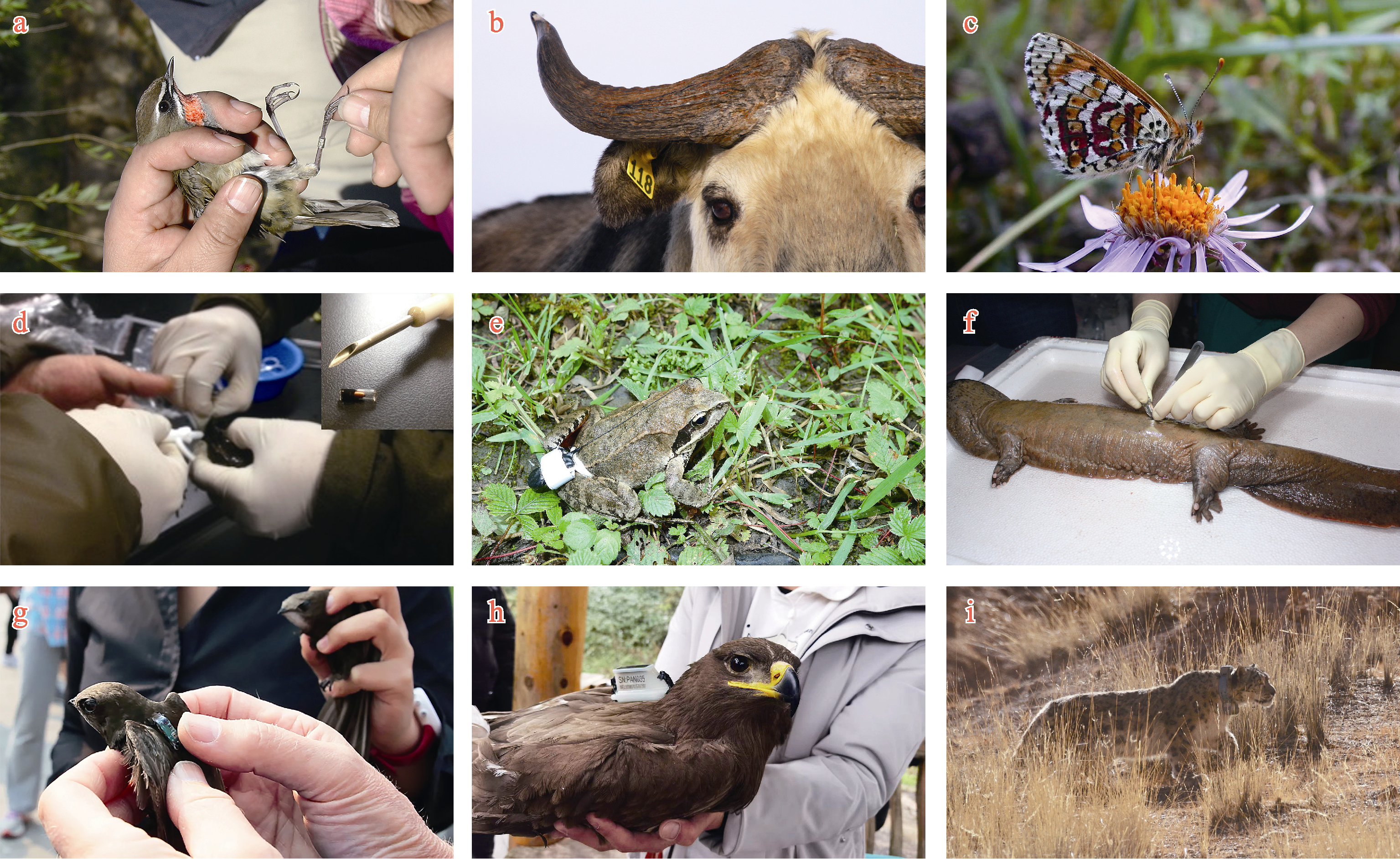
| 图1 中国野生动物研究中使用的传统物理标记(a-c)与基于传感器的追踪标记(d-i)技术示例。a: 红喉歌鸲(Calliope calliope)的金属环志脚环; b: 中华扭角羚(Budorcas taxicolor)的耳标; c: 庆网蛱蝶(Melitaea cinxia)翅上的书写编号; d: 中华蟾蜍(Bufo gargarizans)皮下植入的RFID标签; e: 中国林蛙(Rana chensinensis)的背负式VHF发射器; f: 中国大鲵(Andrias davidianus)的腹腔植入式VHF发射器; g: 普通雨燕(Apus apus)的背负式光敏全球定位传感器; h: 草原雕(Aquila nipalensis)的背负式鸟类卫星追踪设备; i: 雪豹(Panthera uncia)的卫星追踪颈圈。照片由李晟( |
| Fig. 1 Examples of traditional (a-c) and sensor-based (d-i) tracking technologies used in wildlife studies in China. a, Metal leg band used for Siberian rubythroat (Calliope calliope); b, Ear tag used for Chinese takin (Budorcas taxicolor); c, Marked number on the wing of Glanville fritillary (Melitaea cinxia); d, RFID tag implanted under skin of Asiatic toad (Bufo gargarizans); e, Backpacked VHF transmitter used for Chinese brown frog (Rana chensinensis); f, VHF transmitter implanted in the abdominal cavity of Chinese giant salamander (Andrias davidianus); g, Backpacked light-level geolocator used for common swift (Apus apus); h, Satellite-tracking device used for steppe eagle (Aquila nipalensis); i, Satellite-tracking colloar used for snow leopard (Panthera uncia). Photos were provided by Sheng Li ( |
|
|