




生物多样性是衡量保护成效的关键指标, 在维持区域生态系统平衡上发挥着重要作用(付梦娣等, 2021)。科学构建野生动物多样性动态监测体系, 对于掌握区域野生动物多样性现状、动态变化、影响因素等至关重要, 积累的监测数据可为针对性保护与管理策略的优化调整提供重要依据(马克平, 2011; 肖治术, 2016; 李晟, 2020)。野生鸟兽是野生动物中的典型代表, 往往作为生物多样性保护管理成效评估的重要参考(马克平, 2015; Muldoon & Goodman, 2015; 李晟, 2020)。在野生鸟兽物种资源监测与研究中, 相比于传统的调查方法而言, 红外相机技术较为典型且具有一定优势(O’Connell et al, 2011; 李晟等, 2014; 肖治术等, 2014)。随着该技术在我国森林动态监测样地(www.cfbiodiv.org/) (肖治术, 2014)以及各类自然保护地的应用和推广(肖治术, 2019a), 利用红外相机技术构建保护地以及区域鸟兽物种动态监测体系已十分普遍(李晟等, 2014; 肖治术, 2016, 2019a), 同时监测成果也有效助力了我国野生动物红外相机监测网络的建设与发展(肖治术等, 2017; 李晟, 2020)。
四川老君山自然保护区始建于2000年, 2011年晋升为国家级, 是我国第一个以四川山鹧鸪(Arborophila rufipectus)等珍稀濒危雉科鸟类以及常绿阔叶林生态系统为主要保护对象的保护区。保护区面积虽仅35 km2, 但珍稀濒危鸟兽资源十分丰富, 目前已记录至少有6种国家I级和52种国家II级重点保护野生动物(内部资料)。区内多年来围绕野生鸟兽开展了大量调查研究工作, 但主要集中在鸟类, 如四川山鹧鸪(Fu et al, 2017; 付义强等, 2018; 西丽媛子等, 2020)、红翅噪鹛(Trochalopteron formosum) (付义强等, 2011; 吴永恒等, 2018)、红嘴相思鸟(Leiothrix lutea) (廖文波等, 2006; 周明强等, 2012)等。而针对区内鸟兽多样性的调查相对薄弱: Liao (2010)利用夹夜法获得6种啮齿类; 乔陆等(2022)通过夹夜法并结合文献资料, 记录区内有32种小型兽类; 杨杰(2007)①(①杨杰 (2007) 四川老君山自然保护区鸟类群落结构及多样性研究. 硕士学位论文, 四川大学, 成都.)采用“点样带法”并结合文献资料, 记录区内鸟类13目43科249种; 最新的《四川老君山国家级自然保护区综合科学考察报告(2015年)》记录区内有兽类7目22科53种, 鸟类14目45科274种(内部资料)。虽陈本平等(2015)关于保护区红外相机监测的信息动态报道以及《四川老君山国家级自然保护区四川山鹧鸪科学考察报告》(付义强和陈本平, 2017)总结了保护区2013-2014年红外相机调查取得的成果, 但只有1年多的数据。
迄今为止, 保护区还缺乏针对区内鸟兽本底资源的动态调查与评估, 且早期的调查研究距今时隔多年, 有必要科学更新和完善。基于此, 本研究团队于2013年在保护区内及周边区域设置固定监测位点, 利用红外相机对林下大中型兽类与鸟类物种开展持续监测。本文对保护区2013-2020年的红外相机监测数据进行了详细整理与分析, 提供了按照年度统计的红外相机监测数据集, 可为保护区制定针对性保护与管理决策提供科学依据。
1 数据采集与处理方法
1.1 数据采集
四川老君山国家级自然保护区隶属于四川省宜宾市屏山县, 位于四川盆地南缘(103°57°-104°04° E, 28°39°-28°43° N), 总面积35 km2, 其中核心区2,092.87 ha、缓冲区442.79 ha、实验区964.34 ha。区内地形以山地和丘陵为主, 最高点为川南第一高峰——老君山(2,008.7 m), 最低处海拔800 m (内部资料)。
2013年4月至2020年9月, 利用ArcGIS 10.4将保护区划分为1 km × 1 km的监测网格, 结合林下鸟兽物种活动痕迹、关键生境类型、人为活动干扰、野外可到达性、不同区块位置(核心区、缓冲区、实验区及保护区外围)等因素选择34个监测网格开展持续监测, 每个网格中设置1个监测位点。区内气候属亚热带湿润季风气候, 充沛降雨量下极易导致相机损耗, 为了保证每个监测位点监测数据的稳定性, 在每个位点上同时安放2台红外相机(Ltl 6210)。后续的监测过程中, 根据拍摄效果对部分位点进行了适度调整, 但整体覆盖网格保持不变。研究期间, 红外相机布设海拔区间为1,196-1,933 m (图1)。红外相机的安放要求以及参数设置与四川省内多数保护地开展的红外相机监测工作的标准保持一致(邓玥等, 2022; 彭波等, 2022; 宋政等, 2022)。
图1
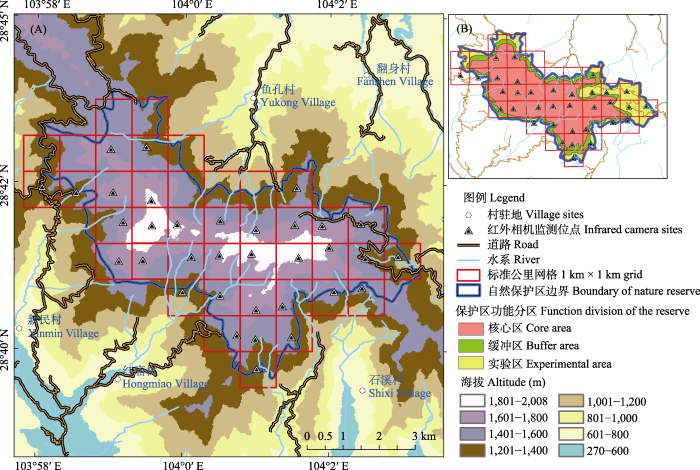
图1
四川老君山国家级自然保护区红外相机监测位点分布图。A: 保护区及周边海拔情况; B: 保护区功能区划情况。
Fig. 1
Distribution of infrared camera traps in Laojun Mountain National Nature Reserve. A, Altitude of Laojun Mountain National Nature Reserve and surrounding areas; B, Function division of Laojun Mountain National Nature Reserve.
1.2 数据处理方法
基础信息的整理与物种分析鉴定统一在“四川自然保护红外相机数据管理信息化平台” (Sichuan Nature Conservation Infrared Camera Data Management System, CDMS,
将单一监测位点下的2台红外相机看作一个整体, 当2台同时持续正常工作或单独1台持续正常工作24 h均记为1个有效相机工作日; 将单一监测位点下2台或1台正常工作的红外相机拍摄的数据视为1个独立的有效监测点数据集, 将其中同种个体的相邻拍摄时间间隔至少为30 min的有效记录(照片或视频)定义为独立有效记录(O’Brien et al, 2003)。通过计算相对多度指数(relative abundance index, RAI)来分析鸟兽物种的相对种群数量: RAI = Ai/T × 100, 式中, Ai表示第i类(i = 1, 2, 3, ……, 75)动物的独立有效记录(照片或视频)数, T表示总的有效相机工作日(O’Connell et al, 2011; 肖治术, 2019b)。通过计算网格占有率(grid occupancy, GO)来分析区内鸟兽物种的分布情况: GO = Gi / AG × 100%, 式中, Gi表示第i种(i = 1, 2, 3, ……, 75)动物被拍到的网格数, AG表示红外相机覆盖的网格总数(肖治术, 2019b)。通过计算每个年度的拍摄率(year capture rate, YCR)和不同区块的拍摄率(functional area capture rate, FCR)来分析鸟兽物种拍摄率的时空变化(李生强, 2017①(①李生强 (2017) 广西弄岗和花坪保护区鸟兽多样性的比较研究. 硕士学位论文, 广西师范大学, 广西桂林.); 邓玥等, 2022): YCR = ny / Ty × 100%, FCR = Nf / Tf × 100%。式中, y代表年度, ny代表不同年度下鸟类与兽类独立有效记录数, Ty代表不同年度下有效相机工作日, f代表不同区块, Nf代表不同区块下鸟类与兽类独立有效记录数, Tf代表不同区块下有效相机工作日。通过计算Shannon-Wiener指数(H')分析鸟类与兽类多样性在不同区块下的差异:
按年度分别统计每个监测位点下的兽类与鸟类物种数、独立有效记录数, 以8年来所有红外相机数据来整理最终的兽类和鸟类物种名录, RAI和GO按年度逐一统计再计算整体结果。利用Office 2019、R 4.1.0完成数据统计分析和制图。
2 数据描述
经处理的红外相机数据共计251,901条, 包括170,902张照片和80,999段视频, 总有效相机工作日为85,346 d。本数据集为这些照片和视频经过识别鉴定与统计分析后的数据成果, 包括7个工作表、2个分析图和2个代表性物种照片压缩文件包, 具体内容概述如下:
(1)监测概况。统计了2013-2020年间每个年度下的相机网格数、相机布设海拔段、总的有效相机工作日、总的独立有效记录数、兽类物种数、鸟类物种数、兽类拍摄率、鸟类拍摄率、年度拍摄率。野生鸟兽独立有效记录共计24,008次, 包括能准确识别到具体物种的15,098次, 尚无法准确鉴定到具体物种的8,910次(主要为啮齿目中的鼠科和松鼠科以及雀形目鸟类)。
(2)相机位点地理坐标。包括34个固定红外相机监测位点以及2013-2020年间每个年度下每个相机位点的有效相机工作日。
(3)独立有效记录数。统计了2013-2020年间每个年度下每个相机位点拍摄的兽类与鸟类物种的独立有效记录数。
(4)物种数。统计了2013-2020年间每个年度下每个相机位点拍摄的兽类与鸟类物种数。
(5)鸟兽物种名录。汇总了2013-2020年间红外相机记录到的所有鸟兽物种种类、保护级别、IUCN红色名录等级、分布海拔、分布区域以及不同年度下的网格占有率与相对多度指数等。共准确识别出5目14科22种兽类以及4目15科53种鸟类, 包括4种国家I级以及19种国家II级重点保护野生动物。亚洲黑熊(Ursus thibetanus)、斑林狸(Prionodon pardicolor)、豹猫(Prionailurus bengalensis)等12种兽类以及四川山鹧鸪、红腹角雉(Tragopan temminckii)、白鹇(Lophura nycthemera)等19种鸟类在4种不同区块均有分布, 而猕猴(Macaca mulatta)、赤狐(Vulpes vulpes)、中华小熊猫(Ailurus styani)等6种兽类以及画眉(Garrulax canorus)、橙翅噪鹛(Trochalopteron elliotii)、黄颊山雀(Machlolophus spilonotus)等19种鸟类仅在1个区块有分布。赤狐、中华小熊猫2种兽类以及黄颊山雀、绿翅短脚鹎(Ixos mcclellandii)、斑胸钩嘴鹛(Erythrogenys gravivox)、画眉(国家II级)、灰胸薮鹛(Liocichla omeiensis) (国家I级)、暗胸朱雀(Procarduelis nipalensis) 6种鸟类均仅在保护区外围发现有分布。亚洲黑熊、豹猫、毛冠鹿(Elaphodus cephalophus)等7种兽类以及四川山鹧鸪、白鹇、红腹角雉等8种鸟类在8个监测年度均被拍到, 但中华鬣羚(Capricornis milneedwardsii) (2013年)、中华小熊猫(2016年)、赤狐(2019年)等5种兽类以及画眉(2013年)、绿背山雀(Parus monticolus) (2013年)、棕头雀鹛(Fulvetta ruficapilla) (2013年)等15种鸟类仅在1个监测年度被拍到。另外, 大熊猫(Ailuropoda melanoleuca)仅在2013年11月以及2014年2月有拍摄记录。
(6)不同区块下鸟兽物种分布。统计了保护区核心区、缓冲区、实验区和保护区外围的红外相机监测网格数、有效相机工作日、兽类与鸟类物种数、独立有效记录数、多样性指数和拍摄率。整体上看, 核心区中兽类与鸟类多样性最高, 其次是保护区外围和实验区, 缓冲区最低。
(7)不同区块物种相对多度(RAI)前8位统计。统计了保护区核心区、缓冲区、实验区和保护区外围中相对多度指数排在前8位的物种。白鹇与四川山鹧鸪在不同区块的RAI均为最高, 表明其种群数量具有明显优势。
(8)兽类和鸟类物种数与有效相机工作日拟合曲线图。直到监测期结束, 兽类物种数趋于饱和而鸟类物种数仍有增长趋势, 表明兽类取样较为充分, 鸟类还需要增加取样量。
(9)兽类与鸟类物种相对多度指数比较分析图。直观展示了相对多度指数前15位兽类物种以及前20位鸟类物种在不同年度下的情况。虽不同监测年度下的物种具体组成以及相对多度指数RAI排序存在差异, 但兽类中的花面狸(Paguma larvata)、赤腹松鼠(Callosciurus erythraeus)、野猪(Sus scrofa)、猪獾(Arctonyx collaris)、亚洲黑熊、珀氏长吻松鼠(Dremomys pernyi)以及鸟类中的白鹇、四川山鹧鸪、红腹角雉、红嘴相思鸟、长尾地鸫(Zoothera dixoni)、棕噪鹛(Garrulax berthemyi)、红翅噪鹛的RAI均排在前列, 说明这些物种的种群数量较高且相对稳定。
(10)代表性物种照片。筛选了保护区有代表性的兽类与鸟类物种红外相机照片, 详见数据集中的文件。
3 讨论
本数据集汇总名录与保护区目前已知的鸟兽名录(内部资料)比较, 新增帚尾豪猪(Atherurus macrourus) 1种兽类以及星鸦(Nucifraga caryocatactes)、白眉鸫(Turdus obscurus)、蓝眉林鸲(Tarsiger rufilatus)和金色林鸲(T. chrysaeus) 4种鸟类, 表明持续多年的红外相机监测可有效补充鸟兽物种本底(邓玥等, 2022; 彭波等, 2022; 宋政等, 2022)。然而, 保护区2015年综合科学考察中调查发现的林麝(Moschus berezovskii)、小麂(Muntiacus reevesi)以及来源于历史资料的中华斑羚(Naemorhedus griseus)等大中型兽类并未被拍到, 可能的原因是: (1)林麝和小麂在保护区内的种群密度较低, 难以被红外相机捕捉; (2)保护区2015年综合科学考察报告中的调查数据来源未注明活动痕迹或访问等信息, 数据可靠性有待斟酌; (3)中华斑羚来源于历史资料, 目前可能已经从保护区消失。据目前的各类调查数据来看, 中华斑羚在保护区邻近的整个凉山山系中仅申果庄保护区拍摄到活动影像(内部资料; 付励强等, 2020; 刘洁等, 2020; 毛泽恩等, 2022)。本数据集仅记录到1种豪猪科物种——帚尾豪猪, 且有连续5年(2016-2020年)的拍摄记录, 经过反复确认和核实, 我们怀疑以往记录到的中国豪猪(Hystrix hodgsoni)信息可能存在错误。本研究回归曲线分析发现, 鸟类物种数在5-5.5万个相机日时有一个明显的快速增加, 这可能与2017年保护区更新了红外相机设备有关, 新的监测设备优化了拍摄画质, 提升了物种(尤其是鸟类)识别的准确率。最终鸟类取样未饱和, 累计鸟类物种数(53种)仅占科考记录274种鸟类的19.34%, 而灰胸薮鹛、绿翅短脚鹎及斑胸钩嘴鹛等保护区常见鸟种在本研究中仅在保护区外围等单一区块发现有分布, 这可能很大程度受限于红外相机本身的使用局限(李晟等, 2014)。
有5种兽类和15种鸟类仅在1个年度被拍到, 说明其种群密度可能较低。然而, 部分仅在早期年度被拍到的物种, 当前是否依然存在值得进一步调查。如仅在2013年拍摄的中华鬣羚在后续多年均未出现, 我们推测该物种种群密度可能已经非常低甚至可能已经从保护区消失; 而仅在2013年11月以及2014年2月有拍摄记录的大熊猫, 在后续多年均未被拍到且未能发现其活动痕迹, 同样推测该物种可能已经在保护区绝迹。野生大熊猫种群长期生存所需要的最小栖息地面积为114.7 km2 (Qing et al, 2016), 而老君山国家级自然保护区面积仅35 km2且相对孤立。虽区内及周边存在一定面积的大熊猫栖息地(四川省林业厅, 2012), 但面积有限且区内原有种群与周边凉山山系大熊猫种群相距较远, 难以进行基因交流。因此, 部分物种在监测期间种群密度较低甚至已经绝迹直接影响了不同年度拍摄到的物种种类, 而2017年以来监测设备的更新同样影响了监测成效, 这些因素可能是8个监测年度下鸟兽物种组成差异较大而从2017年以来相对稳定(兽类14-17种; 鸟类31-34种)的重要原因。目前, 兽类中食肉目相对稳定, 种类至少在9种; 而灵长目和鲸偶蹄目相对稳定的物种仅1-2种。拍摄率上, 鸟兽物种不同年度下的拍摄率差异较大, 2017年之前的拍摄率均偏低(兽类0.36%-1.86%, 鸟类4.14%- 13.98%), 而2017年之后整体拍摄率逐渐增大且相对稳定(兽类2.69%-4.32%, 鸟类14.39%-29.31%)。与周边保护地相比, 保护区鸟类拍摄率较高, 但兽类拍摄率较低, 如马边大风顶国家级自然保护区的兽类为133.14% (付励强等, 2020)、鸟类为99.10% (吴沛桦等, 2020), 黑竹沟国家级自然保护区兽类为6.63% (刘洁等, 2020), 栗子坪国家级自然保护区兽类为10.99%-12.01%、鸟类为1.80% (李健威等, 2020), 贡嘎山国家级自然保护区兽类为40.73%、鸟类为6.96% (乔江等, 2022), 大相岭省级自然保护区兽类为39.67%、鸟类为9.56% (刘鹏等, 2020), 说明保护区内兽类物种整体多度较低, 还需要进一步加强保护力度。
本文提供了基于持续8年红外相机监测获得的数据集, 反映出老君山国家级自然保护区兽类组成变化较大, 稳定存在的大中型兽类偏少且拍摄率不高, 尤其灵长目与鲸偶蹄目物种偏少, 亟需加强保护; 鸟类物种多样性较高, 整体比较稳定且珍稀濒危鸟类较多。基于此, 未来的研究工作需关注以下方面: (1)进一步加强兽类物种保护, 科学探究兽类物种种群变化的原因; (2)以保护区为案例, 探究在较小面积下鸟兽物种稳定长存的科学机制和保护策略。
作者分工: 陈本平主要负责数据收集与整理的协调安排和论文撰写工作; 陈建武和凌征文主要负责红外相机野外布设和数据采集工作; 杨旭和陈鑫主要负责红外相机数据的物种识别和分析鉴定、论文数据的分析整理等; 李生强主要负责整体核查数据、统计物种名录、分析作图以及论文修改等工作; 杨彪主要负责指导研究设计、升华科学问题并统筹论文写作与修改。
致谢
感谢四川师范大学付义强教授对老君山国家级自然保护区红外相机监测技术的指导, 感谢保护区各基层保护站野外监测人员的辛勤付出与支持, 感谢成都观鸟会的杨小农老师与黄科老师在鸟类识别上的大力帮助。
参考文献
The infrared camera monitoring in Sichuan Laojunshan National Nature Reserve has achieved fruitful results
四川老君山国家级自然保护区红外相机监测取得丰硕成果
Diversity and changes of mammals and birds in the Baishuihe National Nature Reserve (Sichuan) based on camera-trapping
基于红外相机监测四川白水河国家级自然保护区林下鸟兽多样性及其变化
Biodiversity and spatio-temporal patterns of mammals in the Mabian Dafengding National Nature Reserve using camera traps
利用红外相机调查四川马边大风顶国家级自然保护区兽类资源及时空分布特征
Construction and application of an evaluation index system for ecological and environmental protection effectiveness of national parks
国家公园生态环境保护成效评估指标体系构建与应用
Research progress of Sichuan partridge (Arborophila rufipectus)
四川山鹧鸪(Arborophila rufipectus)研究进展
Unusual incubation behavior and embryonic tolerance of hypothermia in the Sichuan partridge (Arborophila rufipectus)
DOI:10.1007/s10336-016-1422-7 URL
Winter habitat characteristics of red-winged laughingthrush at Laojunshan National Nature Reserve in China
四川老君山自然保护区红翅噪鹛冬季栖息地特征
The IUCN Red List of Threatened Species
https://www.iucnredlist.org. (accessed on 2023-03-08)
Preliminary camera-trapping survey on wild mammals and birds in Liziping National Nature Reserve
四川栗子坪国家级自然保护区野生鸟兽的红外相机初步监测
Development progress and outlook of the wildlife camera-trapping networks in China
DOI:10.17520/biods.2020425 [本文引用: 3]
中国野生动物红外相机监测网络建设进展与展望
DOI:10.17520/biods.2020425 [本文引用: 3]
Camera-trapping in wildlife research and conservation in China: Review and outlook
DOI:10.3724/SP.J.1003.2014.14203
[本文引用: 3]

During the last two decades, infrared-triggered camera-trapping has been widely used in wildlife and biodiversity research and conservation. In the areas of wildlife ecology research, animal species inventory, biodiversity monitoring and protected area management in China, considerable outputs have been produced by scientific research and conservation applications based on camera-trapping. This technique has been successfully used to detect rare or elusive species, conduct biodiversity inventory, study animal behavior, estimate population parameters, and evaluate the effectiveness of protected area management. Along with the rapid development of modern ecological analysis and modeling tools, camera-trapping will play a more important role in wildlife research at various levels. Meanwhile, along with improvements in techniques, decreasing cost and increasing application interests, camera-trapping will be adopted by more researchers, wildlife managers and protected areas, and can be used for systematic wildlife monitoring using standard protocols. Efforts devoted to its future development and applications should focus on establishing systematically-designed monitoring networks and data-sharing protocols, and developing new analytical approaches and statistical models specifically based on camera-trapping data.
红外相机技术在我国野生动物研究与保护中的应用与前景
DOI:10.3724/SP.J.1003.2014.14203
[本文引用: 3]
20年来, 红外相机技术在国内外野生动物研究、监测与保护中得到了广泛应用。基于红外相机技术, 我国在野生动物生态学研究、动物行为学研究、稀有物种的探测与记录、动物本底资源调查、生物多样性监测及保护地管理与保护评价等领域取得了众多成果。目前, 数学模型、统计分析方法和新的概念正在促进红外相机技术在野生动物监测研究与保护管理中的发展和推广应用。同时, 随着红外相机技术的成熟、成本降低和应用普及, 这一技术也将会被更多的野生动物研究人员、管理人员和自然保护区管理者所采用, 并成为全国各级保护地和区域生物多样性监测研究的关键技术和方法。今后, 建立并完善系统化的监测网络和数据共享平台、开发新一代的数据分析方法与模型, 将是此项技术进一步发展和应用的主要方向。
A comparison of diversity for non-volant small mammal between high and low altitudes in Laojunshan Nature Reserve
Basic call of Leiothrix luteal in Sichuan Laojunshan Nature Reserve
红嘴相思鸟鸣声的初步探讨
Comparison of birds’ and mammals’ diversities using camera-trapping survey in Guizhou Chishui Alsophila National Nature Reserve and its surrounding areas
贵州赤水桫椤国家级自然保护区及其周边区域鸟兽多样性红外相机监测对比
Diversity and changes of large and medium-sized mammals in the Heizhugou National Nature Reserve based on infrared cameras
基于红外相机监测四川黑竹沟国家级自然保护区的大中型兽类多样性及其变化
Camera-trapping survey of wild mammals and birds in Daxiangling Nature Reserve, Sichuan Province
DOI:10.17520/biods.2019381
[本文引用: 1]
Camera-tapping has been considered one of the most efficient tools on the survey of terrestrial mammals and birds. From October 2017 to October 2018, 167 infrared-triggered camera were set-up to investigate the biodiversity of wild mammals and birds in Daxiangling Nature Reserve, Sichuan Province. A total of 3, 317 independent wildlife photographs were collected with an extensive survey effort of 6, 738 camera-days, including 644 photographs of 33 bird species from 5 orders and 11 families, and 2, 673 photographs of 23 mammal species belonging to 5 orders and 14 families. Among these, Ailuropoda melanoleuca, Budorcas tibetanus and Moschus berezovskii are listed as national first-class protected wild animals, and Ithaginis cruentus, Chrysolophus amherstiae, Lophura nycthemera, Tragopan temminckii, Macaca thibetana, Ursus thibetanus, Ailurus fulgens, Martes flavigula, Capricornis milneedwardsii and Cervus equinus are listed as national second-class protected wild animals. Of the species identified, Moschus berezovskii is evaluated as Critically Endangered(CR), 9 species as Vulnerable(VU), and 10 species as Near Threatened(NT) in the Red List of China’s Vertebrate. Among the recorded species, Ailurus fulgens and Moschus berezovskii are listed as Endangered(EN), 5 species as Vulnerable(VU), and 3 species as Near Threatened(NT) by the IUCN Red List. Four species are also listed in Appendix I and six other species are in Appendix II of CITES. Dendrocopos darjellensis, Nucifraga caryocatactes, Turdus obscurus, Brachypteryx montana, Trochalopteron formosum, Petaurista xanthotis and Cervus equinus, have not been recorded before. We found that Elaphodus cephalophus (RAI = 125.26) had the highest relative abundance, followed by Macaca thibetana (RAI = 64.71) and Tragopan temminckii (RAI = 43.34). Our results provided the first record of large and mid-sized mammals and terrestrial birds from this nature reserve, thereby providing primary baseline data of wildlife resources for future management of biodiversity.
利用红外相机监测四川大相岭自然保护区鸟兽物种多样性
DOI:10.17520/biods.2019381
[本文引用: 1]
红外相机调查技术已成为地栖兽类与鸟类物种多样性研究的重要手段之一,2017年10月至2018年10月在四川大相岭省级自然保护区布设167台红外相机进行生物多样性监测,累计监测有效工作日数6, 738天,共获得独立有效照片3, 317张,其中野生鸟类644张、野生兽类2, 673张。鉴定出野生鸟类33种,分属5目11科;野生兽类23种,分属5目14科。属于国家一级重点保护野生动物有3种,即大熊猫(Ailuropoda melanoleuca)、四川羚牛(Budorcas tibetanus)和林麝(Moschus berezovskii);国家二级重点保护野生动物有10种,分别是血雉(Ithaginis cruentus)、白腹锦鸡(Chrysolophus amherstiae)、白鹇(Lophura nycthemera)、红腹角雉(Tragopan temminckii)、藏酋猴(Macaca thibetana)、黑熊(Ursus thibetanus)、小熊猫(Ailurus fulgens)、黄喉貂(Martes flavigula)、中华鬣羚(Capricornis milneedwardsii)、水鹿(Cervus equinus)。其中,属于《中国脊椎动物红色名录》中极危物种的有林麝一种,另外有易危物种9种,近危物种10种;其中小熊猫、林麝被IUCN红色名录评估为濒危物种,5种被评估为易危,3种被评估为近危;被CITES附录I收录的物种有4种,被附录II收录的物种有6种。本研究还发现之前调查未被记录到的物种7种,分别是黄颈啄木鸟(Dendrocopos darjellensis)、星鸦(Nucifraga caryocatactes)、白眉鸫(Turdus obscurus)、蓝短翅鸫(Brachypteryx montana)、红翅噪鹛(Trochalopteron formosum)、灰鼯鼠(Petaurista xanthotis)、水鹿。分析发现物种相对丰富度最高的三种动物分别是毛冠鹿(Elaphodus cephalophus)(RAI = 125.26)、藏酋猴(RAI = 64.71)、红腹角雉(RAI = 43.34)。本次物种调查结果可反映本保护区大、中型兽类和地栖性鸟类本底,为保护区管理和野生动物长期监测提供了基础数据。
Assessing progress of biodiversity conservation with monitoring approach
DOI:10.3724/SP.J.1003.2011.02053 [本文引用: 1]
监测是评估生物多样性保护进展的有效途径
DOI:10.3724/SP.J.1003.2011.02053 [本文引用: 1]
Species Catalogue of China: A remarkable achievement in the field of biodiversity science in China
中国生物多样性编目取得重要进展
Investigation on beasts of suspicious distribution in Mabian Dafengding Nature Reserve
马边大风顶自然保护区分布存疑兽类调查
Primates as predictors of mammal community diversity in the forest ecosystems of Madagascar
DOI:10.1371/journal.pone.0136787 URL [本文引用: 1]
Crouching tigers, hidden prey: Sumatran tiger and prey populations in a tropical forest landscape
DOI:10.1017/S1367943003003172 URL [本文引用: 1]
Diversity and distribution of wild mammals in Xiaozhaizigou National Nature Reserve in Sichuan Province based on infrared camera technology
基于红外相机技术的四川小寨子沟国家级自然保护区野生兽类种类与分布
Mammal and bird diversity recorded with camera traps in Gongga Mountain National Nature Reserve, Sichuan, China
DOI:10.17520/biods.2020395
[本文引用: 1]
<p id="p00005"><strong>Aims</strong> The Gongga Mountain National Nature Reserve lies in the global biodiversity hotspot—the Hengduan Mountains and is a priority area of biodiversity conservation in China. However, surveys of large to medium-sized mammals are insufficient in the reserve. For this reason, we conducted a camera trap survey during 2011-2018.</p><p id="p00010"><strong>Methods</strong> Camera traps were placed in 97 grid cells (1 km × 1 km per cell) with a minimum distance of over 500 m and at the altitudes of 2,672-4,764 m. Only one camera was placed in a cell during the same period. Seventy grid cells located continuously along the western slope of Mt. Gongga.</p><p id="p00015"><strong>Results</strong> A total of 20,932 independent photographs were taken over 39,881 camera-days. Thirty wild mammal species and 78 bird species were captured by camera traps. Seven other mammal species were reported by literature or occasional observation. Among them, 12 species are class I, and 28 are class II national protected animals. 11 and 12 species are listed in the CITES Appendix I and II, respectively. According to the IUCN Red List, 3 and 8 species are listed as endangered (EN) and vulnerable (VU) species, respectively. According to Red List of China’s Vertebrates, 5 species are listed as Critically Endangered (CR), 5 are listed as endangered, and 11 are listed as vulnerable. Using a relative abundance index, the three most detected mammal species were the tufted deer (<i>Elaphodus cephalophus</i>, 147.39), sambar deer (<i>Rusa unicolor</i>, 66.10), and wild boar (<i>Sus scrofa</i>, 36.03); the three most detected avian species were the blood pheasant (<i>Ithaginis cruentus</i>, 14.64), white eared pheasant (<i>Crossoptilon crossoptilon</i>, 10.43), and giant laughingthrush (<i>Garrulax maximus</i>, 8.05).</p><p id="p00020"><strong>Conclusion</strong> We provided an inventory of large to medium-sized mammals in the reserve. More in-depth investigations should be conducted in broad-leaved forest, coniferous and broad-leaved mixed forest, alpine shrub meadow, and alpine scree to survey other undetected mammals.</p>
四川贡嘎山国家级自然保护区鸟兽多样性
DOI:10.17520/biods.2020395
[本文引用: 1]
四川贡嘎山国家级自然保护区位于全球生物多样性热点地区之一的横断山区, 是我国生物多样性保护优先区。本文利用红外相机影像和已发表文献对该保护区的大中型兽类和地面活动鸟类进行编目并提出未来监测建议。2011-2018年在97个1 km × 1 km的网格安放红外相机, 累计39,881个相机日, 获得独立有效照片20,932张, 其中野生兽类16,244张, 鸟类2,775张, 牲畜1,737张, 人176张。鉴定出野生兽类30种, 另有文献报道4种和观察3种, 分属于5目15科; 鸟类78种, 分属于9目22科; 牲畜6种。包括12种国家I级和28种国家II级重点保护野生动物; 被CITES附录I收录的有11种, 附录II收录的有12种。被IUCN红色名录评估为濒危(EN)和易危(VU)等级的分别有3种和8种。被《中国脊椎动物红色名录》评估为极危(CR)、濒危和易危等级的分别有5、5和11种。相对多度指数(relative abundance index, RAI)排名前三的兽类是毛冠鹿(Elaphodus cephalophus, 147.39)、水鹿(Rusa unicolor, 66.10)、野猪(Sus scrofa, 36.03); 鸟类是血雉(Ithaginis cruentus, 14.64)、白马鸡(Crossoptilon crossoptilon, 10.43)、大噪鹛(Garrulax maximus, 8.05)。阔叶林、针阔混交林、高山灌丛草甸和高山流石滩是调查薄弱生境, 后期应开展重点调查, 以厘清本区域大中型兽类资源。
Investigation of small mammals and genetic diversity analysis of dominant species in the Laojunshan National Nature Reserve, Sichuan
四川老君山国家级自然保护区小型兽类调查及优势种遗传多样性分析
The minimum area requirements (MAR) for giant panda: An empirical study
DOI:10.1038/srep37715
PMID:27929520
[本文引用: 1]
Habitat fragmentation can reduce population viability, especially for area-sensitive species. The Minimum Area Requirements (MAR) of a population is the area required for the population's long-term persistence. In this study, the response of occupancy probability of giant pandas against habitat patch size was studied in five of the six mountain ranges inhabited by giant panda, which cover over 78% of the global distribution of giant panda habitat. The probability of giant panda occurrence was positively associated with habitat patch area, and the observed increase in occupancy probability with patch size was higher than that due to passive sampling alone. These results suggest that the giant panda is an area-sensitive species. The MAR for giant panda was estimated to be 114.7 km(2) based on analysis of its occupancy probability. Giant panda habitats appear more fragmented in the three southern mountain ranges, while they are large and more continuous in the other two. Establishing corridors among habitat patches can mitigate habitat fragmentation, but expanding habitat patch sizes is necessary in mountain ranges where fragmentation is most intensive.
Preliminary investigation on mammal and bird resources using camera traps in the Xiaohegou Nature Reserve, Sichuan
利用红外相机对四川小河沟自然保护区兽类和鸟类资源的初步监测
Catalogue of mammals in China (2021)
中国兽类名录(2021版)
DOI:10.16829/j.slxb.150595
[本文引用: 1]
中国是全球兽类物种多样性最高的国家之一,掌握我国兽类物种多样性和分类地位是兽类学研究的基础前提,也是科学保护野生种群的前提。为厘清中国兽类的物种数量及分类地位等关键分类学信息,中国动物学会兽类学分会组织国内长期致力于兽类各类群分类的科学研究人员,在总结前人研究的基础上,根据最新的形态学和分子遗传学证据,综合现代兽类分类学家意见,经编委会充分讨论,形成了最新的中国兽类名录,包括我国现阶段兽类12目59科254属686种。该中国兽类名录使用基于系统发生关系的分类系统,并对物种有效性进行了充分慎重的确认和讨论。
Spatial-temporal distribution of birds using infrared camera traps in Mabian Dafengding Nature Reserve
利用红外相机调查马边大风顶保护区鸟类资源的时空分布特征
Breeding ecology of Trochalopteron formosum in Sichuan Laojunshan National Nature Reserve
四川老君山国家级自然保护区红翅噪鹛的繁殖生态研究
Habitat use and change of Arborophila rufipectus during the breeding season in the Laojunshan National Nature Reserve, Sichuan
四川老君山国家级自然保护区四川山鹧鸪繁殖期的生境利用及其变化研究
An introduction to wildlife camera trapping monitoring from Chinese Forest Biodiversity Monitoring Network (CForBio)
DOI:10.3724/SP.J.1003.2014.14108
[本文引用: 1]
Abstract:
我国森林动态监测样地的野生动物红外相机监测
DOI:10.3724/SP.J.1003.2014.14108 [本文引用: 1]
Developing camera-trapping protocols for wildlife monitoring in Chinese forests
DOI:10.3724/SP.J.1003.2014.14075
[本文引用: 1]
Wildlife monitoring is one key indicator used for biodiversity assessment. Therefore, developing wildlife monitoring protocols is an important component of large-scale biodiversity monitoring program such as the Chinese Forest Biodiversity Monitoring Network (CForBio). Since 2011, the CForBio Network launched an initiative to investigate wildlife diversity using camera traps among forest dynamic plots in China. Because of this initiative, there is an urgent need to develop standardized camera trapping protocols. One important premise of camera-trapping protocols is that camera trap data can be used to conduct comparative research among different plots. Here, we propose camera-trapping protocols based on our own experience in using camera traps for wildlife surveys, and on the terrestrial vertebrate (camera trap) protocol implementation manual produced by the TEAM (Tropical Ecology Assessment & Monitoring) Network. We hope that these protocols can serve as the basis for a standardized tool used in wildlife diversity monitoring in forest ecosystems. We also provide recommendations for plot design, data management and long-term monitoring programs for wildlife diversity monitoring.
探讨我国森林野生动物红外相机监测规范
DOI:10.3724/SP.J.1003.2014.14075
[本文引用: 1]
野生动物多样性是生物多样性监测与保护管理评价的关键指标, 因此对野生动物进行长期监测是中国森林生物多样性监测网络(CForBio)等大尺度生物多样性监测研究计划的一个重要组成部分。2011年以来, CForBio网络陆续在多个森林动态监测样地开展以红外相机来监测野生动物多样性。随着我国野生动物红外相机监测网络的初步形成, 亟待建立和执行基于红外相机技术的统一监测规范。基于3年来在我国森林动态监测样地红外相机监测的进展情况, 以及热带生态评价与监测网络针对陆生脊椎动物(兽类和鸟类)所提出的红外相机监测规范, 本文从监测规范和监测注意事项等方面探讨了我国森林野生动物红外相机监测的现状和未来。
Wildlife resource inventory using camera-trapping in natural reserves in China
红外相机技术促进我国自然保护区野生动物资源编目调查
DOI:10.16829/j.slxb.201603002 [本文引用: 2]
Overview of the mammal diversity observation network of Sino BON
DOI:10.17520/biods.2016159
[本文引用: 1]
Mammals are key indicators for biodiversity conservation and management due to their high diversity, wide distribution range, and sensitivity to habitat changes. Recently launched by the Chinese Academy of Sciences, the Mammal Diversity Monitoring Network of Sino BON (Sino BON-Mammal) is a key member of the Biodiversity Monitoring Networks of Sino BON for the monitoring and inventory of terrestrial mammal resources in China. Firstly, this paper reviews several major advances in terrestrial mammal diversity observations in both China and other parts of the world. We then provide an overview of Sino BON-Mammal, including the major scientific goals, monitoring framework, methods, and data products. In addition, we also summarize some working advances of the Mammal Diversity Observation Network of Sino BON since 2011. This overview will be helpful for the development of national observation programs of mammal diversity in China.
中国兽类多样性监测网的建设规划与进展
DOI:10.17520/biods.2016159
[本文引用: 1]
兽类类群和物种多样, 分布范围广, 适应于多种生境类型, 对栖息地变化特别敏感, 是生物多样性保护管理与评价的关键指示类群。中国兽类多样性监测网是由中国科学院近年来推动建立的中国生物多样性监测与研究网络的专项网之一, 重点对分布于我国境内的陆生兽类物种多样性及资源进行监测与研究。针对当前我国兽类监测研究面临的三大根本任务(兽类物种有什么? 在哪里? 有多少?), 当务之急是应尽快建立和完善我国兽类各类群的监测技术规范, 制定常态监测计划, 全面建设全国性的兽类多样性监测网络技术体系和监测数据公共信息平台。本文在总结国内外兽类监测研究的基础上, 提出了我国陆生兽类多样性监测网的建设规划, 重点介绍该监测网的科学目标、布局、监测技术和监测数据产品等。本文也总结了近年来我国陆生兽类多样性监测网建设所取得的重要进展及存在的问题, 为全面推动我国兽类多样性联网监测明确发展方向。
Application of camera trapping to species inventory and assessment of wild animals across China’s protected areas
DOI:10.17520/biods.2018329 URL [本文引用: 2]
红外相机技术在我国自然保护地野生动物清查与评估中的应用
Development and application of Sichuan Nature Conservation Infrared Camera Data Management System
四川自然保护红外相机数据管理系统的研发及其应用
The preliminary study on breeding habit of Leiothrix lutea at Laojunshan Nature Reserve, Sichuan
四川老君山自然保护区红嘴相思鸟繁殖生态初报


