




全球气候变化加剧了生物多样性的丧失, 并对生态系统的结构和功能造成影响。如何保护生物多样性是保护生物学和生态学的重要前沿问题(Chapin et al, 2000; Kardol et al, 2018)。长期以来, 科学家对生物多样性的保护研究主要集中在地上植物和动物, 特别是大型动物, 而有关土壤动物与植物之间关系的研究则相对滞后(丁彰琦等, 2022)。土壤动物作为陆地生态系统重要的组成部分, 其种类丰富、数量庞大、食性多样, 与地上植物之间存在着非常紧密的相互作用。在森林生态系统中, 土壤动物可以通过调控凋落物分解或直接取食植物根系来影响植物生长, 植物则可以通过改变资源输入和土壤理化性质等直接或间接影响土壤动物群落格局(高梅香等, 2018; 靳亚丽等, 2021)。故阐明植物与土壤动物群落结构之间的关系将有助于理解地上与地下的生态学过程。
甲螨(oribatid mites)隶属于节肢动物门蛛形纲蜱螨亚纲疥螨目甲螨亚目, 体壁呈不同程度的骨化与矿化, 颜色深浅不一, 形似甲虫。甲螨几乎生存在所有的陆地生态系统中, 其种类丰富, 是土壤节肢动物的主要组成成分(Wallwork, 1983; Maraun & Scheu, 2000), 能够参与有机物的分解和营养转化等过程, 在土壤生态系统中扮演着重要的角色(Schneider et al, 2004; Illig et al, 2005)。以往对不同植被下(靳亚丽等, 2017)和不同类型森林中(靳士科等, 2016; 周育臻和吴鹏飞, 2020)土壤甲螨群落的研究发现, 甲螨群落结构和季节动态在不同类型森林间存在差异。受地表植被不可控和采样周期的限制, 以往的研究结果多集中在对一个采样周期内甲螨群落结构差异的描述或探讨土壤理化性质对甲螨群落的影响, 缺乏对植物及其凋落物与甲螨群落结构关系的研究。
中国亚热带森林生物多样性与生态系统功能实验样地(BEF-China)是目前全球范围内物种库最大、树种多样性梯度最多的亚热带森林生物多样性控制实验样地(Wang et al, 2020)。该样地主实验区由相距4 km的A、B两个样地组成, 总面积约40 ha, 分别于2009年和2010年建成。本研究基于对BEF-China样地4个季度连续两年的土壤甲螨定量采集数据, 研究了不同树种组成森林(A样地和B样地)间甲螨多度、物种丰富度和群落结构的差异及其与植物凋落物和土壤理化性质间的关系, 并对两个样地内土壤甲螨群落的季节动态和垂直空间分布进行综合分析, 以期为了解土壤甲螨群落动态和地上与地下生态学过程奠定一定的基础。
1 材料与方法
1.1 研究样地概况
本研究在位于江西省德兴市新岗山镇(29°08′-29°11′ N, 117°90′-117°93′ E)的中国亚热带森林生物多样性与生态系统功能实验样地(BEF-China)进行。BEF-China样地具有典型的季节性季风气候特征, 年平均气温16.7℃, 年平均降水量1,821 mm, 主要土壤类型为红黄壤, 自然植被以亚热带常绿落叶阔叶混交林为主(马克平, 2013; Yang et al, 2013)。由A、B两个样地构成的主实验样地共有566块大小相同的样方(25.8 m × 25.8 m), 每个样方内以20行20列的方式规则种植了400棵树, 个体间距为1.29 m。本研究在两个样地各31块深入研究样方内(very intensively studied plots, VIP)取样。两样地所选样方树种库不重叠, 各有16种(表1)。
表1 A样地与B样地树种组成
Table 1
| A样地 Site A | B样地 Site B |
|---|---|
| 青榨槭 Acer davidii | 臭椿 Ailanthus altissima |
| 米槠 Castanopsis carlesii | 拟赤杨 Alniphyllum fortune |
| 南酸枣 Choerospondias axillaris | 光皮桦 Betula luminifera |
| 细叶青冈 Cyclobalanopsis myrsinifolia | 丝栗栲 Castanopsis fargesii |
| 复羽叶栾树 Koelreuteria bipinnata | 黄果朴 Celtis Biondi |
| 枫香 Liquidambar formosana | 华杜英 Elaeocarpus chinensis |
| 苦楝 Melia azedarach | 秃瓣杜英 E. glabripetalus |
| 蓝果树 Nyssa sinensis | 薯豆 E. japonicus |
| 麻栎 Quercus acutissima | 山桐子 Idesia polycarpa |
| 白栎 Q. fabri | 黄绒润楠 Machilus grijsii |
| 短柄枹栎 Q. serrata | 红楠 M. thunbergii |
| 盐肤木 Rhus chinensis | 华东楠 M. leptophylla |
| 无患子 Sapindus Saponaria | 乳源木莲 Manglietia yuyuanensis |
| 山乌桕 Triadica cochinchinensis | 垂枝泡花树 Meliosma flexuosa |
| 乌桕 T. sebifera | 闽楠 Phoebe bournei |
| 锥栗 Castanea henryi | 乌冈栎 Quercus phillyraeoides |
1.2 标本采集、物种鉴定和数据测定
自2019年9月起, 每年春季(4月)、夏季(6月)、秋季(9月)和冬季(12月)前往样地采集标本, 每次采集工作在10 d内完成, 以降低采集时间跨度对最终结果的影响。在每个样方对角线的中心以及与中心距离相等的位置共设置5个采样点, 使用土钻(钻头直径5 cm, 深10 cm)在每个采样点取样, 每次分别取0-10 cm土层和10-20 cm土层两个土样(距离树干约0.65 m, 两树之间), 将每个样方同一土层的5个土样用布袋装好并混匀记为1个土样(Eissfeller et al, 2013; Corral-Hernandez et al, 2015)。由于研究期间部分样方树木死亡而排除了12个样方, 最终将50个样方数据纳入分析。
将烘烤干燥的土壤用筛网过滤掉石块、植物根等杂质后, 采用电位测定法测量土壤pH值, 使用浓硫酸-催化剂-流动分析定氮法测量土壤全氮含量, 使用浓硫酸-高氯酸-钼锑抗比色法测定土壤全磷含量, 使用重铬酸钾-浓硫酸外加热法测量土壤有机碳含量, 使用强酸消解-原子吸收分光光度法测量土壤钙含量(刘光崧, 1996)。
1.3 数据统计与分析
使用软件Excel 2013和R4.1.2进行数据分析。首先计算甲螨的生态学指标: 物种数代表丰富度指数, Shannon多样性指数参考周育臻和吴鹏飞(2020)计算。对各组数据进行正态分布检验, 满足正态分布条件的使用T检验和单因素方差分析, 不满足正态分布的数据使用非参数Wilcoxon秩和检验和Kruskal-Wallis检验, 以统计数据是否存在显著差异。使用“circlize”包绘制两个样地内甲螨群落的科级组成弦图, 其中多度小于100的类群记为“其他”。
使用“vegan”包通过非度量多维标度排序(non-metric multi-dimensional scaling, NMDS)方法分析不同样地的甲螨群落结构, 使用基于Bray-Curtis距离的相似性分析(analysis of similarities, ANOSIM)方法比较甲螨群落结构差异是否显著(Jiao et al, 2022)。使用“FD”包以每种树的体积加权来计算A、B两样地内不同样方凋落物理化性质的群落加权平均指数(community weighted mean, CWM) (Wang et al, 2019), 对甲螨群落与土壤理化性质间的关系进行Mantel检验和Pearson检验(Qin et al, 2022), 包括温度(S_Temp)、含水量(S_Humi)、pH (S_pH)、碳氮比(S_CN)、碳磷比(S_CP)、氮磷比(S_NP)和全钙(S_Ca)含量和凋落物理化性质(碳氮比(CWM_CN)、木质素含量(CWM_M)、碳磷比(CWM_CP)、氮磷比(CWM_NP)和全钙(CWM_Ca)含量)。
2 结果
2.1 A样地与B样地甲螨群落组成
2019年9月至2022年4月, 累计获得土壤甲螨23,704头, 根据形态特征鉴定为34科50属61种。其中A样地13,666头, 隶属于32科47属58种; B样地10,038头, 隶属于32科46属57种。BEF-China两个样地中单翼甲螨科相对多度最高, 为29.3%, 其次为奥甲螨科, 相对多度为25.3%, 菌甲螨科相对多度为12.9%。A样地中奥甲螨科、罗甲螨科、若甲螨科和尖棱甲螨科相对多度高于B样地; B样地中菌甲螨科、盖头甲螨科和礼服甲螨科相对多度高于A样地(图1)。
图1
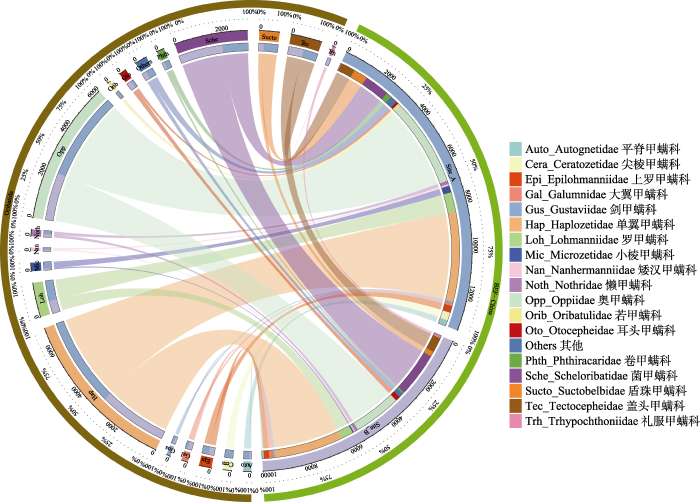
图1
BEF-China样地不同树种森林内甲螨群落组成。由外至内, 左侧第一圈为甲螨(Oribatida), 右侧为BEF-China; 第二圈为甲螨科级相对多度(0‒100%); 第三圈左侧为不同甲螨类群(科级), 右侧为不同样地, 宽度代表甲螨多度; 甲螨类群与其出现的不同空间用线连接, 线的宽度为甲螨多度。Others代表多度小于100的类群。
Fig. 1
Community composition of oribatid mites in forests composited by different tree species. From outside circle to inside. The left side of the first circle is the name of Oribatida, the right side of the first circle is BEF-China. The second circle is percentage scale label (from 0‒100%). The third circle is the family name and the site, the width of the line indicates the abundance of mites. We grouped the oribatid mite abundance less than 100 as others.
图2
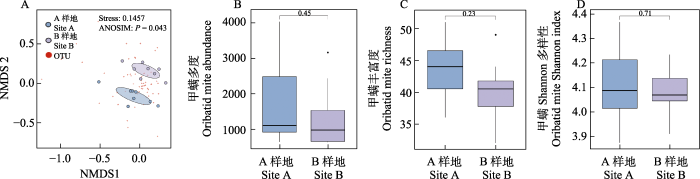
图2
不同树种组成森林中土壤甲螨群落结构及生态指标差异。A: A样地与B样地甲螨群落的非度量多维标度排序(non-metric multi-dimensional scaling, NMDS)分析结果(Stress = 0.1457)。其中椭圆代表围绕A、B两个样地甲螨群落的标准偏差, 红色的十字(OTU)代表群落中的甲螨物种。B、C、D分别表示两样地甲螨多度、物种丰富度和Shannon多样性指数差异。其中方块表示数据分布, 横线表示中位数, 圆点表示极值。
Fig. 2
Community structure and ecological indices of soil oribatid mites in different tree composition forest. A, Non-metric multidimensional scaling (NMDS) analysis showing the community composition of site A and site B. Ellipses represent the standard deviation around the centroids of each sampling site, red crosses refer to the lepidopteran oribatid mite species in each community. B, C, D, The difference of oribatid mites diversity between site A and site B. Boxes and whiskers represent the data distribution about the median, filled circles represent extreme values.
2.2 A样地与B样地甲螨群落季节变化
不同树种组成的两个样地间甲螨群落的季节动态变化并不完全相同(图3)。在A样地中, 4个季节甲螨多度(P < 0.001)、物种丰富度(P < 0.001)和Shannon多样性指数(P = 0.001)差异显著。而在B样地中, 甲螨多度(P < 0.001)和物种丰富度(P < 0.001)在4个季节间具有显著差异, 而Shannon多样性指数(P = 0.061)差异不显著。并且A样地中夏季和秋季甲螨多度、物种丰富度和Shannon多样性指数显著低于春季和冬季; 而B样地中秋季甲螨多度和物种丰富度与春季差异不显著。
图3
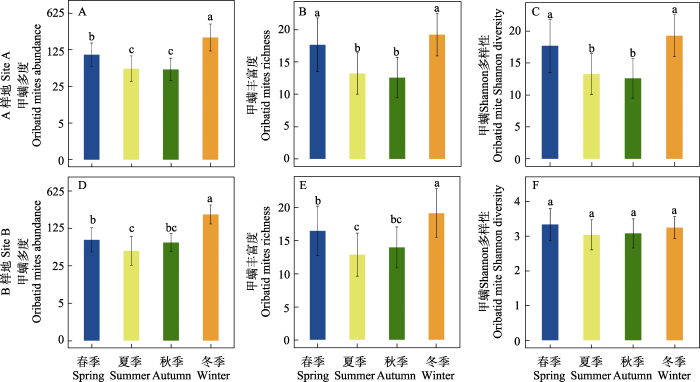
图3
不同树种组成森林样地中甲螨群落的季节动态变化。不同小写字母表示不同季节间差异显著(P < 0.05)。
Fig. 3
Seasonal dynamics of oribatid mite communities in different type forest. Different lower case letters showed significant difference among four seasons at the 0.05 level.
2.3 A样地与B样地甲螨垂直分布
在两个不同树种组成的样地中, 4个不同季节的甲螨均表现出明显的表聚性, 上层(0-10 cm)土层中甲螨多度、物种丰富度和Shannon多样性指数均显著(P < 0.05)高于下层(10-20 cm) (图4)。但不同的是, A样地内夏季和秋季土壤甲螨相对多度为84.6%和85.3%, 高于冬季和春季的82.8%和80.9%; 而B样地内则相反, 冬季和春季土壤甲螨相对多度(89.0%和89.3%)高于夏季和秋季(87.4%和86.1%)。
图4
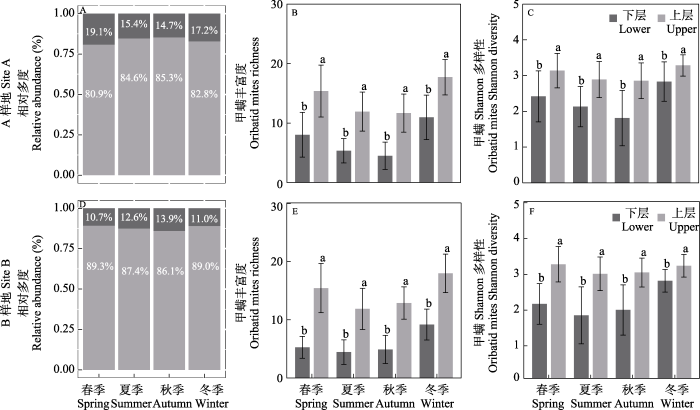
图4
不同树种组成森林样地中甲螨垂直分布的季节动态变化。图中不同小写字母表示不同组间差异显著(P < 0.05); Upper为0-10 cm土层, Lower为10-20 cm土层。
Fig. 4
Seasonal vertical distribution of oribatid mites in different type forest. Different letters showed significant difference among four seasons at the 0.05 level. Upper represent the 0-10 cm soil layer, and Lower was the 10-20 cm soil layer.
2.4 凋落物和土壤理化性质与甲螨群落的关系
A、B两个样地由于树种组成不同, 其凋落物和土壤理化性质存在差异。Pearson检验结果显示, 甲螨多度前10位(科级)的类群与土壤和凋落物理化性质间呈现出不同的相关关系(图5)。例如, 凋落物木质素含量(CWM_M)与单翼甲螨科和菌甲螨科多度呈负相关关系, 而与奥甲螨科多度呈正相关关系。菌甲螨科多度与土壤和凋落物同一理化因子的相关性基本相同, 但是与碳氮比的关系却截然相反, 表现在与凋落物碳氮比(CWM_CN)呈正相关关系而与土壤碳氮比(S_CN)呈负相关关系。Mantel检验结果显示, A样地土壤甲螨群落与凋落物碳氮比(CWM_CN)和碳磷比(CWM_CP)具有显著的相关性; B样地甲螨群落与凋落物钙含量(CWM_Ca)、凋落物木质素含量(CWM_M)、土壤湿度(S_Humi)、凋落物厚度(S_LT)、土壤钙含量(S_Ca)、土壤pH (S_pH)以及土壤碳磷比(S_CP)显著相关(图5)。
图5
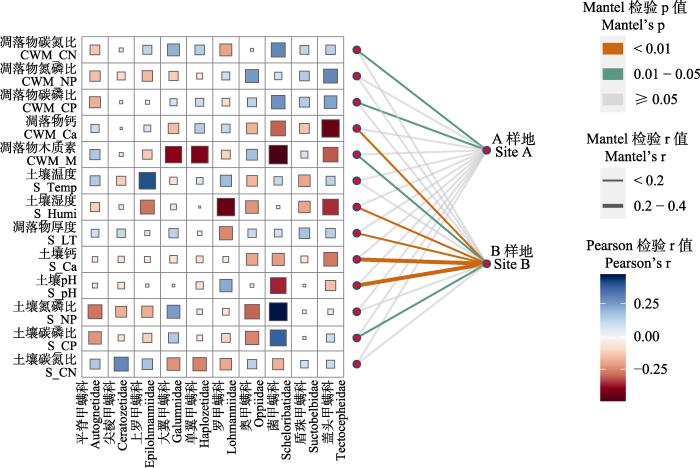
图5
土壤螨类多度与环境因子间相关关系的Pearson检验, 及A、B样地间甲螨群落和环境因子的Mantel检验。
Fig. 5
Pearson correlation analysis of the abundance of oribatid mites and environmental factors, and Mantel test of oribatid mites community and environmental factors in site A and site B. CWM_CN, Community weighted mean C/N ratio; CWM_NP, Community weighted mean N/P ratio; CWM_CP, Community weighted mean C/P ratio; CWM_Ca, Community weighted mean calcium content; CWM_M, Community weighted mean lignin content; S_Temp, Soil temperature; S_Humi, Soil humidity; S_LT, Soil litter thickness; S_Ca, Soil calcium content; S_pH, Soil pH value; S_NP, Soil N/P ratio; S_CP, Soil C/P ratio; S_CN, Soil C/N ratio.
3 讨论
3.1 不同树种组成森林内甲螨群落结构差异
基于BEF-China实验对A、B两样地设计, 本研究所选样方大小、树的数量以及树的排列方式均相同, 但树种库不同(表1)。在两个样地内共采集甲螨23,704头, 根据形态特征鉴定有34科50属61种。土壤螨类优势类群是其适应环境的重要表现, 对环境有重要的指示作用(Manu, 2013)。研究发现在BEF-China两个样地中, 单翼甲螨科(29.3%)、奥甲螨科(25.3%)和菌甲螨科(12.9%)相对多度较高(图1), 与之前在浙江天目山亚热带森林中开展的土壤动物多样性研究结果相似(尹文英, 1992), 但不同于梵净山常绿阔叶林中土壤螨类群落优势类群(林丹丹等, 2018)。产生这一差异的原因可能与植被组成、人类活动和海拔等环境因子的相似或相异有关。
3.2 不同树种组成森林内甲螨群落时空格局差异
季节同样会引起土壤甲螨生境和群落结构的变化。在A、B两个样地内, 冬季和春季甲螨的多度、物种丰富度和多样性指数均高于夏季和秋季水平(图2), 其原因可能与当地的季节性季风气候特征有关。夏季和秋季较高的降水一方面会对移动能力弱的土壤甲螨造成较大的冲刷影响(秦钟, 2009), 另一方面, 土壤湿度过大可以导致部分小型土壤节肢动物被淹死或因土壤中缺氧而死亡(黄丽荣等, 2008)。此外, 由于植物凋落物理化性质在不同季节间具有差异(胡仪等, 2022), 也会对甲螨群落的季节动态产生影响; 并且由于A、B两个样地树种组成不同, 也可能导致两个样地内甲螨群落季节动态存在差异, 研究发现不同植物对甲螨影响不同, 例如欧洲山毛榉(Fagus sylvatica)和日本落叶松(Larix kaempferi)有利于维持甲螨多度(Jacob et al, 2009; Mori et al, 2015), 相反凋落物中C/N值高的植物则不利于土壤甲螨的生存(Korboulewsky et al, 2016)。
综上所述, BEF-China由不同树种组成的A、B样地, 具有相同的土壤甲螨优势类群, 但其群落结构具有显著差异; 在时间尺度上, 两个样地内甲螨群落季节动态不完全相同。本研究表明, 在森林生态系统中, 植物对土壤动物存在自上而下的影响, 植物凋落物和土壤的理化性质是影响土壤甲螨群落结构变化的重要原因。同时, 甲螨群落与植物之间的相互作用过程是复杂的, 在今后的研究中, 要加强对这一过程的深层次挖掘, 为提高土壤甲螨生物多样性的保护效率以及揭示土壤动物与植物之间的互作关系提供科学依据。
致谢:
感谢中国亚热带森林生物多样性与生态系统功能实验研究平台(BEF-China,
参考文献
Consequences of changing biodiversity
DOI:10.1038/35012241 URL [本文引用: 1]
Oribatid mites of China: A review of progress, with a checklist
DOI:10.11646/zoosymposia.4.1.14 URL [本文引用: 1]
Trophic structure of oribatid mite communities from six different oak forests
(Quercus robur).DOI:10.1016/j.soilbio.2015.01.013 URL [本文引用: 1]
Altitudinal pattern of soil fauna-plant interaction in Dongling Mountain, Beijing
北京东灵山土壤动物-植物互作关系对海拔格局的响应
Tree identity surpasses tree diversity in affecting the community structure of oribatid mites (Oribatida) of deciduous temperate forests
DOI:10.1016/j.soilbio.2013.03.024 URL [本文引用: 2]
Spatial patterns and assembly rules in soil fauna communities: A review
DOI:10.17520/biods.2018122
[本文引用: 1]

Identifying spatial patterns and assembly rules in communities is a central study topic in ecology. With the unprecedented rate at which biodiversity is decreasing, it is necessary to recognize the spatial patterns and assembly rules in communities in order to understand why biodiversity is being lost and to be able to protect it. However, previous studies have focused more on plant communities in above-ground terrestrial ecosystems, neglecting below-ground ecosystems, especially soil faunal communities. Indeed, soil faunal biodiversity is a crucial component of global biodiversity because soil faunal communities assist in the maintenance of important ecosystem structures and functions. Therefore, one important aim of identifying spatial patterns and assembly rules in soil faunal communities is to clarify mechanisms of maintaining soil faunal biodiversity at multiple scales, so as to promote these processes, which also maintain ecosystem structures and functions. Soil faunal communities usually form complicated spatial patterns at multiple spatial scales. Here, we propose spatial autocorrelation characteristics, and then show how the complicated spatial patterns are demonstrated by patches and gaps of soil faunal communities at multiple scales. These spatial patterns are mainly controlled by processes of biotic interactions, environmental filtering and random dispersal. Consequently, we discuss the impacts of these processes on soil faunal communities. Finally, we suggest that these three processes are essential to evaluate and construct a theoretical framework for soil faunal communities and should continue to be studied in the future. Because interest in spatial patterns and assembly rules of soil faunal communities is relatively new in China, we expect this review will promote the development of related research areas.
土壤动物群落空间格局和构建机制研究进展
DOI:10.17520/biods.2018122
[本文引用: 1]
群落空间格局和构建机制一直是生态学研究的核心内容。在生物多样性严重丧失的背景下, 揭示群落空间格局及其构建机制, 有助于深刻理解生物多样性丧失的原因, 更有助于应对生物多样性保护等重大生态环境问题。然而, 陆地生态系统的研究多集中于地上生物群落, 对地下生态系统, 尤其是土壤动物空间格局和构建机制的研究尚不充分。事实上, 土壤动物多样性是全球生物多样性的关键组成之一, 是地下生态系统结构和功能维持的重要部分。对土壤动物空间格局和构建机制的研究, 能明确不同空间尺度条件下土壤动物多样性的维持机制。土壤动物群落常在多种空间尺度形成复杂的空间分布格局, 因此, 本文首先介绍了不同空间尺度主要土壤动物群落的空间自相关性特征, 阐述了土壤动物群落斑块和孔隙镶嵌分布的复杂空间格局。继而阐明这种空间格局主要受生物间作用、环境过滤和随机扩散的调控, 并说明这三个过程对土壤动物群落的调控能力和作用方式。作者提出, 这三个过程仍是今后土壤动物群落空间格局和构建机制研究的重点内容, 需要进一步加强以土壤动物为研究对象的群落构建理论的验证和发展。我国土壤动物群落空间格局和构建机制起步较晚, 希望本文能够促进我国土壤动物生态学相关领域的研究。
Characteristics and seasonal dynamics of soil fauna community in farmland ecosystem of different geomorphic types in Changbai Mountain
长白山地不同地貌类型农田生态系统土壤动物群落特征及季节动态
Nitrogen controls on fine root substrate quality in temperate forest ecosystems
DOI:10.1007/s100210000010 URL [本文引用: 1]
Seasonal variations of non-structural carbohydrates in fresh litters of three dominant tree species in subtropical forests
三个亚热带森林优势种凋落物非结构性碳水化合物含量的季节动态
Community characteristics of mid-micro soil animals in cold-temperate zone of the Daxing’an Mountains, China
大兴安岭寒温带地区中小型土壤动物群落特征
Nutrient release from decomposing leaf litter of temperate deciduous forest trees along a gradient of increasing tree species diversity
DOI:10.1016/j.soilbio.2009.07.024 URL [本文引用: 1]
Linking soil fungi to bacterial community assembly in arid ecosystems
Soil meso- and micro-fauna community structures in different urban forest types in Shanghai, China
上海市不同类型城市森林中小型土壤动物群落结构特征
DOI:10.13287/j.1001-9332.201607.015
[本文引用: 1]
于2014年4月(春季)、7月(夏季)、10月(秋季)和2015年1月(冬季)对上海市4种城市森林中小型土壤动物群落进行调查,共捕获土壤动物2190只,隶属于6门15纲22个类群,优势类群为线虫纲和蜱螨亚纲,分别占总密度的56.0%和21.8%,常见类群为线蚓科、轮虫纲、弹尾纲和膜翅目,共占总密度的18.7%.不同类型城市森林中小型土壤动物密度存在显著差异(P<0.05),其中,水杉林密度最高,香樟林最低;类群数以近自然林最高,水杉林最低.各林地中小型土壤动物群落结构具有明显的季节动态,整体表现为秋、冬季密度值较高,夏、秋季类群数较高.在垂直分布上,香樟林表聚程度最为突出,近自然林各层分布相对均匀.密度-类群指数(DG)大小顺序为近自然林(6.953)>香樟林(6.351)>悬铃木林(6.313)>水杉林(5.910),该指数可以较好地表征各林地的群落多样性.冗余分析(RDA)显示,土壤容重、土壤有机质、土壤总氮等是影响城市森林中小型土壤动物群落结构的主要环境因子,其中蜱螨亚纲和线蚓科与土壤有机质和总氮呈正相关,双翅目幼虫和轮虫纲与土壤含水量呈正相关.
上海大金山岛不同植被类型下土壤动物群落多样性
DOI:10.17520/biods.2016306
[本文引用: 1]
大金山岛属上海市金山三岛海洋生态保护区, 岛上土壤未受到人为活动的污染。为了解不同自然植被类型下土壤动物群落结构组成及其生态分布, 于2015年秋季在大金山岛竹林、乔木林和灌木林的南、北坡中分别进行土壤动物采样。结果显示: 6个样地共捕获土壤动物12,769只, 隶属于28个类群, 优势类群为蜱螨亚纲和弹尾纲, 分别占总捕获量的70.15%和19.27%; 常见类群有原尾纲、半翅目、膜翅目和线蚓科, 占总捕获量的7.06%。北坡和南坡优势类群均为蜱螨亚纲(74.26%、65.32%)和弹尾纲(16.52%、22.49%), 但常见类群和稀有类群存在一定差异。不同植被类型土壤动物的群落结构组成存在一定差异, 但无论是北坡还是南坡密度均为灌木林 > 乔木林 > 竹林, 类群数变化为灌木林 > 竹林 > 乔木林。无论北坡还是南坡, 不同植被类型下土壤动物群落生态指数各不相同, Shannon-Wiener多样性指数、Pielou均匀度指数和Simpson优势度指数均为灌木林 > 乔木林 > 竹林。大金山岛灌木林中土壤动物群落多样性高于乔木林和竹林, 很可能与灌木林中较为适宜的微环境有关。
Vertical distribution and seasonal variations of soil fauna communities in Shanghai Jing’an Sculpture Park
上海静安雕塑公园土壤动物群落的垂直分布和季节变化
Long-term effects of species loss on community properties across contrasting ecosystems
DOI:10.1038/s41586-018-0138-7 URL [本文引用: 1]
How tree diversity affects soil fauna diversity: A review
DOI:10.1016/j.soilbio.2015.11.024 URL [本文引用: 1]
Soil mite community structure in the evergreen, broad-leaved forest of Fanjing Mountain, China
梵净山常绿阔叶林土壤螨类群落结构
Studies on biodiversity and ecosystem function via manipulation experiments
生物多样性与生态系统功能的实验研究
Effects of simulated nitrogen deposition on meso-micro soil fauna communities in meadow steppe
模拟氮沉降对草甸草原中小型土壤节肢动物群落的影响
Diversity of soil mites (Acari: Mesostigmata: Gamasina) in various deciduous forest ecosystems of Muntenia region (southern Romania)
DOI:10.2478/biolet-2013-0001 URL [本文引用: 1]
The structure of oribatid mite communities (Acari, Oribatida): Patterns, mechanisms and implications for future research
DOI:10.1111/j.1600-0587.2000.tb00294.x URL [本文引用: 1]
Biotic homogenization and differentiation of soil faunal communities in the production forest landscape: Taxonomic and functional perspectives
DOI:10.1007/s00442-014-3111-7
PMID:25322821
[本文引用: 1]
Biotic homogenization has been reported worldwide. Although simplification of communities across space is often significant at larger scales, it could also occur at the local scale by changing biotic interactions. This study aimed to elucidate local community processes driving biotic homogenization of soil faunal communities, and the possibility of biotic re-differentiation. We recorded species of oribatid mites in litter and soil layers along a gradient of forest conversion from monoculture larch plantation to primary forests in central Japan. We collected data for functional traits of the recorded species to quantify functional diversity. Then we quantified their taxonomic/functional turnover. Litter diversity was reduced in the larch-dominated stands, leading to habitat homogenization. Consequently, litter communities were biologically homogenized and differentiated in the plantations and in the natural forest, respectively. Turnover of functional traits for litter communities was lower and higher than expected by chance in the plantations and in the natural stand, respectively. This result suggests that the dominant assembly process shifts from limiting similarity to habitat filtering along the forest restoration gradient. However, support for such niche-based explanations was not observed for communities in the soil layer. In the monocultures, functional diversity expected from a given regional species pool significantly decreased for litter communities but not for those in the soil layer. Such discrepancy between communities in different layers suggests that communities more exposed to anthropogenic stresses are more vulnerable to the loss of their functional roles. Our study explains possible community processes behind the observed patterns of biological organization, which can be potentially useful in guiding approaches for restoring biodiversity.
Compartmentalization of the soil animal food web as indicated by dual analysis of stable isotope ratios (15N/14N and 13C/12C)
DOI:10.1016/j.soilbio.2009.03.002 URL [本文引用: 1]
Ecological drivers of macroinvertebrate metacommunity assembly in a subtropical river basin in the Yangtze River Delta, China
DOI:10.1016/j.scitotenv.2022.155687 URL [本文引用: 1]
Community structure of soil meso- and micro-fauna in different habitats of urbanized region
城市化地区不同生境下中小型土壤动物群落结构特征
A comparison of methods for determining proximate carbon fractions of forest litter
DOI:10.1139/x90-023 URL [本文引用: 1]
Transitory dynamic effects in the soil invertebrate community in a temperate deciduous forest: Effects of resource quality
DOI:10.1016/j.soilbio.2005.04.033 URL [本文引用: 1]
Listado sistemático, sinonímico y biogeográfico de los ácaros oribátidos (Acariformes: Oribatida) del mundo (excepto fósiles)
Effects of Phyllostachys edulis expansion on soil oribatid mite community structure
毛竹扩张对土壤甲螨群落结构的影响
Oribatids in forest ecosystems
DOI:10.1146/annurev.en.28.010183.000545 URL [本文引用: 1]
Multiple components of plant diversity loss determine herbivore phylogenetic diversity in a subtropical forest experiment
DOI:10.1111/1365-2745.13273 URL [本文引用: 1]
Host functional and phylogenetic composition rather than host diversity structure plant-herbivore networks
DOI:10.1111/mec.15518 URL [本文引用: 1]
Interrelationships between soil fauna and soil environmental factors in China research advance
Soil fauna has close relations with various environmental factors in soil ecosystem. To explore the interrelationships between soil fauna and soil environmental factors is of vital importance to deep understand the dynamics of soil ecosystem and to assess the functioning of the ecosystem. The environmental factors affecting soil fauna can be classified as soil properties and soil external environment. The former contains soil basic physical and chemical properties, soil moisture, and soil pollution. The latter includes vegetation, land use type, landform, and climate, etc. From these aspects, this paper summarized the published literatures in China on the interrelationships between soil fauna and soil environmental factors. It was considered that several problems were existed in related studies, e.g., fewer researches were made in integrating soil fauna's bio-indicator function, research methods were needed to be improved, and the studies on the multi-environmental factors and their large scale spatial-temporal variability were in deficiency. Corresponding suggestions were proposed, i.e., more work should be done according to the practical needs, advanced experiences from abroad should be referenced, and comprehensive studies on multi-environmental factors and long-term monitoring should be conducted on large scale areas.
我国土壤动物与土壤环境要素相互关系研究进展
Diversity of soil animal community in Xiao Hinggan Mountains
小兴安岭森林土壤动物群落多样性的研究
Diversity and spatiotemporal distribution of soil microarthropod communities in forests on the eastern slope of Gongga Mountain
贡嘎山东坡森林小型土壤节肢动物群落多样性与时空分布


