



许多植物在某些年份同步大量繁殖, 而在其他年份很少或根本不繁殖, 这一现象普遍存在于自然界中。生物学家将这种多年生植物种群周期性地(如间隔2-5年)同步大量繁殖的现象, 称为大年结实(masting or mast seeding) (Silvertown, 1980; Kelly, 1994; Herrera et al, 1998)。大年结实包含3个关键要素: 变异性(variability)、同步性(synchrony)、周期性(periodicity) (Kelly & Sork, 2002)。由于大年结实带来了一系列明显的选择性劣势, 包括在种子小年减少了繁殖机会(Waller, 1993)和在种子大年幼苗更严重的密度制约性死亡(Hett, 1971), 例如一些竹类在一次盛花或大量结实后随即死亡的极端现象 (Janzen, 1976; Keeley & Bond, 1999), 因此阐明大年结实的进化与生态意义, 不仅有助于理解物种共存机制, 而且对评估物种多样性维持中随机过程和更新生态位(regeneration niche)也具有重要的作用。此外, 结合不同纬度的种子产量变化及其种间差异, 也可以解释物种多样性的纬度梯度格局(Wright et al, 2005; Usinowicz et al, 2017)。
植物更新是森林生态系统功能维持与健康运转的关键。许多结实大种子的植物通常依赖动物(如鼠类、鸟类)扩散种子, 也即在种子成熟季节, 贮藏种子的动物会将种子搬离母树埋藏在枯枝落叶或土壤浅层, 其中一部分种子会逃脱动物捕食和真菌侵蚀, 并遇到合适的环境条件而萌发生成幼苗, 帮助植物实现了种子传播和更新。因此, 动物的种子贮藏行为对植物更新有重要影响(Vander Wall, 2002; Pesendorfer et al, 2016b)。为了能更好地生存繁殖, 植物表现出大年结实, 这一现象可能是植物适应环境尤其是生物环境(如种子捕食者)的结果: 因为植物必须从大年结实中获益, 即植物在高繁殖努力下提高繁殖效率(又称规模经济, economy of scale, EOS) (Norton & Kelly, 1988; Wright et al, 2005; Żywiec et al, 2012), 以逃避动物的过度捕食和促进动物分散贮藏。动物根据植物种子产量而改变其贮食行为策略, 以适应植物生产的变化。例如, 在美国东部落叶森林, 大年结实引发鼠类、鹿和舞毒蛾等种群波动(Ostfeld et al, 1996)。此外, 植物大年结实常伴有大量的幼苗建成, 因此, 这种生殖特征影响着植物种群的动态和分布格局, 进而可能影响到动植物群落的结构组成, 甚至影响整个生态系统, 对阐明森林生态系统生物多样性、稳定性维持机制具有重要作用(Kelly, 1994; Kelly & Sork, 2002; Crone et al, 2009; Bogdziewicz et al, 2016)。
自20世纪70年代以来, 大年结实现象受到生物学家和生态学家的广泛关注(Janzen, 1971; Kelly, 1994; Norghauer & Newbery, 2011; Koenig et al, 2015), 并且相继提出了一些假说(如: 资源匹配假说、捕食者饱和假说、风媒授粉假说、物候同步假说等)以阐明大年结实现象的原因和机制。然而学界一直存在两种争论, 即大年结实是气候因子造成的结果, 还是一种进化繁殖策略(见: Kelly & Sork, 2002)。为了解决这一争论, Kelly和Sork (2002)试图从植物进化的角度综述之前的研究, 重点从资源匹配假说、风媒授粉假说和捕食者饱和假说等方面分析了大年结实现象潜在的原因和驱动机制; 他们认为大年结实是植物的一种适应性的繁殖策略, 且受气候因素的直接影响。Crone和Rapp (2014)重点从资源预算假说(the resource budget hypothesis, 即大年结实所需要的资源比植物一年累积的还要多)对大年结实的机制进行了概述。Pearse等(2016)提出了一种通过开花诱导、授粉和果实成熟, 将气候、资源与大年结实联系起来的概念图, 并对大年结实的机制进行了综述。国内, 陈波等(2003)对早期植物生殖生态学中大年结实的相关研究进展进行了综述; 杜彦君和马克平(2012)对种子产量的时空变化格局进行了概述; 殷东生和沈海龙(2016)重点从资源分配的角度就大年结实对营养生长和林木资源消耗的影响及主要影响因素进行了综述。
然而, 以上综述主要是从植物的角度来考虑, 更多关心的是植物自身的策略, 而对大年结实与动物行为策略之间关系的总结较少(Vander Wall, 2010)。本文试图从植物大年结实现象的成因和驱动机制、大年结实和动物贮食行为、大年结实的进化和生态意义, 以及现有研究的局限和展望等方面加以概述和分析, 以期对未来深入研究大年结实的原因和机制提供参考。
1 大年结实的驱动机制
植物为什么会间断性地生产大量的果实和种子? 生物学家和生态学家们曾提出了不同的假说, 旨在揭示这一现象的潜在机制。本文梳理了各种解释大年结实现象的假说(表1), 重点概述了与动物介导的植物种子传播和更新有关的捕食者饱和假说、动物扩散假说和大种子假说, 简要分析了大年结实现象的近因(proximate causes)和远因(ultimate causes), 提出了一种综合理解大年结实现象的概念框架。
表1 解释大年结实现象的各种假说
Table 1
| 假说 Hypothesis | 描述 Description | 典型特征 Typical characteristics | 评论 Comment | |
|---|---|---|---|---|
| 资源匹配(气候跟踪) Resource matching (Weather tracking) | 种子产量的变化是由于植物可利用资源的变化造成的 Seed crops vary in response to plant available resources variation (Norton & Kelly, 1988) | 在不改变营养生长或储备资源的情况下实现种子产量的变化 Variable seed crops achieved without switching resources from vegetative growth or reserves | 较早被提出, 早期采用反证法; 多数支持而少数不完全支持 Put forward earlier, and early adopt proof by contradiction (Kelly & Sork, 2002); more evidence in support (Kelly, 1994; Pearse et al, 2014; Monks et al, 2016) and little in incomplete support (Koenig & Knops, 2000; Żywiec et al, 2012; Nussbaumer et al, 2018) | |
| 捕食者饱和 Predator satiation | 大量结实使捕食者饱和, 导致个体被捕食的比例降低 Large seed crops satiate seed predators, which thus lead to individuals experience lower proportion seed predation (Salisbury, 1942; Janzen, 1971) | 种子大年捕食率较低 Lower predation rate in high-seed years | 被多数研究支持; 不过, 取决于功能群的类型 Well supported by many studies (Janzen, 1976; Sork, 1983; Smith et al, 1990; Kon et al, 2005; Fletcher et al, 2010; Xiao et al, 2013b; Wang et al, 2017; Bogdziewicz et al, 2018); however, depends on the types of functional groups. | |
| 风媒授粉 Wind pollination | 风媒授粉植物同步大量开花可以获得更高的传粉效率 Wind-pollinated plants can achieve greater pollination efficiency through synchronized above-average flowering effort (Nilsson & Wastljung, 1987) | 在大量开花年受精比例更高 Higher % fertilization in high flowering years | 很好地被验证; 然而, 部分实验结果是模棱两可的 Well documented (Norton & Kelly, 1988; Smith et al, 1990; Kelly, 1994; Kon et al, 2005; Crone et al, 2009; Moreira et al, 2014); however, some test results are ambiguous (Kelly et al, 2001) | |
| 动物扩散(捕食者扩散) Animal dispersal (Predator dispersal) | 大年结实吸引更多扩散者, 因而刺激分散贮藏动物更多的扩散和贮藏种子 Large fruit production attract more seed dispersers, and result in wider dispersal and hoard by scater-hoarders (Janzen, 1971; Kelly, 1994) | 种子大年扩散率更高或扩散更远 Higher seed dispersal rate or greater dispersal distances in high-seed years | 是否有利于持续繁殖取决于扩散者的功能反应; 部分结论支持, 部分反对 Whether favor constant reproduction, depending on functional response of dispersers; some evidences in support (Silvertown, 1980; Vander Wall, 2002; Vander Wall et al, 2005; Li & Zhang, 2007; Pesendorfer & Koenig, 2016; Pesendorfer et al, 2016b; Zwolak et al, 2016) or against (Koenig et al, 1994; Xiao et al, 2013b) | |
| 环境预测 Environmental prediction | 植物可以“预知”最适气候条件而繁殖和建成 Plants can “predict” favorable climate conditions for reproduction and establishment (Smith et al, 1990; Kelly, 1994) | 种子或幼苗在大年结实时生存率更高 Higher seed or seedling survival in mast seeding | 部分证据支持, 部分反对 Some evidences in support (Williamson & Ickes, 2002; Piovesan & Adams, 2005; Burns, 2012) or against (Koenig et al, 2010) | |
| 大种子 Large seed | 生产大种子增加了种子大年间的恢复时间 Selection for larger seed size increases the recovery time between large seed crops (Sork, 1993) | 在种子较大的物种中, 种子数随年际变化更大 More variable seed number among years in related species with large seeds | 部分结论支持, 部分反对; 其他研究认为种子大小和种子数量存在权衡; 中等大小的种子具有更高的建苗率 Some support (Jansen et al, 2004) or against (Kelly, 1994); other studies have suggested a trade-off between seed size and number (Xiao et al, 2015); medium-sized seeds have a higher rate of seedling establishment (Cao et al, 2016) | |
| 动物传粉 Animal pollination | 大量开花更易于吸引动物传粉者, 从而提高传粉效率 Large flowering attract animal pollinators, thus enhance pollination efficiency (Norton & Kelly, 1988; Sun et al, 2007) | 在大量开花年受精比例更高 Higher % fertilization in high-flowering years | 一些分布稀少的植物个体同时产生大量的花, 更有助于种群数量的增加 A few sparsely distributed individuals that simultaneously produce a large number of flowers are more conducive to population growth (Norton & Kelly, 1988) | |
| 辅助成本 Accessory cost | 较高的固定繁殖成本有利于更少、更大规模的繁殖活动 Higher fixed reproductive costs favor fewer, larger reproductive episodes (Lalonde & Roitberg, 1992; Kelly, 1994) | 在植物内进行大量繁殖时, 每粒种子的辅助成本较低 Lower accessory costs per seed for large reproductive efforts within a plant | 不需要植物个体之间的同步生产, 因此不能单独解释大年结实; 可能夸大了大小年间的变化 Does not require synchrony between individuals, hence cannot alone explain mast seeding; may exaggerate variation between high and low years (Kelly, 1994) | |
| 捕食者净化 Predator cleansing | 竹子的同步性死亡降低了以成年树叶为食的植食性动物的密度 The synchronized death of bamboos reduces densities of herbivores feeding on adult leaves (Pearson et al, 1994) | 群体开花可能是为了逃避捕食 Gregarious flowering may escape predation | 较少验证 Less empirical test | |
| 假说 Hypothesis | 描述 Description | 典型特征 Typical characteristics | 评论 Comment | |
| 大年抑制 Mast depression | 植物种子产量的周期性变化导致植食性动物种群的周期性波动 The cyclic population fluctuation of herbivores is caused by the cyclic seed crops of plants (Selås, 1997) | 高种子产量的生产是以牺牲对植食性动物的化学防御为代价的 The production of high-seed crops is at the cost of chemical defense against herbivores | 主要用种子内化学防御物质的多少来解释植物与捕食者间的关系 The relationship between plants and predators is largely explained by the amount of chemical defenses in seeds | |
| 异型杂交 Outcrossing | 大年结实有利于杂交繁殖 Mast seeding facilitates outbreeding (Tisch & Kelly, 1998) | 大量开花可减少近交衰退 Mast seeding may reduce inbreeding depression | 没有得到很好验证 Not well supported | |
| 竹子火烧循环 Bamboo fire cycle | 竹子等无性系种群大年盛花后同步死亡, 这助长了火灾的发生, 从而阻止了树木与竹子之间的竞争 Synchronized death of clonal populations such as bamboos after high flowering encourages fire, which prevents trees from out-competing the bamboo (Keeley & Bond, 1999) | 竹类等植物依赖林窗更新和扩散种群的一种适应对策 An adaptive strategy for plants such as bamboo that depends on forest gap regeneration and dispersal | 仅是一种推论, 需要实验验证 It is just a inference that needs to be tested experimentally | |
| 物候同步 Phenological synchrony | 大年结实是由个体的资源限制和环境变化引起的种群范围的花粉可利用性共同导致 The mast seeding is caused by both individual resources limitation and population-wide pollen availability due to environmental variation (Koenig et al, 2015; Pesendorfer et al, 2016a) | 物候的作用导致植物同步开花从而增加授粉的有效性 Phenology leads to synchronous flowering of plants, increasing pollination effectiveness | 仅在山谷橡树中得到验证, 需更多实验验证 Only documented in the valley oak (Koenig et al, 2015; Pesendorfer et al, 2016a), more experiments are needed | |
1.1 捕食者饱和假说(the predator satiation hypothesis)
Salisbury (1942)发现山毛榉(Fagus crenata)和橡树的种子在结实大年不会被昆虫全部取食, 据此提出植物周期性大量结实可能是为了避免种子被过度捕食的观点(Salisbury, 1942)。此后, Janzen (1971, 1976)在研究竹类时发现, 捕食者饱和是使竹类物种大年结实的原因之一。这一发现也引发了生物学家对植物大年结实的广泛关注。此后, 捕食者饱和假说被提出, 该假说认为植物大年结实可以使种子捕食者(如昆虫、脊椎动物)的捕食效应饱和, 从而增加种子存活的机会, 提高繁殖适合度(Janzen, 1971)。随后大量的研究证实大年结实时种子被捕食率较低(Smith et al, 1990; Sork, 1993; Kon et al, 2005; Bogdziewicz et al, 2018)。近年来, 在依靠动物扩散种子的植物中, 捕食者饱和效应得到了较好的验证(Fletcher et al, 2010; Xiao et al, 2013b)。例如, Xiao等(2013b)在四川都江堰地区对油茶(Camellia oleifera)种子产量、鼠类数量和种子命运等长达8年的研究结果表明, 种子结实大年, 种子被鼠类搬运和贮藏率更低、有更多种子存留和幼苗生成, 支持捕食者饱和假说(Xiao et al, 2015; Wang et al, 2017)。虽然捕食者饱和假说被普遍认为可以有效解释大年结实现象(Silvertown, 1980; Sork, 1993; Kelly & Sork, 2002), 但仍有不足。例如, 支持捕食者饱和假说的多数证据来自专食性(specialist)的昆虫捕食者(Sork, 1993; Bogdziewicz et al, 2018), 较少来自泛食性(generalist)的脊椎动物捕食者(如鼠类) (Vander Wall, 2010)。
1.2 动物或捕食者扩散假说(the animal or predator dispersal hypothesis)
该假说认为大年结实通过提高种子在扩散后逃脱捕食的机会, 促进了以动物(如分散贮藏鼠类和鸟类)为媒介的植物的种子扩散(Janzen, 1971; Silvertown, 1980; Vander Wall, 2002)。早期Kelly (1994)将该假说定义为: 大量果实更易吸引泛食性的动物扩散者, 或者诱发分散贮藏者广泛扩散。这个假说包含两个关键的预测: 在种子大年, 种子扩散速率更快、扩散距离更远。一般来说, 鼠类和鸦科鸟类面对大量种子时, 会吃掉部分种子而扩散贮藏剩余的种子, 是大种子植物的重要扩散者(Vander Wall et al, 2005; Pesendorfer et al, 2016b); 而有些食种子动物却是纯粹的种子捕食者, 因此大年结实可能对依赖食种子动物扩散的植物不利(Vander Wall, 2010)。Vander Wall (2002)通过模拟大年结实, 结果表明动物介导的种子扩散可能是一种选择力, 伴随着捕食者饱和与高效的风媒授粉, 因而导致一些松树种子产量在时空上发生变化。由于一个种子扩散者的潜在效率不仅是对种子数量的反应, 而且取决于扩散者对大年结实的功能反应, 而不同类型的种子扩散者可能对大年结实的功能反应不同, 因而难以完美地验证动物扩散假说(Koenig et al, 1994; Jansen et al, 2004; Xiao et al, 2013b)。近来的几项研究分别通过调查鸦科鸟类如圣岛丛鸦(Aphelocoma insularis)和西丛鸦(A. californica)对壳斗科植物种子命运的影响(Pesendorfer & Koenig, 2016; Pesendorfer et al, 2016b), 以及黄喉姬鼠(Apodemus flavicollis)对欧洲山毛榉(Fagus sylvatica)种子的命运的影响(Zwolak et al, 2016), 很好地支持了动物扩散假说。
1.3 大种子假说(the large seed hypothesis)
该假说认为, 一些植物结实大种子年和小种子年交替出现, 大种子有利于种子扩散和幼苗生成, 而且一些栎树的种子会随着大年结实时间间隔的延长而增大(Sork, 1993)。植物倾向于结实大种子的进化动力会增加大年结实的间歇时间, 因为结实大种子需要更多时间积累资源(Sork, 1993), 具有大小种子结实交替习性的植物在结实小种子年积累资源是为了结实大种子。Jansen等(2004)在3年内追踪了616粒首次被鼠类分散贮藏的苦油楝(Carapa procera)种子的命运, 发现大种子和高产量会刺激鼠类更多地扮演种子扩散者而不是捕食者, 因此, 分散贮藏的鼠类倾向于选择高产量和大种子, 这将促使植物大量结实。但是, Kelly (1994)认为该假说不能解释大年结实现象。Xiao等(2015)提出了一个基于种子大小和产量的种子存活与扩散权衡框架,表明种子存活与扩散权衡在种子水平和树个体或种群水平的表现不同: 在种子水平上表现为大种子有利于扩散, 而小种子有利于存活; 在个体或种群水平上表现为种子产量低有利于扩散, 种子产量高有利于存活。Cao等(2016)发现中等大小的假海桐(Pittosporopsis kerrii)种子具有更高的建苗率。
1.4 大年结实的近因和远因
在阐明大年结实机制的研究中, 常涉及到近因和远因的探讨。近因是指影响植物在某一年份是否能大量结实的直接和/或间接因素, 而远因则是对植物繁殖进化对策的解释(Kelly, 1994)。研究表明,有3组近因被认为是重要的: (1)环境因素(Schauber et al, 2002; Perez-Ramos et al, 2015; Bogdziewicz et al, 2020)。例如, Perez-Ramos等(2015)对地中海橡树产量与环境关系的研究表明, 气温升高可能对常绿植物种子产量产生不利影响; 在干旱条件下, 落叶物种的种子产量下降幅度可能会更大。然而, Wright等(1999)在热带雨林中研究厄尔尼诺-南方涛动(El Niño-Southern Oscillation, ENSO)对植物种子产量的影响, 表明厄尔尼诺-南方涛动带来的温暖、干燥和阳光充足的条件会促进种子生产(Detto et al, 2018); Kelly等(2013)研究表明, 年际间温度升高有利于种子大年。(2)传粉有效性与受精成功(Koenig & Knops, 2005; Koenig et al, 2012)。例如, Koenig等(2012)研究表明, 花粉限制严重影响了橡树种子产量, 甚至可能影响其他关键的生活史特征。(3)资源分配的时间模式和生殖的生理成本(Crone et al, 2009; Sala et al, 2012)。例如, Crone等(2009)通过一系列的实验, 表明碳水化合物可控制单株植物的隔年开花; 结实率会耗尽碳水化合物, 从而阻止来年开花; 当植物不同步开花时, 它们会减少生产种子的数量, 从而防止碳水化合物过度消耗。以上这些因素都是非排他性的, 很可能共同起作用。例如, 环境因素可能通过影响每年可供繁殖的资源数量而影响第二年的繁殖成功, 进而影响传粉的有效性(Nussbaumer et al, 2018)。
另一方面, 风媒授粉、捕食者饱和与环境预测等假说可能是造成植物大年结实的远因(如: Kelly, 1994)。Sork (1993)对温带和热带橡树大年结实现象进行研究, 提出一种模型比较了3种不同假说以解释橡树的进化意义, 主要考虑动物与植物互作的因素, 但没有考虑气候、资源限制的因素。Koenig等(1994)对几种栎树的大年结实现象进行研究, 认为这种现象是由风媒授粉和捕食者饱和共同决定; 风媒授粉的有效性和气候条件的变化也是影响风媒树种大年结实的远因(Houle, 2001)。Kelly和Sork (2002)认为, 应从全球视角来研究植物的大年结实现象, 不仅考虑气候和自然选择的影响, 同时还应考虑纬度、授粉和传播模式的影响(Koenig & Knops, 2000)。Pearse等(2016)对大年结实的机制进行了综述, 并提出了一个概念图, 主要考虑气候和资源限制的因素, 但没有考虑动物与植物互作; 他们认为在理论上, 大年结实可以几乎完全由资源的可利用性来驱动, 或完全由与植物资源无关的环境因素来驱动, 而实际上, 资源和环境因素都是必要的, 因此需共同考虑。最近, Bogdziewicz等(2020)提出, 阐明大年结实的直接动力机制可从资源动态、授粉限制、遗传和激素调节等3个主要过程来讨论, 而环境变化虽然也是大年结实的一个驱动因素, 但它在很大程度上是通过这些过程产生影响的, 因此, 环境变化作为一种大年结实驱动力的讨论可纳入上述3个过程中。
我们的研究发现, 同域树种的同步或异步结实会影响动物介导的植物种子之间的间接相互作用(似然竞争、互惠或捕食); 这一选择压力反过来可能促使大量植物向大年结实演化(Yang et al, 2020)。因此, 这种物种之间的间接相互作用所导致的进化过程值得深入研究。在Sork(1993)和Pearse等(2016)提出的概念模型基础上, 本文提出一个包括气候、资源、动植物互作的理解大年结实机制的概念框架图(图1)。该框架图既考虑生态过程(实线部分), 也考虑了进化过程(虚线部分)。生态作用包括: 大范围适宜的气候提供了外部条件, 可导致植物同步开花, 同步开花可能有利于吸引传粉者(如昆虫、鸟类)异花授粉而提高传粉效率, 进而导致植物大年结实。植物大年结实一方面通过饱和捕食者或刺激扩散者而改变动物贮食行为, 进而促进动物分散贮藏种子。种子被埋藏在适宜生境, 部分被动物遗忘的种子从而有机会萌发、建成幼苗。植物大年结实另一方面会大量消耗植物储备的资源, 导致次年植物生长和繁殖资源匮乏, 形成负反馈调节, 进而抑制植物同步开花。植物通过调控结实的时间间隔, 从而形成植物大小年之分。
图1
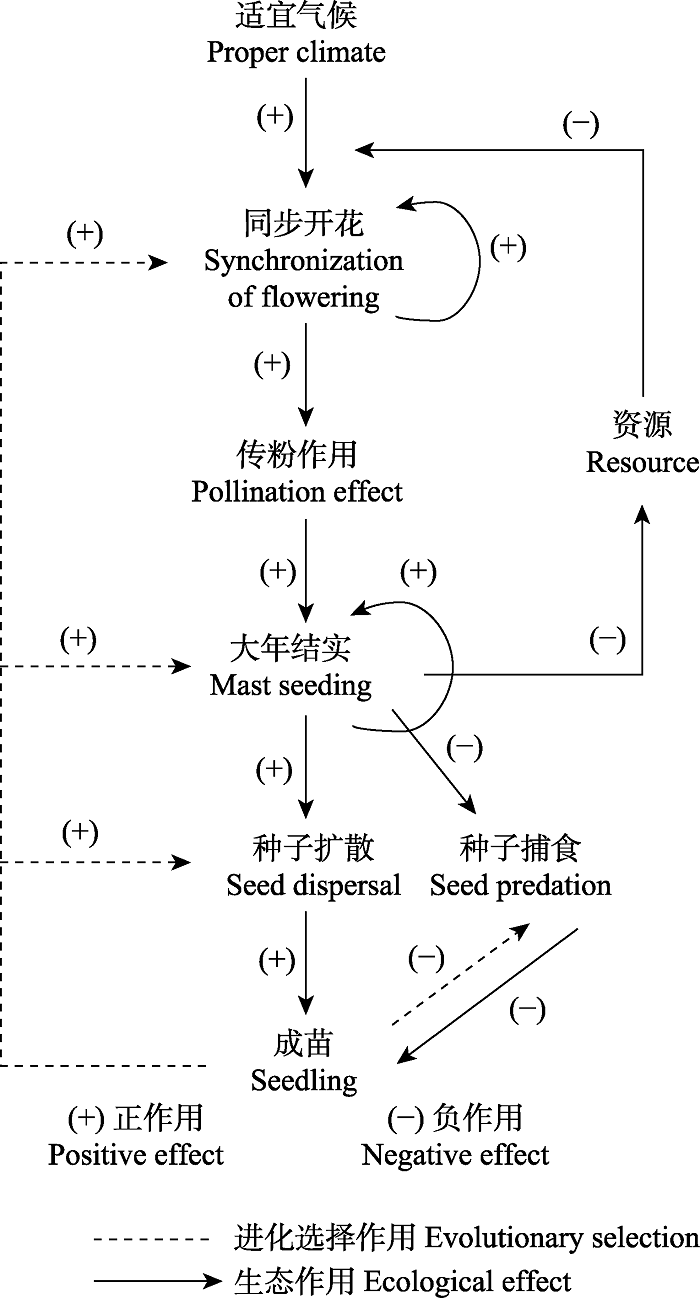
图1
一个整合气候、资源和动植物互作的进化与生态过程的大年结实概念框架图
Fig. 1
A frame-diagram explaining the evolutionary and ecological processes of mast seeding by integrating the climate and resource and plant-animal interactions
进化选择作用包括: 植物在进化过程中, 为了适应环境以使繁殖适合度最大化, 通过遗传变异和分泌激素促使周期性大量同步开花进而吸引大量传粉者以提高传粉效率, 最终导致植物周期性同步大量结实。此过程不仅有利于植物资源的周转, 而且有利于调控动物种群数量及改变动物贮食行为, 促进动物对种子的扩散, 避免动物对种子的过度捕食, 从而使动植物协同进化并处于一种动态平衡状态。这种动态平衡对于维持森林生态系统的生物多样性、稳定性及健康至关重要。
2 大年结实与动物贮食行为
植物间断性地大量结实是多因素综合作用的结果, 而以植物种子(果实)为食的动物也必然会受到植物种子产量波动的影响, 因此动物也会采用相应的适应性策略(Vander Wall, 2010; Selås, 2016)。例如, Granados等(2019)研究发现, 通过砍伐改变植物生物量, 在食物资源较充足的年份增加了脊椎动物的迁移和繁殖。大年结实与动物行为之间的相互关系是一个广泛的话题, 动物行为涉及贮食、领域、繁殖和社会行为等等。动物贮食行为对植物的自然更新有着非常重要的作用, 植物的自然更新包括种子生产、种子扩散、幼苗建成等过程, 其中, 种子扩散是决定植物更新和扩散的关键阶段(Nathan & Muller-Landau, 2000); 动物的贮食行为受植物大年结实影响(Vander Wall, 2010)。限于篇幅, 本节重点概述大年结实与动物贮食行为之间的相互关系。
2.1 动物贮藏行为
动物的贮藏行为可分为集中贮藏(larder hoarding)和分散贮藏(scatter hoarding) (Vander Wall, 1990)。集中贮藏是指动物将收集的植物种子集中贮藏在其洞穴或临时栖居场所, 通常贮藏点少, 每个贮藏位点种子数量多; 分散贮藏是指动物将收集的种子贮藏在多个贮藏点, 每个贮藏点的种子数量少, 通常仅有1粒种子。分散贮藏较集中贮藏更有利于植物种子传播和更新, 因为动物往往将种子埋藏在枯枝落叶或土壤浅层等适宜萌发和建成幼苗的微生境, 这些种子一旦逃脱动物捕食和真菌侵蚀, 就有机会萌发、建成幼苗, 实现植物更新。
种子产量的多少直接影响动物在越冬和繁殖时潜在的食物供应(Vander Wall, 1990)。通过实验室控制性实验如限食, 研究贮食动物在不同资源量条件下(模拟种子产量大小年)的贮藏行为不失为一种很好的手段。例如, 早期研究表明, 西伯利亚仓鼠(Phodopus sungorus)在经历限食之后, 增加了对食物的贮藏, 并且这种增加并不受限食时间长短的影响(Day et al, 1999)。但是, 也有一些研究表明动物在限食后的贮藏行为并没有受到显著影响(Wong & Jones, 1985), 甚至减少了对食物的贮藏(Demas & Bartness, 1999)。这可能与室内条件局限影响动物情绪、行为等有关。
随着研究的不断深入、技术手段的提升, 半自然围栏、野外实验证据也越来越多(Jansen et al, 2004; Fletcher et al, 2010; Xiao et al, 2013a, 2015; Zwolak et al, 2016)。例如, Jansen等(2004)在法属圭亚那采用远程视频监控和线标法连续5年(3年种子大年, 2年种子小年)追踪了3,000粒苦油楝种子的命运, 结果表明种子大年促进了鼠类贮藏种子, 提高了种子扩散成功率。对鸦科鸟类贮藏行为的研究也表明, 种子大年增加了鸟类对种子的贮藏(Pesendorfer & Koenig, 2016; Pesendorfer et al, 2016b)。
2.2 种子扩散速率
Vander Wall (2002)在内华达州西部的研究发现, 在不同年间鼠类对人工释放的杰弗里松(Pinus jeffreyi)和糖松(P. lambertiana)种子的扩散速率差异显著, 种子大年鼠类对种子的扩散速度明显比种子小年要快得多。然而, 也有很多研究与Vander Wall (2002)的结果相反。例如, Sork (1983)的研究表明, 在种子大年野外种子的消失速率比较缓慢, 动物仅搬走很少一部分种子。Montiel和Montaña (2000)通过对墨西哥奇瓦瓦沙漠南部的脊椎动物扩散胭脂仙人掌属(Opuntia)植物果实的研究, 发现果实的消失速率与果实的可获得性成反比: 在低密度种群中和干旱的年份果实的消失速率是最快的。一些研究也证实, 种子在结实小年比结实大年被鼠类扩散得更快(Li & Zhang, 2007; Fletcher et al, 2010; Cao et al, 2017; Xiao & Huang, 2019)。此外, 还有研究表明, 在种子大小年间油茶种子被鼠类扩散的速度没有显著差异, 但却发现在油茶种群较大的斑块释放的油茶种子被鼠类扩散得更快, 因此他们认为油茶种子的绝对数量更能影响种子被扩散的速率(Xiao et al, 2005)。
2.3 动物分散贮藏
动物通过分散贮藏食物资源, 不仅有利于自身的生存和繁殖成功, 而且也有利于植物种子在合适的生境萌发、幼苗建成和植物的更新(Vander Wall, 1990, 2010; Cao et al, 2017; Pesendorfer & Koenig, 2017)。Li和Zhang (2007)研究发现, 种子大年增加了鼠类分散贮藏山杏(Prunus armeniaca)种子的数量; 而且在种子大年, 山杏种子被分散贮藏的数量是种子小年的4倍。Zhang等 (2008)在实验围栏条件下增加油茶种子数量时发现, 小泡巨鼠(Leopoldamys edwardsi)分散贮藏了更多的种子, 支持提出的大年结实促进贮藏假说(the masting- enhanced hoarding hypothesis)。Xiao等(2013a)研究发现, 与种子小年相比, 在种子大年岩松鼠(Sciurotamias davidianus)虽然收获较少的橡子, 但贮藏了更多收获的种子。Pesendorfer等(2016b)研究发现, 种子大年圣岛丛鸦分散贮藏了更多种子。此外, Vander Wall (2002)研究表明, 鼠类在种子大年对埋藏种子的二次埋藏强度低于在种子小年。
然而, Jansen等(2004)认为植物大年结实在饱和捕食者的同时, 也会降低扩散动物分散贮藏种子的比例。Cao等(2017)研究表明, 较大的种子数量减少了鼠类对假海桐种子的贮藏, 但较大的种子数量对鼠类贮藏落瓣山茶(Camellia kissi)种子没有显著影响。其他很多研究也表明, 鼠类分散贮藏植物种子的比例在种子大小年间没有显著的差异(Theimer, 2001; Vander Wall, 2002; Xiao et al, 2005)。
2.4 种子扩散距离
一些研究认为, 在种子大年时, 鼠类有更多的资源能够补充能量的消耗, 为降低种子被其他动物盗食的概率, 鼠类会将种子扩散更远(Vander Wall, 2002; Li & Zhang, 2007; Vander Wall & Beck, 2012)。这些研究支持动物扩散假说。然而, 另一些研究认为, 在植物种子大年时, 丰富的食物资源降低了贮藏种子被盗食的概率, 因此鼠类也会降低对这些种子的管理, 导致种子扩散距离较近(Moore et al, 2007)。很多研究证实在种子结实大年, 动物对种子的扩散距离显著小于种子结实小年(Theimer, 2001; Jansen et al, 2004; Xiao et al, 2005; Cao et al, 2017; Xiao & Huang, 2019)。例如, Cao等(2017)通过群落水平的研究证实, 分散贮藏鼠类对假海桐和落瓣山茶种子的扩散距离在种子大年均极显著小于种子小年。Zwolak等(2016)研究发现, 欧洲山毛榉被鼠类扩散的平均距离在种子小年是种子大年的近8倍。以上这两种截然相反的结果可能是因为, 动物将植物种子扩散到远离母树的地方贮藏起来, 虽然可以降低种子被其他动物盗食的概率, 但扩散种子需要消耗大量的能量, 因此动物对种子的扩散距离取决于种子资源量、动物扩散种子时的能量消耗, 以及贮藏种子被盗食的概率之间的权衡(Moore et al, 2007; Solbreck & Knape, 2017)。
2.5 幼苗建成率
植物大年结实可以使捕食者的食物饱和, 从而使更多种子逃脱捕食而存活, 增加幼苗建成率(Kelly, 1994; Kelly & Sork, 2002)。研究证实, 一些种子的幼苗建成率在种子大年时显著高于小年(Vander Wall, 2002; Jansen et al, 2004)。例如, Vander Wall (2002)发现在种子大年时, 西黄松(Pinus ponderosa)、糖松和约弗里松种子的幼苗建成率分别为种子小年的2.2倍、4.1倍和6.9倍; Jansen等 (2004)发现苦油楝种子的幼苗建成率在种子大年时为小年的4.5倍。多数研究均发现在种子生产大年时种子幼苗建成率比较高, 表明植物大年结实能够在一定程度上促进植物幼苗的更新(Kelly, 1994; Vander Wall, 2002; Joubert et al, 2013)。Zwolak等(2016)连续4年(2 + 2)追踪了1,600粒欧洲山毛榉种子的命运, 结果表明种子大年减少了黄喉姬鼠对埋藏种子的找回, 增加了幼苗出苗率。
3 大年结实的进化和生态意义
大年结实在植物更新、动植物互作以及许多其他生态过程中起着至关重要的作用(Vacchiano et al, 2018; Bogdziewicz et al, 2020)。大年结实意味着食物资源丰富, 因此有更多种子能够逃脱捕食者的捕食(捕食者饱和假说) (Vander Wall, 1990; Jansen et al, 2004; Xiao et al, 2013b; Cao et al, 2017), 同时也会刺激动物的贮食行为, 贮食动物在种子大年比在种子小年贮藏更多种子(动物扩散假说) (Vander Wall, 2002; Li & Zhang, 2007; Xiao et al, 2013a; Zwolak et al, 2016), 动物这种行为可能是对大年结实的进化适应(Zhang et al, 2008); 这些被贮藏的种子将更有机会建成幼苗, 从而促进植物种子扩散和种群更新(Kelly & Sork, 2002; Fletcher et al, 2010; Joubert et al, 2013)。此外, 同域树种的结实同步与否会改变动物(如鼠类)介导的植物种子间的间接关系(Norghauer & Newbery, 2011; Yang et al, 2020), 进而可能影响植物物种之间的共存(Chen & Hsu, 2011; Garzon-Lopez et al, 2015)。通过理解像大年结实这类复杂现象是如何发生的, 有利于更好地推断形成这种现象的进化过程(West-Eberhardt, 2003)。
总之, 研究大年结实的机制和规律, 不仅具有重要的理论意义, 而且有重大的实践意义。对动物来说, 植物周期性地同步结实有助于维持动物多样性(Silvertown, 1980; Kelly, 1994; Bogdziewicz et al, 2016; Granados et al, 2019); 对植物来说, 大年结实提高了授粉效率, 使捕食者饱和, 大量种子被动物搬离母树而分散贮藏在浅层土壤中, 不仅更易逃脱捕食者的捕食, 且有利于种子萌发、幼苗建成, 直至完成种群更新(Kelly et al, 2001; Kelly & Sork, 2002; 孙明洋等, 2011; Pearse et al, 2016)。植物周期性大量繁殖以适应环境变化, 动物群落对这些变化快速响应, 又反过来影响植物空间格局、演替和恢复过程, 从而形成协同进化。此外, 通过阐明大年结实机制, 可以了解其如何以及为何可能对气候变化和宏量营养素循环(macronutrient cycles)作出反应, 以帮助预测植被动态和生物地球化学循环(Vacchiano et al, 2018; Bogdziewicz et al, 2020)。在农业系统中, 对大年结实机制的认识有助于预测具有商业价值的水果和坚果作物如苹果、柑橘和开心果的种植时间(Smith & Samach, 2013; 殷东生和沈海龙, 2016)。在野生动物管理和人类健康方面, 更好地理解与大年结实相关的资源脉冲(resource pulses)时间, 有助于野生动物管理者掌握动物种群的变化规律和公众预防莱姆病(Lyme disease)等潜在的健康风险(Ostfeld et al, 2006)。
4 展望
尽管以往的研究提出的捕食者饱和、捕食者扩散和大种子等假说为理解植物大年结实及其与动物(特别是鼠类)贮食行为之间的关系提供了重要的理论, 但将大年结实作为一种进化特征的很多关键方面还有待阐明。近来的研究多倾向于考虑多种因素的作用, 如Bogdziewicz等(2020)认为, 要全面剖析大年结实现象的直接动力机制, 需要重点关注3个主要过程: 资源动态、授粉限制、遗传和激素调节。由于相对于多年生植物较长的生活史, 一般研究的时间尺度均较短(多在10年左右或更短), 显然不足以揭示多年生植物的生长和繁殖变化机制。未来的研究需要通过长期生态监测对植物物种的结实大小年周期进行精确确定, 并在此过程中调查生态系统中动植物群落的变化规律, 以揭示植物大年结实与包括动物贮食行为在内的各种生态过程之间的关系。
建议未来应关注以下4个方面的研究: (1)在个体和种群水平上, 着重考虑规模经济和资源预算假说, 加强对植物的长期观察研究和改变资源的控制实验; 此外, 从微观水平研究植物遗传和激素对同步开花、大年结实的调控机制, 利用基因组等分子生物学方法深入挖掘植物大年结实的进化机制。(2)在群落水平上, 探讨为什么有些植物物种的种子产量是相对恒定的, 而同样环境下其他物种却出现大年结实现象? 从动物(如鼠类、鸟类)介导的植物种子间的间接相互作用(即动植物互作层面)来探讨大年结实机制, 或许是一种新的研究思路。(3)在景观或全球尺度上, 通过长时间、多种因素共同考虑, 探讨哪些假说是互相排斥的或共同作用的, 哪些因素是占主导作用, 哪些因素是影响大年结实的近因或远因。(4)由于森林生态系统受到了人为干扰和全球气候变化影响, 因此研究在人为干扰和全球气候变化下植物的生产和繁殖策略也是未来研究应该加强的方面。
参考文献
From theory to experiments for testing the proximate mechanisms of mast seeding: An agenda for an experimental ecology
Effectiveness of predator satiation in masting oaks is negatively affected by conspecific density
How do vertebrates respond to mast seeding?
Masting in a temperate tree: Evidence for environmental prediction?
Fluctuation in seed abundance has contrasting effects on the fate of seeds from two rapidly germinating tree species in an Asian tropical forest
Differential foraging preferences on seed size by rodents result in higher dispersal success of medium-sized seeds
A review on mast seeding studies
植物大年结实研究概述
Synchronized reproduction promotes species coexistence through reproductive facilitation
How do plants know when other plants are flowering? Resource depletion, pollen limitation and mast-seeding in a perennial wildflower
Resource depletion, pollen coupling, and the ecology of mast seeding
Diet self-selection and food hoarding after food deprivation by Siberian hamsters
Effects of food deprivation and metabolic fuel utilization on food hoarding by jirds (Meriones shawi)
Resource acquisition and reproductive strategies of tropical forest in response to the El Niño-Southern Oscillation
Advancements and prospects in forest seed rain studies
森林种子雨研究进展与展望
The functional response of a hoarding seed predator to mast seeding
Indirect interactions among tropical tree species through shared rodent seed predators: A novel mechanism of tree species coexistence
The influence of logging on vertebrate responses to mast fruiting
Annual variability in seed production by woody plants and the masting concept: Reassessment of principles and relationship to pollination and seed dispersal
DOI:10.1086/286191
URL
PMID:18811365
[本文引用: 1]

By analyzing 296 published and unpublished data sets describing annual variation in seed output by 144 species of woody plants, this article addresses the following questions. Do plant species naturally fall into distinct groups corresponding to masting and nonmasting habits? Do plant populations generally exhibit significant bimodality in annual seed output? Are there significant relationships between annual variability in seed production and pollination and seed dispersal modes, as predicted from economy of scale considerations? We failed to identify distinct groups of species with contrasting levels of annual variability in seed output but did find evidence that most polycarpic woody plants seem to adhere to alternating supra-annual schedules consisting of either high or low reproduction years. Seed production was weakly more variable among wind-pollinated taxa than animal-pollinated ones. Plants dispersed by mutualistic frugivores were less variable than those dispersed by either inanimate means or animals that predominantly behave as seed predators. We conclude that there are no objective reasons to perpetuate the concept of mast fruiting in the ecological literature as a shorthand to designate a distinct biological phenomenon. Associations between supra-annual variability in seed output and pollination and seed dispersal methods suggest the existence of important reproductive correlates that demand further investigation.
Mast seedling in Abies balsamea, Acer saccharum and Betula alleghaniensis in an old growth, cold temperate forest of north-eastern North America
Seed mass and mast seeding enhance dispersal by a neotropical scatter-hoarding rodent
Seed predation by animals
Why bamboos wait so long to flower
The influence of rainfall, competition and predation on seed production, germination and establishment of an encroaching Acacia in an arid Namibian savanna
Mast flowering and semelparity in bamboos: The bamboo fire cycle hypothesis
DOI:10.1086/303243 URL PMID:10506551 [本文引用: 2]
The evolutionary ecology of mast seeding
Of mast and mean: Differential-temperature cue makes mast seeding insensitive to climate change
DOI:10.1111/ele.12020
URL
PMID:23113938
[本文引用: 1]
Mast-seeding plants often produce high seed crops the year after a warm spring or summer, but the warm-temperature model has inconsistent predictive ability. Here, we show for 26 long-term data sets from five plant families that the temperature difference between the two previous summers (DeltaT) better predicts seed crops. This discovery explains how masting species tailor their flowering patterns to sites across altitudinal temperature gradients; predicts that masting will be unaffected by increasing mean temperatures under climate change; improves prediction of impacts on seed consumers; demonstrates that strongly masting species are hypersensitive to climate; explains the rarity of consecutive high-seed years without invoking resource constraints; and generates hypotheses about physiological mechanisms in plants and insect seed predators. For plants, DeltaT has many attributes of an ideal cue. This temperature-difference model clarifies our understanding of mast seeding under environmental change, and could also be applied to other cues, such as rainfall.
Evaluating the wind pollination benefits of mast seeding
Mast seeding in perennial plants: Why, how, where?
Stabilizing selection for within-season flowering phenology confirms pollen limitation in a wind-pollinated tree
Patterns of annual seed production by Northern Hemisphere trees: A global perspective
DOI:10.1086/303302
URL
PMID:10657177
[本文引用: 2]
We tested whether annual seed production (masting or mast fruiting) in Northern Hemisphere trees is an evolved strategy or a consequence of resource tracking by comparing masting patterns with those of annual rainfall and mean summer temperatures, two environmental variables likely to correlate with available resources. There were generally significant negative autocorrelations between the seed crop in year x and year [Formula: see text] (year [Formula: see text] in species of Quercus requiring 2 yr to mature acorns), as expected if resources are depleted in mast years in part by switching resources from growth to reproduction. Spatial autocorrelation in annual seed production generally declined with distance but was statistically significant over large geographic areas. Variability in annual seed production was relatively high and inversely correlated with latitude and generally not bimodally distributed. Patterns of spatial autocorrelation in annual rainfall and summer temperatures are generally similar to those exhibited by annual seed production, and relative variability in annual rainfall is also inversely correlated with latitude. However, these environmental variables exhibit distinctly different patterns of temporal autocorrelation, are much less variable, and are more normally distributed than annual seed production. Combined with the inverse relationship between growth and reproduction previously documented, these results support the hypothesis that variability in annual seed production is an evolved strategy and that annual seed production is more or less normally distributed rather than an all-or-none phenomenon.
The mystery of masting in trees
Testing the environmental prediction hypothesis for mast-seeding in California oaks
What drives masting? The phenological synchrony hypothesis
DOI:10.1890/14-0819.1
URL
PMID:26236903
[本文引用: 3]
Annually variable and synchronous seed production, or masting behavior, is a widespread phenomenon with dramatic effects on wildlife populations and their associated communities. Proximally, masting is often correlated with environmental factors and most likely involves differential pollination success and resource allocation, but little is known about how these factors interact or how they influence seed production. We studied masting in the valley oak (Quercus lobata Nee), a California endemic tree, and report evidence that phenological synchrony in flowering driven by microclimatic variability determines the size of the acorn crop through its effects on pollen availability and fertilization success. These findings integrate two of the major factors believed to influence seed production in wind-pollinated species-environmental conditions and pollen limitation-by means of a coherent mechanistic hypothesis for how highly variable and synchronized annual seed production is accomplished. We illustrate how, by means of a simulation based on the mechanism proposed here, climate change may influence masting patterns through its effects on environmental variability.
Acorn production by oaks in Central Coastal California: Variation within and among years
Evolutionary advantages of mast seeding in Fagus crenata
On the evolution of masting behavior in trees: Predation or weather?
DOI:10.1086/285387 URL [本文引用: 1]
Effects of mast seeding and rodent abundance on seed predation and dispersal by rodents in Prunus armeniaca (Rosaceae)
DOI:10.1016/j.foreco.2007.01.063 URL [本文引用: 5]
Resource limitation underlying multiple masting models makes mast seeding sensitive to future climate change
DOI:10.1111/nph.13817
URL
PMID:26725252
[本文引用: 1]
Mechanistic models can help resolve controversy over the responses of mast seeding plants to future environmental change. We evaluate drivers of mast seeding by: developing and validating a new mechanistic resource-based model of mast seeding using four 40-yr Chionochloa (snow tussock) datasets; and comparing the performance of competing empirically-based statistical models, that aim to approximate the mechanisms underlying mast seeding, in explaining simulated and observed data. Our mechanistic model explained 90-99% of the variation in Chionochloa flowering, with higher rates of stored resource mobilisation and lower probability of climatic induction of flowering occurring at lower fertility sites. Inter-annual variation in floral induction and the degree to which seeding is resource-limited explained shifts in the relative performance of different empirical models fitted to data simulated from the mechanistic model. Empirical models explicitly capturing the interaction between the floral induction cue and internal resource state underlying the resource-limited induction mechanism had > 8.7x the statistical support of alternatives when fitted to Chionochloa datasets. We find support for resource-limited floral induction with multiple empirical models consistent with this same mechanism. As both resource acquisition and flowering cues are climate sensitive, we expect climate change to impact upon patterns of mast seeding.
Vertebrate frugivory and seed dispersal of a Chihuahuan Desert cactus
Determinants of seed removal distance by scatter-hoarding rodents in deciduous forests
DOI:10.1890/07-0247.1
URL
PMID:18027756
[本文引用: 2]
Scatter-hoarding rodents should space food caches to maximize cache recovery rate (to minimize loss to pilferers) relative to the energetic cost of carrying food items greater distances. Optimization models of cache spacing make two predictions. First, spacing of caches should be greater for food items with greater energy content. Second, the mean distance between caches should increase with food abundance. However, the latter prediction fails to account for the effect of food abundance on the behavior of potential pilferers or on the ability of caching individuals to acquire food by means other than recovering their own caches. When considering these factors, shorter cache distances may be predicted in conditions of higher food abundance. We predicted that seed caching distances would be greater for food items of higher energy content and during lower ambient food abundance and that the effect of seed type on cache distance variation would be lower during higher food abundance. We recorded distances moved for 8636 seeds of five seed types at 15 locations in three forested sites in Pennsylvania, USA, and 29 forest fragments in Indiana, U.S.A., across five different years. Seed production was poor in three years and high in two years. Consistent with previous studies, seeds with greater energy content were moved farther than less profitable food items. Seeds were dispersed less far in seed-rich years than in seed-poor years, contrary to predictions of conventional models. Interactions were important, with seed type effects more evident in seed-poor years. These results suggest that, when food is superabundant, optimal cache distances are more strongly determined by minimizing energy cost of caching than by minimizing pilfering rates and that cache loss rates may be more strongly density-dependent in times of low seed abundance.
Masting promotes individual- and population-level reproduction by increasing pollination efficiency
DOI:10.1890/13-1720.1
URL
PMID:24933801
[本文引用: 1]
Masting is a reproductive strategy defined as the intermittent and synchronized production of large seed crops by a plant population. The pollination efficiency hypothesis proposes that masting increases pollination success in plants. Despite its general appeal, no previous studies have used long-term data together with population- and individual-level analyses to assess pollination efficiency between mast and non-mast events. Here we rigorously tested the pollination efficiency hypothesis in ponderosa pine (Pinus ponderosa), a long-lived monoecious, wind-pollinated species, using a data set on 217 trees monitored annually for 20 years. Relative investment in male and female function by individual trees did not vary between mast and non-mast years. At both the population and individual level, the rate of production of mature female cones relative to male strobili production was higher in mast than non-mast years, consistent with the predicted benefit of reproductive synchrony on reproductive success. In addition, at the individual level we found a higher conversion of unfertilized female conelets into mature female cones during a mast year compared to a non-mast year. Collectively, parallel results at the population and individual tree level provide robust evidence for the ecological, and potentially also evolutionary, benefits of masting through increased pollination efficiency.
Spatial patterns of seed dispersal, their determinants and consequences for recruitment
DOI:10.1016/s0169-5347(00)01874-7
URL
PMID:10856948
[本文引用: 1]
Growing interest in spatial ecology is promoting new approaches to the study of seed dispersal, one of the key processes determining the spatial structure of plant populations. Seed-dispersion patterns vary among plant species, populations and individuals, at different distances from parents, different microsites and different times. Recent field studies have made progress in elucidating the mechanisms behind these patterns and the implications of these patterns for recruitment success. Together with the development and refinement of mathematical models, this promises a deeper, more mechanistic understanding of dispersal processes and their consequences.
Seed predation and cross-pollination in mast-seeding beech (Fagus sylvatica) patches
Seed fate and seedling dynamics after masting in two African rain forest trees
Mast seeding over 33 years by Dacrydium cupressinum Lamb. (rimu) (Podocarpaceae) in New Zealand: The importance of economies of scale
Impact of weather cues and resource dynamics on mast occurrence in the main forest tree species in Europe
Climate, deer, rodents, and acorns as determinants of variation in lyme-disease risk
DOI:10.1371/journal.pbio.0040145
URL
PMID:16669698
[本文引用: 1]
Risk of human exposure to vector-borne zoonotic pathogens is a function of the abundance and infection prevalence of vectors. We assessed the determinants of Lyme-disease risk (density and Borrelia burgdorferi-infection prevalence of nymphal Ixodes scapularis ticks) over 13 y on several field plots within eastern deciduous forests in the epicenter of US Lyme disease (Dutchess County, New York). We used a model comparison approach to simultaneously test the importance of ambient growing-season temperature, precipitation, two indices of deer (Odocoileus virginianus) abundance, and densities of white-footed mice (Peromyscus leucopus), eastern chipmunks (Tamias striatus), and acorns (Quercus spp.), in both simple and multiple regression models, in predicting entomological risk. Indices of deer abundance had no predictive power, and precipitation in the current year and temperature in the prior year had only weak effects on entomological risk. The strongest predictors of a current year's risk were the prior year's abundance of mice and chipmunks and abundance of acorns 2 y previously. In no case did inclusion of deer or climate variables improve the predictive power of models based on rodents, acorns, or both. We conclude that interannual variation in entomological risk of exposure to Lyme disease is correlated positively with prior abundance of key hosts for the immature stages of the tick vector and with critical food resources for those hosts.
Of mice and mast: Ecological connections in eastern deciduous forests
Mechanisms of mast seeding: Resources, weather, cues, and selection
DOI:10.1111/nph.14114
URL
PMID:27477130
[本文引用: 4]
546 I. 546 II. 547 III. 548 IV. 552 V. 554 VI. 556 VII. 558 VIII. 558 IX. 559 559 References 559 SUMMARY: Mast seeding is a widespread and widely studied phenomenon. However, the physiological mechanisms that mediate masting events and link them to weather and plant resources are still debated. Here, we explore how masting is affected by plant resource budgets, fruit maturation success, and hormonal coordination of cues including weather and resources. There is little empirical support for the commonly stated hypothesis that plants store carbohydrates over several years to expend in a high-seed year. Plants can switch carbohydrates away from growth in high-seed years, and seed crops are more probably limited by nitrogen or phosphorus. Resources are clearly involved in the proximate mechanisms driving masting, but resource budget (RB) models cannot create masting in the absence of selection because some underlying selective benefit is required to set the level of a 'full' seed crop at greater than the annual resource increment. Economies of scale (EOSs) provide the ultimate factor selecting for masting, but EOSs probably always interact with resources, which modify the relationship between weather cues and reproduction. Thus, RB and EOS models are not alternative explanations for masting - both are required. Experiments manipulating processes that affect mast seeding will help clarify the physiological mechanisms that underlie mast seeding.
Cues versus proximate drivers: Testing the mechanism behind masting behavior
Biology of the bamboo Chusquea culeou (Poaceae: Bambusoideae) in Southern Argentina
Environmental drivers of mast-seeding in Mediterranean oak species: Does leaf habit matter?
The effect of within-year variation in acorn crop size on seed harvesting by avian hoarders
Competing for seed dispersal: Evidence for the role of avian seed hoarders in mediating apparent predation among oaks
Individual resource limitation combined with population-wide pollen availability drives masting in the valley oak (Quercus lobata)
Context-dependent seed dispersal by a scatter-hoarding corvid
DOI:10.1111/1365-2656.12501
URL
PMID:26876417
[本文引用: 6]
Corvids (crows, jays, magpies and nutcrackers) are important dispersers of large-seeded plants. Studies on captive or supplemented birds suggest that they flexibly adjust their scatter-hoarding behaviour to the context of social dynamics and relative seed availability. Because many corvid-dispersed trees show high annual variation in seed production, context-dependent foraging can have strong effects on natural corvid scatter-hoarding behaviour. We investigated how seed availability and social dynamics affected scatter-hoarding in the island scrub jays (Aphelocoma insularis). We quantified rates of scatter-hoarding behaviour and territorial defence of 26 colour-marked birds over a three-year period with variable acorn crops. We tested whether caching parameters were correlated with variation in annual seed production of oaks as predicted by the predator dispersal hypothesis, which states that caching rates and distances should vary with seed abundance in ways that benefit tree fitness. We also tested whether antagonistic interactions with conspecifics would affect scatter-hoarding adversely, as found in experimental studies. Caching behaviour varied with acorn availability. Caching distances correlated positively with annual acorn crop size, increasing by as much as 40% between years. Caching rates declined over time in years with small acorn crops, but increased when crops were large. Acorn foraging and caching rates were also negatively correlated with rates of territorial aggression. Overall foraging rates, however, were not associated with aggression, suggesting that reduced dispersal rates were not simply due to time constraints. Our field results support laboratory findings that caching rates and distances by scatter-hoarding corvids are context-dependent. Furthermore, our results are consistent with predictions of the predator dispersal hypothesis and suggest that large seed crops and social interactions among scatter-hoarders affect dispersal benefits for oaks and other masting tree species.
The evolutionary ecology of masting: Does the environmental prediction hypothesis also have a role in mesic temperate forests?
DOI:10.1007/s11284-005-0096-z
URL
[本文引用: 1]
The evolutionary advantages of mast seeding in mesic temperate forests are reviewed with reference to the whole plants lifecycle. The aim of this article is to give attention to the environmental prediction hypothesis as an evolutionary aspect of closed-forest dynamics that need to be tested in field studies and modelling. It is suggested that the year after a period of water stress (or other suboptimal conditions for growth) trees respond with high seed production. Due to an understory environment favorable for prolific establishment of seedlings (i.e., more light at the forest floor) this may give rise to a pulse of regeneration. Thus, understanding masting may require a multi-faceted approach including the study of the ecology of the trees themselves beyond pollination and seed predation, and including gap ecology and patch dynamics with special attention to patterns of forest regeneration.]]>
Masting in whitebark pine (Pinus albicaulis) depletes stored nutrients
DOI:10.1111/j.1469-8137.2012.04257.x
URL
[本文引用: 1]
In 2005, the mast year, we compared seasonal changes in leaf and sapwood nitrogen (N) and phosphorus (P) concentrations and leaf photosynthetic rates in cone-bearing branches, branches that never produced cones, and branches with experimentally removed cones. We also compared nutrient concentrations in cone branches and branches that had never had cones between 2005 and 2006, and measured tree ring width and new shoot growth during 2005.During the mast year, N or P depletion occurred only in tissue fractions of reproductive branches, where photosynthetic rates were reduced. However, by the end of the following year, nutrients were depleted in all branches, indicating individual-level resource depletion. New shoot and radial growth were not affected by masting.We provide direct evidence that mast events in wild trees deplete stored nutrients. Our results highlight the importance of evaluating reproductive costs over time and at the individual level.]]>
Masting by eighteen New Zealand plant species: The role of temperature as a synchronizing cue
Cyclic population fluctuations of herbivores as an effect of cyclic seed cropping of plants: The mast depression hypothesis
Seventy-five years of masting and rodent population peaks in Norway: Why do wood mice not follow the rules?
The evolutionary ecology of mast seeding in trees
The advantage of mast years for wind pollination
Constraints to obtaining consistent annual yields in perennial tree crops. I. Heavy fruit load dominates over vegetative growth
DOI:10.1016/j.plantsci.2013.02.014
URL
PMID:23602111
[本文引用: 1]
Farmers lack effective methods to achieve and maintain stable production from year to year in many commercial fruit crops. Annual fruit yield within a region often alternates between high and low fruit load and is termed alternate bearing. The underlying cause of alternate bearing is the negative impact of high fruit load on vegetative growth and next year's flowering. In this review, we emphasize common responses of diverse perennials to heavy crop load. We present botanical, ecological and horticultural perspectives on irregular bearing. The later part of this review focuses on understanding how high fruit load dominates over vegetative growth. We discuss sink strengths and putative mobile signals (hormones), perhaps seed-derived. We highlight gaps in current understanding of alternate bearing, and discuss new approaches to better understand fruit load dominance. Assuming the effect of high fruit load may be related to other mechanisms of sink partitioning, other forms of dominance are presented such as apical, first fruit and king fruit dominance. Dominance seems to be enforced, in independent cases through the establishment of a polar auxin transport system from the stronger sink. Once established this somehow perturbs the transport of auxin out of weaker sinks. Possibly, fruit derived auxin may alter the polar auxin transport system of the shoot to inhibit shoot growth.
Seed production and predation in a changing climate: New roles for resource and seed predator feedback?
DOI:10.1002/ecy.1941
URL
PMID:28703294
[本文引用: 1]
Climate change may cause changes in the dynamics of populations beyond comparatively simple directional effects. To better understand complex effects on dynamics requires long-term studies of populations that experience changes in climatic conditions. We study the dynamics of a seed-production-seed-predation system, consisting of a perennial herb and its two seed predatory insects, over a 40-yr period during which climate change has caused the annual growing season to increase by 20 d. During this period, plant patches have increased almost threefold in size and seed production has slipped into a pattern of alternate high and low years with a higher variance than in the beginning of the period. We find that seed production is associated with precipitation of the present summer and a non-linear feedback from seed production of the previous year. When previous year's seed production is low, weather forcing and unexplained noise determine the extent of seed production. When previous seed production is high, depleted resources limit seed production. Resource depletion happened frequently in the latter parts of the study but rarely in the beginning. The changing patterns of seed production in turn affect the dynamics of seed predation, which is dominated by one of the seed predators. Its dynamics are strongly linked to seed density fluctuations, but its population growth rate is satiated when resource fluctuations become too large. In the latter part of the study period, when seed fluctuations were alternating between years of high and low density, satiation was common and there was a large increase in surviving seeds in good years. Our study illustrates that a changing climate can fundamentally influence patterns of long-term dynamics at multiple trophic levels.
Mammalian seed dispersal of pignut hickory during three fruiting seasons
Evolutionary ecology of mast-seeding in temperate and tropical oaks (Quercus spp.)
Seed predation during general flowering events of varying magnitude in a Malaysian rain forest
Effects of seed productivity on dispersal of nuts of Quercus variabilis by rodents
种子产量对鼠类扩散栓皮栎坚果的影响
Seed scatterhoarding by white-tailed rats: Consequences for seedling recruitment by an Australian rain forest tree
Can wind pollination provide a selective benefit to mast seeding in Chionochloa macra (Poaceae) at Mt Hutt, New Zealand?
Temporal coexistence mechanisms contribute to the latitudinal gradient in forest diversity
DOI:10.1038/nature24038
URL
PMID:28953870
[本文引用: 1]
The tropical forests of Borneo and Amazonia may each contain more tree species diversity in half a square kilometre than do all the temperate forests of Europe, North America, and Asia combined. Biologists have long been fascinated by this disparity, using it to investigate potential drivers of biodiversity. Latitudinal variation in many of these drivers is expected to create geographic differences in ecological and evolutionary processes, and evidence increasingly shows that tropical ecosystems have higher rates of diversification, clade origination, and clade dispersal. However, there is currently no evidence to link gradients in ecological processes within communities at a local scale directly to the geographic gradient in biodiversity. Here, we show geographic variation in the storage effect, an ecological mechanism that reduces the potential for competitive exclusion more strongly in the tropics than it does in temperate and boreal zones, decreasing the ratio of interspecific-to-intraspecific competition by 0.25% for each degree of latitude that an ecosystem is located closer to the Equator. Additionally, we find evidence that latitudinal variation in climate underpins these differences; longer growing seasons in the tropics reduce constraints on the seasonal timing of reproduction, permitting lower recruitment synchrony between species and thereby enhancing niche partitioning through the storage effect. Our results demonstrate that the strength of the storage effect, and therefore its impact on diversity within communities, varies latitudinally in association with climate. This finding highlights the importance of biotic interactions in shaping geographic diversity patterns, and emphasizes the need to understand the mechanisms underpinning ecological processes in greater detail than has previously been appreciated.
Reproducing reproduction: How to simulate mast seeding in forest models
Masting in animal-dispersed pines facilitates seed dispersal
How plants manipulate the scatter-hoarding behaviour of seed-dispersing animals
A comparison of frugivory and scatter-hoarding seed-dispersal syndromes
Seed removal, seed predation, and secondary dispersal
How does mast-fruiting get started?
DOI:10.1016/0169-5347(93)90022-H URL PMID:21236126 [本文引用: 1]
Effects of mast seeding and rodent abundance on seed predation and dispersal of Quercus aliena (Fagaceae) in Qinling Mountains, Central China
Developmental Plasticity and Evolution
Mast fruiting and ENSO cycles: Does the cue betray a cause?
A comparative analysis of feeding and hoarding in hamsters and gerbils
DOI:10.1016/0376-6357(85)90024-5
URL
PMID:24896454
[本文引用: 1]
Male and female hamsters and gerbils were randomly assigned to one of three groups. The animals were tested under ad lib feeding conditions or food deprived until they had lost either 10% or 20% of their predeprivation body weight. They were given a 30-min. hoarding test for three consecutive days. The results indicated that although food-deprived gerbils ate more than control gerbils, deprivation had no significant effect on the food intake of hamsters. A sex difference was also evident in the food intake of gerbils; males ate more than did females. Although there was a sex and species difference in the amount of hoarding, deprivation had no significant effect on the amount of hoarding. The implications of these results for of different models of hoarding are discussed. These models contrast hoarding as a defensive response in the regulation of body weight or as an anticipatory activity that is influenced by other selection pressures.
The El Niño Southern Oscillation, variable fruit production, and famine in a tropical forest
Annual and spatial variation in seedfall and seedling recruitment in a neotropical forest
Sensitivity to seed germination schedule by scatter-hoarding Pére David’s rock squirrels during mast and non-mast years
How seed defense and seed abundance predict dispersal and survival patterns in Camellia
Long-term seed survival and dispersal dynamics in a rodent-dispersed tree: Testing the predator satiation hypothesis and the predator dispersal hypothesis
Seed size and number make contrasting predictions on seed survival and dispersal dynamics: A case study from oil tea Camellia oleifera
The effects of seed abundance on seed predation and dispersal by rodents in Castanopsis fargesii (Fagaceae)
Interspecific synchrony of seed rain shapes rodent-mediated indirect seed-seed interactions of sympatric tree species in a subtropical forest
DOI:10.1111/ele.13405
URL
PMID:31631473
[本文引用: 2]
Animal-mediated indirect interactions play a significant role in maintaining the biodiversity of plant communities. Less known is whether interspecific synchrony of seed rain can alter the indirect interactions of sympatric tree species. We assessed the seed dispersal success by tracking the fates of 21 600 tagged seeds from six paired sympatric tree species in both monospecific and mixed plots across 4 successive years in a subtropical forest. We found that apparent mutualism was associated with the interspecific synchrony of seed rain both seasonally and yearly, whereas apparent competition or apparent predation was associated with interspecific asynchrony of seed rain either seasonally or yearly. We did not find consistent associations of indirect interactions with seed traits. Our study suggests that the interspecific synchrony of seed rain plays a key role in the formation of animal-mediated indirect interactions, which, in turn, may alter the seasonal or yearly seed rain schedules of sympatric tree species.
Research review on the characteristics of mast seeding in forest trees and its influencing factors
林木大年结实特征及其影响因素研究进展
Effects of seed abundance on seed scatter-hoarding of Edward’s rat (Leopoldamys edwardsi Muridae) at the individual level
DOI:10.1007/s00442-008-1114-y
URL
PMID:18661155
[本文引用: 2]
Mast seeding is a common phenomenon, and has important effects on seed dispersal and hoarding by animals. At population level, the predator satiation hypothesis proposes that the satiating effect of a large amount of seeds on a relatively small number of predators benefits seed survival in mast-seeding years. However, the effect of mast seeding on the scatter-hoarding of rodents at the individual level is largely unknown. In this study, we investigated the effects of seed abundance (by simulating mast seeding and non-mast seeding) on the removal, consumption and scatter-hoarding of seeds of Camellia oleifera (Theaceae) by Edward's rat Leopoldamys edwardsi (Muridae) in seminatural enclosures in southwest China. We wanted to test the masting-enhanced hoarding hypothesis, which suggests that rodents tend to scatter-hoard more seeds in mast-seeding years in order to occupy more food resources. Our results indicate that L. edwardsi tended to disperse and scatter-hoard more seeds of C. oleifera per night with increasing seed abundance, and to eat less seeds per night when there was a high level of seed abundance in the enclosure experiments. These results support the masting-enhanced hoarding hypothesis. This capacity of rodents may be an evolutionary adaptation to the mast-seeding phenomenon. Our results suggest that mast seeding benefits forest regeneration not only through the predator satiation effect at the population level, but also through increased hoarding by animals at the individual level.
Advantages of masting in European beech: Timing of granivore satiation and benefits of seed caching support the predator dispersal hypothesis
DOI:10.1007/s00442-015-3511-3
URL
PMID:26612728
[本文引用: 6]
The predator satiation and predator dispersal hypotheses provide alternative explanations for masting. Both assume satiation of seed-eating vertebrates. They differ in whether satiation occurs before or after seed removal and caching by granivores (predator satiation and predator dispersal, respectively). This difference is largely unrecognized, but it is demographically important because cached seeds are dispersed and often have a microsite advantage over nondispersed seeds. We conducted rodent exclosure experiments in two mast and two nonmast years to test predictions of the predator dispersal hypothesis in our study system of yellow-necked mice (Apodemus flavicollis) and European beech (Fagus sylvatica). Specifically, we tested whether the fraction of seeds removed from the forest floor is similar during mast and nonmast years (i.e., lack of satiation before seed caching), whether masting decreases the removal of cached seeds (i.e., satiation after seed storage), and whether seed caching increases the probability of seedling emergence. We found that masting did not result in satiation at the seed removal stage. However, masting decreased the removal of cached seeds, and seed caching dramatically increased the probability of seedling emergence relative to noncached seeds. European beech thus benefits from masting through the satiation of scatterhoarders that occurs only after seeds are removed and cached. Although these findings do not exclude other evolutionary advantages of beech masting, they indicate that fitness benefits of masting extend beyond the most commonly considered advantages of predator satiation and increased pollination efficiency.
Population and individual level of masting in a fleshy-fruited tree


