



准确揭示物种养殖种群的来源和遗传组成不仅有利于了解其遗传结构, 更有利于其野生种群的保护和遗传资源的管理(Larson & Burger, 2013)。缺乏对养殖种群遗传背景的知识可能导致不同野生种群甚至物种在人为介导下发生遗传混杂, 进而出现不同种群或物种间的基因污染(genetic pollution) (Larson & Burger, 2013; Zhang et al, 2017)。尤其在珍稀濒危野生动物的保护实践中, 具有不同遗传背景的种群在改善种质等的需求下被人为混杂而形成人工繁育种群, 此时个体虽然形态上仍属同一物种, 但遗传上已经变为混杂状态, 将它们再放归野外可能污染甚至替代原有野生种群的纯正基因库, 从而严重威胁物种遗传多样性的保护(Ellstrand & Rieseberg, 2016)。国家二级保护动物中国大鲵(Andrias davidianus)是此现象的一个经典案例(Yan et al, 2018)。基于基因组水平的全国大鲵野生种群和养殖种群的研究结果表明, 大鲵养殖种群至少混杂了5个不同的现生种, 且不同的养殖种群混杂了2个或多个物种(Yan et al, 2018)。该结果对大鲵的人工养殖、增殖放流及野生种群的保护均具有非常重要的意义。在鱼类中, 大西洋鲑(Salmo salar)是最为著名的案例(Glover et al, 2017)。研究表明, 自20世纪70年代以来, 上千万吨的养殖大西洋鲑逃逸至野外并与不同地理种群形成杂交后代, 严重威胁到野生大西洋鲑的产量、繁殖和遗传多样性(Glover et al, 2017)。
唐鱼(Tanichthys albonubes)隶属于鲤形目鲤科唐鱼属, 俗称白云金丝、白云山鱼、红尾鱼, 分布于我国华南地区和越南东北部(陈宜瑜, 1998; Freyhof & Herder, 2001)。据信, 唐鱼最早于1935年作为观赏鱼被带入美国(Eastman, 1938), 因来自中国, 故名“唐鱼”, 是为数不多的几种原产中国的世界性观赏鱼类之一。由于唐鱼个体娇小(最大个体体长不超过30 mm) (易祖盛等, 2004)、色彩鲜艳、价格实惠、且容易繁殖和饲养, 目前全球许多国家和地区如新加坡、加拿大、英国、中国台湾等的观赏鱼市场都有它的身影。而其模式产地广州白云山自20世纪60年代后的20多年内未再发现野生种群, 因此唐鱼1988年被原农业部列为国家二级保护动物, 随后被认为已野外灭绝(陈宜瑜, 1998)。自2003年以来, 多个唐鱼野生种群相继在广东(易祖盛等, 2004; 赵俊等, 2010)、海南(Chan & Chen, 2009)、广西(李捷和李新辉, 2011)被发现, 其濒危状态和等级也被重新评估, 由野外灭绝降为极危(曹亮等, 2016)。
自野生种群被重新发现后, 相继有学者对唐鱼养殖种群和野生种群的形态差异、遗传多样性和遗传分化等开展了研究。形态学研究结果表明, 唐鱼野生种群和养殖种群差异极显著, 而且在体型大小上有明显的差异(刘汉生等, 2008; 张秀霞等, 2017)。唐鱼不同野生种群在形态上存在显著差异, 且可能与地理隔离存在着某种相关性(张秀霞等, 2017)。针对唐鱼养殖种群和野生种群的遗传多样性和遗传分化等方面的研究均揭示唐鱼野生种群遗传多样性较低, 而养殖种群遗传多样性较高。Luo等(2015)利用Cyt b基因对唐鱼的5个野生种群和2个养殖种群的遗传多样性与遗传结构的研究结果表明, 唐鱼野生种群的遗传多样性较低, 每个种群都各自形成单系。养殖种群(中国广州的芳村和加拿大)与中国广东清远野生种群亲缘关系较近。Zhao等(2018)基于2个线粒体片段(Cyt b和D-loop)、2个核基因(ENC1和RAG1)和13个微卫星位点, 对采自我国广东、广西、海南和越南的10个野生种群和3个养殖种群开展了遗传结构和遗传多样性研究, 结果表明, 养殖种群起源于单一种群, 养殖种群遗传多样性比大多数野生种群的遗传多样性高, 且与广州附近野生种群间的亲缘关系较其他野生种群近, 不同野生种群间分化十分明显。另外, 研究认为清远种群为放流的养殖种群。虽然该研究对养殖种群的起源提出了一个初步结论, 但未能合理解释唐鱼养殖种群高遗传多样性形成的原因。同时, 对于唐鱼养殖种群与广州附近野生种群的关系也未作深入探讨。此外, 对于清远种群来源于养殖种群这一重要结论亦未给出充分证据。上述问题的存在给唐鱼养殖种群的管理和野生种群的保护带来了严竣挑战。
目前, 在养殖唐鱼可以合法贸易的背景下, 如何避免养殖种群和野生种群间的基因污染是一个十分重要的课题。本研究通过分析已发表的唐鱼3个代表性养殖种群和广州附近4个野生种群(遗传关系较广州外野生种群近)的分子数据, 拟回答以下科学问题: (1)唐鱼养殖种群与广州附近现存4个野生种群的遗传关系; (2)唐鱼养殖种群和野生种群之间的基因流大小以及方向; (3)唐鱼清远种群与主要养殖种群的关系。本研究拟为未来唐鱼养殖种群的科学管理提供理论依据。
1 材料与方法
1.1 样品和数据采集
本研究所用分子数据均为已发表数据(Zhao et al, 2018)。该数据来自具有代表性的3个唐鱼观赏鱼市场(广州芳村、新加坡、加拿大)和广州附近4个唐鱼野生种群(从化良口、从化石门、清远、深圳) (图1)。本研究获取了上述样品的线粒体细胞色素b基因(Cytochrome b, Cyt b), 2个核基因(重组激活蛋白基, recombination- activating gene 1, RAG1; 外胚层神经皮层1类似蛋白基, ectoderm-neural cortexprotein 1, ENC1)序列以及13个微卫星位点的分型数据(深圳种群只利用了线粒体数据)。相关数据均可通过GenBank获取(序列号: KX646833-KX648256)。深圳种群由于与广州附近野生种群地理距离较远, 且已有研究表明其在系统发育上与养殖种群和广州附近野生种群互为姐妹群(Zhao et al, 2018), 因此仅作为系统树中的外类群。养殖种群和野生种群的具体样本量见表1。
图1
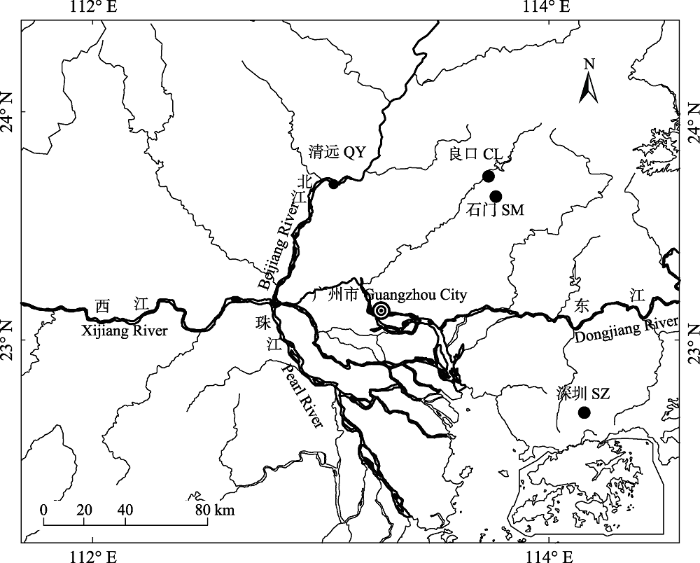
图1
本研究中唐鱼4个野生种群的采样地点(种群代号同
Fig. 1
Sampling location of four wild populations of Tanichthys albonubes in this study. Population codes refer to
表1 本研究的唐鱼样品信息
Table 1
| 种群 Population | 代号 Code | 所属谱系 Lineage* | 样本量 Sample size* | ||
|---|---|---|---|---|---|
| mtDNA | nuDNA | Microsatellites | |||
| 养殖种群 Hatchery populations | |||||
| 广州芳村 Fangcun, Guangzhou, China | FC | A | 30 | 30 | 30 |
| 新加坡 Singapore | SIG | A | 24 | 24 | 30 |
| 加拿大 Canada | CA | A | 12 | 12 | 12 |
| 野生种群 Wild populations | |||||
| 广州从化良口 Liangkou, Conghua, Guangzhou, China | CL | A | 30 | 30 | 30 |
| 广州从化石门 Shimen, Conghua, Guangzhou, China | SM | A | 30 | 30 | 30 |
| 清远 Qingyuan, China | QY | A | 30 | 30 | 30 |
| 外类群 | |||||
| 深圳 Shenzhen, China | SZ | A | 30 | - | - |
| 总计 Total | 186 | 156 | 162 | ||
*Definition of lineage was in accordance with Zhao et al (2018). All the data used has been published (
*谱系定义依据Zhao等(2018), 本研究所用分子数据为已发表数据(
1.2 数据分析
从GenBank获取所有样品的fasta格式的数据后, 导入Clustal X 2.1程序(Thompson et al, 1997)进行序列比对, 比对结果通过MEGA X软件(Kumar et al, 2018)对可能存在的碱基错读、漏读和多读辅以人工校对, 随后利用软件中的Kimura’s two-parameter模型计算不同种群间的遗传距离。利用DNAsp 5.0软件(Librado & Rozas, 2009)检测全部样品的单倍型, 并以深圳种群作为外类群构建基于单倍型的系统发育树。使用贝叶斯推断(Bayesian inference, BI)和最大似然法(maximum-likelihood, ML)两种方法构建系统发育树。核苷酸替代模型(GTR+ G + I)通过PhyML 3.0 (Guindon et al, 2010)软件中的Smart Model Selection (Lefort et al, 2017)在AIC准则(Akaike Information Criterion)下选出。对于BI树, 利用MrBayes v3.2.6软件(Ronquist et al, 2012)运行马尔考夫链蒙特卡罗(Markov Chain Monte Carlo, MCMC) 500万代(3个热链, 1个冷链), 每5,000代抽样1次, 并将25%的样品视为burn-in, 重复运行3次以确保结果的收敛性。对于ML树, 利用RAxML- HPC2 v8.2.10软件(Stamatakis, 2014)构建, bootstrap值设为1,000次。使用 Network 5.0.1.0软件(Bandelt et al, 1999)以邻接法(Median-joining)构建各单倍型之间网络关系图, 并对图中各个单倍型进行种群对应关系分析。利用STRUCTURE v2.3.4软件(Pritchard et al, 2000)基于13个微卫星位点的分型数据推断全部样品的种群遗传结构。为了确定最佳分簇(K), 运行20万代作为burn-in并随后运行马尔考夫链蒙特卡罗(MCMC) 200万代, K设置为1‒10并且每个K重复10次。最佳分簇(K)由ΔK确定(Evanno et al, 2005)并在Structure Harvester (Earl & vonHoldt, 2012)中实现。在R (R Development Core Team, 2015)中使用Adegenet (Jombart, 2008)软件包对13个微卫星位点数据进行主成分分析(principal component analysis, PCA), 以进一步确定是否存在明显的种群结构。为检测不同种群间是否存在明显的基因流, 使用IMa3软件(Hey et al, 2018)基于Cyt b和两个核基因的数据估算基因流的大小和方向, 运行马尔考夫链蒙特卡罗100万代并以其中10%作为burn-in, 3个位点的核酸替代模型为HKY (软件中不提供GTR模型)。重复操作3次, 并以有效取样大小(effective sample size, ESS)大于200作为收敛性的标准。
2 结果
2.1 遗传距离
基于K2P模型得到唐鱼养殖种群和野生种群间的遗传距离结果如表2所示, 范围从0.001‒0.015。新加坡养殖种群和加拿大养殖种群之间以及新加坡养殖种群和清远种群之间遗传距离最小(0.001), 加拿大养殖种群和深圳种群以及石门和深圳种群之间遗传距离均最大(0.015)。野生种群间的遗传距离在0.005-0.015之间, 而养殖种群间的遗传距离为0.001-0.009。加拿大养殖种群和新加坡养殖种群与清远种群之间遗传距离分别为0.001和0.002, 暗示这两个养殖种群与清远种群之间的亲缘关系很近。但同为养殖种群的芳村养殖种群却与加拿大和新加坡养殖种群遗传距离较大, 分别为0.009和0.008, 甚至达到了野生种群之间的遗传距离(如良口和石门种群之间的遗传距离也仅为0.007), 表明芳村养殖种群可能混有不同野生种群的线粒体基因。
表2 基于线粒体Cyt b基因的唐鱼种群间K2P遗传距离(种群代号同表1)
Table 2
| 种群Populations | 芳村 FC | 新加坡SIG | 加拿大CA | 良口 CL | 石门 SM | 清远 QY |
|---|---|---|---|---|---|---|
| 新加坡 SIG | 0.008 | |||||
| 加拿大 CA | 0.009 | 0.001 | ||||
| 良口 CL | 0.006 | 0.006 | 0.007 | |||
| 石门 SM | 0.009 | 0.009 | 0.010 | 0.007 | ||
| 清远 QY | 0.007 | 0.001 | 0.002 | 0.005 | 0.008 | |
| 深圳 SZ | 0.013 | 0.014 | 0.015 | 0.012 | 0.015 | 0.014 |
2.2 系统发育树和单倍型网络图
图2
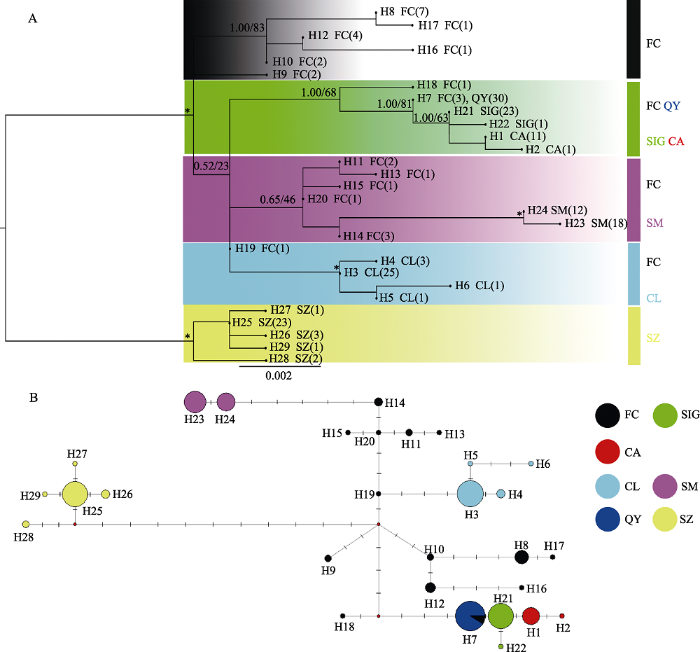
图2
基于Cyt b基因的唐鱼系统发育树和单倍型网络图(种群代号同
Fig. 2
Phylogenetic trees and haplotype networks of Tanichthys albonubes based on Cyt b gene. Population codes refer to
为了更好地阐明唐鱼29个单倍型之间的关系, 将本研究获得Cyt b基因的29个单倍型进行了单倍型网络亲缘关系分析, 用各单倍型之间基于碱基个数差异的遗传距离绘制了单倍型网络图, 结果见图2B。从图可知, 各单倍型之间的变异步数在1-10之间, 表明唐鱼养殖种群和野生种群之间的遗传分化不明显。单倍型网络图分支结构与系统发育树基本一致。芳村养殖种群拥有最多的单倍型且其单倍型位于单倍型网络图的中心位置(如H19); 清远种群只有1个单倍型且与芳村养殖种群共享(H7); 新加坡养殖种群的单倍型突变自芳村养殖种群的单倍型(H7); 而加拿大养殖种群的单倍型则突变自新加坡养殖种群的单倍型(H21)。良口、石门和深圳种群的单倍型均为特有单倍型并且位于单倍型网络图的外围。相较于深圳种群, 良口和石门种群的单倍型数量更少。
2.3 种群结构
由于基于线粒体基因所揭示的种群遗传结构具有较强的偏倚性, 因此本研究利用13个微卫星位点的分型数据进一步检测唐鱼养殖种群及广州邻近地区的野生种群是否存在明显的种群遗传结构, 结果见图3。由图3B可知, 唐鱼养殖种群和野生种群间存在明显的遗传结构, K = 2为最佳分簇。从图3A可知, 芳村、加拿大、新加坡、清远分为一簇, 良口、石门分为另一簇。另外, 3个养殖种群的部分个体与良口和石门种群共享部分等位基因, 表明养殖种群可能引入了这2个野生种群的个体。虽然与养殖种群归为同一簇, 但清远种群色块组成较为单一, 表明只有很少的其他种群的基因混入其中。良口和石门种群形成同一单色块, 暗示其具有相同遗传组成且没有混杂入其他种群的基因。
图3
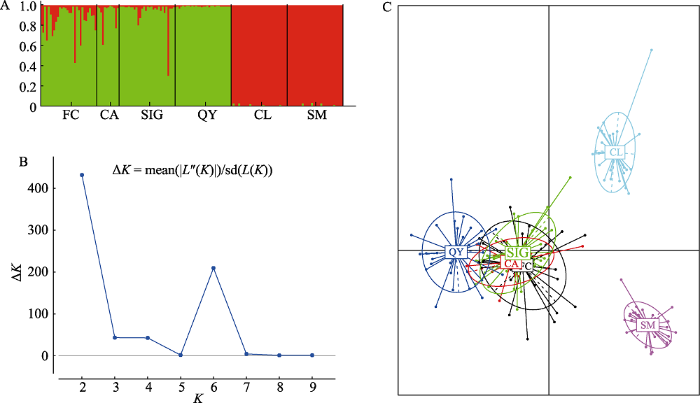
图3
唐鱼养殖种群和野生种群的种群结构分析(种群代号同
Fig. 3
Population structure analysis of hatchery and wild populations of Tanichthys albonubes. (A) STRUCTURE plots of K = 2 based on 13 microsatellite loci; (B) ΔK values of the different number of clusters (K); (C) PCA analysis based on 13 microsatellite loci. Population codes refer to
主成分分析结果进一步揭示了唐鱼养殖种群和野生种群的遗传组成差别。由图3C可知, 虽然野生种群(良口、石门、清远)和养殖种群(芳村、新加坡、加拿大)能够较好地分开, 但也存在部分相似。3个养殖种群在两个主成分上高度重叠, 表明其遗传组成有很大部分相同, 不易区分。同时, 芳村养殖种群拥有最大范围的主成分变异, 表明其基因型更为丰富。相对于良口和石门种群, 清远种群明显与3个养殖种群距离更近并存在部分重叠。此外, 与STRUCTURE结果不同, 良口和石门种群可以清楚地分开, 表明两个种群在等位基因组成上存在明显差异。
2.4 基因流
为了检测唐鱼养殖种群之间、野生种群之间以及养殖种群与野生种群之间是否存在基因流及其方向, 利用IMa3软件并基于Cyt b基因和2个核基因数据估算了不同种群之间的基因流水平, 结果见图4。
由图4可知, 新加坡养殖种群和加拿大养殖种群间存在明显的双向基因流, 其中从新加坡养殖种群到加拿大养殖种群的基因流为0.617, 而从加拿大养殖种群到新加坡养殖种群的基因流为0.558。3个野生种群之间不存在明显的基因流。养殖种群与野生种群之间存在显著的由清远种群到芳村养殖种群的单向基因流(基因流为0.363)。
图4
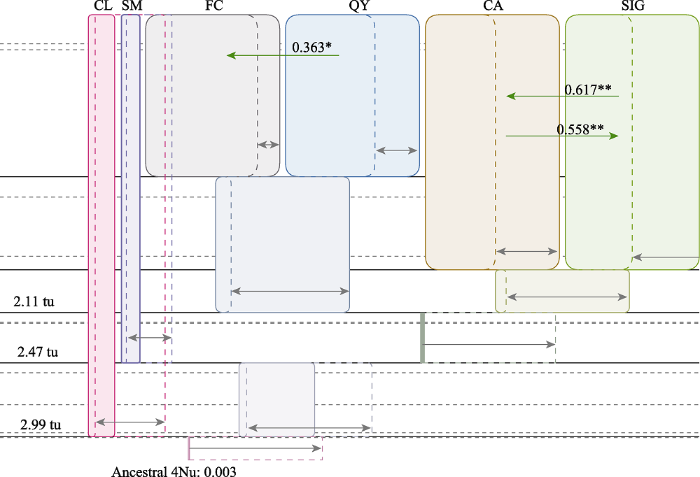
图4
唐鱼养殖种群和野生种群间的基因流估算(种群代号同
Fig. 4
Gene flow estimation among hatchery and wild populations of Tanichthys albonubes. Grey arrows and boxes were marginal distribution values in demographic units. tu means time since ancestral population splitting. Green arrows and the numbers above them showed the gene flows (2Nm values) and their directions. Only statistically significant cases of gene flow are presented. *P < 0.05, **P < 0.01. Population codes refer to
3 讨论
3.1 唐鱼养殖种群的来源
开展鱼类养殖种群的遗传来源和遗传结构的研究对于人工繁育、增殖放流、防范基因污染等方面均具有重要意义(Glover et al, 2017)。作为华南地区的特有鱼类之一, 唐鱼在被广泛引入全球观赏鱼市场之前据信只分布于广州白云山、清远、深圳、香港等少数几个地区(Lin et al, 1932; Weitzman & Chan, 1966; 郑慈英, 1989; 潘炯华, 1990)。因此, 世界范围内唐鱼养殖种群的野生来源应仅限于上述几个地点。随着诸多野生种群的重新发现, 是否存在部分野生种群混杂到养殖种群, 这是一个非常重要的科学问题。另外, 十多年前在广州各区广泛开展的唐鱼增殖放流活动是否对野生种群的遗传多样性和种群结构产生影响, 是另外一个值得探讨的问题。Zhao等(2018)虽然指出唐鱼养殖种群为单一起源, 但未能提供更多证据。同时, 对于芳村养殖种群比几乎所有野生种群遗传多样性高的现象也缺乏合理解释。Weitzman和Chan (1966)提出, 美国市场上的养殖唐鱼存在2种表型, 1种来自广州白云山, 另1种来源于香港。另外, 他们认为旧金山的养殖唐鱼已经被香港表型完全替代。这为唐鱼养殖种群的起源提供了一种可能的解释, 即唐鱼养殖种群可能是混合种群, 而非单一起源。
本研究中, 基于Cyt b基因的养殖种群和野生种群间的遗传距离显示, 芳村养殖种群与加拿大和新加坡养殖种群遗传距离较大, 且达到了野生种群之间的遗传距离(表2), 说明养殖种群并非起源于单一野生种群。而且芳村养殖种群在系统树上拥有多个进化支, 并且有2支与良口和石门构成姐妹支(图2A), 进一步证实芳村养殖种群拥有不同遗传背景的来源, 这一结果与Zhao等(2018)的观点不一致。单倍型网络图的结果显示, 芳村养殖种群拥有最多的单倍型且其单倍型位于单倍型网络图的中心位置(如H19)(图2B)。虽然系统树上其单倍型与良口和石门种群的单倍型关系较近, 但它们之间没有单倍型共享, 表明芳村养殖种群不是直接来源于这两个野生种群, 而可能是来源于与良口和石门种群系统发育关系较近的未采样种群。芳村养殖种群的FC支明显与其他三支分开, 表明其可能是白云山种群线粒体单倍型在目前养殖种群的遗存。Weitzman和Chan (1966)曾认为, 唐鱼自正式命名后, 一直被水族爱好者饲养, 因此可能通过线粒体基因渐渗的方式将白云山种群的单倍型传递至当前的养殖种群。系统树上, 养殖种群和清远种群构成的FC QY SIG CA支位于内群, 故推测其应起源于广州附近另一个野生种群, 而非深圳等地理距离较远的种群。如果养殖种群有混入距离广州较远的野生种群, 则必然有单倍型位于外类群以外, 有关唐鱼现存野生种群的分化情况具体见Zhao等(2018)。形态学的证据也可支持这一假设。当前养殖唐鱼臀鳍分支鳍条数与广州附近野生种群一样均为7-8, 而深圳种群则固定为8 (潘炯华, 1990; 易祖盛等, 2004), 因此有理由认为养殖种群来源于广州附近的野生种群。
STRUCTURE分析结果显示(图3A), 养殖种群包含两种遗传成分, 其中一种与良口和石门的相同, 但这并不一定说明养殖种群就有部分来源于这两个种群。STRUCTURE分析是在特定模型下对等位基因频率的相似性进行分析(Pritchard et al, 2000), 从而推断种群结构, 而非基于等位基因本身进行推断。与非模型条件下的主成分分析相对比, 这一点可以明显得到印证。从图3C可以看出, STRUCTURE结果中被分为同一簇的在主成分分析中可以明显区分, 表明这两个野生种群具有明显的等位基因差异。
综合上述证据, 唐鱼芳村养殖种群应为广州附近多个野生种群混杂而成, 而这可能是唐鱼养殖种群比大多数野生种群遗传多样性高的原因, 具有不同遗传背景的种群混杂而导致遗传多样性上升在鱼类中已有报道(Jaisuk & Senanan, 2018)。未来, 基于广州附近广泛的野生种群采样将有助于准确揭示芳村养殖种群是由哪些野生种群混杂的问题。
除国内唐鱼养殖种群的来源值得探讨外, 国外唐鱼的起源也是一个重要的问题。本研究只采集了新加坡和加拿大养殖种群, 因此仅就这两个养殖种群的起源作探讨。本研究中, 基于Cyt b基因29个单倍型进行的系统发育分析显示, 新加坡和加拿大养殖种群的单倍型与芳村养殖种群的单倍型聚为一支。单倍型网络图则表明新加坡养殖种群的单倍型突变自芳村养殖种群的单倍型(H7), 而加拿大养殖种群的单倍型则突变自新加坡养殖种群的单倍型(H21)。结合主成分分析中新加坡和加拿大养殖种群在两个主成分上均与芳村养殖种群完全重合的结果可以充分说明, 新加坡养殖种群来源于广州芳村, 而加拿大养殖种群则来自新加坡。这一结果与美国唐鱼的情形似乎不同(Weitzman & Chan, 1966)。通过调查, 推测形成这一现象的主要原因是, 早年大陆观赏鱼市场并未与国际市场接轨, 而香港由于政策和制度优势, 在全球观赏鱼的贸易方面比大陆方便简单许多, 相关从业人员也具有更多的技术和资金优势, 因此国外唐鱼养殖者更喜爱从香港进口唐鱼。近年来, 随着国内观赏鱼市场的进一步发展和成熟, 芳村繁殖的唐鱼也可贸易至其他国家, 且在价格和质量方面具有优势, 已逐步占领市场, 因而出现新加坡养殖种群和加拿大养殖种群在遗传特征上与芳村相同的结果。基因流分析结果显示(图4), 新加坡养殖种群和加拿大养殖种群间存在高水平的双向基因流, 这可能是种质改善的结果。未来, 基于全球范围内唐鱼养殖种群的采样将可揭示唐鱼传播至世界观赏鱼市场上的路径, 同时也将全面解释唐鱼养殖种群的起源问题。
3.2 清远种群来源于养殖种群
历史上, 清远曾有野生唐鱼的分布记录(郑慈英, 1989)。然而, Zhao等(2018)基于多种分子标记的分析认为, 采样的清远种群为养殖起源。本研究基于Zhao等(2018)发表的数据, 进行了遗传距离、主成分和基因流等多方面的分析。结果表明, 清远种群与新加坡养殖种群和加拿大养殖种群间遗传距离很小, 未达到野生种群与养殖种群之间的水平。单倍型网络图的结果表明, 清远种群只有一个线粒体单倍型且与芳村养殖种群共享(H7)(图2B)。STRUCTURE分析结果则支持清远种群与养殖种群分为一组, 与主成分分析中清远种群与养殖种群存在部分重叠的结果相一致(图3A和3C)。基于以上多方面的证据, 可以证明清远种群来源于养殖种群中的芳村养殖种群。
值得指出的是, 养殖种群放归清远的时间应早于养殖种群引入野生种群的时间。这一推测源于STRUCTURE结果和主成分分析结果。STRUCTURE结果中清远种群色块较为单一, 表明其为单种群起源, 而当前的芳村养殖种群已为混合种群, 因此清远种群被放流的时间应早于芳村养殖种群引入野生种群的时间。主成分分析中清远种群已经表现出与芳村养殖种群明显不同的等位基因差异, 而不同于新加坡养殖种群和加拿大养殖种群与芳村养殖种群完全重合。这一差异可能是养殖种群放流至清远后, 对当地环境发生了适应性演化, 从而表现出独特的遗传变异。唐鱼性成熟周期短(6月龄可达性成熟)、繁殖期长、一年可繁殖多代(陈国柱等, 2004)的特点为其在较短时间内积累遗传变异提供了可能。
需要指出的是, 不存在芳村养殖种群起源于清远种群这一可能。理由主要有: (1)芳村养殖种群拥有众多单倍型, 而清远种群只有1个且与芳村养殖种群共享; (2)同为野生种群的良口和石门种群在主成分分析中明显与养殖种群分开, 而清远种群却表现出与养殖种群存在部分重叠的现象。
3.3 对唐鱼保护和管理的启示
(1)继续停止不规范的放流活动。2004年, 广州市渔政部门曾委托美国的热带鱼养殖场繁育了2万尾唐鱼成鱼并放归广州花都的山溪中。然而, 如前所述, 当前唐鱼养殖种群为不同种群的混合种群, 将混有不同遗传背景的养殖唐鱼放归原有栖息地将可能污染本地原生种群的基因库, 进而威胁到唐鱼的遗传多样性。因此此类活动应该继续停止直至相应野生种群的人工繁育种群完全建立并可以稳定成熟地提供放流种源。
(2)建立不同野生种群的人工繁育种群以提供放流种源。本研究结果揭示, 芳村养殖种群是新加坡养殖种群和加拿大养殖种群的来源种群, 也是清远野生种群的祖先种群。同时, 芳村养殖种群应来源于广州附近的野生种群, 且至少混合了2个野生种群。这一结果启示我们在未来的唐鱼增殖放流中, 不能简单采用芳村养殖种群, 也不能使用任何遗传背景不明的国外养殖种群, 而需要重新建立各个野生种群的人工繁育种群, 作为原有野生种群地点的放流种源。此外, 应继续禁止从野外捕捞唐鱼补充至养殖种群, 以避免不同野生种群通过养殖种群而发生遗传混杂。
(3)防止养殖种群进入野外。清远种群被证实起源于养殖种群, 这对唐鱼的保护工作是一个警示, 表明曾经存在或当前有不规范的放流活动, 并且放流种群已经形成稳定、可自我维持的自然种群, 这对原有野生种群的基因库产生了严重威胁, 因此这一地点的种群建议清除, 以防止基因污染。同时基因流分析表明, 存在由清远种群到芳村养殖种群的单向基因流, 说明仍有部分野生清远种群被用作人工繁殖。
未来, 相关保护法规的重点应在于禁止不规范的放流活动, 禁止捕捞不同野生种群补充至养殖种群。可喜的是, 本研究暂时未发现养殖种群中有从广州附近以外的野生种群引种的迹象, STRUCTURE分析也未发现养殖种群和野生种群之间杂交的证据, 但仍应该继续监测不同野生种群, 以保存其遗传多样性, 防止其灭绝。
致谢:
感谢英国格拉斯哥大学Kevin Schneider对论文英文摘要的修改。
参考文献
Median-joining networks for inferring intraspecific phylogenies
DOI:10.1093/oxfordjournals.molbev.a026036 URL [本文引用: 1]
Evaluating the status of China’s continental fish and analyzing their causes of endangerment through the red list assessment
DOI:10.17520/biods.2015331 URL [本文引用: 1]
通过红色名录评估研究中国内陆鱼类受威胁现状及其成因
DOI:10.17520/biods.2015331 URL [本文引用: 1]
Discovery of Tanichthys albonubes Lin 1932 (Cyprinidae) on Hainan Island and notes on its ecology
DOI:10.3724/SP.J.1141.2009.02209
URL
[本文引用: 1]

Embryonic development of Tanichthys albonubes
唐鱼胚胎发育观察
STRUCTURE HARVESTER: A website and program for visualizing STRUCTURE output and implementing the Evanno method
DOI:10.1007/s12686-011-9548-7
URL
[本文引用: 1]
We present STRUCTURE HARVESTER (available at http://taylor0.biology.ucla.edu/structureHarvester/), a web-based program for collating results generated by the program STRUCTURE. The program provides a fast way to assess and visualize likelihood values across multiple values of K and hundreds of iterations for easier detection of the number of genetic groups that best fit the data. In addition, STRUCTURE HARVESTER will reformat data for use in downstream programs, such as CLUMPP.
When gene flow really matters: Gene flow in applied evolutionary biology
DOI:10.1111/eva.12402 URL [本文引用: 1]
Detecting the number of clusters of individuals using the software STRUCTURE: A simulation study
DOI:10.1111/mec.2005.14.issue-8 URL [本文引用: 1]
Tanichthys micagemmae, a new miniature cyprinid fish from Central Vietnam (Cypriniformes: Cyprinidae)
Half a century of genetic interaction between farmed and wild Atlantic salmon: Status of knowledge and unanswered questions
DOI:10.1111/faf.2017.18.issue-5 URL [本文引用: 3]
New algorithms and methods to estimate maximum-likelihood phylogenies: Assessing the performance of PhyML 3.0
DOI:10.1093/sysbio/syq010 URL [本文引用: 1]
Phylogeny estimation by integration over isolation with migration models
Effects of landscape features on population genetic variation of a tropical stream fish, stone lapping minnow, Garra cambodgiensis, in the upper Nan River drainage basin, northern Thailand
DOI:10.7717/peerj.4487 URL [本文引用: 1]
adegenet: A R package for the multivariate analysis of genetic markers
DOI:10.1093/bioinformatics/btn129 URL [本文引用: 1]
MEGA X: Molecular evolutionary genetics analysis across computing platforms
DOI:10.1093/molbev/msy096 URL [本文引用: 1]
A population genetics view of animal domestication
DOI:10.1016/j.tig.2013.01.003
URL
[本文引用: 2]
The fundamental shift associated with the domestication of plants and animals allowed for a dramatic increase in human population sizes and the emergence of modern society. Despite its importance and the decades of research devoted to studying it, questions regarding the origins and processes of domestication remain. Here, we review recent theoretical advances and present a perspective that underscores the crucial role that population admixture has played in influencing the genomes of domestic animals over the past 10 000 years. We then discuss novel approaches to generating and analysing genetic data, emphasising the importance of an explicit hypothesis-testing approach for the inference of the origins and subsequent evolution and demography of domestic animals. By applying next-generation sequencing technology alongside appropriate biostatistical methodologies, a substantially deeper understanding of domestication is on the horizon.
SMS: Smart model selection in PhyML
DOI:10.1093/molbev/msx149 URL [本文引用: 1]
A new record of fish Tanichthys albonubes (Cypriniformes: Cyprinidae) in Guangxi, China
广西鱼类一新纪录: 唐鱼(鲤形目: 鲤科)
DNASP v5: A software for comprehensive analysis of DNA polymorphism data
DOI:10.1093/bioinformatics/btp187 URL [本文引用: 1]
New cyprinid fishes from White Cloud Mountain, Canton
Morphological variations between the wild population and hatchery stock of Tanichtys albonubes
唐鱼野生种群和养殖群体的形态差异分析
Population genetic structure in wild and hatchery populations of white cloud mountain minnow (Tanichthys albonubes): Recommendations for conservation
DOI:10.1016/j.bse.2015.08.008 URL [本文引用: 1]
Freshwater Fishes of Gongdong Province
广东淡水鱼类志
Inference of population structure using multilocus genotype data
R: A Language and Environment for Statistical Computing
MrBayes 3.2: Efficient Bayesian phylogenetic inference and model choice across a large model space
DOI:10.1093/sysbio/sys029 URL [本文引用: 1]
RAxML version 8: A tool for phylogenetic analysis and post-analysis of large phylogenies
DOI:10.1093/bioinformatics/btu033
URL
[本文引用: 1]
Motivation: Phylogenies are increasingly used in all fields of medical and biological research. Moreover, because of the next-generation sequencing revolution, datasets used for conducting phylogenetic analyses grow at an unprecedented pace. RAxML (Randomized Axelerated Maximum Likelihood) is a popular program for phylogenetic analyses of large datasets under maximum likelihood. Since the last RAxML paper in 2006, it has been continuously maintained and extended to accommodate the increasingly growing input datasets and to serve the needs of the user community.
Results: I present some of the most notable new features and extensions of RAxML, such as a substantial extension of substitution models and supported data types, the introduction of SSE3, AVX and AVX2 vector intrinsics, techniques for reducing the memory requirements of the code and a plethora of operations for conducting postanalyses on sets of trees. In addition, an up-to-date 50-page user manual covering all new RAxML options is available.
The CLUSTAL_X Windows interface: Flexible strategies for multiple sequence alignment aided by quality analysis tools
DOI:10.1093/nar/25.24.4876 URL [本文引用: 1]
Identification and relationships of Tanichthys albonubes and Aphyocypris pooni, two cyprinid fishes from South China and Hong Kong
The Chinese giant salamander exemplifies the hidden extinction of cryptic species
DOI:10.1016/j.cub.2018.04.004 URL [本文引用: 2]
Rediscovering the wild population of White Cloud Mountain minnows (Tanichthys albonubes Lin) in Guangdong Province
White cloud mountain minnow (Tanichthys albonubes Lin) is an endemic species.It has been listed a second-class state protected animal of China.The species was already on the verge of extinction when LIN Shu-yan first discovered it in 1932 at the Baiyunshan Mountain.Its distribution area is very narrow and only distributed in the mountain brooks of the Baiyunshan Mountain,Huadu City,Longgang in Shenzhen,Hong Kong and the vicinity of Guangzhou in Guangdong Province.It was deeply convinced to extinct in nature because there was not a report of the fish in the wild state since 1980.In September 2003,its population in wild state was discovered in a mountain puddle where spring well up and slow-move on the vicinity of Guangzhou.It likes to stay in clear shallow water with thick growth of weeds.Some basic studies have been done to wild T.albonubes on the morphologic characteristic,feed habits,habitat,growth and reproduction,and factors of endangerment and protect.
野生唐鱼在广东的再发现
White cloud mountain minnow (Tanichthys albonubes Lin) is an endemic species.It has been listed a second-class state protected animal of China.The species was already on the verge of extinction when LIN Shu-yan first discovered it in 1932 at the Baiyunshan Mountain.Its distribution area is very narrow and only distributed in the mountain brooks of the Baiyunshan Mountain,Huadu City,Longgang in Shenzhen,Hong Kong and the vicinity of Guangzhou in Guangdong Province.It was deeply convinced to extinct in nature because there was not a report of the fish in the wild state since 1980.In September 2003,its population in wild state was discovered in a mountain puddle where spring well up and slow-move on the vicinity of Guangzhou.It likes to stay in clear shallow water with thick growth of weeds.Some basic studies have been done to wild T.albonubes on the morphologic characteristic,feed habits,habitat,growth and reproduction,and factors of endangerment and protect.
Geometric morphometric analysis of body-form variability in populations of Tanichthys albonubes
利用几何形态测量学方法分析唐鱼群体的形态变异
Genetic diversity and population history of Tanichthys albonubes (Teleostei: Cyprinidae): Implications for conservation
Background Resources of Aquatic Plants and Animals in Guangzhou
广州市水生动植物本底资源
备案号:京ICP备16067583号-7
Copyright © 2026 版权所有 《生物多样性》编辑部
地址: 北京香山南辛村20号, 邮编:100093
电话: 010-62836137, 62836665 E-mail: biodiversity@ibcas.ac.cn


