A conceptual framework and definitions for the term “wild animal”
Received date: 2020-02-25
Accepted date: 2020-04-27
Online published: 2020-04-27
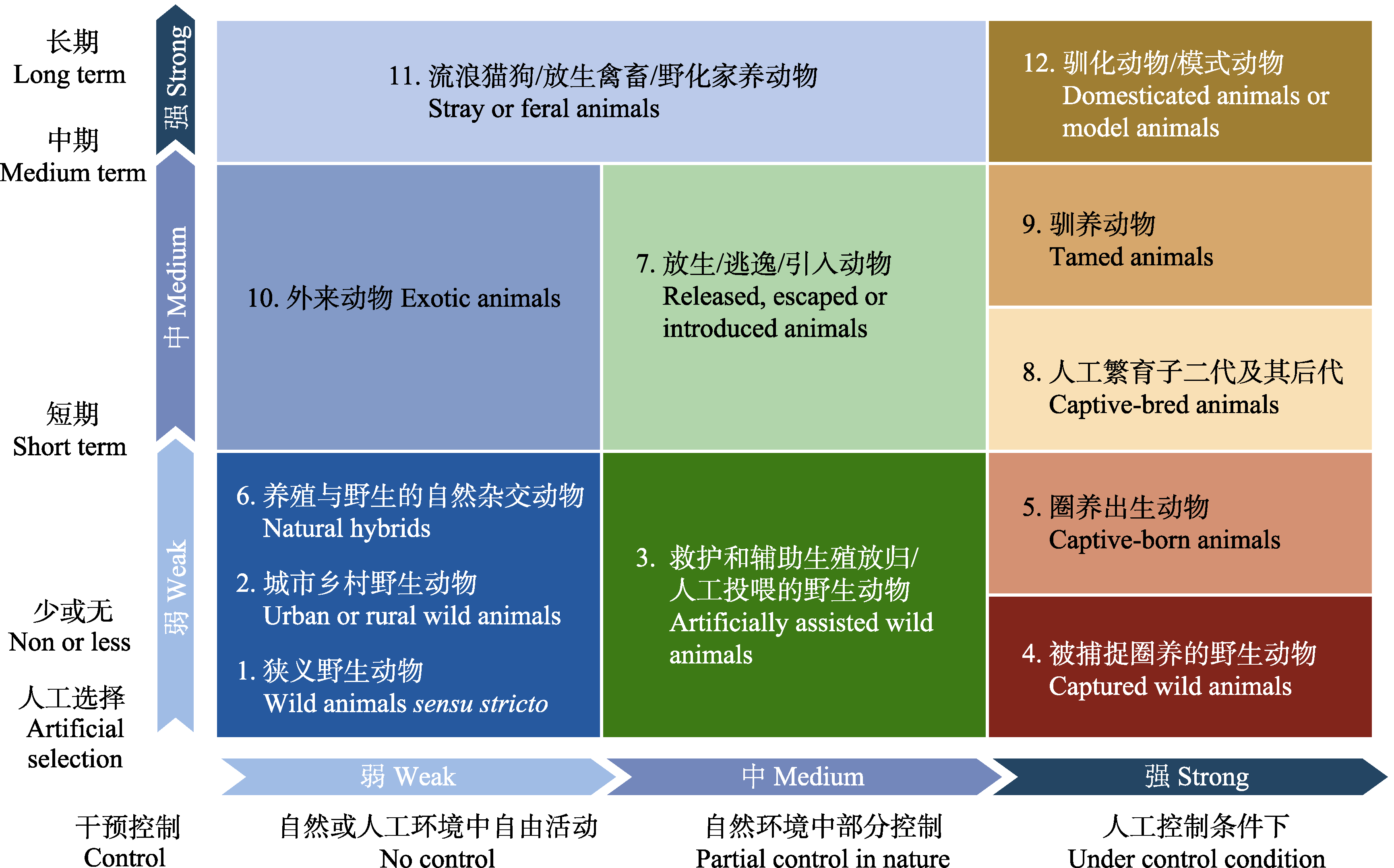
The term “wild animal” has different meanings not only in Chinese but in many languages all over the world. Here, we identify uses of the term “wild animal” through examining interpretations and applications in local, national, and international laws and language used in human controlled animal reproduction. We put forward a two-dimensional conceptual framework of “wild animals” that distinguishes 12 continuous states of animals from “wild” to “domesticated”. Animal groups that have not been artificially selected in the medium- and long-term were considered wild animals. Domesticated animals, whether or not they live under human control, such as domestic cats, dogs, poultry, livestock, and model animals or stray or feral were not considered “wild animals”. However, the management of some categories, such as tamed animals of wild species or exotic/invasive animals needs to base on ecological safety, species conservation, and legislative objectives. The Law of the People’s Republic of China on the Protection of Wildlife shall apply to endangered animal species threatened by humans, whether they were found in the wild or under human control condition. For the management of other states of “wild animals”, existing laws should be strictly implemented, and new laws should be enacted with genetic resources, zoonotic diseases, animal welfare, and ecological safety in mind. We additionally make specific recommendations for the definition of “wild animal” for use under the Law on the Protection of Wildlife.
Yan Zeng , Xiaoge Ping , Fuwen Wei . A conceptual framework and definitions for the term “wild animal”[J]. Biodiversity Science, 2020 , 28(5) : 541 -549 . DOI: 10.17520/biods.2020057
| [1] | Bai C, Ke Z, Consuegra S, Liu X, Li Y (2012) The role of founder effects on the genetic structure of the invasive bullfrog (Lithobates catesbeianaus) in China. Biological Invasions, 14, 1785-1796. |
| [2] | Belyaev DK, Plyusnina IZ, Trut LN (1985) Domestication in the silver fox (Vulpes fulvus Desm): Changes in physiological boundaries of the sensitive period of primary socialization. Applied Animal Behaviour Science, 13, 359-370. |
| [3] | Bos D, Kentie R, La Haye M, Ydenberg RC (2019) Evidence for the effectiveness of controlling muskrat (Ondatra zibethicus L.) populations by trapping. European Journal of Wildlife Research, 65, 45. |
| [4] | Child MF, Selier SAJ, Radloff FGT, Taylor WA, Hoffmann M, Nel L, Power RJ, Birss C, Okes NC, Peel MJ, Mallon D, Davies-Mostert H (2019) A framework to measure the wildness of managed large vertebrate populations. Conservation Biology, 33, 1106-1119. |
| [5] | CITES (Convention on International Trade in Endangered Species of Wild Fauna and Flora) (2020) CITES glossary. https://cites.org/eng/resources/terms/glossary.php. (accessed on 2020-02-13) |
| [6] | Décory MSM (2019) A universal definition of ‘Domestication’ to unleash global animal welfare progress. dA. Derecho Animal (Forum of Animal Law Studies), 10(2), 39-55. |
| [7] | Driscoll CA, Macdonald DW, O’Brien SJ (2009) From wild animals to domestic pets, an evolutionary view of domestication. Proceedings of the National Academy of Sciences, USA, 106(Suppl. 1), 9971-9978. |
| [8] | FAO (Food and Agriculture Organization of the United Nations) (2020) FAO Term Portal. http://www.fao.org/faoterm/en/. (accessed on 2020-02-13) |
| [9] | Fitzpatrick BM, Shaffer HB (2007) Hybrid vigor between native and introduced salamanders raises new challenges for conservation. Proceedings of the National Academy of Sciences, USA, 104, 15793-15798. |
| [10] | Futuyma DJ (translated by Ge S, Gu HY, Rao GY, Zhang DX, Yang J, Kong HZ, Wang YF(2016) Evolution, 3rd edn. Higher Education Press, Beijing. (in Chinese) |
| [10] | [ 葛颂, 顾红雅, 饶广远, 张德兴, 杨继, 孔宏智, 王宇飞 主译 (2016) 生物进化. 第3版. 高等教育出版社, 北京.] |
| [11] | Gibson L, Yong DL (2017) Saving two birds with one stone: Solving the quandary of introduced, threatened species. Frontier in Ecology and the Environment, 15, 35-41. |
| [12] | Hindar K, Fleming IA, McGinnity P, Diserud O (2006) Genetic and ecological effects of salmon farming on wild salmon: Modelling from experimental results. ICES Journal of Marine Science, 63, 1234-1247. |
| [13] | IUCN (International Union for Conservation of Nature) (1995) IUCN Definitions ENGLISH. https://www.iucn.org/sites/dev/files/iucn-glossary-of-definitions_march2018_en.pdf.(accessed on 2020-02-13) |
| [14] | Jiang ZG (2003) The discussion on the definition of “Wild Animal”. Chinese Journal of Wildlife, 24(4), 2. (in Chinese) |
| [14] | [ 蒋志刚 (2003) “野生动物”概念刍议. 野生动物, 24(4), 2.] |
| [15] | Kukekova AV, Johnson JL, Xiang X, Feng S, Liu S, Rando HM, Kharlamova AV, Herbeck Y, Serdyukova NA, Xiong Z, Beklemischeva V, Koepfli KP, Gulevich RG, Vladimirova AV, Hekman JP, Perelman PL, Graphodatsky AS, O’Brien SJ, Wang X, Clark AG, Acland GM, Trut LN, Zhang G (2018) Red fox genome assembly identifies genomic regions associated with tame and aggressive behaviours. Nature Ecology & Evolution, 2, 1479-1491. |
| [16] | Latham ADM, Latham MC, Norbury GL, Forsyth DM, Warburton B (2020) A review of the damage caused by invasive wild mammalian herbivores to primary production in New Zealand. New Zealand Journal of Zoology, 47, 20-52. |
| [17] | Ma JZ, Zou HF, Jia JB (2004) Wildlife Management, 2nd edn. Northeast Forestry University Press, Harbin. (in Chinese) |
| [17] | [ 马建章, 邹红菲, 贾竞波 (2004) 野生动物管理学 (第二版). 东北林业大学出版社, 哈尔滨.] |
| [18] | Mallon DP, Price MRS (2013) The fall of the wild. Oryx, 47, 467-468. |
| [19] | Palmer C (2011) The moral relevance of the distinction between domesticated and wild animals. In: The Oxford Handbook of Animal Ethics (eds Beauchamp TL, Frey RG). doi: 10.1093/oxfordhb/9780195371963.001.0001. |
| [20] | Postigo JL, Strubbe D, Mori E, Ancillotto L, Carneiro I, Latsoudis P, Menchetti M, Parau LG, Parrott D, Reino L, Weiserbs A, Senar JC (2019) Mediterranean versus Atlantic monk parakeets Myiopsitta monachus: Towards differentiated management at the European scale. Pest Management Science, 75, 915-922. |
| [21] | Redford DKH, Amato G, Baillie J, Beldomenico P, Bennett EL, Clum N, Cook R, Fonseca G, Hedges S, Launay F, Lieberman S, Mace GM, Murayama A, Putnam A, Robinson JG, Rosenbaum H, Sanderson EW, Stuart SN, Thomas P, Thorbjarnarson J (2011) What does it mean to successfully conserve a (vertebrate) species? BioScience, 61, 39-48. |
| [22] | Song YL (1994) The management and sustainable utilization of wildlife. In: Principles and Methodologies of Biodiversity Studies (ed. Biodiversity Committee of Chinese Academy of Sciences), pp. 225-258. China Science and Technology Press, Beijing. (in Chinese) |
| [22] | [ 宋延龄 (1994) 野生动物管理与持续利用. 见: 生物多样性研究的原理与方法 (中国生物多样性委员会), 225-258页. 中国科学技术出版社, 北京.] |
| [23] | The Bureau of Legislative Affairs of the State Council of the People’s Republic of China(1991) Laws and Regulations of the People’s Republic of China Governing Foreign-Related Matters. China Legal System Publishing House, Beijing. (in Chinese) |
| [23] | [ 中华人民共和国国务院法制局(1991) 中华人民共和国涉外法规汇编(1949-1990). 中国法制出版社, 北京.] |
| [24] | Xu H, Qiang S, Genovesi P, Ding H, Wu J, Meng L, Han Z, Miao J, Hu B, Guo J, Sun H, Huang C, Lei J, Le Z, Zhang X, He S, Wu Y, Zheng Z, Chen L, Jaro?ík V, Py?ek P (2012) An inventory of invasive alien species in China. NeoBiota, 15, 1. |
| [25] | Yan F, Lü J, Zhang B, Yuan Z, Zhao H, Huang S, Wei G, Mi X, Zou D, Xu W, Chen S, Wang J, Xie F, Wu M, Xiao H, Liang Z, Jin J, Wu S, Xu C, Tapley B, Turvey ST, Papenfuss TJ, Cunningham AA, Murphy RW, Zhang Y, Che J (2018) The Chinese giant salamander exemplifies the hidden extinction of cryptic species. Current Biology, 28, R590-R592. |
| [26] | Zhou ZH, Jiang ZG (2004) Definition and extension of the concepts: “Wildlife”, “wild fauna and flora” and “wild origin”. Acta Ecologica Sinica, 24, 302-307. (in Chinese with English abstract) |
| [26] | [ 周志华, 蒋志刚 (2004) 野生生物、野生动植物和野生来源的定义及范畴. 生态学报, 24, 302-307.] |
/
| 〈 |
|
〉 |
Copyright © 2026 Biodiversity Science
Editorial Office of Biodiversity Science, 20 Nanxincun, Xiangshan, Beijing 100093, China
Tel: 010-62836137, 62836665 E-mail: biodiversity@ibcas.ac.cn