Characteristics of impacts of artificial light at night in the Beijing-Tianjin-Hebei region and its nature reserves
1 State Key Laboratory of Environmental Criteria and Risk Assessment, Key Laboratory of Regional Eco-Process and Function Assessment of Ministry of Ecology and Environment, Institute of Ecology of Chinese Research Academy of Environmental Sciences, Beijing 100012, China
2 College of Ecology, Lanzhou University, Lanzhou 730000, China
Received date: 2026-06-23
Revised date: 2026-07-31
Accepted date: 2026-08-20
Online published: 2026-08-20
Aims: Artificial light at night (ALAN) within protected areas keeps showing an increasing trend, undermining the effectiveness of biodiversity conservation. However, previous studies have rarely identified conservation targets highly sensitive to ALAN, neglect to address the mitigating effect of functional zoning on ALAN disturbance, and rarely focus on the landscape pattern characteristics of patches disturbed by ALAN.
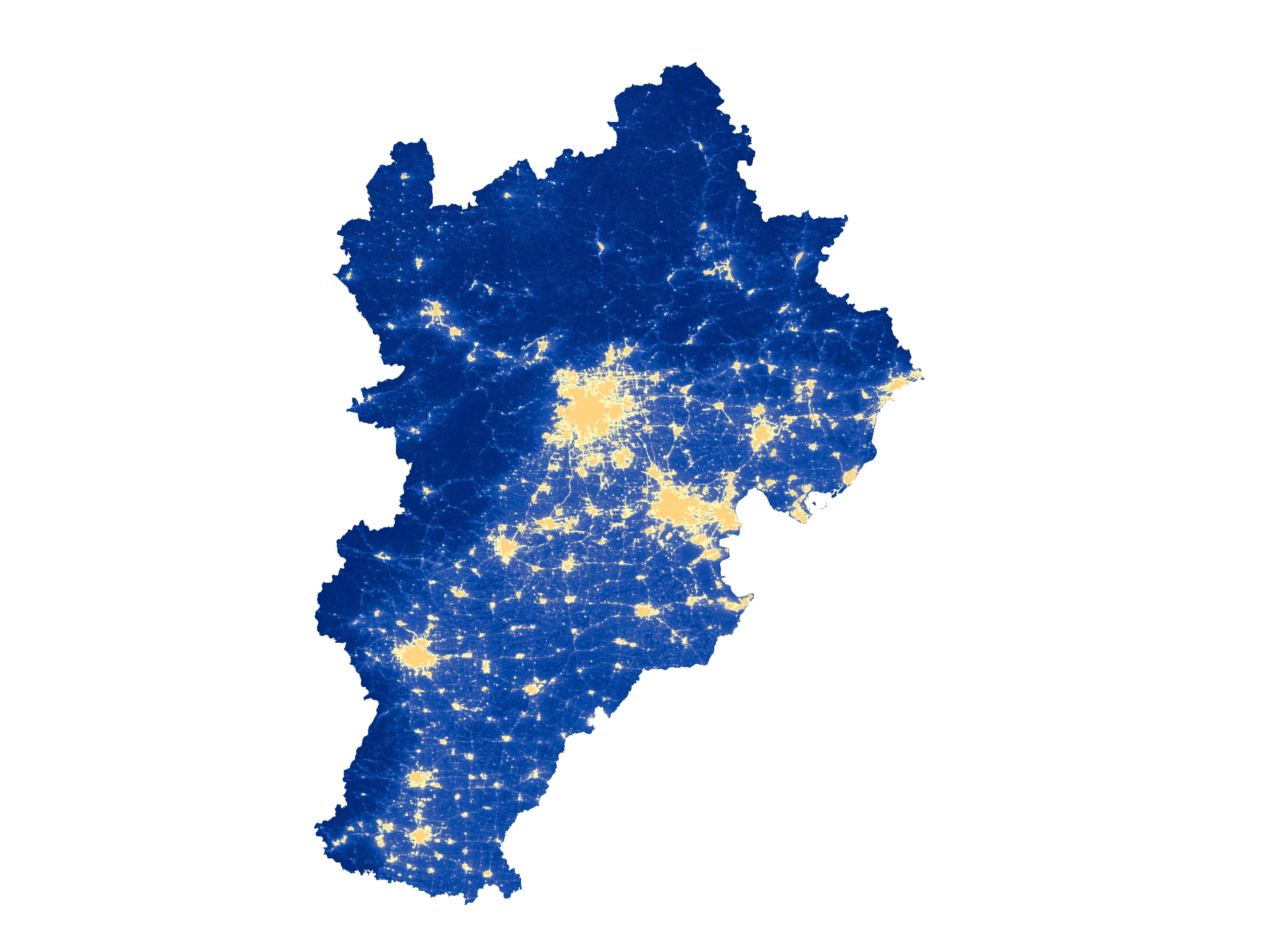
Methods: We employed nighttime light remote sensing data of the Beijing-Tianjin-Hebei region from 2015 to 2024 recorded by the Joint Polar Satellite System. A time-series dataset was constructed via the mean value overlay composite method. On designated spatial units, the mean radiance index of ALAN was calculated. Multiple analyses were subsequently conducted, including the Mann-Kendall trend test, establishment of a disturbance intensity grade system, and landscape pattern analysis of disturbed patches.
Results: (1) The ALAN radiance within nature reserves across the Beijing-Tianjin-Hebei region accounted for approximately one quarter of the regional average, which indicated that human disturbance had been well restrained inside reserves. Nevertheless, 94.54% of the reserve areas showed a significant or extremely significant increasing trend in ALAN. Human activities significantly altered the nighttime darkness within nature reserves. (2) The number of reserves with low disturbance (grade II) and moderate disturbance (grade III) kept rising. Among all reserves, 22 experienced a one-grade upward shift, and 12 saw a two-grade increase. (3) Wetland reserves exhibited remarkably higher ALAN radiance than others. Significant disparities existed between both core zones, buffer zones and experimental zones. (4) II and III disturbance grades patches were distributed both inside and along the edges of reserves, while high disturbance (grade IV) patches concentrated on reserve peripheries.
Conclusion: This research broadens the application of nighttime light remote sensing in ecological assessment of protected areas. It suggests strengthened monitoring and regulation of human activities surrounding reserves, and calls for wider application of nighttime light remote sensing in protected area planning, supervision of key ecological spaces, and conservation effectiveness evaluation.
Yi Hao Pan , Bing Ran Ma , Le Shan Du , Yan Peng Zhu , Xiang Wen Fang , Fang Zheng Liu . Characteristics of impacts of artificial light at night in the Beijing-Tianjin-Hebei region and its nature reserves[J]. Biodiversity Science, 2026 , 34(8) : 26245 . DOI: 10.17520/biods.2026245
/
| 〈 |
|
〉 |
Copyright © 2026 Biodiversity Science
Editorial Office of Biodiversity Science, 20 Nanxincun, Xiangshan, Beijing 100093, China
Tel: 010-62836137, 62836665 E-mail: biodiversity@ibcas.ac.cn