The status and challenges of insect hotels in the conservation of urban solitary bees and wasps diversity
Received date: 2024-10-28
Accepted date: 2025-02-18
Online published: 2025-04-30
Supported by
2024 Special Project for Advancing High-Quality Development of Beijing Landscape Architecture through Technological Innovation(KJCXLM202409);Beijing Natural Science Foundation(5232018);Special Program for the Institute of National Parks, National Forestry and Grassland Administration-Chinese Academy of Sciences(KFJ-STS-ZDTP-2022-001)
Aims: Global biodiversity is under serious threat due to the intensification of climate change and human activities in the ecosystems. As a result, governments and the public are increasingly focused on implementing measures to mitigate biodiversity loss. In recent years, insect hotels have emerged as an innovative approach to biodiversity conservation in urban park management, attracting significant attention and being gradually adopted. The primary purpose of insect hotels is to provide breeding, nesting, and overwintering sites for insects—particularly solitary bees—in urban environments. By doing so, insect hotels contribute to maintaining species diversity and population stability. However, a comprehensive understanding regarding of the effectiveness and challenges of insect hotels in conserving urban insect diversity is still lacking.
Progresses: To address this, we review the global research status of insect hotels, including aspects such as the number of studies, geographical distribution, targeted species, and the materials and specifications of nesting tubes.
Prospects: We summarize the positive impacts (pollination, pest control, and popular science education) and limitations (low occupancy rate, invasive alien species, increased harm from natural enemies and pathogens) of insect hotels in promoting solitary bee diversity in urban environments and propose specific improvement strategies. This study aims to provide a scientific foundation and practical guidance for sustainable development of urban biodiversity.
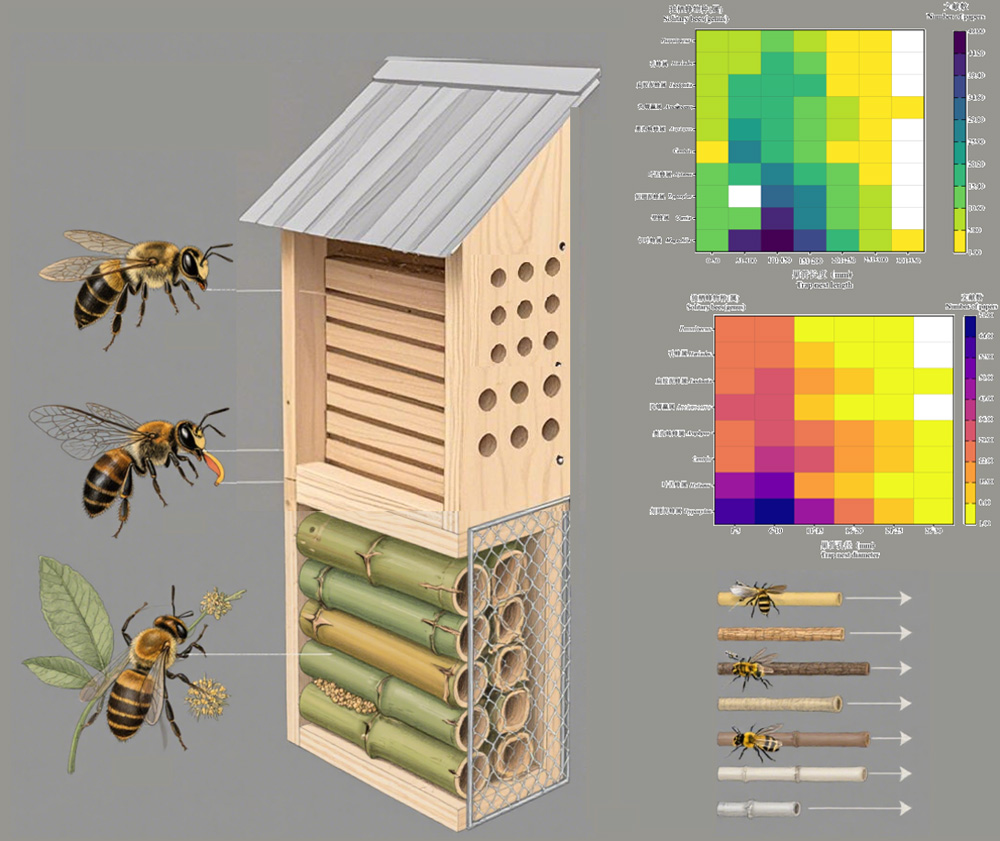
Key words: insect hotel; trap-nest; urban insect; solitary bee; diversity conservation
Hao Zhou , Mingyi Wang , Chuge Zhang , Zhishu Xiao , Fang Ouyang . The status and challenges of insect hotels in the conservation of urban solitary bees and wasps diversity[J]. Biodiversity Science, 2025 , 33(5) : 24472 . DOI: 10.17520/biods.2024472
| [1] | B?nsch S, Tscharntke T, Gabriel D, Westphal C (2021) Crop pollination services: Complementary resource use by social vs solitary bees facing crops with contrasting flower supply. Journal of Applied Ecology, 58, 476-485. |
| [2] | Barthélémy C (2012) Nest trapping, a simple method for gathering information on life histories of solitary bees and wasps. Bionomics of 21 species of solitary aculeate in Hong Kong. Hong Kong Entomological Bulletin, 4, 3-37. |
| [3] | Brock RE, Cini A, Sumner S (2021) Ecosystem services provided by aculeate wasps. Biological Reviews, 96, 1645-1675. |
| [4] | Buys S (2012) Nesting habits, alternative nesting strategies and female territoriality of the cockroach-hunting solitary wasp Penepodium luteipenne (Hymenoptera: Sphecidae). Journal of Hymenoptera Research, 24, 27-41. |
| [5] | Cardoso P, Barton PS, Birkhofer K, Chichorro F, Deacon C, Fartmann T, Fukushima CS, Gaigher R, Habel JC, Hallmann CA, Hill MJ, Hochkirch A, Kwak ML, Mammola S, Ari Noriega J, Orfinger AB, Pedraza F, Pryke JS, Roque FO, Settele J, Simaika JP, Stork NE, Suhling F, Vorster C, Samways MJ (2020) Scientists’ warning to humanity on insect extinctions. Biological Conservation, 242, 108426. |
| [6] | Césard N, Mouret H, Vaissiere B (2014) Des h?tels à abeilles urbains et citoyens. Insectes Sociaux, 175, 7-11. |
| [7] | Chowdhury S, Zalucki MP, Hanson JO, Tiatragul S, Green D, Watson JEM, Fuller RA (2023) Three-quarters of insect species are insufficiently represented by protected areas. One Earth, 6, 139-146. |
| [8] | Colla SR (2022) The potential consequences of ‘bee washing’ on wild bee health and conservation. International Journal for Parasitology: Parasites and Wildlife, 18, 30-32. |
| [9] | Collins CM, Audusseau H, Hassall C, Keyghobadi N, Sinu PA, Saunders ME (2024) Insect ecology and conservation in urban areas: An overview of knowledge and needs. Insect Conservation and Diversity, 17, 169-181. |
| [10] | Dainese M, Riedinger V, Holzschuh A, Kleijn D, Scheper J, Steffan-Dewenter I (2018) Managing trap-nesting bees as crop pollinators: Spatiotemporal effects of floral resources and antagonists. Journal of Applied Ecology, 55, 195-204. |
| [11] | Danforth BN, Minckley RL, Neff JL (2019) The Solitary Bees:Biology, Evolution, Conservation. Princeton University Press, Princeton, New Jersey. |
| [12] | Díaz SS, Carisio L, Manino A, Biella P, Porporato M (2021) Nesting, sex ratio and natural enemies of the giant resin bee in relation to native species in Europe. Insects, 12, 545. |
| [13] | Dicks LV, Showler DA, Sutherland WJ (2010) Bee Conservation:Evidence for the Effects of Interventions. Pelagic Publishing, London, England. |
| [14] | Fortel L, Henry M, Guilbaud L, Mouret H, Vaissière BE (2016) Use of human-made nesting structures by wild bees in an urban environment. Journal of Insect Conservation, 20, 239-253. |
| [15] | Gaston KJ, Smith RM, Thompson K, Warren PH (2005) Urban domestic gardens (II): Experimental tests of methods for increasing biodiversity. Biodiversity & Conservation, 14, 395-413. |
| [16] | Geslin B, Aizen MA, Garcia N, Pereira AJ, Vaissière BE, Garibaldi LA (2017) The impact of honey bee colony quality on crop yield and farmers’ profit in apples and pears. Agriculture, Ecosystems & Environment, 248, 153-161. |
| [17] | Geslin B, Gachet S, Deschamps-Cottin M, Flacher F, Ignace B, Knoploch C, Meineri é, Robles C, Ropars L, Schurr L, Le Féon V (2020) Bee hotels host a high abundance of exotic bees in an urban context. Acta Oecologica, 105, 103556. |
| [18] | Gilpin AM, Brettell LE, Cook JM, Power SA (2022) The use of trap-nests to support crop pollinators in agricultural areas. Ecological Research, 37, 768-779. |
| [19] | Grissell E (2010) Bees, Wasps, and Ants:The Indispensable Role of Hymenoptera in Gardens. Timber Press, Portland, Oregon. |
| [20] | Hamroud L, Lhomme P, Christmann S, Sentil A, Michez D, Rasmont P (2023) Conserving wild bees for crop pollination: Efficiency of bee hotels in Moroccan cherry orchards (Prunus avium). Journal of Apicultural Research, 62, 1123-1131. |
| [21] | Hane EN, Korfmacher KF (2022) Insect “Bee&Bees” and pollinator penthouses: Teaching students about pollinators and their services in an urban environment. Urban Ecosystems, 25, 1057-1064. |
| [22] | Harris BA, Poole EM, Braman SK, Pennisi SV (2021) Consumer-ready insect hotels: An assessment of arthropod visitation and nesting success. Journal of Entomological Science, 56, 141-155. |
| [23] | Hodge S, Bottero I, Dean R, Maher S, Stout J (2022) Stem-nesting Hymenoptera in Irish farmland: Empirical evaluation of artificial trap nests as tools for fundamental research and pollinator conservation. Journal of Pollination Ecology, 32, 110-123. |
| [24] | Junqueira CN, Hogendoorn K, Augusto SC (2012) The use of trap-nests to manage carpenter bees (Hymenoptera: Apidae: Xylocopini), pollinators of passion fruit (Passifloraceae: Passiflora edulis f. flavicarpa). Annals of the Entomological Society of America, 105, 884-889. |
| [25] | Kamke R, Zillikens A, Heinle S, Steiner J (2008) Natural enemies and life cycle of the orchid bee Eufriesea smaragdina (Hymenoptera: Apidae) reared from trap nests. Journal of the Kansas Entomological Society, 81, 101-109. |
| [26] | Kremen C, Williams NM, Aizen MA, Gemmill-Herren B, LeBuhn G, Minckley R, Packer L, Potts SG, Roulston T, Steffan-Dewenter I, Vázquez DP, Winfree R, Adams L, Crone EE, Greenleaf SS, Keitt TH, Klein AM, Regetz J, Ricketts TH (2007) Pollination and other ecosystem services produced by mobile organisms: A conceptual framework for the effects of land-use change. Ecology Letters, 10, 299-314. |
| [27] | Kurczewski FE, Coville RE, Schal C (2010) Observations on the nesting and prey of the solitary wasp, Tachysphex inconspicuus, with a review of nesting behavior in the T. obscuripennis species group. Journal of Insect Science, 10, 183. |
| [28] | Leandro C, Jay-Robert P (2019) Perceptions and representations of animal diversity: Where did the insects go? Biological Conservation, 237, 400-408. |
| [29] | Lu YL, Bullock JM (2021) Biodiversity conservation in a changing environment beyond 2020. Science Advances, 7, eabl8162. |
| [30] | MacIvor JS, Packer L (2015) ‘Bee hotels’ as tools for native pollinator conservation: A premature verdict. PLoS ONE, 10, e0122126. |
| [31] | MacIvor JS (2016) Wild bees in cultivated city gardens. In: Sowing Seeds in the City: Ecosystem and Municipal Services (eds Brown S, McIvor K, Hodges Snyder E), pp.207-227. Springer, Dordrecht. |
| [32] | MacIvor JS (2017) Cavity-nest boxes for solitary bees: A century of design and research. Apidologie, 48, 311-327. |
| [33] | Matos MCB, Santos Silva S, Teodoro AV (2016) Seasonal population abundance of the assembly of solitary wasps and bees (Hymenoptera) according to land-use in Maranh?o State, Brazil. Revista Brasileira de Entomologia, 60, 171-176. |
| [34] | McFrederick QS, LeBuhn G (2006) Are urban parks refuges for bumble bees Bombus spp. (Hymenoptera: Apidae)? Biological Conservation, 129, 372-382. |
| [35] | Miyano S, Yamaguchi T (2001) Ants reduce nest building activities of tube-nesting wasps and bees (Hymenoptera). Entomological Science, 4, 243-246. |
| [36] | Oliveira RC, Menezes C, Soares AEE, Fonseca VLI (2013) Trap-nests for stingless bees (Hymenoptera, Meliponini). Apidologie, 44, 29-37. |
| [37] | Ouyang F, Zhao ZH, Ge F (2013) Insect ecological services. Chinese Journal of Applied Entomology, 50, 305-310. (in Chinese with English abstract) |
| [欧阳芳, 赵紫华, 戈峰 (2013) 昆虫的生态服务功能. 应用昆虫学报, 50, 305-310.] | |
| [38] | Pereira-Peixoto MH, Pufal G, Martins CF, Klein AM (2014) Spillover of trap-nesting bees and wasps in an urban-rural interface. Journal of Insect Conservation, 18, 815-826. |
| [39] | Rahimi E, Barghjelveh S, Dong PL (2021) How effective are artificial nests in attracting bees? A review. Journal of Ecology and Environment, 45, 1-11. |
| [40] | Rezende MQ, Venzon M, Perez AL, Cardoso IM, Janssen A (2014) Extrafloral nectaries of associated trees can enhance natural pest control. Agriculture, Ecosystems & Environment, 188, 198-203. |
| [41] | Rollin O, Bretagnolle V, Decourtye A, Aptel J, Michel N, Vaissière BE, Henry M (2013) Differences of floral resource use between honey bees and wild bees in an intensive farming system. Agriculture, Ecosystems and Environment, 179, 78-86. |
| [42] | Rozen JG Jr, Eickwort GC (1997) The entomological evidence. Journal of Forensic Sciences, 42, 394-397. |
| [43] | Rudd H, Vala J, Schaefer V (2002) Importance of backyard habitat in a comprehensive biodiversity conservation strategy: A connectivity analysis of urban green spaces. Restoration Ecology, 10, 368-375. |
| [44] | Simaika JP, Samways MJ (2018) Insect conservation psychology. Journal of Insect Conservation, 22, 635-642. |
| [45] | Soanes K, Sievers M, Chee YE, Williams NSG, Bhardwaj M, Marshall AJ, Parris KM (2019) Correcting common misconceptions to inspire conservation action in urban environments. Conservation Biology, 33, 300-306. |
| [46] | Staab M, Pufal G, Tscharntke T, Klein AM (2018) Trap nests for bees and wasps to analyse trophic interactions in changing environments—A systematic overview and user guide. Methods in Ecology and Evolution, 9, 2226-2239. |
| [47] | Steffan-Dewenter I, Leschke K (2003) Effects of habitat management on vegetation and above-ground nesting bees and wasps of orchard meadows in Central Europe. Biodiversity and Conservation, 12, 1953-1968. |
| [48] | Stephen WP, Osgood Charles E, (1965) Influence of tunnel size and nesting medium on sex ratios in a leaf-cutter bee, Megachile rotundata. Journal of Economic Entomology, 58, 965-968. |
| [49] | Stork NE (2018) How many species of insects and other terrestrial arthropods are there on earth? Annual Review of Entomology, 63, 31-45. |
| [50] | Tscharntke T, Gathmann A, Steffan-Dewenter I (1998) Bioindication using trap-nesting bees and wasps and their natural enemies: Community structure and interactions. Journal of Applied Ecology, 35, 708-719. |
| [51] | Vicens N, Bosch J (2000) Weather-dependent pollinator activity in an apple orchard, with special reference to Osmia cornuta and Apis mellifera (Hymenoptera: Megachilidae and Apidae). Environmental Entomology, 29, 413-420. |
| [52] | von K?nigsl?w V, Klein AM, Staab M, Pufal G (2019) Benchmarking nesting aids for cavity-nesting bees and wasps. Biodiversity and Conservation, 28, 3831-3849. |
| [53] | Wagner DL, Grames EM, Forister ML, Berenbaum MR, Stopak D (2021) Insect decline in the Anthropocene: Death by a thousand cuts. Proceedings of the National Academy of Sciences, USA, 118, e2023989118. |
| [54] | Wang ZZ, Liu YQ, Shi M, Huang JH, Chen XX (2019) Parasitoid wasps as effective biological control agents. Journal of Integrative Agriculture, 18, 705-715. |
| [55] | Wcislo WT (1996) Parasitism rates in relation to nest site in bees and wasps (Hymenoptera: Apoidea). Journal of Insect Behavior, 9, 643-656. |
| [56] | Williams IH (1972) Trap-nesting solitary bees for students of biology. Bee World, 53, 123-135. |
| [57] | Xu WH, Xiao Y, Zhang JJ, Yang W, Zhang L, Hull V, Wang Z, Zheng H, Liu JG, Polasky S, Jiang L, Xiao Y, Shi XW, Rao EM, Lu F, Wang XK, Daily GC, Ouyang ZY (2017) Strengthening protected areas for biodiversity and ecosystem services in China. Proceedings of the National Academy of Sciences, USA, 114, 1601-1606. |
/
| 〈 |
|
〉 |
Copyright © 2026 Biodiversity Science
Editorial Office of Biodiversity Science, 20 Nanxincun, Xiangshan, Beijing 100093, China
Tel: 010-62836137, 62836665 E-mail: biodiversity@ibcas.ac.cn