人为干扰对白腹锦鸡活动节律的影响
收稿日期: 2021-11-25
录用日期: 2022-06-06
网络出版日期: 2022-08-05
基金资助
生态环境部生物多样性调查评估项目(2019HJ2096001006);云南省省级自然保护区能力建设补助资金
Effect of anthropogenic disturbance on Lady Amherst’s pheasant (Chrysolophus amherstiae) activity
Received date: 2021-11-25
Accepted date: 2022-06-06
Online published: 2022-08-05
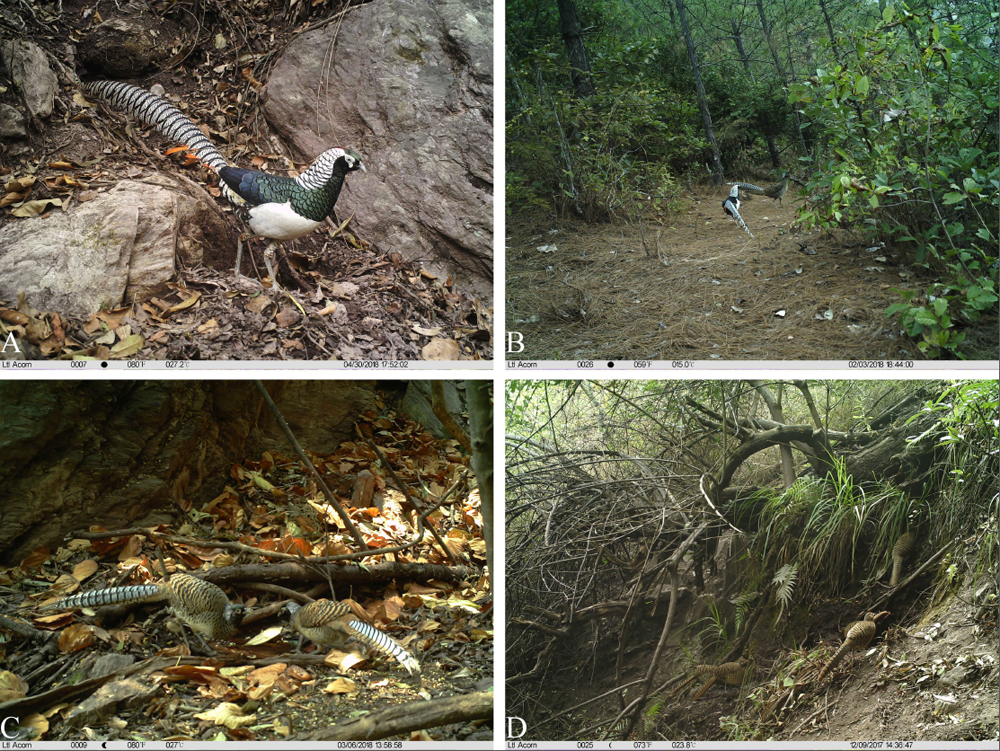
人类足迹的扩张增加了人与野生动物的相互作用。理解自然保护地的濒危物种对人为干扰的响应有助于更好地保护濒危物种和指导保护管理。以往的研究表明野生动物在时空维度会对人类的干扰进行规避, 然而这类研究在野生雉类中还较少, 尤其是分布在人为干扰相对较强的中低海拔区域的雉类, 如白腹锦鸡(Chrysolophus amherstiae)。2017年11月至2018年10月, 我们在中国西南部的一个亚热带森林保护区中使用红外相机陷阱技术对白腹锦鸡和人为干扰进行调查, 并研究了白腹锦鸡在时空维度对3种不同类型人为干扰(人类活动、放牧和家养动物活动)的响应及其季节变化。结果表明, 白腹锦鸡在空间维度并未对人为干扰进行规避, 而在非繁殖季节的活动节律上对人为干扰在时间维度上进行了规避。具体而言, 白腹锦鸡在全年和非繁殖季节的活动高峰集中在17:30-18:30, 明显避开中午的人类活动高峰; 而在繁殖季节, 白腹锦鸡活动水平明显提高, 和人为干扰的重叠度很高, 可能是由于求偶、占区等繁殖行为使得白腹锦鸡无法规避人为干扰。此外, 在人为干扰强度较高的位点, 白腹锦鸡倾向于通过改变其日活动节律, 将活动高峰期推迟至傍晚以降低与人为干扰的重叠度, 进一步说明白腹锦鸡可通过调节其自身的日活动节律从而避开高强度的人为干扰。由于白腹锦鸡地面营巢和春夏季繁殖, 自然保护区管理部门可通过管理人为活动, 尤其在繁殖季节通过控制放牧和猫狗的活动来帮助白腹锦鸡及其他地面营巢鸟类维持繁殖成功率。
胡远芳 , 李斌强 , 梁丹 , 李兴权 , 刘兰香 , 杨家伟 , 罗旭 . 人为干扰对白腹锦鸡活动节律的影响[J]. 生物多样性, 2022 , 30(8) : 21484 . DOI: 10.17520/biods.2021484
Aims: The expanding human footprint has increased the frequency of interactions between humans and wildlife. Understanding how fauna respond to anthropogenic disturbances in protected areas is vital to guide management decisions and conservation efforts. Previous studies suggest that wildlife tends to avoid humans both spatially and temporally. However, little attention has been given to how wild pheasants respond to anthropogenic disturbances in protected areas. The Lady Amherst’s pheasant (Chrysolophus amherstiae) is a widely-distributed wild pheasant found in low- to mid-elevation environments across Southwest China, an area that has been perturbed by extensive human activity. This study assesses the Lady Amherst’s pheasant’s spatial and temporal responses to anthropogenic activity in a nature reserve in the subtropical forests of Southwest China.
Methods: Between November 2017 and October 2018, we deployed 36 infrared camera traps to survey Lady Amherst’s pheasant behavior and the extent of anthropogenic disturbance (i.e., livestock grazing, the presence of domesticated dogs and cats, and human activity). We then assessed the spatial and temporal responses of pheasants to anthropogenic disturbances in breeding and non-breeding seasons.
Results: Lady Amherst’s pheasant exhibited temporal, but not spatial, avoidance of anthropogenic disturbance. Daily activity of the pheasant peaked from 17:30 to 18:30, avoiding the most vigorous anthropogenic disturbance (occurring at approximately 12:00) in the non-breeding season. In the breeding season, daily activity levels increased rapidly and coincided more frequently with anthropogenic disturbance than during the non-breeding season. This may have been related to breeding activities such as territorial defense and mating displays. Furthermore, pheasants in more intensely disturbed sites were more likely to be active at dusk when human activity was low, suggesting that they adjust their behavior in response to anthropogenic disturbance.
Conclusion: Lady Amherst’s pheasants tend to avoid anthropogenic disturbance in the non-breeding season, but reduce avoidance in the breeding season. Management measures such as limiting human activity, grazing, and the number of domestic dogs and cats in the breeding season may help support populations of this wild pheasant and other ground-breeding species in this nature reserve.
| [1] | Benítez-López A, Alkemade R, Verweij PA (2010) The impacts of roads and other infrastructure on mammal and bird populations: A meta-analysis. Biological Conservation, 143, 1307-1316. |
| [2] | Chen LJ, Shu ZF, Xiao ZS (2019) Application of camera-trapping data to study daily activity patterns of Galliformes in Guangdong Chebaling National Nature Reserve. Biodiversity Science, 27, 266-272. (in Chinese with English abstract) |
| [2] | [陈立军, 束祖飞, 肖治术 (2019) 应用红外相机数据研究动物活动节律——以广东车八岭保护区鸡形目鸟类为例. 生物多样性, 27, 266-272.] |
| [3] | Dormann CF, Elith J, Bacher S, Buchmann C, Carl G, Carré G, Marquéz JRG, Gruber B, Lafourcade B, Leitão PJ, Münkemüller T, McClean C, Osborne PE, Reineking B, Schröder B, Skidmore AK, Zurell D, Lautenbach S (2013) Collinearity: A review of methods to deal with it and a simulation study evaluating their performance. Ecography, 36, 27-46. |
| [4] | Gaynor KM, Brown JS, Middleton AD, Power ME, Brashares JS (2019) Landscapes of fear: Spatial patterns of risk perception and response. Trends in Ecology and Evolution, 34, 355-368. |
| [5] | Gaynor KM, Hojnowski CE, Carter NH, Brashares JS (2018) The influence of human disturbance on wildlife nocturnality. Science, 360, 1232-1235. |
| [6] | Han LX, Shun Y (2017) Tracking the Lady Amherst’s pheasant. Forest & Humankind, (2), 98-105. (in Chinese) |
| [6] | [韩联宪, 舜尧 (2017) 追踪白腹锦鸡. 森林与人类, (2), 98-105.] |
| [7] | Han LX, Yang L, Zheng BL (1988) The sound spectrogrhic analyses on the calls of Lady Amherst’s pheasant (Chrysolophus amherstiae). Zoological Research, 9, 127-132. (in Chinese with English abstract) |
| [7] | [韩联宪, 杨岚, 郑宝赉 (1988) 白腹锦鸡鸣声的声谱分析. 动物学研究, 9, 127-132.] |
| [8] | Han LX, Yang L, Zheng BL (1989) Observation on breeding ecology of Lady Amherst’s pheasant. Zoological Research, 10, 285-294. (in Chinese with English abstract) |
| [8] | [韩联宪, 杨岚, 郑宝赉 (1989) 白腹锦鸡繁殖生态观察. 动物学研究, 10, 285-294.] |
| [9] | Kang MJ (2007) Studies on Ecology of Lady Amherst’s Pheasant (Chrysolophus amherstiae). PhD dissertation, Beijing Normal University, Beijing. (in Chinese with English abstract) |
| [9] | [康明江 (2007) 白腹锦鸡(Chrysolophus amherstiae)生态学研究. 博士学位论文, 北京师范大学, 北京.] |
| [10] | Kang MJ, Zheng GM (2007a) Roost-site selection of Lady Amherst’s pheasant. Acta Ecologica Sinica, 27, 2929-2934. (in Chinese with English abstract) |
| [10] | [康明江, 郑光美 (2007a) 白腹锦鸡(Chrysolophus amherstiae)的夜栖地选择. 生态学报, 27, 2929-2934.] |
| [11] | Kang MJ, Zheng GM (2007b) Home range and habitat selection of female Lady Amherst’s pheasant during breeding period. Journal of Beijing Normal University (Natural Science), 43, 558-562. (in Chinese with English abstract) |
| [11] | [康明江, 郑光美 (2007b) 白腹锦鸡雌鸟繁殖期的活动区和栖息地选择. 北京师范大学学报(自然科学版), 43, 558-562.] |
| [12] | Kitchen AM, Gese EM, Schauster ER (2000) Changes in coyote activity patterns due to reduced exposure to human persecution. Canadian Journal of Zoology, 78, 853-857. |
| [13] | Li BQ, Li PY, Yang JW, Zi HJ, Li XQ, Duan XH, Luo X (2018) Wildlife monitoring in Weishan Qinghua Green Peafowl Nature Reserve using infrared cameras, Yunnan Province. Biodiversity Science, 26, 1343-1347. (in Chinese with English abstract) |
| [13] | [李斌强, 李鹏映, 杨家伟, 字红军, 李兴权, 段锡焕, 罗旭 (2018) 运用红外相机调查云南巍山青华绿孔雀自然保护区的鸟兽多样性. 生物多样性, 26, 1343-1347.] |
| [14] | Li BV, Jiang BK (2021) Responses of forest structure, functions, and biodiversity to livestock disturbances: A global meta-analysis. Global Change Biology, 27, 4745-4757. |
| [15] | Li XY, Hu WQ, Bleisch WV, Li Q, Wang HJ, Lu W, Sun J, Zhang FY, Ti B, Jiang XL (2021) Functional diversity loss and change in nocturnal behavior of mammals under anthropogenic disturbance. Conservation Biology, 36, e13839. |
| [16] | Li YH, Wan Y, Shen H, Loss SR, Marra PP, Li ZQ (2021) Estimates of wildlife killed by free-ranging cats in China. Biological Conservation, 253, 108929. |
| [17] | Liang D, Pan XY, Luo X, Cheng WD, Zhao YY, Hu YM, Robinson SK, Liu Y (2021) Seasonal variation in community composition and distributional ranges of birds along a subtropical elevation gradient in China. Diversity and Distributions, 27, 2527-2541. |
| [18] | Liu XB, Wei W, Zheng XG, Zhao KH, He SW, Zhou WL (2017) Activity rhythms of golden pheasant (Chrysolophus pictus) and Satyr Tragopan (Tragopan temminckii) revealed by infrared-triggered cameras. Chinese Journal of Zoology, 52, 194-202. (in Chinese with English abstract) |
| [18] | [刘小斌, 韦伟, 郑筱光, 赵凯辉, 何少文, 周文良 (2017) 红腹锦鸡和红腹角雉活动节律——基于红外相机监测数据. 动物学杂志, 52, 194-202.] |
| [19] | Long S, Zhou CQ, Wang WK, Pan L, Hu JC (2009) Diurnal behavioral rhythm, time budgets and group behavior of dwarf blue sheep in summer. Zoological Research, 30, 687-693. (in Chinese with English abstract) |
| [19] | [龙帅, 周材权, 王维奎, 潘立, 胡锦矗 (2009) 矮岩羊夏季活动节律、时间分配和集群行为. 动物学研究, 30, 687-693.] |
| [20] | Maeda T, Nakashita R, Shionosaki K, Yamada F, Watari Y (2019) Predation on endangered species by human-subsidized domestic cats on Tokunoshima Island. Scientific Reports, 9, 16200. |
| [21] | Norris D, Michalski F, Peres CA (2010) Habitat patch size modulates terrestrial mammal activity patterns in Amazonian forest fragments. Journal of Mammalogy, 91, 551-560. |
| [22] | O’Brien TG, Kinnaird MF, Wibisono HT (2003) Crouching tigers, hidden prey: Sumatran tiger and prey populations in a tropical forest landscape. Animal Conservation, 6, 131-139. |
| [23] | R Core Team (2019) R: A Language and Environment for Statistical Computing. R Foundation for Statistical Computing, Vienna, Austria. https://www.R-project.org/. (accessed on 2022-01-22) |
| [24] | Ridout MS, Linkie M (2009) Estimating overlap of daily activity patterns from camera trap data. Journal of Agricultural, Biological, and Environmental Statistics, 14, 322-337. |
| [25] | Rowcliffe JM, Kays R, Kranstauber B, Carbone C, Jansen PA (2014) Quantifying levels of animal activity using camera trap data. Methods in Ecology and Evolution, 5, 1170-1179. |
| [26] | Shi JB, Dunbar RIM, Buckland D, Miller D (2003) Daytime activity budgets of feral goats (Capra hircus) on the Isle of Rum: Influence of season, age, and sex. Canadian Journal of Zoology, 81, 803-815. |
| [27] | Shi JY, Yang H, Hua JQ, Zhao YZ, Li JQ, Xu JL (2020) The relationship between the diurnal activity rhythm of Reeves’s pheasant (Syrmaticus reevesii) and human disturbance revealed by camera trapping. Biodiversity Science, 28, 796-805. (in Chinese with English abstract) |
| [27] | [石江艳, 杨海, 华俊钦, 赵玉泽, 李建强, 徐基良 (2020) 利用红外相机研究白冠长尾雉日活动节律与人为干扰的关系. 生物多样性, 28, 796-805.] |
| [28] | Stillfried M, Belant JL, Svoboda NJ, Beyer DE, Kramer-Schadt S (2015) When top predators become prey: Black bears alter movement behaviour in response to hunting pressure. Behavioural Processes, 120, 30-39. |
| [29] | Wang KF, Zhang JR, Lei FM (2010) Geographical distribution pattern and its temporal and spatial variation of birds breeding in zoogeographical subregion of China. Acta Zootaxonomica Sinica, 35, 145-157. (in Chinese with English abstract) |
| [29] | [王开锋, 张继荣, 雷富民 (2010) 中国动物地理亚区繁殖鸟类地理分布格局与时空变化. 动物分类学报, 35, 145-157.] |
| [30] | Xiao ZS, Li XH, Jiang GS (2014) Applications of camera trapping to wildlife surveys in China. Biodiversity Science, 22, 683-684. (in Chinese) |
| [30] | [肖治术, 李欣海, 姜广顺 (2014) 红外相机技术在我国野生动物监测研究中的应用. 生物多样性, 22, 683-684.] |
| [31] | Xu JL, Zhang ZW, Liu WJ, McGowan PJK (2012) A review and assessment of nature reserve policy in China: Advances, challenges and opportunities. Oryx, 46, 554-562. |
| [32] | Xu WY, Gong Y, Wang HT (2021) Alert time reflects the negative impacts of human disturbance on an endangered bird species in Changbai Mountain, China. Global Ecology and Conservation, 28, e01709. |
| [33] | Xue L (1993) Weishan Yi and Hui Autonomous County Annals. Yunnan People’s Publishing House, Kunming. (in Chinese) |
| [33] | [薛琳 (1993) 巍山彝族回族自治县志. 云南人民出版社, 昆明.] |
| [34] | Yang JL, Wu ZK, Lin QW (1981) Preliminary remarks on the breeding behaviour and feeding habits of the Chinese copper pheasant. Zoological Research, 2, 243-246. (in Chinese with English abstract) |
| [34] | [杨炯蠡, 吴至康, 林齐维 (1981) 白腹锦鸡繁殖及食性的初步观察. 动物学研究, 2, 243-246.] |
| [35] | Yang L (1992) Pheasants in China:Lady Amherst’s Pheasant. China Forestry Publishing House, Beijing. (in Chinese) |
| [35] | [杨岚 (1992) 中国雉类: 白腹锦鸡. 中国林业出版社, 北京.] |
| [36] | Yang XJ, Wen XJ, Yang L (1994) Feeding activity of Lady Amherst’s pheasant (Chrysolophus amherstiae) in captivity. Zoological Research, 15, 49-54. (in Chinese with English abstract) |
| [36] | [杨晓君, 文贤继, 杨岚 (1994) 笼养白腹锦鸡觅食活动的观察. 动物学研究, 15, 49-54.] |
| [37] | Yang XJ, Wen XJ, Yang L (1995) Time budgets of captive Lady Amherst’s pheasant (Chrysolophus amherstiae) in breeding season. Zoological Research, 16, 178-184. (in Chinese with English abstract) |
| [37] | [杨晓君, 文贤继, 杨岚 (1995) 笼养白腹锦鸡繁殖季节的时间分配. 动物学研究, 16, 178-184.] |
| [38] | Zhang SS, Bao YX, Wang YN, Fang PF, Ye B (2012) Comparisons of different camera trap placement patterns in monitoring mammal resources in Gutianshan National Nature Reserve. Chinese Journal of Ecology, 31, 2016-2022. (in Chinese with English abstract) |
| [38] | [章书声, 鲍毅新, 王艳妮, 方平福, 叶彬 (2012) 不同相机布放模式在古田山兽类资源监测中的比较. 生态学杂志, 31, 2016-2022.] |
| [39] | Zhang YY, Zheng GM (2021) China’s Red List of Biodiversity•Vertebrates (Volume Ⅱ): Bird. Science Press, Beijing. (in Chinese with English abstract) |
| [39] | [张雁云, 郑光美 (2021) 中国生物多样性红色名录•脊椎动物(第二卷):鸟类. 科学出版社, 北京.] |
| [40] | Zhang ZW, Ding CQ, Ding P, Zheng GM (2003) The current status and a conservation strategy for species of Galliformes in China. Biodiversity Science, 11, 414-421. (in Chinese with English abstract) |
| [40] | [张正旺, 丁长青, 丁平, 郑光美 (2003) 中国鸡形目鸟类的现状与保护对策. 生物多样性, 11, 414-421.] |
| [41] | Zhao CG, Chen F, Yan ZK, Liu XY, Liu LM, Li WW, Duan YB (2021) Behaviors and interspecific association of sympatric Lady Amherst’s pheasant and Temminck’s tragopan in the Yaoshan Mountains. Chinese Journal of Ecology, 40, 4008-4014. (in Chinese with English abstract) |
| [41] | [赵晨光, 陈飞, 颜再奎, 刘兴元, 刘鲁明, 李维薇, 段玉宝 (2021) 同域分布的白腹锦鸡和红腹角雉的活动节律及种间联结关系. 生态学杂志, 40, 4008-4014.] |
| [42] | Zhao YL, Wang SY, Duan CC, Jiang WX, Xu ZG (2018) Behavioral rhythm of captive Chrysolophus amherstiae in summer and autumn. Chinese Journal of Ecology, 37, 2995-3000. (in Chinese with English abstract) |
| [42] | [赵运林, 王双业, 段酬苍, 姜卫星, 徐正刚 (2018) 笼养白腹锦鸡(Chrysolophus amherstiae)夏、秋季行为节律. 生态学杂志, 37, 2995-3000.] |
| [43] | Zhao YZ, Wang ZC, Xu JL, Luo X, An LD (2013) Activity rhythm and behavioral time budgets of wild Reeves’s Pheasant (Syrmaticus reevesii) using infrared camera. Acta Ecologica Sinica, 33, 6021-6027. (in Chinese with English abstract) |
| [43] | [赵玉泽, 王志臣, 徐基良, 罗旭, 安丽丹 (2013) 利用红外照相技术分析野生白冠长尾雉活动节律及时间分配. 生态学报, 33, 6021-6027.] |
| [44] | Zheng GM (2015) Pheasants in China. Higher Education Press, Beijing. (in Chinese) |
| [44] | [郑光美 (2015) 中国雉类. 高等教育出版社, 北京.] |
/
| 〈 |
|
〉 |
备案号:京ICP备16067583号-7
Copyright © 2026 版权所有 《生物多样性》编辑部
地址: 北京香山南辛村20号, 邮编:100093
电话: 010-62836137, 62836665 E-mail: biodiversity@ibcas.ac.cn