洞庭湖区麋鹿再野化初期秋冬季生境选择
收稿日期: 2021-01-09
录用日期: 2021-05-19
网络出版日期: 2021-07-28
基金资助
中国科学院战略性先导科技专项子课题(XDA19050204);国家重点研发计划(2016YFC0503303);湖南省野生动植物保护项目(HNYB2020-002)
Autumn-winter habitat selection by the re-wild Milu (Elaphurus davidianus) at the early stage after release in Dongting Lake Wetland, China
Received date: 2021-01-09
Accepted date: 2021-05-19
Online published: 2021-07-28
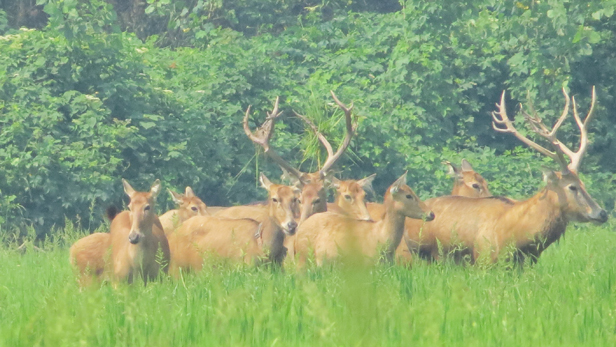
深入了解生境特征和生境选择的季节性差异是开展野生动物生境有效管理的前提。2016年3月, 原国家林业局和湖南省人民政府启动了麋鹿(Elaphurus davidianus)再野化项目, 来自江苏大丰的16头麋鹿(其中11头安装了GPS卫星跟踪颈圈)在湖南东洞庭湖国家级自然保护区君山后湖放归野外。冬季气候寒冷、食物匮乏, 濒危物种个体野放后能否在冬季找到适宜生境是再野化项目能否成功的关键。2016年10月至2017年1月, 借助GPS卫星和地面跟踪信息, 我们采用样方法对再野化麋鹿种群秋、冬季生境选择进行了研究, 测定了生境类型、食物丰富度、草本盖度、乔木盖度、距水源距离、距道路距离、距居民点距离、距隐蔽物距离、隐蔽级等9种生境因子。结果显示: (1)再野化麋鹿种群在秋、冬季对生境类型的选择差异极显著。冬季麋鹿偏好选择水塘、随机利用草本沼泽、避免利用灌草丛; 而秋季对生境类型无明显偏好。(2)再野化麋鹿秋冬季对食物丰富度、草本盖度、乔木盖度、距道路距离、距居民点距离、距隐蔽物距离和隐蔽级的选择差异极显著; 仅在距水源距离上的差异不显著。(3)秋季再野化麋鹿倾向于选择隐蔽级低、食物丰富度高、草本盖度高、距隐蔽物距离近的生境。其生境利用样方与对照样方在隐蔽级上的差异极显著; 在食物丰富度、草本盖度、距隐蔽物距离上的差异显著; 在距水源距离、乔木盖度、距道路距离、距居民点距离上的差异不显著。(4)冬季再野化麋鹿倾向于选择距水源近、食物丰富度高、草本盖度高的生境。其生境利用样方与对照样方在食物丰富度、草本盖度、距水源距离上的差异极显著; 在距道路距离、距居民点距离、距隐蔽物距离、隐蔽级上的差异不显著。研究结果揭示了洞庭湖区再野化麋鹿种群秋冬季生境选择偏好, 为再野化麋鹿种群保护及其生境修复提供了基础数据。
夏昕 , 任静 , 李立 , 王海燕 , 宋玉成 , 杨道德 , 蒋志刚 . 洞庭湖区麋鹿再野化初期秋冬季生境选择[J]. 生物多样性, 2021 , 29(8) : 1087 -1096 . DOI: 10.17520/biods.2021012
Purpose: For restoring the once extinct Milu (Elaphurus davidianus, Père David's deer), the wild management authority in China launched a Milu rewilding project in the Dongting Lake area, Hunan Province, China in 2016. We carried the study to investigate how the re-wild Milu select habitat in the field release area in autumn and winter.
Method: In March 2016, 16 Milu individuals (11 of them fitted with GPS collars) from the Jiangsu Dafeng Milu National Nature Reserve were released into the wild of Junshan Houhu in Hunan East Dongting Lake National Nature Reserve. From October 2016 to January 2017, with the aid of GPS satellite tracking and ground tracking of field released Milu, we used the quadrat method to study the autumn/winter habitat selection by the released Milu. Nine habitat variables were measured in the both Milu-used quadrats and non-used quadrats: habitat type, food abundance, herbage coverage, arbor coverage, distance to water, distance to road, distance to human settlement, distance to shelter, and hidden level.
Results: (1) There was a significant difference in the selection of habitat types by the re-wild Milu between autumn and winter. In autumn, the re-wild Milu appeared to select habitat randomly, whereas they preferred the habitats near ponds and used the herbage swamp randomly, avoiding shrub-grass habitats. (2) There were significant differences in selection for food abundance, herbage coverage, arbor coverage, distance to road, distance to human settlement, distance to shelter, and the hidden level by the re-wild Milu between autumn and winter. There was no significant difference in selection for distance to water. (3) In autumn, the re-wild Milu preferred those habitats that of lower hidden level, higher food abundance, higher herbage coverage, and closer to shelter. There was a significant difference in hidden levels between used quadrats and control (non-used) quadrats in both seasons. Additionally, there were significant differences in the selection for food abundance, herbage coverage, and distance to shelter overall. There were no significant differences in the selection of distance to water, arbor coverage, distance to road, and distance to human settlement. (4) In winter, the re-wild Milu preferred those habitats that are closer to water, with higher food abundance, or higher herbage coverage. There were significant differences in food abundance, herbage coverage, and distance to water between used quadrats and non-used quadrats, but there were no significant differences in distance to road, distance to human settlement, distance to shelter, or hidden level.
Conclusion: The study revealed the differences in habitat selection by the re-wild Milu in autumn and winter, which provide baseline data for habitat management of Milu rewilding in the wetlands of Dongting Lake.
| [1] | Benson JF, Chamberlain MJ (2007) Space use and habitat selection by female Louisiana black bears in the Tensas River Basin of Louisiana. Journal of Wildlife Management, 71, 117-126. |
| [2] | Bian K, Wang KF, Liu CG, Si KC, Zhu DB, Wang ZJ (2016) Habitat selection byNaemorhedus goral during summer and winter in the Zhouzhi Nature Reserve of Qinling Mountain. Chinese Journal of Ecology, 35, 1553-1560. (in Chinese with English abstract) |
| [2] | [ 边坤, 王开锋, 刘楚光, 司开创, 朱代博, 王志军 (2016) 秦岭周至自然保护区斑羚夏冬季生境选择利用. 生态学杂志, 35, 1553-1560.] |
| [3] | Boyce MS, Mao JS, Merrill EH, Fortin D, Turner MG, Fryxell J, Turchin P (2003) Scale and heterogeneity in habitat selection by elk in Yellowstone National Park. Écoscience, 10, 421-431. |
| [4] | Buckley NJ (1997) Spatial-concentration effects and the importance of local enhancement in the evolution of colonial breeding in seabirds. The American Naturalist, 149, 1091-1112. |
| [5] | Cao KQ (1985) On the reasons of extinction of the wild Mi-Deer in China. Zoological Research, 6, 111-115. (in Chinese with English abstract) |
| [5] | [ 曹克清 (1985) 野生麋鹿绝灭原因的探讨. 动物学研究, 6, 111-115.] |
| [6] | Chen HP, Gao ZX (1992) Wildlife Ecology. Northeast Forestry University Press, Harbin. (in Chinese) |
| [6] | [ 陈化鹏, 高中信 (1992) 野生动物生态学. 东北林业大学出版社, 哈尔滨.] |
| [7] | Chen L, Bao YX, Zhang LL, Cheng HY, Zhang JY, Zhou YQ (2010) Seasonal changes in habitat selection by black muntjac (Muntiacus crinifrons) in Jiulong Mountain Nature Reserve. Acta Ecologica Sinica, 30, 1227-1237. (in Chinese with English abstract) |
| [7] | [ 陈良, 鲍毅新, 张龙龙, 程宏毅, 张家银, 周元庆 (2010) 九龙山保护区黑麂栖息地选择的季节变化. 生态学报, 30, 1227-1237.] |
| [8] | Chen L, Li YH, Hu YM, Xiong ZP, Wu W, Li Y, Wen QC (2017) Habitat selection by roe deer (Capreolus pygargus) over winter in the Tieli Forestry Bureau of the Lesser Xing'an Mountains. Biodiversity Science, 25, 401-408. (in Chinese with English abstract) |
| [8] | [ 陈龙, 李月辉, 胡远满, 熊在平, 吴文, 李悦, 问青春 (2017) 小兴安岭铁力林业局冬季西伯利亚狍(Capreolus pygargus)的生境选择. 生物多样性, 25, 401-408.] |
| [9] | Cransac N, Hewison AJM (1997) Seasonal use and selection of habitat by mouflon (Ovis gmelini): Comparison of the sexes. Behavioural Processes, 41, 57-67. |
| [10] | Cresswell W (1994) Flocking is an effective anti-predation strategy in redshanks, Tringa totanus. Animal Behaviour, 47, 433-442. |
| [11] | Dias RI (2006) Effects of position and flock size on vigilance and foraging behaviour of the scaled doveColumbina squammata. Behavioural Processes, 73, 248-252. |
| [12] | Ding YH (2008) Milu Research and Management. Nanjing Normal University Press, Nanjing. (in Chinese) |
| [12] | [ 丁玉华 (2008) 麋鹿研究与管理. 南京师范大学出版社, 南京.] |
| [13] | Ensing EP, Ciuti Sde Wijs FALM, Lentferink DH, Hoedt AT, Boyce MS, Hut RA (2014) GPS based daily activity patterns in European red deer and North American elk (Cervus elaphus): Indication for a weak circadian clock in ungulates. PLoS ONE, 9, e106997. |
| [14] | Ge XF, Meng FL, Wang P, Sheng Y, Wang WP, Feng JC, Xue DY, Meng XX (2015) The spring habitat selection of reindeer (Rangifer tarandus) in Great Xing'anling of China. Acta Ecologica Sinica, 35, 5000-5008. (in Chinese with English abstract) |
| [14] | [ 葛小芳, 孟凡露, 王朋, 盛岩, 王卫平, 冯金朝, 薛达元, 孟秀祥 (2015) 大兴安岭驯鹿(Rangifer tarandus)的春季生境选择. 生态学报, 35, 5000-5008.] |
| [15] | Grignolio S, Rossi I, Bassano B, Apollonio M (2007) Predation risk as a factor affecting sexual segregation in alpine ibex. Journal of Mammalogy, 88, 1488-1497. |
| [16] | Hamel S, Côté SD (2007) Habitat use patterns in relation to escape terrain: Are alpine ungulate females trading off better foraging sites for safety? Canadian Journal of Zoology, 85, 933-943. |
| [17] | He Z, Yang DD, Ma JZ, Li PF, Jiang ZG (2007) Winter habitat selection by Milu in Shishou, Hubei. Sichuan Journal of Zoology, 26, 764-768. (in Chinese with English abstract) |
| [17] | [ 何振, 杨道德, 马建章, 李鹏飞, 蒋志刚 (2007) 湖北石首麋鹿的冬季生境选择. 四川动物, 26, 764-768.] |
| [18] | Hebblewhite M, Merrill EH, McDonald TL (2005) Spatial decomposition of predation risk using resource selection functions: An example in a wolf-elk predator-prey system. Oikos, 111, 101-111. |
| [19] | Hu HJ, Jiang ZG (2002) Experimental release of Père David's deer in Dafeng Reserve, China. Oryx, 36, 196-199. |
| [20] | Hu J, Yao G, Li DY, Yang ZS, Li YH (2018) Summer habitat selection of sambar deer (Rusa unicolor) in Wolong National Nature Reserve. Acta Theriologica Sinica, 38, 277-285. (in Chinese with English abstract) |
| [20] | [ 胡杰, 姚刚, 黎大勇, 杨志松, 李艳红 (2018) 卧龙国家级自然保护区水鹿夏季生境选择. 兽类学报, 38, 277-285.] |
| [21] | Jia YY, Yan R, Lu LL, Xie SB, Wang YZ (2015) Habitat investigation of the main living area of Dafeng Milu. Journal of Anhui Agricultural Sciences, 43(25),114-116. (in Chinese with English abstract) |
| [21] | [ 贾媛媛, 严睿, 陆立林, 解生彬, 王亚忠 (2015) 大丰麋鹿主要生活区的生境特征调查. 安徽农业科学, 43(25),114-116.] |
| [22] | Jiang ZG (2004) Principle of Animal Behavior and Methods in Species Conservation. Science Press, Beijing. (in Chinese) |
| [22] | [ 蒋志刚 (2004) 动物行为原理与物种保护方法. 科学出版社, 北京.] |
| [23] | Jiang ZG (2015) China's Mammal Diversity and Geographic Distribution. Science Press, Beijing. (in Chinese) |
| [23] | [ 蒋志刚 (2015) 中国哺乳动物多样性及地理分布. 科学出版社, 北京.] |
| [24] | Jiang ZG, Harris RB (2008) Elaphurus davidianus. The IUCN Red List of Threatened Species, version 2020.3. http://www.iucnredlist.org. (accessed on 2020-10-17) |
| [25] | Li C, Yang DD, Zhang YM, Song YC, Li PF (2015) Autumn nocturnal bed-site selection by free-ranging and re-wilding populations of Milu (Elaphurus davidianus) in Shishou County of Hubei Province, China. Chinese Journal of Ecology, 34, 2855-2860. (in Chinese with English abstract) |
| [25] | [ 李弛, 杨道德, 张玉铭, 宋玉成, 李鹏飞 (2015) 湖北石首散放麋鹿与野化麋鹿秋季夜间卧息地选择. 生态学杂志, 34, 2855-2860.] |
| [26] | Li J, Li YK, Miao LJ, Xie GY, Yuan FK (2015) A comparison of autumn habitat selection ofCervus nippon andSus scrofa in Taohongling National Nature Reserve, China. Sichuan Journal of Zoology, 34, 300-305. (in Chinese with English abstract) |
| [26] | [ 李佳, 李言阔, 缪泸君, 谢光勇, 袁芳凯 (2015) 桃红岭国家级自然保护区梅花鹿和野猪秋季生境选择差异. 四川动物, 34, 300-305.] |
| [27] | Li YK, Zhang MH, Jiang ZG (2008) Habitat selection by wapiti (Cervus elaphus xanthopygus) in the Wandashan Mountains based on habitat availability. Acta Ecologica Sinica, 28, 4619-4628. (in Chinese with English abstract) |
| [27] | [ 李言阔, 张明海, 蒋志刚 (2008) 基于生境可获得性的完达山地区马鹿(Cervus elaphus xanthopygus)冬季生境选择. 生态学报, 28, 4619-4628.] |
| [28] | Li ZZ, Liu ZS, Mi SH, Wu JP, Teng LW (2021) Habitat selection of the Chinese water deer at Baishan Musk Deer National Nature Reserve in spring and summer. Acta Ecologica Sinica, 41, 1625-1633. (in Chinese with English abstract) |
| [28] | [ 李宗智, 刘振生, 米书慧, 吴建平, 滕丽微 (2021) 白山原麝国家级自然保护区獐春夏生境选择. 生态学报, 41, 1625-1633.] |
| [29] | Lima SL (1995) Back to the basics of anti-predatory vigilance: The group-size effect. Animal Behaviour, 49, 11-20. |
| [30] | Lin J, Xu WX, Yang WK, Xia CJ, Liu W (2012) Habitat suitability assessment ofEquus hemionus hemionus in Kalamaili Mountain Nature Reserve. Biodiversity Science, 20, 411-419. (in Chinese with English abstract) |
| [30] | [ 林杰, 徐文轩, 杨维康, 夏参军, 刘伟 (2012) 卡拉麦里山有蹄类自然保护区蒙古野驴生境适宜性评价. 生物多样性, 20, 411-419.] |
| [31] | Lu QB, Yu JA, Gao X, Yang XY, Zhou Q, Zhang LB, Zhang SY (2007) Winter habitat selection of Reeves's muntjac and wild boars in the Qingliangfeng Mountains. Acta Theriologica Sinica, 27, 45-52. (in Chinese with English abstract) |
| [31] | [ 鲁庆彬, 于江傲, 高欣, 杨仙玉, 周圻, 张良斌, 章叔岩 (2007) 冬季清凉峰山区小麂和野猪的生境选择及差异. 兽类学报, 27, 45-52.] |
| [32] | Luo ZH, Liu BW, Liu ST, Jiang ZG, Halbrook RS (2014) Influences of human and livestock density on winter habitat selection of Mongolian gazelle (Procapra gutturosa). Zoological Science, 31, 20-30. |
| [33] | Michel ES, Gullikson BS, Brackel KL, Schaffer BA, Jenks JA, Jensen WF (2020) Habitat selection of white-tailed deer fawns and their dams in the Northern Great Plains. Mammal Research, 65, 825-833. |
| [34] | Nicoll MAC, Jones CG, Norris K (2004) Comparison of survival rates of captive-reared and wild-bred Mauritius kestrels (Falco punctatus) in a re-introduced population. Biological Conservation, 118, 539-548. |
| [35] | Rettie WJ, Messier F (2000) Hierarchical habitat selection by woodland caribou: Its relationship to limiting factors. Ecography, 23, 466-478. |
| [36] | Reunanen P, Monkkonen M, Nikula A (2002) Habitat requirements of the Siberian flying squirrel in northern Finland: Comparing field survey and remote sensing data. Annales Zoologici Fennici, 39, 7-20. |
| [37] | Richter L, Balkenhol N, Raab C, Reinecke H, Meißner M, Herzog S, Isselstein J, Signer J (2020) So close and yet so different: The importance of considering temporal dynamics to understand habitat selection. Basic and Applied Ecology, 43, 99-109. |
| [38] | Ripple WJ, Beschta RL (2003) Wolf reintroduction, predation risk, and cottonwood recovery in Yellowstone National Park. Forest Ecology and Management, 184, 299-313. |
| [39] | Roberts G (1996) Why individual vigilance declines as group size increases. Animal Behaviour, 51, 1077-1086. |
| [40] | Shang YC (1998) Behavioral Ecology. Peking University Press, Beijing. (in Chinese) |
| [40] | [ 尚玉昌 (1998) 行为生态学. 北京大学出版社, 北京.] |
| [41] | Shen DJ, Zheng HX, Wang Y, Ge L, Zeng GW, Huang YC, Li KJ, Tang L (2009) Winter habitats of dwarf blue sheep (Pseudois schaeferi) and goral (Naemorhedus goral) in Batang County, Sichuan, China. Acta Ecologica Sinica, 29, 2320-2330. (in Chinese with English abstract) |
| [41] | [ 申定健, 郑合勋, 王淯, 格来, 曾国伟, 黄艺川, 李开俊, 唐伦 (2009) 四川省巴塘县矮岩羊与斑羚冬季生境比较. 生态学报, 29, 2320-2330.] |
| [42] | Song YC (2015) The Research on Dispersal Behavior and Population Dynamics of Natural Re-wild Milu (Elaphurus davidianus) in the Dongting Lake Area. PhD dissertation, Central South University of Forestry and Technology, Changsha. (in Chinese with English abstract) |
| [42] | [ 宋玉成 (2015) 洞庭湖区自然野化麋鹿种群扩散机制与种群动态. 博士学位论文, 中南林业科技大学, 长沙.] |
| [43] | Torres RT, Carvalho JC, Panzacchi M, Linnell J, Fonseca C (2011) Comparative use of forest habitats by roe deer and moose in a human-modified landscape in southeastern Norway during winter. Ecological Research, 26, 781-789. |
| [44] | Twigger R (2003) The Extinction Club. Harper Collins Publishers, New York. |
| [45] | Wang LB, Jiang H, An YT, Yang YZ, Yuan BD (2020) Current status and conservation measures for Père David's deer in China. Chinese Journal of Wildlife, 41, 806-813. (in Chinese with English abstract) |
| [45] | [ 王立波, 姜慧, 安玉亭, 杨禹治, 原宝东 (2020) 中国麋鹿种群现状分析及保护对策探讨. 野生动物学报, 41, 806-813.] |
| [46] | Wu PJ, Zhang ED (2004) Habitat selection and its seasonal change of serow (Capricornis sumatraensis) in Cibagou Nature Reserve, Tibet. Acta Theriologica Sinica, 24, 6-12. (in Chinese with English abstract) |
| [46] | [ 吴鹏举, 张恩迪 (2004) 西藏慈巴沟自然保护区鬣羚生境选择的季节性变化. 兽类学报, 24, 6-12.] |
| [47] | Yang DD (2004) Reintroducing Père David's Deer in the Dongting Lake Region, China: History, Practice and Feasibility. PhD dissertation, Northeast Forestry University, Harbin, (in Chinese with English abstract) |
| [47] | [ 杨道德 (2004) 洞庭湖区麋鹿(Elaphurus davidianus)重引入的研究: 历史、实践、可行性. 博士学位论文, 东北林业大学, 哈尔滨,] |
| [48] | Yang DD, Song YC, Ma JZ, Li PF, Zhang H, Price MRS, Li CL, Jiang ZG (2016) Stepping-stones and dispersal flow: Establishment of a meta-population of Milu (Elaphurus davidianus) through natural re-wilding. Scientific Reports, 6, 27297. |
| [49] | Yang ZQ, Xie JR, Gu SG (2004) Summer habitat selection and vertical distribution of the GansuCervus elaphus kansuensis in the Qilianshan Temple Dalong Forest Area. Journal of Hexi University, 20(5),46-48. (in Chinese) |
| [49] | [ 杨忠庆, 谢建荣, 顾生贵 (2004) 祁连山寺大隆林区甘肃马鹿夏季生境选择及垂直分布的研究. 河西学院学报, 20(5),46-48.] |
| [50] | You ZQ, Tang ZH, Yang YB, Yang LH, Shi HY, Liu H, Gan X, Zheng TC, Jiang ZG (2014) Summer habitat selection by white-lipped deer (Cervus albirostris) in Chaqingsongduo White-lipped Deer National Nature Reserve. Acta Theriologica Sinica, 34, 46-53. (in Chinese with English abstract) |
| [50] | [ 游章强, 唐中海, 杨远斌, 杨丽红, 石红艳, 刘昊, 甘潇, 郑天才, 蒋志刚 (2014) 察青松多白唇鹿国家级自然保护区白唇鹿对夏季生境的选择. 兽类学报, 34, 46-53.] |
| [51] | Zhang MH, Li YK (2005) The temporal and spatial scales in animal habitat selection research. Acta Theriologica Sinica, 25, 395-401. (in Chinese with English abstract) |
| [51] | [ 张明海, 李言阔 (2005) 动物生境选择研究中的时空尺度. 兽类学报, 25, 395-401.] |
| [52] | Zhou Y, Jing L, Jia YF, Lei G, Yao Y, Lü C, Chen AP, Lei GC (2019) Population dynamics of four endangered cranes and landscape patterns of habitats in the East Dongting Lake during recent 30 years. Journal of Lake Sciences, 31, 1415-1423. (in Chinese with English abstract) |
| [52] | [ 周延, 靖磊, 贾亦飞, 雷刚, 姚毅, 吕偲, 陈安平, 雷光春 (2019) 东洞庭湖4种濒危鹤类近30年种群动态及栖息地景观格局变化. 湖泊科学, 31, 1415-1423.] |
| [53] | Zhu HQ, Ge ZY, Mao ZX, Liu G, Chang SH, Li C, Zhang XD, Bai YG (2012) Winter habitat selection byCervus elaphus in Huangnihe Nature Reserve. Sichuan Journal of Zoology, 31, 478-482. (in Chinese with English abstract) |
| [53] | [ 朱洪强, 葛志勇, 毛之夏, 刘庚, 常素慧, 李成, 张晓东, 白玉刚 (2012) 吉林黄泥河自然保护区马鹿冬季栖息地选择. 四川动物, 31, 478-482.] |
| [54] | Zou SJ, Song YC, Yang DD, Li PF (2013) Winter bed-site microhabitat selection by Père David's deer (Elaphurus davidianus) in Hubei Shishou Milu National Nature Reserve, South-central China. Chinese Journal of Ecology, 32, 899-904. (in Chinese with English abstract) |
| [54] | [ 邹师杰, 宋玉成, 杨道德, 李鹏飞 (2013) 湖北石首麋鹿国家级自然保护区麋鹿冬季卧息地微生境选择. 生态学杂志, 32, 899-904.] |
/
| 〈 |
|
〉 |
备案号:京ICP备16067583号-7
Copyright © 2026 版权所有 《生物多样性》编辑部
地址: 北京香山南辛村20号, 邮编:100093
电话: 010-62836137, 62836665 E-mail: biodiversity@ibcas.ac.cn