重庆中心城区城市森林兽类组成特征及其对人类活动的响应
收稿日期: 2024-09-08
录用日期: 2025-05-04
网络出版日期: 2025-06-09
基金资助
国家自然科学基金(32471615);重庆市技术创新与应用示范专项重点研发项目(cstc2018jszx-zdyfxmX0007)
Composition characteristics of mammals and their responses to human activities in urban forests of Chongqing central urban area
Received date: 2024-09-08
Accepted date: 2025-05-04
Online published: 2025-06-09
Supported by
National Natural Science Foundation of China(32471615);Chongqing Technology Innovation and Application Demonstration Major Theme Special Project(cstc2018jszx-zdyfxmX0007)
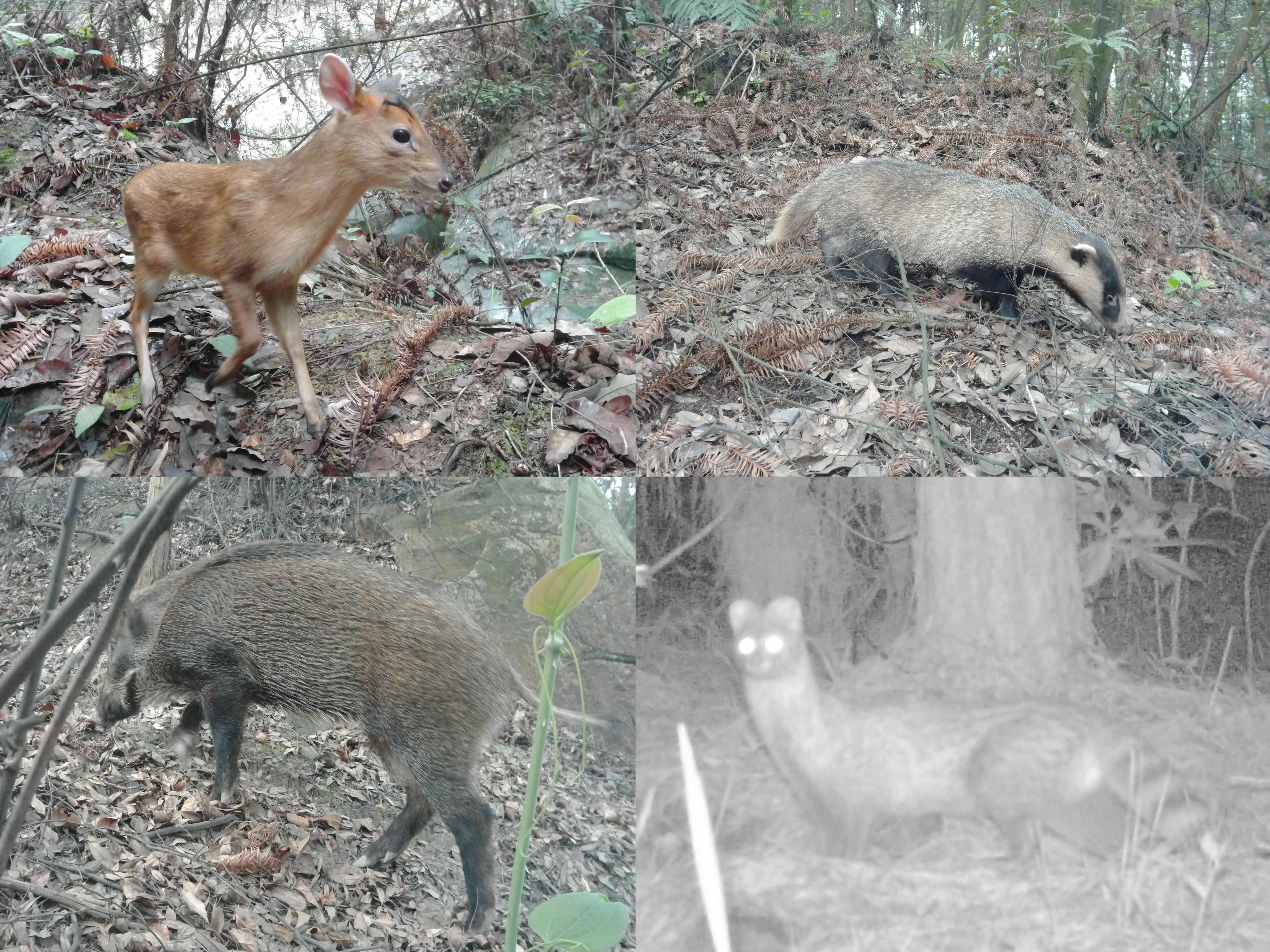
城市森林是城市生物多样性的核心区域, 然而城市森林兽类的生态策略及其对人类活动响应的研究仍然不足。本研究基于红外相机监测技术, 于2019年10月至2024年4月对重庆中心城区城市森林兽类多样性开展调查, 共设置29个监测位点, 布设45台红外相机, 累计有效相机工作日5,814 d, 每个位点平均运行200.48 ± 20.5 d。使用兽类形态、生活史和生态学特征构建功能性状空间。使用核密度分析评价了人类活动与野猪(Sus scrofa)、小麂(Muntiacus reevesi)、花面狸(Paguma larvata)、黄鼬(Mustela sibirica)和红腿长吻松鼠(Dremomys pyrrhomerus)日活动节律的重叠度, 并进一步研究了常见兽类对人类活动的时间响应。监测周期内共记录到兽类13种, 隶属3目7科, 其中国家一级重点保护野生动物有小灵猫(Viverricula indica); 国家二级重点保护野生动物有豹猫(Prionailurus bengalensis)。研究发现, 具有中等体型、中等扩散能力和杂食性生态策略的物种在功能性状空间聚集, 表明其适应策略的相似性。而占据功能性状空间边缘的物种更易受人类活动影响, 野猪在无人类直接活动的区域昼间活动频率显著增加。小麂在家猫(Felis catus)活动的区域活动窗口压缩, 在有家犬(Canis lupus familiaris)活动的区域通过时间偏移策略来调整其活动节律。家猫、家犬与兽类活动的时间重叠度高于徒步、采集等直接人类活动。结果表明, 兽类对人类活动的响应呈现复杂性, 家猫、家犬等间接人类影响更显著。研究结果可为城市生物多样性保护和管理提供科学支持。
罗敏 , 杨永川 , 靳程 , 周礼华 , 龙宇潇 . 重庆中心城区城市森林兽类组成特征及其对人类活动的响应[J]. 生物多样性, 2025 , 33(5) : 24402 . DOI: 10.17520/biods.2024402
Aims: Urban forests serve as key reservoirs of biodiversity within cities. Yet, the ecological strategies of urban mammals and their responses to human activity remain understudied. This study aimed to: (1) document mammal species composition in the urban forests of Chongqing central urban area; (2) analyze the functional traits structuring mammal communities; and (3) assess how native mammals respond to direct human presence and to free-roaming domestic cats (Felis catus) and dogs (Canis lupus familiaris).
Methods: From October 2019 to April 2024, we deployed 45 infrared camera traps across 29 sites in Chongqing central urban area, accumulating 5,814 effective camera days (mean ± SD: 200.48 ± 20.5 days per site). Functional traits— body size, dispersal, diet, life history, and habitat breadth—were used to construct a two-dimensional functional trait space. We applied kernel density estimation to analyze diel activity patterns and evaluated the temporal overlap between human activity (including domestic cats and dogs) and five wildlife species: wild boar (Sus scrofa), Reeves’ muntjac (Muntiacus reevesi), masked palm civet (Paguma larvata), Siberian weasel (Mustela sibirica), and red-hipped squirrel. We further used Wilcoxon rank-sum tests to assess differences in species richness between sites with and without direct human activity.
Results: We recorded 13 mammal species from 3 orders and 7 families. This includes the Class-I nationally protected animal small Indian civet (Viverricula indica) and the Class-II nationally protected animal leopard cat (Prionailurus bengalensis). Species with moderate body size, intermediate dispersal ability, and omnivorous diets clustered near the center of functional trait space, indicating convergence in adaptive strategies. In contrast, species at the periphery of trait space were more sensitive to human disturbance. For instance, wild boar displayed more diurnal activity in areas without direct human presence, while reeves’ muntjac exhibited compressed activity windows in areas frequented by cats, and temporal shifts in response to dog activity. Notably, domestic cats and dogs showed higher temporal overlap with native mammals than did direct human activity.
Conclusion: Mammalian responses to human activity in urban forests are complex. Indirect anthropogenic pressures— especially those mediated by domestic cats and dogs—may pose greater risks to native wildlife than low-intensity human recreation. These findings provide important insights for urban biodiversity conservation and management.
Key words: urban forest; camera trap; human activity; functional trait; diel activity pattern
| [1] | Bateman PW, Fleming PA (2012) Big city life: Carnivores in urban environments. Journal of Zoology, 287, 1-23. |
| [2] | Chen CD (2020) Forgotten urban habitats: Analysis of spontaneous vegetation on the urban walls of Chongqing City. Acta Ecologica Sinica, 40, 473-483. (in Chinese with English abstract) |
| [陈春谛 (2020) 被遗忘的城市“生境”: 重庆市墙体自生植物调查分析. 生态学报, 40, 473-483.] | |
| [3] | Conejero C, Castillo-Contreras R, González-Crespo C, Serrano E, Mentaberre G, Lavín S, López-Olvera JR (2019) Past experiences drive citizen perception of wild boar in urban areas. Mammalian Biology, 96, 68-72. |
| [4] | Contesse P, Hegglin D, Gloor S, Bontadina F, Deplazes P (2004) The diet of urban foxes (Vulpes vulpes) and the availability of anthropogenic food in the city of Zurich, Switzerland. Mammalian Biology, 69, 81-95. |
| [5] | Cooke RSC, Eigenbrod F, Bates AE (2019) Projected losses of global mammal and bird ecological strategies. Nature Communications, 10, 2279. |
| [6] | Cox DTC, Gardner AS, Gaston KJ (2021) Diel niche variation in mammals associated with expanded trait space. Nature Communications, 12, 1753. |
| [7] | Davison J, Roper TJ, Wilson CJ, Heydon MJ, Delahay RJ (2011) Assessing spatiotemporal associations in the occurrence of badger-human conflict in England. European Journal of Wildlife Research, 57, 67-76. |
| [8] | Diao YX, Zhao QQ, Weng Y, Huang ZX, Wu YQ, Gu BJ, Zhao Q, Wang F (2022) Predicting current and future species distribution of the raccoon dog (Nyctereutes procyonoides) in Shanghai, China. Landscape and Urban Planning, 228, 104581. |
| [9] | Fisher DO, Owens IPF (2004) The comparative method in conservation biology. Trends in Ecology & Evolution, 19, 391-398. |
| [10] | Flynn DFB, Gogol-Prokurat M, Nogeire T, Molinari N, Richers BT, Lin BB, Simpson N, Mayfield MM, DeClerck F (2009) Loss of functional diversity under land use intensification across multiple taxa. Ecology Letters, 12, 22-33. |
| [11] | Gaynor KM, Hojnowski CE, Carter NH, Brashares JS (2018) The influence of human disturbance on wildlife nocturnality. Science, 360, 1232-1235. |
| [12] | Hughes J, MacDonald DW (2013) A review of the interactions between free-roaming domestic dogs and wildlife. Biological Conservation, 157, 341-351. |
| [13] | Ikeda T, Kuninaga N, Suzuki T, Ikushima S, Suzuki M (2019) Tourist-wild boar (Sus scrofa) interactions in urban wildlife management. Global Ecology and Conservation, 18, e00617. |
| [14] | Ivan JS, Newkirk ES (2016) Cpw Photo Warehouse: A custom database to facilitate archiving, identifying, summarizing and managing photo data collected from camera traps. Methods in Ecology and Evolution, 7, 499-504. |
| [15] | Ives CD, Lentini PE, Threlfall CG, Ikin K, Shanahan DF, Garrard GE, Bekessy SA, Fuller RA, Mumaw L, Rayner L, Rowe R, Valentine LE, Kendal D (2016) Cities are hotspots for threatened species. Global Ecology and Biogeography, 25, 117-126. |
| [16] | Junker RR, Albrecht J, Becker M, Keuth R, Farwig N, Schleuning M (2023) Towards an animal economics spectrum for ecosystem research. Functional Ecology, 37, 57-72. |
| [17] | Li S, Wang DJ, Bu HL, Liu XG, Jin T (2016) Camera-trapping survey on the mammal diversity of the Laohegou Nature Reserve, Sichuan Province. Acta Theriologica Sinica, 36, 282-291. (in Chinese with English abstract) |
| [李晟, 王大军, 卜红亮, 刘小庚, 靳彤 (2016) 四川省老河沟自然保护区兽类多样性红外相机调查. 兽类学报, 36, 282-291.] | |
| [18] | Li YH, Wan Y, Shen H, Loss SR, Marra PP, Li ZQ (2021) Estimates of wildlife killed by free-ranging cats in China. Biological Conservation, 253, 108929. |
| [19] | Loss SR, Marra PP (2017) Population impacts of free-ranging domestic cats on mainland vertebrates. Frontiers in Ecology and the Environment, 15, 502-509. |
| [20] | Maor R, Dayan T, Ferguson-Gow H, Jones KE (2017) Temporal niche expansion in mammals from a nocturnal ancestor after dinosaur extinction. Nature Ecology & Evolution, 1, 1889-1895. |
| [21] | Markandya A, Taylor T, Longo A, Murty MN, Murty S, Dhavala K (2008) Counting the cost of vulture decline—An appraisal of the human health and other benefits of vultures in India. Ecological Economics, 67, 194-204. |
| [22] | M?ller AP (2012) Urban areas as refuges from predators and flight distance of prey. Behavioral Ecology, 23, 1030-1035. |
| [23] | O’Brien TG, Kinnaird MF, Wibisono HT (2003) Crouching tigers, hidden prey: Sumatran tiger and prey populations in a tropical forest landscape. Animal Conservation, 6, 131-139. |
| [24] | Oksanen J, Simpson GL, Blanchet FG, Kindt R, Legendre P, Minchin PR, O’Hara RB, Solymos P, Stevens MHH, Szoecs E, Wagner H, Barbour M, Bedward M, Bolker B, Borcard D, Carvalho G, Chirico M, De Caceres M, Durand S, Evangelista HBA, FitzJohn R, Friendly M, Furneaux B, Hannigan G, Hill MO, Lahti L, McGlinn D, Ouellette MH, Ribeiro Cunha E, Smith T, Stier A, Ter Braak CJF, Weedon J (2022) Vegan: Community Ecology Package. https://cran.r-project.org/package=vegan. (accessed on 2024-05-12) |
| [25] | Penjor U, Cushman SA, Kaszta ?M, Sherub S, MacDonald DW (2022) Effects of land use and climate change on functional and phylogenetic diversity of terrestrial vertebrates in a Himalayan biodiversity hotspot. Diversity and Distributions, 28, 2931-2943. |
| [26] | Ramirez JI, Zwerts JA, van Kuijk M, Iacobelli P, Li XQ, Herdoiza N, Jansen PA (2021) Density dependence of daily activity in three ungulate species. Ecology and Evolution, 11, 7390-7398. |
| [27] | Ramos-Rendón AK, Gual-Sill F, Cervantes FA, González-Salazar C, García-Morales R, Martínez-Meyer E (2023) Assessing the impact of free-ranging cats (Felis silvestris catus) and dogs (Canis lupus familiaris) on wildlife in a natural urban reserve in Mexico City. Urban Ecosystems, 26, 1341-1354. |
| [28] | Richardson JL, Michaelides S, Combs M, Djan M, Bisch L, Barrett K, Silveira G, Butler J, Aye TT, Munshi-South J, DiMatteo M, Brown C, McGreevy TJ (2021) Dispersal ability predicts spatial genetic structure in native mammals persisting across an urbanization gradient. Evolutionary Applications, 14, 163-177. |
| [29] | Ridout MS, Linkie M (2009) Estimating overlap of daily activity patterns from camera trap data. Journal of Agricultural, Biological, and Environmental Statistics, 14, 322-337. |
| [30] | Soria CD, Pacifici M, Di Marco M, Stephen SM, Rondinini C (2021) COMBINE: A coalesced mammal database of intrinsic and extrinsic traits. Ecology, 102, e03344. |
| [31] | Soulsbury CD, White PCL (2015) Human-wildlife interactions in urban areas: A review of conflicts, benefits and opportunities. Wildlife Research, 42, 541-553. |
| [32] | Vallejo-Vargas AF, Sheil D, Semper-Pascual A, Beaudrot L, Ahumada JA, Akampurira E, Bitariho R, Espinosa S, Estienne V, Jansen PA, Kayijamahe C, Martin EH, Lima MGM, Mugerwa B, Rovero F, Salvador J, Santos F, Spironello WR, Uzabaho E, Bischof R (2022) Consistent diel activity patterns of forest mammals among tropical regions. Nature Communications, 13, 7102. |
| [33] | Wang F, McShea WJ, Wang DJ, Li S, Zhao Q, Wang H, Lu Z (2014) Evaluating landscape options for corridor restoration between giant panda reserves. PLoS ONE, 9, e105086. |
| [34] | Wang QW, Zhao HY, Liu Q, Wan N, Zhu ZB, Niu HY, Zhang HM (2023) Mammal diversity in the forest fragments of Wuhan City. Acta Theriologica Sinica, 43, 258-269. (in Chinese with English abstract) |
| [汪琪薇, 赵恒月, 刘勤, 万能, 朱志兵, 牛红玉, 张洪茂 (2023) 武汉市城市破碎化森林中野生哺乳动物的多样性. 兽类学报, 43, 258-269.] | |
| [35] | Weng Y, McShea W, Diao YX, Yang HB, Zhang XF, Gu BJ, Bu HL, Wang F (2022) The incursion of free-ranging dogs into protected areas: A spatio-temporal analysis in a network of giant panda reserves. Biological Conservation, 265, 109423. |
| [36] | Yan X, Owens JR, Wen YP, Su XY, Wang ZH, Liu SR, Zhang DS, Callan R, Bi WL, Qi DW, Spotila JR, Hou R, Zhang ZH (2020) Dogs and disease threats to giant pandas in China. Journal of Wildlife Management, 84, 268-276. |
| [37] | Zhao GJ, Yang HT, Xie B, Gong YN, Ge JP, Feng LM (2020) Spatio-temporal coexistence of sympatric mesocarnivores with a single apex carnivore in a fine-scale landscape. Global Ecology and Conservation, 21, e00897. |
/
| 〈 |
|
〉 |
备案号:京ICP备16067583号-7
Copyright © 2026 版权所有 《生物多样性》编辑部
地址: 北京香山南辛村20号, 邮编:100093
电话: 010-62836137, 62836665 E-mail: biodiversity@ibcas.ac.cn