依频声学多样性指数用于人类活动区域的适用能力
收稿日期: 2024-07-01
录用日期: 2024-09-07
网络出版日期: 2024-12-05
基金资助
江苏省研究生科研与实践创新计划项目(KYCX21_0299)
Exploring the application of frequency-dependent acoustic diversity index in human-dominated areas
Received date: 2024-07-01
Accepted date: 2024-09-07
Online published: 2024-12-05
Supported by
Postgraduate Research & Practice Innovation Program of Jiangsu Province(KYCX21_0299)
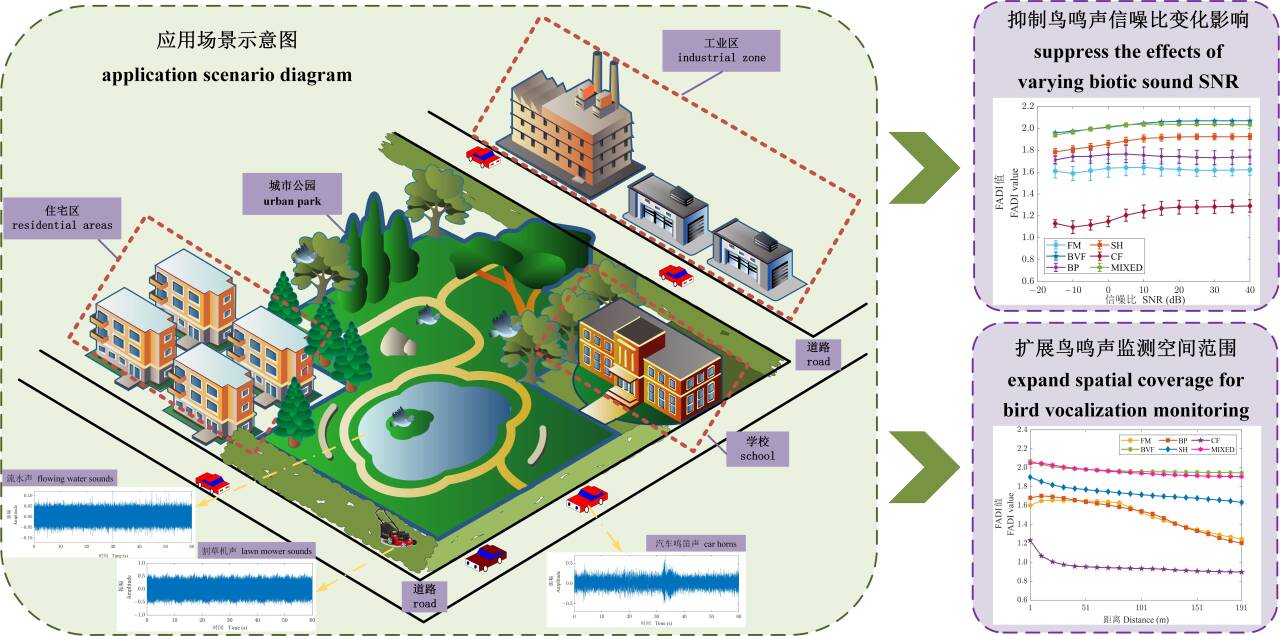
近年来, 基于被动声学监测的声学指数方法作为快速生物多样性评估的热门工具, 因其可以量化生物声音的活动或多样性水平而得到广泛关注。然而, 复杂多变的人为声干扰对声学指数数值结果的影响及其抑制方法尚未获得深入研究, 严重限制了声学指数在城市绿地等人类活动区域的推广应用。基于频变门限检测的依频声学多样性指数(frequency-dependent acoustic diversity index, FADI)是一种对噪声影响低敏感的新型声学指数, 本文以鸟鸣声为对象, 基于实地采集的录音数据开展控制性仿真实验, 从鸟鸣声信噪比(signal-to-noise ratio, SNR)适用下限、鸟鸣声监测空间范围、干扰噪声类型限制3个方面, 对FADI在人类活动区域的应用能力和适用条件进行了客观评估。结果表明:(1)当鸟鸣声SNR在−5 dB至40 dB范围内变化时, FADI对噪声具有显著的稳健性; (2)相较于常规声学多样性指数(acoustic diversity index, ADI), FADI适用的监测距离扩大了6倍以上; (3) FADI能有效抑制如割草机声、雨声、流水声等时变特性较低的干扰影响, 但其性能在具有高度时变特性的干扰声环境中有一定程度下降。本文工作证明FADI在用于人类活动区域的生物多样性监测与快速评估方面具有良好的抗噪能力, 后续可以结合麦克风阵列技术, 在现有的时域和频域之外的基础上增加空域处理维度, 进一步提高FADI对人为声干扰的稳健性。
关键词: 声学指数; 快速生物多样性评估; 被动声学监测, 依频声学多样性指数
陈蕾 , 许志勇 , 苏菩坤 , 赖小甜 , 赵兆 . 依频声学多样性指数用于人类活动区域的适用能力[J]. 生物多样性, 2024 , 32(10) : 24286 . DOI: 10.17520/biods.2024286
Background & Aims: As a popular tool for rapid biodiversity assessment using passive acoustic monitoring (PAM), acoustic indices have attracted increasing attention in the field of soundscape ecology in recent years, which can help quantify the level of activity or diversity of biological sounds. However, the impact of complicated anthropogenic noise on the numerical results of acoustic indices and the methods for suppressing it have not been well understood. This deficit in understanding poses a challenge for wider applications of acoustic indices in human-dominated areas such as urban green infrastructure.
Methods: In this paper, we investigated the frequency-dependent acoustic diversity index (FADI), a recently proposed acoustic index that is robust to noise, in relation to its application conditions and performance in human-dominated areas. Specifically, three controlled computational experiments were conducted focusing on three aspects including the lower limit of signal-to-noise ratio (SNR), the spatial coverage for bird vocalization monitoring, and the limitations imposed by different types of interferences.
Results: The results of the controlled simulation experiments show that, (1) FADI was significantly robust to noise within the SNR range from −5 dB to 40 dB. (2) The monitoring area of FADI can be expanded by more than 6 times compared to conventional acoustic diversity index (ADI). (3) FADI can effectively suppress the effects of temporally stationary interference such as sounds from lawn mower, rain, and flowing water, but its performance shows a certain degree of degradation in environments with highly time-varying noise.
Conclusions: FADI has a great potential to serve as a stable and reliable tool for rapid biodiversity assessment in human-dominated areas. Furthermore, the numerical robustness of FADI can be improved by use of the microphone array technology that can provide spatial signal processing capability in addition to current time-frequency processing.
| [1] | Beason RD, Riesch R, Koricheva J (2023) Investigating the effects of tree species diversity and relative density on bird species richness with acoustic indices. Ecological Indicators, 154, 110652. |
| [2] | Bradfer-Lawrence T, Bunnefeld N, Gardner N, Willis SG, Dent DH (2020) Rapid assessment of avian species richness and abundance using acoustic indices. Ecological Indicators, 115, 106400. |
| [3] | Bradfer-Lawrence T, Gardner N, Bunnefeld L, Bunnefeld N, Willis SG, Dent DH (2019) Guidelines for the use of acoustic indices in environmental research. Methods in Ecology and Evolution, 10, 1796-1807. |
| [4] | Brandes TS (2008) Automated sound recording and analysis techniques for bird surveys and conservation. Bird Conservation International, 18, S163-S173. |
| [5] | Buxton RT, Agnihotri S, Robin VV, Goel A, Balakrishnan R (2018) Acoustic indices as rapid indicators of avian diversity in different land-use types in an Indian biodiversity hotspot. Journal of Ecoacoustics, 2, 8. |
| [6] | Buxton RT, Pearson AL, Allou C, Fristrup K, Wittemyer G (2021) A synthesis of health benefits of natural sounds and their distribution in national parks. Proceedings of the National Academy of Sciences, USA, 118, e2013097118. |
| [7] | Cappe O (1994) Elimination of the musical noise phenomenon with the Ephraim and Malah noise suppressor. IEEE Transactions on Speech and Audio Processing, 2, 345-349. |
| [8] | Cohen I (2004) Speech enhancement using a noncausal Apriori SNR estimator. IEEE Signal Processing Letters, 11, 725-728. |
| [9] | Depraetere M, Pavoine S, Jiguet F, Gasc A, Duvail S, Sueur J (2012) Monitoring animal diversity using acoustic indices: Implementation in a temperate woodland. Ecological Indicators, 13, 46-54. |
| [10] | Diaz SDU, Gan JL, Tapang GA (2023) Acoustic indices as proxies for bird species richness in an urban green space in Metro Manila. PLoS ONE, 18, e0289001. |
| [11] | Dooley JM, Brown MT (2020) The quantitative relation between ambient soundscapes and landscape development intensity in North Central Florida. Landscape Ecology, 35, 113-127. |
| [12] | Doser JW, Finley AO, Kasten EP, Gage SH (2020) Assessing soundscape disturbance through hierarchical models and acoustic indices: A case study on a shelterwood logged northern Michigan forest. Ecological Indicators, 113, 106244. |
| [13] | Elise S, Urbina-Barreto I, Pinel R, Mahamadaly V, Bureau S, Penin L, Adjeroud M, Kulbicki M, Bruggemann JH (2019) Assessing key ecosystem functions through soundscapes: A new perspective from coral reefs. Ecological Indicators, 107, 105623. |
| [14] | Fairbrass AJ, Rennert P, Williams C, Titheridge H, Jones KE (2017) Biases of acoustic indices measuring biodiversity in urban areas. Ecological Indicators, 83, 169-177. |
| [15] | Fuller S, Axel AC, Tucker D, Gage SH (2015) Connecting soundscape to landscape: Which acoustic index best describes landscape configuration? Ecological Indicators, 58, 207-215. |
| [16] | Gage SH, Axel AC (2014) Visualization of temporal change in soundscape power of a Michigan lake habitat over a 4-year period. Ecological Informatics, 21, 100-109. |
| [17] | Gagne E, Perez-Ortega B, Hendry AP, Melo-Santos G, Walmsley SF, Rege-Colt M, Austin M, May-Collado LJ (2022) Dolphin communication during widespread systematic noise reduction—A natural experiment amid COVID-19 lockdowns. Frontiers in Remote Sensing, 3, 934608. |
| [18] | Gasc A, Sueur J, Jiguet F, Devictor V, Grandcolas P, Burrow C, Depraetere M, Pavoine S (2013) Assessing biodiversity with sound: Do acoustic diversity indices reflect phylogenetic and functional diversities of bird communities? Ecological Indicators, 25, 279-287. |
| [19] | Hendriks RC, Heusdens R, Jensen J (2010) MMSE based noise PSD tracking with low complexity. In: 2010 IEEE International Conference on Acoustics, Speech and Signal Processing, pp. 4266-4269. Dallas, TX, USA. |
| [20] | Hyland EB, Schulz A, Quinn JE (2023) Quantifying the Soundscape: How filters change acoustic indices. Ecological Indicators, 148, 110061. |
| [21] | Lellouch L, Pavoine S, Jiguet F, Glotin H, Sueur J (2014) Monitoring temporal change of bird communities with dissimilarity acoustic indices. Methods in Ecology and Evolution, 5, 495-505. |
| [22] | Marler PR, Slabbekoorn H (2004) Nature’s Music:The Science of Birdsong. Academic Press, San Diego. |
| [23] | Martin R (2001) Noise power spectral density estimation based on optimal smoothing and minimum statistics. IEEE Transactions on Speech and Audio Processing, 9, 504-512. |
| [24] | McWilliam JN, Hawkins AD (2013) A comparison of inshore marine soundscapes. Journal of Experimental Marine Biology and Ecology, 446, 166-176. |
| [25] | Metcalf OC, Baccaro F, Barlow J, Berenguer E, Bradfer- Lawrence T, Chesini Rossi L, do Vale éM, Lees AC (2024) Listening to tropical forest soils. Ecological Indicators, 158, 111566. |
| [26] | Moreno-Gómez FN, Bartheld J, Silva-Escobar AA, Briones R, Márquez R, Penna M (2019) Evaluating acoustic indices in the Valdivian rainforest, a biodiversity hotspot in South America. Ecological Indicators, 103, 1-8. |
| [27] | Parker TA (1991) On the use of tape recorders in avifaunal surveys. The Auk, 108, 443-444. |
| [28] | Pieretti N, Duarte MHL, Sousa-Lima RS, Rodrigues M, Young RJ, Farina A (2015) Determining temporal sampling schemes for passive acoustic studies in different tropical ecosystems. Tropical Conservation Science, 8, 215-234. |
| [29] | Rodriguez A, Gasc A, Pavoine S, Grandcolas P, Gaucher P, Sueur J (2014) Temporal and spatial variability of animal sound within a neotropical forest. Ecological Informatics, 21, 133-143. |
| [30] | Rohling H (1983) Radar CFAR thresholding in clutter and multiple target situations. IEEE Transactions on Aerospace and Electronic Systems, (4), 608-621. |
| [31] | Rosenstock SS, Anderson DR, Giesen KM, Leukering T, Carter MF (2002) Landbird counting techniques: Current practices and an alternative. The Auk, 119, 46-53. |
| [32] | Ross SRPJ, Friedman NR, Dudley KL, Yoshimura M, Yoshida T, Economo EP (2018) Listening to ecosystems: Data-rich acoustic monitoring through landscape-scale sensor networks. Ecological Research, 33, 135-147. |
| [33] | Rumelt RB, Basto A, Mere Roncal C (2021) Automated audio recording as a means of surveying tinamous (Tinamidae) in the Peruvian Amazon. Ecology and Evolution, 11, 13518-13531. |
| [34] | Shamon H, Paraskevopoulou Z, Kitzes J, Card E, Deichmann JL, Boyce AJ, McShea WJ (2021) Using ecoacoustics metrices to track grassland bird richness across landscape gradients. Ecological Indicators, 120, 106928. |
| [35] | Sohn J, Kim NS, Sung W (1999) A statistical model-based voice activity detection. IEEE Signal Processing Letters, 6, 1-3. |
| [36] | Sueur J, Farina A, Gasc A, Pieretti N, Pavoine S (2014) Acoustic indices for biodiversity assessment and landscape investigation. Acta Acustica United with Acustica, 100, 772-781. |
| [37] | Sueur J, Krause B, Farina A (2019) Climate change is breaking earth’s beat. Trends in Ecology & Evolution, 34, 971-973. |
| [38] | Sugai LSM, Llusia D (2019) Bioacoustic time capsules: Using acoustic monitoring to document biodiversity. Ecological Indicators, 99, 149-152. |
| [39] | Towsey M, Zhang L, Cottman-Fields M, Wimmer J, Zhang JL, Roe P (2014) Visualization of long-duration acoustic recordings of the environment. Procedia Computer Science, 29, 703-712. |
| [40] | van der Lee GH, Desjonquères C, Sueur J, Kraak MHS, Verdonschot PFM (2020) Freshwater ecoacoustics: Listening to the ecological status of multi-stressed lowland waters. Ecological Indicators, 113, 106252. |
| [41] | Weir LA, Mossman MJ (2005) North American amphibian monitoring program (NAAMP). In: Amphibian Declines (ed. Lannoo M), pp.307-313. University of California Press, Berkeley. |
| [42] | Xia BY, Bao CC (2014) Wiener filtering based speech enhancement with Weighted Denoising Auto-encoder and noise classification. Speech Communication, 60, 13-29. |
| [43] | Xu ZY, Chen L, Pijanowski BC, Zhao Z (2023) A frequency-dependent acoustic diversity index: A revision to a classic acoustic index for soundscape ecological research. Ecological Indicators, 155, 110940. |
| [44] | Zhang CY, Zhang Y, Zheng XJ, Gao XH, Hao ZZ (2024) Influence of recording devices and environmental noise on acoustic index scores: Implications for bird sound-based assessments. Ecological Indicators, 159, 111759. |
| [45] | Zhao Z, Xu ZY, Bellisario K, Zeng RW, Li N, Zhou WY, Pijanowski BC (2019) How well do acoustic indices measure biodiversity? Computational experiments to determine effect of sound unit shape, vocalization intensity, and frequency of vocalization occurrence on performance of acoustic indices. Ecological Indicators, 107, 105588. |
| [46] | Znidersic E, Towsey M, Roy WK, Darling SE, Truskinger A, Roe P, Watson DM (2020) Using visualization and machine learning methods to monitor low detectability species—The least bittern as a case study. Ecological Informatics, 55, 101014. |
/
| 〈 |
|
〉 |