




生物的多样性是地球生命数十亿年发展和进化的结果, 是人类社会生存和发展的重要基础。近年来, 随着人类活动对自然环境的影响, 全球生物多样性正以前所未有的速度丧失(Keil et al, 2015; Pedersen Zari et al, 2022)。生物多样性的调查、研究和保护已成为当务之急, 这也是当今国际社会最紧迫的问题之一(Watson, 1999; Myers et al, 2000; Sala et al, 2000; Cardinale et al, 2012; Andersson et al, 2022)。Hallmann等(2017)做了一项非常具有代表性的研究, 他们花费27年时间使用马氏网对德国63个自然保护区的昆虫生物量进行了长期监测。结果表明, 昆虫生物量在27年内减少了75%, 人类干扰和栖息地退化是最重要的影响因素。同时, 研究人员发现, 农业集约化和气候变化导致昆虫多样性迅速减少(Raven & Wagner, 2021)。在此背景下, 中国科学院动物研究所白明研究员和英国自然历史博物馆Alfried Vogler教授共同发起了“SITE100” (Site based, Insects, Taxonomy, Environment, 100)国际大科学计划(
昆虫的采集是昆虫生物多样性研究的基础, 不同的采集方法可以采集来自地表、低空和高空的不同生态位昆虫, 使采集结果更加全面, 更加科学。目前主流的采集方法有主动式和被动式两种。主动式采集方法包括网捕法、振布法等(Westphal et al, 2008), 因为其操作简单和易于携带的特点, 被广泛使用, 但缺点是采集的效果相对较差, 采集的昆虫数量少, 多样性低。对于大规模和长期采集来说, 被动式采集方法因其高重复性、高多样性和可被追踪的采集信息而日益流行。这些方法包括飞行阻隔器法(flight interception trap, FIT)、马氏网法(Malaise trap, MT)和埋罐法(pitfall trap, PT)等(聂瑞娥等, 2017)。甲虫是世界上数量最多、分布最广的一类昆虫, 就空间而言, 它们几乎分布在所有的生态位(Costa-Silva et al, 2019), 这使得甲虫成为生物多样性研究的代表群体之一, 受到越来越多的学术关注(Ramos-Elorduy et al, 1997)。
香港特别行政区(114°15° E, 22°15° N)位于中国南部, 地形以丘陵为主, 少数地区平坦。香港是典型的亚热带季风气候, 森林占据了香港陆地面积的1/5, 适宜的生态和地理环境使其成为大量野生动物的聚集地, 因此被列为SITE100项目的样地之一。马鞍山郊野公园占地面积约2,880 ha, 西临狮子山郊野公园, 东临西贡西郊野公园。马鞍山山坡以火山岩为主, 植被主要是灌木和草本植物, 拥有良好的自然环境, 远离人为干扰, 是动物的理想栖息地, 因此被选为评估香港甲虫生物多样性的地点之一。基于全球生物多样性的丧失和SITE100计划, 我们选择了上述3种被动式采集方法在香港马鞍山样地进行甲虫采集, 以评估甲虫的多样性。
1 数据采集和处理方法
1.1 采集样地
香港每年的6月气温适宜, 雨量适中, 是采集甲虫的适宜时间。本研究选取中国香港的马鞍山郊野公园为采集样地, 并在样地内均匀选择了13个采样点(图1)。
图1
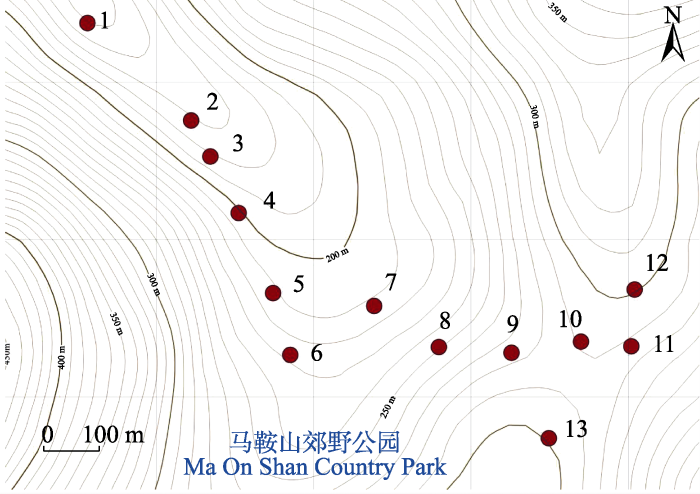
图1
香港马鞍山郊野公园样地采样点分布
Fig. 1
The distribution of sample points in the Ma On Shan Country Park
1.2 样点布设
根据植被类型、海拔梯度和低人为因素干扰的原则, 在样地均匀选择13个样点, 采样点之间的距离在100-200 m之间, 基本实现了采样点对栖息地的全面覆盖(图1)。根据“SITE100”研究团队对样地的工作量以及标本采集效果进行评估, 保证可以覆盖从地表到半高空的昆虫主要活动区域, 最终决定在每个采样点设置1个飞行阻隔器、1个马氏网和10个埋罐来采集甲虫。
1.3 采集装置
飞行阻隔器是一种可以有效采集具有较强飞行能力昆虫的方法(聂瑞娥等, 2017), 马氏网对部分飞行昆虫以及地表昆虫有很好的采集效果, 埋罐采集的昆虫主要在地表活动。
飞行阻隔器(图2a)主要由昆虫标本收集装置(PVC水槽)和垂直拦截网(塑料网、PVC塑料膜或有机玻璃)组成。首先在PVC塑料膜的长边上打10个孔, 用扎带将其固定在竹竿上, 并用绳子将标本收集装置固定在PVC塑料膜的另一端, 然后将竹竿的两端固定在树枝上, 将整个装置悬挂起来。昆虫撞上塑料膜后会掉进下面的收集装置里。在标本收集装置内放置适当的药物来毒杀昆虫。所用药物取决于研究目的: 形态学研究使用生理盐水(5 mmol/L NaCl溶液); 分子生物学研究使用2% SDS (sodium dodecyl sulfate)和EDTA (ethylene diamine tetra- acetic acid, 0.1 mol/L, pH = 8)或高浓度酒精的混合物, 可以有效控制DNA的降解(聂瑞娥等, 2017)。在本次采集过程中, 我们使用的药物是2% SDS和EDTA的混合物。该装置尽量安装在溪流或昆虫的飞行路径上方。也可以通过增加水槽和竹竿的尺寸, 以便于适应更多的栖息地, 并确保采集的有效性。
图2
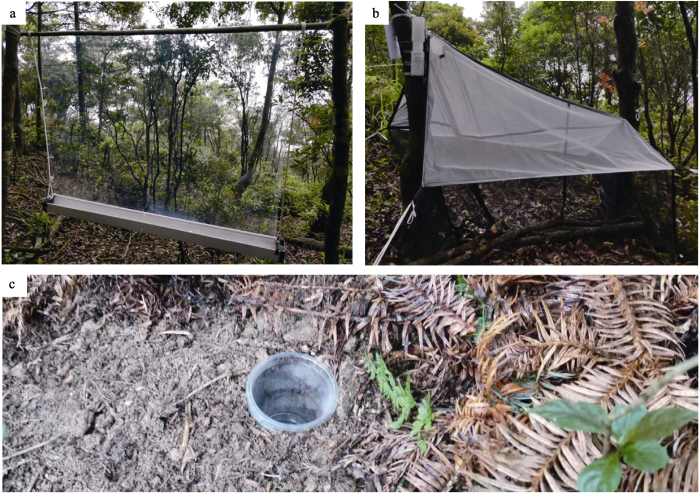
图2
三种被动式采集装置。(a)飞行阻隔器; (b)马氏网; (c)埋罐。
Fig. 2
The three passive acquisition devices. (a) Flight interception trap; (b) Malaise trap; (c) Pitfall trap.
埋罐(图2c)是捕捉地表甲虫的有效方法。我们将塑料盒或塑料杯埋在地里, 使杯子的开口与地面齐平, 向杯中加入无水乙醇用来收集地面的甲虫, 用量为距瓶口距离1/4, 以防止样本因雨水而流失。10个埋罐不均匀地分布在飞行阻隔器和马氏网周围。
1.4 采集时间
通过对香港月平均气温的统计, 5月底和6月达到适宜昆虫生存的温度(27.4℃)并且温度相对稳定, 因此选择5月底开始昆虫采集工作。由于2017年6月雨季来临较早, 并且设备在野外损坏较为严重, 导致甲虫采集时间较短。最终采集时间为2017年5月27日至6月17日。每两天采集1次飞行阻隔器和埋罐, 每10天采集1次马氏网, 将昆虫标本带回实验室, 挑取所有甲虫。根据采集时间、地点、采样点和采集方法进行分类, 并浸泡在无水乙醇中保存。
1.5 标本鉴定和拍摄
根据采集时间、采样点和采集方法, 将甲虫放在白纸上, 每只甲虫的背部尽可能朝上, 记录采集信息的标签放在标本旁边, 使用Olympus EM5 (60 mm)相机进行甲虫整体照的拍摄。如果甲虫数量较多, 可以拍摄多张照片。之后再将甲虫和相对应的标签放回试管中, 并添加无水乙醇保存(图3)。
图3
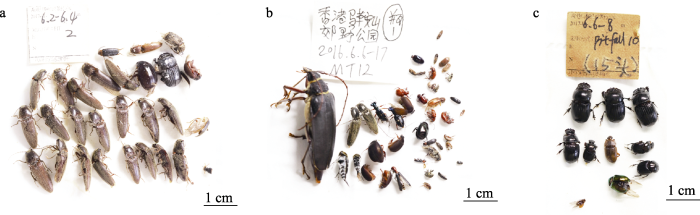
图3
三种被动式采集方法采集的甲虫照片示例。(a)飞行阻隔器; (b)马氏网; (c)埋罐。
Fig. 3
Examples of beetles collected from three passive acquisition methods. (a) Flight interception trap; (b) Malaise trap; (c) Pitfall trap.
对所有甲虫完成拍摄后, 将其拉丁名和采集信息记录在表格中。每种采集方法对应1个Excel表格, 每个表格根据13个采样点分为13张工作表。在每个工作表上水平列出采集时间, 垂直列出甲虫的拉丁名(它们按照形态种的顺序编号为1, 2, 3, …, N)。
2 数据描述
所有数据均已上传至ScienceDB, 具体由以下5个部分组成。
(1) Supplement 1压缩文件中包含了所有甲虫照片原图。以采集样地 + 采集方法的方式命名文件夹。例如, 在MOS-FIT文件中, MOS是采集地英文名称的首字母缩写, FIT是采集方法。根据采集日期将每个文件夹中的照片划分为不同的子文件夹, 例如, 2017-MOS-FIT-527-529, 其中2017年代表采集年份, 527-529代表5月27日至5月29日的准确采集日期。每个子文件夹中的照片以2017MOS-FITX/ MTX/PTX-6XX-6XX(n)的方式命名, 其中2017代表采集时间, MOS代表采集地点的英文缩写, FIT/MT/PT代表采集方法, X代表采样点数量, 6XX-6XX代表采样时间; 如果一个样点在同一天有比较多的昆虫, 并且拍摄了1张以上的照片, 则用n表示照片的数量。(2) Supplement 2压缩文件中包含了带有鉴定结果的照片。对照片上的每只甲虫进行了数字编号, 鉴定结果标记在每张照片下方。(3) Supplement 3压缩文件中包含了记录甲虫具体数量的Excel表格。(4) Supplement 4压缩文件中包含了形态物种鉴定图。(5) Supplement 5压缩文件中记录了13个样点的经纬度、海拔、温度、降雨量等基本信息, 以及每个样点的植被覆盖和人为干扰情况。
图4
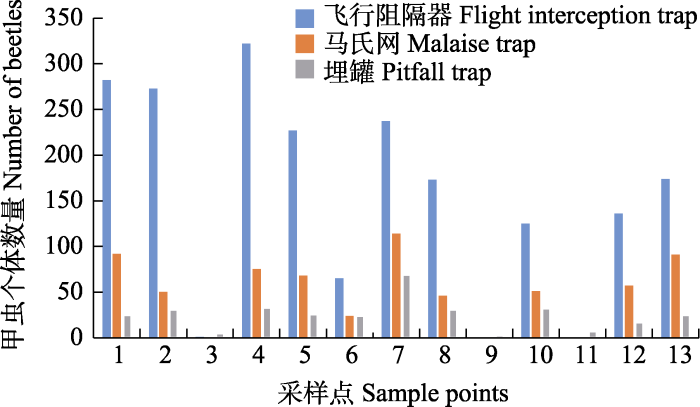
图4
不同采样点通过不同采集方式采集的甲虫个体数量
Fig. 4
Number of beetles collected through different acquisition methods at different sample points
图5
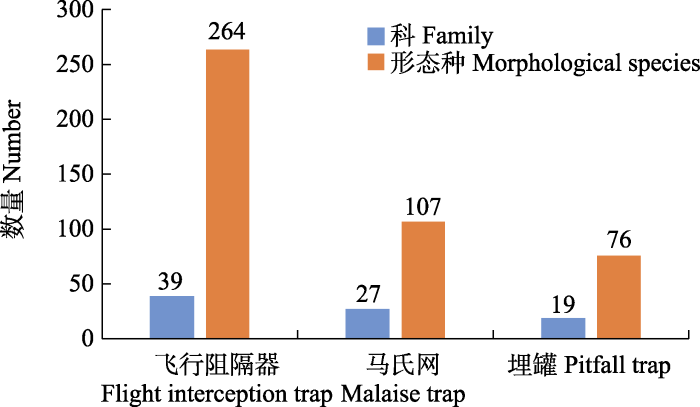
图5
不同采集方法采集到的甲虫科数与形态种数
Fig. 5
The number of beetles at the family level and morphological species level collected by different passive acquisition methods
图6
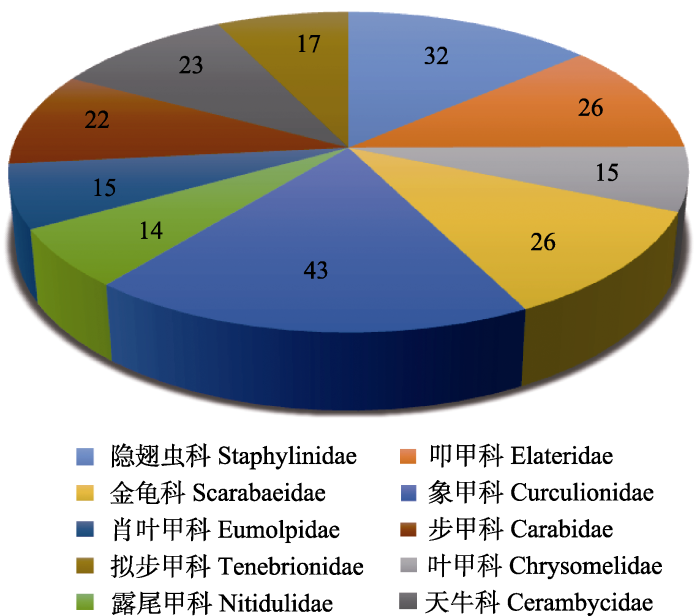
图6
甲虫形态种数量排名前10的科级阶元
Fig. 6
The top 10 families in terms of the number of morphological species
3 数据质量控制和评估
所有标本均在标准化环境中使用Olympus EM5 (60 mm)相机拍照, 将人为因素降至最低。部分照片较为模糊(标本已做分子实验), 为提高数据质量, 对所有标本数量统计进行了多次检查, 并由研究团队对鉴定结果进行审查, 提高鉴定的准确率。
4 数据使用方法和建议
该数据集可为香港甲虫多样性研究提供数据支持。数据集可以通过对3种被动式采集方法的比较来判断采集方法之间的差异, 也为被动式采集昆虫提供了一种有效可行的方法。甲虫的背面观照片也可以用于甲虫外部几何形态学的定量分析。
作者分工: 申昊负责文稿的撰写; 白明、佟一杰设计了本研究的思路; 申昊、赵淑哲、滕备、史晓旭负责甲虫的鉴定与分类; 申昊、韩永金负责数据的分析与处理; 白明、王新谱、佟一杰对文稿写作进行指导。
致谢
感谢香港渔农自然护理署的工作人员在调查过程中的帮助, 感谢聂瑞娥、杨美霞、王志良、陈炎栋、贺旭、边冬菊、阮用颖、宋晓斌、殷子为、刘蓝玉、王兴民、苑彩霞、李学燕、李开琴、周润等老师在甲虫鉴定中提供的帮助, 以及宁夏大学农学院田哲豪、王涛、路金博、韩勐扬等人在数量统计中提供的帮助。
参考文献
Arthropod populations in a sub-arctic environment facing climate change over a half- century: Variability but no general trend
Handbook of Zoology, Coleoptera, Beetles: Morphology and Systematics (Archo- stemata, Adephaga, Myxophaga, Polyphaga partim)
The SITE-100 Project: Site-based biodiversity genomics for species discovery, community ecology, and a global tree- of-life
DOI:10.3389/fevo.2022.787560
URL
[本文引用: 1]

Most insect communities are composed of evolutionarily diverse lineages, but detailed phylogenetic analyses of whole communities are lacking, in particular in species-rich tropical faunas. Likewise, our knowledge of the Tree-of-Life to document evolutionary diversity of organisms remains highly incomplete and especially requires the inclusion of unstudied lineages from species-rich ecosystems. Here we present the SITE-100 program, which is an attempt at building the Tree-of-Life from whole-community sampling of high-biodiversity sites around the globe. Combining the local site-based sets into a global tree produces an increasingly comprehensive estimate of organismal phylogeny, while also re-tracing evolutionary history of lineages constituting the local community. Local sets are collected in bulk in standardized passive traps and imaged with large-scale high-resolution cameras, which is followed by a parataxonomy step for the preliminary separation of morphospecies and selection of specimens for phylogenetic analysis. Selected specimens are used for individual DNA extraction and sequencing, usually to sequence mitochondrial genomes. All remaining specimens are bulk extracted and subjected to metabarcoding. Phylogenetic analysis on the mitogenomes produces a reference tree to which short barcode sequences are added in a secondary analysis using phylogenetic placement methods or backbone constrained tree searches. However, the approach may be hampered because (1) mitogenomes are limited in phylogenetic informativeness, and (2) site-based sampling may produce poor taxon coverage which causes challenges for phylogenetic inference. To mitigate these problems, we first assemble nuclear shotgun data from taxonomically chosen lineages to resolve the base of the tree, and add site-based mitogenome and DNA barcode data in three hierarchical steps. We posit that site-based sampling, though not meeting the criterion of “taxon-completeness,” has great merits given preliminary studies showing representativeness and evenness of taxa sampled. We therefore argue in favor of site-based sampling as an unorthodox but logistically efficient way to construct large phylogenetic trees.
Family-group names in Coleoptera (Insecta)
Biodiversity loss and its impact on humanity
Optimized pitfall trap design for collecting terrestrial insects (Arthropoda: Insecta) in biodiversity studies
DOI:10.1007/s13744-018-0613-8
PMID:29949122
[本文引用: 1]
Pitfall traps are commonly used for the collection of terrestrial insects in ecology and biology studies; they are relatively straightforward to manufacture and there is a large variety of models described in the literature. However, they present a few drawbacks: (i) the removal and transport of the collected material are not practical; (ii) they have low resistance and durability; (iii) they fail to correctly protect the attractive bait against adverse weather conditions and scavengers, and (iv) evaporation of the liquid used inside the trap. We proposed an optimized pitfall trap design for terrestrial insect collection made from cheap and easily accessible materials. The new design allows the transfer of the collected material to the lab by removing only that part of the trap where the insects have been captured; the other part remains in its original place. Thus, the proposed trap allows easier operation since there is no need to transport water to replenish the traps after each transfer; in addition, there is less volume and weight to be carried. The trap can remain in the field for months because of the durability of its material. Furthermore, the collected material is better protected against adverse weather conditions and scavengers. Currently, an efficient and rapid sampling strategy in the field is of global interest to understand mechanisms that can contribute to the monitor changes in phenology, succession, and biodiversity.
More than 75 percent decline over 27 years in total flying insect biomass in protected areas
On the decline of biodiversity due to area loss
DOI:10.1038/ncomms9837
PMID:26575347
[本文引用: 1]
Keil, Petr; Jetz, Walter Yale Univ, Dept Ecol & Evolutionary Biol, New Haven, CT 06520 USA. Keil, Petr; Storch, David Ctr Theoret Study, Prague 11000 1, Czech Republic. Storch, David Charles Univ Prague, Fac Sci, Dept Ecol, CR-12844 Prague 2, Czech Republic.
Malaise traps: The Townes model catches more insects
Tenebrionidae Latreille
Standards and best practices for monitoring and benchmarking insects
DOI:10.3389/fevo.2020.579193
URL
[本文引用: 1]
Benchmark studies of insect populations are increasingly relevant and needed amid accelerating concern about insect trends in the Anthropocene. The growing recognition that insect populations may be in decline has given rise to a renewed call for insect population monitoring by scientists, and a desire from the broader public to participate in insect surveys. However, due to the immense diversity of insects and a vast assortment of data collection methods, there is a general lack of standardization in insect monitoring methods, such that a sudden and unplanned expansion of data collection may fail to meet its ecological potential or conservation needs without a coordinated focus on standards and best practices. To begin to address this problem, we provide simple guidelines for maximizing return on proven inventory methods that will provide insect benchmarking data suitable for a variety of ecological responses, including occurrence and distribution, phenology, abundance and biomass, and diversity and species composition. To track these responses, we present seven primary insect sampling methods—malaise trapping, light trapping, pan trapping, pitfall trappings, beating sheets, acoustic monitoring, and active visual surveys—and recommend standards while highlighting examples of model programs. For each method, we discuss key topics such as recommended spatial and temporal scales of sampling, important metadata to track, and degree of replication needed to produce rigorous estimates of ecological responses. We additionally suggest protocols for scalable insect monitoring, from backyards to national parks. Overall, we aim to compile a resource that can be used by diverse individuals and organizations seeking to initiate or improve insect monitoring programs in this era of rapid change.
Biodiversity hotspots for conservation priorities
DOI:10.1038/35002501 [本文引用: 1]
The application and effectiveness of a flight interception trap for insect collecting
飞行阻隔器在昆虫采集中的应用探究
Regenerative living cities and the urban climate-biodiversity- wellbeing nexus
DOI:10.1038/s41558-022-01390-w [本文引用: 1]
Nutritional value of edible insects from the state of Oaxaca, Mexico
DOI:10.1006/jfca.1997.0530 URL [本文引用: 1]
Agricultural intensification and climate change are rapidly decreasing insect biodiversity
Global biodiversity scenarios for the year 2100
DOI:10.1126/science.287.5459.1770
PMID:10710299
[本文引用: 1]
Scenarios of changes in biodiversity for the year 2100 can now be developed based on scenarios of changes in atmospheric carbon dioxide, climate, vegetation, and land use and the known sensitivity of biodiversity to these changes. This study identified a ranking of the importance of drivers of change, a ranking of the biomes with respect to expected changes, and the major sources of uncertainties. For terrestrial ecosystems, land-use change probably will have the largest effect, followed by climate change, nitrogen deposition, biotic exchange, and elevated carbon dioxide concentration. For freshwater ecosystems, biotic exchange is much more important. Mediterranean climate and grassland ecosystems likely will experience the greatest proportional change in biodiversity because of the substantial influence of all drivers of biodiversity change. Northern temperate ecosystems are estimated to experience the least biodiversity change because major land-use change has already occurred. Plausible changes in biodiversity in other biomes depend on interactions among the causes of biodiversity change. These interactions represent one of the largest uncertainties in projections of future biodiversity change.
Common themes for ecologists in global issues
DOI:10.1046/j.1365-2664.1999.00390.x URL [本文引用: 1]
Measuring bee diversity in different European habitats and biogeographical regions
DOI:10.1890/07-1292.1 URL [本文引用: 1]
A species diversity dataset of beetles by three passive acquisition methods in Tei Tong Tsai (Hong Kong)
DOI:10.1038/s41597-022-01310-9
PMID:35577803
[本文引用: 1]
We based the dataset in this paper on the beetle collection from the sample site of Tei Tong Tsai (Hong Kong) from 1 May to 28 May 2019, a period of high insect diversity. A total of 16,270 beetles (photographed in 318 images) from 478 species belonging to 39 families were collected. The dataset consists of the following components: The original photo of the whole sample obtained at each site with each collection method, the morphological species identification chart, a statistical table describing the species and numbers of beetles collected on different dates at different sites using three passive acquisition methods, and a statistical table describing the longitude, latitude, and altitude information of each sampling point. We aimed to provide a database for the evaluation of beetle species diversity in Hong Kong and a paradigm for the effectiveness of passive acquisition in the beetle collection through the three representative methods, thus laying a foundation for biodiversity research.© 2022. The Author(s).


