



动物声景的时空变化特征受到包括动物自身响应机制以及植被因子、环境因子、人为干扰等在内的诸多因素影响(Marín-Gómez & MacGregor-Fors, 2021)。物种本身的内在激素或繁殖、保卫领土等社会行为是导致动物发声特点不同的主要原因(Tennessen et al, 2014; Jahn et al, 2017)。外部因素中, 植被类型或树种影响着区域整体的动物声景饱和度或复杂性(Lin et al, 2017; Francomano et al, 2021; Scarpelli et al, 2021), 而植被复杂的垂直分层结构决定了以不同频段发声的物种的歌唱行为(Tennessen et al, 2014; Ulloa et al, 2016)。人类活动产生的声音, 如交通噪声、交流谈话声等, 是干扰鸟类通讯信号并导致其合唱活动改变的最重要因素, 这一现象在城市环境中尤为突出(Kight & Swaddle, 2015; Benocci et al, 2022)。光照、温度等环境变化也会导致不同纬度和海拔的动物声学活动改变(Kułaga & Budka, 2020; Znidersic et al, 2020; Budka et al, 2021; Chen et al, 2021)。此外, 风声和雨声等自然声音作为声景的组分之一, 也是影响动物不同发声特点的重要干扰因素, 研究表明部分物种在雨季和旱季期间显示出不同的发声特点(Gottesman et al, 2021; Oliveira et al, 2021)。
城市绿地是城市生态系统的重要组成部分, 是维系城市生物多样性以及生态系统服务功能的重要区域(Kong & Nakagoshi, 2006; Vieira et al, 2018)。城市绿地涵盖了高度人工化的城市公园, 也包括自然遗留地、城郊森林等各类以植被覆盖为主体的开放空间, 空间异质程度高、人类干扰频繁, 城市绿地野生动物及其声景资源时空分布差异巨大(Haq, 2011; Gallo et al, 2017; Liu et al, 2019; Nawar et al, 2022)。近年来, 城市绿地规划与建设开始关注野生动物的保护, 但多集中于动物群落组成、栖息地选择与利用、生物多样性恢复设计等(张颖等, 2022), 对于城市绿地动物声景的时空分布格局及其影响因素尚缺乏系统总结。本文基于国内外67篇研究文献, 总结了城市绿地声景的时空特征与影响因素, 分析了已有研究的局限性, 并对未来的发展方向提出了建议, 以期为城市绿地景观设计与生物多样性保护提供参考(边琦等, 2021)。
1 文献检索与分析
1.1 文献检索方法
基于Web of Science核心合集数据库, 使用布尔运算符对以下字符串进行高级检索: 主题检索TS = (soundscape AND animal) OR (soundscape index AND animal) OR (soundscape AND dawn chorus) OR (acoustic monitoring AND songbird) OR (urban green space AND animal sound) OR (spatiotemporal AND soundscape) NOT (water OR ocean OR fish OR coral reef) NOT (visual OR auditory OR perception), 获取了2005年1月1日至2022年3月31日发表的相关论文353篇, 通过阅读与分析最终筛选出同时满足技术方法采用声学监测和研究内容涉及城市绿地声景的时空变化或影响因素两大条件的文献59篇。但是由于特定因素对动物声景影响的研究较少, 因此以标题检索TI = (vegetation AND bird AND soundscape) OR (forest AND bird AND acoustic) OR (acoustic community AND soundscape) OR (song AND anthropogenic noise) OR (song AND aircraft noise) OR ( urban park AND sound)进行补充检索, 又获取了8篇高度相关文献, 共计67篇。
针对这67篇文献, 按照城市绿地(市区绿地、近郊绿地、远郊绿地、城市及远郊绿地)、时间尺度(昼夜、季节、年度)、影响因素(植被因子、环境因子、人为干扰、自身驱动)、主要调查结果、动物类群(昆虫类、两栖类、鸟类、哺乳动物、多类群)、动物地理区(古北区、新北区、古热带区、新热带区、澳新区、东洋区)、国家及地区以及文献来源等类别进行归纳梳理, 绘制了全球关于城市绿地动物声景时空特征和影响因素研究的总结列表(附录1)。
1.2 文献整理分析
城市绿地动物声景研究受到全球学者广泛关注(图1), 本文整理的67篇文献共涉及6个动物地理区的27个国家。新北区(墨西哥南部以北的美洲)是全球开展动物声景研究最多的动物区系, 美国更是全球动物声景文献发表最多的国家。古北区(包括欧亚大陆的绝大部分以及撒哈拉沙漠以北的非洲)涵盖国家众多, 但大部分研究集中在中国和法国、英国等一些西欧国家。巴西则是新热带区动物声景研究的主要贡献国。与上述3个区系相比, 古热带区、东洋区和澳新区的部分国家对动物声景研究较为薄弱。在时间尺度上, 研究人员聚焦短时间序列, 如昼夜尺度、季节尺度对动物声景特征的研究, 对于超过2年的长时间序列的声景研究十分缺乏(附录1)。
图1
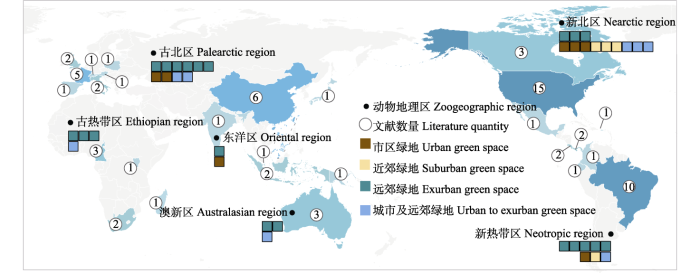
图1
动物声景个例研究的全球分布图。
颜色(蓝色)越深表示发表文献数量越多; 圆点、圆圈及正方形图框分别表示6个动物区系、文献数量和各区内4种城市绿地类型的研究数量。
Fig. 1
Global distribution map of animal soundscape case studies.
The deeper color (blue) represents more documents were published; the dots, circle and the square box represent the number of studies on the six major fauna, number of documents and the four types of urban green space in each region.
不同类型的城市绿地中声景的特点和动物声景的驱动因素有明显差异。6个动物地理区涵盖了城市中的3种绿地类型。由市区绿地向远郊绿地过渡, 人为噪声频率、鸟类叫声最小频率和背景噪声水平均呈现下降趋势(图2)。另外, 我们发现研究涉及的动物类群以鸟类居多, 它常作为城市绿地声景多样性的指示物种, 其研究数量占所有研究类群的46%, 这与鸟类靠声音通讯密不可分(Morrison et al, 2021)。其次为多个动物类群的混合研究(43%)。而研究昆虫类、哺乳动物和两栖类单一类群的研究数量之和为11%, 相对较少。对于动物声景的驱动因素, 从图3可以看出, 距离城市中心越近的绿地类型, 受到的人为干扰影响越大, 受植被因子和环境因子的影响越小。在具有不同城市化程度特征的城市及远郊绿地类型中, 对动物自身驱动因素影响的研究较少。
图2
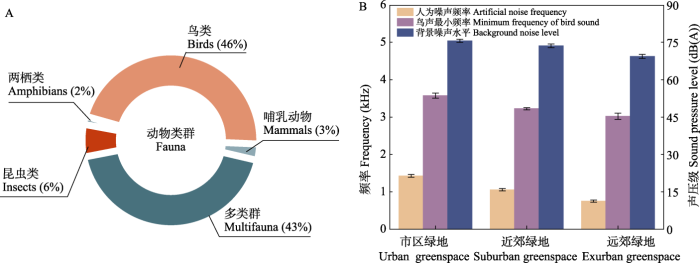
图2
不同城市绿地的研究动物类群分布(A)及声景差异(B)。
%表示文献数量占比。
Fig. 2
Distribution of research animal groups (A) and differences in soundscapes (B) in different urban green spaces.
% represents the proportion of the number of documents.
图3
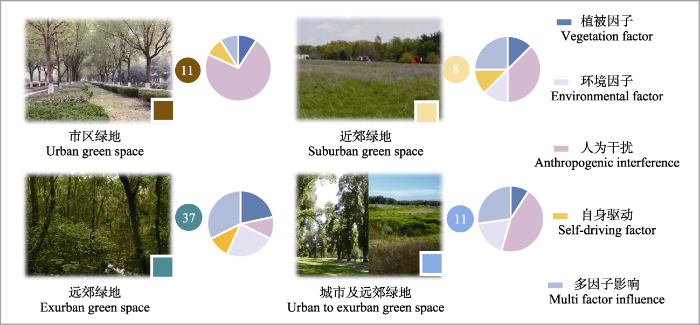
图3
不同城市绿地动物声景的驱动因素。
饼状图表示4种城市绿地类型中5种驱动因素类型的研究比例。数字表示文献数量。
Fig. 3
Drivers of animal soundscapes in different urban green spaces.
Pie charts represent the research proportions of five types of driving factors in four types of urban green space. Numbers represent the number of documents.
2 动物声景的时空特征
2.1 时间变化特征
2.1.1 昼夜尺度
在陆地栖息地上, 白天声景的生物部分几乎全由鸟类声音组成。鸟类通常在白天歌唱, 有明显的黎明和黄昏合唱(Alquezar et al, 2020)。由于经纬度的差异, 各地的黎明和黄昏时段不完全相同, 大部分研究以日出前后和日落前后来指示黎明和黄昏(Puswal et al, 2021; Quiroz-Oliva & Sosa-López, 2022)。通常从5:00左右开始, 鸟鸣声逐渐响起, 动物声景功率值在6:00左右达到峰值, 直到18:00再次达到合唱高峰(图4)。在寒冷的冬季, 黎明和黄昏时间稍有延迟或提前。例如, 在阿拉斯加的野生动物保护区内, 鸟类在8:00具有较高的合唱水平, 而17:00左右大部分动物都已结束歌唱(Mullet et al, 2016)。黎明合唱过后, 鸟类通常会减少或停止歌唱, 并开始日常活动, 例如觅食或与附近物种对唱(Berg et al, 2006; Puswal et al, 2021), 这可能也是白天动物声景功率较低的其中一个原因。
图4
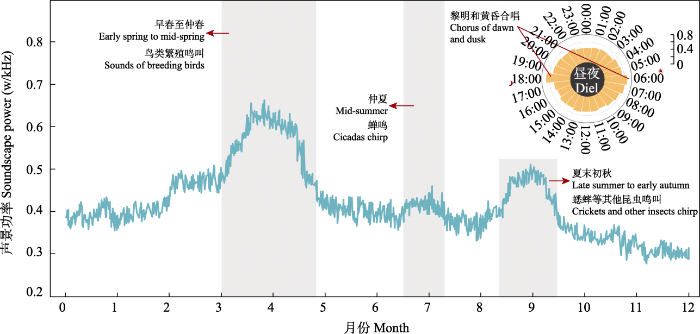
图4
城市绿地动物在一天(玫瑰图)和一年(折线图)中的声景功率变化。
太阳和月亮图标表示日出和日落时间。
Fig. 4
Variation of soundscape power in animals during the day (rose plot) and year (line plot).
The sun and moon icons represent the time of sunrise and sunset.
2.1.2 季节尺度
中高频率段的季节性动物声景主要由鸟类和昆虫声主导。早春的声景功率值普遍较低, 而随着鸟类春季繁殖季节的推进, 声景功率值逐渐上升。鸟类繁殖期间, 所有物种开始歌唱的时间相对于日出时间较早, 而停止歌唱的时间相对于日落时间较晚(Da Silva et al, 2014)。而且这种时间模式还会随着雌雄配对状态和繁殖物候变化, 例如, 产卵后雄鸟歌唱显著下降; 迁徙的鸣禽在到达合适的繁殖地后不久就会发出强烈的声音(Turner et al, 2018)。特别地, 中频(3-5 kHz)声景功率值在春末有所上升, 夏季下降, 到夏末至初秋又开始上升, 晚秋再次下降(图4)。这可能与季节性昆虫的出现有关。高频(> 5 kHz)动物声景在夏季的高功率值通常与高频昆虫的声学活动模式相匹配, 如蝉的合唱通常在仲夏较为突出(Kirschel et al, 2009; To et al, 2021)。
2.1.3 年度变化
动物声景的年度变化在评估气候变化、人为干扰等因素对野生动物和自然资源的影响上发挥着重要作用, 可进一步用于城市绿地管理, 如土地利用、林木管理等(Doser et al, 2020)。然而, 已有研究中有关动物声景的长时间序列研究相对较少(附录1)。
2.2 空间分布特征
2.2.1 环境空间梯度
海拔梯度的变化不仅促进一些非生物参数(如温度和湿度)的变化, 也会影响动物的多样性和分布, 导致动物声景结构的变化。低海拔处低频噪声突出, 高海拔处声景主要由宽带噪声(如强降雨等)主导, 因此大多数生物声音被掩盖, 随着海拔升高, 动物声学多样性降低(Lin et al, 2017; Chen et al, 2021)。然而, 有研究表明, 尽管高海拔地区的低温和氧气供应少等特点在一定程度上限制了部分物种的分布, 但高海拔区的两栖动物较低海拔区发声更频繁(Herrera-Montes, 2018)。海拔和声景饱和度的关系也受到研究人员的关注, Burivalova等(2018)发现具有连续森林覆盖的高海拔地区的声景饱和度更高, 这是因为大量物种在不同频率下同时发声。但海拔与声景饱和度的关系也明显受到时间因素的影响, 白天较高的海拔与较高的声景饱和度相关, 黎明合唱之前和黄昏合唱之后, 较高的海拔与较低的声景饱和度相关, 夜间声景饱和度则与海拔无关(Burivalova et al, 2019)。
地理纬度的变化引起动物声景的不同, 受纬度影响, 处于不同温度带的森林动物声景有明显差异。与温带地区相比, 由于热带地区生物多样性高, 共同发声的动物物种数量更多, 动物声音频率范围更广, 因而动物声景的多样性和复杂性可能更高 (Pijanowski et al, 2011a; Robert et al, 2019)。热带森林的声学群落主要以昆虫和鸟类为主, 其中鸟类的发声率明显高于哺乳动物和两栖动物, 随着纬度的升高, 物种发声率显著降低(Diepstraten & Willie, 2021)。虽然热带动物声景更复杂多变, 但也有研究发现, 在一些特殊种群间, 温带和热带动物声景复杂程度稍有不同。例如, 温带森林中的昼夜鸟类几乎全天歌唱, 而高山热带雨林内的昼夜鸟类通常白天鸣唱, 夜晚沉默(Budka et al, 2021)。
受城市化程度影响, 动物声景构成复杂(Liu et al, 2013)。随着城市化程度的降低, 白天的声学多样性升高, 均匀度下降。森林栖息地往往具有丰富的动物群落, 可在不同时间和频率下发出不同的声音, 导致动物声景的不均匀性, 而一些物种匮乏的城市地区, 发声物种较少, 声景均匀度更高(Bradfer-Lawrence et al, 2020; Dröge et al, 2021)。归一化差异声景指数已被证明能够准确反映区域动物声音和人为噪声的情况, 随着城市化程度的降低, 人工声不断降低, 生物声不断升高(Ross et al, 2018)。城市梯度下的背景噪声往往呈现规律性, 动物歌曲频率随着背景噪声水平的增加而升高(Derryberry et al, 2016)。随着城市化进程的加快, 城市化对于动物声景多样性的影响研究成为声景生态学研究的热点之一(Hensley et al, 2019; Suhonen & Jokimäki, 2019; Xie et al, 2022)。
2.2.2 植被空间结构
植被空间结构包括植被的水平结构和垂直分层结构。水平结构上, 不同植被类型引起的动物声景差异明显(Ulloa et al, 2016)。在相对未受干扰的森林绿地, 通常人工噪声相对较少, 生物声和地球物理声(如风声、雨声等)更容易被感知(Liu et al, 2019; Izaguirre et al, 2021)。与针叶林相比, 阔叶林中的动物声学多样性更高且持续时间更长(Lin et al, 2017)。相反, 在一些受到自然或人为损害的次生林中, 两栖动物和昆虫声学活动一般低于原始森林(Eldridge et al, 2018)。而在一些存在水-陆交错界面且灌木和草本植物集中的湿地区域, 一些择水而居的蛙类动物合唱活动较为强烈(Buckley et al, 2021)。而且因缺少高大植被, 鸣禽较少在该区域进行声学活动, 因此动物声景多来源于昆虫和两栖动物以及少数涉禽的发声(Khanaposhtani et al, 2019; Hopson & de Szalay, 2021)。
总体来看, 动物声景本身变化复杂, 且研究区域之间存在着概念界定不清、分类体系混乱、地理空间重叠等诸多问题, 目前对于动物声景的空间变化仍处于初步探索阶段。
3 动物声景的驱动因素
3.1 植被因子
图5
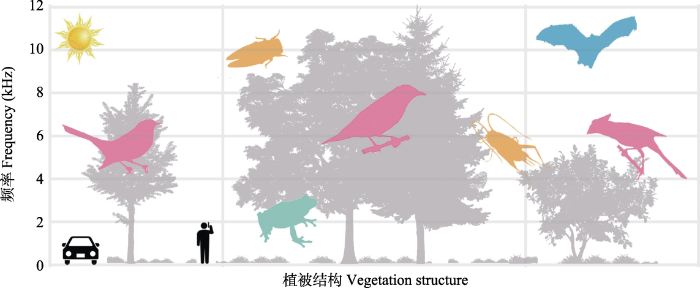
图5
动物声景的驱动因素及部分物种的频率分布概念图。
根据动物的频率分布展示了影响动物声景时空模式的4种驱动因素, 即植被因子(深灰色阴影)、环境因子、人为干扰(黑色阴影)、自身驱动。涉及动物类别包括了城市绿地上常见的鸟类(粉色阴影)、昆虫(黄色阴影)、两栖动物(如蛙类, 绿色阴影)以及哺乳动物(如蝙蝠, 蓝色阴影)。
Fig. 5
Concept map of driving factors of animal soundscapes and frequency distribution of some species.
Four driving factors affecting the spatiotemporal patterns of animal soundscapes are shown according to the frequency distribution of animals, i.e. vegetation structure (indicated by dark gray shading), environmental factors, human interference (black shading), and self-driving. The categories of animal include birds (pink shading), insects (yellow shading), amphibians (such as frogs, green shading), and mammals (such as bats, blue shading) that are commonly found in urban green spaces.
不同类型的城市绿地在范围大小、管理和人类活动等方面存在差异, 但它们都包含某些自然或半自然植被。然而, 并非所有绿地都具有相同的生态特征。例如, 城市中心的附属绿地通常规模较小, 植被修剪整齐, 人类活动量大(Nava-Díaz et al, 2020), 而森林绿地往往包含复杂植被, 而且自然植被比例较高(Sikuzani et al, 2018)。因此, 在评估城市绿地对动物声景空间分布的作用时, 不应忽视绿地之间的栖息地差异(Gallo et al, 2017)。例如, 一些开放空间觅食者(如蝙蝠)在小型绿地中的声学活动非常活跃, 这也许跟它们在有限的空间里能更好地发挥回声定位功能有关(Suarez-Rubio et al, 2018)。
3.2 环境因子
生物声音和地球物理声音在很多时候直接受环境因素的影响, 例如光照、温度、风力和降雨等气候变化以及月相周期等(Pijanowski et al, 2011b)。在森林绿地中, 动物黎明合唱的时间可能与光照强度有关。一般来说, 热带阔叶森林中的林下层与冠层相比, 其光强度最多衰减了两个数量级, 而树冠处的物种比林下层的物种更早歌唱(Berg et al, 2006), 这也就意味着光照强度的增加可能会使物种的歌唱时间提前。然而, 停止歌唱的时间比开始歌唱的时间更易变化, 特别是对于那些在日落前完成歌唱的物种来说。这与大多数物种在黄昏时歌唱时间的变异性高于黎明时的变化一致(Da Silva et al, 2014)。因此, 黎明歌唱的时间与光照条件更密切相关, 而黄昏歌唱受其他因素(例如温度)的影响更大。
除了光照, 环境温度也被认为是影响鸟类合唱行为的主要因素之一(Puswal et al, 2021)。随着全球气候变暖, 生物的物候会发生变化。例如, 温度升高会显著影响植物物候, 导致植物生长和开花时间提前或延迟, 某些动物物种遵循植被物候, 在这期间的生物声有所增加(Krause & Farina, 2016)。气候变化也会引起鸟类迁徙模式的物候变化, 鸟类的较早到来和繁殖很大程度上归因于春季气温的升高。此外, 温度升高会影响动物发射高频信号。例如, 蝙蝠通常利用高频超声波信号的短脉冲来进行回声定位以捕捉猎物。然而因为高频对高温更敏感, 导致声信号量衰减更强, 从而影响声音检测结果(Straka et al, 2019)。以前的研究还发现昆虫声音频率与海拔高度密切相关, 在较低的海拔高度下, 温度水平更高, 致使蟋蟀产生更高频率的歌曲(Kirschel et al, 2009)。
值得注意的是, 环境除了直接影响动物的发声, 还可以通过影响某一物种间接影响另一物种。例如, 为了避免被低频昆虫声音掩盖, 绿莺(Hylia prasina)以较低的频率歌唱(Kirschel et al, 2009)。在人类活动密集的城市公园, 昆虫本身受到人为噪声的干扰, 当其针对这部分噪声进行声信号调整时, 可能产生累积效应, 鸟类之间的沟通效率随着昆虫声音的加入而进一步降低(To et al, 2021)。但是, 目前对于这一部分的研究仍然较少, 未来或许可以加强复合噪声对动物发声的影响研究。另外, 虽然上述各种影响因素均对动物声景各有影响, 但这些变量在城市绿地中的相互作用机制尚不清楚, 有关低频声音受环境噪声影响, 高频声音受生境结构影响的说法仍需进一步验证(LaZerte et al, 2015)。
3.3 人为干扰
人为噪声和人造光污染也导致了动物声景的声学复杂性(Marín-Gómez & MacGregor-Fors, 2021), 城市人为噪音将是导致动物歌唱行为改变的最突出因素之一。常见的人为噪声类型有交通噪声(图3)、飞机噪声、施工噪声等, 它们以特定方式影响物种, 导致其歌唱时间提前或延迟(Alquezar et al, 2020; Schlicht & Kempenaers, 2020; Retamosa Izaguirre et al, 2021)。交通噪声的频率范围能够与某些动物声音的频率范围发生重叠, 进而影响种内交流(Khanaposhtani et al, 2019)。有研究表明, 飞机在公园上空频繁飞过, 也会导致动物发声数量的减少, 但Farina等(2011)的研究结果却表明鸟类的歌唱活动与飞机日常入侵存在弱的负相关性, 鸟类群落在飞机入境期间并未停止歌唱活动。
为了避免被噪音掩盖, 动物可能会通过调整频率、振幅、歌曲速率或歌曲持续时间来改变它们的发声, 即“隆巴德效应” (Lombard effect) (Proppe et al, 2013; Hao et al, 2015; To et al, 2021)。例如, 发出中等频率声音的物种受到城市低频噪声影响时往往可以通过切换到更高频率的歌声来应对(Guo et al, 2016; Zhan et al, 2021)。对于低频(< 1 kHz)动物而言, 由于其发声特征很难以改变歌曲频率的形式来应对, 因此需要采用其他非频率的声音调整, 如增加歌曲幅度以改善信噪比(Grabarczyk & Gill, 2020)。当噪声掩蔽导致感知入侵信号的能力变弱时, 雄性物种往往会以更高速率或更长的歌曲来应对入侵者(Grabarczyk & Gill, 2019)。城市绿地尽管长期受到噪声污染, 但有些物种发声的最小频率远高于人为噪声的峰值频率(To et al, 2021), 这就造成噪声也不能掩盖动物以较高频率进行通信的声信号(Deoniziak & Osiejuk, 2021)。
目前对于人造光对动物声景的时空差异影响尚存争议。分布于商业区、住宅区和街道路边的绿地通常存在较为严重的光污染现象。一些研究人员认为光污染可能会影响动物声学活动的时间模式。例如, 人造光可以通过破坏褪黑激素周期来影响鸟类的昼夜节律, 导致在光污染地区出现较早的黎明合唱(Dominoni, 2015)。但也有研究结果表明, 光污染不是热带鸟类黎明合唱的决定因素, 夜间人造光与黎明合唱时间之间没有关系(Marín-Gómez & MacGregor-Fors, 2019)。由此可见, 光污染影响鸟类黎明合唱与否也可能因所处位置不同而有所差异。值得注意的是, 目前仍然无法确定影响动物鸣声的因素仅是人为干扰而无其余因素的驱动, 人为干扰对动物发声行为的影响的独立贡献依然模棱两可(Barber et al, 2010; Suarez-Rubio et al, 2018)。
3.4 自身驱动
公园声景的生物声的每日趋势大多与鸟类合唱有关。研究发现, 鸟类黎明合唱的出现可能与内在因素有关。例如, 睾酮被认为是温带鸣禽成年歌唱行为表达的主要因素, 可通过其雄激素或雌激素代谢物产生。而当阻断雄激素或雌激素作用时出现黎明歌唱的可能性显著降低(Van Duyse et al, 2005)。
鸟类黎明合唱的一般功能是吸引配偶、保护配偶和防御领土(Puswal et al, 2021), 当这些社会因素发生变化时, 合唱行为也会随之改变。这种变化在繁殖季节尤为明显。在繁殖季节的早期, 即寻找配偶阶段, 雄性鸟类会优先发出比平时更高频率的呼叫, 随后雌性鸟类加入互动以创造二重唱(Quiroz-Oliva & Sosa-López, 2022)。另外, 持续的高呼叫活动也预示着该物种的高繁殖成功率, 只有身体状况良好的雄性才能维持长时间的发声活动(Jordão et al, 2012)。日出前的黎明歌唱对于领土防御也尤为重要。Amrhein和Erne (2006)研究表明, 当领土遭到入侵时, 鹪鹩(Troglodytes troglodytes)在日出前显著增加了它们的歌曲输出。其他鸣禽也会通过在广阔区域发出长距离信号以吸引配偶和进行领土防御(Grabarczyk & Gill, 2020)。
4 问题与展望
随着声景监测技术的迅速发展, 声景监测的时空范围和密度大大增加。通过远程监测城市绿地动物声景的时空变化并对其可能存在的影响因素进行分析, 为有效掌握生物多样性的动态变化及其相互作用机制提供了第一手资料。但是, 为了深入揭示城市绿地的动物声景特征及定量评估其影响因素, 城市绿地声景生态研究面临机遇和挑战。
4.1 开展多时空尺度变化规律研究
迄今为止, 针对长时间序列和大空间尺度范围的动物声景研究十分薄弱。动物声景年度模式在指示鸣禽迁徙物候、预测环境气候变化、评估当地遭受自然或人为破坏以及绿地修复速度方面发挥着重要作用(Buxton et al, 2016; Doser et al, 2020; Duarte et al, 2021), 加强动物声景的多年监测和分析研究具有重要意义。此外, 大多数动物声景研究都集中在温带地区, 关于热带地区城市绿地的动物声景信息仍然较为缺乏。热带森林拥有比温带森林更丰富的植被结构和生物种群, 加强其研究并与温带地区动物声景进行比较, 对于掌握全球动物声景的时空模式具有积极作用。从城市绿地的角度出发, 探讨不同时空尺度的动物声景特征及其演变规律, 可实现从更大规模和更多层面掌握动物声景动态特征。
4.2 创新动物声景分析方法
目前大部分动物声景研究对声音的分析多集中于某个种群声学活动的发声率和强度, 对于个别物种发声的具体呼叫结构和歌唱歌曲信息缺乏足够的研究和描述, 如歌曲的音节、类型、数目和持续时间等。动物歌曲结构信息不仅能够直接显示由各种外在或内在因素引起的物种声音的变化, 更是进行物种个体识别的重要线索。当前研究的动物类群多为鸟类和昆虫, 部分两栖类和哺乳动物虽有所涉及, 但研究数量仍相对较少(de Andrade et al, 2020), 未来应突破物种层面, 在生态系统层面对更多动物类群进行声景变化的研究。
4.3 定量解析影响因素及其响应机制
4.4 建立城市绿地动物声景数据库
附录 Supplementary Material
附录1 不同城市绿地动物声景时空特征及其驱动因素的全球研究总结
Appendix 1 Summary of the global studies of spatiotemporal characteristics and their drivers of animal soundscapes on different urban green spaces
参考文献
Lack of consistent responses to aircraft noise in dawn song timing of bird populations near tropical airports
DOI:10.1007/s00265-020-02865-6 URL [本文引用: 3]
Dawn singing reflects past territorial challenges in the winter wren
DOI:10.1016/j.anbehav.2005.07.023 URL [本文引用: 1]
The costs of chronic noise exposure for terrestrial organisms
DOI:10.1016/j.tree.2009.08.002 URL [本文引用: 1]
Eco-acoustic assessment of an urban park by statistical analysis
DOI:10.3390/su13147857 URL [本文引用: 1]
Auto-correlations and long time memory of environment sound: The case of an urban park in the city of Milan (Italy)
Application of ecoacoustic monitoring in the field of biodiversity science
DOI:10.13287/j.1001-9332.202103.032
[本文引用: 2]

Sound is an important way of communication among organisms. The monitoring and analy-sis of biological sound is an emerging method to describe and evaluate biodiversity. This method does not invade or damage the natural environment. By recording ecological information through sound, it can effectively reflect the relevant characteristics of biodiversity. The sound-based exploration of biodiversity change has broadened the interdisciplinary approach and has been increasingly applied to ecological research. Here, we expounded on the main theoretical foundations and research methods of using acoustic monitoring to assess biodiversity. We introduced related research fields from two aspects, namely the biodiversity of vocal animals and the temporal and spatial diversity of soundscape. We presented examples of the application of acoustic monitoring to assess the impact of land-use change, climate change and urbanization on biodiversity. Finally, we proposed the future direction of development, and hope that the potential of sound surveys could be further explored to provide an effective reference for biodiversity monitoring and assessment.
生物声音监测研究在生物多样性领域的应用
DOI:10.13287/j.1001-9332.202103.032
[本文引用: 2]
声音是生物之间交流的重要手段,对生物声音的监测与分析是描述和评估生物多样性的新兴方法。这种方法不侵入和破坏自然环境,通过声音记录生态信息,并有效反映生物多样性的相关特征,是一种重要的生态工具。从声音角度探讨生物多样性的变化拓宽了多学科交叉的新思路,因此近年来被越来越多地应用于生态学研究中。本文阐述了利用声音监测评估生物多样性的主要理论基础和研究方法,从发声动物的生物多样性、声景的时空多样性两个方面介绍了相关领域的研究进展,列举了声音监测在评估土地利用变化、气候变化和城市化对生物多样性影响的应用实例。最后,对未来研究方向进行了展望,希望能进一步挖掘声音调查的发展潜力,为生物多样性的监测评估提供有效的借鉴和参考。
Rapid assessment of avian species richness and abundance using acoustic indices
Assessing ecological and environmental influences on boreal chorus frog (Pseudacris maculata) spring calling phenology using multimodal passive monitoring technologies
Nocturnal singing by diurnal birds in Afrotropical highlands
DOI:10.1007/s10336-020-01842-0 URL [本文引用: 5]
Using soundscapes to investigate homogenization of tropical forest diversity in selectively logged forests
DOI:10.1111/1365-2664.13481
[本文引用: 1]
Selective logging in tropical forests changes the local number of animal species (alpha diversity), but it also likely affects species turnover (beta diversity). Whilst such changes are documented in many ecosystems under different disturbances, they are poorly understood in selectively logged tropical forests. By using soundscape recordings across broad spatial scales, we measured soundscape saturation and dissimilarity of pairs of soundscapes, as a proxy of alpha and beta diversity, respectively, in selectively logged and protected tropical forest in Indonesian Borneo. Soundscapes of selectively logged forests were more homogeneous than the soundscapes of never logged forest, and that soundscape saturation of protected forest was higher during the day and lower at night in comparison with selective logging concessions. Synthesis and applications. Selectively logged forests act as an important reservoir of biodiversity. Optimizing such production forests for biodiversity conservation requires the consideration of the total continuous area that is assigned to selective logging, and spatial arrangement of annual cutting blocks, as these could affect beta diversity and its recovery.
Using soundscapes to detect variable degrees of human influence on tropical forests in Papua New Guinea
DOI:10.1111/cobi.12968
PMID:28612939
[本文引用: 1]
There is global concern about tropical forest degradation, in part, because of the associated loss of biodiversity. Communities and indigenous people play a fundamental role in tropical forest management and are often efficient at preventing forest degradation. However, monitoring changes in biodiversity due to degradation, especially at a scale appropriate to local tropical forest management, is plagued by difficulties, including the need for expert training, inconsistencies across observers, and lack of baseline or reference data. We used a new biodiversity remote-sensing technology, the recording of soundscapes, to test whether the acoustic saturation of a tropical forest in Papua New Guinea decreases as land-use intensity by the communities that manage the forest increases. We sampled soundscapes continuously for 24 hours at 34 sites in different land-use zones of 3 communities. Land-use zones where forest cover was fully retained had significantly higher soundscape saturation during peak acoustic activity times (i.e., dawn and dusk chorus) compared with land-use types with fragmented forest cover. We conclude that, in Papua New Guinea, the relatively simple measure of soundscape saturation may provide a cheap, objective, reproducible, and effective tool for monitoring tropical forest deviation from an intact state, particularly if it is used to detect the presence of intact dawn and dusk choruses.© 2017 The Authors. Conservation Biology published by Wiley Periodicals, Inc. on behalf of Society for Conservation Biology.
Using bioacoustics to examine shifts in songbird phenology
DOI:10.1002/ece3.2242
PMID:27547306
[本文引用: 2]
Monitoring patterns in biodiversity and phenology have become increasingly important given accelerating levels of anthropogenic change. Long-term monitoring programs have reported earlier occurrence of spring activity, reflecting species response to climate change. Although tracking shifts in spring migration represents a valuable approach to monitoring community-level consequences of climate change, robust long-term observations are challenging and costly. Audio recordings and metrics of bioacoustic activity could provide an effective method for monitoring changes in songbird activity and broader biotic interactions. We used 3 years of spring and fall recordings at six sites in Glacier Bay National Park, Alaska, an area experiencing rapid warming and glacial retreat, to examine the utility of bioacoustics to detect changes in songbird phenology. We calculated the Acoustic Complexity Index (ACI), an algorithm representing an index of bird community complexity. Abrupt changes in ACI values from winter to spring corresponded to spring transition, suggesting that ACI may be an effective, albeit coarse metric to detect the arrival of migrating songbirds. The first peak in ACI shifted from April 16 to April 11 from 2012 to 2014. Changes in ACI were less abrupt in the fall due to weather events, suggesting spring recordings are better suited to indicate phenology. To ensure changes in ACI values were detecting real changes in songbird activity, we explored the relationship between ACI and song of three species: varied thrush (Ixoreus naevius), Pacific wren (Troglodytes pacificus), and ruby-crowned kinglet (Regulus calendula). ACI was positively related to counts of all species, but most markedly with song of the varied thrush, the most common species in our recordings and a known indicator of forest ecosystem health. We conclude that acoustic recordings paired with bioacoustic indices may be a useful method of monitoring shifts in songbird communities due to climate change and other sources of anthropogenic disturbance.
The relationship between acoustic indices, elevation, and vegetation, in a forest plot network of southern China
Does the song of the Wren Troglodytes troglodytes change with different environmental sounds?
DOI:10.3161/00016454AO2016.51.1.002 URL [本文引用: 1]
Artificial night lighting rather than traffic noise affects the daily timing of dawn and dusk singing in common European songbirds
DOI:10.1093/beheco/aru103 URL [本文引用: 2]
City sloths and marmosets in Atlantic forest fragments with contrasting levels of anthropogenic disturbance
DOI:10.1007/s13364-020-00492-0 URL [本文引用: 1]
Spatio-temporal scaling of biodiversity in acoustic tropical bird communities
DOI:10.1111/ecog.04544 URL [本文引用: 1]
Seasonality and social factors, but not noise pollution, influence the song characteristics of two leaf warbler species
Patterns of song across natural and anthropogenic soundscapes suggest that white-crowned sparrows minimize acoustic masking and maximize signal content
Assessing the structure and drivers of biological sounds along a disturbance gradient
The effects of light pollution on biological rhythms of birds: An integrated, mechanistic perspective
DOI:10.1007/s10336-015-1196-3
[本文引用: 1]
Light pollution is considered a threat for bio-diversity given the extent to which it can affect a vast number of behavioral and physiological processes in several species. This comes as no surprise as light is a fundamental, environmental cue through which organisms time their daily and seasonal activities, and alterations in the light environment have been found to affect profoundly the synchronization of the circadian clock, the endogenous mechanism that tracks and predicts variation in the external light/dark cycles. In this context, birds have been one of the most studied animal taxa, but our understanding of the effects of light pollution on the biological rhythms of avian species is mostly limited to behavioral responses. In order to understand which proximate mechanisms may be affected by artificial lights, we need an integrated perspective that focuses on light as a physiological signal, and especially on how photic information is perceived, decoded, and transmitted through the whole body. The aim of this review is to summarize the effects of light pollution on physiological and biochemical mechanisms that underlie changes in birds' behavior, highlighting the current gaps in our knowledge and proposing future research avenues.
Assessing soundscape disturbance through hierarchical models and acoustic indices: A case study on a shelterwood logged northern Michigan forest
Listening to a changing landscape: Acoustic indices reflect bird species richness and plot-scale vegetation structure across different land-use types in north-eastern Madagascar
The impact of noise from open-cast mining on Atlantic forest biophony
DOI:10.1016/j.biocon.2015.08.006 URL [本文引用: 1]
Changes on soundscapes reveal impacts of wildfires in the fauna of a Brazilian savanna
Sounding out ecoacoustic metrics: Avian species richness is predicted by acoustic indices in temperate but not tropical habitats
DOI:10.1016/j.ecolind.2018.06.012 URL [本文引用: 1]
Avian soundscapes and cognitive landscapes: Theory, application and ecological perspectives
DOI:10.1007/s10980-011-9617-z URL [本文引用: 1]
Sonic environment and vegetation structure: A methodological approach for a soundscape analysis of a Mediterranean maqui
DOI:10.1016/j.ecoinf.2013.10.008 URL [本文引用: 1]
Acoustic monitoring shows invasive beavers Castor canadensis increase patch-level avian diversity in Tierra del Fuego
DOI:10.1111/1365-2664.13999 URL [本文引用: 1]
Visualization of temporal change in soundscape power of a Michigan lake habitat over a 4-year period
DOI:10.1016/j.ecoinf.2013.11.004 URL [本文引用: 4]
Acoustic patterns at the Samford ecological research facility in South East Queensland, Australia: The Peri-Urban SuperSite of the Terrestrial Ecosystem Research Network
DOI:10.1016/j.ecoinf.2017.01.002 URL [本文引用: 1]
Mammal diversity and metacommunity dynamics in urban green spaces: Implications for urban wildlife conservation
DOI:10.1002/eap.1611 URL [本文引用: 2]
Cricket calling communities as an indicator of the invasive ant Wasmannia auropunctata in an insular biodiversity hotspot
DOI:10.1007/s10530-017-1612-0 URL [本文引用: 1]
Use of citizen science datasets to test effects of grazing exclusion and replanting on Australian woodland birds
What does resilience sound like? Coral reef and dry forest acoustic communities respond differently to Hurricane Maria
Anthropogenic noise affects male house wren response to but not detection of territorial intruders
Anthropogenic noise masking diminishes house wren (Troglodytes aedon) song transmission in urban natural areas
DOI:10.1080/09524622.2019.1621209
[本文引用: 3]
Anthropogenic noise changes the acoustic environment in which avian signals have evolved, possibly decreasing active space or the area over which signals may be detected and discriminated by receivers. Linking signal transmission patterns to signal function and species' spatial ecology is important for understanding behavioural changes of receivers in noise. We tested whether varying levels of ambient noise affectstransmission of two structurally distinct sections of male house wren (Troglodytes aedon) song used for short- and long-distance communication. We placed our experiment in an ecological context by measuring signal degradation and attenuation in relation to species-typical spacing patterns to investigate whether song structure is maintained within (short-distance within-pair communication) and between territories (long-distance male-male and extra-pair communication) depending on noise levels. Songs experienced more masking and fell below thresholds for detection and discrimination at shorter distances under noisier conditions. Decay of signal-to-noise ratios and cross-correlation factors in noise were so pronounced that song components used for both short- and long-distance communication did not transmit beyond average territory boundaries. Noise masking could affect species ecology: if signals are not detected by intended receivers in noisier habitats, settlement, space use and social interactions may be fundamentally altered compared to those in quieter environments.
Soundscape dynamics of a cold protected forest: Dominance of aircraft noise
DOI:10.1007/s10980-021-01360-1
PMID:35035087
[本文引用: 1]
One mainstay of soundscape ecology is to understand acoustic pattern changes, in particular the relative balance between biophony (biotic sounds), geophony (abiotic sounds), and anthropophony (human-related sounds). However, little research has been pursued to automatically track these three components.Here, we introduce a 15-year program that aims at estimating soundscape dynamics in relation to possible land use and climate change. We address the relative prevalence patterns of these components during the first year of recording.Using four recorders, we monitored the soundscape of a large coniferous Alpine forest at the France-Switzerland border. We trained an artificial neural network (ANN) with mel frequency cepstral coefficients to systematically detect the occurrence of silence and sounds coming from birds, mammals, insects (biophony), rain (geophony), wind (geophony), and aircraft (anthropophony).The ANN satisfyingly classified each sound type. The soundscape was dominated by anthropophony (75% of all files), followed by geophony (57%), biophony (43%), and silence (14%). The classification revealed expected phenologies for biophony and geophony and a co-occurrence of biophony and anthropophony. Silence was rare and mostly limited to night time.It was possible to track the main soundscape components in order to empirically estimate their relative prevalence across seasons. This analysis reveals that anthropogenic noise is a major component of the soundscape of protected habitats, which can dramatically impact local animal behavior and ecology.The online version contains supplementary material available at 10.1007/s10980-021-01360-1.© The Author(s), under exclusive licence to Springer Nature B.V. 2022.
Low frequency dove coos vary across noise gradients in an urbanized environment
DOI:S0376-6357(16)30125-5
PMID:27268468
[本文引用: 1]
Urbanization poses a challenge to bird communication due to signal masking by ambient noise and reflective surfaces that lead to signal degradation. Bird species (especially oscines) have been shown to alter their singing behaviour to increase signal efficiency in highly urbanized environments. However, few studies on the effects of noise on song structure have included birds with low frequency vocal signals which may be especially vulnerable to noise pollution due to significant frequency overlap of their signals with traffic noise. We compared the perch coos of spotted doves (Streptopelia chinensis), a species with very low frequency vocalizations, in different background noise levels across urban and peri-urban areas in Hong Kong. We documented a 10% upward shift in the minimum frequency of coos of spotted doves across the noise gradient (a relatively small but significant shift), and a reduced maximum frequency in urban habitats with a higher density of built up area. Hong Kong doves had significantly higher minimum and maximum frequencies than doves from throughout their range (from mostly rural sites). Our results indicate that urban species with extremely low sound frequencies such as doves can alter their vocalizations in response to variable urban acoustic environments. Copyright © 2016 Elsevier B.V. All rights reserved.
Integrated effects of urban morphology on birdsong loudness and visibility of green areas
DOI:10.1016/j.landurbplan.2015.01.006 URL [本文引用: 1]
Vegetation structure and temporality influence the dominance, diversity, and composition of forest acoustic communities
Urban green spaces and an integrative approach to sustainable environment
DOI:10.4236/jep.2011.25069 URL [本文引用: 1]
Evaluation of natural sounds in urban greenery: Potential impact for urban nature preservation
Effects of urbanization on native bird species in three southwestern US cities
Protected area zoning as a strategy to preserve natural soundscapes, reduce anthropogenic noise intrusion, and conserve biodiversity
Alteration of above and below-water soundscapes by roads
DOI:10.1007/s13157-021-01407-8 URL [本文引用: 1]
It is not just about birds: What do acoustic indices reveal about a Costa Rican tropical rainforest?
An application of artificial intelligence techniques in prediction of bird soundscape impact on tourists’ mental restoration in natural urban areas
人工智能技术在预测城市自然地区鸟类声景对游客心理恢复的影响中的应用
Automated sound recognition provides insights into the behavioral ecology of a tropical bird
Chorusing behaviour in the lusitanian toadfish: Should I match my neighbours’ calling rate?
DOI:10.1111/j.1439-0310.2012.02078.x URL [本文引用: 1]
Effects of highways on bird distribution and soundscape diversity around Aldo Leopold’s shack in Baraboo, Wisconsin, USA
Eastern bluebirds alter their song in response to anthropogenic changes in the acoustic environment
DOI:10.1093/icb/icv070
PMID:26116201
[本文引用: 2]
Vocal responses to anthropogenic noise have been documented in several species of songbird. However, only a few studies have investigated whether these adjustments are made in "real time" or are longer-term responses to particular soundscapes. Furthermore, increased ambient noise often is accompanied by structural changes to the habitat, including the introduction of noisy roadways and the removal of native vegetation. To date, no studies have simultaneously investigated the impact of both acoustic and structural disturbance on the same species. The relevance of each of these variables must be quantified if we wish to refine our understanding of the ways in which human activities influence avian communication. In this study, we quantified both among-male and within-male adjustments of song in response to ambient noise, and also investigated whether anthropogenic modifications of the habitat explained variations in songs' parameters. Recordings of songs were collected from male, breeding eastern bluebirds (Sialia sialis) residing in a network of nestboxes distributed across a gradient of anthropogenic disturbance. Levels of ambient noise were associated both with the average song-parameters of each male and with the change in a male's song-parameters between the loudest and quietest periods at his nest box. Males' song parameters were also related to habitat structure, as assessed using geographic information systems techniques. Males in noisier sites produced both higher-pitched and louder songs than did birds in quieter areas. Likewise, individual males demonstrated immediate adjustments to disturbance by noise, increasing the amplitude of their song between periods of quiet and loud ambient noise. Both spectral and temporal aspects of a male's song were related to whether his habitat was more "natural" or "anthropogenic." Our results indicate that males' adjustments of song may represent simultaneous responses to multiple modifications of the habitat by humans. However, we also conclude that biotic noise remains an important influence on avian signals even in anthropogenic areas. We suggest that human habitats provide an ideal setting in which to perform experiments on communication strategies, with resulting data poised to reveal underlying evolutionary processes while also informing conservation and management. © The Author 2015. Published by Oxford University Press on behalf of the Society for Integrative and Comparative Biology. All rights reserved. For permissions please email: journals.permissions@oup.com.
Birdsong tuned to the environment: Green hylia song varies with elevation, tree cover, and noise
DOI:10.1093/beheco/arp101 URL [本文引用: 3]
Spatial-temporal gradient analysis of urban green spaces in Jinan, China
DOI:10.1016/j.landurbplan.2005.07.006 URL [本文引用: 1]
Using ecoacoustic methods to survey the impacts of climate change on biodiversity
DOI:10.1016/j.biocon.2016.01.013 URL [本文引用: 2]
Nocturnal singing by diurnal birds in a temperate region of central Europe
DOI:10.1007/s10336-020-01794-5 URL [本文引用: 1]
Loss of urban forest canopy and the effects on neighborhood soundscapes
DOI:10.1007/s11252-018-0820-4
[本文引用: 1]
The urban landscape constitutes a key aspect of human - nature interactions, as more than 60% of the world's population resides in cities and their suburbs. This study focuses on the characteristics of the landscape that humans (and other organisms) perceive as sound and the role of a suburban soundscape in defining experience of place. Vegetation plays an important role in shaping soundscapes, both by creating sound and attenuating sound from natural and human sources. An invasive insect pest, the Emerald Ash Borer (Agrilus planipennis), is killing millions of ash trees (genus Fraxinus) throughout North America. As a result, many municipalities are systematically removing Fraxinus trees. The objective of this research was to determine if and how removal of a substantial amount of the urban forest in such a community causes changes in the local soundscape, particularly in the proportion of human-sourced sounds versus sounds associated with nature. We selected Arlington Heights, Illinois, as the study site, where a series of before-and-after sound recordings were gathered as ash trees were removed between 2013 and 2015. Comparison of recordings using the Raven sound analysis program revealed significant differences in some measures of sound attributes tested as tree canopy decreased. We detected more human-produced mechanical sounds (anthrophony) and fewer sounds associated with weather (geophony) in these sites. Changes in sounds associated with animals (biophony) varied seasonally. We conclude that monitoring changes in the proportions of anthrophony, biophony and geophony provides insight into fauna biodiversity and the human experience of a suburban ecosystem.
Relative effects of ambient noise and habitat openness on signal transfer for chickadee vocalizations in rural and urban green-spaces
DOI:10.1080/09524622.2015.1060531 URL [本文引用: 3]
Soundscape components, perceptions, and EEG reactions in typical mountainous urban parks
Computing biodiversity change via a soundscape monitoring network
Spatiotemporal variability of soundscapes in a multiple functional urban area
DOI:10.1016/j.landurbplan.2013.03.008 URL [本文引用: 1]
Factors associated with soundscape experiences in urban green spaces: A case study in Rostock, Germany
How early do birds start chirping? Dawn chorus onset and peak time in a neotropical city
DOI:10.13157/arla.66.2.2019.ra5 URL [本文引用: 1]
A global synthesis of the impacts of urbanization on bird dawn choruses
DOI:10.1111/ibi.12949 URL [本文引用: 2]
Bird population declines and species turnover are changing the acoustic properties of spring soundscapes
DOI:10.1038/s41467-021-26488-1
PMID:34728617
[本文引用: 1]
Natural sounds, and bird song in particular, play a key role in building and maintaining our connection with nature, but widespread declines in bird populations mean that the acoustic properties of natural soundscapes may be changing. Using data-driven reconstructions of soundscapes in lieu of historical recordings, here we quantify changes in soundscape characteristics at more than 200,000 sites across North America and Europe. We integrate citizen science bird monitoring data with recordings of individual species to reveal a pervasive loss of acoustic diversity and intensity of soundscapes across both continents over the past 25 years, driven by changes in species richness and abundance. These results suggest that one of the fundamental pathways through which humans engage with nature is in chronic decline, with potentially widespread implications for human health and well-being.© 2021. The Author(s).
Temporal soundscape patterns in a Panamanian tree diversity experiment: Polycultures show an increase in high frequency cover
Temporal and spatial variation of a winter soundscape in south-central Alaska
DOI:10.1007/s10980-015-0323-0 URL [本文引用: 2]
Drivers of functional composition of bird assemblages in green spaces of a neotropical city: A case study from Merida, Mexico
Present status and historical changes of urban green space in Dhaka City, Bangladesh: A remote sensing driven approach
The Caatinga Orchestra: Acoustic indices track temporal changes in a seasonally dry tropical forest
Sounding the call for a global Llibrary of underwater biological sounds
Determining temporal sampling schemes for passive acoustic studies in different tropical ecosystems
DOI:10.1177/194008291500800117 URL [本文引用: 1]
What is soundscape ecology? An introduction and overview of an emerging new science
DOI:10.1007/s10980-011-9600-8 URL [本文引用: 2]
Soundscape ecology: The science of sound in the landscape
DOI:10.1525/bio.2011.61.3.6 URL [本文引用: 1]
Anthropogenic noise decreases urban songbird diversity and may contribute to homogenization
DOI:10.1111/gcb.12098
PMID:23504885
[本文引用: 2]
More humans reside in urban areas than at any other time in history. Protected urban green spaces and transportation greenbelts support many species, but diversity in these areas is generally lower than in undeveloped landscapes. Habitat degradation and fragmentation contribute to lowered diversity and urban homogenization, but less is known about the role of anthropogenic noise. Songbirds are especially vulnerable to anthropogenic noise because they rely on acoustic signals for communication. Recent studies suggest that anthropogenic noise reduces the density and reproductive success of some bird species, but that species which vocalize at frequencies above those of anthropogenic noise are more likely to inhabit noisy areas. We hypothesize that anthropogenic noise is contributing to declines in urban diversity by reducing the abundance of select species in noisy areas, and that species with low-frequency songs are those most likely to be affected. To examine this relationship, we calculated the noise-associated change in overall species richness and in abundance for seven common songbird species. After accounting for variance due to vegetative differences, species richness and the abundance of three of seven species were reduced in noisier locations. Acoustic analysis revealed that minimum song frequency was highly predictive of a species' response to noise, with lower minimum song frequencies incurring greater noise-associated reduction in abundance. These results suggest that anthropogenic noise affects some species independently of vegetative conditions, exacerbating the exclusion of some songbird species in otherwise suitable habitat. Minimum song frequency may provide a useful metric to predict how particular species will be affected by noise. In sum, mitigation of noise may enhance habitat suitability for many songbird species, especially for species with songs that include low-frequency elements.© 2012 Blackwell Publishing Ltd.
Effects of temperature and season on birds’ dawn singing behavior in a forest of eastern China
DOI:10.1007/s10336-020-01848-8 URL [本文引用: 4]
Vocal behaviour of Sclater’s wrens, a duetting Neotropical songbird: Repertoires, dawn chorus variation, and song sharing
DOI:10.1007/s10336-021-01936-3 URL [本文引用: 4]
Vegetation, bird and soundscape characterization: A case study in Braulio Carrillo National Park, Costa Rica
The theory of island biogeography and soundscapes: Species diversity and the organization of acoustic communities
DOI:10.1111/jbi.13611
[本文引用: 1]
Aim On islands, species richness is reduced and interspecific competition relaxed in relation to the mainland, allowing species to use broader ecological niches. These factors are known to affect diet and morphology, but can also affect communication and acoustic signalling in particular. However, no study has ever compared insular and continental soundscapes to determine to which extent islands present reduced acoustic richness (number of co-vocalizing species) and fewer constraints for vocalizing species. Location Sao Tome Island, Mount Cameroon, Madeira Island, Southern France. Taxon Birds. Methods We compared two pairs of insular and continental soundscapes: one in a temperate zone, the other in the tropics. We recorded sounds produced in similar types of primary forests and measured acoustic richness and ambient noise profiles. We then assessed acoustic niche organization by computing, for each community, species turnover, temporal and frequency overlaps, and acoustic avoidance. Results We found fewer species co-vocalizing on islands compared to mainland and in temperate compared to tropical region. Ambient noise was louder in the tropics and occupied a wider frequency range, especially on the mainland, thereby revealing a reduction in available acoustic space for tropical mainland birds. In this more crowded and noisy soundscape, species presented a higher acoustic turnover, overlapped less in time and in frequency with each other and acoustically avoided each other more when compared to the three other communities. Main conclusions Soundscapes differed and imposed fewer constraints on vocalizing species along the species diversity gradient from tropical mainland to temperate island. Acoustic niche partitioning increased with species richness and was associated with increased levels of acoustic interference. Results set a scene for an effect of relaxed competition on song evolution on islands, especially in the tropics.
Temporal and spatial variability of animal sound within a neotropical forest
DOI:10.1016/j.ecoinf.2013.12.006 URL [本文引用: 2]
Listening to ecosystems: Data-rich acoustic monitoring through landscape-scale sensor networks
What does Atlantic forest soundscapes can tell us about landscape?
The Soundscape: Our Sonic Environment and the Tuning of the World
The effects of season, sex, age and weather on population-level variation in the timing of activity in Eurasian Blue Tits Cyanistes caeruleus
DOI:10.1111/ibi.12818 URL [本文引用: 1]
Changes in the spatial pattern and ecological functionalities of green spaces in Lubumbashi (the Democratic Republic of Congo) in relation with the degree of urbanization
Tree cover mediates the effect of artificial light on urban bats
DOI:10.3389/fevo.2019.00091 URL [本文引用: 1]
Insectivorous bats respond to vegetation complexity in urban green spaces
DOI:10.1002/ece3.3897
PMID:29607021
[本文引用: 5]
Structural complexity is known to determine habitat quality for insectivorous bats, but how bats respond to habitat complexity in highly modified areas such as urban green spaces has been little explored. Furthermore, it is uncertain whether a recently developed measure of structural complexity is as effective as field-based surveys when applied to urban environments. We assessed whether image-derived structural complexity (MIG) was as/more effective than field-based descriptors in this environment and evaluated the response of insectivorous bats to structural complexity in urban green spaces. Bat activity and species richness were assessed with ultrasonic devices at 180 locations within green spaces in Vienna, Austria. Vegetation complexity was assessed using 17 field-based descriptors and by calculating the mean information gain (MIG) using digital images. Total bat activity and species richness decreased with increasing structural complexity of canopy cover, suggesting maneuverability and echolocation (sensorial) challenges for bat species using the canopy for flight and foraging. The negative response of functional groups to increased complexity was stronger for open-space foragers than for edge-space foragers., a species foraging in open space, showed a negative response to structural complexity, whereas, an edge-space forager, was positively influenced by the number of trees. Our results show that MIG is a useful, time- and cost-effective tool to measure habitat complexity that complemented field-based descriptors. Response of insectivorous bats to structural complexity was group- and species-specific, which highlights the need for manifold management strategies (e.g., increasing or reinstating the extent of ground vegetation cover) to fulfill different species' requirements and to conserve insectivorous bats in urban green spaces.
Temporally stable species occupancy frequency distribution and abundance-occupancy relationship patterns in urban wintering bird assemblages
DOI:10.3389/fevo.2019.00129 URL [本文引用: 1]
Soundscape of urban-tolerant crickets (Orthoptera: Gryllidae, Trigonidiidae) in a tropical Southeast Asia city, Singapore
DOI:10.1080/09524622.2020.1813627 URL [本文引用: 1]
Traffic noise causes physiological stress and impairs breeding migration behaviour in frogs
Multiple constraints on urban bird communication: Both abiotic and biotic noise shape songs in cities
DOI:10.1093/beheco/arab058
PMID:34690550
[本文引用: 7]
Ambient noise can cause birds to adjust their songs to avoid masking. Most studies investigate responses to a single noise source (e.g., low-frequency traffic noise, or high-frequency insect noise). Here, we investigated the effects of both anthropogenic and insect noise on vocalizations of four common bird species in Hong Kong. Common Tailorbirds () and Eurasian Tree Sparrows () both sang at a higher frequency in urban areas compared to peri-urban areas. Red-whiskered Bulbuls () in urban areas shifted the only first note of their song upwards. Swinhoe's White-eye () vocalization changes were correlated with noise level, but did not differ between the peri-urban and urban populations. Insect noise caused the Eurasian Tree Sparrow to reduce both maximum, peak frequency, and overall bandwidth of vocalizations. Insect noise also led to a reduction in maximum frequency in Red-whiskered bulbuls. The presence of both urban noise and insect noise affected the sound of the Common Tailorbirds and Eurasian Tree Sparrows; in urban areas, they no longer increased their minimum song frequency when insect sounds were also present. These results highlight the complexity of the soundscape in urban areas. The presence of both high- and low-frequency ambient noise may make it difficult for urban birds to avoid signal masking while still maintaining their fitness in noisy cities.© The Author(s) 2021. Published by Oxford University Press on behalf of the International Society for Behavioral Ecology.
Sound-mapping a coniferous forest—Perspectives for biodiversity monitoring and noise mitigation
Screening large audio datasets to determine the time and space distribution of screaming piha birds in a tropical forest
DOI:10.1016/j.ecoinf.2015.11.012 URL [本文引用: 4]
Simultaneous treatment with an aromatase inhibitor and an anti-androgen decreases the likelihood of dawn song in free-living male great tits, Parus major
DOI:10.1016/j.yhbeh.2005.02.013
PMID:15878579
[本文引用: 1]
Gonadal steroids, most importantly testosterone (T), are considered to be a major factor in the expression of adult song behavior in temperate-zone songbirds. The action of T within specific brain regions involved in the regulation of song may occur either directly, or through its androgenic or estrogenic metabolites. In the present study, we tested steroid-dependence of great tit dawn song by blocking both known pathways of T action by simultaneous implantation of flutamide, an anti-androgen, and ATD, an aromatase inhibitor. By our knowledge, this is the first study investigating the effects of androgen inhibitors on dawn song in free-living birds. Male great tits were implanted during their mate's egg laying stage, being the time of maximal male song activity at dawn. Treatment with ATD and flutamide significantly increased plasma T levels, probably because feedback mechanisms on T secretion were inhibited. The treatment decreased the likelihood of showing dawn song, which is in line with the hypothesis that sex steroids are involved in the endocrine control of song behavior. In males that did show dawn song, we found no evidence for a treatment effect on song quality. Although the implants were present for the larger part of the breeding season, males were able to maintain control of a territory and mate and to complete their brood cycle as successful as control males.
Purpose of crested Francolin Ortygornis sephaena male collective calls at dusk based on livestream audio censusing
DOI:10.2989/00306525.2020.1827463 URL [本文引用: 1]
Green spaces are not all the same for the provision of air purification and climate regulation services: The case of urban parks
DOI:S0013-9351(17)31653-5
PMID:29040950
[本文引用: 1]
The growing human population concentrated in urban areas lead to the increase of road traffic and artificial areas, consequently enhancing air pollution and urban heat island effects, among others. These environmental changes affect citizen's health, causing a high number of premature deaths, with considerable social and economic costs. Nature-based solutions are essential to ameliorate those impacts in urban areas. While the mere presence of urban green spaces is pointed as an overarching solution, the relative importance of specific vegetation structure, composition and management to improve the ecosystem services of air purification and climate regulation are overlooked. This avoids the establishment of optimized planning and management procedures for urban green spaces with high spatial resolution and detail. Our aim was to understand the relative contribution of vegetation structure, composition and management for the provision of ecosystem services of air purification and climate regulation in urban green spaces, in particular the case of urban parks. This work was done in a large urban park with different types of vegetation surrounded by urban areas. As indicators of microclimatic effects and of air pollution levels we selected different metrics: lichen diversity and pollutants accumulation in lichens. Among lichen diversity, functional traits related to nutrient and water requirements were used as surrogates of the capacity of vegetation to filter air pollution and to regulate climate, and provide air purification and climate regulation ecosystem services, respectively. This was also obtained with very high spatial resolution which allows detailed spatial planning for optimization of ecosystem services. We found that vegetation type characterized by a more complex structure (trees, shrubs and herbaceous layers) and by the absence of management (pruning, irrigation and fertilization) had a higher capacity to provide the ecosystems services of air purification and climate regulation. By contrast, lawns, which have a less complex structure and are highly managed, were associated to a lower capacity to provide these services. Tree plantations showed an intermediate effect between the other two types of vegetation. Thus, vegetation structure, composition and management are important to optimize green spaces capacity to purify air and regulate climate. Taking this into account green spaces can be managed at high spatial resolutions to optimize these ecosystem services in urban areas and contribute to improve human well-being.Copyright © 2017 The Authors. Published by Elsevier Inc. All rights reserved.
A primer of acoustic analysis for landscape ecologists
DOI:10.1007/s10980-011-9636-9 URL [本文引用: 1]
Acoustic classification of Australian frogs based on enhanced features and machine learning algorithms
DOI:10.1016/j.apacoust.2016.06.029 URL [本文引用: 1]
The role of urban waterbodies in maintaining bird species diversity within built area of Beijing
Background noise but not urbanization level impacted song frequencies in an urban songbird in the Pearl River Delta, Southern China
Analysis on the habitat design strategy of community park based on the improvement of bird diversity
基于鸟类多样性提升的社区公园生境营造策略探析
Optimizing green space locations to reduce daytime and nighttime urban heat island effects in Phoenix, Arizona
DOI:10.1016/j.landurbplan.2017.04.009 URL [本文引用: 1]
Progress and outlook for soundscape ecology
DOI:10.17520/biods.2020114
[本文引用: 3]
Soundscape ecology studies the patterns of sounds across a variety of spatial and temporal scales, which reflects coupled natural-human dynamics in a changing landscape. We reviewed peer-reviewed studies on soundscape ecology, and summarized the conceptual framework of soundscape ecology, the methodology used and acoustic indices developed in these studies. Current studies primarily focus on the following aspects: 1) acoustic composition of soundscape; 2) acoustic interactions between soundscape components; 3) temporal patterns and spatial variability in the soundscapes; 4) acoustic indices developed for biodiversity monitoring and their efficacy. For future studies on soundscape ecology and biodiversity conservation, we suggest: 1) establishing systematic acoustic monitoring network and data management platform; 2) developing new methods for data collection and analysis (e.g., recording matrix and machine learning algorithm); and 3) treating soundscape as an important resource in future research and conservation.
声景生态学研究进展和展望
DOI:10.17520/biods.2020114
[本文引用: 3]
声景生态学以景观中的声音为研究对象,探讨其在不同时空维度上的分布和变化模式,从而揭示自然环境、野生动物和人类活动的相互作用关系。通过系统检索声景生态学研究的相关文献,本文回顾了该学科的研究框架、研究方法,总结了目前常用的声学指标,重点归纳了声景生态学的研究内容,包括声景组成和各组分间的相互作用,声景的时空格局,以及声景生态学在生物多样性监测中的应用。目前,声景监测中存在的问题主要包括监测的生态系统类型和物种类群有限、声学指标效力有待提高等。建议未来着重推进建立系统性的声景监测网络和数据管理平台;开发和完善音频数据采集、分析方法和评估指标;并重视声景数据的采集,将声景视作一种资源进行研究和保护。
Using visualization and machine learning methods to monitor low detectability species—The least bittern as a case study


