海南大田国家级自然保护区小灵猫的活动节律与栖息地选择
收稿日期: 2023-11-06
录用日期: 2024-04-27
网络出版日期: 2024-06-06
基金资助
海南大田国家级自然保护区2021年中央财政林业改革发展资金(国家重点野生动植物保护)
Diel activity and habitat selection of small Indian civets (Viverricula indica) in Hainan Datian National Nature Reserve
Received date: 2023-11-06
Accepted date: 2024-04-27
Online published: 2024-06-06
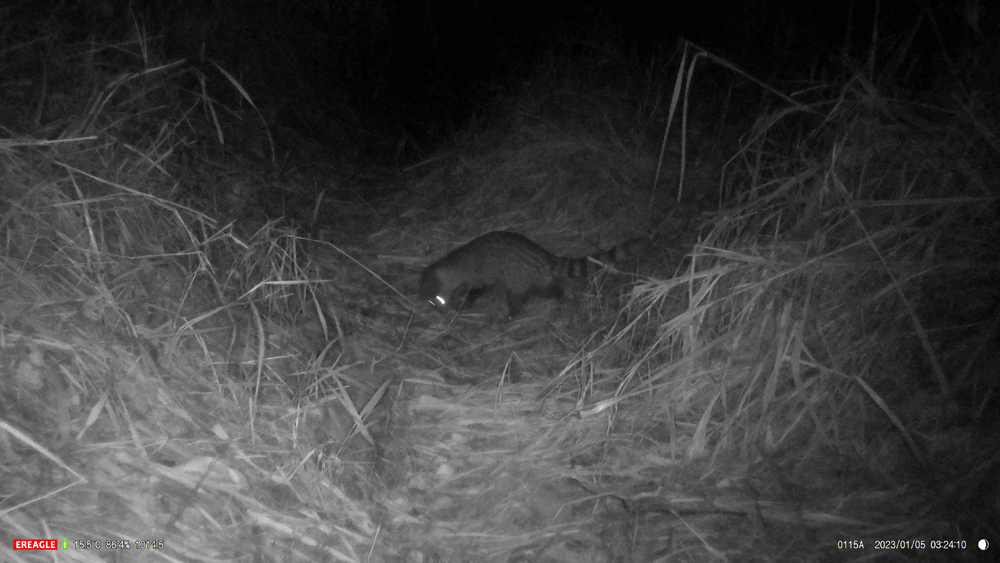
小灵猫(Viverricula indica)是国家一级重点保护野生动物, 有关该物种在我国的当前分布和栖息地生态学的资料非常有限, 不利于其保护管理策略的制定。2021年10月至2023年8月, 作者在海南大田国家级自然保护区通过红外相机技术监测调查了小灵猫的分布, 采用核密度函数和Vanderploeg & Scavia资源选择指数分析了小灵猫的活动节律和栖息地选择。本次调查在区内50个位点共布设了120台红外相机, 总相机工作日累计24,778天, 获得独立有效照片6,250张, 调查期间在13个位点获取了48次小灵猫独立有效探测, 证实小灵猫在该区域稳定存在。小灵猫的活动节律为典型的夜行性, 日活动曲线呈单峰分布, 活动高峰处于22:00前后。区内小灵猫对于人类活动在时间层面呈现明显回避(重叠系数∆ = 0.04), 与同域分布竞争物种豹猫(Prionailurus bengalensis)之间存在时间生态位上的分离(P < 0.001)。在栖息地选择上, 小灵猫偏好利用食物资源丰富的杧果(Mangifera indica)林、乔木郁闭度中等(50%-75%)、干扰强度中低的生境。本调查研究填补了海南岛小灵猫分布及生态信息方面的空缺, 为后续的深入研究提供了基础信息, 也为更多区域野生小灵猫的保护和管理提供了一定的科学依据。
张明军 , 王合升 , 颜文博 , 符运南 , 王琦 , 曾治高 . 海南大田国家级自然保护区小灵猫的活动节律与栖息地选择[J]. 生物多样性, 2024 , 32(6) : 23420 . DOI: 10.17520/biods.2023420
Aims: The small Indian civet (Viverricula indica) is a national first-class key protected wild animal in China. However, there is very little information about the current distribution and habitat ecology of this species in China. The aims of this study were to: (1) understand how the diel activity pattern of V. indica is affected by sympatric species and human activities; and (2) investigate habitat selection of V. indica in Hainan Datian National Nature Reserve.
Methods: From October 2021 to August 2023, the diel activity pattern and habitat selection of V. indica in the nature reserve were studied by camera trapping, with 120 camera traps placed at 50 sites. A non-parametric circular kernel-density method was adopted to analyze the diel activity patterns of V. indica, sympatric leopard cats (Prionailurus bengalensis), murine rodents, squirrels, and humans. We used the Mann-Whitney U test to compare differences in habitat characteristics between plots where V. indica were detected (number of plots N = 13) and those where they were not (N = 19). These habitat characteristics included the number of prey animals (murine rodents and squirrels), tree diameter at breast height, tree height, grass cover, distance to the nearest water source, and distance to the nearest road. Vanderploeg & Scavia’s resource selection index was used to select three discrete variables to model civets’ habitat preferences: vegetation types, tree canopy, and disturbance intensity.
Results: Our sampling effort totaled 24,778 camera days, during which we recorded 48 independent detections of V. indica from 13 sites, thus confirming that V. indica was stably distributed in the region. The diel activity pattern of the species was strictly nocturnal, with a nighttime activity peak around 22:00. The study suggested that the activities of V. indica didn’t align with human activity, with a very low temporal overlap index (∆ = 0.04) between them. Squirrels had similar activity rhythms to humans, which obviously differed from V. indica (∆ = 0.14). The activity time of V. indica and P. bengalensis overlapped greatly (∆ = 0.58), but their activity rhythms were significantly different (P < 0.001). Murine rodents were common prey of V. indica and P. bengalensis, with both predators displaying a large temporal overlap with murine rodents (V. indica: ∆ = 0.77; P. bengalensis: ∆ = 0.65). In terms of habitat selection, V. indica preferred Mangifera indica forests, which feature moderate levels of tree canopy (50% to 75%) as well as low to medium disturbance intensity. In addition, plots used by V. indica had significantly greater numbers of prey animals than unused plots (P < 0.001).
Conclusion: The diel activity pattern of V. indica was strictly nocturnal. They obviously avoided human activities, and their activity rhythms were significantly different from P. bengalensis. Viverricula indica preferred habitats with abundant food resources in Mangifera indica forests, featuring a moderate level of tree canopy and weak to moderate disturbance.
| [1] | Akrim F, Mahmood T, Belant JL, Nadeem MS, Qasim S, Dhendup T, Fatima H, Bukhari SA, Aslam A, Younis H, Rafique A, Subhani ZA, Hashmi SA, Munawar N (2023) Niche partitioning by sympatric civets in the Himalayan foothills of Pakistan. PeerJ, 11, e14741. |
| [2] | Chen LJ, Shu ZF, Xiao ZS (2019) Application of camera-trapping data to study daily activity patterns of Galliformes in Guangdong Chebaling National Nature Reserve. Biodiversity Science, 27, 266-272. (in Chinese with English abstract) |
| [陈立军, 束祖飞, 肖治术 (2019) 应用红外相机数据研究动物活动节律——以广东车八岭保护区鸡形目鸟类为例. 生物多样性, 27, 266-272.] | |
| [3] | Chen MT, Liang YJ, Kuo CC, Pei KJC (2016) Home ranges, movements and activity patterns of leopard cats (Prionailurus bengalensis) and threats to them in Taiwan. Mammal Study, 41, 77-86. |
| [4] | Chen MT, Tewes ME, Pei KJ, Grassman LI (2009) Activity patterns and habitat use of sympatric small carnivores in southern Taiwan. Mammalia, 73, 20-26. |
| [5] | Choudhury A, Duckworth JW, Timmins R, Chutipong W, Willcox DHA, Rahman H, Ghimirey Y, Mudappa D (2015) Viverricula indica. The IUCN Red List of Threatened Species 2015:e.T41710A45220632. http://dx.doi.org/10.2305/IUCN.UK.2015-4.RLTS.T41710A45220632.en. (accessed on 2024-01-12) |
| [6] | Fu ML (2023) Research on predation behavior of Python bivittatus in Hainan Datian National Nature Reserve. Chinese Journal of Wildlife, 44, 140-145. (in Chinese with English abstract) |
| [符明利 (2023) 海南大田国家级自然保护区蟒种群动态及进食研究. 野生动物学报, 44, 140-145.] | |
| [7] | Gao YT, Wang S, Zhang ML, Ye ZY, Zhou JD, Ma YQ, Li GH, Wu JY, Zheng YL, Guo FZ, Xu LH, Peng HS, Wang YX, Sheng HL, Li CZ, Fu YY, Wang SY, Yan K, Zhang YR, Niu Y, Liu DS (1987) Fauna Sinica?Mammalia (Vol. 8): Carnivora. Science Press, Beijing. (in Chinese) |
| [高耀亭, 汪松, 张曼丽, 叶宗耀, 周嘉樀, 马逸清, 李贵辉, 吴家炎, 郑永烈, 郭方正, 徐龙辉, 彭鸿绶, 王应祥, 盛和林, 李承忠, 傅毅远, 王申裕, 岩崑, 张彦荣, 牛勇, 刘大森 (1987) 中国动物志?兽纲(第八卷): 食肉目. 科学出版社, 北京.] | |
| [8] | Gaynor KM, Hojnowski CE, Carter NH, Brashares JS (2018) The influence of human disturbance on wildlife nocturnality. Science, 360, 1232-1235. |
| [9] | Gerber BD, Karpanty SM, Randrianantenaina J (2012) Activity patterns of carnivores in the rain forests of Madagascar: Implications for species coexistence. Journal of Mammalogy, 93, 667-676. |
| [10] | Hisano M, Newman C (2020) Adaptations to prey base in the hypercarnivorous leopard cat Prionailurus bengalensis. Ethology Ecology & Evolution, 32, 324-335. |
| [11] | Jiang ZG, Wu Y, Liu SY, Jiang XL, Zhou KY, Hu HJ (2021) China’s Red List of Biodiversity?Vertebrates (Vol. 1): Mammals (I). Science Press, Beijing. (in Chinese and in English) |
| [蒋志刚, 吴毅, 刘少英, 蒋学龙, 周开亚, 胡慧建 (2021) 中国生物多样性红色名录?脊椎动物(第一卷): 哺乳动物(上册). 科学出版社, 北京.] | |
| [12] | Kilgo JC, Ray HS, Vukovich M, Goode MJ, Ruth C (2012) Predation by coyotes on white-tailed deer neonates in South Carolina. The Journal of Wildlife Management, 76, 1420-1430. |
| [13] | Yan S Q, Peng J C, Wu Q. Exploring the non-linear effects of city size on urban industrial land use efficiency: A spatial econometric analysis of cities in eastern China[J]. Land Use Policy, 2020, DOI: 10.1016/j.landusepol.2020.104944. |
| [14] | Lau MWN, Fellowes JR, Chan BPL (2010) Carnivores (Mammalia: Carnivora) in South China: A status review with notes on the commercial trade. Mammal Review, 40, 247-292. |
| [15] | Li JL, Zhou TL, Huang X, Huang LH, Liu H (2019) Bird and mammal diversity in Wuzhishan National Nature Reserve, Hainan. Chinese Journal of Wildlife, 40, 924-932. (in Chinese with English abstract) |
| [李佳灵, 周铜磊, 黄翔, 黄良鸿, 刘辉 (2019) 海南五指山国家级自然保护区鸟兽多样性研究. 野生动物学报, 40, 924-932.] | |
| [16] | Li S, Wang DJ, Xiao ZS, Li XH, Wang TM, Feng LM, Wang Y (2014) Camera-trapping in wildlife research and conservation in China: Review and outlook. Biodiversity Science, 22, 685-695. (in Chinese with English abstract) |
| [李晟, 王大军, 肖治术, 李欣海, 王天明, 冯利民, 王云 (2014) 红外相机技术在我国野生动物研究与保护中的应用与前景. 生物多样性, 22, 685-695.] | |
| [17] | Li ZL, Duo LA, Li S, Wang TM (2021) Competition and coexistence among terrestrial mammalian carnivores. Biodiversity Science, 29, 81-97. (in Chinese with English abstract) |
| [李治霖, 多立安, 李晟, 王天明 (2021) 陆生食肉动物竞争与共存研究概述. 生物多样性, 29, 81-97.] | |
| [18] | Lin WM, Weng Y, A J, Wang M, Wang Q, Wang F (2023) Preliminary research on daily activity rhythm, habitat use and response to human activity of large Indian civet (Viverra zibetha) in Bayuelin Nature Reserve, Sichuan Province. Acta Theriologica Sinica, 43, 364-377. (in Chinese with English abstract) |
| [林炜明, 翁悦, 阿家, 王敏, 王琦, 王放 (2023) 四川八月林自然保护区大灵猫日活动节律、栖息地利用及其对人类活动响应的初步研究. 兽类学报, 43, 364-377.] | |
| [19] | Marneweck C, Butler AR, Gigliotti LC, Harris SN, Jensen AJ, Muthersbaugh M, Newman BA, Saldo EA, Shute K, Titus KL, Yu SW, Jachowski DS (2021) Shining the spotlight on small mammalian carnivores: Global status and threats. Biological Conservation, 255, 109005. |
| [20] | Meng JC, Yang XK, Feng YH, Qi XM, Liu H (2023) Diversity of companion mammals and birds based on infrared camera trapping in the forest canopy of Hainan gibbon range. Journal of Tropical Biology, 14, 289-297. (in Chinese with English abstract) |
| [蒙金超, 杨雪珂, 冯悦恒, 齐旭明, 刘辉 (2023) 基于红外相机技术的海南长臂猿分布区林冠层伴生鸟兽多样性的研究. 热带生物学报, 14, 289-297.] | |
| [21] | Meredith M, Ridout M (2014) Overlap: Estimates of coefficient of overlapping for animal activity patterns. https://CRAN.Rproject.org/package=overlap. (accessed on 2019-01-07) |
| [22] | Monterroso P, Díaz-Ruiz F, Lukacs PM, Alves PC, Ferreras P (2020) Ecological traits and the spatial structure of competitive coexistence among carnivores. Ecology, 101, e03059. |
| [23] | Nakashima Y, Sukor JA (2010) Importance of common palm civets (Paradoxurus hermaphroditus) as a long-distance disperser for large-seeded plants in degraded forests. Tropics, 18, 221-229. |
| [24] | O’Brien TG, Kinnaird MF, Wibisono HT (2003) Crouching tigers, hidden prey: Sumatran tiger and prey populations in a tropical forest landscape. Animal Conservation, 6, 131-139. |
| [25] | Pimsai U, Pearch M, Satasook C, Bumrungsri S, Bates P (2014) Murine rodents (Rodentia: Murinae) of the Myanmar- Thai-Malaysian Peninsula and Singapore: Taxonomy, distribution, ecology, conservation status, and illustrated identification keys. Bonn Zoological Bulletin, 63, 15-114. |
| [26] | Rabinowitz AR (1990) Notes on the behavior and movements of leopard cats, Felis bengalensis, in a dry tropical forest mosaic in Thailand. Biotropica, 22, 397-403. |
| [27] | Rabinowitz AR (1991) Behaviour and movements of sympatric civet species in Huai Kha Khaeng Wildlife Sanctuary, Thailand. Journal of Zoology, 223, 281-298. |
| [28] | Rich M, Thompson C, Prange S, Popescu VD (2018) Relative importance of habitat characteristics and interspecific relations in determining terrestrial carnivore occurrence. Frontiers in Ecology and Evolution, 6, 78. |
| [29] | Rowcliffe JM, Kays R, Kranstauber B, Carbone C, Jansen PA (2014) Quantifying levels of animal activity using camera trap data. Methods in Ecology and Evolution, 5, 1170-1179. |
| [30] | Saharia S, Saikia PK (2021) Ecology and status of lesser cats and other small carnivores in India. Biodiversity Journal, 12, 893-897. |
| [31] | San EDL, Sato JJ, Belant JL, Somers MJ (2022) The world’s small carnivores: Definitions, richness, distribution, conservation status, ecological roles, and research efforts. In: Small Carnivores: Evolution, Ecology, Behaviour, and Conservation (eds Do Linh San E, Sato JJ, Belant JL, Somers MJ), pp. 1-38. Wiley-Blackwell, New Jersey. |
| [32] | Sanghamithra D, Nameer PO (2021) The diel activity pattern of small carnivores of Western Ghats, India: A case study at Nelliampathies in Kerala, India. Journal of Threatened Taxa, 13, 19466-19474. |
| [33] | Selvan KM, Krishnakumar BM, Ramasamy P, Thinesh T (2019) Diel activity pattern of meso-carnivores in the suburban tropical dry evergreen forest of the coromandel coast, India. Journal of Threatened Taxa, 11, 13960-13966. |
| [34] | Shou ZH, Wang S, Lu CK, Zhang LG (1966) Investigation of mammals in Hainan Island. Acta Zootaxonomica Sinica, 3, 260-276. (in Chinese) |
| [寿振黄, 汪松, 陆长坤, 张銮光 (1966) 海南岛的兽类调查. 动物分类学报, 3, 260-276.] | |
| [35] | Su S, Sale J (2007) Niche differentiation between common palm civet Paradoxurus hermaphroditus and small Indian civet Viverricula indica in regenerating degraded forest, Myanmar. Small Carnivore Conservation, 36, 30-34. |
| [36] | Teng LW, Liu ZS, Song YL, Zeng ZG (2004) Forage and bed sites characteristics of Indian muntjac (Muntiacus muntjak) in Hainan Island, China. Ecological Research, 19, 675-681. |
| [37] | Wang H, Fuller T (1993) Notes on the ecology of sympatric small carnivores in southeastern China. Mammalian Biology, 66, 251-255. |
| [38] | Wang WY, Jiang HS, Wang CD, Li SY (2002) Investigation and evaluation of wildlife resources in Datian National Nature Reserve, Hainan. Tropical Forestry, 30, 37-40. (in Chinese with English abstract) |
| [王文毅, 江海声, 王春东, 李善元 (2002) 海南大田国家级自然保护区野生动物资源调查及评价. 热带林业, 30, 37-40.] | |
| [39] | Wang YH, Zhao QQ, Diao YX, Gu BJ, Weng Y, Zhang ZJ, Chen YB, Wang F (2023) Diel activity, habitat utilization, and response to anthropogenic interference of small Indian civets (Viverricula indica) in Shanghai urban areas based on camera-trapping. Biodiversity Science, 31, 22294. (in Chinese with English abstract) |
| [王怡涵, 赵倩倩, 刁奕欣, 顾伯健, 翁悦, 张卓锦, 陈泳滨, 王放 (2023) 基于红外相机调查上海市区小灵猫的活动节律、栖息地利用及其对人类活动的响应. 生物多样性, 31, 22294.] | |
| [40] | Watanabe S (2009) Factors affecting the distribution of the leopard cat Prionailurus bengalensis on east Asian islands. Mammal Study, 34, 201-207. |
| [41] | Wei FW, Yang QS, Wu Y (2022) Taxonomy and Distribution of Mammals in China. Science Press, Beijing. (in Chinese) |
| [魏辅文, 杨奇森, 吴毅 (2022) 中国兽类分类与分布. 科学出版社, 北京.] | |
| [42] | Wells K, Kalko EKV, Lakim MB, Pfeiffer M (2007) Effects of rain forest logging on species richness and assemblage composition of small mammals in Southeast Asia. Journal of Biogeography, 34, 1087-1099. |
| [43] | Xu LH (1981) The relationship between the development of natural resources and the evolution of mammals in Hainan Island. Tropical Geography, 1, 44-47. (in Chinese) |
| [徐龙辉 (1981) 海南岛自然资源的开发与兽类演变的关系. 热带地理, 1, 44-47.] | |
| [44] | Xu LH, Liu ZH, Liao WP, Li XH, Yu SM, Qiu JC, Zhou YY, Deng JX, Guan GX, Lu JZ, Yan K (1983) Birds and Mammals in Hainan Island. Science Press, Beijing. (in Chinese) |
| [徐龙辉, 刘振河, 廖维平, 李小惠, 余斯绵, 丘金昌, 周宇垣, 邓巨燮, 关贯勋, 卢济珍, 岩崑 (1983) 海南岛的鸟兽. 科学出版社, 北京.] | |
| [45] | Zeng YJ, Xu JL, Cui GF, Li JW (2010) Study on the impact of human activities on large mammals in Hainan Island and related protection strategies. Sichuan Journal of Zoology, 29, 550-555. (in Chinese with English abstract) |
| [曾娅杰, 徐基良, 崔国发, 李景文 (2010) 人类活动对海南岛大型兽类资源的影响及保护对策研究. 四川动物, 29, 550-555.] | |
| [46] | Zhou XY, Jiao HW, Dou YS, Aryal A, Hu J, Hu JC, Meng XX (2013) The winter habitat selection of red panda (Ailurus fulgens) in the Meigu Dafengding National Nature Reserve, China. Current Science, 105, 1425-1429. |
/
| 〈 |
|
〉 |
备案号:京ICP备16067583号-7
Copyright © 2026 版权所有 《生物多样性》编辑部
地址: 北京香山南辛村20号, 邮编:100093
电话: 010-62836137, 62836665 E-mail: biodiversity@ibcas.ac.cn