生态网络分析: 从集合群落到集合网络
收稿日期: 2023-05-26
录用日期: 2023-08-19
网络出版日期: 2023-08-27
基金资助
国家自然科学基金(32171527);国家自然科学基金(31770463)
Ecological network analysis: From metacommunity to metanetwork
Received date: 2023-05-26
Accepted date: 2023-08-19
Online published: 2023-08-27
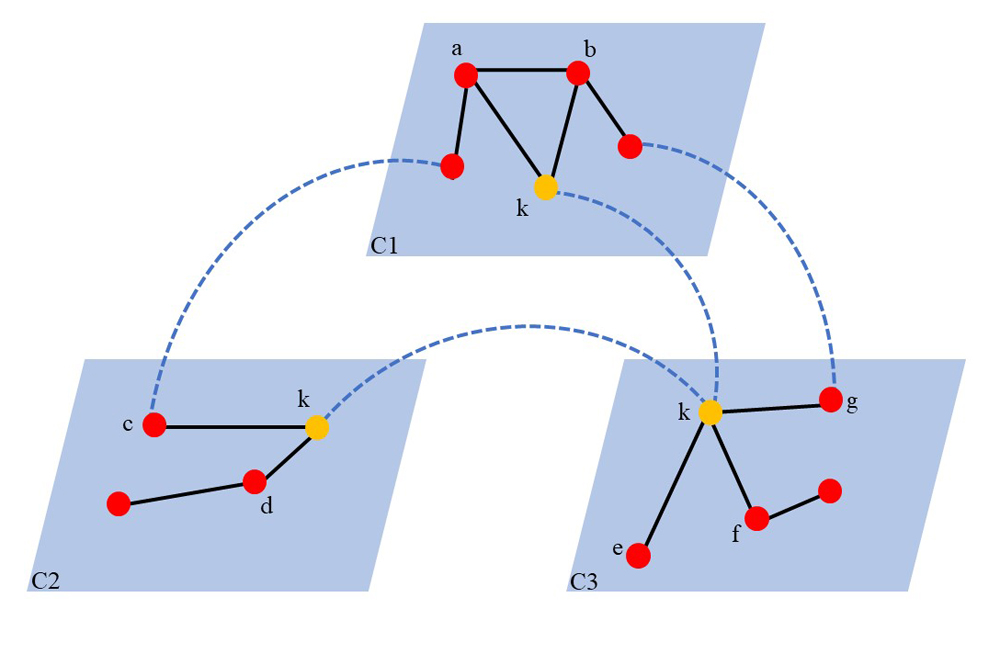
在景观尺度上, 沿不同环境梯度分布着多个局域群落, 这些局域群落通过物种扩散相联系, 形成了集合群落(metacommunity)。当同时考虑集合群落的物种组成和种间互作时, 出现了集合网络(metanetwork)的概念。近年来, 基于集合网络的概念, 运用网络分析的方法描述物种互作在多个群落中的分布和动态成为生态网络研究的新趋势。在网络分析中, 研究的尺度及对应于不同数据类型的众多网络指标及其统计推断思路常常让研究者感到困惑。本文首先对网络指标进行了归类整理, 将其划分为全局网络指标和局域网络指标, 解释了网络指标的应用场景、计算过程和生态学意义, 讨论了采样强度对网络指标的影响以及指标之间的相关性; 介绍了基于互作多样性的网络β多样性指标。随后, 梳理了网络分析中基于单一网络指标和网络β多样性指标的统计推断思路。在此基础上, 总结了近年来从集合群落到集合网络的研究趋势的演变。我们对网络分析面临的问题进行了总结并对未来的研究方向进行了展望。强调在研究性论文中应该考虑物种系统发育关系对网络组成和互作的影响。多层网络能从更广泛的物种互作尺度反映群落结构, 揭示更加全面的群落动态。集合网络的分析思路应保持一致, 以利于在不同研究之间进行比较。
冯志荣 , 陈有城 , 彭艳琼 , 李莉 , 王波 . 生态网络分析: 从集合群落到集合网络[J]. 生物多样性, 2023 , 31(8) : 23171 . DOI: 10.17520/biods.2023171
Background & Aims: At the landscape scale, multiple local communities are distributed along environmental gradients, and these local communities are interconnected through species dispersal, together forming metacommunity. When considering both the species composition and interspecific interactions of metacommunity, the concept of metanetwork emerges. With methods in network analysis, metanetwork illustrate the distribution of species interactions across multiple communities. The research scale and numerous network metrics corresponding to different data types often confuse researchers.
Progress: We begin by categorizing and organizing network metrics, and then proceed to differentiate between global and local network metrics. This provides explanations for their application scenarios, computation processes, and ecological significance, while also discussing the impact of sampling intensity on these metrics and exploring their relationships. We introduce the network β-diversity metrics that are computed based on interaction diversity. Subsequently, we outline the statistical inference approaches used in network analysis, incorporating both individual network metrics and network β-diversity metrics. Finally, we provide a summary of the recent research trends, which has shifted from metacommunity to metanetwork.
Prospects: We stress the significance of taking into account the influence of phylogenetic relationships on network composition and interactions in research papers. Multilayer networks offer the capability to represent community structures at a wider scale of species interactions, thus revealing more comprehensive community dynamics. Consistency in the analytical approach of metanetworks is vital for facilitating comparisons across diverse studies.
| [1] | Almeida-Neto M, Guimar?es P, Guimar?es PR Jr, Loyola RD, Ulrich W (2008) A consistent metric for nestedness analysis in ecological systems: Reconciling concept and measurement. Oikos, 117, 1227-1239. |
| [2] | Almeida-Neto M, Ulrich W (2011) A straightforward computational approach for measuring nestedness using quantitative matrices. Environmental Modelling & Software, 26, 173-178. |
| [3] | Bascompte J (2009) Mutualistic networks. Frontiers in Ecology and the Environment, 7, 429-436. |
| [4] | Bastazini VAG, Ferreira PMA, Azambuja BO, Casas G, Debastiani VJ, Guimar?es PR Jr, Pillar VD (2017) Untangling the tangled bank: A novel method for partitioning the effects of phylogenies and traits on ecological networks. Evolutionary Biology, 44, 312-324. |
| [5] | Belyea LR, Lancaster J (1999) Assembly rules within a contingent ecology. Oikos, 86, 402-416. |
| [6] | Blanchet FG, Cazelles K, Gravel D (2020) Co-occurrence is not evidence of ecological interactions. Ecology Letters, 23, 1050-1063. |
| [7] | Blasco-Costa I, Hayward A, Poulin R, Balbuena JA (2021) Next-generation cophylogeny: Unravelling eco-evolutionary processes. Trends in Ecology & Evolution, 36, 907-918. |
| [8] | Blüthgen N, Menzel F, Blüthgen N (2006) Measuring specialization in species interaction networks. BMC Ecology, 6, 9. |
| [9] | Burkle LA, Alarcón R (2011) The future of plant-pollinator diversity: Understanding interaction networks across time, space, and global change. American Journal of Botany, 98, 528-538. |
| [10] | Burkle LA, Myers JA, Belote RT (2016) The beta-diversity of species interactions: Untangling the drivers of geographic variation in plant-pollinator diversity and function across scales. American Journal of Botany, 103, 118-128. |
| [11] | Carstensen DW, Sabatino M, Tr?jelsgaard K, Morellato LPC (2014) Beta diversity of plant-pollinator networks and the spatial turnover of pairwise interactions. PLoS ONE, 9, e112903. |
| [12] | Casas G, Bastazini VAG, Debastiani VJ, Pillar VD (2018) Assessing sampling sufficiency of network metrics using bootstrap. Ecological Complexity, 36, 268-275. |
| [13] | Chacoff NP, Vázquez DP, Lomáscolo SB, Stevani EL, Dorado J, Padrón B (2012) Evaluating sampling completeness in a desert plant-pollinator network. Journal of Animal Ecology, 81, 190-200. |
| [14] | Chase JM, Leibold MA (2002) Spatial scale dictates the productivity-biodiversity relationship. Nature, 416, 427-430. |
| [15] | Chesshire PR, McCabe LM, Cobb NS (2021) Variation in plant-pollinator network structure along the elevational gradient of the San Francisco Peaks, Arizona. Insects, 12, 1060. |
| [16] | Classen A, Eardley CD, Hemp A, Peters MK, Peters RS, Ssymank A, Steffan-Dewenter I (2020) Specialization of plant-pollinator interactions increases with temperature at Mt. Kilimanjaro. Ecology and Evolution, 10, 2182-2195. |
| [17] | Dáttilo W, Vasconcelos HL (2019) Macroecological patterns and correlates of ant-tree interaction networks in Neotropical savannas. Global Ecology and Biogeography, 28, 1283-1294. |
| [18] | Dormann CF, Fründ J, Blüthgen N, Gruber B (2009) Indices, graphs and null models: Analyzing bipartite ecological networks. The Open Ecology Journal, 2, 7-24. |
| [19] | Dormann CF, Gruber B, Fründ J (2008) Introducing the bipartite package: Analysing ecological networks. R News, 8, 8-11. |
| [20] | Emer C, Galetti M, Pizo MA, Guimar?es PR Jr, Moraes S, Piratelli A, Jordano P (2018) Seed-dispersal interactions in fragmented landscapes—A metanetwork approach. Ecology Letters, 21, 484-493. |
| [21] | Fang Q, Huang SQ (2013) A directed network analysis of heterospecific pollen transfer in a biodiverse community. Ecology, 94, 1176-1185. |
| [22] | Freilich MA, Wieters E, Broitman BR, Marquet PA, Navarrete SA (2018) Species co-occurrence networks: Can they reveal trophic and non-trophic interactions in ecological communities? Ecology, 99, 690-699. |
| [23] | Fricke EC, Svenning JC (2020) Accelerating homogenization of the global plant-frugivore meta-network. Nature, 585, 74-78. |
| [24] | Fründ J, McCann KS, Williams NM (2016) Sampling bias is a challenge for quantifying specialization and network structure: Lessons from a quantitative niche model. Oikos, 125, 502-513. |
| [25] | Gallinat AS, Pearse WD (2021) Phylogenetic generalized linear mixed modeling presents novel opportunities for eco-evolutionary synthesis. Oikos, 130, 669-679. |
| [26] | Guimar?es PR Jr (2020) The structure of ecological networks across levels of organization. Annual Review of Ecology, Evolution, and Systematics, 51, 433-460. |
| [27] | Hall MA, Stavert JR, Saunders ME, Barr S, Haberle SG, Rader R (2022) Pollen-insect interaction meta-networks identify key relationships for conservation in mosaic agricultural landscapes. Ecological Applications, 32, e2537. |
| [28] | Henriksen MV, Chapple DG, Chown SL, McGeoch MA (2019) The effect of network size and sampling completeness in depauperate networks. Journal of Animal Ecology, 88, 211-222. |
| [29] | Huang SQ (2007) Studies on plant-pollinator interaction and its significances. Biodiversity Science, 15, 569-575. (in Chinese with English abstract) |
| [29] | [ 黄双全 (2007) 植物与传粉者相互作用的研究及其意义. 生物多样性, 15, 569-575.] |
| [30] | Huang SQ (2018) A better understanding of ecological networks needs studying plant-pollinator interactions. Biodiversity Science, 26, 429-432. (in Chinese with English abstract) |
| [30] | [ 黄双全 (2018) 了解生态网络需要监测植物与传粉者的相互作用. 生物多样性, 26, 429-432.] |
| [31] | Ibanez S, Arène F, Lavergne S (2016) How phylogeny shapes the taxonomic and functional structure of plant-insect networks. Oecologia, 180, 989-1000. |
| [32] | Krebs CJ (1999) Ecological Methodology, 2nd edn. Addison-Wesley Educational Publishers, Menlo Park, CA. |
| [33] | Lara-Romero C, Seguí J, Pérez-Delgado A, Nogales M, Traveset A (2019) Beta diversity and specialization in plant-pollinator networks along an elevational gradient. Journal of Biogeography, 46, 1598-1610. |
| [34] | Leibold MA, Holyoak M, Mouquet N, Amarasekare P, Chase JM, Hoopes MF, Holt RD, Shurin JB, Law R, Tilman D, Loreau M, Gonzalez A (2004) The metacommunity concept: A framework for multi-scale community ecology. Ecology Letters, 7, 601-613. |
| [35] | Li HD, Tang LF, Jia CX, Holyoak M, Fründ J, Huang XQ, Xiao ZS (2020) The functional roles of species in metacommunities, as revealed by metanetwork analyses of bird-plant frugivory networks. Ecology Letters, 23, 1252-1262. |
| [36] | Li HD, Wu XW, Xiao ZS (2021) Assembly, ecosystem functions, and stability in species interaction networks. Chinese Journal of Plant Ecology, 45, 1049-1063. (in Chinese with English abstract) |
| [36] | [ 李海东, 吴新卫, 肖治术 (2021) 种间互作网络的结构、生态系统功能及稳定性机制研究. 植物生态学报, 45, 1049-1063.] |
| [37] | Librán-Embid F, Grass I, Emer C, Ganuza C, Tscharntke T (2021) A plant-pollinator metanetwork along a habitat fragmentation gradient. Ecology Letters, 24, 2700-2712. |
| [38] | Liu CR, Ma KP, Chen LZ (2002) Nestedness: Methods mechanisms and implications for biological conservation. Acta Phytoecologica Sinica, 26, 68-72. (in Chinese with English abstract) |
| [38] | [ 刘灿然, 马克平, 陈灵芝 (2002) 嵌套性: 研究方法、形成机制及其对生物保护的意义. 植物生态学报, 26, 68-72.] |
| [39] | Llopis-Belenguer C, Balbuena JA, Blasco-Costa I, Karvonen A, Sarabeev V, Jokela J (2023) Sensitivity of bipartite network analyses to incomplete sampling and taxonomic uncertainty. Ecology, 104, e3974. |
| [40] | Marini L, Bartomeus I, Rader R, Lami F (2019) Species- habitat networks: A tool to improve landscape management for conservation. Journal of Applied Ecology, 56, 923-928. |
| [41] | McCann K, Hastings A, Huxel GR (1998) Weak trophic interactions and the balance of nature. Nature, 395, 794-798. |
| [42] | Minachilis K, Kantsa A, Devalez J, Trigas P, Tscheulin T, Petanidou T (2020) Bumblebee diversity and pollination networks along the elevation gradient of Mount Olympus, Greece. Diversity and Distributions, 26, 1566-1581. |
| [43] | Nielsen A, Bascompte J (2007) Ecological networks, nestedness and sampling effort. Journal of Ecology, 95, 1134-1141. |
| [44] | Ohlmann M, Miele V, Dray S, Chalmandrier L, O’Connor L, Thuiller W (2019) Diversity indices for ecological networks: A unifying framework using Hill numbers. Ecology Letters, 22, 737-747. |
| [45] | Oliveira HFM, Pinheiro RBP, Varassin IG, Rodríguez-Herrera B, Kuzmina M, Rossiter SJ, Clare EL (2022) The structure of tropical bat-plant interaction networks during an extreme El Ni?o-Southern Oscillation event. Molecular Ecology, 31, 1892-1906. |
| [46] | Pascual M, Dunne JA (2005) Ecological Networks:Linking Structure to Dynamics in Food Webs. Oxford University Press, New York. |
| [47] | Peralta G (2016) Merging evolutionary history into species interaction networks. Functional Ecology, 30, 1917-1925. |
| [48] | Pichler M, Boreux V, Klein AM, Schleuning M, Hartig F (2020) Machine learning algorithms to infer trait-matching and predict species interactions in ecological networks. Methods in Ecology and Evolution, 11, 281-293. |
| [49] | Pilosof S, Porter MA, Pascual M, Kéfi S (2017) The multilayer nature of ecological networks. Nature Ecology & Evolution, 1, 101. |
| [50] | Poisot T, Canard E, Mouillot D, Mouquet N, Gravel D (2012) The dissimilarity of species interaction networks. Ecology Letters, 15, 1353-1361. |
| [51] | Ponisio LC, Valdovinos FS, Allhoff KT, Gaiarsa MP, Barner A, Guimar?es PR Jr, Hembry DH, Morrison B, Gillespie R (2019) A network perspective for community assembly. Frontiers in Ecology and Evolution, 7, 103. |
| [52] | Proulx SR, Promislow DEL, Phillips PC (2005) Network thinking in ecology and evolution. Trends in Ecology & Evolution, 20, 345-353. |
| [53] | Pulliam HR (1988) Sources, sinks, and population regulation. The American Naturalist, 132, 652-661. |
| [54] | Rafferty NE, Ives AR (2013) Phylogenetic trait-based analyses of ecological networks. Ecology, 94, 2321-2333. |
| [55] | Ramos-Jiliberto R, Domínguez D, Espinoza C, López G, Valdovinos FS, Bustamante RO, Medel R (2010) Topological change of Andean plant-pollinator networks along an altitudinal gradient. Ecological Complexity, 7, 86-90. |
| [56] | Rivera-Hutinel A, Bustamante RO, Marín VH, Medel R (2012) Effects of sampling completeness on the structure of plant-pollinator networks. Ecology, 93, 1593-1603. |
| [57] | Runghen R, Poulin R, Monlleó-Borrull C, Llopis-Belenguer C (2021) Network analysis: Ten years shining light on host- parasite interactions. Trends in Parasitology, 37, 445-455. |
| [58] | Saavedra S, Reed-Tsochas F, Uzzi B (2009) A simple model of bipartite cooperation for ecological and organizational networks. Nature, 457, 463-466. |
| [59] | Schleuning M, Ingmann L, Strau? R, Fritz SA, Dalsgaard B, Matthias Dehling D, Plein M, Saavedra F, Sandel B, Svenning JC, B?hning-Gaese K, Dormann CF (2014) Ecological, historical and evolutionary determinants of modularity in weighted seed-dispersal networks. Ecology Letters, 17, 454-463. |
| [60] | Shmida A, Wilson MV (1985) Biological determinants of species diversity. Journal of Biogeography, 12, 1-20. |
| [61] | Sun S, Zhang ZQ, Zhang B, Yang YP (2012) Perspectives on plant-pollinator interactions from the evolution of cooperation. Biodiversity Science, 20, 250-263. (in Chinese with English abstract) |
| [61] | [ 孙杉, 张志强, 张勃, 杨永平 (2012) 从合作的进化探讨植物与传粉者的相互作用. 生物多样性, 20, 250-263.] |
| [62] | Thompson PL, Gonzalez A (2017) Dispersal governs the reorganization of ecological networks under environmental change. Nature Ecology & Evolution, 1, 162. |
| [63] | Tylianakis JM, Didham RK, Bascompte J, Wardle DA (2008) Global change and species interactions in terrestrial ecosystems. Ecology Letters, 11, 1351-1363. |
| [64] | Tylianakis JM, Morris RJ (2017) Ecological networks across environmental gradients. Annual Review of Ecology, Evolution, and Systematics, 48, 25-48. |
| [65] | Ulrich W, Gotelli NJ (2007) Disentangling community patterns of nestedness and species co-occurrence. Oikos, 116, 2053-2061. |
| [66] | Wang B, Ma LB, Pan B, Dong YY, Huang JF, Peng YQ (2022) Spatial variation in ant-tree bipartite networks is driven by a bottom-up process. Ecological Entomology, 47, 1011-1021. |
| [67] | Wang J, Dong YY, Ma LB, Pan B, Ma FZ, Ding H, Hu YP, Peng YQ, Wu XB, Wang B (2020) Spatial variation in ant-tree network organization in the Xishuangbanna National Nature Reserve. Biodiversity Science, 28, 695-706. (in Chinese with English abstract) |
| [67] | [ 王剑, 董乙乂, 马丽滨, 潘勃, 马方舟, 丁晖, 胡亚萍, 彭艳琼, 吴孝兵, 王波 (2020) 西双版纳国家级自然保护区蚂蚁-树互作网络空间变异. 生物多样性, 28, 695-706.] |
| [68] | White CD, Collier MJ, Stout JC (2022) Anthropogenic induced beta diversity in plant-pollinator networks: Dissimilarity, turnover, and predictive power. Frontiers in Ecology and Evolution, 10, 806615. |
| [69] | Wilson DS (1992) Complex interactions in metacommunities, with implications for biodiversity and higher levels of selection. Ecology, 73, 1984-2000. |
| [70] | Xiao YA, Zhang SS, Yan XH, Dong M (2015) New advances in effects of global warming on plant-pollinator networks. Acta Ecologica Sinica, 35, 3871-3880. (in Chinese with English abstract) |
| [70] | [ 肖宜安, 张斯斯, 闫小红, 董鸣 (2015) 全球气候变暖影响植物-传粉者网络的研究进展. 生态学报, 35, 3871-3880.] |
/
| 〈 |
|
〉 |
备案号:京ICP备16067583号-7
Copyright © 2026 版权所有 《生物多样性》编辑部
地址: 北京香山南辛村20号, 邮编:100093
电话: 010-62836137, 62836665 E-mail: biodiversity@ibcas.ac.cn