
三江源国家级自然保护区内云塔村雪豹种群动态
收稿日期: 2022-04-01
录用日期: 2022-09-19
网络出版日期: 2022-09-26
基金资助
科技部重点研发项目(2022YFF1301500);华泰证券“一个长江”项目;字节跳动公益和阿拉善SEE三江源项目
Population dynamic of snow leopard (Panthera uncia) in Yunta Village, Sanjiangyuan National Nature Reserve, China
Received date: 2022-04-01
Accepted date: 2022-09-19
Online published: 2022-09-26
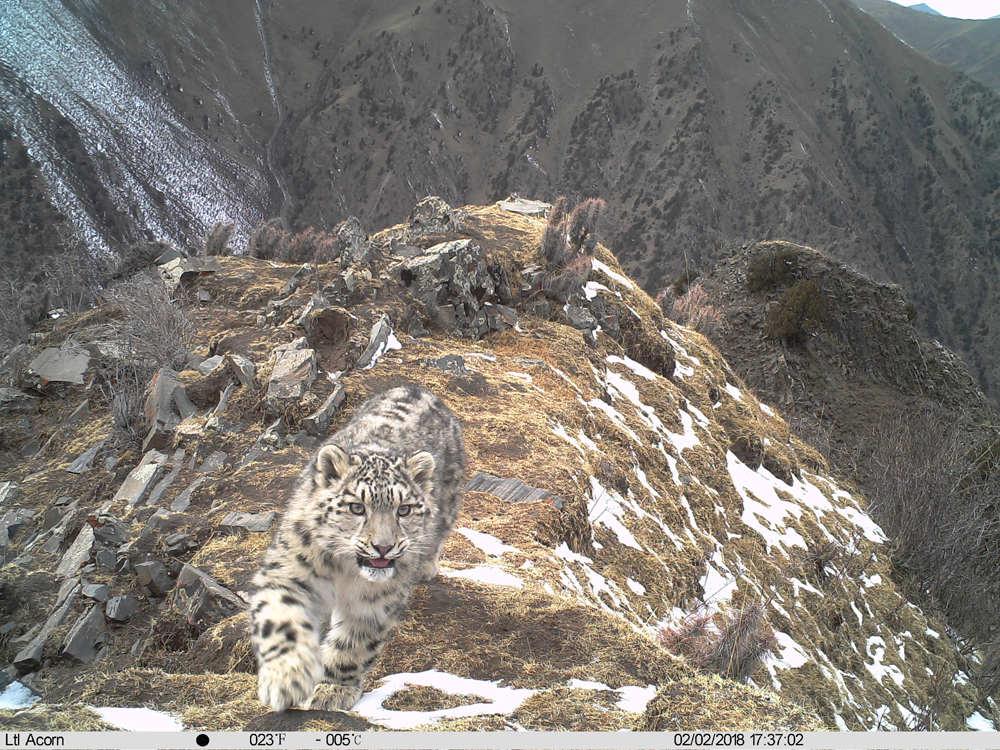
种群监测可为物种研究和保护提供关键信息和依据。雪豹(Panthera uncia)作为亚洲高山生态系统的顶级捕食者和旗舰种, 一直是研究和保护的重点, 但其难以到达的栖息地、隐秘的行踪和广阔的家域使其监测工作开展难度较大, 雪豹种群动态研究较为匮乏。本研究在2013年10月至2019年1月期间, 使用当地社区维护的红外相机, 监测三江源国家级自然保护区通天河沿保护分区内青海省玉树州哈秀乡云塔村雪豹种群的密度和动态, 共识别出35只雪豹个体。基于数据质量较好的2015、2016、2017年连续3年的红外相机数据各年截取3个月数据, 使用空间标记-重捕模型估算种群数量和密度, 发现当地雪豹种群和成年个体密度基本维持稳定, 种群增长率为1.02, 但监测期间雪豹个体更替明显, 平均个体更替率为0.44, 并且围绕两片雪豹核心利用区域发生了领域取代。推测雪豹种群具有较多个体更替和领域取代是因为种群处在雪豹潜在扩散通道上, 或调查范围未覆盖完整种群。本研究是国内首次对雪豹进行较为长期的种群动态监测和分析, 研究结果体现了动态监测的重要性, 也显示出以当地社区为主体监测哺乳动物种群的可能性。
初漠嫣 , 梁书洁 , 李沛芸 , 贾丁 , 阿卜杜赛麦提·买尔迪亚力 , 李雪阳 , 姜楠 , 赵翔 , 李发祥 , 肖凌云 , 吕植 . 三江源国家级自然保护区内云塔村雪豹种群动态[J]. 生物多样性, 2022 , 30(9) : 22157 . DOI: 10.17520/biods.2022157
Aims: Wildlife population monitoring projects provide important insight and basis for species research and conservation efforts. The snow leopard (Panthera uncia), as the top predator and flagship species of Asian mountainous ecosystems, is of great scientific and conservation interest. However, due to its remote habitat, elusive behavior and large home ranges, long-term population monitoring study on snow leopards is rarely reported. Here we report a long-term population monitoring project of snow leopards in Sanjiangyuan National Nature Reserve (Yunta Village, Haxiu Township, Yushu Prefecture, Qinghai Province) from Oct. 2013 to Jan. 2019.
Methods: We monitored the population using infrared cameras maintained by the local community. We estimated population size and density as well as population growth rate using spatially explicit capture-recapture model (SECR). We calculated population turnover rates and analyzed territory replacement.
Results: In total, we identified 35 snow leopard individuals. From SECR, population estimation based on 3-month high-quality data for three consecutive years (2015-2017) suggested stable population dynamic with a growth rate of 1.02. However, individual turnover was obvious with a rate of 0.44, and territory displacement happened around core utilization area of snow leopards. We proposed that the snow leopard population might locate on a potential dispersal pathway of snow leopards, or the camera array only covered a fraction of the population.
Conclusion: As the first long-term population monitoring project of snow leopards reported in China, our work highlights the importance of long-term monitoring, and demonstrates the feasibility of mammal population monitoring maintained by local communities.
| [1] | Alexander JS, Cusack JJ, Chen PJ, Shi K, Riordan P (2016a) Conservation of snow leopards: Spill-over benefits for other carnivores? Oryx, 50, 239-243. |
| [2] | Alexander JS, Gopalaswamy AM, Shi K, Riordan P (2015) Face value: Towards robust estimates of snow leopard densities. PLoS ONE, 10, e0134815. |
| [3] | Alexander JS, Zhang CC, Shi K, Riordan P (2016b) A granular view of a snow leopard population using camera traps in Central China. Biological Conservation, 197, 27-31. |
| [4] | Borchers D (2012) A non-technical overview of spatially explicit capture-recapture models. Journal of Ornithology, 152, 435-444. |
| [5] | Borchers DL, Efford MG (2008) Spatially explicit maximum likelihood methods for capture-recapture studies. Biometrics, 64, 377-385. |
| [6] | Estes JA, Terborgh J, Brashares JS, Power ME, Berger J, Bond WJ, Carpenter SR, Essington TE, Holt RD, Jackson JB, Marquis RJ, Oksanen L, Oksanen T, Paine RT, Pikitch EK, Ripple WJ, Sandin SA, Scheffer M, Schoener TW, Shurin JB, Sinclair AR, Soulé ME, Virtanen R, Wardle DA (2011) Trophic downgrading of planet earth. Science, 333, 301-306. |
| [7] | Harmsen BJ, Foster RJ, Quigley H (2020) Spatially explicit capture recapture density estimates: Robustness, accuracy and precision in a long-term study of jaguars (Panthera onca). PLoS ONE, 15, e0227468. |
| [8] | Jackson RM (1996) Home Range, Movements and Habitat Use of Snow Leopard (Uncia uncia) in Nepal. PhD dissertation, University of London, London. |
| [9] | Jackson RM, Roe JD, Wangchuk R, Hunter DO (2006) Estimating snow leopard population abundance using photography and capture-recapture techniques. Wildlife Society Bulletin, 34, 772-781. |
| [10] | Janečka JE, Munkhtsog B, Jackson RM, Naranbaatar G, Mallon DP, Murphy WJ (2011) Comparison of noninvasive genetic and camera-trapping techniques for surveying snow leopards. Journal of Mammalogy, 92, 771-783. |
| [11] | Jia D, Li PY, Zhao X, Cheng C, Xiao LY, Lü Z (2020) Overview of Sanjiangyuan community-based camera- trapping monitoring platform. Biodiversity Science, 28, 1104-1109. (in Chinese with English abstract) |
| [11] | [贾丁, 李沛芸, 赵翔, 程琛, 肖凌云, 吕植 (2020) 三江源红外相机社区监测平台概述. 生物多样性, 28, 1104-1109.] |
| [12] | Johansson Ö, Ausilio G, Low M, Lkhagvajav P, Weckworth B, Sharma K (2021) The timing of breeding and independence for snow leopard females and their cubs. Mammalian Biology, 101, 173-180. |
| [13] | Johansson Ö, Samelius G, Wikberg E, Chapron G, Mishra C, Low M (2020) Identification errors in camera-trap studies result in systematic population overestimation. Scientific Reports, 10, 6393. |
| [14] | Li J (2012) Ecology and Conservation Strategy of Snow Leopard (Panthera uncia) in Sanjiangyuan Area on the Tibetan Plateau. PhD dissertation, Peking University, Beijing. (in Chinese with English abstract) |
| [14] | [李娟 (2012) 青藏高原三江源地区雪豹(Panthera uncia)的生态学研究及保护. 博士学位论文, 北京大学, 北京.] |
| [15] | McCarthy KP, Fuller TK, Ming M, McCarthy TM, Waits L, Jumabaev K (2008) Assessing estimators of snow leopard abundance. Journal of Wildlife Management, 72, 1826-1833. |
| [16] | McCarthy T, Mallon D, Jackson R, Zahler P, McCarthy K (2017) Panthera uncia. The IUCN Red List of Threatened Species 2017. https://www.iucnredlist.org/species/22732/50664030. (accessed on 2022-01-19) |
| [17] | Miller DJ (2000) Tough times for Tibetan nomads in Western China: Snowstorms, settling down, fences and the demise of traditional nomadic pastoralism. Nomadic Peoples, 4, 83-109. |
| [18] | Prugh LR, Stoner CJ, Epps CW, Bean WT, Ripple WJ, Laliberte AS, Brashares JS (2009) The rise of the mesopredator. BioScience, 59, 779-791. |
| [19] | Ripple WJ, Estes JA, Beschta RL, Wilmers CC, Ritchie EG, Hebblewhite M, Berger J, Elmhagen B, Letnic M, Nelson MP, Schmitz OJ, Smith DW, Wallach AD, Wirsing AJ (2014) Status and ecological effects of the world’s largest carnivores. Science, 343, 1241484. |
| [20] | Rode J, Lambert C, Marescot L, Chaix B, Beesau J, Bastian S, Kyrbashev J, Cabanat AL (2021) Population monitoring of snow leopards using camera trapping in Naryn State Nature Reserve, Kyrgyzstan, between 2016 and 2019. Global Ecology and Conservation, 31, e01850. |
| [21] | Royle JA, Karanth KU, Gopalaswamy AM, Kumar NS (2009) Bayesian inference in camera trapping studies for a class of spatial capture-recapture models. Ecology, 90, 3233-3244. |
| [22] | Sharma K, Bayrakcismith R, Tumursukh L, Johansson O, Sevger P, McCarthy T, Mishra C (2014) Vigorous dynamics underlie a stable population of the endangered snow leopard Panthera uncia in Tost Mountains, South Gobi, Mongolia. PLoS ONE, 9, e101319. |
| [23] | Sharma RK, Bhatnagar YV, Mishra C (2015) Does livestock benefit or harm snow leopards? Biological Conservation, 190, 8-13. |
| [24] | Sharma RK, Sharma K, Borchers D, Bhatnagar YV, Suryawanshi KR, Mishra C (2021) Spatial variation in population-density of snow leopards in a multiple use landscape in Spiti Valley, Trans-Himalaya. PLoS ONE, 16, e0250900. |
| [25] | Sollmann R, Gardner B, Belant JL (2012) How does spatial study design influence density estimates from spatial capture-recapture models? PLoS ONE, 7, e34575. |
| [26] | Suraci JP, Clinchy M, Dill LM, Roberts D, Zanette LY (2016) Fear of large carnivores causes a trophic cascade. Nature Communications, 7, 10698. |
| [27] | Suryawanshi KR, Khanyari M, Sharma K, Lkhagvajav P, Mishra C (2019) Sampling bias in snow leopard population estimation studies. Population Ecology, 61, 268-276. |
| [28] | Tang Z, Yang J, Liu XH, Wang PY, Li ZY (2017) Research on snow leopards (Panthera uncia) using camera-trapping in Wolong National Nature Reserve, China. Biodiversity Science, 25, 62-70. (in Chinese with English abstract) |
| [28] | [唐卓, 杨建, 刘雪华, 王鹏彦, 李周园 (2017) 基于红外相机技术对四川卧龙国家级自然保护区雪豹(Panthera uncia)的研究. 生物多样性, 25, 62-70.] |
| [29] | Xiao LY (2017) The Interaction Among Snow Leopards (Panthera uncia), Blue Sheep (Pseudois nayaur) and Livestock in Sanjiangyuan Region. PhD dissertation, Peking University, Beijing. (in Chinese with English abstract) |
| [29] | [肖凌云 (2017) 三江源地区雪豹(Panthera uncia)、岩羊(Pseudois nayaur)与家畜的竞争与捕食关系研究. 博士学位论文, 北京大学, 北京.] |
| [30] | Xiao LY, Hua FY, Knops JMH, Zhao X, Mishra C, Lovari S, Alexander JS, Weckworth B, Lü Z (2022) Spatial separation of prey from livestock facilitates coexistence of a specialized large carnivore with human land use. Animal Conservation, doi: 10.1111/acv.12769. |
/
| 〈 |
|
〉 |
备案号:京ICP备16067583号-7
Copyright © 2026 版权所有 《生物多样性》编辑部
地址: 北京香山南辛村20号, 邮编:100093
电话: 010-62836137, 62836665 E-mail: biodiversity@ibcas.ac.cn


