四川卧龙国家级自然保护区多空间尺度下绿尾虹雉的生境选择
收稿日期: 2021-12-22
录用日期: 2022-04-19
网络出版日期: 2022-05-05
基金资助
四川省自然科学基金(2022NSFSC0123);国家自然科学基金(32000354);国家自然科学基金(42071279);国家自然科学基金联合基金(U21A20193);2022年国家重点生态功能区转移支付禁止开发区补助项目
Multi-scale habitat selection of Chinese monal (Lophophorus lhuysii) in Wolong National Nature Reserve, Sichuan
# Co-first authors
Received date: 2021-12-22
Accepted date: 2022-04-19
Online published: 2022-05-05
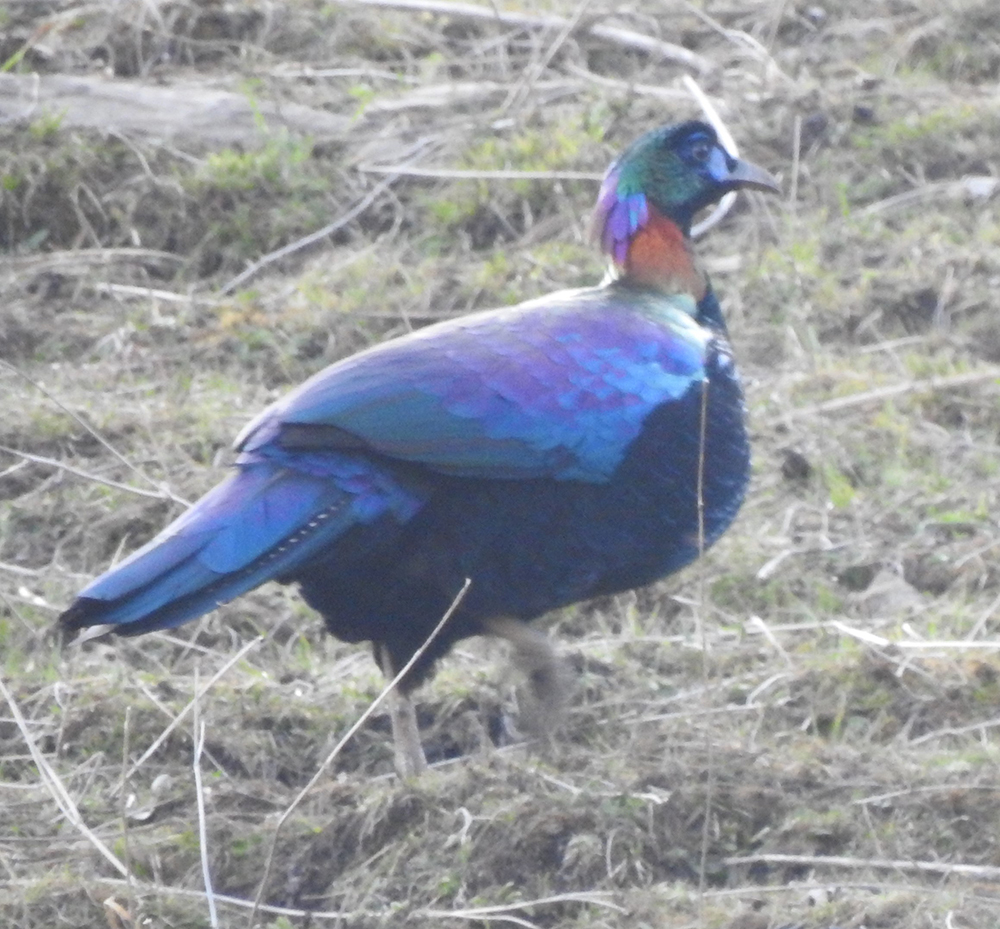
动物的生境选择具有空间尺度依赖性, 在不同空间尺度上影响生境选择的环境因素有所不同。研究不同空间尺度下动物生境选择的关键影响因子及其季节性变化, 对于全面了解物种的生境资源需求和开展生境保护具有重要意义。绿尾虹雉(Lophophorus lhuysii)是中国特有的高山雉类, 国家一级重点保护野生动物, 具有极高的保护价值。然而, 目前尚未对其不同尺度和时期的生境选择进行过探究。本研究于2019年10月至2020年10月, 在四川卧龙国家级自然保护区的羊角湾、魏家沟和文扎都3个区域共布设15条样线、303个样方, 并结合红外相机监测(176个红外相机位点), 对保护区内绿尾虹雉种群的生境利用状况进行了调查, 使用主成分分析和逻辑斯蒂回归模型分别从景观和微生境两个尺度对繁殖期(3‒8月)和非繁殖期(9月至翌年2月)的生境选择模式进行了分析。结果显示, 在景观尺度上, 在繁殖期和非繁殖期都显著偏好海拔较高(3,700‒ 4,300 m)、坡度较小(27°‒33°)、靠近阳坡、草甸和流石滩比例较高而森林和灌丛比例较低的生境。在微生境尺度上, 绿尾虹雉在繁殖期显著偏好岩石盖度较高的生境; 而非繁殖期则显著偏好草本盖度较高、灌木盖度和落叶盖度较低的生境。研究表明, 绿尾虹雉在景观和微生境尺度上均对生境有明显的选择性, 并且其微生境选择还存在季节性变化, 反映了该物种在生活史不同阶段具有不同的资源需求。本研究丰富了绿尾虹雉的基础生态学信息, 为卧龙及其他自然保护区绿尾虹雉的生境管理和种群保护工作提供了参考。
杨华林 , 程跃红 , 周天祥 , 冯茜 , 胡强 , 张贵权 , 杨建 , 张晋东 , 王彬 , 周材权 . 四川卧龙国家级自然保护区多空间尺度下绿尾虹雉的生境选择[J]. 生物多样性, 2022 , 30(7) : 21535 . DOI: 10.17520/biods.2021535
Aims: The habitat selection of animals is a scale-dependent ecological process, affected by environmental factors across spatial scales. Studying key factors which influence habitat selection across both spatial and temporal scales is tantamount to a comprehensive understanding of species’ resource requirements and effective habitat protection. Chinese monal (Lophophorus lhuysii), an alpine-obligate Galliformes species native to China, has received a first-class National Protected Wildlife status with a high priority for global conservation. To our knowledge, no study to date has examined habitat selection of Chinese monal across spatial and temporal scales. In this paper, we detail how Chinese monal habitat selection patterns may reveal habitat in critical need for protection to facilitate its persistence and the conservation of biodiversity at scale.
Methods: During October 2019 to October 2020, we constructed 15 transect localities and established a network of infrared camera monitoring stations in Wolong National Nature Reserve, Sichuan. In total, we sampled 303 quadrats, including both microhabitat used by Chinese monal and systematic controls and collected landscape-scale habitat usage data from 176 wildlife cameras. To examine spatial patterns in habitat selection of Chinese monal, we used principal component analysis (PCA) and logistic regression models to analyze the data at the microhabitat and landscape scales, respectively. Furthermore, our analyses separate data from breeding (March-August) and non-breeding (September-February) periods, which allowed us to examine interactions in habitat utilization at both spatial and temporal scales.
Results: At the landscape scale, the Chinese monal showed similar habitat selection patterns during breeding and non-breeding periods, with significant preferences for habitats (1) at higher elevation (3,700‒4,300 m), (2) intermediate slopes (27°‒33°), (3) proximity to exposed slope-faces, and (4) a higher proportion of meadows and tundras (complimented by a lower proportion of forests and bushes). At the microhabitat scale, the Chinese monal displayed significant preferences for habitats with higher rock coverage during breeding period. However, during non-breeding period, habitats with higher herbage coverage and lower shrub and litter coverage were significantly preferred.
Conclusions: Our research indicates that Chinese monal show habitat specificity at both landscape and microhabitat scales, as well as seasonal variation in microhabitat selection reflecting changes in resource demands at different life stages. These findings enrich our understanding of the life history, biology, and ecology of Chinese monal. Given the endangered status of this species, we believe our research can inform more effective habitat and population management in the Wolong National Nature Reserve and beyond.
Key words: Chinese monal; habitat selection; spatial scale; seasonal variation; protection
| [1] | Bartoń K (2020) MuMIn: Multi-Model Inference, Version 1.43.17, https://CRAN.R-project.org/package=MuMIn. (accessed on 2021-12-21) |
| [2] | Bibby C, Jones M, Marsden S (1998) Bird Surveys. Expedition Advisory Centre, London. |
| [3] | Burnham KP, Anderson DR (2002) Model Selection and Multimodel Inference: A Practical Information-Theoretic Approach, 2nd edn. Springer-Verlag, New York. |
| [4] | Calcagno V (2020) glmulti: Model Selection and Multimodel Inference Made Easy, Version 1.0.8. https://CRAN.R-project.org/package=glmulti. (accessed on 2021-12-21) |
| [5] | Chen DM, He S, Wei Y, Fu MT, Chen L, Deng JY, Zhou CQ (2017) Preliminary report on the effects of artificial illumination on reproduction of Lophophorus lhuysii. Sichuan Journal of Zoology, 36, 19-24. (in Chinese with English abstract) |
| [5] | [ 陈冬梅, 何松, 韦毅, 符明泰, 陈黎, 邓江宇, 周材权 (2017) 光照影响绿尾虹雉繁殖效果初报. 四川动物, 36, 19-24.] |
| [6] | Chen YH (2013) Conservation priority for endemic birds of mainland China based on a phylogenetic framework. Chinese Birds, 4, 248-253. |
| [7] | Cui K, Li WJ, James JG, Peng CJ, Jin JZ, Yan CC, Fan ZX, Du LM, Price M, Wu YJ, Yue BS (2019) The first draft genome of Lophophorus: A step forward for Phasianidae genomic diversity and conservation. Genomics, 111, 1209-1215. |
| [8] | Del Hoyo J, Collar NJ, Christie DA, Elliott A, Fishpool L (2014) HBW and Birdlife International Illustrated Checklist of the Birds of the World: Non-Passerines. Lynx Edicions, Barcelona. |
| [9] | Evangelista PH, Kumar S, Stohlgren TJ, Jarnevich CS, Crall AW, Norman JBI, Barnett DT (2008) Modelling invasion for a habitat generalist and a specialist plant species. Diversity and Distributions, 14, 808-817. |
| [10] | He FQ, Lu TC, Lu CL, Cui XZ (1986) Study on the breeding ecology of the Chinese monal. Acta Ecologica Sinica, 6, 186-192. (in Chinese with English abstract) |
| [10] | [ 何芬奇, 卢汰春, 卢春雷, 崔学振 (1986) 绿尾虹雉的繁殖生态研究. 生态学报, 6, 186-192.] |
| [11] | Hu Q, Lin HQ, Dai Q, Yang ZS, He LY, Zhang W, Shi XG (2020) Niche differentiation among three middle-sized carnivores in Wolong Nature Reserve. Chinese Journal of Zoology, 55, 685-691. (in Chinese with English abstract) |
| [11] | [ 胡强, 林红强, 戴强, 杨志松, 何流洋, 张文, 施小刚 (2020) 卧龙保护区三种中型食肉动物的生态位差异. 动物学杂志, 55, 685-691.] |
| [12] | Jiang ZG, Jiang JP, Wang YZ, Zhang E, Zhang YY, Li LL, Xie F, Cai B, Cao L, Zheng GM, Dong L, Zhang ZW, Ding P, Luo ZH, Ding CQ, Ma ZJ, Tang SH, Cao WX, Li CW, Hu HJ, Ma Y, Wu Y, Wang YX, Zhou KY, Liu SY, Chen YY, Li JT, Feng ZJ, Wang Y, Wang B, Li C, Song XL, Cai L, Zang CX, Zeng Y, Meng ZB, Fang HX, Ping XG (2016) Red List of China’s Vertebrates. Biodiversity Science, 24, 501-551. (in Chinese and in English) |
| [12] | [ 蒋志刚, 江建平, 王跃招, 张鹗, 张雁云, 李立立, 谢锋, 蔡波, 曹亮, 郑光美, 董路, 张正旺, 丁平, 罗振华, 丁长青, 马志军, 汤宋华, 曹文宣, 李春旺, 胡慧建, 马勇, 吴毅, 王应祥, 周开亚, 刘少英, 陈跃英, 李家堂, 冯祚建, 王燕, 王斌, 李成, 宋雪琳, 蔡蕾, 臧春鑫, 曾岩, 孟智斌, 方红霞, 平晓鸽 (2016) 中国脊椎动物红色名录. 生物多样性, 24, 501-551.] |
| [13] | Johnson DH (1980) The comparison of usage and availability measurements for evaluating resource preference. Ecology, 61, 65-71. |
| [14] | Jones J (2001) Habitat selection studies in avian ecology: A critical review. The Auk, 118, 557-562. |
| [15] | Kotliar NB, Wiens JA (1990) Multiple scales of patchiness and patch structure: A hierarchical framework for the study of heterogeneity. Oikos, 59, 253-260. |
| [16] | Li S, Wang DJ, Bu HL, Liu XG, Jin T (2016) Camera-trapping survey on the mammal diversity of the Laohegou Nature Reserve, Sichuan Province. Acta Theriologica Sinica, 36, 282-291. (in Chinese with English abstract) |
| [16] | [ 李晟, 王大军, 卜红亮, 刘小庚, 靳彤 (2016) 四川省老河沟自然保护区兽类多样性红外相机调查. 兽类学报, 36, 282-291.] |
| [17] | Liu MY, Gao YM, Chen JN, Xiao Z, Du CYZ, Li MJ, Wang JQ, Wang LB, Liu WH, Yang CZ (2013) Research status of conservation biology on Lophophorus lhuysii. Jiangxi Forestry Science and Technology, 41(1), 36-39. (in Chinese with English abstract) |
| [17] | [ 刘梦瑶, 高依敏, 陈建宁, 肖珍, 杜重阳子, 李敏洁, 王洁清, 王淋波, 刘武华, 杨承忠 (2013) 绿尾虹雉保护生物学研究现状. 江西林业科技, 41(1), 36-39.] |
| [18] | Liu W, Wu YJ, DuBay SG, Zhao CH, Wang B, Ran JH (2019) Dung-associated arthropods influence foraging ecology and habitat selection in Black-necked Cranes (Grus nigricollis) on the Qinghai-Tibet Plateau. Ecology and Evolution, 9, 2096-2105. |
| [19] | Long TL, Shao KQ, Guo G, Cheng CY, Zou XY, Landel H, Rimlinger D, Zhou FL (1998) Observational study on the ecology of Chinese monal in winter. Sichuan Journal of Zoology, 17(3), 8-9. (in Chinese) |
| [19] | [ 隆廷伦, 邵开清, 郭耕, 程彩云, 邹学英, Landel H, Rimlinger D, 周方林 (1998) 绿尾虹雉冬季生态的跟踪观测研究. 四川动物, 17(3), 8-9.] |
| [20] | Lu TC (1985) Field investigation of Chinese monal in Sichuan Province. Sichuan Journal of Zoology, 4(1), 15. (in Chinese) |
| [20] | [ 卢汰春 (1985) 四川绿尾虹雉的野外考察. 四川动物, 4(1), 15.] |
| [21] | Lu TC, Liu RS, He FQ, Lu CL (1986) Ecological studies on Chinese monal. Acta Zoologica Sinica, 32, 273-279, 306. (in Chinese with English abstract) |
| [21] | [ 卢汰春, 刘如笋, 何芬奇, 卢春雷 (1986) 绿尾虹雉生态学研究. 动物学报, 32, 273-279, 306.] |
| [22] | Mi SH, Zhao C, Sun J, Li ZZ, Teng LW, Liu ZS (2021) Study on the habitat selection of alpine musk deer in the Helan Mountains in autumn. Sichuan Journal of Zoology, 40, 169-175. (in Chinese with English abstract) |
| [22] | [ 米书慧, 赵唱, 孙嘉, 李宗智, 滕丽微, 刘振生 (2021) 贺兰山马麝秋季生境选择. 四川动物, 40, 169-175.] |
| [23] | Orians GH, Wittenberger JF (1991) Spatial and temporal scales in habitat selection. The American Naturalist, 137, S29-S49. |
| [24] | R Core Team (2021) R: A Language and Environment for Statistical Computing. https://www.R-project.org. (accessed on 2021-12-21) |
| [25] | Shi XG, Hu Q, Li JQ, Tang Z, Yang J, Li WJ, Shen XL, Li S (2017) Camera-trapping surveys of the mammal and bird diversity in Wolong National Nature Reserve, Sichuan Province. Biodiversity Science, 25, 1131-1136. (in Chinese with English abstract) |
| [25] | [ 施小刚, 胡强, 李佳琦, 唐卓, 杨建, 李文静, 申小莉, 李晟 (2017) 利用红外相机调查四川卧龙国家级自然保护区鸟兽多样性. 生物多样性, 25, 1131-1136.] |
| [26] | Sutherland WJ, Newton I, Green R (2004) Bird Ecology and Conservation:A Handbook of Techniques. Oxford University Press, Oxford. |
| [27] | Tian S, Xu JL, Li JQ, Zhang ZW, Wang Y (2018) Research advances of Galliformes since 1990 and future prospects. Avian Research, 9, 32. |
| [28] | Wang B, Xu Y, Price M, Yang N, Liu W, Zhu BW, Zhong X, Ran JH (2021) Niche partitioning among three montane ground-dwelling pheasant species along multiple ecological dimensions. Ibis, 163, 171-182. |
| [29] | Wang B, Xu Y, Ran JH (2017) Predicting suitable habitat of the Chinese monal (Lophophorus lhuysii) using ecological niche modeling in the Qionglai Mountains, China. PeerJ, 5, e3477. |
| [30] | Wang B, Xu Y, Zhang B, Wu YJ, He XC, Ran JH, Zeng T (2018) Overlap and selection of dust-bathing sites among three sympatric montane galliform species. Auk, 135, 1076-1086. |
| [31] | Xu JL, Zhang XH, Zhang ZW, Zheng GM, Ruan XF, Zhu JG, Xi B (2006) Multi-scale analysis on wintering habitat selection of Reeves’s pheasant (Syrmaticus reevesii) in Dongzhai National Nature Reserve, Henan Province, China. Acta Ecologica Sinica, 26, 2061-2067. (in Chinese with English abstract) |
| [31] | [ 徐基良, 张晓辉, 张正旺, 郑光美, 阮祥锋, 朱家贵, 溪波 (2006) 白冠长尾雉越冬期栖息地选择的多尺度分析. 生态学报, 26, 2061-2067.] |
| [32] | Xu Y, Wang B, Zhong X, Yang B, Zhang JD, Zhao C, He XC, Li JG, Ran JH, Zhou CQ (2020) Predicting range shifts of the Chinese monal (Lophophorus lhuysii) under climate change: Implications for long-term conservation. Global Ecology and Conservation, 22, e01018. |
| [33] | Xu Y, Zhang K, Dou L, Yang N, Wang B, Ran JH (2021) Landscape-scale habitat selection by Buff-throated Partridges Tetraophasis szechenyii during the breeding season. Acta Ecologica Sinica, 41, 3248-3254. (in Chinese with English abstract) |
| [33] | [ 徐雨, 张凯, 窦亮, 杨楠, 王彬, 冉江洪 (2021) 繁殖期黄喉雉鹑在景观尺度上的生境选择. 生态学报, 41, 3248-3254.] |
| [34] | Yu X, Chen JC, Wang B, Yan Y, Ran JH, He F, Peng B (2017) Population density estimation and habitat suitability assessment of Lophophorus lhuysii during breeding season in Xiaozhaizigou National Nature Reserve, Sichuan Province. Sichuan Journal of Zoology, 36, 361-367. (in Chinese with English abstract) |
| [34] | [ 余翔, 陈俊橙, 王彬, 严勇, 冉江洪, 贺飞, 彭波 (2017) 四川小寨子沟国家级自然保护区绿尾虹雉种群密度调查与栖息地评价. 四川动物, 36, 361-367.] |
| [35] | Zhang T (1995) Distribution and ecology of Chinese monals in Baishuijiang Nature Reserve, Gansu. Chinese Journal of Zoology, 30(4), 25-28. (in Chinese with English abstract) |
| [35] | [ 张涛 (1995) 甘肃白水江自然保护区绿尾虹雉分布与生态的初步观察. 动物学杂志, 30(4), 25-28.] |
| [36] | Zheng GM (2015) Pheasants in China. Higher Education Press, Beijing. (in Chinese) |
| [36] | [ 郑光美 (2015) 中国雉类. 高等教育出版社, 北京.] |
| [37] | Zhong X, Deng Y, Yang B, Zhao C, Wang B, Zhou CQ (2020) Population density estimation and microhabitat selection of Golden Pheasant in Sichuan Baishuihe National Nature Reserve. Journal of Sichuan University (Natural Science Edition), 57, 174-180. (in Chinese with English abstract) |
| [37] | [ 钟雪, 邓玥, 杨彪, 赵成, 王彬, 周材权 (2020a) 四川白水河国家级自然保护区红腹锦鸡种群密度及微生境选择. 四川大学学报(自然科学版), 57, 174-180.] |
| [38] | Zhong X, Yang N, Zhang L, Cheng YH, Feng X, Hu Q, Jin YG (2021) Population survey and habitat quality assessment of Lophophorus lhuysii in the Wolong National Nature Reserve. Sichuan Journal of Zoology, 40, 509-516. (in Chinese with English abstract) |
| [38] | [ 钟雪, 杨楠, 张龙, 程跃红, 冯茜, 胡强, 金义国 (2021) 卧龙国家级自然保护区绿尾虹雉种群分布和生境质量评价. 四川动物, 40, 509-516.] |
| [39] | Zhong X, Yang WR, Zhu YD, Zhou CQ, Wang B (2020b) Assessment of Chinese monal habitat in Sichuan Piankou Nature Reserve with MaxEnt model. Ecology and Environmental Monitoring of Three Gorges, 5(4), 49-55. (in Chinese with English abstract) |
| [39] | [ 钟雪, 杨炜蓉, 朱云东, 周材权, 王彬 (2020) 基于MaxEnt模型的四川片口自然保护区绿尾虹雉栖息地评价. 三峡生态环境监测, 5(4), 49-55.] |
| [40] | Zhou XP, Zhang MC, Huang S, Xu YL, Chen T, Zeng W, Liu GY, Zhang HM (2019) The distribution of Budorcas taxicolor in Wolong National Nature Reserve. Journal of Sichuan Forestry Science and Technology, 40(2), 75-79. (in Chinese with English abstract) |
| [40] | [ 周小平, 张明春, 黄山, 徐亚琳, 陈涛, 曾文, 刘桂英, 张和民 (2019) 卧龙自然保护区羚牛(Budorcas taxicolor)的分布格局. 四川林业科技, 40(2), 75-79.] |
/
| 〈 |
|
〉 |
备案号:京ICP备16067583号-7
Copyright © 2026 版权所有 《生物多样性》编辑部
地址: 北京香山南辛村20号, 邮编:100093
电话: 010-62836137, 62836665 E-mail: biodiversity@ibcas.ac.cn