四川白河国家级自然保护区鸟兽红外相机监测
收稿日期: 2020-07-07
录用日期: 2020-12-03
网络出版日期: 2021-02-04
基金资助
生态环境部生物多样性保护专项(2110404);四川省科技厅应用基础研究项目(2017JY0325)
Camera-trapping survey on mammals and birds in Baihe National Nature Reserve, Sichuan Province
Received date: 2020-07-07
Accepted date: 2020-12-03
Online published: 2021-02-04
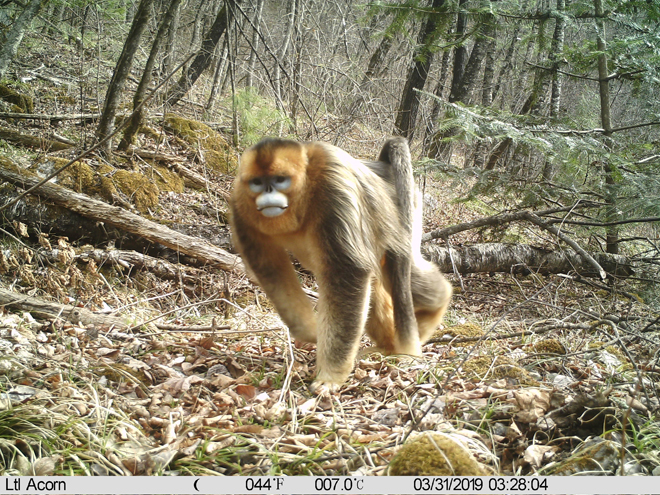
为了调查四川白河国家级自然保护区及其周边区域兽类及鸟类多样性, 2018年11月至2019年9月, 我们利用GIS将调查区域划分成1 km × 1 km的网格, 并布设了110台红外相机, 每3-6个月回收一次数据。累计获得19,748个相机工作日, 采集可辨别鸟兽照片和视频55,858份, 独立有效探测6,856次, 共记录到野生兽类4目12科17种, 鸟类5目12科33种。其中, 国家I级重点保护野生动物5种, 即川金丝猴(Rhinopithecus roxellana)、林麝(Moschus berezovskii)、四川羚牛(Budorcas tibetanus)、红喉雉鹑(Tetraophasis obscurus)和绿尾虹雉(Lophophorus lhuysii); 国家II级重点保护野生动物有黑熊(Ursus thibetanus)、黄喉貂(Martes flavigula)和中华斑羚(Naemorhedus griseus)等15种, 合计占野生物种总数的40.0%; 被IUCN红色名录评估为濒危(EN)的2种, 易危(VU)的5种, 近危(NT)的2种, 合计占野生物种总数的18.0%; 被《中国脊椎动物红色名录》评估为极危(CR)的1种, 濒危(EN)的1种, 易危(VU)的8种, 近危(NT)的9种, 合计占野生物种总数的38.0%。相对多度指数较高的前5种兽类为毛冠鹿(Elaphodus cephalophus)、猪獾(Arctonyx collaris)、岩松鼠(Sciurotamias davidianus)、野猪(Sus scrofa)和川金丝猴, 相对多度指数较高的前5种鸟类为红腹角雉(Tragopan temminckii)、红嘴蓝鹊(Urocissa erythrorhyncha)、紫啸鸫(Myophonus caeruleus)、勺鸡(Pucrasia macrolopha)和橙翅噪鹛(Trochalopteron elliotii)。本调查为白河国家级自然保护区鸟兽多样性研究提供了基础数据, 为后续保护区的保护和管理工作提供了支持。
关键词: 红外相机技术; 鸟兽多样性; 生物编目; 相对多度指数; 白河国家级自然保护区
黄凯 , 万雅琼 , 李佳琦 , 朱宇静 , 孙治宇 , 夏万才 , 黎大勇 , 任宝平 . 四川白河国家级自然保护区鸟兽红外相机监测[J]. 生物多样性, 2021 , 29(4) : 554 -559 . DOI: 10.17520/biods.2020270
Aims: We aim to investigate the diversity and abundance of large mammals and birds in Baihe National Nature Reserve and surrounding areas in Sichuan Province.
Methods: We divided the reserve into 1 km × 1 km grids using the Geographical Information System. We selected 110 grids according to habitat type and placed one camera-trapping per grid. We collected data from camera-trappings every 3-6 months from November 2018 to September 2019.
Results: The surveys produced a total of 19,748 camera-days of data, including 55,858 pictures and videos, and 6,856 independent detections. We recorded 17 mammal species belonging to 4 orders and 12 families, as well as 33 bird species belonging to 5 orders and 12 families. Among the detected species, 5 species are listed as first-class National Protected Wildlife (Rhinopithecus roxellana, Moschus berezovskii, Budorcas tibetanus, Tetraophasis obscurus, and Lophophorus lhuysii), and 15 species are listed as second-class National Protected Wildlife (including Ursus thibetanus,Martes flavigula,Naemorhedus griseus, and others). Combined, these species accounted for 40.0% of the total recorded species. Two species are listed as Endangered (EN), five as Vulnerable (VU), and two as Near Threatened (NT) according to the IUCN Red List, together accounting for 18.0% of the total recorded species. Moreover, Moschus berezovskii is also listed as Critically Endangered in the Red List of China’s Vertebrates. The five mammals with the highest relative abundance index wereElaphodus cephalophus, Arctonyx collaris, Sciurotamias davidianus, Sus scrofa, and Rhinopithecus roxellana. The five birds with the highest relative abundance index were Tragopan temminckii, Urocissa erythrorhyncha, Myophonus caeruleus, Pucrasia macrolopha, and Trochalopteron elliotii.
Conclusion: Our results show that the Baihe National Nature Reserve has high species diversity and many rare and endangered species. As the main protected species, the Sichuan snub-nosed monkey is abundant and widely distributed in the reserve. In addition, we detected some human and livestock disturbance in the reserve. We suggest that to preserve the high diversity and abundance of important mammal and bird species that the protected area should strengthen management and increase public awareness of the reserve.
| [1] | Andrew TS, Xie Y (2009) A Guide to the Mammals of China. Hunan Education Publishing House, Changsha. (in Chinese) |
| [1] | [ Andrew TS, 解焱 (2009) 中国兽类野外手册. 湖南教育出版社, 长沙. ] |
| [2] | Chen X, Zhao LJ, Hu XX, Luo CP, Liang CP, Jiang SW, Liang L, Zheng WC, Guan TP (2019) Impact of livestock terrain utilization patterns on wildlife: A case study of Wanglang National Nature Reserve. Biodiversity Science, 27,630-637. (in Chinese with English abstract) |
| [2] | [ 陈星, 赵联军, 胡茜茜, 罗春平, 梁春平, 蒋仕伟, 梁磊, 郑维超, 官天培 (2019) 基于地形的牲畜空间利用特征及干扰评价——以王朗国家级自然保护区为例. 生物多样性, 27,630-637. ] |
| [3] | Jiang ZG, Jiang JP, Wang YZ, Zhang E, Zhang YY, Li LL, Xie F, Cai B, Cao L, Zheng GM, Dong L, Zhang ZW, Ding P, Luo ZH, Ding CQ, Ma ZJ, Tang SH, Cao WX, Li CW, Hu HJ, Ma Y, Wu Y, Wang YX, Zhou KY, Liu SY, Chen YY, Li JT, Feng ZJ, Wang Y, Wang B, Li C, Song XL, Cai L, Zang CX, Zeng Y, Meng ZB, Fang HX, Ping XG (2016) Red List of China’s Vertebrates. Biodiversity Science, 24,500-551. (in Chinese and in English). |
| [3] | [ 蒋志刚, 江建平, 王跃招, 张鹗, 张雁云, 李立立, 谢锋, 蔡波, 曹亮, 郑光美, 董路, 张正旺, 丁平, 罗振华, 丁长青, 马志军, 汤宋华, 曹文宣, 李春旺, 胡慧建, 马勇, 吴毅, 王应祥, 周开亚, 刘少英, 陈跃英, 李家堂, 冯祚建, 王燕, 王斌, 李成, 宋雪琳, 蔡蕾, 臧春鑫, 曾岩, 孟智斌, 方红霞, 平晓鸽 (2016) 中国脊椎动物红色名录. 生物多样性, 24,500-551. ] |
| [4] | Jiang ZG, Liu SY, Wu Y, Jiang XL, Zhou KY (2017) China’s mammal diversity (2nd edition). Biodiversity Science, 25,886-895. (in Chinese with English abstract) |
| [4] | [ 蒋志刚, 刘少英, 吴毅, 蒋学龙, 周开亚 (2017) 中国哺乳动物多样性(第2版). 生物多样性, 25,886-895. ] |
| [5] | Li S, Wang DJ, Bu HL, Liu XG, Jin T (2016) Camera-trapping survey on the mammal diversity of the Laohegou Nature Reserve, Sichuan Province. Acta Theriologica Sinica, 36,282-291. (in Chinese with English abstract) |
| [5] | [ 李晟, 王大军, 卜红亮, 刘小庚, 靳彤 (2016) 四川省老河沟自然保护区兽类多样性红外相机调查. 兽类学报, 36,282-291. ] |
| [6] | Li S, Wang DJ, Xiao ZS, Li XH, Wang TM, Feng LM, Wang Y (2014) Camera-trapping in wildlife research and conservation in China: Review and outlook. Biodiversity Science, 22,685-695. (in Chinese with English abstract) |
| [6] | [ 李晟, 王大军, 肖治术, 李欣海, 王天明, 冯利民, 王云 (2014) 红外相机技术在我国野生动物研究与保护中的应用与前景. 生物多样性, 22,685-695. ] |
| [7] | Ma KP (2015) Species Catalogue of China: A remarkable achievement in the field of biodiversity science in China. Biodiversity Science, 23,137-138. (in Chinese) |
| [7] | [ 马克平 (2015) 中国生物多样性编目取得重要进展. 生物多样性, 23,137-138. ] |
| [8] | MacKinnon J, Phillipps K, He FQ (2000) A Field Guide to the Birds of China. Hunan Education Publishing House, Changsha. (in Chinese) |
| [8] | [ 约翰·马敬能, 卡伦·菲利普斯, 何芬奇 (2000) 中国鸟类野外手册. 湖南教育出版社, 长沙. ] |
| [9] | O’Connell AF, Nichols JD, Karanth KU (2011) Camera Traps in Animal Ecology: Methods and Analyses. Springer, New York. |
| [10] | Tian C, Li JQ, Yang XY, Yu L, Yuan D, Li YX (2018) Preliminary surveys of wild animals using infrared camera in Wanglang National Nature Reserve, Sichuan Province. Biodiversity Science, 26,620-626. (in Chinese with English abstract) |
| [10] | [ 田成, 李俊清, 杨旭煜, 余鳞, 袁丹, 黎运喜 (2018) 利用红外相机技术对四川王朗国家级自然保护区野生动物物种多样性的初步调查. 生物多样性, 26,620-626. ] |
| [11] | Xiao ZS (2019) Application of camera trapping to species inventory and assessment of wild animals across China’s protected areas. Biodiversity Science, 27,235-236. (in Chinese) |
| [11] | [ 肖治术 (2019) 红外相机技术在我国自然保护地野生动物清查与评估中的应用. 生物多样性, 27,235-236. ] |
| [12] | Xiao ZS, Li XH, Wang XZ, Zhou QH, Quan RC, Shen XL, Li S (2014) Developing camera-trapping protocols for wildlife monitoring in Chinese forests. Biodiversity Science, 22,704-711. (in Chinese with English abstract) |
| [12] | [ 肖治术, 李欣海, 王学志, 周岐海, 权锐昌, 申小莉, 李晟 (2014) 探讨我国森林野生动物红外相机监测规范. 生物多样性, 22,704-711. ] |
| [13] | Yuan SB (2018) Report on Comprehensive Scientific Survey in Baihe National Nature Reserve of Sichuan. Science Press, Beijing. (in Chinese) |
| [13] | [ 袁施彬 (2018) 四川白河自然保护区综合科学考察报告. 科学出版社, 北京. ] |
| [14] | Zhang DC, He YL, Feng YF, Hu JC, Yang B, Li SQ (2020) Preliminary camera-trapping survey on wild mammals and birds in the Wujiao Nature Reserve, Sichuan. Sichuan Journal of Zoology, 39,221-228. (in Chinese with English abstract) |
| [14] | [ 张德丞, 和延龙, 冯一帆, 胡建成, 杨彪, 李生强 (2020) 四川勿角自然保护区野生鸟兽的红外相机初步监测. 四川动物, 39,221-228. ] |
| [15] | Zheng GM (2017) A Checklist on the Classification and Distribution of the Birds of China, 3rd edn. Science Press, Beijing. (in Chinese) |
| [15] | [ 郑光美 (2017) 中国鸟类分类与分布名录(第三版). 科学出版社, 北京. ] |
| [16] | Zhu SY, Duan F, Li S (2017) Promoting diversity inventory and monitoring of birds through the camera-trapping network in China: Status, challenges and future outlook. Biodiversity Science, 25,1114-1122. (in Chinese with English abstract) |
| [16] | [ 朱淑怡, 段菲, 李晟 (2017) 基于红外相机网络促进我国鸟类多样性监测: 现状、问题与前景. 生物多样性, 25,1114-1122. ] |
/
| 〈 |
|
〉 |
备案号:京ICP备16067583号-7
Copyright © 2026 版权所有 《生物多样性》编辑部
地址: 北京香山南辛村20号, 邮编:100093
电话: 010-62836137, 62836665 E-mail: biodiversity@ibcas.ac.cn